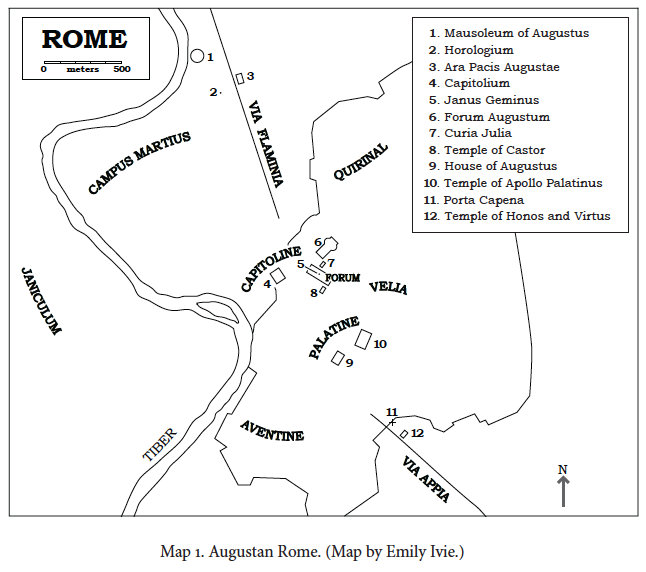
This monograph's argument would not be complete without discussing Augustus' masterful conclusion of the Res Gestae and its theological implications. After ten chapters devoted to affairs in the provinces, the RG ends in two chapters that draw together events from the beginning and from the apex of Augustus' Principate. These final two chapters cover his restoration of the Republic in 27 BCE and the conferral of the title pater patriae during his thirteenth consulship in 2 BCE. As he did in RG chapters 9–13, Augustus again anchors his honors in Rome's urban landscape, thereby tying this landscape to himself. The succession of honors described in the final two chapters of the RG form an itinerary in which each honor is tied to a significant place, starting with his own person. In chapter 34, the list progresses from his new name, Augustus, to the laurels and civic crown affixed to his Palatine house, and then to the golden clupeus virtutis set up in the Curia Julia.1 In chapter 35, Augustus is named pater patriae, and the title is inscribed on his Palatine house and then again in the Curia Julia.2 The chapters share a common pattern in ordering the progression of his honors: (1) bestowal of an honorific name, (2) placement of an honor on his Palatine home, and (3) placement of an honor in the Curia.
While the inscription's opening chapters move from outside the city to its interior in triumph and adventus, the final chapters present an intra-city itinerary that begins with the emperor and then proceeds from his palace to the Curia. The two urban journeys in these last chapters are parallel but not identical. Importantly, the differences reflect the evolution of Augustus' position between the years 27 and 2 BCE, as well as the concomitant evolution of the Roman landscape. The different ways the emperor is addressed and the differences in the decoration of his home and the Curia are evidence that city and princeps were evolving together.
Chapter 35 differs from chapter 34 most critically in its addition of one last destination, the Forum of Augustus, which was dedicated on February 5, the day of the festival of Concordia.3 The title pater patriae was inscribed there, below the triumphal quadriga that had been set up in accordance with a decree of the Senate. The placement of this honor at the very end of the Res Gestae imbues the title with a cumulative or climactic quality.4 Suetonius' account of the conferral of the honor and of Augustus' reaction to it indicates that Augustus saw it as the crowning honor of his career at the time he received it.
Patris patriae cognomen universi repentino maximoque consensu detulerunt ei: prima plebs, legatione Antium missa; dein, quia non recipiebat, ineunti Romae spectacula frequens et laureata; mox in curia senatus, neque decreto nequc adclamatione, sed per Valerium Messallam. Is mandantibus cunctis: “Quod bonum,” inquit, “faustumque sit tibi domuique tuae, Caesar Auguste! Sic enim nos perpetuam felicitatem rei publicae et laeta huic precari existimamus: senatus te consentiens cum populo Romano consalutat patriae patrem.” Cui lacrimans respondit Augustus his verbis (ipsa enim, sicut Messalae, posui): “Compos factus votorum meorum, patres conscripti, quid habeo aliud deos immortales precari, quam ut hunc consensum vestrum ad ultimum finem vitae mihi perferre liceat?”5 [Suddenly, with the greatest consensus, the entire citizenry conferred upon him the name “father of the country”: the plebs first sent an embassy to Antium; then, because he did not receive it, when he was entering the games at Rome, they, crowned in laurel, pressed around him; next, the Senate in the Curia, neither by decree, nor by acclamation, but through Valerius Messalla. He, entrusted with this responsibility by all, said: “May you and your household prosper and be lucky, Caesar Augustus! For in saying this we suppose we are praying for the never-ending felicity of the Republic and joy for this body too. The senate uniting [consentiens] with the people of Rome salutes you as father of the country.” To this Augustus tearfully responded (and I have provided the very words he spoke, just as I did those of Messalla): “My prayers have been granted, conscript fathers; what remains for me to ask of the immortal gods than that this concord [consensus] of yours might endure to the final end of my life?”]
Suetonius claims to have drawn his account of the honor of pater patriae from a verbatim record of the exchange between Messalla and Augustus (ipsa enim, sicut Messallae, posui). The thematic continuity between these quotations and the final chapters of the RG supports the idea that Augustus deliberately emphasized consensus at the end of the RG in a way that was designed to recall the events of 2 BCE. In Suetonius, Messalla speaks of the Senate uniting (consentiens) with the people in naming Augustus pater patriae. The last chapters of the RG refer to consensus universorum and the three orders (Senate, knights, and people) together honoring Augustus with the title pater patriae. The RG closes directly after the honor of pater patriae, with a reference to the time Augustus authored the text of the inscription, his seventy-sixth year. The implicit message is that the consensus that brought about the honor of pater patriae did, in fact, endure to the end of the emperor's life, in accordance with the hope he had publicly announced in 2 BCE.
Part III of this monograph interpreted chapters 1–13 of the RG through the lens of arrival ceremonies and political theology. The first arrival occurred when Augustus, a young man of eighteen years, embarked on his first act of statesmanship, by fighting Antony to frustrate the latter's attempt to seize Gallia Cisalpina from Decimus Brutus. As argued in chapter 7 of this book, the same opening of the RG also alludes to the infancy of Romulus and his subsequent act of revenge in overthrowing the usurper Amulius. In this way, although the beginning of Augustus' life is not expressly addressed in the inscription, the inscription implicitly connects Augustus' beginnings with his first foray into deeds of public significance. Augustus' quadriga in the Forum of Augustus, appearing in the final chapter of the inscription, should be viewed as the final destination of a journey that began in the first chapter. The apex of his honors is appropriately linked to the final year of his life.
The chronological jump from the honor of pater patriae in 2 BCE to the last year of Augustus' life in 14 CE in the last two sentences of chapter 35 of the RG constitutes a very powerful statement, in that it shows how Augustus succeeded where Sulla and Caesar had failed. Both of these predecessors had not managed to birth a stable Republic with a sustainable leadership role for themselves. Sulla seems never to have intended to obtain a position of permanent political preeminence at Rome, but there is also the possibility that illness closed off any possibility of an attempt. Cicero's Caesarian speeches may be interpreted to imply the incompatibility of a stable Republic with the presence of someone occupying such an extraordinary leadership position. After all, magistracies, particularly special ones like the dictatorship, had traditionally been temporary. Of course, Caesar still attempted to forge a permanent position for himself, and he was assassinated before he could arrive at a sustainable solution. Augustus outlived both Caesar and Cicero, and he used the long years after Actium to achieve the solution that the former had failed to construct and that the latter had feared. The final chapters of the RG set out Augustus' definition of that solution: a Principate unconnected to any traditional magistracy and built on lawful powers, honors, and, above all, a surpassing influence through which the harmony of the orders was to be maintained.
Augustus took the title of pater patriae as the signal that his work was effectively accomplished. The honor was not new. At the same time, the preceding grants of the honor do not completely define its significance here. The title of pater patriae evoked figures like Romulus, Camillus, Cicero, and Caesar. Ennius' Romulus was parens patriae, while Cicero had been honored with the title pater patriae by senatorial decree in recognition of his rescue of the Republic from the conspiracy of Catiline.6 Caesar would be voted the honor of parens patriae.7 Augustus, the man who had brought an end to a hundred-year era of civil war, was clearly worthy of the same title. It is important to keep in mind, however, that the titles of pater patriae and parens patriae were polysemic, and their meaning was evolving. Caesar had received postmortem cult as parens patriae, and thus this title took on further cultic associations.8 One must therefore examine the contextual web of significances that contributes to the honor's meaning for Augustus in order to understand its significance at a particular point in Augustus' career.
Augustus last shaped the meaning of the honor of pater patriae when he wrote of the title's placement under his triumphal quadriga in the last sentence of the RG, thus treating it as the capstone of his career. Accordingly, subsequent emperors—at least those with a positive literary legacy—tended to refuse the honor until they had reigned for some years. One of the purposes of such special honors for emperors was to provide them opportunities for distinction outside of the reach of their senatorial peers. The honor of pater patriae also signaled the lifelong nature of the princeps' position. A scion of the imperial family could easily be consul and censor (or, at least, exercise censoria potestas) before the age of fifty. The RG's depiction of pater patriae further marks the presence or place of Augustus in ways that other honors do not. Consider the contrast with the honors listed in chapter 34. That chapter lists an array of various honors that adorn the emperor, his house, and the Curia. In his person, he is Augustus; on his house, there are laurels and a civic crown; in the Curia, he is represented by the testimony of his virtues on a golden shield. Chapter 35 portrays him as pater patriae in all of these places and further adds the Forum of Augustus.9 This seems to suggest that, in place of a hodgepodge of forms of recognition, Augustus is now uniformly pater patriae in every context. One might even go so far as to say that this unity of honors and places is designed to reflect the consensus that brought about the grant of pater patriae in the first place. Rome has effectively been given a new civic landscape, organized along new lines, and the change is reflected in the new title of its ruler.
Imperial Theology in the Forum Augustum
A thorough discussion of the Forum of Augustus is outside the scope of this book. This conclusion will nevertheless proffer a few possible reasons why Augustus arranged his account of the Forum of Augustus in the RG as he did. Exploring these reasons serves to elucidate further the potential aims of his final political theology.
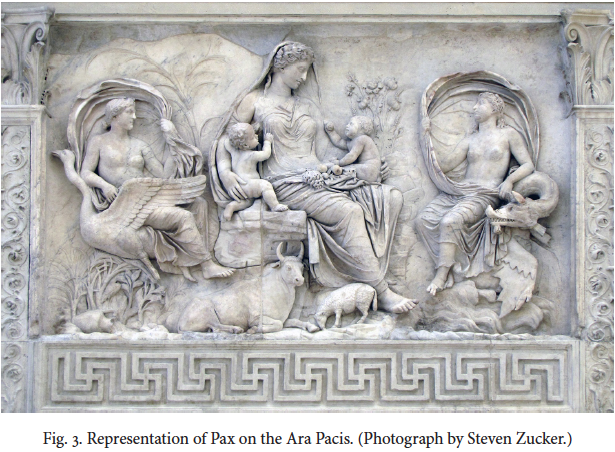
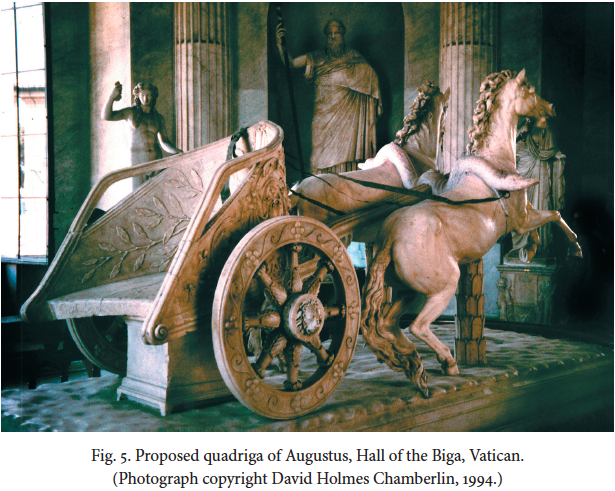
Recently, Strocka has argued that the first-century marble chariot housed in the Hall of the Biga at the Vatican is, in fact, the quadriga from the Forum of Augustus.10 Its decorations strikingly resemble other Augustan monuments, such as the Ara Pacis.11 Strocka further argues that the chariot was empty. In support of this, he offers the testimony of Cassiodorus, who refers to the decree of an honorific currus for Augustus in 19 BCE, which he refused to mount, and to coins contemporary to Augustus' return from Syria and depicting a triumphal chariot, sometimes empty.12 The center column on the inside of the chariot is a tapered column—the image of Apollo Agyieus (Apollo of the Ways), whom Nigidius Figulus had related to Janus.13 The same aniconic deity also appears on Augustus' Temple of Palatine Apollo and palace.14 Agyieus' form recalls the obelisk in the Horologium. The arrangement of Agyieus in the chariot at the Forum's center is also echoed in the Augustan Meta Sudans, a fountain in a shape reminiscent of the Forum of Augustus, with a sixteen-meter-high cone in the center.15 The fountain's cone has been identified as Apollo Agyieus, a suggestion that is consistent with the fountain's placement at the convergence of four of Rome's fourteen regions—a meeting of the “ways.”
The presence of the image of Agyieus in the quadriga also recalls Horace Carmina 4.6, a paean to Apollo in which Apollo is addressed by this name.16 Carmina 4.6 is part of a series of odes that celebrate the homecoming of Augustus from Gaul in 16 BCE. The immediately preceding poem, 4.5, takes the form of a petition to Augustus that he return from Gaul. The driverless quadriga may be interpreted as the fulfillment of such a petition, in that it represents the end of the journey, when the rider has dismounted from the chariot. The quadriga may evoke not only Augustus' return from the provinces but also the patron Apollo, who guards the way, and the solar Apollo, whose path sets the days and seasons.
If one accepts Strocka's identification of the Vatican chariot as the quadriga of the Forum of Augustus, then the existence of an image of Apollo Agyieus therein and the absence of a statue of Augustus are potent theological symbols. The empty chariot evokes historical instances of the establishment of cults of “descending” ruler-deities bearing the epiclesis Kataibates, on the spot where a Hellenistic king first touched the ground at the city. As discussed in chapter 6, the Ara Fortunae and Ara Pacis may be viewed in a similar light. Such an image is also particularly fitting for Apollo Agyieus because of his presence on the Palatine via both the Palatine palace and the Temple of Palatine Apollo.17 Most interesting is the dream of Augustus' father in which he saw his son Octavius in the guise of Sol-Jupiter driving a quadriga. As in that dream, the presence of Apollo Agyieus in the chariot transcends the usual triumphal imagery and points in the direction of apotheosis. Athena was Heracles' divine escort back to Olympus, as Dionysus was for Hephaestus, after first having made the smith-god drunk.18 Perhaps Augustus envisioned Apollo Agyieus as his escort back to heaven.19 He may have also wanted others to identify him as this Apollo.
During Augustus' lifetime, the empty quadriga might have underlined the end of his participation in the triumph, something that had occurred almost two decades before the Forum's dedication. Standing solitary in a Forum filled with statues, the quadriga would have been an unusual sight. The man who had planned the space and its interpretation of history was conspicuously absent from the quadriga standing in his own Forum. After Augustus' death, comparisons with Romulus, already in circulation during Augustus' lifetime, may have altered perceptions of the empty quadriga. One version of the end of Romulus' life has him disappear in the midst of a storm cloud as he reviewed his army near the Caprae Palus on the Campus Martius.20 At daybreak the following day, Julius Proculus conversed with the parens urbis, as Proculus called Romulus' deified form in his report.21 The absence of Romulus' body on earth signaled its presence in the heavens. Likewise, the absence of any body in the sarcophagus of Numa suggested Numa's apotheosis. It is thus altogether likely that after Augustus' death, Augustus' absence from the quadriga would have suggested his apotheosis too.
The use of the empty quadriga to signify Augustus' apotheosis would have become clearer after his funeral, which had a procession of statues that eerily matched the itineraries of the last two chapters of the RG.22 As already noted, those chapters had a parallel pattern of (1) bestowal of an honorific name, (2) placement of an honor on his Palatine home, and (3) placement of an honor in the Curia. In the final chapter, the Forum of Augustus is added to this honorific itinerary. Dio's description of Augustus' funeral lists three statues of the princeps: the first, made of wax, was carried from the palace by the magistrates elected for the following year; the second, made of gold, was borne from the Curia; the third was placed on a triumphal quadriga.23 Dio does not state the place of origin of the triumphal quadriga, but the Forum of Augustus would have been a logical choice, given that it was particularly associated with the triumph and was the location of Augustus' most famous honorific quadriga.24 The body of Augustus was taken to the Campus Martius and placed on a pyre that was probably aligned with the Mausoleum.25 After being circled by the priests, knights, and infantry, the pyre was lit from beneath.26 As the flames consumed his body, an eagle was released, to symbolize Augustus' ascent to the divine realm.27 After five days, Livia and a handful of knights gathered Augustus' bones and interred them in the Mausoleum.28
The official deification of Augustus by the Senate followed the funeral.29 The use of the quadriga in a funeral procession that ended in the flight of an eagle bearing the emperor's spirit to heaven arguably transformed the significance of the honorific quadriga in the Forum of Augustus. A prop that had been used as part of a triumphal honor in life commemorated the apotheosis of the emperor in death. Considered in the context of the imagery of the Forum, the empty quadriga in the center of the Forum—an emphasized absence of the divine emperor—distinguished Augustus from the rest of the figures in the space. If there had been a statue in that quadriga, the effect would have been less pronounced. The absence expressed in the image of the empty quadriga arrests one's attention because it suggests that the emperor held a unique position in the panoply of honorands, human and divine.
To assess fully the uniqueness of this imagery requires viewing the arrangement of images in the Forum as presenting a theology that was both hierarchical and narrative in nature.30 The narrative was the story of Rome's foundations in both the history of Aeneas and the line of Alban kings, on the one hand, and in the history of Romulus and the heroes of the Republic, on the other. These two narrative chains, represented by statues in opposing hemicycles, were brought together in the Temple of Mars Ultor, where a trinity of heavenly gods—Mars, Venus, and the divine Caesar—resided. Hierarchy is arguably indicated by the fact that Aeneas and Romulus, though divine, are located outside the temple, while the divine Julius is within. In other words, however heroic Aeneas and Romulus may have been, they arguably did not rise to the level of the divine Caesar. Nevertheless, occupying the center positions of their hemicycles, Aeneas and Romulus have priority over others in their respective hemicycles. The bronze statues of future triumphators would occupy the hemicycles closer to the entrance of the Forum and thus would obtain a place lower on the hierarchy.31 The path from the entrance of the Forum to the Temple of Mars Ultor may therefore be viewed as a linear journey in status to ever-loftier honorands that ends in the celestial deities Mars, Venus, and Caesar.
If one assumes that Augustus' empty quadriga stood in the center of the Forum, facing the Temple of Mars Ultor, it would have appeared like the triumphal chariot of a commander who had just completed his triumphal procession and had dismounted to perform his sacrifices before the temple.32 Thus the quadriga's image depicted a ceremonial action frozen in time. It was closer to the Temple of Mars Ultor than the triumphators of the empire and closer to the axis on which Aeneas and Romulus stood across from each other. If the quadriga was indeed in the center of the Forum, the other statues occupied hemicycles and the sides, while the chariot was symbolically on a lonely path that led toward the heavenly deities, including the Divine Julius, in the Temple of Mars Ultor. By such a scene, one is reminded of Apollo's words to Iulus after the latter had slain Numanus: macte nova virtute, puer: sic itur ad astra, / dis genite et geniture deos (“Well done, and with rare courage too! This is the path to the stars, child of gods and future father of gods”).33 The Jovian eagle released at Augustus' funeral was intended to dramatize Augustus' ascent heavenward on the final stretch of the journey.34 The presence of Apollo Agyieus in the quadriga drawing him onward, typical solar imagery, made the chariot's heavenward path even more explicit.35 More solar imagery is discernible in the relationship between Apollo Agyieus in the quadriga and the obelisk at the Horologium, which is similar to the image of Agyieus in shape. The cremation of the emperor occurred near the Horologium, with its central obelisk. The tapered cone of Apollo Agyieus in the quadriga of the Forum, present also at Augustus' funeral, thus formed the second part of a pair marking a solar circuit based on the visual metaphor of the Circus Maximus, with its metae at the ends of the spina. The solar circuit symbolizes the eternal regeneration of Rome and its empire through the agency of the Augustan order and its dynasty.36
The circuit of the sun repeats, but the degree to which Augustus intended his own career to be replicated is uncertain. The empty quadriga, which distinguishes Augustus' achievements from all others, perhaps militates against such repetition. That future triumphators would occupy a position in the Forum that was theologically inferior, visually speaking, supports the view that the imperial family was to hold a permanent position above other leading men in the empire. Future triumphators could not hope to equal Augustus' honors. Augustus had successfully forged a position for himself that matched Cicero's judgment of the merciful and wise statesman: non summis viris simillimum…sed deo (“not like the greatest of men, but like a god”). Augustus had previously proclaimed in an edict that he had set up the statues of the summi viri so that the Roman people could hold him up to the standard of these heroes.37 The quadriga of Augustus, positioned on a path toward the Temple of Mars Ultor, showed that Augustus was not similar to the summi viri of the Forum but was, instead, like the gods in the temple that his chariot faced.38 After Augustus' death and official deification, Tiberius built a colossal statue in honor of the dead emperor, housing it in the large rectangular room by the north entrance of Augustus' Forum.39 Having completed his journey, Augustus now stood adjacent to the heavenly gods in his Forum.
The RG, the Forum of Augustus, and Augustus' own funeral all contributed to the emperor's final theological statement.40 It was a theology that was designed to elevate him to a level above his contemporaries and perhaps his successors too. Varro's idea that possibly only one of a succession of kings would be deified may have inspired Augustus in this regard.41 In Varro, of all the kings of Alba Longa and Rome, only Aeneas, Aventinus, and Romulus were deified after death. If Dio Cassius' version of Tiberius' funeral oration for Augustus is at all faithful to the original, it would appear that, at least according to Tiberius' understanding, no one should have imagined being capable of rising to Augustus' level of achievement.
τίς γὰρ οὐκ ἐπίσταται τοῦθ᾽, ὅτι οὔτ᾽ ἂν πάντες ἄνθρωποι συνελθόντες ἀξίους αὐτοῦ ἐπαίνους εἴποιεν, καὶ πάντες ἐθελονταὶ [6] τῶν νικητηρίων αὐτῷ παραχωρεῖτε, οὐχ ὅτι οὐδεὶς ἂν ὑμῶν ἐξισωθείη οἱ φθονοῦντες, ἀλλὰ καὶ αὐτῷ τῷ ὑπερέχοντι αὐτοῦ ἀγαλλόμενοι; ὅσῳ γὰρ ἂν οὗτος μείζων ὑμῶν φανῇ, τοσούτῳ μείζονα ὑμεῖς εὐηργετῆσθαι δόξετε, ὥστε μὴ ἀφ᾽ ὧν ἐλαττοῦσθε αὐτοῦ βασκανίαν ὑμῖν, ἀλλ᾽ ἀφ᾽ ὧν εὖ πεπόνθατε ὑπ᾽ αὐτοῦ σεμνότητα ἐγγενέσθαι.42
[For who does not realize that not all mankind assembled together could worthily sound his praises, [6] and that you all of your own free will yield to him his triumphs, feeling no envy at the thought that not one of you could equal him, but rather rejoicing in the very fact of his surpassing greatness? For the greater he appears in comparison with you, the greater will seem the benefits which you have enjoyed, so that rancor will not be engendered in you because of your inferiority to him, but rather pride because of the blessings you have received at his hands.]
This formulation of Augustus' superior status in the hierarchy of achievement is directly preceded by an image of unity, a chorus in which Tiberius fills the role of chorus leader: ὥστε κοινὸν κἀν τούτῳ παρὰ πάντων τὸν ἔπαινον γενέσθαι, ἐμοῦ τε ὥσπερ ἐν χορῷ τινὶ τὰ κεφάλαια ἀποσημαίνοντος (“Hence, in this respect also, his eulogy will be a public one, rendered by us all, as I, like the leader of a chorus, merely give out the leading words, while you join in and chant the rest”).43 As chorus leader, Tiberius occupies a position somewhere between the chorus (his fellow Romans) and the man being praised. Augustus thus joins the company of heroes and gods who populated the great songs, such as the Salian Hymn depicted in Vergil's account of Aeneas' visit to Evander's Pallanteum.44
The idea that Augustan theology was designed to establish and maintain the superiority of Augustus over both other members of the senatorial order and his own imperial successors may help to explain seemingly rough patches in the transition from the reign of Augustus to the reign of Tiberius. Of course, Tacitus' depiction of Tiberius' behavior and interactions with the Senate must be read with care. His negative view of Tiberius has colored subsequent readings, which can be distorted as a result of readers' familiarity with Tacitus' position.45 Woodman has shown how Tiberius scrupulously observed Republican forms between the death of Augustus and his second meeting of the Senate, in which his power was formalized. Woodman further suggests that Tiberius earnestly attempted a serious recusatio in that meeting. The present reading of Augustus' political theology of the Principate suggests another possibility: that Tiberius was interpreting his role relative to the position of Augustus in the way Augustus had intended him to do.
In his second meeting of the Senate, Tiberius' presentation of the figure of Augustus as supernally able deliberately conformed to the portrayal of the dead emperor in his funeral and the process of his deification.
et illa varie disserebat de magnitudine imperii, sua modestia. solam divi Augusti mentem tantae molis capacem: se in partem curarum ab illo vocatum experiendo didicisse, quam arduum, quam subiectum fortunae regendi cuncta onus.46
[He discussed in various terms, with his usual diffidence, the great burden of empire. Only the divine mind of Augustus was equal to so great a burden. He had learned, thanks to his experience in that part of the tasks he had been called to share by Augustus, how arduous, how subject to chance, was the burden of ruling all things.]
When Tiberius suggested that he and the Senate revisit the division of responsibilities that Augustus had arranged in 27 BCE, a scene of senatorial distress, eerily reminiscent of 27, erupted.47 It is usually assumed that Tacitus intended to highlight Tiberius' duplicity in this context. Yet Woodman has ably demonstrated that, contrary to this view, Tacitus here showed a Tiberius who was sincerely ambiguus imperandi.48 Yet when one considers the various indicators that are preserved not only in the structure and decoration of the Forum but also in the accounts of Augustus' funeral and that point to an Augustan theology in which the first emperor occupied a uniquely lofty position in respect to his peers and his successors, one can easily conclude the opposite of what Tacitus has sought to show. In consulting with the Senate about their mutual responsibilities, Tiberius was not ambiguus imperandi; he was, instead, seeking to renegotiate the position of princeps to conform to the position that Augustus had forged for his successors, who lacked the divina mens.
The empty quadriga of RG 35 comes at the end of a grand tour of the empire and hints strongly at the idea that the emperor's travels had also come to an end. In those travels, Augustus outstripped even Alexander the Great's achievements. What more was there to accomplish? Should the emperor's successor even attempt to repeat such a performance? Was it even possible? If the career of Tiberius is taken as any indicator, the answer is negative.49 Tiberius seems, instead, to have lived out the role Augustus created for him as one who would bear Augustus' titles and powers but never seek to replicate or surpass his achievements. Augustus' achievements could only be repeated if a domestic and foreign chaos similar to that of the Late Republic were to return. The Augustan order had been instituted to bring an end to such disorder once and for all. Tiberius' self-enforced inferiority to Augustus was necessary in order to fulfill the promise of Augustus' restoration of the Republic. Tiberius understood and accepted this role. Accordingly, he never left the vicinity of Rome to fulfill any military assignments in the provinces. In his place, he sent Germanicus, in order to groom the younger man as his successor. Still, Germanicus was sent forth to maintain the status quo, not conquer new territories. Augustus had, after all, advised that the empire should be kept within the boundaries he had set.50
Tacitus suggests that Augustus had offered this advice about the empire (which was really more of a prescription) out of fear or envy (incertum metu an per invidiam). The conclusion of this examination of late-republican political theology is that Augustus instead set these boundaries as part of his larger program to prevent the unfettered competition that had caused such chaos in Rome. Only through setting an insuperable limit to such competition could factional competition be tempered for the salvation of the Republic. A deified Augustus was intended to provide this insuperable limit and also to serve as the basis for his successor's legitimacy. The texts and images of the Res Gestae and the Forum of Augustus point, at one and the same time, to the end of the emperor's role as an itinerant military commander and to Augustus' attainment of his journey's goal of deification. With Augustus' achievement having set an impenetrable ceiling for Roman honores, there was no need for Tiberius to set out on campaign to achieve further recognition. Such a campaign would constitute an implicit admission that the task of restoring the empire had not actually been completed.51 Now the emperor would serve as the supreme commander over his heirs and provincial governors, who would earn honors for their achievements, albeit honors that could not equal the emperor's, much less those of the divine Augustus, who stood at the theological pinnacle of the imperial order.
The political theology of Augustus, which follows in a long tradition of similar theologies but traces most clearly back to ideas set forth by Sulla in his memoir, helps explain the Principate's form. In his memoir, Sulla had cast himself as the divinely appointed savior of Rome who would rescue the city at a time when Italian secular prophecies seemed to point to a major shift in the fortune of powers in Italy and when messianic eastern prophecies predicted the East's eclipse of Rome. Sulla's departure for the Social War and eventual triumph over Mithradates (and Marians) shaped Sulla's account of his own career—an account that tied divinely aided success as a commander together with the fortune and survival of Rome. He further linked his self-presentation as a savior to his subsequent actions in refounding the city. His putative successors in claiming to have saved the Republic or undertaking major reforms of its constitution similarly used ceremonial and rhetorical devices to lay claim to the same mantle of savior of the Republic. The staging of a dramatic arrival ceremony was an effective way for the Roman commander to perform this political theology. The narrative of such an arrival could be combined with virtuoso performances of rituals and ceremonies–such as the census, lectio senatus, and recognitio equitum—to emphasize the restoration of order and virtue within the state.
In constructing his personal political theology, Augustus drew on the examples of his predecessors, starting with Sulla, in the claim to be the secular savior. The fullest expression of this theology—one that would echo throughout the history of the empire—is found in the Res Gestae, where Augustus masterfully combined elements of regal and Republican history, a profound sense of space and place, and the legitimizing force of cult, in order to make himself out to be the culmination of all the Roman heroes who had gone before and the stable foundation on which the future would stand sure. In setting out this narrative theology of his life and career, Augustus followed the precedent set by Sulla and adopted the narrative and ceremonial pattern of magisterial departure and return, which not only set the rhythm of the city but had been “mystified” through its resonance with myth. Readers of his Res Gestae, particularly those who read it at Augustus' Mausoleum before entering the city on the Via Flaminia, were implicated in this imaginary procession and, therefore, in his New Republic as well.
Chapters 9–13 of the Res Gestae in particular become the pivot point for the advent of Augustus' saeculum, which is made to coincide with his arrivals in 19 and 13 BCE and the three closings of the Gates of Janus. The theological thought that Augustus put into this process, which included consulting the work of religious thinkers of the Late Republic, accounts for no small part of the success of his work. That forging an imperial theology subsequently became an important part of founding an imperial dynasty stands as a testament to that success. Over the course of the civil war of 68/69 CE, the different aspirants to empire sought to forge new political theologies for their regimes. Galba revived a prophecy from the second century BCE regarding the rise of a world ruler in Spain.52 He also placed a genealogy showing his divine ancestors in the vestibule of his palace.53 His entry into Rome, however, had been inauspicious; he slaughtered men in Nero's naval legion who were agitating to have their promotion to legionary status officially recognized by the new princeps.54 Tacitus singled out this event in Galba's reign for special notice, because he understood that the time of entry was crucial for the perception of a new ruler. Vespasian's long adventus was filled with supporting oracles and divine miracles, some even performed by the emperor himself.55 Pliny the Younger's description of Trajan's joyous adventus at Rome as civilis princeps and assistant of Jove was an indispensable tool for refashioning the emperor's theological status in relation to Jupiter and Rome after the hubris of the dominus et deus Domitian.56 The emperor's adventus, in fact, continued to be vital to the crafting of an emperor's theological image into the Late Empire.
1. Ridley 2003, 220–27; Cooley 2009, 256–72. For a brief summary of the bibliography and discussion of chapter 34 of the Res Gestae up to the 1980s, see Ramage 1987, 154–57. See also map 1 in the present book.
2. Ridley 2003, 157–58; Cooley 2009, 272–76. On pater patriae in this context, see Ramage 1987, 104–10.
3. Eder 2005, 29. L. Manlius dedicated a Temple of Concordia on February 5, 216 BCE, after he had quashed a mutiny of his soldiers. See Liv. 22.33.7; CIL I2 p. 233, 309. See figure 1 in the present book.
4. Salmon 1956, 477: “Readers of [the RG] are thus left with the impression that Augustus reached the culminating point, the peak and pinnacle of his career when the Senate, the Equestrian Order, and the Roman People named him Pater Patriae in 2 B.C.”
5. Suet. Aug. 58. Zanker (1990, 129) places the conferral of this honor at the same date as the dedication of the Forum. This suggestion makes sense given the language of the quoted exchange. For the Nones (the fifth) of February, Ovid (Fast. 2.127–28) writes, sancte pater patriae, tibi plebs, tibi curia nomen / hoc dedit, hoc dedimus nos tibi nomen, eques.
6. On Cicero's honor, see Cic. Pis. 6; Sest. 121; Att. 9.10.3; Phil. 2.12; Plu. Cic. 23.6.
7. On parens patriae, see Liv. Per. 116; App. BC 2.106, 144; D.C. 44.4.4; Syd. 178–79; ILS 71; Inscr. Ital. 1.182–83. On pater patriae, Degrassi ILIC no. 1 (p. 203): [C. Iulium Cae]sarem ponti[ficem maxim]um [pa]trem [patriae deum]que. Raubitschek (1954, 75 n. 31) suspects that this inscription honors Claudius, not Julius Caesar. On Caesar as parens patriae, see Weinstock 1971, 200–205.
8. Suet. Jul. 85; Luc. 9.601; ILS 72: genio deivi Iuli parentis patriae, quem senatus populusque Romanus in deorum numerum rettulit.
9. Starr 2010.
10. Strocka 2009, 21–55. See figure 5 in the present book.
11. Strocka 2009, 25–40.
12. Ibid., 48–50. The most intriguing examples are RIC2 I Augustus 107–10, which show an empty chariot on display in a round temple. Cf. Cass. Chron. a.u.c. 735: C. Sentius et Q. Lucretius. His conss. Caesari ex provinciis redeunti currus cum corona aurea decretus est, quo ascendere noluit.
13. Strocka 2009, 41–42.
14. See chapter 8, n. 82.
15. Longfellow 2010, 22–25.
16. Hor. Carm. 4.6.28: levis Agyieu. For commentary, see Thomas 2011, 170. Levis is interpreted as smooth-cheeked, a reference to the youthfulness of the deity. On the performance of Carmina 4 at the adventus of Augustus in 16, see Du Quesnay 1995, 143–45.
17. Recall that the Temple of Palatine Apollo was built in response to a lightning strike. Cf. Suet. Aug. 29.3; D.C. 49.15.5.
18. Peisistratus emulated Heracles' procession to Olympus in the company of Athena in his second bid for the tyranny. See Hdt. 1.59–62; Connor 1987, 40–50; Hedreen 2004, 38–64.
19. Interestingly, an instance of the latter image was found beneath the Lapis Niger, near the purported location of the tomb of Romulus. See Coarelli 1983, 161–78.
20. Liv. 1.16. See also Plu. Num. 2.
21. After Augustus' funeral, Numerius Atticus testified that he witnessed Augustus' spirit ascend to heaven. Cf. Suet. Aug. 100.4; D.C. 56.46.2.
22. On the funeral of Augustus, see Sumi 2005, 256–61; Swann 2004, 319–39; Toynbee 1971, 56–60; Weber 1936, 76–86; Rowell 1940, 131–43.
23. D.C. 56.34.1–2. It is important to bear in mind that Augustus left instructions for his own funeral. Cf. D.C. 56.33.1; Swan 2004, 316. This practice was not unusual in elite Roman society. See Flower 2000, 116–17. On the images, see Swan 2004, 320–22.
24. Beard 2007, 295; Dyson 2010, 131. On the Forum of Augustus as the possible starting point for the quadriga in Augustus' funeral procession, see Sumi 2005, 258.
25. Noreña 2013; Rehak 2006, 85–86: “A line extended from the Mausoleum through the obelisk intersects the site of Augustus's Ustrinum.” On Dio's account of the cremation and burial, see Swan 2004, 340–45.
26. Dio's language regarding the parade of soldiers (περιέδραμον) indicates that it was a decursio (defined in the OLD as “a military exercise organized…as a pageant on ceremonial occasions”), such as was held at the funeral of Sulla. Cf. App. BC 1.106. See Swan 2004, 341–42. One is reminded of Livy's account (1.16) of the disappearance of Romulus, wherein the king was holding a military census (cum ad exercitum recensendum contionem…haberet) on the Campus Martius at the time the storm enveloped him.
27. D.C. 56.42.2–3. Many scholars have dismissed the ritual of the eagle as an anachronism. See Swan 2004, 343–44, for discussion and bibliography. Two pieces of evidence have been adduced in favor of its historicity. First, the Belvedere Altar shows an eagle soaring above a chariot drawn by four winged horses bearing the deceased heavenward. Cf. Arce 1988, figs. 42–43. As support for the historicity of Dio's account, Gradel (2002, 293–94) offers two Tiberian bronze coin types with radiate heads of Divus Augustus on the obverse. One bears an eagle standing on a globe on the reverse (BMC 1.142.155–56), the other a winged thunderbolt (RIC I Divus Augustus.1).
28. D.C. 56.42.4. Cf. Swan 2004, 344–45.
29. Tac. Ann. 1.10.8: ceterum sepultura more perfecta templum et caelestes religiones decernuntur. Cf. D.C. 56.46–47.
30. Harrison 2011, 170–77.
31. The Forum of Augustus originally had four hemicycles but was modified during the subsequent construction of neighboring fora. See La Rocca 2001, 184; Meneghini and Santangeli Valenzani 2007, 54–57.
32. On Caesar's honorific chariot on the Capitoline, see D.C. 43.14.6, 21.2. Gradel (2002, 61) expressed uncertainty about which statue of the god Caesar's chariot faced. However, one would only expect specificity on this point if the orientation were not the most obvious choice. Strocka (2009, 53) notes that we do not know for certain where the quadriga was located in the Forum.
33. Verg. A. 9.641–42.
34. See n. 27.
35. At Verg. A. 12.161–64, the godlike Latinus drives a quadriga of massive size. Circling his brow are twelve golden rays, a symbol of Sol, his ancestor. Consider also the quadriga of the sun in the Phaethon story at Ov. Met. 2.105–10, 167–68. See Weinstock 1971, 68–75.
36. For extensive discussion of the cosmic aspects of the theology of the Augustan Principate, see Schmid 2005.
37. Suet. Aug. 31.5: commentum id se, ut ad illorum velut ad exemplar et ipse, dum viveret, et insequentium aetatium principes exigerentur a civibus.
38. The term summi viri was applied to the great men whose statues were in the Forum in antiquity. Suetonius (Aug. 31.5) writes the following of the relationship between the various figures in the Forum and their respective honors: proximum a dis immortalibus honorem memoriae ducum praestitit, qui imperium populi Romani ex minimo maximo reddidissent. The author of the Historia Augusta mentions the summorum virorum statuas in the Forum of Augustus. Cf. SHA Sev. Alex. 28.6. The summi viri appeared in Augustus' funeral procession, but Divus Julius did not, because of his divinity. Romulus, however, did. Cf. D.C. 56.34.2. Likewise, Augustus did not appear in funeral processions after his official deification.
39. Anderson 1984, 74–75. The colossus is mentioned by Martial (8.44). Suetonius (Tib. 53.2, 58.1) twice mentions the construction of an important statue of Augustus. Pliny (Nat. 35.10.27, 35.36.93–94) describes the paintings therein. One depicted War and Triumph; the other, the Castors and Victory. Servius (A. 1.294) also mentions the paintings.
40. Slater (2008), remarking on the first-person mode of the RG and its location in front of the Mausoleum, sees the inscription serving the function of a self-delivered laudatio funebris. It is logical, then, to bring the extant laudationes of Drusus and Tiberius into discourse with it. After all, the speeches Dio provides would have been composed with the RG in mind.
41. August. C.D. 18.21: post Aenean…undecim reges habuit, quorum deus factus nullus est.
42. D.C. 56.35.5–6 (trans. Cary). Emphasis added. Swan (2004, 325) views Tiberius' laudatio funebris for Augustus as entirely Dio's own creation, which he composed from his own narrative in books 45–56. I hesitate to go so far, since the themes of the speech match so well not only the rest of the funeral but the words and actions of Tiberius regarding Augustus' memory as related by Tacitus and Suetonius.
43. D.C. 56.35.4 (trans. Cary).
44. Verg. A. 8.285–305.
45. Tacitus' bias against Tiberius is well known. See Syme 1997, 345–46. For careful analysis of Tacitus' account of Tiberius' early meetings with the Senate after the death of Augustus, see Woodman 1998, 40–69.
46. Tac. Ann. 1.11.1.
47. D.C. 53.11.
48. Woodman 1998, 63–69.
49. An indirect confirmation of this hypothesis may be found in Augustus' respective treatment of the memory of Alexander the Great and the Ptolemies. After crowning the corpse of Alexander and sprinkling flowers over his body (corona aurea imposita ac floribus aspersis veneratus est), Augustus is asked whether he would like to see the Ptolemies, to which he replies, regem se voluisse ait videre, non mortuos (“I wished to see a king, not corpses”). See Suet. Aug. 18.1; D.C. 51.16.5. This story is consistent with other anecdotes about Augustus' experience in Egypt wherein he sought to define carefully his and Rome's relationship with the province. For example, he refused to worship Apis but publicly commended the god Serapis. See D.C. 51.16.4–5; Reinhold 1988, 139–40. In his veneration of Alexander, Augustus overlooks the Ptolemaic past to identify his true predecessor in ecumenical empire. At the same time, his actions may be interpreted as a statement regarding the status distinctions between the founder of the empire and his successors. Just as no Ptolemy was ever in a position to rise to the level of Alexander's achievement, so Tiberius would never be in such a position relative to Augustus. Doubly interesting is the fact that the story draws this distinction through Augustus engaging in a kind of ruler cult (veneratus) to the dead Alexander, just as he expected others would venerate him posthumously. Strabo (17.1.8), who resided in Alexandria in the twenties BCE, speaks of the mausoleum of Alexander (the Soma) as the place that formerly had been an enclosure containing the tombs of the kings and Alexander. In other words, it no longer was. Erskine (2002, 177) suggests that the Ptolemies were evicted from the Soma, an action that is reasonably attributed to Augustus at the time of his visit to Alexandria. Erskine's interpretation of the Strabo account supports the basic historical foundation of the story of Augustus' visit to the Soma or at least the rationale behind it.
50. Tac. Ann. 1.11.4: quae cuncta sua manu perscripserat Augustus addideratque consilium coercendi intra terminos imperii, incertum metu an per invidiam.
51. Consider that those Julio-Claudian emperors and heirs who did campaign sought or at least feigned to seek to outstrip the achievements of Augustus, Julius Caesar, or Alexander the Great, if only in a token and largely symbolic way. Caligula feigned an invasion of Britain and Germany. Claudius did add Britain to the empire, and Nero allegedly planned expeditions beyond the Caspian Gates and in Ethiopia. See D.C. 63.8.1. Tiberius neither campaigned nor allowed Germanicus, despite his successes, to put him in a position where he would be forced to re-annex Germany up to the Elbe (an achievement that would only have recovered lost ground). Instead, he recalled his heir and granted him a triumph before reassigning him to another command. See Tac. Ann. 2.26. Seager (2005, 72–73) does not view this reining in of Germanicus as a refusal to get involved in Germany henceforth. Of course, it also does not suggest any intention of expanding the empire beyond its furthest extent under Augustus.
52. Suet. Gal. 9.2.
53. Ibid. 2.
54. Tac. Hist. 1.6.2: introitus in urbem trucidatis tot milibus inermium militum infaustus omine atque ipsis etiam, qui occiderant, formidolosus.
55. For a compact account of the dreams, omens, oracles, and wonders, see Suet. Ves. 4–7.
56. Plin. Pan. 23–24; Schowalter 1993, 71–75; Luke 2010, 105–6.