
1
The early years
1904–24
‘Heaven lies about us in our infancy!’, declares Wordsworth’s ‘Immortality Ode.’; Greene’s Brighton Rock says of Pinkie: ‘Hell lay about him in his infancy.’ One of the distinctive features of Greene’s life was his readiness to seek and find the ominous and the dangerous, sometimes the hellish amid the ordinary, the horrific within the mundane. His recollections of his own childhood provide striking illustrations of this capacity, even though, ostensibly, Greene was exceptionally favoured by the circumstances of his birth. He entered an upper-middle-class family that was prosperous, large and well-connected, living in a pleasant part of England.
Graham Greene (baptised Henry Graham Greene) was born on 2 October 1904. His father, Charles, was second master at Berkhamsted, a private school in Hertfordshire; his mother, Marion, was a cousin of Robert Louis Stevenson, the novelist. One uncle was William Graham Greene, Admiralty Secretary and a founder of Naval Intelligence: he would be knighted in 1911. A great-uncle owned the Greene King brewery at Bury St Edmunds, a continuing source of wealth; another uncle, Edward, had been a highly successful businessman in Brazil; and another relative, Benjamin Buck Greene (1808–92), had been Governor of the Bank of England. In the little town of Berkhamsted, thirty miles north-west of central London, there were two connected families of Greenes (‘seventeen ….. resident in one small place’, ‘the rich Greenes and ….. the intellectual Greenes’), each with its extensive retinue of nurses, maidservants and handymen. Graham belonged to the ‘intellectual’ Greenes; yet even that branch was amply rich by most people’s standards. He and his five siblings lived in a household served by ‘a nanny, a nursemaid, a gardener, a fat and cheerful cook, a beloved head-housemaid, a platoon of assistant maids’. He said that he had a general impression of happiness in his childhood; yet the early pages of his memoirs offer glimpses of the strange, disgusting and horrific:
The first thing I remember is sitting in a pram at the top of a hill with a dead dog lying at my feet …..
There was a crowd outside one of the little houses and a man broke away and ran into the house. I was told that he was going to cut his throat …..
[M]y mother gained in my eyes great dignity from her superintendence of the linen-cupboard, where a frightening witch lurked …..
An unpleasant memory of those years is of a tin jerry full of blood: I was feeling horribly sick, for I had just had my adenoids out and my tonsils cut.
(SL, pp. 14, 16, 17, 17)
If his recollections are accurate, they show the bases of some almost obsessional features of his eventual writings. That incident, for example, of the desperate man who runs into a house, perhaps to cut his throat, would recur in ‘Analysis of a Journey’, ‘The Innocent’, Journey without Maps and The Lawless Roads. Generally, he would be fascinated by combinations of the mundane and the horrific. Later preoccupations probably influenced his scansion of memory, so that he selected and heightened some grim elements of the early years. For his readers, Berkhamsted, however attractive its reality, would become permanently associated with a sombre canal, a humpbacked bridge, ugly almshouses and an attempted suicide. Childhood fears – of darkness, birds, bats, ‘the witch in the linen-cupboard’ – far outnumber childhood joys in those later works. Yet his mother, Marion, who seems to have been reasonably caring, recorded times when Graham appeared very happy, whether on an outing to primrose-filled woods or at a birthday party with his cousins. Certainly he was shy and sensitive; he recalled his mother as a remote figure of ‘cool puritan beauty’. He felt early resentment towards his father, who seemed ‘even more distant than our aloof mother.’; and only after many years did he exhume ‘a buried love’ for this man who was ‘liberal in politics and gently conservative in morals’.
A green baize door separated domestic life and the world of formal education. Greene entered Berkhamsted School at the age of seven, and three years later moved from the Preparatory to the Junior School there. In the holidays he browsed among the thousands of books in its library (and stole other works from the local W. H. Smith shop). He later recalled, with affectionate relish, the pleasures of his early reading: of Stanley Weyman, G. A. Henty and Rider Haggard, for instance.
[W]ithout a knowledge of Rider Haggard would I have been drawn later to Liberia? ….. And surely it must have been [Haggard’s] Montezuma’s Daughter and the story of the disastrous night of Cortez’ retreat which lured me twenty years after to Mexico.
(SL, p. 53)
Like Conrad, whose early enjoyment of works of travel and exploration had led him to a maritime career and to the heart of Africa, Greene’s itinerant life and dramatic narratives were being shaped by the magical impress of those books on the boy’s imagination.
Prompted by his memoirs, biographers trace the eventual novelist’s interest in espionage, betrayal and duplicity to his schooldays. At thirteen, Greene was a boarder in the school where his father was now the headmaster. And it was in those years as a boarder that his deepest misery developed. Thin, self-conscious and clumsy, he was poor at most sports; and the school’s atmosphere seemed often foul and oppressive: he detested ‘the smell of sweat and stale clothes’, and ‘no moment of the night was free from noise, a cough, a snore, a fart’. Worse still, he was bullied by two other boys, Lionel Carter and A. H. Wheeler. He portrays Carter as attractive but indefatigably resourceful in the infliction of mainly psychological torments; while Wheeler, at first a friend, had betrayed him by siding with Carter.
I had left civilization behind and entered a savage country of strange customs and inexplicable cruelties: a country in which I was a foreigner and a suspect, quite literally a hunted creature, known to have dubious associates. Was my father not the headmaster? I was like the son of a quisling in a country under occupation ….. I was surrounded by the forces of the resistance, and yet I couldn’t join them without betraying my father and my brother.
(SL, p. 72)
His elder brother, Raymond, was a school prefect, while his father was a disciplinarian headmaster concerned to seek and punish real or imagined vices (particularly masturbation and homosexuality) amonst the pupils; he ensured that there were no locks on the lavatory doors. If the young Greene sided with his father by informing on the pupils, he was betraying his peers; if he sided with the other lads in rule-breaking, he was betraying his father. If he tried to please both sides, he was learning the wiles of a double agent. This division was eventually to prove a fruitful basis for many of the novels: so often his major works display sympathy with double agents of various kinds and with the protagonist whose loyalty to one principle or person entails treachery to another; so often he depicts a symbiosis between hunter and hunted. As a schoolboy, Graham attempted to resolve the division by repeated acts of truancy and by somewhat incompetent attempts at suicide (drinking hypo and hay-fever drops, eating deadly nightshade, swimming while stupefied by an overdose of aspirins). As for the bullying by Carter aided by the treacherous friend Wheeler, this gave him a lingering desire for revenge, ‘alive like a creature under a stone.’; and the revenge would take a variety of fictional forms. He would associate his adolescent experiences with evil and the hellish: repeatedly Greene later mined his schoolday recollections for infernal imagery, whether the ostensible subject were Africa (in Journey without Maps) or Mexico (in The Lawless Roads). One of Greene’s grandfathers had been manic-depressive, and Greene’s memoirs suggest strongly that he himself had inherited that trait. ‘A manic-depressive, like my grandfather – that would be the verdict on me today’, he wrote in 1971.
After an episode of truancy, Greene, now sixteen years old, was released from school for a while to be treated by a psychiatrist, Kenneth Richmond, a Jungian and spiritualist who encouraged him in the recording and analysis of his dreams. This was to be a lifelong preoccupation (‘two novels and several short stories have emerged from my dreams’), and cryptic dreams were to figure prominently within his works too. Both Freudians and Jungians stress the covert personal significance of dreams, but Jungians (more mystical and less materialistic) place far less emphasis on the discovery of sexual repression than on the therapeutic value of a descent via the personal unconscious towards the collective unconscious and its sustaining myths. Richmond’s conviction that messages could be received from the spiritual world may also have influenced Greene’s belief in precognitive dreams. Socially, Kenneth Richmond and his wife Zoë introduced Greene to a relaxed and permissive lifestyle, and fostered his literary ambitions. The treatment seems to have been reasonably successful for a time: on his return to school, Greene now made friends easily (Eric Guest, Claud Cockburn, Peter Quennell) and, encouraged by a sympathetic classics master, continued to write fiction. A short story, ‘The Tick of the Clock’, for the school magazine (The Berkhamstedian), had been published in the Star, an evening newspaper (and would eventually reappear in The Heart of the Matter); ‘The Creation of Beauty’, a tale in which God explains that the creation, with all its woes, is redeemed by ‘the beauty of woman’, appeared in the Weekly Westminster Gazette; and the typescript of a play went to drama societies but was never performed. Meantime, there were the throes of adolescence: ‘Lust and boredom and sentimentality, a frightened longing for the prostitute in Jermyn Street.’; and, as enduring sustenance, the sensuality, sophistry and defiant romanticism of Browning’s poetry: ‘Better sin the whole sin, sure that God observes.’
In 1922 Greene failed to win a scholarship to Oxford University, but his father’s money purchased entrance for the son. Greene read history at Balliol, was often drunk, and sent love-letters to a governess who was already engaged. He co-edited Oxford Outlook, predictably deeming his own poetry worthy of inclusion in this magazine. Other verses appeared in Weekly Westminster, the Cherwell, the Oxford Chronicle and the Decachord, and he organised a poetry broadcast for the BBC. Meanwhile, he defeated depression and boredom by playing Russian roulette with a ‘small ladylike’ revolver loaded with one cartridge. So he often claimed. In 1978, however, he reflected that the cartridges ‘might have been harmless’. One biographer, Michael Shelden, speculates that the gun may only have been a starting pistol and the cartridge a blank, so that he risked merely a singed ear; but that is not how Greene usually portrayed the episode, and two of his Oxford friends regarded the danger as real. Greene recalled:
The discovery that it was possible to enjoy again the visible world by risking its total loss was one that I was bound to make sooner or later.
….. A kind of Russian roulette remained too a factor in my later life, so that without previous experience of Africa I went on an absurd and reckless trek through Liberia; it was the fear of boredom which took me to Tabasco during the religious persecution, to a léproserie in the Congo, to the Kikuyu reserve during the Mau-Mau insurrection, to the emergency in Malaya and to the French war in Vietnam.
(SL, pp.128,130–1)
He experienced boredom intensely, as a terrifying ‘pressure inside the skull.’; but his phrase ‘the fear of boredom’ simplifies a mixture of motives. One motive was romantic: emulation of the heroes he had read about in childhood, such as Rider Haggard’s Allan Quatermain and the heroes of Captain Charles Gilson’s The Lost Column and The Pirate Aeroplane. Another was emulation of Conrad, the voyager-novelist. Another motive was the search for source-materials for fiction. And another was his astute recognition that a travelling writer might be paid at least thrice in succession – first for pieces of reportage in newspapers or magazines, secondly for the re-publication of such journalism in book form, and thirdly for the emergent novels. A fascination by espionage, whether amateur or professional, played its part.
There was related astuteness when he joined the Communist Party branch at Oxford: he hoped that it might lead to ‘a free trip to Moscow and Leningrad.’; though, instead, it gained him access to the Party’s headquarters at Paris and a tedious meeting there which provided material for a later novel, It’s a Battlefield. A similar urge to obtain subsidised travel, excitement and entry to the world of intrigue led him to offer his services as a propagandistcum-agent to the German Embassy. The harsh treatment of Germans in the French-occupied Rhineland (in the region of Trier) had, he said, aroused his indignation. Funded by the German Embassy, he went on a tour of the region with Claud Cockburn; and, though they failed to discover any atrocities, Greene used the experience as the basis of some articles and for (eventually) The Name of Action. ‘I was ready to be a mercenary in any cause so long as I was repaid with excitement and a little risk. I suppose too that every novelist has something in common with a spy’, he commented later. He even claimed that in 1923, in Dublin, he had offered to serve as an agent in Northern Ireland. The Irish journey was funded by the Weekly Westminster Gazette, which published his consequent ‘Impressions of Dublin’.
By autumn 1924 Greene was leading what he himself called ‘an odd schizophrenic life’ at Oxford: attending tutorials on English history, watching debates at the Union, getting drunk, working on a never-published novel, and writing love-letters to Gwen Howell. She worked as a nanny to his sister Elisabeth, was ten years older than Greene and was already engaged; but, in talk, letters and love-poems, tormented by desire and jealousy, he sought in vain to lure her from her fiancé. Her marriage took place in February 1925. Some of the amatory poems appeared in Babbling April, a volume published two months later which attracted (and deserved) little attention; the planned printing of 500 copies was reduced to 300, and only 62 were sold in the first year. The Times Literary Supplement was dismissive. The Oxford aesthete, Harold Acton, reviewing the book in the Cherwell, deemed the poet homesick, sentimental, and modest ‘in spite of the multitude of his egos.’; a poem describing an episode of Russian roulette (‘The Gamble’) made Acton wish ‘to throw down the book in disgust, to cry aloud: “For God’s sake, be a man!”’ Greene responded in the Cherwell by scorning ‘Mr Acton as a professor of Manliness’. To his mother, he said that this was ‘All grist to the mill of advertisement’. For many years to come, Greene would be energetic, resourceful and astute in his quest for publicity, fame and commercial success as a writer.
By now he was a passably handsome but gangling young man: tall (6 feet 1 inch, he stated), thin, somewhat awkward, with large ears and prominent pale blue eyes. His accent was that of the English upper middle class, rendering ‘bad’ and ‘sad’ as ‘bed’ and ‘sed.’; his voice had a somewhat growly intonation, and the ‘r’ sounds were gutturalised in a Gallic manner. He wore spectacles but removed them for photographs. Evidence would accumulate that women often found fascinating his combination of the imposing and the diffident, the intense and the vulnerable.
Meanwhile, in addition to maintaining contact with the German authorities, Greene offered to be the Trier correspondent of an extreme right-wing paper, The Patriot, which supported the French, and solicited introductions from the French Embassy. This ingenious scheme to become a double agent was, he says, defeated mainly by the Dawes Plan, which helped Germany to meet her treaty obligations and resolved the crisis in Trier. In a variety of ways, however, Greene was to be a ‘double agent’ in his future life, whether as lover, political traveller or fiction-writer. Whatever his avowed religion, his tutelary deity was often Janus, the two-faced god who looks both ways at once.
1925–29
Greene, now aged twenty, graduated from Oxford with a second-class BA in History. He entered employment with the British-American Tobacco Company, but resigned after a few weeks and became a private tutor to an eight-year-old boy in Derbyshire. He then turned to journalism, and worked as an unpaid writer for the Nottingham Journal: unpaid, because he hoped that after serving an apprenticeship there he might be accepted by a London paper. Once again, his father supplied funds. Subsequently, on becoming a sub-editor of The Times, he was very happy to leave industrial Nottingham (which would feature in Stamboul Train, A Gun for Sale and The Confidential Agent) for the manifold attractions of London. It was while living in Nottingham that he took instruction in Roman Catholicism from a local priest, George Trollope, who was ‘very tall and very fat ….. with big smooth jowls which looked as though they never needed a razor’. The reason for the instruction was that he was engaged to marry a Catholic.

Greene as a young man
Vivienne Dayrell-Browning (who later preferred to abbreviate her Christian name to Vivien) had written to Greene in 1925, when he was at Balliol, to correct the religious terminology in a film review he had published: she objected that Catholics did not ‘worship’ the Virgin Mary but offered veneration or ‘hyperdulia’. The letter led to meetings and, after considerable reluctance on her part, to a love-relationship. Vivien, then twenty, worked as a secretary for Basil Blackwell, the publisher. Two years previously, she had become a Catholic convert. She wrote romantic poetry, some of which had appeared in Poetry Review and in a collection, The Little Wings. Greene, immediately impressed by her prettiness, rapidly declared himself ‘frantically in love’. Put on his mettle by awareness that he had rivals, he sent her letters that were variously adoring, passionate, sensual, sentimental, whimsical, witty and facetious. In October 1925 he wrote:
This is to certify that whereas the aforesaid Graham Greene has on this day, October 2nd, attained his legal majority & has thus become legal master of himself & his actions, the aforesaid Graham Greene herewith states & declares that he surrenders himself entire, with no reservation, to be the property sole & freehold, of Miss Vivienne Dayrell, to do with as she may at any time think fit.
Signed:- Graham Greene. Witness: Paddy [dog] – his mark. (Life I, p. 230)
In these letters, Vivien is termed ‘a saint’, a ‘miracle worker’ who has ‘given ….. the sun a gold it’s never had before.’; she holds ‘all beauty and all mystery and all wonder’. He promised that for her sake he would become the ‘youngest Conservative Prime Minister since Pitt, or Mr Graham Greene, O.M.[,] the successor of Thomas Hardy’. (He was to enter the Order of Merit in 1986.) Initially, she had declined his offer of marriage, one objection being that he was a sceptic whereas she was devout; but Graham persevered and succeeded, becoming a convert in the process. His friend Claud Cockburn recalled telling him:
‘Go right ahead – take instruction or whatever balderdash they want you to go through, if you need this for your fuck, go ahead and do it, and as we both know, the whole thing is bloody nonsense.’
(Life I, p. 193)
Greene’s fervour increased: another letter to Vivien says:
Will you be affectionate in spite of the cold weather? Will you be brazen? I shall be. Will you be scandalous? I shall be. Will you be shocking? I shall be. Gooja Gooja …..
(Life I, p. 20)
Father Trollope, a former actor who was to become a Redemptorist monk, prevailed in argument against Greene’s atheism, and Greene became a communicant of the Roman Catholic Church in February 1926, ‘convinced of the probable existence of something we call God’. He insisted that his faith had a rational rather than an emotional basis. The marriage to Vivien took place at St Mary’s Church in Holly Place, London NW3, on 15 October, 1927, and was followed by an idyllic honeymoon in France, during which the couple went sightseeing in Paris and swam naked in the Mediterranean. On the return, there ensued (Greene recalled) a particularly happy phase of his life: newly married to the adorable Vivien, writing a novel (his third attempt) in the mornings, and working for The Times from 4 p.m. to midnight.

Vivien Greene
His initial salary at The Times was £250 a year, with the prospect that it might soon double if his work were satisfactory. At that time, a doctor could earn around £600 per annum, an electrician £150; a new three-bedroom house might cost £500. Greene said that the period of sub-editing had literary value, for it taught him to eliminate linguistic clichés and superfluities; it also gave him the excitements of being a strike-breaker, helping to produce and distribute the newspaper during the General Strike. (He even served as a special constable, guarding the Establishment from the militant workers.) Eventually, in 1928, Charles Evans, the chairman of William Heinemann Ltd, accepted his novel, The Man Within, on generous terms: a £50 advance on a royalty starting at 12½ per cent. At Evans’s office, Greene felt that he had joined the legendary company of Heinemann authors: Galsworthy, Masefield, Somerset Maugham, George Moore – and Conrad, whose ‘bearded ghost ….. rumbled on the rooftops with the rain’. For a first novel, The Man Within sold very well: after the initial printing of 2,000 copies, rapid reprints took sales beyond 12,000 (MW, pp. 138–9).
In retrospect, Greene found himself baffled by the success of The Man Within, which seemed a ‘very young and very sentimental’ novel. Its action is set (rather vaguely) in the early nineteenth century. The protagonist, Francis Andrews, is described as ‘a sort of Judas’. One of a band of smugglers, he has betrayed them to the authorities. His motives are mixed, but include a desire to prove his own importance to the smugglers who had derided him; he also feels a jealous admiration for their leader, Captain Carlyon. A beautiful and virtuous young woman, Elizabeth, persuades Andrews to walk from Shoreham across the South Downs to Lewes to testify at the trial of the arrested smugglers; and he does indeed appear in court, but largely because he has met a promiscuous woman, Lucy, who agrees to copulate with him only if he testifies. He returns to Elizabeth and they agree to marry; yet, in an act of cowardice, he deserts her when vengeful smugglers arrive, and she, assaulted, commits suicide. Andrews, rapidly reconciled to Carlyon, helps him to escape and lets himself be arrested for Elizabeth’s death. As the novel ends, Andrews prepares to kill himself.
This is a strange, murky, implausible novel which seems largely to be an act of psychological self-purgation by Greene. Although the setting is the early nineteenth century, the characters’ emotions and some of the dialogue seem to belong rather to the 1920s. There are numerous technical implausibilities; coincidental meetings abound. The plotting has remote echoes of Scott and Stevenson and of the Conrad-Hueffer novel, Romance (1903). In Romance, too, the hero is involved with smugglers, moves on a borderline between the guilty and the innocent, falls dangerously in love, and is the central figure in a trial. The protagonist of Marjorie Bowen’s The Viper of Milan, which fascinated Greene, betrays his followers in vain and loses the woman he loves. For readers today, the main interest of The Man Within probably lies in its anticipations (variously vague, unfocused and naïve) of characters, situations and themes which were to be developed with far more acuity and sophistication in later works by Greene.
The central character is divided and often self-hating, capable of good actions but also of Judas-like treachery and cowardice; he recognises love and virtue but is led by lust into betrayal of the virtuous woman; and he has a strange love-hate relationship with a charismatic male who is both his admired rescuer and a second father-figure to be jealously defied. He is repeatedly drawn into ambush. In crude form there are anticipations of later self-condemning protagonists, including Scobie and Bendrix; of figures who try to assist the destruction of someone they admire (even the relationship between Martins and Lime is vaguely foreshadowed) ; of weary fugitives whose capture seems inevitable; and of those males who seem obliged to distrust and hurt the loving woman, like Bendrix in his relationship with Sarah in The End of the Affair or Brown with Martha in The Comedians.
Autobiographical pressures seem to distort the narrative. Andrews’s resentful attitude to the jeering smugglers appears to derive from Greene’s bitter recollections of the Berkhamsted schoolboys. The contrasting attractions of the saintly Elizabeth and the lustful Lucy may reflect Greene’s division between marriage to Vivien and the appeal of illicit carnality (and reflects also the ancient misogynistic stereotype of woman as either virgin or whore). Andrews’s harsh view of his father may derive partly from Greene’s feelings of resentment towards his own father, who disliked the book when he read it. One of Greene’s biographers speculates that the love-hate (or, as it proves, love-hate-love) relationship to the surrogate father, Carlyon, derives from a romantic friendship with Joseph Macleod. One connection is that Greene and Macleod, close friends and fellow-poets at Oxford, had watched a beautiful sunset together, as had Andrews and Carlyon. Macleod, who was to become a famous broadcaster, would be mentioned in The Ministry of Fear. The epigraph of The Man Within is Sir Thomas Browne’s remark, ‘There’s another man within me that’s angry with me.’; and this might serve as epigraph not only to the long sequence of Greene’s works featuring a divided, self-scorning protagonist, in whom goodness is at war with hatred and egotism, but also, indeed, to Greene’s sense of himself, his psychology and his emotional allegiances. One symptom was his occasional employment of the pseudonym ‘Hilary Trench’, associated with a dark or vindictive aspect of his personality.
Features of the novel clearly result from direct research: Greene, like his protagonist, had walked over the Sussex downs from Hassocks to Lewes, and the description of the countryside and of Lewes High Street remains accurately evocative. (An early essay is ‘A Walk on the Sussex Downs’.) Even where the novel is unconvincing, it has some of the memorability of dream or nightmare, an impression created partly by the stress on Andrews’s subjective viewpoint and partly by the deliberately (if sometimes absurdly) poetic prose: claustrophobic warmth, chilly night, sinister fog are well conveyed. (A sample of the poetic prose: ‘A sky curdled with dark, heavy clouds had forced the pace of night.’) The nasty hero was, for the time, rather unconventional; and the treatment of the sexual encounter between Andrews and Lucy was, again for that time, frankly erotic. Greene had found, for marketing purposes, a convenient combination: some features of popular commercial fiction (picturesque location, dramatic action, love and lust) and some features to appeal to more intellectual readers (psychological introspection, ethical division, hints of religious allegory, mannered and even expressionistic prose). It was a combination which, handled more dextrously and given greater moral and social substance, would eventually help to ensure Greene’s enduring success. And, like most of his other novels, The Man Within would be filmed: in 1947, with Michael Redgrave as Carlyon and Richard Attenborough as Andrews. (A ‘shockingly bad’ version, said Greene, recalling its scene of torture and ‘its strong note of homosexuality’.)
The temporary success of The Man Within was indeed remarkable. From the start, the staff at Heinemann were enthusiastic: the manager of the trade department told his colleagues to buy a copy of the first edition (‘it’s sure to appreciate in value’), and lavish publicity was provided. Doubleday, Doran & Co. agreed to publish it in the USA. Two editions were sold before publication ‘and within six months it went into six impressions and was translated into German, Dutch, Norwegian, Danish and Swedish’ (Life 1, p. 366). The Sphere, hailing Greene as ‘a new star’, lauded this ‘novel of extreme brilliance.’; the New York Outlook and Independence called it ‘probably the most original and possibly the strongest new talent of the year in English fiction, a remarkable study of the inward conflict of a dual nature.’; to the Nation it was a ‘perfect adventure story.’; the Sunday Times praised ‘this strangely fascinating book.’; and the Publisher’s Circular prophesied ‘a big demand for this book – in style original and powerful’. Some reviewers compared it with work by Greene’s relative, Robert Louis Stevenson. The novelist J. B. Priestley, at least, was not dazzled: he rightly thought the writing too mannered, the whole dreamlike and unconvincing. (In later works, Greene attempted to take revenge on Priestley; but the attempt would have a disastrous outcome.)
Elated by the reception of The Man Within, Greene resigned from The Times at the end of 1929 after securing a generous arrangement from Charles Evans: £650 a year for three years (half the money to be supplied by the American publisher, Doubleday, Doran & Co.), in return for three further novels. This sum, however, was an advance payment of royalties yet to be earned by those books. It proved to be an arrangement that the author would bitterly regret.
1930–32
His second published novel, The Name of Action, appeared in October 1930. It used the Trier location which Greene had visited years before; and it adapted political material from his unpublished Carlist novel, The Episode. The hero, a faithless ‘hollow man’, is a callow idealist who, while supporting a revolution against a puritanical dictator, Demassener, becomes infatuated by the dictator’s beautiful wife. Eventually, however, after copulating with her, the disillusioned hero (Oliver Chant) accompanies the toppled (and sexually impotent) dictator back to England, while the beautiful wife is clearly destined to become the mistress of Kapper, the unsavoury leader of the victorious revolutionaries – a ‘shifty-eyed, mean-bodied Jew’.
The plot of The Name of Action (like that of The Man Within) depends heavily on coincidental meetings; and the character of the hero again seems peculiarly weak in its basis: he is variously naïve, immature, and implausibly romantic. By the end, the novel has revealed a disturbing alliance of foes: the seductress, the Jew and the revolutionary; against them, the callow protagonist and his impotent father-figure. As in The Man Within, the hero’s relationship to the older man changes from that of jealous betrayer to friend and rescuer. (Greene’s Oedipal feelings seem to be at work.) Like its predecessor, this novel appears, at times, to be a means of psychological catharsis for its author. The narrative is more convincing in its treatment of locations and travel (particularly the cold river-journey by barge) than in its rendering of dialogue, emotional confrontation or social politics. The whole is an unconvincing mélange of Anthony Hope’s Ruritania, Trier in the 1920s, Angelo’s regime in Measure for Measure, the Grail legends of the impotent Fisher King, and expressionism. Yet, though unconvincing, it retains a memorability like that of a feverish dream. Such memorability is, indeed, characteristic of expressionistic works, in which the vista seems the expression of an abnormal state of mind.
Greene said that he had spent too long studying the technique of ‘the point of view’ as analysed in Percy Lubbock’s The Craft of Fiction and that he had neglected the art of rendering action vividly by means of economical language: the phrasing of The Name of Action, he justly felt, was too often self-conscious and self-indulgent. (A notorious example is: ‘A revolver drooped like a parched flower to the pavement.’)
Reviews of the novel were mixed but predominantly negative; Evelyn Waugh, for instance, gave it a mainly unfavourable account in the Graphic; the New Statesman was scathing: ‘his story is half in Cloud-cuckoo land and half in Ruritania’. Greene recalled that sales were disastrous: only 2,000 copies. According to the publisher’s records, cited by Shelden (MW, p. 156), the figure was 5,000; but this was still disappointing after the success of The Man Within.
In 1931, Greene and Vivien had moved to a cottage in Chipping Campden (a small rural market-town in Gloucestershire) in order to make the make the financial advance from the publishers go further. Rats and mice rustled in the thatched roof, but apples and lettuces grew in the garden. Greene, restlessly energetic, went on many rambles through the countryside, sometimes with his brother Hugh: he visited Tewkesbury, Stow-on-the-Wold and Gloucester. He and Vivien recalled this time as one of poverty (though they employed a maidservant and a gardener), discomfort, worry and love. Greene sometimes felt that his nerves were on edge; but he and his wife sent each other endearing love-letters even when they were both at home and only a few yards from each other. The Man Within, The Name of Action and Stamboul Train were all dedicated affectionately to Vivien. Nevertheless (as biographers note), Greene’s diary shows that he secretly maintained relationships with two women in London, apparently prostitutes, Annette (or ‘A’) and ‘O’. In England Made Me, Annette would become Anthony Sant’s favourite prostitute. Greene’s commitment to marital fidelity and his powers of sexual self-control were consistently weak; repeatedly, he betrayed and deceived his wife. His sexual anxieties were not so feeble as to be allayed by only one partner; nor was his Catholicism so inflexible as to deter him from a long sequence of adulteries.
Greene’s father, a diabetic, had now retired from teaching and, with Marion, was living at Crowborough; there they were sometimes joined by Greene’s brother Herbert, who was often unemployed. Raymond, a brother three years older than Graham, had commenced a distinguished career as a physician and gained fame as a mountaineer in the Himalayas: notably on the Kamet and Everest expeditions (1931, 1933). A sense of rivalry with Raymond was another of Graham’s incentives to travel far and wide.
The literary career faltered again when Rumour at Nightfall was published by Heinemann in November 1931. This story of the Carlist rebellion, set in Spain, again drew material from the abortive The Episode – that misbegotten work prompted by Conrad’s The Arrow of Gold. Actually, the Carlist material serves as mere backdrop for a novel of jealous love between two men, one of whom (Chase) is angered when his friend (Crane) falls in love with a beautiful Catholic woman. Crane hastily marries her, experiencing a miraculous or hallucinatory conversion; but, betrayed by Chase, he is killed by rebels, leaving his friend and widow to console each other. Once again, one male friend betrays another; once again, the woman is the fulcrum of jealousy. The ostensible subjects of his first three published novels may have been smuggling, revolution and Carlism respectively; the underlying subject seems to be Greene’s difficulty in reconciling the claims of heterosexuality in the large adult world with recollections of adolescent and post-adolescent male friendships and enmities in the narrow world of the public school and the Oxford college.
Rumour at Nightfall is marred by pretentiously ‘literary’, sub-Conradian descriptive passages and by prolix, sub-Jamesian analyses of dialogue; generally, by romantic elaboration. Two instances:
[Crane sees] shadows from house to house that lay like velvet carpets stretched for a reception or a dance, or like deep felt to deaden sound outside the dwelling of a dying man …..
She said with a quiet amusement that he felt would always fall like rain upon parched soil, like sunlight on a dripping hedge, like the moon on darkness bringing peace, ‘You would be shriven too easily.’
(pp.221, 214–15)
Action freezes into tableaux; commentary suffocates dialogue.
The work’s reception was utterly depressing for Greene. Rumour at Nightfall sold only 1,200 copies, he later recalled, though another 1,000 were sold by Doubleday in the USA. Heinemann recorded sales nearer 3,000, but still low. Reviews were generally hostile, deploring the theatrical, artificial features of the narration. The New Republic complained of the excessive mental analyses of the characters and noted ‘atmosphere laid on heavily, like paint.’; the Spectator said that Greene is ‘one of those authors who have something to say but whose turgidity prevents them from saying it’. A scathing review by Frank Swinnerton persuaded Greene it was time to make a fresh conceptual start. Both this novel and The Name of Action were eventually suppressed by the author, excluded from the collected editions of his works and from his books’ listings of his publications: a drastic act of self-criticism and penance.
Greene was in debt to the publishers; and he had rashly devoted time to a biography of the atheistic libertine poet, John Wilmot, Earl of Rochester, only to see it rejected by Heinemann. (It did not appear until 1974, as Lord Rochester’s Monkey, by which time bawdy verse was welcomed rather than eschewed by publishers.) Greene sought, unsuccessfully, to return as a journalist to The Times, and was rejected by the Catholic Herald; he even solicited a lecturer’s post at a university near Bangkok. Vivien was pregnant; the worries mounted. In August 1932 he reflected that he was effectively £30 in debt with no guarantee of any money or employment after that month. (The average income of an employed person was then £3 per week.) Like his great literary hero, Conrad, who had so often groaned under the burden of depression and debt, Greene experienced the anguish of having committed himself to the notoriously risky career of a novelist.
After these years of financial struggle, however, Stamboul Train was to provide an interval of success. This novel was well researched and was written with a new thematic richness, diversity of characterisation, liveliness of movement and sharpness of observation. He had turned away from nostalgic literary romanticism towards contemporary cinematic realism; away from the verbosity of The Arrow of Gold to the mobile montage of film.
Greene loved travel, but was somewhat reluctant to pay his own fares. Hence, in part, his flirtation (and later steady relationship) with secret service work. When researching Stamboul Train, he asked the French railway company to pay his return fare to Constantinople; the firm declined, so he was obliged to buy his own ticket – though then he travelled only as far as Cologne, taking copious notes. To save money on meals, he (like Coral Musker in the novel) took sandwiches on the journey. For descriptions of Istanbul, the setting of the end of the novel, be relied on memories of his 24-hour visit during a recent Hellenic cruise, on H. G. Dwight’s Constantinople, on a Baedeker guide-book and probably on John Dos Passos’s Orient Express. His memories of Nottingham blended with Coral’s recollections. Coral herself was based partly on Anna Sten, star of the film The Crime of Dmitri Karamazoff.
Published in December 1932, the novel was at once declared a Book Society choice: this guaranteed large sales to the members, perhaps 10,000 copies. The choice was not entirely unexpected, since Greene had friends, on the selection committee (he had met Clémence Dane at Oxford, and Edmund Blunden was a friend of the family); furthermore, the Society’s secretary, Rupert Hart-Davis, had promised to use his influence. Heinemann soon printed around 13,000 copies. Doubleday (USA) sold initially another 4,000. (Sales mounted to 21,000 and 5,000 respectively: MW, p. 165.) A last-minute hitch occurred when J. B. Priestley threatened a libel action: he had seen an advance copy and quickly identified the character of the novelist Savory as a satiric portrayal of himself. Savory is a complacent, pipe-smoking popular author, a ‘modern Dickens’, and, it is hinted, a potential sex-offender. To reduce the likeness between Priestley and Savory, Greene was humiliatingly obliged to devise hasty textual changes which he sent by telephone to the publisher; he had to pay for the revisions. (In Brighton Rock, however, he would jeer at the popularity of The Good Companions.) A complication is that Savory’s shrewd calculative watchfulness as a writer, exemplified in the following extract (pp. 143–4), seems almost identical to Greene’s:
[Savory] wondered what terms he could use to describe the night. It is all a question of choice and arrangement; I must show not all that I see but a few selected sharp points of vision. I must not mention the shadows across the snow, for their colour and shape are indefinite, but I may pick out the scarlet signal lamp shining against the white ground, the flame of the waiting-room fire in the country station, the bead of light on a barge beating back against the current ….. One thing the films had taught the eye, Savory thought, the beauty of landscape in motion, how a church tower moved behind and above the trees, how it dipped and soared with the uneven human stride ….. That sense of movement must be conveyed in prose …..
That sense is vigorously conveyed in Stamboul Train. The description of the train’s progress from Bruges (pp. 13–14) is a model of filmic montage:
The fire-hole door opened and the blaze and the heat of the furnace for a moment emerged. The driver turned the regulator full open, and the footplate shook with the weight of the coaches. Presently the engine settled smoothly to its work, the driver brought the cut-off back, and the last of the sun came out as the train passed through Bruges, the regulator closed, coasting with little steam. The sunset lit up tall dripping walls, alleys with stagnant water radiant for a moment with liquid light ….. The sparks from the express became visible, like hordes of scarlet beetles tempted into the air by night; they fell and smouldered by the track, touched leaves and twigs and cabbage stalks and turned to soot. A girl riding a carthorse lifted her face and laughed; on the bank beside the line a man and woman lay embraced. Then darkness fell outside, and passengers through the glass could see only the transparent reflection of their own features.
Sharp details, rapid momentum, a strong sense of light and colour: these help a narrative in which nimble shifts of viewpoint from one character to another accentuate the mounting suspense.
Reviews of Stamboul Train were generally very good. Furthermore, Twentieth-Century Fox bought the film rights for the (then) large sum of £1,738: Greene was ecstatic. He commented later:
That year, 1931, for the first and last time in my life I deliberately set out to write a book to please, one which with luck might be made into a film. The devil looks after his own and in Stamboul Train I succeeded in both aims …..
(WE, p. 26)
With Stamboul Train, Greene reached maturity as a novelist. The callowness, dreaminess and analytic prolixity of the early works have gone. Stamboul Train is gripping, ruthless, powerfully atmospheric; it has a vivid gallery of characters and a dextrously interwoven thematic strucutre. It has the pace of a thriller, the compression and technical agility of an experimental novel, and it is, as Greene deliberately intended, superbly cinematic. That the work also happens to be deeply tainted by anti-Semitism makes a sad commentary on its times.
1933–39
The financial success of Stamboul Train brought new security. From 1933 Greene was also being paid for regular book reviewing in the Spectator; after 1935 he would be the magazine’s film reviewer, too. Feeling affluent after their relatively austere phase, Graham and Vivien moved from the cottage at Chipping Campden to a luxurious new flat in Oxford; and in December 1933 their first child (Lucy Caroline) was born by Cæsarean section at the Radcliffe Infirmary. Vivien recalled:
It was like a train running slowly into the buffers ….. It certainly did hurt ….. It had to be a caesarean and they were so brutal about the stitches. I remember that awful head nurse or sister coming to me and saying, ‘Oh this room smells’ and flinging open the window, and I said, ‘I can’t do anything about it – I can’t get up.’ And she came up and leant over me and said, ‘Don’t you talk to me like that!’ It was terrifying.
(Life I, p. 504)
Greene, a reluctant father, had become reconciled to the idea of paternity, but the presence of the baby made him even less domesticated; he continued to seize opportunities to travel to London and farther afield. He had visited Norway and Sweden in 1933; in 1934 he made a mysterious journey to Berlin, Latvia and Estonia, accompanied for part of the time by the British Consul of Tallinn. Shelden (MW, p. 189) speculates that, in the Baltic, Greene was ‘working for a foreign power’.
Meanwhile, between September 1932 and August 1933, Greene had written It’s a Battlefield, which was published in February 1934. At the opening of this novel, a communist, Jim Drover, has been sentenced to death after stabbing and killing a policeman during a turbulent demonstration. Friends attempt to bring about a reprieve for him. His brother, Conrad Drover, a mentally disturbed clerk with an inferiority complex, undergoes a breakdown. Finally, while attempting to assassinate a Police Commissioner, Conrad is knocked down by a car and dies, unaware that, after all, his brother has been reprieved – not as a result of any petition but on the grounds of political expediency. The three main female characters are Jim Drover’s wife, Milly, her sister, Kay, and a wealthy patroness, Caroline Bury. Milly is weak and lonely, and sleeps with Conrad; Kay is frankly hedonistic and promiscuous; Caroline Bury (based partly on Lady Ottoline Morrell) is a friend of the arts and of liberal causes.
The work as a whole is evidence of Greene’s study of socialism: he had read, with admiration, G. D. H. Cole’s The Intelligent Man’s Guide through World Chaos. In the novel, however, the socialist case is implausibly compiled. Duplicative descriptions establish a laboured, detailed and unlikely parallel between the prison in which the condemned man languishes and the match factory in which Kay works long hours. In both places, there are Blocks A, B, and C; in both, people may advance from the relatively poor conditions of Block A, via Block B, to the better conditions of Block C; in both, Block C provides facilities for singing, and food good enough to be eaten by the warders or management as well as by the prisoners or workers. As preparation, Greene had visited two prisons (Wormwood Scrubs and Wandsworth) in London and the Moreland (‘England’s Glory’) match factory at Gloucester: the novel makes much of the long hours, poor wages, and appallingly noisy conditions experienced by the factory women. (The author had joined the Independent Labour Party in August 1933.) But, although the story offers some broad support to the socialist case, the narrator looks with a jaundiced eye on a Communist Party meeting. There power is seized by force by a brutal demagogue who has no sympathy with Jim Drover. Another communist, Mr Surrogate (based on Middleton Murry), is depicted as a jaded, ageing, rather hypocritical figure; he lives in pampered luxury.
The novel is strongly indebted to Conrad’s The Secret Agent: a matter discussed in Part Two of this book. Greene, in his depiction of London’s topography, in the interweaving of characters representing a cross-section of the urban society, and in the representation of individual psychology (which often moves towards inner monologue or stream of consciousness), may also be indebted to Virginia Woolf’s Mrs Dalloway (1925). The increasing derangement of Conrad Drover has some resemblances to that of Septimus Warren Smith. But the comparison with Woolf throws into relief Greene’s interest in the depiction of squalor and of sordid sexuality: repeatedly, sexual encounters are shown to be disappointing, treacherous or insignificant; loving mutuality seems to evade the characters. Mr Surrogate quotes Thomas Hobbes, the sceptical philosopher; and Hobbes’s claim that in the state of nature man’s life is ‘solitary, poor, nasty, brutish, and short’ seems to apply all too well to numerous denizens of London in It’s a Battlefield.
Compared with Stamboul Train, It’s a Battlefield marks a regression: the narrative lacks the tight, purposeful organisation and the accelerating dramatic momentum of the earlier novel. Greene repeatedly revised the text: the ‘Commissioner’ of the first edition became the ‘Assistant Commissioner’, and in some later editions the ‘mad murderer’ scene and the Communist Party meeting have been cut. His next work, England Made Me, which appeared in June 1935, also has its disappointing features, but it illustrates well Greene’s use of shock-tactics.
England Made Me features a close relationship between a pair of twins, Anthony and Kate Farrant. Kate has become the mistress of Erik Krogh, a Swedish millionaire who is both a financier and a manufacturer; and she has done so largely because she seeks to help her brother. Anthony Farrant is the first of many gentlemanly parasites or charming con-men in Greene’s fiction. He is from a minor public school, is a prolific liar (claiming to be a retired captain from the army), moves from job to job, repeatedly being sacked because of his dishonesty, and is outwardly charming but lazy and inveterately parasitical. His later fictional relatives include numerous raffish confidence-tricksters, ranging from Hands in ‘The Other Side of the Border’ and ‘Captain’ Jones in The Comedians to the Captain in The Captain and the Enemy and Visconti in Travels with My Aunt. He is based on ‘the black sheep of the family’, Herbert Greene, who similarly roamed the world, being unable to hold down a job, getting into scrapes, borrowing money that he never repaid, and becoming an alcoholic. In a letter to Vivien about him, Graham Greene wrote:
Herbert’s started again. Cables home that the Lloyd’s job has ‘come to an end’ and money needed ….. I wish to goodness he’d shoot himself ….. I think my people are getting simply desperate about him. If I was my father, I should simply send him nothing and let him get something or starve. Only I suppose he’d borrow enough money from some fool and get home. Killing would be no murder in his case.
(Life I, p. 497)
‘Killing would be no murder’: so, in England Made Me, by an easy act of psychological transference, the Herbert character, Anthony Farrant, is eventually murdered, pushed into the sea by Krogh’s thuggish henchman. Like other members of this literary clan, Anthony is an engaging rogue, relatively innocent when his tricks are compared with the machinations of Krogh in the world of finance and industry; and, like those other members, too, Anthony does have a capacity for sympathy with the underdog: he tries in vain to help the pathetic son of a socialist who has been unjustly sacked.
In Stamboul Train, Greene had dealt frankly (if caustically) with lesbianism; in England Made Me, he boldly breached another taboo by dealing with incestuous love. Astutely, he invoked the precedent of Shakespeare, whose bizarre late romance, Pericles, Prince of Tyre, is repeatedly recalled. For example: a Swedish scholar obtains from Krogh the money to stage this play in his own translation, and drunken comedy ensues as the Professor attempts to enlist actresses for the magnum opus. Pericles includes not only sordid brothel scenes; it also reveals and denounces the incestuous passion between Antiochus and his daughter (‘both like serpents are, who though they feed / On sweetest flowers, yet they poison breed’). The Shakespeare play thus provides an ominous ironic commentary on the sexual promiscuity of the women encountered by Anthony and particularly on the fact that his sister’s attraction to him is not merely affectionate but actively sexual. Their culminating exchange is this:
‘I love you ….. you’re the only damned man in the world I love.’
‘Brother and sister,’ he jeered, with a sense again of a great waste …..
Commenting later on these siblings (WE, p. 38), Greene implied that ideally they should have copulated:
Kate was nearer to knowledge than Anthony and both used their superficial sexual loves, Kate with Krogh and Anthony with Loo, to evade the real right thing. The cowardly evasions were not mine; they belonged to the doomed pair.
Perhaps Greene was recalling his early sexual attraction to his cousin Ave, who later said: ‘Graham wanted to marry me. Then he said no, we’re cousins, my father and mother wouldn’t have it …..’ (MW, p. 106). He later took her sister, Barbara, on an African journey.
In England Made Me, the Stockholm area is depicted with sharp detail, reflecting Greene’s visit in 1933, during which his female companion was the young woman who provided the model for Loo, the tourist who slaps Anthony’s face when he suggests that she is a virgin. Details of Krogh derive from the tycoon Ivar Kreuger, the ‘match king’ and ‘Napoleon of finance’ who eventually committed suicide. In 1933 Greene had reviewed for the Spectator George Soloveytchik’s biography of the financier. Looking back on England Made Me, Greene felt with pleasure that Minty, the seedy journalist, was a characterisation that had gained an independent life. Nevertheless, the novel is, on the whole, a hollow, unconvincing work; the characters generally seem to be artifical constructs rather than living entities; the central relationship is too egregious to be interesting; and the plotting is awkwardly contrived. Predictably, sales of both this novel and It’s a Battlefield were disappointingly low. Greene remarked:
I had squandered my reserves by writing It’s a Battlefield which in spite of the praise from Ezra Pound and V. S. Pritchett remained almost unread. Second to it in public indifference came England Made Me.
(WE, p. 68)
Nevertheless, 1935 was a productive year: it saw the publication of not only England Made Me but also The Bear Fell Free and The Basement Room and Other Stories (his first collection of tales). The Bear Fell Free is a collectors’ item, having been published in a limited edition of 285 copies. This is a slim volume containing a tale told in a highly experimental manner: the time-sequence is hectically jumbled like a box of jigsaw pieces. Gradually the reader construes the story of a disastrous air-flight and sexual treachery. (The name of the hero, Anthony Farrell, indicates his kinship to the hero of England Made Me; his duplicitous friend is given the name, Carter, of Greene’s tormentor at school; and his mascot, a teddy bear, was also Greene’s.) The experiment seems rather specious, for the ironies resulting from the jumbling might have arisen more effectively from relatively conventional narration; but it may have helped Greene to greater dexterity in other works, and, as will be shown in a later section, it is a key to his interest in trans-chronological devices.
Anthony Farrell had turned back from a rash attempt to fly the Atlantic. Graham Greene soon set out on a rash journey, but saw it through. In 1936, when he was thirty-one years old, Greene embarked on an arduous African trek through Liberia, a republic governed by the descendants of freed American slaves. For four weeks he trekked 350 miles through terrain which was often dangerous, oppressive, unhealthy, squalid, tedious. Characteristically if thoughtlessly, he had invited an attractive young woman to accompany him: his cousin Barbara (who later became Countess Strachwitz). Headlines in the News Chronicle announced: ‘Beauty of 23 Sets Out for Cannibal Land / Cousin as Only Companion / To Blaze White Trail in the Jungle / Slavery and Disease’. (She was actually twenty-eight, not twenty-three.)
Starting from Sierra Leone, they entered north-western Liberia and progressed through the deepest inland regions of the country, crossing briefly into French Guinea before heading to the coast at Grand Bassa. They were accompanied by numerous African carriers and servants: Graham, ‘from the beginning, treated them exactly as if they were white men’, Barbara noted. The trek tested Greene’s courage and physique to breaking-point; yet the resultant travel book, Journey without Maps, makes remarkably few references to Barbara, even though her resources of spirit and stamina seem to have been ampler than his. She nursed him when he seemed close to death, and reflected that, if she were in danger, he might well be too absorbed in noting the situation to go to her aid. Given the book’s stress on the oppressive features of the journey – rats, ants, jiggers (parasites that burrow under the toe-nails and up the leg), mosquitoes, cockroaches, tropical diseases, oppressive heat, squalid amenities – one might well wonder why Greene ever wished to go.
He was escaping domesticity, his wife and the baby; though by the end of the trip he was yearning to be home again. He hinted that a death-wish impelled him, but a dose of tropical fever soon induced ‘a passionate interest in living’. His companion was apparently charming and considerate: Barbara said that during the journey she became very fond of Graham. In addition, his travelling costs were partly subsidised: an advance had been provided by his publisher. There was an element of the fashionable:
It was a period when ‘young authors’ were inclined to make uncomfortable journeys in search of bizarre material – Peter Fleming to Brazil and Manchuria, Evelyn Waugh to British Guiana and Ethiopia.
(WE, p. 45)
Again, there was romantic emulation of admired writers of the past: notably of Conrad. Joseph Conrad had trekked through the Congo Free State in 1890, and his masterpiece ‘Heart of Darkness’ had ensued. Journey without Maps occasionally cites that masterpiece (and quotes Conrad’s related ‘Congo Diary’). On his journey down the African coast, Marlow, Conrad’s narrator, had observed such places as Little Popo and ‘Gran’ Bassam’: the very Grand Bassa that was the terminus of Greene’s purgatorial progress. Another motive may have been the practice of espionage, however amateurish. Greene admits, in the book, that his passport permitted him to visit only western Liberia and certain ports; but, instead, he trespassed far into the interior. Perhaps he was observing the region for the British Foreign Office; and probably he was reporting to the Anti-Slavery Society, for he had cultivated the friendship of Sir John Harris, the Society’s Parliamentary Secretary. The political interest would lie in the investigation of claims that Colonel Davis, a black mercenary, had carried out a savage campaign against villagers in remote regions, and that the President himself had been exporting slaves. These matters had been aired in the House of Lords and in a parliamentary Blue Book. Greene actually secured interviews with both Davis and the President, and (poker-faced) he reports Davis’s claims that, far from being a ruthless murderer, he had been a rescuer and benefactor of the villagers. To Greene, ‘there was something attractive about the dictator of Grand Bassa.’; he seemed to resemble Conrad’s soldier of fortune, Captain J. K. Blunt. Another reason for the journey was cultural and psychological: an attempt to evaluate civilisation and human nature; a new endeavour to penetrate ‘the heart of darkness’.
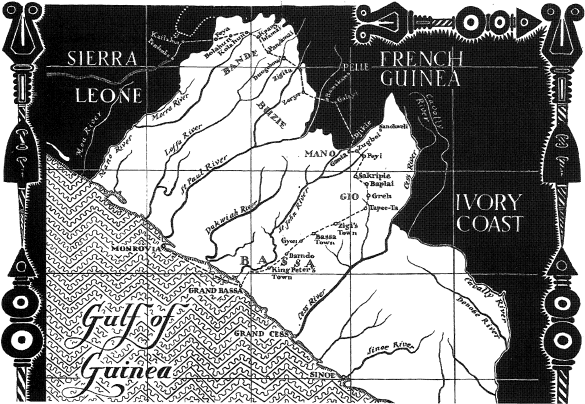
Map of Liberia: endpaper to Journey Without Maps (1936)
The eventual account, Journey without Maps, is variously interesting, perceptive, vivid, odd, and padded; it emerges as a confused attempt to vindicate a quixotic journey. Its best feature is probably the intense and discriminating interest that Greene took in the diversity of Africans whom he encountered, particularly in his considerate treatment of the various carriers and his compassionate concern for the sufferings he observed. Daily he dressed the sore of a carrier afflicted with venereal disease; and once he treated a leper:
At Zigita a leprous man from the town came, with the sellers, to be healed, standing dumbly, holding out his rotting hands. Passive misery had been stamped on his face for a long while, but he had seen the carriers take medicine from me and one could tell that behind the misery a spark of belief had been struck in miracles. It was no good destroying hope and admitting there was nothing I could do. I gave him a few tablets of boric acid to dissolve and bathe his hands with.
(p. 157)
Peter Fleming, reviewing the book in the Spectator, felt that Greene’s ‘unillusioned honesty’ was preferable to the egotism displayed by Hemingway in Green Hills of Africa. One setback occurred when Journey without Maps was subject to a libel action by Dr P. D. Oakley, who believed that he had been misrepresented as the drunken ‘Pa Oakley.’; the book had to be withdrawn and was not reprinted for nearly a decade. Greene’s satiric energies sometimes provoked a litigious response: first Priestley, then Oakley; later there would be the Shirley Temple case. Two literary by-products of the Liberian trek were ‘A Chance for Mr Lever’, a sardonic tale which has some resemblances to Conrad’s ‘An Outpost of Progress’, and ‘The Other Side of the Border’ (the start of an unfinished novel), published eventually in Nineteen Stories.
After his return from Africa, Greene was busily productive, writing articles, books, tales, film reviews and book reviews. With the help of his literary agents – first Curtis Brown, then from 1935 Pearn, Pollinger and Higham – Greene was mastering the art of being paid several times for the same piece of work.
A good example is his long tale, ‘The Basement Room’, the story of a boy’s unintentional betrayal of Baines, the butler who has befriended him. Once again, as in The Man Within, the mentor is the victim of treachery. The viewpoint of the boy, variously beguiled and frightened by the machinations of adults, is well maintained, as is the irony that the betrayal will be a self-blighting one: ‘The glowing morning thought, “This is life”[,] had become under Baines’s tuition the repugnant memory, “That was life”.’ The tale was first commissioned for £50 as a serial by the News Chronicle. Then it became the first story in his first collection of tales, The Basement Room, of 1935. Next, it was serialised (for eighteen guineas) in Argosy magazine, and appeared in a further collection, Nineteen Stories. In 1948 it became a successful film, The Fallen Idol, for which Greene provided the screenplay. With his concurrence, the film made substantial changes to the story and its setting; yet, when re-published under the title ‘The Fallen Idol’ in the volume ‘The Third Man’ and ‘The Fallen Idol’ (1950), the tale had reverted to its original form.
Throughout his career, Greene would be similarly resourceful in recycling his material: pieces of journalism would reappear in his travel books, prefaces would blend into his autobiographies, and autobiographical material would also be incorporated in tales and novels. He earned money in his sleep: he published his dreams. His film reviews were later reprinted in Reflections, The Pleasure-Dome and The Graham Greene Film Reader. There was some recycling of the materials of the novels: locations used in one novel would be re-used in another (Nottingham, Berkhamsted and Brighton, for example). Certain characters would recur under different guises; a character would even appear under the same name in two works. Repeatedly, as we have noted, Greene wrote his fiction with the cinema in mind, whether as a model for techniques or as one of the destinations of the text. ‘The writer has become director and producer’, remarked Evelyn Waugh (CCE, p. 97).
Greene’s interest in the cinema was imaginative and professional. In the reviews which appeared in the Spectator (1935 to 1940) and in Night and Day (July to December 1937), he was lively and knowledgeable, radiating enthusiasm for the potentialities of film. Those reviews are variously witty, incisive, imaginative, constructive and cruel: no conventional courtesies sheathed his critical stiletto. He assailed sentimentality, priggishness and propaganda; he scorned the Hays Office censorship; and he applauded gritty realism, frank sensuality, wild comedy. He was quick to recognise the talents of Carol Reed, Fritz Lang and Luis Bunuel as directors, Humphrey Bogart and Jean Gabin as actors, Bette Davis and Ingrid Bergman as actresses; he delighted in the absurdities of the Marx Brothers and the pompous cynicism of W. C. Fields. Generous in praise and waspish in rebuke, he had the knack of making bad films sound so ludicrous as to be enjoyable. His cameos of some of the stars of the day are sharply memorable: Jean Harlow ‘toted a breast like a man totes a gun.’; Garbo is ‘stiff, awkward, bony, rather grotesque.’; Marlene Dietrich ‘consents to pose’ – as for acting, ‘;she leaves it to her servants’. Mae West has ‘the Edwardian bust, the piled peroxided hair, the seductive and reeling motions reminiscent of an overfed python’.
He often assailed what he saw as the malign influence of Hollywood moguls, particularly ‘the Mayers and the Goldwyns’. Sometimes the comments have an anti-Semitic edge: if Hollywood produces a film of value, that is perhaps ‘when Jehovah is asleep’. There are also signs of an increasing bias against the United States: he complains repeatedly of what he sees as ‘the eternal adolescence of the American mind’, ‘the same adolescent features, plump, smug, sentimental ….. Civilisation would shock them’. Among producers based in Britain, he repeatedly attacked a Jew from Hungary, Alexander Korda (formerly Sandor Kellner), whom he depicted as vulgar in outlook and alien to British culture:
England, of course, has always been the home of the exiled; but one may at least express a wish that émigrés would set up trades in which their ignorance of our language and culture was less of a handicap: it would not grieve me to see Mr Alexander Korda seated before a cottage loom in an Eastern country, following an older and a better tradition. The Quota Act has played into foreign hands, and as far as I know, there is nothing to prevent an English film unit being completely staffed by technicians of foreign blood. We have saved the English film industry from American competition only to surrender it to a far more alien control.
(The Pleasure-Dome, pp. 78–9)
Korda, head of London Films, generously responded by paying Greene extravagantly (£175 initially for a story, then £125 a week for collaboration which included script-writing). The magnate was to prove himself a particularly hospitable friend of Greene. He worked for the British security agency, SIS, as Greene was to do; so their collaboration extended from film work to modes of espionage. In the course of time, Korda paid Green £2,000 for the film rights of The Power and the Glory, £3,000 for writing The Fallen Idol, £4,000 for the rights of The Heart of the Matter, and £9,000 for The Third Man. Having condemned scriptwriters as virtual prostitutes, taking ‘money for no thought’, the author was happy enough to take the money. Typically, he mocked the tycoon obliquely in Loser Takes All. Korda, who owned the yacht Elsewhere (in which Greene and his lover would sail with the Oliviers), would be fictionalised as Herbert Dreuther, the imperious and impetuous tycoon who owns the yacht Seagull: ‘For a month at a time he would disappear in his yacht with a cargo of writers and actresses and oddments …..’
Greene himself, beginning to prosper, was diligently increasing his social circle. In 1935 he, Vivien and their young daughter had moved to 14 North Side, Clapham Common: a beautiful Queen Anne house overlooking the common, its pond and the church. It was to be destroyed during the Blitz, its devastation being commemorated both in the novel The End of the Affair and in the cynical story, ‘The Destructors’. Here he entertained leading figures in the worlds of publishing and literature, among them Rupert Hart-Davis, Hamish Hamilton and Antonia White. Elsewhere, he met such notable figures as T. S. Eliot, Violet Hunt, Herbert Read, Rose Macaulay, H. E. Bates and A. L. Rowse. Greene’s domestic responsibilities were growing: in September 1936 his son, Francis, was born, and Vivien recalled that at the time Graham was ‘very supportive’. There were to be no more children; Vivien remarked that Graham took little interest in Francis and Lucy until the latter was about nineteen.
In July, Heinemann published A Gun for Sale: An Entertainment. The list of his works which appeared in the preliminary matter of this volume showed that Greene was now dividing his longer narrative works into the cateogories of ‘Novels’ (The Man Within, It’s a Battlefield, England Made Me) and ‘Entertainments’ (Stamboul Train and A Gun for Sale itself). The two works he disowned, Rumour at Nightfall and The Name of Action, were excluded. He envisaged the ‘novels’ as relatively serious and subtle works, the ‘entertainments’ as relatively popular and commercial. Eventually, however, he rescinded this distinction (which sometimes seemed merely nominal), so that all were listed as novels.
A Gun for Sale is another cinematic thriller: William Plomer, reviewing it in the Spectator, said that it ‘reads very much as a quick-firing gangster film looks and sounds’. Book sales were disappointing. In Britain, It’s a Battlefield had sold about 7,500 copies, England Made Me 4,500; A Gun for Sale sold 5,000; US sales were about 2,000 in each case. On the other hand, Paramount had paid Greene (before publication) £2,500 for the film rights of A Gun for Sale: Alan Ladd and Veronica Lake would be the stars. His regular readers would have found some of the novel’s material familiar, thanks to Greene’s aptitude in recycling. The ‘Nottwich’ (Nottingham) of Stamboul Train is more fully depicted here; Coral Musker, the needy but honest showgirl of Stamboul Train, is reincarnated as the more robust and fortunate showgirl, Anne Crowder. Raven, the hare-lipped killer from a deprived background, anticipates in important respects the Pinkie of Brighton Rock: an isolated, callous figure, emerging from a sordid background and driven by hatred of the world at large. In Anne’s sense of the division of her allegiance between Raven, whom she has befriended, and her fiancé Jimmy Mather, the detective sergeant devoted to law and order, there is a foretaste of Rose, whose loyalty to Pinkie leads to her defiance of Ida Arnold. The account of Kite’s death in A Gun for Sale anticipates and partly explains the circumstances of Kite’s death in Brighton Rock.
The plot of A Gun for Sale repeatedly depends on unlikely coincidences: for example, when Raven kidnaps Anne, he is unwittingly kidnapping the fiancée of the very police officer who is dedicated to pursuing him; and Davies, who is Raven’s paymaster, happens also to be a financial backer of the very revue in which Anne is performing at Nottwich. The most unlikely incident comes when Anne, whom Davies thought he had killed, is found wedged up a chimney, bound and gagged but alive. (The finder is Raven.) Even though she has been trapped there for many hours, she soon becomes briskly active. Writing of The Third Man, Greene remarked: ‘Reality, in fact, was only a background to a fairy tale’. So often in his novels we encounter the combination of a convincing, intensely-rendered setting and a highly-contrived plot-sequence. Finally, the most depressing feature of A Gun for Sale is that it presents with caricaturish clarity a stale anti-Semitic thesis. The villain, Sir Marcus, is at the centre of a conspiracy by wealthy Jews to profit by war and death. In Stamboul Train Greene had at least attempted to question anti-Semitic prejudice; here that prejudice is all too easily endorsed.
Soon, in December 1936, Greene was offered by Chatto & Windus the literary editorship of a new weekly magazine, Night and Day (modelled on the New Yorker), which first appeared in the following June. His salary was £600 per year, and Evelyn Waugh agreed to be a leading book reviewer at £6 per week. Other recruits included Elizabeth Bowen, John Betjeman, Christopher Isherwood, Herbert Read, Stevie Smith and William Empson. Despite the range of talented contributors, the magazine failed (its final issue was dated 23 December 1937). Night and Day did not pay its way, and hopes of raising fresh capital to revive its fortunes were dashed by the Shirley Temple libel suit. When reviewing the child star’s film Wee Willie Winkie, Greene alleged that the nine-year-old girl’s ‘well-developed rump’, ‘searching coquetry’ and ‘dimpled depravity’ appealed to ‘her antique audience [of] middle-aged men and clergymen’. One suspects that the reviewer, at any rate, found her provocative. Shirley Temple and Twentieth-Century Fox then sued the magazine, its publishers and printers, and Greene himself, for this ‘beastly libel’. The case was heard in March 1938: the Lord Chief Justice deemed the review ‘a gross outrage’. Damages of £3,500 were awarded to Twentieth-Century Fox; £500 to be paid by Greene (a sum roughly equivalent to £20,000 in 1996). Fifty years later, Shirley Temple, in her autobiography Child Star (p. 186), said:
The whole event could be viewed as immensely fruitful. My punitive award was recycled immediately into 5 percent British War Loan Bonds to help arm sorely pressed England against a troubled Europe ….. [T] he saucy publicity tweaked British box-office interest, for Wee Willie Winkie prospered gloriously.
While reviewing, editing and travelling, between 1936 and 1938 Greene found time to write Brighton Rock This, in several ways, is the most extreme of his texts. Here he goes deeper into Greeneland than ever before; and here he presents in most stark and appalling form the paradox of ‘the virtue of evil’. This novel is partly a thriller, partly a detective story (with Ida as the detective), partly a satiric fantasy and partly a theological riddle. It is remorselessly cynical. It is ostentatiously stylised and expressionistic. Grotesque, jaundiced, sardonic, it can still (for all its implausiblities) leave in the mind an enduring aftertaste which is both foul and fascinating. This utterly distinctive minor masterpiece stages a bold conflict between the ethic of right and wrong and the ethic of good and evil; special pleading on behalf of the depraved Pinkie creates the bizarre sense that a callous, treacherous killer may, from a theological viewpoint, be superior to a decent, hedonistic, secular person like Ida.
Catholicism had figured significantly in some of his earlier novels (notably Rumour at Nightfall and It’s a Battlefield), but in Brighton Rock the treatment is more radical and extensive. Norman Sherry remarks: ‘[I]ts religious theme, its examination of the Roman Catholic religion, makes it his first Catholic novel, his first enquiry into the ways of man and God’ (Life I, p. 649). Rose Macaulay thought it ‘horrifying.’; Marghanita Laski said that the ending is ‘the most painful any novelist has ever written’. Sales were slow initially: Heinemann took only £256 in the first nine months after publication. Gradually, however, it gained both large sales and high critical acclaim. In 1943 it was adapted as a stage play in a version which appalled the author: Hermione Baddeley seemed a grotesque Ida, and the theological conclusion was excised. (The play prospered after being transferred from Blackpool to the Garrick Theatre in London.) The film which appeared in 1948, however, was one of the more successful adaptations of a Greene novel; the young Richard Attenborough (who had taken the same rôle in the stage play) made a very effective Pinkie: a convincingly cold-blooded enfant maudit.
Greene had arranged further travels, which took place soon after the demise of Night and Day in December 1937. Viking Press of New York and Longman in England had agreed to commission a book by Greene on Mexico: a non-fictional work dealing with the persecution of the Catholic Church there. With Vivien he set off across the Atlantic on the Normandie in January 1938, and they travelled from New York to Washington and New Orleans. From there, Vivien returned disconsolately to England, while Greene proceeded to Mexico and made arduous journeys deep into regions where the Church had been suppressed by the atheistic authorities. Among the people, their plight and their localities, he found much to depress and disgust him. There resulted a travel book, The Lawless Roads (1939), and his finest novel, The Power and the Glory (1940). Together they offer a remarkable illustration of the transmutation of personal impressions into enduring art.
In the 1920s and 1930s, various British writers described Mexico. These included D. H. Lawrence, in The Plumed Serpent (1926) and Mornings in Mexico (1927), Aldous Huxley in Beyond the Mexique Bay (1934), and Evelyn Waugh in Robbery under Law (1939). In the late 1930s Malcolm Lowry wrote much of his Under the Volcano (1947). ‘Since the depression’, said Huxley, ‘books on Mexico have been almost as numerous, I should guess, as books on Russia’. A travel-writer has no innocent eye but is usually concerned to test a prior schema against the evidence offered by the new region. So Lawrence’s Mexico is a location of natural beauty and instinctual forces; he seeks and finds evidence of primaeval vitality. Huxley, more detached, intellectual and sceptical in stance, moves rapidly from particular details to general reflections on history, psychology and philosophy, offering a lengthy criticism of Lawrence’s primitivism. Greene’s The Lawless Roads has remarkable similarities to Journey without Maps. As in the African travel book, the schema is predominantly religious and entails personal reminiscences of upbringing in England. Greene opens with recollections of schooldays: the baize door separating home from school, the cruelties of ‘Collifax’ who practised torments with dividers, the smells, the lavatory doors without locks. Other people might not have been led to faith by such mundane features, but, according to Greene (p. 11), school provided evidence of Hell, and that leads to belief in Heaven: ‘One began to believe in heaven because one believed in hell, but for a long while it was hell only one could picture with a certain intimacy …..’

Map of Mexico: endpaper to The Lawless Roads (1939)
These early pages of The Lawless Roads have eerie echoes of Brighton Rock. Prewitt, echoing Marlowe, had said, ‘Why this is hell, nor are we out of it.’; The Lawless Roads quotes more closely: ‘“Why, this is hell,” Mephistopheles told Faustus, “nor am I out of it.”’ That favourite Greenian inversion of Wordsworth, ‘Hell lay about them in their infancy’, recurs here. At the end of the novel, the old priest commends Charles Péguy, who challenged God in the name of the damned; in the travel book, Greene himself commends Péguy. The opening of The Lawless Roads serves not only to establish Greene’s Catholic credentials for this book on the persecution of Catholics, but also to establish the religious criteria by which Mexico will be judged.
During his journey, Greene experienced some moments of contentment, ease, even bliss. But on the whole his impressions of Mexico were negative. The government was corrupt; religion was persecuted with varying degrees of rigour in the different states of the country; Greene was often regarded with hostility as a gringo, and he felt that many of the people seemed trapped in ‘a cruel anarchic adolescence’. He regarded compassionately the partly superstitious, partly devout rituals maintained by the impoverished Indians, but repeatedly he found the Mexican mestizos untruthful and unreliable. Broadly, in a pattern similar to that of Journey without Maps, the poorest people of the interior often seemed better, in moral and religious terms, than the people of the cities. Mexico City, in particular, appalled him; he even came to share D. H. Lawrence’s fierce and sweeping reaction:
How right Lawrence was when he wrote: ‘This city doesn’t feel right – feels like a criminal plotting his next rather mean crime,’ and again: ‘I really feel cynical about these “patriots” and “socialists” down here ….. You know socialism is a dud. It makes just a mush of people: and especially of savages. And seventy per cent of these people are real savages, quite as much as they were three hundred years ago. The Spanish-Mexican population just rots on top of the black savage mass. And Socialism here is a farce of farces: except very dangerous.’
(p. 115)
Actually, what Greene encountered was not socialism but tyrannical and exploitative government; but he had ample reason to feel depressed. In the states that he chose to explore, churches had been demolished or stood in ruins; atheistic indoctrination was provided in the schools; crass superstition flourished; squalor and poverty abounded. As always, Greene has a keen nose and eye for the squalid, and gives predictably detailed accounts of the poor sanitary arrangements (for example, the foul crusted lavatory on a steamboat; its door fell off in his hand) and of the pangs of his dysentery. Yet, in a typical paradox, he claims that with all its vileness, Mexico is preferable to the commercial civilisation of the USA:
I loathed Mexico – but there were times when it seemed as if there were worse places ….. Here was idolatry and oppression, starvation and casual violence, but you lived under the shadow of religion – of God or the Devil. ‘Rating for Dating’ [an article in a US women’s magazine] – it wasn’t evil: it wasn’t anything at all – it was just the drug-store and the Coca-Cola, the Hamburger, the graceless sinless empty chromium world.
(p. 249)
The contrast is crudely schematic and rather self-indulgent: Greene denounces as ‘Godless’ a civilisation whose amenities he was sufficiently prosperous to enjoy at length. Certainly, in Mexico he displayed courage and tenacity in visiting some very remote, impoverished and unhealthy regions; but he was a visitor, a note-taking tourist, and could return to luxuries of the kind he so often denounced. ‘The graceless sinless empty chromium world’ of the USA was a world which was enriching him by publishing and filming his books. Like Conrad and Lawrence, Greene could bite tenaciously the hand that fed him. Nevertheless, The Lawless Roads demonstrates Greene’s sharpness of vision, his thin-skinned sensitivity, and his disarming frankness when describing his own blunders and woes. There is some padding, but also a good range of evocative writing; and in The Power and the Glory the rancour and spleen of the travel book would be transmuted into a far more complex and prismatic rendering of Mexican life.
Greene returned to a Europe in which forebodings of a second world war were growing, and a forerunner of that conflict seemed to be the Spanish Civil War, fought between 1936 and 1939. Spanish army leaders, resenting the socialist and anticlerical tendencies of the Republican government, revolted; General Franco became leader of the rebellion, which was supported by nationalist, clerical and Fascist forces. The USSR helped the Republicans; Nazi Germany and Fascist Italy helped Franco. The eventual victory of Franco resulted partly from internecine strife on the Republican side, and partly from a change of policy in the USSR, which was moving towards an iniquitous pact with Hitler.
While the Spanish War was proceeding, many British writers felt obliged to take sides and to declare their support either for the Republican side (as did, for example, Auden, Spender and Day Lewis) or for the Fascist side (as did Roy Campbell and Edmund Blunden). Given that Greene was both left-wing and Catholic in sympathies, taking sides would be no easy matter: many of the Republicans were anti-clerical, while the Fascists had substantial backing from the Catholic hierarchy. In the event, he noted that the Basques of northern Spain fought on the Republican side (hoping for eventual autonomy) but did so with the blessing of their local priests; his sympathies therefore lay with them. (The bombing and strafing of the Basque city of Guernica by German aircraft was famously commemorated by Picasso.) Greene was commissioned, apparently by the BBC, to travel to Bilbao, which was being besieged by the Nationalists. He reached Toulouse, but no aircraft was readily available to take him further, so he returned empty-handed. His brother Herbert, in contrast, reached Spain and (to Ernest Hemingway’s fury) was reputedly a spy for the Fascists. Herbert said that he initially supported Franco but later sympathised with the Republicans.
The Spanish Civil War is the lightly disguised background to The Confidential Agent: An Entertainment, which appeared in September 1939. In its plotting, this is one of the most blithely preposterous of Greene’s works; plausibility is repeatedly sacrificed on the altar of dramatic incident and precipitate reversals. It is predominantly a popular, commercial thriller with more than a touch of fantasy; the political and ethical discussions are scarcely allowed to impede its hectic pace of action. Towards the end, the reader may not suspend disbelief so much as expand disbelief, relaxing into expectation of the increasingly implausible. The Sunday Times put the matter kindly in describing the work as ‘an exciting fantasia’, a ‘kaleidoscopic affair’ in which ‘Mr Greene has few rivals’.
The novel’s central character, ‘D.’, a scholarly widower, is the unlikely ‘confidential agent’ of a government which approximates to that of Republican Spain; repeatedly he is outwitted and thwarted by an aristocratic agent who serves ‘the General’ (Franco inevitably comes to mind). Although Greene makes brief attempts to veil the linkage with Spain, it is the Spanish conflict which fits most of the relevant political facts. The book’s sympathies lie, on balance, with the Republicans, but it is quite a fine balance. ‘[M]y people commit atrocities like the others’, remarks D.; and D. is betrayed by people who, though supposedly on his side, have sold out to the enemy. (His researches on The Song of Roland should have forewarned him.) D.’s idealism is wan, more weary and limited than that of Czinner, his literary relative in Stamboul Train. His mission ends in stalemate: he fails to gain a supply of coal, but at least prevents the other side from gaining it. Nevertheless, in an ending to gratify a film director with a taste for the commercially romantic, he succeeds in winning the love of a beautiful young woman who bravely (and to his surprise) joins him on the tramp-steamer for the return to his homeland. There, he may well be shot; in the meantime, they can enjoy a brief idyll.
The light went by astern: ahead there was only the splash, the long withdrawal, and the dark. She said, ‘You’ll be dead very soon: you needn’t tell me that, but now …;’
He felt no desire, and no claim: happiness was all about them on the small vibrating tramp. To the confidential agent trust seemed to be returning into the violent and suspicious world.
That’s how the first British edition concluded. From later editions Greene excised the whole of that final paragraph, making the conclusion less conventionally affirmative.
One interesting development in The Confidential Agent is Greene’s attempt to balance the anti-Semitic features of earlier novels by giving a predominantly sympathetic treatment to Mr Forbes (alias Furtstein), the businessman who is the fiancé of Rose, the novel’s heroine. Admittedly, the holiday-camp that he owns is depicted by the narrator as a vulgar, alien importation. On the other hand, it is through Forbes’s agency that D. is eventually rescued and put on that steamer heading home; and, in a gallantly romantic gesture, Forbes relinquishes his matrimonial claims on Rose (even though their marriage would be a financially astute move) so that she can join the man whom she really loves. Forbes is thus a positive counterpart, an altruistic complement, to the Myatt of Stamboul Train.
Another characteristic of The Confidential Agent is the presence of some private, personal allusions which would have eluded most of the original readers but which, in the light of subsequent biographical knowledge, are easily detectable. Greene’s developing wry friendship with Alexander Korda, the film magnate who would be knighted in 1942, explains the text’s repeated use of ‘Korda’ as a term in the international language ‘Entranationo’, an equivalent of Esperanto. Korda, we are told, is the synthetic language’s term for ‘the heart’ (logically enough, recalling the Latin cor, cordis); in an Entranationo song, ‘the word Korda, Korda came in a lot’. (The film producer was probably a model for Forbes.) The text also deploys repeatedly the name ‘Glover’. A woman called Glover is the owner of a flat in which the hero takes refuge:
He took it quickly in to the home-made water colours on the walls and the radio set by the dressing-table. It spoke to him of an unmarried ageing woman with few interests …..
It seemed hard luck on Glover – whoever she might be: ….. intrusion into a stranger’s home was an act of lust.
(pp. 147, 187)
England Made Me had been dedicated ‘To Vivien / With Ten Years’ Love / 1925–1935.’; but The Confidential Agent eventually bore the dedication ‘To Dorothy Craigie’, and Dorothy Craigie was the nom de plume of Dorothy Glover, a book-illustrator (hence the water-colours noted above). Her sexual affair with Greene began in 1938 or 1939 and lasted through the war years, contributing some features to The End of the Affair (1951). Vivien described Dorothy (born in 1901) as ‘a small stoutish woman in blue glasses.’; to David Higham she was ‘short and a bit stout (though not fat), stocky more than anything’. A photo confirms the impression that, compared with Greene’s later partners, she was distinctly unglamorous. Initially their liaison was secret, but gradually Vivien became painfully aware of it. ‘Graham said something about the most terrific sort of sexual thrill he had was seeing her sitting in a red dressing gown in front of a dressing table.’ It is characteristic of Greene’s use of private, personal material in his novels that Fowler in The Quiet American defines his ‘deepest sexual experience’ thus: ‘Lying in bed early one morning and watching a woman in a red dressing-gown brush her hair.’ Constituting an irony that must have been particularly painful to Vivien, Dorothy Glover collaborated with Greene by illustrating a series of story-books that he wrote for young children: The Little Train (1946), The Little Fire Engine (1950), The Little Horse Bus (1952) and The Little Steamroller (1953).
Derek Verschoyle, reviewing The Confidential Agent, said disparagingly: ‘Mr Greene, with his eyes fatally fixed on Hollywood, has slapped his hero down against a merely formal background and handed out action neat.’ Greene himself held a low opinion of this rushed ‘entertainment’, but he succeeded in his commercial aim. At first the book sold 5,000 copies in Britain, not as many as Greene might have expected; but Warner Brothers bought the rights, and the eventual film employed Charles Boyer as D., Peter Lorre as D.’s hapless victim, and Lauren Bacall as Rose. Bacall complained, with some reason, that the character was ‘totally straight and dreary’.
The middle years
1939–45
On 23 August 1939 the Molotov-Ribbentrop pact was signed. This was the pact in which Stalin’s communists agreed to cooperate with Hitler’s Nazis. One rapid outcome was the conquest of Poland in the following month: the Nazis invaded Poland from one side, and the Russians invaded from the other. Britain and France, in support of the Poles, then declared war on Germany. The Second World War had begun.
The Molotov-Ribbentrop agreement made nonsense of many intellectuals’ belief that communism was a bulwark against Fascism. Some of those intellectuals, and many of the well-to-do, followed W. H. Auden and Christopher Isherwood (a relative of Greene’s) in seeking the sanctuary of the USA. Five thousand people departed for America in the first two days after the declaration of war.
To facilitate his writing and his private life, Greene had rented a studio in Mecklenburgh Square in Bloomsbury, away from his family. Dosing himself with benzedrine, he had worked on The Confidential Agent in the mornings and The Power and the Glory in the afternoons. He was still producing regular book and film reviews for the Spectator, in 1940 he became its literary editor.
As soon as the Molotov-Ribbentrop pact was announced, Greene evacuated his wife and children to his parents’ home at Crowborough in Sussex. Vivien sent him many affectionate and pining letters, but Greene was secretly enjoying the company of Dorothy Glover. Touchingly, Vivien remarked reproachfully: ‘Bizet wrote Carmen, Wagner wrote Lohengrin. Nobody writes me: Gee, I’m lonesome!’ Eleven months later she and the children were moved again, this time to lodgings owned by Trinity College, Oxford; an old friend of hers was married to the College’s President.
In late September 1939 Greene appeared before a military draft board and persuaded its members to postpone his conscription into the army until June 1940 so that he could finish The Power and the Glory – although, Norman Sherry notes, he had actually completed the writing of that novel (Life II, p. 30). He then eluded the army by taking a position at the Ministry of Information, even though he had previously criticised intellectuals who dash for Ministry posts. He spent six months there (with Dorothy Glover as his secretary), involved in plans for propaganda, before being sacked from an overstaffed office. Dorothy, however, remained. During these war years, Greene felt that he was in the position of ‘loving two people [Vivien and Dorothy] as equally as makes no difference’ (Life II, p. 145).
When The Power and the Glory appeared, it gained numerous excellent reviews. The Times said that it was ‘beyond question his best novel. Nothing in his previous work has quite prepared us for the accomplishment’. Sir Hugh Walpole said: ‘Greene’s new novel proves that he is the finest English novelist of his generation. Simply magnificent.’ Greene urged his agent (successfully) to press Heinemann to publicise the novel more extensively. Greene claimed that initial sales were only 3,500, but the print run was 12,600, and 5,000 copies were sold in the first five weeks. (After the war, the pocket edition of 1945 sold 18,650 copies, the uniform edition of 1949 23,450.) The sexual frankness of The Power and the Glory led to its denunciation by Cardinal Pizzardo of the Holy Office in Rome; Greene preferred to call him ‘Cardinal Pissardo’. Pope Paul VI, long afterwards, told Greene to ignore those Catholics who took offence. This novel, too, was filmed: as The Fugitive, directed by John Ford: a work which, in the author’s view, crudely simplified the issues.
During the Blitz on London, Greene worked as a fire-warden at nights (with Dorothy, a station-warden), reporting the location of explosions and fires, and helping to rescue people from bombed areas. Through the flames, smoke and debris, he worked courageously. He said later: ‘In the blitz, one was very frightened to begin with but then one gave up the idea that one was going to survive and one wasn’t frightened any more’ (Life II, p. 57). He even experienced exhilaration, as landmark after landmark was erased during the nocturnal havoc.
Greene’s sister Elisabeth worked in the Secret Intelligence Service (SIS, department MI6), and with her help he was appointed to a very well-paid post in MI6: the salary was about £1,000 a year, tax-free. Nominally a member of the CID Special Branch, in December 1941 he sailed from Liverpool for Freetown, aboard a cargo steamer. (During the perilous voyage, recalled in ‘Convoy to West Africa’, he wrote much of his critical book, British Dramatists, which includes particularly warm appreciations of Elizabethan and Jacobean playwrights.) At Freetown, Sierra Leone, he worked as a counter-espionage agent: among other tasks, he had to send information about Vichy airfields in French Guinea and to search ships for smuggled industrial diamonds. The search for contraband and the oppressively humid location later found their way into The Heart of the Matter; though Greene, unlike Scobie, was provided with ‘a very nice piece & a good drinking companion’, Doris Temple. Greene, like the agent Carter in the novel, also visited the primitive local brothel.
He was cheered by learning that The Power and the Glory had been awarded the Hawthornden Prize and that A Gun for Sale would be filmed by Paramount. He completed another ‘entertainment’, The Ministry of Fear, saying ‘There’s a good cinematic idea in it.’; and his literary agent, Laurence Pollinger, sold that novel, also, to Paramount, for £3,250. The Ministry of Fear (published in 1943) has two aspects. Its plot is that of a mystery-thriller; a conspiracy of fifth-columnists in England is eventually exposed and destroyed. The plotting, as in some of his previous thrillers, is strained and implausible, dependent on coincidental meetings and ludicrously contrived intrigue; sometimes it is difficult to distinguish between the frequent dreams of its hero and the events around him, which are dreamlike, nightmarish or phantasmagoric in their unlikely concatenations. As a narrative, it seems to have been improvised with little overall planning. The second aspect, however, is quite different. As background to the tenuous sequence of the main events, Greene offers numerous vivid cameos of wartime London: the Blitz, the austerity, the drabness, the steady course of destruction, the ranks of sleepers on the smelly underground platforms, and the euphoria of survival in the morning.
[M]en and women were emerging from underground: neat elderly men carrying attaché-cases and rolled umbrellas appeared from public shelters. In Gower Street they were sweeping up glass, and a building smoked into the new day like a candle which some late reveller has forgotten to snuff ….. A notice turned them from their course, and on a rope strung across the road already flapped a few hand-written labels. ‘Barclay’s Bank. Please enquire at …;’ ‘The Cornwallis Dairy. New address …;’ ‘Marquis’s Fish Saloon …;’ ….. He noticed the briskness, the cheerfulness of the faces: you got the impression that this was an early hour of a national holiday. It was simply, he supposed, the effect of finding oneself alive.
(pp. 200–1)
As so often in Greene, the detailed rendering of the location seems more truthful than the plot.
While Greene was in Africa, his father (who had retired from the headmastership of Berkhamsted in 1927) died after many years of diabetic illness. Greene said:
Suddenly, between the secret reports to be coded and decoded, I unexpectedly felt misery and remorse, remembering how as a young man I had deliberatedly set out to shock his ideas which had been unflinchingly liberal in politics and gently conservative in morals.
Charles Greene seemed to him ‘a very good person in a way we don’t seem able to produce in our generation’ (Lifell, p. 151).
Soon, after a row with his boss at Freetown, Greene was recalled from Africa to work at St Albans and London under Kim Philby, who would later be exposed as a traitor paid by Moscow. This phase of espionage would find its way eventually into Our Man in Havana and The Human Factor. In the summer of 1944, Greene suddenly resigned from MI6. Norman Sherry (Life II, p. 183) speculates that this was because he had realised that Philby was secretly working for the Russians. In London, Greene lived with Dorothy during the time of the raids by the Vls (the pilotless pulse-jet aircraft) and V2s (the appallingly destructive rockets) : raids to be recalled in the novel The End of the Affair.
Greene then became a part-time editor for the publishing firm Eyre & Spottiswoode, and after the war stayed on as managing director until 1948. Initially lively and enthusiastic, he brought new authors (notably Mervyn Peake) to the firm’s list; books by François Mauriac and R. K. Narayan were added, and one of his favourite novels, James’s The Wings of the Dove, was reprinted in a new edition. Greene’s boss at Eyre & Spottiswoode was Douglas Jerrold, a Catholic who had supported Franco in the Spanish Civil War. He perceptively observed that Greene was not ‘a religious novelist’ but one who was ‘interested in religion’, and whose works overemphasise sin and guilt while neglecting good works and salvation. To Jerrold, Greene was still an adolescent emotionally but an adult in business matters. At the office:
He would settle down to the serious business of the day, telephoning with rapid succession to his bank, to his stockbroker, to his insurance agent, to his literary agent, to a film company or two, and, if it was a really busy morning, to two or three editors. During these conversations the tortured conscience so frequently, and so movingly, on exhibition in his novels was notably absent.
(Harper’s, August 1952, p. 52)
1945–55
In this post-war decade, Greene’s fame and success rose to a zenith. He became internationally lauded and debated; his face appeared on the cover of Time magazine; his movements were followed by reporters. He became so prosperous that he was free to roam as he wished; he even bought a yacht, partly as a means of alleviating taxation. Greene could now mix on an equal footing with the wealthy and glamorous: among them Sir Alexander Korda, Laurence Olivier, Vivien Leigh, Margot Fonteyn and Noël Coward.
The Heart of the Matter (1948) is one of his major works; highly acclaimed, controversial, it became an enduring best-seller. Other important novels included The End of the Affair (1951), which boldly recruited God as a miracle-working character, and The Quiet American (1955), a partly prophetic account of the CIA’s intervention in Vietnam. A minor novel was Loser Takes All (1955), a story of love and gambling with – for once – a happy ending. His tales appeared in two volumes overlapping in their contents: Nineteen Stories (1947) and Twenty-One Stories (1954). Non-fictional works included The Lost Childhood (1951) and his contribution to Why Do I Write? (1948). As a sign of his popularity and eminence, Heinemann began to produce the ‘Uniform Edition’ of his works. (A ‘Collected Edition’, by Heinemann and The Bodley Head, would appear in the 1970s, and he wrote a series of prefaces for it: another resemblance to his admired Conrad.)
In collaboration with Basil Dean, he adapted The Heart of the Matter for the stage; but the opening in Boston (1950) was disastrous, and the plans for the play to open in New York were aborted. (Doping himself with benzedrine was perhaps less helpful to his creativity than he imagined.) Nevertheless, he persevered with play-writing, and completed The Living Room in 1952. This is a predominantly realistic drama with theological debate and symbolic overtones. The basic plot is strong and simple: Rose, the heroine, has an affair with a married man; after meeting his distraught wife, she commits suicide as an altruistic act. There are hints that though, to Roman Catholics, suicide is a mortal sin, God may choose to be merciful. As Rose prepares to die, her Pater Noster veers into a childhood prayer whose poignant ending would have had particular resonance for Greene: ‘Our Father ….. please God don’t let school start again ever.’
The Living Room was an enormous success when it opened in London: Eric Portman (as Father Browne) and particularly the young Dorothy Tutin (as Rose) received accolades; on at least one occasion there were as many as fourteen curtain-calls. It ran at Wyndham’s Theatre in London from 16 April 1953 until 9 January 1954. The Times said:
All the men and women who matter in this play have a sense of sin; and their actions take on in consequence a momentousness all too rare on the stage …..
The play is beautifully acted, especially by Miss Dorothy Tutin as the young girl, and most effectively directed by Mr. Peter Glenville.
(17 April 1953, p. 2)
Greene was now a significant dramatist as well as a major novelist. Yet, when making a curtain speech in response to cries of ‘Author! Author!’, he was predictably sombre:
Do not call me a success. I have never known a successful man. Have you? A man who was a success to himself? Success is the point of self-deception. Failure is the point of self-knowledge.
(Life II, p. 456)
His international fame was magnified by the prestige and popularity of two films: The Fallen Idol (1948) and The Third Man (1949). Both were directed finely by Carol Reed; both were admirably acted; and both succeeded greatly not only with the critics but with the general public. The Third Man, in which Orson Welles was at his best as the charismatic villain, Harry Lime, deservedly won the Grand Prix at the Cannes International Film Festival, and the theme music (by Anton Karas, the zitherplayer) became a best-selling record internationally. Thereafter, Greene sometimes found that musicians in night-clubs and hotels would play ‘The Third Man Theme’ when he entered. A less successful but still notable film was that of The Heart of the Matter (1953), in which Trevor Howard gained plaudits as Scobie.
Various works by Greene in this decade reflect, or comment on, his emotional entanglements, which became intensified in the post-war years. At the end of the war, he was seeing his wife, Vivien, at weekends while living with Dorothy Glover during the week. Then, in 1946, he met the remarkable Catherine Walston. She was strikingly beautiful, intelligent, vivacious, seductive, uninhibited and wealthy. Her husband, Henry (known as Harry), was of Jewish ancestry (his father had changed his name from Waldstein to Walston), rich, agnostic, kind and tolerant. He stood as a Liberal candidate in 1945 and as a Labour candidate in a series of subsequent elections, eventually becoming a Life Peer nominated by Harold Wilson. He owned Newton Hall in Cambridgeshire, a huge farm at Thriplow nearby, a London flat in St James’s Street, a flat in Dublin, a cottage on an island off the Irish coast, and a banana plantation on the Caribbean island of Santa Lucia.

Catherine Walston
Ironically (Vivien recalled), the relationship between Catherine Walston and Graham Greene was initiated when she asked him to be her godfather at her conversion to Catholicism. Vivien deputised for Graham, but at later meetings with his god-daughter he became entranced by Catherine and fell intensely, passionately, jealously in love. Their sexual relationship endured for a decade; they spent holidays together in Ireland, on Capri and at numerous other locations. ( The Living Room was dedicated ‘To Catherine with Love’.) While Vivien in Oxford did her best to cope with the austerity, rationing and shortages of post-war Britain, the Walstons at Thriplow lived in a land of milk and honey – or at least of ‘grouse, partridges, ham, a leg of mutton and half a cold goose’, as Evelyn Waugh reported. Greene took a flat next to Caroline’s in St James’s Street. Repeatedly he begged Caroline to leave Harry and marry him; but his infatuation was greater than hers, and very slowly, in spite of many idyllic and passionate reunions, the relationship cooled. The long-suffering Vivien knew of it: on one occasion the couple called on her unexpectedly in Oxford, and she was obliged to prepare a meal and overnight accommodation for them. Dorothy Glover, too, suffered; Greene sent her on an African cruise, hoping that during it she would transfer her affection to some other man. Only gradually and reluctantly, with many quarrels and reproaches, did Dorothy relinquish her hold.
Greene’s attempts to reconcile adultery with Catholicism took ingenious forms. In one letter to Catherine, he said:
Whenever we settled for any length of time, we would have two rooms available, so that at any time without ceasing to live together & love each other, you could go to Communion (we would break down again & again, but that’s neither here nor there).
(Life II, p. 324)
In another:
[M]y prayer is always that God’s will shall be in favour of our love. Don’t be too sure that it may not be & who knows whether the peace we have so often got together has not been with him, instead of against him? I feel no wrong in this love for you …..
(Life II, p. 329)

Greene with troops in French Indo-China, 1951
He even assured her: ‘I’m a much better Catholic in mortal sin!’ (Life II, p. 257). After all, he had papal precedent: Pope Alexander VI had reconciled his conscience with extensive sexual activity. In A Burnt-Out Case, Parkinson puts a similar point in crude journalese: ‘St Francis was the gayest spark in all the gay old city of Firenze.’ Father Crompton, in The End of the Affair, says: ‘There’s nothing we can do some of the saints haven’t done before us.’ Catherine Walston’s numerous lovers included Roman Catholic priests. Greene was increasingly displaying a voracious appetite for attractive young women: while assuring Catherine that he felt truly married to her, from 1951 he was also enjoying a sexual relationship with Jocelyn Rickards, a young artist from Australia who had hitherto been an inmate of the ‘harem’ of A. J. Ayer, the eminent sceptical philosopher. Rickards and Greene liked to fornicate in public places: a park at night, or the compartment of a train between Southend and London. With Graham she visited the music-hall at Islington Green, went to theatres, and met T. S. Eliot (who called her, aptly, ‘Pixie’). Subsequently she became an adulterous lover of the playwright John Osborne.
Greene continued to travel far abroad to dangerous regions. As usual, among other motives, he was impelled partly by a kind of death-wish, and partly by the related desire to let danger overcome his intense phases of boredom and depression. In 1950, commissioned by Life magazine, he explored Malaya during the crisis of insurgency by communist guerrillas, undertaking an arduous trek with Gurkhas. In the following year, he toured French Indo-China, where the French were fighting a losing battle against the Vietminh; there he came close to the battle-lines, flew with a bomber on its raids, and at Phat Diem perilously crossed a canal which was choked with corpses. The French authorities suspected him of being a British agent; and, in spite of his denials, they were correct in their suspicions, for Greene was sending reports to the SIS. Once again, his travels served multiple functions: he was writing articles for Paris Match, carrying out a form of espionage, and gathering material for a novel and an autobiographical work. As if he had not taken sufficient risks already, in August 1953 he toured Kenya during the Mau Mau insurgency, that campaign during which the Kikuyu rebels killed many white settlers and many more of the Kikuyu people. During this campaign, with its particularly atrocious slaughters, Greene’s sympathies swung between the insurgents seeking liberation from colonialism and those settlers who, isolated and tense, remained on their farms at the risk of their lives.
The major novel of this decade, The Heart of the Matter, is characteristic of Greene in its blend of well-researched locations and highly personal experience. The setting is Freetown in Sierra Leone, where Greene had worked as a secret agent during the war. The locale is superbly evoked: the humidity (blotting-paper soaks sweat from Scobie’s wrist as he writes), the tedium, the tropical diseases, the refuse; ‘A dead pye-dog lay in the gutter with the rain running over its white swollen belly.’ Scobie, the hero, is a scrupulous, sensitive police officer who is led gradually into corruption. It is easy to see analogies between Greene’s relationship with Vivien and Scobie’s pitying relationship with the wife, Louise, whom he no longer loves. (Louise’s nickname for Scobie, ‘Ticki’, was also Vivien’s for Greene.) To give her a holiday from the area that she finds oppressive, Scobie accepts a bribe to turn a blind eye to smuggling. Next, he commits adultery with Helen Rolt, a woman young enough to be his daughter, and is consequently blackmailed, so that he himself becomes a smuggler. A devout Catholic, he yet takes Mass in a state of mortal sin, being unable to repent his adultery. Next, he arranges for his servant (who knows too much of his corruption) to be ‘silenced’ – actually murdered. Finally, he commits suicide, an extreme mortal sin for a Catholic, attempting to disguise this as a heart attack. The suicide, we are led to believe, he undertakes partly out of pity for his wife and Helen, and partly out of pity for Christ, who (he imagines) would repeatedly be wounded by Scobie’s protracted impenitence if he lived:
He had a sudden picture before his eyes of a bleeding face, of eyes closed by the continuous shower of blows: the punch-drunk head of God reeling sideways …..
He thought, ‘And again at Christmas,’ thrusting the Child’s face into the filth of the stable.
(pp. 256, 257)
The ‘heart of the matter’, it seems, is pity.
The ending has multiple ironies. Louise, it is revealed, has been well aware of her husband’s adultery, in spite of all his endeavours to conceal it. Scobie’s attempt to conceal the fact of suicide fails, too. A final irony, however, occurs when Father Rank, the Catholic priest, talks to Scobie’s widow. Scobie believed that in committing suicide he was damning himself. Rather like the priest who, in Brighton Rock, consoled Rose after Pinkie’s death, Father Rank says:
‘For goodness sake, Mrs. Scobie, don’t imagine you – or I – know a thing about God’s mercy ….. The Church knows all the rules. But it doesn’t know what goes on in a single human heart.’
(p. 297)
Thus, once again, the text suggests that, after all, the sinner may be saved: God may take Scobie’s love (of God, or of fellow-humans) as a redemptive quality. As so often, Greene offers the prospect of a redeemed (if not sanctified) sinner; of the salvation of a man who, by orthodox standards, has been corrupt and destructive.
This final paradox of The Heart of the Matter can clearly be related to Greene’s own endeavours to reconcile his faith with his adultery, and particularly with his notion that even adulterous love may, in some degree, be an aspect of divine love. It was one of the features which made the novel so controversial. Evelyn Waugh, a fellow-Catholic, said in a review:
[T]housands of heathen will read it with innocent excitement, quite unaware that they are intruding among the innermost mysteries of faith ….. [T]he idea of willing one’s own damnation for the love of God is either a very loose poetical expression or a mad blasphemy …..
(CCE, pp. 96, 101)
Waugh, Edward Sackville-West and Raymond Mortimer considered the possibility that Scobie was a saint; but Greene denied any such intention. Other Catholics condemned the work strongly. Ronald Brownrigg said that some readers might ‘be muddled by The Heart of the Matter into thinking that what Christ said was “If you love me, break my commandments”’. The Reverend John Murphy declared that Scobie was a man of weak will, more afraid of women than God, who ‘despaired when he should have repented’. The sceptical George Orwell questioned radically the plausibility of the novel:
If [Scobie] were capable of getting into the kind of mess that is described, he would have got into it years earlier. If he really felt that adultery is mortal sin, he would stop committing it ….. If he believed in Hell, he would not risk going there merely to spare the feelings of a couple of neurotic women. And ….. if he were the kind of man we are told he is ….. he would not be an officer in a colonial police force.
(CCE, p. 108)
The last point is shrewd. If he were that kind of man, he would hardly be an officer in the colonial police; but he could be a novelist such as Greene, who often felt that adultery (particularly with Catherine Walston) seemed to strengthen his faith; a novelist who sometimes had difficulty in distinguishing between sacred and profane love. In ‘Congo Journal’, Greene claimed that Orwell was wrong, for Greene had ‘worked fairly closely with an old Commissioner in Freetown’ who was humane and sensitive. But if Scobie were so humane, he would not have acquiesced in the murder of his servant. The demands of the plot seem to have twisted the characterisation into self-contradiction. Later, Greene said: ‘I don’t like the book much ….. Freetown is well described, but the dilemma of Scobie seems to me an exaggerated one’ (GGFR, p. 555).
The Heart of the Matter was controversial, much publicised, banned in Eire, and chosen by the Book of the Month Club. It became an international best-seller. In Britain The Ministry of Fear, his previous novel, had sold 18,000 copies; within three years, The Heart of the Matter sold nearly 300,000 (MW, p. 356). Publishers promptly reissued his earlier novels, so that Greene’s royalty-earnings soared.
Three years later, The End of the Affair made God an even more conspicuous presence in a novel of adultery. In this work, the protagonist, Bendrix, loves Sarah, who is married. Suddenly, after a bomb-explosion during an air-raid, she discontinues their relationship. Bendrix suspects that she has taken another lover. At last, after her death, he discovers that her other lover is actually God. What had happened was that when Bendrix seemed to have been killed in the explosion, Sarah had made a wager with God: ‘I’ll give him up for ever, only let him be alive’. Furthermore, it appears that Sarah had thereafter become a tutelary saint, performing miracles, in life and after death. Her kiss heals a strawberry-mark on a rationalist’s cheek (thus also completing her cure of his rationalist scepticism). A boy with a grave stomach complaint dreams that she touches his stomach, and he is promptly healed. Bendrix prays to her to save him from taking another woman as a mistress; and he is promptly prevented from doing so by the importunity of her mother, who reveals that Sarah was baptized a Catholic. Henry, Sarah’s widower, is led towards the Catholic faith, gaining consolation from her priest, Father Crompton. The more Bendrix defies God, the greater the reality that God has for him; finally his tone is that of a weary believer: ‘O God, You’ve done enough’. Bendrix, a fiction-writer, has become a character in God’s plot.
This novel exhibits a familiar tension in Greene’s work. The setting is convincing, and so is the rendering of the stresses, guilts and jealousies of lovers; the complications of the plot are far less so. The evocation of wartime London, particularly the time of the V1 raids, is persuasively detailed. The central sexual relationship draws some details from Greene’s wartime affair with Dorothy Glover and much material from the post-war affair with Catherine Walston. When Bendrix and Sarah copulate under her husband’s roof, it reflects Greene’s own experiences with Catherine at Thriplow. Henry Miles, the husband, has obvious kinship with Henry Walston: both are important public figures, involved in wartime administration; Miles, too, has the prospect of a knighthood. ‘Crompton’, the priest’s surname, was Catherine’s maiden name. Bendrix is an established novelist, gaining success, who once used the stream-of-consciousness method but has abandoned it (one recalls The Bear Fell Free, the rendering of Conrad Drover’s character in It’s a Battlefield or the introspections of England Made Me). The British edition was dedicated ‘To C; the US edition ‘To Catherine with Love’. Harry Walston declined to sue the author.
The novel’s suggestion that adultery may lead, via a bargain with God, to sainthood for an erring wife, is a characteristic Greenian paradox. But never before had Greene written a novel in which God intervened so directly and manifestly in the arrangement of events. Even a believer might flinch at the extent to which the outcome appears to depend on supernatural intervention. Bendrix’s life saved by Sarah’s wager with God, Smythe’s strawberry-mark cured by her kiss, Bendrix rescued by the dead Sarah from fornication with Sylvia Black, Parkis’s boy healed by Sarah’s ministry: it’s a long list, and the supernatural aura is strengthened by a number of dreams by which Sarah appears to be communicating consolingly from heaven to earth. If the evidence had been more ambiguous, it might have been more plausible. Greene himself later recognised this. In his introduction to the 1974 Collected Edition text, he says:

Greene with Catherine Walston on Capri
I realised too late how I had been cheating – cheating myself, cheating the reader ….. The incident of the strawberry mark should have had no place in the book; every so-called miracle, like the curing of Parkis’s boy, ought to have had a completely natural explanation.
Accordingly, he revised the novel, so that in the later version the strawberry-mark (a congenital disfigurement normally permanent unless treated by surgery) becomes urticaria or nettle-rash, a malady of the skin which is characterised by itchy red or whitish raised patches and which is usually caused by an allergy. So, whereas the 1951 text refers to the ‘purple crumpled strawberry mark’ on Smythe’s cheek and gives Bendrix the comment, ‘I’ve read somewhere these marks are hysterical in origin’ (pp. 94, 234), the 1974 text refers to ‘gross livid spots’ and lets Bendrix comment, ‘I’ve read somewhere that urticaria is hysterical in origin’ (pp. 84, 208). Consequently, the cure appears markedly less miraculous, though it is still part of a large sequence of evidence that Sarah, the adulterous sinner, has become a saint awaiting formal canonisation.
For The End of the Affair, which, he told Catherine Walston, was ‘your novel’, in 1952 Greene was awarded in New York the Catholic Authors’ award for fiction. An article in Time magazine bore the caption ‘Adultery can lead to sainthood’ and suggested that Greene might be a new Dostoyevsky. In 1955, the predictable film followed; an indifferent version, with Van Johnson as Bendrix and Deborah Kerr as Sarah. Greene, on the set, noted that Johnson chewed gum during his love-scenes; but he thought Kerr’s performance ‘extremely good’.
The other important novel of this period, The Quiet American, draws on Greene’s experiences in Vietnam. His reports of the visit to the front-line at Phat Diem and of his flight in the bomber which destroyed a sampan are transferred with few alterations to the novel. During his tour of Vietnam, Greene frequently took opium, enjoying the resultant ‘white nights’ of tranquillity. In the novel, the protagonist, Fowler, similarly smokes opium: a vice perhaps appropriate to a reporter who seeks detachment. (Like Greene, he is separated from a Catholic wife who declines to grant him a divorce.) Fowler is eventually drawn into political commitment: he instigates the murder of Pyle, an American working for the CIA. Fowler’s motives are mixed: by removing Pyle, he is removing a rival for the love of Phuong, his own mistress. But he also believes he is removing a dangerous ‘innocent’: a well-meaning but ignorant American whose schemes to establish a ‘Third Force’ in Vietnam have entailed the killing of citizens by plastic bombs which he has provided.
Greene’s anti-Americanism is a strong feature of the novel. He evidently believed the novel’s political thesis: that some of the terrorist explosions in Saigon, particularly one in the rue Catinat, were the work not of the Vietminh insurgents but of the CIA in conjunction with a maverick Vietnamese Colonel. The historical evidence, according to Norman Sherry’s investigations (Life II, pp. 426–34), refutes Greene’s thesis. The fact that US citizens were not killed by the particular explosion that Greene recalled was a matter of chance, not calculation. In any case, it is difficult to see how US interests could be advanced by actions which would suggest to the world the inadequacy of defences against communist and nationalist insurgents. When Fowler ‘takes sides’, he does so with a communist agent.
Greene later said that he was not anti-American but critical only of certain US policies. Nevertheless, as we have seen, even in The Lawless Roads a general distaste for the materialistic affluence of the USA is manifest; and frequently Greene conveys hostility to US culture. He once told Malcolm Muggeridge, about the Church, ‘Russians only destroy its body, whereas the Americans destroy its soul’. His sympathy with the underdog led him easily into opposition to the upperdog of the modern world. He also resented the fact that, having been briefly a member of the Communist Party, he fell foul of the McCarran Act of the 1950s, with the result that he experienced repeated difficulties in gaining a visa to enter the USA: frequently he had to make do with a short-term visa instead of the longer one he sought.
The Quiet American was widely praised by reviewers in Britain; but, not surprisingly, there were some hostile reviews in the USA, notably from Newsweek, which said that Greene had now played into the Russians’ hands: Pravda’s enthusiasm, it remarked, showed that Greene’s characters were close to Marxist stereotypes. In an American interview, against the background of the Cold War and the political witch-hunt led in the USÁ by Senator Joseph McCarthy (a Catholic), the author quoted Franklin D. Roosevelt and Tom Paine: ‘The only thing to fear is fear itself; ‘We should guard even our enemies against injustice’.
1955–65
Greene continued to compound his adultery with attractive women, some of them twenty or more years younger than himself. In 1955 he began a relationship with Anita Björk, a very attractive Swedish actress who had recently been widowed. He frequently visited her at a house that he bought for her near Stockholm, and they vacationed at his villa in Anacapri. This relationship lasted for several years; but Greene gallantly assured Catherine Walston that it was less important than his with her.
Then in 1959, at Douala in the Cameroons, he met and made friends with Jacques Cloetta, his wife Yvonne and their daughter Martine. They had a house at Juan-les-Pins; and, when Greene settled in Antibes in 1965, they were near-neighbours. Yvonne, yet another attractive woman who found the blue-eyed author appealing, became Greene’s companion for the remainder of his life: he called her his ‘happy, healthy kitten’, or simply ‘HHK’. The late volume Travels with My Aunt is dedicated to her. She would spend afternoons and evenings with Greene, returning to her husband at night; an arrangement which seems to have suited Greene admirably. ‘Fame’, says Querry in A Burnt-Out Case, ‘is a potent aphrodisiac. Married women are the easiest …..’ Eventually, in J’Accuse, Greene would take up cudgels on behalf of Yvonne’s daughter Martine, who was involved in litigation with her former husband and his influential associates.
‘In 1957 I travelled more than 44,000 miles’, he claimed. Greene’s travels in this decade were as extensive as ever: the countries he visited included Poland, the USSR, China (where his endeavours as a secret agent were apparently fruitless), Goa, Tahiti, Haiti, the Congo, and Cuba (in the days of the Batista regime and later when Fidel Castro became dictator). His janiform nature is illustrated by his ability to enjoy the decadent pleasures of the Batista era while assisting Castro’s rebels. In Ways of Escape (p. 241) he recalls, for instance, one sojourn with a female friend in Havana:
[We] had been to the Shanghai, we had watched without much interest Superman’s performance with a mulatto girl (as uninspiring as a dutiful husband’s), we had lost a little at roulette, we had fed at the Floridita, smoked marijuana, and seen a lesbian performance at the Blue Moon. So now we asked our driver if he could provide us with a little cocaine.
(The driver promptly sold Greene a quantity of boracic powder.) On the same visit to Havana, the author agreed to smuggle warm clothing to Castro’s partisans, who were based in the mountains. When Greene, in Vietnam, had interviewed Ho Chi Minh, the resultant account was warmly sympathetic to the communist leader: ‘I am on my guard against hero-worship, but he appealed directly to that buried relic of the schoolboy.’ There is more than a touch of hero-worship in Greene’s essay on his meeting with Fidel Castro, who is depicted as charismatically lively, shrewd, pragmatically idealistic, close to the people, generous, and akin to St Paul, being ‘Pauline in his labours and in his escapes’. The author ‘argued for the possibility ….. of cooperation between Catholicism and Communism’. At least Greene’s essay concludes by noting astutely that whereas passenger aeroplanes arriving in Havana are ‘almost empty’, those departing have ‘every seat filled’.
Pre-revolutionary Cuba, with its night-clubs, strip-shows and lotteries, formed the setting of Our Man in Havana (1958). This novel is distinctly ‘an entertainment’, with strong elements of broadly satiric comedy. Greene mocks his employers in the British SIS by depicting them as naïve, absurd and incompetent. (The asinine Hawthorne is based on ‘C’, Sir Stuart Menzies, head of MI6: see Life II, pp. 171–2.) Wormold, the hero, is recruited as an agent, and responds by employing imaginary informants so that he can collect their pay; he sends to London plans for a Cuban secret weapon which are in fact drawings based on a type of vacuum cleaner that he sells. His fantasies become lethal as rival agents attempt to assassinate his supposed informants. Escaping assassination himself, he shoots and kills the treacherous Carter: thus Greene again takes vicarious revenge on the Carter who was his juvenile tormentor. Eventually, when Wormold is recalled to London, the full extent of his deception is tardily recognised, but the deception is hushed up; MI6 actually rewards him with an OBE – Kim Philby’s reward – and with the position of lecturer in espionage to new agents. (Here Greene recycles some plot-material of the tale ‘Nobody to Blame’.) In future, Wormold can live happily with his partner Beatrice.
The whole novel works proficiently as a comedy-thriller. The narrator’s view of the world is broadly benign, the satire almost genial. (The actual incompetence and lenience of the British security services provided good warrant for their depiction in the novel.) Even the sinister Cuban police-chief, Segura, reputedly a torturer, is depicted as a character capable – at least in his private life – of benevolence. The most serious note is probably that sounded by Wormold when he makes a speech at a banquet: in it (p. 220), he compares rival nations to rival firms making vacuum cleaners:
‘There’s not much difference between the two machines any more than there is between two human beings, one Russian – or German – and one British. There would be no competition and no war if it wasn’t for the ambition of a few men in both firms; just a few men dictate competition and invent needs …..’
Though it mocks the rhetoric of the Cold War, Our Man in Havana does not purport to be making any probing analysis of international relations; it does well what it sets out to do – to entertain. A reviewer in the Daily Telegraph termed it ‘as comical, satirical, atmospheric an “entertainment” as he has given us’. Greene’s rueful postcript was:
Alas, the book did me little good with the new rulers in Havana. In poking fun at the British Secret Service, I had minimised the terror of Batista’s rule.
(WE, p. 249)
A far more taxing work is A Burnt-Out Case (1961). In this, Querry, a famous ecclesiastical architect, travels into the Congo to a leper colony organised by Catholic priests. He is befriended by a doctor there and permitted to do practical work on behalf of the lepers. ‘A burnt-out case’, is, we are told, the name given to a leper in whom the disease has run its course; he or she is extensively mutilated and lacks feeling in those areas. Querry is a moral and psychological burnt-out case: depressed and rootless, he has lost his Catholic faith, his ambition, his sexual desire, his interest in everyday humanity. Gradually, however, he becomes involved in the work of the colony. Observing the community of priests, studying the conscientious work of Dr Colin, and planning the construction of new hospital buildings, he begins to awaken: he even experiences contentment.
Querry said to Colin, ‘You know I am happy here.’ He closed his mouth on the phrase too late; it had escaped him on the sweet evening air like an admission.
This, however, is the calm before the storm: Querry’s innocently helpful involvement with a young married woman is misconstrued by her husband, Rycker, who jealously shoots and kills him.
The novel is thoroughly researched. The African setting is as convincing as any in Greene’s fiction, and the work of the leper colony is described in specific, knowledgeable detail. The European organisers, the priests and the doctor, are well differentiated; the African lepers, too, are depicted with fine discrimination, from Deo Gratias, Querry’s helper, to the pot-bellied child of three with a finger in the corner of his mouth. The accounts of the modes of leprosy, its treatment and its social consequences, are unsentimental, unsparing and compassionate. It is the characterisation of Querry which is problematic. What makes him hard to credit is that repeatedly he seems to be a vehicle for thinly disguised autobiography. Greene the author seems to be infiltrating the characterisation of Querry, creating an oddly ambivalent and even embarrassing effect. The autobiographical connections are many and varied, extending even to the fact that the faces of both men adorned the cover of Time magazine. Querry, in an allegoric confession to Mrs Rycker, tells her that he was once successful, famous, wealthy, with many lovers, yet also devout: he believed that in his artefacts he was serving God (‘the King’ in the allegory).
‘Sometimes people were a little perplexed that such a good man should have enjoyed quite so many women – it was, on the surface anyway, disloyal to the King who had made quite other rules. But they learnt in time to explain it; they said he had a great capacity for love and love had always been regarded by them as the highest of virtues ….. Even the man himself began to believe that he loved a great deal better than all the so-called good people …..’
(p. 198)
As artistic success grew, he tired of major works and produced relatively trivial ones; yet the critical industry burgeoned, and many interpreters of his work continued to stress its theological aspects. But a change came. His belief in God had been not emotional but based on a variety of grounds (‘historical, philosophical, logical and etymological’); and the belief has died. He now feels that his work, and even his love-making with women, had been a matter of egotism and pride. One faint glimmering of hope is that his present state of vacancy ‘might be his punishment’: ‘he wondered if his unbelief were not after all a final and conclusive proof of the King’s existence’.
Querry is not Greene; but just as Querry’s story to Marie Rycker is transparently confessional (his allegory of the jeweller refers to ‘a building’, rather than a jewel, that the man has completed), it also has features which seem to stem from Greene rather than from an architect. For instance, Querry says that his commentators write books in which ‘There was nearly always a chapter called The Toad in the Hole: the Art of Fallen Man, or else there was one called From Easter Egg to Letters of Marque, the Jeweller of Original Sin’. These references bring to mind numerous critical essays on the theological aspects of Greene’s fiction; it is hard to imagine that the work of a jeweller (or an architect) would be subject to such specifically theological interpretation. As for Querry’s loss of religious conviction, this too was happening to Greene; in his later life, his views were modulating towards the agnostic. It is clear that once again, in a major characterisation, Greene is drawing on personal experience in a way which introduces tensions and, arguably, inconsistencies. Evelyn Waugh’s diary-entries on A Burnt-Out Case are apt:
[It] emphasizes a theme which it would be affected not to regard as personal ….. His early books are full of self pity at poverty and obscurity, now self pity at his success …..
His new novel makes it plain that he is exasperated by his reputation as a ‘Catholic’ writer.
(The Diaries of Evelyn Waugh, 1976, p. 779)
Later in 1961, Greene published In Search of a Character: Two African Journals. The second item in this volume, ‘Convoy to West Africa’ (which had previously appeared in The Mint, an anthology, in 1946), is a journal of the perilous voyage to Freetown in 1941 which yielded material for The Heart of the Matter. The first item, ‘Congo Journal’, with its title reminiscent of Conrad’s ‘Congo Diary’, is a fascinating study of the research for A Burnt-Out Case. Greene was aware of Conradian precedent: ‘Heart of Darkness’ is cited several times in the journal. Repeatedly one finds that convincing details in the novel derive from Greene’s careful notation of events in the Congo. Greene was evidently unflinchingly courageous in taking such close interest in the lives and sufferings of the lepers and the modes of treatment: ‘the man without fingers or toes nursing a small child: the man with elephantiasis, testicles the size of a football’. He had long been fascinated by the example of Father Damien (1840–89), the priest who worked in a leper colony on Molokai until he died of leprosy; and Albert Schweitzer (1875–1965) was a theologian world-famous for his labours at the hospital of Lambaréné. ‘Congo Journal’ shows how the conception of Querry emerged by imaginative trial and error, helped along by a variety of personal encounters. The autobiographical element in the character is accentuated by Greene’s footnote to the following journal entry (p. 26):
Pursued by the schoolmaster who now tries to exercise a kind of spiritual blackmail. I am replying that I am not competent in matters of faith: he should apply to a priest.
(‘I’m not competent to discuss it’, says Querry, in the novel, when Rycker seeks religious guidance from him.) The note is:
I would claim not to be a writer of Catholic novels, but a writer who in four or five books took characters with Catholic ideas for his material. Nonetheless for years – particularly after The Heart of the Matter – I found myself hunted by people who wanted help with spiritual problems that I was incapable of giving. Not a few of these were priests themselves ….. I was already beginning to live in the skin of Querry, a man who had turned at bay.
In Ways of Escape, Greene similarly emphasises the nausea he had experienced as, following the international success of The Heart of the Matter, so many people turned to him for spiritual help. Without becoming an atheist, he felt that atheism was preferable to ‘the piety of the educated, the established, who seem to own their Roman Catholic image of God’. During an exchange of letters with Evelyn Waugh, Greene used a quotation from a favourite Browning poem (‘Bishop Blougram’s Apology’ again) to convey his own position:
What have we gained then by our unbelief
But a life of doubt diversified by faith,
For one of faith diversified by doubt?
We called the chessboard white, – we call it black.
His volume of tales entitled A Sense of Reality appeared in 1963. Of its four tales, ‘A Visit to Morin’ (which had first been published in the London Magazine in 1957 and had already been printed on its own as a booklet in 1960), clearly anticipates the depiction of Querry in A Burnt-Out Case. Its central character, Morin, is an ageing writer who once was acclaimed as a Catholic novelist but who has lapsed. He says that he has lost his belief in God, though he retains his faith. Having ceased to go to confession (because he enjoyed extra-marital sexual relationships too much to have a sincere ‘purpose of amendment’), he has been appropriately punished.
‘I can tell myself now that my lack of belief is a final proof that the Church is right and the faith is true. I had cut myself off for twenty years from grace and my belief withered as the priests said it would. I don’t believe in God and His Son and His angels and His saints, but I know the reason why I don’t believe and the reason is – the Church is true and what she taught me is true.’
(p. 95)
Greene’s love of paradox was never more keen than when he offered loss of belief as proof of the presence of the object of belief. The logic is akin to that of a person who feels that his loss of belief that the earth is flat is a punishment for his failure to attend meetings of the Flat Earth Society, and therefore is proof that the earth is indeed flat.
‘A Visit to Morin’ is rather drily didactic. ‘Under the Garden’, however, which Greene thought one of his best tales, is more vivid: the dying narrator records a childhood dream of a descent to a tunnel beneath a little island in a pond. Javitt, the bluff, tough ruler of this subterranean realm, offers Greenian wisdom to the juvenile quester:
‘Be disloyal. It’s your duty to the human race. The human race needs to survive and it’s the loyal man who dies first from anxiety or a bullet or overwork. If you have to earn a living, boy, and the price they make you pay is loyalty, be a double agent.....The same applies to women and God. They both respect a man they don’t own, and they’ll go on raising the price they are willing to offer.’
(pp.55–6)
Probably the most interesting story in this collection is the last, ‘A Discovery in the Woods’, which belongs to the tradition of post-nuclear-holocaust works: a genre which burgeoned in the 1950s as Cold War fears grew and international nuclear testing repeatedly polluted the atmosphere. Works in this genre include Marghanita Laski’s The Offshore Island, David Campton’s Mutatis Mutandis and Little Brother, Little Sister, Nevil Shute’s On the Beach, and, supremely, William Golding’s Lord of the Flies. Greene’s ‘A Discovery in the Woods’, an interesting venture into science fiction, tells of children from a strangely primitive community who, on an exploration of a far hillside, discover a mysterious ruined building (actually a wrecked ship, the France) containing a skeleton: ‘He’s six feet tall and he has beautiful straight legs’, says one of the stunted, deformed children. The vessel from the civilised world has served, we realise, as the Noah’s ark for this new, blighted, primitive era that succeeds a nuclear holocaust. In this tale which has brief passing resemblances to Wells’s The Time Machine as well as Lord of the Flies, Greene well exploits the techniques of delayed decoding and covert plotting. Delayed decoding occurs when an author describes an effect but delays or withholds an account of its cause; covert plotting occurs when a plot-sequence is presented so obliquely that only in retrospect, or at a second reading, will it be perceived as a coherent sequence.
In this decade, Greene also pursued energetically his career as a dramatist, employing an unpredictable diversity of theatrical modes. The Potting Shed opened in London in 1958, The Complaisant Lover in 1959, and Carving a Statue in 1964. Each had fine actors and directors. The Potting Shed occasionally recalls Eliot’s The Family Reunion, in that the central character gradually learns of a crucial incident in his past and is liberated into new life. The crux of the plot is that in the past, as a boy, fames Callifer had hanged himself on being deprived of religious belief by rationalistic argument; his uncle, a priest, had prayed: ‘Take away my faith, but let him live.’ The prayer was promptly answered: the apparently dead boy revived, but the priest lost his faith (though he continues to practise, an alcoholic pastor). At the same time, James’s father, an atheistic rationalist whose friends include Bertrand Russell, lost his own ‘faith’, since his atheistic rationalism had been subverted by this seeming miracle. Near the end of the play, James has learnt of all this; he rediscovers religion, love and significance; he is restored to his estranged wife. The priest, meanwhile, feels that he is regaining his vocation. The drama offers an easy defeat for sceptical rationalism, and challenges the psychoanalytic viewpoint (which is prominently represented). As we have seen, the paradox that loss of belief in God may be evidence of the presence of God occurs also in A Burnt-Out Case and ‘A Visit to Morin’. A crucial ‘wager with God’ (resulting in divine intervention) had provided the fulcrum of The End of the Affair and, arguably, of The Heart of the Matter (Book Two, Chap. 1). The dialectical basis of the play – the debate between atheistic rationalism, psychoanalysis and Catholicism – had featured in numerous works from Stamboul Train onwards. Even bizarre details are familiar: in lodgings at Nottingham (shared with a journalist), James feeds his dog with tinned salmon, and it is frequently sick: memories of Greene’s time as a Nottingham journalist.
The first London production, in February 1958, had a fine cast: John Gielgud as James Callifer, Irene Worth as his wife, Gwen Ffrangçon-Davies as his mother. The Times (6 February 1958, p. 12) said: ‘In several scenes of suspense Mr. Graham Greene leads up with deft strokes of characterization to a revelation with a strong emotional and spiritual impact.’ Punch declared it well acted but ‘not altogether persuasive.’; a harsher view was that of Brian Inglis in the Spectator (14 February 1958, p. 203), who said that the play was ‘trite’ intellectually:
The psychiatrist appears to have picked up his craft by assiduous reading of The Seventh Veil; the rationalist is a figure preserved by some feat of taxidermy from around 1900; and the reasons for the priest’s moral collapse are desperately unconvincing.
Furthermore, he said, the acting is inadequate: ‘a parish amateur dramatic society ….. would do better than this distinguished but bewildered cast’.
The Potting Shed ran for just three months. The Complaisant Lover proved much more successful: a comedy of marital infidelity in which the husband finally asserts control over his wife’s lover, condoning a ménage à trois in such a way as to chasten his rival. Hence the ironic title: here it is the lover, not the husband, who is expected to become ‘complaisant’. Once again, a superb cast was employed: Paul Scofield was the lover, Phyllis Calvert the adulterous wife. The central role, that of Victor Rhodes, the cuckolded dentist, was an ideal part for Sir Ralph Richardson; indeed, it may well have been composed with that actor in mind, for Richardson excelled in roles like this, in which he could display endearing eccentricity and crafty innocence. He gained many plaudits, though Alan Brien (in the Spectator) complained that it was a ‘much over-praised performance’ by a self-indulgent veteran. The Times, however, applauded the play for being thoroughly entertaining and for offering a smooth transition from the farcical comedy of the first half to the serious comedy of the second; Ralph Richardson was ‘masterly’. The play was so popular that its run at the Globe Theatre lasted a year, from June 1959 to June 1960.
During the 1950s a double revolution took place in the British theatre. John Osborne’s Look Back in Anger (staged in 1956) inaugurated a range of works (by himself, Arnold Wesker, David Mercer and others) offering a more realistic, ‘angry’ and socially critical kind of drama. Samuel Beckett’s Waiting for Godot (staged in London in 1955) was followed by kindred plays by Harold Pinter and Tom Stoppard, which showed that radical, ‘absurdist’ drama could be successful at the box-office. Greene’s response was to move away from the middle-class ‘drawing-room naturalism’ of his previous works to the stark and bleak stylisation of Carving a Statue. This employs just one set: the studio of a fanatical artist in which stands a vast, incomplete sculpture intended to represent God: a statue so vast that only shins and feet can be seen on stage. Whether God is created in the sculptor’s (or man’s) image or the sculptor is created in God’s image is one of the questions set by the play. The father largely ignores his son or treats him callously; his obsession is the work of art, which, it is clear, he is unlikely ever to complete. The boy has two girl-friends: one is sexually assaulted by the father; the other (who is deaf and dumb) dies in a motor-accident after being raped by a lascivious doctor. The harshness of the play’s allegoric suggestions is represented well in the following exchange of dialogue (p. 56):
Father: God doesn’t love. He communicates, that’s all. He’s an artist. He doesn’t love.
Son: Did He hate his son?
Father: He didn’t love or hate him. He used him as a subject.
One of the main sources of the play, Greene explained, was the life of Benjamin Haydon, the early-nineteenth-century painter who had grandiose ambitions but limited talents. (He committed suicide by both shooting himself and slashing his throat with a razor.) The notion of God as an aesthete, quoted above, might have been suggested by Gonrad’s remarks in A Personal Record : ‘I have come to suspect that the aim of creation cannot be ethical at all. I would fondly believe that its object is purely spectacular.’ There is more than a hint of Beckett in the play: the single set, the bleak action, the suggestion that the central task will never be completed, the ruminations on a possibly hostile deity. Sometimes Waiting for Godot comes to mind, sometimes Fndgame; but Carving a Statue, less formally experimental, remains characteristically Greenian in its preoccupations. Greene denied that it was symbolic, saying that it displayed merely ‘an association of ideas.’; but the term ‘symbolic’ seems a reasonable critical short-hand for the play’s mode. Either way, Carving a Statue failed (it was withdrawn after just six weeks at the Haymarket Theatre), even though some praise was won by Sir Ralph Richardson as the father and Dennis Waterman as his son. ‘Pretentious and steadily untheatrical’, said Eric Keown in the Illustrated London News; ‘threadbare’, said The Times. Greene himself called it ‘an abortion’, criticised Richardson’s interpretation, and declared:
Never before have I known a play so tormenting to write or so fatiguing in production as Carving a Statue. I was glad to see the end of it, and to that extent I was grateful to the reviewers who may have hastened the end.
(WE, p. 236)
Stylised, bleak, expressionistic, bold, negative, contrived and nasty: Carving a Statue at least showed that Greene, at the age of sixty, was still a restless and venturous creator.
The later years
1965–75
Although Greene was now in his sixties, he still travelled widely, and exotic and dangerous regions continued to beckon him. In 1967, for example, in Israel during the aftermath of the Six-Day War, he was taken close to the Egyptian front-line just at the time when the Egyptians began to shell Israeli-held territory; shells and bullets flew overhead as Greene and his guide crouched behind a sand-dune. During this visit one of his hosts was the renowned military strategist, General Moshe Dayan (who, to Greene’s satisfaction, entertained him at an Arab restaurant). On other journeys he travelled as far as Argentina and Paraguay in search of material. One of his novels, Our Man in Havana, travelled rather further, having been the reading material of a Russian cosmonaut during his voyage through space.
The range of literary productions in this decade looks quite impressive, though it is noticeable that an increasing number of the books are gatherings of earlier material. These books include Collected Essays (1969), Collected Stories (1972) and The Pleasure-Dome (1972, a selection of his film reviews). A Sort of Life (1971), the first volume of his autobiography, incorporated material which had previously appeared in the form of essays and prefaces. At last there emerged the biography of John Wilmot, Lord Rochester’s Monkey (1974), which he had written over forty years previously during the early years of his marriage. He revised it while residing at Antibes, in circumstances detailed in the tale ‘May We Borrow Your Husband?’, near the ramparts overlooking the sea. Rochester, the libertine poet, the debauchee and adulterer, the carouser, the Hobbesian sceptic who yet underwent a deathbed repentance and renewal of faith: an ideal subject for Greene. Indeed, Greene’s own life may have been influenced by that of Rochester, of whom he says: ‘The spirit was always at war with the flesh; his unbelief was quite as religious as the Dean of St Paul’s faith.’ The colourful biography is an apt labour of fascination if not of love.
Greene’s retrospective preoccupation during this period is strongly evident in Travels with My Aunt: A Novel (1969). The subject, Greene said, was old age and death; but he found it enjoyable to write, and what emerges is a comic picaresque in which Aunt Augusta is the picara and her son a middle-aged Pooterish apprentice in various forms of lawbreaking. Greene remarked:
If A Burnt-Out Case in 1961 represented the depressive side of a manic-depressive writer, Travels with My Aunt eight years later surely represented the manic at its height – or depth.
(WE, p. 286)
(Greene associated this manic mood with his decision to leave England and settle permanently in France.) A striking feature of this comic novel is that it is a saturnalia of self-referentiality: it abounds in literary in-jokes for Greene’s loyal readers. There’s a scene in Brighton, a journey on the Orient Express, a lover called Visconti (who is termed ‘a viper’) in honour of Bowen’s Viper of Milan, and a friend called Mario after Greene’s flamboyant friend Mario Soldati. The aunt’s relationship with a younger black lover echoes the situation of the ageing hôtelière and Marcel in The Comedians; and the name of that lover, Wordsworth, was borrowed from the Liberian quartermaster described in Journey without Maps. Greene said the novel simply unfolded without planning: ‘I felt like a rider who had dropped the reins.’; and that is largely how the book reads: loose, galloping, entertaining enough; though death finally enters even this Arcadian race-course. Another reason for the episodic nature of the work is that Greene decided to incorporate in it a number of tales that he had not developed for inclusion in May We Borrow Your Husband?. Although the work has its serious and black-comic elements, it is predominantly comic and nostalgic, inflected by whimsy and fantasy. The older Greene became, the more he was prepared to relax and to contemplate life with a smile rather than a sneer or scowl.
The two other novels of this decade are The Comedians (1966) and The Honorary Consul (1973). The Comedians (which initially sold 60,000 copies) is a political comedy-thriller set in Haiti during the era of the ghoulish dictator, Doctor Duvalier: an era of tyranny, corruption, voodoo, poverty, decay. Greene knew it at first hand, having visited the island thrice, most recently in 1963. One of the main characters in the novel is a familiar Greenian type: Jones is yet another likeable English middle-class confidence-tricker. After various shady and farcical escapades, he emerges as a courageous hero in reality, dying while defending a group of rebels against the harsh regime. A Marxist idealist, Dr Magiot, opposes the dictatorship and proposes a Greenian thesis, an alliance of Catholics and communists against tyranny; he also sounds a distinctively Greenian note of hostility to the USA when he remarks: ‘I’m not sure I wouldn’t fight for Papa Doc if the [US] Marines came.’ Magiot is killed by Duvalier’s Tontons Macoutes to reassure the USA that Haiti is a bastion against communism. This anti-American theme is to some extent counterbalanced by the sympathetic portrayal of Mr Smith, a liberal former presidential candidate, and his intrepid wife. (She saves the narrator, Brown, from a brutal death at the hands of the Tontons.) The novel finally hints that Brown might be led from disillusioned detachment to left-wing political commitment.
Understandably, The Comedians infuriated Duvalier. Soon Haitian embassies distributed a pamphlet entitled Graham Greene démasqué which denounced Greene as ‘a liar, a crétin, a stool-pigeon ….. a spy ….. a drug-addict ….. a torturer’. From this, Greene concluded that ‘a writer is not so powerless as he usually feels, and a pen, as well as a silver bullet, can draw blood’ (WE, p. 270). Another consequence was the customary film. The impressive cast included Richard Burton, Elizabeth Taylor, Alec Guinness, James Earl Jones, Peter Ustinov and Lillian Gish; but it proved to be an expensive failure: ‘negligible’, said the New Statesman, criticising the script; ‘Elizabeth Taylor was a disaster’, remarked Greene.
The Honorary Consul is more consistent in tone than the previous novel. Its main political target is US foreign policy, particularly the policy of supporting right-wing South American dictatorships – in this case, the dictatorship of General Stroessner in Paraguay. Set on the Argentinian side of the border with Paraguay, the novel tells how guerrillas attempt to kidnap a US ambassador in the hope that some Paraguayan political prisoners will be released in exchange. Incompetently, they capture not the ambassador but Charley Fortnum, an alcoholic British Honorary Consul. The guerrillas include a Marxist and a former Catholic priest; they are aided by Dr Plarr, a sympathiser who has been enjoying an adulterous relationship with Fortnum’s young wife. Eventually Plarr and the kidnappers are surrounded and are ruthlessly shot; Fortnum is rescued and returns to his wife. He knows of her infidelity but forgives her. A central contrast in characterisation is that between the cynical Dr Plarr and the innocently trusting and loving Fortnum.
The novel would have been improved by editorial pruning. The ratio of ethical debate to action, particularly in the last third of the novel, is too high; suspense wilts as discussion extends. Father Leon, the guerrilla who reluctantly resumes his priestly duties during the siege, seems to have stepped from the hinterland of Greene’s old preoccupations: a figure deployed for the sake of debate rather than a credible character in his own right. He does at least offer the interestingly heretical idea (which can be traced back to Thomas Hardy’s The Dynasts) that God has a malevolent as well as a benevolent aspect, and may be helped to evolve into full benevolence by the interaction of human beings with their Creator: ‘“[T]he evolution of God depends on our evolution. Every evil act of ours strengthens His night-side, and every good one helps His day-side.”’ (p. 286).
Greene deemed the The Honorary Consul ‘perhaps the novel I prefer to all the others.’; but he knew that while General Stroessner remained in power, he would never be able to return to Paraguay, ‘that sad and lovely land’.
Meanwhile, he continued his progress as a playwright with The Return of A. J. Raffles (1975), subtitled ‘An Edwardian Comedy in Three Acts based somewhat loosely on E. W. Hornung’s characters in The Amateur Cracksman’. Raffles, the gentlemanly safebreaker, becomes involved with the Oscar Wilde set (specifically Lord Alfred Douglas) and burgles Wilde’s foe, the Marquess of Queensberry. All ends genially; the Prince of Wales is depicted as a thoroughly decent, likeable and tolerant man of the world; the Marquess is defeated; and the work as a whole is a whimsically nostalgic tribute to Hornung and some putative cultural qualities of turn-of-the-century England, notably the elegance and gentlemanly cameraderie of the upper middle class. One of the settings is Albany, the luxurious block of flats (or of ‘suites of chambers’) in Piccadilly in which Greene had resided in the 1950s. The play reflects the atmosphere of the new ‘permissive era’, too: it includes a scene of nudity, and homosexuality is prominent. (When Lord Alfred asks a friend whether Raffles was bisexual, the reply is: ‘Of course not. He never looked twice at a woman.’) The Return of A. J. Raffles, with its gags and ludicrous confusions, was one of Greene’s increasingly frequent holidays from Greeneland to a more benign region. This farcical comedy was produced by the Royal Shakespeare Company in London for a six-week run at the Aldwych, with Denholm Elliott as Raffles and Paul Rogers as the Prince. Some reviewers were disappointed; but Richard Mayne, in the Times Literary Supplement (12 December 1975, p. 1486), commented: ‘Nobody loses, except the police and some of the newspaper critics, who seemed not to have had the good time the rest of us enjoyed.’
1975–85
Greene’s main base was now his flat in Antibes, where Yvonne Cloetta continued to make regular visits as his lover. Her daughter, Martine, had separated from her husband, Daniel Guy, but was then involved in bitter disputes with him over the custody of the children. Greene thereupon wrote the pamphlet J’Accuse (1982, the title rather presumptuously borrowed from Emile Zola), in which he suggested that the husband was an unbalanced criminal protected by corrupt officials in Nice. This led to lawsuits: Daniel Guy was awarded damages against Greene and his publishers.
During this period Greene was intricately involved in Central American politics. In a relationship initiated in 1976 by General Omar Torrijos Herrera, dictator of Panama, he visited Panama several times as the dictator’s guest, becoming his friend and enthusiastic admirer: an admiration recorded in Getting to Know the General (1984), which describes the leader as ‘a patriot and an idealist who had no formal ideology, except a general preference for Left over Right’. When the Panama treaty of 1977 was ratified at Washington by Torrijos and President Carter, in the presence of such notorious generals as Stroessner of Paraguay, Videla of Argentina and Pinochet of Chile, Greene was proud to be a member of the Panamanian delegation. The treaty granted various concessions to Panama, including conditional sovereignty over the Canal from the year 2000.
Greene also visited Belize and Costa Rica, and had a further friendly meeting with Fidel Castro of Cuba. Indefatigably, he travelled in Nicaragua after the victory of the Sandinistas, for he had been warmly sympathetic to the cause of the Sandinista guerrillas there and had given them financial aid. (After implementing admirable social reforms, the Sandinista government was beset by economic crises and soon suffered electoral defeat.) The author twice acted as an intermediary during negotiations following political kidnappings in El Salvador. In 1981, General Torrijos was killed in an air-crash: Getting to Know the General voices the suspicion that CIA agents had planted a bomb on the plane. Greene held amicable meetings with Colonel (later General) Noriega, who subsequently became dictator of Panama but was deposed and arrested by US armed forces in 1989. Both Torrijos and Noriega had presided over regimes of corruption and brutality. On reading how the author was so flatteringly fêted and lavishly entertained in Panama, one suspects that he was being manipulated and exploited by politicians; and Greene himself remarked: ‘I have never hesitated to be “used” in a cause I believed in, even if my choice might be only for a lesser evil.’
In 1963, Kim Philby, Greene’s former boss at the British Secret Intelligence Service, defected to the Soviet Union. From the 1940s onwards, the British security services had given generous hospitality to numerous traitors: among them, Philby, Blake, Burgess, Maclean and Blunt. Paid by the British taxpayer to secure British interests, these people had increased their incomes by passing secrets to the USSR. Guy Burgess and Donald Maclean had defected in 1951 (and John Cairncross had resigned soon afterwards); George Blake was jailed in 1961, but later escaped to Moscow; and Anthony Blunt’s treachery (which cost him his knighthood) was discovered in 1964 but not publicly revealed until much later. Philby was responsible for sending numerous agents to their deaths; yet Greene remained on friendly terms with him until the end of his life, visiting him several times in Moscow. Of course, Greene passed parts of his correspondence with Philby back to the SIS. The author was thus an intermediary between MI6 and the KGB. Greene wrote the introduction to Philby’s book, My Silent War (1978), in which he sought to defend the traitor by offering such claims as these: Philby genuinely believed in the superiority of the Soviet system; he was very courageous; and he resembled the Catholic conspirators against Queen Elizabeth I. ‘Perhaps my childhood experience of divided loyalties has helped me to sympathize with people like Kim Philby …..’
In 1960 Evelyn Waugh told a correspondent: ‘I think [Greene] is [a] secret agent on our side and all his buttering up of the Russians is “cover”.’ The truth is more complicated: Greene retained a long and deep-seated hostility to several aspects of the USA, and repeatedly and influentially expressed sympathy with several aspects of Marxism; but he also enjoyed the gratifications (and material advantages) of work as an informer for the security services. The SIS, he said, was ‘the best travel agency in the world’. He noted the literary precedent: Daniel Defoe had worked both as a government agent and as a novelist, and some of his political writings had been regarded as propaganda for the forces he was purportedly opposing.
The Philby defection forms part of the background to The Human Factor (1978). This is one of the best of Greene’s post-war novels. In Our Man in Havana, he had depicted the SIS as bungling and incompetent. In The Human Factor it is depicted as Machiavellian, ruthless, and collaborative with the Apartheid regime in South Africa. The hero, Castle, employed by MI6, has a black wife and adopted son. Out of gratitude to communists, who helped the woman and her son to escape from South Africa, he has been passing British secrets to the Russians. His office comes under suspicion; his colleague Davis, wrongly thought to be the traitor, is murdered by his own employers. Castle then escapes to Moscow. In a bitter ending, he learns that his information was regarded as of minor importance; it was being passed back to London by a Russian agent in order to fool London into thinking that the Russian was really on the British side. So Castle has merely been helping to establish the credentials of a triple agent. Furthermore, although he had been promised that his wife and son would soon be allowed to follow him, the promise is not kept. Castle, it seems, will have a lonely existence in bleak Moscow for a long time to come. (In his flat there, he reads Defoe’s Robinson Crusoe; a castaway consoled by a castaway.) The world of spying is thus shown by the novel to be a world of bluff and double bluff, of multiple treachery and profound cynicism. When we are told that ‘a manic depressive has that touch of schizoid about him essential for a double agent’, we may, recalling Greene’s diagnosis of himself as a manic-depressive, further understand his divided allegiances.
As for Apartheid, the novel attacks it in three ways. One is by the suggestion that the South African regime might, in collaboration with Germans and the CIA, be prepared to use nuclear weapons against a Black African invasion-force. The second way is by illustrating the ruthless treatment of its victims by BOSS, the South African security service. The third is by the sympathetic depiction of Castle’s wife and her son.
The Human Factor, while lacking the imaginative intensity of the best of the early novels, offers an effectively coordinated and richly ironic narrative. There are some implausibilities, but in the main it is lean, deft and proficient as an intelligent espionage thriller; compared with the thrillers of John le Carré, it is somewhat more substantial and subtle in characterisation, and morally more ambiguous. The Human Factor proved to be yet another Greenian best-seller, enhancing even further his international reputation.
The subsequent novel, Doctor Fischer of Geneva (1980), was, deservedly, far less successful; for it is short (little more than a protracted short story), slight and trivial. As a satire on the greed of the rich or as an allegory of materialistic corruption, it remains unconvincing, being so unlikely in its plot and characterisation. Paradoxically, whereas The Human Factor yielded a disappointing film, Doctor Fischer of Geneva became, thanks largely to the sardonic acting of James Mason, an effective film for television.
Far more enjoyable as a novel was Monsignor Quixote (1982), a genial comic novel set in Spain, in which the modern-day counterpart to Don Quixote is a benevolently innocent old priest. A Marxist ex-mayor is his Sancho Panza, a battered Seat car his Rosinante. Greene offers ingenious present-day equivalents, variously whimsical, farcical and satiric, to scenes in Cervantes’s novel, concluding with a death-scene rather more sentimentally pietistic than the original. The beguiling televised version made apt use of Alec Guinness as Quixote and Leo McKern as his Marxist friend.
The Tenth Man was published in 1985 but had been written many years previously: begun in 1937, completed in 1945 as a story for a film that was never made, and then left in the archives of MGM until exhumed by a researcher. It is hard to imagine that this overly ingenious novella of double imposture could have become an effective film. Other minor works of this period are the playlet Yes and No and the comedy For Whom the Bell Chimes, both first performed at the Haymarket Studio, Leicester, in March 1980, and both published in a limited edition in 1983. Yes and No makes gentle mocker)’ of Harold Pinter, Sir John Gielgud and Sir Ralph Richardson. For Whom the Bell Chimes is a farcical black comedy with some debt to Joe Orton: the corpse of a murdered woman makes embarrassing appearances on a swivelling bed; a killer escapes; a rogue has a love-scene with a transsexual police officer. It brings to mind but fails to match Orton’s linguistic intensity, his zestful language of bizarrely skewed cliché and cynical epigram. Greene remarked:
The fate of the play is not important – the fun of testing the spoken word, of cutting and altering and transforming, of working with a group, of escaping solitude[,] is everything.
(WE, p. 238)
Finale
1985–91
The last of Greene’s novels to be published in his lifetime was The Captain and the Enemy (1988), an uneasy mixture of familiar ingredients. Once again, Berkhamsted is a setting; once again, as in his first novel, The Man Within, the young hero is rescued from school by an older male; again, the older male is the raffish gentleman-trickster type (like Jones in The Comedians) ; and, as in The Comedians, the trickster is vindicated by a heroic death. In this case, he dies during an attempt (betrayed by the CIA) to bomb President Somoza of Nicaragua. As in The Man Within, the young protégé is an informer against his mentor. The setting of the later part of the novel is Panama: Greene draws on his recent experiences with General Torrijos and his henchman, José Martinez, known as Chuchu. The structure is loose, and the work as a whole seems rather weakly derivative from previous materials; it gives a sense that a social narrative of a considerably earlier period (concerning the Captain, Liza, and Jim as a boy) is being grafted on to a tale of current politics.
The retrospective aspect of Greene’s late period was maintained by further gatherings of past material. Yours, Etc. (1989) is a selection of his letters to the press. The Last Word and Other Stories (1990) includes one tale not previously published (‘A Branch of the Service’), but all the others had appeared in magazines: there was even an item, ‘The New House’, from the Oxford Outlook of 1923. Numerous pieces of journalism and some introductions to books were gathered in Reflections (1990). Posthumous collections included A World of My Own: A Dream Diary (1992) and The Graham Greene Film Reader (1993). The general effect of these volumes is to emphasise both his astute literary husbandry (nothing wasted, much recycled) and his astonishingly productive, diverse and adventurous longevity as a writer.
Greene’s eminence was acknowledged by the awards that he had garnered over the years. He had been appointed a Companion of Honour in 1966 and enrolled to the Order of Merit in 1986. Balliol, his old college, had made him an Honorary Fellow in 1963. Honorary doctorates were conferred by Cambridge University (1962), Edinburgh (1967), Oxford (1979) and Moscow (1988). Prizes awarded to him included the Shakespeare Prize (Hamburg, 1969), the John Dos Passos Prize (1980), and the Jerusalem Prize (1980). In France, he was made a Chevalier de la Légion d’Honneur (1967) and a Commandeur des Arts et Lettres (1984). He was made an Honorary Citizen of Anacapri in 1978 and was awarded the Medal of the City of Madrid in 1980, the Grand Cross of Panama’s Order of Vasco Núñez de Balboa in 1983, and Nicaragua’s Order of Rubén Darío in 1987.
Even in his last years, he continued his travels: between 1986 and 1988, for example, there were several visits to Moscow, where he had conversations with Philby; he met Mikhail Gorbachev, and visited Siberia; and in 1989 he flew to Ireland to be the presiding judge in a GPA Book Award competition. In Spain, in the company of his devoted follower Father Leopoldo Durán (a model for Monsignor Quixote), he had made bibulous tours and meditative retreats to a monastery, though he told journalists that he was now an agnostic. In Panama in 1987 he presented the unsavoury Manuel Noriega with a gift from Nicaragua’s President Ortega.
In view of his lifestyle, particularly his hard drinking (his devotion to whisky – ‘the medicine against despair’ – could almost be termed the most enduring of his love affairs), he had enjoyed remarkably good health. With undiminished energy, he had survived illnesses in some of the most unhealthy regions of the world. In 1979 he had recovered well from an operation for intestinal cancer. Ten years later, however, he collapsed and needed thereafter to undergo frequent blood transfusions to compensate for a form of anaemia. In 1990 he moved from Antibes to Corseaux, a village near Vevey in Switzerland. There he was nursed by Yvonne Cloetta, assisted by her daughter, Martine, and by his daughter, Lucy Caroline. Eventually, pale and weakening, he was taken to the Hôpital de la Providence. Father Durán attended his bedside and administered last rites. Graham Greene, eighty-six years old, died on 3 April 1991.
During the burial service at Corseaux’s cemetery, Durán declared: ‘My faith tells me that he is now with God, or on the way there.’ The mourners included both Yvonne Cloetta, Greene’s partner, and Vivien Greene, his wife of so many years. Subsequently, in England, a Requiem Mass was held at Westminster Cathedral, the citadel of Roman Catholicism in the land. The Cardinal Archbishop of Westminster was present, and among those paying tribute were Louise Dennys (his niece), Muriel Spark (the novelist whom he had helped in her early days as a writer) and Sir Alec Guinness (the leading actor in the film of Our Man in Havana).
Among numerous reported tributes from fellow-writers were William Boyd’s praise of Greene’s ‘democratic and humane qualities’: ‘Applied to Greene, the old saw about being “a citizen of the world” is very true’. Anthony Burgess said:
He always showed, when it was necessary, a becoming humility and was always aware of himself as a sinner and as a popular writer. He admitted to the exploitation of the Catholic faith for sometimes sensational ends. But he was convinced, justly, that the wrongs of the world could only be judged sub specie aeternitatis [under the aspect of eternity].
And Sir William Golding declared:
Graham Greene was in a class by himself ….. He will be read and remembered as the ultimate chronicler of twentieth-century man’s consciousness and anxiety.