
Chapter 4
THE JOURNEY
On the second night in the cave, the Wyandot conferred about what might be their next course of action. They had managed to take only two captives, their wounded comrade would not live through the night and the militia had come dangerously close to discovering their hiding place during the day. The only logical path was to abandon the cave before dawn, leaving the dead warrior behind, take the captive woman and her baby with them and start the long trek back to their village.
Before the sun began to rise, Phebe watched as the warriors carried their comrade out of the cave on his litter, and her impression was that they hid the body in a neighboring pool of water.143 Once the Wyandot returned, they pulled her to her feet, and as she carried Tommy, they marched out into the darkness and headed west, away from the slowly brightening skies behind them. The warriors moved swiftly, as years of training and experience had taught them to do. They knew their pursuers might very well find the cave and pick up their trail, so time could not be wasted. Phebe did her best to keep up, concerned that any sign of weakness on her part might convince the warriors that she and her infant son were not worth the trouble.
Over the course of the next few days, Phebe’s fatigue and hunger increased dramatically. Her Wyandot captors were conditioned by a lifetime of hunting and raiding to move great distances in a short amount of time and do so with little need for food or water. As a result, they did not make stops to rest, much less take a drink of water or have meals. They did take the time to kill a wild turkey; however, they only gave Phebe the head to eat. After that, they only provided her with three papaws, and despite her intense hunger, she carefully husbanded the fruit, eating each one slowly, making them last several days.
Shortly thereafter, they crossed the Ohio River and continued their march into the Ohio Country. After nine days, Phebe’s body began to wear down under the strain induced by days of walking with little food or water. Her feet were badly swollen, and because of their frequent wading across streams, her skin and nails soon stuck painfully to her stockings. Her repeated requests to stop and allow her to remove the stockings so she could tend to her injured feet were denied, and she did her best to keep up the pace.144
However, the worst side effect of the lack of nourishment and increasing dehydration Phebe experienced was that her breasts stopped producing milk. Little Tommy sucked plaintively at her nipples, but now only blood came from them. Without food, he began to suffer badly and cried continuously. At this point, the warriors decided the child had become a liability and they would dispense with him. As Phebe held him, they suddenly and swiftly killed him with a single tomahawk blow. Taking Tommy’s lifeless little body from her arms, one of the warriors tossed the infant boy’s body into the bushes, jerked Phebe to her feet and pulled her onward down the trail.145 There was no burial, not even time for a prayer. The last of her children was dead, and her future was darkly uncertain, at best. For Phebe, it must have felt as if her descent into hell was now complete. Still, one can only wonder what her thoughts were as she marched on, numb with deep grief, despair and pain, following the Wyandot onward into the Ohio woods.
A few days later, the small party reached a Delaware village, probably somewhere near the Muskingum River. Here, the warriors finally stopped to rest and eat something more substantial. By this time, Phebe’s feet were so badly torn that she could barely walk. Seeing her plight, one of the Delaware women took pity on this dirty, ragged young white captive. As the warriors rested, she knelt next to Phebe and carefully removed the shreds that were all that remained of her stockings. She tenderly washed Phebe’s feet and then applied a mix of medicinal herbs to the swollen, bleeding skin. The treatment seemed almost a miracle to Phebe, as the pain soon subsided and her feet actually began to heal.
However, the rest was short-lived, as the warriors continued their march to the north and west. As they approached the Scioto River and drew closer to their home village, the landscape changed dramatically, with hills and dense forest giving way to a broad, flat plain dotted with the occasional patch of woodlands. This area was described by a missionary of the time as a place where “there is nothing but grass which is so high and long that on horseback a man can hardly see over it, only here and there a little clomp [sic] of bushes.”146 After several more days of walking, the Wyandot finally reached their village in the area that is now Madison County, Ohio, about 20 miles west of Columbus.147 The raiding party had traveled over 250 miles on foot, dragging Phebe with them every step of the way. Phebe’s journey was over, although a new sort of journey was about to begin. As she walked through the palisade gates of the Wyandot town, she entered a new world, one that, in some ways, must have been as alien as that of another planet.
THE WYANDOT
The French explorer Jacques Cartier first encountered the Wyandot in his journey up the St. Lawrence River in October 1535. At that time, one group of the Wyandot occupied a large town known as Hochelaga near the current site of Montreal. However, by 1615, when Samuel de Champlain arrived in Canada, these Wyandot had moved west into what is now Ontario, where they joined the rest of their people in a land the Wyandot called “Wendake.”148 The French called them the Huron, a disparaging term that derived from the French hure, or “boar’s head,” which designated an individual as boorish, unmannerly and “savage.”
However, the people of Wendake referred to themselves as the “Wendat,” from which the word “Wyandot” is derived.149 In the Wyandot tongue, Wendake means “the island,” and the Wendat, therefore, are “those that live on the island.” Wendake was a lush land of forests and lakes located between what we refer to today as Lake Simcoe and Georgian Bay, where the Wyandot had lived since before 1300. Located between two bodies of water and surrounded by dense woods and wetlands, Wendake did probably feel like an island world unto itself.
Wendake’s landscape included deep woodlands, hills and plentiful water in the form of clear, cold streams filled with trout and bass as well as lakes holding even larger fish, such as northern pike and sturgeon. These provided a source of food all year, and the forests were alive with game, including rabbits, squirrel and white-tailed deer that were drawn to the habitat surrounding the Wyandot fields. Those fields were planted on a sandy soil that supported what was known as the “three sisters” of Wyandot agriculture: corn, beans and squash, with corn being the centerpiece of their diet. As one historian points out, this made corn an important crop: “This was crucial in a land powerfully marked by the four seasons, each bearing its own color and foods to add to the staple of corn: muddy brown spring with turkeys calling for males, green summer with plentiful turtles and frogs, orange autumn with pumpkins ripening on the vine, and white winter, difficult to be sure, but also an opportunity to catch fish through the ice and to hunt deer struggling through the crusty snow.”150
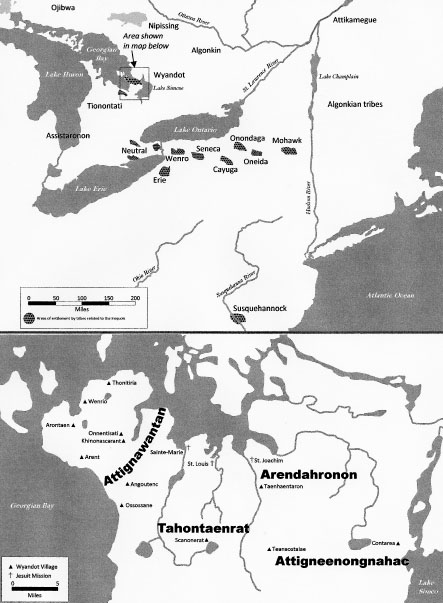
Maps indicating the location of the major woodland Indian nations and the Wyandot homeland of Wendake. Drawn by the author using data from Bruce Trigger’s The Huron: Farmers of the North and Erik Seeman’s The Huron-Wendat Feast of the Dead.
However, Wendake was much more than a mere place or even a homeland. It was also a crucial element in the Wyandot belief system and its underlying mythology.151 For them, Wendake was the center of a larger universe, and the story of its creation provides a critical basis for understanding their concept of the connection between the physical and spiritual worlds, as well as their own unique sense of morality, good and evil.
The Wyandot believed that, in the beginning, a female spirit named Aataentsic lived in the sky with other spirits. One day, as she worked in her fields, her dog saw a bear nearby and began to chase him. Aataentsic ran after her dog and the bear but, in the process, she fell into a hole and plunged out of the sky down to the watery world below the spirit realm. The large turtle that lived in waters below saw her falling and called on the other aquatic animals to help him save her, telling them to gather soil from the seabed and place it on his back. The other animals responded to the turtle’s pleas, and in short order, they had created an island on his back where Aataentsic gently landed.
As it would turn out, Aataentsic was pregnant when she fell from the sky and soon gave birth to a daughter who magically became pregnant as well but died giving birth to twin sons, Tawiscaron and Iouskeha. Aataentsic raised her grandsons to manhood, but as they grew up, the two boys’ personalities diverged, with Iouskeha becoming something of a malevolent troublemaker, while his brother was gentle and very benevolent. As a result, the twins began to quarrel, and eventually, they battled to the death. Using a sharp set of deer antlers, Iouskeha wounded his brother and then chased him down and killed him. However, Tawiscaron’s death was not totally in vain, as his blood droplets became flint, from which the Wyandot could make axes and arrowheads.
Following Tawiscaron’s death, Iouskeha, representing the sun, and his grandmother, Aataentsic, being the moon, returned to the sky. There, grandmother and grandson lived much as the Wyandot did below, in a village surrounded by cornfields, forests and lakes, which became the village of the dead. The village of the dead was said to be far to the west and was the final destination for human souls after death. Unlike Christians, however, the Wyandot did not believe in one afterlife for the “good” and another for the “evil.” In fact, they did not see good and evil as two forces in battle but, rather, as two natural elements of life that provided balance for all living things.
For example, from their village in the sky, Iouskeha and Aataentsic influenced the lives of humans below. Following his brother’s death, Iouskeha adopted much of Tawiscaron’s innate goodness, and it was he who created the animals that provided food for the Wyandot, and as the sun, he delivered good weather and warmth. Meanwhile, his grandmother, Aataentsic, often worked to spoil Iouskeha’s good works by bringing bad weather, disease and death. As such, she was a spirit to be feared. For that reason, when she took human form (personified by a dancer) and made her appearance at Wyandot feasts, the people would shout insults at her.152
This duality, as well as the one involving Tawiscaron and Iouskeha, was a critical feature of the Wyandot belief system. Tawiscaron was seen as benevolent and his brother the opposite, with Aataentsic being fonder of the more malevolent brother. They were the twin forces of creation, with good and evil required to keep the world in equilibrium. After Tawiscaron’s death, Iouskeha took up the task of balancing the world with his grandmother. Therefore, rather than the Judeo-Christian belief of an absolute good and an absolute evil, the Wyandot saw the moral universe as being far more complex and much more like life itself. In fact, they viewed the idea of both an absolute good and an absolute evil as equally dangerous concepts, for either would throw the world out of the balance needed to sustain life. In their eyes, humans had to have adversity in order to live. The Wyandot, like most of the other Indian nations of the woodlands, saw the universe as a circle in which life triumphs without eliminating death and takes place within a world that is not only beautiful and good but also bleak, mysterious and, at times, dangerous.153
Furthermore, in the Wyandot view of the universe, humans were not the only creatures imbued with souls. For them, the birds, fish, deer and all living animals had souls as well. Therefore, they held rituals before and after hunting, with those coming after an animal was killed in the hunt seen as especially important. If this was not done, the spirit of the animal would be unhappy and might return to this world to tell all the other creatures of the forest and waters not to cooperate with Wyandot hunters and fishermen. Because of this belief, Wyandot rituals revolved around displaying an honest respect for animal bones, which is where they believed the animals’ souls existed.154
However, the Wyandot view of souls did not stop with humans and animals—for them inanimate objects such as rocks and water possessed souls as well. Although historians and ethnologists are uncertain if this belief meant every grain of sand or snowflake had a soul, they do know that large, powerful or otherwise unusual objects were believed to have their own spirits. Eric Seeman writes, “If a Wendat traveling through the forest found a stone shaped like a spoon or a pot, he was likely to keep it as a charm. This, he believed, had been lost by a spirit who lived in the forest, and the item itself had a soul that would allow its bearer to connect with the spirit world.”155
These beliefs persisted even after the Wyandot were exposed to Christianity in the early seventeenth century by first the Recollets and then the Jesuits. In fact, the Wyandot became convinced that the white man was the product of a different creation entirely, and they later came to tell a legend of the battle between the god of the red man and that of the white:
We are Indians, and belong to the red man’s God. That Book [the Bible] was made by the white man’s God, and suits them. They can read it; we cannot; and what he has said will do for white men, but with us it has nothing to do. Once, in the days of our grandfathers, many years ago, this white man’s God came himself to this country and claimed us. But our God met him somewhere near the great mountains, and they disputed about the right to this country. At last they agreed to settle this question by trying their power to remove a mountain. The white man’s God got down on his knees, opened a big Book, and began to pray and talk, but the mountain stood fast. Then the red man’s God took his magic wand, and began to pow-wow, and beat the turtle-shell, and the mountain trembled, shook, and stood by him. The white man’s God got frightened, and ran off, and we have not heard of him since.156
Perhaps the most important product of the Wyandot belief system was that no creature of this world was in any way superior to others. In their eyes, men did not have any right to a natural superiority over women, and humans did not hold a higher rank than the animals. For the Wyandot, equilibrium and balance were critical elements in the foundation of life, of all creation. Everyone and everything on the planet were equals, and all had their role to play in the great sacred Circle of Life. Given the nature of this strong spiritual heritage of equality, it is not surprising that, prior to their first contact with the Europeans, the Wyandot were utterly unaware of the concept of human exploitation aimed at the subjugation of others and the accumulation of power by one group “to the detriment of the majority, whose lot in life, condition, and even religion must thereafter be that of acquiescence, or indeed the culture of poverty and destitution.”157 Sadly, Europeans would teach them a very painful lesson in this regard.
Another critical aspect of the Wyandot belief system and their creation mythology was the idea of the centrality of the Wyandot race. They believed that they were the first people created on the “island,” and therefore, their nation was at the center in the family of all nations. In 1837, the Wyandot chief Oriwahento would say, “When all the tribes were settled, the Wyandots were placed at the head.”158
Interestingly, there was much fact from real life that lent credence to this idea. When the French first encountered the Wyandot in Wendake, they occupied the position of the chief people in the political and economic hierarchy of the northern woodlands nations. As such, they held sway over what was the most widespread and unified trading network in North America. In addition, the Wyandot language served as the standard, the lingua franca, for trade and diplomacy among at least fifty Native American nations.
Even long after the Wyandot were driven from Wendake, the other nations looked up to them and always allowed them to be the keeper of the sacred council fires. In 1721, the Jesuit historian Pierre Francois Xavier de Charlevoix wrote, “The [Wyandot] nation is almost defunct, and they are reduced to two mediocre villages that are very distant from one another, yet they continue to be the moving spirit in all the councils when matters of general concern are being discussed.”159 Furthermore, even the Americans would know of and understand the Wyandot’s place among the Indian nations. In 1795, following the American victory at Fallen Timbers, representatives of twelve Indian nations met with General Anthony Wayne to sign the Treaty of Greenville, which ended the woodland tribes’ long struggle against the tide of western expansion. At the conclusion of the conference, General Wayne handed over a wampum belt with a stripe of white beads running down its center, which represented the “roads” to the “Fifteen Fires” of the fifteen United States. In doing so, Wayne referred to “your uncle the Wyandot” saying, “I place it…in your uncle’s hand, that he may preserve it for you.”160
When the Jesuits arrived in Wendake, they found four nations that formed the Wyandot Confederacy. The oldest of these were the Attignawantan and Attigneenongnahac, whose names roughly translate to “Bear Nation” and “Cord Nation,” respectively. In addition, there were the Arendahronon, or Rock Nation, and the Tahontaenrat, or Deer Nation. Like the Five Nations of the Iroquois Confederation, the Wyandot Confederacy seems to have been formed for strategic reasons during the sixteenth century. All four nations had strong cultural and linguistic links, and they probably deemed it wise to unify themselves against potential outside enemies.161
The confederacy was a key factor in the Wyandot’s prosperous trade enterprise because it eliminated any undue internal competition, allowing Wendake to become known as a great clearinghouse for trade among the woodland Indians. Tribes from the north would travel there to deliver beaver, marten and arctic fox pelts in exchange for corn, which they could not grow in the higher latitudes. Meanwhile, tribes from the south of Wendake brought tobacco, which they exchanged for the warm northern furs.
However, what is perhaps most interesting about this great trade process is that the Wyandot never appeared to seek a profit. Although they clearly wished to obtain basic necessities as well as certain luxuries, their primary goal was to use trade as a foundation for peaceful relations with other Indian nations. Therefore, they did not try to achieve the best “price” for their goods but, rather, used the trading process to create a mutually beneficial dependence among the various nations while maintaining positive communications and reciprocal ties.162
These Wyandot tribes were a powerful force in the region, living in twenty-five villages, each with a population that varied from approximately 500 to 1,500 people. There are a variety of figures used to characterize the size of the Wyandot population when the Jesuits arrived in the early seventeenth century, but the most likely number was between 22,500 and 25,000 people.163
Amongst the four Wyandot nations, there existed a social and political structure based on kinship relations grounded in the nuclear family. Each Wyandot belonged to one of the four nations, as well as one of eight clans called yentiokwa, each of which were named for various animals: Bear, Deer, Turtle, Beaver, Wolf, Sturgeon, Hawk and Fox.164 Through these clans, the confederacy was woven into a single, unified political fabric. The Wyandot in one clan within a particular nation were tied to those of their clan in another nation, and these bonds, while essentially artificial, were as real as if they were blood ties. In fact, they were seen as more important than the bonds of a blood relationship, as they were a kinship “desired and dictated” through dreams and visions by guardian spirits. In other words, clans were “conceptualized” as kinship groupings, with members sharing a common name and claiming descent from a particular ancestor. However, there is no evidence that clan members shared any real biological or genealogical relationship. Therefore, clan kinship superseded all ethnic lines and provided a source for harmony and peaceful resolution of conflicts, as even enemies felt themselves to be kin via clan memberships and alliances.165
These clans were also matriarchal in nature, and any single individual belonged to the same clan as his or her mother. Marriage, furthermore, could never include members of the same clan, even if they were from a different tribe, nation or confederation. As a result, marriage always took place between the members of two different clans and served as a means of linking clans together, which helped create new alliances and ensure friendship. Again, even through marriage, the Wyandot sought to build a complex community via means that helped ensure harmony and prevent conflict.166
Clans played their primary political role within the village, where they constituted the basic level of government. Across the Wyandot, there were four levels of government: the lineage (the segment of a particular clan within the village), the village, the nation and the confederacy. Each lineage, which consisted of about ten matrilineages called ahwatsira, included between 250 and 300 individuals. Every lineage in the village chose a chief of civil affairs and a chief of defense, with the older women, the Clan Mothers, playing the most influential role in the selection process. The key characteristics of the men selected to be chiefs were intelligence, oratorical skill, willingness to work, popularity and courage, and the women of the lineage could dismiss the chief at any time if they thought his performance unsatisfactory.167
The village then formed a council composed of the various lineage chiefs as well as elders from the tribe, known as atiwanens. These councils often met on a daily basis, and although all matters were decided via consensus and no chief had any superiority over the others, one of the lineage civil chiefs would act as the village chief. This position was usually hereditary in nature, and it carried no real authority. Rather, the village chief served as the spokesman, the voice of the community, and it was he who announced the decisions of the village council.168
At the national level, all the village lineage chiefs met as a council, and one person, based on heredity, would act as the principal chief for the people of the nation. Again, this chief had very limited powers and could not be considered equivalent to a European head of state. Interestingly, at the highest level, that of the Wyandot Confederacy, the ruling council was formed from only the civil chiefs of the various nations, indicating they viewed their deliberations to concern primarily matters of peace and not war. The confederacy also had a principal chief, and this man would come from the Attignawantan nation, as it was seen as the senior member of all the nations.169
Furthermore, it is important to understand that, among the Wyandot, a chief was seen as someone who surrendered his own will to that of the people. Their concept of a chief was of a man obliged to submerge his own personality and personal interests in favor of the people he serves—his duty was to incarnate the spirit of the community.170 As Bruce Trigger, the noted Canadian anthropologist, would state:
[Wyandot] chiefs had no constitutional authority to coerce their followers or to force their will on anyone. Moreover, individual [Wyandots] were sensitive about their honor and intolerant of external constraints, and friends and relatives would rally to the support of someone who believed himself insulted by a chief. Overbearing behavior by a chief might, therefore, encourage a violent reaction and lead to conflicts within or between lineages. In the long run, chiefs who behaved arrogantly or foolishly tended to alienate support and would be deposed by their own lineages. The ideal chief was a wise and brave man who understood his followers and won their support by means of his generosity, persuasiveness, and balanced judgment.171
In 1634, French Jesuit priests arrived in Wendake, established a mission and, in doing so, doomed the Wyandot Confederacy to eventual destruction. Champlain had first brought a group of Recollet priests to Wendake in 1623, but their missionary efforts among the Wyandot quickly failed, primarily because their approach demanded that the Wyandot not only accept the Christian god but also abandon all their customs and culture in favor of those of European Christianity. The Jesuits, on the other hand, employed an approach to conversion that showed greater tolerance toward Wyandot culture. So long as a custom did not directly contradict the teachings of the Catholic Church, the Jesuits did not attempt to either eliminate or reform it.172
Using il modo soave, or the “gentle way,” the Jesuits were very successful in their efforts to convert many of the Wyandot to their faith, despite the fact that the Wyandot tended to view them with great curiosity and no small amount of amusement. Outfitted in their distinctive black Jesuit vestments, the Wyandot referred to the priests somewhat derisively as “Black Robes.” These robes were seen by the Wyandot as not only effeminate but ridiculously impractical for a life in the wilderness, as the wearer had great difficulty walking in the dense woodlands, much less climbing in and out of canoes. Further, Wyandot men, who had sparse facial hair and made an almost religious habit of pulling out those few hairs they had with shell tweezers, found the Black Robes’ beards thoroughly disgusting. Moreover, for a race whose culture encouraged the free exploration of sexuality among their unmarried adolescents, the Jesuits’ celibacy seemed both highly curious and more than a little ominous.173
However, as the Jesuits spread their faith, they also sowed the seeds of factionalism among the nations of the confederacy. In the process of conversion, the Black Robes created deep divisions in village communities whose very foundation was built on unity, consensus and tolerance. Converts and traditionalists now began to argue violently and openly, undermining the consensus decision-making process that was the hallmark of Wyandot society. Elders began to lose influence, and village communities, as well as the overall Wyandot community, saw their unity of purpose and corresponding ability to respond to crisis erode away.174
While the erosion of cohesion among the Wyandot might be seen as an “intangible” sort of damage, the Jesuits and other French colonists proceeded to inflict a far more real means of calamity on the Wyandot: disease. In 1634, the first French children arrived in Quebec, and Wyandot traders who visited there during the summer soon became sick with measles and smallpox. Returning to their home villages, they spread sickness like a wildfire in the forest. According to one Jesuit, the symptoms of the illness were severe: “This sickness began with violent fever, which was followed by a sort of measles or smallpox, different, however, from that common in France, accompanied in several cases by blindness for some days, or by dimness of sight, and terminated at length by diarrhea which has carried off many and is still bringing some to the grave.”175 Before the epidemic in this Jesuit’s village ended later that winter, 20 percent of the tribe’s population was dead.
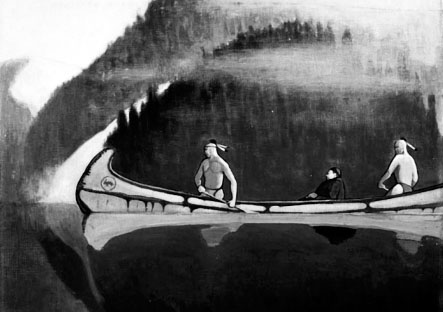
A “Black Robe” travels via canoe to a mission in Wendake in J.C. Hennessey’s painting, Jesuit Missionary en Route. Library and Archives Canada.
Within weeks, these virgin soil diseases touched every longhouse in every village, except, of course, those of the Black Robes, who appeared to have an almost supernatural immunity. Rather than comfort the Wyandot, the Jesuits tried to use this calamity to their advantage, telling the Wyandot that this was a sign of their god’s power and unhappiness that so many clung to their old beliefs, a story many of the Jesuits honestly believed. One of the priests wrote, “With the Faith, the scourge of God came into the country; and, in proportion as the one increased, the other smote them more severely.”176
In response, some Wyandot leaders accused the Jesuits of bringing these calamities to Wendake by encouraging their people to abandon the beliefs that had sustained them for centuries. Father Paul Le Jeune wrote to his superiors that the Jesuits were trying
to disabuse the people of the rumors spread by some Huron Apostates, who attribute to the Faith all the wars, diseases, and calamities of the country. They allege their own experience in the confirmation of their imposture; they assert that their change of Religion has caused their change of fortune; and that their Baptism was at once followed by every possible misfortune. The Dutch, they say, have preserved the Iroquois by allowing them to live in their own fashion, just as the Black Gowns have ruined the Hurons by preaching the faith to them.177
By 1640, repetitive waves of European diseases had killed almost 60 percent of the Wyandot population in Wendake, leaving only about ten thousand survivors.178 In only six years, a thriving, powerful and prosperous people had been devastated by internal dissent and external bacteria, all sown by the supposed benevolent agents of civilization and the Christian faith. This disaster might have been enough to finish off any society, but the Wyandot now faced a new and even more deadly threat from the Iroquois Confederation.
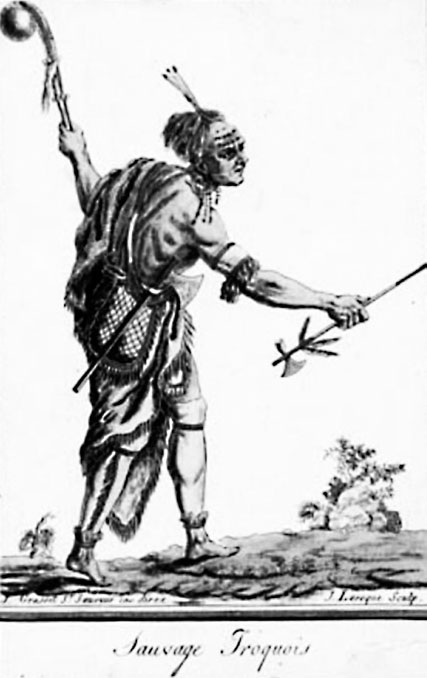
This eighteenth-century drawing depicts a “savage” Iroquois warrior, like those who attacked the Wyandot in their Wendake homeland. Library and Archives Canada.
As discussed in an earlier chapter, because of their growing fur trade and the decimation of the beaver population from over-trapping in their own territory, the Iroquois began to covet the beaver in the hunting grounds of neighboring nations. This desire was even stronger when the Iroquois looked west to the Wendake. The Wyandot, as stated earlier, were master traders, and as a result, their success drew the Iroquois’ ire. What began as a series of small raids in 1640 exploded into open warfare in 1648 when the Iroquois attacked the village of Teanaostaiae and the mission of St. Joseph. In the resulting fighting, the Iroquois killed almost seven hundred Wyandot, as well as the Jesuit missionary, Father Antoine Daniel.179
The following spring, the Iroquois returned in mid-March, surprising the Wyandot with such an early offensive. Unbeknownst to the Wyandot, a force of some 1,200 Iroquois, mostly Seneca and Mohawk warriors, had spent the entire winter near Lake Ontario, just south of Wendake. As a result, when they attacked the village of Taenhatentaron on March 16, there were no warriors in the palisade watchtowers to give warning. The Iroquois took the village against virtually no resistance, and four hundred inhabitants were either killed or captured. The Iroquois then moved on to the mission village of St. Louis, where they met stiffer resistance from an assembled force of eighty Wyandot warriors. Nevertheless, the Iroquois were soon victorious and either killed or tortured the remaining survivors, including two Black Robes.180
This pattern of Iroquois attacks and Wyandot defeats continued for the next three years. The Iroquois executed a carefully developed strategy designed to exploit Wyandot weaknesses. The Wyandot fought bravely, but in reality, they had lost before the Iroquois even launched their offensive. The seeds of their defeat were sown by the Jesuits, fortified by the diseases the colonists of New France carried among them and brought to blossom through the fratricide caused by an alien religion.
By 1653, the great Wyandot Confederacy was dead, its people driven from their beautiful Wendake forever, and they began decades of wandering in search of a new home. Some would go to Quebec and place themselves under the protection of the French garrison, their descendants being known today as the Hurons of Lorette, while others fled to the Neutrals, the Erie, the Tionontati and other non-Wyandot nations. When some of these nations, such as the Tionontati, were also attacked by the Iroquois, they and their Wyandot guests took refuge on the islands of Lake Huron. For the rest of the surviving Wyandot, their course of wandering led them to Michilimackinac; Manitoulin Island; Green Bay; the Potawatomi; the Illinois; the neighborhood of the Ottawa on Chequamigon Bay, on the south shore of Lake Superior; and again to Michilimackinac. By the late seventeenth century, many had moved to Detroit and the Sandusky River region of Ohio. Here they settled at last, eventually claiming the entire Ohio Country as their own, and here they remained until they left for Kansas in 1842, the last Indian nation exiled from their homes in Ohio.181
VILLAGE LIFE
By the time Phebe arrived in the village, the Wyandot had been in that region of Ohio for almost forty years, but most of their customs and way of life remained unchanged from their days in Wendake. What might have seemed most remarkable to her were the roles of men and women in Wyandot society. Having lived all of her twenty-four years in a patriarchal society where the roles of women were marginalized and the world revolved around decisions made by men, Phebe now found herself in a community where women were not only revered but where they were also the dominating influence in the community’s decision-making process. Although the men might hold all the public offices, the women of the village placed them in those offices and the women could dismiss them, as well. If a war chief wanted to take a teenage boy away from the village, they had to obtain permission from the women of the boy’s lineage. To be sure, women’s daily duties involved the care of children, cooking, maintenance of the longhouse, sewing and working in the fields, while men hunted, fished and performed heavy manual labor, much as in European society. However, there was still an important, innate difference between the worlds of settler and Indian. In Wyandot society, women were seen as the very heart of the community. The men might kill to provide necessary subsistence and material needs, but the women of the Wyandot community nurtured it and provided spiritual culture, which was considered of the utmost importance in Wyandot life.182
As for the village itself, it likely covered about two acres, all surrounded by a strong palisade consisting of as many as three to four rows of stakes arranged in a rough oval around the village. Outside the palisade were acres of cornfields that surrounded the village. Most Wyandot settlements contained about two dozen longhouses, called yannonchia. Each of these were windowless structures about 150 feet long, although archaeologists have unearthed some that were as long as 250 feet. While longhouses appeared shaggy and dilapidated to the naked eye, they were actually marvels of construction. Built on a wooden frame and covered with slabs of bark, they had to be strong enough to withstand the gale-force winds and heavy snowfalls of a Canada or Ohio winter. As a result, their walls employed vertical support poles, sharpened at one end and pushed or twisted into the ground down to a depth of two to three feet. These poles were then reinforced with horizontal ones that were lashed to them with either shredded bark or rope, and both types of poles were approximately two to four inches in diameter. The roof of the longhouse consisted of additional poles attached to the uprights and then bent to form a semicircular arch. The entire frame was covered with slabs of bark, which had been either soaked or steamed to make them more pliable.183
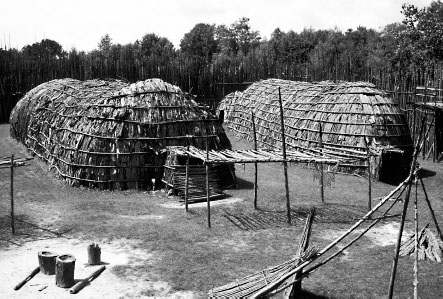
This photo shows a re-created Wyandot longhouse at “Ska-Nah-Doht” Huron Village, Longwoods Road Conservation Area, Delaware, Ontario, Canada. This modern re-creation is probably similar to the one in which Phebe Cunningham lived during her three years as an adopted member of the Wyandot. Courtesy of James P. Rowan.
Once Phebe entered the Wyandot village, her status and future had to be determined. When she told her story to her granddaughter, Phebe said that the village chief was a kind, elderly man named Darby, and in fact, today there is a Little and Big Darby Creek as well as the Darby township in Ohio that are his namesakes. She added that she “was not treated badly after she became acquainted with the Indians and their white captives, some of whom became her friends.”184 Interestingly, Phebe apparently said nothing else regarding her time with the Wyandot, although some nineteenth-century accounts say she was given to the dead warrior’s family as a servant but not adopted. From what is known about the Wyandot culture, this is extremely unlikely, and therefore, it is almost certain that she was adopted.
Why Phebe did not tell anyone about her life and likely adoption is probably related to the racism and social mores of her times. It was one thing for a man to relate his stories of being adopted into the tribe and of being accepted into the warrior culture, but for a woman, matters were different. To the typical white settler, uneducated in the culture of the Native American world, adoption might imply she became the property of a male with all the sexual rights that might entail. In a society where many said any white woman should prefer death to suffering the sexual “depredations” of a savage, it is understandable, perhaps, that she was reluctant to add any detail to her story. Of course, as we now know, no Wyandot male would have ever forced himself on her. In the Wyandot community, sexual activities by unmarried members of the tribe were common and even encouraged, but they were virtually always consensual, and rape was almost unknown.
What did almost certainly happen upon Phebe’s arrival in the village was a decision by the Clan Mothers to adopt her. While these elder women of the community might deliberate her fate, adoption of women and children into a Wyandot tribe was essentially automatic. Furthermore, given the Wyandots’ love and care for their own children, it is hard to imagine that, once they learned the fate of Phebe’s children, the women of the village could not help but feel some empathy for her. The story that Phebe was given to the family of the dead warrior makes sense, as the Wyandot typically would give captives over to adoption by families who had lost members during a raid. In fact, in some cases, when a captive woman was given to a family to replace a lost female matriarch, the new adoptee would actually assume the role of her predecessor and be the leader of her longhouse.185
Phebe then would go through the adoption rituals. First, she would be required to run a gauntlet composed of the village women. Her gauntlet most likely consisted of two parallel lines of women, who stood facing one another with just enough space between the lines for her to run. The length of any particular gauntlet varied based on the size of the village, but at times it could be several hundred yards long. At the end, there would be an objective to reach, usually a council house, a village chief or some specific object. As Phebe ran the gauntlet, the women struck her with fists, clubs, switches and briars. However, the thrashing a woman received would typically be much lighter than that administered by warriors on a male captive. This process was not seen so much as one in which anger and grief were expressed but, rather, one in which the women were beating the “whiteness” out of Phebe.186
Although Phebe said she was not allowed to wash at first, a ritual bathing would be the next step in the adoption process. She would have been taken down to the stream near the village where the women of her new longhouse home would plunge her into the water, then wash and rub her severely. As one chief explained to a male captive, this Indian “baptism” was necessary to ensure “every drop of white blood was washed out of your veins.”187
With the bathing finished, the transformation into Wyandot society was completed by dressing Phebe in Wyandot clothing. For a woman, this meant wearing moccasins on her feet, along with a deerskin cloak, breechclout and skirt, with the latter extending from the waist to partway up the knees. The only exception to this attire would come the following summer, when most Wyandot women left their bodies bare from the waist up.188 One can only imagine what Phebe’s reaction was to that particular custom.
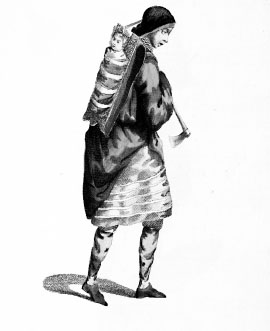
This mid-eighteenth century drawing depicts the clothing of a Wyandot woman. New York Public Library.
After that, Phebe would be accepted into her new family, living in the longhouse and working alongside the other women of her adopted lineage. At first, she likely was exposed to brief periods of abuse and hard labor that alternated with periods when she was treated affectionately as a family member.189 Soon, however, as she proved herself worthy, she would be embraced, loved and cared for as though she was a Wyandot by birth.
Phebe’s life with the Wyandot almost certainly included working in the fields, a task she was familiar with from her life as a settler. While Wyandot men were responsible for clearing the farm fields, once that was complete, all farming activities fell under the authority of the village women, and they performed all the agricultural labor. They loosened the soil with hoes, planted the seeds, pulled weeds and harvested the crops. These crops usually included corn, beans and squash, all of which were grown in the same fields, using cornstalks as poles to support the bean plants. Furthermore, Wyandot women displayed great insight and detailed technical farming knowledge. For example, to combat the danger posed by late spring frosts, they planted their squash seed in bark trays filled with powdered wood, which they kept near the fires in the longhouses. After the seeds had sprouted, they transferred the young plants to the fields.190
If there were no signs of potential raids by the white militia, women would sometimes leave the village with their children during the early weeks of summer to live in small cabins near the fields. These cabins were essentially smaller versions of the longhouses, and each one belonged to a different lineage. As the warm summer days went by, Phebe and the other women worked hard to keep the fields weeded, as the children made sure any birds or small animals were kept away. In just over three months time, the corn would grow to over six feet high, bearing two or three ears each, with each ear producing between 100 and 650 kernels. In early September, the Wyandot women harvested the corn, pulling the leaves back and bundling the cobs, which were hung from poles under the roof of the longhouse to dry. When dry and ready for storage, the women cleaned and shelled the corn before storing it in large vats.191
Besides farming, Phebe would have also participated in gathering activities that supplemented the food grown in the fields. Many varieties of berries were collected by the women of the village, with some being dried for use in the winter, as treats for the sick, to add flavor to otherwise bland corn porridge called sagamité and to put into small cakes they baked in ashes. Acorns, which were boiled to remove their inherent bitterness, as well as walnuts and grapes, were also common items on the Wyandot menu.192
As might be expected, cooking also fell into the Wyandot woman’s list of responsibilities. Again, while this was certainly not an unknown chore to Phebe, some of the items cooked and their unique preparation were probably new to her. Although some summertime meals were cooked outside, most meal preparation took place at the family fireplace inside the longhouse. As with the fireplaces of colonial settlers like Phebe, these hearths were kept active constantly. If a new fire had to be made, it was done by rubbing one stick inside the hollow of another. Despite the fact that the entire extended lineage family lived within the same longhouse, the two daily meals consumed by the Wyandot were always cooked and eaten separately by each nuclear family.193
Of course, corn was the staple of the Wyandot diet. The corn that had been dried by the Wyandot women of the longhouse was either pounded into flour using a mortar hollowed out of a tree trunk and a pole about six feet long or else ground between two stones. The best and most grit-free flour was produced using the wooden mortar.194
Although the Wyandot prepared a variety of dishes, much of their cuisine revolved around a few essential items. Their most common food was the sagamité, which they made by boiling cornmeal in water. They would add a little variety to this otherwise dull dish by including bits of fish, meat or squash. Fish, either whole or cleaned, were boiled for a brief period, then pounded into a mash and returned to the pot to complete cooking, with no attempt made to remove the bones, scales and entrails. During special feasts, Wyandot women would prepare a thick corn soup and serve it with fat or oil poured over it. They also cooked a soup made from roasted kernels of corn mixed with beans, as well as another from andohi. The latter was regarded as a delicacy, consisting of immature ears of corn fermented for several months in a stagnant pool of water.195
The Wyandot also made unleavened bread, cooked under the ashes of the longhouse fires. The bread dough was first rolled into cakes a few inches long and often included dried fruit and small bits of deer fat. The cakes were then either wrapped in fresh corn leaves for baking or placed directly into the ashes. When using the latter cooking method, the bread was washed before it was eaten. In the summer, the women also made a special bread from fresh corn, which they first masticated and then pounded in a large mortar. The resulting soft paste was wrapped in corn leaves and baked.196
While all this might not have seemed too alien to Phebe, cleanliness and general meal decorum was probably something to which she had to become accustomed. First, the Wyandot did not wash their hands before eating. However, if their hands became greasy during the meal, they might wipe them on their hair or the fur of a nearby dog. In addition, they seldom cleaned their cooking and eating utensils, although each person appears to have had his or her own spoon and bowl. Finally, it was considered completely appropriate to belch without inhibition during meals.197
The women of the longhouse were also tasked with gathering and splitting all the firewood required for cooking and heating. The best wood was usually available after a winter storm knocked any dead limbs from trees. During two days in March or April, the women from each village would help one another collect all the wood needed for the following year, which they tied in faggots and carried back to the village on tumplines.
Lastly, Phebe and the other women were responsible for maintaining the interior of the longhouse. This could be a daunting job given that anywhere from eight to ten families lived in the longhouse, with each family having its own sleeping area and a hearth they shared with one other family. As a result, the space inside became quite confining, especially during the long winters. The women would regularly sweep the houses but the presence of smoke, dogs, vermin and young children who openly urinated on the floors made cleanliness a great challenge. Despite the care taken to ensure a dry wood supply that was smoke-free, smoke was still produced and not all of it escaped as planned through the holes in the longhouse roof. As a result, eye diseases were common, and many of the elderly members of the tribe became blind in their later years. Large numbers of dogs also roamed freely inside the houses, knocking over and often breaking cooking pots and then helping themselves to whatever food they might be able to reach in the process. It is not surprising, therefore, that mice, lice and fleas were also a common problem.198
The longhouses were somewhat Spartan in their furnishings. Sheets of bark, supplemented in the winter by a large leather hide or blanket, covered the doorways. Simple mats served as both seats and mattresses, and each person had his or her own. When spread out, a mat designated that person’s place in the longhouse. Benches usually ran along either side of the house, and most work was performed either sitting or squatting. Fire was an omnipresent danger, so the Wyandot placed their most valued possessions in boxes and buried them in shallow pits both inside and outside the longhouse.199
Nevertheless, the longhouse was more than merely shelter to the Wyandot. For each clan lineage, it was the center of their family, a place shared with generosity despite the confining space, where harmony and peace was the rule. In many ways, despite the fact that it certainly was not an easy life, Wyandot society provided what could be an almost idyllic existence. One female settler who spent much of her adult life as an adopted Iroquois would later write, “Their lives were a continual round of pleasures. Their wants were few, and easily satisfied; their cares were only for to-day; the bounds of their calculations for future comfort not extending to the incalculable uncertainties of to-morrow. If peace ever dwelt with men, it was in former times, in the recesses from war, amongst what are now termed ‘barbarians.’”200
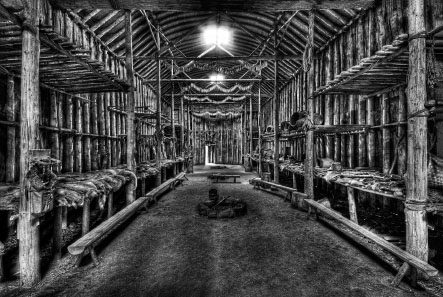
This photo of a re-created Wyandot longhouse at Campbellville, Ontario, Canada, shows the interior of the longhouse, where all the clan members within a Wyandot village lived together. Courtesy of Tom Freda.
Even the colonial farmer Crevecoeur speculated, “It cannot be, therefore, so bad as we generally conceive it to be; there must be in their social bond something singularly captivating and far superior to anything to be boasted among us…There must be something more congenial to our native dispositions than the fictitious society in which we live.”201
Among these people and within this world, Phebe would spend the next three years of her life. She was, for all intents and purposes, a Wyandot and, most likely, a valued family member. However, deep inside, she longed for her old life and for her husband, and she probably dreamed of finding a way home. In the meantime, she persevered, harbored hope and remained resilient. Unbeknownst to her, the way home would appear one day, and it would do so in the form of two of the most legendary American villains of her time.