
Once upon a time, there was a young couple. They were married, had children, lived their lives. They started out in the front row of family pictures. Then moved to the middle, where they posed behind their children. Then, before they had time to note the change, were pushed into the last row, the place reserved for matriarchs and patriarchs. A step back and they’d tumble out of the frame altogether.
After living in Brooklyn, Long Island, New Jersey, Libertyville, Glencoe, Washington, and Miami Beach—a new house or apartment in each town, a new street with new friends and new habits—they found themselves in this palm-fringed bungalow astride the third fairway of the Boca Delray Golf and Country Club. There was a player piano in the living room, a bathroom walled with mirrors—you could see parts of your body you’d never even imagined—a screened-in pool where shanked tee shots drummed down like hail.
Several of the old Warriors—excluding Larry and the West Coast contingent—were vegetating in nearby communities with opulent names. The Shangri Shalom. The Heavenly Heathen. Herbie and Ellen began gathering with these aging Brooklynites in the afternoon in this or that house or condo. They had known each other since grade school. They had been fourteen when Japan surrendered. They had lived through it all. The Cold War. Nuclear terror. Nixon and Clinton. The collapse of the Berlin Wall. Being a little old for rock and roll, they had stayed with the classics—Sinatra, Nat King Cole. When I asked Herbie how he’d missed the Beatles—he was thirty when they appeared on Ed Sullivan—he said, “I was too busy working.” They had seen America at its apex, had seen the boom and what appears to be the decline.
There were usually five or six old Warriors at these get-togethers, some of whom I’d known all my life, some of whom I’d known only from stories. Bernie Horowitz, Who Ha, who was still married to Honey and still described himself as a “manufacturer’s representative”; Inky Kaplan, who’d been only the second white student to attend the Howard University College of Dentistry; Arnie Perlmutter, who was short with supernaturally long arms, “which,” said Herbie, “is what made him such a devastating softball pitcher”; Brazie Abbate, who’d never fully recovered from the Moppo thing, was a brain surgeon with practices in Asheville, North Carolina, and Beijing, China; Mal Afchin, who’d been a great athlete in his day—he played Division 1 college basketball—and who worked for IBM; Bucko had been an army MP in Korea, a runner for the mob, a grifter, a stock car racer, a legend on the dirt ovals of the Southeast, then a real estate broker in Florida. It seemed funny, the fact that no matter what these men had done or achieved in their lives, they ended up back together, in the same place, drinking the same wine in the same marble-floored rooms. (Nothing poses a greater threat to the elderly than wet marble.) One of the wives had T-shirts made up for the men (“Aging Warrior”) and for the women (“Aging Warriors Ladies Auxiliary”).
I loved going to their events, listening to the small talk and stories. Once, when Arnie was trying to remember where he’d played YMCA basketball, he turned to Mal and said, “Hey, Mal. Do you remember that Turkish place where we had dinner a few years ago in the city? You got a stomachache and had to leave early. Do you remember the address?”
“I remember,” said Mal. “It was on Tenth Street and Second Avenue. Only it wasn’t a stomachache I had, you schmuck! It was a heart attack! Remember the large white vehicle with flashing lights that took me away?”
Ellen loved these get-togethers, then didn’t. “It’s depressing,” she told me. “Every time we go, they tell us someone else is dead.”
The last time they gathered as a group was at Mal Afchen’s funeral. The rabbi, who had not known any of the Warriors, eulogized Mal in the generic way of a clergyman working off someone else’s notes. He said Mal had been a member of a gang called the Warriors, which had a clubroom in the basement of a house owned by Larry King.
Who Ha shouted when the rabbi said this: “Bullshit! That was my house. Larry had no fucking house. Larry lived in an apartment.”
Herbie shushed Who Ha, who snapped at him, saying, “No, I won’t shush. Larry got famous, so what? Does that mean everything that happened to me gets attributed to him?”
“Hey, Bernie, who gives a fuck about your house?” said Herbie. “Let’s remember why we’re here. See that box up there? Our friend Mal is in that fucking box.”
Larry’s fame had long been a distraction. To most of the Warriors, it was exciting in the way Koufax’s success had been. It connected them to the upper world. It put the landscape of their childhood on the map. Who Ha hated it. Every mention of Larry—“Did you grow up with Larry King?” “Did you know Larry King before he was famous?”—felt like Zeke the Creek giving him the high hat. When Herbie and Larry arrived at a reunion in a hired car, Who Ha went wild. “What? You think you’re special because you got a limo? I can get a limo here in ten minutes. Let me make a call and I’ll have a limo and then I’ll be a big shot too.” Who Ha made the call. When the Warriors stumbled out at midnight, Who Ha’s car was waiting by the curb. “Now I’m a big shot too!” he said.
No. 52
Herbie finally completed his sequel to You Can Negotiate Anything. It was called Negotiate This! By Caring, but Not T-H-A-T Much. He went on tour for the book, did all the shows, including that of Dr. Phil, who wired a few average shoppers so Herbie, watching on a screen in an unmarked van, could talk them through deals, coaching them to say things like “You know what, I don’t need it after all.” Or: “Can I see a floor model?” Or: “What kind of ties will you be throwing in with this?” According to the website, “Dr. Phil sent Claire jewelry shopping with a hidden camera. Meanwhile Herbie watched from a van outside. When the saleswoman put a bracelet—costing $1,050—around Claire’s wrist, Claire commented how lovely it is. ‘Look at that,’ said Herbie. The sales woman ‘wants Claire to fall in love with this bracelet. This should not be an emotional purchase.’”
Herbie, who’d been famous in his forties, became something of a cult figure in his later years, name-checked in books and by stand-up comedians and on TV shows. He was a leitmotif in the first season of Mike Judge’s Silicon Valley. Whenever a character closed a deal, another would say, “You’re our own Herb Cohen!”
Asked by Mediaite to bring his analytical skills to pop culture, he delivered a weekly commentary on the needs, motivations, and tactics of The Real Housewives of New York City, a show he watched with an intensity he’d once reserved for televangelists. “In my time—remember, I’m an old guy—we had Mickey Rooney and Judy Garland putting on shows in a barn where there was dancing and singing,” he explained. “This show is this generation’s Mickey and Judy.”
“Luann arrives to meet Jill in a rickshaw pulled by a bike and the rider of that bike is a black guy, so now,” Herbie said after one scene, “they’ve integrated the show.”
“If you’re in a conversation and someone should walk over and publicly call you a slut and a whore,” he said, after another, “keep your composure and calmly reply, ‘That’s a lovely dress.’”
As Sharon’s and Steven’s kids progressed through high school, he became fixated—obsessed—by the question of where they’d go to college. He compiled exhaustive lists, breaking hundreds of universities down according to reputation, cost, quality. When one of his grandchildren complained, he’d talk about life and how it’s a race and how the track on which you run that race is divided into lanes and how the person in a good school starts on an inside lane while a person in a less good school starts on an outside lane and so must work harder and run faster to reach the same place.
Calling in from the next room, Sharon would say, “Is he talking about the lanes?”
He’d dreamed of sending us to Yale, which he’d idealized ever since his snowy midnight ride through New Haven with Who Ha, Larry, and Sandy. When he realized it was not in the cards, he admonished me, saying, “If you’d done better, you could’ve gone to Yale.”
“No,” I said. “If you’d done better, I could have gone to Yale.”
When his grandchildren likewise failed, he chose to live in fantasyland, telling an alumni coordinator from my high school—they were putting together a directory—that I had in fact gone to Yale.
“That’s not what we have,” she said. “We have his college as Tulane.”
“Well, you have it wrong,” he said.
“It clearly says Tulane University class of 1990.”
“If you’re so certain,” asked Herbie, “then why are you calling?”
“Just to confirm.”
“Fine. Consider it confirmed. He went to Yale.”
No. 53
I never worried about Ellen’s health. In comparison to Herbie, she seemed rock solid, bulletproof. She was always thirty-five in my mind, blasting down the expressway with Helen Reddy on the tape deck. Which is why I thought nothing of it when Herbie called to say my mother had checked into a hospital in Delray Beach with stomach pains.
My siblings and I devised a plan: they’d fly to Florida to help my father; then, if my mother was still in the hospital on Monday, I’d take their place.
At 2:00 p.m., Herbie called to say Ellen had been diagnosed with pancreatitis, which a doctor described as “painful but not serious”; with antibiotics, she was expected to recover quickly. He called back at 6:00 p.m. to say her condition had worsened. Asked to rank her pain from one to ten, Ellen said “ten”—“but that’s not unusual,” said the doctor. “She should rebound in the next few hours.” Herbie called again at 8:00 p.m. to say the doctor, confused by her failure to respond to treatment, had sent her for more tests. At 10:00 p.m., Herbie called to say the diagnosis had been changed from pancreatitis to ischemia.
“What’s that?” I asked.
“I don’t know,” he said. “Do a Google.”
I looked it up when we got off the phone.
“My father got something wrong,” I told my wife, Jessica. “He says that she has ischemia, but according to this, if she has ischemia, she’s going to die.”
My sister began calling with reports as soon as she arrived in Florida. Her voice was calm on the phone, but there was a tone of disbelief.
At noon on the second day, she called and said, “You need to fly down here.”
“When?”
“Now.”
It was less hospital than jacked-up urgent care center, a glass building off Military Trail in Delray. My family was sitting around my mother’s bed in the ICU—my father, my sister, my brother, and my father’s sister, Renee. Steven was joking, but nothing seemed very funny. My mother, who’d been coherent a few hours before, had already begun to slip away. Her eyes were open but lost and searching.
We sat around the bed and talked over and about but not to my mother. Herbie was in the corner, sitting quietly. A doctor told us what was happening—she did indeed have ischemia; she was being attacked by her own immune system—but none of it registered with me. My wife later said that each time we spoke on the phone, my news was worse, but I didn’t seem to realize it. I’d say, “The ischemia has brought on sepsis, but they’re treating it, and she’ll be home by the end of the week.” I’d say, “She’s going to need rehab, but they’re treating it, and she’ll be home by the end of the week.” You prepare yourself for the big moment, then don’t even notice when it arrives. I thought I was passing time while my mother was being treated. It was only later that I realized I was watching my mother die.
We went back to the house to get some sleep. It was the middle of the night. I don’t know what time. The doctors were going to operate in the morning. They’d fix her. She’d be home by the end of the week.
The phone woke me. I looked at the clock: 2:47 a.m. It rang and rang but no one stirred. I wandered through the dark, looking for an extension. I picked it up and said hello. A nurse told me that my mother was coding, which I later learned means her heart had stopped. “They’re working on her,” said the nurse, “you should probably get back here.”
The hospital door was locked. We banged and banged until a janitor let us in. A nurse was waiting. She said the doctors had been able to restart our mother’s heart. She was going to be okay, I told myself, she’ll be home by the end of the week.
The surgeon arrived at 6:00 a.m. He took us into the hall. He was Israeli. I don’t remember his exact words, but they were something like “Your mother is going to die. We are going to operate so you won’t feel like you left anything untried.”
We waited in the lobby while they prepped her for surgery. We were sitting in chairs along a wall. The sun had risen, but it still felt like night. The electric door opened and a clown came in. This did not seem like an official hospital clown, the sort hired to entertain kids. This clown was dirty and smelled bad. She wore whiteface and a wig of loose red curls. She scanned the room, then fixed on me. I was holding an iPhone. She grinned and said, “It looks like someone’s sad! Don’t be sad!” Taking the phone from my hand, she yelled, “SELFIE!” leaned close, turned, and took a picture. After she’d left, my brother said, “Can you please send me a copy of that picture?”
“Why?”
“I want to look at it whenever I need to remember what life is like.”
Sharon went to check on my mom, then rushed out to get us. My mother had gone back into cardiac arrest. She was coding. We stood by the bed as doctors and nurses shocked her with paddles. Each jolt sent her into the air. It went on and on. Then they stopped. A doctor looked at his watch and said, “Ten twenty a.m.” Someone wrote that down. Someone else led us to the interfaith chapel, a room with nothing in it. We stood there for a while, staring at the walls. Another nurse came and took us back to say goodbye to our mother. They’d cleaned her up. We stood around, kissing her face, then went home and started making phone calls.
No. 54
I don’t know what killed my mother. One minute she was fine; the next minute she was gone. She failed so fast. Ischemia was the ultimate cause, but what caused the ischemia? It might have been bad luck, like rolling snake eyes. Or it might have been hereditary, something in her genes. I suspect it was something she swallowed, one of the pills she’d been prescribed by one of those shady Broward County doctors. Herbie later cursed himself for not paying closer attention to her habits. He wished he’d studied the labels and intervened. But the fact is, my parents enabled each other in that stucco house in Delray. She did not judge him and he did not judge her. One night, Ellen spotted a cockroach on the wall near the ceiling. What started as my father on a stepladder with a broom ended with both of them in the hospital and the cockroach still very much alive.
No. 55
The funeral was in Manhattan. Herbie was too upset to speak. My brother, sister, and I took his place. We drove together in one car to the cemetery in Valhalla, New York. My mother had not been afraid to die. She often spoke of it as a good thing, a state of nonbeing she craved. She believed that life without death would be insufferable, that death is what makes life valuable and gives it meaning. Once, when I asked her what she thought happens when you die, she said, “Whatever you want to happen, that’s what will happen to you.”
No. 56
We figured Herbie would not survive a year without Ellen. Not only did he love her, but he relied on her; she did everything. Ordered his meals, apportioned his pills, booked his flights, bought his clothes. He did not even know how to use an ATM. He did not even own a bank card or cell phone. He had not paid a bill in fifty years. It was not grief that would kill Herbie but lack of heat or water. Or he’d forget to take his blood thinner and have a stroke. Or he’d take it, forget he’d taken in, take it again, bump into a chair, and bleed to death. He bought a roast chicken in a seedy deli a few weeks after my mother died, ate some of it, left the rest on the counter, ate that a few days later, then was rushed to the hospital with food poisoning. Here’s the first thing he said when I called: “I never would’ve eaten that chicken if your mother was alive.”
But we underestimated him. After a few months, he began to recover, even rally. He sold the Florida house and moved to Brooklyn. He was the same, but the borough had changed. He made new friends. He fell in with a social group, a clique, that, oddly, included Tony Danza. He’d advise Danza on the set list for his musical act, saying, “You want to bring ’em down in the middle, Tony, but leave ’em up at that end, which always means Cole Porter.”
He was named to the planning committee for the Feast of San Gennaro, the only non-Italian to have the honor. (“At a certain age, Italians and Jews become indistinguishable,” he explained.) He served as a judge of the big meatball-eating contest that ended the festival. (“My job is to make sure none of the winners vomit.”) He began dating a woman he met in a bereavement group. When he told us about this relationship, he did it gingerly. If he diminished her, or so he seemed to think, we would not take it as an insult to our mother. “Her name is Roseanne. She’s a little younger than me, but she will never replace your mother. Your mother was the most beautiful person I have ever known.”
When I asked if I was too old to yell, “You’re not my mother. You can’t tell me what to do,” at Roseanne, then bolt the dinner table, he dismissed me as “a wise guy.”
Most amazingly, he continued to work, fielding calls, negotiating fees, booking gigs. He lectured around the country and world, but there was a new lilt to his voice, a new resonance to his routine. He spoke with the wisdom of the old-timer whose every aphorism—“money talks, but it doesn’t tell the truth”; “the fish doesn’t know it’s in the water”—seems to possess a deeper meaning. Condé Nast hired him to teach its international staff how to negotiate in Southeast Asia. He says he loves working in China because, in China, age is considered wisdom. He trained European execs how to operate in Russia, how to deal with what he still calls “the Soviet style.” “Against a stubborn opponent,” he says, “it’s better to be stupid than smart.”
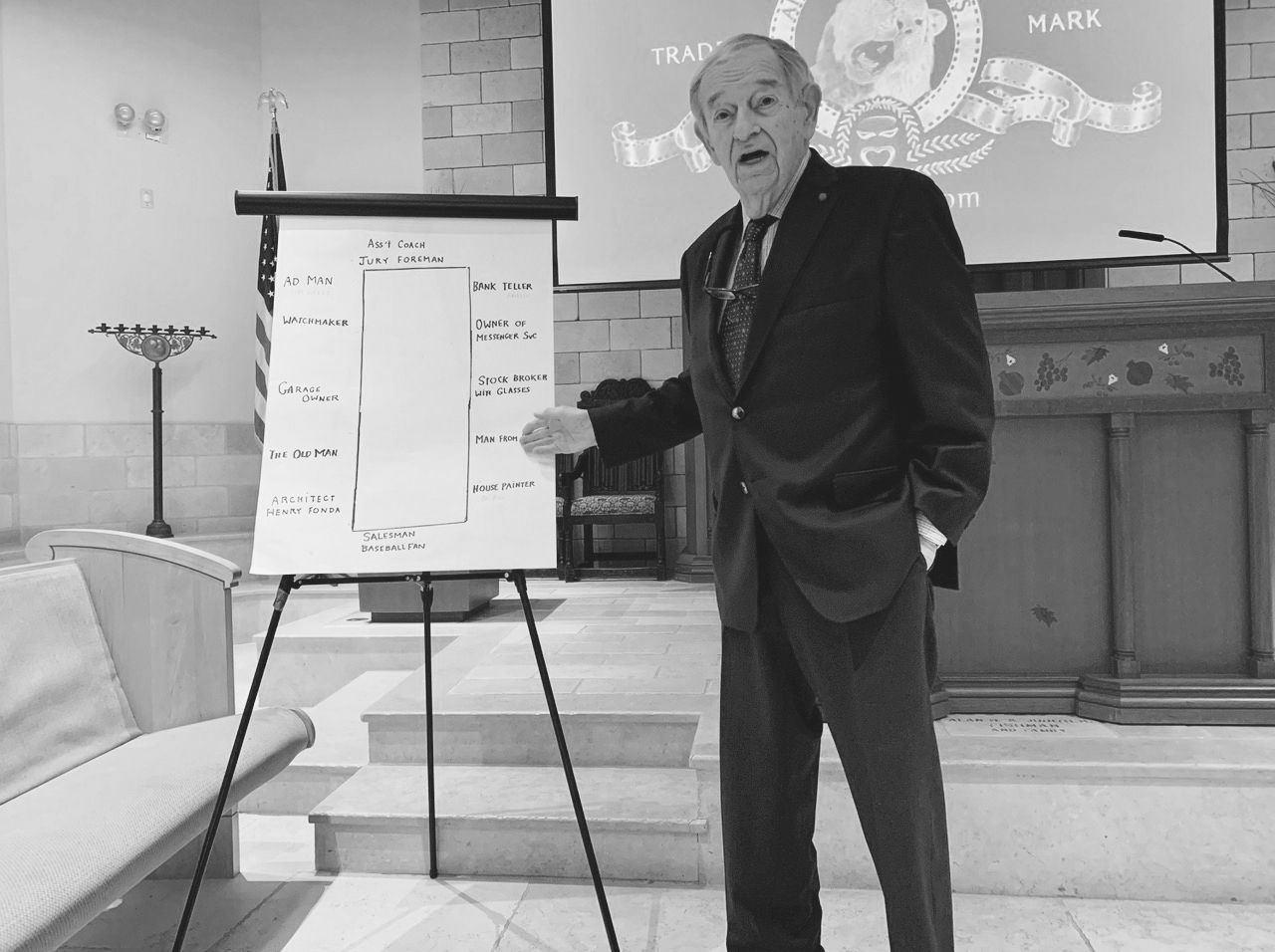
People have died all around him, but he keeps going, retooling his shtick to meet the needs of a different generation, instructing the young in the Jedi art. He’s not quite as fast as he used to be, but what’s been lost in speed is made up for in perspective. His business strategy has deepened into philosophy. He’s a Brooklyn Buddha preaching detachment: “Life is a game best played at a remove; the secret is to care, but not that much.”
My brother persuaded him to reprise his screening and analysis of 12 Angry Men for a group in Brooklyn Heights. It had been years, but according to Steven, who sent the picture on the preceding page, he was just as good as ever.
“How’d he end it?” I asked.
“You know how he ended it,” said Steven.
He kept meeting people who said his books had been part of their lives. They felt as if he’d been with them when they bought their first car, closed their first deal, tried to reason with their kids.
No. 57
I wrote a profile of Larry King for Rolling Stone in 1996. I spent a week with Larry at La Costa, the California health spa built with Teamster money by Jimmy Hoffa. Larry told me the story of his life, which is also my father’s story. Larry was coming off yet another heart procedure—the man was held together by tape, bubble gum, staples, and glue—when we spoke. He said he believed in nothing beyond this life and planned to live forever. “And do me a favor,” he added. “Let’s say I end up in a hospital, and I’m filled with tubes, and there’s no brain activity, the line is flat, and machines are keeping me alive, don’t let them unplug me! Keep everything in the wall. And if you see a loose cord, plug that in, too.”
And that’s basically what happened. Larry spent the last few years of his life in and out of hospitals. Herbie went to visit him at Cedars-Sinai in L.A. in 2019. Larry, who’d had cancer and a stroke, was in intensive care. Herbie felt sick just looking at Larry and ended up in the hospital himself, in a bed down the hall. You know it’s bad when you visit a friend and the doctors don’t let you leave. My sister, brother, and I went out to retrieve our father—it was his gallbladder—and stopped in to see Larry. He looked terrible, skin and bones. He pointed a bony finger at me and said, “Writer.”
That was the last time any of us saw Larry, including Herbie. A few weeks later, COVID broke, forcing everyone, especially octogenarians, to shelter in place. Larry died in January 2021. My father had not spoken to him on the phone in a few weeks—the longest they’d gone without talking since the 1970s.
This made my father, a man you might have picked to go early, one of only a handful of surviving Warriors. (Inky, the orthodontist, is still taking appointments.) A new kind of freedom has come with age. There are richer and more powerful people than Herbie, but no one outranks him. No one is above or beyond. He can say what he wants without feeling bad; he can do what he wants without asking permission or calculating the extended effects. Longevity, survival—these have been added to his list of accomplishments, how he’s continued to participate in the world even as everything in it has changed.
When COVID-19 swept through New York in 2020, he accepted it with equanimity.
“You’ll be fine,” he said. “Your kids will be fine. I’m the one who will probably die, and, let’s be honest, that’s no tragedy.”
The quarantine robbed us of time together, but spurred me to call him more often, to spitball, interrogate, and ask to hear all the old stories again.
Tired of skirting the big question, one day I finally just came out and asked it: “What’s the meaning of life?”
“The meaning of life?” he said, laughing. “Don’t you know? The meaning of life is that there is no meaning of life, none we can know. That’s not your business anyway. Your business is to be a decent person, raise nice kids, and keep going as long as you can.
“The meaning of life,” he said at last, “is more life.”