
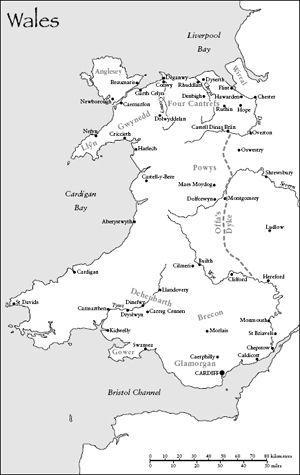
The trouble began in Wales. The view expressed in 1256 by Edward’s chief steward that everything there was progressing according to plan and that the Welsh were in the palm of his hands was, of course, the view of an insensitive and complacent Englishman. To the Welsh of the Four Cantrefs it seemed rather that they were under the heel of the oppressor’s boot. For the past decade, ever since Henry III had confiscated their homeland, they had been complaining of the unjust behaviour of royal officials, yet nothing had been done to alleviate their distress. Once the region had been transferred to Edward’s control, matters had, if anything, become worse, and it may well be that his visit in the summer of 1256 was the final straw. Until that moment the Welsh might have hoped, like the Gascons, that a new young lord would bring a turn-around in their desperate circumstances. If so, they must have been sadly disillusioned by the arrogant swagger of Edward and his gang of unruly followers. Expectations had been raised, only to be dashed. The people of the Perfeddwlad realised that they would have to look elsewhere in their search for a saviour.1
The obvious candidate was not far to seek. Across the River Conwy, the people of Gwynedd had acquired a new, dynamic and undisputed leader. Llywelyn ap Gruffudd, grandson of Llywelyn the Great, had also suffered the experience of being brought low by the English. In 1247, following Henry III’s military intervention, he had been obliged to share what little remained of his grandfather’s power with his older brother, Owain. Since that time, however, he had worked secretly and assiduously to revive the fortunes of his dynasty. Supremacy in Gwynedd itself had been assured in the summer of 1255 when Llywelyn, then in his early thirties, had defeated Owain in battle and had him cast into prison. Yet victory in arms had not solved all his problems. He still had other, younger brothers to provide for, and only a diminished patrimony that he was unwilling to divide. Llywelyn and his family needed more land, just as surely as the men and women of the Four Cantrefs needed better lordship. The result was not hard to foresee. At the start of November 1256 Llywelyn led his army across the Conwy and swept east through the area of English occupation. Within a matter of days the region was completely in his hands. Only the new English castles at Dyserth and Deganwy held out.2
The English court was at Windsor when the news broke. Henry III favoured a diplomatic response and wrote to Llywelyn expressing his surprise and disappointment. As for his son’s reaction, we have the testimony of Matthew Paris: ‘Edward was determined to check the impetuous rashness of the Welsh, to punish their presumption, and to wage war against them to their extermination.’ Such intentions, though, were frustrated by the onset of foul weather. ‘The whole winter that year,’ Paris explained, ‘was so wet and stormy that the entire country of Wales … was utterly inaccessible to the English, and thus Edward’s labour and expenditure of money were fruitless and of no avail.’3
Money was, in fact, the truly insurmountable problem. Edward had immediately recognised that his own financial resources would be insufficient for a war in Wales. His first instinct had been to rush to his uncle, Richard of Cornwall, who had furnished him with a loan of 4,000 marks (£2,666). But by December it was all was gone, and Richard had no more money to give, so Edward turned to his parents for aid. Their money, however, was tied up in the disastrous scheme to obtain the throne of Sicily for Edward’s younger brother. The grandeur of his folly in embarking on this project was starting to dawn on Henry, in line with the mounting criticism it was attracting from his subjects. In January 1257, for example, his latest request for funds was rejected by a specially convened assembly of Cistercian abbots. In such circumstances, the king would have already been ill disposed to hear his eldest son’s appeal for assistance. As it was, given their recent tussles over authority, and Edward’s express desire for greater independence, he was also able to relish the irony of the situation. When, in February, Edward again beseeched his father for assistance in Wales, Henry could not resist the obvious rejoinder. ‘What is it to me?’ he reportedly demanded. ‘The land is yours by my gift.’ The rebellion, he advised, was an opportunity to be seized; Edward should make a name for himself, so that his enemies might fear him in the future. ‘As for me,’ the king concluded, ‘I am concerned with other business.’ Edward, in short, was on his own.4
Llywelyn, meanwhile, was winning lots of new friends. Other dispossessed Welsh lords were flocking to his banner, and he was restoring them to their lands, ‘keeping nothing for himself but fame and honour’, in the words of a Welsh chronicler. Having driven the English out of north Wales, Llywelyn was now pushing south. In December and January he had marched his forces into Deheubarth and Powys, the two other ancient ‘kingdoms’ of Wales. By February their success was such that they were able to launch attacks on the English lordships along the south Welsh coast. In Kidwelly and in Gower the foreigners were thrown onto the defensive, and the castle at Swansea was burned to the ground. Llywelyn’s power and fame were growing daily. ‘The Welsh followed him,’ said one English writer, ‘as if they were glued to him.’5
His drive into south Wales brought Llywelyn into a new arena of contention with his principal adversary. Edward’s endowment had also included a number of lordships and castles in the south, and it was from these positions – principally his castles at Carmarthen and Cardigan – that the king’s son elected to strike back. Cardigan, in particular, located on the west coast, had the advantage that it could be supplied from Ireland, and this process was already under way when the English counteroffensive was launched at the end of May. Edward himself was still in Westminster at the time, and just as well, for the result was an unmitigated disaster. No sooner had his troops set out from Carmarthen than they came under heavy attack from the Welsh, and when, on 2 June, the two sides met in open battle, Edward’s army, including its commander, was completely wiped out.6
The killing of so many Englishmen, especially ones of rank, meant that the war in Wales was no longer something that Henry III could reasonably ignore. The king now accepted that he would have to intervene in person, and to this end a royal army was ordered to muster at Chester in August. In the middle of that month both father and son advanced into north Wales at the head of these forces, intending to strike at the heart of Llywelyn’s power. Here too, however, the English response failed as a result of its undue haste. Although the king’s host quickly regained control of the Four Cantrefs, raising the sieges of Dyserth and Deganwy in the process, it lacked the supplies to progress any further. Ships that should have arrived from Ireland failed to appear. After vainly scanning the horizon at Deganwy for a week, Henry announced that he was giving up. Less than a month after they had set out from Chester, his army began their retreat, harassed all the while by attacks from the Welsh. By October the king was back in Westminster.7
The failure of the English assault left Llywelyn stronger than ever. As the royal armies withdrew, the Welsh leader was able to reoccupy the Four Cantrefs and resume his attacks on their two castles. More than this, however, he could now plausibly maintain that his power was irresistible. Those Welsh lords who had until this point regarded themselves merely as his allies were persuaded – no doubt forcibly in some cases – that Llywelyn was, in fact, their rightful superior. Throughout the winter of 1257–58, Llywelyn concentrated on eliciting such admissions, seeking to transform his military triumph into something greater still – an acknowledged political supremacy. By March his purpose was achieved, and he was trying out a new title to match his enhanced status. No longer simply ‘lord of Snowdon’, he was now, in addition, ‘prince of Wales’.8
During those same winter months, Edward was also redefining himself and his relationship with those around him. The fiasco in Wales had made one thing abundantly clear: his parents, and especially his mother, had failed him, and not only on the issue of money. Eleanor and her Savoyard circle had controlled Edward’s affairs since the day he was born. His administration and estates, including those in Wales now lost to Llywelyn, had from the first been administered by men of his mother’s choosing. Edward was now determined that this would no longer be the case. As he prepared for a renewed offensive in the spring, he began to reshape his entourage along lines of his own devising, introducing men who possessed the kind of talents that he personally prized. Henry of Almain, son of Richard of Cornwall, the cousin with whom Edward had grown up at Windsor, was one such. But there were also brand-new associates with whom Edward had come into contact only by virtue of the outbreak of war. These men were the lords of the March of Wales.9
The March of Wales was a term applied to the numerous lordships spread along the south Welsh coast and the country’s eastern border with England. Carved out in the wake of the Norman Conquest, and aggressively expanded whenever subsequent opportunity allowed, these lordships were by their nature opposed to the polities of native Wales. At the same time, however, they formed no part of England. Having conquered their lands without royal assistance, the lords of the March had developed the theory that they were not answerable to the English Crown. ‘In the March of Wales,’ so their maxim went, ‘the king’s writ does not run.’ The March, as a consequence, was literally a law unto itself: its lordships were governed like little, self-contained kingdoms, and relations between them and their Welsh neighbours were regulated according to Marcher rules. Most often this meant that matters were decided by force, and Marcher lords therefore tended to be an anachronistic breed. Such men kept their castles in good repair at all times, and their swords within easy reach.10
Llywelyn, in his exuberance, had not only reversed the conquests of Henry III; he had also intruded himself into the March, and thereby provoked the Marchers’ wrath. This made them natural allies for Edward, and before Christmas 1257 several of their number had joined his inner circle. Roger Clifford, for example, was the latest in a long line of lords who took their name from Clifford Castle in Herefordshire, and who took their position as Marchers seriously (one of his relatives once famously forced the bearer of a royal writ to eat it – parchment, wax seal and all). In November 1257 Edward sent Clifford to Carmarthen in order to restock its castle, ready for the renewal of war.11
In these developments there was plenty to alarm the queen and her advisers, who had already been given cause to worry in recent years by the independent direction in which Edward’s activities had been leading him. Not until too late, however, did they perceive the logical outcome of his increasing fraternisation with the violent men of the March and his continuing need for ready cash. Only in the spring of 1258 did it become apparent, when Edward, in return for substantial loans, mortgaged several of his English manors to the Marcher lord of Pembroke and his brother, the bishop-elect of Winchester. Which is to say, when he struck a deal with William and Aymer de Valence, his notorious Lusignan half-uncles. The queen’s worst enemies had become her son’s principal allies.
This was a moment of crisis for Eleanor and her Savoyard circle. They had of late been losing the struggle against the Lusignans for Henry III’s affections. If they lost their long-established control of Edward to their rivals they stood to be permanently undone. The danger hardly required further emphasis, but this was provided anyway, when on 1 April Aymer de Valence sent an armed gang to attack the property of one of the queen’s closest advisers – an act of lawlessness reminiscent of his earlier assault against her uncle Boniface, but worse in that on this occasion one of the defenders died.12
By the time parliament met in Westminster a week later, the Savoyards had decided to take action against the Lusignans. To put their plan into effect they sought additional support among the other aristocrats in attendance and found no shortage of willing and powerful allies. Since their first arrival in England Henry III’s half-brothers had by their arrogant and lawless behaviour made many enemies among the great men of his court. Even while parliament was in session, William de Valence began to quarrel violently with other English lords, openly accusing them of failing to prosecute the war in Wales with sufficient vigour, and going so far as to accuse them of colluding treasonably with the Welsh. Ironically, the men he accused were in collusion by this point – but only with each other, and in a plot to remove their accuser and his brothers from England for good.
As the conspiracy around the queen closed ranks, however, she and her Savoyard supporters were evidently advised by their new aristocratic allies that assistance came at a price. Appalling as the Lusignans were, everyone accepted that the responsibility for correcting their behaviour had ultimately rested with the king. Yet for years Henry had failed to curb his half-brothers’ excesses, turning a blind eye to even the gravest of misdemeanours. At the start of the present parliament, when a complaint had been laid before him about Aymer de Valence’s most recent murderous attack, the king had simply brushed the matter aside and tried to make light of the offence.
Moreover, his indulgence of the Lusignans was just one aspect of Henry’s ineptitude. Parliament had been summoned, after all, to discuss how to address the disaster that was still unfolding in Wales, and also the ludicrous business involving Sicily. It was the latter, above all, that really marked Henry down as a vir simplex, a man severely lacking in sound judgement. Not only was the scheme inherently unfeasible; the king’s failure to obtain a tax to fund it had led him to demand unreasonably large sums from his local officials. Across the country, sheriffs, foresters and justices were extorting excessive sums; the whole kingdom was paying the price for Henry’s woeful lack of common sense. If, therefore, the king was to be compelled to sort out his half-brothers, he must also be compelled to attend to counsels beyond those of his wife and her uncles, the other architects of the Sicilian scheme. It was a deal that the Savoyards were ready to strike. To preserve their power over Henry and Edward, they were willing to see them both constrained.13
It was the last day of April, and the Easter parliament was drawing to a close. Two days before, the king, still focused on the Sicilian business, had asked for a new tax. Today he would receive his answer. At around nine in the morning Henry was seated in the Great Hall of the Palace of Westminster, when suddenly a multitude of knights and barons appeared before him. They were armed – that is, they were wearing their armour; their swords, as a mark of respect, they had left at the door. The threat of force, though, remained abundantly clear. ‘What is this, my lords?’ asked the trembling king. ‘Am I your captive?’
‘No, my lord, no,’ replied Roger Bigod, the earl of Norfolk, who stood at the front of the crowd. What they wanted, he explained, was the removal of the ‘wretched and intolerable’ Lusignans, and a promise from the king that in future he would attend to the counsels of the company now confronting him.
And the company was formidable. Besides Bigod, two other earls had joined the Savoyard conspiracy. Richard de Clare, earl of Gloucester, was one; Simon de Montfort, earl of Leicester, was the other. Their status was significant: earls were the only noblemen of rank in thirteenth-century England (there were no dukes or marquises above them), and in total they numbered only about a dozen. But what really mattered in this instance was the raw power on display. Bigod, Clare and Montfort all had extensive estates and, as a consequence, massive incomes, which in turn gave them the wherewithal to recruit and reward others. In addition, Bigod and Montfort had reputations as fearsome warriors. Together, the three earls and their followers formed an irresistible force. Henry saw that he had no choice but to comply with their demands, and swore on the gospels that he would accept their counsels.14
So too did his son. Edward is not identified specifically in the chroniclers’ accounts of the confrontation in Westminster Hall, though he was almost certainly present. Frustratingly, at this crucial time, he has a tendency to shrink from view. What is not in doubt is the strength of his opposition to what was happening. We are specifically told that he swore his oath unwillingly, and his unwillingness must be one of the main reasons that the earls’ plan faltered at its first step. Another was the inherent contradiction between the forceful opening remarks of Roger Bigod and the moderate scheme he and his allies went on to propose. Their plan, it transpired, was to create a committee of twenty-four men that would undertake the reform of the realm, and it was generously conceded that Henry should select half of its members. But in response, the king included the Lusignans among his nominees, thereby making an instant mockery of Bigod’s demand for the brothers’ banishment. ‘The nobles,’ said Matthew Paris, ‘had not yet learned what knot to bind their Proteus with (for it was an arduous and difficult matter).’ Within days talks had broken down entirely, with nothing agreed except that they should reassemble in Oxford in one month’s time.15
The revolution looked to have been botched. Henry went to his birthplace at Winchester, the magnates to their own parts, and each side attempted to muster their strength. All parties were able to maintain the fiction that that they were raising troops for a campaign in Wales, but everyone realised that what was really looming was a civil war. The mood across the whole country was tense. The earls sought to close all the seaports, fearing that the king would try to bring in foreign mercenaries; in London, the city gates were fastened at night with better bars; a week before the Oxford parliament was due to meet, Bigod drew up a new will, naming Clare and Montfort as his executors.16
In the event, however, swords remained sheathed. When the Oxford parliament assembled, around 11 June, it was huge. Local knights had ridden there from all over England, partly in response to the summons to fight in Wales, but also because the word was out – reform of Henry’s unjust and oppressive regime was finally under way. The knights were all in favour; parliament buzzed with petitions for far-reaching change. The king’s party were hopelessly outnumbered, and their opponents buoyed by popular support. Riding the crest of this wave, the earls acted decisively to complete the take-over of royal government that had stalled the previous month. A new, far more radical scheme was proposed, which became known as the Provisions of Oxford. On 22 June a new royal council was created, and almost all of its fifteen members were strong supporters of the original coup. On the same day all royal castles, which were naturally in the hands of the king’s supporters, were transferred to the keeping of what one eyewitness called ‘reliable Englishmen’ – that is, supporters of the earls. Next the new council set out to recover all the lands and castles that Henry had lately granted away as gifts. Ostensibly this was a measure to improve royal finances, but its real aim was to break the power of the Lusignans, who in recent years had been the principal beneficiaries of the king’s bounty. The brothers understood the threat to their position only too well, and swore ‘by the death and wounds of Christ’ that they would not comply, leaving Simon de Montfort to spell out the alternative in stark terms. ‘Make no mistake about it,’ the earl told William de Valence, ‘either you lose your castles, or you lose your head.’17
The only awkward and embarrassing detail in all of this was that the Lusignans still had the backing of the heir to the throne. Far from driving them apart, adversity had pulled Edward and his half-uncles closer together, and together they were determined to resist the revolution that was taking place. As the council moved to strip the brothers of their power, Edward, in what can only be read as a deliberately provocative act, began to appoint them to positions of authority in his own lands. Guy de Lusignan he made keeper of Oléron, an island off the coast of Gascony, while Geoffrey de Lusignan he placed in charge of the duchy as a whole. This was discovered by the council, who took steps to reverse it, but probably not before a fresh twist which further underlined the strength of the bond between the king’s half-brothers and his eldest son. Towards the end of June Edward and the Lusignans stole out of Oxford and fled south. The earls raced after them, fearing that if the brothers reached the coast they might succeed in landing foreign troops. As it was, the fugitives shut themselves up in Wolvesey Castle, Aymer’s episcopal residence in Winchester, and there, in the first week of July, a final stand-off took place. Now offered only imprisonment or banishment, the Lusignans opted for the latter. On the day of their surrender Edward swore an oath to abide by the new scheme of government prescribed by the Provisions of Oxford. Four days later, having been escorted to Dover, his half-uncles sailed across the channel and into exile. The April plot had finally succeeded. The Lusignans were gone, and the king and his son were shackled.18
What had happened at Oxford in June 1258 had been truly revolutionary. Nothing like it had ever been attempted before, and nothing similar would be tried again for another four centuries. The new council imposed on Henry III had assumed almost all of the king’s executive power. From now on the earls and their allies would rule on such crucial matters as the distribution of royal lands and the custody of royal castles. Royal policy would not be concocted by the king and a narrow clique of advisers; it would be decided by the council, in consultation with the rest of the realm in parliament: one of the most important of the Provisions of Oxford laid down that parliament had to meet three times a year for this purpose. Nothing was left to Henry’s initiative except the most routine aspects of government. The king of England had effectively been reduced to a rubber stamp.19
All this affected Edward as well. Like his father, he too was obliged to accept the rule of an advisory committee: a separate body of four men, answerable to the main council, had been created to regulate his affairs. The real worry for Edward, though, was the envisaged duration of the new arrangements, which threatened to remain in place far into the future. The Provisions of Oxford stated that the council would appoint the keepers of royal castles for the next twelve years, a stipulation that would continue to apply even if Henry III died in the meantime. In such circumstances Edward would simply take over his father’s role as the council’s cipher.20
Nevertheless, there were limits to conciliar control. The earls and their allies sought to restrain and redirect the monarchy, not to replace it. Henry and Edward, for this reason, had considerable freedom in their personal movement and – the banishment of the Lusignans apart – freedom of association. For a man of Henry’s non-martial nature, this offered little opportunity for self-help. The king chose to place his faith in God, and to this end embarked in the autumn of 1258 on a tour of East Anglian shrines. Edward, by contrast, saw in his freedom the opportunity to improve his circumstances. His overriding aim, revealed in a private agreement with the earl of Gloucester in March 1259, was ‘that he may speedily have his castles and lands in his hand and in his power’.21
The situation in Wales gave him a good degree of cover, and justified his continued association with his tough, warlike friends from the March. In the summer of 1258 the new council had concluded a truce with Llywelyn ap Gruffudd, but by the autumn it had already been breached, and Edward was therefore able to maintain that he was ‘going to Wales’. Where there was no war, moreover, it could be simulated. It is striking that in the spring and summer of 1259 Edward attended at least three tournaments, even crossing to France for one of them. This was a tried and tested way for a lord to recruit violent young men to his banner and to train them covertly in readiness for the real business of war. The suspicion has to be that this was Edward’s ulterior motive. If 1258 had shown anything, it was that matters were ultimately decided by force.22
But the revolution had also shown that, in the long run, ideas could matter more. Edward, his father and the Lusignans had lost in 1258 because they were perceived, not without reason, to be the villains of the piece. By the same token, the earls had succeeded because their manifesto was popular. For years the cry in the country had been for more responsible, less oppressive government, and that was what the Provisions of Oxford promised. Reform was in train, and not just of an irresponsible royal regime: lordship of every kind was coming under scrutiny, and offenders stood to be shamed and punished.
Edward took all of this on board, perceiving how the charges applied in his own case. His behaviour of late, and that of his friends and officials, if not in the same league as that of the Lusignans, had nevertheless been far from exemplary. To regain his independence, he would have to do more than simply confront the new council; he would also have to rebuild his damaged public image and align himself with the forces calling for reform. His conversion was swift but verifiably sincere. In a private letter to his chief official in Chester, Edward decreed that it was essential for good government to be maintained at all times. ‘If … common justice is denied to anyone of our subjects by us or our bailiffs,’ he said, ‘we lose the favour of God and man, and our lordship is belittled.’
The letter was written on 21 August 1259, while Edward was at Warwick, participating in the last of his three known tournaments that year.23 As the summer drew to a close and the autumn approached, he was ready to resume the fight for real.
* * *
By this point the revolutionary regime was running into grave difficulties. The earls and their allies had dealt with the king’s oppressive government; it remained to correct the endemic abuses in private administrations across the country. But on this issue fundamental differences had arisen between leading members of the council. Roger Bigod, for example, was all for pushing ahead with the process. His younger brother, Hugh, had been sent at the start of the revolution on a countrywide judicial tour to correct all manner of wrongdoings. Together, the two of them represented the more idealistic aspects of reform. By contrast, Richard de Clare had set his teeth against further progress. He had joined the original conspiracy because he had favoured getting rid of the Lusignans, but, in terms of reputation, there was little to distinguish him from the exiled brothers. Clare was particularly resistant to the idea of opening up his own administration to public scrutiny, knowing that the findings were bound to be damning.24
Between the idealism of the Bigods and the self-interest of Clare stood Simon de Montfort, who managed to maintain an improbable mix of both positions. In his own mind at least, Montfort was not a man to compromise. Like the others, he had sworn a sacred oath to uphold the Provisions of Oxford, and being a religious fanatic he took it very seriously. At the same time, the earl had possessed reasons of his own for participating in the coup. His disputes with the king’s half-brothers had been bitter, but they were nothing compared to his deep-seated grievances against Henry himself. Partly because of his unpaid expenses in Gascony, but mainly because of a long-standing dispute about the size of his wife’s estate, Montfort maintained that his royal brother-in-law owed him massive amounts of land and money. Like the Bigod brothers, the earl wanted reform and was impatient to see it carried through. But more than this he wanted his private claims settled – so much so that, like Richard de Clare, he was ready to frustrate reform if it suited his own ends.25
All these factors, evident from the first, came into sharper focus in the autumn parliament of 1259. Because of the disagreements among the major earls, the much talked about reforms of baronial administration had still not taken place. As a result, parliament opened with a protest by a mysterious group of men, described by one chronicler as ‘the community of the bachelors of England’. The most interesting thing about their protest is that, as well as being directed at the council, it was directed at Edward – and it was Edward who swore immediately to support the bachelors ‘to the death’ in fighting for the community of England and the commonweal. The term ‘bachelors’ was often used to describe young men at tournaments, which raises the possibility that at least some of the protesters were the same men with whom Edward had been mixing throughout the spring and summer, and rouses the suspicion that his immediate pledge of support for their cause was not quite as spontaneous as it might first appear. This was his first opportunity to demonstrate his own power and new-found sense of social responsibility, and it was effective. The council, moved by the threat of force, finally proceeded to pass the long-promised reforms, which became known as the Provisions of Westminster.26
One person, above all, took note of Edward’s stand, and that was Simon de Montfort. The earl was one of Edward’s godparents, though that hardly made him unique, and up to this point there is little to suggest that they were in any way close. From this moment on, however, mutual self-interest and a new-found reciprocal esteem drew them together. Each must have been impressed by the other’s zeal for reform and preparedness to threaten force. With the support of Edward and his bachelor friends, Montfort could push for the settlement of his personal claims; with Montfort’s backing on the council, Edward could perhaps regain control of his lands and castles. By the middle of October a deal had been struck, and the two men had sworn a secret agreement to aid and counsel each other. Its terms and its aims are not altogether clear, but one fact above all is striking. In pursuit of their objectives, godfather and godson were prepared to wage war.27
This private pact between two of the principal players, hitherto in opposing camps, prompts an important general observation. For a long time, historians regarded the politics of the years immediately after 1258 in terms of a monolithic struggle – a clash between a group of idealistic barons on the one hand and a royalist party bent on resisting reform on the other.28 As we have already seen, however, it was not nearly that simple: profound divisions existed among both the royal family and the reforming magnates. Therewas a lot of idealism in the air in 1258, and intense debate about how England ought to be governed. But, at the same time, the people engaged in these debates had emotions every bit as complicated as our own, private grievances and ambitions, and competing, often conflicting calls on their loyalty: their love for their families and their friends, their hatred for their enemies. Indeed, what was arguably more important during these years than any clash of principle was the series of bitter feuds at the heart of the royal family: between the Savoyards and the Lusignans, between Montfort and Henry III, between Edward and his mother. To follow the shifts in these feuds can be a complicated business, but it is the surest guide to what was really happening in England as the revolution of 1258 started to unravel.
Consider, for example, the historic peace that was being brokered between England and France in the autumn of 1259. With some regret and reluctance, Henry III was finally about to drop his ancestral claims to Normandy, Anjou, Poitou and Maine in exchange for French recognition of his right to hold Gascony. It was sound policy, and had almost universal political support, but not from Edward and Montfort (indeed, their opposition to the proposed treaty was another factor that had served to pull them together). Edward’s disapproval, arguably misplaced, was at least sincere – he seems to have feared that too much was being conceded; Montfort’s objections, by contrast, were almost entirely cynical. The terms of the draft treaty – terms that Montfort himself had helped to negotiate – required the renunciation of rights in France from an unusually large section of Henry III’s family: not just the king and his sons, but his siblings too. This meant a quitclaim was required from Eleanor, Henry’s sister, but could not be obtained, for she also happened to be Montfort’s wife. To the fury of both the king and the council, the Montforts stubbornly refused to drop Eleanor’s claim until they received satisfaction on all their personal grievances.
For months the Montforts played this card, but by the end of the year they were forced to cede it. In November Henry III took part of his court across the Channel in order to finalise the peace. Under sustained pressure from both kings, the Montforts were forced to give up their veto in return for the promise of a later settlement with Henry. On 4 December the historic peace, known as the Treaty of Paris, was sealed, and Montfort’s leverage evaporated.29 In the New Year he returned to England, disappointed, bitter, and in search of new ways to put pressure on his brother-in-law.
He did not have to look for long, for in his absence his godson had been busy. The finalisation of the French peace had heralded the end of Montfort’s strategy of obstruction, but it had presented Edward with his greatest opportunity since 1258. The departure of his father to France had also meant the departure of his mother, still the principal check on his independence, as well as her main supporters, Richard de Clare and Peter of Savoy. England had been left in the hands of a diminished group of councillors, headed by the Bigod brothers, both moderate men. Edward saw his chance and seized it with both hands. As soon as the royal party sailed he made his move, ousting the men appointed to keep his castles and replacing them with custodians of his own choosing. (His marcher friend Roger Clifford, for example, was handed control of three castles in south Wales.) In early December Edward installed himself in Bristol Castle, the centre of his administration, where he and his supporters spent a defiant Christmas. But by the end of January they were loitering on the Sussex coast, probably in order to meet Montfort, and in early February the earl and his nephew arrived in London, ready to push their own agenda.30
Ostensibly, they came to uphold reform. It was a central requirement of the Provisions of Oxford that three parliaments should be held every year, and it was now time for the February session. But with Henry still abroad, the other councillors in Westminster balked: could a parliament assemble in the absence of the king? Henry had already written from France telling the council in no uncertain terms that the answer was no. So which mattered more: obeying the king or obeying the Provisions? Montfort, Edward and their partisans could argue for the integrity of reform, but there was clearly much more at stake besides. Edward’s self-proclaimed independence, Montfort’s ability to obtain personal redress – these too would be decided by the outcome of this new clash of wills.31
Edward, at least, made some attempt to reach an accommodation. Later in February, he sent letters to his father – now hovering close to the Channel at St Omer – and Henry wrote back, ‘pleased and rejoiced’ at his son’s words. But the king was much influenced by the queen and her allies, who were already recruiting mercenary troops, and were certainly not about to be sweet-talked into accepting Edward’s recent self-enfranchisement as a fait accompli. Henry therefore concluded his reply by saying he would send someone back ‘to see if deeds matched words’, and in the event he sent Richard de Clare, whose arrival in England caused an immediate escalation. There was a deep personal animosity between the earl of Gloucester and Edward, its principal cause being their rival claims to Bristol Castle.32 As a result, the earl was as determined as the queen to see her son put back in his box. When he discovered that Edward and Montfort were attempting to hold a parliament in spite of the king’s prohibition, he responded by raising forces of his own. London was sent into panic by the prospect of hostile forces gathering within its walls. On the other side of the Channel, too, there was now great alarm: malicious rumours, almost certainly started by Gloucester, told Henry that his errant son was about to seize the throne.
It took the intervention of another earl to pull matters back from the brink. In early April, Richard of Cornwall, having played no discernible part in English politics for over a year, arrived in Westminster to back the beleaguered council and stiffen London’s resolve. Under his direction, all the city’s gates were closed and guarded, and every male over the age of fifteen was issued with arms. Consequently, as the date of the controversial parliament (25 April) drew near, the contending forces found themselves shut out. Gloucester and his supporters made their camp in Southwark, while Edward and Montfort took up residence in the hospital of St John in Clerkenwell. A state of high tension continued until, at last, the king himself returned. Henry entered London on the last day of the month, escorted by a hundred foreign knights.33
The king’s return meant that matters could no longer be decided by force. To cross swords with Gloucester would be one thing, but for Edward and Montfort to move on London now would constitute open rebellion. Negotiation was the only way forward, though the path was far from easy. ‘Let not my son Edward appear before me,’ Henry is reported to have said, afraid his fatherly love would compromise his kingly anger. ‘If I see him, I shall not restrain myself from embracing him.’ Edward’s own anger was directed less at his father than his mother. ‘She was said to be the cause of all the malice,’ said the same chronicler, no doubt reflecting the view from Clerkenwell. With emotions running high on both sides, it took two weeks of further mediation by Richard of Cornwall before Edward and his parents were brought face to face in a specially convened assembly of magnates in St Paul’s Cathedral. Before this company Edward denied his recent actions had been intended to injure his father, at the same time proudly asserting that only his father, together with his uncle, could judge him. Henry and Eleanor in due course gave their son the kiss of peace, but in the queen’s case this was clearly an empty show. The price of reconciliation for Edward was a return to subjugation. It was immediately followed by the removal of his men from his castles and the installation of new appointees.34
For Montfort, meanwhile, there was to be no reconciliation at all. Henry and Eleanor were by this time heartily sick of their brother-in-law, who in the past year had almost derailed the French peace and then seduced their son from the path of obedience, even to the point of rebellion. They were determined to put the earl on trial, and proceedings against him began in parliament in July. An extraordinarily detailed record preserves both Henry’s accusations and Montfort’s denials, the latter sarcastic in tone and reflecting Montfort’s reputation as a silver-tongued speaker. But, in spite of his sparkling performance, Montfort was in a tight spot, short of options and allies. As well as incurring the wrath of the king and queen, he had forfeited the support of moderate councillors such as the Bigods, to whom he had tried to dictate during the recent crisis. The only figure of real consequence who continued to stand beside him was Edward, but he could do little following his return to a state of tutelage. It was, in short, hard to see how either of their situations could be reversed or improved.35
Their unlooked-for saviour was Llywelyn ap Gruffudd. Ever since his stunning victories of 1257 and the revolution in England the following year, the self-proclaimed prince of Wales had been resting on his laurels and restraining his hand. Llywelyn had conquered enough territory for the time being; what he wanted from the English now was the admission of his right to hold it. To his frustration, however, no such recognition had been forthcoming – all the council in England had been prepared to grant him was a series of temporary truces, which suggested that in the fullness of time they expected to challenge his supremacy. By the beginning of 1260 the prince had decided that he could wait no longer, and brought new pressure to bear on the situation by besieging the royal castle at Builth. For six whole months the garrison there had held out, but suddenly in the middle of Montfort’s trial, messengers arrived in Westminster. Builth had fallen, and Llywelyn had razed it to the ground.36
News of this fresh disaster in Wales caused chaos in Westminster. Henry’s orders show him buffeted by conflicting advice, one day commanding harsh retaliation against Llywelyn, the next countenancing the prince’s further appeasement. Undoubtedly the chief advocate of a strong military response was Edward. Builth had been his castle, but – thanks to the restrictions imposed upon him – not under his own control. Furious at its loss, he refused to absolve its keeper, and by extension the council, from blame. A month after the castle’s fall, Edward was in his lordship of Cheshire, preparing to lead an assault into Llywelyn’s territory. Others, meanwhile, raced to renew the truce. In the event, the appeasers won the day. A new two-year ceasefire was agreed and, on 1 September, one week before a royal army was due to muster in Chester, Henry III called off the attack.37
For all Edward’s righteous anger at the loss of Builth (and his presumed anger at being prevented from avenging it), the distraction had been timely. Montfort’s trial had been derailed as soon as news of the crisis had broken. Partly this was because Montfort himself would have been needed in Wales had any war of retaliation taken place. More generally, the crisis had divided the council not only in their opinions but also in their persons. Those councillors with lands in the March had rushed to their defence, while others must have returned to their own parts to raise troops. It was only a temporary diaspora, but it gave Edward and Montfort a crucial respite, and room to manoeuvre.38
The key to their recovery, they realised, was an alliance with the earl of Gloucester. On the face of it this was an astonishing proposition, given that just a few months earlier he had been their chief adversary. There was enough mutual self-interest, however, to recommend a rapprochement. Much as they may have personally disliked Gloucester, both Edward and Montfort recognised that his enormous wealth and power made him an essential ally. If Edward was to regain his independence, and Montfort was to make his temporary reprieve permanent, some form of understanding would have to be reached. Gloucester, for his part, also had good reasons for adopting this new, rather awkward embrace. He had, for one thing, been uneasy about Montfort’s trial since its inception, fearing that it would expose his own dubious and provocative role during the Easter rising. In more general terms, Gloucester found that he was still part of a council intent on pushing ahead with reform, outnumbered by men who remained determined to investigate and correct abuses committed by great lords in the running of their own estates. Here too Gloucester had much to worry about. Having opposed this policy from the start, he now made its emasculation his price for supporting Edward and Montfort. Together they agreed that great lords like themselves should be allowed to correct their own failings, and not have to submit their administrations to any independent scrutiny. It was a shabby compromise, but it worked where a stand on principle had failed. When a new parliament assembled in October, the three improbable allies arrived in Westminster and took over the government.39
Henry III and the other councillors were taken completely off guard by this swift and bloodless coup, and were powerless to prevent it. Committed reformers like the Bigod brothers were ejected from the council or persuaded to bow out; other key figures, such as the treasurer and the chancellor, were replaced by men chosen by Edward and Montfort. The changes were so swift and so silent that they passed almost unnoticed by contemporary chroniclers. All that registered was the spectacle as the new junta brazenly advertised its success. In the course of the parliament Edward publicly knighted Montfort’s two eldest sons, Henry and Simon, respectively a year older and a year younger than Edward himself. As for Henry III, he was simultaneously furious and incredulous. The council that had been foisted upon him two years previously may have been unwanted, but hitherto it had at least had the virtue of being dominated by moderate men; now it was controlled by his principal antagonist. In a few short months his mercurial brother-in-law and his headstrong son had succeeded in completely turning the tables.40
Edward was once again free to decide his own future, and he wasted no time in doing so. Immediately after the October parliament he crossed the Channel. He left with a large entourage of young knights, the two Montfort boys included among his existing cohort of friends. Together they travelled through France as far south as Lyon, participating in tournaments and being honourably received wherever they went. To this extent, the trip was simply a continuation of the chivalric celebrations that had begun at Westminster. But Edward also crossed to France with an express political purpose. Within a month of his departure, while paused in Paris, he was reunited with all four of his exiled Lusignan uncles. Nothing in the past two years had lessened his determination to renew his earlier association with the notorious brothers; quite the reverse. His parents had proved that they were still bent on controlling his behaviour, so he continued to make a special point of defying their wishes. Soon after reaching Gascony, where he and his entourage spent Christmas, Edward appointed Guy de Lusignan his lieutenant in the duchy. There could be no clearer signal, especially to the queen, that her son was determined to control his own destiny.41
Edward remained in Gascony until March, at which point he must have learned of dramatic developments in England. In his absence, Montfort and Gloucester had become complacent, rather assuming that Henry and Eleanor would placidly accept their recent coup. But the king was genuinely incensed by the new state of affairs, as were the queen and her Savoyard supporters. When the time had come for the regular February parliament, it was their turn to seize the initiative. Forsaking the comforts of the Palace of Westminster, they rushed instead to the Tower of London. Henry generally had little use for the great fortress on the city’s eastern edge, established by his more warlike ancestor William the Conqueror almost two centuries before. Indeed, during the two decades prior to this point, there is no record of his having visited the Tower at all. In 1261, however, he was grateful for its mighty walls. Safely ensconced within them, he fulminated against Montfort and Gloucester, accusing them, among other things, of exceeding their authority as councillors, of appointing ministers against his wishes, and of causing Edward to withdraw from his father’s friendship. Negotiation followed, but no resolution. All that was agreed was that the two sides would hold talks at Easter, which fell on 24 April. It may even have been agreed to defer further discussion until Edward’s arrival. In any case, when news reached him of this fresh stand-off, Edward hurried home.42
He returned in the same spirit of determined defiance in which he had left, bringing with him William de Valence, now the most notorious of the Lusignan brothers, Aymer de Valence, equally notorious, having died in December. This alarmed those in the Tower with the king: it was, after all, the queen and her Savoyard circle who had been the chief architects of the Lusignans’ exile. In late March, reflecting the anxieties of those about him, Henry wrote to his son forbidding him to return with Valence by his side. The king’s opponents, by contrast, appear to have been less worried by this prospect. Soon after forging his alliance with Edward, Montfort had contrived to repair his relationship with the Lusignans, and had long been ready to acquiesce in Edward’s wish to see them reinstated. The earl appears to have been convinced that, since Edward himself was still firmly attached to his side, Valence’s loyalty could be similarly retained. It was with the assent of the opposition that both men arrived in England shortly before Easter, and Valence immediately swore the oath to uphold the Provisions of Oxford.
Here, however, Montfort badly miscalculated, reckoning without the independent will of the king, the pragmatism of the queen and, above all, the motives of Valence himself. Henry had never had any quarrel with his half-brother and was delighted by the prospect of his return. Eleanor and her circle, although altogether less elated, now accepted that there was an urgent need for reconciliation. Valence, of course, had returned to England not to fight for any cause other than the restoration of his own estates. It was an easy decision to make. Within days he had crossed over and joined the king’s party.43
The defection of a man who remained deeply unpopular in England was not in itself problematic for the king’s opponents, but it was highly dangerous in creating a conflict of loyalties for their greatest asset. Edward’s long-standing desire to be reunited with Valence, the uncle who encouraged his independence before 1258, was now at odds with his more recent attachment to Montfort, the uncle who had supported his subsequent bids for freedom. There was, of course, still the question of reform, but here too the issue no longer seemed as clear cut as had once been the case. By the time of Edward’s return to England, both sides were claiming to be adhering to the programme that had been set out at Oxford. (His parents had apparently moderated their stance.) It was with some justification that Henry could accuse Montfort and Clare of having exceeded the letter of these reforms, and Edward, as a party to their recent coup, knew that Montfort was not above amending the reform programme to suit his own ends.44 Where, then, should his loyalty lie: with one uncle or the other? With one profession of integrity or another?
In making this difficult choice, Edward could not help but be swayed, like William de Valence, by his own self-interest. For over two years he had sought to recruit other vigorous young knights to his banner, and the process of rewarding them had imposed a serious drain on his finances. According to one chronicler, ‘the tongue could scarcely convey’ the sums Edward had spent during the crisis of the previous Easter. His recent tour of the international tournament circuit would have demanded similar lavish expenditure and may have dealt a final and fatal blow. Whatever the precise cause, Edward stood on the brink of bankruptcy in the spring of 1261, and knew that solvency could proceed from only one source. Towards the end of May his decision was made. Following Valence’s example, Edward rejoined his parents’ side.45
For his parents, their son’s defection could not have been more timely. It was at precisely this moment that Henry also welcomed the return of a messenger he had secretly sent abroad at the start of the year. A few days later, the court moved from London to Winchester, and there, on 12 June, the king revealed his true colours. He now held in his hands a letter from the pope, absolving him from his oath to the Provisions of Oxford, and annulling all the initiatives introduced since 1258. The repeated professions of respect for the reform programme made throughout the spring had been entirely duplicitous. Henry declared that he would rule his kingdom as of old, without his council, as he alone saw fit.46
The close coincidence begs an important question: did Edward know of his parents’ dishonest intention before his decision to switch sides or learn of it only afterwards? One chronicler has it that he was disgusted by their conduct and, on discovering that he too had been absolved from obeying the Provisions by the pope’s letter, promptly re-swore his oath to uphold them. Unfortunately, however, this particular writer was rather confused, especially when it came to chronology, and presents the episode as if it occurred before Edward’s defection.47 Another annalist says that Edward was won over by his mother’s flattery, which might also be taken to suggest that he was deceived. Other individuals close to the king were, for certain, taken in by his stance during the spring. Hugh Bigod, brother of the earl of Norfolk, was one such. But as soon as Henry showed his hand at Winchester, such men showed their disgust by rejoining Montfort and Clare. Edward did not do so. Instead, as civil war threatened, he left the country.48
His decision to go abroad at this moment would seem to be the best indication that Edward did indeed feel duped. He could not rejoin the opposition; some of his reasons for deserting them still stood, and he also had to maintain what was left of his pride. At the same time, he was not prepared to assist his parents by fighting against his former allies. As the summer of 1261 progressed, and news of the king’s duplicity spread, the opposition became more potent and more popular. Montfort orchestrated widespread resistance to the king’s government, installing his own supporters in the counties to challenge the king’s sheriffs, and attempting to summon a parliament in defiance of royal authority. Henry and Eleanor responded by planning to bring in forces from overseas; foreign knights were expected to land at Dover in the first week of November. In all of this, though, Edward took no part. As the crisis in England deepened, he went to Gascony and busied himself with the duchy’s internal problems. There is no sign that he raised any troops for his parents. When November arrived he was still far away, attending to a dispute on the foothills of the Pyrenees. As the crisis at home approached its climax, Edward’s continued absence suggests that he had washed his hands of the whole affair.49
In the event there was no fighting in England. War was avoided when the earl of Gloucester, whose alliance with Montfort had seemed improbable from the start, reverted to type and rejoined the king – thanks, it was said, to bribes promised him by the queen. This final desertion compromised the opposition to the extent that further resistance became useless. Those men who remained with Montfort sought terms with the king, drawn in by Henry’s promise of arbitration on the issue of the reform. Montfort himself, however, refused to submit. He had tried arbitration in the past and got nowhere. To obtain satisfaction of his personal grievances against Henry, the earl had to win power over him. That had not happened; the latest round had gone to the king. Deeply disappointed, and accusing his erstwhile allies of breaking their oaths, Montfort left for France, leaving an uneasy peace to settle on Henry’s kingdom.50
And so 1261 drew to a close. For Henry and Eleanor it had been a year of great triumph. By guile and cunning, they had outmanoeuvred their opponents and overturned all the restrictions placed on royal authority. For Montfort, by contrast, the wheel had turned full circle. His refusal (on this occasion) to compromise may have bolstered his image in the country at large, and indeed his image of himself, but it had left him bereft of allies and facing a possibly permanent exile.51
If Montfort felt isolated by the end of 1261, so too did his former protégé. One of the most galling developments in the past twelve months for Edward had been the very small number of his supporters that had been prepared to join him in desertion. His closest friends – Henry of Almain, for example – had remained in opposition. The same was true of the Marcher lords, such as Roger Clifford, who had joined his household in 1257 and contributed much to its martial reputation. That winter, as Edward celebrated Christmas and the New Year in Bordeaux, he must have contrasted the festivities with those of the previous year, when he and his friends had stopped in the city midway through their tour of the tournament fields. In spite of the collapse of Montfort’s party and the peace made between the opposition and the king, there had as yet been no rapprochement between Edward and his former supporters.52
Nor was any rapprochement likely to occur, thanks to the vigorous scrutiny to which his parents had been subjecting his affairs in his absence. In the autumn of 1261 Henry and Eleanor began an audit of Edward’s finances, and attributed the disarray they uncovered to profligacy and peculation on the part of his erstwhile acquaintances. Roger Clifford was one of the men who stood accused. Another was Roger Leybourne, who until the summer had been the steward of Edward’s estates. Leybourne, in particular, was marked out as the chief culprit and charged with repaying the very heavy sum of £1,820. There was more to this than simply righting Edward’s finances after a period of heavy and (quite possibly) irresponsible expenditure. The queen, especially, had never approved of the violent and unruly element in her son’s household; men who (as she saw it) had encouraged him not only in squandering his money but also in his general disobedience. Having succeeded in dividing Edward from their company in 1261, she was now determined to keep them apart by driving further wedges between them. One well-informed chronicler blamed Eleanor for inciting her son against Leybourne and, if this was the case, by the spring of 1262 she had succeeded. In April Edward himself revoked a grant of land that he had made to his former steward some eighteen months before, a sure sign that the esteem that the gift had originally symbolised was now lost.53
Edward by this time was back in England, having returned towards the end of February. His primary concern seems to have been his parents’ ongoing re-arrangement of his lands and finances. Henry and Eleanor, although they did not try to impose the same strict controls on their son as before, nonetheless took steps that were clearly intended to limit his ability for independent action, at least in the immediate future. In June 1262, for example, they contrived to reduce the size of his landed estate. Edward was persuaded to surrender, for three years, sizeable parts of his endowment, in return for which he was compensated with a slice of royal revenue. Significantly, the major losses were all in England and Wales. His territories in Gascony and Ireland were unaffected, and the intention may well have been to try and confine Edward’s political ambitions to these overseas dominions. England was only recently pacified; his continued presence there might serve as a rallying point for further trouble. As it was, he had little incentive to stay. Immediately after this new deal had been agreed, he returned to France.54
Estranged from his friends, deprived of his lands, and lacking any obvious political purpose, in the summer of 1262 Edward entered one of the most listless stages of his adult life. He did at least find some new companions with whom to share it. Since the winter of 1260 there had been a number of French knights in his household. Edward now increased their number, to the point where new recruits from Burgundy, Champagne and Flanders became the dominant element.55 With this new entourage, he once again took to the tournament field. According to one hostile English chronicler, the new tour began badly, with Edward himself being beaten and gravely wounded soon after his arrival in France. Nothing points to a concern with any more serious pursuits – there is no evidence, for example, to suggest that on this occasion Edward paid a visit to Gascony to attend in person to the duchy’s affairs. It would be unfair to describe his activities as frivolous, but he does appear directionless, cut adrift. Much of the summer and autumn he spent in Paris, to where his parents had travelled in pursuance of their feud with Simon de Montfort. Inevitably the arbitration proposed between the earl and his in-laws failed, collapsing in a blizzard of mutual recrimination. In December Henry and Eleanor returned to England, leaving Montfort angry and unreconciled in his political isolation. Their son, however, did not go with them. He too lingered on the Continent, saying he would come back at a later date. The reasons for Edward’s self-imposed exile also remained in place: he saw no urgent need to hurry home.56
But then he had not heard the latest of Llywelyn ap Gruffudd. The prince, already impatient for a permanent peace with England, had concluded by the autumn of 1262 that he had been wasting his time. The English had not respected the truces they had granted him; the Marcher lords were attacking his lands. It is even possible that Llywelyn had learned of Henry III’s opinion, expressed in a letter during the summer, that the recent Welsh conquests were illegitimate and must be reversed. Either way, the prince was now angry enough to throw off all restraint. At the end of November he and his army overran the whole of the middle March, raiding and burning into Herefordshire. The Welsh war against England had been resumed on the fullest scale.57 Henry III received this bad news as soon as he landed in England, a few days before Christmas. Already in an ill-humour – an epidemic in Paris had nearly killed him, and had carried off scores of his friends and servants – the king immediately dispatched a petulant letter to his eldest son, chiding him for his complacency in remaining abroad while his lands in Wales burned. This was hardly fair, but then Henry’s barbs hardly mattered: all Edward saw was the opportunity he had been waiting for, a chance to win renown and respect in an arena where he had once been humiliated. On 24 February he landed at Dover, and by the start of April he had arrived in the March.58
But his return had unseen and far-reaching side effects. As in Wales, so too in England: everywhere there was deep dissatisfaction with Henry III’s rule. The king, in restoring himself to power the previous year, had gone too far. Overthrowing his council was one thing; but Henry had also swept away all the good work of reform – the aspect of the Provisions that had proved so very popular from the first. By the summer of 1262 men had begun openly to denounce the royal regime, prompting a government crackdown in response. Henry himself was an obvious target for public reproach, but in his subjects’ eyes the real villains were his foreign advisers. It was Queen Eleanor and her Savoyard circle who were correctly perceived as the principal architects of the king’s return to unfettered power.59
In this general atmosphere of hostility, nobody harboured greater resentment against the government than Edward’s former friends. Roger Clifford, Roger Leybourne and their companions were still incensed at the way they had been parted from their former leader and harassed on the orders of his mother. By the second half of 1262 they were already demonstrating signs of being dangerously disaffected, going about in arms and holding unlicensed tournaments. The country as a whole was combustible, but these desperadoes were the explosive charge.60
Edward’s return lit the fuse. A new war with Wales had given his former friends cause to hope for reconciliation, confident in the expectation that he would need their military services, as of old. But Edward, when he returned, came accompanied by his new associates – the French knights with whom he had taken up during his months of exile. This proved too much for the likes of Clifford and Leybourne to stomach – yet more foreigners coming into the kingdom, reaping the rewards and the favours that should rightfully have been their own. Desperation drove them into direct action. A ready-made banner was to hand in the form of the Provisions of Oxford – a scheme concocted in part to rid the land of undesirable foreigners. All they lacked was a leader, but the obvious candidate was not far to seek. On 25 April, in response to their call, Simon de Montfort returned to England.61
In early May, therefore, as Edward was struggling to bring relief to his besieged castles in north Wales, Montfort was mustering armed opposition in the heart of Henry III’s kingdom. With his instinctive grasp for good publicity, the earl rallied his new army of malcontents at Oxford, where the reform programme had been launched almost five years before, and where they now renewed their oaths to uphold the Provisions. A letter was immediately dispatched to the king demanding that he denounce as mortal enemies all those who refused to do the same. The equally swift refusal this elicited provided the necessary pretext. In the first week of June, under Montfort’s direction, Clifford, Leybourne and their companions unleashed a series of devastating attacks on the lands of the queen and her supporters. In time-honoured medieval fashion, they burned crops and buildings, reducing to ashes their enemies’ economic assets. Hostages were also taken: the opening attack saw the Savoyard bishop of Hereford dragged from his cathedral and carried off to imprisonment at one of Clifford’s castles.62
This new and ferocious firestorm caught the royal family completely off guard. Edward, for his part, responded swiftly, abandoning the war in Wales and racing south-east. His first thought was to secure the loyalty of the Channel ports and thus keep open the way for further foreign aid. Obtaining reinforcements, however, would take time, and this, like other commodities, was fast running out. When Edward rejoined his parents in London a few days later, he found a desperate situation. Henry and Eleanor had fled to the Tower, but it was not a well-planned move of the kind they had made two years before. Then the Tower had been well stocked and well garrisoned; now it was empty of both food and soldiers. Money, too, was in short supply, and without it even the existing foreign mercenaries that Edward had with him could not be retained for much longer. Ordinarily, the royal family could have turned to the rich citizens of London for support. But, at this moment, according to one chronicler, ‘there was no one in the city who would give them a halfpennyworth of credit’. London’s ruling oligarchy, although instinctively royalist, correctly surmised that this attitude placed them out of step with the rest of their fellow citizens. In the streets of the capital, as across the country as a whole, anti-royal and anti-foreign feeling was running high, especially after Edward’s arrival with his mercenary army of Frenchmen.63
It was London, rather than its unwelcome royal residents, that received an ultimatum from Montfort in the last week of June. Were they for or against the Provisions of Oxford? The city’s rulers decided that they were indeed in favour, and sent a delegation to the Tower to persuade the king that he should do likewise, at the same time urging him to get rid of his son’s foreign knights. Henry was inclined to agree. By this stage the raids on royalist property were no longer confined to the west of England. Now there was plundering and devastation of royalist property in East Anglia too. With no provisions and no money, submission to the demands of Montfort and his allies seemed to be the only way out of the spiralling crisis.64
Before the king could make his decision, however, his eldest son had determined on independent action. On 29 June Edward and his followers rode to the New Temple, which lay to the west of the city just outside its walls. The chief headquarters in England of the famous crusading order of the Templars, the Temple was also favoured by the wealthy as a place of deposit for their riches. This, indeed, gave Edward his argument for admission. Finding the doors locked on his arrival, he obtained the keys by claiming he had come to view his mother’s jewels. It was a lie. Once inside, Edward’s men used iron hammers to smash open the chests, and seized, by one estimate, almost a thousand pounds. They then sped with their loot to Windsor Castle, which they proceeded to stock by similar methods, raiding the surrounding countryside for supplies. By resorting to deceit and robbery, Edward had obtained what his father in London lacked: the wherewithal – so he hoped – to resist Montfort.65
But Montfort was too good a general to have his fire drawn by this distraction. Moving south, the earl and his cohorts skirted Windsor and made instead for Kent, where they took all the ports except Dover – the mighty castle and its royalist garrison held out. In London, meanwhile, the situation had descended into total chaos. The raid on the Temple, an outrageous act of royal presumption, had triggered the feared revolution. Within hours of Edward’s departure the lesser citizens had taken to the streets and begun attacking and looting the properties of prominent royalists and foreigners. On 4 July, still trapped in the Tower, Henry III agreed to submit to the demands of his enemies. These had now expanded in line with Montfort’s estimation of his own success and the virulence of the xenophobia he had unleashed. Having begun their protest by demanding that the realm should be governed only by ‘native-born men’, the opposition now insisted on nothing less than the total expulsion of all foreigners, ‘never to return’.66
The king might meekly accept this new provision; his Provençal queen could never do so. In any case, she was made of sterner stuff than her husband. Even as Montfort’s forces advanced on the capital, Eleanor of Provence decided she would rather take a stand with her eldest son. On 13 July she and a small number of attendants set out from the Tower by boat, intent on following the Thames upstream to Windsor. But word of her departure travelled more quickly than the queen herself. By the time she reached London Bridge, a hostile crowd was waiting, and, as her the barge tried to pass beneath, they let fly with insults, eggs and stones. Realising that her life was in danger, the queen abandoned her voyage and took refuge in the palace of the bishop of London.67
The royal family was beaten. Two days later Montfort and his forces entered London, and Henry and Eleanor submitted. Within a week, acting on Henry’s orders, the garrison at Dover Castle had also surrendered. Only Edward, with his army of French knights at Windsor, continued to resist, though with an increasing awareness that resistance might prove useless. Their desperate attempt to take Bristol a few days before London’s fall had failed in the face of opposition from the town’s angry citizens. News of the loss of Dover, which ended all hope of aid from abroad, must have coincided with news of Montfort’s advance: the earl and his army, now marching under royal banners, left London on 24 July, intending to besiege Windsor. There was no choice but to agree to terms. The demand for the expulsion of all foreigners had been devised chiefly with this moment in mind. As Edward himself rejoined his parents, his army of French knights were escorted to the coast, having sworn ‘never to return’.68
Montfort was now effectively in charge of the kingdom. In a few short months, through a skilful combination of violence and xenophobic rabble-rousing, he had achieved the mastery over Henry III that had eluded him for the past two years. Flushed with success, he began reordering government along lines of his own choosing, promoting his friends to high office and granting them custody of key royal castles. Faced with this monopoly of force, the best that the king and his family could manage was a secret appeal for help to the king of France. This, too, however, proved futile. King Louis obligingly summoned Henry and his family to Boulogne, along with Montfort and his supporters, only to surprise everyone by ruling that the July settlement should stand. The royalist attempt to discredit Montfort had actually succeeded in granting his government a measure of international legitimacy.69
Back home, however, support for the earl’s regime was already evaporating. The blitzkrieg of the summer may have been devastatingly effective in military terms, but it had left a bitter legacy of recrimination in its wake. Those whose lands and property had been despoiled wanted compensation, but the new government was insufficiently organised to provide redress. A specially convened parliament at the start of September had found no way forward. At the start of October the archbishop of Canterbury – a Savoyard himself, and hence a victim of the attacks – ordered the excommunication of those who had taken part in the raids, including Montfort, whom he named as the chief culprit. In simple terms, Montfort was unable to sort out the mess his coup had caused.70
More dangerous still to the earl was the internal collapse of his own party. The men who had invited him back to England – Roger Clifford, Roger Leybourne and their ilk – did not care in the slightest for the Provisions of Oxford, nor, for that matter, for any of their leader’s private grievances. Their sole ambition had been to revenge themselves on the queen and to restore their relationship with her eldest son. With the exile of the foreign knights from Windsor, the way for reconciliation became clear. Once again, Montfort had failed to foresee the logical conclusion of his actions. Within weeks of his surrender Edward had settled his difference with Clifford, Leybourne and the rest. In an agreement on 18 August, they swore ‘to be his friends in all his affairs’.71
This was apparently kept secret from Montfort. By this stage, reconciliation between Edward and his uncle was no longer an option. It was over two years since the spring of 1261, when their close alliance had been ended by Edward’s defection. Perhaps the earl regarded his godson as an ungrateful turncoat from that moment onwards. If so, there is no evidence of reciprocal hostility: Edward had continued to act as if conflicted, and had showed no sign of sympathy for his parents in their struggle against his uncle. It was only in 1263 that we can be certain that his neutrality came to an end. That summer Montfort had revealed a whole new dimension to his malevolence and opportunism. In pursuit of his private feud with Henry III, the earl had seen fit to exploit Edward’s difficulties in Wales as well as his rift with his friends. As a consequence, the English position in north Wales was now entirely lost – late in the summer, Llywelyn had finally achieved his long-sought supremacy in the Four Cantrefs by destroying the castles at Dyserth and Deganwy. Montfort had also, by his willingness to provoke more widespread hostility to royal authority, endangered the life of the queen: the episode at London Bridge had a profound impact on Edward, and he would never forgive those responsible. Aside from its obvious psychological effect, an attack on an anointed queen was something that Edward, as a future king, could not allow to pass. Montfort had not only usurped the power of the Crown; he had also besmirched its dignity. For this reason, above all, he had to be stopped.72
In mid-October, as a new parliament assembled in Westminster, Edward put his plan into action. He moved with sly circumspection: Montfort, attended by large numbers of armed Londoners, still had the monopoly of force. Claiming, therefore, that he wanted to see his wife, Edward made his way to Windsor. Very soon he was joined by the friends he had won back in the summer, and by Henry III, who left Westminster the next morning. Then the floodgates burst. Almost all the magnates who had come to parliament came over to the king’s side. Few of them can have been taken in by Henry’s declaration that he intended to uphold the Provisions of Oxford, and some of them, it was said, had been bribed by Edward with promises of land. Most of those who now rallied to Windsor, however, were attracted by neither idealism nor greed but by a desire to end the chaos Montfort had created. The need now was for stable and properly constituted government which only a king could provide.73
From a military point of view this new royalist party looked unstoppable. In November Henry and Edward took Oxford and Winchester, and by December they were threatening Dover and London itself. Montfort had been outmanoeuvred and also left massively outnumbered. Apart from his own sons and a handful of long-standing friends, the men who continued to stand by him were for the most part ideologues: radical churchmen and hot-headed young knights who believed in the Provisions as a just and holy cause. Staring defeat in the face, Montfort now in his turn pushed for a new arbitration by the king of France. His wish was granted, and early in the new year Henry, Edward and the numerous royalist party crossed the Channel to argue their case against the much smaller band of Montfortians. Alas for the latter group, Louis IX had changed his mind. Since his earlier intervention, the French king had been lobbied by the royalists who had remained resident at his court during the autumn – Eleanor of Provence, after her close encounter with the London mob, must have been particularly persuasive. Accordingly, judgement went in favour of Henry III: kings should rule unfettered, Louis declared, and as such the Provisions should be quashed entirely. The decision – the so-called ‘Mise of Amiens’ – was not quite a total disaster for Montfort: to some extent it helped the earl by confirming him as the only hope for those who truly believed in reform. After its publication more men joined his side, a few even returning from the royalist camp. In general terms, however, the verdict was disastrous. Its uncompromising severity left Montfort and his acolytes with no option but to go to war.74
The fighting began at once in a predetermined theatre. Immediately before his departure for France, Henry III had set out to distract Montfort by striking hard at his personal interests. The king’s well-chosen instrument for this task was Roger Mortimer, one of the most significant of the new royalists recruited the previous autumn. Mortimer was a Marcher lord – indeed, the Marcher lord par excellence, a man with a fearsome reputation in arms. As such he might have been expected to have joined Edward’s circle at an earlier date, but personal grievances, first with Henry, later with Edward himself, had served to keep him in the opposition camp. All that had been quickly forgotten in December, however, when Henry had given Mortimer permission to seize three valuable royal manors in Herefordshire. It was a doubly astute move, for the manors in question had previously been granted to Montfort. At a stroke, the king had cemented the support of one redoubtable warrior and simultaneously set him against another. The clash was as swift as it was inevitable. Within days of the decision at Amiens, Montfort struck back, sending his sons to attack Mortimer’s other estates and castles. Other royalists and Montfortians quickly piled into the fray. Before Henry III had returned from Amiens, the March was already in flames, with near disastrous consequences. Edward, having rushed home ahead of his father, came close to being captured at Gloucester. Trapped in the castle, he escaped only because of the naive chivalry of his assailants, who granted him a truce and withdrew.75
From that moment on, however, the royalists contrived to win almost every trick. Henry summoned an army to Oxford in March and, with Edward once again by his side, wrested back Montfort’s early gains in the Midlands. On 5 April they won a considerable victory at Northampton, capturing around eighty of the earl’s knightly supporters, including his son, Simon. In response Montfort tried to make new gains in Kent, laying siege to Rochester Castle, but without success. Henry and Edward appeared in the south sooner than he expected, and sent him scurrying back to London.76
Siege and counter-siege, raid and counter-raid: such was the normal method of medieval warfare. Skilled commanders moved their troops like pieces on a chessboard, taking individual castles and knights as part of a developing strategy. Attrition and retaliation were the name of the game; direct confrontation was to be avoided at all costs. No matter how daring a general might be, he would almost never commit to battle because of the enormous risk involved. In the noise and confusion of a battle everything could be lost in a few short hours. As a consequence, they were rare events: in the spring of 1264, there had been no battle in England for almost half a century. Montfort, a renowned warrior well into his mid-fifties, had never fought in one.
And yet it was battle that Montfort now sought. In recent weeks his range of options had diminished rapidly. After his retreat to London they had never seemed so limited or so bleak. Dover Castle, his only other significant asset, was now threatened by the arrival in the south of the royal army; once it fell, Montfort would be trapped. In strategic terms it was almost checkmate, but the earl was not a man readily to concede defeat. On 6 May, like a cornered animal, he came out fighting, marching his forces out of London in search of his enemies.77
Henry and Edward were in Sussex when they received news of Montfort’s warlike approach, and quickly moved to nearby Lewes, where both the town walls and the castle offered a strong defensive advantage. When their enemy drew up his forces a few miles to the north, however, it seemed they had been unduly cautious. Montfort’s army, as contemporary chroniclers attest, was tiny; modern estimates suggest that his cavalry may have been outnumbered by their royalist counterparts by as many as three to one. Unsurprisingly, therefore, there was little mood for negotiation in the king’s camp. Henry III himself was apparently ready to talk, but his son was bullishly dismissive: the Montfortians could have peace, Edward assured them, if they presented themselves with halters round their necks, ready for hanging. Exchanges between the two camps concluded on 13 May with the exchange of formal letters of defiance. ‘From this time forth,’ wrote Edward and the royalists, ‘we will do our utmost to inflict injury upon your persons and possessions.’78
Montfort was eager to fight at once, hoping to hasten his enemies into handing him an advantage. Lewes nestles in a gap in the South Downs, and the road to the north runs through a narrow defile. If the royalists could be lured in this direction, Montfort’s inferior numbers would matter less. Henry and Edward, however, refused to be rushed. The surrounding hills, as much as the town and the castle, were their protection. They would engage the earl on their own terms in the morning, assuming he was still there. In the meantime they went to bed.
They woke at dawn to discover Montfort and his army staring down at them. During the night, the earl had used the woods to the west of Lewes and the enveloping darkness to march his men, undetected, to the top of the Downs. He now had command of the high ground, and his troops were already ranged ready for battle. Formed into three divisions, their frontline stretched over half a mile.79
After a swift council of war the royalists drew up their army in a similar formation, with three divisions arrayed according to the immediate position of their commanders. Henry III, lodged in the priory to the south of Lewes, led the division on the left; Edward, quartered in the castle to the north of the town, the one on the right. A third division, led by Henry’s brother, Richard of Cornwall, formed in the middle. This deployment, arrived at seemingly by chance, would determine the outcome of the battle.80
The cavalry, at the front of each contingent, were first to engage, thundering towards each other and meeting in a clash of wood and steel. It is hard to imagine either Henry or his brother leading such an assault, but Edward knew his moment had come. ‘He was not slow to attack in the strongest places, fearing the onslaught of none,’ wrote one eyewitness (and a Montfortian one at that) immediately after the event. All those long hours in the saddle since boyhood and the more recent practice on the tournament field now stood Edward in good stead. He and his friends defeated the horsemen on Montfort’s left flank with their first charge, capturing them or putting them to flight. That left only the infantry to the rear, and they too had begun to flee from the oncoming swords and lances.81
Edward, however, was not about to let these foot soldiers escape unscathed. By chance, the contingent facing his own had been chiefly comprised of Londoners – the same rabble that had attacked and abused his mother the previous year. Edward was now in a position to exact bloody revenge. Exhilarated by his initial success, he and his knights rode after the fugitives, pursuing them to the north for several miles, slaughtering as they went.
It was a fatal error. By the time they regrouped and returned to Lewes – probably around mid-morning – all was lost. Edward’s departure had given Montfort the essential opening he needed, with disastrous consequences for the royalists. Richard of Cornwall had been captured having taken refuge in a windmill (a cause of much amusement for his captors). Henry III, badly beaten, had escaped back in the direction of the town, but he too was trapped: Montfort’s forces were closing in on Lewes from all directions. And now it was Edward’s turn to suffer defeat. At his approach, a force of Montfortians rode out and attacked him, putting many of his followers to flight. Edward himself evaded capture and began searching for his father. He found the king, together with the remnant of his army, holed up in the priory.82
The Battle of Lewes was clearly over, and Simon de Montfort was indisputably the victor. Against all odds, his small force of inexperienced young knights – many of them ennobled only on the eve of the conflict – had triumphed over the superior might of the royal army. It was, as contemporaries were quick to conclude, nothing short of miraculous: proof that the earl’s cause was just, and a sure sign that he and his followers were favoured by God.83
And yet outright victory remained elusive. Until Montfort had custody of the king and his son, he could not translate triumph on the battlefield into the political settlement that was his ultimate goal. Nor would getting hold of the pair be easy. To begin with, the royalists were far from being an entirely spent force. Henry had retreated into Lewes Priory with some of his contingent, and Edward still had his redoubtable Marcher friends by his side. It was enough, according to one chronicler, for Edward at least to consider making a sortie. Montfort almost certainly had the strength to take the priory by storm, but that posed an altogether more awkward problem. The Battle of Lewes would make a song worthy of remembrance; the Siege of Lewes Priory would not. Attacking a house of God would compromise the earl’s credibility as a holy warrior and undermine the righteousness of his cause. For similar reasons, there was no real question of executing royalist prisoners like Richard of Cornwall, although Montfort did apparently make the threat. Aristocrats could kill their non-noble inferiors with impunity, as the case of the unfortunate Londoners had shown, but they did not kill or mutilate each other, even in battle. Capture, imprisonment, ransom and release – these were the long-established conventions of thirteenth-century warfare. It was almost two hundred years since the last English earl had been executed, and not even Montfort, ruthless as he was, would dare to break such a taboo.84
Both sides, therefore, recognised that a negotiated surrender by the royalists was the only way forward: terms were agreed that evening. Montfort’s superior position is evident from the fact that, on most points, he got his way. The restoration of the Provisions of Oxford had been the earl’s cry to arms, so it was no surprise that the reforms were now resurrected in their entirety. Henry III was once again obliged to accept the tutelage of a council that would rule on his behalf. Montfort’s only concession on this matter was a promise to review the arrangement at a later date, but such promises he could easily contrive to ignore. On another front, however, the earl was forced to make a major concession that betrays the limits of his bargaining power. In return for the surrender of the king and his son, Montfort agreed to let the Marchers go free. This was a serious gamble, for these were dangerous men, whose number included not only Edward’s bellicose friends Roger Clifford and Roger Leybourne, but also Roger Mortimer, the man who had recently become Montfort’s hated rival. Accordingly, the earl imposed all manner of conditions and oaths on them, and sought further to guarantee their good behaviour by retaining two high-ranking hostages. Henry of Almain, the eldest son of Richard of Cornwall, was one. Edward was the other.85
From this moment on, therefore, the king and his son were once again in Montfort’s power. For all the constitutional and conciliar structures that Montfort erected, this was now effectively his kingdom. Henry, of course, remained king in name and it was necessary to maintain the fiction that he was still in charge of government. He was kept comfortably in London, theoretically at liberty but under the watchful eyes of a new set of household officers. Edward, on the other hand, was officially a prisoner and could therefore be kept in much stricter custody. There would be no opportunities, of the kind he had exploited in the past, for sneaking off to renew the struggle. After a brief spell of incarceration at Dover, he and Henry of Almain were transferred to Richard of Cornwall’s castle at Wallingford in Berkshire. Soon they were joined by Earl Richard himself, who was also being detained at Montfort’s pleasure.86
Hope of deliverance lay in two directions. In the west the Marchers remained at large and unpacified, refusing from the first to co-operate with Montfort’s new regime. Across the Channel, meanwhile, royalist exiles were being rallied by Eleanor of Provence. Drawing on all the political and financial credit she could muster, the queen had begun to build an army and a fleet with the intention of winning back her husband’s kingdom. The seriousness of this threat is attested by the scale of the English response. Playing on the xenophobia he had become so adept at exploiting, Montfort assembled a massive peasant army in Kent, ready to resist the planned invasion. In the event, however, the earl’s great experimental horde was never put to the test. As summer turned to autumn, Eleanor’s expedition started to stall, and by November her mercenary forces had disbanded. That left Montfort a free hand to deal with the Marchers, who were brought to new terms in December, and promised to go into exile in Ireland. As their options narrowed, the royalists became increasingly desperate. November witnessed a daring attempt by some of the knights of Edward’s household to spring their lord and his co-detainees from their captivity at Wallingford, but this, too, was unsuccessful. The would-be rescuers were forced to depart empty-handed when the defenders threatened to liberate Edward themselves with the aid of a trebuchet.87
The new regime, however, was vulnerable from within as much as from without. Montfort may have been a natural autocrat, surrounded by councillors of his own creation, but there was still one individual in the winter of 1264 whose wishes and opinions he was obliged to respect. Gilbert de Clare (or Gilbert the Red, as he was sometimes known, on account of his ginger hair) was by far the most important of the angry young men who had fought alongside the earl at Lewes. His particular grievance against Henry III was the king’s maladroit handling of his inheritance, and his inheritance – the earldom of Gloucester – was the key to his importance. The eldest son of the late, not especially lamented Richard de Clare, Gilbert had succeeded – eventually – to his father’s massive estates and wealth, and this meant that his political affiliation mattered. After their victory in battle, Montfort had unhesitatingly accorded Gilbert a role in government that, in theory at least, was equal to his own. In terms of real power, however, the new earl of Gloucester was soon left feeling short changed, resenting the way his older ally monopolised the spoils or lavished them on his own overbearing sons. In terms of policy, too, a gulf began to appear between the two men. Gloucester began, in particular, to develop serious qualms about the continued detention of the heir to the throne. This was part conscience, part self-interest, for a day would surely come when Edward would wear his father’s crown, and would call to account those responsible for his incarceration.88
Gloucester must have been relieved, therefore, when, at the start of 1265, Montfort yielded to pressure and agreed to release his principal prisoner. On 11 March, in a grand ceremony in Westminster Hall, Edward was handed over to his father. By that date, however, it had become apparent that Montfort was prepared to countenance this measure only because he had developed an alternative vision of England’s future. In return for his liberty, Edward was obliged to hand over to the earl and his sons almost all of his lands. It was an ominous move, for these had long been declared an inalienable part of the royal estate. An additional provision that Edward would be disinherited should he ever attempt to bring foreign troops into the realm further underlined the alarming direction in which Montfort’s thoughts were moving. If not for himself, then for his sons, the earl was considering a bid for the crown.89
The ceremony in Westminster Hall was an empty show – Edward was allowed no more liberty after his release from captivity than his closely supervised father – but it was probably responsible for pushing Gloucester into decisive action. Around this moment he quit the court and went west to his own estates in Wales. Montfort was alive to the danger – this was the same region where the Marchers, having reneged on their promise to go to Ireland, were continuing to cause trouble. Within a few weeks the old earl took his private army of followers, along with Henry III and Edward, and went west in pursuit of his erstwhile ally. His hope was a peaceful reconciliation, and for a brief moment in early May talks with Gloucester seemed to promise such a prospect. But then came the news that a force of royalist exiles, led by William de Valence, had landed in Pembrokeshire – a region under Gloucester’s control. Immediately, the scales fell from Montfort’s eyes. His enemies were clearly in collusion, and a new plot to restore Henry III was already under way.90
Montfort perceived all of this quickly, and moved to Hereford, where he began to make preparations for the expected military action. What he failed to see developing, however, was the most important element of the royalist plan. Perhaps fearing his chances in a fight, the earl seems to have continued to hope for a compromise with Gloucester, and to have further imagined that this might be brokered with the help of his godson. In the last week of May Edward was permitted to receive a string of visitors, including his friends Clifford and Leybourne, as well as Gloucester’s younger brother, Thomas. The extent to which Montfort’s optimism was in this respect misplaced was revealed on 28 May, when Edward and Thomas were permitted to ride out from Hereford in order to exercise their horses. They proceeded to ride each animal, including those of their guards, until all were exhausted. All that is, except one, which Edward promptly mounted and galloped away from his captors. ‘Lordings, I bid you good day!’ he reportedly shouted. ‘Greet my father well, and tell him I hope to see him soon, to release him from custody!’ It was clearly a precisely planned escape. In woods outside the city Edward found Roger Mortimer lying in wait, and together they sped north to Ludlow, where they met Gloucester. There a new alliance was struck. The earl would help recover the kingdom if Edward would swear to uphold its established laws, banish aliens and rule only through natives. Edward readily assented. The manifesto, while crude, preserved the popular demands of the reformers without placing any serious constraints on the power of a future king.91
Montfort was left reeling by his catastrophic error, and watched helplessly as his various royalist enemies – the recently returned exiles, the recalcitrant Marchers – now rushed to join Edward, Mortimer and Gloucester. Against such a formidable coalition, the earl and his small force in Hereford could do nothing. To survive, they needed to move back east, where Montfort could muster more support. Their opponents, however, acted swiftly to prevent such a plan. In June Edward and his allies mounted a lightning campaign to seize control of the River Severn: every bridge was broken and every boat beached on the eastern shore. By the end of the month they had their quarry trapped behind an impassable north–south line, and in July they moved in for the kill. Montfort had no option but to retreat. In the weeks that followed he was reduced to moving his tiny army, and the reluctant Henry III, around south Wales, pursued all the while by Edward and his companions.92
The endgame took place in the opening days of August. The start of the month found Montfort back at Hereford, still trapped, but now hopeful of deliverance. The cavalry was coming. The earl’s namesake son, Simon, had received his father’s call for help and was advancing westwards with reinforcements. Already their approach had forced Edward to move back to Worcester, and the line of the Severn, in antici pation of this new threat.93
Alas, Montfort had not counted on the inexperience of his offspring and the daring of his enemies. On 1 August news reached Edward that young Simon had arrived at Kenilworth, his father’s great fortress in the Midlands, but had failed to ensconce himself safely within its walls: confident that conflict was still a day’s ride away, the intended relief force had camped in the town and were availing themselves of its comfortable beds and baths. This was too good an opportunity for the royalists to waste. Setting off at once with only a cavalry force, Edward and his allies rode through the night from Worcester to Kenilworth – a distance of some thirty-five miles – and fell upon the sleeping Montfortian army at dawn. The rout was not quite total: young Simon saved his own skin by rowing, naked, across the castle’s moat, and others must have had similar lucky escapes. Nevertheless, the raid was a striking success: a great many Montfortian knights were caught napping, and Edward returned to Worcester on 2August with numerous high-ranking captives.94
But by this time Montfort had crossed the Severn. Having seized the opportunity presented by his enemies’ temporary absence, the earl was now camped on the river’s eastern shore. He was, in fact, only a few miles south of Worcester, but Edward, after his exhausting dash through the night, was unable to contemplate pushing himself or his forces any further. Both armies therefore spent an uneasy twenty-four hours resting in close proximity. During this time, Montfort heard the news from Kenilworth, and not all of it was bad. In spite of its losses, his son’s army was still intact. The hope of uniting their two forces therefore remained undimmed, and with this end in mind the earl began to move his army on the evening of 3 August. Marching under cover of darkness, he aimed to give his enemies the slip for a final time. At dawn the next day, which broke around 5 a.m., his forces arrived in Evesham, and there they paused for breakfast.95
Three hours later, their spirits suddenly soared: on the horizon were spotted the advancing banners of young Simon’s army. Their stealthy night-time manoeuvres, it seemed, had been a success. With these reinforcements, they would stand a fighting chance. But then, with equal suddenness, all hope evaporated. From the top of the tower of Evesham Abbey, the lookout called down to Montfort in despair. ‘We are all dead men, for it is not your son, as you believed.’96
It was Edward. The royalist army had not been given the slip at all. On the contrary, they had silently shadowed their opponents throughout the night, all the while remaining undetected. Playing the advantage of surprise for all it was worth, they had advanced the last few miles under the banners captured at Kenilworth two days before. Now, at last, the lengthy game of cat-and-mouse of the past two months was over: Montfort was trapped. Evesham lies in a loop of the River Avon, closed in from every direction except the north, and it was here, at the top of the hill, that Edward and Gloucester lined up their army.97
The old sorcerer had been out-generalled by both his former apprentices, and he knew it. ‘How skilfully they are advancing,’ he exclaimed, before adding, with characteristic arrogance, ‘They learned that from me!’ His only possible escape route was the bridge at the southern end of the town, but there was not nearly enough time to get a whole army across it. The earl and his cavalry might flee and leave the others to their fate, but the loss of prestige would spell the end of his career. In any case, flight was hardly Montfort’s style. Instead, he rallied his forces for a final time and marched north out of Evesham, up the hill, to face his foes. The sky darkened and a thunderstorm broke.98
Montfort’s chances at Evesham were terrible. The element of surprise and the command of the high ground, both so useful to him at Lewes, had this time been seized by his enemies. Once again, his forces were outnumbered three to one. When the two sides engaged, the wide royalist frontline quickly absorbed and enveloped the smaller Montfortian force. Defeat was inevitable.99
So too was death. Well before the first blow had been struck, Edward had let it be known that, on this occasion, the normal rules of chivalric warfare were to be suspended. No quarter was to be given, no surrender accepted. Consequently, as the royalists closed in, the killing began. Montfort’s young knights were dragged from their horses, stripped of their armour and stabbed. At least thirty of them perished in this way, an orgy of blood-letting not seen for centuries. Montfort himself, meanwhile, had received the special honour of a dedicated death-squad – a dozen men, ‘the strongest and most intrepid in arms’, chosen by Edward and Gloucester on the eve of battle, whose sole task was to find the earl and kill him. Yet in the end it was Roger Mortimer, the pugnacious Marcher lord with the personal grudge, who struck the killer blow, running Montfort through the neck with his lance. Others then fell on the earl’s lifeless body, hacking off his hands, feet and head. In a final piece of grotesque savagery, his genitals were cut off and placed in his mouth, and the severed head was dispatched to Mortimer’s wife as a grisly token of her husband’s triumph.100
Amid such brutal carnage, there were few survivors. One man dressed in Montfortian armour had a miraculous escape, but not before he had been wounded in the shoulder. ‘I am Henry of Winchester, your king!’ he cried. ‘Do not kill me!’ Roger Leybourne immediately intervened and saved the stricken monarch, but it was Edward himself who led his father away from the battlefield.101
Meanwhile, all around them, the killing continued to rage. Those fleeing across the fields were cut down as they ran. In the town, too, the streets were thick with the slaughtered. Even those who sought sanctuary in the abbey church were not spared. ‘The choir, the walls, the cross, the statues and the altars were sprayed with the blood of the wounded and the dead,’ wrote one horrified eyewitness. ‘From the bodies around the high altar, a stream of blood ran right down into the crypts.’
‘The murder of Evesham,’ wrote another, ‘for battle it was none.’102