
Contemporary chroniclers, if they noticed it, maintained a discreet silence; posterity, as a result, has also failed to register its alarming significance. But it can hardly have escaped the attention of Edward I, engaged as he was in the summer of 1284 with the manipulation of myth and search for historical validation: Alfonso, the son and heir to whom he had recently dispatched ‘Arthur’s crown’ for presentation at the high altar of Westminster Abbey, had died on 19 August – the very date on which, ten years earlier, the king himself had stood in the same sacred space on the day of his coronation.1
To a man who had proclaimed that his recent conquest was proof of the unerring dispositions of divine providence, such a coincidence must surely have been more than a little jarring. Alfonso, ten years old at the time of his death, had passed beyond the more perilous years of infancy that had claimed the lives of his predeceased brothers. The toys that Edward had bought him – which included a wooden castle and a miniature siege-engine – had already been exchanged for hawks, hounds and horses. It was premature to call the boy, as one chronicler did, ‘the hope of knighthood’, but surely no exaggeration for the same writer to suggest that Alfonso had been ‘a comfort to his father’. As Archbishop Pecham put it his letter of condolence to the king, ‘the child … was the hope of us all’. Once again, death had robbed the realm of its future security, and left the succession dangling on the fate of a four-month-old baby.2
Nevertheless, Edward, as usual, succeeded in disguising his discomfort. Alfonso was swiftly buried in Westminster Abbey, a week after his death, and with neither of his parents present. Such apparent indifference might seem callous, or perhaps be thought typically medieval, but neither was necessarily the case. Henry III and his queen, for example, had shown great and public concern during the sicknesses of their children and exhibited extreme grief when one of them (a girl called Katherine) had died at a young age. But Katherine was seemingly their sole casualty; their eldest son and his wife, by contrast, had not been nearly so lucky. Edward and Eleanor’s first three children – all daughters – had died before the couple departed on crusade and, within four more years, their eldest sons had likewise been lowered into early graves. Given such a record, it would be understandable if the king and queen came to regard their children with greater detachment than most parents. Other evidence, however, suggests that, in spite of their frequent absences, the king and queen were neither emotionally distant nor uninvolved. Edward’s presents for his son, like the similar gifts he showered on his daughters, are reasonable indicators of genuine affection. Eleanor regularly wrote letters asking after her children’s health. And, while she was unable to attend his funeral, the queen had Alfonso’s heart preserved, in order that it could one day be buried with her own.3
What prevented Edward and Eleanor from rushing back to Westminster that August was an overriding commitment to completing their business in Wales. With the conquest and the celebrations over, the king had elected to embark on a victory tour that would take in the whole country. In September, as a prelude, he travelled to his new abbey at Vale Royal in Cheshire and presented the monks with yet another significant trophy – a silver chalice, made from the melted seal matrices of Llywelyn, Dafydd and Eleanor de Montfort. This was followed a few days later by another festive assembly, which took place on the border at Overton. According to royal financial accounts, a thousand Welsh minstrels gathered there, presumably to perform for the court’s entertainment during the fortnight that followed. It was not until early October that Edward crossed the River Dee and the tour began in earnest. The rest of that month was spent visiting each of the new castles in north Wales – Conwy, Caernarfon and Harlech. Then, in November, it was the turn of west Wales, and for the first time the king got to see his castles at Aberystwyth and Cardigan, as well as the cathedral at St David’s. Finally, in December, Edward and Eleanor moved into the south of the country. Until this point they had been accompanied only by their friends and servants (Robert Burnell, Otto de Grandson and John de Vescy are the foremost witnesses to royal charters), but now they were joined, and welcomed, by several of their great magnates in turn. At the castles of Cardiff, Caldicot and Chepstow, the earls of Gloucester, Hereford and Norfolk were all pleased to play host to the court, which consequently swelled in size as the tour, and the year, drew to a close. Around 21 December the king and his companions took ship across the Severn estuary to Bristol, where they stopped to celebrate Christmas.4
The overriding question now became: what next? Wales was completely subjugated, its native dynasties tamed or extinguished, its history and symbols of independence erased or appropriated. England was at peace, its people inspired by their king’s triumph, its nobles united as never before in their sense of shared achievement. Gascony was beset by its normal array of problems, but faced no immediate crisis and required no urgent intervention; Ireland was no more troublesome, nor alluring, than usual. Edward, and the tireless Eleanor, given their recent exertions, might well have been forgiven had they decided to take a well-earned rest, and allowed themselves to lapse into the kind of easy routine they had been enjoying before the fateful rebellion had been raised.
Instead they decided to go on crusade again. Edward had always intended to return to the Holy Land. But, as he had made clear in his correspondence with one pope after the next (the turnover since 1274 had been tremendous – no fewer than six in ten years, including one who had lasted only a month), affairs in England must for the time being take first priority. During this decade, Edward had repeatedly emphasised that his brother Edmund was an experienced crusader who would be more than happy to lead an English army in his place. The popes, however, had ultimately rejected this suggestion. What was needed, they averred, was a leader of international renown who would rally all of Christendom behind his banner. And only Edward, whose earlier exploits in the East were already the stuff of legend, could truly take on such a role.5
And so, in the end, Edward agreed to go. His decision was announced early in 1284, in the wake of his Welsh conquest, and the two events are probably not unconnected. At the height of his power, filled with a sense of divine purpose, grateful to God for granting him victory: here was a king newly inspired, ready again to confront the greatest challenge his age could offer.6
To follow one colossal and costly conflict with another in this way might seem to be imprudent, even wholly impracticable; but in fact this was not the case. This time, Edward would not be a junior partner, scrabbling around for funds. On the contrary, as the papacy’s chosen leader, he expected the papacy’s full financial support, and by 1284 this looked set to be very substantial. For much of the past decade, and in the face of strong opposition in England, Rome had been taxing the churches of Europe in anticipation of a new expedition. For six continuous years from 1274, 10 per cent of all ecclesiastical income had been relentlessly harvested, with the result that, in every major church and abbey, sacks of silver pennies were sitting, waiting to be spent. (Edward, indeed, was well aware of their existence: in the spring of 1283, incensed by the clergy’s refusal to subsidise the Welsh war, he had angrily ordered this money seized. It was a move that had made even his bankers blanch, and the sacks were soon returned, for the most part unopened.) Impressive as these funds were, however (they totalled about £130,000), Edward knew from experience that they would not be enough; his first, unsuccessful crusade had cost at least £100,000. Negotiations with Rome were therefore ongoing in 1284. Pope Martin IV – three years into his pontificate, and still going strong – had offered to tax the Church for another three years; Edward, in response, had suggested that ten years might be nearer the mark.7
Such long-distance haggling was time consuming and tedious, but there was no question that a compromise could be reached in due course. The obstacle to a new crusade in 1284 was not financial, nor volitional, but political. Edward could hardly lead a great Christian coalition to fight the infidel when the kings of western Europe were poised on the brink of war with each other.
The cause of contention, once again, was Sicily. In the thirty years since it had ensnared Henry III, the island had continued to act as a focus for the rivalries of Europe’s rulers. For a while, it is true, matters there had seemed settled. In the late 1260s Charles of Anjou had taken up the pope’s offer of the Sicilian crown and forcefully established his authority. Within a few years – even by the time of Edward’s visits during his first crusade – his power appeared to be unshakeable. But Charles had gone on to overplay his hand in pursuit of a dream of Mediterranean empire. In 1271 he had acquired the kingdom of Albania; in 1277 he bought the title ‘king of Jerusalem’; by the start of the 1280s he was planning to capture the city of Constantinople. And yet, all the time he was expanding eastwards, the ambitious Angevin was neglecting, and abusing, the core of his power. To raise the armies for his campaigns, Charles subjected Sicily to the harshest measures: taxes were raised in ever greater sums, deserters were punished with death, and the threat of reprisals against their wives and children. By the spring of 1282 the islanders had decided that they would stand for no more. On Easter Monday that year, with the cry ‘Death to the French!’, they rose up, killing their oppressors, or sending them fleeing to the Italian mainland.8
This revolt, known because of its timing as the Sicilian Vespers, came just a week after the similar anti-colonial uprising in distant Wales, and provoked a similar reaction from the ousted overlord. ‘We intend,’ said Charles of Anjou, ‘to confront the rebel island of Sicily with an army by land, and a fleet by sea, to bring about the total collapse and confusion of our enemies and rebels.’ And had the Sicilians, like the Welsh, stood alone, he might well have succeeded.9
But the Sicilians were not alone. On the contrary, they were backed by an international coalition of malcontents, all of whom had been itching to curb the rise of Angevin power. The emperor of Constantinople, fearful for his own security, was one. Peter of Aragon, king of Spain’s second most sizeable kingdom, was another. His queen was a daughter of the Hohenstaufen – the once great dynasty whose power Charles of Anjou had terminated – and, as such, regarded herself as Sicily’s rightful heir. Within a few weeks of the rebellion, Peter set sail from Spain to aid the islanders in their struggle and to uphold his wife’s claim. On 1 September he reached Palermo, where he was greeted by rapturous crowds, and had himself crowned as Sicily’s new king.10
This intervention by the king of Aragon dragged in the king of France. Philip III was Charles of Anjou’s overlord (for Anjou itself) and, more to the point, his nephew. He had warned Aragon in advance that any action taken against Sicily would be regarded as an attack on France. Since King Peter had chosen to ignore this admonition, a new war across the Pyrenees threatened.
Such a war was actively encouraged by the papacy, the last player in this international crisis. Rome had long regarded Sicily as its own special preserve; it was the pope, and no one else (certainly not the Sicilians) who should decide who ruled there, and Charles of Anjou had long been the approved papal candidate. The fact that Pope Martin was a Frenchman merely reinforced his determination to see Angevin power on the island restored. In short order, he excommunicated Peter of Aragon, then deprived him – which is to say, he declared that the king should rule no more – and empowered the French to put the sentence into effect. In 1284, therefore, Philip III began dutifully to raise an army and fleet to attack his southern neighbour. By the start of 1285 his stores were assembled on the Mediterranean coast, his ships were set to sail, and an army of 8,000 men was mustering, ready to march.11
Edward had done his utmost to discourage an escalating conflict in which both sides had looked to him for help. Peter of Aragon regarded the English king as a friend (for years they had been planning the wedding of their eldest children); Philip III claimed Edward’s allegiance as a cousin and, more contentiously, as his overlord (for Gascony). Most troubling of all, Pope Martin had designated the war against Aragon as a crusade. Edward had previously been able to offer his apologies to all three, explaining that he was preoccupied with the rebellion of his own subjects in Wales. But now, at the start of 1285, he was faced with two equally unappealing alternatives. Either he could offend one side by backing the other, or he could do nothing, and watch as the papacy squandered its carefully husbanded crusading funds on a war between Europe’s Christian kings.12
Edward was certainly not inclined to fight, but nor was it in his nature to stand aside and do nothing. His stay at Bristol during Christmas 1284, surrounded by his great magnates, was more than just a culmination of that autumn’s royal progress around Wales. Locals (if not later historians) were proud to regard it as a parliament, indicating that the festivities must have been mixed with much serious debate. The question under discussion was what should be done about the imminent conflict on the Continent. And, by the start of the new year, the king had decided on a course of action.13
He had decided, it seems, to intervene in person to stop the war. In early January Edward departed from Bristol, leaving the chancery behind him in his haste, and sped eastwards across southern England. After a fleeting visit to London, he rode on to Dover, from where he intended to cross to France. This was clearly not a military mission: no troops were raised, and the letters of protection issued to the king’s small entourage were set to expire at Easter. What Edward appeared to have had in mind was an eleventh-hour meeting with Philip III, by which he hoped to talk his cousin out of launching his invasion.14
This being the case, he must have been disappointed. By the middle of February the king had left Kent for East Anglia, where he remained for the next two months. Contemporary chroniclers and modern his torians have speculated as to why he suddenly changed course in this way. What seems most likely is that, after several weeks of waiting, he received word from Philip, telling him not to come. Denied the opportunity to petition the French king in person, Edward embarked on the only other route that remained open to him. The shrines and altars of Norfolk and Suffolk were a favourite recourse when divine assistance was required.15
No doubt frustrated by his inability to intercede, but still hopeful perhaps that war was not yet inevitable, Edward summoned a parliament to meet in May 1285 – one of the most important of his entire reign. Apart from his brief visit in January, the king had not been seen in London for over three years; at the same time, because of the prolonged emergency in Wales, much of the normal business of government had necessarily been retarded. The long delay, the need for a fresh start and, once again, a desire to celebrate his great victory: Edward acknowledged all of these by the spectacle he staged to mark parliament’s opening.
On Friday, 4 May, the king, together with the queen, set off on foot from the Tower of London – still decorated with the mouldering heads of Llywelyn and Dafydd ap Gruffudd – towards Westminster Abbey. With them walked all the magnates of the land and no fewer than fourteen bishops, while at the front of the procession went Archbishop Pecham, carrying before him the most precious of the many relics that had once belonged to the vanquished princes. The Croes Naid, as it was known, was believed to be a piece of the cross on which Christ himself had been crucified. Placed at first on the abbey’s high altar, at some point thereafter it was committed to the keeping of the nuns of St Helena at Bishopsgate. Here, again, Edward was advertising his awareness, and his command, of history: it was Helena’s special claim to have been the discoverer of the True Cross. That she was also known to have been the mother of the Emperor Constantine was merely a fitting coincidence.16
Having staged what amounted to a virtual re-enactment of his corona tion procession, the king and his parliament settled down to business. First on the agenda was the situation in Europe, and the question of whether Edward, as duke of Gascony, was really obliged to respond to the military summons of the king of France. As with most aspects of their complex relationship, there was no certain answer, but the Gascons themselves were clearly very concerned: already they had sent word to Edward, emphasising the dangers and subjugation that would undoubtedly ensue should he accede to the French demand. No doubt many English magnates, like the king himself, also viewed such a prospect with considerable unease. It was decided, therefore, to reply in uncertain terms. Before the end of May, English ambassadors were dispatched to Paris with an offer of debate. It is also likely that they took with them the message that Edward’s offer to act as an arbitrator between France and Aragon still stood.17
While they waited for a response, there was much domestic business to transact. The king, it was noted, confirmed many of the charters of his ancestors in this parliament and knighted many of the sons of his magnates. New laws were also promulgated. The second Statute of Westminster sought to provide a comprehensive statement on questions relating to land law, while a new Statute of Merchants laid down proced ures for those trying to recover their debts.18
The most dramatic legal and mercantile developments, however, were those that affected the city of London. The capital and its citizens, as we have already seen, had a love–hate relationship with England’s kings – a standing disagreement about the proper limits of royal power and civic liberty. London had long claimed special rights of self-government – the right to elect its own mayor, and its own sheriffs – and when the Crown needed popular support, it tended to agree with the city’s estimation of its own independence. When, on the other hand, the Crown felt strong or vengeful, it acted as if these rights did not exist. Henry III, for example, had suspended London’s liberties at least ten times during the course of his reign. As this high number suggests, however, such suspensions were only ever temporary. Even Henry’s most wrathful intervention – his punishment of the capital in the wake of its support for Simon de Montfort – was soon moderated, and within five years the mayor and sheriffs were restored to their full independence.19
London had more reason to fear the coming of Henry’s son – the dislike between Edward and the citizens ran much deeper, a result of their attack on his mother and his bloody retribution at Lewes. And yet, once the new reign had started, the capital’s worst fears were not realised. The king’s massive redevelopment of the Tower – begun not long after his accession, and largely finished by the summer of 1285 – radiated the threat of royal power, but thus far there had been no direct assault on the city’s franchise.20
During his first decade, Edward had been content to meddle in London’s politics indirectly. Soon after the coronation, for example, Mayor Henry le Waleys (‘the Welshman’) – an instinctive authoritarian of whom the king thought highly – was voted out and replaced by the more moderate and conservative Gregory of Ruxley. Edward had responded by gradually packing the city’s narrow electing council with royalists, with the result that, in 1281, Waleys was returned to office.21
Edward had two quite specific objectives in getting his own mayor elected. The first was to make the capital more competitive. Full civic privileges extended to only a narrow and self-sustaining oligarchy, which protected the vested interests of a few long-established families, while denying a fair and free market to both lesser citizens (such as fish mongers and cordwainers) and foreign merchants (such as the Riccardi). The king’s second objective was to reduce crime. London was growing rapidly in the thirteenth century – its population had probably doubled from 40,000 to 80,000 in the time since Edward’s birth – and rapidly growing more lawless. At best this manifested itself in noisy and violent games being played in the streets; at worst, it meant armed gangs roaming around after dark, and hiring themselves out to settle – and hence to perpetuate – civic feuds. Waleys, as Edward’s placeman, responded with a series of hardline measures: tougher sentences for curfew-breakers, plus the building of a brand-new prison. The Londoners responded, once again, by voting him out, and returning to power his more lenient predecessor. Given the choice, it seems, the citizens prized liberty more highly than public order.22
Such a line would have been difficult to defend before Edward I at the best of times; in the charged atmosphere that existed in 1285 it proved impossible. Not only did the king return that spring at the height of his power; he also came back, after his long absence, to a capital recently rocked by scandal. The previous twelve months had witnessed rioting in the streets, a break-out from Newgate Prison, and a notorious murder in which several leading councillors were implicated. It was a sufficiently damning litany of failure to merit some form of intervention on the part of the Crown, but Edward used it as his pretext for going much further than anybody expected. At the start of the summer the king announced that he was appointing a special commission to look into matters of law and order, but before it sat he ordered the enclosure of St Paul’s Churchyard – the area where, since time immemorial, London’s public assemblies had been held. On the last day of June, Mayor Ruxley resigned his office in protest and remonstrated with the royal commissioners at the Tower. They, in response, ordered the detention of some eighty Londoners and announced that the city was being taken into the king’s hands. The following day royal officers, headed by a new royal warden, moved in. London was now Edward’s city, to be governed as he alone saw fit.23
The same day, with parliament finished and the capital constrained, Edward left Westminster and embarked on a more leisurely round of summertime activities. Along with his family – all his daughters, and even the little Lord Edward – the king went on pilgrimage to Canterbury, where he marked the feast of Thomas Becket by presenting four gold figures at the saint’s shrine (Edward the Confessor and St John for the sake of Henry III; St George and his horse for their help in conquering Wales). A week at Leeds Castle and some hunting in Hampshire were followed by another family occasion at Amesbury in Wiltshire, where Edward’s six-year-old daughter Mary was veiled as a nun (a move that pleased his mother, who had a strong attachment to Amesbury, far more than it pleased his wife).24 Finally, as the summer drew to a close, the king was reunited with his magnates at Winchester Castle. Because their gathering saw more law-and-order legislation (the Statute of Winchester), it has sometimes been mistaken for a parliament. In fact, this was a more select assembly, almost exclusively secular and military in character. It was, in all probability, the occasion for another chivalric celebration of the conquest of Wales: a much grander restaging of the smaller scale tournament held at Nefyn the previous year. And, although we cannot be entirely certain, it was most likely the event for which Edward had fashioned a real Round Table, eighteen feet across and weighing three-quarters of a ton. Repainted in the sixteenth century and restored in the twentieth, it now hangs on the wall of Winchester’s Great Hall. Around this table, for several glorious days that September, the king and his knights must have feasted.25
Throughout these leisured weeks of summer, Edward had, of course, been waiting for news from across the Channel. By the time the court reached Winchester he had heard the worst: France had begun its invasion of Aragon. Neither the death of Charles of Anjou (which had occurred in January) nor the death of Pope Martin IV (in March) had been enough to dent Philip III’s resolve, and Edward’s ambassadors had come too late: by the time they had reached Paris, the French king and his army were already crossing the Pyrenees. The knowledge that a fratricidal war among Christians was under way must have soured the celebrations at Winchester. By this French action, English plans for a new crusade seemed irreparably compromised.26
But, just a month or so later, Edward – by this point on the Isle of Wight – received fresh intelligence, at once terrible and hopeful. Philip III was dead. The French king and his troops had barely entered Aragon before being struck by plague, and forced into an ignominious retreat. Like his father Louis, Philip had died in the midst of a diseased and defeated army, his crusade a similarly misdirected disaster. It was a lucky escape for Peter of Aragon, who must have breathed a sigh of relief – but little else. On 10 November, just six weeks after the death of his rival, the Spanish king also gave up the ghost.27
Thus, by Christmas, which the English court spent in Exeter, Edward would have known that all four protagonists in the great European feud were dead. The issues that had divided them, of course, still remained, but the war, for the moment, had ground to halt. Moreover, Philip III and Peter of Aragon had both been succeeded by young sons – a teenager and a twenty-year-old – who might hesitate before continuing their fathers’ fight. What a difference, then, a year had made. Peace, which had seemed such a forlorn hope the previous Christmas, was suddenly a much stronger prospect.28 According to one chronicler, the solemn French embassy that arrived in Westminster in February urged Edward to cross the Channel as soon as possible in order to act as peacemaker; if so, then the contrast with the previous year, when the king’s overtures had been rebuffed, was even more pleasing. In any case, Edward now had to go to France: as duke of Gascony, he was obliged to do homage to the new French king. Accordingly, a short parliament was called for April, in which the king’s cousin, Edmund of Cornwall (Richard of Cornwall’s younger son) was entrusted with the custody of the kingdom. Edward then went immediately to Dover and, on 13 May, set sail for France.29
We are well informed about Edward’s Continental visit, thanks to the voluminous surviving records of his household. These tell us, among many other things, that the king travelled to France in great state, taking with him not only the queen and close advisers like Burnell, Vescy and Grandson; his entourage also included several earls, including his brother the earl of Lancaster, his friend the earl of Lincoln, and his uncle, William de Valence – an earl in all but name. Even Gilbert de Clare, the prickly earl of Gloucester, had agreed to accompany the royal party, at least as far as Paris. These men and their attendants, combined with the already large staff of the royal household, made for a total contingent that numbered well into four figures. It took several days to ferry them all, and at least 1,000 horses, across the Channel. Eight ships were needed for the kitchen equipment.30
Once in France, this great company rode first to Amiens, where they were greeted by the new French king. Philip IV, son of Philip III, although already knighted and married before his father’s death, was still only seventeen years old at the time of his recent coronation. Dazzlingly beautiful – Philip le Bel (the Fair), his countrymen called him – he was also apparently painfully shy. This reserve may explain why some people found him aloof; later in his reign the king was famously described by a hostile French bishop, who caustically compared him to an owl. ‘The handsomest man in the world, [he] can do nothing except stare at men.’31
Nevertheless, the new French king seemed to hit it off reasonably well with his second cousin. From Amiens, Edward and Philip moved quickly to Paris, where the English court remained for several weeks, lodged on the Left Bank, in the monastery of St Germain-des-Prés. The length of their stay, the feasts thrown by both kings, and Edward’s repeated boat trips across the Seine to visit Philip at his palace of the Louvre – all of this has been taken as good evidence that genial relations were being maintained and developed.32
No doubt they were, at least in some quarters. But the duration of the visit and the frequency of contact is also as likely to have been the result of the arduous negotiations that were taking place on two fronts. In the first place, there was the delicate matter of the relationship between France and Gascony, which required renewal, but which had also been tested by the recent French demands for military service. When Edward did homage to Philip on 5 June, he had been careful, once again, to use words that were imprecise and conditional. ‘I become your man for the lands which I hold overseas,’ the English king had said, ‘according to the terms of the peace made between our ancestors.’ Before he did so, Robert Burnell had made the English position more explicit, explaining that they considered that France had not fulfilled its obligations under the Treaty of Paris; that, indeed, Edward’s rights had been threatened by French behaviour and that, for this reason, some Englishmen had advised their king to challenge Philip’s claim to homage. It was a bold opening statement that must have occasioned much debate.33
More intractable still was the question of peace between France and Aragon. Philip IV himself appears to have been opposed to his father’s war (his mother, who had died when Philip was a small child, had been Aragonese), and the Aragonese, for their part, were willing to talk (their ambassadors were in Paris). As far as the papacy was concerned, however, the struggle should continue as long as Aragon remained defiant over Sicily – the root cause of all the contention – and the Aragonese were equally adamant that the island would not be relinquished.34
On this issue the Aragonese could afford to be dogmatic. At an earlier stage in the fight for Sicily, the fortunes of war had dealt them a card that trumped all others. In June 1284 a naval battle had been fought off the coast of Naples between the Aragonese fleet and the forces of Sicily’s ousted overlord, Charles of Anjou. Charles himself was not present at this engagement, but his namesake son and heir was. Victory had gone to Aragon, and Charles, prince of Salerno, had been captured in the course of the fighting.35
Two years on and Charles of Salerno was still being held in an Aragonese prison. His continued detention was a source of great concern to his immediate family, and to his cousin, Edward I. The two men had met on at least one occasion (a tournament in 1279) and had evidently got on well. When, in 1281, it had looked as if another French feud would pull them into rival camps, the king had written to the prince, expressing his reluctance to get involved. ‘My heart is not in it,’ he told his cousin, ‘on account of the love between you and me.’ At a more practical level, Edward knew that there could be no crusade to the Holy Land while Charles – now nominally a king after the death of his father in 1284 – continued in his confinement. The prospect of his liberation, however, looked bleak. Unless Aragon agreed to withdraw from Sicily, the papacy would not drop its anathema; unless the papacy dropped its anathema, Aragon would not agree to Charles’s release.36
There was no way, therefore, that Edward could have brokered a conclusive peace agreement during his stay in Paris that summer. Nevertheless, after several weeks of negotiation, he did succeed in arranging a ceasefire. In the last fortnight of July, having been empowered by both Philip IV and the Aragonese ambassadors, the English king ordained a truce that would begin in August and last until September the following year. This was at least a start: one which gave him just over twelve months to broker something more decisive.37
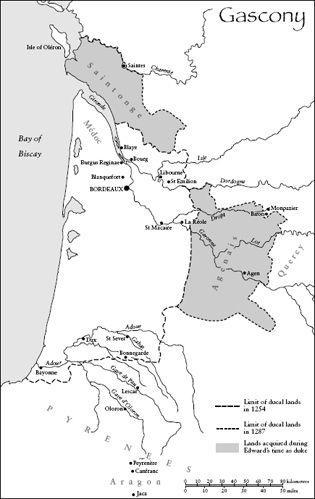
A few days later similarly patient bargaining on Anglo-French relations also bore fruit. Philip IV made concessions to Edward involving his jurisdiction as overlord, and also regarding the lands promised to the English king under the long-standing peace treaty. Edward’s rights in Saintonge (that is, the area around Saintes, a town on Gascony’s northern frontier) were finally acknowledged, while Edward, for his part, agreed to drop his claim to Quercy, a region to the east of the duchy, in return for an annual payment of several hundred pounds.38
This breakthrough on both fronts in Paris was accompanied by equally encouraging news from a third direction. Around this time, the English must have learned that the new pope, Honorius IV, had improved on the financial package offered by his predecessor. The papacy was now prepared to grant Edward a new six-year crusading tax, provided that he took up the cross by May the following year. If this was not quite everything the king wanted – he wrote back asking for payment in advance – it was nevertheless excellent news. When the English court finally quit the French capital at the end of July, there must have been a general consensus that they had already achieved a great deal.39
Their next destination was Gascony, but they set off in no great hurry. Having bought himself some time, Edward chose to spend it partly on pilgrimage. From Paris he led his retinue south-east, to the city of Auxerre and the abbey of Pontigny (where Edmund of Abingdon, the archbishop of Canterbury who had officiated at Edward’s baptism, lay buried). From there they went west, and along the River Loire to Fontevrault, burial place of Edward’s Angevin ancestors (Henry II and Richard the Lionheart). Consequently, it was September before the king started south in the direction of his own lands. These, of course, had expanded greatly since his last visit twelve years earlier, and Edward, as was his wont, made a special effort to appear in each new area under his lordship, inspecting its management and impressing himself on the inhabitants. From mid-September to mid-October he toured newly acquired Saintonge; then, in the later part of the autumn, he moved east along the Dordogne, until he reached the Agenais, ceded to him in 1279. By 15 November he had reached Agen itself, and he stayed in the city, or its environs, for a month. Not until mid-December did he head up the River Garonne towards Bordeaux, and in the event the English court spent Christmas and the New Year in the small town of St Macaire.40
If his itinerary sounds laid back and listless, this is probably because it was partly so. No one was more anxious than Edward to settle the great problems of Europe, but the wheels of international diplomacy turned slowly, not least because of the distances involved. It took weeks, running into months, for letters and ambassadors to pass through the Pyrenees to Aragon or across the Alps to Rome. When, in early January, the king finally reached Bordeaux, there were some preliminary talks with an Aragonese delegation. But, once they had departed, Edward necessarily focused his attentions on Gascony which, as usual, had problems of its own. John de Grilly, the seneschal appointed in 1278, had proved capable but corrupt; removed before the king’s arrival, he was put on trial the following year. For royal and ducal officials, at least, there was much work to be getting on with. Edward himself spent most of February exploring the far reaches of the Médoc. At one point in March we catch him hunting wolves.41
At Easter, however, events suddenly and dramatically sped up. Once again, we are able to reconstruct what happened in forensic detail thanks to the records of the royal household. On Wednesday, 2 April, the king came back to Bordeaux in time to celebrate Easter on the Sunday. Two days after his arrival the Aragonese ambassadors also returned, in what even the dry financial accounts acknowledge was ‘a solemn embassy’: some eighty-three men and forty-six horses were accommodated in the city at Edward’s expense. Perhaps, like the king himself, they were entertained by the little boy who was paid two shillings for playing the bagpipes, or the damsel who received seven pence for her dancing.42
Then came Easter Sunday itself – a day of such drama that it made the news back home in England. As the best-informed chronicler explains, ‘a great misfortune befell the king’. Edward, we are told, was standing with his nobles in a certain solar (the topmost room in a tower) when the floor beneath their feet suddenly fell away. The assembled company tumbled from an estimated height of eighty feet. Some of them were crushed, some suffered broken bones. Three knights were said to have been killed, while others apparently walked away unscathed. As for Edward himself, he was not nearly so unlucky, nor quite so fortunate. Found under a Gascon knight who had broken his leg, the king emerged from the wreckage with a broken collarbone.43
A tragedy for some, the incident was generally held to have been a miraculous escape: proof that Edward and those around him had been spared for a reason. If, as one later chronicler seems to suggest, the collapse was caused by a bolt of lightning that passed through a window, it can only have reinforced the impression that the event was heaven sent. As it was, the fact that it had happened on Easter Sunday – the day of Christ’s passion – must by itself have been seen as significant. Edward had been expressing his willingness to go on crusade – that is, to recover Jerusalem, the site of Christ’s passion – for more than three years by this point. In spite of this, however, he had still not yet taken the cross.44
That was now set to change. The king, for the time being, could go nowhere. It may have taken him as long as five weeks to recover from his injuries. But within days of the near-disaster, three of his servants were given money for their journey to the Holy Land. Soon afterwards, letters arrived from the pope, dated three weeks before the accident, offering final terms for the payment of crusade funds, provided that Edward accepted the offer before 24 June.45 The king, once he was able to move, needed no further encouragement. By 12 May he had left Bordeaux for nearby Blanquefort, a recently acquired castle that served as a retreat from the city, and there made his vow. Many others joined him in doing so. The ceremony was conducted by the archbishop of Ravenna, a papal legate empowered for the purpose. Edward was recognised as ‘captain of the Christian army’.46
It must have been just a few days later that they had further news from Rome. Pope Honorius was dead – he had passed away nineteen days after sending his last letter. This meant that the legate’s authority had expired before he had signed the king with the cross. Worse still, it meant that the tortuous and protracted business of negotiating the financial terms of the crusade would have to begin all over again with Honorius’s successor.47
At least negotiations with Aragon were moving forward, perhaps impelled by the same sense of divinely ordained purpose. In the first week of May, after a stay that may have lasted longer than they intended, the Aragonese ambassadors left to return home. At the same juncture, and probably in their company, Edward’s close associate John de Vescy rode south to finalise plans for the two kings to meet in person. By 10 June he was back with a date and a place. At once Edward dispatched certain members of his household to make the necessary arrangements for his coming. Then, twelve days later, the king and his company set out.48
Their destination was Oloron, a substantial town on the southernmost fringes of Edward’s power, just twenty miles distant from the peaks of the Pyrenees. The English court had arrived there by 11 July; the Aragonese court must have arrived a few days later, and Edward would have welcomed Alfonso III, the twenty-two-year-old successor to the late King Peter. Of Alfonso himself little is known. Like Edward, though, he seems to have travelled in great state. Just as the English king had brought with him some Welshmen in order to advertise the extent of his power, so the Spaniard had come attended by several Saracens, reluctant recruits from his own wild frontier. Their meeting was characterised by the kind of celebratory festivities that generally accompanied such royal rendezvous. Jousts and other games took place outside the town, destroying cornfields and vineyards, whose owners Edward later felt obliged to compensate. Exotic gifts were exchanged: Alfonso presented Edward with a lion and a wildcat. The lion later killed a horse belonging to a local, further increasing the English bill for compensation. And two of Alfonso’s Saracens absconded, taking with them a mule. But otherwise the chivalric ice-breaker appears to have passed without incident.49
Amid the gaiety and the gift-giving, of course, there was serious business to be getting on with. Edward’s primary reason for coming to Oloron was to secure the release of his cousin, Charles of Salerno. Until Charles was a free agent there could be no lasting European peace; anything he promised in captivity was likely to be obviated by a later claim that it had been exacted under duress. Alfonso, for his part, was happy to consider Edward’s request, but made it clear that he would require a lot in return. It was not a question of greed: the captive king was Aragon’s best guarantee against future French and papal aggression. Charles was not going to be liberated unless he agreed to hand over very substantial new securities by way of exchange. In a nutshell, Alfonso wanted hostages and money: three of Charles’s sons, including his heir, were to be handed over, along with sixty nobles from his French county of Provence. In addition, Charles was bound to pay 50,000 marks. All of these were in return for a three-year truce and would be restored if a lasting peace was sealed by the end of that term. If not, they would be returned only if Charles returned to captivity, and Provence would be forfeited to Alfonso.
These, at least, were the conditions that Edward accepted on 25 July, when an agreement at Oloron was reached. In order to move matters forward more quickly, the English king made himself personally involved, taking on the responsibility for finding 20,000 of the 50,000 mark security. He also promised to seek papal permission for his daughter, Eleanor, to marry Alfonso. Their long-planned wedding had latterly been forbidden by the papacy in view of Aragon’s pariah status.50
Papal approval was the point on which the whole deal pivoted. As his eagerness to ally himself with Edward shows, what Alfonso wanted most was to be welcomed back into the fold of European princes. But he was also determined to retain Sicily, and it was a central requirement of the Oloron agreement that both France and the papacy should acknowledge his right to the island. In any circumstances, therefore, Edward’s ambassadors were going to have a hard time persuading both powers to accept the results of his honest brokerage. But in the summer of 1287, when they set out for the attempt, there was a more fundamental problem. Despite the fact that Honorius IV had died in April, the college of cardinals had still not agreed on who should be his successor. This was the great short-term stumbling block to peace. There could be no papal approval (or, for that matter, disapproval) while there was no pope.51
For a while Edward was evidently optimistic that matters might be wrapped up quickly. Once the summit at Oloron was over and the two courts had gone their separate ways, the English king remained in the south of his duchy. As the summer turned to autumn, he spent one listless week after another, first at Dax, then at St Sever, waiting hopefully for news that would allow the early release of his cousin. During this time, he was pleased to receive an unexpected visitor in the form of Rabban Bar Sauma, a Chinese monk who had come to Europe as an ambassador for the Mongols. His master, il-khan Arghun, son and successor of Edward’s erstwhile ally il-khan Abagha, was contemplating renewed military action in the Middle East against the forces of Islam, and hoped for European support. Encouraged by this news, the king made a statement that the ambassador recorded in his journal and that reveals the strength of conviction that underlay his actions at this time. ‘We … have taken the sign of the cross upon our body,’ Edward said, ‘and have no other thought than this affair. My heart swells when I learn that what I am thinking is also being thought by King Arghun.’52
As autumn turned to winter, however, the hope in the king’s heart of an early settlement of Europe’s affairs began to fade. Part of the problem was Philip IV. Having given Edward a free hand to negotiate, the French king now balked at the provision that Aragon should occupy Provence if peace did not ensue. The main obstacle, though, was the continuing vacancy of St Peter’s throne. In November the cardinals wrote to Edward commending him for his efforts but, before these letters reached him, the king had already concluded that Charles of Salerno would not be freed that year. On 21 November he turned and headed north, back to Bordeaux, where the English court stayed for Christmas. Until a new pope was in place, everything – the truce, the peace, the projected crusade – hung in the balance.53
Perhaps to occupy his time more than for any other reason, Edward elected to spend the early months of the new year founding a new town. For most of February, March and April 1288 the king and his court were camped on the banks of the River Garonne, some twelve miles north of Bordeaux. At this point the Garonne joins the region’s other main river, the Dordogne, and together they form the wide estuary of the Gironde, which flows out into the Bay of Biscay and beyond into the Atlantic. It was here, at the confluence of the two main commercial arteries of his duchy, that Edward chose to plant his new settlement. From the first it was given the Latin name Burgus Reginae, in tribute to Eleanor of Castile. In England it would have been known as Queensborough.54
Although Edward’s decision to involve himself (and Eleanor) so directly in the creation of Burgus Reginae looks slightly self-indulgent, in general there was nothing whimsical about such urban initiatives. The creation of new towns had been official policy in Gascony from the moment of Edward’s accession as duke. Following the example of the counts of neighbouring Toulouse, who had begun a similar programme some two decades earlier, in 1274 Edward had ordered his seneschal in Gascony to plant new settlements wherever in the duchy he saw fit. As a consequence, dozens had sprung up in the twelve years that had elapsed since the king’s previous visit, and many more were still being laid out at the time of his return in 1286.55
The local word for such new towns was ‘bastides’ – it derived from a southern French word meaning ‘to build’. For those who equate medieval with muddle, the most striking thing about the majority of these places is the regularity of their design. Planned with precision, and with each plot laid out to the same size as its neighbour, the streets of a bastide form a perfect gridiron: the kind of effect more commonly associated with the towns and cities of modern America than those of thirteenth-century Europe. Of the scores that were created, some have swollen to become substantial modern towns, while others have shrunk to the smallest of villages. Perhaps the best preserved, in terms of overall ambience as well as original size, is the bastide in the Agenais known as Monpazier. Founded in 1285, and visited by Edward himself during his tour of the region the following year, Monpazier still exhibits many of the original details that made bastides so distinctive. Its regular grid of streets give out onto a central square, with an open market hall at one end, where even the original metal bins for measuring grain still survive. Around the square, the buildings with vaulted archways known as cornières are another characteristic medieval feature. Monpazier is also the only place, to the best of this author’s knowledge, that can boast a Hotel Edward Premier.56
The creation of bastides served Edward in two ways. First, and most obviously, as commercial centres they were a source of profit, both direct (in the form of local tolls and taxes) and indirect (they increased trade that was taxed at other points, such as Bordeaux). Secondly, and perhaps less obviously, they were a means by which he could increase his authority as duke. As we have already noted, Edward’s power as duke of Gascony was nothing like his power as king of England. In Gascony he had comparatively little land of his own, and far less money. Towns founded in his name not only swelled his coffers; they also looked to him as their lord and protector. As the bastides spread, therefore, so too did Edward’s seigneurial influence.57
As such, it was wont to run up against existing vested interests. Other landlords were often quick to object when a new town was being planned or planted on their doorstep, recognising that their own profits were bound to suffer, not least because their tenants tended to slope off to become townsmen. The lowest sections of society were lured to bastides not only by the prospect of becoming richer, but by the promise of freedom that urban life would bring.58 For this reason, around half of all bastides were founded on the principle of paréage, a public-private partnership, whereby the local lord or lords would put up the land, the duke provided the authority and the permission, and the profits were split between all parties. Monpazier again supplies a good example: the town was created by an act of paréage between Edward and the lord of Biron, whose castle still stands some four miles to the south of the town. By such a method, it was possible for all parties – duke, lords and peasants – to profit from a new foundation.59
The whole initiative of creating new urban communities on virgin sites was possible only because Gascony, at the time of Edward’s accession, was an economically underdeveloped region. Although it still preserved the visible traces of its civilised, Roman past, the duchy had latterly fallen on hard times (in the early thirteenth century, for example, it had been ravaged by decades of war). Consequently, it lagged behind other regions in western Europe and was ripe for economic exploitation. With the advent of stability from the middle of the thirteenth century and a growing reliance on the wine trade with England, there was a great incentive to clear the surrounding forests and plant vineyards in their place (some bastides even provided for this in their foundation charters). It was all for the greater good. New towns meant new roads; new roads and fewer forests meant fewer places for rebels and robbers to haunt. A region that had grown wild was once again being tamed and civilised.60
In this respect alone – its economic underdevelopment – Gascony resembled Wales, and for this reason Edward saw fit to plant new towns there as well. After the first Welsh war he had laid out new settlements at Flint, Rhuddlan and Aberystwyth; the conquest of Wales had led to the creation of several more, at Conwy, Caernarfon, Harlech, Bere and Criccieth. Of course, in Wales Edward was supreme lord and conqueror: there was no need for him to purchase land or split profits in these cases. But, from a physical point of view, his Welsh towns closely resembled the bastides that were simultaneously being laid out in Gascony. The streets of Flint still preserve a near-perfect medieval grid. Conwy and Caernarfon, slightly less regular, are nonetheless the most impressive, surrounded as they are by splendid circuits of stone walls, among the best preserved in Europe.61
In the immediate aftermath of the conquest of Wales, in fact, Edward seems to have been infected with such an enthusiasm for town foundation that he attempted one or two similar projects in England. His trip to the Isle of Wight in the autumn of 1285, for example, was to inspect the town of Francheville (Newtown), bought from the bishop of Winchester the previous year with a view to further development. A few weeks later in 1285, in the wake of a visit to Corfe Castle, he ordered a new town to be laid out on the nearby Dorset coast. Neither of these initiatives, however, was successful – indeed, the Dorset project never seems to have got past the planning stage. The fact was that, by Edward’s reign, if not before, England already had enough new towns – they had been increasing steadily in number, thanks largely to the lead of enterprising local lords, since the eleventh century.62 Edward’s only truly successful foundation in England was the new settlement he created at Winchelsea, and in this case the circumstances were special. Winchelsea was an existing port on the Sussex coast that became imperilled in the middle of the thirteenth century due to the shifting shingle beds of the sea floor. By the time Edward came to the throne the old marketplace was disappearing under water and the waves were lapping at the church door. From 1281, therefore, and by royal command, a new town was laid out for the citizens on the crest of a nearby ridge. One of the men in charge of the project was Henry le Waleys, the king’s favourite townsman and erstwhile mayor of London. The result was the closest thing in Britain to a French bastide (Waleys was also later responsible for several new sites in Gascony). This was highly appropriate, since Winchelsea, lying on England’s south coast, was one of the principal places of import for Gascon wine. Beneath the empty grass plots in the town today are several well-preserved, expensively fashioned stone cellars, where once the barrels of wine and cheese were rolled and stacked, and that once echoed to the sound of Gascon as well as English voices.63
Even in Gascony itself, by the time of Edward’s visit in the late 1280s, there were signs that the countryside was approaching a point where it had sufficient new urban settlements. The earliest bastides, provided they were well located and well managed, flourished and prospered. Libourne, a pioneering early effort of 1270, founded by and named after Edward’s friend and sometime seneschal Roger Leybourne, is now a modern French town of some consequence. By contrast, the bastide known as Baa, founded by the king himself in 1287, and so called as a compliment to Robert Burnell (bishop of Bath), has long since disappeared. In fact, of all the king’s personal foundations in Gascony, not one has survived as a modern settlement. Even Burgus Reginae, on which the king lavished the greatest personal attention, and no doubt considerable sums of money, has now vanished. The only clues to its existence, beyond the written record, are the suggestive shapes of the surrounding vineyards, the plausible path of some banks and ditches, and the name of the nearby village – La Bastide.64
At some point towards the end of his protracted stay at Burgus Reginae in the spring of 1288, Edward received news from Rome. At last, the cardinals had elected a new pope. Nicholas IV had ascended to the papal throne on 22 February 1288 – and immediately decreed that the Treaty of Oloron should not stand. Negotiations with Aragon would have to begin all over again.65
At the start of June, therefore, the English king and his entourage set out for a second time on the long journey south, determined to find a new way out of the diplomatic impasse. By the end of the month they were back at Oloron. On this occasion, we are not nearly so well informed about their activities, but it seems fairly certain that exchanges with Aragon were more difficult. Whatever discussions took place at Oloron, for example, proved abortive: by the end of July Edward had retreated to the small cathedral city of Lescar, some fifteen miles to the north-east. It was probably not until September that the two kings came face-to-face for their second meeting, and when they did so it was in Aragon. Presumably at Alfonso’s insistence, the English court trekked through the high passes of the Pyrenees in the late summer and were received by the Spanish king in his mountain city of Jaca. It must have been there, in early September, that a new deal was brokered.66
The only way forward was for Edward to take on more responsibility for the security of the deal. His previous offer to provide some of the money was repeated, and indeed fulfilled – 23,000 marks were handed over at once, and 7,000 more were promised. Moreover, the English king now agreed to supply some of his own men as temporary hostages, until they could be replaced by hostages gathered from the domains of Charles of Salerno. Accordingly, in the early autumn Edward was obliged to make another long journey back and forth across the Pyrenees in order to round up the necessary recruits. Eventually, on 28 October, at the small town of Canfranc, the northernmost settlement in Alfonso’s realm, the two courts came together once more. No fewer than seventy-six hostages were handed over to begin a captivity that they earnestly hoped would be impermanent. Most of them were Gascons, but included among their number were several leading members of the English court, including Otto de Grandson. Also, as per the earlier agreement, three of Charles of Salerno’s sons at this moment became involuntary guests of the Aragonese king. But Alfonso was at last satisfied. In exchange for this extensive supply of human collateral, Charles of Salerno himself was finally set free.67
For Edward and his diminished entourage, it was now an anxious waiting game. While the grateful Charles sped off to raise the rest of the money and the replacement hostages, his English cousin had little choice but to sit out the winter months in the south of his duchy. Edward, however, was incapable of remaining idle, even when motionless, and so selected a site for this enforced sojourn where he could profitably expend his energies. The English camped themselves at a place called Bonnegarde, an ancient fortified site high above the River Luy, which marks the boundary between Edward’s own domains and those of his once turbulent vassal, Gaston de Béarn. A few years earlier Bonnegarde had been reinvented as a small, irregularly shaped bastide, but now, during the winter of 1288–89, it was apparently extended on a massive scale, with a great expanse of adjoining land to the south and east being enclosed within new banks and ditches. Today in private ownership, Bonnegarde has proved the most enduring of Edward I’s personal initiatives during his time in Gascony.68
Charles of Salerno had been given three months to find his own hostages, and in February, as this deadline looked set to expire, the English court became visibly more restless. But, at last, as the end of the month approached, Charles reappeared, and together he and Edward set out for the border. Queen Eleanor, for once, did not accompany her husband. At this time of year the Pyrenees were almost impassable. The king, his cousin and the replacement hostages had to ride through snowy peaks, guided by hundreds of specially recruited foot soldiers. Their destination was Peyrenère, the highest point of the mountain pass, more than 5,000 feet above sea level. When they arrived there in early March, Edward had a great wooden cross erected, to mark the boundary between his power and that of the king of Aragon. Around 6 March Alfonso arrived, and the exchange of hostages took place. The reunited English court rode back to Oloron, where they were received with relief by the anxiously waiting queen.69
The task that Edward had set himself in Gascony was at last complete. Charles of Salerno was free, and would remain forever grateful to the cousin who had secured his deliverance. ‘You proved your sincerity,’ he later told the English king, ‘unloosed my bonds, and broke the walls of my prison.’ There was also great joy in Oloron that the English hostages had returned safely.
But there was no disguising the fact that Edward’s time in Gascony had been tedious and frustrating. A week after the king’s return to Oloron, a clerk in his company sent a letter to a friend in Canterbury.
‘I would have written more often,’ he explained, ‘if things had gone smoothly with our lord the king during his stay in Aquitaine; but things were rather bad than good.’
‘Soon, I hope,’ the same clerk concluded, ‘the king will be on his way home again. The stay in these parts has seemed too long, both to him and his.’
In this hope our correspondent was not disappointed. Edward spent just three more months in Gascony, finalising the arrangements for the duchy’s future government and its relationship with France. As soon as this business was concluded, on 13 June 1289, the king and his court set out north in the direction of home.70
Back in England, Edward’s regency government had by no means had an easy time during their master’s absence. Several major problems had arisen to test the capabilities and the resolve of Edmund of Cornwall and the other home councillors. In 1287, to take the most major example, a sizeable rebellion had erupted in south Wales. Rhys ap Maredudd, one of the few Welsh lords to have consistently supported the Crown, seems to have belatedly decided that he had been backing the wrong horse all along. In June that year he seized a number of castles and burned several towns. His rising, however, was short lived. The regents, perhaps fearing that a revolt on the scale of 1282–83 was in the offing, responded with a magnificent overreaction. Twenty-four thousand men were mobilised in order to bring Rhys to heel, a sledgehammer to crack a walnut. By the start of the new year it was all over, and English power in south Wales was undisputed. Rhys’s chief castle at Dryslwyn fell to English siege-engines and was added to the list of the king’s Welsh fortresses. In its shadow yet another new town was laid out, and English burgesses were soon moving in to take up residence.71
Rhys ap Maredudd himself evaded capture in 1288, and the following year it was rumoured that he was likely to escape to Ireland. How well he might have fared had he done so is an open question, for there too royal power was waxing irresistibly strong. Edward, as will now have become quite clear, had very little interest in Ireland. It was over thirty years ago, at the time of his first visit to Gascony, that he had received letters from his father telling him that Dublin should be his next port of call. Since then he had crossed the Channel to visit his French lands on four further occasions; but he had still yet to sail across the Irish Sea.72
There were obvious reasons for this preference. Gascony was cultured, civilised, warm and alluring. Its castles and cathedrals were the work of Edward’s ancestors, its cities and roads had been laid out by the Romans. Its people might be fickle and devious (such was the king’s opinion of them as expressed in a letter), but they were recognisably men of his own kind: wily, indeed, but also French-speaking, sophisticated and chivalrous.73
Ireland, by contrast, was a wild place – inhospitable, inclement and in many respects abhorrent to civilised sensibilities. The English clerk who wrote that he would rather go to prison than have to go back there probably spoke for many of his fellow countrymen.74 Culturally, the country was thought to contain little worthy of curiosity. Edward, for example, displayed no interest in Irish history to compare with his marked fascination with the legendary past of Wales. The biggest problem with Ireland, however, was the people – or rather peoples. Ireland’s problem was that it had not one people, but two.
A century before Edward’s accession, the first English settlers had crossed the Irish Sea. Adventurous lords, enterprising townsmen and land-hungry peasants – all had set out into the west, tempted by the prospect of a fertile landscape they might profitably tame. The kings of England – Henry II and John – had soon followed, and Ireland was integrated into a royal empire that stretched from Dublin to Westminster and beyond to the Pyrenees.
But not wholly integrated. When those first English settlers had arrived in Ireland, they discovered a people whom they quickly concluded were the worst kind of savages. This was the late twelfth century: the English had been honing and developing their hostile attitudes towards the Welsh for more than fifty years, and found that such attitudes could be easily exported and applied to the Irish. Socially and culturally, there could be no question of mixing with such people. Moreover, by this stage, English governmental institutions and practices were also well developed and inflexibly hidebound, so political integration proved similarly impossible. English lords therefore took what they could by force of arms, and English settlers shut themselves away in self-contained and self-sustaining new towns. The Irish found themselves denied the most fertile parts of their island and driven to subsist on its less productive margins – the hills, the forests and the bogs. The result was a deeply divided society: English colonists and restless natives.75
For three generations, this English colony prospered. New castles, towns, abbeys and churches were built, the area under cultivation was expanded, flocks were increased, trade boomed, and some men made a fortune. But, around the middle of the thirteenth century – that is, around the time that Edward took over the island’s lordship – the colony began to stall and stagnate. Several of the great English lordly dynasties died out, and the flow of settlers from England dried up. From this point on, more often than not, the lords of Ireland were absentees, rarely if ever crossing the sea to visit their Irish estates.76
This, of course, was true above all of Edward himself. Distracted by events in Wales from 1256 and then by political upheaval in England from 1258, the future king had little time or thought to spare for Ireland. As a result, the decline there steepened: English colonists began to fight among themselves, and the native Irish began to reassert their power. In 1258 one Irish chieftain even went so far as to declare himself ‘king of Ireland’, much as Llywelyn ap Gruffudd had proclaimed himself ‘prince of Wales’. This would-be king, and hence his revolt, proved short lived. But other revolts followed in its wake. Provinces formerly under English power began to be lost. A Gaelic revival was under way.77
Hence, at the time of his accession, Edward knew that something had to be done about Ireland. The country might have held no personal attractions for the king, but he appreciated its value as a source of soldiers, food and money, and by 1274 these useful returns were suffering badly. After twenty years of his lax lordship, for instance, profits from the Irish exchequer had halved, from £5,000 to just £2,500 a year.78
Edward’s solution was delegation. As with Gascony, so too with Ireland: the king dispatched a number of capable, trustworthy men, armed with wide powers of discretion to turn the lordship around. But whereas the individuals he sent south were smooth conciliators, those who went west were tough enforcers, licensed to use almost any means to restore order. Consider the example of Thomas de Clare. The younger brother of Earl Gilbert of Gloucester and one of the key players in Edward’s escape from Montfort’s clutches, Thomas had subsequently cemented his friendship with the future king by following him on crusade. Within weeks of his return and coronation, Edward had dispatched this daring and militaristic young man to Ireland to exercise his talents. As a younger son, with no inheritance to look forward to, Clare had a strong personal incentive to make a name and fortune for himself. The lordship he carved out in south-west Ireland was based on the former Irish kingdom of Thomond, centred on the estuary of the River Shannon. For a decade from 1276, Clare behaved like an old-school English conquistador of the previous century. Settlers were drafted in from England and planted on the Shannon’s north shore. New stone castles were constructed. At Bunratty, the giant fortress that Clare erected has now vanished, but an impressed contemporary described it as ‘girt with a thick outer wall, containing an impregnable roofed tower, and other buildings, large and limewashed’. By such irresistible methods, and with the Crown’s backing, the ambitious Englishman was able to impose his domination on a wild frontier.79
Part of Edward must have realised that such a policy of repression could not provide a lasting solution. At some stage, and to some degree, the Irish would have to be included. That, after all, was very much the wish of the Irish themselves. In 1277 they collectively petitioned the king to allow them to use English law, and offered to pay handsomely for the privilege. But, while Edward may have been minded to accept such a move, the English settler community made it clear that they were not. To allow the Irish to use English law would be tantamount to treating them as English, and that would never do. The colonists jealously guarded their law as a marker of their identity, and so the proposal was ultimately rejected. The alternative path to integration, of course, would have been for the king to recognise Irish law and bring it under the umbrella of the Crown’s jurisdiction. Edward, after all, had been prepared to do this with Welsh law before 1282, and parts of Welsh law had been allowed to stand after the Conquest. In Ireland’s case, however, incorporation was regarded as a bridge too far; Irish law was so perverse and barbarous that its absorption was completely unconscionable. As the king himself declared in 1277, ‘the laws the Irish use are detestable to God, and so contrary to all law that they ought not to be deemed law’.80
Denied the right to use English law and condemned for using their own, Ireland’s original inhabitants were thereby destined to remain a race apart, and the only way left for the newcomers to deal with them was further marginalisation and military repression. Thus in 1277 Thomas de Clare dealt with one of his Irish rivals, Brian O Brian, by personally executing him at Bunratty, while in 1282 the English justiciar of Ireland – a bishop, no less – dealt with the troublesome MacMurrough brothers, native leaders of the south-east, by having them assassinated. It was hardly chivalrous, never mind Christian, but chivalry did not extend to the Irish. They were literally outlaws, living beyond the rules of civilised society.81
In any case, the proof of the pudding was in the eating. By 1289, as Edward prepared to leave Gascony, English royal policy in Ireland was seen as having succeeded. Profits at the exchequer in Dublin were back at the former high levels, boosted in part by the need to supply food to the troops and construction workers in north-west Wales. Thomas de Clare himself died in 1287, apparently of natural causes. But at the end of that same year, an anonymous Englishman in Ireland could write that the country ‘was so pacified these days that in no part of the land is there anyone at war, or wishing to go to war, as is known for sure’.82
In many respects, therefore, royal power was at its height when Edward and Eleanor returned to England in the summer of 1289. (They were met off the boat at Dover on 13 August by five girls and one five-year-old boy, all pleased to see their parents after a separation of three years.) The king’s patient diplomacy had given him a standing in Europe that was beyond compare, his rule in Gascony had been consolidated peacefully in person, and his power in Wales and Ireland had been consolidated forcefully by his deputies.83
In England itself, however, there was considerable disquiet. General lawlessness, for example, appears to have increased, in spite of the king’s earlier legislation. There had been violent feuding between both magnates and merchants; men had ridden about the country in armed gangs. At Boston in Lincolnshire there had been a particularly notorious incident in 1288 when certain individuals had conspired to rob the town’s famous annual fair, with the result that much of it went up in smoke.84
Some of these disturbances were a natural consequence of Edward’s absence; robbers as well as rebels would seize the opportunity if they thought the government seemed weak. But England’s restlessness during these years was also fuelled by a deepening sense of political discontent. The citizens of London, for instance, still bridled at their loss of liberty in 1285; the clergy, too, had become increasingly resentful of royal interference in their affairs and challenges to their jurisdiction. Above all, though, the trouble lay with the magnates, who were furious at the treatment they had been receiving from the Crown. When the regent had warned certain men against riding around causing trouble in 1288, four of them were earls. Before the king’s departure these men had been reasonably quiescent, but soon after he left they were literally up in arms.85
The principal reason for disgruntlement among England’s great men was the ongoing royal investigation into their rights and liberties as landowners. Launched by Edward soon after his coronation, but then postponed on account of the first Welsh war, the long-running inquiry had resumed in earnest in 1278–79. At that point the king’s justices had begun to summon men to court to defend their claims, and their insistent question ‘quo warranto?’ had given the whole process its popular name. In every case, the justices demanded to know ‘by what warrant’ an individual claimed his or her special privileges.86
From the first the magnates had found this all very tedious, frustrating and expensive. It meant having to hire lawyers to defend perfectly legitimate ancient rights, and having to bribe jurors where those rights were not quite so old and unimpeachable. As one piece of contemporary doggerel put it, ‘And the Quo Warranto/Will give us all enough to do!’ The main problem was one of evidence. Naturally, the best rejoinder to the question ‘by what warrant’ was to say ‘by this one’, and wave under the inquisitor’s nose a royal charter that set out in precise detail all the rights that one was defending. But in most cases such a charter simply did not exist; only latterly had society come to place such a heavy reliance on documentary proof. Often the only defence a landlord could offer was that he and his ancestors had enjoyed such rights since time immemorial, and hope that local jurors would back him up in his assertion.87
This is why, latterly, the magnates had become so agitated. In 1285 royal justices had announced that, in future, claims of long usage would not be admissible as evidence – only a charter would do. (Hence, probably, the rush to get old charters confirmed by the king during that year’s summer parliament.) When, therefore, the hearings had resumed in Edward’s absence, the landowning classes had found themselves losing out badly to the king’s lawyers. As one chronicler succinctly explained, ‘a great many men who did not have charters lost, without recovery, liberties and free customs of which they had been seized for a long time before’.88
One can well understand the magnates’ frustration. They had helped Edward reduce and conquer Wales in two separate campaigns, in many cases at considerable personal expense and in return for little, if anything, by way of compensatory reward. More recently they had given the same support to the regency government in suppressing the rebellion of Rhys ap Maredudd. Their reward for this service, it seemed, was to be dragged through the courts by arrogant royal justices and forced to defend the hard-won liberties of their ancestors. So much for the king’s pretence that they were like Arthur and his knights, a brotherhood of equals sat at a Round Table. Of late, it felt more like a conventional domestic setting, with Edward and his lawyers sat together at the high table, while the magnates sulked on the benches below.
It is no coincidence that this period saw the production of anonymous tracts, not only attacking royal justices but also simultaneously asserting the rights of the magnates. The Mirror of Justices, for instance, as well as demonstrating a pronounced hostility for the king’s lawmen, begins with a fabulous justification for restricting royal power. Its author explained how, when the Anglo-Saxons had first arrived in Britain, it was the earls who had been the sovereigns; only after many years of infighting had they agreed to elect one of their number as king. Edward’s great men, in other words, had begun to follow his own example, and were appealing to (and, in this case, inventing) history to justify present politics. According to a well-known chronicle tradition, either the earl of Gloucester or the earl of Surrey made a similar, impassioned appeal to the past when he came before the Quo Warranto judges. When asked by what warrant he claimed his rights, the earl brandished an ancient, rusty sword. ‘Behold, my lords!’ he said. ‘This is my warrant. For my ancestors came with William the Bastard and conquered their lands with the sword – and by the sword I shall defend them from anyone wishing to seize them. The king did not conquer and subject the land by himself, but our forebears were sharers and partners with him.’89
Edward therefore returned to England realising that he faced opposition on several fronts – a situation similar to the one that had greeted him at the start of his reign. If the discontent and disorder did not run as deep as they had done fifteen years earlier, the disillusionment was greater, and the grounds for optimism were fewer. There was, moreover, a strong similarity between the Crown’s financial position in 1274 and 1289: once again, the king was coming home in serious debt. His time in Gascony had been massively expensive, and not just because of obvious costs, such as his payment to free Charles of Salerno or the lavish hospitality laid on for the Aragonese court. The main cause of insolvency was that Gascony’s resources were totally inadequate for maintaining an entourage on the scale that royal dignity had demanded. For three years, Edward had been keeping up a kingly appearance on a ducal income, and as a result he had run up a debt to compare with the cost of his crusade or the conquest of Wales. On the day he had sailed for England, the king acknowledged that he owed the Riccardi a sum of almost £110,000. Attempts to alleviate this burden in his absence had already run aground. Asked for an aid at the start of 1289, the discontented magnates, led by the earl of Gloucester, had assured the regency government that no tax would be granted as long as the king was outside his kingdom. Whether or not they would change their tune now he was back remained to be seen. As at the start of his reign, Edward needed to do some serious conciliating.90
He began in the autumn of 1289 with the same kind of move that had won him popularity on that earlier occasion. In October it was announced that all those who had grievances against the king’s local officials could come forward and complain. This time around, however, the strategy fell flat, probably because it was perceived as overtly cynical. Edward obtained more popularity – and a convenient windfall of cash – from a simultaneous crackdown on corruption among his judges. Most of the leading lights of the judiciary were found guilty of one charge or another, lost their jobs and were made to pay large fines. The chief justice, Thomas Weyland, was sent into exile. But, unpopular as the judges were, this purge produced no corresponding boost for the king. When a parliament met at the start of 1290 – the first since 1286 – there was naturally much business to be discussed, but nothing was done to improve the king’s finances.91
For Edward to get the support and the money he needed, he was going to have to do more than conciliate. Concessions were required, and, as far as the magnates were concerned, the key was Quo Warranto. When parliament met again after Easter, the protests and petitions on this issue reached their highest pitch. For several weeks, in spite of his need, the king remained obstinate: as far as he was concerned, any rights without proof of entitlement were usurpations, and he had sworn at his coronation to recover them for the Crown. Eventually, however, around 21 May, a compromise was reached. Edward allowed that liberties could stand where landowners could prove continuous and responsible usage since 1189 (the start of the reign of Richard I). The face-saving formula was that all claims accepted in this way had to be confirmed by the king, thereby preserving the fiction that the Crown had conceded them in the first place.92
By this partial royal climbdown, the magnates were partially appeased. It helped Edward’s cause that he had successfully neutralised his chief opponent, the earl of Gloucester, by making him an offer he couldn’t refuse. At the start of the parliamentary session, in a private ceremony in the royal chapel, Earl Gilbert was married to the king’s daughter, Joan. The spirited eighteen-year-old princess may have presented obvious attractions to the forty-six-year-old divorcee, but the match’s principal enticement was the proximity it promised the earl to the centre of royal politics, allowing him a prominence he had not enjoyed since the 1260s.93
By themselves, however, the magnates – as Edward must surely have appreciated – were in no position to grant him the huge amount of money that he needed to achieve solvency. In their capacity as his principal tenants, they offered him the kind of levy that any lord might demand on the occasion of his daughter’s wedding, but this promised to yield such a nugatory sum that the king did not even bother to collect it. What he needed to clear his debts was a grant of general taxation, and, while mending fences with the magnates was an essential first step, consent for such a measure could come only from the knights of the shires. In the middle of June writs of summons were sent out to the counties, and parliament went into recess until their arrival.94
The lesser landowners of England, like the magnates, had one outstanding grievance: in spite of successive rounds of legislation, for which they had paid through the nose on two earlier occasions, the problems associated with Jewish credit had persisted. The ban on moneylending that Edward had imposed at the start of his reign had not worked – all it had succeeded in doing was to drive the practice underground. The Jews had continued to lend money as before, albeit covertly, with some concealing their deals with false contracts for commodities. Moreover, the king’s ban had not eradicated debts taken out before 1275, and so the dubious trade whereby Christian speculators could snap up encumbered estates had also continued unabated.95
As of old, the most notorious speculators were the richest members of society who congregated at the king’s court, and none was more notorious than the queen. Eleanor of Castile, a smart and shrewd woman, had never assumed a political role in England – there were no rival factions at her husband’s court to compare with those of the previous reign. Instead, and with Edward’s encouragement, Eleanor had directed her energies into playing the property market, pouncing on estates whenever their owners looked vulnerable. ‘The king would like to get our gold/The queen, our manors fair, to hold,’ ran one scurrilous rhyme. The fair Leeds Castle was one of many properties acquired in this way. It had been obtained from William Leybourne (son of the king’s friend, Roger) in exchange for clearing his debts to the Jews.96
Such sharp practice had a corrosive effect on Eleanor’s reputation – so much so that, while the queen had been away in Gascony, Archbishop Pecham had felt compelled to write to one of her leading clerks. ‘A rumour is waxing strong throughout the kingdom,’ Pecham began, ‘and has generated much scandal. It is said that the illustrious lady queen, whom you serve, is occupying many manors, lands, and other possessions of nobles, and has made them her own property – lands which the Jews have extorted with usury from Christians under the protection of the royal court.’
‘There is public outcry and gossip about this in every part of England,’ the archbishop continued, before urging the recipient of his letter to intercede. For her own good, he averred, the queen must desist: her dealings were damnable.97
In 1290, therefore, Edward was almost as fed up with the Jewish problem as the knights of the shires themselves. In several different ways, on several different occasions, he had tried to solve it by means that, to his mind, seemed very conscientious. In 1275 he had banned moneylending and exhorted the Jews to live by lawful trade; in 1280 he had ordered all Jews to attend special sermons, preached by Dominican friars, with the hope of persuading them to convert. But his ban had not been obeyed, and his exhortations were ignored. The problem was as bad as ever, and its taint now reached so high, touching even the queen, that it threatened to discredit the king himself. Something would have to be done.98
One option was simply to get rid of the Jews altogether. Wholesale expulsions were nothing new in thirteenth-century Europe. The king of France had expelled all Jews from his own lands in 1182; the duke of Brittany had driven them out of his duchy in 1239. In England, as we have already seen, both Simon de Montfort and Eleanor of Provence had ordered local expulsions from their own estates. According to one chronicler, it was his mother who suggested to Edward that he expel the Jews from England in 1290. For those who ordered them, such expulsions were a matter of Christian conscience and, for this reason, they were sometimes ordained as a preparatory step towards going on crusade. In the late 1240s Louis IX had expelled the Jews from the French royal demesne in advance of his first passage to the East. And Edward, having taken the cross for the second time in 1287, had ordered the Jews out of Gascony. After God had spared him from falling to his death, it seemed the least he could do.99
The downside for any prince or potentate who acted in this way was that, while spiritually beneficial, it was commercially disadvantageous. Of course, the property of expelled Jews could be sold off, but the profits involved were not huge and, besides, profiteering was hardly in keeping with the piety of the exercise. When Edward had expelled Gascony’s Jews, he had given the proceeds to the local friars.100
An expulsion, therefore, might cut the Gordian knot of England’s Jewish problem, but financially it would be a backward step. The Jews were no longer the great cash cow they had once been – successive royal depredations, culminating in the king’s own coin-clipping pogrom of 1279, had seen to that – but 1290 was not a year for doing away with any form of revenue, no matter how small. Indeed, it looks very much as if, in June that year, Edward was preparing to tallage the Jews, hoping to squeeze out of them what little money remained.101
But then, it seems, someone – we don’t know precisely when, where or with whom the idea originated – had the happy notion that the king might be able to copy his cousin. Following his release from captivity, Charles of Salerno had expelled the Jews from his counties of Maine and Anjou. Naturally, his expulsion edict made much of the Jews manifold crimes (usury, in Charles’s mind, was apparently trumped by the Jews tendency to ‘cohabit evilly with Christian maidens’). But – and this was the notably pioneering part – Charles also made no bones about the fact that, by expelling the Jews, he was hurting his own pocket. As the edict went on to explain, it was for this reason – ‘as some recompense for the profit which we lose through the said expulsion’ – that Charles’s subjects had agreed to vote him a tax.102
In the second week of July 1290, parliament resumed in Westminster. The session re-opened with another royal wedding, as Edward’s fifteen-year-old daughter Margaret married John, heir to the duchy of Brabant. In contrast to the private ceremony of the spring, this match was deliberately presented as a great affair of state, and celebrated on a maximum scale. The marriage itself took place in Westminster Abbey, and hundreds of lords and ladies attended, along with almost a thousand Londoners. At the wedding feast no fewer than 426 minstrels entertained the throng. Immediately afterwards – again, no doubt by deliberate design – Archbishop Pecham preached the cross. Gilbert de Clare and his new wife swore to go east, as did many other nobles and bishops.103
In this atmosphere of celebration and heightened religious fervour, the knights of the shire assembled. The magnates, mindful of the king’s concession on Quo Warranto and appeased by a raft of other recent measures, approved the grant of a tax. Would the knights oblige the king by doing the same? We do not know if the idea was put to them first (as seems most likely) or whether they demanded it as the price of their consent. Whatever the case, the deal was quickly done. Edward was granted his tax. And, in return, on 18 July the royal orders went out. All Jews were to leave the realm before the 1 November.104
For what was very definitely the final time, the Jews were made to pay the price for the king of England’s insolvency. That summer, the small, impoverished and broken community – perhaps numbering only 2,000 souls by this time – gathered together their belongings, and the enforced exodus began. In general, their departure was peaceful, and they made their way to the coast without incident. Once on board ship, some groups fell victim to murderous Christian captains, who were later punished, though more for their failure to respect royal authority than on account of any belated sympathy for the Jews. In his anti-Semitism, as in other aspects of his bigotry, Edward marched in step with his subjects. The knights of the shire were so pleased at the prospect of being rid of the Jews that they had agreed to a generous grant of one-fifteenth of their goods. Its yield, a massive £116,000, was not only the biggest of the whole reign, but the single biggest tax collected in Britain during the entire Middle Ages. The Church was so delighted with the king’s pious performance that they voted a thank-you tax of their own in the autumn. Without doubt, the expulsion of the Jews was the most popular act Edward ever committed.105
By this expedient, the king had once again squared the circle. His critics were appeased, his finances restored. He could now devote his attention fully to the great project of his crusade. Already in 1290 he had received a further embassy from the Mongols and sent Otto de Grandson to the Holy Land on an advanced reconnaissance mission. There was also excellent news from Europe: in spite of further difficulties since his departure, a universal peace between France, Aragon, Anjou and Rome now seemed to be in train. Meanwhile, during negotiations with his subjects in England, parallel negotiations with Rome had come to final fruition. By the start of the year the new pope had endorsed the financial package agreed by his predecessor, and by the end of the summer, after further fine-tuning, Edward held in his hands a document to which he was ready to commit. A special, select parliament of magnates was summoned. They met in October, at Clipstone, a royal hunting lodge in Sherwood Forest. There, surrounded by his great men, with whom he was once again united, Edward set his seal to the pope’s offer. He would be paid the £130,000 of crusading funds already collected, and would receive the proceeds of a new, six-year tax as quickly as they came in. The date for departure was set. The king and his fellow crusaders would leave at midsummer 1293.106
Then the queen fell ill, and Edward’s world fell apart.