
[5]
HAVING thus summarily dealt with the Greek revolt, Alexander left the smoking ruins of Thebes behind him, and hurried back north to Pella. There was much to be done, and little enough time in which to do it. His arrival seems to have been marked by fresh purges, this time of Cleopatra's more highly placed relatives: clearly he was taking no chances while abroad.1 Parmenio was recalled from Asia Minor: as Philip's best and most experienced general, he was to become Alexander's second-in-command. If the king could have found anyone else for the job he almost certainly would have done so, but he had little choice in the matter. The old marshal was indispensable, and knew it.
Alexander next summoned a council to discuss that most burning of issues, the crusade against Persia. When was the campaign to be launched, and what strategy should be followed? Antipater and Parmenio both (as usual) advised him to proceed cautiously. In particular, with the grim struggle for the succession still fresh in their minds, they urged — very reasonably — that before leaving Macedonia he should marry and beget an heir (since both of them had eligible daughters at the time their motives may not have been wholly disinterested). However, the king rejected this notion out of hand, a decision which was to cause untold bloodshed and political chaos after his death. It would be shameful, he told them, for the captain-general of the Hellenes, with Philip's invincible army at his command, to idle his time away on matrimonial dalliance.
It is possible that more calculation entered into his decision than is generally supposed. Whether he chose a wife from the out-kingdoms or the lowland baronies, someone was bound to be offended, and thus become ripe for sedition: better to leave such a decision in abeyance until his return. But perhaps this is to flatter the young Alexander unduly. His interest in women was (to put it mildly) tepid, and could not begin to compare with his burning sense of destiny. Once again we hear the young Achilles speaking; once again we glimpse the profoundly apolitical world of Homer'sareté, in which war remains, first and foremost, an instrument to enhance the hero's personal glory. As time went on, Alexander learnt to temper his vision with political expediency; but there was always a streak of après moi le déluge about him. His refusal to marry may not have been ‘the most crushing evidence of Alexander's irresponsibility’; on the other hand, it was less than statesmanlike.2
At the same time Alexander undoubtedly had one pressing and all too practical reason for his impatience. Philip's attitude to money (which his son inherited) had been more or less that of the Prussian general Von Moltke, who in 1914, when presented with a memorandum on the need for an Economic General Staff, replied: ‘Don't bother me with economics — I am busy conducting a war.’3 But to maintain a professional standing army created economic problems that could not possibly be ignored. When Philip died, he was 500 talents in debt,4 and the pay of his troops had fallen badly into arrears. Even the 1,000 talents which he drew annually from the Pangaeus mines would only cover one third of the cost of maintaining the Macedonian field army on a standing basis.5 To make matters worse, Alexander on his accession had abolished direct taxation (see above, p. 113): this may have won him considerable support, but it was also rapidly leading the country into bankruptcy. Every month Macedonia's national debt soared still further. The situation had to be resolved, and quickly.
Alexander in fact found himself facing a very modern dilemma. Retrenchment could only be achieved by dissolving the splendid army on which all his hopes hung. This, for him, was unthinkable. But if he refused to reduce his commitments, he had to increase his resources; and his notions of how this could be done were strictly limited (see above, p. 31). To his way of thinking, an empty treasury was best filled at someone else's expense — and the Great King's coffers, as everyone knew, were fabulously well stocked. In other words, to solve his economic crisis, Alexander must either sink back into obscurity, or wage a successful war of aggression. There was never much doubt which course he would choose.
Nevertheless, he had cut things very fine. The Balkan and Illyrian campaigns were almost certainly run at a loss. The sale of Theban captives would just about wipe out Philip's debt; but that still left the problem of finding cash wages for a large field army — at least until they laid hands on some Persian gold. To support them during a minimum six-month training period, even if the allies paid for themselves, would cost 1,000 talents at the very least. It followed that the invasion could not possibly be postponed beyond the following spring (334), and to this date the council reluctantly agreed. Alexander had one obvious recourse, to borrow capital; but in an age when credit-banking was still regarded as a dangerous novelty (a feeling not wholly eradicated from the Greekmind even today) this was something much easier said than done. Besides, most of the bankers and moneylenders were Athenians, if only by adoption; and no Athenian had any intention of lending Alexander money if he could humanly avoid it.
The king therefore turned to his own barons, whose position would make it very hard for them to refuse his demands. Propaganda subsequently romanticized this transaction in a way calculated to enhance Alexander's reputation for generosity and sublime self-confidence. Before the expedition sailed — so the story runs — the king inquired into the financial circumstances of all his friends and Companions, and made over to them the bulk of Macedonia's crown lands, together with their revenue. Indeed, he refused to leave Europe until each man was provided for. When Perdiccas asked him, ‘But what have you left for yourself, Alexander?’ he got the famous answer: ‘My hopes.’ ‘In that case,’ said Perdiccas, ‘we should do the same.’ It was not right, he went on, for the barons to accept Alexander's possessions; they should all hold on in expectation of sharing Darius' wealth.
This is a charming story, but it leaves out one central fact. What Alexander was doing, clearly, was borrowing money from his Companions, on the only security he had left to offer them. Perdiccas, with true Homeric tact, put down his contribution to the war-chest gratis; others were not so generous. An inscription still survives, for instance, recording Alexander's gift of land to Ptolemy the Bodyguard.6 By these methods the king managed to raise another 800 talents, but he was still perilously short of ready cash. When the expedition set sail, he took with him no more than seventy talents (which represented about a fortnight's pay, or less, for his troops), and provisions for thirty days. On the other hand, his personal debt, according to one account, had by then been reduced to 200 talents — which suggests that, with a few exceptions only, his barons had followed Perdiccas' lead, and made him outright gifts rather than loans. The bulk of this sum would, of course, have gone to make up arrears of pay.7
The final muster-roll of the expeditionary force is a revealing document in more ways than one.8 Apart from the advance corps already operating round the Dardanelles, which numbered 10,000 foot-soldiers and perhaps 1,000 horse, Alexander's Macedonianarmy consisted of over 30,000 front-line infantry, and some 3,300 cavalry.9 Even this by no means exhausted Macedonia's reserves of manpower. From time to time fresh reinforcements were sent out, while numerous agricultural workers remained at home to till the soil and keep the farms productive.10 a Of these 30,000 troops, perhaps 5–6,000 were on garrison duty in occupied cities, leaving 24,000 at Alexander's disposal. Yet no less than half this total — a really staggering figure — was earmarked for home defence underAntipater, together with 1,500 of the 3,300 cavalry available. Nothing could show more clearly what Alexander thought of the situation in Greece and the Balkans — or, indeed, what Greece thought of Alexander.
This provides an ironic gloss on the supposed nature of the expedition itself. In theory, Alexander had been commissioned by the league to carry out a Greek war of vengeance against Persia, in retribution for the wrongs which Xerxes had done Greece a century and a half before. This was the Panhellenic crusade preached by Isocrates, and as such the king's propaganda section continued — for the time being — to present it. No one, so far as we know, was tactless enough to ask the obvious question: if this was a Panhellenic crusade, where were the Greek troops? But many must have realized that the resistance movement had already begun to pay off, indirectly, by making the king leave half his army behind as a de facto occupation force.
Alexander had a total of 43,000 infantry with him in Asia: the league's contribution to this figure was 7,000. Of cavalry he had over 6,000; the Greek states provided a beggarly 600. The league was responsible for Alexander's fleet, such as it was: 160 ships, of which Athens — with well over 300 triremes in commission — reluctantly supplied twenty. (These, together with 200 cavalrymen, a third of the whole Greek contingent, were all Alexander ever got out of her.) Indeed, despite the league's official veto, far more Greeks fought for the Great King — and remained loyal to the bitter end — than were ever conscripted by Alexander.b What is more, the league troops serving Alexander were never used in crucial battles (another significant pointer) but kept on garrison and line-of-communication duties. The sole reason for their presence, apart from propaganda purposes, was to serve as hostages for the good behaviour of their friends and relatives in Greece. Alexander found them more of an embarrassment than an asset, and the moment he was in a position to do so, he got rid of them (see below, p. 322).
This practice of using troops as hostages Alexander had inherited, like so much else, from his father. It was a simple but highly effective device; perhaps its most successful embodiment was the Royal Corps of Pages — Macedonian youths of good family, kept in personal attendance on the king while training as officer-cadets. But their presence also gave Alexander (as it had given Philip, who initiated the practice) a powerful hold over their turbulent baronial families. Similarly with the allied tribal chieftains: anytough-minded or ambitious warriors among them Alexander took with him — to avoid sedition, as Justin says — leaving home affairs in charge of mild and obsequious conformists.11
The overall composition of the expeditionary force can perhaps be most easily understood if set out in tabulated form:
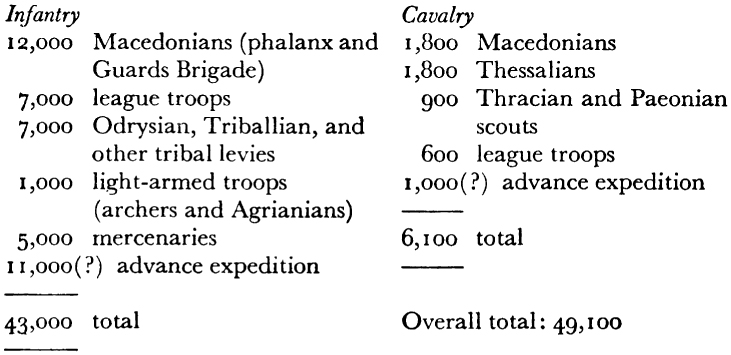
The small number of Agrianians and archers is misleading: Alexander used this force continually, in every kind of engagement, and it must have been reinforced by regular drafts from the Balkans. A shortage of mercenaries, on the other hand, is just what we might expect: at this stage Alexander simply could not afford them.12 We should also note the special status of the Thessalian cavalry, which stood in a category of its own among the allied contingents.
Philip had been elected Archon of Thessaly for life, an office which Alexander inherited (see above, p. 117). Ethnically speaking, Thessaly was far more akin to Macedonia than it was to the Greek city-states, being governed by a very similar type of feudalaristocracy. The Thessalian cavalry was, therefore, more or less indistinguishable from its Macedonian counterpart, being identically armed, and organized in the same way — that is, by territorial squadrons.13 Another vital distinction between this unit and other league forces was the degree of trust which Alexander placed in it — though here his hand may have been forced to some extent. The Thessalians' permanent battle-station was on the left wing, which meant that they came under the direct command of Parmenio. It has been argued, with some force, that ‘they virtually formed Parmenio's personal Companion Cavalry, with the Pharsalus squadron in a similar capacity to the Royal Squadron of the Companions’.14
This interesting alignment has considerable significance in the light of later events: it fits in very well with what we know of the quiet but deadly struggle that went on between Parmenio and Alexander, right from the beginning, to secure effective control of the army. Every key command must have been fought over tooth and nail. At this stage, however, Parmenio — who even now, perhaps, still thought of the young king as a more than usually active figurehead, dashing but politically immature — was negotiating from strength. He was indispensable in the field, and he had been instrumental in securing Alexander's succession. His bill for these invaluable services proved a costly one. Of his sons, Nicanor obtained command of the Guards Brigade (hypaspistae), while Philotas— that same Philotas who had betrayed Alexander's dealings with Pixodarus to Philip — became colonel of the Companion Cavalry. Parmenio's son-in-law Coenus was allotted one of the six battalions of the phalanx, while the light cavalry probably went to his brother Asander. Since he himself was second-in-command of the entire expeditionary force, Parmenio's position must have seemed virtually unassailable.
Furthermore, when it came to the crucial business of deciding which troops stayed with Antipater, and which were for service in Asia, Parmenio saw to it that a large proportion of the latter was drawn from Philip's old veterans. This particularly applied to the officer corps, at regimental and company level. Though Alexander secured battalion commands in the phalanx for several of his young friends, such as Craterus and Perdiccas, the majority of the officers in 334 were men who had served under Philip, and were not much younger than Parmenio himself. When Justin says that staff headquarters looked ‘more like the senate of some old-time republic’15 he is hardly exaggerating. Alexander may have had his own reasons for agreeing to this arrangement: experienced veterans would be of more use on a major campaign than untried amateurs, while from the political viewpoint it was better, surely, to have Parmenio's old guard — not to mention Parmenio himself — where he could keep a weather eye on their activities. But the fact remains that when Alexander landed in Asia, it was at the head of Philip's army, staffed mainly by Philip's officers and with Philip's old general as his chief of staff. Parmenio had every reason to feel confident.
In addition to front-line troops, the invasion force included large numbers of technicians and specialists. There was a corps of sappers and siege-engineers under Diades the Thessalian: these men were responsible not only for Alexander's artillery and assault-gear, but also for tunnelling, mining, and the construction of roads and bridges. There was a surveying section, the bematistae, who ‘collected information about routes and camping-grounds and recorded the distances marched’.16 Staff administration and the secretariat were run by Eumenes of Cardia, Philip's former head of chancery. A more unusual feature — and here Aristotle's influence shows out most clearly — was the surprising number of scholars and scientists who accompanied it in an official capacity.Alexander had always known the value of good intelligence-reports: this military principle he now applied on a far wider scale. His team included architects and geographers, botanists, astronomers, mathematicians and zoologists. All scientific knowledge of the East, for centuries to come, depended, ultimately, on the accumulated information they brought back with them.
Alexander was also, so far as we know, the first field-commander in antiquity to organize an official publicity and propaganda section. Achilles had had Homer to immortalize him, and Achilles' descendant was determined that his own achievements should not go unsung. Besides the day-to-day record of the expedition,c something a little more literary and grandiloquent was called for. To supply it, Alexander appointed Aristotle's nephew Callisthenes as the expedition's official historian.17 It is generally assumed that this was an unhappy choice, where for once the claims of nepotism prevailed over any considerations of suitability. Callisthenes was a man of principle who believed in speaking his mind — two characteristics not normally conducive to the production of effectivepropaganda. Aristotle, having heard him in conversation with the king, quoted a line of Homer: ‘The way you're talking, my child, you won't last long.’ Callisthenes had known Alexander as a schoolboy at Mieza, and saw no reason to flatter him. At this stage his young patron was still merely Philip's son, about to embark on a reckless adventure, with an empty treasury, against vastly superior odds.18
In fact, however, the king seems to have sized his nominee up with cool, not to say cynical, percipience. Alexander was not by temperament an intellectual himself, but he understood the intellectual mentality, and exploited it — as he did so much else — for his own benefit. Callisthenes was just what he needed at this point: a convinced Panhellenist, a believer (through his uncle's teaching) in the philosophical justification of monarchy through areté, above all a political innocent. He had already made some reputation for himself as a historian, while his background (he came from Olynthus) would render him acceptable to his prospective Greek public. He was useful, but inessential. When he had served his purpose he could be, and was, discarded. His prospective task was to chronicle the king's achievements, in a way that would favourably impress Greek opinion. This record was to be sent home by instalments, as the expedition proceeded. Though Alexander reserved the right to check Callisthenes' final draft, and sometimes (as we shall see) suggested a particular slanting of events, it should not be assumed that he virtually dictated all his chronicler wrote. There would be no need to stop Callisthenes setting down the truth as he saw it: it was for his all too predictable intellectual opinions that the historian had been hired in the first place.
Callisthenes himself never realized this; nor, in all likelihood, had he any clear notion of how his work was going to be used. The fact that he was expendable never seems to have occurred to him, either; like so many of his kind, he was not only boorishly outspoken, but a person of quite monumental self-conceit. A little common sense might have told him that he could only rely on staying in favour so long as Alexander needed to conciliate the Greek world. But common sense, as his uncle knew, was not one of Callisthenes' more outstanding qualities; and the lack of it ultimately cost him his life.19
He was, however, a by no means isolated phenomenon. Once it became known that Alexander not only wanted his exploits written up, but would hand out good money for the privilege, a whole rabble of third-rate poets, historians and rhetoricians attached themselves to his train. Their numbers swelled as time went on, since Alexander's unbroken run of successes not only gave them more material, but increased the rewards they could command. In these circumstances it is not surprising that their flattery was gross, and their work for the most part beneath contempt. Alexander himself told one of them, Choerilus, that he would rather be Homer's Thersites than Choerilus' Achilles. But pure artistic merit was no criterion of reward in the propaganda section: another sedulous ape,Pyrrho (who presumably had his employer's foibles better sized up), later received no less than 10,000 gold pieces for one honorific ode. What Philip's veterans made of these chattering civilian literati can all too easily be imagined.20 Alexander himself often derived malicious amusement from playing them off against each other.
His military preparations thus completed, Alexander — in accordance with a tradition established by King Archelaus — celebrated the so-called ‘Olympian’ Games, a nine-day festival, in honour of Zeus and the Muses, held either at Aegae or Dium. There were lavish sacrifices to the gods, followed by dramatic and musical contests. The king was determined to put his army in a good humour, and a few talents more or less could make little difference now. Indeed, a really lavish display might help to discredit rumours of Macedonian insolvency: one late source claims that Alexander was only stopped from putting an entire bronze proscenium arch in the theatre by his architect, who objected that it would interfere with the acoustics. He certainly ordered a gigantic marquee, large enough to hold a hundred dining-couches, and gave a splendid banquet in it for his Companions, his senior officers, and ambassadors from the Greek city-states. This tent afterwards accompanied him on all his campaigns: the belief that he was only corrupted byPersian luxury is a myth. There was a free distribution of sacrificial animals to the troops, ‘and all else suitable for the festive occasion’.21
One curious incident — all the more tantalizing in the light of what was to come — took place during this period. Just before the great expedition left Macedonia, Olympias is said to have told Alexander, ‘and him alone, the secret of his begetting, and bade him have purposes worthy of his birth’. Whatever that secret may in fact have been, there is no doubt what men afterwards (Callisthenes amongst them) thought it was. Alexander, so his mother claimed, had been begotten by a god, in all likelihood Zeus Ammon. Some confirmation of this belief is provided by an almost identical story told of Alexander's comrade-in-arms Seleucus, who afterwards became a king in his own right, giving his name to the Seleucid dynasty. His mother, Laodice (who in fact was married to one ofPhilip's generals), dreamed that she lay with Apollo, and became pregnant. As a token of the god's paternity she received a ring with an anchor-device carved on the stone. This ring he bade her give to the son she would bear, when he came of age.
Next morning Laodice awoke to find just such a ring in her bed; and it subsequently transpired that she was, in fact, pregnant. The son she bore was Seleucus, and, sure enough, he had the mark of an anchor on his thigh. When he grew up, and was about to set forth on the great expedition with Alexander, Laodice ‘told him the truth of his begetting, and gave him the ring’. This whole story is, of course, a palpable fabrication, probably based on some fortuitous birthmark, and put into circulation at a time when Seleucus needed good antecedents for his claim to divine kingship. For this reason it has had less attention than it deserves. What is significant is the particular form the fabrication took. There can be little doubt that Seleucus was consciously attempting to emulate Alexander, and transferred to his own mother a legend first told of Olympias. That he chose to do so at all suggests not only that the story had wide currency, but that it was also thought to embody the actual secret which Alexander heard from his mother before leaving Europe.22
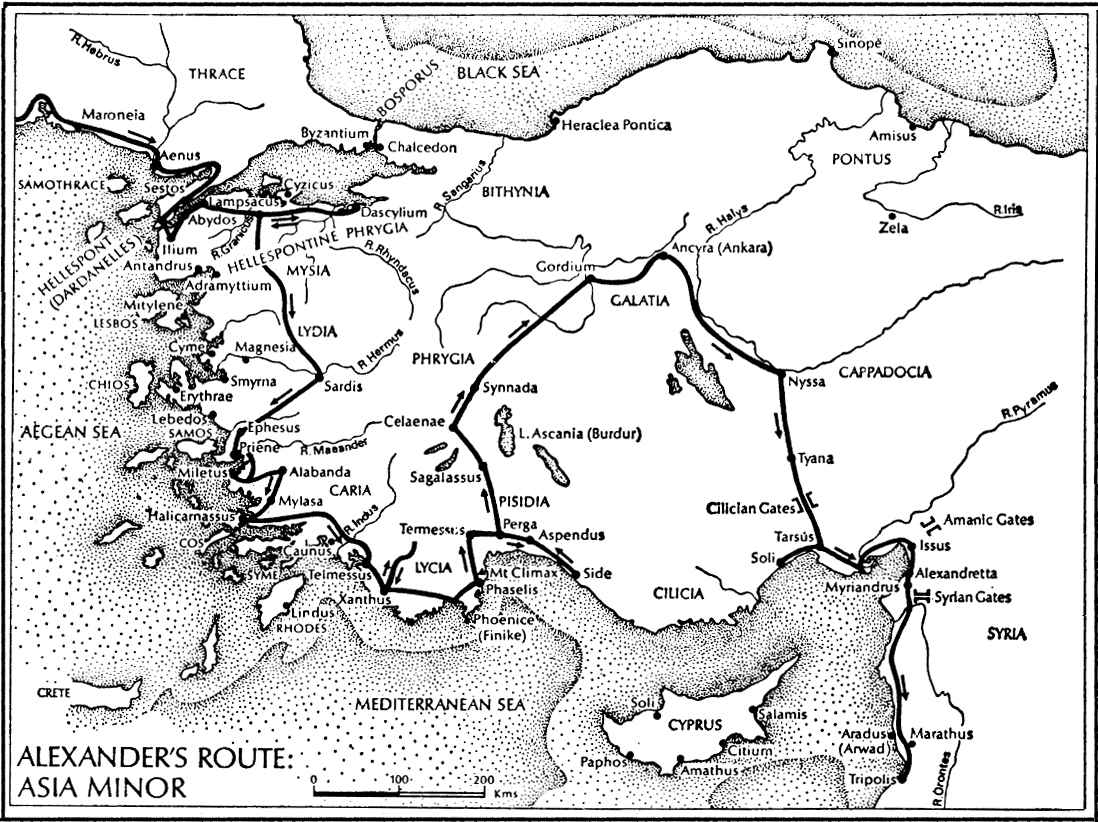
In early spring 334 King Alexander of Macedon set out at last from Pella at the head of his expeditionary force, and marched for the Hellespont. Ever since childhood he had dreamed of this moment: now the dream had been fulfilled, and he was entering on his destiny of conquest. Few men can ever have given such solid embodiment to their private myths. He was the young Achilles, sailing once more for the windy plains of Troy; but he was also captain-general of the Hellenes, whose task it was to exact just vengeance for Xerxes' invasion of Greece. The two roles merged in his mind, as the two events had merged in history. ‘Xerxes had made it clear that his expedition was the Trojan War in reverse; Alexander therefore in turn reversed the details of this most famous of all oriental attacks.’23
To begin with, he crossed the Narrows at the same point. He brought his host the 300 miles to Sestos, by way of Amphipolis and Thrace, in twenty days, which was good going. The advance corps had held the bridgehead, and his crossing took place withoutPersian opposition. This, however we look at it, was the most extraordinary piece of good luck for Alexander. His one great weakness lay in his fleet. He had only 160 vessels, supplied by the league, and their crews were far from the best that were available. Darius'Phoenician navy was almost three times as large, and far more efficient. A determined attack by sea during the actual crossing might well have scotched the invasion before it was well launched. But no such attack took place; not one enemy ship was sighted. Coordinated strategy could not be called the Persian High Command's strongest point.
Alexander himself was, it would seem, blithely indifferent to the possibility of such a counter-move: perhaps he had had encouraging reports from his intelligence section. At all events, he left Parmenio to supervise the main crossing to Abydos — a complex but boring operation — while he took off on what has variously been described as a propaganda trip, a romantic religious pilgrimage, and a mere high-spirited youthful lark.24 It probably in fact contained elements of all three. Accompanied by at least 6,000 men,25he made his way overland to Elaeum, at the southern tip of the Thracian Chersonese (Gallipoli Peninsula). Here he sacrificed before the tomb of Protesilaus, traditionally the first Greek in Agamemnon's army who stepped ashore at Troy. Alexander prayed that his own landing on Asiatic soil might be luckier; an understandable request, since he intended to be first ashore himself, and Protesilaus had been killed almost immediately.
He then set up an altar at the point where he was about to leave Europe, made sacrifice, and invoked the gods for victory in his war of vengeance. This done, he and his party crossed the Dardanelles in the sixty vessels which Parmenio had sent down fromSestos to meet him. Alexander steered the admiral's flagship in person. When the squadron was half-way across, he sacrificed a bull to Poseidon, and made libation with a golden vessel, just as Xerxes had done before him: the emphasis could hardly have been clearer. On entering ‘the Achaean harbour’ — this, I suspect, was in fact Rhoeteum, safely held by Calas' troops — Alexander stood at the prow of his vessel, in full armour, and flung a spear into the sand, ‘signifying that he received Asia from the gods as a spear-won prize’. Then he leapt ashore. His ritual spear-throwing gesture has been much disputed. Since it only occurs in one late source, many scholars have denied that it ever took place at all. If it did, was it simply a formal declaration of war? Or was Alexander, with deliberate archaism, employing a long-obsolete symbol of ‘conquest by the spear’? Did he, in fact, intend to overthrow the Achaemenid empire, root and branch, from the very outset? This last supposition seems the most probable, and what happened next tends to confirm it.26
The king's first act on landing was to set up another altar, to Athena, Heracles, and Zeus of Safe Landings — throughout his life he showed himself genuinely scrupulous in religious matters, great and small alike — and to pray that ‘these territories might accept him as king of their own free will, without constraint’.27 Then he set off on his pilgrimage to Ilium. This, ironically, was not the true site of Homer's Troy, but a later foundation, itself by Alexander's day a mere village, with a ‘small and cheap’ temple of Athena, and a collection of relics — bogus in all likelihood — from the Trojan War.28 He was welcomed by a committee of local Greeks, from Sigeium and other towns in the area. Following the lead of his navigator, Menoetius, they presented him with ceremonial gold wreaths. Alexander then offered sacrifice at the tombs of Ajax and Achilles, or what local tradition presented as such. (This was predictable: Xerxes, too, had visited Troy during his invasion march, and had poured libations to the spirits of the Trojan heroes.) To be on the safe side, the king also made a placatory offering at the sacred hearth of Zeus of Enclosures, where, according to legend, his own ancestor Neoptolemus had slain Priam.
But the oddest ceremony — to our eyes — was when Alexander and his inseparable companion Hephaestion laid wreaths on the tombs of Achilles and Patroclus respectively (which Aelian took to mean that they enjoyed a similar relationship) and then ran a race around them, naked and anointed with oil, in the traditional fashion. How fortunate Achilles was, the young king exclaimed, to have so faithful a friend all his life, and no less a poet than Homer to herald his fame when he was dead! Later, during a sight-seeing tour round the town, he was asked if he would care to inspect a lyre which had belonged to Paris. He refused curtly, saying that all Paris had ever played on this instrument were ‘adulterous ditties such as captivate and bewitch the hearts of women’. But, he added, ‘I would gladly see that of Achilles, to which he used to sing the glorious deeds of brave men.’29
Before leaving Ilium, Alexander sacrificed in the sanctuary of Athena. His personal seer, Aristander of Telmessus, observing the overthrown statue of a former rebel satrap which lay outside the temple, predicted a great cavalry victory for the king, in which he would slay an enemy general with his own hands. Aristander's ingenuity at interpreting omens knew no bounds. When a statue of Orpheus was reported to be sweating continually, he explained that this meant ‘the writers of odes and the epic and melic poets had hard work coming to celebrate Alexander and his exploits in verse and song’. The king, however, was a glutton for good omens, which may explain why Aristander lasted so long in his service. At all events, he now made lavish sacrifice to Athena, and dedicated his own armour at the goddess's altar. In exchange he received a shield and panoply of guaranteed Trojan vintage, with which he armed himself for his first major engagement on Asiatic soil, at the Granicus River (see below, pp. 176 ff.). However, they got rather badly knocked about during the fighting, and thereafter Alexander merely had them carried into battle before him by a squire.30
From Ilium Alexander moved north again, and rejoined the main army at Arisbe, a little way outside Abydos. He made it known that there was to be no looting or ravaging during the advance. This land, he told the troops, was now theirs: one should not depreciate one's own property. In particular, they were to respect the estates of Memnon, Darius' Greek general — an act which, it was hoped, might lead the Great King to wonder whether his employee was not perhaps trafficking with the enemy.31 After reviewing and numbering his host — again, just as Xerxes had done — Alexander led them forth on the road to Dascylium, where the Phrygian satrap had his seat of government.
The first town they came to was Percote, still safely in Macedonian hands. But the next major city on their route, Lampsacus, was now controlled by Memnon (see above, p. 139), and to judge from our scanty evidence, quite a number of other Greek towns in Asia Minor were in the same position. The philosopher Anaximenes, acting as his city's official envoy, persuaded Alexander to by-pass Lampsacus, probably with a massive bribe: the king's shortage of money was already public knowledge in Asia. For this service (the nature of which he afterwards embroidered somewhat to increase his dignity)32 Anaximenes received the honour of a statue at Olympia, dedicated by his grateful fellow-citizens. They could, in fact, have saved themselves the expense. With only a month's supplies — apart from what he could commandeer locally — and enough pay to last a fortnight, Alexander's one hope was to tempt the Persians into a set battle, and win it. He had neither the time nor the reserves to invest a city: if it did not surrender on his approach, he left it severely alone. Colonae, for example, received the same treatment as Lampsacus, without paying anything for the privilege.
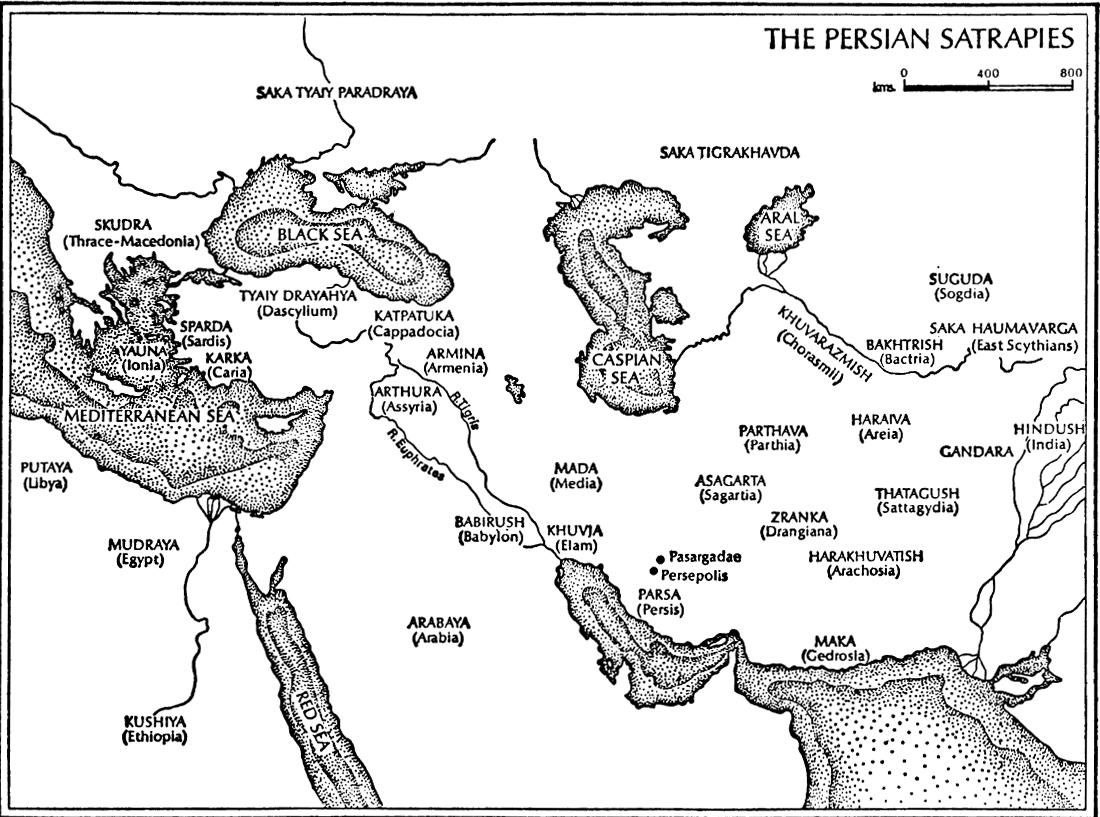
When he reached Priapus, however, he was in better luck. His advance scouts reported that the citizens were willing to receive him, and he sent a small force to take the town over. The captain-general had performed his first act of ‘liberation’, and we may be sure that Callisthenes made the most of the occasion in his dispatches.33 By now the Persians, who had been too late34 to stop him at the Dardanelles, saw clearly enough what his intentions were. Arsites, the satrap of Hellespontine Phrygia, sent out an appeal for help to his fellow-governors in Asia Minor: Arsamenes, on the Cilician seaboard, and Spithridates, who ruled over Lydia and Ionia. The three of them established a base-camp at Zeleia (Sari-Keia), east of the Granicus River, and summoned their military commanders to a council of war. They still felt, clearly, that the crisis could be dealt with at provincial level, which shows how badly they underestimated Alexander as an opponent.d
The most sensible plan of campaign was that proposed by Memnon the Rhodian, a seasoned professional mercenary who knew all about Alexander's shortage of money and supplies, and seems, in addition, to have had excellent intelligence concerning the situation in Greece. (His source in both cases was probably the renegade Macedonian general, Amyntas, son of Antiochus.) What he now put forward was a scorched-earth policy: destroy all crops, strip the countryside, if need be burn down towns and villages. Such a policy, as he made clear, would very soon force the Macedonian army to withdraw for lack of provisions. Meanwhile, the Persians should themselves assemble a large fleet and army, and carry the war across into Macedonia while Alexander's forces were still divided.
This was first-class advice; unfortunately it came from a Greek mercenary, whose brilliance and plain speaking did not endear him to his Persian colleagues. A little tact might well have got Memnon all he wanted; but he now went on to say, without mincing his words, that they should at all costs avoid fighting a pitched battle, since the Macedonian infantry was far superior to their own. The plain truth of this assertion hardly made it more palatable. The Persians were hurt in their dignity; Arsites declared, with more patriotism than common sense — he may also have had one eye on Darius, who did not take kindly to reports of satrapal cowardice — that he would not suffer one single subject's house in his satrapy to be burnt.e Memnon's plan was therefore rejected, and thePersians decided to fight it out.35
Nothing could have pleased Alexander more. Nevertheless, his opponents still enjoyed one very considerable advantage: choice of terrain. Alexander had marched north-east from Abydos rather than in any other direction (e.g. along the Royal Road toSardis, which might have seemed more logical) simply and solely because that was where the Persian satraps were mustering their forces. Once his opponents realized how badly he needed a fight — and Memnon must surely have rubbed this point in — they could, without much difficulty, bring him to battle where and when they pleased. In the event, they chose a defensive strategy: once Memnon's scheme had been discarded, this was probably the most sensible alternative. Alexander's dashing reputation had, clearly, preceded him. If he could be lured into attacking a strongly held position, over exposed and dangerous ground, where his cavalry would find difficulty in charging, and the Macedonian phalanx could not hold formation, then that might well be the end of the invasion.
Having collected all available reinforcements, the satraps advanced from Zeleia to the River Granicus (now the Koçabaş), which Alexander would have to cross if he wanted to reach Dascylium — or, indeed, to force an engagement. They chose a position where the stream ran fast and deep, and the bank on the eastern side was high, with thick deposits of alluvial silt beneath it.36 This offered the best possible conditions for the strategy they had in mind.f 37 At the crossing-point itself Arsites posted Memnon and hismercenaries, about 5–6,000 strong: a solid spear-wall, reinforced with light-armed javelin-men, was the best possible defence against a frontal assault by cavalry.38 Flanking them were the Persian cavalry regiments. Arsites, touchy though he was on this subject, knew better than to hold the front line with his own conscript infantry levies. The cavalry would be immobilized, and in fact acting as mounted infantry for the occasion; but he had to make the best use of what troops were available.
He could, in fact, have been a great deal worse off. His overall force was not much over 30,000 men, whereas Alexander had 43,000 infantry alone. In cavalry, however, he enjoyed a vast superiority of numbers: 15–16,000 to Alexander's 6,000+.39 This factor dictated much of his subsequent tactics. Whatever he did, he must avoid exposing his inferior infantry to the Macedonian phalanx on open ground. If he was to defeat Alexander, it would be through the skilful use of his cavalry and mercenaries in combination.
Alexander, meanwhile, was advancing on the Granicus, baggage-train in the rear, ‘his infantry massed in two groups, both wings protected by cavalry’, with a strong detachment of light troops thrown out in front to reconnoitre the ground. When his scouts rode back and informed him that the enemy had been sighted, he drew up his forces in battle-order and moved on at full speed to the river, ready for an immediate engagement. But when they got there, and saw the conditions under which they would be required to attack, Alexander's officers were something less than enthusiastic. Mostly veterans with years of hard campaigning behind them, these men knew a death-trap when they saw one.
Parmenio did his best to reason with the king. The Persians could not be tempted out of their entrenched position: they had every advantage, and knew it. The depth and speed of the river meant that the Macedonians would be unable to advance in extended line. They would have to cross in column, and while they were struggling up that slippery bank on the far side, in general disorder, they would be totally vulnerable. Besides, it was already late in the afternoon. The most sensible course, surely, was to camp where they were for the night. Arsites was so heavily out-numbered in infantry that he might well withdraw; and then the Macedonians could ford the river at dawn without any fear of opposition. Alternatively, they could march downstream under cover of darkness and find an easier crossing-point. ‘A failure at the outset,’ Parmenio concluded — perhaps his most telling argument — ‘would be a serious thing now, and highly detrimental to our success in the long run.’
But Alexander would not listen to reason; he was hell-bent on attacking there and then. The enemy lay before him; his supplies and cash reserves were fast running out; it was, he felt, now or never. Parmenio's suggestion that Arsites might decamp during the night must have strengthened the king's resolve more than anything else: this was the one thing he had to prevent at all costs. Besides, his destiny was summoning him, like his exemplar Achilles, to achieve heroic fame through great deeds — and where better, on this occasion, than across the Granicus, against such fearful odds?40 As a last resort Alexander's staff, knowing their young king's touchy Homeric pride, tried to raise religious objections. It was now May, the Macedonian month Daisios, during which, it seems, military campaigning was taboo — a prohibition originally connected with the need to get the harvest in.41 Alexander retorted by making an ad hoc intercalation to the calendar, so that the month became — by royal decree, as it were — a second Artemisios. He had made up his mind, and nothing, it seemed, would budge him.
If a direct assault in fact took place at this point,42 it was almost certainly an expensive failure (see below, pp. 508 ff.). Whether it did or not, Alexander was finally forced, however reluctantly, to accept Parmenio's advice. It was the most sensible plan by far, and in his heart of hearts the king knew this as well as anyone. But the loss of face and humiliation which such a decision implied were not things lightly forgotten by a man of Alexander's temper, and may well have played a larger part than most historians allow in his subsequent treatment of Parmenio. From now on, it has been observed, Callisthenes never misses an opportunity, in his official record, of reporting occasions when Parmenio supposedly gave the king bad advice. This advice, needless to say, was always ignored — to the benefit of everyone concerned.
There can be little doubt as to who put such an idea into the historian's head, or why. The fiasco at the Granicus rankled deeply, and this systematic denigration of Parmenio was one of its more unpleasant consequences. Callisthenes, as a progressive Greek intellectual, seems at this stage to have disliked Philip's old guard barons on principle: it took the proskynesis affair (see below, pp. 372 ff.) to drive him into their camp, presumably on the principle that ‘my enemy's enemy is my friend’. At all events he carried out his brief with partisan thoroughness, in a smear-campaign which reached its peak at Gaugamela (see below, p. 294). Callisthenes' dispatch on the battle accused the old marshal, quite unjustifiably, of cowardice and military incompetence.43 But by then Alexander was ready to close in on Parmenio, and in a position to do so. At the time of the Granicus, Parmenio still held most of the trump cards.
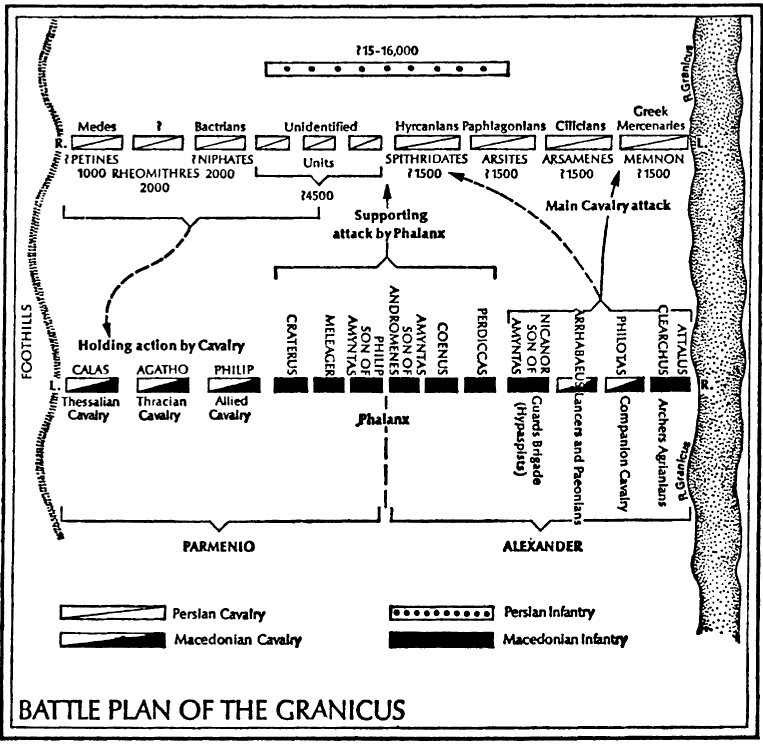
Under cover of darkness — probably leaving all camp-fires ablaze to deceive the Persians44 — the army marched downstream till a suitable ford was found. Here they bivouacked for a few hours. The crossing began at dawn. While it was still in progress,Arsites' scouts gave the alarm. Several regiments of cavalry hastily galloped down to the ford, hoping to catch Alexander's troops at a disadvantage — as they had done the previous afternoon. But this time they were too late. The bulk of the army was already on the eastern bank, and Macedonian discipline had no difficulty in coping with a surprise attack of this sort. While the phalanx formed up to cover their comrades in the river, Alexander led his own cavalry in a swift outflanking charge. The Persians wisely retreated. Alexander got the rest of his column across at leisure, and then deployed in battle-formation (see plan, p. 174). It was rich, rolling plainland, ideal for a cavalry engagement; on the hills — then as today — spring wheat rippled in the morning breeze.45
Arsites and his colleagues had to think fast. Their initial advantage was lost. They would now have to fight in open country — what Justin calls the Adrasteian plain — with the river on their left flank and their right wing stretching away towards the foothills. They were strong in cavalry, lamentably weak in infantry. There was only one thing for them to do. They put all their cavalry regiments into the front line, deploying them on as wide a front as possible, while the infantry was held in reserve. Then they advanced towards Alexander's position. Their aim, in all likelihood, was to roll up his wings by means of a massive outflanking movement.
If they were also, as Tarn believed, determined to kill Alexander, they certainly can have had no trouble in identifying him. He wore the magnificent armour he had taken from Athena's temple at Ilium; his shield was emblazoned as splendidly as that ofAchilles, and on his head he had an extraordinary helmet with two great white wings or plumes adorning it (which sounds decidedly un-Homeric in style).46 All round him thronged an obsequious crowd of pages and staff-officers. The Persians, having observed that he was taking up his battle-station on the right wing, transferred some of their best cavalry regiments from the centre to meet his assault. This was precisely what Alexander had hoped they would do; his conspicuous display (as with so many of his actions) was made with a very practical ulterior motive.
A moment later, with trumpets blaring, while hills and river re-echoed to the terrible battle-cry of the phalanx, the king charged, leading his cavalry in wedge formation. He feinted at the enemy left, where Memnon and Arsamenes were waiting for him; then he abruptly swung his wedge inwards, driving at the now weakened Persian centre. Meanwhile Parmenio, away on the left flank, was fighting a holding action against the Medes and Bactrians. Alexander was making a classic pivotal or echeloned attack (cf. above, p. 24), with his left wing, as usual, forming the axis. When the Persian right moved forward against Parmenio, with the intention of outflanking him, a gap opened in their centre, and it was here that Alexander and the Companion Cavalry punched their way through.47 The king himself was in the thick of the fighting: blows showered on his shield and body-armour from all sides.
A desperate and truly Homeric struggle now ensued. Mithridates, Darius' son-in-law, counter-charged at the head of his own Iranian cavalry division, accompanied by forty high-ranking Persian nobles, and began to drive a similar wedge into the Macedonian centre. Alexander's spear had been broken in the first onslaught, and old Demaratus of Corinth gave him his own. The king wheeled round and rode straight for Mithridates. The Persian hurled a javelin at him with such force that it not only transfixed his shield, but pierced the cuirass behind it. Alexander plucked out the javelin, set spurs to his horse, and drove his own spear fair and square into Mithridates' breastplate. At this, says Diodorus, ‘adjacent ranks in both armies cried out at the superlative display of prowess.’ It is all remarkably like a battle-scene from the Iliad — which does not necessarily make it suspect testimony.
However, the breastplate held, the king's spear-point snapped off short, and Mithridates — shaken, but still game — drew his sword in readiness for a close-quarters mounted duel. Alexander, with considerable presence of mind, jabbed the broken spear into his opponent's face, hurling him to the ground. He was, however, so preoccupied with Mithridates that he had eyes for no one else. Another Persian nobleman, Rhosaces, now rode at him from the flank, with drawn sabre, and dealt him such a blow on the head that it sheared clean through his winged helmet and laid the scalp open to the bone. Alexander, swaying and dizzy, nevertheless managed to dispatch this fresh assailant; but while he was doing so, Rhosaces' brother, Spithridates, the satrap of Ionia, moved in behind him, sword upraised, ready to deliver the coup de grâce. In the very nick of time ‘Black’ Cleitus, the brother of Alexander's nurse, severed Spithridates' arm at the shoulder with one tremendous blow. It was none too soon; the king collapsed half-fainting to the ground, and a battle-royal raged over his prostrate body.
Meanwhile the phalanx was pouring through the gap in the Persian centre, and had begun to make short work of Arsites' native infantry. Alexander's light-armed troops darted in among the Persian riders, hamstringing their horses and causing general confusion. Somehow the king struggled on to his own horse again, and the Companions rallied round him. The enemy centre began to cave in, leaving their flanks exposed. Many distinguished Persian commanders had already been killed. This was the beginning of the end. Parmenio's Thessalian cavalry, on the left wing, now made a well-timed charge, and in a moment the entire Persian line broke and fled.
Their infantry divisions, except for the mercenaries, put up little resistance. But Memnon and his men retreated in good order to a high knoll above the battlefield, and there made a last stand. They sent a herald to Alexander asking for quarter, but the king (for whatever reason) was in no mood to grant it. He now concentrated his entire attention on destroying them. While the phalanx delivered a frontal assault, his cavalry hemmed them in from all sides to prevent a mass break-out. Seeing they could expect no mercy, Memnon's troops fought with savage and desperate courage: more Macedonians were killed during this stage of the battle than at any other point. Alexander himself, leading the cavalry, had his horse killed under him by a spear-thrust. But there could be only one end to such a struggle. Perhaps 3–4,000 mercenaries died where they stood; the remaining 2,000 laid down their arms and surrendered. Memnon himself somehow contrived to get away: Alexander had not yet seen the last of him. The rest of Arsites' forces were fleeing in wild disorder across the plain, and Alexander let them go. The battle of the Granicus was over, and the captain-general had won a famous victory. His personal conduct during the battle was heroic to a degree; seldom can the palm for valour, awarded him ‘by common consent’, have found a more deserving recipient.48
Casualties among the Persian cavalry units numbered some 2,500, of whom 1,000 were native Iranians. The death-roll included many great noblemen: Darius' son-in-law Mithridates, his son Arbupales, his wife's uncle Pharnaces, together with Spithridates, the Cappadocian commander Mithrobuzanes, and many others. Arsites himself survived and fled into Phrygia, where he committed suicide, believing — justifiably or not — that he was primarily responsible for the disaster. The losses suffered by the Persian infantry have been grossly exaggerated (by Diodorus in particular) and there is no sure way of determining them.49 However, since they broke and ran without putting up much of a fight, their casualties are unlikely to have been heavy. The losses attributed to theMacedonians are equally suspect. The highest number of casualties said to have been suffered by Alexander's infantry is thirty, and two sources reduce this figure to nine. Similarly with the cavalry: the maximum loss recorded is 120. But the same two authorities (Ptolemy and Aristobulus) admit no more than sixty, of whom twenty-five were Companions who fell ‘in the first charge’.50 Alexander subsequently had statues of these twenty-five erected at Dium in Macedonia: a unique gesture, never to be repeated. He also, characteristically, included his own likeness in the group.51
Memnon's 2,000 surviving mercenaries were chained like felons and sent back to forced labour in Macedonia, probably down the mines. Common sense would have suggested acquiring their valuable services for the Macedonian army, at cheap rates: Alexander's action smacks of pure vindictiveness. His ostensible reason — still widely believed — was that ‘they had violated Greek opinion by fighting with orientals against Greeks’. In other words, he was making a placatory gesture as captain-general of theleague. But Greek public opinion was something of which Alexander took notice only when it suited him; and the league he used as a blanket excuse for a good many underhand actions (the destruction of Thebes is only one example). In fact from now on he enrolled Greek mercenaries — including those who had previously taken service under Darius — whenever he could get hold of them. Aristobulus says he was ‘influenced more by anger than by reason’, and this, surely, is the plain truth.52
From the spoils of victory he selected 300 panoplies, and sent them to Athens for dedication in the Parthenon. The accompanying inscription ran as follows: ‘Alexander son of Philip and the Greeks — Lacedaemonians excepted — these spoils from the barbarians who dwell in Asia’. Once more, under cover of executing the league's decrees, Alexander had made it very clear what would happen to any Greeks — Athenians included — who were rash enough to oppose him; the snub to Sparta was merely incidental. Whether the omission of any reference to his own Macedonians was designed to emphasize their Greekness (and his own role as the league's servant), or had some darker and more splenetic motivation, is a question which cannot easily be decided.53
On the day following the battle the king celebrated splendid obsequies for his own fallen, who were buried, like true warriors, with their arms and armour. He also granted their immediate relatives exemption from military service, and from all local or property taxes — privileges which, he calculated, would ‘create in his men greater enthusiasm to face the hazards of battle’: the ulterior pragmatic motive is seldom far to seek in his actions. Perhaps for the same reason he made a point of visiting the wounded, and encouraging them to boast of their personal feats of bravery during the engagement. The bulk of the luxury articles which fell into his hands — purple robes, drinking-cups and suchlike — he sent home to his mother.54
After this defeat Darius could no longer fail to take the Macedonian threat seriously. From the very jaws of defeat Alexander had snatched an overwhelming victory. The whole of western Asia Minor now lay open before him: the Persian crusade had begun in grim earnest. As he surveyed the stricken field of the Granicus on that May morning, the captain-general of the Hellenes had good reason to feel pleased with himself. Yet this — as he knew too well — was only the beginning. A long and dangerous journey still lay before him: just how long, and how dangerous, perhaps not even he realized.