
Men believed that Alexander had ascended to heaven, but for the next twelve years it must have seemed equally likely that all who had helped him were under a curse. The situation at Babylon was proof of the price that a king must pay for killing all rivals at his accession, a policy which strengthens the throne briefly, then delivers it into the hands of its barons. When Alexander died, Roxane was pregnant and her baby was not due for at least six weeks; it might anyway prove to be a girl. Alexander had also left a bastard son Heracles by his first Persian mistress Barsine, but the three-year-old boy had been ignored and no Macedonian took him seriously. Officers as prominent as Perdiccas, Leonnatus or the elderly Polyperchon claimed royal blood through their local dynasties in highland Macedonia; their claims were remote, had not Philip’s bastard son Arrhidaeus been the only male alive in Alexander’s royal family, an adult but also a half-wit. A choice had to be made, and as Alexander had bequeathed his ring to his Vizier Perdiccas, his was the first decision; disdaining the idiot Maccedonian, he encouraged the Bodyguards and cavalry to favour Roxane’s unborn child. But the Foot Companions were roused by their brigadier Meleager to call for Arrhidaeus, a face they knew and for all his deficiencies, not of Oriental blood. The common man’s hatred of Alexander’s Oriental policy had not disappeared with his death. Meleager, too, had once complained of undue honours bestowed on conquered Indians.
The result was a quarrel which surprised even the officers. Perdiccas and Ptolemy fled with their friends to the chamber where Alexander was lying in state, only to find that the door was smashed in by Meleager’s infantry who started to pelt them with spears; they were stopped, just, and Perdiccas withdrew with his cavalry to the fields outside Babylon where he began an insidious revenge. All food was blocked from reaching the city until Meleager and the infantry were starved into an agreement that Arrhidaeus should share the kingship if Roxane bore a son and that infant and half-wit should be guarded by Perdiccas and Meleager in partnership. According to custom, the army was then purified from the taint of Alexander’s death by marching between the two halves of a disembowelled dog; when everyone was off their guard, Perdiccas had thirty of Meleager’s faction seized and thrown to the elephants for execution, Meleager took his own life, seeing his cause was hopeless. All too plainly, order had broken down, although Alexander had only been dead for a week. This was indeed the ‘age of paradox’, for on the news of his death, the Greeks were roused to rebellion by Athens and her general Leosthenes, whereas the Persians shaved their heads and lamented the passing of a fair-minded king; Sisygambis, mother of Darius, fasted to death after only five days, mourning the man whose chivalry she had respected ever since her capture at Issus. It was the most telling tribute to Alexander’s courteous way with women, and with the camp in disorder she could not be blamed for her gloomy view of the future.
Within a year the turbulence of Macedonia’s baronry had burst over Asia and the Mediterranean. For many the empire was a unity, and should remain so; for a few, there were kingdoms to be carved out, whether in Egypt where Ptolemy first seized a satrapy and made it independent or in Maccedonia where Antipater’s death raised hopes of a separate realm. For the next twenty years, separatism grew to overpower unity, until the world had been split into four: in Egypt, Ptolemy; in Asia, Seleucus, once leader of Alexander’s Shield Bearers; in Thrace, Lysimachus, a former Bodyguard, and in Macedonia whichever king could raise and hold support. They were years of war and murder on the grand scale, and they swept men along with them; six years after Alexander’s death, an army from the upper satrapies met an army from western Asia in the wild mountains of inner Media, perhaps near modern Kangavar, and began their massive battle in mid morning. When each side had routed one of the other’s wings, night was already falling and they had strayed three miles from the battlefield. They rallied and by common consent drew up their lines again, elephants and all, to continue their fight by the light of the moon. Only at midnight did they stop to bury their dead; throughout there were Macedonian units slaughtering each other on either side.
The spell of disaster began at once among Alexander’s associates. In Babylon Roxane sent for his second wife, now called Stateira, Darius’s daughter, and poisoned her, with Perdiccas’s approval. Roxane’s baby turned out to be a son, Alexander IV, who was given Perdiccas as a guardian; within three years Perdiccas had been stabbed by his guards after asking them to cross the Nile against its crocodiles and sandbeds. Craterus, loved by the troops as a true Macedonian, was trampled to death in the same month, his horse having tripped in battle; his troops were conquered by Eumenes the secretary, who knifed a commander of the Shield Bearers in the course of victory. Already Ptolemy had murdered the financier Cleomenes and seized Egypt; he went on to murder Perdiccas’s relations, various kings of Cyprus and Syria’s satrap Laomedon, one of Alexander’s oldest friends. Anaxarchus the contented refused to flatter a Cypriot king, was killed for his obstinacy and had his tongue pounded in a pestle and mortar; Peucestas was removed from Persia to the fury of the Persians who loved him; Porus was killed by a Thracian who coveted his elephants; the original Shield Bearers returned to the Asian battlefields at the age of sixty and more and fought with decisive ferocity, until one of their generals was thrown into a pit and burnt alive. The rest of the unit were dismissed to the satrap at Kandahar who was ordered to use them in twos and threes on particularly dangerous missions to be sure that they never combined and returned. Thais, meanwhile, saw her children prosper and her Ptolemy take political wives; Pyrrho the philosopher, who had accompanied Alexander, returned to Greece and founded the school of the sceptics who professed to know nothing for certain. Nobody referred to Bagoas again.
In Greece, the pattern was hardly brighter. Leosthenes of Athens died in battle and his rebellion collapsed; Demosthenes, in exile, took poison; Aristotle was driven from Athens because of his Macedonian past and ended his life in his mother’s house on the island of Euboea, saying that he grew fonder of the myths in his loneliness; when Antipater died of senility, Olympias promptly clashed with his son Cassander. With the help of her Thracians she killed king Arrhidaeus and a hundred of Cassander’s friends and family; to Eurydice, great niece of Philip, she sent hemlock, a noose and a sword and told her to choose; Eurydice hanged herself by her girdle, whereupon Cassander retorted. He besieged Olympias in the coast town of Pydna and reduced her to feeding her elephants on sawdust; she ate those that died, along with the corpses of her maids. After nine months she surrendered and went to a proud death; Cassander killed off her family and turned against Roxane who was visiting Greece with her son; they were murdered by his henchmen twelve months after their imprisonment. Most ruthless of Antipater’s children, Cassander disgraced a brother and sister who had nothing to do with him; his brother founded a drop-out community on Mount Athos and his sister alone stood out in these savage times, defending the innocent and helping penniless couples to get married at her own expense.
While the world was ripped apart by feuding and ambition, Alexander was not allowed to rest in peace. At Babylon, Egyptians embalmed him for posterity and while his officers wondered who would befriend them, they put it about that his dying wish had been to be buried at Siwah, conveniently distant from all their rivals. Meanwhile, his last plans were produced from his official papers and put to the troops: Hephaistion’s pyre was to be completed regardless of cost; a thousand warships, larger than triremes, were to be built in the Levant for a campaign against Carthage, along north Africa, up to the Straits of Gibraltar, back down the coast of Spain and so to Sicily; roads and docks were to be distributed along the north African coast; six temples were detailed for Greek and Macedonian religious centres at huge expense; the largest possible temple was to be set at Troy and Philip should have a tomb equal to the biggest Egyptian pyramid; last, but not least, ‘cities should be merged and slaves and manpower should be exchanged between Asia and Europe, Europe and Asia in order to bring the greatest two continents to common concord and family friendship by mixed marriages and the ties of kith and kin.’
None of these plans is unlikely in spirit or outline. A harbour for a thousand ships had already been ordered at Babylon and after Arabia, the conquest of Carthage and the West was surely a reasonable plan, modest even, for a young man with time and money on his side and a record of victory which stretched as far as the Punjab. The opposition was not strong, and such was Carthage’s low ebb that she had been raided and occupied by Sicilian adventurers within twelve years of his death. As for the buildings, if Alexander could afford anything he wanted, then six big temples and a gigantic one at Troy were intelligible ambitions, besides bringing welcome business to the workmen and citizenry of his chosen sites; a pyramid to Philip was not an inept idea for a son who may have been booed by his veterans for preferring his ‘father’ Zeus Ammon ever since his visit to the land of the Pharaohs. The merging of Europe and Asia is the plan which catches the attention; ‘common concord’ was a political catchphrase of the time, and therefore empty, but the plan of mixed marriage and forcible transfer of peoples befitted the man who had ordered the Levant to be drained of settlers for his new towns on the Persian Gulf, who had approved the oriental wives of his soldiers and who had forced Iranian brides on his Companions. It was a memorable plan, but an alarming one; its announcement, however, was not above suspicion.
When the last plans were read to the soldiery, the officers had reason for wanting their cancellation. In the west, Antipater’s intentions were not certain, and Craterus had already reached the Asian coast with Alexander’s orders and the 10,000 veterans he was leading home; there was no reason yet to mistrust his ambitions, but he did hold the balance between Asia and Macedon if their very different courts could not cooperate. Meanwhile, it was a time of consolidation, until Roxane’s baby arrived and the guardianship could be seen to work; rivals, however, might claim that Alexander had wished it otherwise. Craterus or Antipater were the danger, for they might publicize papers which Alexander had left them; it suited their fellow officers that all such documents should be aired first in Babylon and agreed to be impractical before anyone tried to invoke their authority. The plans were read by Perdiccas, friend and patron of Eumenes the royal secretary; what Eumenes may have done to the Diaries of Alexander’s last days he may also have done to the plans, inflating their scale to ensure that the troops would reject their excesses. The 240-foot high pyre for Hephaistion, the cost of the temples and the size of Philip’s pyramid are not unthinkable extravagances, nor are they proof that Alexander had lost all sense of the possible, for Pharaohs had built pyramids before him and colossal architecture was nothing new for kings who lived in Babylon or Susa. But in their political context, they perhaps owe more to Perdiccas’s invention than to Alexander’s wishes; the man who read them out did not intend to hear them approved, and ‘mass transfers and marriages between Asia and Europe’ were a powerful threat to troops who had just refused a son of Roxane as their sole Iranian heir. Possibly, Perdiccas made up the suggestion: ‘They realized, despite their deep past respect for Alexander that these plans were excessive, and so they decided that none should be carried out.’ But the plans had had to seem plausible to their announcers and audience; western conquest, honour for the Greek gods, a tribute to Philip that was perhaps too insistent to be sincere, and above all, the dreaded union and city-settlement of Asia and Europe on a huger scale than ever before, these were what friends and soldiers believed to have preoccupied their king at the end of his life. There is no surer evidence of how Alexander was eventually seen by his men than the spirit, if not the detail, of these final plans.
Men who turned his plans to their purpose could also make play with his remains. Possession of Alexander’s corpse was a unique symbol of status, and until the west and Antipater seemed certain, no officer at Babylon was likely to let it go from Asia; there was talk of a Siwah burial to keep the soldiery quiet, and for two years, workmen were busied with elaborate plans for the funeral chariot. Meanwhile the situation in Macedonia was tested and found to be friendly, so much so that the corpse could at last be sent home. It was to lie among spices in a golden coffin with a golden lid, covered with purple embroidery on which rested Alexander’s armour and famous Trojan shield; above it, a pillared canopy rose 36 feet high to a broad vault of gold and jewels, from which hung a curtain with rings and tassels and bells of warning; the cornice was carved with goats and stags and at each corner of the vault there were golden figures of Victory, the theme which Alexander had stressed from Athens across Asia and into the Punjab. Paintings were attached to mesh-netting down either side of the vault, Alexander with his sceptre and his Asian and Macedonian bodyguards, Alexander and his elephants, his cavalry, his warships; gold lions guarded the coffin and a purple banner embroidered with an olive wreath was spread above the canopy’s roof. There were precedents for such a chariot, not least in Asia where it recalled the ritual chariot of the god Mithras, a divine nuance which was perhaps intended for Alexander’s Persian admirers; the chariot was built in Persian style and its decoration of griffins, lions and a canopy recalled the throne ornament of the Persian kings. Sixty-four selected mules drew four separate yokes in Persian fashion; the ornate wheels and axles had been sprung against potholes, while engineers and roadmenders were to escort them on their way. When the whole was ready, Perdiccas its guardian was fighting the natives of Cappadocia, the one gap in Alexander’s western empire; his back was turned, and Egypt’s new satrap Ptolemy befriended the cortege’s officer-in-command. Macedonia was not consulted; the chariot set out in secret for Egypt, where Ptolemy came to meet the spoils which would justify his independence. He had stolen a march on rivals who had talked too blandly of Siwah, and instead of sending the cofhn into the desert, he displayed it first in Memphis, then finally in Alexandria, where it was still on show to the young Augustus when he visited Egypt three hundred years later. It will never be seen again. Despite fitful rumours, modern Alexandria has not revealed the site of its founder’s remains; probably his corpse was last visited by Caracalla and was destroyed in the city riots of the late third century A.D.
Servant in death of Ptolemy’s independence, Alexander had fought through ten years of his life for broader ends. Unlike Ptolemy, he had believed it possible for one power to rule from the Mediterranean to the far edge of India, by basing an empire on Macedonia and on the inexhaustible abundance of Babylon and her surrounding farmland. To this end and to ease the importing of Indian and Eastern luxuries, he had planned to reopen the old sea routes which had formerly met in the Persian Gulf. Once this was done, he had believed that the conquered Iranian nobility should share in their victors’ court and government and that the army and the future of the empire depended on westernized native recruits and the children of soldiers’ mixed marriages brought up in Macedonian style. Above all, he had believed that culture and government meant cities as all Greeks knew them, a belief to which the infinitely older and more adaptable style of the nomads was no exception. It has often been said that these three beliefs were sure to founder on the prejudice of his successors or the realities of any age that followed. Alexander was not such a shallow or unworldly judge.
Politically, his belief in one possible empire from the west Mediterranean to India was not refuted by the way that it failed within thirty years of his death. Those years were chaotic, but not once are the natives known to have risen seriously against Macedonian rule, except in the cities of mainland Greece which had never been firmly held anyway; there the uprising collapsed within a year. Egypt, a part of Iran and the Punjab were indeed lost to the court at Babylon, but Egypt was detached because its new satrap Ptolemy pursued his ambition of being an independent Pharaoh; some twenty years after Alexander’s death, India, the Hindu Kush and probably the Helmand valley as far as Kandahar were abandoned for a price of 500 elephants to the new and ruthless empire of Chandragupta, admirer of Alexander and heir to the eastern kingdom of Magadha whose last ruler he had overthrown; if Alexander’s men had not mutinied on the Beas, Magadha would have fallen to the west and Chandragupta’s army would never have pressed so soon on the eastern frontier. Within eighty years of Alexander’s death, Parthian tribesmen from the lower course of the Oxus had overrun new grazing-lands south and southwest of the river and cut off the one remaining land route to the rich upper satrapy of Balkh and Sogdia; there the Greek and Macedonian generals took the title of king, perhaps as much from helplessness as from sinister ambition. These Parthians, who later grew to rule Asia, were nomads and outsiders, men who would only have been forced into Alexander’s satrapies by the uncontrollable pressures of weather and pasturage; as for the kings of Bactria, they were Greeks and Macedonians who wore the diadem like Alexander and went east to reclaim his Indian conquests in campaigns as surprising as they are obscure. Neither kings nor Parthians were native subjects; Alexander’s empire was never challenged from beneath or within.
Secure from inside, his one kingdom could have been realized if only his high commanders could ever have agreed among themselves, for Ptolemy, Chandragupta and the Parthians only broke off their separate pieces at moments when the Asian Successors were absorbed elsewhere with struggles between themselves, their brothers and their wives. Reprisals came, but in each case too late and from kings who were pressed by rivals in western Asia; India and eastern Iran were not given up lightly as the huge price of 500 elephants was asked for them; it was proof of the kings’ priorities that those elephants were promptly moved to the west, where they won the decisive battle that made Seleucus the king of Asia. Caught between west and east, the Successors put the west and its family struggles first; had Alexander lived, his personality would have towered over the Empire and held them together for the repulse of any nomads or Chandragupta. In another twenty years he could have schooled his sons to succeed him. As for the far west, the victories of Pyrrhus the Epirote and Agathocles the Sicilian in the next fifty years showed that the western plans which Alexander had begun through his brother-in-law and implied at the end of his life were not an impossibility. Both Pyrrhus and Agathocles linked themselves to Alexander’s Mediterranean Successors; what was left to these two minor allies of his inheritance could surely have been achieved by Alexander himself and then entrusted to client kings. The ‘frog-pond’ of the Greeks would have extended from Sicily to the river Beas.
It was not, then, a grave lack of manpower or an outburst of native hatred which told against Alexander’s aims; it was the older enemies of time and distance, combined against officers who fought amongst themselves through the accident of his early death. Because the Successors lost the east, they are often thought to have disdained it. This, however, is to pass improbable judgement on what is unknown. Alexander’s belief that the court and army should include Iranians and a wide class of hellenized orientals has often been claimed as a victim of his officers’ prejudices; again, the point is too complicated to go unqualified. By the third century the high court officials of the Successors’ kingdoms were almost exclusively Greeks, attracted from the Aegean to a personal rank in royal service where neither class nor home were counted against them; even the Macedonians were relatively rare in administrative jobs outside the army. This open society did not extend beyond talented Greek immigrants. In the Ptolemies’ Egypt, hellenized natives were very seldom admitted to high court rank; the name of Persian was confined to a privileged class of mixed settlers. There is hardly an Iranian satrap or servant known at the western court of the Seleucids; they are only known to have used Iranians in their army where they were too valuable to ignore. So much, it might seem, for Alexander’s ‘concord and partnership in the empire’. The heirs to his colonists resorted to tortuous inter-marriage to avoid taking native wives into their family property; there are very few Greeks in eastern cities who are known to have married wives with native names. It was the prejudice of the ruling class which finally won.
Their victory may not have been total or immediate. In Egypt Ptolemy began by employing certain natives in high posts and perhaps only hardened his policy later under the influence of philosophers from Aristotle’s school. In Asia, ninety-two Iranians had been married to Companions and only five are known in their new capacity. Three were deserted for western political wives, but of the other two one was Seleucus’s wife, daughter of the rebel Spitamenes. When Seleucus rose to be king of Asia he did not divorce her; their son, Antiochus I, was sent to be regent of Iran among barons who remembered his grandfather’s war of resistance. This was hardly the choice of a man lacking sympathy with the east or with the promotion of Iranians. In the upper satrapies Iranians and Greeks had reason to present a common front against the nomads, a tendency which Antiochus’s origins must have encouraged. The Seleucids’ method of rule there is still unknown, but the barons are likely to have rallied round this semi-Iranian king. The rejection of Alexander’s ‘concord’ may only have set in gradually as his own generation died, taking its memory with them. In upper Iran it may never have died at all.
In Asia, therefore, the Successors lived in Alexander’s shadow. They abandoned his plans for Arabia, but they may not have overturned his court policies at once and just as they rallied to a half-Iranian king, so they followed him in founding and renaming a host of Asian Greek cities. It had been Alexander’s belief that the Greek city was worth planting all across Asia on the sites of old Persian citadels, and this one belief was his most lasting contribution to history. He had spent his youth in a palace-society, but he had watched his father Philip found cities as far east as the Black Sea; he had also learnt from his tutor, for Aristotle wrote his political theory round the web of the Greek cities which would last far longer than the empty succession of Asia’s kings, flourishing on Asia’s western coast for a thousand years, until the rise of the Arabs and Islam reduced their offspring to embattled forts. The thin crust of classical culture only formed in its cities, linked by rough roads and surrounded by alien country-tribes; though Alexander’s conquests opened a vast new frontier to the east and south, this new sense of space meant as little as the Greeks’ daily business as the manning of the moon has meant to the strident nationalism of the planet Earth. The age of kings did not kill the spirit of the city-states in Greece, for they fought and protested as much as in any Periclean age; politically, it was an age of new beginnings, of broader federations and closer unions, which were mostly handled by their Macedonian masters with a restrained disinterest. In Asia, the age of the Successor kings was not markedly harsher to Greek city freedom and self-government than the empires of Athens, Sparta and Darius which had gone before: there was still room for manoeuvre. The real turning point comes with the Roman Conquests, stabilized into an Empire by Augustus from 31 B.C. onwards. Romans were not sympathetic to the Greeks’ democratic freedom and so they encouraged a renewed spread of oligarchy.
East of the Euphrates and into the Punjab, some eighteen Alexandrias had been sited in the first shock of Alexander’s conquests; seventy years ago their qualities could only be guessed, and the guesses were mostly pessimistic. Peopled with natives and Alexander’s war wounded, their way of life had few intuitive admirers, until inscriptions and archaeology from Susa to the Oxus began to reveal its human face. The further a man is left from his home, the more fiercely tenacious he becomes of all it once meant to him. In Afghanistan, where the river Kokcha rushes down from the mountains and the blue mines of Badakshan to join the upper Oxus in sight of Russia and the corridor-road through the Pamirs to China, the huge Greek city of Ai Khanum has begun to be uncovered, probable site of the most north-easterly Alexandria, Alexandria-in-Sogdia, founded on a Persian frontier-fort in the months after the ending of Spitamenes’s revolt. Three thousand miles from the Aegean, Greek, Macedonian and Thracian citizens enjoyed their temples, gymnasium and wrestling ring exactly as in a city of mainland Greece; the broad timbered roof of their enormous mud brick palace was guarded by a porch of delicate Corinthian columns and supported on capitals of carved Greek acanthus-leaves. Just as the radar-warning outposts of modern America try to create the home life of California on the northern coast of the Eskimos’ Arctic under the blessing of the Pope, so this frontier town among Sogdian barons and buff-coloured desert had set up a perfect copy of the moral teaching of the Seven Sages as recorded at Delphi, holy centre of their home Greek world. ‘In childhood, seemliness; in youth, self-control; in middle age, justice; in old age, wise counsel; in death, no pain’; the wording and lettering, like the marble sculptures found in the city, are as purely Greek as a fragment of distant Athens.
Alexandria-in-Sogdia is not alone in this. At Kandahar, Alexandria-in-Arachosia, Alexander had left veterans and 6,000 Greeks to settle with natives in a larger walled Alexandria round the old Persian fort; twenty years after his death, the city was given up to the Indian Chandragupta with an express provision that the Greek citizens could intermarry with Indians of any caste. But the Greeks’ sons and grandsons had held so fast to their way of life that Chandragupta’s grandson, Asoka the Buddhist king, could put up an edict of the Buddhist faith near Kandahar inscribed in clear Greek letters and phrased in impeccable philosophic Greek. He was writing for Alexander’s heirs, for the Greek public of an Alexandria which was still described as a Greek city three hundred years later by a Greek geographer from the Persian Gulf ‘Those who praise themselves and criticize their neighbours are merely self-seekers, wishing to excel but only harming themselves.…’ Buddhist precepts fell elegantly into an idiom that Plato might have written, and were rounded off with the usual greeting of a worshipper at a Greek oracle. Kandahar was not a mere military outpost. It was a city with Greek philosophers, interpreters, stone-masons and teachers, where a man could read the classics or put on a Greek stage play; there was more discussed in Alexander’s fortress than the charge of the Companions at Gaugamela or the merits of the Thracian hunting-sword.
In these Alexandrias, men from the Balkans were making a new start, and naturally they made it in the style of their past. Just as the English laid cricket pitches along the Yangste river, so Alexander’s settlers built gymnasiums without respect for heat or landscape; every Greek city in the east required one, under the patronage of Heracles and the god Hermes, while on the ‘island of Icarus’ which Nearchus had discovered in the Persian Gulf, the athletic festivals of the Greek calendar were observed in a summer temperature which ought to have made exertion impossible. The tenacity of the Greek and Macedonian settlers was astonishing. At Dura, a military colony on the Euphrates, families with pure Macedonian names can be traced four hundred years after their foundation, still in close control of land allotments which they preserved by tight intermarriage. When property was at stake, no native wife would be introduced lightly, for a colonist’s farm was leased to him and his heirs; his reasons for keeping his family close were also reasons for clinging to his own Greek culture, irrespective of native outsiders. To that end, he would marry his sister, niece or granddaughter, rather than a foreigner.
In these cities, athletics and the gymnasium were part of every prominent citizen’s education for he was not a slave to the will of the distant court. He served among magistrates and a citizen-body to whom the king addressed his respectful requests; decrees were passed in the ponderous style of Attic Greek; officials were not allowed to hold office twice running and were subjected to legal scrutiny, as in Athens, on giving up their public duties; Greek law ruled their private and public dealings and what little we so far know of its details would not have seemed foreign to a judge from the Aegean. Nor would the cities’ entertainments, for all across Asia, Alexander had held Greek festivals of drama and the arts, and their literature did not fade away behind him; Sophocles was read in Susa; scenes from Euripides inspired Greek artists in Bactria; comic mimes were performed in Alexandria-in-the-Caucasus; Babylon had a Greek theatre and the tale of the Trojan horse was a favourite in Ai Khanum where men must have read it in early Greek epic poets; Homer, deservedly, reached India and together with Plato and Aristotle, ended by being enjoyed in Ceylon. The settlers in Iran did not add to these classics, although a drab Greek hymn to Apollo was written by a settler at Susa; the company of expatriates does not encourage new writers unless they are novelists, and no Greek after Homer had shown a talent which could have produced the right kind of novel. The eastern cities had nothing to compare with the library and the posts for scholars in Egyptian Alexandria and so they never developed an academic school of poets from the literature they still enjoyed. When a man of letters was asked to stay in one of Mesopotamia’s new Greek cities, a ‘dish’, he replied, ‘cannot contain a dolphin’; these ‘dishes’ beyond the Euphrates have no creative writer to their credit.
But by their tenacity they had kept open the horizons of a wide and uniform Greek world, and this reached further than literary merit. ‘The world my children…’, Asoka the Buddhist king proclaimed on the river-boundary of north-west India, and at a time when the struggles of the Successors in western Asia baffle the historians they now preoccupy, he wrote of his concern for each of the four Greek kings who ruled from Babylon as far west as Epirus and the Adriatic. This open horizon gave travellers a new freedom. Asoka’s Buddhist monks set out on missionary journeys from India into Syria, where they may have encouraged the first monastic movements in the history of the Mediterranean; Greeks from Ionia helped to settle a city on the Persian Gulf and while the Successors warred, Greeks from Egypt travelled and settled south of the Caspian; Greek ambassadors passed from Kandahar by road to the Ganges and the Indian court at Palimbothra; the Delphic precepts of Alexandria-in-Sogdia were copied and brought to the city by the philosopher Clearchus, probably a pupil of Aristotle who walked the 3,000 miles from Delphi to the Oxus. He then wrote pamphlets which derived the wisdom of the Jews and the Brahmins from that of the Magi and described dialogues between Greek and Oriental philosophers to the marked advantage of the latter. In the generation after Alexander, this Aristotelian would have passed from one Alexandria to the next on his journey through Iran, visiting their new gymnasiums and talking with the men who shared his style of philosophic Greek; there was a comforting regularity about these new Greek cities, built over old Persian forts and citadels and set on a river-bank or wherever possible, on the meeting-point of two rivers; some were colonized from cities in western Asia, all used the same official dialect which Philip had first introduced to his court; they lived to a pattern, and their straight streets ran in the rectangular plan which signified the Greeks at home from the Punjab to southern Italy. Only the olive-trees were missing, but the Macedonians in Babylonia were at least planting vines in their native manner.
This defiant network stands directly to Alexander’s credit; it depended on him, and his death nearly undid it, for the Greek settlers in the upper satrapies rebelled at the news ‘longing for their own Greek upbringing and way of life which they had only forfeited through fear of Alexander in his lifetime’. It took an army sent by Perdiccas at Babylon to turn them back and so save Greek Iran for history: several thousand were killed, but certainly not the majority. Some cities, those in the Merv oasis and Alexandria-the-furthest, were rapidly attacked by nomads and had to be rebuilt; those in India passed to Chandragupta; those in upper Iran were cut off after eighty years, and within two centuries every Greek city beyond the Euphrates had been overrun by Parthians and central Asian nomads. But politics are only one part of history and Greeks and Greek culture did not vanish with a change of masters; because years seem like minutes when they are so far distant, it is hard to remember that the Greek cities in Iran had lasted as long as the British empire in India. Just as British cooking still disgraces the kitchens of the Caribbean and Shakespeare is still taught in Indian schools, so the prints of the Greeks can be traced for another seven hundred years, whether in the city-planning of their first nomad masters or in the shapes of small clay figures which were traded from Samarkand to China, in alphabets and central Asian scripts or in the astonishing funerary art of nomads beyond the Oxus. The one detailed book on the towns and routes of central Asia to be written by a westerner in the Roman Empire derived its facts from a Macedonian entrepreneur, whose father had left his colonial home in Syria and moved to Bactria, where he mastered the silk trade which ran from the Oxus to China.
Politically, this spreading of Greek culture had suited Alexander; in the process he forcibly rolled back the boundaries of the Mediterranean until the Greeks’ own ‘frog-pond’ had threatened to reach to the outer ocean. This new horizon was extremely significant. Three centuries later, the frontier of his Roman successors came to rest on the river Euphrates, and even then the frontier was never absolute. A traveller from Roman Syria to the Parthians’ Fertile Crescent had not passed into a different world of barbarity, for the Semitic peoples were a vigorous unity which forts and frontiers could not divide. Likewise, in the upper satrapies beyond them, Alexander’s Mediterranean legacy had not altogether died. The common blood of Hellenism still survived in skills and settlers, while it also flowed from Egyptian Alexandria round Arabia and so to India by the great sea route which its founder had meant to realize. Beyond the Roman frontier men were not barbarians; to a historian in senatorial Italy they ‘had the deplorable quality of not being barbarian enough’. Greek culture had not been confined to Greek colonists; it was dominant and it had invited its subjects to surrender to it.
To an age which has seen the collapse of Iran to the ideals of western industry and the aping of America by a Japan which has lost its own nerve, this effect of Alexander’s conquest is as fascinating as it is elusive. Every area responded differently, the broad divisions of Egypt, Asia Minor, the Semitic peoples and Iran, and within them every desert and valley, mountain and farmers’ plainland; the thin veins of a road or the nearness of a royal estate and a westernized court could lift a tribe out of its past and link it with the skills and language of the Greeks, while neighbours inland continued their herding and grazing in the manner of their ancestors. The Syrians’ Aramaic, the Iranian dialects and the country speech of Asia Minor’s hinterland did not die before the new common Greek, but they certainly went underground. In Iran there was no native alphabet; in the west local dialects survived, but they seldom obtrude in the surviving evidence, apart from the names of native gods and the fact that a Phoenician under Greek rule wrote his people’s prehistory in Aramaic prose.
As these dialects retreated before their rulers’ Greek, the results of their westernization were varied and seldom edifying. The flowering of science and scholarship in the Ptolemies’ third-century Egypt was mostly the work of Greek immigrants from the old Aegean world; it stood as a tailpiece to the history of classical Greece, owing very little to westernized Egyptians. The special case of Egypt’s Alexandria was mirrored in the fate of Babylon. The Successors favoured its temple communities in the manner of free Greek cities, and this tolerance limited foreign hellenism to a few native governors and priests; Greek immigrants were scarcer and less of a distortion. Thus the Fertile Crescent did not lose its vigour; when the Parthians seized it two centuries after Alexander, it gave them a new and spiritual style of art and a flourishing architecture of vaults and arches. But these styles owed more to Semitic culture than to the upper layer of Greek taste which had never smothered the natives’ unity.
The shining exception was Syria, always contested by the Successors’ armies. Circumstances forced Seleucus to found four cities on undeveloped sites, diverting the caravan trade from the Persian Gulf through a backward patch of country. Hellenism surged through these cities and their nearby military colonies: the one exception is athletic culture, for so far, athletic games are unattested here in early Hellenistic evidence. Syrian philosophers and a school of Syrian poets sprang up, who wrote witty Greek epigrams and referred to their homes as ‘Assyria’s Athens’. They left them soon enough, but it mattered more that Syria had joined the Greeks’ common culture than that she could not contain her brightest children. This culture lasted and became the chain for the spread of Christianity. Without this common language of Greek, Christianity could never have spread beyond Judaea.
East of the Euphrates and among Iranians Hellenism has received less attention, partly because it has long been less known: few hellenized Persians are mentioned by name in surviving Greek literature, and the sense of an open frontier, where a man could speak Greek from Syria to the Oxus, can only be deduced from the horizons of Greek geographers and chance remarks in westerners’ histories. Archaeology has recently added new evidence, a process which still has far to go: at a time of new beginnings the grandiose experiment of Alexander’s eastern frontier deserves another thought.
First, the generalities. After Alexander, Greek became the culture of every Asian native who wished to succeed, and so it swept through the circles of Asia’s governing classes; ‘Let us make a covenant with the Gentiles’, wrote the Jewish author of the only historical work which describes the conflicts of hellenizing the East, ‘for since we have been different from them we have found many bad things.…’ The urge to belong to the Greek world was the urge of successful men everywhere; it made no difference that much of Alexander’s empire broke into local kingdoms within a hundred years. Just as the romanization of western Europe only took root through the efforts of local patron landowners four hundred years after Caesar’s conquests, so the hellenization of the East was best served by these local kings, because they needed to work Greek culture down through their subjects and ensure secretaries, treasurers, generals and orators to plead their cause in the wide Greek world. Alexander had never controlled Cappadocia, mountainous refuge of many of Darius’s followers, and under his Successors it became an independent kingdom with an Iranian aristocracy and line of kings. But two hundred years after Alexander, those kings patronized Greek actors and issued coins of pure Greek design; a Cappadocian man of letters was connected with Delphi, and an old Assyrian military colony in the Cappadocian plains had already turned itself into a Greek city which observed the law of Alexander’s kingdom and passed decrees in perfectly balanced Greek. The neighbouring king of Armenia enjoyed Greek literature and wrote a play himself, though his kingdom had never acknowledged the Successors; the hellenizing families in Jerusalem were willing to buy from the Seleucid king the privilege of setting up a gymnasium to turn Jerusalem into a Greek city called Antioch, for they wished to belong to Alexander’s legacy and their wish was all the stronger for being spontaneous.
It is not too remote to invoke Alexander’s name in this. Apart from the ceaseless fighting, his years in the ‘upper satrapies’ beyond Hamadan had brought Greek into the lives of Iranians by deliberate and calculated stages, his persistent games, sacrifices and festivals in Greek style, his recruitment of 30,000 natives for Greek training, his mixed marriages and plans for their children, his Greek teachers for the Persian queen and her daughters, his Greek-speaking court, his use of Greek army commands in his integrated army and above all, the settling of more than 20,000 Greeks and veterans in rebuilt Alexandrias where they were mixed with a native citizenry and so spread their language through their wives, families and fellow-inhabitants. Each Alexandria was a full-blooded city where men had to vote on Greek decrees and agree to Greek law; citizenship was a privilege which did not extend to all the natives housed in these cities, nor was a city granted to every group of soldiers whom Alexander settled. A city was a distinct and special foundation. Just as the Persian kings had granted land to feudal tenants in return for military service, so Alexander manned military colonies in his own name, inheriting the Great King’s colonists and adding settlers of his own. More than a dozen such settlements were left to guard against the nomads where the province of Media met their desert steppes; they were not full Alexandrias, but their farming soldiery grew to adopt the law and language of their western landlords, and it is from these ‘second class citizens’ that there come the most impressive tributes to the force of Greek culture among Iranians. None has yet been excavated in the upper satrapies, but at Dura on the Euphrates, an early colony of the Successors, every legal contract known for the next four hundred years conforms to Greek law, although the majority of colonists were Oriental natives and the colony had long passed to Parthian rule; in the Lydian plains on Asia’s west coast, the Hyrcanian colonists whom Cyrus had settled came to be called Macedonian Hyrcanians and even under the Roman empire they retained their Macedonian military dress. In the wild Kurdish mountains near Hamadan, where Alexander had barely trodden, settlers with Iranian names were still drawing up the deeds of sale for their vineyards in passable Greek and clear Greek law a century after Greek rule in Asia had ended, the most compelling evidence so far for the spread of the language through inaccessible corners of Iran. They were surely descendants of cavalry-colonists, planted there by Alexander’s early successors.
Through his court and his cities. Alexander had brought Greek speech and customs to some 100,000 Orientals from the upper satrapies alone; they would widen from one generation to the next, though the numbers of Alexander’s first hellenizers are irrelevant, as Greek was the culture of the government and so it was bound to dominate. Within its limits, hel-enization had to be complete. These limits were not demanding; an Oriental became a recognized Greek simply by speaking the language and sharing the games and customs of a Greek court or community. He did not have to change his religion and his colour was irrelevant; the one bar was nudity, for the Greeks exercised naked in gymnasiums, a habit which Orientals found repugnant and embarrassing; and not the least of the worries of hellenizing Jews in their new Jerusalem was that they should be seen by fellow athletes to be circumcized. The names ‘Greek’ and ‘Macedonian’ were freely applied to Jews, Syrians, Egyptians or Persians provided that they spoke Greek and adopted Greek customs, if not Greek gods; to the first Christians, the word Hellene applied to every pagan, regardless of race or religion.
Because it excluded nobody, Greek culture could spread universally; to do so, it also had to seem impressive. Nowadays, the meek surrender of the East to western culture is a surrender to technology and industrial growth, helped by the by-ways of tourism, pop-songs and the drip-dry world of the businessman. In Alexander’s empire, land transport was painfully slow and only the patient and hardy could travel; economically, the Greeks promised no miracle and although Cleomenes and the Ptolemies primed the royal economy of Egypt for the coins with which to hire their troops and sailors, it was the government who gained by this skilful change, not the vast mass of Egyptians. The founding of Egyptian Alexandria and the reopening of the sea route from India to the west were proof that Alexander had his father’s awareness of the merits of trade, but the trade he inspired did not work deeply into the agricultural world of most of Asia. Alexandria’s trade only flourished through the Greek middlemen of nearby Rhodes and through customer cities with the harbour or river to receive it, while the trade from India was the hazardous life of a minority, bringing luxuries west to the courts of the rich, not the villages of tribes and peasants. By opening a string of new mints from Sardis to Babylon, Alexander had encouraged a wide coinage on the same Athenian standard which had already prevailed in the satraps’ mints on the Asian coast; more coins then circulated on a standard and a royal design which was generally used in Greece. and for the trading minority and the hired soldiery this was no doubt a useful convenience. But in this agricultural world where most men lived by a natural economy, the scattered finds of small everyday coins cannot support the sweeping theories of coinage which collectors of valuable gold and silver pieces have written into the classical past; Alexander has even been blamed for promoting inflation in the Aegean by coining too rapidly from Darius’s vast treasures, as if the farming society of Greece would ever have been troubled by the fluctuations of his silver tetradrachms or this alleged glut of precious coin, sound proof of which has still to be discovered. As for Asia’s nomads and country villagers, they had no need for a coinage which tended to circulate, if at all, in towns. The most notable find of Alexander’s small-change coins in Iran are the bronze obols in the mouths of nomads’ skeletons beyond the Oxus, presumably placed for the customary Greek offering to Charon the ferryman, who shipped the dead across the river of the Greek underworld.
If the Greeks promised no wide prosperity, like their western heirs they impressed the East with their technical skill. In places it was as if they were working on an underdeveloped ‘third world’: ‘When the Indians saw sponges in use among the Macedonians,’ wrote Nearchus, ‘they imitated them by sewing hairs and string into a sort of wool; then they pressed the wool to make it like felt, carded it and dyed it different colours. Many of them, too, were quick to learn to make the “rubbers” which we used for massage and the flasks in which we carried our oil’. Technically the Indians could train elephants and cure the bite of their poisonous snakes, but it was probably a Greek engineer who first devised the howdah for the elephant’s back, and Greek doctors were always used for the surgery of serious flesh wounds. ‘The Indians here have huge resources of salt, but they are very naive about what they own…’ Alexander’s Greek prospector reported critically on the minerals of each Asian province and though mining was an ancient art in Asia, the Greeks may have introduced the skill of splitting rocks by fire to tribesmen who formerly picked precious stones from the beds of their fast-flowing rivers. Greek surveyors paced out the first accurate distances through lands which had otherwise been measured by the variable stages of an hour’s journey; irrigation had long been the basic skill of Iranian farmers, but two new Alexandrias show signs of an improved water system, probably due to their Greek inhabitants. The tools and calendar of agriculture are likely to have changed little, for local lore is always authoritative and its fertile results had impressed Greek observers. However, the spreading of Asia’s precious trees and plants though the open frontiers of Greek Asia can be traced in the vigorous efforts of the Ptolemies to import new crops and spices into Egypt; minor kings in Greek Asia continued their botanical example. In their buildings Greek architects could manage a wider unsupported roof-span than the builders of Persepolis, while the simple rectangle of their city-planning was adopted in oases along the Oxus and continued by the nomads who finally burst on their cities; their towered walls and ditches were a necessary defence to their own new principles of siege-craft, powered by the torsion-spring which had so surprised the Oxus nomads. In Syria, the Greeks even dug new harbours from bays which had been left ‘natural’ by their able Phoenician predecessors.
This power of invention was all the more impressive for being a break with the Persian past. The Persians had borrowed their skills from their subjects, but the Greeks brought their own with them and then created more. The golden age of experimental Greek science under the patronage of the Ptolemies in Egyptian Alexandria is the purest tribute to the Greeks’ gifted intellect, for no Persian ever calibrated a catapult, studied human anatomy, applied steam power to toys or divided the world into zones of climate. If Greek science was for too long the follower of Aristotle’s dogmatism, always more theoretical than applied, it was nonetheless the symptom of a new mental liveliness. The financial exploitation of Egypt was a matter for Greeks, as the Pharaohs had already realized; under the Ptolemies in Alexandria, taxation, agriculture, improved canals, a coinage and commercial law helped to open a new economy to the Greek world. Visiting Greek doctors took the study of human anatomy far beyond Egyptian magic; the royal library encouraged the birth of classical philology and the deadening rise of textual scholarship. Whereas Babylon had been Asia’s intellectual centre, the Greeks took the Babylonian records of astronomy and deduced the precession of the equinoxes which no compiler had ever detected; while a Babylonian wrote a book on the magical properties of stones, a Greek in the Successor’s new Babylonian capital was arguing that the earth went round the sun and that the tides must be affected by the phases of the moon. Babylonians treated the particular, but the Greeks saw the general, and it was only to be expected that the liveliest political culture in the world should influence local government, the form of a Babylonian decree and the phrasing of a Jewish manifesto. The Greeks had an elegant mathematical theory and the power of abstract reasoning; a simple cell for electroplating silver on to copper has been found in Parthian Babylonia, and it is natural to credit its invention to a Greek.
To the tribes and villages of Iran, these skills must have appeared in the light of rifles and telescopes to their first Indian observers. The Greeks had more fundamental weapons, their art and their language, the two skills which still impress the classical past on an industrial world. To carve and to think in Greek was to work in a finer and more sensitive idiom, for it was well said by a Roman in the age of disputed theologies that if he started to discuss the Trinity in Latin, he could not avoid any one of three grave heresies. These new tools opened up a new world; there is no written history of the hellenization of the upper satrapies, but there are their arts and a few inscriptions and these are perhaps more revealing than mere events.
In Iran, Alexander had left Greek as the one written language. No Iranian dialect was literate and so the Persians’ lame Aramaic was continued for native administration. With the annoying persistence of a pidgin jargon its script flourished far and long as a result, passing into Khwarezm beyond the Oxus where it served as the first native alphabet five hundred years after Alexander, and then as far as China where it was inscribed centuries later on the Heavenly Temple in Peking. It was no competitor for serious thought. Although the long tradition of the Iranian minstrel continued to flower in the professional gosans who sang at the Parthians’ court, In Iran Greek was the only language for written poems and for the education of soldiers in each Alexandria; so the Greek classics appealed to the East with an impact which has only since been equalled by popular songs of the modern West. At the palace of Nisa, court of the Parthian kings on the lower Oxus, Greek plays were performed before an audience of former nomads, while among the palace documents directions have been found for the making of a mask for a tragic actor. In neighbouring Armenia, verses of Euripides were inscribed, perhaps as a school text, at a time when the province was ruled by an independent Iranian king; in Roman times, the tale of Castor and Pollux was known in the Swat highlands above the Indus; in the Punjab, five hundred years after Alexander, Indian Buddhists still carved the tale of the Trojan Horse alongside the life of their Buddha, a theme which is now known to have passed to them directly from Alexander’s heirs in the neighbouring Greek kingdom of Bactria. Homer was always said to have been translated into an Indian language, and the extraordinary find of inscriptions in Ceylon which appear to discuss him together with Plato, Aristotle and Alexander in their Indian names more than five hundred years after Greek rule in Iran had ended should remove any doubts that the fate of Greek poetry in the East was brief or insignificant. When the Greek kingdoms fell, the Persian Gulf traders could still carry their legacy east by ship. The Persian kings had first settled Ionian Greeks as sailors in the ports near Susa, and their persistent Greek culture is the background to the Greek after-glow in western India.
The same is true of art. The coins and the silver trappings of the Greeks in Bactria are of the highest craftsmanship, and at the Parthians’ palace of Nisa, their profound effect on Iranian neighbours can now be appreciated. Iranian drinking-cups were carved with the legend of Dionysus; Aphrodite, Heracles and Hera were sculpted in marble; the palace ineluded a gymnasium and columns with acanthus leaves, a style which left its trace in the Punjab’s art for another four hundred years. These kings were the sons of Iranian nomads, and yet they took to Greek art like Czarist Russians playing with French civilities; their taste had an astonishingly long history both among the nobles and the alternative culture of the nomads. Greek influence can be traced in the pattern of the oriental carpets found in central Asia of the same broad date as Nisa, again in the sculpture and architecture of an Iranian palace and temple at Surkh Kotal in Afghanistan a century after nomads had seized Greek Bactria, in the coins placed for Charon in the mouths of the dead beyond Alexander’s north-east frontier and in the clay figures made in Samarkand some seven hundred years after the last Greek Bactrian king. Through Alexander’s planned sea route from Egyptian Alexandria along the Persian Gulf to the river Indus the Greek art of Alexandria reached to the Punjab and outer Iran for at least five hundred years; its designs may have helped the long life of Greek art in the area, and they certainly influenced the first carved Buddhist reliefs of north-west India. They had also come by the route which Alexander had determined to reopen.
And yet the hellenization of Iran was not deep or wide enough for permanent results. It was competing with an alternative, the Iranian nobility to whom a town was more the sum of its great families than a self-governing citizenry in an expanse of royal land. To these Iranians the family was life’s one continuity, marked out by genealogies and rigid rule of precedence; a culture which spread through cities and administrators could not work down through their looser forms of rural government. Already at Nisa, the Parthians’ documents were written in Aramaic, not Greek, and the courtiers’ names were all Iranian, while the old words of rural Iranian government continued unchanged, the food-levy for the king’s table, the land tax and the village commissioner, the satrapies and the baronial castles. ‘Whosoever shall compel you to go with him a mile, go with him twain’; the word which Christ used for this requisitioning in hellenized Judaea was the Persians’ old word for forced service on the stations of their Royal Road. In the country, Alexander had not come to change. His empire of vast spaces and wooded mountains could not be travelled swiftly or cheaply by centralized officials, so he chose to balance the old Persian forms. The new Greek cities were his chosen points of loyalty among tribesmen and desert-chieftains and once those cities fell to nomads or to the stronger pull of family allegiance, Iran had only the memories of Persian rule on which to feed; it was not by chance that the design of the throne of Achaemenid Persia lived on under Greek rule in the royal art of upper Iran. Persia, moreover, was still prepared to step back into her past, for Alexander’s Successors had left the Persians’ mountainous home province to Persian client-kings, and naturally, they had made no parade of hellenism. Five hundred years after Alexander, it was from this ‘deep south’ of Iranian feeling that the great Persian revival began, with a new line of kings, who at once brought back the titles of Darius’s Empire. But this new Persia’s triumphs were also inscribed on rock in an official Greek translation. Trapped between nomads and tribal barons, the heirs to Alexander’s Greek cities had at last given way to a Persian court of country squires, but the embers of hellenism were still seen to glow in the brighter fire of Sassanid Persia.
During the centuries of their slow decline, the Greeks’ own education by the East is a far more delicate subject. Although to western geographers, Alexander’s conquests seemed to have opened a wider and more accurate knowledge of a far East where men spoke Greek, their own views of the East were not noticeably more correct. The one advancement may have been spiritual rather than scientific. Like western intellectuals who idealized Stalinist Russia, distant academics fathered Utopian ideals on far eastern peoples whom they had not seen; this attitude was possible because they felt that the philosophy of the East had a claim to their respect. Though debates between Oriental wise men and Greek philosophers had already featured in Greek literature, under Greek rule the theme persisted that the East possessed the older and more venerable wisdom. So far from suppressing Oriental gods the Greeks identified them with their own and a certain attitude of deference shows through the art of the gods they combined. In portraits of Greco-Oriental deities, especially the many Eastern mother-goddesses, the oriental element tends to be dominant; it is easy to imagine how the diverse religion of the Olympians gave ground before the moral and spiritual faiths of Zoroaster and Buddha and the tenderer goddesses that characterized the obedient societies of the East, not the self-willed cities of free Greece. There are hints of this, even in the very limited evidence; there were Macedonians, probably in the colonies of Asia Minor, who followed the Magi and took to the Iranians’ fire-worship, while in the Greek cities of western Asia, the influence of the Iranian families who held the city’s priesthoods of the goddess Artemis, their own Anahita, cannot have been insignificant. When the kings of Greek Bactria put pagan Indian gods on their coinage, they may have intended more than a tactful appeal to the Indians in their kingdoms, while among the Greeks abandoned to Chandragupta and his Indian successors, a conversion to Buddhism is very likely, not least through their native marriages. An official in the restored Greek kingdoms of north-west India made a dedication to Buddha in Greek, while another, perhaps a Macedonian, did likewise two hundred years after the ending of Greek rule; these wisps of evidence suggest Greek Buddhists were not uncommon. To those who see the wide appeal of eastern religion among the youth of the industrially dominant West there is nothing surprising about the Greeks’ conversion.
If the Greeks were aware of a certain wisdom in the Orient, they still interpreted it in their own western terms. Unlike the British, who encouraged the study of native Indian culture, the Greeks took little interest in eastern tradition except where they could bend it to concepts of their own; they saw the East through eyes trained by Plato and Herodotus and their own culture determined the points which they chose to notice. Each eastern tribe and community was fitted into the Greeks’ prehistory of myth and heroes without respect for their independent origins; Buddha became a descendant of a fellow-soldier of Dionysus’s Indian invasion, just as Thessalians in Alexander’s army had already explained the Armenians as sons of their hero Jason, because they wore clothes of Thessalian style. No Greek writer is known to have spoken an Iranian dialect, and Orientals who wrote Greek books on their kingdoms’ history tailored their narrative to concepts common to a Greek; a hellenized author could not distance himself from the Greek attitudes he chose to share. For Greeks, Zoroaster the prophet was described more as a magician than a religious reformer; it is only a worthless legend that Alexander arranged a Greek translation of the many Zoroastrian scriptures which he found at Persepolis.
When the history of the hellenized Orient is known more fully, it will still seem a story of missed opportunities, of new frontiers thrown away by the quarrels of Alexander’s Successors. Alexander’s own intentions will never be certain, but as he passed through the villages and tribal wastes beyond Hamadan, it must have been easy (except to our post-colonial fashion) to feel that a Greek upbringing and Greek aspirations were a power from a superior world. The wide and absolute break with the past that came over the East after Alexander’s conquest had so far seemed more obvious to historians of eastern art than to students of the written and scattered evidence. But art is a measure of society and the more that is known of it, the more Alexander deserves to be seen as decisive.
Most historians have had their own Alexander, and a view of him which is one-sided is bound to have missed the truth. There are features which cannot be disputed; the extraordinary toughness of a man who sustained nine wounds, breaking an ankle bone and receiving an arrow through his chest and the bolt of a catapult through his shoulder. He was twice struck on the head and neck by stones and once lost his sight from such a blow. The bravery which bordered on folly never failed him in the front line of battle, a position which few generals since have considered proper; he set out to show himself a hero, and from the Granicus to Multan he left a trail of heroics which has never been surpassed and is perhaps too easily assumed among all his achievements. There are two ways to lead men, either to delegate all authority and limit the leader’s burden or to share every hardship and decision and be seen to take the toughest labour, prolonging it until every other man has finished. Alexander’s method was the second, and only those who have suffered the first can appreciate why his men adored him; they will also remember how lightly men talk of a leader’s example, but how much it costs both the will and the body to sustain it.
Alexander was not merely a man of toughness, resolution and no fear. A murderous fighter, he had wide interests outside war, his hunting, reading, his patronage of music and drama and his lifelong friendship with Greek artists, actors and architects; he minded about his food and took a daily interest in his meals, appreciating quails from Egypt or apples from western orchards; from the naphtha wells of Kirkuk to the Indian ‘people of Dionysus’ he showed the curiosity of a born explorer. He had an intelligent concern for agriculture and irrigation which he had learnt from his father; from Philip, too, came his constant favour for new cities and their law and formal design. He was famously generous and he loved to reward the same show of spirit which he asked of himself; he enjoyed the friendship of Iranian nobles and he had a courteous way, if he chose, with women. Just as the eastern experience of later crusaders first brought the idea of courtly love to the women’s quarters of Europe, so Alexander’s view of the East may have brought this courtesy home to him. It is extraordinary how Persian courtiers learnt to admire him, but the double sympathy with the lives of Greece and Persia was perhaps Alexander’s most unusual characteristic. Equally he was impatient and often conceited; the same officers who worshipped him must often have found him impossible, and the murder of Cleitus was an atrocious reminder of how petulance could become blind rage. Though he drank as he lived, sparing nothing, his mind was not slurred by excessive indulgence; he was not a man to be crossed or to be told what he could not do, and he always had firm views on exactly what he wanted.
With a brusque manner went discipline, speed and shrewd political sense. He seldom gave a second chance, for they usually let him down; he had a bold grasp of affairs, whether in his insistence that his expedition was the Greeks’ reverse of Persian sacrilege, though most Greeks opposed it, or in his brilliant realization that the ruling class of the Empire should draw on Iranians and Macedonians together, while the court and army should stand open to any subject who could serve it. He was generous, and he timed his generosity to suit his purpose; he knew better than to wait and be certain that conspirators were guilty. As a grand strategist, he took risks because he had to, but he always attempted to cover himself, whether by ‘defeating’ the Persian fleet on dry land or terrorizing the Swat highlands above his main road to the Indus: his delay till Darius could do pitched battle at Gaugamela was splendidly aggressive and his plan to open the sea route from India to the Red Sea was proof of what wider insight into economic realities to which his Alexandria in Egypt still bears witness. The same boldness encouraged the fatal march through Makran; he had tactical sense, whether on the Hydaspes or in the politics of Babylon and Egypt, but self-confidence could override it and luck would not always see self-confidence through. Here, it is very relevant that rational profit was no more the cause of his constant search for conquest than of most other wars in history. Through Zeus Ammon, Alexander believed he was specially favoured by heaven; through Homer, he had chosen the ideal of a hero, and for Homer’s heroes there could be no turning back from the demands of honour. Each ideal, the divine and the heroic, pitched his life too high to last; each was the ideal of a romantic.
A romantic must not be romanticized, for he is seldom compassionate, always distant, but in Alexander it is tempting to see the romantic’s complex nature for the first time in Greek history. There are the small details, his sudden response to a show of nobility, his respect for women, his appreciation of eastern customs, his extreme fondness for his dog and especially his horse; deliberately his court artists created a romantic style for his portrait and it was perhaps characteristic that from the sack of Thebes the one painting which he took for himself was of a captive woman, painted in the intensely emotional style which only a romantic would have appreciated. He had the romantic’s sharpness and cruel indifference to life; he was also a man of passionate ambitions, who saw the intense adventure of the unknown. He did not believe in impossibility; man could do anything, and he nearly proved it. Born in a half-world between Greece and Europe, he lived above all for the ideal of a distant past, striving to realize an age which he had been too late to share;
‘My friend, if by deserting from the war before us
You and I would be destined to live for ever, knowing no old age,
We would do it; I would not fight among the first,
I would not send you to the battle which brings glory to men.
But now as things are, when the ministers of death stand by us
In their thousands, which no man born to die can escape or even evade,
Let us go.’
No man ever went as far as Alexander on those terms again. The rivalry of Homer’s hero Achilles was revived by his successor, King Pyrrhus, but he lacked the talent for outright victories against Rome and in Sicily and he died in failure, struck down by a woman. The rivalry then faded only to the tombstones of late Roman gladiators, who called themselves by names from Homer, last heroic champions in an age when a hero’s prospect had narrowed from the world to the arena and the circus.
Within five years of Alexander’s death his Asian Successors gathered near Persia as if to discuss their differences; they could not be brought so much as to sit together, until the suggestion was made of Alexander’s royal tent, where they could talk as equals before Alexander’s sceptre, his royal robes and his empty throne. These men had been his officers, but they would not take common counsel without his unseen presence. A mood had gone out of the court with his death, and they knew it. Only a lover of Homer can sense what that mood must have been.
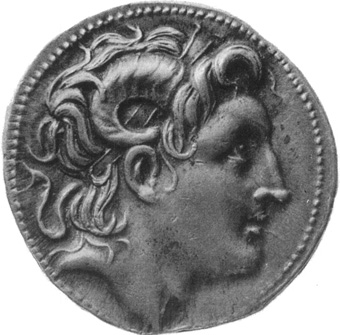
1. Alexander wearing the diadem and horn of Zeus Ammon. The idealized features suggest his divinity. Silver coin of his successor Lysimachus, c. 290 BC.
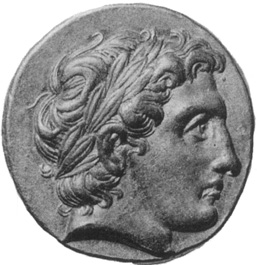
2. Gold coin of Philip’s reign, showing the god Apollo; the features strongly suggest Alexander’s own. Comparisons with the god were frequently used afterwards for young and talented princes.
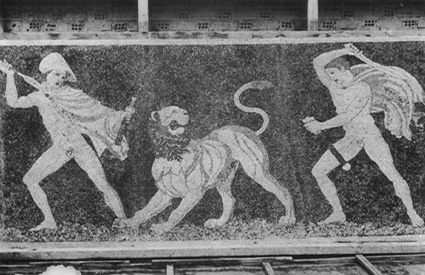
3. Pebble mosaic from Pella c. 300 BC. Alexander, on the left, is being rescued from a lion by Craterus in their famous lion hunt at Sidon in 333.
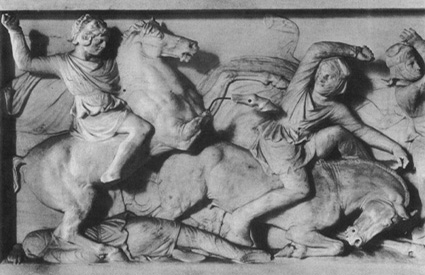
4. The Alexander Sarcophagus’, probably made for Alexander’s host, the King of Sidon, c. 320 BC. Alexander, wearing the lion’s head helmet of Heracles, attacks Persian horsemen at Issus. The style is very exact, even showing the harness of Bucephalas.
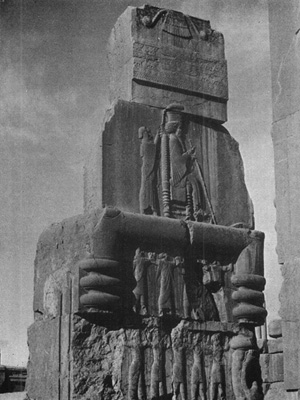
5. Door relief from the Hundred Columned Hall at Persepolis. At the top is the symbol of the protecting god Ahura Mazda, bordered by royal lions. Below sits Darius I (522-486) attended by the Royal Fly-swatter, an ancient and enduring minister of oriental kings. The enlarged throne which frames the lower panel is supported by subject peoples of the empire, among them the Macedonians. Its design of lion’s paw feet is seen on the right above characteristic bell capitals used in Persian palaces, and remained adominant style for thrones in Iran even after Alexander’s conquest
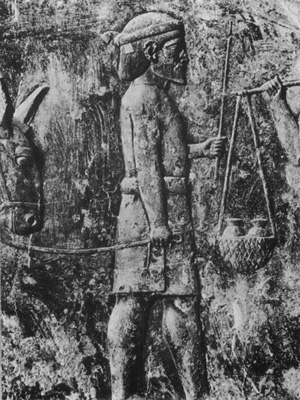
6. Relief from Persepolis of Indian envoy bringing tribute to the Persian New Year Festival. He wears the turban, sandals and cotton robe of his people and leads a wild ass. The baskets before him may carry pearls or perhaps gold dust, tribute of the province.
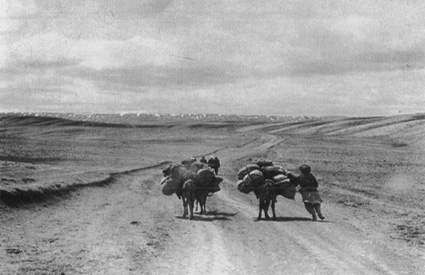
7. Road to Herat followed by Alexander. Such heavy laden mules would have served as his main baggage train in increasingly rough country where wheeled transport was impossible.
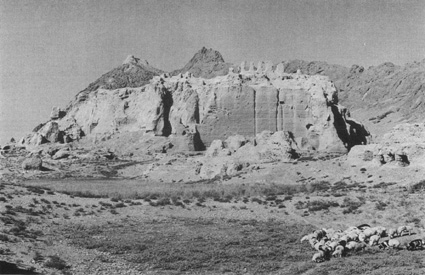
8. Remains near Kandahar of Alexandria-in-Arachosia, founded by Alexander. The name Kandahar is more likely to be derived from Gandahara, the old Persian name for the district, than from Alexandria.
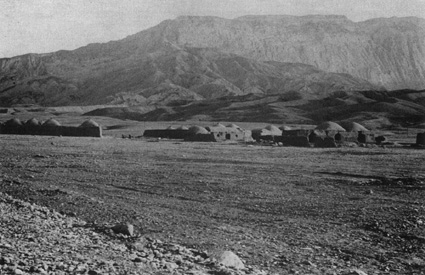
9. Village at the foot of the Khaiwak Pass, by which Alexander probably crossed the Hindu Kush. The village is a later one but the style of the houses with a dome on a square base was noted in the area by Alexander’s officers.
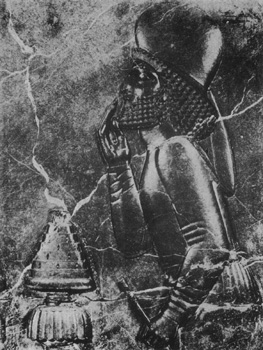
10. A Mede, probably steward of the entire Royal Household, bows in audience before Darius I, seated to the left out of the picture. The Mede’s hand has finished paying proskynesis. Some have thought he is shielding his breath from the sacred fire, but the objects in front of him are plainly incense burners.
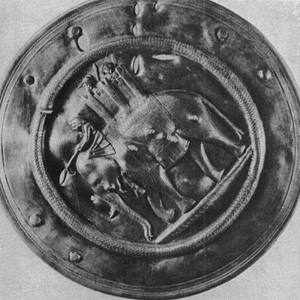
11. The inner section of a silver plate from Greek Bactria, possibly late third century BC, to be worn on a bridle. The howdah’s towers match possible Greek city walls in the area and may have been a Greek invention. The mahout’s goad, the elephant’s bell and the griffin on his saddle were all used in the East before Alexander. A similar plate was found in the eighteenth century in the Channel Islands: the widest known spread of a Hellenistic elephant and as yet unexplained.
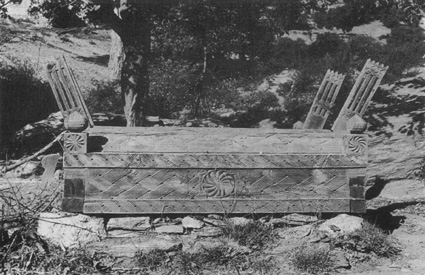
12. Wooden coffin still used by the Kafirs in Nuristan, alone among Afghan tribesmen. The coffins mistaken by Alexander’s men for firewood in this area were presumably the ancestors of this distinctive style. Greek influence, perhaps from later Greek kingdoms in Bactria, has also been noted in the carved pillars of Kafir buildings.
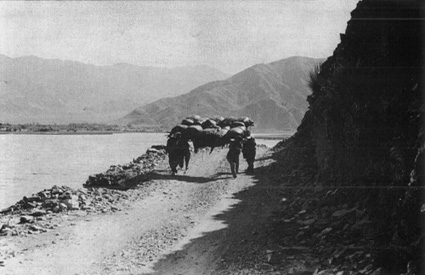
13. Modern raft of goat skin for use near the Oxus. These rafts are sewn and stuffed with chaff, one of Asia’s oldest skills. The Assyrian armies used them in the seventh century BC; Alexander crossed the Danube and Oxus by the same method; Roman armies kept a unit of ‘bladder bearers’ for the purpose. A man can float on one skin only, but this large raft could carry up to 400 lbs.
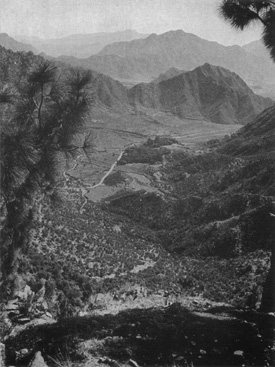
14. View of the Swat highlands entered by Alexander in the autumn of 327.
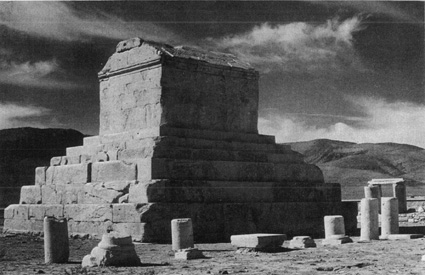
15. Tomb of Cyrus the Great at Pasargadae built c. 530.
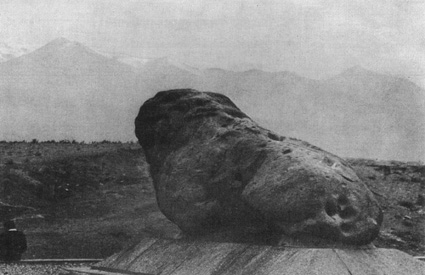
16. The Lion of Hamadan, probable monument to Hephaistion.
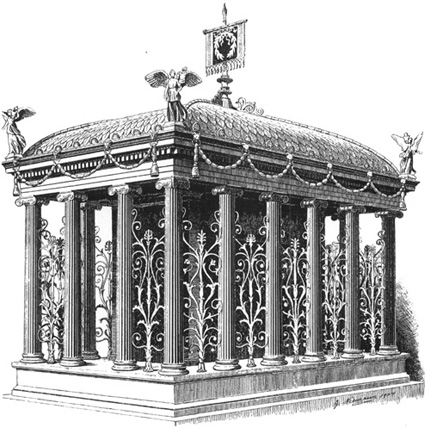
17. The funeral chariot to take Alexander’s body from Babylon. The detailed ancient description is the basis for this outline reconstruction by G. Niemann.