
CHAPTER THIRTEEN
Amelia Earhart’s 1932 transatlantic flight was her rite of passage. The twenty-two-year-old amateur pilot who had called flying a “sport” had become a thirty-four-year-old professional obsessed by it. The obsession was rooted in the little girl who “belly-slammed” her sled down icy hills, the student who kept a scrapbook reflecting the unique accomplishments of women, and the young woman who drove a truck to pay for flying lessons. “I flew the Atlantic because I wanted to,” she wrote. “To want in one’s head to do a thing, for its own sake; to enjoy doing it; to concentrate all of one’s energies upon it—that is not only the surest guarantee of its success. It is also being true to oneself.”
In the four years since her 1928 flight, the indecisive drifter manipulated by George Palmer Putnam had become, to a large extent, the master of her own fate, setting seemingly impractical goals but reaching them by very practical means. The basic Amelia remained true to herself while the mature Amelia developed new relationships with the public, the press, her colleagues, friends, and family.
To the public, and the press that conveyed her image to that public, Amelia was not completely honest, revealing none of her resentment of prying reporters and her dread of shouting, shoving, anonymous admirers. In an attempt to evade the official reception scheduled for June 20 in New York she wired Mayor James J. Walker, suggesting that the ceremonies be dropped and the money used for the relief of the unemployed.
Her friend, Viola Gentry, a Ninety-Nine member serving on the welcoming committee, said that Amelia’s request was refused by Walker who insisted that the reception would “cost nothing.” The charming, if somewhat corrupt, “Jimmy” had a keen sense of what his constituents wanted. They needed proof that human courage could triumph over fearful odds. Amelia was a symbol of that courage at a time when ten million of her fellow Americans were out of work in the worst depression of the twentieth century.
The New York homecoming was even more overwhelming than she had expected, matched only by that given to Charles Lindbergh in 1927. Thousands turned out to see her ride down Broadway through a blizzard of tickertape and pages torn from telephone books. Unlike the demonstration for her in 1928 this one was rightfully hers. She was no longer “Lady Lindy,” a woman who deprived Stultz and Gordon of the acclaim owed them because she looked like Lindbergh and went along for the ride.
The daylong celebration began when the Ile de France loomed out of the fog off Quarantine and dropped anchor with a thundering blast of its siren, soon joined by the shrieking whistles of tugs, ferries, and pleasure craft crowding the harbor. When Amelia crossed the narrow gangplank to board the city’s welcoming boat, the Riverside, she was unable to shout above the noise. She smiled and reached out to greet David Putnam and as many others as she could, among them Eugene Vidal, Paul Collins, Bernt Balchen, and the backer of her first flight, Amy Phipps Guest. High above the Riverside were nine Army planes and flying beneath them three heavy Douglas observation planes, losers in a competition for attention with three Navy Curtiss Fledglings. Only once did Amelia reveal any tension. When the Fledglings swooped so low that daredevils Frank Hawks and Al Williams, who were standing on the deck next to Amelia ducked, she gasped, “Gracious! I wish they wouldn’t do that!”
After being escorted to a cabin at the stern of the Riverside Amelia faced the press calmly, answering questions with what one reporter described as “a happy faculty for choosing the right phrase.” She posed for photographers, urging the women aviators who had come out to meet her to join her for more pictures at the ship’s rail. Once ashore and seated in a processional car with Charles L. Lawrance, president of the Aeronautical Chamber of Commerce and the man who had designed the motor of her first airplane, Amelia pulled off her hat, smiling and waving at the cheering crowds. At Wall Street her admirers broke through the police lines, cutting the procession in two until reinforcements restored a semblance of order just before the parade reached City Hall. Inside the hall, Walker presided at one ceremony, followed by a second outdoors on the steps. A third followed at Bryant Park, where two thousand spectators gathered to see Amelia receive the Cross of Honor from the United States Flag Association.
From Bryant Park she went to the Waldorf-Astoria where one thousand members and guests of the New York Advertising Club were waiting in the ballroom for a luncheon in her honor, followed by another ceremony at which three members of the Society of Woman Geographers presented her with a scroll notifying her she was to be awarded the society’s first gold medal. After an hour’s rest there were more press interviews and just enough time to dress for the dinner given by the Aeronautical Chamber of Commerce.
The next day she left on a Ludington plane for Washington to receive the National Geographic Society’s gold medal. She was accompanied by G. P. and David, her cousin Lucy Challis, Paul Collins, and Bernt Balchen. The Society’s president, Gilbert H. Grosvenor, met her at the Washington airport and took her to the White House for what is now called a “photo opportunity.” Amelia and President Hoover, who was to present the medal that night, did several “takes” for newsreel cameramen in which she spoke her lines nicely but he became flustered, addressing her as “Miss Earhart, ahem, Mrs. Putnam, I mean.…”
After lunch at the Society she was taken by Grosvenor to meet the secretaries of state, war, navy, and commerce, then on to the Senate and House. The Senate was recessed while she stood in the well of the chamber, her old friend Senator Bingham presenting her to the members who filed by to shake her hand. Fannie Kaley, who had seen Amelia fly the autogiro in Denver and was in the Senate gallery that day, wrote to Amy Earhart, “Never have I seen such a greeting as your daughter received. Everyone was on their feet immediately and cheered lustily.”
Amelia’s second trip to the White House that day was for dinner, an occasion G. P. described as formal, “with a kind of Victorian elegance.” He meant dull. Always rather somber and reserved, Hoover was not overjoyed to have a man at his dinner table who had just published a book criticizing him and his party during an election year. Amelia, wearing a pale blue crepe gown, looked frail and very tired. Although the greater part of her earnings came from public speaking, she always dreaded it, so much so that on her lecture tours she customarily asked to be left alone for a few minutes before going on stage. On this night, when she was to describe in detail her Atlantic flight to one of the most discerning audiences she had ever faced, she had to spend the preceding ninety minutes at dinner making conversation with strangers.
From dinner the party went to Constitution Hall where Amelia received the Geographic Society’s medal from Hoover before the fortunate thirty-eight hundred who had tickets. Ten thousand had applied. She was the fifteenth person and first woman to receive it, since its first presentation to Commodore Robert E. Peary by President Theodore Roosevelt in 1906. In her speech, broadcast over NBC’s thirty-eight-station network, Amelia repeated familiar themes. She made the crossing for her own personal satisfaction. It added nothing to the advance of aviation. The reward was out of proportion to the deed. She would be happy if her “small exploit has drawn attention to the fact that women are flying, too.”
The wan, frail heroine observed in Washington may have felt the worst was over once she had delivered her speech because she seemed to have recovered the following day. Back in New York, she was honored at three affairs—an Explorers Club luncheon, a Zonta tea, and a dinner at the Astor Hotel given by fifty womens’ clubs and attended by one thousand guests. A friend of Muriel’s, commenting on how graciously Amelia accepted the praise given her, wrote that she “charmed everybody.” Home from the dinner by midnight, she went to a luncheon given by Standard Oil executives the next day before leaving with G. P. and David for Cleveland. The following day they were in Chicago for another parade.
After a single day of rest, the “circus” resumed on June 27 when the towns of Rye and Harrison gave an all-day civic reception. Although Amelia and G. P. used Rye as their address, the house in Westchester was on property that lay in both townships and both claimed her. Amelia tactfully told her audience that she raised her vegetables in Rye and ate them in Harrison.
On June 29 she arrived in Boston, accompanied by Lucy Challis and Hilton Railey. Amy and Muriel were at the airport but all Amelia had time to say was “Hello, Ma! How’ve you been?” and “Hello, Sis!” before the official party made off with her. The program that followed left only one hour to see her mother at Muriel’s place in Medford between a celebration at Braves Field in the afternoon and a dinner that night at the Copley-Plaza.
When she returned from Boston her book, The Fun of It, which she had written before the flight with the exception of the last nine pages, was on sale. G. P. released it at the close of her first week of homecoming ceremonies so that in addition to reviews, which were generally complimentary, photographs of the author appeared in the rotogravure sections of newspapers throughout the country. These included pictures taken with Mayor Walker, President Hoover, and the king of Belgium. In each copy of the first edition was a small record of her BBC-CBS speech from London. Exploiting every sales possibility, G. P. made a special offer to members of the New York chapter of Zonta, an autographed copy for all those who ordered through the club.
There was one more banquet, one Amelia actually pleasantly anticipated, to be given July 8 by the Southern California chapter of the National Aeronautic Association in Los Angeles. The guests would include many old friends meeting in a city she had loved from the time she first lived there in 1920. She could now talk with pilots as a colleague of proven ability. The California members of the Ninety-Nines would be there and her former instructor, Monte Montijo, already had his ticket.
Arrangements for the banquet were being made by Pancho Barnes. Pancho was hostess to pilots and film stars at parties reputed to offer drugs, drink, and sex. However, she was also one of the organizers of the Motion Picture Pilots Association, a union that wrested from tight-fisted film producers an acceptable scale of fees for life-threatening stunts. An expert stunt flier herself, she owned a Travel Air Mystery S (for ship) in which she had broken Amelia’s speed record in 1930. If teetotaler Amelia disapproved of Pancho’s social life, she admired her skills as an aviator and an organizer. Years later, when Pancho was proprietor of the notorious Happy Bottom Riding Club at Edwards Air Force Base and friend to a young Chuck Yeager, Yeager’s wife Glennis observed that Pancho liked men but “there were very few women she would speak to.” Amelia was one of the few.
Aiming for a transcontinental speed record on her way back from Los Angeles, Amelia left G. P. and David there when she took off for Newark a few days after the banquet. A faulty gas line forced her down at Columbus, ruining her plans for a nonstop trip and giving her a lapsed time of nineteen hours and fifteen minutes with almost eighteen hours of actual flying time.
It was evident from her press comments that she would not accept this failure, but before trying again she returned to California to receive the Distinguished Flying Cross on July 29 and to attend the summer games of the Tenth Olympiad. Two days before he opened the games, Vice-President Charles Curtis presented her with the DFC. It was awarded by a joint resolution of the 72nd Congress for “displaying heroic courage and skill as a navigator at the risk of her life … by which she became the first and only woman to cross the Atlantic ocean in a plane in solo flight.” In a magazine article that was on the stands three days later, she wrote that one of the reasons she made the flight was to prove that “women can do most things men can do,” not everything, she added, but “jobs requiring intelligence, coordination, speed, coolness and will power.”
Amelia, G. P., and David were all sports fans. In a letter to her mother she wrote that the games were wonderful, the weather ideal, and added, “You know what a track fan I have always been.” The track fan met two of her heroes, Paavo Nurmi, Finnish gold medalist in 1924, and the great Jesse Owens. The letter to Amy did not mention receiving the DFC nor the celebrities with whom she was photographed, among them Duke Kahanamoku, Hawaian swimmer and gold medalist in 1912 and 1920, actress Fay Wray, who would long be remembered as the object of King Kong’s affections, comedian Harold Lloyd, and Hollywood’s most famous couple, Douglas Fairbanks and Mary Pickford. Amelia, G. P., and David were dinner guests at Pickfair during the games, but to Amy Amelia wrote only family news and that she expected to return east “in a week or so.” She did not tell Amy she planned to make a second attempt at a nonstop, cross-country record.
She did it, on August 24–25, in nineteen hours and five minutes, the longest continuous time she had ever flown alone. She also set a women’s record for distance—2,447 miles. G. P. and David, who had returned to New York earlier in the week, were not there to meet her. Instead, a shouting, pushing crowd of fans threatened to knock her over when she climbed down from the cockpit. Dressed in wrinkled brown jodhpurs and a crumpled orange silk shirt she motioned wearily, pleading, “Don’t come near me. If you knew how I feel.…”
How she felt may have been more dreadful than her admirers could guess. In addition to fatigue, air sickness from gasoline fumes, and her abhorrence of being touched by strangers, there may have been another reason she wanted to remain at a distance from the crowd. A Newark aviation mechanic confided to an aeronautical designer there that after one of her long-distance flights her plane had reeked of urine. This may have been the flight to which he referred. Relief tubes designed for men were useless to women. In view of her nearly fanatical fastidiousness, to be in such a state would have been an agony for her.
Before the crowd could reach her the police intervened and a few minutes later she had recovered sufficiently to smile for the photographers and talk to reporters. When one asked why her husband was not there to meet her she explained that he regarded herflying as a routine affair. Not everyone did. Charles and Anne Lindbergh wired, “Splendid flight. So pleased at your success.” In her brief account of the flight Amelia said, “If I had had the weather I had on my first attempt, I might have broken the men’s record.” If she had, it would not have been for long. She was referring to Frank Hawks’s time of seventeen hours and thirty-five minutes. Four days after her flight Jimmy Haizlip flew from Los Angeles to Floyd Bennett Field in Brooklyn in ten hours and nineteen minutes, little more than half Amelia’s time.
Much as she wanted to try again, she could not. After flying for “fun” for the better part of 1932 it was time to go to work. Before she left for Washington to receive the National Geographic medal, she had told reporters that she was ready to capitalize on her Atlantic flight “in any legitimate way that comes to hand. Any woman who wishes to should be able to do so without stigma.” She was “willing to lead the way” but “wouldn’t do anything false.”
Amelia needed money, for her half of the household expenses at Rye, for the maintenance of an airplane, for Amy’s support, and for the limited luxuries she had begun to enjoy—a good car, a simple but expensive wardrobe, and an impressive library. On July 20 she went to Detroit to a three-day introductory celebration for a new automobile—the Essex. Produced by the Hudson Motor Car Company, the first Essex off the line was christened by Amelia on July 22 when she broke a bottle of gasoline over its hood, then watched a parade of two thousand new cars pass by, each driven by a Hudson or Essex dealer. Amelia was given an Essex Terraplane, a stylish little coupe.
Amelia was thrifty. She never left a hotel room without taking all the stationery in it. For years she used whatever came to hand, including Bert Kinner’s, Dennison Airport’s, Cosmopolitan’s, and the NAA’s. She once wrote to Amy on the back of a Ninety-Nine bulletin and Marian Stabler received a letter on tiny pages from a notepad. In London she used Lady Astor’s, and some from the U.S. embassy which caused considerable embarrassment. She had written an endorsement of a Swiss watch used on her flight. When the letter with the embassy’s address showing clearly appeared in a trade paper, a jeweler complained to the State Department. A department spokesman said that the use of the ambassador’s stationery did not constitute a government endorsement. After that, although she wrote a note to her mother on White House stationery, she was very careful.

Amelia as a child. (Source: The Schlesinger Library, Radcliffe College)

Amelia and Wilmer Stultz, pilot of the Friendship, being congratulated by Mr. and Mrs. Harry Moore after the 1928 transatlantic flight. (Source: American Heritage Center, University of Wyoming)

Amelia, wearing the wings presented to her in 1928 as an honorary major in the 381st Observation Squadron, U.S. Army Reserve, at Cressey Field, Presidio of San Francisco. (Source: Margaret Haviland Lewis)
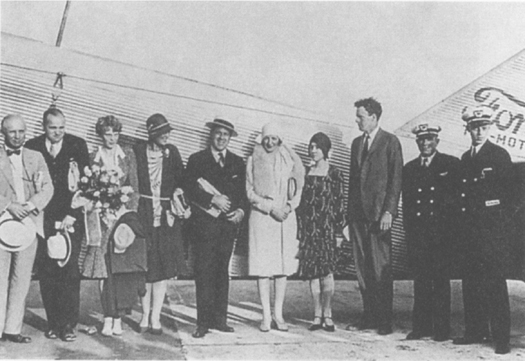
Conclusion of the first westbound flight of Transcontinental Air Transport, July 9, 1929. Pictured are Amelia (third from left), Dorothy Binney Putnam (fourth from left), and Charles and Anne Lindbergh (third and fourth from right). (Source: Trans World Airlines)

Amelia in the cockpit of the Lockheed Vega that she flew in the Women’s Air Derby, August 1929. (Source: Harvey C. Christen)
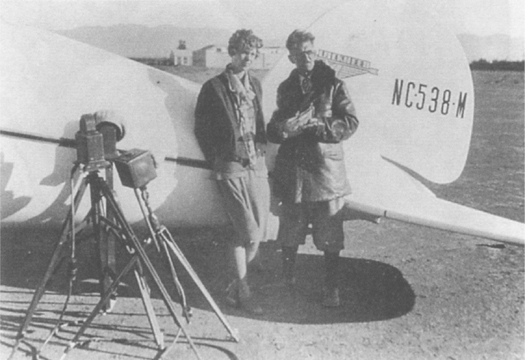
Amelia with Joe Nikrent, official timer of the NAA’s Los Angeles chapter, after breaking the women’s speed record in November 1929. The plane was a borrowed Lockheed Vega with a wooden fuselage. (Source: Office of Public Information, Lockheed-California Company)

Amelia with polar flier Bernt Balchen, the man who outfitted her “Little Red Bug” for the Atlantic solo crossing in 1932. (Source: W. M. Tegerdine)

Amelia and George Palmer Putnam shortly after their marriage in February 1931. (Source: Marcia-Marie Canavello)

Amelia greeting film star Mary Pickford, the honored guest, at a Fourth of July celebration during the 1933 National Air Races in Los Angeles. (Source: Trans World Airlines)

The avid amateur airplane mechanic was fascinated by all mechanical devices not just airplanes. (Source: Office of Public Information, Lockheed-California Company)

The power, speed, and beauty she loved, in the air or on the ground, are all here in her new, twin-engine Lockheed Electra 10E and elegant 1936 Cord Phaeton. (Source: Office of Public Information, Lockheed-California Company)
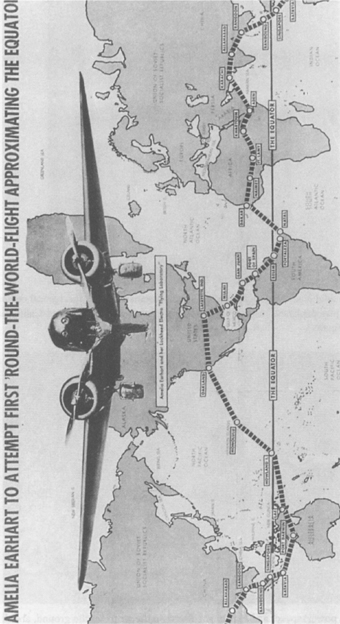
The original plan for the ’round-the-world flight, from Oakland westward. In her second attempt she reversed directions, flying east from Oakland to Miami, leaving the Pacific stretch last. (Source: Office of Public Information, Lockheed- California Company)

With Amelia, in one of the last informal photographs taken of her, is Lily MacIntosh, whose husband W. Bruce MacIntosh took Amelia and navigator Fred Noonan fishing off the Miami coast. (Source: Clinton and Marian Morrison)

At the Karachi airport with navigator Fred Noonan. (Source: Margaret Haviland Lewis)

Front page of the Chicago Herald and Examiner, Monday, July 5, 1937.
Amelia not only needed and wanted work for herself, she looked for jobs and wrote letters of recommendation for her colleagues. Before networking among women began, she was trying to make the Ninety-Nines a central exchange of information on the qualifications of its members and job opportunities. During the National Air Races in August of 1932, when she was re-elected president of the organization, she spent hours in her hotel room writing proposals and letters to enlarge and strengthen it.
She also helped individual members in any way she could. When Nancy Hopkins Tier, who had competed in the 1930 races, had neither a plane nor even a pass to the field in 1932, Amelia gave Tier her pass, remarking with a grin that she thought she could get in without it.
Amelia proposed that the Ninety-Nines have a magazine with Clara Trenckman Studer, a newspaper reporter who had lost her job at Curtiss Wright in a depression cutback, as editor. Amelia would pay her salary until the magazine could raise it through advertisements.
She also found work for Helen Weber, another woman fired by Curtiss Wright, first at Ludington Airlines as her temporary assistant and later as co-author, with G. P., of a boy’s book. In 1932, when Weber was recuperating from surgery, she was the Putnams’ houseguest and in November of that year Amelia hired her as her secretary.
Amelia certainly needed one. In a letter to Clara Studer on November 11, Weber gave a vivid picture of Amelia’s work while she was based at Rye:
AE left early-early today [Saturday] for Hartford for luncheon, peerade [sic] and lecture tonight, thence by horse car to Williamstown … to speak over nation-wide hookup on Sunday night—thence to Keene, New Hampshire, thence to Waterbury, Connecticut, and I am to have a candle in the window sometime after midnight on Tuesday night. Wednesday is the big SECRET, of course, not more than 6,000 people know about it—don’t tell Walter Winchell—but AE is to get the AWA award at a dinner at the Penn Hotel. She will speak on Thursday, the 17th, at McMillan Theater, Columbia University. So I should think she would stay at the Seymour Hotel on Thursday … in case you are hankering to see her.
On Friday she was in Portland, Maine, and on Saturday, in Poughkeepsie, New York.
Life was even more hectic when she left Rye for the lecture circuit. She flew when the weather permitted, drove at other times, often alone and at night, and took trains under protest. In the last half of October she was based in Chicago and ranged as far west as Lawrence, Kansas, and Des Moines, Iowa, as far north as Milwaukee, Wisconsin, and Marquette, Michigan. After a week at home she spent most of November and December on the road again, often with two lectures booked for the same day. Along with the lectures, there were autographing sessions in book stores to promote sales of The Fun of It.
When she drove she took her favorite car, the big, powerful, black Franklin sedan that G. P. claimed handled like a truck. After taking it to Chicago for a lecture to more than one thousand 4-H Club members, she became so ill with either influenza or food poisoning that she had to leave it in Cleveland a day later. The next day she was flown from Cleveland to Erie, Pennsylvania, where a Ninety-Nine friend, Helen Richey, met her and took her to Williamsburg for her next lecture. A day later she gave two in Detroit before moving on to Cincinnati. Richey again met her and drove her, in the Franklin, to Johnstown, where Amelia had to insist to an eager arrangements committee that she could not join them for coffee but had to have a rest before giving both afternoon and evening lectures. On December 6 she was in Ithaca, on the eighth, in Springfield, Massachusetts, to speak at a luncheon along with Dr. Mary Woolley, president of Mt. Holyoke College. That night she made a network broadcast. On the ninth she was back in Cleveland and on the tenth, in Detroit.
Returning to Cleveland to pick up her car, Amelia drove to Greenville, Pennsylvania, to receive an honorary degree from her father’s alma mater, Thiel College. She left early the following day in a blinding sleet storm for Toronto. After returning to Rye for forty-eight hours, on December 17, she gave another National Geographic Society lecture in Washington. Although she still needed at least fifteen minutes alone before each appearance to prepare for the ordeal, once on stage she spoke with the assurance and grace of a professional actress.
The same assurance was reflected in changing personal relationships. At thirty-five, with no children of her own and no desire to have any, Amelia displayed genuine affection for her nineteen-year-old stepson. She kept open house for his friends and pleaded his cause when he aroused G. P.’s fearsome temper, a fairly frequent occurrence. A handsome, intelligent youth, David was cheerfully impetuous, breaking enough rules to warrant several changes of boarding schools. While he was in California with his father and Amelia, she arranged a job for him with Paul Mantz, stunt man, master pilot, owner of an aviation garage at Burbank, and choreographer of the dog fights in Howard Hughes’s great war film, Hell’s Angels.
Mantz also gave young Putnam flying lessons. After only a few weeks of instruction, David soloed “in a Kinner Fleet, a hot stunt plane in those days.” Practical joker Mantz did not make it easy for the young explorer and author. To a crowd waiting to see a Mexican Olympic team arrive at the field, Mantz announced over the public address system, “You will now see a young American make his first flight.” Mantz rattled the novice for a moment, but David pulled himself together, took off and soloed successfully, receiving his license not long after.
Amelia gave him his first aeronautical textbook and later, his first automobile, in what she called a “trade.” In exchange for the Essex Terraplane she had received in Detroit, she took his raccoon coat, a wardrobe staple for Ivy League students. In spite of her heavy lecture schedule that fall, she found time to accompany G. P. to Providence to see David play on the Brown University freshman football team.
While her relationship with her stepson grew closer, she became increasingly estranged from her mother. Before the solo Atlantic flight there had been disagreement over Amy’s expenditure of her allowance on Muriel and other members of the family. In September Amelia suggested that Amy accompany her on at least part of one lecture tour. “It might be just one hotel after another,” she warned but if Amy didn’t want to tour then she might like to spend a week in Rye that month or the first part of October. She had not yet been to the house in Rye.
This letter was followed by one on September 18 in which Amelia asked her mother to come to Rye for “a day or two” to work out the details for accompanying her on a tour. With the invitation she enclosed only half of Amy’s allowance explaining that “if I sent the whole you would spend it on someone else and not have anything left for yourself by the first of the month.” The someone else was Muriel.
The invitations to Amy were not renewed. On November 4 Amelia wrote that she had finished her first tour and that G. P. would go with her on the next to New England. When Amy suggested she come along, Amelia replied, “I don’t know what to say about your coming.… You said maybe it was just as well that you didn’t go so there would be no chance of your disgracing me or words to that effect.”
She followed this with a halfhearted promise to try to work something out if Amy really did want to come along “for a few days” but nothing came of it. On Christmas Eve Amelia wrote Amy a long letter describing her visit to Thiel College on December 11. If Amy were jealous of Amelia’s affection for Edwin the letter would have done nothing to placate her. The devoted daughter who had never stopped loving her father wrote:
I met several people who were in Dad’s class and others who knew him. I found his record for scholarship, ie., age of graduation has never been equaled. He was fourteen when he entered college and only eighteen when he got his degree.…
Everyone remembered Dad as so handsome and bright.…
She could not extend to Amy the childlike love she felt for Edwin. As a youngster she had expected and received affection and guidance from her mother. As as adolescent she had followed Amy’s example in withdrawing from an alcoholic Edwin and turned to her mother for the money for college fees and her first airplane. But from the time she became a self-supporting adult she romanticized her father while assuming a caretaker’s role toward her mother.
Neither Amelia’s gratitude for past support nor her voluntary assumption of financial responsibility for Amy could overcome other differences—in personality, values, and generational perceptions. The mother whom the child Amelia had thought intelligent and determined seemed to have become opinionated and stubborn. Amelia disagreed with Amy’s focus on the extended family as the center of life. To the older woman, anyone within the family, no matter how inept or even dishonest, deserved her consideration and, often, assistance. After a miserable adolescence caused by a father she refused to condemn, Amelia was a confirmed loner, no longer tied to the family, reserved even with friends.
On the surface, the conflict between mother and daughter centered on money. Amelia had had so little until after she was thirty that she spent it carefully and invested wisely. Never stingy, she enjoyed giving it to her mother as well as to a number of friends in need but, having given it, she was angered by Amy’s use of it. Her mother lived in an ill-kept, often cold house with Muriel and the husband Amelia despised. Amy was co-housekeeper, cooking, sewing, cleaning, and baby-tending. When she was not giving her money and labor to the Morrisseys, she went to Philadelphia to tend her dying sister, Margaret Balis, a woman who had borrowed and spent the life savings of their retarded brother without a hope of repaying him.
In addition to withholding half of Amy’s allowance and banking it for her, Amelia bought her clothing and asked that doctor bills be sent directly to her, because either Amy did not have the money to pay them or, worse, would not see a physician when she really needed one. If Amelia’s letters seemed domineering and insensitive they were in response to a determined and evasive mother who pretended acquiescence and then did as she pleased. Nevertheless, Amelia wrote frequently, more than to any other person, remaining a concerned, dutiful, and frequently exasperated daughter.
Amelia’s relationship with G. P. also changed. He remained her publisher and agent as well as her husband, but she was no longer his student or prodigy. He himself affirmed this when he first heard she had landed in Ireland, telling a reporter, “This is her stunt. She’s doing it under her own name, Amelia Earhart. That’s the name she made for herself.”
If he slipped back into his previously domineering role, she did not hesitate to correct him. During a press conference aboard the Riverside a reporter noted that when G. P. continually interrupted her she turned to him and said, quietly but firmly, “Just a minute, dear,” then continued to give her account of the Atlantic crossing. Later, when G. P. again interrupted to say, “Tell them about your lunch with the king and queen of Belgium,” she ignored him, describing instead how admirably the British press had treated her. She was confident but not angry with him. Two hours later, speaking to the Flag Association, she said that much of the credit for her flight belonged to her husband. “It was much harder for him to stay than it was for me to go,” she said.
She repeated this praise in a magazine article, written with G. P., entitled “My Wife—My Husband,” reminding the reader that her husband was a publisher, writer, and explorer, who was not accustomed to stand on the sidelines while others played the game. Yet he had cancelled an important business engagement when she called and asked him to come to England and help her with appointments and correspondence. For his part, G. P. wrote that they had from their “bargain of partnership” mutual independence of action. When she told him the chances of getting across the Atlantic were one in ten, he was not happy about it but it was her show, he said, and if the engine held out she would.
They could hardly be critical of one another in a magazine article but their claims of compatibility were confirmed by friends. Amelia’s confidante of college days, Marian Stabler, was not so sure at first. She disliked G. P. intensely, calling him a “lion hunter” who discouraged Amelia’s friendship with anyone except the famous. Marian had also heard a story about them soon after their marriage, told her by a friend who worked in an automobile agency. The friend said that Amelia had come to the salesroom before G. P. and accepted a demonstration ride. While she was gone, he arrived and “fussed and fumed, walking up and down like a caged lion.” When Amelia returned, “he took her to task in a very humiliating way in front of the two salespeople … for not waiting for him.”
Marian was certain that G. P. was responsible for the infrequency with which she saw her old friend. On one of the rare occasions she dined with them, Marian said that Amelia’s warm cordiality was not enough to compensate for her host’s rude, patronizing manner. Yet in spite of her dislike of him, Marian said, “That night I was there, after dinner they settled down together and I could see that she cared for him and he cared for her. I’m quite sure they were in love.”
If G. P. was as rude to Amelia as the car story indicated, her calm manner and growing assertiveness put a stop to such scenes soon after. In commenting on G. P.’s unrestrained profanity during one of his frequent temper tantrums, Bradford Washburn, a young author who was sitting in the office one day during a typical outburst, later remarked, “Putnam would never speak like that in front of Amelia.”
Whether she was in love or not, the marriage Amelia had told Marian was one of “convenience and necessity” proved very convenient and not nearly as confining as she had anticipated. Much of their limited time together was spent at the house in Rye where they shared an avid interest in gardening. Helen Weber looked out the window one day when she was working as Amelia’s secretary and saw G. P. giving Amelia a ride in the wheelbarrow, racing up and down, tipping and tilting the vehicle while his passenger alternately squealed in delight and roared with laughter.
Another shared interest, a new one to Amelia, was entertaining. Cousin Lucy Challis, who resented news stories that she thought “masculinized” Amelia, said that Amelia managed the Rye house perfectly and liked entertaining. Although she was reluctant to “make conversation,” she found no need to do so when entertaining with G. P. The guests, friends of G. P.’s as well as some she had met on her own, all had careers or professions that interested her.
At the close of 1932, on the night before New Year’s Eve, Amelia and G. P. entertained at a gathering that G. P.’s columnist friend Walter Trumbull called “one of those famous parties given by George Palmer Putnam and Amelia Earhart.” The fifty or more guests included Roy Chapman Andrews, the naturalist just back from an expedition to Central Asia, Arctic explorers Vilhjalmur Stefansson and Sir Hubert Wilkins, African adventurers Martin and Osa Johnson, novelist Fannie Hurst, aviators Hilton Railey, Eugene Vidal, and Paul Collins, and the Elliott Roosevelts, Bernard Gimbels, and Ogden Reids.
Their hostess was as famous as any of her guests. In a single year she had been awarded the Distinguished Flying Cross, crosses of the Belgian Order of Leopold and French Legion of Honor, the Rumanian Order of Virtutea Aviation Medal, National Geographic medal and medals from the Comite France-Amerique, Le Lyceum Societé des Femmes de France at New York, the Columbia Broadcasting System, the Commonwealth of Massachusetts, and the cities of Chicago, New York, and Philadelphia. She also received awards from the Aero Club of France and the Aero Club Royal de Belgique.
An article in U.S. Air Services magazine claimed that her solo crossing of the Atlantic had carried “Amelia Earhart Putnam … into the PLAN to RAYM volume of the next and all succeeding editions of the Encyclopedia Britannica.” As predicted, she was in succeeding editions of the Britannica, but not under “P” with the three Putnams—G. P., his grandfather George Palmer Putnam, and his uncle George Haven Putnam. Amelia was listed under “E” for “Earhart, Amelia, U.S. aviation pioneer,” a title she would both justify and exploit in the coming year.