
FIFTEEN
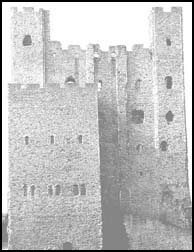
An even more radical improvement in Eleanor’s situation came when King Philip rightly insisted on the return of his widowed half-sister’s dowry, in particular the three Vexin castles.
No one can have been more surprised than Eleanor when Henry declared blandly that this was impossible because Marguerite’s dowry had passed to the captive queen in 1179, in compensation for her birthright passing to Richard. As ‘proof’ of this, she was brought from England in October under close escort1 to take possession of Gisors in particular, spending six months in Normandy with her daughter Matilda of Saxony as companion. This was not exactly freedom, but conditions were radically better than she had known since first being locked up in Old Sarum.
Philip was playing a long game. At a meeting on 6 December 1183 in the shadow of the castle where she was living out this fiction he shelved his first demand in return for an annual pension to Marguerite of 2,750 pounds Angevin, payable in Paris, where she was living as his protégée. No abstemious monk manqué like his father, Philip liked to eat and live well, to dress fashionably and enjoy amusing company, but he was as persistent in negotiation and as swift in warfare as Henry. Shortly after coming to the throne he changed the title of the French monarch from king of the Franks to king of France.2 It was an important difference. From the beginning of his reign, those who followed the fortunes of kings were prophesying that he would reverse the ascendance of the Angevin dynasty over the house of Capet, as indeed proved the case.
He insisted that his other half-sister Princess Alais, who had been shut up in Winchester Castle throughout most of her childhood and adolescence, should be released from the betrothal to Richard, who had no intention of marrying her or anyone else. To placate his insistent suzerain, Henry promised to marry her off to John instead and swore fealty for the continental possessions to Philip, which he had previously refused to do.
On the intervention of the archbishop of Canterbury and in reward for her cooperation over the issue of Gisors, Eleanor’s conditions on her return to England were eased still further. Although she remained in the custody of Glanville’s deputy Ralph fitz Stephen, dresses, riding clothes and saddlery were hers for the asking, together with items for the faithful Amaria, now benefiting from her mistress’ better fortunes. Easter 1184 was spent at Becket’s former palace in Berkhamsted, where Matilda of Saxony came to visit, largely pregnant. From there, the queen moved to Woodstock but was in Winchester for the birth in mid-June of Matilda’s son William.3
Delighted with the upturn in his fortunes, Richard meanwhile saw his court of familiars swollen daily by those who wanted to curry favour with the prince now destined to be king of England. Disturbed by this sudden popularity and Richard’s increasing arrogance, Henry had Prince John come from England, with the idea of making him duke of Aquitaine, thus placing Richard in what had been Young Henry’s invidious position of being king without a kingdom. Richard was not impressed, even with the promise that John would do homage to him for the duchy. To gain time, he asked for a respite of two or three days and then declared from the safety of Poitiers that he would never part with an inch of his birthright.4
At this defiance, Henry provided funds for Geoffrey and John to make war on Richard, thus launching a new round of depredations and death5 in which Richard was campaigning in Brittany to punish Geoffrey, while he and John were laying waste Poitou in return.6 In the viscounty of Limoges, Mercadier’s mercenaries were on the loose under the pretence of fighting for Richard, while other bands under the son of the count of Toulouse were doing the same ostensibly for the other side. Finally Henry gave in to the protests of the bishops and ordered the three princes to come to London at the end of November.
The Christmas court in Windsor was thus a fraught family reunion, even by Plantagenet standards. Also present were Matilda of Saxony, her husband and children … and Eleanor. Resolved not to play Henry’s game a second time, she allied herself with Richard in refusing to even consider John being invested as duke of Aquitaine. Playing on the siblings’ rivalry, Henry then released the ever-pliable Prince Geoffrey to return to Normandy while keeping John and Richard with him. A change of mind led to Geoffrey being recalled and Richard allowed to return to Poitou after giving patently false promises of good conduct. Rightly fearing his father’s change of mind, he took ship before the week was out.
In intervals between warfare and hunting, he was often generous to the poor and particularly so to religious foundations, once declaring in a letter to the abbot of La Sauve Majeure that the abbey was dearer to him than his own eyeballs. This particular progress southwards was several times halted to issue charters granting or confirming privileges – and to establish new towns at St Rémy and elsewhere, to be peopled by offering tax-haven status for merchants and artisans.
Eleanor’s youngest son John was now eighteen. Spoiled by his father since the Young King’s death, he loved the good life, fine clothes and jewellery – also gambling, with backgammon being a favourite pastime. During Lent 1185 Henry dubbed him a knight and sent him at the head of an army into Ireland after naming him its overlord. Having a whole country to call his own revealed John’s true colours: he mocked the unfashionable clothing and long beards of the Irish lords and their halting attempts to speak Norman French. Within an eight-month stay he alienated both them and the Anglo-Norman nobility to the point that Henry replaced him by a viceroy, John de Courcy.
Thanks to the intercession of Matilda and her husband, Eleanor had been living with them at Windsor under conditions that were very comfortable, compared with her years in Old Sarum. Summoned with them in mid-Lent to Rouen by Henry, she had another pleasant surprise on learning that he had solved the problem of Richard’s overweening arrogance by sending him an ultimatum to surrender Poitou and Aquitaine immediately to his mother. Should he not comply, Henry threatened to march at the head of an army and reinstall her as duchess by force!7
His vassals refusing to support him against Henry, Richard rode sullenly to Normandy and declared in front of witnesses that Eleanor was the true mistress of Poitou and Aquitaine. To make the point that he really had become the second young-king-sans-kingdom, Henry had a treaty drawn up confirming Eleanor’s plenary powers, on parchment at least.8 A grandmother of sixty-three, it was natural that she should celebrate this amazing upturn of fortune after eleven years of deprivation by making generous gifts from the proceeds of her own estates to the abbey of Fontevraud and other foundations.
To emphasise that she was acting of her own volition at long last, she announced the gifts to the archbishop of Bordeaux, the bishops and barons and just about everyone else of importance in Aquitaine. Henry seemed to have softened a little since the collapse of the great design, and his health was gradually declining. In November 1185, after acting the peacemaker and brokering a settlement between Philip and the count of Flanders who had been so generous to Young Henry, he was too ill to attend the treaty signing.
Back in England, although Eleanor was now living a fairly normal life, she still had keepers. Henry of Berneval replaced Ralph fitz Stephen as Glanville’s eyes and ears, watching her at every turn as she stayed mainly at Winchester, where Princess Alais was still captive. At his next meeting with Philip in Lent of 1186, Henry again promised to marry Alais to Richard or hand back Gisors. If the latter was a conditional promise he had no intention of keeping, the first alternative was out of the question, since Richard had no desire for a wife and it was common knowledge that Alais had been Henry’s mistress for years.
Before returning to England on 27 April 1186 Henry neutralised Richard, who continued to style himself duke of Aquitaine9 in the absence of its duchess, by equipping him with an army of Brabanter mercenaries and sending them to invade the county of Toulouse in alliance with the count of Montpellier and the king of Aragon. The declared aim was to punish Raymond of Toulouse for his support of Young Henry.
Geoffrey was meanwhile playing a different game on the Ile de la Cité. During one of a series of tournaments given by Philip to entertain him, the honoured guest fell in a mêlée. This was not a joûte à outrance or fight to the death, but in the confusion he was trampled to death by the horses,10 despite his armour. Like thousands of unrecorded victims of the sport, he died on 19 August 1186 and was buried with great pomp in the basilica of Notre Dame, Philip having to be restrained from throwing himself into the grave with the coffin.11
Eleanor learned of this in Winchester. First the Young King, now Geoffrey. Three of the five sons she had borne to rule an empire were dead. Given Richard’s violent way of life, did she already have a premonition about him dying prematurely too?
Philip afterwards demanded as suzerain of the dead prince that Henry send Geoffrey’s daughter Eleanor of Brittany to be raised at the French court until she was of an age to be married, so that she would be under his control. When Henry prevaricated, Philip insisted to the point of war. For the first time since falling out with Becket, Henry delegated real authority, dividing his forces into four corps: one commanded by Richard; the second by John; the third by the Count of Aumale; and the fourth by Geoffrey the Bastard.
On 29 March Geoffrey’s widow Constance gave birth to her ill-starred son Arthur, whose only good fortune was in her choice of name, which made many superstitious Bretons believe him a reincarnation of the eponymous mythical king. The boy inheriting his dead father’s title at birth, Philip as suzerain now sought to bring both him and his sister to Paris with the widowed Constance.
While Henry refused to allow this, he also had no intention of allowing Geoffrey’s widow to become one of those powerful mothers who brought their sons up with a view to a great destiny – as the Empress Matilda had brought him up. He therefore exercised his right to dispose of widowed vassals in forcing Constance to marry the young count of Chester, Ranulf de Blundeville, after which Philip’s forces marched into Berry, where a new war was only averted by the truce of Châteauroux.
In Paris, seeking the welcome Philip always extended to a disaffected son of Henry, Richard was told – if he did not already know – that his father’s talk of marrying Alais to John after making him duke of Aquitaine was a smokescreen. The truth was even worse, Philip said: after twenty-two years of keeping Alais his prisoner and latterly his helpless mistress, Henry intended to marry her himself and make their young bastard son his heir to the throne and all that went with it, to the detriment of the two surviving sons by the marriage to Eleanor.
The plan, if such it was, failed when Alais’ child died, but Philip’s talk fanned Richard’s ever-smouldering animosity towards his father, as his host had intended. In Paris, he was shown every kindness, king and prince spending their days together, sharing their favourite foods at table and drinking from the same goblet, at night sharing a bed. The intensity of their relationship was such that all Henry’s bribes failed to persuade Richard to leave Paris.12 When he eventually did, in his own good time, it was to head straight for Chinon and help himself to considerable funds from the treasury there, which he used to fortify several castles in direct defiance of his father’s orders.
Eleanor seems to have spent most of 1187 at Winchester, following from a distance all these manoeuvrings in conditions that were comfortable. With Henry’s worsening health, it must have been about then that she realised for the first time that there was a very good chance of her outliving him. Should Richard too die before his father, John was capable of having her locked up for the rest of her life. Therefore it was in her interest to forgive Richard and use what influence she had in his favour.
A new crusade was being preached by Archbishop Joscius of Tyre to recover Jerusalem from the great Saracen general Salah-ed-Din, called Saladin in the West, who had captured the holy city on 2 October 1187. All that remained in Frankish hands was the coastal strip including three vital ports, without which the Latin Kingdom could not survive. A couple of years earlier, Henry had been offered the throne of Jerusalem,13 but preferred instead to fund the Templars to defend the holy places in his name. In a fit of adolescent enthusiasm, the atheist Prince John took the cross. Although his relative and friend Count Philip of Flanders had gone all the way to Jerusalem to check out the possibilities and returned disillusioned, Richard could not do less. Having taken crusader’s vows did not stop him treating rank-and-file captives taken in his campaigns against Toulouse with his usual brutality – until his chaplain Milo came up with the humane solution of pardoning them on condition they swore to accompany him on the coming ‘pilgrimage to Jerusalem’.14
Dunned to support the new crusade, Henry promised Joscius that he too would take the cross – a bluff which compelled Philip to do the same. Making both monarchs swear to respect each other’s status as pilgrims and live in peace until their return from the Holy Land, on 22 January 1188 the archbishop of Tyre pinned a white cloth cross to the cloaks of Henry’s retinue, with red ones for Philip and his barons and green ones for the count of Flanders and his men.
All three thereupon declared a new tax to finance the crusade, known as the Saladin tithe: a tenth of all revenues and movable property, with the exception of a knight’s horse, armour and weapons, the clergy’s books and vestments, and Church treasures. In both Normandy and England protests were raised at this precursor of income tax15 proclaimed by the bishops, who threatened defaulters with excommunication. Unable to impose it in his domains, Philip was at a financial disadvantage vis-à-vis Richard when they did eventually depart on crusade.
In addition, a prolonged Lenten fast was decreed – with no meat to be eaten on Wednesdays, Fridays and Saturdays.16 Many other details were thrashed out: there were to be no beggars or pardoned criminals on this crusade, but only disciplined fighting men. Fine clothes were banned, as were dice and swearing. Eleanor must have smiled when she learned that there were to be no Amazons this time – nor any other women except ‘decent’ washerwomen.17
While many knights and barons departed early for the Orient, both Henry and Philip could claim a thousand reasons to delay their departure for the Holy Land. From Périgord, Bertran de Born was heard deploring from a distance ‘the journey that the kings had forgotten to make’.18 Few considered it a sin to kill Saracens, but there were some pacifists with the courage to express profound belief in the sanctity of life: a future canon of Lincoln Cathedral, Radulfus Niger held that the terrestrial Jerusalem was a mirage distracting men’s minds from the true priority of a spiritual Jerusalem. With extraordinary courage, he raised his lone voice in the wilderness of crusade fever, calling out that it was wrong to kill Saracens because they were human beings, albeit infidels.
After visiting Eleanor briefly in Old Sarum, where she was suffering for her support of Richard, Henry took ship for Barfleur at the head of an army of English and Welsh mercenaries to meet Richard with his Brabanters and Basques converging on Berry to teach the French a lesson. Whatever one side won was soon lost again. At a meeting on 16 August under the ancient elm below Gisors Castle, Richard was sent away by his father when his temper got the better of him. This was not gullible Louis with whom they had to deal: Philip played all the tricks Henry had served on Louis in earlier times, even having the elm cut down at the end of their negotiations to demonstrate that the time for talking was over.19
And so it went on: skirmishing, revenge, campaigns, sieges, retractions and lies. At times supporting Henry, Richard on one occasion went so far as to kneel before Philip in his presence and swear allegiance for Normandy, Poitou, Anjou, Maine, Berry, the Limousin and every other land Henry held in fief on French soil.20 The game was complicated by Geoffrey the Bastard, always faithful to Henry since he had no entitlement except by his hand. But Henry’s health and vigour were failing. He was fifty-five, worn out and limping from his leg injury. With failing health went dwindling authority: many barons ignored the summons to the Christmas court of 1188 in Saumur.
During the winter Henry sent Cardinal John of Agnani to exhort Philip to be reasonable or threaten him with excommunication, to which the king of France replied that the dispute was not Church business and asked coldly how much English money the cardinal had smelled.21 At Easter, when the Lenten truce expired, Henry was too ill at Le Mans to attend a meeting with Philip.22 His condition worsened. Lesions of the vertebral discs and both internal and external haemorrhoids and their complications were common in men who had spent many hours every day of their adult lives thumping up and down on leather saddles, which is why most of his coevals had retired from warfare. In his case, untreated haemorrhoids worsened into what sounds like an anal fistula, possibly a side-effect of tuberculosis or Crohn’s disease, whose patterns of crisis and remission could account for his increasingly frequent and severe spells of ill-health.
Whatever the exact diagnosis, discomfort made it agony to sit on a cushion, let alone mount a horse. Yet his meeting with Philip at the end of May or beginning of June saw him still refusing to back down over Gisors while Philip repeatedly insisted that Alais be married to Richard before he left on crusade and Richard ranted that he would not go to the Holy Land unless John went too, so little did he trust his father not to give everything to the new favourite, once his back was turned.
With Richard’s help, and abetted by many of Henry’s vassals who thought him near death, Philip reopened hostilities, besieging him at Le Mans. When the defenders fired everything outside the walls to deny food and shelter to the attackers, the blaze got out of hand and ravaged the whole town. Exhausted and ill, Henry waited until the last moment before escaping via the nearest ford, held at great cost in lives by his Welsh mercenaries. Richard caught up with the rearguard, not having had time to don his armour. It was his good fortune to come up against William the Marshal, who disdained to injure him, and had the skill and forethought to drive his lance instead into the prince’s horse, which fell and placed Richard out of harm’s way as the fight moved on.
Henry’s fortunes had never sunk so low. On 3 July Tours fell to the Franks. The following day, Richard refused to believe that his father was unable to leave his bed until Henry arrived for the meeting with Philip suffering from septicaemia and with a high fever. It was so evident that he could neither stand nor sit unaided that Philip spread his own cloak on the ground, but Henry could not dismount. Swaying in the saddle and supported by his companions, he acceded to every demand, agreeing at long last to place Alais in the care of the archbishop of Canterbury or of Rouen pending her marriage and to make good the costs incurred by his victorious adversaries in the recent fighting. In addition, he was to swear allegiance to Philip for all his possessions, pardon all the rebels and depart on crusade by Lent 1190. This last was patently impossible.
The only thing Henry had the strength to refuse was the ritual kiss of peace demanded by Richard, hissing into his ear instead, ‘May God let me live to avenge myself on you.’23
Succumbing at last to exhaustion and fever, he had to be borne the few miles back to Chinon on a litter, cursing Heaven for having given him such sons and refusing to confess himself despite the pleas of the archbishop of Canterbury and the bishop of Hereford, to whom it was obvious he had not long to live. On the following day, which was 6 July 1189, he finally allowed his bed to be carried into the chapel and there made confession, received absolution and took communion. The final blow for him was to hear his vice-chancellor Roger Malchat or Malcheal read out the list of his vassals who were to be pardoned under the treaty for siding with Philip. The first name read out was that of Prince John.24 Abandoned by both the princes, Henry was consoled in his last hours only by Geoffrey the Bastard.
In the same ritual of spoliation that had left the corpse of the Conqueror with nothing in which to be buried, the body of the count who had risen to govern an empire was abandoned immediately after death while his servants ransacked the castle for anything of value. Returning to prepare the corpse for burial, they found few suitable clothes, an imitation coronet having to be improvised from the golden tassels of a woman’s dress. It was to the nearby abbey of Fontevraud, where he had sought to confine Eleanor fifteen years earlier, that the body was conveyed for the funeral service. The poor from many miles around who were waiting along the route in expectation of the customary last alms were sent away empty-handed because the royal treasury was empty.
The community received Henry’s remains with the respect due to a great benefactor, and was shocked that the normally observant Richard paid only a brief visit to make sure his father was dead. Unaware that he would be lying in a coffin in the same abbey church in ten years’ time, he stayed kneeling by the bier for a few minutes before heading with no display of grief for Chinon, there to possess himself of whatever remained in the Angevin treasury.
The eulogies concentrated on Henry’s achievements as king of England, which were considerable in terms of legislation and stability. In Eleanor’s lands of Poitou and Aquitaine, no one grieved his passing, for he had regarded her duchy as a source of revenue to be milked to the last denier and prevented the economy from developing outside the handful of great cities. The epitaph on Henry’s tomb at Fontevraud included these lines which seem to hint at the grand design:
Eight feet of ground is now enough for me
whom many kingdoms failed to satisfy.
Who reads these lines, let him reflect
upon the narrowness of death,
and in my case behold
the image of our mortal lot.
This scanty tomb doth now suffice
for whom the earth was not enough.25
Finding the treasury at Chinon exhausted by expenditure on weapons, fortifications and mercenaries’ salaries, Richard’s solution was to place Etienne de Marsai, Henry’s seneschal of Poitou, in a dungeon fettered hand and foot until he consented to hand over out of the fortune made during years of tax-farming, a quarter of the annual revenue of the duchy, amounting to some 30,000 pounds Angevin.26
Meeting William the Marshal for the first time since their encounter at the ford, Richard accused the master-at-arms of trying to kill him, and received the reply that the lance could just as easily have been aimed at the rider as the mount, had he chosen to do so. The honest rejoinder, so typical of the man, earned him several commissions in England, not least of which was liberating Eleanor.
As reward for the Marshal’s services to Henry and in expectation of similar loyalty in the future, Richard also confirmed his father’s promise to William of one of the richest heiresses in England,27 despite having already bestowed her on Count Baldwin of Béthune, who saw his fortunes diminished in favour of a man more useful to Richard. Aged thirty-five, with his best tournament years behind him, William’s high destiny was now assured. A member of the mighty Clare family that was said to be related by blood to everyone who was anyone in England, his bride was sole heir to vast estates on both sides of the Channel, for which reason she had been kept thirteen years a ward of the Crown. William departed for England, well pleased with his reward, and turned out to be as loving a husband as he was a loyal knight.
While requiring loyalty of others, Richard merited once again Betran de Born’s nickname for him, Aye-and-Nay. His fellow rebels of yesterday found he had no intention of restoring to them possessions confiscated by his father during the early stages of the recent rebellion despite the specific provisions to this effect in the peace treaty of Villandry. What had been Henry’s was now his, and was going to stay so. In their first encounter at Gisors, King Philip found that his formerly intimate friend now refused just as adamantly as his father to hand back the castle in whose shadow they were talking – on the grounds that he would marry Alais after his return from crusade, on which even wives were forbidden, and then be entitled to it as her dowry after all.
At Sées the archbishops of Canterbury and Rouen gave Richard absolution for the mortal sin of bearing arms against his father in defiance of the Peace of God while both of them were bound by their crusaders’ oaths. This formality accomplished, he was installed in the presence of 21-year-old Prince John on 20 or 29 July as plenary duke of Normandy. Among his first acts were the confirmation of his younger brother’s possessions on both sides of the Channel and the marriage Henry had arranged for him to the count of Gloucester’s daughter Hawise or Isabelle, despite Henry I being their common great-grandfather.
After giving up his chancellor’s seal, Geoffrey the Bastard was appointed by Richard to the vacant see of York, a measure intended to cool any ambition he might have to wear a crown. Six weeks after Henry’s death, Richard was at Barfleur, taking ship to England for the all-important ritual of coronation. The Norman and Angevin kings of England did not immediately succeed, so for him to be recognised as king it was necessary for him to be crowned and seen to wear the crown.
William the Marshal, after stopping only to take a proprietorial look over some of his bride’s estates near Dieppe, had found Eleanor at Winchester the previous month, not in prison but already liberated on her own authority, her status having risen overnight on the news of Henry’s death from the status of VIP prisoner to that of dowager queen of the dual realm. Although she had not been kept in irons in a dungeon like Etienne de Tours or starved on half rations of bread and water like Robert de Sillé, she had nevertheless been subject throughout to Henry’s chief justiciar Ranulf de Glanville as his master’s whims relaxed and then reimposed the many restrictions under which she had lived for the last decade and a half. Even during the intervals of house arrest and the two journeys she had made to France, she had been under guard.
She was sixty-seven years old and had spent nearly a quarter of her life a prisoner. Virtually everyone of her generation had died; Bernard of Clairvaux was not only dead but had been recognised as a saint for over a decade. Most released prisoners or hostages of half her age who have suffered only a few weeks’ confinement have one thought only: to go home. Home in her case was a land where people spoke her mother tongue, a land of vines and olives where valiant men composed poetry for fair ladies and she was the virtual queen by birth of a proud and independent people. She had surely merited to live in peace and tranquillity for whatever span was left to her, but Eleanor was an extraordinary person by the standards of any age. She had taken a bet with fate that her will would hold out against all the tricks Henry could play, and she had won out in the end.
But that was not enough for her. She had her sights set far higher than mere retirement and inactivity. Henry had cheated her of the power, the dignity and the privileges that were the prerogative of the queen of England, and she was determined to regain them now.