
14
For the six months between Arens’s departure and Rosenne’s arrival, Netanyahu was in charge of the Washington embassy. It was a relatively calm period after the previous year’s Lebanon invasion. Effort went into planning another White House meeting for the prime minister. Begin’s visit to the United States in November 1982 had been cut short when news arrived of the death of his wife, Aliza, before his scheduled meeting with Reagan. Begin was fading. Broken in body and spirit, he refused to set a date, and the 1983 visit was canceled.
Bibi took full advantage of groundwork laid by Arens, replacing him in the relationship with Shultz. It was no ordinary feat for the temporary ambassador of a small nation to arrange frequent meetings with a secretary of state twenty-nine years his senior. But Netanyahu had much more than an American accent to set him apart from other foreign envoys. As a graduate of MIT’s Sloan School of Management, he shared lingo with Shultz, who had been a professor of economics at Sloan.
As US Marines became targets in Lebanon, views within the administration differed sharply over how to deal with the growing threat of terrorism, and Netanyahu succeeded in inserting himself in Shultz’s orbit as an unofficial advisor. It was a blurring of the lines between foreign diplomat and American insider, at which Netanyahu was adept.
ON AUGUST 20, 1983, Begin addressed the cabinet, saying, simply, “I cannot go on.” He never gave reasons for his resignation. For months he had barely been seen in public, closed away in his office. Broken by the death of Aliza, at home he was constantly tormented by protesters outside against the Lebanon War. The protesters held up signs with the number of Israeli soldiers killed.
As Jabotinsky’s successor, he had led the Revisionists for forty years. He had led them underground and through the wilderness of opposition all the way to power.
Begin had no obvious successor. Arens was not a Knesset member and therefore could not become prime minister. He lacked the desire anyway. Two men vied for leadership. One of them was the housing minister, David Levy, a member of the generation of young Mizrahi activists who had arrived in Israel after independence from Arab lands, in his case Morocco. They had joined Likud seeking recognition and respect. The other was Foreign Minister Yitzhak Shamir, who, like Begin, had been a commander of underground Revisionist fighters during the British Mandate.
Shamir, supported by Arens, won the Likud Central Committee vote, becoming Israel’s seventh prime minister and the third leader of the Revisionist movement. Levy remained a perennial and frustrated runner-up.
Originally a member of IZL, Shamir had joined the breakaway Lohamei Herut Yisrael (LHY, Fighters for the Freedom of Israel) in 1941 rather than give up fighting the British during World War II. As LHY military chief, he had commanded operations that even many Jews considered acts of terror. In September 1948 he had ordered the assassination of a Swedish count, Folke Bernadotte, a UN mediator trying to impose a ceasefire limiting the territory of the Jewish state. He later joined Mossad, where he founded the intelligence agency’s special operations unit.
Shamir had joined Likud in the late 1960s to prevent Israeli pullbacks from the territories captured in the Six-Day War. There was always something of the underground commander and spy chief about him. He wasn’t given to the grandiloquent rhetoric of Begin and was more ideologically rigid.
Shamir believed that Israel must brazen out any pressure to make territorial concessions. Playing on the old Arab threats to “throw the Jews into the sea,” he coined a new phrase: “The sea is the same sea and the Arabs are the same Arabs.” Netanyahu, whose views were closer to Shamir’s than Begin’s, would quote the phrase appreciatively, but Shamir never held him in high regard. He saw Netanyahu as shallow, vain, self-destructive, and prone to pressure. Years later, he would say, “The sea is the same sea and Netanyahu is the same Netanyahu.”1
Shamir succeeded in building a good relationship with Reagan, who appreciated the slightly gruff and straight-talking leader who, unlike Begin, didn’t bore him with long speeches about the Bible.
Netanyahu wasn’t in those meetings with Reagan. Ambassador Rosenne represented the embassy. Bibi was adjusting badly to being relegated once again to the number-two position. He showed Rosenne no respect and continued meeting with Shultz and making media appearances without updating him. He was skating on thin ice. Perhaps he believed that Arens’s patronage still protected him, or maybe he was already considering a plunge into politics. He soon had his eye on another glittering prize.
The post of Israel’s ambassador to the United Nations was about to become vacant. Bibi asked Arens to float the idea of appointing him to the post to Shamir, who remained foreign minister upon becoming prime minister. But Shamir already had his candidate for the job: Elyakim Rubinstein, a brilliant young lawyer, the Foreign Ministry’s legal counsel and one of Shamir’s closest advisers.
Ironically, the same ministry union that had tried to block Netanyahu’s Washington posting the previous year helped him out this time by opposing Rubinstein’s appointment on the grounds that he was too young (Rubinstein is two years older than Netanyahu) and lacked diplomatic experience. With an election coming up, Shamir had no time to deal with fractious diplomats, and the appointment of a new UN ambassador was postponed.
THE 1984 ELECTION delivered a stalemate. Despite the disaster in Lebanon and the economic meltdown, with annual inflation at 400 percent, Shimon Peres failed for the third time to win as Labor’s leader. Neither Peres nor Shamir could form a majority coalition, and after weeks of negotiations they were forced into a national unity government, with each serving two years as prime minister. Peres took his turn first. Shamir returned full-time to the Foreign Ministry.
This was Bibi’s chance. Peres still had a soft spot for Yoni’s brother and failed to realize that ideologically Netanyahu was much closer to Shamir. As prime minister he had the prerogative to appoint a few ambassadors, and Shamir begrudgingly accepted his decision. So once again Peres played a key role in advancing the career of the man who would one day bring about his ultimate downfall.
Netanyahu celebrated his thirty-fifth birthday, now an ambassador in his own right, back in the city where as a child he had spent a miserable year learning English. He was returning in style. The ambassador’s apartment was on the corner of Eighty-second Street and Fifth Avenue, opposite Central Park and the Metropolitan Museum of Art. Netanyahu immediately put in a request for renovations and spent the next few months living with Fleur at the Regency Hotel.
At the Permanent Mission of Israel to the United Nations, Bibi formed better relations than he had at the Washington embassy. The staff had undergone a tough period under a constant barrage of resolutions condemning Israel’s war in Lebanon. Things were calmer now, and Netanyahu was not that interested anyway in the drudgery of the global organization’s interminable bureaucracy. Now, with a budget of his own, he hired Israeli students to work on research. They monitored the airwaves and scoured the archives for damning quotes from Arab leaders to be used in his speeches. A large part of the mission’s daily work went into planning the speeches, which typically went through five or six drafts, including Netanyahu’s own extensive revisions, before he deemed them ready.
“Bibi didn’t have much interest in the inner workings of the UN committees, but he saw his own speeches there as historic events,” one former diplomat at the mission later said. “The fact-checking that went into them, the testing out of every idiom and nuance, were painstaking and went on for days. When he finally delivered the speech, he managed to give the impression that he was speaking almost off-the-cuff, as if the ideas had just occurred to him.”
Netanyahu loved using visual aids on the podium. Once, when the Lebanese government moved to condemn Israel for its presence in their country, he screened a film of a secretary at the mission trying unsuccessfully to phone Lebanon. It ridiculed the idea that anyone controlled the country.
But Bibi saw New York as a much wider playground than just the United Nations. He still acted as if he were Israel’s ambassador to the United States, communicating with senior Reagan administration officials and undertaking daily media and speaking engagements across the country.
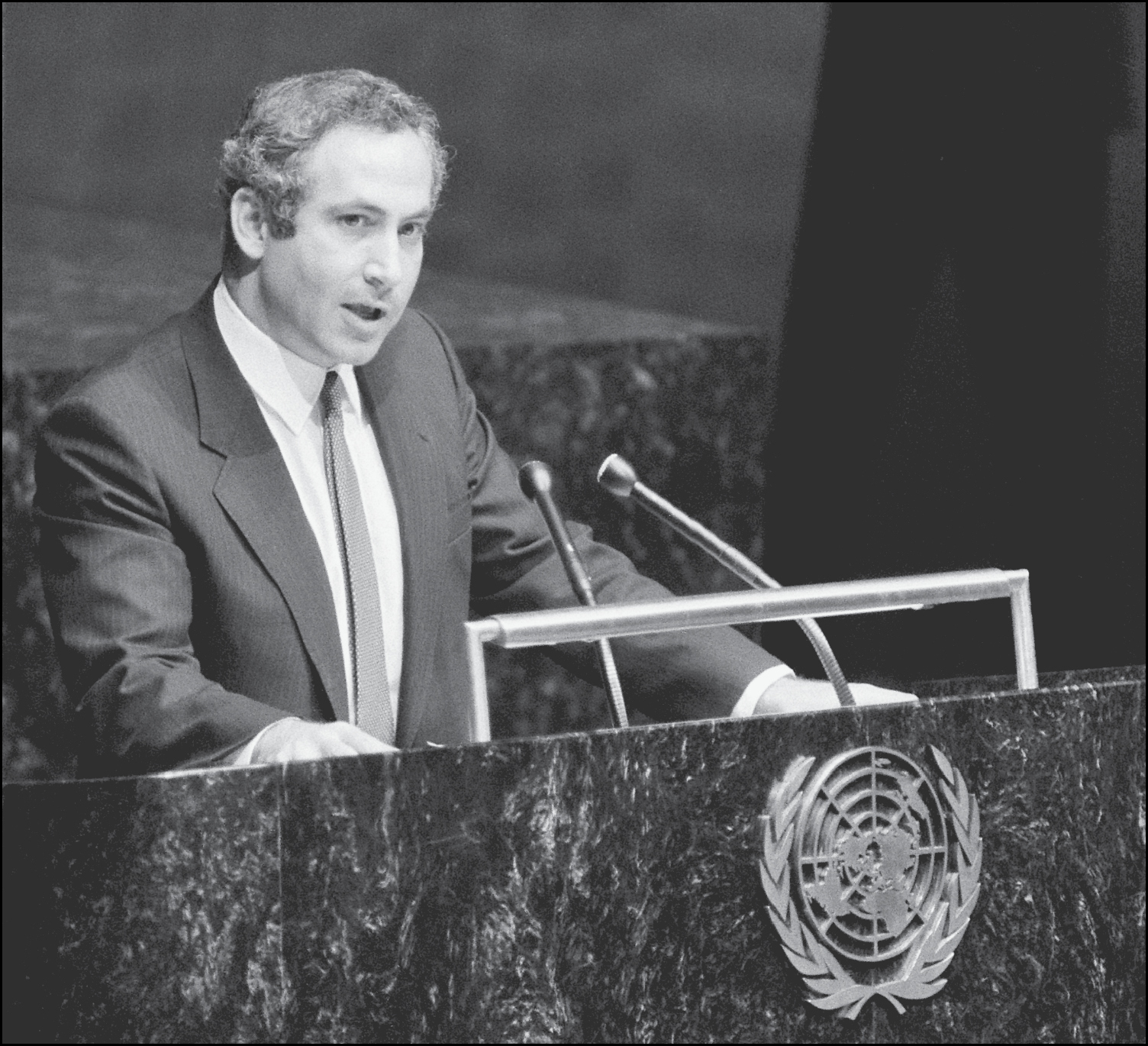
Ambassador Netanyahu at his favorite spot—the podium at the United Nations.
The consul general in New York is one of Israel’s main diplomatic positions, its envoy to the largest Jewish community anywhere at any time in history. Netanyahu had little time for the consuls—Naphtali Lavi, an old appointment of Dayan’s, or his replacement, Moshe Yegar, an old-school diplomat and historian. There could be no question who served as Israel’s senior representative in the city during Netanyahu’s three and a half years there.
Within weeks, Netanyahu was cutting a swath from UN headquarters at Turtle Bay all the way to the New York Times newsroom and all the major network studios, maintaining the friendships he had made during his Washington posting and making new ones. He invested time in the new cable news channels, flying to Atlanta to charm producers at CNN headquarters. Netanyahu understood how the twenty-four-hour rolling news cycle would reorder the news agenda and made plans to enhance his media-monitoring operation accordingly.
From the launch of CNN’s flagship interview show, Larry King Live, in 1985, Netanyahu became one of its habitués. Not long before the show’s demise in 2010, King devoted an entire program to one last interview, waxing nostalgically, “We only go back, oh, almost thirty years.” King once said of Netanyahu that “on a scale of 1 to 10 as a great guest, he is an 8. If he had a sense of humor, he’d be a 10.”2 Netanyahu, in his methodical way, took the advice on board. His interview/speech prep must include jokes.
It didn’t take long for Netanyahu’s star to rise in New York society. A visiting Israeli settler leader later remembered having breakfast with Netanyahu while he lived in the Regency. “Jewish matrons kept coming up, complimenting him on his television performance and inquiring if he wasn’t also an American citizen, because he should run for president one day.” He also recalled Netanyahu ordering bacon and eggs and being told off by Fleur for doing so while sitting with a religious friend.
Fleur, of part-Jewish ancestry, wasn’t considered Jewish by strict Orthodox law. This didn’t concern the completely secular Netanyahu personally, but it would have been out of the question for a senior right-wing Israeli politician to be married to a non-Jew. Already preparing for Bibi’s next career move, Fleur accepted that undergoing conversion to Judaism was part and parcel of being an Israeli political wife. For decades later, long after they divorced, there were those who claimed that she had undergone a non-Orthodox conversion and criticized Netanyahu for hypocrisy, when he nevertheless collaborated in coalitions with the anti-progressive ultra-Orthodox who would not consider her a Jew.
NEW YORK WAS Netanyahu’s real introduction to the Jewish community. Having regarded American Jews, at least those he met as a teenager in Philadelphia, as weak and feckless, in New York he met the leaders of the big Jewish organizations, the mega-donors and political players.
It was shake-up time in major American Jewish organizations, especially those dealing with Israel. Getting used to Likud in power was not easy for Jews who had supported Israel during its long Labor period. For many, the heady right-wing cocktail of Likud and Reagan was difficult to stomach. Tom Dine, the savvy, liberal-leaning executive director of the American Israel Public Affairs Committee (AIPAC), courted Republican donors, who would make AIPAC both more right-wing and more influential. Netanyahu would become a star of AIPAC conferences, his presence assuring Jewish Republicans that the organization was on the right side.
The Conference of Presidents of Major American Jewish Organizations, another group shifting rightward, hired the hawkish Malcolm Hoenlein as chief executive in 1986. Hoenlein and Netanyahu became friends and collaborators. Hoenlein would introduce Netanyahu to many of the millionaires who would become his supporters.
IN EARLY 1986, allegations surfaced in Austrian media that former UN secretary general Kurt Waldheim, who was then running for Austrian president, had lied in his autobiography about his doings during the Nazi era. Israel’s initial position was that it didn’t believe Waldheim had been a war criminal. But as Jewish organizations and American politicians took up the case, Netanyahu joined in.
He made a great show of demanding that the United Nations reveal the file it held on Waldheim. However, the decision of Waldheim’s successor, Secretary-General Javier Pérez de Cuéllar, to open the file was actually a result of a threat by Senator Alfonse D’Amato of New York to spend his reelection campaign bashing the United Nations. Ultimately, the UN file didn’t hold a “smoking gun” on Waldheim, and he was elected Austrian president.
The Waldheim case was to have a profound effect on another ambassador, Ronald Lauder, scion of the Estée Lauder cosmetics empire and a Republican donor, who had been appointed by Reagan as ambassador to Austria. Lauder and Netanyahu closely cooperated on the Waldheim case. The allegations against Waldheim caused a resurgence of anti-Semitism in Austria, and Lauder, who described himself as having been a “three days a year Jew,” reconnected with his roots and became involved in Jewish philanthropy and politics.
For the next two decades, until their falling-out, Ron and Bibi were close friends. Lauder introduced him to his own circle of New York millionaires, many of whom were not Jewish. That was when Bibi first met the brash real-estate entrepreneur Donald Trump, an old friend of Lauder’s. Netanyahu and Trump were never close, but they remained in contact. Years later, Trump appeared on a list that Bibi compiled of millionaires upon whom he could rely for various favors.
ANOTHER IMPORTANT AMERICAN Jewish leader he met in those days was Rabbi Menachem Mendel Schneerson, the “Lubavitcher Rebbe,” leader of Chabad Hasidism. Schneerson was ideologically opposed to secular Zionism but nevertheless supported Jewish statehood, and senior Israeli politicians frequently visited him in New York. His views on the Israeli-Arab conflict were ultra-hawkish; he was adamantly opposed to any territorial concessions. During the Yom Kippur War, he suggested that Israel continue its push on the Syrian front all the way to Damascus.
One of Netanyahu’s former Matkal soldiers, a secular kibbutznik who had become a Chabad Hasid, took him to see Schneerson in Brooklyn in late 1984, shortly after Netanyahu’s appointment to the United Nations. He arrived at 770 Eastern Parkway after midnight on the festival of Simchat Torah marking the end of the annual cycle of Torah readings. Thousands of Hasidim were waiting for the eighty-two-year-old Rebbe to start the ritual dancing with Torah scrolls. Netanyahu introduced himself, and Schneerson, to everyone’s amazement, stopped to talk to him for over half an hour. According to one Hasid there, the Rebbe told Netanyahu that in each of Israel’s wars, politicians had squandered the military gains, and that “when the goyim [non-Jews] come and demand parts of Eretz Yisrael, we must stand forcefully and deny them.” Netanyahu frequently brings up another message of Schneerson’s he remembers from that night: “You will go into a house of lies [referring to the United Nations]. Remember that in a hall of perfect darkness, if you light one small candle, its precious light will be seen from afar, by everyone. Your mission is to light a candle for truth and for the Jewish people.”3
At the time, Schneerson was just another leader of American Jewry whom Netanyahu was courting. Twelve years later, the Lubavitcher’s disciples would play a pivotal role in Netanyahu’s ascendancy.
Meanwhile, Netanyahu was using more earthly methods to advance his career.
IN JUNE 1984, while Netanyahu was still deputy chief of mission in Washington, the Jonathan Institute was resurrected for another international conference on terror.
This time, Netanyahu was promoted from organizer to star speaker; he opened the conference before handing the mic to the keynote speaker, Secretary of State George Shultz. It was an even higher-powered lineup than the one at the first conference. From Israel arrived Yitzhak Rabin and Arens. The American lineup included, besides Shultz, Reagan’s counselor (later attorney general), Edwin Meese, and the FBI director (later CIA director) William Webster. Netanyahu’s success at bringing heavy-hitters to his conference, which took place at the Four Seasons in Washington, DC, wasn’t just a result of his growing influence in Washington. It was a sign of the times.
Following America’s bloody episode in Lebanon, there was a growing interest in the issue of terrorism and a feeling that this was now America’s problem, too. And in Reagan there was a president willing to take it on. Netanyahu has claimed that the Jonathan Institute conferences played a major role in this development. That’s a gross exaggeration. Reagan hardly needed encouragement toward military action, and he saw the Soviet Union lurking behind every foreign threat long before Bibi came to Washington. But Netanyahu was certainly of the moment, and Shultz has credited him with having influenced his thinking.
On April 15, 1986, Reagan ordered an air strike on military targets in Libya, following the bombing of a nightclub in Berlin frequented by American servicemen in which 3 people (including two Americans) were killed and 229 injured. The Palestinian terrorists carrying out the bombing had been financed and directed by Colonel Muammar al-Qaddafi’s regime.
It was a proud moment for Netanyahu. He had said two years previously at the conference that “if a government has harbored, trained and launched terrorists, it becomes the legitimate object of a military response.” The United States had finally retaliated against a terror-supporting state. The decision to strike Libya was popular in America but roundly criticized by the “international community,” including many European allies. The UN General Assembly voted 79–28 on a resolution of condemnation. Netanyahu derived great satisfaction from, for once, voting in support of an isolated United States. Usually it was the American ambassador supporting isolated Israel.
The timing could not have been better. During the week of the Libya bombing, a book containing the lectures from the Jonathan Institute conference was published in the United States. Bibi himself had written only the introduction and a couple of chapters of Terrorism: How the West Can Win, but for all intents and purposes, it was “Netanyahu’s book.” His name appeared in bold letters on the cover (“Edited by” was much smaller). It was of the moment, reviewed in the major newspapers, and appeared on the cover of Time magazine, which published a seven-page excerpt. Secretary of State Shultz endorsed it and President Reagan apparently read it on Air Force One.
Netanyahu was achieving a degree of prominence that few foreign diplomats ever had. It was also the moment when Israeli media, fascinated by the amount of attention their ambassador to the United Nations was receiving, began seriously taking notice.
FROM HIS EARLIEST days in Washington, Netanyahu cultivated Israeli reporters based there as assiduously as he cultivated the American media. In return for tips on his inner dealings with the administration, he received favorable mentions as the rising star of Israeli diplomacy. After the Time cover, he became a superstar. The best-selling tabloid Yedioth Ahronoth, which would later become his strongest critic, sent a correspondent to New York to prepare a lengthy interview for its weekend magazine. The interviewer observed that “no-one now regrets the decision to appoint Netanyahu ambassador to the U.N.”4 The edgier Hadashot published a detailed analysis of why, ten years hence, Netanyahu and the head of the IDF’s Central Command, Major General Ehud Barak, would face off as Likud’s and Labor’s candidates for prime minister, respectively.5 It was a rare near-perfect political prediction. Hadashot got it right. The showdown with Barak took place in 1999.
Not all the coverage was positive. One left-wing daily published a list of Netanyahu’s publicity stunts undermining Ambassador Rosenne and Israel’s consul general, Moshe Yegar. But nearly all the reports were laudatory, describing Bibi staunchly fighting Israel’s cause in the corridors of the United Nations and on America’s television screens.6
During his trips home to Israel, Netanyahu visited newspaper offices, meeting publishers, news editors, and beat reporters. It was Bibi’s honeymoon with the Israeli media, in complete contrast to what would come later. He appeared everywhere, from the political pages to entertainment talk shows, projecting a dual image as a cerebral, bookish man of the world and a down-to-earth Israeli everyman, a cigar-smoking sabra whose favorite pastime, he claimed, was hiking through the Judean Desert. In an interview with Maariv, he said that what bored him most were “one-tone repetitive speeches.”7
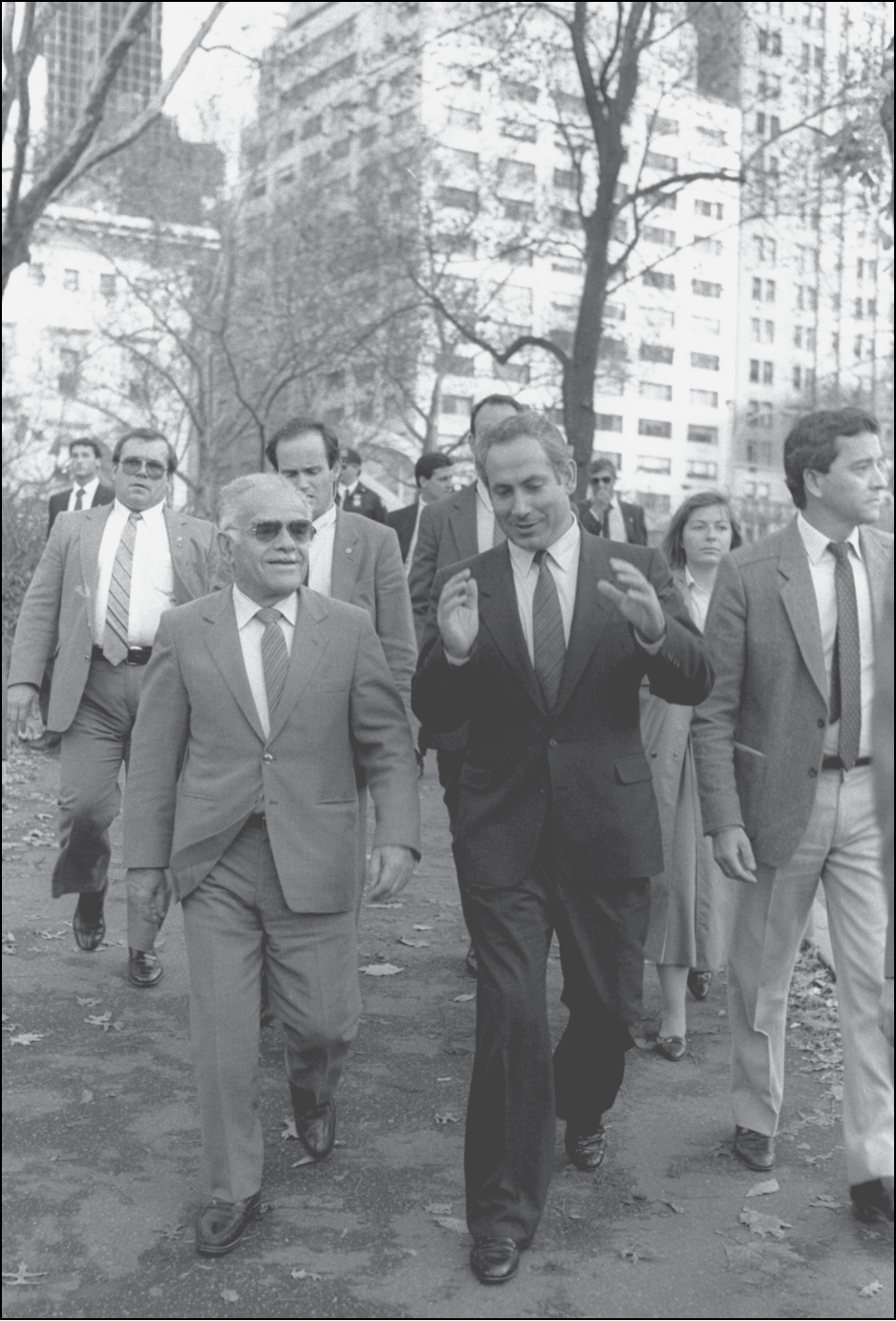
Ambassador Netanyahu with Prime Minister Yitzhak Shamir in Central Park in 1987. Six years later Bibi would replace him as Likud leader.
Netanyahu’s destination on the political map was clear. Despite being a civil servant, he allowed himself to express his own views even when they diverged with government policy. The most striking example was in May 1985, when the government agreed to exchange 1,150 mainly Palestinian prisoners for the release of three IDF soldiers who had been captured by the Popular Front for the Liberation of Palestine in Lebanon. The controversial, lopsided deal was supported by nearly all the cabinet ministers as well as by the Labor Party, Likud, and other parties, in the hope that it would draw a line under the traumatic war.
Netanyahu defied instructions and publicly opposed the deal in interviews. In a letter to one of the ministers, he wrote: “This action has shaken the faith of many here [in the United States] in Israel’s resilience and I have no doubt that it has deeply undermined our moral standing in Israel itself. How can we demand our soldiers endanger their lives, attacking the murderers working to destroy us, if we ourselves squander their sacrifice?”8
Did he think he was untouchable? Or was Netanyahu prepared to be fired in the hope that it would create the ideal circumstances for his entrance to politics? As it turned out, he got off with a light reprimand.
Under the Labor-Likud national unity government, Israeli foreign policy was run simultaneously by two leaders with very different worldviews. The result was four years of diplomatic paralysis as Shamir vetoed any effort by Peres to launch new peace initiatives. For opportunist diplomats stationed abroad, it meant a large degree of freedom.
In October 1986, “the rotation” took place. Shamir returned to the prime minister’s office, and Peres became foreign minister. Two years earlier, Peres had supported Bibi’s appointment. By now he had little doubt that he was dealing with a Likudnik who ignored directives to tone down his rhetoric toward the Arabs. However, replacing Netanyahu would have been difficult, as Shamir would have objected. Besides, it was clear that Bibi was about to resign in order to run in the next election. Why give him even more publicity?