
20

Two unpredictable bad spots — (1) Bing muffled a top note. (2) Elissa Landi lost a page. Bob Burns had one very long story that took too long for the laughs. There was so much fun and frolicking by cast it probably was not so enjoyable over the air.
— H. C. Kuhl, KMH program report (1936) 1
Jack Oakie, a popular guest in the early days of Bing’s tenure on Kraft Music Hall, liked to recount a cherished story about an appearance by Detroit Symphony Orchestra conductor Ossip Gabrilowitsch, who was also a concert pianist. Shortly before airtime, as Oakie told it, while humorist Victor Borge was warming up the studio audience, director Cal Kuhl realized that the show was running long and anxiously asked Bing to instruct spectators not to applaud. “You’re kidding,” Bing said. 2 Kuhl was adamant. There must be no applause, especially for Gabrilowitsch: “Now listen, we know he’s going to murder ‘em, and if they get started applauding for him, he’ll louse up our time.” 3 Bing made the announcement.
The program was in progress when the pianist arrived, an entrance recalled in loving detail by Oakie, who was fascinated because Gabrilowitsch was married to Clara Clemens, the daughter of his idol, Mark Twain. Oakie watched him doff his large-brimmed fedora and cape and pace silently, awaiting his turn. When Bing introduced him, Gabrilowitsch marched to the piano and, in Oakie’s telling, “gave one of the greatest performances of his career! He played the last notes, lifted his hands, and held them above the ivories in a dramatic pause.” The audience was quiet as a tomb. He just sat there, dazed. “Those silent moments, which must have seemed an eternity to him, must have been one of the greatest shocks of his life,” Oakie observed. Finally, he bestirred himself and, as if in a trance, walked off the stage and out of the building. Afterward, Bing wanted to know what was troubling the maestro. “Bing,” Oakie asked, “did you tell him about the no-applause business tonight? ‘Oh, my God!’ was all Bing could say.’Oh, my God!’” 4
This is classic show-business apocrypha: the setup, the details, the specific names, the vivid movielike finish. It even has a second punch line. So thunderstruck was the musician, he left the building without his cheese basket, the sponsor’s much coveted gift to each guest. Though something like that may have — or certainly should have — happened during radio’s golden age, Oakie’s story is as much a fabrication as his idol’s “Celebrated Jumping Frog of Calaveras County.” Ossip Gabrilowitsch never appeared on Bing’s show. Oakie himself appeared only once before Gabrilowitsch’s death. The pianist on that occasion was Alexander Brailowski; Oakie was rebuked by the director for “discourteous” mugging during his spot. 5
But Oakie’s nuanced telling gives the game away, underscoring the absurdity of the tale: Victor Borge didn’t relocate from Denmark to the United States until years later, and he joined the Crosby show as a regular cast member, not as an audience warmer; Bing’s musical guests were invariably involved in patter with the star; Kraft Music Hall, like all network programs, was a minutely timed operation, and radio did not permit the luxury of “silent moments” (Bing would be on the mike in an instant), especially when time was short. Above all, Oakie ignored a unique component of the show: applause was always forbidden, by directive of Crosby himself, who found it disruptive and contrived. Bing particularly disliked what he called “organized applause” at the start of the show, before he had done anything — or so he argued — to merit it. Had he been able to persuade his sponsor, he would have had no audience at all. Listening to disc transcriptions of Bing’s early Kraft shows, one is startled by the rapid intros and outros surrounding musical numbers, the absence of any kind of mitigating response, the consequent fast pace and easy, nothing-special ambience. One wouldn’t know an audience was present, but for its frequent laughter.
During Bing’s reign, Kraft became a lightning rod for comic yarns, some of which were actually true, for example, the often told tale of David Niven and the bounteous cheese basket. Every guest received a large wicker hamper containing pounds of the sponsor’s products, individually wrapped in cellophane, festooned with ribbons, and tied to a teakwood tray. Shortly before he was scheduled to appear, Niven was warned by Samuel Goldwyn, to whom he was under personal contract, that the producer was entitled to whatever he was paid for his radio work but would magnanimously allow the actor half. “When I got home,” Niven wrote in a memoir, “we meticulously removed half the spread from the jars, cut every cheese in half, every sardine in half, then with an envelope containing a check for half my salary from the show, I sent the lot to Goldwyn inside half the basket.” 6
Bing’s Kraft Music Hall generated droll postmortems in part because it represented something different for radio. It had become a way station for entertainers high and low and was a must for Hollywood notables plugging their wares. A pleasure for listeners and performers alike, thanks chiefly to Bing’s even keel on air and behind the scenes, KMH erased Hollywood’s last resistance to radio as a low-life competitor. Here was fresh ground, on which hillbilly comedian Bob Burns and longhair icon Leopold Stokowski could mix it up under the benevolent gaze of ringmaster Bing. The show was so effortlessly amusing, the humor so unforced, that the audience assumed it was largely if not entirely ad-libbed. This assumption was shared even by people supposedly in the know, like the press. They believed KMH to be, no less than the numberless talk shows spawned in its wake, a playful hour in which Bing and friends shot the breeze, joked, performed, and periodically took time out so the announcer could sell cheese.
That a program as complicated as KMH, with its repartee, musical numbers, commercials, and skits, could be produced off the cuff was about as likely, in 1936, as Ossip Gabrilowitsch wandering off the set in silence. But the assumption was an unbeatable tribute to Bing’s finest and longest-running characterization, as the relaxed, neighborly, decent, straight-shooting, genial host who was too much himself, too much a creation of his own lazy tempo to read a script or mind cues. Whenever Bing cracked up or misread or stumbled over a lovingly intoned ten-dollar word or scooped a punch line with his plucky baritone, he contributed to the illusion of spontaneity. The genuinely impromptu moments, for Bing was no slouch at quips, were isolated. Never mind the thousands who (quietly) attended his weekly broadcasts and saw the artists standing around a mike with scripts in hand; the radio-listening audience had its own mind, and in that realm Crosby was simply not the rehearsal type. As his radio persona grew in stature, it subsumed the personae he created on records and film.
The Kraft-Phenix Cheese Company had introduced the Kraft Music Revue in 1933, for the express purpose of promoting a faux-mayonnaise concoction called Miracle Whip. Doubling as sandwich spread and salad dressing, the new product appealed to Depression purses and deficient palates and received a dynamic send-off with a program that starred Al Jolson, music commentator Deems Taylor, and Paul Whiteman, whose Rhythm Boys then included Johnny Mercer. An immediate success, that show, like all network shows, was created by the sponsor’s advertising agency — in this instance, the powerful J. Walter Thompson, specifically Thompson’s visionary chief of broadcast production, John Reber. Writer Carroll Carroll, who played a decisive role in unleashing Bing’s radio id, wrote of the man who put him on the agency’s payroll: “The fact that I met the unbelievable Reber, one of the most inspired and inspiring showmen of the Golden Age of Radio, while he was clad in Chinese red pajamas is the only thing that kept me from being scared to death of him.” 7 Reber, a tall, gaunt man, had launched hit programs for Rudy Vallée, Burns and Allen, Eddie Cantor, and Edgar Bergen, among others. Carroll contributed to most of those shows but came into his own as sole writer of the New York—based Kraft Music Revue.
When Jolson took sabbaticals to work in California, as he often did, Reber — knowing that radio waves were especially responsive to deeper voices — sought personable baritones to fill in. He employed a few unknowns who remained unknown, compensating for their mediocrity with an impressive rotation of celebrated guests from Broadway, jazz, and opera. When Jolson left for good, Reber renamed the hour Kraft Music Hall and promoted Whiteman to host. White man, typically, presided over a showcase for his musicians and band, contrary to Reber’s desire for a more diverse variety program. To Reber’s relief, Whiteman refused to change his modus operandi, freeing J. Walter Thompson to pursue — now that Woodbury proved Bing had the makings of a radio personality — the hottest baritone of all. Whiteman, in turn, was picked up by Woodbury.
During his fruitful August trip to Saratoga, the day after the recording session with the Dorsey Brothers, Bing appeared as Paul’s radio guest for what the cheese company regarded as a de facto audition. He also sang that evening at Whiteman’s opening night at the Riviera Club. Four months later, in December, the KMH baton officially passed from the bandleader to his erstwhile crooner — a formality spread over four Thursday-night shows, for which Whiteman served as host in New York while Bing was wired in from Hollywood, taking his cues on the telephone. The audio engineer responsible for this sleight of hand was a young wizard named Murdo MacKenzie, who went on to record and eventually transcribe and produce Bing’s radio ventures for three decades.
Bing was paid $3,000 for each of those four performances, a series that began shakily despite long rehearsals. Following the “Miracle Fanfare,” announcer Ford Bond introduced Whiteman, who explained that the featured guest was not in the Music Hall, but in Hollywood with Jimmy Dorsey’s “swell” orchestra. This was to be a big night, Whiteman continued, because “Bing is not only a swell singer and a swell guy, but he happens to be one of the best friends I’ve got in all the world. So naturally, I’m mighty happy to have him with us.” 8 As a token of his esteem, Whiteman offered a medley of Crosby hits, from “Mississippi Mud” to “I Wish I Were Aladdin.” Then the microphone passed to Bing.
The verdict at Thompson was divided, but the enthusiasm of director Cal Kuhl carried the day; he was placed in charge of the show. Kuhl wrote in his program report, “[Dorsey] still nervous at playing for Bing. It’ll wear off shortly.” 9 He also noted the more pressing problem of Bing’s tendency to stand too close to the mike. For the third show, a lectern was placed in front of Bing to force him to keep his distance. On the last of the four dual broadcasts with Whiteman, a comic named Bob Burns came into his own. A vaudevillian from Van Buren, Arkansas, billed as the Arkansas Traveler, Burns had appeared occasionally with Whiteman and Rudy Vallée, to little response. He personified the kind of rube humor that amused Bing back in his “Bingville Bugle” days and would now thrive as Bing’s sidekick on KMH and in two films. KMH even signed him as Bing’s summer replacement, and Paramount starred him in his own low-budget films.
On January 2, 1936, broadcasting over station KFI at 7:00 P.M. Pacific time from NBC’s Studio B, a temporary setup on the back lot at RKO, Bing finally presided as sole host of the Kraft Music Hall, his radio home for the next decade. From the beginning, KMH juggled classics and pop, the concert stage and Hollywood. On the first show, teenage violinist Ruggiero Ricci played a classical number and director Cecil B. De Mille participated in a scripted interview. Don Wilson announced, Jimmy Dorsey’s band underscored Bing’s rhythmic zing, and Burns demonstrated a musical instrument of his own invention: a brass contraption made of sliding pipes with a funnel at one end, resembling a kitchen-sink trombone but sounding more like a jug. He called it a bazooka, after the sound it made, and his featured numbers became so popular that the name was later appropriated by the army for short-range rocket launchers.
Burns’s job included welcoming the audience (the studio accommodated 400) and asking it to withhold what other stars craved. He appeared just before airtime, introduced himself and the host (“that fella back there in the corner is Bing Crosby”), 10 and said:
The Kraft people welcome you all here and ask you not to applaud, but if you find something funny, feel free to laugh. Now, when the green light turns to red, we will be on the air. And then, when the red light goes off and the green light comes on again, if you feel like applauding, please do. 11
In his program report for the first show, Kuhl complained about Bing’s stubborn hugging of the mike and worried, “Show may need a bit of working over to find correct formula to the Crosby style and personality.” 12 Improvement was immediate. Following the second installment, Kuhl exulted, “Crosby in fine fettle. Show changed from opening program and now is more in the Crosby style, which is distinctive and different.” 13 He found it well engineered and fast moving, especially praising contributions by classical pianist Mischa Levitski and commentator Rupert Hughes. Bing even held back on the mike. The jazz and humor quotient were raised by old friend Joe Venuti, whose impertinent, monosyllabic wit invariably made Bing laugh and who, in the argot of musicians, could swing you into bad health. 14 On the next few shows, guests included John Barrymore (who arrived in his cups yet, steadied by Bing, flawlessly rendered Hamlet’s soliloquy), Percy Grainger, Joe E. Brown, Leopold Stokowski, and Marina Schubert, a minor actress whose singing made her an early KMH favorite.
The February 6 show was memorable. Walter Huston’s dramatic reading fell flat, but he enchanted listeners by reminiscing about his years in vaudeville and movingly croaking a song — in effect, a prelude to his triumph in the 1938 musical Knickerbocker Holiday and his renowned recording of the score’s only hit, “September Song.” Elusive Russian pianist Josef Lhevinne, however, showed a slackening in his fabled technique; “the mike is cruel,” Kuhl wrote. 15 Most important, that night marked the KMH debut of Bing’s new announcer, Ken Carpenter.
Don Wilson was well known as Jack Benny’s corpulent foil, and KMH wanted a fresh personality to serve as Bing’s man. Ken Carpenter was made to order. Mildly stentorian and quick on his feet, he was a sincere, gentle, and never unctuous pitchman. Like Benny’s Wilson, Carpenter became an essential part of the show, an agile straight man who relished every opportunity for clowning. Bing called him “a genuine professional radioman. He made me look good every time. He could do a lot of things with that big voice of his. He’d kinda surprise you. He could break you up putting on some kind of character — a rube or something like that.” 16
Carpenter was born in Illinois in 1900 and, after relocating to Los Angeles, was hired to emcee the Cocoanut Grove broadcasts featuring the Rhythm Boys. At the time Bing took over KMH, he was reminded of Ken’s abilities listening to him announce the Rose Bowl. The chemistry between the two men was evident: they both loathed pomposity. Carpenter was even willing to accept the task of manually ringing the NBC chimes — the network’s famous three-note trademark — before it became a push-button job. Their association was all business but engendered mutual loyalty. Ken announced other programs (including The Edgar Bergen/Charlie McCarthy Show, One Man’s Family, and The Lux Radio Theater) but was known chiefly for his long association with Crosby. Like Murdo MacKenzie, he worked with Bing after the war and remained with him through his last radio series, in 1962. In 1976 Ken presented Bing with the Armstrong Award in recognition of his pioneering work in the medium.
KMH, an instant success, would ultimately reach a weekly audience of some 50 million, a Thursday-night ritual across the country. Riotous laughter and roof-raising musical numbers were not the goal; the idea was to engage the listener’s smile and sense of involvement, as if KMH were a family circle that just happened to comprise superb musical entertainers. An open-house feeling was underscored by the diversity of Bing’s guest list, which has never been equaled. Suddenly radio was an eminent address — not just an obligatory promotional stop. For a while the movie studios held out, restricting their biggest stars and imposing arbitrary conditions on those they let appear; players contracted to 20th Century-Fox, for example, were required to mention studio chief Darryl Zanuck. B-list players appreciated the exposure as well as the work; concert artists relished the chance to be heard by millions. No other program in broadcast history did as much to introduce Americans to classical music and its stars, whom Bing chaperoned with casual respect, presenting their talents as a non-medicinal contrast to the pop tunes handled by himself and Jimmy Dorsey’s twelve-piece band.
In his first year alone, Bing’s KMH visitors included Spencer Tracy, Alice Faye, Andres Segovia, Charlie Ruggles, Leonard Pennario, Dorothy Wade, Lotte Lehmann, Ann Sothern, Bronislaw Hubermann (who insisted the piano be retuned to European pitch while the show was on the air), Patsy Kelly, Emanuel Feuermann, Lyda Roberti, Virginia Bruce, Grete Stuckgold, Edward Everett Horton, Albert Spalding, Binnie Barnes, Rudolph Ganz, Joan Crawford, Ernestine Schumann-Heink, Efrem Zimbalist, ZaSu Pitts, Fritz Leiber, the California Society of Ancient Instruments, Louis Prima, Rose Bampton, the Avalon Boys, Frank Morgan, Bette Davis, Fyodor Chaliapin (who slowed the show by ad-libbing but utterly enchanted Bing), George Jessel, Norma Talmadge, Edith Fellows, Pat O’Brien, Toscha Seidel, Martha Raye, Frances Farmer, Norman Taurog, Jean Arthur, Bert Wheeler, Robert Taylor, Robert Young, Dolores Costello, Louis Armstrong, Alison Skipworth, Elizabeth Rethberg, Dorothy Lamour, Joan Bennett, Ruth Chatterton, Slip Madigan (the football coach), Josephine Hutchinson, Warren William, Iona’s Hawaiians, Cary Grant, Elissa Landi, Adolphe Menjou, Gladys George, Mary Astor, Gene Raymond, Rochelle Hudson, Bruce Cabot, James Gleason, Gregor Piatigorsky, Anita Louise, Jose Iturbi, and Art Tatum, some of them appearing two or three times or more, plus those previously mentioned, as well as regulars (notably the Paul Taylor Choristers), sketch actors, and many others — all during 1936. As Barry Ulanov wrote, “The longhairs were shortened; the crew-cuts were lengthened.” 17 The result was unprecedented cultural democratization.
The most important figure on the program, beyond Bing, was the writer who serendipitously became his collaborator in creating Bing’s KMH self: the talented, elfin, and cheerfully sardonic Carroll Carroll. When Bing was hired, Thompson initially assigned him a writer in its West Coast office, Sam Moore. But two months after Bing took over, Moore left the agency. Rather than bring in an outsider, Reber asked Carroll to head west and take his place. Moore had spent the month before Bing’s first KMH show trailing after him like a puppy, trying to learn the Crosby lingo, an effort that Carroll redoubled. He knew better than to create a character for Bing. Although radio was a medium of pioneering intimacy, its first dictum was to fake sincerity. But Crosby, Carroll acknowledged, had little capacity for fakery. He could not play a fictional character like Jack Benny’s vain skinflint, nor could he assume the role of humanitarian or spokesman as Eddie Cantor had. Bing could only be himself — modest, playful, intelligent, and appealingly aloof. Carroll’s challenge was to allow Bing to be Bing, only more so.
Though in later years he published an important memoir of his radio years, None of Your Business, Carroll was sparing with details about his background. He was born Carroll Weinschenk in New York in 1902 and dropped out of high school to write. He traveled for a while, working briefly as a farmhand, and when he returned to New York, his stories and poems began to appear regularly in humor magazines as well as the Saturday Evening Post, Life, and The New Yorker; he wrote a radio column for the New York Sunday World. Sixty years later announcer Ken Roberts remembered his poems as “brilliant.” 18 But they did not pay the rent, so Carroll began taking public-relations assignments, which led him to John Reber and his Chinese pajamas. Bespectacled and short and pleasantly owlish, he was soon recognized as one of the best comedy writers in radio. Actor Eddie Bracken described him as “a little unassuming guy who loved good comedy in a serious way, a pleasure to be with, just a regular old shoe, you know? You couldn’t find anybody more natural or wonderful than Carroll Carroll.” 19
Bing was somewhat less enthralled and, to the writer’s annoyance, kept Carroll at a distance. Their first meeting was a chance encounter outside Studio B, after a rehearsal. “Glad to know you,” Bing said as Kuhl introduced them. But when he learned that Carroll was the new writer from New York, Bing said merely, “Ohhhhh? Lots of luck,” and strode off. 20 Carroll had already sized up the man, observing him during the rehearsal: “Bing, wearing a porkpie hat, a dark blue outboard shirt, henna slacks, and black and white golf shoes, was smoking a pipe, doping a race, and running through a new tune, with Jimmy Dorsey reminding him of it on the saxophone. Nothing could have been more typical.” 21
Bing’s clashing clothes, which reflected the fact that he was colorblind, became a running gag, as much a part of the Crosby persona as Jack Benny’s cheapness — though, in this instance, grounded in reality. Bing could not tell red from green; he was able to drive because traffic lights were all the same to him — red on top, green on bottom. Carroll recalled once pointing out to Bing that he was wearing different socks, black and red. Bing looked down and replied, “That’s funny. They both fit.” Asked on another occasion if he knew the color of his socks, Bing answered, “Dark?” 22Lines like that are found treasure for a comedy writer, but not necessarily usable. Color-blindness is no joke. The trick was to make fun of the Hawaiian shirts and array of hats (Bing never wore his rug on the air), the motley of plaids and stripes, without suggesting a disability.
As they began to work together, Carroll realized that he and Bing shared a fascination with language and a mutual love of show-business eccentrics. (Bracken recalled their hilariously trading stories about actor Charlie Butterworth.) Carroll played on those interests to flesh out Bing’s radio character. For a while Bing resisted speaking more than was necessary; as late as 1946 he argued that listeners wanted to hear him sing, not talk, and he had a habit of severely pruning his dialogue. But as Joe Bigelow — formerly Bige of Variety and by 1946 the Thompson account executive in charge of KMH — noted, for all his protests Bing actually liked talking once he got going, especially trading lines with fast comics. 23 Carroll understood that. He began jotting down the odd words and bizarre slang that peppered Bing’s conversation and put them into the scripts.
“That ain’t English,” Bob Burns observed, “that’s a language called Crosby.” 24 A 1938 issue of the sponsor’s house magazine, Cheesekraft, published a Bing Crosby glossary: “the full treatment” (a good job), “prayer bones” (knees), “I pass” (I give up), “snozzy little ketch” (a yacht), “I seem to be playing infield” (I’m all confused), “let’s have a recount” (I’m still confused), “go in there and pitch” (give them a good show), “a dinger” (a honey), “a whingdinger” (superlative), “fret-tin’ cuticle” (worrying), “zingy” (quick), “in the groove” (down the alley), “shooting gallery” (movie theater), 25 and dozens more, some borrowed from vaudeville and jazz, others of unknown origin, like the one that tickled Miriam Hopkins about dropping a load of pumpkins, or Carroll’s favorite among Bing’s on-air quips, spoken to trumpeter Wingy Manone after a solo: “Man, that was dirtier than a Russian horse-doctor’s valise.” 26
Carroll’s routine was straightforward and full-time. He spent the weekend interviewing upcoming guests to get a feel for the way they spoke, looking for any quirks that could be written into the patter. He explained, “The policy was to talk to highbrows as if they were athletes and athletes as if they were highbrows.” 27 On Monday and Tuesday he wrote the script, delivering complete copies to Bing and Burns, and applicable sections to the guests. The next day he collected okays and suggestions from the guests. Not until Thursday morning did he receive Bing’s edits, which Carroll was free to incorporate or ignore. Thursday’s rehearsal was conducted in segments, each timed, but usually not in order. There was never a complete run-through, so only Bing knew how the entire show would play. Carroll emphasized one reason the show seemed so informal: what other programs considered dress rehearsal, KMH presented as the actual program, aired live Thursday evening at seven.
For Bing, of course, KMH was anything but full-time. He was also making three movies and recording, on average, forty records a year. All of which he seemed, at times, to treat as necessary intrusions on his primary interests, those of a gentleman sportsman. In that capacity, too, he made history. The year before he took charge of KMH, Bing purchased his first racehorse, Zombie, who placed and showed in two races at Santa Anita, representing Bing’s colors of blue and gold. At the same time, he hired as his trainer Albert Johnson, a Spokane boy who left a few years before Bing to make his name as a top jockey, winning the Kentucky Derby in 1922. Bing built stables and an exercise track at Rancho Santa Fe, and before the year was out he had fifteen horses, and soon after that twenty-one. He was betting and losing heavily, and his compulsion would worsen before he had it under control. But he earned respect for his serious love of the turf. Trainer Noble Threewitt recalled him arriving at 4-4:30 A.M., an hour before the track opened, to pad around the stables, schmooze with the trainers, and read the papers. 28
Thus, Bing was the obvious person to approach when William A. Quigley, a former football star, successful stockbroker, and occasional racing official, got the idea of establishing a track at Del Mar, not far from Bing’s Rancho Santa Fe getaway. Bing loved the idea, and the Del Mar Thoroughbred Club was incorporated May 5, 1936. This was to be largely a Hollywood project, financed and promoted by film stars, whose regular presence at the track would heighten its appeal for the general public. Bing, the primary stockholder, called for a board meeting the day after incorporation, at Warner Bros.’ studio. Executives were elected: Bing president, actor Pat O’Brien (the second-largest stockholder) vice president, Everett Crosby secretary-treasurer, and Oliver Hardy and director Lloyd Bacon officers. The other film people appointed to the executive committee were Gary Cooper, Joe E. Brown, David Butler, William LeBaron, and Leo McCarey, who soon dropped out, to be replaced by Clark Gable and George Raft. Remaining directors, drawn from the business world, included millionaire Charles Howard and his son Lindsay Howard. Quigley was named general manager. When the stock offering failed to take off, Bing and O’Brien borrowed on life-insurance policies to complete construction of the track. They filed an application with the California Horse Racing Board for a twenty-five-day meet, beginning July 3, 1937. On the day the world first learned of Amelia Earhart’s disappearance, Bing, in a loose shirt and yachting cap, personally opened the gates and — as newsreel cameras turned — welcomed customers and collected their tickets. His horse, High Strike, won the first race.
At the same time, Bing pursued his primary love, golf. In 1936 he won the Lakeside Golf Championship, the first of several such victories. Though he didn’t play on a professional level, he was widely conceded to be one of the best in Hollywood, his low handicap (two) occasionally contested by those who claimed he was a scratch player; twenty years after Bing’s death, Bob Hope could be heard complaining that without the handicap they would have been more evenly matched. 29 On one occasion, Bing qualified for the national amateur golf championship. Golf expert Toney Penna noted, “If he could have hit the ball twenty to thirty yards farther, he could have been one of the country’s top amateurs.” 30
Bing’s main contribution to the game was as a popularizer and organizer. Penna (who scored fourth in the 1938 U.S. Open) put it into his head to create a pro-amateur invitational. Bing was intrigued by the idea of a competition in which Lakeside members and other low-handicap amateurs could team up with pros. The obvious place to hold it was the course near his home at Rancho Santa Fe. In February 1937, seven months before Del Mar opened, the Rancho Santa Fe Amateur-Pro — later known throughout the sporting world as the Bing Crosby National Pro-Am Tournament — made its debut. It was a triumph despite rains that washed out the first day’s play as well as the bridge leading to a green; firemen and policemen in hip boots piggybacked the players across the water. Sam Snead won $500 carding a 68. Bing came in with an 87. The Crosby, the first and longest-running celebrity golf tournament, allocated all proceeds to charities.
All this was grist for Carroll Carroll’s mill, albeit with alterations. Winning ponies, of which Bing had quite a few, were not as funny as losers, so Bing’s limping nags became a running joke. His obsessive golfing, in Carroll’s hand, was just another indication of Bing’s laid-back, even lazy, approach to life. Obviously, Bing was never lazy, just relaxed. Fans, who confused the two, did not get many glimpses of the iron discipline that kept him on track and on time. His punctuality never wavered; the old days of sheepish arrivals were long past. Film, recording, and radio directors grew accustomed to arriving in the studio or on the set to find Bing already there. For Bing, a 5:30 A.M. call did not mean 5:40, and though he apparently never upbraided those who wandered in late, the sight of the leading man alone on an empty set, reading the newspaper or a racing form, humbled many of his coworkers into tightening their own schedules.
Conversely, Bing left promptly at the designated time, no matter what, even in the middle of a scene. “Tell him exactly when you wanted him and he’d be there,” Carroll wrote, but the minute the session was over, he was “like a school kid who knew the bell ought to ring.” 31 Bing considered punctuality a matter of courtesy. If he was on call to the studio from 6:00 to 4:00 and had another appointment at 4:30, he figured he ought to be prompt for both. The devil might tempt him with pleasures of the flesh, but never with idleness. That such exactitude could coexist with the insouciance and imperturbability for which he was renowned dumbfounded coworkers, especially those leading ladies who felt neglected because he was always pushing off to another appointment. Even fooling around had its place and time. By categorically following the clock, Bing was never rushed, never harried.
As Carroll fed Bing’s own speech patterns back to him, Bing began to relish the tongue twisters that emerged from the dependable rhetorical device of mixing highfalutin words with slang. A few weeks into the job, Carroll wrote openings for Bing that even friends thought were impromptu. For example, the May 7 show:
Good evening, ladies and gentlemen, Bing Crosby welcoming you to another of our regular Thursday-evening soirees in the Kraft Music Hall. And we hope you’re all comfortably settled by your “soiradios” — the Bob Burns influence. At any rate, in addition to the insidious Burns, Jimmy Dorsey and his orchestra, and the Paul Taylor Choristers, we have with us in the Hall this evening my friend George Raft. We thought maybe the Raft wouldn’t get back from location to be with us tonight, but I’m glad to report that the smooth and sinister yet romantic Georgie made it. Mr. Toscha Seidel, one of the greatest violinists in the world, is also with us this evening, I’m proud to say. And Miss Una Merkel, MGM’s very popular and extremely busy young commediene. 32
This was followed by patter between Bing and Merkel, with exchanges like:
Bing: How long ago was that?
Una: Goodness, no southern gentleman asks a girl to name dates.
Bing: I’m from Spokane.
Una: That’s far enough south of Alaska to make you a southern gentleman.
And:
Bing: Do you really think it’s wise for a girl to give up school to go on the stager?
Una: What’s the difference? It’s an education. One way, you get smart by degrees. The other way, by stages.
Bing: I wonder what a southern gentleman would say to that?
Una: What do you say to it? Do you think a boy who wants to should go on the stage or stay in school?
Bing: What’s the difference? It’s an education. One way, you get smart by degrees. The other way, by stages.
Una: I just said that.
Bing: I know. I wanted you to hear how it sounded.
And for a closer to the five-minute “interview”:
Una: By the way, now that you know all about me, how did you happen to get into show business?
Bing: Well, you see I was…
Una: Thank you. What was your first big dramatic part?
Bing: Miss Una Merkel, ladies and gentlemen…
Una: Do you think crooning is here to stay?
Bing: Miss Merkel will…
Una: Do the other two Rhythm Boys miss you much?
Bing: Jimmy, Una’s on…
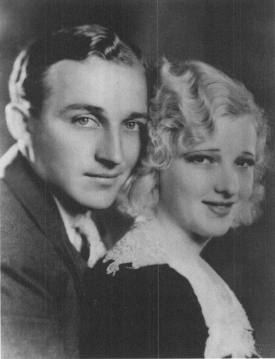
Bing was twenty-seven and Dixie was eighteen when they married, on September 29, 1930, at the Church of the Blessed Sacrament in Hollywood. She was far more famous than he was, and the wedding photo was widely published. Susan Crosby Collection
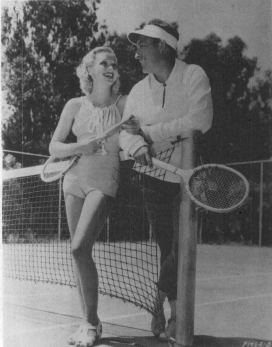
In 1934, shortly before the birth of the twins, Bing and Dixie bought a sixty-five acre property in Rancho Santa Fe. Bing hired Lillian J. Rice to restore the nineteenth-century Spanish style, but added modern improvements, including a tennis court. Susan Crosby Collection
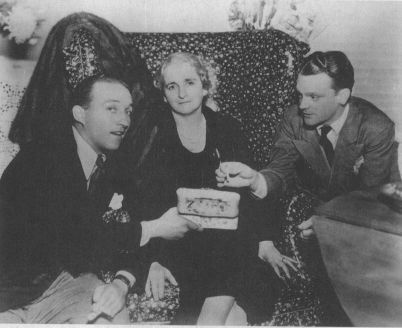
Bing, his mother, and James Cagney celebrate the christening of Bing’s first son, Gary, on October 8, 1933. Ron Bosley Collection
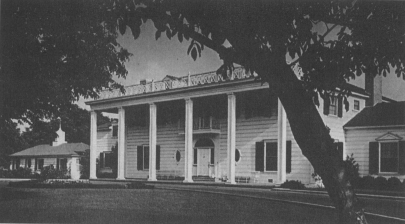
In 1936 Bing and Dixie built their beloved mansion on six acres at 10500 Camarillo Street in the Toluca Lake section of North Hollywood. It would be destroyed by fire in January 1943. Architectural Digest
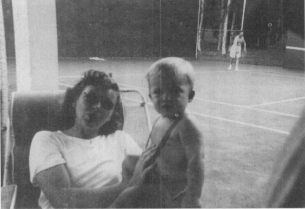
Dixie with her fourth son, Linnie, 1938. She was a dedicated tennis player until a kidney infection forced her to quit. Rory Burke Collection
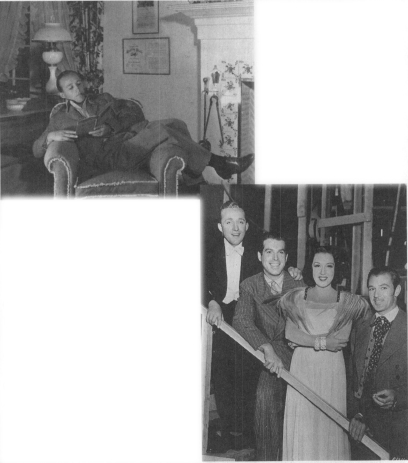
Top: Bing was a voracious reader, even when he wasn’t posing for publicity shots in his Camarillo Street home. Architectural Digest
Bottom: On the set of Anything Goes, Bing posed with his costar Ethel Merman and two Paramount players who dropped by, Fred MacMurray and Bing’s old friend Gary Cooper.
Ron Bosley Collection
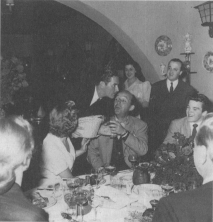
At a 1953 party Errol Flynn demonstrated his admiration for Bing’s refusal to wear a toupee when he wasn’t working. Linnie is seated on Bing’s left. Susan Crosby Collection
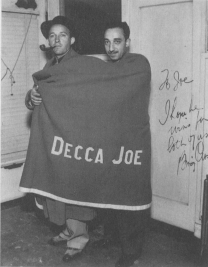
Bing named a horse Decca Joe, after Joe Perry, the prolific producer who recorded many celebrated hits in the thirties and forties. Elsie Perry Collection
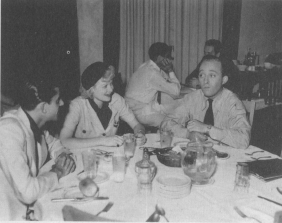
A frequent guest on Bing’s Kraft Music Hall was Lucille Ball, shown here with Bing and an unidentified friend. Gary Giddins Collection
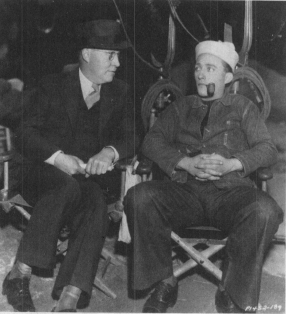
Harry Crosby visited Bing on the set of Were Not Dressing, 1934.
Elsie Perry Collection
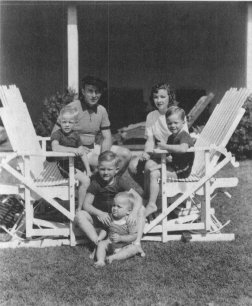
Bing and Dixie on the lawn of their home with, left to right, Phillip, Gary, Linnie, and Dennie, 1940.
Susan Crosby Collection
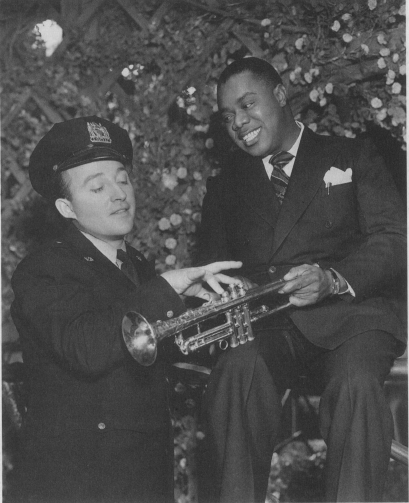
Bing looked forward to working with Louis in Doctor Rhythm, a picture plagued with mishaps; to Bing’s chagrin, the Armstrong footage was cut and apparently lost, November 1937.
Gary Giddins Collection
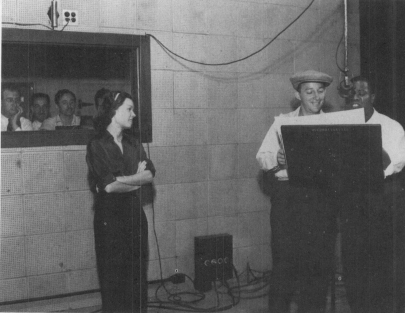
Jack Kapp, Joe Perry, and an engineer listen from the recording booth as Frances Langford, Bing, and Louis Armstrong record the Pennies from Heaven medley, August 17, 1936.
Elsie Perry Collection
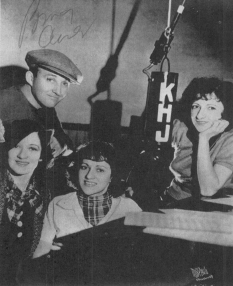
The Boswell Sisters alternated with the Mills Brothers as regulars on Bing’s Woodbury radio show. Bing later recorded famous duets with Connie Boswell, center.
Ron Bosley Collection
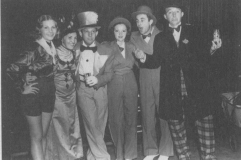
ABOVE: The Crosbys’ Westwood Marching and Chowder Club minstrel shows were major Hollywood social events in the late 1930s. Bing poses with (left to right) Bessie Burke, Midge and Herb Polesie, Dixie, and Johnny Burke. BELOW: Seated with an unidentified blackface actor, Pat O’Brien, and Jerry Colonna, Bing enjoys Bessie Burke’s backless chaps.
Rory Burke Collection
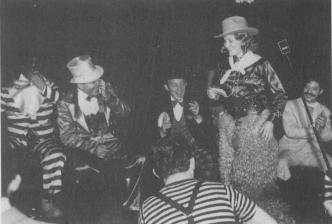
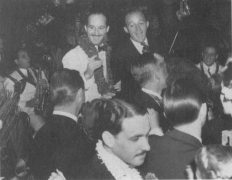
Bing takes the baton from bandleader and songwriter Harry Owens, after “Sweet Leilani” became the surprise hit of 1937 and helped turn Los Angeles into a Hawaiian theme park.
Len Weissman/Elsie Perry Collection
At which point the band struck up a loud and hasty introduction for her song.
Bing kept clear of the commercials, segueing with a line like “And here is Ken Carpenter to say a word on behalf of the management.” Then he sang his first song, backed by Dorsey’s “swanky swingsters.” No matter what the song, Bing sang with his accustomed rhythmic lilt when Jimmy or his sub, Joe Venuti, led the band. Then he would trade a few lines with Bob Burns, whom Bing usually called by his given name, Robin. Burns would do seven or eight minutes about his relatives — the drunk uncle, the shrewish sister-in-law — and close with a bazooka solo. Frequently the patter with Burns or another guest would produce an uncommon word, like bauxite, that recurred as a comic motif throughout the show. One Crosby segment created a tradition, imitated on radio and TV: he would offer a few clues to a bygone day and give the audience the space of a station break to guess the correct year. Then he sang a representative song. On this show the year was 1928, and the song “June Night.”
Time now for the second guest, George Raft, who spoke of his big break in Scarface, plugged the picture he was currently filming, and talked baseball — all very informal, very scripted, with a few inside curves:
Raft: Who’s taking care of the store now?
Bing: You mean the studio? Paramount?
Raft: Yes. Any changes made since I’ve been away?
Bing: Oh, A. Zukor’s back in charge.
Raft: You mean that racehorse, Azucar?
Bing: No, no — Adolph Zukor, the little giant. He’s running things now.
Raft: Oh, I see. Say, what’s this gag about bauxite? All I’ve heard since I’ve been here this evening is bauxite. What is the stuff?
Bing: I’ll tell you, George. I’m going on location Saturday and you’re going tonight. When I come back and you come back, there may be some report from the research committee. I’ll tell you then.
Then Bing sang, sometimes a medley and sometimes one of his current records, but often not. The few surviving recordings of the 1930s Kraft shows are treasured not least because he never formally recorded more than half the songs featured on the air, including dozens of good ones, like Berlin’s “I’m Putting All My Eggs in One Basket” and Ellington’s “I Let a Song Go Out of My Heart.”
Next came the longhair spot. Bing introduced Seidel with straightforward biographical remarks, noting his Oslo debut, his first American visit, and his 1,100 recitals, winding up with a peculiarly Crosbyan verbal turn, starting high and landing low: “Mr. Seidel favors us this evening with the scherzando movement from Lalo’s violin concerto Symphonie Espagnole, and when you hear Mr. Seidel play it, if you don’t think it’s swell music, then you can’t pick tunes for me.” After the number, they talked a minute. Seidel was eager to get back East for the fights:
Seidel: But before I leave for New York, I’d like to know what bauxite is.
Bing: I’d be glad to tell you, but later. I don’t want Burns to hear.
Seidel: Well, I’ll wait around then.
Bing: And while he’s waiting around, ladies and gentlemen, Toscha Seidel plays as an encore a composition by one of his colleagues, Fritz Kreisler’s very lovely “Schôn Rosmarin.”
That number was followed by a combo from the Dorsey outfit playing an original jazz riff, “Coolin’ Off.” The show was winding down. After the third and final commercial, Burns explained to Bing that bauxite is “a ferruginous aluminum hydroxide,” spelling the chemical equation. Bing, in what was often the hour’s high point, settled into a ballad — tonight, “The Touch of Your Lips.” He then named the guests for the next week’s show as “Where the Blue of the Night” swelled behind him.
The show’s most caustic critic was invariably the director. Kuhl described the May 7 program as “O.K.,” before laying on his comments. Bing was on top of the mike again: “An elephant never forgets and a Crosby never remembers,” he wrote in his report. The show suffered from “spring fever” and lacked “the usual pep, pace, and vivacity.” Merkel was good, but she “should learn to play comedy.” Raft had no material. Kuhl worried that Bing came across as “disrespectful of Seidel, a la Jolson” and thought he had trouble with the key on one number. He considered only Burns to be “very good.” Even a cheese promo left a bad taste: “Kraft couples carry on the silliest conversations.” 33 Kuhl’s reservations were shared by few listeners.
* * *
Friends noticed that real Bing and radio Bing were sounding more and more alike, the former catching up with the latter. It was as if the object of Carroll’s study had been liberated by the resulting caricature. Predilections stressed in his scripts were embraced by Bing, and he became indistinguishable from Carroll’s takeoff. Put another way, Bing got a better sense of who he was from the role he played. In publicist Gary Stevens’s analysis, “Carroll gave Bing the suavity, savoir-faire, the throwaway personality that Bing never had, and Bing lived that part for the rest of his life.” 34 To Eddie Bracken, “Carroll’s wonderful fey way of writing just fit Bing beautifully and literally made Bing a better actor. Carroll gave him a type of characterization different than anything else on radio and also different for Bing.” 35 To Bing, Carroll’s influence was comparable to that of Jack Kapp: “He’d send a script around to my home and I’d try to rewrite the speeches he’d written for me so as to make them sound even more like me. And I’d try to put in little jokes if I could think of any. Most of them were clumsy and pointless, but once in a while I hit something mildly amusing and Carroll wouldn’t delete it if he thought it had a chance of getting a laugh. The way we worked together resulted in the next best thing to ad-libbing.” 36
But the next best thing was not good enough. To keep things lively, Carroll encouraged Bing to ad-lib a little, even if just an impromptu laugh — an infectious burbling that audiences loved. Observing how verbally dexterous Bing could be with his friends, Carroll was confident of Bing’s ability to stand his ground and quip with the best. At first, with Kuhl’s support, Carroll encouraged safe ad-libbing, the kind that takes place in rehearsal; if Bing (or a guest) came up with a zinger, it was written into the script. Carroll soon devised the subterfuge of handing Bing a slightly different script than that of his guests. The first time he tried it, he simply had a guest inquire about Bing’s latest golf score. The studio went dead for a moment as Bing paled before finally responding, “Why, about eighty-two.” When the guest asked another surprise question, Bing said, “Let’s get back to the script here.” 37 He had a fit when the show ended, threatening to quit when Kuhl told him to expect more of the same. He got used to it, however; his nervousness abated, and he began to sound more like himself. When Mischa Levitski made his third KMH appearance, the repartee began with Levitski remarking that he played better in the Music Hall than anywhere else because he could dress informally.
Bing: I’m delighted to hear it, and may I say that all day long I’ve been admiring your splendid red suspenders.
Mischa: A great many pianists wear suspenders exactly like these.
Bing: Any reason?
Mischa: Yes. To hold up their pants. 38
The joke was older than vaudeville, a cousin to minstrelsy’s road-crossing chicken, yet it generated an enormous response, in part because Levitski was delivering it, but chiefly because Bing did not see it coming and cracked up. His script read, “Because the flannel is soft and doesn’t cut into the shoulders the way elastic suspenders do.” Radio laughter galvanized audiences with its titillating suggestion of an indiscretion, especially Bing’s, for he was almost always unflappable.
Kuhl marveled at Bing’s ability to pilot the show no matter what the obstacles, sometimes sacrificing his own numbers. “Drastic cutting, late in the game, hurt show,” Kuhl noted of one program, “but not as much as if Bing with typical, Quixotic gallantry, hadn’t insisted Avalon Boys do two numbers at expense of his own medley, which we cut.” 39 When Bette Davis’s segment was shortened for time, Kuhl wrote, “an ad-lib of Bing’s” (unpreserved) saved John Reber “the price of orchids.” 40 At times, Bing’s ad-libbing proved “the only way out when the free speech of the show gets beyond control — and it’s the free speech that makes the show.” 41
After KMH had been rolling for a few months, the New York Post radio columnist observed that what began as “a slightly casual touch” quickly “crystallized into an attitude of catch-as-catch-can good humor,” adding that no other show could so ingratiatingly offer artists of the caliber of Harold Bauer and Lotte Lehmann: “Mr. Crosby presents them not as something that the audience ought to like but as something that the audience will like.” 42 Bing’s presumption flattered his listeners. Their presumption that he was one of them, despite his much publicized prosperity in times of economic woe, flattered Bing. Movie-star wealth was an ancient story by the mid-1930s — the fantastic estates and servants and blocklong cars, the yachts and exotic playgrounds. But on Bing, who so obviously enjoyed his good fortune, it looked good, providing vicarious pleasure for his fans, as well as a measure of proof that the system — America itself — was not in irreversible decline.
* * *
The KMH Bing was almost instantly reflected on the silver screen. Paramount bought a Damon Runyon story, “Money from Home,” that Ernst Lubitsch wanted to direct him in; the idea, in part, was to show off Bing’s riding abilities. The story was rejected, however, in favor of Rhythm on the Range, a contemporary western designed to capitalize on Bing’s success with cowboy songs. The plot, a wire hanger on which to drape the music and comedy, recycled one of the Depression’s favorite fairy tales, apotheosized in Frank Capra’s It Happened One Night: a wealthy and beautiful heiress runs out on her effete fiancé and finds happiness with a penniless, average Joe — average like Clark Gable or Bing Crosby. Bing himself had snared an heiress in We’re Not Dressing, and he would get two more in Double or Nothing and Doctor Rhythm. In the early drafts, the heiress was a mere showgirl fleeing the bright lights, and Jack Oakie and singer Frances Langford were set to costar. Those plans were scuttled with many others. Paramount kept Bing on salary for three months before a story was finally approved.
After producer Benjamin Glazer hired director Norman Taurog, and a roomful of writers cobbled together the script, production was delayed by the search for a leading lady. The contenders included Jean Arthur and Olivia de Havilland, but the choice narrowed to two talented but little-known Paramount starlets: sweet-faced nineteen year-old former model Marsha Hunt and stunning twenty-two-year-old University of Washington graduate Frances Farmer. “I lost out, and it broke my heart,” Hunt recalled. “For once, instead of just being a pretty young thing, like most leading-lady roles, here was something where Bing sang to you. He would win her, lose her, and win her back, and then fade out. Frances, who was not a comedienne, got the role, and it broke my heart.” 43 Hunt’s booby prize was a publicity stunt: she escorted two frogs representing Bing and Burns to the annual jumping frog contest at Angel’s Camp, a ghost town in northern California. Neither frog won.
By the time the film began to shoot, in late April, KMH had been on the air for three months, and Burns was tapped to reprise his role of Bing’s pal on the big screen. He had already played small roles in a few Saturday-matinee westerns, but Rhythm on the Range established him as a briefly dependable if minor movie star in his own right. Playing opposite Burns was another newcomer, a veteran vaudevillian of nineteen, who some thought walked away with the picture. Martha Raye was an original, and if her knockabout antics quickly dated, they overwhelmed audiences in the 1930s. Sharing a stage with her parents since the age of three, Maggie, as she was known to friends, climbed the lower rungs of show business, desperate to make herself known and liked. She perfected an aggressive and lusty attack, shorn of vanity. She was also a stunning singer, and her powerful rhythmic sense and brassy projection might have earned her a reputation as a Swing Era warbler. Yet she trusted only her comedie ability, a talent recognized by Charlie Chaplin, who cast her as his unsinkable victim in the 1947 Monsieur Verdoux and allowed her to steal their every scene. Maggie’s wacky humor was bolstered by a rubbery face centered on a square maw of a mouth and a curvaceous figure that gave a shivery edge to her manhungry bellow, “Ooooh boy!”
While singing at a club outside Los Angeles, she signed up for a Sunday-night turn at the more glamorous Trocadero, where performers on the make entertained performers who could afford places like the Trocadero. In the audience were Jimmy Durante and Joe E. Lewis, who assisted her with friendly heckling, and an astonished Norman Taurog, who offered her a screen test. At Benjamin Glazer’s request, Sam Coslow went down to the joint where she was working and volunteered to write a specialty number for her test. The result, “Mister Toscanini,” was perfect — part fake ballad and part raucous swinger. The test delighted Glazer and Taurog, who resolved to add the song as well as Maggie to the picture. In order to avoid offending a living maestro, however, a change in title was mandated. Reborn as “Mr. Paganini,” it became her trademark number. Coslow recalled that at a sneak preview of the picture, Raye’s delivery of the song literally stopped the show — the audience cheered until the projectionist reran the scene.
That response was appropriate enough for a movie that was, in effect, filmed radio — specifically, filmed Kraft Music Hall. It is not a succession of radio numbers strewn around a plot, like The Big Broadcast, but rather a variety show in which plot is routinely interrupted to accommodate specialty numbers. The action revolves around Bing, but his character has little history or depth beyond his on-air personality. In this kind of picture, it does not matter whether he is decked out in a Stetson or a yachting cap; he is basically the same guy — winning, then losing, then winning the girl while singing like nobody’s business. Ever the cordial host, he took it upon himself to soothe the nerves of movie newcomers Raye and Frances Farmer, calming them down and boosting their confidence.
It’s a shame Rhythm on the Range didn’t have a script worthy of the potential chemistry between Bing and Farmer, whose brief, stormy career virtually began here. (Howard Hawks saw the rushes and chose her for Come and Get It, her best film; the next year she joined New York’s Group Theater to star in Clifford Odets’s Golden Boy.) An opalescent blond beauty, she was obliged to dye her hair bright red, as was Raye, the better to accommodate Karl Struss’s cinematography. Farmer was slim, secure, and observant, an expert listener with the manner of a patrician coed, cocking her head and looking at her costar with bemused innocence. She described the filming as “a long sweet nightmare,” 44 claiming that she never really knew what the film was about. But as the only cast member who wasn’t called upon to be musical or funny, she brought depth to a shallow role. The fetching contrast between Crosby’s chaste shyness and her glimmering frankness defined a new motif in Bing’s movies: the KMH-era Bing, unlike the Sennett Bing, is always pursued, never in pursuit. Bing and Dixie invited Frances and her husband, actor Leif Erickson, to Rancho Santa Fe. Bing was enchanted by her. After the wrap he gave her a diamond necklace she treasured all her life.
Bing enjoyed making Rhythm on the Range and more than a decade later said the part of Jeff Larabee, the singing cattleman turned rodeo performer, was his favorite. Much of the filming was done on location in the High Sierras, where, as he wrote, “every prospect pleases and only work is vile.” 45 He took full advantage of the opportunities to fish and ride and claimed that the experience of working on the picture inspired him to purchase, in 1943, his own working ranch in Elko, Nevada. Bing avowed that he wore no makeup beyond a suntan and dropped twelve pounds before shooting commenced, though he looks chunky in his flannel shirts and jeans. His most exhaustive preparation entailed two weeks’ perfecting a technique for hand rolling cigarettes. In the film he hands the results to Frances; Mother Crosby’s boy refrained from puffing onscreen.
With its quartet of stars and an octet of contributing songwriters, the picture is so free with in-jokes and non sequiturs that it doesn’t even bother to deliver on the promised confrontation with the bad guys who vainly contrive to kidnap the heiress. Bing’s Jeff Larabee was named after an offscreen character in Two for Tonight. His boss, the mannish Aunt Penny (Lucille Webster Gleason), suggests, as she stomps around Madison Square Garden, Bing’s ancestor Cornelia Thurza Crosby, the trout expert who scandalized that very venue by wearing a green skirt seven inches above the floor. Since Martha Raye was known for a drunk routine, one was pointlessly thrown in, allowing her to murder “Love in Bloom.” Bing, who routinely used his movies to employ friends, found a slot for Louis Prima, whose jazz was pulling them in at the Famous Door, and Bob Nolan’s Sons of the Pioneers, including Leonard Slye, who later changed his name to Roy Rogers. His most important hand up was to a new acquaintance who had been working New York and Hollywood for years with infrequent success, Johnny Mercer.
Born in Savannah in 1909, Mercer got his break as Bing had, with Whiteman. Although he sang with southern-fried gusto and occasionally played juveniles (Leo McCarey thought he had potential as a film actor), Mercer was first and last a lyricist of genius, known for his peerless ear for the vernacular. Except for two or three revues, however, he enjoyed little attention on Broadway, and in two years out West he placed songs in only three pictures, notably To Beat the Band (“If You Were Mine”). But none were hits, and offers were drying up. While driving home to Savannah through Texas, he came up with an idea — words and music — for a song about ersatz westerners. He showed “I’m an Old Cowhand” to Bing, who put it in the film and later made a jolly and tremedously popular record with Jimmy Dorsey. “I really think he saved my Hollywood career,” Mercer said. 46
It marked the beginning of a long personal and professional relationship. “It was my good fortune to know him when he was married to Dixie and his boys were small,” Mercer wrote a friend long afterward. “They often rode on my back and I enjoyed the happy days around the track and poolside with this most attractive couple. She was very kind to me, as I was in such awe of him and she knew it. Also, I was a Southerner, and she made me feel at home. I shall never forget their kindness to a very young writer and performer.” 47 The film rendition of Mercer’s song lacks the swinging élan of the record, but it’s the picture’s hot spot, a jam session in which Bing, Raye, Burns, Prima, and the Sons of the Pioneers trade choruses, each leading to a satirical break, for example:
I know all the songs that the cowboys know,
’Bout the big corral where the doagies go,
’Cause I learned them all on the radio.
Yippy I O Ki Ay.
Bing displays many facets of his vocal and comedie charms. When he sings “Empty Saddles” mounted on a horse in Madison Square Garden, his pianissimo head tones are uniquely affecting, a style derived from John McCormack and beyond the ken of most popular singers; Sinatra, for example, never attempted it, though Presley did. Bing’s love of silent comedians comes through when least expected; while serenading Farmer in a boxcar headed west (and hanging a modesty curtain in the process), he does a funny Stan Laurel nod. When they finally reach the ranch and embark on “I’m an Old Cowhand,” he demonstrates all his patented vaudeville shtick — jerky short-arm movements, tap dancing, torso wiggling — and, backed by guitar only, swings the tail of his solo chorus.
Rhythm on the Range easily returned its million-dollar investment as one of the top-grossing pictures of the year, number one on Para-mount’s roster. It was, as usual, a smash in towns and cities all over the country, breaking several house records, including one in Tucumcari, New Mexico, where the marquee promised, “Bessie Patterson in Rhythm on the Range.” Bessie, whose walk-on was so fast that even her mother had to forbear blinking to see it, was the girl who had won the Miss College Humor contest in 1933, for which she was promised a bit part. Now that she was eighteen, Paramount gave it to her, quietly. She was not necessary for the publicity campaign, which began with Bing, in cowboy regalia, whistling a few measures of “Where the Blue of the Night” while preserving his hands and feet in cement at Grauman’s Chinese Theatre. Kraft delivery trucks were billboarded with the film for weeks. A thousand Kraft dealers in New York alone were provided window displays. Jukeboxes were prepped with Crosby records. The reviewers went along, although Variety was at a loss for a pigeonhole: not really a western, it advised, not really a musical — the cowboy stuff takes place in New York, the jazzy stuff takes place at the ranch, and most of it takes place on the road. Nevertheless, the paper concluded, Crosby “will satisfy most everybody.” 48
* * *
Bing had planned to spend the summer — the racing season — in New York with Dixie and made plans to travel there with Everett and his wife. But with KMH finding its footing, John Reber persuaded him to postpone the ten-week vacation stipulated in his contract until September, to continue broadcasting. Bing probably didn’t need a lot of persuading. On June 1 the Crosbys took possession of their new home at 10500 Camarillo Street. 49 The custom-tailored southern colonial could accommodate three boys and more, should any arrive, as well as servants. It was a picture-postcard house, and the Crosbys loved it. Bing’s dad regarded it with awe as a “mansion or palace.” “It sure is some place,” he remarked. 50
A driveway curved through a ranging front lawn and up to the front door, while out back nearly half a block of trees made way for a tennis court, pool, bathhouse, and chicken coop. The roof, flat but for two modest gables, shaded a porch the length of the house with the help of six slim pillars. Inside, the spacious and pillared foyer faced a magnificent winding staircase that led to the bedrooms on a balconied second floor. Downstairs were Bing’s den and bar, a playroom, and the living room — with fireplace and imposing chandelier — where Christmas and other parties were held. The design and furnishings mixed Georgian, Regency, Chippendale, Dresden, Victorian, and more; the walls were a panorama of linen, damask, and mirrors, the colors dark oak and a sedate blue-gray. The twenty rooms were, on balance, snug and lived-in. An official of the American Institute of Decorators remarked that no more than two rooms, the living room and dining room, could be described as formal. 51 The new house motivated Bing to renegotiate contracts; his price soared to $150,000 per picture, $3,500 per broadcast.
He decided to maximize his summer schedule by shooting the independent film he had wrangled from Paramount. Although the studio had fired Manny Cohen, he continued to hold contracts with Bing (and Mae West and Gary Cooper). If Paramount expected distribution rights, it was badly mistaken. Cohen formed Major Pictures Corporation with Bing, Everett, and John O’Melveny and sought bids for distribution of its first project, which as yet had neither story nor score, only Bing. Columbia’s Harry Cohn won, and an agreement was drawn up. They would film a musical in which Columbia, Bing Crosby, Inc., and Cohen each owned a third. Paramount claimed not to care, shrugging off the deal as no different than a loan-out, which was true to a degree, except that loaning Bing was tantamount to making a cash donation to a rival studio, and an independent production relieved the recipient of any obligation to return the favor.
They decided to move ahead with a story called The Peacock’s Feather, by Katherine Leslie Moore, as elaborated by screenwriter Jo Swerling (The Whole Town’s Talking, It’s a Wonderful Life) and retitled Pennies from Heaven. Within weeks of wrapping Rhythm on the Range, Bing was on a soundstage again, this time as an ex-con who dreams of singing and playing lute on a gondola in Venice. Pennies from Heaven was neither the best nor the most successful picture Bing made, but it was surely the most emblematic of those that preceded the Road series and Going My Way,presenting him literally in the role with which many people already associated him, that of an American troubadour. The film’s immense impact on his career was manifest in its recruitment of Johnny Burke and John Scott Trotter, who became, respectively, his principal songwriter and musical director.
And, as it was Bing’s project, he had the clout to repay an old debt. He wanted Louis Armstrong in the film. Cohen balked, seeing no reason to entail the expense of flying him in and having no desire to negotiate with Armstrong’s crude, mob-linked but devoted manager, Joe Glaser. Bing refused to discuss the matter. The Reverend Satchel-mouth was about to make his Hollywood debut. What’s more, though his part was small (one musical number, two comic exchanges), Louis would be top-billed as part of a quartet of stars. 52 No black performer had ever been billed as a lead in a white picture. The combination of Louis’s delightful performance and billing that presumed his magnitude as an artist greatly enhanced his career. Louis had previously appeared in two shorts and a (long-lost) independent feature; after Pennies from Heaven he became a Hollywood regular, instantly signed by Paramount for Martha Raye and Mae West vehicles and subsequently asked to provide cameos in pictures made for Warners, MGM, Columbia, Goldwyn, and others.
Sadly, Bing and Louis do not get to perform a vocal duet, though it would have been easy to schedule one in the nightclub scene that features Armstrong’s band. Evidently, this was a bow to the color line, which was harder to breach in movies than on radio or records. The two do share a vaudeville sketch, however, in which Louis shows off his distinct yet never fully exercised acting skills for the first time. Their camaraderie is unmistakable. Bing, as usual, is the straight man and Louis the clown — a chicken-stealing, mathematically challenged yard worker who is also, conveniently, a genius entertainer. Variety found Armstrong the picture’s strongest asset, not only “as an eccentric musician but as a Negro comedian.” 53 Armstrong himself enthusiastically recounted his role thirty years later:
Those scenes I had with Bing in that picture were Classics. Especially the scene where he wanted to open this Big Time Haunted House Night Club. But he didn’t have enough loot to open this joint. And he liked our little seven piece band. So… He said Henry (that was my name in the film), I would like to hire your band and I will give you and your boys ‘TEN’ percent of the business, so you go and talk it over with your Musicians. Come back tomorrow and let me know as to what conclusion your boys came to. The next day I was right on time. And — Mr Poole (Bing’s name) met me halfway in the back yard, saying Henry, have your boys decided yet? And I said, Mr Poole, I talked it over with my boys and told them you are willing to give them ten percent of the business. And my boys said that they cannot figure out ten percent as we’re only seven men. So if you will be so kind as to give us seven percent, We’ll — Just then Mr Poole said, OK Henry, it’s a deal. And I smiled as I walked away saying Mr Poole, thank you very much. — I told those guys that you would do the right thing. — ‘GASSUH’ personified.
Oh, I could run my mouth about my Man Crosby — those Broadcasts moments, and Stuff — why you’d be reading for years. But I must say this. Here’s paying tribute to one of the finest Guys in this musical and wonderful world. With a heart as big. (As the world) Carry on Papa Bing, 01 Boy!! You will still be giving young singers food for thoughts (Musically) for Generations to come. 54
Bing’s other costars were less enchanting: Madge Evans, an attractive but wooden former child star who left Hollywood two years later, and Edith Fellows, a talented scampy thirteen-year-old who soon suffered her own problems making the transition to grown-up roles. As Patsy, the beleaguered orphan whom Bing befriends, Fellows was the first of several screen children he aided over the years. In his movie roles Bing more often rescued lost children than bore his own. He seemed genuinely fond of Fellows. Nanette Fabray, a child performer herself and Fellows’s roomate, recalled Bing’s visiting her when she was in bed with the flu and later arranging a fancy dinner for both girls.
The cursory plot has Bing feuding with Madge Evans for eight reels and marrying her in the ninth. Yet the picture opens with a startling scene: Bing behind bars on a smuggling charge, absurdly awaiting his impending release in the same cell block as a killer on his way to the electric chair. In a strangely upbeat mood, the killer asks Bing to deliver a letter to the family of his victim (Patsy and her grandfather, played by Donald Meek), leaving them an old abandoned house in New Jersey.
Pennies from Heaven, despite its fantastical script, is one of the few Depression musicals to acknowledge the Depression, albeit without actually using the D-word. In the pre-Code years Busby Berkeley invoked hard times and suicidal bitterness in his Warners musicals, but by 1935 Fred and Ginger and Eleanor Powell and even Berkeley himself were setting their work in the rarefied chambers of penthouse ballrooms and battleships. Pennies from Heaven, probably the only Hollywood musical set in a part of New Jersey other than Atlantic City, presents a vision of contented socialism in which everyone is pleasant except people with jobs: the latter are carnival tricksters, social workers, municipal officials, and landlords. The only direct political shot is taken at the Townsend Plan, a shady pyramid-pension scheme conceived by a retired doctor in California, subscribed to by millions in the period before Social Security. Larry Poole’s view of privation is the familiar refrain of live and let live, formulated as only a Crosby character can: “I’m the last of the troubadours,” he says, “the friend of man. I envy nobody and I’m sure nobody envies me.”
Bing is most effective in early scenes. He kept his weight down this time, and he looks seasoned and even slightly angular. While singing for coins, he encounters Patsy at a fair and performs “So Do I” in an effectively sentimental episode, the song reinforced by plush strings and woodwinds, his audience a montage of working-class neighbors, the treacle cut by close-ups of Bing. His line readings are sharp, and his composure and canny physical movements contribute to the impression that he has the makings of a deeper actor than previously suspected. The KMH spirit is asserted in an improvised group-sing (“Old MacDonald”) and in his dialogue with Armstrong and others. He mines laughs from lines that do not necessarily contain them.
The film is pushed amiably forward by director Norman Z. McLeod, an underrated comedy specialist, who presided when the Marx Brothers, W. C. Fields, Danny Kaye, and Bob Hope did some of their finest movie work; he later directed Bing and Bob in Road to Rio. But Pennies from Heavenderives its staying power largely from a remarkable score. Composer Arthur Johnston had, with Sam Coslow, written one of Bing’s breakthrough songs, “Just One More Chance,” along with the scores for College Humor and Too Much Harmony. He now surpassed himself in the company of a lyricist ten years his junior, Johnny Burke, who, like Carmichael and Mercer, achieved his place in Hollywood through Bing.
“One of the best things that’s happened to me is a one hundred and forty-five pound Irish leprechaun named Johnny Burke,” Bing wrote. 55 Born in northern California in 1908 and educated at the University of Wisconsin, Burke was a small, round-faced, hammy wag who endeared himself to Bing instantly. He had been knocking around music publishing houses for years, writing songs, mostly novelties, with Harold Spina. “Annie Doesn’t Live Here Anymore” was their one substantial hit, thanks to Fred Waring and Guy Lombardo, though Fats Waller and the Dorseys had fun with their “My Very Good Friend, the Milkman.” Burke did anonymous work-for-hire at Fox but never managed to get a song into the movies, so Bing was taking a chance on him for his first independent production. He was to become one of Bing’s closest friends, until his drinking put a wedge in their relationship. For seventeen years Burke, whom Bing called the Poet, was his personal songwriter, the man behind a string of evergreens introduced by Bing through movies or records or both, among them “This Is My Night to Dream,” “I’ve Got a Pocketful of Dreams,” “Moonlight Becomes You,” “An Apple for the Teacher,” “What’s New?,” “Swinging on a Star,” “Sunday, Monday or Always,” “But Beautiful,” “Like Someone in Love,” and “It Could Happen to You.” In all, he wrote twenty-three film scores for Bing, more than 120 expressly tailored songs.
Johnny got off to a rousing start with Pennies from Heaven, especially the title song, for which he wrote a singular, much imitated and parodied verse:
A long time ago, a million years B.C.
The best things in life were absolutely free.
But no one appreciated a sky that was always blue;
And no one congratulated a sun that was always new.
So it was planned that they would vanish now and then
And you must pay before you get them back again;
That’s what storms were made for
And you shouldn’t be afraid for…
And into the famous chorus, a winning variation on the Depression tenet that life is as often as not a bowl of cherries. The song was so cogent, Bing and McLeod elected to shoot it live, with the orchestra on the soundstage, forgoing the economy-minded practice of prerecording. The even-keel swing of Johnston’s abac melody, with its recurring rhythmic motif of four quarter notes (“Ev-ry-time-it rains it rains pen-nies-from-heav en”) and an expansive double-triplet measure toward the close, make it memorably accessible and helped ensure its acceptance.
The whole score was popular and widely covered: Count Basie swung “Pennies from Heaven,” and Billie Holiday and Artie Shaw each recorded three selections. Of the score’s five songs, four yielded Decca hits for Bing (“Pennies from Heaven,” “Let’s Call a Heart a Heart,” “So Do I,” and the charged “One, Two, Button Your Shoe,” with a counting game setting off the stanzas) and one for Armstrong, the exhilarating “Skeleton in the Closet.” That tune — performed by a masked studio group with drummer Lionel Hampton in the film but recorded with Jimmy Dorsey’s band — was singled out by many critics as the film’s pinnacle.
Bing’s “Pennies from Heaven” dominated sales of records and sheet music for more than three months. His record established a “new high in gross sales all over the country,” according to Down Beat, which credited Bing’s continuing popularity to his ability to “sing a sweet ballad with the same finesse he displays in warbling a ‘get-off’ tune.” 56 Kapp was so certain of the record’s success that before releasing it, he recorded a second version, with Bing, Louis, and Frances Langford. The song was nominated for an Academy Award (it lost, reasonably enough, to the Jerome Kern and Dorothy Fields ballad “The Way You Look Tonight”). In England it was said to be the most recorded movie melody since the start of talking pictures.
* * *
Writing songs is one thing, orchestrating them another. Because Pennies from Heaven was independent, the production did not have access to the Paramount music department. Columbia was not known for musicals, and Arthur Johnston was not sufficiently trained to arrange his melodies for a score. Burke suggested to Bing that he farm out the assignment to his friend, John Scott Trotter. 57 Knowing of Trotter’s long association with the Hal Kemp band and admiring his arrangements for the band’s singer, Skinnay Ennis (“Got a Date with an Angel”), Bing readily agreed. Trotter had been with Kemp from the beginning, when they organized a student band at the University of North Carolina that declined to play stock arrangements and, as a result, developed an original style. Kemp led a sweet band that occasionally played hot jazz; Bunny Berigan was the main soloist, and Trotter the pianist and chief arranger. He had met Bing once in 1930, on a night when Kemp was rehearsing late, long after the ballrooms had closed. Bing and Hoagy Carmichael walked in, the latter so excited about a new song he had written that, with Bing cheering him on, he took a running dive and slid the length of the dance floor on his belly, holding aloft the new manuscript: “Star Dust.”
After Trotter left Kemp in 1936, he visited the West Coast for the first time, as a tourist. He had taken an apartment for a few months when Burke arrived with his wife to work on the film. Like Burke, he was twenty-eight, and for a while all three lived together. When Burke told him about the picture, Trotter protested that he was on vacation and turned it down — until he saw the songs. He arranged all but the Armstrong number. On the day the recording of the score was completed, Trotter packed his car and headed for New York, where a job awaited him with ARC, supervising recordings by the Andrews Sisters, Duke Ellington, Raymond Scott, and others, including a few historic sessions by Billie Holiday and Teddy Wilson. (John Hammond, the initiator of the Holiday series, dismissed Trotter as an intrusive executive, but the presence of Bunny Berigan and Pennies from Heaven songs would seem to support Trotter’s claim to having produced those sides.) In June 1937 he received a wire from Larry Crosby: CAN YOU BE HERE 2IST. DORSEY LEAVING. YOURE TO TAKE OVER MUSIC ON KRAFT SHOW.
The Swing Era was in full flower, and Jimmy Dorsey felt he was missing out. Tommy and many musicians he came up with were now leading popular bands, and their record sales not only were unprecedented for jazz but were stimulating the whole recording industry. And here was Jimmy, nationally prominent because of his role on KMH yet reined in by it all the same. He was encouraged to leave by Kapp, for whom he had already scored one hit, and his agent, Cork O’Keefe. With Fud Livingston writing his arrangements (“Too hot for you, Uncle Fud?” Bing ad-libs on their tub-thumping version of “I’m an Old Cowhand”) and an appealing Crosby-style baritone in Bob Eberle (who attended each KMH broadcast as a band member but never sang on the show), Jimmy was ready for the road. Carroll Carroll later implied that had Jimmy not quit, he would have been removed by Kraft in favor of a more versatile musical director. In any event, Jimmy left after the July 1 broadcast and prospered with the Swing Era.
Trotter could hardly have been more different. Of his July 8 debut, Cal Kuhl’s only comment was that the featured instrumental was “not effective.” 58 But that was Bing’s final show of the season. When he returned in October, Bing and John Scott became working chums. Writing for Hal Kemp, Trotter had developed a vibratoless staccato style that he characterized as a refined Schottische rhythm; Johnny Mercer, a fan, more colorfully described it as a “typewriter” attack, clipped and orderly. 59 Trotter had also become accustomed to doubling the melody for singers who needed all the help they could get, while Bing preferred an arranger who let the singer alone. He surprised Trotter by emphasizing that opera orchestrations do not double the singer’s line and asked him to write “just that way.” 60 Bing chose the songs he sang on the air, in contradistinction to those he waxed for Jack Kapp. After each show, Trotter recalled, “Bing would go into the booth and select his numbers for the following week.” 61 He listed them on the left-hand page of a loose-leaf binder; a secretary typed them on the right-hand page. Trotter took the selections and went to work arranging them, his job for the next seventeen years.
He was a huge but nimble and amiable man, as obsessed with cooking and antiques as he was with music. Though immensely well liked, Trotter was something of a loner, traveling the country to sample fabled restaurants or to London to visit Georg Solti, his lifelong friend. His solitary, self-sufficient manner appealed to Bing. John Scott, a popular weekend and dinner guest, maintained a friendship with the Crosbys long past the KMH and Decca years, encouraged by Bing’s second wife, Kathryn. Trotter never married, never lived with a lover; if he was gay, no one knew for certain. Alan Fisher, the Crosby butler during his second marriage, said, “He was totally asexual. Wasn’t interested in women, wasn’t interested in men, wasn’t a closet anything. He was very close to the first Mrs. Crosby and, if anything, closer to the second Mrs. Crosby, who adored him. He formally helped decorate their homes. Extremely good taste, beautifully mannered, witty and funny, the children loved him. John Scott Trotter coming to stay was always a joy. Bing Crosby loved him, I’d have to say that. And if he was going to confide in anyone, I’d almost say it would have been him. They always sat in the library to talk.” 62
“He was fun,” Johnny Burke’s daughter, Rory, remembered. “He was at our pool all the time, a very large man in his swimming trunks, a little flamboyant with a big face, lots of curly brown hair, burly, strong, light on his feet — I can still see him jumping off the diving board.” 63 Stories of his devotion to food are legion. “When we had the private house he used to come often,” Frieda Kapp recalled. “A lovely fellow. Big. Once he came to the house after one of our holidays and we had a lot of gefilte fish left. And Jack says, ‘Give some of this gefilte fish to John.’ I said, Are you crazy? John, a southern gentile, what’s he going to do with it? He ate the entire platter.” 64 Carroll Carroll told of a weekend morning when John called Carroll’s wife to say he was making vichyssoise and wanted to bring them some. They arranged to have dinner that night, but John never showed. He apologized in the morning, explaining that the soup was so good that he ate it all himself, then went to sleep.
In selecting musicians for the band, a new experience for Trotter, he drew on Hollywood studio players and added a small string section (it grew over the years) to the conventional big-band instrumentation. To sustain the swing and spontaneity Bing demanded, he peppered the ensemble with jazz musicians, including two former Whiteman trumpeters, Andy Secrest, whose solos carried a hint of Beiderbecke’s bright lyricism, and (when he could get him) Manny Klein, whose lustier attack was in demand all over town. Trotter also recruited trombonist Abe Lincoln, who became a Dixieland regular; drummer Spike Jones, who achieved much fame as a musical parodist; and, most important, guitarist Perry Botkin, who had worked as a New York session man with Victor Young, Red Nichols, and Crosby himself, on the later Brunswicks. Like Trotter, Perry was a large man and a Crosby loyalist; he occupied Eddie Lang’s chair for the next two decades. He was also a studio politician, and Trotter appointed him contractor, in charge of hirings. As the band grew, with violas and cellos, Trotter took to farming out many if not most of the arrangements. Among the young writers he apprenticed were Nelson Riddle and Billy May.
“Really, I can think of so many times when he has rescued me from glaring gaffes and melodic clichés,” Bing wrote of Trotter, “when his choice of material, his arrangements, his use of voices and instruments meant the success of an album or a record.” He continued with the usual excessive modesty: “If I am able to distinguish the good from the bad, if I know anything about music at all, what little I know rubbed off Trotter onto me.” 65 What surely rubbed off on him was John Scott’s musical conservatism. For if he helped make KMH homier than ever, the cost was the accelerated weaning of Bing from jazz and his corresponding conversion to a more decorous and conventional style. Trotter was Bing’s man, not Decca’s, but as a versatile musician who preferred the middle of the road, he was a dream come true for Jack Kapp. Trotter conducted the majority of Bing’s records, but Jack knew better than to allow him full rein.
As the impoverished thirties caromed into the murderous forties, the middle of the road — alongside Bing — was for many the only place to be. Crosby embodied stability, his life an apparently open book, his voice a healing balm. “The other man puts a nickel in the phonograph,” John Steinbeck writes in The Grapes of Wrath, “watches the disk slip free and the turntable rise up under it. Bing Crosby’s voice — golden.” 66 Bing was everywhere. KMH filled out the world’s mental picture of the man it knew from records, pictures, and fan magazines. If those close to him found him remote, ultimately unknowable, those at a distance thought they knew him about as well as you could know a man. Everyone thought he could sum up the public and private Bing, including a calypso legend named Roaring Lion. In 1938, when Portuguese businessmen paid his way from Trinidad to New York to popularize the music of the islands, the Lion played for President Roosevelt and appeared on Rudy Vallées show. After Bing dropped by for one of his recording sessions, the Lion commemorated his idol with a song released by Decca in 1939. It was called, simply, “Bing Crosby.”
Of all the world’s famous singers
That I have ever seen
On the movie screen,
Of all the world’s famous singers
That I have ever seen
On the movie screen,
Lawrence Tibbett and Nelson Eddy,
Donald Novis and Morton Downey,
Kenny Baker and Rudy Vallée,
But the crooning prodigy is Bing Crosby.
Bing has a way of singing
With his very heart and soul,
Which captivates the world.
His millions of listeners never fail to rejoice
At his golden voice.
They love to hear his la-da-de-da [whistles]
So sweetly and with such harmony
Thrilling the world with his melody.
Mention must be made of Bing’s romantic life,
Centered on his wife.
As lovely as the soft sylphs of poetic dreams
Her smile is like the moonbeams.
A former star, we know she can sing.
But now her voice she has reserved
for her sons and Bing.
So, so happy must be Bing Crosby
That he married a beauty like Dixie Lee.
I wonder if you heard him singing that song
“May I (be the only one to say I)?”
And yet I’m wondering if you heard again,
“(Every time it rains, it rains) Pennies from Heaven”?
But “Love Thy Neighbor” was the most thrilling song,
And “Git Along, Little Dogies, Git Along.”
So sweetly and with such harmony
Thrilling the world with his melody.
Bing has a most interesting personality
Beloved universally.
He has two private horses, Double Trouble and Ligaroti,
Pipe smoking is his hobby.
He has a queer eccentricity —
Takes off his hat very infrequently.
So one and all, let’s unanimously
Shout three cheers for this golden voice prodigy. 67