
In a preface authors thank those who helped them. In the internet age he or she will certainly not know some of the most important of them: the anonymous librarians, archivists, scholars, researchers, and technicians who put precious resources on line, digitalize catalogues, contribute to online encyclopedia and great reference books such the Oxford Dictionary of National Biography or the Neue deutsche Biographie. How can I thank personally the archivists at the New York Times who provided online the report in its original typeface of the wedding in Vienna on 21 June, 1892 of Herbert Bismarck and Countess Marguerite Hoyos? No Bismarck biographer before me has enjoyed such a wealth of unexpected, unusual and fascinating new material. Whatever the weaknesses of this work, the author had access to more remote and essential material than any predecessor, no matter how diligent, could have exploited.
I know the names of others without whom I could not have written this biography. Tony Morris, publisher and friend, asked me to write a life of Bismarck, and Andrew Wheatcroft, publisher, historian, and friend, saved the project when the first publisher abandoned it. Through Andrew Wheatcroft I gained the help of the perfect literary agent, Andrew Kidd of Aitken Alexander, who guided it safely to Oxford University Press where Timothy Bent steered it through its rough early stage and encouraged me to cut it to a less unwieldy size. His skill and editorial expertise helped me polish and polish again the slimmed down manuscript.
My friend and colleague, Chris Clark, author of Iron Kingdom: The Rise and Downfall of Prussia, 1600–1947, read the first draft, all 800 pages, with a care and attention to errors and misinterpretations that only he could have given. Karina Urbach, author ofBismarck’s Favourite Englishman: Lord Odo Russell’s Mission to Berlin, gave me the benefit of her great knowledge of the period and of German society. Rabbi Herb Rosenblum of Philadelphia passed on to me the astonishing fact that in 1866 Bismarck had attended the dedication of the Oranienburg Street Synagogue in Berlin.
An author fortunate enough to be published by Oxford University Press gets two publishers for the price of one. Timothy Bent and his colleagues at 198 Madison Avenue welcomed me with every kind of assistance and support. Luciana O’Flaherty, Publisher, Trade Books, and her colleagues at Oxford University Press, Great Clarendon Street, Phil Henderson, Coleen Hatrick, and Matthew Cotton have been an author’s ‘dream team’. Deborah Protheroe found illustrations that I had missed and put up with my foibles about the pictures. Edwin Pritchard copy-edited the text with skill and tolerance of the author’s irregular habits. Claire Thompson, Senior Production Editor, guided me through the final stages of proof-reading and indexing. Joy Mellor proof-read the text.
Nothing in my long professional career has been as much fun as the composition of this work. I got to ‘know’ the most remarkable and complex political leader of the nineteenth century and had (and still have) the illusion that I understand him. I met and read the letters and diaries of the greatest figures in Prussian society. That ‘imagined society’ took me away from, and made me a nuisance to, my family, but all of them supported the enterprise in every way and gave me their love and good cheer, which kept my spirits up. Without my partner, Marion Kant, I could never have written the book and I have dedicated it to her.
Philadelphia, PA
October 2010
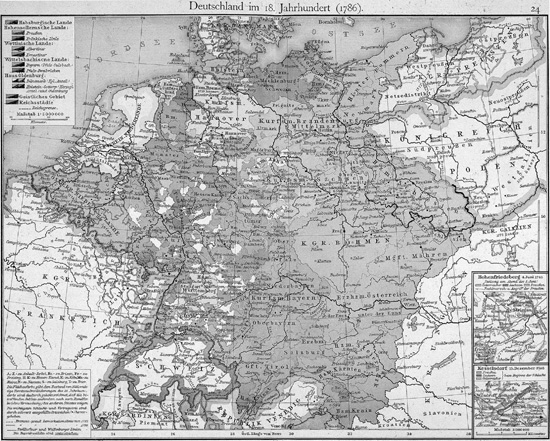
Map 1 Map of Germany showing the political boundaries in 1786.
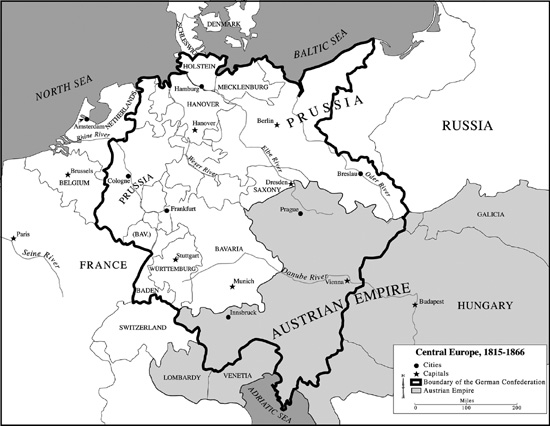
Map 2
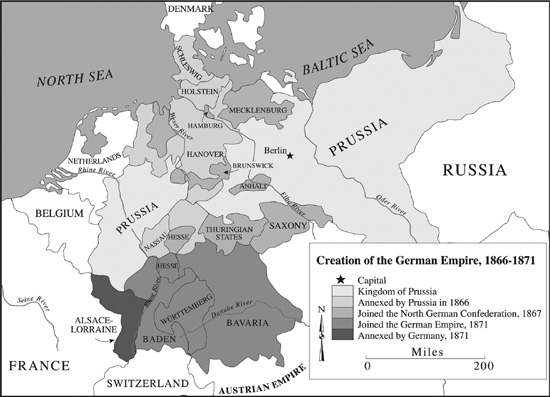
Map 3