
4
Bismarck entered politics through his position as a landlord and did so in company with his neighbours. On 19 December 1846 the Prussian Minister of Justice issued an order that reform proposals for the traditional patrimonial justice—the right of Junker landlords to have courts on their own estates in which they served as judge and jury—be submitted to him. As always when Bismarck saw his personal, patrimonial interests threatened, he went into action. He and his influential neighbour, Ernst von Bülow-Cummerow (1775–1851)1 submitted what came to be known as the Regenwald Reform Programme. The authors submitted the plan because they feared ‘that the King could find himself in the end moved to pay attention to the many sorts of attacks on patrimonial justice’. Their plan foresaw a district patrimonial court with a director and at least two lay judges. The judges would sit in the villages on a regular rota.2 Bismarck called assemblies of his fellow landowners in his own district on 7 January 1847 and spoke at the county diet on 3 March, the convention of the Magdeburg Knights’ Assembly on 20 March, and in between, on 8 March, as he reported three days later, he had had ‘a conversation of several hours with Ludwig von Gerlach, whose skills he found occasion to admire’.3 In the meantime the county diet had instructed him to prepare what we would now call a ‘position paper’ and authorized him to seek a meeting with the minister in Berlin to see how the government proposed to approach the issue. On 26 March 1847 Bismarck wrote to Ludwig von Gerlach and put forward his own plan, without von Bülow-Cummerow, for reform of patrimonial justice, which abolished individual estate courts and replaced them with local judicial districts where the landlords would elect a district judge in exactly the way local county assemblies elected their Landrat or county representative. Gerlach wrote shrewdly on the margin:
Something which in time becomes feasible through a process of reconciliation, can be left for the moment to one side. The majority of estate judges and the most influential defenders of patrimonial justice would see this proposal as abolition.4
Bismarck’s new political activity gave him tremendous pleasure. As he wrote to Johanna, he was ‘full of politics to the point of bubbling over’.5 He had found his purpose in life. Bismarck had become—and in that respect he always remained—a brilliant, persuasive and overwhelmingly convincing parliamentary politician. He had rushed around, talked to his constituents, got them to sign on to his suggestions, drafted resolutions, and eventually convinced them to adopt his radical reform proposals, which, as Gerlach noticed at once, amounted to ‘abolition’ of the traditional right to a patrimonial court. This was the first time Ludwig von Gerlach had to confront the force of nature he and his brother Leopold had unleashed but could not control.
When Bismarck wrote to Johanna on 8 May 1847 that he had been elected a deputy to the United Diet, he described it as if it had happened without his agency. The Magdeburg electors ‘quite unusually elected me to the first position though I am new in the county and was not even an alternate deputy’.6 The truth was, as we have seen, very different. He had run a campaign to get his reform proposals for local patrimonial courts accepted which had made him very well known indeed to the Magdeburg and other electors.
On 3 April 1847 King Frederick William IV invited the entire membership of the eight provincial parliaments in the Kingdom of Prussia to meet in a United Diet in Berlin. He took care to make this enterprise as medieval, feudal, romantic, and unlike the French National Assembly as possible, nothing to do with one man-one vote. Frederick William IV saw the ‘state as a work of art in the highest sense of the word. … he wanted to admit and incorporate into his cathedral those spiritual forces and persons who in any way recognized his kingdom.’7 Representation would be entirely in Stände or estates. The Lords would form the upper curia and knights, towns, and country communities the lower curia. He also took care, quite explicitly, not to recognize the promise made by his predecessor in 1815 that there would be a proper constitution for the Kingdom of Prussia and a parliamentary assembly, a promise which Frederick William III had evaded for twenty-five years. The new assembly would have no function save to approve new taxes.8 Although it had the trappings of feudalism, as Christopher Clark points out, the realities had changed from below. The provincial diets had been created in 1823:
Although they looked like traditional Estate bodies, they were in fact representatives institutions of a new type. Their legitimacy derived from a legislative act by the state, not from the authority of an extra-governmental corporate tradition. The deputies voted by head, not by estate, and deliberations were held in plenary session, not in separate caucuses as in the corporate assemblies of the old regime. Most importantly of all, the ‘noble Estate’ (Ritterschaft) was no longer defined by birth (with the exception of the small contingent of ‘immediate’ nobles in the Rhineland) but by property. It was the ownership of ‘privileged land’ that counted, not birth into privilege status.9
What Burke and von der Marwitz had most feared had reached the Prussian countryside; the land, in Burke’s term, had been ‘volatized’, turned into a commodity to be bought and sold. Clark writes that ‘in 1806 75.6% of noble estates in the rural hinterland of Königsberg were still in noble hands. By 1829 this figure had fallen to 48.3%.’10
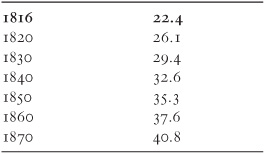
The King called the new United Diet because a combination of economic distress and intellectual discontent forced him to do so. Between 1815 and 1847 the world had changed dramatically. For reasons which demographers still debate, European population began to grow in the middle of the eighteenth century and continued into the nineteenth as Table 1 shows:11
Table 1. The population of Germany (within the borders of 1871) (millions)
After 1815 England’s industrial revolution produced huge volumes of machine-made goods and British factories flooded European markets with cheap textiles. Domestic craftsmen with their traditional hand looms could not compete; hunger crises—in effect, localized famines—in the Rhineland in 1816–17, in eastern Westphalia in 1831, and in Posen and East Prussia in 1846–7 created unrest and frightened the possessing classes. Bad harvests still meant ruin for local farmworkers, especially if the large estate concentrated on exports. As in the Irish famine of 1845, the impossibility of moving goods before railroads meant that people starved to death when ample supplies lay just beyond their reach. In south-western Germany, partible inheritance, that is, dividing family land equally among the sons, led to subdivisions of family property and what came to be known as the Zwergwirtschaft (dwarf economy). Even though these peasants were free, their smallholdings led to grinding poverty. Finally, the post-war crisis after 1815 had been accompanied by falling prices. Weak harvests and particularly severe winters in 1819 and the mid-1840s made for widespread misery. Though nobody could yet feel it, agricultural productivity had risen and gave promise of a better-fed future. Pflanze shows that in Prussia agricultural productivity in the years 1816 to 1865 went up by 135 per cent whereas the population rose by 59 per cent.12 As soon as the crops could be transported more easily, and that came with railroads, famine in Germany would disappear. Europe was still far from urbanized, as Table 2 shows. By 1850, only England had really begun to generate serious urban growth.
Table 2. Proportion of population living in cities of over 100,000 inhabitants
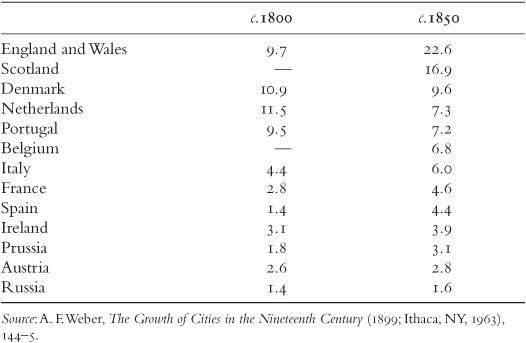
The table shows that Prussia in 1850 belonged among the backward continental European states. Though the city of Berlin had grown, Prussia remained overwhelmingly rural and far behind the urban growth in Britain. That too was beginning to change but nobody saw it yet in 1847.
Railroads had just started to transform European life. During the 1830s and 1840s railroad companies sprang up and the first primitive, short lines were built. Within twenty years, European travel and trade had been revolutionized by the railroad boom (seeTable 3).13
Table 3. Spread of railways in selected countries (Length of line open in kilometers (1km = 5/8 mile))
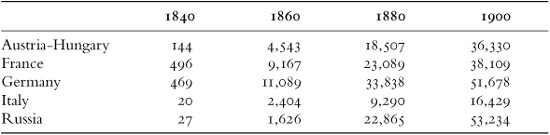
German railroad growth outstripped in speed and scale every other continental country. In the 1840s there was a short-lived German railroad ‘bubble’ as speculative investment piled into the new joint stock companies and raised share prices on insecure foundations. In 1843 a series of bankruptcies set off the first modern depression, though still very small in scale, at the same time that the last European famine crisis had hit East Prussia.
In August 1846 Bismarck wrote to his brother to describe the terrible economic situation in Schönhausen. There had been a prolonged drought and crops were ruined:
There is absolutely no money in Schönhausen. Daily wages amount to more than 60 thaler a week and with the meadows we are far from finished. In the cash drawer there is nothing and no income to be expected in the near future. In the brick works we have to offer very long credit if we do not want to damage the customers.14
In April of 1847 he saw the first riots in Cöslin, a medium-sized town in middle Pomerania, 15 miles south of the Baltic sea coast (Kozalin in Polish today). Bismarck described them in a letter to Johanna:
In Cöslin there was uproar, even after 12 the streets were so full that we could only get through with difficulty and under the protection of a unit of reserve militia which had been ordered in. Bakers and butchers have been plundered. And three houses of corn merchants ruined. Glass slivers all over … In Stettin a serious bread riot, apparently 2 days of shooting, and artillery was supposed to be deployed. It will very probably be an exaggeration.15
On Sunday, 11 April 1847, 543 deputies assembled in Berlin for the largest such assembly ever held on German soil. As David Barclay writes, ‘the public mood in Berlin seemed to reflect the weather … The winter had been long and hard. Food shortages and unemployment were becoming increasingly serious problems, and spring had still not arrived. The day was cold and blustery, with a mixture of snow and freezing rain.’16 The King’s mood was solemn and serious. When he delivered his Speech from the Throne he made clear the limited power of the assembly he had convened:
There is no power on earth that can succeed in making me transform the natural relationship between prince and people … into a conventional constitutional relationship, and I will never allow a written piece of paper to come between the Lord God in heaven and this land.
After this encouraging start, the King pointed out that by calling the United Diet he had merely followed the provisions of the State Indebtedness Act of 1820, which required a meeting of the Estates to authorize new taxes.17 The members of the diet, regardless of their political views, were stunned. Count Trautmannsdorf declared that the speech had ‘hit the assembly like a thunderbolt … With one blow the Stände have seen their hopes and desires obliterated; not one happy face left the assembly.’18
The odd thing about the diet was how quickly and naturally it turned itself into a normal parliament with all the courtesies and practices of parliamentary life complete with forms of address such as ‘the Honourable Gentleman, the previous speaker’, and so on. Of the deputies, the overwhelming majority belonged either to the bourgeois liberal groups or the aristocratic Prussian liberal group under the Westphalian Freiherr Georg von Vincke. The group of nay-sayers who rejected any move to transform the gathering into a proper parliament was not large. Erich Marcks estimates that the ‘aristocratic ultras’ who refused even the slightest alteration in the King’s absolute power, cannot have been more than 70, among whom Otto von Bismarck numbered.19 This was his first public stage and he knew by his innate instinct for showmanship exactly how to use the platform it offered. On 17 May 1847 Bismarck made his maiden speech, as the first speech by a new member in the House of Commons is called. It was a sensational debut. In a manner not unlike the way the young ‘fox’ Bismarck became the darling of his duelling fraternity, Bismarck outraged the other deputies. He denied that the enthusiasm of 1813, the so-called ‘Prussian Rising’, had anything to do with liberalism or a demand for a constitution. He portrayed the popular movement against French occupation in a way that mocked the central myth of Prussian liberalism—that the free people had risen to throw out Napoleon and the French in a War of Liberation. It is hard to grasp how offensive Bismarck’s remarks were. A whole generation of Prussian liberals had lived through the cold days of reaction by warming their hopes on the glorious memories of the people’s war for liberty, which Bismarck belittled. As the stenographic report of the proceedings records, Bismarck asserted that the revolt of 1813 had nothing to do with constitutional liberalism:
as if the movement of 1813 could have other motives ascribed to it or indeed, as if another motive were necessary, than the disgrace that foreigners in our country brought …
Stenographic report: murmuring and loud shouting interrupts the speaker; he draws the Spenersche Newspaper from his pocket and reads it until the Marshall has restored order. He then continues
It does the national honour a poor service (continued murmurs) if one assumes that the mistreatment and humiliation which the foreign power holders imposed on Prussia were not enough on its own to bring their blood to boiling point and to let all other feelings be drowned out by hatred of the foreigner.
(Great noise; Several deputies ask to speak. Deputies Krause and Gier dispute the speaker’s right to judge the nature of the movement, which he had not lived through.)20
Otto von Bismarck had arrived on the Prussian political stage, which he was never again to leave until his death in July 1898, and the appearance has all the characteristics of his later speeches in the Landtag and the Reichstag: complete contempt for the members of these bodies, dramatic gestures, violent ideas couched in sparkling prose but delivered in easy conversational tones. He consistently chose conflict over consensus and saw in such clashes what Clark calls a ‘clarifying element’. Erich Marcks agrees:
The lasting peculiarities of his temperament and his way to judge things show up on the very first day and the entirety of his performance contains—I want to say in the ground tones—the whole Bismarck.21
However bold he appeared at the speaker’s podium, the uproar had slightly unnerved him. The next day he wrote to Johanna:
I tried my luck at the speaker’s platform and aroused yesterday an unheard of storm of displeasure in that body through an observation, not entirely clearly phrased, about the nature of the popular movement in 1813. I wounded the misunderstood vanity of many from our party and naturally caused a great big hello! from the opposition. The bitterness was particularly great because I only said the truth when I applied the sentence to 1813 that somebody (the Prussian people) who gets beaten by somebody else (the French) to the point where he finally defends himself can hardly claim to have done a great service to a third person (the King).22
This was not exactly a stenographic account of what he said; indeed, it was false. Here we meet another permanent and not very agreeable feature of Bismarck’s character: he never took full responsibility for his acts. Forty years later he had still not found the courage to take responsibility for his mistakes, even in small personal matters. That Bismarck should have concealed the actual content of the speech from his wife reflects his constant need to be seen to be right, not unusual in politicians, but in Bismarck’s case the scale of the correction of his own history has the proportions of his own gigantic ego.
A few days later, Ernst von Bülow-Cummerow met Moritz von Blanckenburg and complained about Bismarck’s outrageous behaviour:
‘I had always considered Bismarck a sensible chap. I cannot understand how he can disgrace himself in this way.’ Blanckenburg replied, ‘I think he was entirely right and I am delighted that he has tasted blood. You will soon hear the lion roar in an entirely different way.’23
Bülow-Cummerow was not an obscure Junker but by far the most famous and widely read aristocratic pamphleteer, and defender of knightly supremacy, who also advocated the application of modern agricultural technology to Junker agriculture and the development of rural banking facilities in which he himself had engaged, and demanded freedom of the press. Bülow-Cummerow, unlike most of his neighbours, had not been ‘born again’ and remained untouched by Evangelical Christianity. He had one of the biggest Junker estates in Pomerania, and when in 1848 a ‘Junker Parliament’ met he was the obvious choice to be its Speaker.24 Bülow-Cummerow could not understand why Bismarck stirred up unnecessary trouble. He, as a sensible, large landowner, would never have done that.
Within a few days Bismarck had taken a leadership position among the ultra-conservatives, as he explained in a letter to Johanna four days after his maiden speech. He first apologized for not going to Reinfeld, the estate of his in-laws, the Puttkamers, where his fiancée pined for him, over Whitsun because every vote counted and he had to stay in or near Berlin. First things first with Bismarck. He then observed:
I have succeeded in gaining influence over a large number, or in any case several, deputies from the so-called Court Party and the other ultra-Conservatives, which I use as far as I can to keep them from bolting and attempting clumsy jumps to the side which, now that I have spelled out my direction unmistakably, I can do in the least suspect way.25
To obtain superiority over the extreme conservatives in the United Diet of 1847, Bismarck turned himself into the most extreme of extremists, the wildest of reactionaries, and the most savage of debaters. All that he could shed as easily as he took off his extravagant costume at Göttingen when he returned with Motley to his rooms. A sensible man like Bülow-Cummerow could not understand the demonic game unfolded before his eyes; very few could.
On 8 June, he wrote to Johanna:
In general I am well and calmer than before, because I have taken a more active part than before … the deliberations have become very serious because the opposition makes everything into a party matter. I have made myself many friends and many enemies, the latter more inside, the former more outside, of the Landtag. People, who before did not want to know me and others whom I do not yet know, overwhelm me with courtesies, and I get many well meaning squeezes from unknown hands … The political assemblies after the Landtag in the evening are a little wearing; by nightfall I come back from my ride, and then go right to the English House or into the Hotel de Rome, and get so deeply involved in politics that I never get to bed before 1.26
Bismarck had found a passion for politics, the attendant intrigues, and, I suspect, the growing awareness of his enormous intellectual and personal superiority over the other deputies and their backers. He plunged into politics the way he had hunted in the ‘mad Junker’ phase, taking risks, drinking too hard, and riding too fast. Above all, he loved the power to manipulate others. The word ‘intrigue’ pops up again and again in his private correspondence. And then there were other opportunities in his new position of prominence, and the handsome, blonde, 32-year-old giant knew how to value them. On 22 June 1847 he wrote to Johanna, ‘The day before yesterday we were with our friend the King and I was very spoiled by their Highnesses.’27
His next major speech took place in the debate on the removal of civil disabilities for Prussian Jews. We saw in Chapter 2 that for Junkers like Ludwig von der Marwitz liberalism and equality for Jews meant that ‘our old, venerable Brandenburg-Prussia will become a new-fangled Jewish state’.28 Friedrich Rühs had declared in 1816 unequivocally that ‘a Christian state can therefore absolutely not recognize any other members than Christians’.29 The only good Jew for the Junker Pietists was a converted Jew. When the United Diet debated the Jewish question on 14 June 1847, General Ludwig August von Thile, president of the Berlin Mission to the Jews, argued in these words against full rights for Jews:
I have also heard today that Christianity and even religion should play no role in the discussions of the state; but one of the honourable delegates put this in words which I could heartily endorse when he said ‘Christianity should not be constituted within the state. It should be above the State and should govern it’. With this I heartily agree … He [a Jew] may be the born subject of another nation, he may out of private interest or out of a feeling of general love for humanity make great sacrifices to the circumstances in which he lives, but he will never be a German, never be a Prussian because he must remain a Jew.30
On 15 June 1847 it was Bismarck’s turn to address the United Diet on civil equality for Jews:
I admit that I am full of prejudices; I have sucked them in, so to speak, with the mother’s milk and I cannot succeed in talking them away; if I should imagine having before me, as a representative of the King’s Sacred Majesty, a Jew whom I would have to obey, I must confess that I would feel deeply depressed and humiliated, that the feeling of pride and honour would leave me with which I now endeavour to discharge my duties towards the state.31
In this case Bismarck merely expressed what almost all of his Junker colleagues thought and here, for a change, he belonged to the majority. On 17 June 1847 the United Diet rejected by 220 to 219 the right of Jews to hold public office or serve in the Christian State.32 A few days later on 23 July 1847 the Judengesetz (the Jew Law) forbade Jews from exercising so-called ständische rights, that is rights inherent in class and status. Thus membership in district or provincial diets was closed to them and also the exercise of any rights associated with the knightly estate-ownership, even though a few wealthy Jews had purchased country estates which conferred such rights on them as owners.33
The extreme right-wing party of Bismarck and his friends had become—in spite of their protestations—a parliamentary party and, within a little more than a year, Prussia would have a constitution. They needed an ideology and, as Robert Berdahl writes, ‘they needed an ideology that developed a theory of strong monarchical power without at the same time, succumbing to bureaucratic absolutism’ and in 1847 all they had was the inadequacy of the traditional patrimonial justifications of Adam Müller and Carl Ludwig von Haller which compared the state to an enlarged family.34
Help came from a most remarkable and now largely forgotten figure, Friedrich Julius Stahl (1802–61). Born in Würzburg in an orthodox Jewish household, as Julius Jolson, he took the name ‘Stahl’ and added Friedrich when he converted to Lutheranism on 6 November 1819. Stahl became the philosophical and legal brain of the conservative moment. He wrote a two-volume philosophy of law which attacked not only the Enlightenment philosophers but the entire natural law tradition. Stahl had the intellectual power to take on Hegel and offer an alternative, subjective view of the basis of law. The exclusive reliance on reason was ‘as if one considered the eye as the source of light and wanted to discover history not through the observation of events but by examining the inner construction of the eye and its various parts’.35 He argued for an essentially Burkean conception of history and institutions but based it not on historic liberalism but on a profoundly orthodox Lutheran view of man’s sinfulness and failings.
Elected to the Upper House in 1848 he joined the thirteen extreme conservatives among the members and rapidly became their leader. His biographer, Ernst Landsberg, notes what he calls an ‘almost world-historical irony’ in the fact that the party of neo-Pietist Christian great landowners should have found its intellectual leader in this tiny, delicate little bourgeois, ‘simple in his habits, excruciatingly polite to everybody … dressed in his chosen black suits more that of a clergyman than a professor of law, his speaking in a sharp voice but without pathos, in his external appearance the very type of his origins’, that is, the little Jewish professor.36 When Stahl died on 10 August 1861, Hans von Kleist wrote to Ludwig von Gerlach:
One can truly say that Stahl was the House of Lords. He gave it intellectual significance and thus weight in its decisions in contrast to those of the other House, the Government and in the country at large. He was the soul of his ‘Fraction’ [the German word for a party grouping—JS], and it determined things again up to the present in the whole house.37
Gerlach, who belonged to the ‘born again’ wing of Lutheran piety, was not so sure. Six years later he wrote to a friend,
It is painful to write this about a dear friend, who fought so bravely and in whose soul I took such delight and strength and edification, but you have forced me to do so … he fell for the most part into a vulgar constitutionalism and sought only to temper it in a conservative manner through Christian moral feelings.38
The revolutionary years thus gave Prussian conservatism a new ideological direction and that in turn gave Bismarck a platform on which to build his political career. Stahl may have preached ‘vulgar constitutionalism’ but constitutionalism would happen no matter what he preached. By another ‘world historical irony’ the arch-conservative Otto von Bismarck needed constitutions and parliaments to show his brilliance. Moritz von Blanckenburg was delighted with Bismarck’s speeches on the Jewish question and told Ludwig von Gerlach that since as recently as 4 October 1846 at Trieglaff Bismarck had defended a strict separation of church and state, now his conversion to the ideal of the Christian state was wonderful.39 Lothar Gall takes this sudden change with a large grain of salt:
For the spirit of Christian self-righteousness which he met in Pomerania and frequently in his own circle of political friends, he had far too sharp an eye to allow him to fall for such ideas … Bismarck was never entirely comfortable as he entered the thin air of such abstractions … 40
For Gall and for Marcks the question remained how seriously could either take Bismarck’s speech on the Christian State and both devote several pages to casuistical attempts to reconcile the speech with Bismarck’s scepticism about the more enthusiastic and doctrinaire aspects of religion and the known peculiarities of his faith. There can be no doubt that Bismarck was religious in his idiosyncratic way, but in this case neither Marcks nor Gall draw the obvious conclusion that the speech on the Jews was pure cynical opportunism. It gave him an opportunity to spread his colourful feathers and enhance his already formidable reputation. Pflanze has, I think, the sharpest view of Bismarck’s religion:
His need to dominate and direct did not spring from a sense of divine mission, but from an earlier, more elemental force in his personality. Conversion did not fundamentally alter his attitude toward his fellowman. His cynical view of minds and motives, his hatred and malevolence to those who opposed him, his willingness to exploit and use others show that the Christian doctrine of love and charity had little influence upon him. His faith provided the reinforcement, not the foundation of his sense of responsibility … Religion gave him a sense of security, a feeling of belonging to a coherent, meaningful and controlled world—the kind of environment that his parents did not provide. The God he worshipped was powerful (in contrast to his father) and loving, supportive and omnipresent (in contrast to his mother).41
When King Frederick William IV prorogued the United Diet, Bismarck had completed the first seven weeks of his long career as a public figure and from his point of view they had been successful weeks. He had emerged as the young star of the extreme right and had made a reputation which could not harm his career among the King’s entourage. The royal Princes, Frederick, Albert, and the Crown Prince himself wrote enthusiastic letters and Herr von Puttkamer, who had also been a deputy, wrote to Johanna that Bismarck was ‘the spoiled darling of the princes’.42 As important was his discovery of the fascination of parliamentary politics, the influence, threats, and blandishments, the management of men and affairs, the excitement of the duel in the chamber, and his brilliance as a debater and speaker. The end of the United Diet left him flat but not unoccupied. He tried to organize a new conservative newspaper. He busied himself with the next stages of legal reform and other projects, but the stage lights had gone dark for a while.
And, of course, at some point he had to get married. On 28 July 1847 the wedding took place in Reinfeld on the Puttkamer estate. The best man was ‘little Hans’ von Kleist-Retzow, who in his toast ‘hoped and prophesied that the groom would be a new Otto the Saxon’, the legendary medieval duke, Otto the Great.43 The couple travelled first in Prussia visiting relatives and then on 11 August 1847 set out for Prague via Dresden (where Johanna, the quiet country girl, saw her first play), and from Dresden on to the great city of Vienna, then upriver to Linz and Salzburg. Only a few of Johanna’s letters survive but they testify to an extremely happy life with Otto. On 25 August she wrote to her parents that ‘the world gets ever more beautiful with every passing day [and] Otto with all his warmth is heartily good and loving.’44 On 1 September in Meran they met a Bismarck cousin Count Fritz von Bismarck-Bohlen, and Albrecht von Roon, who was travelling as tutor to the young Prussian Prince Friedrich Karl, later a distinguished army commander in 1866 and 1870. On 8 September 1847 von Roon wrote to his wife Anna that he and Prince Friedrich Karl ‘had the pleasure of seeing Otto Bismarck and his young wife. They promised to visit you in Bonn.’45 The Bismarcks decided to join Roon, the Prince, and Cousin Fritz on their trip to Venice where on 6 September they found King Frederick William IV and his entourage. On the same night, the Bismarcks went to the theatre in Venice. Bismarck described what happened in his memoirs:
The King, who had recognised me in the theatre, commanded me on the following day to an audience and to dinner; and so unexpected was this to me that my light travelling luggage and the incapacity of the local tailor did not admit of my appearing in correct costume. My reception was so kindly, and the conversation, even on political subjects, of such a nature as to enable me to infer that my attitude in the Diet met with his encouraging approval. The King commanded me to call upon him in the course of the winter, and I did so. Both on this occasion and at smaller dinners at the palace I became persuaded that I stood high in the favour of both the King and the Queen, and that the former, in avoiding speaking to me in public, at the time of the session of the Diet, did not mean to criticize my political conduct, but at the time did not want to let others see his approval of me.46
The two essential elements in Bismarck’s career had fallen into place: the certainty that he could master political bodies and the favour of the King. From September 1847 to March 1890 he always had both. When he lost the latter, he lost power. He never had any other foundation for his achievements. No crowds followed him and no party acknowledged him as leader. Even his closest Junker allies, the Gerlach brothers, little Hans, and the others were never ‘his’ party, and owed him nothing for their position in society. Gradually they realized that he shared less of their values than they had thought. The other element to note is the presence of Albrecht von Roon in the story. Bismarck had intended to head for home because the constant rain in Austria had begun to depress him. Did Roon convince him to go to Venice in the hope that he would meet the King? If so, as in 1858 and 1862, he did his friend an incalculable service.
The Bismarcks returned to Schönhausen in late September 1847 and settled in to married life. On 24 October, he wrote letters to his sister and to his brother. To his sister, he wrote that marriage suited him and that he was free ‘of the bottomless boredom and depression that plagued me as soon as I found myself within my four walls’.47 In the letter to Bernhard he complained about his mother-in-law’s ‘great natural melancholy … She sees a black future.’ He then wrote that the honeymoon had cost 750 thaler for 57 days, or 13 thaler per day and he was forced to use Joanna’s wedding money, which she had wanted to spend on silver. For his part he was quite happy to go on using his father’s old silver plate. As he wrote, tea in Wedgwood ‘tastes just as good’.48 On 11 January 1848, the King kept his promise and invited Bismarck to dine at the palace. He sat next to Ludwig von Gerlach and seems not to have taken Johanna.49
As Bismarck made his way home that night, the streets of Palermo in Sicily were buzzing with rumours. The next day a revolt against the King of Naples broke out and the revolutionary year of 1848 had begun. In France on 23 February 1848, full-scale revolution broke out. Within hours, Louis Philippe fled and the Second French Republic had been declared with its fiery Jacobin language and memories of the Terror. As the news from Paris spread across Europe cities from Copenhagen to Naples began to stir. Meetings were held and crowds gathered. On 27 February 1848 in Mannheim a mass meeting demanded press freedom, jury trials, a militia army, and the immediate creation of a German parliament. Revolts and mass meetings took place in all German cities. Peasants rioted and attacked manor houses. In Vienna on 13 March 1848 a rising began and Prince Metternich fled the city. The symbol of repression of the old regime had scurried out of his capital like a fugitive. In Milan on 17 March the news of Metternich’s fall arrived and revolt broke out there as well.
The big garrisons in all European cities in March 1848 had no tactics to cope with Parisian style street-fighting: barricades across narrow, winding streets in old urban centres, boiling water and emptied chamber pots poured from upper floors, and the constant danger of fraternization between troops and citizens undermined the army’s morale. In northern Italy Marshall Radetzky had overwhelming force, more than 10,000 armed men, and he had garrisons in all the fortresses around Milan but he still lost control of the city. Within a day of the reports that Metternich and the Viennese government had fallen, Milan had become a maze of improvised barricades and fortifications.50
In Berlin, the excitement had begun as soon as the news from Paris arrived. Very good weather helped to keep the crowd on the streets. As Christopher Clark writes,
Alarmed at the growing ‘determination and insolence’ of the crowds circulating in the streets, the President of Police, Julius von Minutoli, ordered new troops into the city on 13 March. That night several civilians were killed in clashes round the palace precinct. The crowd and the soldiery were now collective antagonists for control of the city’s space.51
For the next few days King Frederick William IV hesitated, pulled between doves, those advocating concessions, and hawks led by General Karl Ludwig von Prittwitz (1790–1871) the commanding officer of the brigade of Guards Infantry regiments in Berlin, who argued for force. On 17 March the King, shaken by news of the flight of Metternich, finally gave in and agreed to lift press censorship and introduce a constitution for Prussia. Apparently in spite of his bombastic speech from the throne eleven months earlier, he had discovered there was a ‘power on earth that [could] transform the natural relationship between prince and people … into a conventional constitutional relationship’—fear. The next morning, as a crowd gathered in the Palace Square to celebrate, a series of clashes occurred between the army and the demonstrators. Barricades went up all over Berlin. The army could not control the city. Just before midnight on 18 March 1848, General von Prittwitz, whom his biographer describes as ‘a serious, reserved and closed personality’,52 arrived at the palace to ask the King for permission to order the city to be evacuated and then to bombard the rebels until they surrendered. David Barclay describes the scene:
The non-committal monarch listened, thanked Prittwitz and returned to his desk. Prittwitz noted ‘the comfortable way in which His Majesty sat down at his desk pulling a furry foot-muff over his feet after taking off his boots and stockings, in order, as it seemed, to begin writing another lengthy document’. The document he was drafting was perhaps the most famous of his whole reign: his celebrated address ‘To My Dear Berliners’ (an Meine lieben Berliner).53
By dawn the document had been posted all over Berlin. In it he declared that the army would be withdrawn:
Return to peace, clear the barricades that still stand … and I give you my Royal Word that all streets and squares will be cleared of troops, and the military occupation reduced to a few necessary buildings.
The order to pull the troops out of the city was given on the next day shortly before noon. The king had placed himself in the hands of the revolution.54
For most of the soldiers and indeed for Prince William, the King’s brother, and the Crown Prince, Frederick William was a coward who had surrendered to the mob. Roon, stationed in Potsdam, considered emigration. Bismarck instinctively reached for his sword. Two days later, on 20 March, a delegation from Tangermünde arrived in Schönhausen and demanded that the black-red-gold flag of the German Republic be raised on the church tower. Bismarck ‘asked the peasants whether they wanted to defend themselves. They answered with a unanimous and vigorous Ja and I recommended to them to drive the city-dwellers out which with the enthusiastic help of the women they rapidly did.’55 On 21 March Bismarck hurried to Potsdam to see if it made sense to march on Berlin with armed peasants. Bismarck described what happened in his memoirs and the main outlines square with the accounts given by Gall, Engelberg, and Pflanze:
I dismounted at the residence of my friend Roon, who, as governor to Prince Frederick Charles, occupied some rooms in the castle; and visited in the Deutsches Haus General von Möllendorf, whom I found still stiff from the treatment he had suffered when negotiating with the insurgents, and General von Prittwitz, who had been in command in Berlin. I described to them the present temper of the country people; they in return gave me some particulars as to what had happened up to the morning of the 19th. What they had to relate, and the later information which came from Berlin, could only strengthen my belief that the King was not free. Prittwitz, who was older than I, and judged more calmly, said: ‘Send us none of your peasants, we don’t want them. We have quite enough soldiers … What can we do after the King has commanded us to play the part of the vanquished? I cannot attack without orders’.56
Gall argues that from this moment on, Bismarck determined to ‘take part in all efforts to save the traditional monarchical-aristocratic order even if against the present wearer of the crown’.57 In one sense, Bismarck had no choice but to do that. Since September when the King invited him to the palace, Bismarck had seen a career through the court as his way to power. With the King in the hands of the revolution, that would not happen. Bismarck could not have imagined that the arrival of constitutional government would offer him the perfect balance between the remains of royal absolutism and the need for parliamentary adroitness. The conflict between King and Chamber would give Bismarck his platform, but not yet.
According to the later Queen Augusta, Bismarck came to her on 23 March of 1848 on behalf of her brother-in-law, Prince Carl Alexander of Prussia, a younger brother of King Frederick William IV and of her husband, Prince William, Prince of Prussia, to ask for her authority ‘to use the name of her husband and of her young son for a counter-revolution through which the measures granted by the King would not be recognized and his right to make them and his capacity to act rationally would be contested.’58 She wrote to the Crown Prince who had fled to England:
I confined myself to talking to Herr von Bismarck-Schönhausen, to whom I said that you had given an example of the truest devotion and obedience and that any measure against decisions of the King would contradict your views. I let him give me his word of honour that neither your name nor that of our son would be compromised by such a reactionary attempt.59
Bismarck’s version has a very different character:
In this condition of affairs I hit upon the idea of obtaining from another quarter a command to act, which could not be expected from the King, who was not free, and tried to get at the Prince of Prussia. Referred to the Princess, whose consent thereto was necessary, I called upon her in order to discover the whereabouts of her consort, who, as I subsequently discovered, was on the Pfaueninsel. She received me in a servant’s room on the entresol, sitting on a wooden chair. She refused the information I asked for, and declared, in a state of violent excitement, that it was her duty to guard the rights of her son.60
The reader can choose which version to accept but needs to bear in mind that Bismarck always covered up his mistakes, and this headstrong act of folly led to deep hostility between the future Queen and her future Minister-President. In addition, one must reflect that Bismarck wrote the passage after his fall from power and after forty years of his neurotic hatred of her.
The situation then worsened. On 25 March Frederick William arrived in Potsdam and addressed the army commanders and officers:
I have come to Potsdam in order to bring peace to my dear Potsdamers and to show them that I am in every respect a free King, and to show the Berliners that they need fear no reaction and that all the disquieting rumours to that effect are completely unfounded. I have never been freer and more secure than I am under the protection of my citizens. …61
Bismarck watched this moment and recorded later in his memoirs his bitterness at what he heard:
At the words ‘I have never been freer or more secure than when under the protection of my citizens,’ there arose a murmuring and the clash of sabres in their sheaths, such as no King of Prussia in the midst of his officers had ever heard before, and, I hope, will ever hear again.62
Bismarck had no other choice but to return to Schönhausen and confer with his Junker allies. Three days later he wrote in a much calmer frame of mind to his brother Bernhard and commented on the news from Paris:
As long as the present government in Paris can hold on, I do not believe there will be war, doubt that there’s any urge to it. If it is undermined or even overthrown by socialist movements, which is entirely foreseeable, it will have or its successor no money and nobody will lend it any, so that a state bankruptcy or something similar must occur. The motives of 1792, the guillotine and the republican fanaticism, which might take the place of money, are not present.63
In this shrewd and absolutely accurate assessment of the French Second Republic, we hear for the first time the cool tones of Bismarck, the diplomat and statesman. From his remote outpost in Brandenburg, he saw what Tocqueville in the streets of Paris had also noted—that the French Revolution of 1848 was an imitation of 1792 or, in Tocqueville’s memorable phrase, ‘the whole thing seemed to me to be a bad tragedy played by actors from the provinces.’64
On 29 March 1848 the King appointed Ludolf Camphausen (1803–90), a grain and commodity trader, banker, and investor from the Prussian Rhine provinces, as his new Prime Minister and summoned the United Diet to a session on 2 April. Camphausen had the distinction of being the first representative of the new capitalism to hold office under a Prussian king. These changes affected Bismarck, who was a deputy in the United Diet and he therefore left Schönhausen for Berlin. On 2 April he wrote to Johanna from Berlin that ‘I am much calmer than I was.’65
In the meantime elections for the Prussian National Assembly had been declared. The franchise was indirect. Voters elected a college of electors who in turn voted for the deputies. All adult males were eligible to vote if they were not on relief and had resided in the same place for six months. In a letter to his brother on 19 April, Bismarck reported:
I have little or no chance to be elected. I don’t know whether to rejoice or be annoyed about that. It’s a matter of conscience to campaign with all my energy. If it does not succeed, I shall lay myself down in my big easy chair with the satisfaction of having done my bit and spend two to six months sitting around under conditions more agreeable than in the Landtag.66
The elections had an electrifying effect on the newly enfranchised peasants and artisans who flocked to the meetings that preceded the elections. Habits of subservience fell off their backs like old clothes and a not insignificant number of middle-class radicals joined them to stir up passions and make careers. The new Prussian cabinet led by David Hansemann and Ludolf Camphausen pursued a combination of liberal economic policies and constitutional proprieties but did little or nothing for grievances of artisans and peasants who wanted guaranteed security, not watered-down Adam Smith. At the same time that voters elected deputies to the new Prussian Landtag, they also chose representatives for the so-called German Pre-Parliament, a kind of constitutional convention for Germany as whole. This led to a second cleavage among supporters of the new order, between those who remained essentially Prussian or Bavarian or Saxon—revolutions had occurred in all thirty-nine German states—and those who wanted to see their state ‘go up’, in Hegelian language, into the new united Germany.
A coherent account of the revolutions of 1848 requires unusual narrative skills. There was no single revolution but many and often different ones. The events themselves occurred among states and within states. Within a state like Germany thirty-nine revolutions broke out in big kingdoms like Prussia or Bavaria and in tiny German state-lets like the Principalities of Reuss older line and Reuss younger line, one of which was ruled by Heinrich the XX and the other by Heinrich the LXII (this is not a misprint).67The Habsburg Monarchy had revolutions in almost as many places as there were national identities but in particular in the German, Czech, Hungarian, Italian, and Polish cities and in some rural areas where serfdom, the robot, still existed. The attempt to create a German national state foundered quickly on the disagreement about what Germany included. The Habsburg Empire had German and non-German states. Each kingdom, dukedom, principality, or city had its feudal constitution and special relationship to its King, Prince, Duke, Count, Margrave, Landgrave, or Lord. The German nationalists who wanted a ‘Greater Germany’ laid claim to historic German territories such as Bohemia and Moravia which had non-German majorities. The German national state had to include the ‘eternally united’ Duchies of Schleswig and Holstein, though only Holstein was a member of the German Confederation both had the King of Denmark as their sovereign. Frictions developed between classes and regions, between entrepreneurs and workers, between anxious artisans who wanted to restrict entry to skilled trades and doctrinaire liberals who applied principles of free markets to all closed corporations. The disintegration of millennial forest and field rights affected Bismarck and his social class who faced the loss of small privileges like the right to a tenth of honey harvests from peasant hives.
Fighting broke out all over Europe as nationalists tried to force the creation of their new states. Charles Albert, King of Piedmont, under the banner l’Italia farà da se (Italy will make itself) sent his army into neighbouring Lombardy where radical republicans fought against the Piedmontese and against the Imperial forces of Habsburg rule. To the west and to the east two great powers escaped the turmoil, Great Britain because it already had liberalism, capitalism, a constitution, and a middle class (though it was a close call and radicals in 1848 like the Reverend Frederick Maurice expected the revolution any day) and Russia which had none of those things.
Twenty-five years of censorship came to an end overnight and radicals, conservatives, and liberals of every hue began to make speeches, print flyers, and found newspapers. The sheer kaleidoscopic complexity of places, persons, issues, heritages, trades, traditions, conflicts, and overlapping jurisdictions bewildered contemporaries and continues to baffle historians who have first to understand the events and then describe them.
The kings and princes had suffered a collective loss of nerve but, as the first shock wave died down, they gradually noticed that they still had their armies, which, though furious and humiliated at their failure to quell the mob, were intact and often, as in the case of Prussia, outside the turbulent capital city. The Austrian armies in northern Italy began to regain control of Lombardy and Venetia and on 17 June suppressed the Czech revolt in Prague. From 23 to 26 June General Cavaignac put down the workers’ revolt in Paris in the so-called ‘June days’. On 24 and 25 July Marshall Radetzky decisively defeated the Piedmontese army of Charles Albert and restored Austrian rule in northern Italy. The old order began to gain confidence.
In Prussia, the conservatives around the Gerlachs had begun their domestic counter-revolution within days of the King’s surrender to the crowd by creating a ministère occulte, a secret shadow government, lodged inside the royal establishment, also known as the ‘camarilla’. Since the new constitutional arrangements had not altered the King’s powers of command over the army, the Gerlach brothers became the moving spirits in the creation of the new secret structure. General Leopold von Gerlach and his brother Senior Judge Ernst Ludwig von Gerlach were the key figures along with various royal adjutants-general and the ministers of the royal household. As Hans-Joachim Schoeps writes of Leopold von Gerlach,
as a result of the close personal friendship with Frederick William IV—a deep spiritual bond linked them—Gerlach had a strong influence over all Prussian policy after 1848. He was frequently sent on smaller diplomatic missions. In the daily coffee report his counsel and judgement counted for more than the minister-presidents in office … Since, on the other hand, the men in the intimate royal circle had no lust for power—Gerlach was much too scrupulous for that—a complete lack of organization distinguishes the Camarilla as its most striking feature.68
The key feature of the royal government then and in presidential government in those states where it exists today is the social space of power. If you see the King or President every day, especially if you see him alone, you have power irrespective of the title of your office or its place in the hierarchy. Leopold von Gerlach had coffee with the King every day. He had power.
In 1850 or 1851 Leopold von Gerlach became the President of the Berlin Society for the Promotion of Christianity among the Jews, functioning exactly as the founder General Job von Witzleben did before him. The date is uncertain because the Annual Reports of the Society for 1850 and 1851 are missing.69 Like General Job von Witzleben, who combined Christian vocation and office as Adjutant-General, Leopold von Gerlach did exactly the same thing. Anti-Semitism continued to be institutionalized at the top of Prussian society and the prominence of Jews among revolutionary leaders deepened it. Von der Marwitz had said it prophetically in 1811, liberalism meant that ‘our old, venerable Brandenburg-Prussia will become a new-fangled Jewish state’.70
On 21 June Bismarck told his brother that he was going to Potsdam for a few days of ‘political intrigues’. On 3 July he wrote to Alexander von Below-Hohendorff:
Last week I was in Potsdam and found the high and highest personalities more decisive and much clearer about their position than one would have thought given all that has happened. I also was able to assure myself through sight of a confidential letter from the Tsar that the danger of war with Russia is completely imaginary, as long as civil war does not break out here and our ruler does not call for Russian help. The rest by word of mouth.71
On the same day, 21 June 1848, the ‘Society for King and Fatherland’ was founded, a semi-clandestine association of Junker landlords, not more than ten or twenty in each province, who would, by joining other organizations without acknowledging the existence of the Society itself, influence local people and report to the central committee in Berlin on the atmosphere in the country at large. There was a public committee and a secret one which Ludwig von Gerlach directed.72
The camarilla recognized that secret and royal influences would not be enough. They had to do other, more overt, political things. Above all, they needed their own newspaper. Before 1848 there had been talk of one but nothing had come of it. Now in the new more democratic era, the conservatives needed a journalistic voice. Bernhard von Bismarck described the difficulties they faced:
Although the financial situation and credit of the estate owners stood on wobbly foundations and mine most of all, I succeeded nevertheless through my words, my writing and my example in collecting money to support the conservative press. Through a letter of credit for several thousand thalers which I, my brother and Kleist-Retzow put up to pay the guarantee deposit, we covered the initial expense. Otherwise the paper might well have gone under shortly after it first appeared.73
On 1 July 1848 the Neue Preussische Zeitung appeared for the first time. Because of the iron cross on its masthead, it became known as the Kreuzzeitung. Bismarck took an intense interest in the fledgling paper. He wrote for it and also sent the new editor Hermann Wagener regular comments on it. Here are two from its first days. In July of 1848 he received his first copy and wrote to Wagener to express his delight that a new paper had appeared but complained that
there are not enough ads. In our rural remoteness ads are a necessity. The women cannot exist without them and in any case the survival of a newspaper rests on the fees from advertising. New papers can help themselves by reprinting the notices in the established papers and so by means of appearance eventually create the reality of an important information paper … Births, deaths, weddings announcements must be taken over from the Spener-Vossische in my view in full, if necessary without phrases. You cannot imagine how many women read papers only for the notices and if they do not find them, forbid their husbands to buy the paper.74
In early September Gerlach noted in his diary that Bismarck ‘offers himself almost as a minister … a very active and intelligent adjutant for our Camarilla headquarters’.75 Gerlach’s dominance over an entire generation of young conservatives like Wagener, Kleist-Retzow, and Schede rested on his immense personal authority as a legal mind and a judge but also on the extraordinary, almost saintly, qualities of his Christian faith. Bismarck never quite belonged among these disciples. He had not been a Referendar in Gerlach’s superior provincial court nor could he share Gerlach’s comprehensive application of Christian principles to the state.76
In the autumn of 1848, Bismarck needed Ernst Ludwig von Gerlach, who helped to set up and direct the camarilla as a political force. Gerlach wrote a column called Review every month in the Kreuzzeitung and the Reviewer became the most widely read and most influential voice on the Right. He never failed to startle readers as in his October 1848 column in which he argued, ‘we cannot oppose Revolution only with repressive and security measures, we must always have ideas of justice.’77 Since his brother Leopold had coffee in private with the King every day, Bismarck reckoned that the brothers Gerlach would be his road to power, and they were.
On 12 July the German Confederation in Frankfurt, which had continued to function alongside the revolutionary German National Assembly, decided to cease meeting but it did so in a way that would affect Bismarck’s career. It did not announce ‘the end of its existence’ but instead ‘the end of its previous activity’.78 When the revolution finally ended, the Austrians could call it back out of its temporary suspension and resume their dominance of the German political structure. That would mean, if Prussia agreed, that there would have to be again a Prussian representative to the Bundestag, the job which Bismarck eventually got.
The Prussian national assembly had debated in July the abolition of all manorial rights and, as a result, in Bismarck’s neighbourhood the counterrevolution became still more active. On 24 July an organization for the representation of the great landowners had been founded called the Verein zur Wahrung der Interessen des Grundbesitzes und zur Förderung des Wohlstands aller Klassen (Association for the Protection of the Interests of Landownership and for the Promotion of the Prosperity of all Classes). Although the country aristocracy dominated it, some 26 per cent of the landowners were non-noble. The leading figures were mostly from Brandenburg and their names are already familiar to us: Ernst von Bülow-Cummerow, Hans von Kleist-Retzow, Alexander von Below, and Otto von Bismarck. When the first annual general meeting of members gathered on 18 August, some 200 to 300 men showed up including smallholders and peasants. Since the long name hardly rolled off the tongue, the organizers shortened it to the Verein zum Schutz des Eigentums (the Association to Protect Property) and the journalists immediately called it ‘the Junker Parliament’. Although only 34 years old, Hans von Kleist was elected President. Leopold von Gerlach recorded in his diary for 10 December 1855: ‘It was the basis and the beginning of the later mighty party which saved the country.’79 On 22 August 1848 Ludwig von Gerlach addressed the Junker Parliament and gave for the first time his Christian justification for the preservation of manorial rights:
Property is itself a political concept, an office bestowed by God, in order to preserve his law and the Kingdom of his Law; only in association with the duties which arise from it is property holy. As mere means of enjoyment it is not holy but dirty. Communism correctly rejects property without duties. For that reason we may not surrender the threatened rights—patronage [of church and school], police [estate constables], the legal jurisdiction [estate owners as judges]; for these are more duties than rights.80
Bismarck had been tireless in organizing and furthering the Association. He had once again shown his political skills and energy. He wrote to Hermann Wagener on 25 August and put his own, rather different, interpretation on the Gerlach version of noblesse oblige:
It is a criterion of nobility that it serves the country for nothing. To be able to do that it must have its own wealth, from which it can live; otherwise the thing simply will not work. As result we have to be as materialistic as necessary to defend our material rights.81
Not quite what von Gerlach had in mind. In the midst of the Junker Parliament, on 21 August 1848, the Bismarcks’ first child, Marie, was born and Hans von Kleist-Retzow became her godfather.82
In the great world beyond Brandenburg, international and national forces had begun to contain, and ultimately crush, the German Revolutions of 1848–9. The day after Bismarck wrote to Hermann Wagener, 26 August 1848, under pressure from Britain and Russia, the Prussian government, whose army had been fighting a quixotic campaign against Denmark for the liberation of the Duchies of Schleswig and Holstein, agreed to sign an armistice with Denmark without consulting the German National Assembly, whose agent in theory Prussia had been. This betrayal of the national cause made clear the evident fact that Frankfurt as capital of the new Germany had no executive force of its own. When on 16 September the National Assembly in Frankfurt ratified the armistice—they could hardly do otherwise—rioting broke out in the street and two deputies, Auerswald and Lichnowsky, were murdered by the mob. The Prussian army entered the city and restored order.83
The loss of prestige in the National Assembly affected the Prussian National Assembly in a similar way. On 11 September 1848 the Liberal Prussian Auerswald-Hansemann ministry resigned. The King hesitated. Could he do away with liberals altogether? Bismarck went to Berlin where His Majesty received him and even apparently considered appointing him to office. The King opted for General Adolf von Pfuel, who was 69 when appointed Minister-President of Prussia and had been until 18 March 1848 the military governor of Berlin. Pfuel had been a close childhood friend of the poet and writer Heinrich von Kleist, had been a regular at the Jewish salon of Rahel Varnhagen von Ense, and had an unusual reputation. Though a Prussian Junker of Mark Brandenburg stock, he had genuine liberal sympathies. He tried to keep to the agreements of March 1848 but failed to gain the King’s support as the conflict between Crown and Parliament, stirred up and forced by the Gerlachs, sharpened.84 On 23 September 1848 Bismarck wrote to Johanna:
Either the government shows itself to be weak like its predecessors and gives way, something that I am working against, or it does its duty in which case I do not doubt for a minute that on Monday evening or Tuesday blood will flow. I had not thought the Democrats would be bold enough to accept battle but their whole attitude suggests that they will. Poles, Frankfurter, loafers, freebooters, all sorts of scum, have again appeared. They reckon that the troops will back out, probably through the speeches of a few unsatisfied chatterboxes who thus mislead the troops. I think they are wrong. I have no reason to stay here and tempt God to protect me, for which I have no claim. I shall bring my person to safety tomorrow.85
In spite of his letter, Bismarck stayed in Berlin, though in what capacity beyond busybody cannot easily be established. He went here and there, saw this one and that, and generally made sure that he could not be ignored. It seems that he seriously expected to be nominated to high office in the near future and that, in fact, turned out to be quite correct. In Berlin the camarilla had gradually won the King to its views. In early September 1848 Leopold von Gerlach suggested the establishment of a ‘military ministry to be headed by a general’, which would finally put down the revolution in Prussia. His brother Ludwig told Leopold on 29 September 1848 that the time had come for such a ministry composed of General Count Brandenburg, a member of the royal family, with Otto von Bismarck, Hans Hugo von Kleist-Retzow, and the Prince of Prussia as ‘generalissimo’.86 By 6 October 1848 the camarilla had convinced the King to appoint Brandenburg. Friedrich Wilhelm Count von Brandenburg (1792–1850) was the third and youngest of the three generals who reclaimed Berlin from revolution. Brandenburg, who had grown up in the home of the Minister of the Royal Household, von Massow, must have known Frederick William IV as a child. He had many virtues but no acquaintance with politics whatever when on 2 November 1848 Frederick William IV appointed him to succeed von Pfuel.87 Bismarck recalled his helplessness:
Count Brandenburg, indifferent to such anxieties, declared himself ready to take the presidency of the Council, and then the difficulty was to find him fit and acceptable colleagues. A list presented to the King contained my name also: as General Gerlach told me, the King had written in the margin ‘only to be employed when the bayonet governs unrestricted.’ Count Brandenburg himself said to me at Potsdam: ‘I have taken the matter in hand, but have scarcely looked into the newspapers; I am unacquainted with political matters, and can only carry my head to market. I want a mahout, a man in whom I trust and who tells me what I can do. I go into the matter like a child into the dark, and except Otto Manteuffel [then at the head of the Ministry of the Interior], know nobody who possesses previous training as well as my personal confidence.88
The fate of the revolution in Prussia depended less on von Brandenburg but on another Prussian general, the flamboyant and clever ‘Papa Wrangel’. Friedrich Heinrich Ernst von Wrangel was born on 13 April 1784 in Stettin and died on 1 November 1877 in Berlin at the age of 93. In the Napoleonic Wars he had won the highest Prussian order, Pour le mérite. During the long peace years he distinguished himself as a dashing and effective cavalry officer. On 19 April 1848 the King gave him command of the Prussian army expeditionary force to go to Schleswig-Holstein and again he won a variety of notable engagements. After the armistice Wrangel returned to Berlin and on 13 September reported to the King who appointed him military governor of ‘the Marches’, the territory surrounding Berlin. He took up his headquarters in the royal palace in Charlottenburg and deployed 50,000 troops around the city. The scenario had already been established by Cavaignac and Radetzky, but Wrangel was shrewder and more dramatic. On 9 October he organized a military parade to the horror of von Pfuel who advised against it. Wrangel decided that it was high time Berlin saw some soldiers. With drums and flags the army marched from Charlottenburg into the heart of Berlin and drew a huge, cheering crowd.89 Wrangel spoke fluent Berlin dialect and made himself easily available to the crowd. The parade showed that the revolutionaries had lost support and that the army had regained its prestige especially when commanded by a witty, dialect-speaking, people’s general. Eleven days after Wrangel’s parade, Bismarck wrote to Johanna:
Not the slightest sign of revolt here. But instead bitter feelings between workers and civil guard, which can bear good fruit. The workers cheer the King and the army and want the King to rule alone etc.90
Meanwhile in Vienna, the Austrian government used force. On 6 October 1848 street fighting broke out and the court fled the city. On 26 October, under the command of General Alfred Prince zu Windisch-Graetz and the Croatian general Count Joseph Jelačićvon Bužim, the Austrian army began to bombard the city and on 31 October stormed it with overwhelming numbers. Two thousand people died in the fighting and several prominent leaders, including Robert Blum, a deputy in the Frankfurt National Assembly, were executed by firing squad. Wrangel had done the same job with a parade and no casualties. The German revolution had run its course. On 9 November 1848 Count Brandenburg had decided to remove the Prussian National Assembly from Berlin as a first step to the occupation of the city by Wrangel’s troops.
Bismarck had remained in Berlin to make himself as important as possible and seems to have managed that exercise, as he tells us in his memoirs:
Early in the morning of November 9, General von Strotha, who had been appointed War Minister, came to me, sent by Brandenburg, in order to have the situation made clear to him. I did that as well as I could, and asked: ‘Are you ready?’ He answered with the rejoinder: ‘What dress has been decided upon?’ ‘Civilian dress,’ I replied. ‘That I don’t possess,’ said he. I provided him with a hired servant, and luckily, before the appointed hour, a suit was hunted up at a tailor’s. Various measures had been taken for the security of the ministers. First of all, in the theatre itself, besides a strong posse of police, about thirty of the best shots in the light infantry battalions of the guard were so disposed that they could appear in the body of the house and the galleries at a given signal; they were unerring marksmen, and could cover the ministers with their muskets if they were actually threatened. It was assumed that at the first shot all who were present would speedily vacate the body of the house. Corresponding precautions were taken at the windows of the theatre, and at various buildings in the Gendarmenmarkt, in order to protect the ministers from any possible hostile attack as they left the theatre; it was assumed that even large masses, meeting there, would scatter as soon as shots were fired.91
None were and on the following day, 10 November 1848, General Wrangel occupied Berlin and put an end to the revolution in Prussia, as it turned out, for good. Now what was there for Bismarck? On the following day he wrote one of those disarmingly honest letters that still have the power to startle the reader:
I sit here partly as a deputy of our knights’ association in Berlin and partly as a court and chamber intriguer. Up to now nothing much has happened except uninterrupted disarming of Berlin, through which as of now, after half of the districts have been searched, eighty to ninety percent of the weapons have been collected. Passive resistance turns out more and more to be cover for weakness. The military in addition to ensuring calm and order turns out to be popular and the number of the angry reduces itself to the fanatics, the rogues and the barricadists.92
On the same day King Frederick William IV issued a proclamation, which contained a promise to grant the subjects a new constitution:
Prussians! I give you once more my unbreakable assurance that you will not be injured in your constitutional rights, that it will be my most immediate effort to be a good constitutional King, and that we together will erect a stately and lasting structure under whose roof to the benefit of our Prussian and German Fatherland our descendents may enjoy in harmony the blessings of freedom for centuries to come. To that may God grant his blessing!93
A few days later on 16 November, Bismarck wrote to Johanna:94
Yesterday I was invited to dinner by the King. The Queen was English pleasant. I picked a piece of heather from her sewing table and send it to you so you won’t be jealous … Afterwards the King summoned me to an audience of about an hour in his cabinet or more accurately his bedroom, which is hardly larger than our little room. The Royals live together in the city palace and are rather cramped. Among other things he said, and instructed me to communicate it to all those well meaning persons, that he will hold to his promises, the right one and the silly ones, without question, without the slightest duplicity, but he intends to secure the rights of the Crown to the last consequence, as long as he has a single soldier and a toe-hold in Prussia.95
Years later Bismarck told Lucius von Ballhausen his crushing assessment of the King: Frederick William IV had ‘an unsteady character … if one grabbed him, one came away with a handful of slime.’96
On 5 December 1848 the Prussian National Assembly was dissolved and the King fulfilled his promise by ‘imposing’ a constitution on the country. Though it had been oktroyiert or ‘dictated’ from above, the king declared ‘as a consequence of the unusual situation which has arisen which made the planned agreement on the Constitution impossible,’97 the 1848 Constitution was by no means entirely reactionary. It stipulated that all Prussians were equal before the law (Article 4); had personal freedom guaranteed (Article 5); inviolability of their dwellings (Article 6); property was inviolable (Article 8); and religious freedom was guaranteed (Article 11); research and teaching were free (Article 17). Every male Prussian over the age of 24 who had lived in his community for six months and had not been declared ineligible by a court had the right to vote (Article 67). The lower house had 350 members (Article 66) who served for three years (Article 70). Every 250 voters selected one Elector (Article 68) and the Electors elected the Deputies in districts so organized that at least two deputies were elected per district (Article 69). An upper house of 180 members, elected for six years by provincial, county, and districts (Articles 62–5) completed the structure.
On the other hand the core structure of the Prussian state had not been touched. In four articles, the fate of the ‘Iron Kingdom’ from 1848 to 1918 was sealed. The King exercised supreme command of the army (Article 44). He filled all posts in the same way in the remaining branches of the civil service insofar as the law had not prescribed an alternative (Article 45). The King had the right to declare war, make peace, and enter into treaties with foreign powers (Article 46). The King had the right to dissolve either of the Chambers (Article 49).98 Thus, the personnel and command of the army and civil service remained entirely in the hands of the King, who appointed and dismissed ministers and army officers alike, in effect, the spinal cord of the absolute regime. This constitutional structure, as amended by the Constitution of 1850, which eliminated equal suffrage and introduced a suffrage based on the income of the voter, remained in effect to 11 November 1918, when a republic replaced the monarchy.
Among the other prerogatives of the Crown, according to §3 of the Order of 12 October 1854, was the unlimited right to name members of the House of Lords as a sign of ‘special All-Highest confidence’.99 As Hartwin Spenkuch shows in his account of the Prussian House of Lords, successive monarchs named 325 such members between 1854 and 1918. Membership of the House of Lords elevated all sorts of commoners into the service nobility of the new constitutional kingdom but also rewarded nobles who had served in royal office either in civil or military functions. The Prussian House of Lords resembled the modern British version much more than one might expect and in one respect exceeded any equivalent provision of the British House of Lords of today. Between 1854 and 1918, forty university professors received nominations from their institutions to be ‘presented’ to the King as peers and twenty-one other professors were directly named by the King himself. These academic peerages in Prussia might be compared not implausibly to life peerages for distinguished academics nominated by the British Prime Minister today but with the advantage that the universities themselves selected two-thirds of the candidates. Among the 61 were the theorist of the Christian State, F. J. Stahl (1802–61); the economists of the so-called ‘Historical School, Adolf Wagner (1835–1917) and Gustav Schmoller (1838–1917); and the classicist, Ulrich von Wilamowitz-Moellendorf (1848–1931).100
From 5 December 1848 the rules of the political game in Prussia were changing in Bismarck’s favour. His conservative patrons would need his skills more than they had before and before all else he had to get himself elected to the new lower house, the Landtag. There was not much time. The voters would choose Electors on 22 January 1849 and the Electors would elect Deputies on 5 February. Four days after the imposition of the constitution, Bismarck wrote to his brother,
From September on I have been like a shuttle-cock going back and forth between here and Berlin, Potsdam and Brandenburg … In general I flatter myself that I have poured pepper on the tails of the cowardly dogs and look back at my day’s work with satisfaction.101
His friends in the Union for King and Fatherland formed an electoral committee and Bismarck joined Julius Stahl, Moritz August von Bethmann Hollweg, Hermann Wagener, and his university friend Karl von Savigny as a member. Their manifesto stated: ‘The political way of thinking which moves our Committee, is a unitary one and in many ways has sharper definition than among other fractions of the Conservative side. It consists of an absolute refusal to negotiate with the revolution.’102 Bismarck plunged with his customary energy into the electoral campaign, as he explained to his brother,
In the electoral assemblies I declared myself for the recognition of the constitution, defence against anarchy, equality before the law (but against abolition of the nobility), equal distribution of tax according to income, so far as possible; election according to interests, and against the abolition of monetary rights without compensation, for strict press and club laws and that is how I intend to behave in the Landtag.103
On 5 February 1849 Otto von Bismarck was elected to the Prussian Landtag from Teltow, in Brandenburg. Heinz von Kleist was elected from Belgard. General Leopold von Gerlach noted in his diary: ‘Of the reliable people, upon whom we can call, Bismarck, Kleist, and I will assume, Professor Keller, have been elected. It would be important to organize them as a counter-opposition.’104
On 28 March 1849 the Frankfurt National Assembly adopted a constitution with universal, manhood suffrage and secret ballot and passed a resolution to offer the Imperial German Crown to Frederick William IV. On 3 April the King received the Frankfurt delegation led by the President of the Frankfurt Parliament, the Prussian Liberal Eduard von Simson. The meeting went badly. Frederick William IV received the ‘32 Crown Bearers’, as Leopold von Gerlach scornfully called them, in the Knights’ Hall of the Royal Palace, and told them with great courtesy that, though he was honoured by the offer of the Crown, he would have to see whether the German states accepted the constitution. At the reception that evening, the disappointed von Simson complained that the King had ‘nullified’ the Frankfurt Assembly, to which Leopold von Gerlach replied with satisfaction ‘that is a very correct observation’.105 The King wrote to his sister Charlotte, as the wife of the Tsar known as the Tsarina Alexandra Feodorovna, later to be a great friend of Bismarck,
You have read my reply to the man-donkey-dog-pig-and-cat-delegation from Frankfurt. It means in simple German: ‘Sirs You have not any right at all to offer me anything whatsoever. Ask, yes, you may ask, but give—No—for in order to give, you would first of all have to be in possession of something that can be given, and this is not the case!106
Bismarck’s view of the Frankfurt crown was not much higher than the King’s. On 21 April 1849 Bismarck made an important speech in the Landtag on it:
The Frankfurt crown may glitter brightly but the gold which lends authenticity to its sparkle must be won by melting down the Prussian crown and I have no confidence that the smelting will succeed with the form of this constitution.107
Meanwhile Bismarck had settled into the parliamentary round as he told his brother,
We are from the mornings at 9 in the expert committees, then plenary sessions, then after lunch in section meetings from 5 to 7 and then party meetings to 10 or 11. In between invitations, tedious visits to pay and to receive, intrigues and working on people and issues. Given my natural tendency to laziness, you will find my silences understandable. The sessions of every kind are the more exhausting because the first word tells you what the whole speech will contain like certain bad novels but you cannot leave because of the possibility of votes.
He had moved to 71 Wilhemstrasse, ‘where it is a bit more expensive but then one doesn’t get involved in the pubs’.108
In August of 1849, he was re-elected to the Prussian Landtag and lived in an inn with Hans von Kleist-Retzow. He wrote Johanna that he had considered taking a chamber garnie with him.
He is for my lifestyle too tyrannical. He wakes me every morning before I want to get up and orders my coffee, so that it is cold when I get to it, suddenly draws Gossner’s Schatzkästchen [Little Chest of Treasures] out of his pocket and imposes morning prayer on me with hymn that he reads out. That is very nice but often untimely.109
Nine days later on 17 August, he conceded defeat:
I live with Hans here on the corner of the Taubenstrasse, 3 rooms and an alcove, very elegant but narrow, little holes, Hans’s bed full of bed-bugs, mine not, apparently they don’t like the way I taste. We pay 25 Reichsthaler a month.110
Hans was now dragging him to Lutheran churches, and Bismarck groaned about it to Johanna:
The singing in Protestant congregations really does not please me. I prefer a church with good church music played by people who know what they are doing and I like to have a church like the Tein church was inside with masses, priests in white vestments, in the fog of candles and incense, that is much worthier, don’t you think, Angela?111
In September 1849 Bismarck went with his sister Malwine to Friedrichshain to visit the graveyard of the revolutionaries killed in the March days.
Yesterday I went with Malle to Friedrichshain and not even the dead could I forgive. My heart filled with bitterness at the piety for false gods around the graves of these murders, where every inscription boasts on the crosses of ‘Freedom and Justice’, a mockery of God and man … My heart swells with poison at what they have made of our Fatherland, these murderers with whose graves the Berliners worship as idols.112
This rage at his ‘enemies’ would become more and more prominent as he got older and more powerful, and would take an increasing toll of his energies and health.
The end of the Frankfurt Parliament brought a new and unexpected complication. Radowitz returned to Berlin on 22 April 1849, from Frankfurt, where he had been a deputy. Joseph Maria von Radowitz (1797–1853) had a story-book career, a young man from a Catholic Hungarian noble family, he arrived on Berlin in 1823 knowing nobody and on the run from his master, the Grand Duke of Hesse. Within a few years he had become an important member of the new Prussian General Staff, a close friend of the Crown Prince who later became Frederick William IV, a founding member along with Count Voss, the Gerlachs, and others of that group of the Berliner Wochenblatt, whose aim it was ‘to fight the false freedom of the revolution through the true freedom found in right order and never through absolutism, no matter in what guise it shows itself’.113 In other words, though Catholic, he had taken on the feudal and aristocratic ideology of the Neo-Pietists against revolution but also against Frederick the Great’s state absolutism. He rose to high rank in the army, published literary essays, and produced mathematical work as well. He wrote a memorandum on 20 November 1847 entitled ‘Germany and Frederick William IV’ in which he urged the King to take the lead in a federal, voluntary union of German states under Prussia, an effort which he always believed would have prevented the events of 1848. Only an unofficial, though powerful adviser of the King, he could not convince the ministers to pursue this course and after the March days he retired to an estate of his wife’s relatives in Mecklenburg where, rather to his surprise, he was elected a deputy to the Frankfurt Parliament from a Westphalian constituency.
After the collapse of the revolutionary parliament in Frankfurt, Radowitz convinced Frederick William IV to use the new prestige of Prussia—the Frankfurt parliament had offered the German imperial crown to the Prussian king and Prussian force had suppressed tumult in Frankfurt and a peasants’ revolt in Baden—to unify Germany in a ‘Union’ of Princes on a federal basis but without Austria. Radowitz’s plan won the King’s approval and led to the calling of a meeting of princes.
In Berlin Radowitz’s scheme for a Union had little support within Prussia. Radowitz had no office but his close friendship with the King gave him power. The King’s ministers mostly disliked the scheme. The camarilla hated it because it introduced an elected German parliament, the equivalent in their eyes of ‘revolution’. Radowitz repeatedly offered to withdraw. The King just as repeatedly ordered him to stay. The ‘Alliance of Three Kings’ concluded between Prussia, Saxony, and Hanover on 26 May 1849 bound the three states to form a union if all other German states, with the exception of Austria, agreed. At a meeting in Gotha on 25 June 1849, 150 former liberal deputies to the German national assembly acceded to the draft of the Union constitution. Under Prussian pressure twenty-eight German states recognized the constitution and joined the union by the end of August 1849 but Bavaria held out and the loyalty of Saxony and Hanover to the idea was never very strong. Radowitz finally took formal office on 26 September 1849 as Prussian Foreign Minister but he had no support around the ministerial table. The King backed him but ever less certainly.
The idea made sense but it ran into two implacable foreign obstacles: the Austrian Empire and the Russian Empire. The Tsar Nicholas I had been furious that Frederick William IV had surrendered to the ‘mob’ and referred to him as the ‘king of the pavements’ and the 18-year-old Emperor of Austria, Franz Joseph, had a new adviser, Prince Schwarzenberg. His Serene Highness Felix, the Prince of Schwarzenberg, Duke of Krumlov, Count of Sulz, Princely Landgrave of Kelttgau (1800–52) belonged to the highest European aristocracy and had a powerful personality. He had arranged with the Tsar to help crush the Hungarian revolution, had imposed an entirely centralized government system on the Habsburg dominions, and intended to restore the federal structure of Germany to its pre-1848 position with Austria as sole power as its president.
On 31 January elections for the Union Parliament had taken place. Bismarck was elected and on 20 March 1850 the Union Parliament met in Erfurt for the first time. In spite of his reputation for black reaction Bismarck was elected as secretary of the parliament. He gave his first speech in the Erfurt House of the People on 15 April 1850 in which he objected to the term ‘German Empire’ because
it runs the gravest risk a political measure can face, that of becoming ridiculous. … Gentlemen, if you make no concession to the Prussian, the old Prussian, the core Prussian spirit more than those made in this constitution and if you try to impose this constitution on the Prussian subject you find in him a bucephalus, which carries the rider whom it knows with courageous joy but the unauthorized Sunday rider complete with his black-red-gold embroidery it will dump into the sand (Loud applause on the right).114
On 19 April, he wrote to Johanna:
Things are heading to a crisis here. Radowitz and Manteuffel oppose each other. Brandenburg lets himself be wound round by Radowitz … so that at my urgent pleading Manteuffel set out for Berlin to see the King. For which side he opts will be decided in a day or two, and then either Erfurt is dead or Manteuffel is no longer minister. The little man has behaved very well and decisively; he wanted to break openly with Radowitz yesterday but Brandenburg prevented it … it’s awful to live in such a small city with 300 acquaintances. One cannot call a moment one’s own. An hour ago the last boring person left and I went to supper in the snug and consumed an entire wurst which tasted delicious, drank a pint of Erfurt Fellsenkeller beer and now as I write I have eaten the second box of marzipan, which may have been meant for Hans, who in any case got none of the wurst. In exchange I’ll leave him the ham.115
At long last the summer holidays freed Bismarck from his seat on the podium in Erfurt and he had time to write to Hermann Wagener in June of 1850:
I lead a bottomlessly lazy life here, smoking, reading, taking walks and playing family father. I hear about politics only through the Kreuzzeitung so I run absolutely no risk of contamination with heterodox ideas. My neighbours are not inclined to visit and this idyllic solitude suits me perfectly. I lie in the grass, read poetry, listen to music and wait for the cherries to ripen … The bureaucracy is eaten up by cancer in its head and members. Only the stomach remains healthy and the legal shit that it excretes is the most natural thing in the world. With this bureaucracy including the judges on the bench we can have press laws written by angels and they cannot lift us from the swamp. With bad laws and good civil servants (judges) one can still govern, with bad civil servants the best laws cannot help.116
To his old college friend Gustav Scharlach he wrote about Radowitz from Schönhausen on 4 July 1850:
Radowitz is a man who in no respect rises above the average save one, an astonishing memory by means of which he … affects in bits and pieces a comprehensive knowledge and memorizes good speeches for the gallery and the centre. In addition he has studied the weaker sides of our All-Highest Lord, knows how to impress him with gestures and grand words and to exploit his nobility and his weaknesses of character. In addition as a private person R. is a decent and unobjectionable human being, an excellent father of his family, but as a politician without an idea of his own, he lives from small expedients and fishes for popularity and applause, driven by immense personal vanity … 117
In July Bismarck too had to face the prospect of being ‘an excellent father of his family’. He had to go with his wife and small children to the seaside, a prospect that filled him with gloom and took him away from politics. The letters he wrote to his sister about these holidays show Bismarck as a writer of comic genius. Here is one:
The nearer it comes the more I see this as a ticket to the madhouse or to the Upper Chamber of parliament for life. I see myself with children on the platform at Genthin station, then in the compartment where both satisfy their needs ruthlessly and emit an evil stink, the surrounding society holding its nose. Johanna too embarrassed to give the baby the breast so he screams himself blue, the battle with the crowd, the inn, screaming children on Stettin station and in Angermünde 1 hour waiting for horses, packing up, and how do we get from Kröchlendorf to Külz? If we had to spend the night in Stettin, that would be terrible. I went through that last year with Marie and her screaming … I am, I feel, somebody to whom a dreadful injustice has been done. Next year I shall have to travel with three cradles, three nurses, nappies for three, bed clothes; I wake at 6 in the morning in a gentle rage and cannot sleep at night because I am haunted by all sorts of travel pictures, which my fantasy paints in the blackest hues, right to the picnics in the dune of Stolpmünde. And if there were only daily payments for this but instead it causes the ruin of a once flourishing fortune by travelling with infants—I am very unhappy.118
September meant parliament, Berlin and, at long last, escape from the stresses of family life. The crisis over the Erfurt Union had not yet been resolved. Austria and Prussia headed for a serious clash. On 27 August 1850 Schwarzenberg declared the Union plans incompatible with the Federal Act and called for an emergency meeting of the German Confederation on 2 September 1850, in Frankfurt. Schwarzenberg shrewdly took advantage of the fact that the old German Confederation, the Bund, still existed, because in July of 1848 it had not announced ‘the end of its existence’ but instead ‘the end of its previous activity’.119 Then a crisis blew up in the Electoral Duchy of Hesse-Cassel where the reactionary duke had turned the clock back to 1847, annulled the gains of the revolution, and restored absolutism. His subjects who had enjoyed freedoms under their new constitution rebelled by going on a tax strike. On 17 September 1850 the Grand Duke, Frederick William II, appealed to the German Confederation under the terms of its foundation for ‘federal execution’—that is, military intervention—to help him restore order. The territories of Hesse-Cassel lay between the western Prussian provinces and the main body of the Prussian Kingdom and the idea that Saxon or Hanoverian troops might block Prussia’s east-west axis alarmed and outraged senior officers who otherwise wanted nothing to do with the Erfurt Union, its parliament, or any other such institution.
On 1 November 1850 troops of the German Confederation marched into the Electorate of Hesse. The Prussian action to protect its lines of communication put the King into the absurd position of defending ‘revolution’ against a legitimate sovereign and Tsar Nicholas made such threats that the King dismissed Radowitz on 2 November. The Prussian government drifted toward a war with Austria and the German Confederation to defend a position which nobody accepted any longer but to admit that would be to suffer a complete humiliation. Things went badly in the military preparations for a war which now had no object. As Arden Bucholz writes:
from 6 November 1850 to 31 January 1851, the Kingdom of Prussia carried out its first war mobilization for thirty-five years. It was a disaster from start to finish … The War Ministry, and below it, the command and staff headquarters were in chaos.120
Members of the royal family argued, the cabinet split, and the atmosphere grew more ominous.
The game of bluff ended when the Prussian government gave in. On 29 November 1850 Manteuffel and Schwarzenberg signed a convention, the Punktation of Olmütz, in which Prussia withdrew her troops from the Electorate of Hesse and abandoned the Union project. The Prussian surrender to Austria ranks with the Battle of Jena as a moment of national humiliation. Austria and Prussia agreed to restore the German Confederation jointly but the Austrians ignored the promise.121 The shame of Olmütz crushed even the most bitter opponents of the Erfurt scheme. Otto von Bismarck was not one of them. On 3 December 1850 he made one of the most important speeches of his entire career. It had a new tone, one for which he would become famous:
Why do great states fight wars today? The only sound basis for a large state is egoism and not romanticism; this is what necessarily distinguishes a large state from a small one. It is not worthy for a large state to fight a war that is not in its own interests. Just show me an objective worth a war, gentlemen, and I will agree with you … The honour of Prussia does not in my view consist of playing Don Quixote to every offended parliamentary bigwig in Germany who feels his local constitution is in jeopardy.122
The speech made a real impact. His conservative friends had 20,000 copies printed and circulated throughout the country. The tone, realistic, unemotional, and based on material interest, marks the moment when Bismarck, the practitioner of Realpolitik, made his public debut. The Gerlachs could not complain because his icy realism had saved them from the humiliation of an outraged public. Lothar Gall adds another consideration. Bismarck’s parliamentary skills would never bring him power in the new neo-absolutist constitutional structure which post-1850 Prussia would become. Thus the prospect of leading the conservatives in the Landtag as an unpaid parliamentary performer was ‘uninteresting’. Real power would remain in the King’s weak hands and palace figures would control it. Gall writes: ‘the goal of the Olmütz speech was, therefore, to recommend himself for a high state office.’123 Without qualifications, without experience, and without a reputation for reliability, Bismarck still hoped to find a post in the diplomatic service which would move him onto a very different scene, one for which, as it turned out, he had a natural flair.
1851 began and nothing much seemed to be happening. Bismarck’s letters to his wife are full of gossip and small matters. In March he wrote about a fire in the Prussian House of Lords and how much the Berliners enjoyed it. He quoted their jokes in dialect ‘burning questions’—‘who would have thought that the old place had so much fire in it?’ ‘At last the light has been turned on!’,124 and a few days later that Hans had come back from Halle but had not slept at home for five nights.
I got so worried about him, even though he tyrannizes me, that I had him paged in the visitors lounge [at the Landtag—JS] and he came at once. People talk about his making a very profitable marriage but I doubt it. He is in his personality and his inner nature so buttoned up as if we have only known each other for three days. The young lady in question [Gräfin Charlotte zu Stolberg-Wingerode] is shrewd, pretty, charming and devout, in addition a rich heiress and from a good family. I should like to grant her to him if her parents think as I do.125
In early April he wrote home on religion:
Yesterday at your bidding I went to see [Pastor] Knaak again. For my taste he draws the strings too tight. He considers not only all dancing, but also all theatre-going and all music, which is not done for ‘the honour of God’ but just for pleasure sinful and a denial of God, as St Peter said, ‘I know not this man’. That goes too far for me, it’s zealotry. But I love him personally and do him no injury in spirit … 126
On 10 April 1851 the Landtag shut for the Easter holidays and Bismarck went home to Schönhausen for the break with no news about a possible new job. On 23 April he returned to Berlin at Hans’s request and, as they lay in the dark in their little flat in the Jägerstrasse, Kleist told Bismarck that he had decided to ask for the hand of Countess Charlotte zu Stolberg-Wernigerode, who was about to be a Deaconess. Then he told Bismarck that he had been to Manteuffel to ask about his future. Manteuffel had told him that he was to become Regierunspräsident [Provincial Governor] in Cöslin and Bismarck was to go to Frankfurt as Ambassador. As his biographer writes,
He never forgot that hour, and he came to think of himself as a prophet when he decided to follow the custom of the ‘awakened’ on solemn occasions, as, for example, in the home of Princess Marianne of Prussia, to give somebody a Bible verse to accompany him or her in life. The 149th Psalm was to serve as Bismarck’s guide in his future career, especially verses 5 to 9:
5 Let the saints be joyful in glory;
Let them sing aloud on their beds.
6 Let the high praises of God be in their mouth,
And a two-edged sword in their hand,
7 To execute vengeance on the nations,
And punishments on the peoples;
8 To bind their kings with chains,
And their nobles with fetters of iron;
9 To execute on them the written judgment—
This honor have all His saints.
Later when his friend solved the German question with the two-edged sword, deposed kings and princes, enthroned an Emperor and humiliated an over-mighty nation, Kleist recalled that hour in the quiet student flat in the Jägerstrasse and saw that the words he had given Bismarck had been fulfilled.127
Five days later, Bismarck wrote to Johanna with the news that he had seen ‘Fradiavolo’ (Bismarck’s nickname for Minister-President Manteuffel) and Manteuffel had explained that as a consequence of Olmütz, the vacant post of Prussian envoy to the Bund, the German Confederation, in Frankfurt had to be filled. The plan was to send Theodor Heinrich von Rochow (1784–1854), an experienced diplomat in his late 60s, as the first delegate initially with Bismarck there as successor to take over in two months, when von Rochow would move on to the senior position of Prussian Ambassador to the Imperial Russian court. Bismarck’s apprenticeship was over. He was now to make his first appearance on the great stage of European diplomacy which he would eventually dominate in his unique way.128