
Salon
12 June 2000
7) Bob Dylan: “Blowin’ in the Wind” (live) on The Best of Bob Dylan, Volume 2 (Sony UK). In this seven-minute, undated 1990s “field recording” the song is less a message than an occasion for music, with a lot of guitar. The song itself is now blowing in the wind, and has long blown away from its author; on this night people have momentarily attached themselves to it, the author with little more claim to the composition than the audience. The confidence and condescension of a younger man—Don’t you get it?— have turned into the regret of an older one. The song is no oldie, though. Singing alongside Dylan, Charlie Sexton and Larry Campbell take the tune to a new, higher register, and suddenly “Blowin’ in the Wind” is not only an occasion for music, not when it’s daring the future to shut it up.
Salon
26 June 2000
7) Favorite Albums of Senatorial Candidates in Minnesota, from “So You Want to Be a Senator” questionnaire (City Pages, Minneapolis, May 31). Mike Ciresi (Democratic-Farmer-Labor, 54): “Ann’s Favorites” (wife’s compilation of his favorites); David Daniels (Grassroots—party, not group—45): Bob Marley & the Wailers, Natty Dread; Leslie Davis (Independence, born 1937): Janis Joplin’s Greatest Hits; Mark Dayton (DFL, 53): Jefferson Airplane, Volunteers; Dick Franson (DFL, 71): “All of Frank Sinatra’s albums”; James Gibson (Independence, 47): “my wedding album”; Jerry Janezich (DFL, 50): Meat Loaf, Bat Out of Hell; Steve Kelly
(DFL, 47): Mary Black, Collected; David Lillehaug (DFL, 46): Kansas, Greatest Hits; Steven Miles (DFL, 50): Bob Dylan, Time Out of Mind; Erik D. Pakieser (Libertarian, born 1969): Beastie Boys, Paul’s Boutique, Ice Cube, Death Certificate, Beatles’ “white album”; Ole Savior (DFL, 50): Rolling Stones, no album named; Rebecca Yanisch (DFL, 47): Van Morrison, Moondance; Rod Grams (Republican, incumbent): did not respond.15
Salon
10 July 2000
5/6) Colson Whitehead: The Intuitionist (Anchor) and Bob Dylan: “I’ll Keep It with Mine,” from the bootleg series volumes 1-3 [rare & unreleased] 1961-1991 (Columbia). Dylan’s weary 1966 piano demo is about whether or not to get on a train; Whitehead’s 1999 novel is a metaphysical mystery about elevator inspection; and these lines, from Whitehead’s gnostic textbook “‘Theoretical Elevators, Volume Two,’ by James Fulton,” could have been written to translate the song: “You are standing on a train platform. A fear of missing the train, a slavery to time, has provided ten minutes before the train leaves. There is so much you have never said to your companion and so little time to articulate it. The years have accreted around the simple words and there would have been ample time to speak them had not the years intervened and secreted them. The conductor paces up and down the platform and wonders why you do not speak. You are a blight on his platform and timetable. Speak, find the words, the train is warming towards departure.”
Salon
7 August 2000
10) Bob Dylan: The American Troubadour, directed by Stephen Crisman, written by Ben Robbins (A&E, Aug. 13). This two-hour documentary is a thrilling exercise in the legal doctrine of fair use. With no permissions forthcoming for any material controlled by its subject, let alone a contemporary interview, the drama proceeds according to occasional fragments of old recorded Q&A’s, enough panning of still photos to make you think the career in question predated the invention of motion pictures, never more than a single chorus of any given song, and a great deal of time devoted to the pronouncements of not very many talking heads, one of whom, Todd Gitlin, in the sixties a head of Students for a Democratic Society and currently a sociology professor at NYU, emerges as his generation’s David Halberstam. Around the edges are traces of an untold story: a circa-1958 audio tape of Dylan’s high-school combo the Golden Chords harmonizing on a piece of original doo-wop (“I’ll be true, I love you, yes I do”—after a moment it sounds just like Fargo’s Bobby Vee on his earliest Buddy Holly imitations) is really not that far from the 1967 basement tapes Dylan tune “Dontcha Tell Henry” as performed here by Levon Helm of the Band. At sixty he’s been through cancer and looks it. He sounds it: his barely audible rasp, mandolin clutched to his chest, calls up a simple music that will outlive its singers, not that people like Helm or Dylan seem likely to grant that death’s mortgage on their bodies ought to take priority over the music’s lien on their souls.
Salon
13 November 2000
1) Ethan and Joel Coen: O Brother, Where Art Thou? (Touchstone Films). Three white prisoners escape from a Mississippi chain gang and run straight into a series of blackouts about old-time music—starting when they stop their jalopy to pick up a young black man in suit and tie, bluesman Tommy Johnson, fresh from selling his soul to the devil for guitar prowess and ready to rock. Unlike the younger Robert Johnson, Tommy Johnson (“Cool Drink of Water Blues,” 1928, though here he’s given Skip James songs to play) actually bragged of the transaction. (What could be cooler?) When in the Coen Brothers’ version he’s seized by the Ku Klux Klan for ritual lynching, he figures it’s just payback coming sooner than he bargained for.
It’s a scene that recalls The Birth of a Nation, but so culturally blasphemous there are really no precedents for it. In a clearing in the dead of night, hundreds of Klansmen in pure white robes whirl about like a college marching band at halftime, executing lightning moves as if they were born to them. They come to rest in formation, facing a red-robed Grand Master. Johnson is brought before them—and then, from a high platform, from inside the Master’s mask, issues the most horrifying, the most full-bodied, the most perfect rendition of the ancient plea “Oh Death” imaginable. As the long, tangled song goes on, with no accompaniment but the audience, the victim, and the night, a lynching becomes a philosophy lesson—and the slapstick escape that follows takes off none of the chill.
2) O Brother, Where Art Thou?—Music from the Original Soundtrack (Mercury). Typically, the dynamism of the film doesn’t carry over into disembodied recordings—even if, with the torrential “Man of Constant Sorrow” that the cons plus Johnson cut in a radio station, it’s the same recording. Pick to click, among the modern recreations by the likes of Ralph Stanley, Alison Krauss, Gillian Welch, Emmylou Harris, the Cox Family, and the Whites: running under the titles, Harry McClintock’s 1928 version of the hobo jungle anthem “The Big Rock Candy Mountain.”
3) November 3, from the ether: A friend writes: “I went to sleep when the networks called Florida for Bush, woke up ninety minutes or so later to see they were recalling it again, down to 500 votes at that point—and, shortly, someone cut to a shot of an Elvis impersonator (in black street clothes, but with the sideburns/hair/ aviator glasses), presumably in Nashville, clasping his hands in silent prayer. It was that kind of night.”
4) Al Gore: Huntington, West Virginia (November 4). Lest we forget, as we will, at the close of the campaign, with Gore taking up George W. Bush’s truthful but (simply because of, in Bush’s mouth, the accidental nature of its truthfulness) bizarre claim that “The people in Washington want to treat Social Security like it’s some federal program,” Gore finally hit the note that had eluded him for so long: “It wasn’t a slip of the tongue. It was an expression of ingrained hostility, a preference on the other side for a dog-eat-dog, every-person-for-himself mentality that—” And here the words vanish into the next four years.
5) Bono: “Foreword” in Q Dylan Q, October 2000). “The best way to serve the age is to betray it,” Bono says of Bob Dylan, quoting Brendan Kennelly from The Book of Judas. He goes on: “The anachronism, really, is the ’60s. For the rest of his life he’s been howling from some sort of past that we seem to have forgotten but must not. That’s it for me. He keeps undermining our urge to look into the future.”
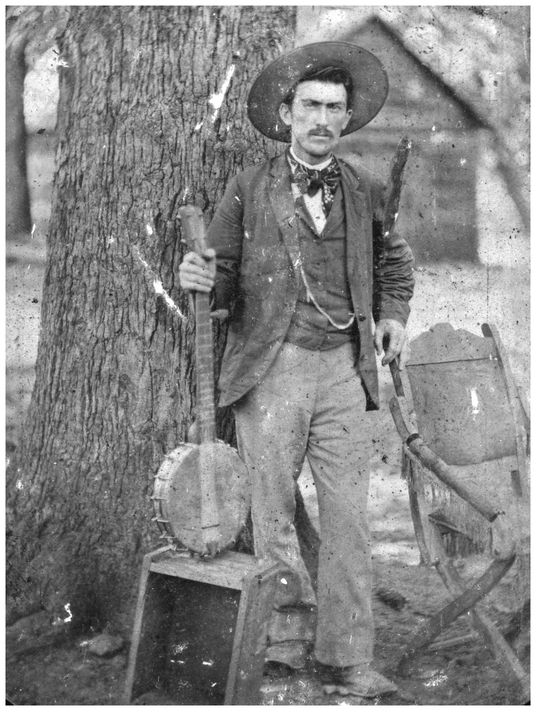
6) Richard Carlin and Bob Carlin: Southern Exposure: The Story of Southern Music in Words and Pictures (Billboard Books). Mostly pictures, from the 1880s to the 1950s—pictures of musicians who made the music that in the 1920s was already the last word of another world. It’s the real world of O Brother, Where Art Thou? especially in one mottled, degenerating photo: it shows a dashingly handsome, dark-haired man with dark, hooded eyes looking you in the face under a broad-brimmed hat. Foulard tie, jacket, vest, watch chain: holding his five-string banjo, he is the dandy, the woman stealer. You wake up next to him and he’s already gone. In Warren Smith’s irresistibly slow, beckoning 1957 rockabilly tune he’s the man with a “Red Cadillac and a Black Moustache,” but all through Lee Smith’s 1992 novel The Devil’s Dream, back from her to the Carter Family in 1940, making a circle with Bob Dylan’s 1992 Good As I Been to You, he’s Black Jack Davey. Given what stories, regrets, laments, fond memories, or erotic dreams he might have left behind in Hope, Arkansas, where he stands as his picture is taken, sometime in the 1890s, he’s also Bill Clinton.
7/8) Kasimir Malevich: Dynamic Suprematism, 1915/16, and Bill Woodrow: Twin-Tub with Guitar, 1981, at the Tate Modern (London, through 2000). In a huge, insistently conceptual long walk through twentieth-century art, these pieces jumped out. In the Manifesto Room of the History/Memory/Society sector, the old broadsides covering the walls shout and stamp their feet, announcing Futurism, the Bauhaus, Kandinsky’s New Theater, Suprematism itself, while off in a corner Wyndam Lewis is Blasting England to bits. Among a few other paintings is the Malevich, a tilted but upright triangle: it’s quiet, modest. From somewhere in Russia it pulls all the noisy declarations of the future into its own abstraction and silences them. In its abstraction, the piece at least seems to speak clearly—about the ease of remaking and rearranging the world, its constituent elements of life. If you keep looking, though, the triangle begins to seem like a figure, an idea, a person, someone with a name. With the bars and squares that score the triangle now arms, eyes, and hats, the figure gestures. It is now obese, absurd, threatening, its identity so obvious: Alfred Jarry’s loathed and loved Pere Ubu, in Jarry’s own woodcuts the same shape, the same fascist trod across whatever might be in his way—and now, with Ubu on the march into the New Day, somehow morally cleansed.

Ivan Chtcheglov, 1953, “Formulary for a New Urbanism”: “Given the choice of love or a garbage disposal unit, young people all over the world have chosen the garbage disposal.” Not so fast, says Bill Woodrow, born 1948 in the U.K., in his own room in the Still Life/Object/Real Life sector. For his piece he’s cut the outline of an electric guitar out of the grimy metal casing of a post-war Hotpoint washing machine but not removed it, so the two remain attached like a parasitic twin still part of its host. The curators comment: “The sculpture wittily combines two potent symbols of Western consumerism.” Not so fast: why not art out of functional-ism, or the art hiding in object of utility, desire hiding in need? Woodrow: “The guitar was a pop icon and the washing machine was an everyday, domestic item. So it was bringing the two things together like a slice of life.” Not so fast: why not the urge to create sneaking out of the wish for comfort, and superseding it? There’s no trouble imagining this as Pete Townshend’s diddley bow, his first guitar.
9) Middle-aged man shaking a cardboard coffee cup full of change like maracas (6th Avenue and 13th Street, New York, November 5). He was hammering out a tremendously effective R&B number that sounded halfway between anyone’s “C. C. Rider” and almost anything by Bo Diddley, and it wasn’t until I’d added my change to his and was halfway down the block that the song revealed itself out of its own beat: Elvis Presley’s first record, “That’s All Right.”
10) Pere Ubu 25th Anniversary Tour (Knitting Factory, New York, October 14). “The long slide into weirdness and decay,” leader David Thomas announced. When synth player Robert Wheeler moved his hands over two homemade theremins—to play the theremin you can’t look like anything but someone casting spells—the small pieces of metal seemed less like musical instruments than UFOs, and the high-pitched sounds coming from them, drifting through the rest of the music like swamp gas, nothing but the cries of creatures trapped inside. Like any number of people other than myself must feel as I write, the day after the election.
Salon
28 November 2000
Special bizarre all-quotation edition!
1/3) Alan Berg and Howard Hampton on Election night and after: Berg, November 6. “I am trying to cope with my jitters by listening to the five CDs of Dylan’s Basement Tapes bootlegs and nothing else till it’s over.” November 9: “I didn’t think I’d have time to listen to all five CDs. When things got rough, right before Pennsylvania came in, ‘Clothesline Saga’ came on and that took care of Pennsylvania. Right now it just went to ‘We carried you / In our arms / On Independence Day.’ No question about what this will be resolved on: ‘I’m Not There.’” Hampton, November 18: “Today I played the only appropriate song I could find: ‘I Was in the House When the House Burned Down.’”
4) Fran Farrell: “I Want to Be Teenybopped: Teen Star Sex Fantasies” (Nassau Weekly, Princeton, N.J., October 19). “Jordan Knight, of the New Kids on the Block, was the first person I ever masturbated about . . . While my friends were playing with Barbie, I was imagining having sex with Jordan, and sometimes a three-some with Joey, on their big tour bus. See, I met Jordan when I was 10; it was downhill from there. Fast forward 10 years, to London, England. I’m walking down the street when I see a sign, the most beautiful sign I’ve ever seen—Jordan Knight, performing at 4 o’clock today. I couldn’t believe my luck. Then I thought, this isn’t luck, it’s fate. We met 10 years ago, but now it’s legal for him to have sex with me!!!! So I wait in line for FOUR HOURS. Yes, four hours for that has-been. The line was full of 15-year-old girls with thick British accents, acne and very bad teeth. I was squished in the middle of a crowd of sweaty, ugly girls screaming for a washed-up ’80s pop star. But when he came onstage . . .”
5) Sen. Joseph Lieberman: Fiftieth birthday greeting for Bob Dylan (U.S. Senate, 24 May 1991). “Twenty-five or thirty years ago, I would have had a very difficult time imagining Bob Dylan, whose music was so much a part of my life at the time, being fifty years old, an age he attains today, his birthday. I would have had even greater difficulty imagining me taking note of his achievements in remarks in the Senate of the United States.
“Back in 1963, it is hardly likely any member of Congress would have been talking about Bob Dylan, at least not on the floor or either chamber; at least not in favorable terms. After all, it was he who said of them, ‘Come senators, Congressmen, please heed the call / Don’t stand in the doorway, don’t block up the hall.’ So times have changed, though Dylan’s sentiment still holds true when we consider how many problems we still have to heed. I am sure he sings those words with the same spirit and intensity today as he did twenty-eight years ago.16
“There is a mystery to Bob Dylan, which is surprising, in a way, given how freely he has expressed himself through his music. But the mystery results, I think, from Dylan’s refusal to play roles society might seek to assign him—roles like superstar, rock idol, prophet. ‘I tried my best to be just like I am / But everybody wants you to be just like them.’”
6) David Thomson: The Big Sleep (BFI Publishing). On Lauren Bacall, director Howard Hawks, and To Have and Have Not (1944): “Betty was born in 1924, and grew up looking like nothing else on earth. I mean, how does one describe that young woman who could look like a Jewish teenager, a Eurasian doll, a Slav earth mother and the smoke that gets in your eyes—and all that before Hawks got hold of her? Add to that the allegation that she was only seventeen, and you can see what a wide-open country America was then.”
7) Ishmael Reed: on the dance mania “Jes Grew” sweeping the nation after the election of Warren G. Harding, “the first race president,” in 1920, and the conspiracy of the “Antonist Wallflower Order” to stop it, from Mumbo Jumbo (Scribner, 1972). “It has been a busy day for reporters following Jes Grew. The morning began with Dr. Lee De Forest, inventor of the three-element vacuum tube, which helped make big-time radio possible, collapsing before a crowded press room after he pleaded concerning his invention, now in the grips of Jes Grew: ‘What have you done to my child? You have sent him out on the street in rags of ragtime to collect money from all and sundry. You have made him a laughingstock of intelligence, surely a stench in the nostrils of the gods of the ionosphere.’”
Tycoon Walter Mellon: “Jes Grew tied up the tubes causing Dr. Lee De Forest to cop a plea at the press conference . . . At the rate of radio sales, 600,000,000 dollars’ worth will be sold by 1929, correct?”
Hierophant I of the Wallflower Order: “That is true, Mr. Walter Mellon.”
“Suppose people don’t have the money to buy radios. It will be an interesting precaution against this Jes Grew thing, isn’t that so?”
“I don’t get what you’re driving at, Mr. Mellon.”
“The liquidity of Jes Grew has resulted in a hyperinflated situation, all you hear is more, more, increase growth . . . Suppose we shut down a few temples . . . I mean banks, take money out of circulation, how would people be able to support the appendances of Jes Grew, the cabarets the juke joints and the speaks. Suppose we put a tax on the dance floors and get out of circulation J.G.C.s like musicians, dancers, its doers, its irrepressible fancy. Suppose we take musicians out of circulation, arrest them on trumped-up drug charges and give them unusually long and severe prison sentences. Suppose we subsidize 100s of symphony orchestras across the country, have government-sponsored Waltz-boosting campaigns . . .”
“But wouldn’t these steps result in a depression?”
“Maybe, but it will put an end to Jes Grew’s resiliency and if a panic occurs it will be a controlled panic. It will be our Panic.”
8) Hal Foster: Election “Diary,” on a word soon to disappear from our lexicon (London Review of Books, November 30). “Chad . . . For some reason I think of Troy Donahue, and imagine him dimpled, pregnant, hanging or punched.”
9) Colin B Morton: on Metallica and Napster in “Welsh Psycho: Extracts from the Teenage Diary of Colin B. Morton” (Clicks and Klaangs #3, October/November). “William Hague, leader of the UK Tory Party, has recently come out in defense of a man who shot dead a youth who was trespassing on his private property. Even more recently, the Tory Party has used, without permission, the music of Massive Attack to help promote the idea that we shouldn’t have to pay tax or care about the sick. Hague’s own logic dictates, therefore, that Massive Attack’s Daddy G and 3D should have the right to shoot all members of the Tory Party for trespassing on their Intellectual Property. Either Intellectual Property doesn’t exist, or they can have that right. Hague can’t have it both ways. (Well, he can, but that’s another story entirely.)”
10) Special “Forward into the Past” Election Update—Francis Russell, The Shadow of Blooming Grove: The Centennial of Warren G. Harding (McGraw-Hill, 1968), quoting Progressive newspaper editor Brand Whitlock on the Republican Party’s nomination of Warren G. Harding as its candidate to replace Woodrow Wilson: “I am more and more under the opinion that for President we need not so much a brilliant man as solid, mediocre men, providing they have good sense, good and careful judgment, and good manners.”
Salon
19 March 2001
4/5) Low: Things We Lost in the Fire (Kranky) and Peter S. Scholtes, “Hey, We’re in Duluth” (City Pages, February 7). “When they found your body / Giant Xs on your eyes / And your half of the ransom,” Alan Sparhawk sings in “Sunflower,” “The weather hadn’t changed”—I made the last line up, but it wouldn’t be out of place. From Duluth, where forty-two years ago Bob Dylan sat in the audience at the National Guard Armory as Buddy Holly played his third-to-last show, this notoriously unhurried trio captures the insignificance of human desire as opposed to the fact of a Minnesota winter even as they suggest they might prefer that the weather never change at all. Or, as Scholtes puts it in his Twin Cities visitor’s piece on “the emerging sense among Duluthians of an emerging sensibility among Duluthians”—that is, signs of a termite culture going public—“if there is one certainty at the heart of Duluth’s mystique it is Lake Superior. The lake is always there and it is always cold. It will always be there and it will always be cold. Nothing about the physical landscape of the lake’s corner should make a visit this spring more pressing than one the next.”
7) When Brendan Met Trudy, directed by Kieron J. Walsh, written by Roddy Doyle (Collins Avenue/Deadly Films 2). As culture—the picture it draws of what it means to live happily, almost fully, in a funhouse of representations—the writing in this movie is as sexy as the smile in Flora Montgomery’s eyes. “He makes movies,” Montgomery’s young thief says to her warden, describing her schoolteacher boyfriend, and he does: home movies, as scripted by Godard, Iggy Pop, Kevin Spacey, Jean-Claude Van Damme starring in Remedial Action. As when he runs into one of his teenage students, whose name he can never remember. “Dylan,” the boy reminds him, as his parents beam at the one remaining sign of a hipness long since erased by the class system. “Mr.—Tambourine Man,” the teacher says, having already forgotten the student’s name again but translating the reference into a bigger story. The kid has no idea what he’s talking about.
Salon
2 April 2001
5) The Early Blues Roots of Bob Dylan (Catfish). The tribute album backward—assembling the originals, the set makes the present-day man pay homage to his forebears, whether he wants to or not. But Bob Dylan is not at issue—right off, with the Mississippi Sheiks’ 1931 “I’ve Got Blood in My Eyes for You,” you hear how completely sixty-two years later he entered the song and changed it from the inside out. The structure remains the same; only the soul is different. Rather, it’s the wide range of the compiler’s ear—picking up Booker T. Sapps’ obscure 1935 “Po’ Laz’rus,” Will Bennett following the melody of “Railroad Bill” in 1929 like a man going downstream in a canoe, the Rev. J. C. Burnett chanting “Will the Circle Be Unbroken” in a black church in 1928—that makes you realize what an undiscovered country remains to be found. When, just before the end, in the Parchman Farm Penitentiary in Mississippi in 1939, Bukka White begins to hammer the high, ringing chords of “Po’ Boy,” his voice an eternal whine, as if he knows this is the only way to get God’s ear, you reach that country, and you can’t believe you have to leave. You can; he couldn’t.
Salon
1 May 2001
2) No Depression in Heaven—An Exploration of Harry Smith’s Anthology of American Folk Music, produced by Hal Willner (Getty Center, Los Angeles). The sixties Cambridge folkie Geoff Muldaur led the assemblage. He looked like the kindly town pharmacist; when he opened his mouth Noah Lewis’ 1928 “Minglewood Blues” came out like a tiger. “You’re going to be killing a lot of people tonight, aren’t you?” fiddler Richard Greene asked Rennie Sparks of the Handsome Family, who was one of only four or five people under forty, or maybe fifty, on the stage. “That’s what I do best,” she said sweetly. Sparks writes lyrics about murder and clinical depression for her husband, Brett, to sing; she introduced the Blue Sky Boys’ 1936 “Down on the Banks of the Ohio” as a song in which “a woman is slaughtered to ensure the river remains full.” “This record sounds like it came from Mars,” Greene said, kicking off Floyd Ming and His Pep Steppers’ 1928 “Indian War Whoop” (a new version orchestrates Baby Face Nelson’s arrest in O Brother, Where Art Thou?). It sounded just like Slim Whitman’s “Indian Love Call,” which in Mars Attacks! makes all the Martians’ heads explode.
The fourteen-person band was heading toward cuteness when Garth Hudson began to play. He was everywhere at once. As soon as you thought you caught a tune—“Home Sweet Home,” “Shenandoah”—it vanished. He was an avant-garde pianist in a 1915 grind house, forgotten girlie flicks and In-a-castle-dark epics turning profound under his fingers. And then, like a sermon, came a low, thick, unbending voice from the back of the stage, insisting on the Great Depression as God’s will, punishment for sins unknown, even uncommitted, and insisting on the only solution, which was suicide. “I’m going where there’s no Depression,” as the Carter Family sang in 1936, on their way to heaven. “There’ll be no hunger, no orphan children crying for bread / No weeping widows, toil or struggle.” The singer was Maud Hudson, and when, with absolute dignity, she reached the lines “No shrouds, no coffins / And no death,” you realized the song was calling for nothing so small as the end of a life, but for the end of the natural order: the end of the world.
Salon 14 May 2001
Special Absurdity of Worldwide Commemoration of Bob Dylan’s May 24 60th Birthday Edition!
1) This column has been unable to confirm a report that at his May 1 concert in Asheville, N.C., Bob Dylan performed his Oscar®winning song, “Things Have Changed,” with the Thing Itself prominently displayed on a speaker cabinet. True or false, the story doesn’t touch the night Michael Richards showed up on The Tonight Show wearing his new Seinfeld Emmy as a necklace.
2/3) Bob Dylan: “You Belong to Me” on Natural Born Killers—A Soundtrack to an Oliver Stone Film, produced by Trent Reznor (nothing/Interscope, 1994) and “Return to Me” on The Sopranos: Peppers & Eggs—Music from the HBO Original Series (Sony). Listening to his startlingly gentle version of “You Belong to Me” on the Natural Born Killers soundtrack, you could figure that Jo Stafford would have smiled at Dylan’s cover of her 1952 smash, her biggest record. And you can imagine what Dean Martin would have to say about this cover of his 1958 smash—and his best record. Probably he wouldn’t say anything, just give Dylan the same sneer Robert Mitchum gives Johnny Depp in Jim Jarmusch’s Dead Man. A look that says, “Are you still here?”
4) A Nod to Bob: An Artists’ Tribute to Bob Dylan on His Sixtieth Birthday (Red House). Suzzy and Maggie Roche can’t help letting you know how clever they were to choose “Clothesline Saga,” one of Dylan’s coolest songs—and their bohemian posing stands out as rock ’n’ roll raunch on this collection of bored and pious folkie tributes, most of which somehow project condescension through the veil of homage. But if you’re ever yearned to hear “I Want You” done as a prayer, this is for you.
5) New Dylan Alert! Robbie Fulks: Couples in Trouble (Boondoggle). Fulks has an uncanny ability to write songs as if they were remembered from a previous life—a life lived in England in the 17th century. This album leads off with “In Bristol Town One Bright Day”—“A stranger he came calling,” that other person says through Fulks. It’s a new—or unfound—version of “The Daemon Lover,” dripping blood: “And on his lips the strangest words seemed so meek and common.” You want a warning? That’s a fire alarm. This is the sort of song Dylan would be sneaking into his shows next week, if he hadn’t already recorded it as “House Carpenter” (1962, on the bootleg series, volumes 1-3) and “Blackjack Davey” (in 1992, on Good As I Been to You). As for Fulks, the rest of the record is Don McLean in loud clothes.
6) Duluth Does Dylan (Spinout). Bands who still live where Bob Dylan was born dive in with no respect and come out sounding as young as they are. Not all of it is good, and some of it’s horrible, but little is predictable—not Chris Monroe’s deep winter cover drawing, the First Ladies’ wasted “Father of Night,” or the way the chorus of “Like a Rolling Stone” keeps surfacing in the Black Labels’ Where did you say we are? And who are you, anyway? reading of “Rainy Day Women #12 & 35.” Everybody must get stoned, like a rolling stone—why didn’t anyone think of that before?
7) Old New Dylan Alert! Bob Marley & the Wailers: Catch a Fire: Deluxe Edition (Tuff Gong/Island). Before releasing the Jamaican sessions that made up this 1972 album—songs included “Stir It Up,” “Kinky Reggae,” “400 Years,” “Slave Driver,” and “Stop That Train”—producer and label owner Chris Blackwell had some overdubbing done in London. This set presents the originals—including two numbers left unrevised and unissued—on one disc, plus, on a second, Catch a Fire as it almost, but not quite, caught fire around the world.
“Concrete Jungle”—here in its first form as a Jamaican single—was always the test between the real thing and its adulteration. This profound protest against the specific political and economic realities of Jamaica in the moment, and against the weight of history, of slavery, pressing down like an elephant’s foot every time the singer tried to think, speak or act, is smaller as the Wailers made it on their own—spare, the sound open, the backing vocals word-by-word clear. Despite the backing singers, and the careful, impeccable rhythm of the band, this is one man’s testament, a work of dignity.
In London, John “Rabbit” Bundrick of Texas added organ, and Wayne Perkins of Alabama added guitar; the backing vocals were muffled, and somehow given even greater presence. There is a long, slow introduction, Perkins edging his way into the theme like a stranger trying to walk into a bar without anybody noticing, though after one turn into the music he’s got his money out. Aston Barrett’s bass, a counter in Jamaica, is huge here; as much as Bundrick’s Garth Hudson-like tentacles, it’s this that makes a mood in which you can’t tell curse from judgment, the future from too late. Straight off, the sound puts everything in doubt, and everyone on the record in jeopardy.
As the song goes on, the backing singers seem to circle Marley’s lead, pointing at him, smiling, frowning, offering approval, withholding it, and soon the prosaic has vanished from the performance: the crying chorus is made up of the “many thousands gone” of “No More Auction Block.” “Where Dead Voices Gather,” Nick Tosches calls his forthcoming book on 1920s blackface minstrel Emmett Miller; this remixed “Concrete Jungle” is one place they gather.
All through the progression of the song, Perkins has been waiting, offering up a sign or a riff, a comment or a counterpoint, like the man in the bar looking a split-second too long at the guy who seems to own the place, holding his glass in a way not quite the same as anyone else, calling another drink with words that are English but sound like Spanish. As Marley steps back, then, Perkins steps in. The solo he plays is so restrained in form, and so passionate in tone, it translates the pain of Marley’s story into a dream beyond words or even images. It is a dream of flight, of the running man trapped, escaping only to be trapped again, until, in a shocking moment, the solo turns over, and turns back on itself, as if to say, this record will end, but the story can’t end. Not well; not even badly. And you can’t wait it out. “400 Years”? You thought that meant from then to now, but it means from now to then.
8) Bob Dylan: Live: 1961-2000: Thirty-Nine Years of Great Concert Performances (Sony Japan). Sixteen tracks, from “Wade in the Water,” taped in 1961 in Minneapolis, to “Things Have Changed,” from Portsmouth, England, last year. Killer: “Dead Man, Dead Man,” studio version on Shot of Love, 1981. Taped in New Orleans that same year, “Dead Man” is a textbook warning against the devil, if you listen as if you’re reading; if you hear it, it’s a poker game, and the singer’s winning.
9) Pre-Dylan Alert! Robert Cantwell: “Darkling I Listen: Making Sense of the Folkways Anthology,” talk at Harry Smith: The Avant-Garde in the American Vernacular (Getty Center, Los Angeles, 20 April 2001).17 About old American music, as first recorded in the 1920s and assembled by Smith in 1952 as his anthology American
Folk Music—which, given the degree to which he absorbed it, in the late fifties and early sixties might have been Bob Dylan’s pillow. The records were not quite the songs, and the performances of the songs were not quite the songs either, Cantwell argued: when seven decades ago those who Dylan once called “the traditional people” faced new machines, what resulted were “thought experiments, science fictions—newer than new, as it were, and older than old. They lead us, finally, to the Anthology’s central mystery: How can these performances have found their way to thoserecords? Or better, these records to those performances?—questions that would not arise at all were it not for the still deeper question with which Harry has confronted us: What is a record?”
With the strange old sounds (“It is the sound of the old records we have, not the records themselves”), Cantwell said, Smith “placed us roughly where the listeners to Edison’s phonograph were, phenomenologically speaking, in the early weeks of its public unveiling, when, according to the editor of the Scientific American, ‘the machine inquired as to our health, asked how we liked the phonograph, informed us that [it] was very well, and bid a cordial good-night. ’ At succeeding demonstrations young women fainted; eminent scientific heads were convinced it was a trick of ventriloquism; a Yale professor pronounced it a flat-out hoax. What was this machine that could steal the human voice? That could make absent people present—or was it that it rendered present people absent? That immortalized the human voice, but at the same time abolished it? What can one say of a machine that brings the dead back to life, but in the same instant buries them again?” No one has ever come closer to rendering Smith’s selections—the likes of the Alabama Sacred Heart Singers’ “Rocky Road” or Blind Lemon Jefferson’s “See That My Grave Is Kept Clean”—in mere words, as opposed to, as with Dylan’s versions of the latter, on his first album in 1962, and in the basement tapes sessions five years later, more recordings.
10) Anonymous Dylan fan (e-mail, May 7). “Bob birthday blast of coverage reminds me of fifties country song—I forgot to remember to forget—except updated—I forgot, then remembered then forgot then remembered then remembered why I never should have forgotten in the first place.”