London Times
7 June 2008
What’s this stick-figure fisherman looking over a harbor full of blues and yellows and lots of sunny white? It’s one of the 170 Drawn Blank gouaches and watercolors that Bob Dylan made last year—going back to a collection of Drawn Blank black and white drawings and sketches he’d made between 1989 and 1992, taking transfers of the old work, painting over them, discovering what the old pictures wanted to become.
Like many pictures more—Amagansett, Vista from a Balcony, Bicycle, Still Life with Peaches, Sunday Afternoon (which could be called “Sunday Painter”)—Fisherman is also postcard art. It’s the sort of stuff that’s sold in tourist towns in the retail equivalent of tea rooms, the stores that call themselves shoppes and charge extra for the cards “By Our Local Artists.” An overstylization, which here is a lack of style, presses a banality that often seems to be the ruling principle of the pictures (“Drawn Blank?” Firing blanks? Or a shooter who doesn’t even look at what he’s shooting at?). Depthless bodies and faces match the dullness of the pleasant scenes, their primitiveness its own kind of pretentiousness, whether it’s Woman Near a Window, Society Lady (so much less than the Weegees it seems to come from, just as Reno Balcony calls up Robert Frank’s 1956 view from a hotel room in Butte, Montana), portraits of Tom Clark, Paul Karaian, Nick LeBlanc, Cupid Doll, or any of the nudes and semi-nudes. You’ve seen it all before. But others draw you into a dialogue. Where is this place? Have I been there? Is it real?
Here, working through three or four new paintings made from a single old drawing, what’s shown no longer fits into its cliché. Houses—House on Chestnut Street, Front Porch of a House on Hayes Street—seem almost to burst from some unseen pressure, as if they’re rotting from the inside. The heat that comes out of the density in Freret Street New Orleans is instantly recognizable if you’ve ever been there, but you haven’t seen it before: unlike the person who painted this, you haven’t imagined how it looks. TV sets, found in motel rooms—Lakeside Cabin, View from Two Windows —hold more secrets than women. The women pretend to be alive, or the painter is trying to bring them to life; the TV sets acknowledge they’re already dead, or the painter has somehow broken them before they were turned on. Looking at these little boxes, you can’t imagine that they ever carried pictures of their own.
The work here that sings with invention, play, seriousness—a commitment to the moment the image is making—comes with a few Twilight Zone-like variations: like an octopus changing colors before your eyes, in Corner Flat the same chair is occupied by four different people, seemingly in an instant, as if it’s a single person in disguise against his or her own self.
In Rose on a Hillside, there is a rose in the foreground. Behind it, absolutely different scenes—mountains, a small town, a house, the New York skyline from across the Hudson—loom up in turn, as if, if you know how to look at the rose, it will call up whatever you desire. There is Train Tracks:a western scene, a track to its vanishing point, mountains in the background, a depot, a telegraph pole. One in blue and green and brown, two in black and white except for a warm brown for the track, three, it’s a movie set—and then, with the final version, the whole scene in black and white, save for the sky, blank before, now a quiet explosion of pure gold.
It’s a visionary moment, just as the oh-so-contemplative series Man on a Bridge is its counterfeit—for those who need to reduce all art to autobiography, pictures which allow the viewer to imagine that the bearded figure there is Bob Dylan himself, at the crossroads of life. Symbolism! But the last Train Tracks is not symbolism. It’s not reducible. You want to go to this place. You want to see that sky happen. You can’t, so you settle for the next best thing. You keep looking at the picture—which after all made up that sky as if it had never been, which maybe it hadn’t.
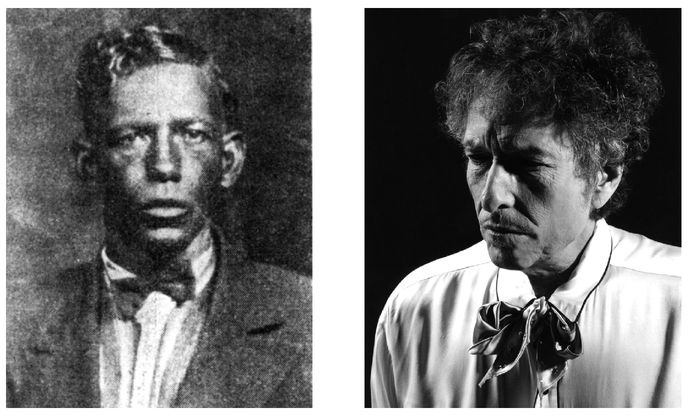
The portrait of Bob Dylan that serves as a frontispiece for the book version of The Drawn Blank Series is a 2006 photo by William Claxton—the jazz photographer best known for his intimate, almost preternaturally cool mid-1950s pictures of Art Pepper, Billie Holiday, and most of all Chet Baker. His Dylan picture seems based on the only photo known of the protean Mississippi bluesman Charley Patton, made in about 1929. Dylan’s floppy bow tie ties the two together; both communicate a sense of weight, knowledge, experience, fatalism. Those qualities are present here and there in the Drawn Blank pictures—not so fully as in the strongest of Dylan’s recent music, “Ain’t Talkin’” from the 2006 Modern Times, but with an unlikelihood to make you realize Dylan’s songs don’t say all he might want to say.
Bob Dylan, The Drawn Blank Series. New York: Prestel USA, 2008.