
I BELIEVE ALL THE POLLS, AND NONE OF THEM
Salon
3 November 2008
I write four days before the election, in Minnesota, where yard signs are everywhere. Here in the modest Uptown part of Minneapolis, it’s almost all Obama; in the wealthier sections you can find McCain signs that loom as large as billboards. At a family dinner one night we toasted misery on the next-door neighbors. This is a very patriotic part of the country. People are proud of their convictions.
For weeks, all of the indicators, measurements, polls, and calculations have pointed to an Obama victory, even an overwhelming rout. But while I read the polls many times a day and half believe them—believe them all, the poll that has Obama leading by 15 as much as I believe the poll on the same day that has him leading by 2—I also believe absolutely none of it. My whole life, my upbringing, education, travel, and talk, from working in Congress as an intern at the height of the Civil Rights movement in the mid-1960s to every election in which I’ve ever voted, makes it all but impossible for me to believe that, on Tuesday, a single state will turn its face toward the face of a black man and name him president of the United States.
Throughout the primary season it was trumpeted again and again that regardless of the outcome of the Democratic contest, the nation would see its first major-party ticket headed by either a woman or a citizen whose skin was not white. But it was not remarked on that, in a world where women have led Israel, India, Great Britain, and Germany, a female president was not unthinkable, but that an African-American president was. “I never expected to see this in my lifetime,” the white, left-wing journalist Larry Bensky, in his sixties, said one day on the radio, bitterly, because while it was a fact, it was not necessarily true: he could not credit it. He might have been thinking that it was all an illusion, a trick the country was playing on itself. Could the election be a vast and horrible twenty-first century version of the now-forgotten 1950s embarrassment Take a Negro to Lunch Day, or the nation remade as its own blackface minstrel show, with the whole thing over when the sun goes down?
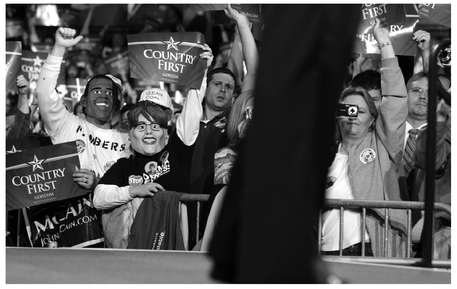
McCain rally, Concord, South Carolina, 21 October 2008, New York Times.
The more likely an Obama victory seems, the more monstrous the alternative has become. That is partly because McCain has made himself a monster of hate and lies, homing in on the evil that lies as a legacy in the heart of every white American: a guilt that turns into fear, less of a strangely calm, eloquent, dark-skinned man not yet fifty, but of even symbolic reckoning for four hundred years of racist crime.
But the specter of a McCain presidency, with Sarah Palin waiting in the wings—a Dominionist, which is to say she believes, and entered politics to ensure, that her God by right has and by her hand will enjoy dominion over every aspect of life in the United States—seems monstrous also because it promises, at best, in merely practical terms, to wreck the country, if not to erase it, leaving the Constitution the dead letter Bush and Cheney have worked to make it, acting, throughout their terms, as if it already were. The country that as it has for more than 200 years struggled both to escape and live up to its charter is still recognizable, but there have always been Americans who never recognized that America, and McCain now stands for them.
What sort of president might Barack Obama be (“If,” in the thought that crosses so many minds if not so many mouths, “he lives”)? The presidency changes people; there is no way of telling. He might be ground down, his gift for speaking of complex things in a complex way that sounds like ordinary talk breaking up into catch-phrases and clichés, as on the campaign trail in its last days, Obama like McCain repeating the same lines hour after hour until even he must be nearly choking over the way a truth can feel like a lie. Or he might, with a carriage and a way with words that makes comparisons with John F. Kennedy seem to flatter Kennedy, not him, again plant seeds of possibility that anyone might harvest.
There are also comparisons to Lincoln, and these map the desert Obama as president would have to cross. “Instead of glory, he once said,” the historian Richard Hofstadter wrote of Lincoln, “he found only ‘ashes and blood.’” For the moment, for the country, perhaps for Obama too, that would be reward enough.
ELECTION NIGHT
GQ Style March 2009/ Black Clock 2010
“It’s been a long time comin’, but—” So said Barack Obama in the first moments of his victory speech in Grant Park in Chicago on election night, calling on Sam Cooke along with the other familiars—Abraham Lincoln, Martin Luther King, Jr.—he invisibly but unmistakably gathered to his side. “If you ever hear me sing ‘A Change Is Gonna Come,’” Rod Stewart once said of Cooke’s song, released in late December 1964, just after Cooke was shot to death outside a motel in Watts, “you’ll know my career will be over”—because, Stewart seemed to imply, he would not be able to look an audience in the face after failing to live up to the song. But Obama had more confidence—or, because he was perhaps testifying that, not four years old when “A Change Is Gonna Come” first aired on the radio, he had lived out his life under the shadow of the song, had carried it with him like a manifesto, Obama was asserting that he could not only sing the song, in his own way, in his own cadence, but rewrite it. “But I know, a change gone come,” Cooke sang. “Change has come to America,” Obama said. Did he really do that? Did Sam Cooke really do that?
I wasn’t in Chicago that night. I was in Minneapolis, in Northrop Auditorium at the University of Minnesota, in the audience, as Bob Dylan played for the first time on the campus of his erstwhile alma mater. The second song was “The Times They Are A-Changin’,” from the year before “A Change Is Gonna Come,” a song I’ve never liked. It always seemed as if it were written by the times, which is to say it felt like a manifesto written by a committee, or commissioned by one. But on this night so much history was loaded into the song it was impossible not to be sucked into its gravity.
Dylan paced the song with space between the words, the rhythm the steps of someone making his way through an empty mansion with both care and dread. It was as if the song, or the history it carried, was moving in slow motion, carrying—as Obama would say later in the night of a 106-year-old voter named Ann Nixon Cooper, “born just a generation past slavery”—not only the history the song was made to celebrate—“She was there for the buses in Montgomery, the hoses in Birmingham, a bridge in Selma, and a preacher from Atlanta who told a people ‘we shall overcome’”—but the history that remained to be made: the history that the song and those present to hear it would witness as it and they had witnessed what had come before.
But it was more than that. As Dylan took all of the triumphal-ism out of the song, the cheering, the defiance, all of the easy ride the song had promised when it first appeared, he turned it into a kind of dirge. He divided history in two: the time the song had, now, outlasted, and the time that would, now, test it. As a dirge the song became a warning: in the past, the people listening had or had not made the history the song spoke for, but now they would have to make it, or fail the song just as Rod Stewart believed he would fail “A Change Is Gonna Come.”
The last song of the night was “Blowin’ in the Wind,” another song I’ve never liked, another song that, this night, for me rang a bell it never had before—even if it was, as Sam Cooke himself stated plainly, the song that inspired him to write “A Change Is Gonna Come.” “I was born in 1941,” Dylan said just before he began the number. “That was the year they bombed Pearl Harbor. I’ve been living in a world of darkness ever since. But it looks like things are going to change now.” I only caught the last line; when the song ended, everyone crowded into the Northrop lobby, under a giant television screen tuned to CNN. It was ten o’clock, just as the polls closed in California, just as the anchorman over our heads announced that Barack Obama had been elected president of the United States. Dylan had not gone a minute past where he knew the show had to end.
What happened then, all over the country, and all over the world—people shouting through their tears—is not unrelated to the way Obama was able to call up “A Change Is Gonna Come” as he spoke that night. It is not unrelated to the sense of authority that has surrounded Obama since. Almost always, when someone is elected president of the United States, whether it is someone you supported or someone you opposed, it takes a long time before the attachment of the word president to that person’s name begins to sound even remotely real, and with Obama that was not true on election night and it has not been true since. That is, I think, because of the way he speaks—a manner for which the word eloquence is merely pretty, and hollow.
It’s the ability to speak of complex things to large numbers of people in a way that neither compromises the complexity of what the speaker means to say nor insults the intelligence of those who are listening—to speak in a manner that itself attunes those who are listening to their own complexity. I am thinking of Obama’s speech on race, from March 18 of last year, when controversy over statements and sermons by the Rev. Jeremiah Wright threatened to derail his campaign—a thirty-seven-minute address that gathered listeners as if around a campfire—but I am also thinking of a scene from John Ford’s 1939 film Young Mr. Lincoln as described in Short Letter, Long Farewell, a novel published by Peter Handke in 1972.
The narrator, a young Austrian in America, goes to a theater. Lincoln, played by Henry Fonda, has agreed to defend two brothers accused of murder; a drunken mob arrives at the jail to lynch them, and Lincoln faces it down. He talks; he captures the drunks, the narrator says in wonder and awe, not missing the flicker of an eyelash, the turn of a vowel, “by softly reminding them of themselves, of what they were, what they could be, and what they had forgotten. This scene—Lincoln on the wooden steps of the jailhouse, with his hand on the battering ram—embodied every possibility of human behavior. In the end not only the drunks, but also the actors playing the drunks, were listening intently to Lincoln, and when he had finished they dispersed, changed forever. All around me in the theater I felt the audience breathing differently and coming to life again.” That is what eloquence is too weak a word for: speech that is not only about democracy, but that is itself democratic.
In The Human Stain, published in 2000, Philip Roth tells the story of Coleman Silk, a seventy-two-year-old man from an African-American family from East Orange, New Jersey, who has passed as a Jew—that is, as a white man—his entire adult life. Reading the novel now, one can hardly avoid imagining Barack Obama into its pages, not because he ever passed or ever could, but because as an African-American he seems to have invented himself as absolutely as does Coleman Silk. “What do we really know about this man?” John McCain asked throughout the fall campaign, and even without the innuendo—was he a Muslim, a communist, somehow a terrorist?—the question hit home because it was about something real. Obama’s very ease in his own skin, his apparent immunity from slurs and lies—like Jackie Robinson in his ability to trust in his own gifts and never betray his own rage at the slurs and lies that by election day had at Republican rallies become a torrent of hate, with crowds shouting “Traitor!” and “Kill him!” at the mention of his name—spoke for, as Roth wrote of Coleman Silk, “the democratic invitation to throw your origins overboard if to do so contributes to the pursuit of happiness.” Obama seems like his own creation: that is the source of his aura, the sense of self-command that draws people to him, and it is at least partly the sense that he is not quite real, not quite human, that terrifies, or sickens, others. The self-made American embodies America, a nation that was itself made up—“Every day,” Roth wrote, “you woke up to be what you had made yourself”—but the self-made American is also a kind of Frankenstein.
The banner headline on the front page of the New York Times the day after the election was queer in its affirmation of what the election had been about: RACIAL BARRIER FALLS IN HEAVY TURNOUT. As a self-invented American, one who could claim the history of the Civil Rights movement, as in his litany of place names from Montgomery to Atlanta, without excluding anyone from that history, Obama did not run as someone who had set himself against a racial barrier. A particular individual set himself a goal and achieved it; America was not less racist the day after the election than it was the day before it. But perhaps what was wrong about the headline was that it spoke in terms that were too narrow, too small, too merely functional for what had actually occurred.
The country may not have changed, but its history did. It rewrote itself. For as a friend said, “Blowin’ in the Wind,” Bob Dylan’s last word on election night, was not just “Blowin’ in the Wind.” It was also the song Dylan has long said he “took it off,” “a spiritual,” a song that dates to the Civil War, a song Lincoln might have heard, but not likely ever sang—as, one night in Greenwich Village, in a performance of an empathy so great it might better be called transubstantiation, a Jew in 1962, turning himself into an African-American in 1862, Bob Dylan sang the song: “No More Auction Block.”