
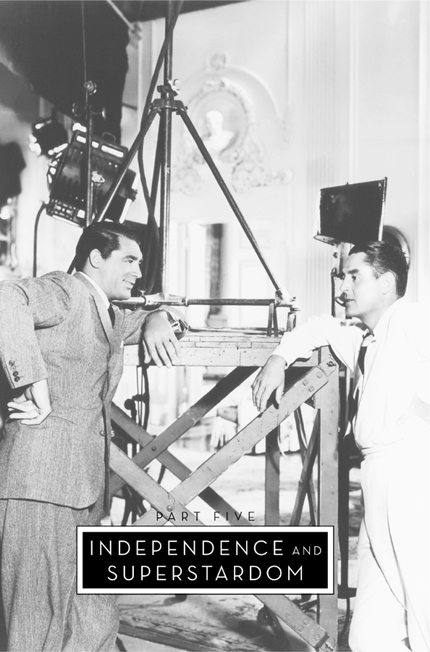
On the Columbia Pictures set of The Awful Truth (1937), Cary Grant mirrors the physical style of his director and first comic mentor, Leo McCarey. (Courtesy of the Academy of Motion Picture Arts and Sciences)
10
“My first great chance came in 1936, when I was borrowed by RKO for Sylvia Scarlett playing opposite Katharine Hepburn. This picture did nothing to endear its female lead to the public, but it helped me to success…. After this picture I made one after another, probably too many.”
—CARY GRANT
Once he and Randolph settled back into West Live Oak Drive, Grant became something of a social recluse, refusing to leave the house for any reason except to go to the studio, fearing he would be laughed at by his friends because Cherrill had left him and because of the sordid details of her testimony. On weekends he took to sitting alone in the sun for hours at a time, with a glass of straight scotch in one hand, a lit cigarette in the other.
He did some last-minute reshoots for James Flood's Wings in the Dark, a weeper with Grant as a blind man who learns to “see” through the love of a good woman, played by Myrna Loy, in many ways a reversal of Chaplin's City Lights scenario, but without any of Lights's humor, depth, or emotion. Grant showed up for the reshoots with his face deeply tanned and insisted the studio come up with light pancake to match the skin tone of his earlier scenes. Thus began what was to become a pattern for the rest of his moviemaking days, using the sun's rays for makeup.
After Wings in the Dark, because of Paramount's financial problems, Grant's next film was a long time coming. While waiting for a new script, he became involved in an odd relationship with a significantly older woman who called herself Countess di Frasso, a fifty-year-old heiress whose real name was Dorothy Taylor and whose New York–based family had become wealthy in the decidedly nonroyal leather goods trade. She had acquired her title by marrying an Italian count, her second unsuccessful foray into legal bliss. He turned out to be a deadbeat with no appreciable earning skills. Their fortune, such as it was, all came from her, and it was barely enough to pay the mortgage on their beautiful Italian villa.
Nevertheless, the count and countess loved to lavishly entertain at their villa, especially visiting Hollywood celebrities, one of whom, Gary Cooper, arrived in 1931 and returned to Beverly Hills with Countess di Frasso dutifully in tow. Cooper and the countess carried on an open affair in Hollywood until he surprised everyone, including her, by suddenly marrying socialite Veronica Balfe.
The jilted countess decided that rather than return to her villa she would stay in Hollywood and soon enough, after following the details of Grant's divorce in the newspapers, marked him as her next Hollywood paramour. While it is highly unlikely that he sexually serviced her with anything like the passionate fervor that Cooper did (if he serviced her at all), they met and somehow managed to become, if not lovers, good friends. Hovering over this new relationship was the ever-present professional rivalry and personal animosity between Cooper and Grant. This time Grant got to “replace” Cooper in a way he knew would annoy his heavily narcissistic competitor.
For the next several years, the countess occasionally blew through Grant's life like an unpredictable breeze, depending upon her availability and his. Their noticeable age difference (she was twenty-two years older), his great looks (she loved being seen with him in public), her financial generosity (she paid for everything), and his appetite for social status (she was, after all, a countess) made him the ideal companion. On Grant's side, his serial melancholia about Elsie made the countess an ideal mother-surrogate: a doting older woman willing to spoil her precious and beautiful “little boy.” In the parlance of the real golden days of Hollywood, as one who was there at the time rather crudely recalled, “Cary was the perfect central-casting fag to Taylor, a rich, old, self-delusional hag.”
Meanwhile the studio, deep into reorganization and temporarily unable to get major bank funding for any new films, tried to raise cash by loaning Grant to Warner Bros. as a last-minute replacement for an ailing Robert Donat in that studio's big-budget production of Michael Curtiz's Captain Blood.* Grant, with his natural athletic abilities, would fit perfectly into the part of the swashbuckling British pirate. But when Zukor offered him to Curtiz, Warners unconditionally turned him down. According to one version, Grant was rejected by the studio for being “too effete.” Although the quote has been often repeated, it is rarely attributed. It was actually made by Warner Bros. contract director Michael Curtiz himself, his angry reply to Jack Warner for even making the suggestion. Curtiz—the “wild Hungarian,” as he was known—had little use for Grant and his “type.” Instead, he cast über-heterosexual Errol Flynn to play the role that would go on to make the handsome, rugged Australian a star.
With time on his hands and his skin cooked to a golden tan roughly the tone and consistency of a holiday turkey, Grant continued to ignore Scott's advice to get out of the sun, out of the house, and back into the social scene. To make that happen, Scott finally agreed to introduce Grant to Howard Hughes, one of the few Hollywood celebrities besides Chaplin he still wanted to meet. Scott figured if anyone could get Grant's head out of his own rear end, it was Hughes; after all, MGM may have had more stars than there were in heaven, but Hughes had all the starlets. If Grant still wanted to play with girls, a couple of nights together out on the town, Scott believed, would make him forget all about Virginia Cherrill.
Scott's reasons for wanting to put Grant and Hughes together were not completely selfless. Already thirty-seven years old, Scott had a far less successful movie career than Grant, and even fewer prospects. He figured that if he supplied Hughes with something he wanted, Hughes might give him something more in return. Hughes loved beautiful women, and Scott knew that Cary Grant was the ultimate lure.
Meanwhile, to replenish his nearly depleted post-divorce bank account, Grant accepted radio work in New York. Appearing on radio was something he had previously been opposed to, believing that giving away a performance for free would make audiences less inclined to pay to see or hear an actor perform onscreen. Nevertheless, with no films in his immediate future, on May 5, 1935, he made his debut on the airwaves starring in a live broadcast of the Lux Radio Theater, opposite Constance Cummings, a thirty-minute onetime performance for which he was paid $1,750, plus airfare and hotel.
To his surprise, he quite enjoyed the whole experience. For one thing, no physical preparation was required, and for another, it exposed him to a new group of performers, mostly East Coast types who, for a while, dominated the prime time airwaves. Throughout the next twenty years, whenever he had the opportunity, Grant worked on the radio, either as a character in a drama or as a guest on a celebrity variety show, most often with Groucho Marx on his Kellogg Show, The Eddie Cantor Show, and George Faulkner's talk show, The Circle. Whenever Grant did Faulkner's show, he would find himself alongside other Hollywood luminaries, such as his good friend British actor Ronald Colman. One time he even recorded a full-length radio version of his blindman opus, Wings in the Dark, that, as it turned out, worked far better on the sightless medium than it had in the movies.
He returned to making movies after the dust settled around Paramount's 1935 reorganization. Paramount Publix became Paramount Pictures and emerged from bankruptcy. In some ways, at least as far as Grant was concerned, day-to-day operations at the studio had changed little; mostly it was business as usual.* Gary Cooper had recently scored a tremendous success starring in Henry Hathaway's The Lives of a Bengal Lancer, but when Zukor wanted to make a sequel, The Last Outpost, both Cooper and Hathaway rejected the idea, and the project fell to studio hacks Charles Barton and Louis Gasnier, who cast Grant in the Cooper role and told him to prepare for the role by trying to look more manly. Grant's response was to grow a mustache that made him a ringer for Douglas Fairbanks.
His costar in the film was Claude Rains, who upstaged everyone else in it, including Grant. The Last Outpost was released in October 1935 and quickly disappeared, after which Zukor lent Grant to RKO Radio Pictures to costar opposite a new up-and-coming actress by the name of Katharine Hepburn. The move would prove crucial to Grant's career and forge two professional relationships that would profoundly affect both his career and his personal life.
Katharine Hepburn, “the Magnificent Yankee,” had been born into a line of bluebloods of Scottish descent from West Hartford, Connecticut. Her father was a noted urologist and surgeon and an early pioneer in the fight against syphilis. He was tall, good-looking, and athletic, a highly skilled investor who had become wealthy from stocks and real estate. Her mother, known to everyone as Kit, was a Boston Houghton (accounting for all six of the Hepburn children having the same Houghton middle name) and a cousin of the ambassador to Britain.
Under her father's strict guidance, Hepburn became a superb athlete, with considerable skills in wrestling, tumbling, trapeze, water sports, and golf. She was intrigued by acting at an early age, a drive that became supercharged in a twisted way after her older brother Tom tried to duplicate a trick they had seen in a stage production of A Connecticut Yankee in King Arthur's Court and accidentally—or as some claim, deliberately—hanged himself. She attended Bryn Mawr and, while exhibiting superior learning skills, nearly flunked out because she spent most of her time in the drama department.
Upon graduation she joined a Baltimore theatrical company and soon made the jump to Broadway, where she appeared in several shows, most of them flops. Then in 1928 she surprised everyone by marrying Ludlow Ogden Smith, a Philadelphia socialite. Upon her return from their honeymoon she agreed to understudy the Broadway star Hope Williams in the lead role of Philip Barry's Holiday (a role she would perform only once during its entire year-long run). That led to a starring role in 1932 in The Warrior's Husband, a contemporary version of Lysistrata. The part gave Hepburn the chance to showcase her considerable athletic skills and also to display a lot of her body, including her previously undisplayed gorgeous long legs.
Word of her audience-pleasing performance eventually reached Merian C. Cooper, the executive producer of RKO Radio Pictures, who sent his then production head, David O. Selznick, to New York, to offer the young actress an exclusive acting contract with the studio for $150 a week. When Selznick met with Hepburn, he asked what it would take to get her to come to Hollywood, and she pulled a figure out of her head that she was certain would send Selznick running. Through her agent, Leland Howard, she had demanded a starting salary of $1,500 a week. Selznick agreed without hesitation, and when The Warrior's Husband ended that summer, she flew to Hollywood to begin her film career.
Her first fearure was A Bill of Divorcement, in the leading role that every young actress in Hollywood had fought for. It was based on the New York stage play by Clemence Dane that had made a star out of Katharine Cornell in 1921. Once the studio had acquired the rights to the play, it was given to one of its hot new directors with a Broadway pedigree, George Cukor, who, because of his success with Cornell and his superior stage work with Ethel Barrymore, Laurette Taylor, and Helen Hayes, had developed a reputation as a “woman's director.” When film legend Dorothy Gish committed to making her long-awaited Broadway debut in Young Love, she'd insisted George Cukor direct her.
Even before Cukor officially took up residence at RKO, Selznick had purchased What Price Hollywood? for him, a film that in many ways anticipates Cukor's later A Star Is Born (1954). What Price Hollywood? made a star out of its lead, the previously unknown Constance Bennett, and Selznick hoped Cukor would repeat his success by turning Hepburn into the studio's next female box office sensation. Selznick's instinct proved correct; on the strength of her performance in Cukor's A Bill of Divorcement (1932), Katharine Hepburn did indeed become the newest star of the silver screen.
In addition to reaffirming George Cukor's reputation as a “woman's director,” the film erased any lingering doubts about his talent and commercial viability. It also began what amounted to a half-century of continually successful film collaborations between Hepburn and Cukor.
After two more hits—Morning Glory (for which she won her first Oscar) and Cukor's Little Women—Hepburn completed her obligations to the studio in 1935 and was then hesitant to re-sign with RKO after Selznick left to join his new father-in-law, Louis B. Mayer, at MGM. She finally accepted an offer of $300,000 from RKO for six films still to be chosen, with script approval and choice of role. Nevertheless, Selznick's absence proved as damaging as Hepburn had feared, and her next three films—John Cromwell's Spitfire, Richard Wallace's The Little Minister, and Philip Moeller's Break of Hearts— were major disappointments at the box office. The producer of all three was Pandro S. Berman, who had been given the nearly impossible assignment of replacing the legendary Selznick. His shepherding of the trio of Hepburn films was so disastrous, it nearly ended her film career as well as his own.
Her next film, George Stevens's Alice Adams (1935), another Berman production, was a standard Depression-era fantasy of a poor girl successfully climbing the social ladder. Fortunately for Hepburn (and Berman), the film hit a nerve with audiences and helped restore some of the luster to her Hollywood career. It not only proved a winner at the box office but earned Hepburn a second nomination as Best Actress.* Once again she was the hottest female star in Hollywood.
For her next project, she turned once more to her favorite director, Cukor, who this time had what he believed was the perfect Hepburn vehicle. It was based on a 1918 Compton MacKenzie novel, The Early Life and Adventures of Sylvia Scarlett, loosely based on the sensational British Crippen case, which Cukor wanted to somehow turn into a comedy.
Once he had his star in place, Cukor hired the distinguished novelist Evelyn Waugh to write the script.* The story of the film begins in France and concerns the adventures of young Sylvia Scarlett, whose father is an embezzler and must flee the country to escape imminent capture and imprisonment. Arriving in London, Sylvia, disguised as a boy to throw off the authorities tracking the duo down, and her father meet up with Jimmy Monkley, a swaggering con-artist cockney lad with whom they team to roam and loot the countryside. Eventually, Sylvia's father marries a wacky servant girl named Maudie Tilt, while Sylvia meets a successful artist, Michael Fane, and must revert to being a “girl” in order to win his affections.
For the part of Henry, Sylvia's father, Cukor cast curmudgeonly Edmund Gwenn, and to play Michael Fane, he chose Brian Aherne, a well-known British actor who was nevertheless regarded as a standard-issue trunk-jawed Hollywood leading man. The one part he had the most difficulty casting was Jimmy Monkley. No one at RKO could master to Cukor's satisfaction the essential cockney accent of Monkley's self-proclaimed “gentleman adventurer.” It was Hepburn who suggested that Cukor try to borrow Cary Grant from Paramount for the part, something the director was at first, to Hepburn's surprise, reluctant to do.
Cukor's hesitancy was fostered by a longstanding skepticism about Grant's acting ability, based on the movies he had seen him in. “I could never get weak-kneed at the idea of Cary Grant,” he had told one studio head early on, when considering suggestions as to who should play opposite Hepburn in A Bill of Divorcement. The role eventually went to John Barrymore.
More than likely the real reason for Cukor's hesitancy had to do with the director's private life and the increasingly repressive atmosphere that surrounded and affected both Cukor's and Grant's social and sexual proclivities. Cukor was unabashedly homosexual, his reputation as a “woman's director” industry code for his own sexual sensitivities. Actresses, knowing they were never going to have to submit to a Cukor casting couch, adored him for his manner as much as for his manners. He came from the theatrical world of Broadway, where the gay life was not merely tolerated but prevalent. Once he made the change to Hollywood, he found the atmosphere more restrictive, even more so after the onset of the Hays Code. The lavishly appointed living room of Cukor's Hollywood home became a kind of private if informal West Coast Algonquin room, which many of the industry's most interesting (and often, but not exclusively, gay) luminaries regularly attended, including Sinclair Lewis, Theodore Dreiser, Fanny Brice, Ferenc Molnár, Tallulah Bankhead, Greta Garbo, Somerset Maugham, Noël Coward, Tennessee Williams, and Katharine Hepburn. These gatherings caused Joseph L. Mankiewicz to publicly characterize Cukor as “the queen of the roost.”
Cukor and Grant had both spent approximately the same decade working in the New York theater. It is therefore difficult to believe that they did not know, or at least know of, each other in some capacity, if only in passing, having crossed paths at one opening or another, or party, or social seasonal gathering. Yet both maintained that prior to Cukor's casting Grant in Sylvia Scarlett, they had never met. Moreover, Grant's longtime personal secretary, Frank Horn, whom he had hired in the early 1930s, was a Hollywood hillside neighbor of Cukor's, with a legendary collection of male pornography and, it was believed, extensive contacts in that field. Horn and Cukor were intimates, making it even more unlikely that Grant and the director were total strangers.
All of this suggests not so much that Cukor and Grant were ever romantically involved or that they had anything to hide, but how pervasive the gay fear factor was for so many of Hollywood's biggest actors and directors. Cukor especially was extremely afraid of risking his livelihood by going “above the line” in his unquenchable thirst for male lovers, and on more than one occasion his homosexuality did negatively affect his career (his notorious firing a few years later as director of Gone With the Wind at the insistence of Clark Gable, who refused to take direction from a homosexual).
Nevertheless, Hepburn insisted on having Grant as her costar, and in the end Cukor would not refuse her and went to Zukor to see if he could borrow Grant for the film.* As far as Zukor was concerned, Grant was, these days, available for rental to whatever studio was willing to meet his premium fee. Paramount agreed to pay Grant a $15,000 bonus for the scheduled six-week shoot, about twice his normal salary, which had by now reached $2,500 a week, applied against what it received from RKO—about half—while Hepburn received $50,000 and her regular contract salary.
Grant was understandably unhappy with this financial arrangement, as well as with the relatively small size of his role and what he considered the relatively uninteresting parameters of his character. The film, as he saw it, was nothing more than a star vehicle for Katharine Hepburn, and the only other real role was the part of her father.
When producer Pandro Berman became aware that Grant was upset, he in turn was miffed. He considered the casting of the actor in a Hepburn movie a gift, an automatic and much-needed boost for a career that, as far as Berman was concerned, had already fizzled and was not likely to reignite. Like so many Hollywood producers, he thought Grant largely uncastable— too old for young romantic leading roles (for which James Stewart and Joel McCrea were perfect), too “precious” for action parts (Fairbanks, Gable, Flynn), too pretty to play stubbled hard-edgers (McLaglen, Colman), too prissy for genre and period pieces (Laughton, Tone), and too weak for traditional heroes (Cooper, Gable, William Powell). Furthermore, Berman knew that Zukor had much the same opinion of Grant and because of it had given up on trying to turn him into a top-of-the-line star at Paramount. Grant, meanwhile, sensing his position at the studio was becoming increasingly shaky, accepted the role and the money despite his misgivings.
One of the people most pleased with Grant's being cast in the film was Randolph Scott, who used the opportunity to finally put Howard Hughes and Grant together. Scott convinced Grant that, with his contract nearing an end, the time was finally exactly right for him to become friendly with the billionaire independent filmmaker. What's more, Hughes had lately become interested in Katharine Hepburn, and a friendship with Grant, Scott knew, would give him a reason to be on set while they filmed.
Grant and Hughes hit it off immediately and were soon fast buddies. Hughes appreciated Grant's understated sense of humor and lack of pretense. He particularly liked Grant's aloofness when it came to the press. And because Grant had little apparent interest in women, Hughes felt no competition for any of the ones he wanted, especially Hepburn. As far as Grant was concerned, Hughes was just the type of male whose social company he enjoyed. He found him unpretentious, rough-edged, nonjudgmental, and with a genuine taste for adventure tinged with danger that Grant found exciting. During the filming of Sylvia Scarlett, Hughes invited Grant to take a ride with him in his new H-1 plane over Los Angeles. Grant agreed, and soon they were soaring together above the coast, above the country, above the world.
For the first time since Randolph Scott, Grant felt he had found a kindred soul, someone who was interested in and liked him. Hughes felt the same way, his own reserve perfectly meshing with Grant's coolness, two sides of the same antisocial coin. Moreover, through his friendship with Grant, Hughes got to know Katharine Hepburn better, and they soon began a blazing affair.
Finally, the Grant-Hughes friendship solved one more problem for Scott, who had recently decided to get married. Unable or unwilling to break the news to Grant until almost the day of his wedding, Scott was relieved to have successfully passed Grant off to Hughes—if not in exactly the same fashion of friendship that he enjoyed, nevertheless in a way that benefited all three of them.
Scott had quietly been seeing his childhood acquaintance Marion duPont Somerville, daughter of William duPont, the man who had invented nylon and rayon and gone on to amass one of the greatest American fortunes. The day after his ex, Vivian Gaye, married film director Ernst Lubitsch in 1934, Scott had flown home to visit his family in Orange, Virginia, to lick his emotional wounds, and it was during this trip that he rekindled his friendship with Marion.
Scott and Marion shared two interests: horses and money. His fiancée had a personal fortune estimated to be in excess of $100 million. Scott believed that marriage was a contract of shared wealth and mutual convenience as much as love, and on those terms he considered Marion the potentially perfect wife. She was certainly not the kind of gold digger he believed Virginia Cherrill was, and she was happy to continue on with her own non–show business life, separate and apart from his. The rumor that persisted throughout her life, that she was a whip-wielding lesbian (her horses was the reason she always gave for carrying a riding crop tucked under her arm), didn't bother Scott at all. Nor did it bother him that she had just been divorced from jockey Tom Somerville. If anything, Scott was amused by all of this and saw no problem with her “individualism.” Or with the fact that shortly before they married, Marion was rumored to have invested heavily in Paramount Pictures, the studio where Scott was a contract player.
Still, just as Grant had had with Cherrill, Scott began experiencing problems with Somerville from the moment he announced they were officially engaged. To begin with, she had an intense dislike of Hollywood. She considered it vulgar, an unseemly place for people of wealth to live. She made it clear to Scott that there was no way she would ever consider relocating to Los Angeles. Scott, on the other hand, was equally adamant about never permanently moving back to the South. To him, it was a place that represented repression, guilt, and loneliness. By contrast, Hollywood had allowed him to live out his greatest desires, with a man he loved and respected, in a way that would likely have gotten him lynched in Virginia. Of course, neither of these obstacles proved a deal-breaker, once both realized that Scott could simply stay in L.A. The impending marriage also solved Scott's ongoing “confirmed bachelor” problem with the studio. The one remaining obstacle that had stood in his way was the lonely and morose post-Cherrill Grant, a problem he solved finally by hooking him up with Hughes.
At a pre-release screening of Sylvia Scarlett open to the public, Cukor, Hepburn, and Grant slipped in through a side door, anticipating nothing but laughter and applause. Instead, they witnessed the film playing to a silent, bewildered audience. The biggest laugh the film got was a shot of the northern coast of Malibu, whose nearby mountain ranges were meant to pass for the fabled white cliffs of Dover. Less than half the audience stayed for the entire picture. Those who departed early included B. B. Kahane, the new head of RKO.
Hepburn in particular was aghast at what she saw, and right up to the official opening implored Berman not to release the film, promising him a “free” performance in exchange. The picture's world premiere, which took place on January 3, 1936, at Radio City Music Hall, proved her instinct correct: it was soundly rejected by critics and public alike. Everyone seemed to intensely dislike the film for one reason or another; it did not fit easily into any specific genre, as its story was too difficult. Was it an adventure, a romance, a comedy, or a crime flick? And finally, the miscasting of Katharine Hepburn as an androgyne more boyish than Peter Pan did nothing to help either the movie or her career.
After its disastrous opening, Hepburn's movie career was considered to have reached a financial dead end. Her defiant (and confusing) crossdressing in the film was taken by some as a flaunting of her presumed lesbianism in those carefully morally coded Depression times. Other aspects proved equally suggestive, such as Brian Aherne's “crush” on the disguised Hepburn that causes him to say, “There's something queer going on here.” A bit later on in the film Hepburn, still dressed as a boy, is kissed by a maid and told she is “very attractive.” In yet another, Grant reaches for Hepburn (still in drag) and says, “It's nippy out tonight. You'll make a proper hot water bottle… but there's something that gives me a queer feeling every time I look at you.” And, at one point, a maid paints a mustache on “Sylvester” and kisses her.
Apparently, audiences weren't the only ones to read things into the film. Shortly after it opened, it was officially condemned by the Legion of Decency and would go on to earn the dubious honor of being RKO's biggest financial disaster of 1936. Pandro Berman was so humiliated by the magnitude of the failure that he tried to distance himself from it, Hepburn, and Cukor, insisting he would never work with them again (pointedly leaving Grant out of this declaration). In fact, the only one to come out of the film with any positive reaction was Cary Grant. His Cockneyed performance was the breakthrough that freed him from the endless run of stilted lovers and cardboard “tux” heroes he had suffered through, by his winning portrayal of a wholly realized and thoroughly likable character. His quick wit and effortless physicality were a revelation for audiences. Cukor summed it up best later on, when he said of Grant's amazing performance, “Until then he was a successful young leading man who was nice-looking but had no particular identity… Suddenly, in Sylvia Scarlett, he blossomed. It was a well-written part, well directed, he knew what this character was, and he gave a marvelous performance.” For years, in fact, Cukor (as West did with She Done Him Wrong) claimed that he had discovered Grant and that Sylvia Scarlett had made him a star. Statements of such immodesty and exaggeration did nothing to endear him to Grant.
The critics' praise for Grant, and only Grant, was unqualified. Variety proclaimed, “Cary Grant… virtually steals the picture.” Time magazine did the same: “Cary Grant's superb depiction of the Cockney almost steals the show.” The New York Times said that “Cary Grant, whose previous work has too often been that of a charm merchant, turns actor in the role of the unpleasant Cockney and is surprisingly good at it.”
Grant felt professionally liberated. For the first time, he did not have to be told he was good in a movie. This was, after all, his meat, the kind of physical performing with rhythmic comic timing that he had sharpened to a fine edge in his years of stage performing. “Sylvia Scarlett was my breakthrough,” he would recall years later. “It permitted me to play a character I knew.” Although he was, in private, less than thrilled with Cukor, Grant, in a publicity interview, made a point of thanking him in public for allowing him to play the role “as I saw it.”
It wasn't until after the film's opening that Scott finally broke the news to him that he intended to marry Marion duPont. The next day a devastated Grant quietly packed his bags and caught a plane back to New York City. Once there he booked passage on a luxury liner bound for Mother England.
* Donat had suddenly taken ill, and the studio decided that it was still early enough into the production to reshoot the entire film.
* The studio went into receivership in 1934 and, after its reorganization a year later, still had outstanding debts of $95 million. In 1936, the newly formed Paramount Pictures made a $6 million profit. By 1941, the end of the Depression and the emergence of a movie-hungry, star-worshiping war generation pushed that profit to nearly $11 million. By 1944 that figure had swelled to $16 million, and peaked at $44 million the following year. By 1946, the studio had paid off all its remaining debt.
* The film was also nominated for Best Picture. It lost in both categories, Hepburn to Bette Davis in Alfred E. Green's Dangerous, and the film to Frank Lloyd's Mutiny on the Bounty.
* Little of Waugh's work made it into the final production.
* There is at least one other possible explanation for Cukor's casting of Grant. The Countess di Frasso always insisted that it was her “influence,” such as it was, that got Cukor to hire Grant for Sylvia Scarlett. As it happened, she and Cukor were good friends, and although the story is most likely apocryphal, neither Cukor nor Grant ever publicly disputed the countess's often-made claim.