
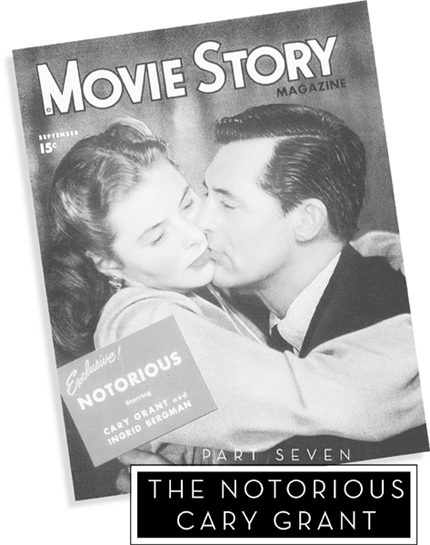
Cover boy and girl—Grant and Ingrid Bergman grace the cover of Movie Story magazine to promote the release of Alfred Hitchcock's 1946 classic, Notorious. (Rebel Road Collection)
20
“I can't portray Bing Crosby: I'm Cary Grant. I'm myself in that role. The most difficult thing is to be yourself—especially when you know it's going to be seen immediately by 300 million people.”
—CARY GRANT
In February 1945 Cary Grant was nominated for Best Actor by the Motion Picture Academy for his performance as Ernie Mott in None But the Lonely Heart. It was his second nomination, his forty-sixth film. He believed he had no chance to win, not only because of the Academy's longstanding hostility toward him, but also because the film had opened to mixed reviews and done poorly at the box office, and Hollywood was loath to give awards to actors whose movies lost money. Unwilling to give the Academy yet another chance to snub him, Grant kept his promise to himself and passed up the chance to sit at a table for hours with a smile fixed on his face until the time came for him to applaud when someone else's name was announced from the podium.
His instinct proved correct. At the ceremony Bing Crosby was awarded the coveted gold statuette for his portrayal of Father Chuck O'Malley in Leo McCarey's Going My Way. The Academy then underscored its snubbing of Grant by awarding a Best Supporting Actress Oscar to Ethel Barrymore, Best Original Score Oscars to composers C. Bakaleinikoff and Hanns Eisler, and a Best Editing Oscar to Roland Gross, in recognition of their work on None But the Lonely Heart.
For the rest of the year, a bitter Grant rejected all scripts offered to him for his consideration and reverted to his postmarital love-lost rejection/ depression/remorse cycle, not all that different from what he had put himself through following his divorce from Virginia Cherrill. When he found out that Hutton had taken up residence at the Mark Hopkins Hotel in San Francisco, he tried to reach her there, but no matter how many times he called—and on certain days it was as many as a dozen—she refused to come to the phone. When that didn't work, he sent flowers with all sorts of expensive presents attached, none of which managed to evoke from Hutton a call or even a thank-you card. When at last he did manage to catch her on the telephone, she was friendly but cold. Nevertheless, just hearing her voice made him believe they were going to get back together, and a suddenlyhappy Grant confidently told his friends they were reconciling.
They were not. While Hutton still considered herself a friend of her exhusband (“How could anyone really stay angry at such a lovely man,” she told one of the gossips), she remained firm in her conviction that their marriage was history. To get that message hammered into Grant's handsome head, Hutton used Louella Parsons as her personal messenger. She took to having frequent chats with the columnist, knowing Parsons's column was the surest way to send her ex-husband missives. When he could no longer stand it, Grant traveled to San Francisco and waited for Hutton in her hotel's lobby until she came down. She was surprised to see him but remained cordial. They talked and even had a drink, and Hutton told him once again that the time had come for both of them to move on. The next day Parsons ran another item from Hutton: “Cary was the husband I loved most, he was so sweet, so gentle, it didn't work out. But I loved him.” Grant took that as a hopeful sign.
Not long afterward, Hutton moved to Tangier, where she planned to live out the rest of her days. Upon hearing the news of her departure, Grant holed up in his apartment and for weeks did nothing but fumble around from room to room, according to friends, crying at night and drinking himself into fitful sleep.
It was the persistent Frank Vincent who, that spring, finally broke through Grant's black cloud and convinced him the time had come to reenter the world of the living. For openers, he insisted Grant move out of his dark and depressing apartment and into a real home. He found Grant a spacious six-room split-level above Hollywood in the lavish, star-studded Beverly Hills.
Despite an ongoing housing shortage, Vincent had no problem jumping to the front of the long line of buyers wanting the house, because it happened to belong to Howard Hughes, who had purchased it with the intention of living there with Katharine Hepburn upon her triumphant return to Hollywood following the success of The Philadelphia Story. Although the two actually did spend a little time in the house, the interior paint had barely dried before Hepburn left Hughes for good, having fallen in love with Spencer Tracy. The house then sat empty until the summer of 1945, when Hughes finally put it on the market. Vincent quickly gobbled it up for Grant (taking the discount Hughes offered for cash).
In the fall of 1946, as the Hills of Beverly were beginning to give up their warm summer breezes for the slicker spicy cool that blew through the storied canyons, Grant finally moved his relatively few pieces of functional furniture out of his small apartment and into his spacious new home.
Harry Cohn, meanwhile, was growing increasingly impatient with his sullen, reclusive star and wanted him to make the one movie left on his contract. As it happened, Jack Warner, whose studio had scored a major hit with Destination Tokyo, was also interested in using Grant again, whose postwar value had skyrocketed. Many of the biggest male stars who had gone off to war had returned with the wear from their emotional and physical battles etched into their once-smooth faces.
Two of the biggest, Clark Gable and James Stewart, had joined the armed forces as perfect physical specimens, only to come back looking rugged and creased and, in Stewart's case, with far less hair on his head. Gable, arguably the single biggest male star of the 1930s, had suffered more than most, beginning with the untimely, horrible death of his beautiful wife Carole Lombard; he had spent the rest of the war in uniform, as if to atone for somehow being personally responsible for the war bond plane crash that had killed her and her mother. As a result, his once-mischievous grin had flattened into a permanent leathered fret, and the new gray brushstrokes around his temples put even more distance between this Gable and the roguish prewar Rhett Butler. Stewart, too, had acquired some roughness around his edges; his eyes now reflected a haunted look. Besides Gable and Stewart, dozens of other A-listers had newly “matured” in one way or another, including Tyrone Power, Robert Taylor, and after four long years in the British service, David Niven.
There was no getting around the fact that few of Hollywood's male stars, such as Henry Fonda and Bob Hope, looked as good as they had before the war (and none looked as good as Grant did, before or after). At forty-two years old, Grant could easily play ten years younger on the big screen. Jack Warner believed that Grant's physical perfection made him the last of his generation's leading men who could still deliver a romantic picture into big profit. That was why he put out feelers to Columbia about the possibility of purchasing the rights to Grant's last unmade film he owed the studio. He had a specific project in mind for Grant and took Frank Vincent to lunch to discuss it.
Vincent listened patiently, then said simply that it didn't make any difference whether Columbia said yes or no—Grant was not ready to resume making motion pictures and might not ever be, and the best thing Warner could do was wait. In time, he might be able to get Grant without having to go through Columbia.
That sounded like nonsense to Warner, who thought it had to be some kind of bargaining ploy. The next week, ignoring Vincent's advice, he arranged a meeting with Harry Cohn, and the day before it took place, he called Vincent and suggested he be there for it. To Warner's surprise, Vincent showed up with Grant, who was beautifully tailored, well tanned, smiling, and bright-eyed. Vincent had told Grant about the meeting, and was surprised to hear him say he wanted to go. Grant told Vincent he respected both men, they had been very good to him, and while he had absolutely no interest in making any more movies, he felt obliged to at least show them the respect of listening to their offers.
Grant's mindset abruptly changed when Warner revealed to him the picture he had in mind—a musical biography of Cole Porter that he wanted to call Night and Day, with Grant starring as the great composer.
It was a temptation Grant couldn't resist. In addition to his stated feelings to Vincent of moral obligation to his friends, his decision to attend the meeting most likely meant his emotional cycle had finally turned and he was ready to go back to work. The Cole Porter biopic sounded to him like the perfect picture with which to make a triumphant return to film.
He was right. A biographical movie often was the highlight of an actor's career. In the seventeen years of the Academy's existence prior to the release of Night and Day, biopics had brought Oscars to an impressive roster of stars, including George Arliss for Disraeli (1929), Charles Laughton for The Private Life of Henry VIII (1933), Paul Muni for The Story of Louis Pasteur (1936), Spencer Tracy for Father Flanagan in Boys Town (1938), Gary Cooper for Sergeant York (1941), James Cagney for George M. Cohan in Yankee Doodle Dandy (1942), and Jennifer Jones for The Song of Bernadette (1943).*
The elusive Oscar was still very much on Grant's mind. The very nature of both the business he was in and the person he was, and the fact that each was such a defining element of the other, meant that a part of him still desperately wanted to win one, if for no other reason than to be able to wave its golden ass in the faces of those studio heads dedicated to seeing that he never got the chance to do so. Comedy hadn't done it for him; neither had romance or drama. Perhaps, he figured, biography was the way to go.
The notion of playing the flamboyant Cole Porter, a social acquaintance of his for many years but not a particularly close friend, held enormous appeal to Grant. Porter had been, during Grant's Broadway years, a manneristic (rather than a physical) role model; one reason why it had amused him when the small, gnomish, physically impaired, and owl-eyed composer, asked by the press who, in a perfect world, he could see playing him onscreen, had replied without hesitation, “Why, Cary Grant, of course!”
Negotiating with Jack Warner, Porter expressed concern over what “facts” might actually be included in a film about his life. He would agree to sell the rights to his story only if the script excluded certain “touchy” elements of his real life. These included the composer's excessive drinking, his well-known homosexual lifestyle, and his marriage-for-appearance-and-bankbook to the older and extremely wealthy divorcée Linda Lee Thomas. And, of course, the price had to be right.
Night and Day had been a pet project of Jack Warner since 1943, although when he first had the idea of making a movie about Cole Porter, he knew very little about the songwriter's life. One night, not long after the Warners biopic Yankee Doodle Dandy,directed by Michael Curtiz, had opened to rave reviews and great business, Warner was having dinner with songwriter Irving Berlin, during which the subject somehow turned to Cole Porter. Berlin told Warner about the famous horseback-riding accident that had crippled Porter. The idea of making a movie with a physically impaired hero, at a time when wounded soldiers were starting to return to the States, appealed to Warner, who was still looking for the right project to mark the twentieth anniversary of The Jazz Singer, the film his studio had made that had ushered in the era of talking pictures.
Before Night and Day, Warner had gone into production on another songwriter bio, Rhapsody in Blue, a big-budget star-studded bonanza about the life of George Gershwin. The problem with the picture was that its lead, Robert Alda, wasn't a big enough star or strong enough to outshine his supporting players. The film was a hit, but not the smash Warner was looking for, and he was still searching for the right subject to commemorate The Jazz Singer when he had dinner with Berlin and shortly after decided to turn Cole Porter's life into a movie.
Warner paid Porter $300,000 for the rights to his life, a deal in which Porter would have total script and cast approval and retain the final choice of which of up to thirty-five of his songs would be included in the film. Warner then went after Cary Grant, the only star he believed could do justice to the role. He offered Grant $100,000 up front, plus a percentage. In addition, he bought out the contract for Grant's last film that he owed Columbia.
While Grant waited for Warner to come up with a script that Porter approved, he remained at his new, still barely furnished Beverly Hills house, where he spent much of his time reading mystical self-help books, of which he had become a fan, occasionally venturing out at the behest of Howard Hughes.
One evening Hughes, enmeshed in negotiations to take control of the perpetually money-losing RKO, needed a place to hold a top-secret meeting with Dore Schary—privacy never an easy thing to secure in Hollywood. Tipsters all over town grew rich reporting to the gossips the whereabouts of stars and their supposedly secret goings-on, while the owners of celebrity hangouts such as the Trocadero, Ciro's, the Brown Derby, and Chasen's regularly serviced the gossips in return for a mention in their columns.
The one place Hughes knew to be absolutely impenetrable to the press was his former home, Grant's present one. As Billy Wilder once wryly observed, “I know of not one single soul—nobody—who has been inside Cary Grant's house in the last ten years.” Grant's reclusiveness made it the place of choice for Hughes's most important meetings, as well as his many secret sexual rendezvous with young starlets. Hughes, who shunned being the target of scandalous rumor as if it were a communicable disease, knew Grant was one of the few people in Hollywood he could trust unconditionally. Grant, as well, considered Hughes one of his best and most loyal friends, and whenever he wanted to use his former house, Grant was more than accommodating, to the extent of leaving all the bathrooms the way the six-foot-four Hughes had had them custom-built, with extra-large toilets, showers, bathtubs, and beds to suit his lengthy frame.
The night of the meeting Schary arrived a few minutes late and saw Hughes's automobile already parked in the driveway. Upon being let in by Grant himself, who answered his own door—he no longer employed fulltime live-in help and even kept his part-time cook's food budget to one hundred dollars, preferring cold turkey sandwiches made in the afternoon to elaborately prepared evening meals—Schary, who had never been to Grant's home before, was surprised by what he saw, or more accurately, what he didn't see, inside of the home of one of the wealthiest stars in Hollywood. Aside from a few framed seascapes, notable for their lack of human figures, and a studio daybed in the living room still unmade, its blankets in a bunch, “there wasn't a paper, a cigarette, a flower, a match, a picture, a magazine— there was nothing except two chairs and the sofa. The only sign of life was Hughes, who appeared from a side room in which I caught a glimpse of a woman hooking up her bra before the door closed.”
The woman Schary saw was Linda Darnell, one of several actresses Hughes was chasing at the time, among them Swedish-born actress Ingrid Bergman, red hot since winning the 1944 Best Actress Oscar for her role as the victim in George Cukor's Gaslight.Bergman accepted an invitation from Hughes to travel with him to New York City one weekend, as long as they had a twenty-four-hour chaperone. Every straight actor in Hollywood (and more than one well-known lesbian actress) was after Bergman, despite the fact she was married at the time to Swedish doctor Peter Lindstrom, the father of her seven-year-old child. None of that mattered to Hughes. As far as he was concerned, her fame, her fortune, and the fact that she was a Swedish beauty made the luscious, tall, high-nosed actress irresistible.
After much convincing, Grant told Hughes he'd chaperone, provided he could bring a suitable traveling companion to make the reason for his presence a bit less obvious. Grant then asked Irene Mayer Selznick if she'd like to accompany him, and she quickly agreed. Grant and Selznick had been friends since his theatrical days in New York City, when he was an actor and she was a producer, and Grant still considered her one of his closest and most trusted confidantes. At the time Selznick and her husband were having difficulties in their marriage, and Grant thought the trip might take her mind off her troubles for a few days. He was right; they both had a ball watching Hughes fall flat on his face trying to woo Bergman. All four spent at least one night together in the upstairs room of “21” eating peanut butter and jelly sandwiches, Grant's choice, chased with expensive iced champagne. The only thing Hughes got out of it was a sticky tongue.
That Monday, Grant and Selznick took an early commercial flight back to L.A., while Hughes insisted that Bergman fly with him later in the day. When they arrived a few minutes late at check-in, Bergman discovered that not only had the seats Hughes insisted he had reserved been given away, but all the seats on every L.A.-bound flight scheduled for that day had been sold. She didn't know it at the time, but Hughes had purchased them all so that they would have to fly home in his private plane, which happened to be fully fueled, on the runway, and cleared for takeoff. “It was all very flattering,” Bergman said later, “and I imagine some women would have been very impressed.”
Unfortunately for Hughes, she wasn't one of them. She found his attempts at seduction laughable (and, not surprisingly, she found Grant far more attractive). Upon their arrival back in Los Angeles, Hughes dropped off Bergman and went directly to the home of Linda Darnell and apologized for the “pressing business” that had necessitated his sudden trip to New York that weekend.
When Jack Warner felt he had a workable Cole Porter script, delivered to him by a team of screenwriters that included Charles Hoffman, Leo Townsend, William Bowers, and Jack Moffitt, he hired Porter's close friend and Broadway veteran Arthur Schwartz to produce the movie, and Monty Woolley, another member of Porter's tight circle, to serve as technical adviser (he also played himself in the film). To direct, Warner chose Michael Curtiz, a selection that made no one happy except Warner, who had him under salaried contract. Curtiz, a solid journeyman director, had an old-world temperament and histrionic methods that made him extremely unpopular among actors, despite his roster of impressive movies that included Angels with Dirty Faces (1938), for which he was nominated for Best Director, Yankee Doodle Dandy (1942), for which he was again nominated, and Casablanca (1942), which finally brought him the coveted Oscar.
Production on Night and Day began in the fall of 1945. Grant, in a foul mood and still lingering in post-Hutton melancholia, was in no mood for Curtiz's high-booted whip-cracking, and soon the two were going at it, in an on-set feud that became the talk of Hollywood.
For Grant, however, the real problem wasn't Curtiz but the gnawing fear that once again he had chosen a project that, rather than propelling him forward, was merely spinning his wheels.
Night and Day was released July 2, 1946, its world premiere held at Radio City Music Hall. Despite generally lukewarm reviews by skeptical critics, who knew better than to accept this version of Cole Porter's life as anything but Hollywood fantasy, everyone loved Grant's acting and even his campy singing in a memorable rendition of “You're the Top.” Whenever Porter was asked how he felt about it, he insisted he loved the film as well, but he was always quick to qualify his opinion with the disclaimer that there wasn't a word of truth in it.
Audiences didn't seem to mind the film's extended flight of fancy, and to Grant's surprise and Warner's delight, Night and Day became the hit of the summer, grossing more than $14 million in its initial domestic theatrical release, more than justifying the huge amount of money Warner had spent to make it. Indeed, he had spared no expense, insisting that the picture be shot in beautiful three-strip Technicolor—Grant's first color feature film— and the incandescence it added to Grant's face astonished audiences, most of whom had previously seen Grant only in glossy black and white.*
Having once more proven his alchemical ability to turn leaden celluloid into box office gold, Grant decided to leave the motion picture business on a high note, and this time he meant forever.
* Academy Award winners in biographical roles after Night and Day include Best Actors: Maximilian Schell as Hans Rolfe in Judgment at Nuremberg (1961), Paul Scofield as Sir Thomas More, A Man for All Seasons (1966), George C. Scott, Patton (1970), Gene Hackman as Jimmy “Popeye” Doyle, The French Connection (1971), Robert De Niro as Jake La Motta in Raging Bull (1980), Ben Kingsley, Gandhi (1982), F. Murray Abraham as Salieri, Amadeus (1984), Daniel Day-Lewis as Christy Brown, My Left Foot (1989), Jeremy Irons as Claus von Bülow, Reversal of Fortune (1990), Geoffrey Rush as David Helfgott, Shine (1996); Best Actresses: Anne Bancroft as Annie Sullivan, The Miracle Worker (1962), Katharine Hepburn as Eleanor of Aquitaine, The Lion in Winter (1968), Barbra Streisand as Fanny Brice, Funny Girl (1968), Sally Field, Norma Rae (1979), Sissy Spacek as Loretta Lynn, Coal Miner's Daughter (1980), Hilary Swank as Brandon Teena, Boys Don't Cry(1999), and Julia Roberts as Erin Brockovich (2000). Several actors won biographical Supporting Oscars, such as Joseph Schildkraut, The Life of Emile Zola (1937), Walter Brennan as Judge Roy Bean, The Westerner (1940), Anthony Quinn as Paul Gauguin, Lust for Life (1956), Shelley Winters, The Diary of Anne Frank (1959), Patty Duke as Helen Keller, The Miracle Worker (1962), Estelle Parsons, Bonnie and Clyde (1967), Jason Robards as Ben Bradlee, All the President's Men (1976), Robards again as Dashiell Hammett, Julia (1977), Vanessa Redgrave, Julia (1977), Maureen Stapleton as Emma Goldman, Reds (1981), Haing S. Ngor as Dith Pran, The Killing Fields (1984), Brenda Fricker as Mrs. Brown, My Left Foot (1989), Martin Landau as Bela Lugosi, Ed Wood (1994), Judi Dench as Queen Elizabeth I, Shakespeare in Love (1998), Marcia Gay Harden as Lee Krasner, Pollock (2000), Jim Broadbent as John Bayley, Iris (2001), and Jennifer Connelly as Alicia Nash, A Beautiful Mind (2001).
* Grant had actually appeared onscreen in color once before. In 1935, MGM released a twentyminute color short, Pirate Party on Catalina Isle, that featured several cameo appearances, including a very brief shot of Cary Grant sitting at a table with Randolph Scott, listening to Buddy Rogers and his band. The film was directed by Louis Lewyn. Grant was in it because, at the time, he was on loan to MGM for Suzy, and the studio wanted to take advantage of his availability. Grant agreed to do the short on condition that Scott appear in it as well. After its brief initial release, it was rarely screened again in theaters.