
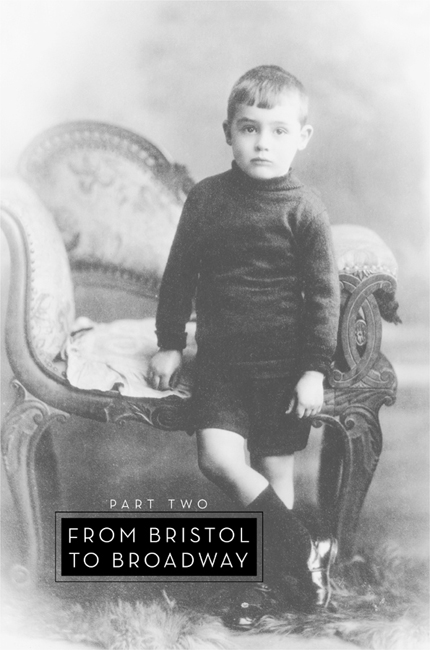
Archibald Alec (Alexander) Leach, age 4, Bristol, England, 1908. (Courtesy of the private collection of the Virginia Cherrill Estate)
2
“I'm reminded of a piece of advice my father gave me regarding shoes; it has stood me in good stead whenever my own finances were low. He said, it's better to buy one good pair of shoes than four cheap ones. One pair made of fine leather could outlast four inferior pairs and, if well cared for, would continue to proclaim your good judgment and taste no matter how old they become. It is rather like the stock market. It makes more sense to buy just one share of blue chip than 150 shares of a one-dollar stock.”
—CARY GRANT
Bristol is the seventh-largest city and third-largest seaport in Great Britain. It is situated to the south of Cardiff, Wales, to the west of Bath, and to the southwest of Gloucestershire. In 1497, John Cabot, the discoverer of Newfoundland, first sailed to the New World from Bristol. Noted natives of Bristol include England's seventeenth-century poet laureate Robert Southey; William Penn, for whom Pennsylvania is named; and the celebrated Shakespearean actor Sir Henry Irving. During the first years of the twentieth century, Bristol was the designated port of departure for those who wished to sail via luxury liner from England to the United States. It is adored by the rest of the world for its celebrated cream sherry.
Bristol is also one of England's many great theatrical districts, home to the famous Theatre Royal on King Street, which first opened in 1766 and remains in operation to this day. The other major stops on the British vaudeville circuit at the turn of the twentieth century were Bristol's Empire and Hippodrome. All three venues were the first signposts on the journey to dreamland for the boy whose destiny it was to become Bristol's most beloved progeny, young Archibald (Arch-eee-bald) Alec (Alexander) Leach.
Archie, as everyone called him, was the second child born to Elsie Maria Kingdon, the daughter of an Episcopalian shipwright, and Elias Leach, the son of an Episcopalian potter. Although Elias had big dreams of one day becoming a famous entertainer, he earned his living wage as a tailor's presser at Todd's clothing factory. The Kingdons generally presumed, in the waning days of the staunch Victorian epoch, that their prudent daughter had, unfortunately, married beneath her class. They did not consider Elias—at thirty- three, twelve years their daughter's senior—socially acceptable or sufficiently established in business for a man his age.
Nevertheless the slight, attractive, cleft-chinned, and prohibitively shy Elsie did not turn him down when he proposed. How could she? He was tall, slim, dashing, and a charmer, the mustachioed man of her dreams. She resolutely believed in Elias, even if her parents didn't, and was certain that he meant it when he promised her that the type of fancy coats and suits of the wealthy he pressed at the factory would one day belong to him as well, that the manual labor in the steamy, windowless shop in which he toiled six days out of seven was but a brief stepping-stone to a better life for the both of them.
Elias could dream with the best of them, and he also knew well how to make at least some of those dreams come true. By the time he walked his twenty-one-year-old wife down the aisle, he had already played through the field of Bristol's most (and least) eligible women, using his good looks to insinuate himself into their beds if not their lives. When he met Elsie, he sensed that her father might provide a rich dowry and, later on, a comfortable inheritance. It was enough to lure him to renounce his wild ways and seek Elsie's hand in marriage.
They settled in to one of the newly built working-class semidetached homes along Hughenden Road, just off Gloucester, a dwelling too chilly and damp in the winter, the air roughened by the smelly choke of poorly ventilated coal heating, and too sweaty in the clumping humidity of summer. In dire need of fresh stimulation, Elias soon returned to his carousing ways. At least part of his problem was sexual frustration. Less than a year into the marriage, he discovered he was no longer able to raise Elsie's temperature, no matter what the time of year. Her Victorian disposition toward romance dictated that procreation was the only justification for engaging in the act of sex. Doing it for pleasure was unproductive, a sacrilegious waste of time, at least as far as she was concerned.
Filled with many splendorous churches and lively music halls, Bristol provided ample opportunity for Elsie to worship God, at least as much as the numberless pubs and music halls accommodated her husband's more secular devotions. Indeed, Elias's relapse into roguishness found easy pickings in the traveling vaudeville companies that continually played the local theaters, where that sort of entertainment itself was seen by Elsie and the church folk as nothing more (or less) than the work of the devil himself.
Victorian society believed that no crime went unpunished. If the authorities of the state did not arrest and prosecute those who broke the legal code, a higher authority surely would avenge those who broke the moral one. Such was the only explanation Elsie could fathom to explain the unexpected death of her firstborn, John William Elias Leach.
She had given birth at home on February 9, 1899, and from the moment baby John took his first breath, Elsie devoted herself to his every need. She showered him with all the love and affection she withheld from her husband, who, she believed, had not remained true. He was surely the cause of God's retribution on their home when, in his eighth month of life, the child developed a cough, followed by violent convulsions and the onset of a fever that would not break. John died of tubercular meningitis on February 6, 1900, two days before his first birthday and one day before Elsie's twenty-third.
She would not allow herself to cry at baby John's funeral. Throughout the solemn service she sat tearless, cloaked in black, and stared straight ahead into the private world of her overwhelming grief. God had indeed punished Elias for his sins and in so doing had brought His wrath down upon her as well, taking back the fruit of their corrupted marriage. After his burial, baby John's name was never spoken again by either Elsie or Elias.
In the spring of 1903 Elsie became pregnant once more, a sign, she believed, of a merciful God. She had Elias redecorate the room that had been her firstborn's and add more insulation to the walls and ceiling to prevent any deathly drafts from blowing onto her new baby.
Archibald Leach was born on January 18, 1904. Early on, to ensure his good health and moral righteousness, Elsie imposed her obsessive orderliness upon the lad, a prudent upbringing that would stay with him the rest of his days. “As a little boy,” he would remember nearly eighty years later, “I was fined for spilling things on the tablecloth. Thruppence a blib. But that wasn't so bad. I had a shilling a week for allowance, so I had four blibs—and we only put the tablecloth on the table on Sundays.”
Elsie enjoyed keeping little Archie's hair long and curly and dressed him in frilly clothes that resembled nothing so much as a little girl's dresses. Much has been made elsewhere of this early treatment as the speculative root of Cary Grant's later bisexuality, and while it may indeed have been a factor, this was the common style of Victorian childrearing in pre-Freudian England. A toddler's sexuality was presumed to be nonexistent, and the so- called cross-dressing of boys was nothing more provocative than a mother's innocent “dolling up” of her baby, without regard to gender. Nevertheless links are links, and Freud did establish that sexual feelings are present in children, and that preadolescent emotional connections are often retained, in one form or another, for a lifetime. In his thirties Cary Grant and his house- mate and lover Randolph Scott often showed up at costume parties dressed as women, and in his mid-fifties Grant surprised reporter Joe Hyams by admitting that he still often preferred wearing women's nylon panties under his regular clothes when he traveled because they were easier to pack than men's underwear and he could wash them out himself, which saved on hotel laundry bills.
As likely to have influenced the young Grant's psyche as his too-close physical attachment to his mother was Elias's frequent absences, which deprived him of a father's normalizing presence. In truth, her husband's nights away from home no longer worried Elsie. Instead, she saw them as an opportunity for additional uninterrupted playtime with her perfect little Archie.
And yet even as the boy grew more attached to his mother and her possessive ways, he still strongly identified on some level with his father. If Archie had become the surrogate husband to his mother, receiver of her smothering affection and perhaps a bit of her misplaced rage, on some primitive or instinctive level he probably knew why Daddy wasn't always around. The few nights Elias did stay home, he and Elsie had loud arguments over money (or the lack of it), which only deepened the emotional split in the boy's loyalties between the two and secured the groundwork for his well-known lifelong thriftiness and later conflicted views of adult love—his uneasy acceptance of the public's at-times-wild adulation, the chaste pursuit of women he believed he unconditionally loved, his failure at marriage, his preference for the company of men over women, or the choice of no company at all. “My parents tried so hard and did their best,” Grant said later on. “The trouble was that they weren't happy themselves. The lack of money for my mother's dreams became an excuse for regular sessions of reproach, against which my father learned the futility of trying to defend himself. But that isn't really to say that either one of them was ‘wrong’ or ‘right.’ They were probably both right.”
Elias (Jim to his friends) was, if anything, relieved by his exclusion from his fatherly responsibilities to his son. He preferred the aroma of cigar smoke and ale spilled on wood at a local pub to the hot cabbage and cold wife waiting for him at home. Whenever Elias did get to spend time alone with his son, it was that much more fun for the both of them. When Archie was just five, his father began taking him to the pressing factory on Saturdays, where the boy loved to stand amid the loud machinery until closing time, then walk through town holding his hand above his head to reach his father's big one as Elias made the rounds of the local pubs and the traveling cribbage games. Archie always received two rewards for “assisting” his father at work. The first was a wrapped candy he was encouraged to fish for with his fingers in the well-pressed pants Elias wore for after-work activities. The second was the advice of a man who admired fine clothing, who believed that visual presentation, despite one's social standing, was the best way to self-promote. One afternoon Elias, after noticing the inferior quality of Archie's shoes, gave him a stern but loving lecture about the importance of proper footwear. Elsie, ever thrifty and practical, had bought Archie four pairs of inexpensive shoes. It was the kind of thrift Elias did not approve of. To him, the dress-up shoes his son wore looked “cheap” and “wouldn't last.” Better to have just one good pair, he advised the young boy, than several that were worthless. “Buy less at higher quality” was a lesson Archie would remember the rest of his life.*
One of Elias and Archie's favorite Saturday-night pastimes was to go to a Bristol music hall or vaudeville theater to see pantomime—a particularly raucous and quite popular entertainment where men played both male and female parts, and the male lead was always played by a young and usually attractive woman—and the song-and-dance routines of the newest performers.
In 1909, at just five years of age, young Archie caught his first glimpse of the performer he would be obsessed with for much of of his life. Charlie Chaplin was a member of the Karno Players, a traveling vaudeville group that regularly toured the music hall circuit that included Bristol. A year later, Karno took Chaplin and others to America, a journey from which Chaplin would not return. He became a solo sensation first in the New York City vaudeville houses along Forty-second Street, then in short film comedies, and triumphed in Hollywood when he gave the world, and Archie, the gift of “the Little Tramp.”
Elias was a bit of a piano-roller himself, and soon enough young Archie could plunk out some pretty fancy rhythms on the pub's beer-stained clanky uprights. When Elsie learned of her son's musical talent, in a gesture of kindness perhaps tinged with parental competitiveness, she had her father buy a fancy brand-new upright for the family living room. The arrival of the piano angered Elias, not because he didn't enjoy the boy's playing but because he hadn't paid for it himself, and his loud but hollow complaints about not wanting to live off her father's charity set off yet another squabble over money that was anything but music to young Archie's ears.
At Elsie's insistence, Archie began studying classical piano, while at his father's urging he continued to develop his music hall style. The conflicted direction of his percussive abilities confused the boy, even as it became yet one more focal point of his parents' polarization, to the point where, while he loved to play, he rarely did for either of them.
Soon enough Elsie, ever the practical puritan, decided that her young boy's God-given talents (aided by the strong left hand, which he naturally favored) qualified him for early admission to one of the best schools in the area, the Bishop Road Junior School in Bishopston. She was rightly proud when Archie's musical abilities convinced the board he was fit to take one of the few available vacancies. The only thing that concerned her was Archie's left-handedness, something she feared might keep the school from allowing him to enroll.
Once enrolled, five-year-old Archie played the piano far less often than he kicked a football, and his unusually deft playground skills won him the friendship and admiration of the other boys his age and older. With all the good food and exercise he got, he spurted upward like a bean weed, stretching to a full six foot one before his thirteenth birthday. What then became apparent to everyone at school, students and teachers alike, was how unusually handsome young Archie was, tall, strong, and blessed with a face that was embossed with his mother's dimpled chin and rich brown eyes and his father's thick black wavy hair and ready smile.
If life seemed better for him at Bishop Road, his absence from home only made things worse between Elsie and Elias. Without Archie as the restraining buffer, their bickering became more frequent, and always centered on either Elias's philandering or his lack of sufficient income. More than once their fights turned physical. For Elias, as he saw it, at times the only way to deal with his stubborn wife was to beat her into proper submission.
Whenever things became too intense between them, Elsie simply left until thing cooled down. It eventually became clear to Elias that the situation between them was hopeless and that he had to leave for good. Unable to pay for a divorce, he figured out a route to freedom by taking a factory job in Southampton, eighty miles southeast of Bristol near the southern shore, to make uniforms for both militaries in the ongoing Italian-Turkish conflict.
Years later Grant would recall in this revealing description the traumatizing incident of what he took as his father's abandonment and his own culpability in helping to drive him away: “Odd, but I don't remember my father's departure from Bristol. Perhaps I felt guilty at secretly being pleased, but now I had my mother to myself … anyway, I don't remember my father's going, but I missed him very much despite all his, and therefore my, faults” (emphasis mine).
In Southampton, Elias quickly took a young mistress by the name of Mabel Alice Johnson and set up a second household. They soon had a baby, born out of wedlock, while back home, Elsie and Archie were forced to move to even smaller quarters.
Whenever Archie made the occasional visit to Southampton to visit his father, Elias made no secret of his new live-in relationship, and rewarded the boy's arrival with a trip to the local cinema to see the latest Chaplin–Mack Sennett two-reeler. Archie always laughed out loud at Charlie's put-upon character and exasperated glances through the camera—straight at him!— that brought a special brightness and joy to his otherwise lonely life.
IT WAS A JOY THAT would not last. One day in 1914 when he was ten years old, Archie came home from school and could not find his mother. With the war imminent, relatives had begun to live together to share ration books. Despite their smaller house, Elsie had taken in two of her brother's children, both of them older than Archie; now they silently watched as he ran from room to room looking for his mum. When he finally asked where she was, they said she had gone to a seaside resort for a little while. Why, Archie wondered, would she do that without taking him along? Without even telling him? And who was going to take care of him while she was away?
Elsie's sudden disappearance deepened Archie's increasingly tortured feelings of abandonment, guilt, and despair that would, in one form or another, stay with him for the rest of his life. Years later, Grant had this to say about his many failed marriages: “I [made] the mistake of thinking that each of my wives was my mother, that there would never be a replacement once she left. I found myself being attracted to [women] who looked like my mother—she had olive skin, for instance. Of course, at the same time I [often chose] a person with her emotional makeup, too, and I didn't need that.”
What did happen to Elsie? Where had she gone? Not to a seaside resort, and not for a little while, as his relatives first told him. That story was quickly replaced by another; his mother had died of a heart attack.
The news devastated the young boy, who soon began to act out both his rage at being abandoned again, this time by his mother, and his guilt for somehow having caused both his parents to leave him. He soon turned to petty thievery and kept at it, even when, mostly out of pity, the community awarded him a scholarship to the prestigious Fairfield Secondary School. It was there he met his first girlfriend, someone he would still remember decades later as “plump, pretty, and frankly flirtatious” but utterly beyond his reach. The daughter of a local butcher, the girl so turned Archie's head that one day while staring at her, he walked straight into a lamppost and very nearly knocked his own teeth out.
That summer, Archie relocated himself to Southampton. He longed to move in with his father, but Elias said no, claiming that the woman he lived with and their baby, Archie's half-brother, took up all the room in the house. Archie then volunteered for summer work as a messenger and gofer on the military docks, often sleeping in alleys at night if he didn't make enough money to rent a cot in the local flophouse. This was wartime, and one of his daily chores was to hand each soldier a life belt before he set out from the English Channel in a transport ship, many of which were sunk by German submarines only a few miles offshore. Out of his sense of patriotism, Archie refused to accept any tip money from the soldiers for whom he ran these errands. Instead, he would take a military button or a regimental badge. He coveted these as if they were the true reflection of his self-worth and proudly wore as many of them as he could fit on his own belt.
Archie reluctantly returned to Bristol that fall for school, still consumed with grief over the death of his mother. He often spent his nights alone in his room, staring at a photo of Elsie, weeping softly as he prayed for God to watch over her soul. On weekends he would take himself to the local docks to watch the schooners and steamships that, he would later recall, “came right up the Avon River into the center of town.” During these periods his notion of leaving Bristol forever intensified: “While most of my school friends were playing cricket, I'd sit alone for hours watching the ships come and go, sailing with them to far places on the tide of my imagination, trying to release myself from the emotional tensions which disarranged my thoughts.”
In many ways, his longing to “release” himself was not all that different from, in many ways an emulation of, Elias's having found a way out of Bristol. Archie wished to escape as well, but no longer just to Southampton—his dreams now stretched much farther than that. Like his (and every Brit's) hero, Charlie Chaplin, he wanted to travel to the land of magic and dreams. America—that was where he longed to go.
THE NEXT SERIES OF EVENTS have often been described as “a lucky happenstance,” the “fateful meeting of a boy and his mentor,” or as Grant himself would later recall, “a coincidence of destiny zeroing in on my future.” Thirteen-year-old Archie, although at best an average student with a bit of an aptitude for chemistry, was nonetheless befriended by his science professor's part-time assistant, brought in one day to help conduct a class experiment.
The assistant was actually a close friend of the teacher and an electrician who worked at the newly rebuilt Bristol Hippodrome (which then replaced the old Empire). Archie eagerly asked to be taken backstage to see the theater's modern switchboard and lighting system. It was a request his friend happily granted, and Archie quickly learned the technical aspects of putting on a show; he got to watch the performers from the privileged perspective of the wings, from where he could see the awestruck faces of the young boys in the first few rows lit by the spill of stage lighting as they bounced up and down with delight. According to Grant, “That's when I knew.” Like Charlie Chaplin, he too would join the theater and see the world!
Archie's electrician friend then introduced him to the house manager of the Hippodrome, who also took a liking to the boy. He often invited young Archie to sit with the backstage crews and occasionally help them pull curtain and lighting cables and change scenery between acts. Archie did so well he was eventually promoted to help the lighting men handle the special twin arc lamps, or limelights, as they were known (for their tendency to throw a pale green halo around performers). They hung from the ceiling at either side of the stage and had to be manually focused to keep the star performers in their special sharp, double-spot illumination.
Eventually Archie was allowed to operate one of the limelights on his own and was good enough with it to operate the all-important center “moving white” at the back of the house. All went well until one time during a performance he misfocused the center spot on a couple of back mirrors that gave away the secret to a headlining magician's best trick. At the magician's insistence, Archie was permanently barred from ever again working at the Bristol Hippodrome.
He was devastated and vowed to never set foot inside another theater, but soon found himself once again hanging around the fringes of Bristol's many playhouses, spending time with the actors he had gotten to know during his brief career as a lighting man. On the odd occasion he was even able to get some pickup work at the Hippodrome as a call boy after school for ten shillings a week, which is how he first heard about Bob Pender's troupe of young knockabout comedians.* Pender's was a specialty act whose performers padded their skits with intricate slapstick numbers, stilt-walking choruses, and intricate mime routines complete with matching costumes and oversize masks. Pender, whose real name was Bob Lomas, had first made a name for himself as a performer in the tradition of the great Drury Lane clowns before forming his own company, intending to follow the path of the legendary Fred Karno traveling shows.
Lomas's entourage was a decidedly family affair. His wife, Margaret, a former Parisian Folies-Bergère ballet mistress, gave the Pender troupe the benefit of her specialized training in movement and balance. Among the lead performers were Lomas's daughter Doris, his brothers Tom and Bill, his widowed sister-in-law, and her son.
Like all companies made up of mostly young performers, Pender's was forever in need of trainable talent to replace those who grew too quickly, got bored and left, fell in love, married, or went into the military. After getting to know young Archie, Lomas invited him to try out as a member of the traveling company. Archie was beside himself! After hanging on the backstage fringes of the business for what seemed like forever, he was, at last, going to have a chance at performing.
He worked up a series of athletic moves he had learned from the older footballers in school, with a couple of flips he had always been able to do, and also showed that he could walk on his hands, a trick his father had taught him. Lomas liked what he saw and offered him a position with the company, provided that Elias give his written approval. Archie immediately accepted, went home, forged a letter of permission from his father, and brought it back to Lomas, who then sent him off to observe the troupe in Norwich.
Unfortunately, Archie's first tour ended abruptly ten days later, while the troupe was still in Norwich, by the sudden and unexpected arrival of Elias. He had been told by Archie's Bristol relatives that the boy had run away. He quickly tracked his son down, confronted Lomas, and informed him that Archie was not yet fourteen, the legal work age in England at the time. Elias demanded that he be returned to school at once and threatened to press criminal charges of abduction of a minor against Lomas. Reluctantly, Archie packed his few things, said good-bye to everyone, and returned to Bristol without ever having appeared on stage.
Back home, Archie longed to return to the theatrical life and came up with a clever plan to make it happen. Years later, according to Grant, he “investigated” the girls' lavatory at school, meaning that he drilled a small peephole through one of the walls to watch the girls go to the bathroom. Other sources claim he reverted to his old ways and was caught stealing. Whatever the reason, his official expulsion, for “inattentiveness, irresponsibility, and incorrigibility,” occurred in March 1918, just two months after his fourteenth birthday. The school's decision conveniently freed him to rejoin the Pender troupe.
That August Archie eagerly signed a three-year contract, this time actually cosigned by Elias, that officially granted him permission to join Pender's troupe, at a weekly salary of ten shillings with board and lodging included and technical training to be provided by Lomas. By now Elias was more than happy to give his son over to Lomas, for reasons that had less to do with Archie's budding talents than his own present needs. When the boy got in trouble at school, the local authorities had investigated why he was living with relatives in Bristol rather than with his father in Southampton. The last thing Elias wanted was the Bristol authorities sniffing into his personal life. Finally, when Elias discovered that Lomas was a fellow Mason and a family man, he gave his full consent, believing his boy would be well cared for.
ARCHIE PROVED an apt pupil when he wanted to be, especially in the more physical aspects of British music hall entertainment. His specialties became stilt-walking, tumbling, and pratfalls, to which he brought his natural athleticism and the same kind of natural rhythm and timing he had shown at the piano. At Lomas's urging, he also began to work on his speech to lose his pronounced West Country Bristol brogue. Unable to master “cultured English talk,” he developed a unique vocal mix of rhythms, raspy voice, and hesitant diction, the sound of which would one day be instantly identifiable to movie audiences all over the world.
For the next two years Archie and the troupe traveled the British music hall circuit, occasionally jumping over to the European mainland and the larger theatrical outposts of the Middle East.
By the age of sixteen, six-foot-one Archie Leach, with his handsome face, great smile, easy laugh, and natural athletic ability, had developed a charismatic stage presence that brought him to the front ranks of the Pender touring company. And then it happened. In 1920 Lomas's organization was invited by famed New York impresario Charles Dillingham, Oscar Hammerstein's chief competitor, to come to the United States, to perform at 42nd Street's Globe Theater as the opening act for Fred Stone, one of vaudeville's biggest stars. With room for only eight of the twelve resident young men in his company, Lomas was forced to eliminate one-third of his male leads. Archie could hardly contain himself when he saw his name posted on the bulletin board along with the other youngsters who had survived the cut.
He arose at dawn the morning of July 21, the day of the troupe's departure, and was the first to arrive at the Southampton docks, accompanied by Elias, who wanted to be there to say farewell. After kissing his father goodbye, he boarded the luxury liner RMS Olympic (the Titanic's sister ship), bound for America.
Also aboard were two of the most famous Hollywood film stars in the world. Douglas Fairbanks and his bride, Mary Pickford, whose marriage had caused an international newspaper and newsreel frenzy, were completing their six-week European honeymoon with a first-class cruise back to the States. It was just before leaving for the Continent that Fairbanks and Pickford had signed their historic deal, along with Chaplin and D. W. Griffith, to create their own studio, United Artists, with the intention of gaining their artistic freedom and financial independence from the other studios.
When word got out that Fairbanks and Pickford were on the Olympic, it thrilled the other passengers, but none more than Archie. Every day he watched the people stream in and out of the dining room until he got his nerve up to approach the glamorous couple for their autographs. Fairbanks and Pickford proved remarkably gracious, and when Archie asked permission to have his picture taken with them, they happily complied. Archie told them how much he admired their movies, and how he hoped one day to be as great a physical actor as Fairbanks, famous for his astonishing acrobatic stunts often filmed in single, uncut sequences. Fairbanks thanked the boy, and then, to Archie's surprise, asked if he would like to join him in his daily on-deck morning calisthenics. Would he! Doing jumping jacks next to the well- tanned, immaculately dressed, and perfectly coiffed actor thrilled Archie and inspired him to “doggedly strive” to keep himself as fit and well groomed as his first famous Hollywood friend.
And so it was, late every afternoon, while the Olympic steamed westward and the other passengers took their daily naps, played cards, or stole away for a romantic interlude, Archie Leach stood by himself on deck, leaning over the rail trying to see the face of his future. Freed at last from the prison of British provincialism, he vowed that once in America, he would never again look back at the loneliness and sadness of all his yesterdays, left buried somewhere with Elsie in her Bristol grave.
* This sartorial philosophy was reflected in the relatively sparse wardrobe of the highest-quality clothing that Grant maintained, even at the height of his great wealth and enormous popularity. Once he became an independent player, to the end of his career, he contracted to keep, at his discretion, all the clothing he wore in his films, more than once green-lighting a script out of consideration of the wardrobe. Grant was quoted (Davis, “Cary Grant”) as saying that his favorite film in terms of fashion was That Touch of Mink (1962) because of the luxurious and exclusive custom-made Cardinal suits his character wore. At the end of shooting he kept the entire wardrobe of blues and grays that so perfectly offset his then blue-gray hair.
* Variously known as “Bob Pender's Little Dandies,” “The Pender Troupe of Giants,” “Bob Pender's Nippy Nine Burlesque Rehearsal,” and by Grant in later recollections as “The Bob Pender Acrobats.”