
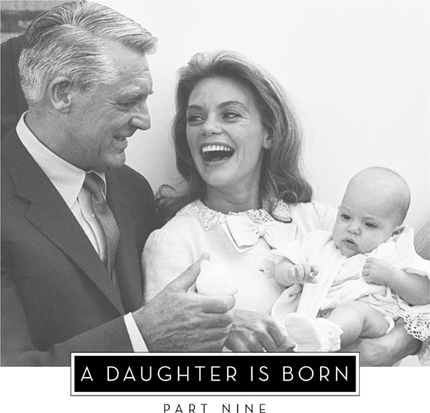
Cary Grant, fourth wife Dyan Cannon, and Grant's only child, three-month-old Jennifer, in 1966, during the brief period of time the couple appeared to be happily married. (Bettmann/CORBIS)
30
“I was a self-centered boor. I was masochistic and only thought I was happy. When I woke up and said, “There must be something wrong with me,' I grew up. Because I never understood myself, how could I have hoped to understand anyone else? That's why I say that now I can truly give a woman love for the first time in my life, because I can understand her.”
—CARY GRANT
At Drake's insistence, Grant tried a reconciliation that he knew couldn't possibly work. Even before he finished North by Northwest, Grant was preparing himself for his permanent exit from the marriage and once again rushed into the protective safety of another movie. Emotional separation had always been difficult, and nothing else in his life could occupy him so completely and take his mind off his personal woes as making movies. In his capacity as filmmaking “tycoon, bargaining with a mind like an IBM machine,” and in a deal he negotiated on his own, Grant turned the tables on Universal Studios by insisting it guarantee Grandon 75 percent of the profits or 10 percent of the gross, whichever was greater, with a guarantee of $1 million up front and outright ownership of the negatives after seven years.
It was still a good deal for Universal, but a great one for Grant, who had become more actively involved in the financial planning of his motion pictures after he summarily dispatched Lew Wasserman and MCA. With the huge financial success of North by Northwest, the agency had begun to press him to move into television, something he had openly resisted ever since the little flickering box first began to appear in living rooms across the country. In his biography of Wasserman, Dennis McDougal describes how the Wasserman-Grant split happened: “The final outrage [after MCA's failure to acquire Bell, Book and Candle for Grant] came when Grant was summoned to appear at Wasserman's Beverly Hills office for a career discussion. There, several executives told Grant he ought to follow his triumphant appearance in North by Northwest by doing his own TV series. Grant immediately became hostile. He asked again whether they really believed that he should appear in television and MCA replied, ‘Yes.' Grant asked who would produce the show and was told it would be MCA, of course. He stood up, scanned the roomful of Wasserman clones, all clad in dark suits, white shirts, and black ties, and said, ‘Our contract is over as of now,’ walked out and never returned.”
Grant had every reason to be outraged. It was clear to him now that MCA was far less interested in prolonging his giant film career than reducing it to twenty-one black-and-white inches, in a medium where they would have complete control of the vehicle, the talent, the advertising, and the profits. Wasserman had done the same thing with Alfred Hitchcock in the mid1950s, giving him a half-hour drama anthology series, then using it as a way to bolster Revue, Universal's TV unit. (The director, however, was smart enough to ensure that he would be allowed to continue to make movies and maintain creative control over the show's content as well as long-term ownership of all its episodes. Wasserman was not going to make that mistake again. Grant would not have been offered creative input, profit participation, or ownership.)
As always, Grant's timing was perfect. He left Wasserman and MCA just as the government was tightening its long-term investigation into the alleged monopolistic practices and mob influence at the powerful management and talent agency.*
RELEASED IN DECEMBER 1959, in time for the lucrative holiday season, OperationPetticoat, Grant'ssixty-seventhfilm, became the most successful of his career. It outgrossed North by Northwest by more than $3 million and in doing so elevated Grant into the rarefied air (of the time) where independent producers of films that surpass the $10 million gross mark (in their initial domestic thea trical release)we refe wand far between. A sproducerandstarofOperationPetticoat, he earned a personal net gain of $3 million, the most he had ever made from a single picture. A month after the film's opening, on the strength of his powerhouse box office, Cary Grant became the first star in film history to have his films gross more than $10 million in a single theater. He had already had a record twenty-four movies of his premiere at the cavernous 3,200-seat art deco Radio City Music Hall auditorium in the heart of New York City. Operation Petticoat pushed Grant's collective Music Hall gross over the $10 million milestone.
AS HE CROSSED THE MID-FIFTIES line on his life's journey, each tick of the biological clock sounded more and more like a soundtracked funereal bass. His continued regular weekly doses of LSD were the best reminders of who he really was and what he still needed to do, even as he sensed that time was running out to salvage his own childhood by creating his own child. In February 1961, just after his fifty-seventh birthday, Grant told an entertainment reporter from The New York Times that “there is no doubt that I am aging. My format of comedy is still the same as ever. I gravitate toward scripts that put me in an untenable position. Then the rest of the picture is spent in trying to squirm out of it. Naturally, I always get the girl in the end. It may appear old-fashioned. There seems to be a trend toward satirical comedy, like The Apartment. Perhaps it is because young writers today feel satirical living in a world that seems headed for destruction.”*
Grant's notion that his films could somehow save the world was a macro fantasy of fatherhood as wild and expansive as it was appealing to him. That month Grant quietly began spreading the word among friends that he was offering a bounty of a million dollars in cash for “the right woman willing to bear him a son.” That bounty would be resurrected periodically for the rest of his life.
GRANT DECIDED TO COMPLETE ALL his outstanding film commitments to his own and Donen's film companies and take on no new projects. That winter he finally began work on The Grass Is Greener. The film was based on a successful British stage play by Hugh and Margaret Williams, shot on location in London and directed by Stanley Donen. Grant had insisted the film be shot there because he wanted to return to England. Thrifty as ever, he had found a project that would finance the entire trip without interfering with his nonmoviemaking affairs. The Grass Is Greener was, in that sense, the ideal project. With the exception of one or two scenes, it is essentially a one-set project; much of the action takes place in Lynley Hall, the stately mansion of Victor, Earl of Rhyall (Grant), who for financial reasons—he's flat broke—has opted to turn the place into a tourist attraction.
Grant cast Deborah Kerr to play his wife, Hilary, although she wasn't his first choice; the earthier Jean Simmons was. Simmons, however, was on the verge of divorce and because of it asked for and got the smaller role of Hilary's girlfriend, Hattie Durant. Donen recommended Robert Mitchum to play Charles Delacro, the wealthy young American who, while taking the tour, meets and falls in love with Kerr. In the key role of the butler, Grant dearly wanted Noël Coward, but Donen preferred Moray Watson, who had created the role onstage at the West End—the only original cast member to make the transition to film. Grant acquiesced.
The plot centers on Charles's efforts to woo Hilary away from Victor. The sex mess is treated in a veddy Briddish manner, meaning much civilized talk with little physical action, until the two men agree to resolve their differences in a duel. Victor is wounded, Hilary realizes she still loves him, and everyone lives happily ever after, including Charles, who somehow winds up with Hattie (with whom Victor had faked a romance in the hopes it would make Hilary jealous and win her before any shots were fired).
Grant had, at one point, considered not being in the picture at all, and unofficially offered his part instead to Rex Harrison, who agreed to do it— until the death of his wife, Kay Kendall, forced him to drop out. To avoid an expensive delay, Grant then agreed to play the role after all, one he knew he could do with his eyes closed. Mitchum, on the other hand, stood out like an American sore thumb, cast against type in the guise of an articulate, understated wealthy American urbanite. Grant okayed Donen's choice of Mitchum because he had already starred in two films with each of The Grass Is Greener's female costars, and thought their experience would produce a familiar chemistry well suited for this ensemble piece.*
As it happened, Grant felt early on that Mitchum's acting was too understated, and that because of it he, Grant, would be seen as overplaying his part. Mitchum saw things differently. He complained that his role was underwritten, consisting mostly of reactions like “Really?” and “Oh?” amid long stretches of dialogue from either Grant or Kerr. Moreover, Mitchum found Grant a bit old-man stodgy, both in the part and in real life, and he later told friends that he didn't appreciate Grant's “humor… sort of old music-hall jokes. ‘What's that noise down there? They're holding an Elephant's Ball? Well, I wish they'd let go of it, I'm trying to get some sleep,'” adding somewhat facetiously, “I guess that was when he was coming off his LSD treatment.”
Donen remembers the film as a milestone of sorts, marking the end of a certain type of sophisticated British comedy, before the antic humor of Peter Sellers arrived and dominated the English cinematic 1960s: “Cary played a titled Englishman, and [in several scenes] was wearing what an earl would wear at night in his country house—a dark green velvet smoking jacket. Halfway through making the picture, he got terrified. ‘I don't want to be in a smoking jacket,’ he said. He was afraid that by playing that kind of man he would lose people's interest. A certain sort of polish in films—the way people moved and spoke—vanished then. And it never came back.”
DURING FILMING, GRANT SPENT EVERY weekend in Bristol visiting his mother, for the first time enjoying the occasional flash of genuine wit that emerged from her diminished capacities without the overlay of guilt that had long plagued their relationship. Grant loved treating Elsie to shopping sprees in search of the antiques she loved to collect.
Less blissful was a visit he received from Drake, who, as part of yet another of her futile attempts to reconcile with Grant, flew to England to be with him for several weeks while he was shooting. During her stay she and Grant were invited by Princess Grace to go sailing with her and Prince Rainier off the shores of Monaco—something that caused the prince no little amount of consternation. Not only had he absolutely forbidden his wife to return to filmmaking, he didn't even like being reminded of that part of her life, which, as far as he was concerned, was, like all of Hollywood, cheap and tawdry (and threatening). No doubt he both envied and feared his imagined (and in some cases real) Hollywood rivals for Kelly's affections. He was especially jealous of Grant, who was much taller and far more fit than the pudgy prince, who could not get out of his head the images of the passionate kisses and sexual flirtation between Grant and his wife in To Catch a Thief. (He nevertheless screened the film frequently at the palace, when guests from America stayed with them, always by request. Of all her films, it remained the only one he refused to allow to be shown publicly in Monaco.)
According to one who was there, throughout Grant and Drake's visit “the prince did not hide his bad humor during their stay at the palace. He spoke to no one. He sulked… the princess, meanwhile, was cool—her usual attitude to her husband's moods.”
For her part, Drake mistook the princess's coolness for well-founded jealousy and in turn became jealous herself. The resulting criss-crossing of tensions made everyone less comfortable than they otherwise might have been. Princess Grace and Grant both knew what was taking place and did their best to ignore their spouses' suspicions and just enjoy themselves.
This was the last official invitation to Monaco Grant would receive during the princess's lifetime.
The Grass Is Greener opened in December 1960, and its comic conceits—that the British were essentially so superior to the Americans in the ways of civilized love that their marriages could survive a little harmless flirtation, while the boorish Americans, no matter how rich or refined, would chase anything in a skirt, single or married—laid a gigantic egg in the United States. Even Grant's most diehard female fans tended to stay away, not wanting to see their idol compromised by, of all men, the swarthy, bullying Robert Mitchum.
Because of it Grant took a bit of a financial bath, something at the time with which he simply could not be bothered. Instead, his focus returned once more to his pursuit of finding the proper soulmate as a wife and future mother. While he continued his search, he moved along briskly with his plan to eliminate all remaining film obligations. He soon began production on the decidedly all-American That Touch of Mink, in which he appears opposite Doris Day, the cross-eyed, freckled, lemon-haired eternal virgin of the American mid-twentieth-century cinema.
Grant plays the role of a suave and debonair millionaire ladies' man originally intended for Rock Hudson, Day's onscreen partner in the hugely successful sex(less) comedies Pillow Talk and Lover Come Back, both made at Universal. Day's husband, manager, and producer, Martin Melcher, felt that Hudson had gotten too much credit and Day too little for the previous films' successes, and as the Hudson characters were always described as “Cary Grant” types, he decided to go for the real thing.
Grant, meanwhile, since firing Wasserman, loathed the thought of doing any more business with Universal and turned Melcher down several times. Finally Stanley Fox came up with a workable plan good enough to convince Melcher's company, Arwin Productions, to bring in Grant as a partner and make Stanley Shapiro the film's screenwriter and coproducer, along with Grant and Melcher. It was the choice of Shapiro that finally convinced Grant to sign on. Shapiro, who came up with the original concept for That Touch of Mink, was also the screenwriter for Operation Petticoat and a cowriter of both Pillow Talk and Lover Come Back, all three of which were highly successful, big-profit pictures.
In That Touch of Mink, millionaire bachelor Philip Shayne (Grant) romances working girl Cathy Timberlake (Day). After a meet-cute in which Grant's Rolls-Royce accidentally douses Cathy's coat with mud, Philip, assisted by his ever-loyal manservant and moral adviser Roger (Gig Young), decides to romance Day every-American-woman's-fantasy style, which includes a visit to the dugout of the New York Yankees (Grant, a lifelong baseball fan, was thrilled to death to appear with Mickey Mantle, Roger Maris, and Yogi Berra in a scene shot on location at Yankee Stadium), a trip to Bermuda on everything but gossamer wings, and midnight top-of-the-world dinners at his penthouse, all of which gets him no closer to having sex with Cathy. Somehow this only makes him want her more. In the end, they get married.
The film, which borrowed heavily from Shapiro's previous Day comedy Lover Come Back, is a basic meat-and-potatoes middle-aged man meets girl, middle-aged man loses girl, middle-aged man gets chicken pox (and the girl who gives it to him). Audiences loved it and welcomed back the familiar “American” Cary Grant with open arms and wallets. The film opened at Radio City Music Hall on July 18, 1962, and earned more than $1 million in its initial domestic theatrical release. It went on to become the second-highest-grossing Cary Grant film of all time (just behind Operation Petticoat).
Although That Touch of Mink earned $4 million for Grant, personally he remained indifferent to the film and thought nothing about it other than it was one less he would ever have to make.*
Three weeks later, on August 13, 1962, Drake, who had returned from a trip to England after not hearing from Grant even once the entire time she was gone, was convinced at last that their relationship could not be saved and sued for divorce on the grounds of mental cruelty.
According to court records, Drake's reasons for seeking the divorce included the fact that Grant “preferred watching television to talking to me.
He appeared bored. I became lonely, unhappy, miserable, and went into psychoanalysis. He told me he didn't want to be married. He showed no interest in any of my friends.”
As was his custom, Grant made no public comment, other than the onesentence comment that “Betsy was good for me.” Drake's initial reaction to the press waiting outside the courtroom door after the one-day hearing (at which Grant did not testify) was done with dramatic flair: “I was always in love with him,” she said, then paused, turned her head, and added, “and I still am.”
Later on, pressed by Louella Parsons for more “exclusive” information, Betsy told the gossip, “I left Cary, but physically he'd left me long ago.”
Drake received a generous settlement from Grant rumored to be more than $1 million in cash and a portion of the profits from all the films he had made during the nearly thirteen years they were married. Shortly thereafter she left show business, and his life, forever.
The swiftness and generosity of Grant's participation reflected his only remaining interest in his third wife: getting rid of her as soon as possible so he could continue to search for the woman truly worthy of being the mother of his child.
* McDougal's account of Grant's exit from MCA was taken from an FBI audiotape of the meeting, made on November 4, 1960, without the knowledge of any of the participants.
* Billy Wilder, someone Grant was never particularly fond of, produced and directed The Apartment(1960), for which he won Best Picture, Best Director, and Best Screenplay (with I.A.L. Diamond) Oscars. The film also won for Art Direction–Set Direction and editing. Grant's reference is an obvious one. Wilder's black and white film is cynical, sexual, and edgy, while Grant's post-Hitchcock films were at Grant's directive colorful, positive, wholesome, and relaxed.
* Mitchum starred with Jean Simmons in Otto Preminger's Angel Face (also known as Murder Story) (1952) and Lloyd Bacon's She Couldn't Say No (1954), and with Deborah Kerr in John Huston's Heaven Knows, Mr. Allison (1957) and Fred Zinnemann's The Sundowners (1960).
* As part of his deal, Grant kept the beautiful wardrobe custom-designed for him to wear in the movie by Norman Norell and (an uncredited) Rosemary Odell.