
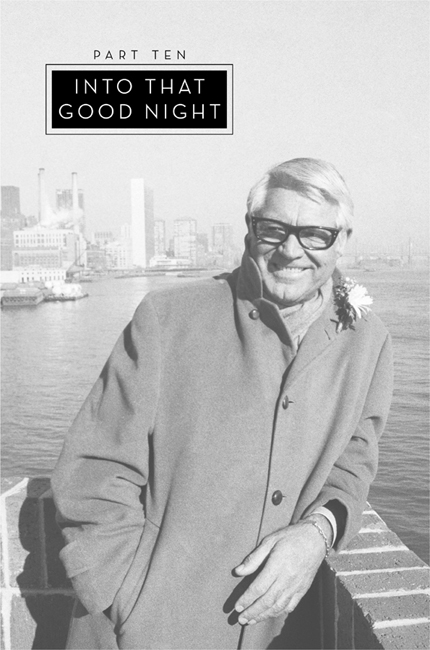
A gray-haired, contented Cary Grant at 80, along New York City's East River. (Bettmann/CORBIS)
33
“Every one of my wives left me. I don't know why, maybe they got bored, tired of me. I don't know. Maybe I was making the mistake of thinking that each of my wives was my mother, that there would never be a replacement once she left … I'm not at all proud of my marriage record, but I have wanted a family for years. I finally have this one child, and I will do whatever I can for her …It has taken me many years to learn that I was playing a different game entirely. My wives and I were never one, we were competing …My first wife accused me of being a homosexual. All the women except Betsy have accused me of being a homosexual. Virginia was just the first.”
—CARY GRANT
In January 1973, two weeks short of her ninety-fifth birthday, just after high tea, Elsie Leach took an afternoon nap and passed away in her sleep at the nursing home in Clifton, England, where Grant had placed her. Beside her bed was a picture of her son Cary and one of her granddaughter Jennifer.
Grant received word of his mother's death en route to a board meeting of Western Airlines, the newest corporation he had joined. He had last seen Elsie only two weeks earlier, on one of his regular visits to Bristol.
He immediately boarded a private plane provided by George Barrie to attend her funeral. As he prepared to take off from Kennedy Airport, a few members of the press found him and asked for a reaction. Grant thought about it for a few seconds, then told them “she never smoked, never drank, and ate very lightly. She died in her sleep. There will be no services. I shall reunite her with my father in the Bristol cemetery. With the past now gone, I'll have the future ahead—with my daughter Jennifer.” He made no other public comment regarding the passing of his mother.
Elsie's death triggered a bizarre reaction in Grant. He resumed calling Dyan Cannon every day. Cannon, who had since moved into the Malibu colony and was living with radio and TV personality Joey Reynolds, refused to take his calls. According to Reynolds, “I was there the night Mr. Grant called and announced that he was trying to buy the house next door. Dyan had a hissy fit, and it ruined a good pot high. She had made a record deal with a friend of mine from Motown and was singing to me on her bed when the call came. Grant was trying to harass her because she had, lately, been giving him a hard time on visitation.”
Eventually Grant stopped calling. Not long afterward, he licensed the broadcast rights to six of his films to National Telefilm Associates, a TV film distribution company, for $2 million plus royalties. They included Operation Petticoat, Indiscreet, That Touch of Mink, The Grass Is Greener, Father Goose, and Penny Serenade. Grant later claimed he did it so he could watch them in private without having to screen them in the projection room of his home, because whenever he did, it greatly upset his daughter. “Jennifer once walked up to the screen and tried to slap Deborah Kerr. She kept telling her to ‘stop kissing my daddy.'” Ironically, the medium Grant had always refused to appear on out of fear that it would dilute his moviegoing audience became the primary cultivator of a new generation of Cary Grant fans.
He occasionally leaked to the press that if something came along that interested him, he might return to making films, but he continued to reject any and all offers to do so. He turned down a million dollars from Warren Beatty to make a cameo appearance in Heaven Can Wait, and the lead in Joe Mankiewicz's film version of the hit play Sleuth, which went to Laurence Olivier (opposite cockney actor Michael Caine). MGM offered him the lead in an all-star-cast remake of Grand Hotel. He said no to that as well. He also turned down the chance to costar opposite Elizabeth Taylor in Night Watch. Even George Barrie tried to get him to star in the first film for Fabergé's new motion picture division, Brut Pictures' A Touch of Class, opposite Glenda Jackson, but after much wavering, Grant turned him down too, and the part was rewritten to suit the more youthful George Segal. “I'd have done it if I were fifty years younger,” Grant later joked to Variety.
Director Peter Bogdanovich also tried to convince him to return to movies in his film homage to screwball comedy, What's Up, Doc? opposite Barbra Streisand. Grant said no, and that part went instead to Ryan O'Neal. Grant then told friends that the only roles he was suited for were old fellows in wheelchairs, and he had no desire to portray that type of character. Unfazed, yet another producer offered Grant $2 million in cash and 90 percent of the net proceeds to star in something called One Thousand Cups of Crazy German Coffee. That one made him laugh out loud. The producer had recently acquired the rights to a script that Grant himself had owned for years, before selling it when he decided he was never going to make another movie.
In June 1973, Grant and Gratia von Furstenberg accepted and split a $70,000 settlement from the trucking company the court deemed responsible for the accident that had put them both in the hospital in 1968 just prior to his divorce hearing.
SHORTLY AFTERWARD, in a rare extended interview with The New York Times, Grant spoke for the first time in years about his experience with LSD and how he felt it had affected his marriages. “My intention was to make myself happy,” Grant told journalist Guy Flatley. “A man would be a fool to take something that didn't make him happy. I took it with a group of men, one of whom was Aldous Huxley. We deceived ourselves by calling it therapy, but we were truly interested in how this chemical could help humanity. I found it a very enlightening experience, but it's like alcohol in one respect; a shot of brandy can save your life, but a bottle of brandy can kill you. And that's what happened when a lot of young people started taking LSD, which is why it became necessary to make it illegal. I wouldn't dream of taking LSD now; I don't need it now.”
In 1974 Jennifer began Montessori school, which afforded Grant a little more leisure time but also brought back the feelings of loneliness he had been able to buffer so effectively in the role of doting father. At exactly this time he became involved with a twenty-year-old beauty by the name of Vicki Morgan. Unknown to Grant, Morgan, who apparently had a thing for older, wealthy men, was also involved at the time with department store magnate Alfred Bloomingdale, an elderly millionaire with a penchant for kinky sadomasochistic games. Eerily, a few years later Morgan, like Bouron, was found bludgeoned to death.*
The seventy-year-old Grant then pursued a twenty-six-year-old entertainment reporter, British-born, Hollywood-based Maureen Donaldson. She had first come to America to serve as a nanny for rock star Dee Donaldson, whom she eventually married. They divorced in 1973, after which she briefly worked as a reporter for gossip-monger Rona Barrett's popular and profitable Hollywood magazines. In 1974 one of her assignments was to interview Cary Grant.
Donaldson—in her own words “no great beauty”—quickly fell under the spell of her charismatic subject. They began dating, and Grant soon assigned her the task of picking up and delivering Jennifer to Dyan Cannon, so that he could avoid having to come face to face with his ex-wife. While Donaldson may have taken Grant's interest in her for something serious, his motivations were more likely practical and calculated. He was considering suing Cannon for greater custody and believed that if he had a steady girlfriend, especially one who was a former nanny, his chances would be significantly increased.
For the next four years Donaldson was Grant's constant companion, and their names occasionally surfaced in the gossips, where the most persistent rumor was that she was to become Grant's fifth wife. He was always quick to deny it, telling any reporter who directly asked that he was never going to marry again. When that became clear to Donaldson, the relationship faded, and she disappeared from his life.*
IN 1976 HOWARD HUGHES DIED in his private plane while on a flight to Mexico. Grant was saddened by Hughes's passing and frightened by how, surrounded by his staff and his security guards, he still managed to die, to all intents and purposes, utterly alone. It reinforced Grant's determination not to go the same way.
IN 1977, still looking fit if a little fuller around the middle, his thick head of white hair cut short and his skin evenly bronzed, Grant finally won a round in his ongoing court battle with Cannon when the courts loosened the restrictions on his visitation rights with Jennifer. Ironically, that seemed to bring Grant and Cannon closer together than at any time since the night before the Academy Awards. They began taking their daughter out together for Chinese food at Jennifer's favorite restaurant, the child-friendly Madame Wu's in Santa Monica, and those who saw them there remember what looked like happy times for the threesome.
During this period yet another reporter inquired as to whether Grant would ever make another picture, to which he replied, “Jennifer is my best production.”
In the spring of 1977, under the pseudonym Cary Robbins, Grant checked into St. John's Hospital in Santa Monica for surgery to repair a hernia, an event whose significance was elevated by the fake name that fooled no one in Hollywood and hence garnered worrisome headlines in the trades about Grant's health until he emerged from the hospital with a big smile on his face. He gently chided the crowd of two dozen waiting reporters, telling them they ought to be spending their time looking for a real story. Eleven years after his last movie had been released, Cary Grant's newsworthiness was a tribute to his remarkable popularity.
The year ended on a sad note for Grant, with the news of Charlie Chaplin's passing on Christmas Day. Although they had never become what either would describe as friends—besides their shared status as Hollywood outsiders and loners it's possible Grant's marriage to Cherrill also had something to do with it—Grant never lost the inspiration Chaplin instilled in him.
IN 1978 THE SEVENTY-FOUR-YEAR-OLD Grant began dating a new woman, twenty-eight-year-old Tanzanian-born Barbara Harris. They had met two years earlier on a British-based Fabergé junket. One friend of Grant's described the difference in their ages as a resurfacing of “Grant's Chaplin complex,” his attraction to younger women “as periodically dependable as the revival of Modern Times.”
Grant continued to visit Harris every month in England, where she lived, and after a while invited the attractive brown-haired, hazel-eyed young woman to visit him in Los Angeles. Harris declined all his invitations. To keep seeing her, he increased the frequency of his British Fabergé junkets until late in 1978, when after about a year of dating, she invited him to meet her parents in Devon.
Grant was fifteen years older than her father. Later that same year Grant, along with Mr. and Mrs. Frank Sinatra and the Gregory Pecks, was invited to Princess Caroline's wedding in Monaco. Everyone in Peck's party, including Grant, arrived at the Pecks' villa at St-Jean-Cap-Ferrat in the South of France alone. After a long conversation between Grant and Peck, during which Grant discussed his reservations about the age difference between himself and Harris, on the first night of Grant's arrival Peck encouraged him to disregard it, call her up, and invite her to join the party. Grant did just that, and to his delight, Harris immediately packed a bag and caught a plane for Nice. Grant drove to the airport by himself to pick her up, and they spent two days alone together before rejoining the others.
After the wedding Grant once again invited Harris to come to Los Angeles with him, and this time she said yes. They flew back to the States, and she stayed at his Beverly Hills home for three weeks, leaving only when her position at Fabergé required her to attend a function in London, after which an apologetic Barrie happily flew her back and forth on his private jet.
The next weekend was a difficult one for Grant. He arranged for the two of them to spend it in Palm Springs with his daughter. Wary of how Jennifer had reacted to his costars whenever she watched his old films, Grant wondered what her reaction would be to a real-life woman he brought into the mix. To his great relief, Jennifer and Harris got along extremely well, as Grant would later describe it, almost like sisters. His mood quickly elevated, and a sparkle no one had seen in his eyes for years was said by friends to have returned.
As did his presence in the gossip columns. Typical of the kind of pieces being written was this one that showed up in the pages of People magazine: “In London and L.A. the talk of the town is that Cary Grant's latest Blonde Venus is Barbara Harris, 28, whom he met on Holiday some months ago and implored to move to the U.S. Figuring that Ladies Should Listen, she recently did. Never Indiscreet, the two are talking about their romance, but still Harris' mom confirms that it's more than a Suspicion. It's no Charade.” And so on.
IN APRIL 1979, Grant made a last-minute decision to appear at that year's Oscar ceremonies after Marlon Brando backed out of presenting Laurence Olivier a special noncompetitive “Honorary Award for the full body of his work, for the unique achievements of his entire career and his lifetime of contribution to the art of film.” Directly after Michael Cimino was given his Best Director Oscar for The Deer Hunter, Grant appeared at the podium to thunderous applause and a standing ovation. He was clearly moved by the warm reception and needed a few moments to pull himself together. When he finally did begin to speak, his voice was a bit rougher than most remembered. He covered his eyes with thick black-rimmed glasses, Lew Wasserman style, and read softly from the TelePrompTer: “Those of us who have had the joy of knowing [Laurence Olivier] since he came to Hollywood warmly and fondly and yet respectfully call him Larry. He represents the ultimate in acting.” At that point a bearded Olivier stepped out from the wings and into yet another standing ovation. Grant handed him the award and slowly disappeared from sight as Olivier made his acceptance speech.
Backstage, the energy was of a different sort. Dyan Cannon had been nominated for her second Best Supporting Actress Oscar, this time for her performance in Heaven Can Wait, Warren Beatty's remake of Alexander Hall's magical 1941 comedy Here Comes Mr. Jordan, the same film in which Grant had repeatedly turned down the chance to play God. Cannon (who lost to Maggie Smith in California Suite) had apparently not been told that her ex-husband was going to stand in for Marlon Brando and was upset about it. She had not approved of his introducing their twelve-year-old daughter to his much younger girlfriend, and she was said to be even more annoyed that Jennifer had liked her. The two former spouses politely nodded to each other but, according to witnesses, did not speak.
After his triumphant appearance at the Oscars, rumors swirled that Grant was seriously considering a return to the motion picture screen, and that the vehicle he had chosen was a film version of novelist Irwin Shaw's novel Nightwork. The more Grant denied he was going to make the film, the more persistent the rumors became.
In May 1979, Barbara Hutton, Grant's second wife, nearly penniless, died of a heart attack at the age of sixty-two, in her suite at the Beverly Wilshire Hotel while visiting Los Angeles. He could not bring himself to attend her funeral, and his only comment was a statement issued through his office: “Barbara was really a very sweet girl. She could be very funny, and we had some wonderful times together.”
Later that same year Grant flew to England to attend the funeral of Lord Louis Mountbatten, who had been assassinated by the Irish Republican Army. It was to be his last trip home.
He was back in Los Angeles for less than two weeks when Mae West died. Several months later, in May 1980, the bells tolled yet again when Alfred Hitchcock passed away. This was a particularly painful death for Grant. Hitchcock was his favorite director, the one with whom he had shared an unspoken understanding of the art of movie acting. He went into seclusion after Hitchcock's passing and was not seen again in public for weeks.
THAT FALL, CHEAP GOSSIP hit an all-time low when comedian Chevy Chase—who only a few years earlier had been touted by critics as the “next Cary Grant” for his good looks and light comedic touch in movies—committed professional suicide on a late-night show by attacking one of the industry's most beloved figures. It happened the night of September 30, 1980, on Tom Snyder's Tomorrow talk show. During the taping of the interview the generally effusive Snyder mentioned the buzz surrounding Chase's burgeoning film career. He could easily see Chase, he said, as the next Cary Grant. A look of obvious disgust crossed the actor's face, as he replied, “I understand he was a homo.” Snyder, who was never easy to catch off guard, pulled back, laughed nervously out loud, and then warned Chase that he was on his own. The comic didn't take the hint. Mistaking Snyder's guffaw as a sign of encouragement rather than a warning, he said of Grant, “He was brilliant. What a gal!”
The next day, Grant sued Chase for slander to the unfunny tune of $10 million. Chase's legal defense was based on the First Amendment right to free speech and the protective cloak of satire.
The ugly affair was eventually settled out of court. Although the records were sealed and the amount of the settlement confidential, Grant reportedly received $1 million from Chase, whose film career never recovered from the incident. Grant's only comment after the resolution of the suit was simply to dismiss the whole affair by publicly stating, “True or untrue, I'm old enough not to care.”
ON APRIL 15, 1981, three months past his seventy-seventh birthday, Cary Grant married thirty-year-old Barbara Harris on the terrace of his home, overlooking Beverly Hills. The only invited guests were Jennifer, Stanley Fox and his wife, and Grant's part-time Philippine butler and his wife. When the ceremony was over, Grant and Harris drove out to Palm Springs to be the guests of Frank and Barbara Sinatra, who were throwing a combined wedding celebration for the Grants and a twenty-fifth wedding anniversary for Princess Grace and Prince Rainier.
On July 31, Grant hosted the gala reopening of the MGM Grand Hotel, after a fire had all but gutted the Las Vegas gambling site. Word that Grant would personally host the ceremony caused a run on the hotel rooms, and all 2,076 sold out within three hours of the announcement.
On August 8, 1981, it was announced that Cary Grant was to be awarded the prestigious Kennedy Center Honor for Career Achievement in the Performing Arts. The other recipients that year were Count Basie, Helen Hayes, Jerome Robbins, and Rudolf Serkin. The official ceremony was held December 5 at the White House and hosted by President Ronald Reagan, followed by a public reception at the Kennedy Center during which Rex Harrison, paying tribute to Grant, told an audience that included such notables as Douglas Fairbanks Jr., Tennessee Williams, Lillian Gish, Irene Worth, Joshua Logan, and Peter Bogdanovich, “The fact is, there is but one Cary Grant, the original, the supremely gifted man whom we honor tonight for a magnificent career on the screen.” Harrison then turned to Grant and publicly asked him to return once more to the screen. The request caused an uproar of approval throughout the auditorium.
Afterward a reporter asked Grant about what Harrison had suggested, and he politely replied that while he was indeed honored, his performing days were over. Another asked him when he was going to write his memoirs (apparently unaware of Hyams's ghostwritten version). “I wouldn't think of it,” Grant said. “I'm sure other people will write books, they can go ahead. They'll make me a Nazi spy or a homosexual or some other such thing … What the hell.”
In 1982, when he was nominated for the American Film Institute Award for Lifetime Achievement, he flatly turned it down unless the institute agreed to forgo the obligatory TV show they made out of it. His stated opinion was that the award was merely an excuse to sell products, and as he already represented Fabergé, it presented a conflict of interest. Instead, he accepted the New York Friars Club honor as its Man of the Year and attended the Sunday evening celebration at the Waldorf-Astoria (which was not broadcast), only after he was assured all the proceeds from the $250-to-$1,000-a-plate dinner would be divided among the Motion Picture and Television Fund, the Children's Diabetes Fund in Denver, and the Jennifer Jones Foundation for Mental Health. The host of this affair—attended by Katharine Hepburn, Irene Dunne, and Jean Arthur, three of the most reclusive movie stars—was Friar Abbot Frank Sinatra, who referred to Grant that night as “this Cockney baby!” before singing “The Most Fabulous Man in the World” to the tune of “The Most Beautiful Girl in the World.” At that point Grant, sitting with his wife, broke down in tears and wept like a baby.
One of the guests on the dais was John Kluge, owner of local television Channel 5 in New York. At two o'clock that morning, as a tribute to Grant and Sinatra, he had the station broadcast the rarely seen The Pride and the Passion with no commercial interruption.
IN AUGUST 1982 news reached Grant that Ingrid Bergman had succumbed to cancer. Friends reported that her passing left him inconsolable for weeks. Worst of all for him was the crushing news, only a month later, of Princess Grace's untimely death in an automobile accident. She had suffered a stroke while driving down the same winding road where they had shot their memorable car scene together for Hitchcock twenty-eight years earlier in To Catch a Thief. Grant attended her funeral and wept continually through the magisterial service that was broadcast live around the world.
He intended to spend the last years of his life close to home with only his wife and frequent visitor Jennifer. He loved nothing more than to watch the day's edge slip into the ocean, or receive the occasional visit from a friend, and he studiously avoided anything that reminded him of death. While watching On Golden Pond on TV, he turned it off in the middle because, as he later told columnist Cindy Adams, “Henry Fonda's aging character reminded me of me.” The next morning he promised Harris that he would live to be one hundred years old.
Tony Curtis, one of the few outsiders Grant allowed to visit regularly, remembered their time together this way: “I stayed close to Cary always and really admired him. There was much to admire. We'd be on his terrace, and I'd tell him the trials and tribulations of being an actor (as if he didn't know), what was going on in my life, this or that party, and he'd just sit there and say, ‘Tony, Tony, Tony!' I loved it. I was one of the boys on the street for him. I was one of the voices for him, one of the eyes. Acting was an ongoing subject of conversation between us. ‘Tony,' he'd say, ‘you must forget that you're making a movie…so artful it's artless.’ That was Cary Grant's gift to me, and I always loved him for it.”
There was one place where Grant occasionally still liked to go, and that was Las Vegas. He would have Barbara pack up the car, and together they would be driven to the MGM Grand, where for the next several days they would take in all the shows on the Strip. Nothing amused him like live club performances, especially by comedians. One he especially liked was Charlie Callas, a particularly manic old-school vaudeville–Borscht Belt comic with bulging eyes and rubber face, whom Grant had become familiar with from Johnny Carson's Tonight Show, a program he almost never missed. One night, after seeing Callas's show at the Sands, Grant took Harris backstage to meet him. “I just want to tell you,” Grant told Callas, “I think you are the funniest comedian in Las Vegas!”
They struck up a friendship that lasted for the rest of Grant's life, and they exchanged letters on a number of topics, including the art of comedy, the life of a stand-up, and other assorted show-business musings. Whenever Grant went to Vegas, he always looked up the comedian and spent days at his home. Grant especially enjoyed the Jewish dialect Callas was so adept at and asked if he could teach him how to do it. As Callas remembers, “Grant trying to sound Jewish was one of the funniest things I'd ever heard.”
The friendship with Callas was more than pleasant relaxation. It planted the seed for what Grant eventually decided to do with whatever time he had left. That seed began to germinate one day in 1982, when he got a telephone call from Steve Allen, who had put together a one-man show he took around the country, mostly to college campuses, during which he would reminisce about his career and show a few autobiographical slides. Allen had come down with a severe cold and asked Grant if he could possibly fill in at the DeAnza Community College in Cupertino, about forty miles outside San Francisco. Grant agreed, and the next night, before a full house of 2,500 students, he found himself sitting on a stage answering questions from the audience about his own life and career.
At one point, noting the recent passing of Henry Fonda, Grant returned to the dominant subject that had inevitably taken over his life. He told the audience, “I remember being in New York in the 1920s and watching a parade on Veterans Day of soldiers from the Civil War. Each year there were less and less. I asked Jimmy Stewart the other day if he'd experienced the feeling of everybody leaving us and not knowing what to think about it. He said he hadn't at all.
“But I have.” The evening proved such a success, Grant began working on a ninetyminute one-man show he called A Conversation with Cary Grant. In the fall of 1984, shortly after his eightieth birthday, Jennifer Grant entered Stanford University as a freshman, and Grant decided the time was right to try his new “act” out on the road and, if it worked, tour with it around the country. He wanted it to be like the beginning of his career, when he toured the smaller cities of America as part of a vaudeville troupe, mining the backroads of bigtime showbiz. To that end, he grew a full beard that he kept well trimmed and, with Barbara by his side, revisited the atmosphere of his youth, playing places like Texarkana, Joliet, Red Bank, Sarasota, and Schenectady, all regular vaudeville stops on the turn-of-the-twentieth-century circuit. He kept the price of admission to a relatively low twenty-five dollars to encourage younger people to come out and see him.
He always began his presentation with film clips from Bringing Up Baby, The Philadelphia Story, Suspicion, Notorious, and To Catch a Thief, and the night he received his Honorary Oscar. Then the spotlight would come up on him already onstage and seated. He would tell stories to the audience, mostly off the cuff from a few prepared cue-notes, and end the evening taking questions.
In October 1984, after a particularly rigorous touring schedule, a gala for President Reagan at the Century Plaza Hotel in Los Angeles that the Grants attended, and a trip to Monaco for the Princess Grace Red Cross Ball, Grant suffered a slight stroke and was advised by his doctors to give up his touring show. He refused.
IN APRIL 1986, Grant and Harris celebrated their fifth wedding anniversary by renewing their marriage vows. They spent that summer together touring, and because of overwhelming demand, Grant extended his dates through Thanksgiving, after which he promised Harris he would take several months off and do nothing but rest and relax.
As time went on, his presentation became smoother, more charming, and more informative. The most gratifying thing for Grant was that even though he hadn't made a movie in nearly twenty years, the public, especially the college generation that knew him from their film appreciation courses, kept every seat filled. He became more comfortable giving his answers, with occasional flashes of the old charm and wit, and as word of the show spread, he regularly sold out threeand four-thousand-seat venues.
He loved the mix of questions and the notable lack of personal gossip, which students in particular seemed not to be interested in at all. One night someone asked him why more westerns weren't being made. Grant's standard good-natured reply was that he wasn't sure but that he would spread the word around Hollywood to get on the ball. A while later that same evening someone else asked the same question. Grant asked him his name and told him he ought to get together with the other fellow, and would either of them mind if he lay down for a while? The audience roared its approval at his quick wit. To questions about who his favorite leading lady was, Grant, with apologies to all the others, always cited Grace Kelly. As to which role came closest to the “real” Cary Grant, he never varied: “The bum I played in Father Goose.” Occasionally he sounded as if he were confiding in the closest of friends. Of his taking LSD, he said, “The doctor read a book over in the corner with a little light. He played music associated with my youth. Like Rachmaninoff. It would last three or four hours. I would see nightmares, and the fears, the scenes associated with nightmares. Out of these sessions I learned to forgive my parents for what they didn't know. And my [lifelong] fear of knives. After which I joined humanity as best I could. I no longer have hypocrisies.”*
One of the most frequently asked questions was whether he would ever return to the movies. “I don't have the energy for it anymore,” he told one crowd in San Francisco. “I loved my work, so I had fun making most of my films—especially those I did for Alfred Hitchcock.” One evening, when asked about his still superb physical condition, he said that he never exercised: “The best exercise I know of is making love.” That was his closing comment, and it brought the audience to its feet.
On November 28, 1986, the final stop of the thirty-six-city fall tour took eighty-two-year-old Grant and thirty-six-year-old Harris to the Blackhawk Hotel in Davenport, Iowa. They spent the morning touring the city under the guidance of local businessman Doug Miller. That afternoon Grant and Harris went to the Adler Theater for a quick technical rehearsal. Afterward an unusually winded and pale Grant told Harris he wasn't feeling well and went to his dressing room to lie down. After an hour he had Harris take him back to the hotel, saying that he still wasn't a hundred percent.
At seven o'clock he asked that the scheduled performance be canceled. At eight o'clock Miller came to check on Grant and, after seeing how weak he was, called his personal physician, Dr. Duane Manlove. “He was weak, complaining of dizziness and a headache, and had been vomiting,” Manlove later recalled. “I examined him and called for a cardiologist.”
At eight-fifteen Grant's face began to glaze over, and he started speaking out loud to no one in particular. “He was talking about going back to Los Angeles,” Dr. Manlove said. “But I knew that was impossible. He didn't have that much time to live. He was having a major stroke, and it was getting worse.”
At eight forty-five cardiologist James Gilson arrived. “I don't need doctors, I just need rest,” Grant protested, his voice now barely above a whisper.
Dr. Gilson called an ambulance. At nine o'clock paramedic Bart Lund and two others arrived. According to Lund, “We found Cary Grant lying on a bed—without shoes, wearing slacks, a shirt, and jacket. He was conscious and, despite his age, hardly looked as though he was ill. He told us, ‘I'm feeling a little pain in the chest. But I don't think it's anything. I don't want to make a fuss.'”
As he was being taken down the hotel service elevator, they hooked him up to wires and monitors. A glassy-eyed Grant kept calling for Barbara, who was standing right next to him.
At nine-fifteen the ambulance arrived at St. Luke's Hospital emergency room. As Grant was being wheeled into the emergency room, he squeezed his wife's hand. “I love you, Barbara,” he said. “Don't worry.”
At 11:22 P.M., Cary Grant was pronounced dead.
* Her roommate was later charged with her murder.
* The year after Grant passed away, Donaldson wrote a so-called “intimate” memoir of her “life” with him, a poor rehash of Grant's life, most of which had been lived before they'd met. In her introduction, Donaldson noted one interesting meeting she had with Dyan Cannon, after the breakup: “‘I loved the man,' [Donaldson] told Cannon, ‘but couldn't live with him. With one hand he was always pulling me toward him, but with the other he always seemed to be pushing me away. Am I making any sense?’ ‘Exactly!' Dyan concurred. ‘And the funny thing is, everybody else thinks you are the luckiest girl on earth. After all, you've got Cary Grant. The man of every girl's dreams. But they don't understand the baggage that comes along with that—and neither do you, at least at the top of the relationship.'”
* Although he claimed to know the source of his knife phobia, he never revealed it.