
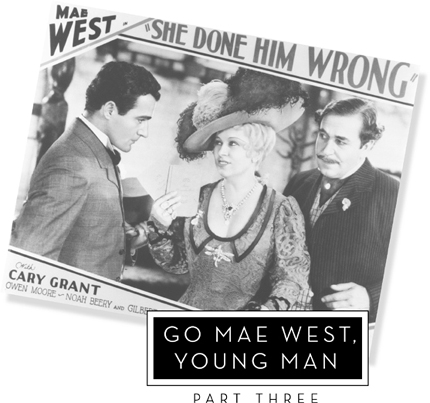
Movie poster for the original theatrical release of She Done Him Wrong (1933), with Mae West receiving star billing over Cary Grant. (CinemaPhoto/CORBIS)
5
“Some men squeeze a line to death. Cary tickles it into life.”
—MICHAEL CURTIZ
In February 1932, only six weeks after his arrival in Hollywood, Archie Leach had become Cary Grant by way of a name change that was industry real if not legally official and had signed a five-year exclusive-services contract with Paramount Publix at a starting salary of $450 a week, with incremental raises to be made at the studio's discretion.
Grant was convinced the movies would not only magnify every inch of his face, body, and movement, they would, in turn, enlarge his personality as well. The better he looked, he believed, the more of his personality his acting would project onto audiences. As a result, he became obsessed with his physical appearance even more so than he had while living in New York City. Every morning after his first shower (he took at least three daily) and shave, he would closely examine his face in the round extension wall mirror, pulling it close in to search for the tiniest of skin nicks or flaws. He declined to have his teeth “painted” white by the studio, a technique they used to increase the dazzle of a smile during shoots. He was especially proud of his great teeth and practiced fixing his smile in such a way as to show them off to their fullest advantage. He brushed them compulsively, several times a day, often until his gums bled. He started as soon as he woke up, and sometimes did it in the morning while still in bed with a dry toothbrush, always after every meal, and at night just before he went to sleep. He carried a brush with him at all times and in company would often excuse himself after smoking a cigarette to get to a men's room, where he would scrub any dulling residue, real or imag- ined, from his one-pack-a-day habit.
He also refused to allow the studio to send him to Max Factor's face spe- cialists, who were adept at perfecting the slightest facial flaw. (Although throughout his life Grant denied he had ever had a nose job, it does look noticeably slimmer in photographs taken after 1932, with the slightly thick Roman curve somewhat reduced, the bridge a bit narrower, and the tip more smoothly planed.) He put weights in his bedroom and worked out every morning and every evening. He carefully monitored his diet and greatly reduced his intake of alcohol.
As a personal reward for the physical progress he was making, he bought himself a beautiful Sealyham terrier he jokingly referred to as his alter ego. Owning a dog in New York had been impossible for him. Now that he could afford one, he wanted the best he could get. He named the hound Archie Leach.
GRANT'S FIRST FEATURE FILM was Frank Tuttle's This Is the Night, an adaptation by George Marion Jr. of Avery Hopwood's Broadway sex comedy Naughty Cinderella, in which he played the role of a cuckold opposite Lily Damita and her costar, the comedic Roland Young. It was a thankless role in which Grant cheerily loses his wife to another man, and it annoyed him, not for the character he played, but because he was cast as a second-string sup- port player behind such A-listers as Charles Ruggles, Young, and Damita. He was further dismayed when he saw the film's final pre-release cut. He thought that even though he came off sleazy and weak-willed, no one would ever believe that someone so good-looking would lose his wife to the funny but unattractive Young. If the public bought him in this type of role, he feared they would never accept him as a legitimate leading man.
After the screening, he left the studio, stopped off, had a few drinks, then a few more, and sometime around midnight returned to the house on Sweetzer and solemnly informed Charig he was heading back to New York City. Charig managed to calm down the obviously inebriated Grant and, while forcing coffee down his throat, placed a call to Orry-Kelly, who had lately not been all that available to Grant. Orry-Kelly had claimed it was sim- ply due to his heavy workloads, but the truth was, he had moved on, and while neither had admitted it to the other, both knew it was so. On the phone Orry-Kelly talked to Grant for a long time and tried to explain to him the real- ity of Hollywood. He was a working film actor now, and regardless of his roles, he should be grateful he had a studio contract.
The next morning a hungover Grant returned to the studio, where he was to begin shooting scenes for his second feature, Alexander Hall's Sinners in the Sun, starring Carole Lombard. Schulberg had personally selected Grant for this role and, because the actor was still doing retakes on This Is the Night, had him delivered by golf cart between the sets of the two films, often with- out so much as time for a regular costume change, forcing Grant to slip into a tux while in transit. In Sinners, Grant was cast as a sophisticated man-about- town, a role he felt was a bit more suited to his abilities but still not the type he felt he could play.
Because of it, he believed his acting days in Hollywood were likely num- bered, and he used some of his earnings to become a silent partner in Neale's Smart Men's Apparel, a retail clothing operation on Wilshire Boulevard. Neale was L. Wright Neale, whom Grant had met socially and liked, even though the man often referred to Grant as “Sister Cary” (a cutesy reference to the Theodore Dreiser novel Sister Carrie that Grant didn't particularly appreciate). The shop was located on Wilshire and Vermont, near all the new and fashionable retailers and large department stores that catered to the town's big movie money. Grant wanted to invest in a non–show business venture and chose tailoring because as a child he had learned something about the trade from his father. His participation in the business was, on some level, a tangible link to happier memories of childhood.
To Grant's surprise, the Daily Variety called his performance in This Is the Night “striking,” and noted that “he looks like a potential femme rave,” Variety-speak to describe his good looks. The only thing about the review that bothered Grant was the critic's having mistakenly referred to him as “Gary.”
Still in 1932 he was put into yet another film, Dorothy Arzner's Merrily We Go to Hell, starring Fredric March and Sylvia Sidney, who also happened to be Schulberg's mistress. Grant, meanwhile, quietly invested in a second retail branch of his clothing business, this one in New York City.
In Merrily, March was badly miscast (comedy was never his forte), which allowed Grant to walk off with the film as a character-within-a-character in playwright March's play-within-a-play. His small but well-received perfor- mance was strong enough to convince the still self-exiled Gary Cooper to has- ten his return to the studio after his good friend March had sent word to the safariing actor that this new fellow Grant was apparently being groomed as his possible replacement. He also sent along the Variety review with Grant's misspelled first name.
At a huge reception thrown by Zukor to hail its returning star, Cooper, whose feathers were still ruffled by the Cary/Gary name incident, delivered a personal gift he'd brought back from Africa for the studio head—a monkey on a chain. He also intentionally snubbed Grant by bypassing him in the reception line and ignoring him when Grant introduced himself and tried to make polite conversation over cocktails. It was the start of a personal ani- mosity between the two that was to last for many years.*
To further placate their reluctant superstar, Zukor cast Cooper in a role he had, in fact, been considering for Grant, the lead in Marion Gering's Devil and the Deep, costarring Charles Laughton and Tallulah Bankhead, relegating Grant to a small and completely forgettable part. Nevertheless, Grant's performance was good enough to convince the studio to make him one of the leads opposite Dietrich in Blonde Venus, the fifth Josef von Sternberg/Marlene Dietrich film. The cast also featured British West End sensation Herbert Marshall as Dietrich's cuckolded husband, while Grant played Dietrich's guilty-conscienced lover.
In the movie, American scientist Ned Faraday (played by Marshall in full- tilt British accent and manner) marries sultry German nightclub singer Helen Jones (Dietrich), a familiar echo of the Blue Angel scenario. Marshall, Sternberg's obvious onscreen surrogate, in this instance an intellectual not all that different from The Blue Angel's Professor (Emil Jannings), falls for his (Sternberg's) real-life obsession, the easy showgirl Marlene Dietrich, andthen proceeds to punish her brutally for the very thing that attracts her to him: her beauty and sexuality. When Faraday develops radiation poisoning that can be cured only by expensive treatments, Helen returns to work as the nightclub sensation “Blonde Venus,” making her first entrance dressed as a gorilla (Sternberg's inside joke on Cooper's gift to Zukor upon his return to the studio. Ever since Morocco, during the making of which Cooper and Dietrich had had a torrid affair, there was no love lost between and the actor and the director).
While performing in the club, Dietrich's character meets and falls for mil- lionaire Nick Townsend, played by a slicked-up Grant, who promptly puts her out on the street as his slave-lover and high-priced prostitute. Nick is, in reality (if that is the right word), a pimp. Through him, Helen raises enough money to send her husband to Germany for medical treatment, but upon his return when he discovers she has been unfaithful, he leaves her and tries to take their child with him. Desperate, Dietrich flees to Paris, resumes her nightclub career, and once again takes up with Grant. This time he realizes he is in love with her, proposes marriage, and she agrees. Upon their return to America, her husband forgives her, and reluctantly she leaves Grant for Marshall.
What is remarkable about this otherwise soapy film, besides the lumi- nous cinematography that captured Dietrich's always extraordinary beauty and overt sexuality, is the undeniable flash of dark brilliance Grant brought to his first substantial role. Von Sternberg usually allowed Dietrich to intim- idate her male costars (Emil Jannings, Victor McLaglen, Warner Oland, Adolphe Menjou, and Clive Brook; only Gary Cooper managed to come off as heartless, clever, sexual, and charming, a first-class womanizer too good- looking for his—or Dietrich's—own good). But Grant was able to deflect Dietrich's brute force—and play to the audience's sympathies—by showing compassion for Marshall's plight. He came off more noble and forgiving than weak and heartless. Audiences, women especially, loved it when Marshall took his wife back in the final scene (a plot turn hotly contested by Sternberg, who thought the studio-imposed ending was neither happy nor realistic, and that Dietrich should have wound up alone in the gutter where she belonged).
The trickiest aspect of Grant's character, and what also made his playing of it so convincing, was his ability to sustain an evil yet appealing irresistibility. For the first time Grant showed the blueprint from which he would con- struct his style of acting—the suggestion of an emotional darkness beneath the brightness of his surface attractiveness. In the end, Grant managed to make Townsend's broken heart not merely comprehensible to audiences, but brood- ingly compassionate, all conveyed through a single last look on his wounded beautiful face that became even more beautiful because it was wounded.
Throughout the filming of Blonde Venus (and throughout his career), Sternberg maintained his brilliant if eccentric sense of visual perfectionism. During the filming of Grant's first scene, Sternberg took a comb and parted his star's hair on the right side rather than the left, the way Grant had always combed it before. The change gave Grant's already remarkable face an added symmetrical beauty. For the rest of his life Grant would comb his hair in the manner first prescribed by Sternberg. The director also lit Grant in his trade- mark shadow-and-light stylistics, which kinetically enhanced his emotionally textured performance.
Blonde Venus came very close to being rejected by the censorial Hays Office for its depiction of Dietrich's character having an adulterous affair with Cary Grant, enjoying it, and then returning to her husband and child to live happily ever after. With enough alterations to satisfy the censors, Blonde Venus was released, and while it didn't make Grant a star, it did well enough to solidify his reputation as one of Hollywood's new crop of fast-rising actors, one of the band of British “colonists,” as they were known in Hollywood, that included C. Aubrey Smith, Ronald Colman, Basil Rathbone, Victor McLaglen, Boris Karloff, John Loder, David Niven, Charles Laughton, and of course Grant's longstanding idol and role model, Charlie Chaplin.
Grant finished out 1932 making his sixth and seventh films, William Seiter's Hot Saturday and Marion Gering's Madame Butterfly. That same year, for economic reasons Paramount eliminated many of its highest-paid performers, among them Tallulah Bankhead, George Bancroft, Buddy Rogers (who was unable to make the vocal transition to sound), the Marx Brothers (who would be picked up by Irving Thalberg at MGM and become the most successful comedy team of their era), Richard Arlen, Jeanette MacDonald, and Maurice Chevalier. This bloodletting created a casting vac- uum that helped suck surviving newcomer Cary Grant into the vacancies left by the studio's decimated top-of-the-line stars.
When trouble erupted over the casting of Hot Saturday, the story of a love triangle, Grant was perfectly positioned to step in. At Schulberg's directive, he took over the starring role of Romer Sheffield when Gary Cooper refused to play it on the advice of his friend Fredric March, who had also flatly turned down the part, believing the supporting role of Bill Fadden was the more sympathetic one. Schulberg then cast another studio newcomer, Randolph Scott, in the supporting role of Fadden, which had originally belonged to Grant. Hot Saturday wasn't much of a movie but did have a profound effect on Grant's personal life, as it marked his first meeting with Scott and the beginning of one of the longest, deepest, and most unusual love relationships in the history of Hollywood.
Grant's satisfaction at being cast in the lead of Hot Saturday was tempered by the studio's having to shelve its planned big-budget sound remake of its 1922 silent blockbuster Blood and Sand, in which he was to have played the role that the late Rudolph Valentino had created. Schulberg had been the driving force behind the remake and wanted Grant to star because of his dark-haired, tall, sleek, and sexually appealing screen presence. Schulberg, whose huge $6,500 weekly salary had afforded him far too much time to gam- ble, drink, and bed every starlet on the lot, had also caused him to lose sight of the financial realities that were closing in on Paramount. When, in 1932, Paramount could no longer make its mortgage payments on the studio's expansive real-estate holdings, and even after firing so many of its star play- ers could not make payroll, Zukor, whose studio now hovered on the brink of bankruptcy, blamed Schulberg's philandering for much of Paramount's problems, fired him, and canceled Blood and Sand. Grant was extremely dis- appointed at both the firing, as he had come to like Schulberg a great deal, and a lost opportunity to become the logical successor to the still manically worshiped and so far irreplaceable Valentino. Grant feared such a star- making role might never come his way again.
His next film seemed to bear this fear out: a musical version of Madame Butterfly, whose script he found all but incomprehensible. The thankless role of Lieutenant Pinkerton, who drives Cho-Cho San (Sylvia Sidney) to suicide, was yet another that Cooper had flatly refused to play.
Madame Butterfly was one of many Hollywood films of the 1930s that catered to the country's growing interest in Eastern culture. Unfortunately, to make the film “comprehensible” to the general public, Paramount chose to Westernize the Japanese characters, giving all the leads to well-known Anglo Hollywood actors and actresses. The film captured Grant's already dated singing style in his solo “My Flower of Japan,” a music-hall hiccough that infringed on his thin, reedy tenor. It remained to the very end (along with Singapore Sue) one of the films that Grant most detested. In later years he actually tried to buy the negative in order to destroy it.
WHILE THE FORWARD THRUST of Grant's early film career seemed to have been stalled by Madame Butterfly, Zukor decided to bet the studio's future on one final extravaganza, a film version of Mae West's 1928 scandal- splattered Broadway stage hit, Diamond Lil, the sequel to her 1926 self- written stage smash, unsubtly titled Sex, very loosely based on Somerset Maugham's short story Rain. The project had originally been signed by Schulberg, who believed its sensational star and vehicle couldn't help but make a fortune for the studio. In New York the stage version had caused many highly publicized police “raids” for “lewdness, nudity and profanity.”*
What worked on Broadway was one thing; turning it into a hit movie would prove to be quite another. With the Hays Office gaining power in Hollywood, the major studios had become increasingly hesitant to make movies that Will Hays deemed too controversial, too antisocial, or too sexu- ally explicit. Carl Laemmle, the head of Universal, was the first to consider a screen version of Diamond Lil but was ultimately pressured by Hays into giving up the idea, even after signing West to a generous contract.
Indeed, West's persona as a fleshy, smirky sex goddess without modesty or morals had made her as pervasive a pop culture phenomenon as Chaplin's celebrated “Little Tramp.” One of West's favorite publicity stunts was to allow herself to be photographed in her famous “swan” bed, whose headboard looked like nothing so much as the bare upper thighs of a Victorian woman with skirts hiked high up the front. Her enduring popularity—her audiences wanted to know everything about her, including what she wore in the boudoir (“a black lace nightgown, sometimes with black stockings”)—trans- lated into money, a lot of it, and her talent for making it finally convinced Zukor to greenlight Schulberg's offer to West of a $5,000-a-week salary (above the negotiated rights for Diamond Lil) to star in the movie version of her play for Paramount.
Less than six weeks after her arrival in L.A. in the fall of 1932, Zukor, eager to see some return on his investment, put West into a quickie film role as Maudie Triplett, opposite another Paramount Valentino-hopeful, song- and-dance man George Raft, who bore a slight physical resemblance to the dead actor but lacked his charm, mystery, and heat.
The seventy-minute film, Night After Night, proved a huge winner at the box office, and West received rave reviews, while Raft was all but ignored. Photoplay, one of the most influential film magazines of the time, said, “Wait till you see Mae West. An out-and-out riot!” Zukor then hired Schulberg back on a freelance basis to produce Diamond Lil, having promised the Hays Office a complete rewrite of the original stage version and a cleaned-up, san- itized film version, not just of the play but of the West persona, as well. After changing the project's name to She Done Him Wrong, the film was added to the fall production schedule. George Raft, originally cast by Zukor as the love interest, was at Schulberg's directive replaced by Cary Grant, who had always been the producer's first choice to play opposite West.
One of the most erroneous yet persistent myths about Cary Grant is that he was discovered by Mae West while both were strolling the Paramount backlot, that she took one look at him and said, “If that guy can talk, I'll take him—he's the only one who could do justice to the role of ‘The Hawk.'” Several versions of this “moment of discovery” exist; the most popular comes from West's own memoirs.* Here she recalls visiting the Paramount lot one day in 1932 prior to signing on to film Diamond Lil and seeing “a sensational- looking man walking along the studio street… the best thing I'd seen out there.” According to West, she then insisted that Grant be her costar or there wouldn't be a film.*
Grant himself flatly denied the story many times, always claiming, “It wasn't true. Mae West didn't discover me. I'd already made four pictures before I met her.”† In an interview he gave to Screen Book in December 1933, he gave this version of the story: “I had met Miss West one night at the [American] Legion [Friday night] fights at the Hollywood American stadium. I understand that she had already seen me and asked for me to play ‘The Hawk’ in her picture. It seems that during her search for a suitable leading man, she had seen me getting out of my studio car and decided I was the type to play opposite her. I suppose it was because she is blond and I am dark and we make a suitable contrast. Another factor in my getting the role in She Done Him Wrong was that Lowell Sherman, the director, had liked my work with Miss Dietrich in Blonde Venus.”
In fact, both West's and Grant's version were likely made up, and for good reason. Grant and West had appeared on Broadway at the same time for sev- eral seasons and became quite well acquainted during this period. As it hap- pens, while West was developing her sex goddess stage image, she was also running a highly successful male escort service. One stresses that there is no smoking gun, but because of how perfectly the timings mesh (West was run- ning her service before, during, and after the two-year period when Grant “disappeared”), it is tantalizing to wonder if Grant worked for her, and if she was, in fact, the otherwise unknown, unidentified “Marks.”
Because of the studio's financial difficulties, the film was given an eighteen-day shooting schedule (instead of the fifteen to twenty weeks nor- mally allotted a “big” picture). Filming began on November 21, after the full seven-day rehearsal period that West had insisted upon. Set in a Bowery bar at the turn of the twentieth century, the sanitized but still raunchy story cen- ters on Lady Lou, the proprietor of the Dance Hall (a standard euphemism for a house of prostitution), corun by West's husband (Noah Beery Sr.), which sells beer to the boys while also dealing in a little white sexual slavery on the side. Captain Cummings, aka “The Hawk” (Grant), is an undercover cop running a nearby missionary and is bent on “saving” her. One of the most famous (and often misquoted) lines in all of film history is uttered in She Done Him Wrong with a moistness hard to misinterpret, when Lil meets Cummings for the first time and says, “Why don't you come up sometime, see me. I'll tell your fortune.” By the end of the film, after a series of bizarre plot twists, love changes and redeems them both. In the final scene, Cummings leads her away, with the strong suggestion he is going to reform her first, then marry her. They get into a cab and Grant removes all the rings on her fingers so he can slip a single small diamond on one. Lou looks into his eyes and murmurs, “Tall, dark, and handsome,” to which he replies, “You bad girl.” “You'll find out,” she says, sucking in her cheeks and smiling wickedly as the film ends.*
She Done Him Wrong, West's second film, was, in retrospect, the best per- formance of her career. It was loosely based on her own early experiences in New York, the saloon being a substitute for the stage, white slavery a refer- ence to her (and possibly Grant's) escort days, and her arrest at the end rem- iniscent of the legal troubles her shows had run into with the city's moral squads.
It was also the eighth and final film Grant made in 1932 and, after this highly productive year, the one that brought him closer than ever to the first rank of Paramount's leading men.† Ironically, it was Grant's approach to playing the romantic lead in She Done Him Wrong that did it. His onscreen aloof- ness, a reflection of nothing so much as his own uncertainty as to how to play a love scene opposite the voracious West, was taken by the public to be just the opposite—manly, moral resistance to Lil's many charms—and created a new type of romantic sophisticate, not only for Grant but for the legions of actors who would thereafter try to imitate him. Grant's “Hawk” was under- played and always gentlemanly, resistance translated into self-assurance and moral righteousness, all highly glossed with what would become his trade- mark shimmering elegance.
No one was more surprised than Grant at how successful he was opposite the voracious West. As in the past, he had tried to mask what he thought of as his own lack of any true acting style by emulating his performing idols, Chaplin, Noël Coward, Jack Buchanan, Rex Harrison, and Fred Astaire. Years later Grant perceptively and graciously summed up his acting in She Done Him Wrong as a combination of pose and impersonation. “I copied other styles I knew until I became a conglomerate of people and ultimately myself,” he told an interviewer. “When I was a young actor, I'd put my hand in my pocket trying to look relaxed. Instead, I looked stiff and my hand stuck in my pocket wet with perspiration. I was trying to imitate what I thought a relaxed man looked like.”
Nevertheless, the physical image of Cary Grant seemed even more per- fect on the big screen than it had on stage. In his early movies especially, the camera quickly discovered and magnified the perfection of his features, the beautiful dark and sharp eyes that sat carved beneath his thick black brows, the handsome nose, the flawlessly smooth skin, the thick, slick hair always perfectly cut and parted, and that remarkable cleft in his chin, whose two smooth and curved bulges resembled nothing so much as a beautiful woman's naked behind while she was on her knees in sexual supplication before the godlike monument of his face.
Opposite West, Grant's arched body language seemed to react with bemused distaste, an apparent product of calculated wit. He smartly held his own by not allowing himself to get engaged in a competition he could not win. In the silvery sheen of sharp black and white, all Grant had to do was show up and let his irresistible face be photographed in shadowed cuts, as if caught in the flash of lightning. Holding his own, however, was not enough.
Working with West had taught him a valuable lesson. As long as he was the pursuer, the focus was always going to be on the object of his affection. The thing to be in any movie was the one pursued. It was what all front-rank stars in Hollywood benefited from, and why he was not yet in their league. Should he ever have the opportunity to call the shots, as West had, he promised him- self, he would make himself the object of his co-stars', and by extension the audience's, heated pursuit. Eventually this decision would come to define the essence of, and the reason for, Cary Grant's superstar persona.
The enormous profits generated by She Done Him Wrong were enough, for the time being at least, to save Paramount from impending bankruptcy. Costing what was then a risky $200,000, the film earned more than $2 mil- lion in its initial three-month domestic run, making it one of the highest- grossing and most profitable films Hollywood had ever produced. It would go on to gross an additional million dollars worldwide in first release (despite being banned in Australia after its premiere and in several other smaller mar- kets), and it remains to this day one of West's few films still shown on the theatrical revival circuit and on cable TV's classic movie channels.
For her next movie, Paramount agreed to pay West $300,000 plus writing royalties to star in I'm No Angel.* Grant was once again assigned to costar, and in appreciation for his contribution to the success of She Done Him Wrong, Paramount raised his salary from $450 to $750 a week. By contrast, he knew, West was being paid a mint. Not because she was a better actor than he was (although that might have been the case), but because she was a bet- ter businessperson. Like his idol, Chaplin, she had managed to remain a per- picture independent, able to demand and get her price, one that, unlike Broadway money, could be parlayed into a real fortune. In the theater, an actor (with rare exceptions, such as run-of-the-play contracts) was paid for a single performance, or number of performances, and if asked to go on the road, paid again. An actor in film was also paid once, but the film could earn residual money as long as it could be run and rerun. The only way, Grant realized, to get some of that money was to do what Chaplin and West had done, to find a way to own a piece of the pie.
Even before production began on I'm No Angel (during which time Grant made three more nondescript studio “quickies”),* he had already begun to formulate a plan for his own financial emancipation.
SHORTLY AFTER THE SUCCESS OF She Done Him Wrong, as if on the studio's cue, Cary Grant's steady ride to stardom was threatened by rumors that were being spread by the studio-controlled gossip columnists. Everyone in the business knew these journalists-cum-rumormongers were organs of the industry, used to keep their players in line. Hedda Hopper, Sheilah Graham, and Louella Parsons owed their success to easy access behind the studios' iron gates, where all the “good” stories were. The hard truth was, no matter how talented a director, screenwriter, or producer, no matter how crucial they may have been to the suc- cess of their movies, no one cared about them or went to see a film because of them, at least not knowingly. The only real attraction factor in the studio era was star power. For this reason the studios carefully stroked the egos of their stars and at the same time sought to control them by resisting union movements, never grooming noncontract players for stardom, and most effectively, imposing the so-called morals clause. The public, the studios knew, would tolerate a lot, was in fact titillated by the endlessly reported bouts of drinking, fighting, illicit but consentual sex, and even, for a while, subversive politics (like liberal Hollywood's romance with the Lincoln Brigade). Everyone, however, drew the same line in the moral sand when it came to the three absolute no-nos: het- erosexual rape, child molestation, and male homosexuality.
No star, however big, ever completely escaped the gossip rumor mill— those who had affairs, those who didn't, those who weren't gay, those who were, those who were suspected, and those targeted by a rival studio. Gary Cooper, known in the industry for the size of his penis (huge) and his love of gorgeous women (insatiable), because of his extremely pretty face and enormous box office clout was a favorite target of rival studios, who used to continually hint that he really preferred men to women (ridiculous).†
But the same stories about Grant—who, unlike Cooper, had never been romantically attached to any woman during his New York years and now not in Hollywood—made the heads of Paramount a bit nervous. Their anxiety grew after their biggest female star, Marlene Dietrich, who made a habit of literally taking the measure of her male costars—during the filming of Morocco she raved about the size of Cooper's sex organ and his ability to use it—let it be known among her inner circle, who then informed the gossips, that in the love department, Grant got an “F for fag.” He was, she claimed, “a homosexual.” Grant's angry and unconvincing response was to hint at Dietrich's well-known penchant for women, saying, “If women want to wear men's clothes, let them do men's work.” He didn't mean construction.
The niggling rumors about Grant's sexual preferences, generated by com- peting houses and spread by the gossips, took a giant step into the public's consciousness when Tallulah Bankhead, his costar in Devil and the Deep, who had tried and failed to bed Grant, publicly echoed Dietrich's evaluation of his lack of sexual interest in women. Next to give him the failing grade was his Sinners in the Sun costar Carole Lombard. This landslide of negative evaluations that began to show up in the gossip columns became increasingly difficult for either the studio or the public to ignore.
To counter the running rumors, Paramount arranged for a torrent of sanc- tioned newspaper “interviews” and “inside stories” to be published about Cary Grant—“The Lover,” “The Ultimate Ladies' Man,” “The All Around Athlete”—and flooded magazines with photos of him taken with every leading woman it had under contract. Grant, for his part, seemed willing to play the publicity game, hoping that in the end it would result in his greater value to the studio, and therefore to himself. Another reason he was reluctant to rock any boats was that Neale's Smart Men's Apparel—in which he had invested, hoping it would turn into a nationwide franchise and make him a millionaire—had turned into a bottomless money pit and sucked him dry of nearly every penny he had before it finally went under.
On the other hand, much to Paramount's dismay, the rumors about Grant's standoffishness with women failed to induce him to behave with caution. A few months earlier, in the fall of 1932, Grant and Phil Charig had moved out of their small Sweetzer apartment into a larger, although still cozy house by Hollywood-movie-star standards, on West Live Oak Drive in Griffith Park, nestled just below the giant-lettered hollywoodland sign, a place that afforded them a fabulous view of the night-lighted sky of Tinseltown.*Then, just before Grant began shooting She Done Him Wrong, Charig sat his roommate down and broke the news that he was giving up trying to break into the motion-picture-scoring business, had packed his things, and was returning to New York City to work on Broadway.
If Charig thought Grant might try to convince him to change his mind and stay, he was mistaken. Instead, Grant told him he understood, thought he was doing the right thing, wished him well, and asked him how soon he could leave.
One week after Charig's departure, Grant put out a permanent welcome mat for his new roommate: the young, single, handsome, and athletic con- tract player he had met during the filming of Hot Saturday, Randolph Scott.
* Decades later in an interview Cooper gave to actress/journalist Suzy Parker, he confessed his long- standing “hate” for Grant, adding a swipe at his looks and acting style by mentioning that his “man- nerisms always got on my nerves.”
* Schulberg likely was aware that the so-called raids were actually staged by the producers to sell tick- ets, a clever scheme that turned an ordinary show into a box office sensation. It made West the biggest star on Broadway, and that was enough for Schulberg to want to bring her to Paramount.
* A highly fanciful bit of self-promotion ghostwritten by Martin Sommers in 1933 for the News Syndicate Co., which ran it in several installments. It later appeared in book form under the title Goodness Had Nothing to Do with It.
* Another version of the Grant discovery story, from West herself, went like this: “In 1932 I was standing with William LeBaron, the producer of the film I was going to make, She Done Him Wrong. I saw Cary across the studio street. I says, ‘What's this?' I says, ‘If this one can talk, I'll take him.' He says, ‘What part will you use him for?’ I says, ‘The lead, of course.'” West recounted this version of her “discovering” Cary Grant to Richard Gehman in American Weekly, October 21, 1962.
†She Done Him Wrong was actually Grant's eighth full-length feature film.
* Other memorable Mae West lines that came from She Done Him Wrong: When asked if she had ever met a man who made her happy, West replies, “Sure. Lots of times.” A woman admires her dia- monds and says, “Goodness!” West replies, “Goodness had nothing to do with it!” When Grant resists her advances, she says, “That's right, loosen up, unbend. You'll feel better.” When Grant apologizes for taking her time, she replies, “What do you think my time is for?” An updated, suggestive version of the song “Frankie and Johnny” is sung by West, along with several others, including “A Guy What Takes His Time.”
†In his first year in Hollywood, Cary Grant made eight movies, a little more than 11 percent of the seventy-two features he would appear in between 1932 and 1966. In the next thirty-three years (begin- ning in 1933), Grant made sixty-four additional movies, an average of two a year, although once he became a free agent, he deliberately slowed down the pace. In 1940 he made his thirty-sixth film, the halfway mark of the total output of films he would make in his lifetime, when he starred in Garson Kanin's My Favorite Wife. In the next twenty-six years he would make the same number of films he had in the first eight of his Hollywood career.
* The screenplay was adapted by West from a script by studio screenwriter Lowell Brentano, origi- nally called The Lady and the Lions. West kept the general story and rewrote all the dialogue.
* Paul Sloane's Woman Accused, Stuart Walker's The Eagle and the Hawk, and Louis Gasnier and Max Marcin's Gambling Ship.
†Paramount countered those stories by letting it be known through the same gossips that women knowingly referred to Cooper as someone who “talked softly and carried a big dick.”
* The fifty-foot-tall hollywoodland sign was originally erected in 1923 at the top of Beechwood Drive as an advertisement for real estate. In 1945 it was abandoned by the original owners and claimed by the city, which shortened it to hollywood.