
Part II

Vieira de Mello with General Michael Jackson (center) in Kosovo.
Eleven
BEcOMING A BUREAUCRAT
Working at UN Headquarters in New York for the first time in his career, Vieira de Mello sometimes felt as though he were suffering death by a thousand paper cuts. His first public appearance came on November 14, 1997. After Secretary-General Annan introduced him to the media as the new under-secretary-general for humanitarian affairs, responsible for coordinating all the humanitarian efforts in the UN system, he offered characteristically understated remarks. “I hope to contribute my modest field experience in humanitarian and peacekeeping operations to the strengthening of the office,” he said. “Since solutions to humanitarian problems cannot be humanitarian,” he continued, he intended to enlist the support of political, military, human rights, and economic development experts.
At the press conference he stood beside Annan in order to field journalists’ questions. But the media had more pressing issues on their minds. The Republican-controlled U.S. Congress had torpedoed a spending bill that would have turned over to the UN nearly $1 billion of the $1.4 billion that the United States owed in back dues.1 Annan warned that the UN could not keep borrowing from its peacekeeping budget in order to meet its obligations around the world.2
But the main topic of the day was the one that would define Annan’s tenure as secretary-general: Iraq. Since the end of the Gulf War in 1991, UN inspectors had been mandated to dismantle Iraq’s long-range ballistic missiles and its biological and chemical weapons programs. But two days before the press conference, Saddam Hussein had expelled the American weapons inspectors, and the Clinton administration had responded by threatening to bomb Iraq. Asked during the press conference whether he planned to evacuate UN staff there, Annan said he still hoped a diplomatic solution could be found. “We would definitely not put our staff in harm’s way,” he said. “And the moment we feel their lives are in danger, we will pull them out.”3
When Vieira de Mello was at UNHCR, his colleagues could be roughly divided between two camps. On one side were the rights “fundamentalists” like Dennis McNamara who believed refugee law permitted few compromises with governments. On the other were the “pragmatists” like himself who were prepared to make deals that appeased the powerful in the belief that such compromises served the long-term interest of civilians. Having generally failed to persuade the UNHCR fundamentalists of his views, he had taken a good deal of heat and was glad by 1997 to strike out in a new place.
But no sooner had he arrived at the intensely pragmatic Secretariat in New York than he grew nostalgic for what he had left behind. The countries in the UN General Assembly had established UNHCR in 1951 as an office distinct from the UN as a whole. Because it raised its own funds and answered to its own governing board, it had a high degree of autonomy. By contrast, senior officials at UN Headquarters knew that their salaries were paid by the annual dues of UN member states. While UNHCR officials thought of themselves as servants of the refugees, UN officials in the Secretariat saw themselves as servants of governments. “There is the UN that meets and the UN that does,” his UNHCR colleague Nicholas Morris told him. “Now you are joining the UN that meets.”
Kofi Annan had been elected secretary-general the previous year by promising sweeping UN reform and by pledging to meet the demands of Republican senators Jesse Helms and Bob Dole to cut the bloated UN down to size. In announcing his plans, Annan said that the changes he proposed were the “most extensive and far-reaching reforms in the fifty-two-year history of the Organization.”4 One of the first targets for Annan’s scalpel was the branch of the UN that Vieira de Mello had been tapped to run.
Annan tasked Vieira de Mello with downgrading the Department of Humanitarian Affairs into a smaller Office for the Coordination of Humanitarian Affairs (OCHA). Vieira de Mello did as asked, restructuring the office. Strongly partial to field experience over desk jobs, he filled vacancies by borrowing staff from the humanitarian field agencies. Joe Connor, the under-secretary-general for management who would have to approve any structural changes, raised no objections. But when Vieira de Mello sent a written version of his restructuring plan up to Annan’s office, Connor summoned his colleague to see him. Connor and his team lined up on one side of the table, while Vieira de Mello and his closest associates stacked the other. In what Vieira de Mello took to be a patronizing lecture, Connor told him that New York was not Geneva, UN Headquarters was not UNHCR, and he would spare himself and the UN great inconvenience if he would put plans in writing and receive formal clearance before sending anything to the secretary-general. Vieira de Mello was so angry that he could not even speak. His tapped his leg under the table, and he took no notes. As soon as he got back to his office, he exploded in rage, telling Fabrizio Hochschild, his special assistant, “Who do they think I am? Some unknowing little humanitarian child who doesn’t know the wise ways of the adults in New York!”
Since he hated being disliked, he was the wrong person to manage shrinking an office. As a field person accustomed to making do with very few people around him, he reviewed the posts within his department and wondered,“What the hell do all these people do every day?” He cut the staff size by half, which naturally demoralized officials who had predated him.
But the hostility of his immediate staff paled beside that of the powerful UN agencies that OCHA was supposed to coordinate.The heads of agencies more often came to meetings to protect their own interests than to develop common strategies. Hochschild remembers, “The attitude among the agencies toward Sergio then was, ‘You can pretend to coordinate us if you want, but we’re going to go right ahead with what we are doing, thank you.’” Vieira de Mello knew he lacked the one thing that might help him secure cooperation: money. Indeed, he had no operational budget at all.
He was miserable. For the first time in his long career, the wars he spent his days fighting were several thousand miles from any battlefield or refugee camp. He turned on his charm for number crunchers, not warlords. And while he had always found the paperwork at UNHCR tiresome, he had never had to fill out as many forms as he did at Headquarters. A man whose strongest asset was his charisma was reduced to making his appeals on paper—and in service not of action, but of mere coordination. “I’m not sure I believe in what we’re doing,” he confessed to an aide. “Do we really need this place?”
Once he had completed the restructuring of OCHA, he did what he had always done. Rather than bowing to fixed hierarchies, he identified and relied upon those who could get the job done and largely excluded those he considered deadweight. In his inner circle were those he trusted; in a more distant circle, those he respected; and in the outermost circle, those he deemed mediocre. The more junior staff flocked to him. “Young people at Headquarters trailed him around as if he were the Pied Piper,” recalls John Ruggie, an assistant secretary-general.
Annie had remained in Europe with Laurent and Adrien, now nineteen and seventeen. Laurent was studying in Lausanne, while Adrien would en-roll at the university in Lyon, France. Vieira de Mello bought an apartment for himself in the Manhattan Place complex on First Avenue between East Thirty-sixth and Thirty-seventh streets.
The building lobby was marbled and manned by a doorman with white gloves. The apartment itself was a drab, 1970s-style two-bedroom, lined with mirrors, but it had a stunning 180-degree view of the New York skyline, spanning from the East River to the World Trade Center towers at the southern tip of Manhattan. He loved the view and cherished finally having his own permanent base.
He had long appreciated wine, fine food, music, and the arts. But in New York, the world’s cultural capital, he remained in “mission mode.” With the exception of the runs he took several times each week in Central Park, his routine was indistinguishable from that in remote southern Lebanon. He remained in the office later than almost anybody on his staff, and he seemed perfectly content at night being one of the only officials in the entire UN system who read all the code cables from the field. On the occasions he took advantage of New York’s culinary or cultural assets, he did so with friends from the UN, rarely reaching beyond his work circle. “For Sergio there was never a clear division between his personal life and his professional life,” recalls Hochschild. “There was no such thing as ‘after hours.’ ”
Each day he was in New York, his appetite for management shrank further. By late 1998 he had delegated much of the bookkeeping and coordination to Martin Griffiths, his deputy whom he had come to nickname “the one-and-only Martin Griffiths.” The bureaucratic battles were dull, degrading, and time-consuming. “Sergio had endless patience for everything else,” says Hochschild, “but no patience for administration.”
But parts of the job did suit Vieira de Mello: diplomacy, big-picture reflection, and speaking up on behalf of endangered civilians. In the multiple calls he paid to ambassadors with seats on the Security Council, he framed issues in language they would understand—both by speaking their languages and by relating the natural disasters, refugee flows, and civil wars to crises that their countries had endured. He knew that the more they trusted him, the more funds he would be able to extract from them during emergencies. Yet there were certain lines he would not cross: he despised diplomatic receptions and avoided them with vehemence.
One of the few people that Vieira de Mello failed to woo was the undersecretary-general for political affairs, Kieran Prendergast, a knighted former British ambassador.5 Prendergast found Vieira de Mello’s charm “studied” and his overall persona “obsequious.” And Vieira de Mello could not stand Prendergast’s prefacing his own name with “Sir” in his UN correspondence, as he thought it sent a message of class division ill suited to the UN’s egalitarian ideal. The two men often sparred over minutiae. On one occasion Vieira de Mello argued that the term “hegemon” should be used in a public speech to describe the United States. Prendergast told him in his posh English accent that the word had pejorative overtones. Vieira de Mello believed that the term neutrally described U.S. predominance and telephoned Prendergast later in the day to happily inform him that the Oxford English Dictionary indeed defined “hegemon” neutrally as “leadership, predominance, preponderance.” Prendergast dismissed him again. “I’m a native English speaker,” he said coolly. “You’ll have to trust me.”
Vieira de Mello had hoped that being based in New York would afford him the time to branch out intellectually. He blocked out two or three hours each morning so that he could get reading done. But these reading slots were usually eaten up by unavoidable meetings or by the unexpected arrival of an old acquaintance from places as far-flung as Mozambique or Mongolia, for whom Vieira de Mello would always make time. Still, he did manage to offer philosophical guidance on nettlesome intellectual and moral challenges to UN officials who did not themselves have the luxury of time to reflect. To nonexperts, humanitarian action and human rights sounded like synonyms or, at the very least, complements. But he knew that, in the real world, feeding people was often incompatible with speaking out. “How do we reconcile the need for humanitarian access and thus discretion, with the need, sometimes the obligation, for human rights?” he asked a gathering of diplomats from donor countries in Geneva, undoubtedly with the events of Zaire and Tanzania on his mind. “In the face of overwhelming human rights abuses, when do humanitarian agencies withdraw? Does the so-called humanitarian imperative have its limits?” Aid workers were generally so reactive that they could seem unprofessional. “In each situation we have to invent a new set of ground rules,” he argued. “This in turn has led to accusations that we are inconsistent and promote different standards in different situations.”6 When he laid out these fundamental questions, he sounded almost embarrassed for having introduced theory into practice. “I have grown a bit abstract,” he told diplomats at the gathering,“a symptom that the remoteness of New York is beginning to have an effect on me!”7 But if he didn’t devise principles to guide humanitarian action, he worried that the aid organizations his office coordinated would continue to drift haphazardly from one crisis to the next.
He excelled at serving as an emissary in New York for afflicted peoples and regions. Nobody in the UN system was more persuasive about why a place or a cause mattered morally or strategically. In November 1998 he visited the Central American countries (El Salvador, Honduras, Nicaragua, and Guatemala) that had been devastated by Hurricane Mitch. In December 1998 he traveled to North Korea and returned to launch an appeal for $260 million in UN food aid. The UN officials who accompanied him on his various trips gaped at the ease with which he rattled off the names of officials from a rural Chinese province or from the obscure Russian republic of Ingushetia, pronouncing each name as if he were a local. His recall was photographic.Yet no matter how compelling his presentations, donors were often uninterested in contributing. After visiting Ukraine, for instance, he tried to draw attention to the needs of the survivors of Chernobyl, but his office raised just $1.5 million out of the $100 million it requested.8
AFGHANISTAN: “THE HUMANITARIAN TRAP”
Afghanistan was his hardest sell. He visited the country soon after he started in New York. An earthquake had killed 4,500 and displaced another 30,000, which only compounded the poverty and cruelty in a country that had suffered nineteen years of war. “In my 28 years with the UN, I have seen few places that gather as many nightmarish conditions as Afghanistan,” he told the press. “Kabul looked to me like an immense Sarajevo. There is every reason to feel outraged.”9
Since the Taliban took over in September 1996, the country had become what he called “the most difficult place to work on earth.”10 Taliban leaders said that they would not accept UN aid if the organization delivered relief directly to women. As the nominal coordinator of aid agencies, Vieira de Mello had to decide whether the UN agencies should accept the Taliban’s discriminatory dispersal of aid, when he was sure that suspending aid on principled grounds would, in his words, “sentence civilian populations to death or greater suffering.”11 Asked by a reporter whether women still had access to humanitarian aid, he answered: “Yes. But if you ask me if they have access to a number of more important things than immediate food aid for survival, such as education, work, sanitary services, and medical professions, where women were previously in the majority, the answer is no. Or rather, they have access that is extremely limited to an unacceptable and revolting degree.”12
As he usually did, he chose the path of negotiation. He treated the Taliban as rational actors, meeting with them in Kabul and creating what he called “a test of sincerity.” In order to receive UN aid, they had to allow five schools for girls to be built along with five for boys.13 But when he returned to New York, he received a letter from the Taliban informing him that they had no intention of educating girls and that foreign female UN employees would no longer be permitted to work in the country unless they were accompanied by their male relatives. Unsurprisingly, the Taliban had flunked his sincerity test.
Vieira de Mello protested the new regulations, but he also urged the UN agencies to send Muslim women to replace non-Muslims in the hopes of smoothing ties.The Taliban just grew more brazen. On March 23, 1998, the Taliban governor of Kandahar slapped the locally hired head of one UN agency in the face. The governor previously had struck an official from the International Committee of the Red Cross and thrown a thermos at a UN regional coordinator. Vieira de Mello felt he had no choice but to recommend that the UN pull its international staff out of Kandahar and that it suspend its aid programs in southern Afghanistan.
Yet still he bowed to the humanitarian imperative. Not long after the face-slap, he appealed to UN agencies to return to the region. Before long, most evacuated staff had in fact resumed aid deliveries. No matter how many lines the Taliban crossed, relief groups brought the same attitude to bear that they had with the Serbs and the Rwandan Hutu: They believed their primary duty was to provide food, medicine, and educational services to civilians. They were willing to swallow an awful lot if it meant continuing to deliver aid. Vieira de Mello had taken to calling this the “humanitarian trap.” In May 1998, when Griffiths helped negotiate a twenty-three-point memorandum of understanding between the UN and the Taliban, human rights groups denounced the UN for accepting the Taliban’s rules. “The UN endorsement of Taliban restrictions on women’s basic rights to education and health care,” Physicians for Human Rights said in a press release,“is a betrayal of international human rights standards and of the female population of Afghanistan.”14
And with a regime as brutal and erratic as the Taliban, any “understanding” was bound to be temporary. The following month the Taliban ordered all private aid groups to gather their workers into a dilapidated building in Kabul, where henceforth they could be more easily controlled. More than two hundred foreigners from thirty-eight aid organizations left Afghanistan in protest, forcing the suspension of three-quarters of international aid to the country.
With Vieira de Mello’s backing, large UN agencies such as the World Food Program and the UN Development Program hung on. But security kept deteriorating. On July 13 two local UN staff were abducted in eastern Afghanistan and found hanged a week later. And on August 20 tensions increased when the United States retaliated for al-Qaeda’s attacks on the U.S. embassies in Kenya and Tanzania by firing cruise missiles on a terrorist training camp in eastern Afghanistan allegedly housing Osama bin Laden.15 The following day a French UN employee was shot in the face and an Italian UN military official was fatally shot in the stomach while driving in a UN vehicle in Kabul.
For the next seven months UN agencies remained outside Afghanistan, but Vieira de Mello maintained contact with Taliban leaders. Initially he told them that the UN would not return unless the deaths of UN staff were investigated and punished. But in March 1999, under pressure from donor countries and the aid groups themselves, he said that the Taliban had made a “satisfactory and concerted effort” to investigate the murders, and he claimed that security conditions in the country permitted the UN’s gradual return.
Neither he nor powerful governments seemed to appreciate the extremity of the crisis brewing in Afghanistan. He told the Taliban of his fears that bin Laden would stage attacks on UN personnel, but Taliban leaders persuaded him that they had al-Qaeda under control. “We have raised the Osama bin Laden problem with the Taliban leadership,” Vieira de Mello told reporters on the day he announced the UN return. He said unconvincingly that they had given him “assurances” that bin Laden was “not above the law” and would “not be allowed to put the lives of international staff of humanitarian agencies in danger.”16 In but one testament to his ability to hear what he wanted to hear, he took them at their word.
"TAKING SIDES”
Vieira de Mello understood better than most the risks faced by aid workers in the field. Some fifty humanitarians had been killed in 1998, while sixty-four would die in 1999.17 In almost all of his public appearances, he tried to sound the alarm about the increasing danger to humanitarian personnel. In the new era of warfare, where irregular armed forces were proliferating, aid workers were seen increasingly as bonus targets. “The providers of food are automatically perceived as taking sides,” he said. “Anyone helping the victims on one side is bound to be accused by the other side of supporting the enemy.” He noted that “for the first time in our history it is more dangerous to be an unarmed humanitarian worker than an armed soldier on peacekeeping duties.”18Believing the best he could do was to press for laws that might deter attacks, he argued that the new International Criminal Court should punish the targeting of humanitarian personnel as a war crime.19
What infuriated him was that at just the time aid workers were assuming ever greater risks, they were taking ever more blame for their ineffectiveness. He defended the work of his colleagues in the field who were not in a position to defend themselves. In 1999 scholar Edward Luttwak published an influential article in Foreign Affairs entitled “Give War a Chance,” in which he suggested that aid workers and peace-brokers were prolonging wars that would only end permanently if they were “allowed to run their natural course.” “Policy elites,” Luttwak wrote, “should actively resist the emotional impulse to intervene in other peoples’ wars—not because they are indifferent to human suffering but precisely because they care about it.”20
Vieira de Mello wrote a steaming letter to the editor slamming Luttwak’s “simplistic compilation of old arguments and wrong conclusions.”21 He faulted Luttwak for his “uniform picture of war.” Since few conflicts tidily confined themselves within national borders, Vieira de Mello argued, turning one’s back on violence would often result in wider, messier regional conflicts. In addition, since so many governments and rebel movements benefited from war, they had an incentive to prolong war on their own. They didn’t need any help from aid workers. While he acknowledged that humanitarian action could sometimes have perverse consequences, he wrote that “to deny aid altogether is not only unhelpful, it is unthinkable.”22 He noted that he generally valued critical commentary, but he found unhelpful such “oversimplified accounts far removed from the complexities of actual war and blanket statements that lead to quietism.”23
Of course, after his time in Bosnia and Zaire, Vieira de Mello had his own concerns about humanitarian action and its capacity to do inadvertent harm. But he thought the flawed tendency of aid workers to give aid uncritically and indefinitely was a lesser danger than the tendency of rich countries to turn their backs on humanitarian crises altogether. The biggest flaw in the UN system was that governments came to the UN and paid lip service to the tenets of the UN Charter but were unprepared to do what it took to patrol the global commons. “There are currently more international instruments and mechanisms to control the illicit production and trade of compact discs than there are for small arms,” he observed.24 For as long as countries calculated their self-interest within short time frames, the UN and other humanitarian bodies would be left to manage only the violent symptoms of inequality, rage, and terror.
In early January 1999, a year into his time at Headquarters, Vieira de Mello nearly quit the United Nations. The Washington Post and the Boston Globe broke a story alleging that several UN weapons inspectors in Iraq (the team included nine Americans, eight Brits, one Russian, and one Australian) had passed along eavesdropping intelligence to the Clinton administration. The intelligence had made it easier for Washington to bomb targets that it said were connected to Iraq’s development of weapons of mass destruction. The scandal underscored just how tangled the webs of intergovernmental and governmental allegiances could become. The inspectors had joined the UN only after working for their national intelligence services. “When we ask for nonproliferation people, where do they come from?” Charles Duelfer, a senior U.S. inspector on the team, was quoted as saying. “The Red Cross doesn’t have chemical weapons experts.”25 But the inspectors had been admitted to Iraq only because they operated under the UN—and not the U.S. or British—flag. Inspectors signed loyalty oaths when they joined the UN, promising never to share their findings with their governments or the public.26 In Iraq on a UN mission of peace, they seemed to have instead facilitated an American war.
Vieira de Mello telephoned Omar Bakhet after midnight on a Friday, two days after the story first broke. “Sergio, you sound drunk,” said Bakhet, who had been posted to New York after Rwanda.
“Something terrible has happened,” said Vieira de Mello. “Can you meet me in the morning?”
The two men met the next day at a Starbucks in midtown Manhattan. When Vieira de Mello arrived bleary-eyed and unshaven, Bakhet exclaimed, “Sergio, I never thought the day would come where I would be able to say this to you, but you look horrible.”
Vieira de Mello ignored his friend and thrust a copy of the Washington Post down before him. “This is unacceptable. It will taint the UN everywhere,” he said. “I think I have to resign.”
Bakhet glanced at the cover story and back at his friend. “You’re not actually surprised that the Americans are using the UN as cover, are you?” Bakhet asked.
“Omar, the United Nations is spying for the United States,” said Vieira de Mello. “Spying! We have completely surrendered our independence, our impartiality, and our neutrality. And without our principles, we have nothing. Nothing!”
Bakhet shook his head and said, “What amazes me, Sergio, is your naïveté.”
Vieira de Mello cut him off:“I am not speaking to you naïvely. The minute we become an instrument, the minute that we cover up for governments, we’ve lost all we’ve got to offer.”
“But, Sergio,” Bakhet said, “you of all people know the influence of the United States.”
Vieira de Mello interrupted again. “Influence, yes,” he said, “but outright servitude, no.”
Only after several espressos did he agree to let the weekend pass before drafting his letter of resignation. By the following day he had calmed down and begun debating tamer measures, such as visibly snubbing Richard Butler, the head of the UN inspections team, who was thought to be responsible for the leaks, when he next visited UN Headquarters. Hochschild, his assistant, agreed that some kind of public rebuke of Butler was called for, and was thus taken aback when he saw Vieira de Mello greet Butler on his next visit as if nothing had happened. No matter how great his outrage, Hochschild noted, Vieira de Mello remained as reluctant as ever to make an enemy.
KOSOVO: “NOT WAGING WAR”
When he lived in the Balkans in the early 1990s, Vieira de Mello had refused even to make an enemy of Serbian president Slobodan Milošević, who, like Saddam Hussein, had tormented his citizens for more than a decade. Milošević had been halted but not deposed by Western military force in Bosnia in 1995. Throughout 1998, Vieira de Mello’s first year in New York, Milošević’s police and paramilitaries had responded to an insurgency in the southern Serbian province of Kosovo by stepping up their attacks on ethnic Albanians, who made up 90 percent of the population of two million.18
By the fall of 1998 a guerrilla force known as the Kosovo Liberation Army (KLA) had also stepped up its attacks on Serb policemen and other Serb authorities in the hopes of driving them out of the province. The Serbs had retaliated by forcing some 230,000 Kosovar Albanians out of their homes and killing some 700 civilians. In September the UN Security Council passed a resolution demanding that the Serbs cease their attacks on ethnic Albanians and withdraw their forces from Kosovo. The Council also authorized the dispatch of international monitors. But despite the resolution and the presence of the monitors, by December Serb gunmen had resumed burning homes and displacing civilians. On January 15, 1999, Serb paramilitary forces murdered some 45 Kosovar Albanians in the town of Racak. Because NATO had already put its reputation on the line in the region—some 33,000 NATO troops were still patrolling the peace in neighboring Bosnia—Western leaders believed that Serbia’s antics were making the alliance look weak, and they began to consider using military force against the Serbs.
In February 1999 diplomats from the United States, Europe, and Russia convened Kosovar and Serb leaders at the French château of Rambouillet and presented a take-it-or-leave-it plan that would have kept Kosovo within Serbia but granted it unprecedented powers of self-governance. It would also have provided for the deployment of a NATO force to deter violence and enforce the deal. After a delay the Kosovar Albanians accepted the plan, but the Serbs walked out of the talks. In the meantime, 40,000 Serbian soldiers, one-third of Serbia’s total armed forces, massed in and around Kosovo.
Richard Holbrooke, the Clinton administration’s envoy to the Balkans, traveled to Serbia’s capital, Belgrade, to inform Milošević that he could either accept the Rambouillet deal or face NATO bombing. When the Serbs made no concessions by March 23, he departed Belgrade. Kofi Annan withdrew UN aid workers from Kosovo the same day. The stage had been set for war—and for the biggest challenge to the UN Charter since the end of the cold war.
On March 24, 1999, NATO began bombing Serbia. NATO secretary-general Javier Solana was insistent that, despite all appearances to the contrary, NATO’s action was not especially aggressive. “Let me be clear,” he said implausibly as cruise missiles rained down on Serbia, “NATO is not waging war against Yugoslavia.”27
The UN Security Council had not authorized what NATO was doing. The United States and the U.K. had not introduced a resolution in the council because Russia and China, two of its five permanent members, had made plain their intention to veto it. And according to the UN Charter, the Security Council was the only body empowered to determine whether Milošević’s attacks on ethnic Albanians constituted a sufficiently grave “threat to international peace and security” to warrant collective military action. The Council had authorized the U.S.-led Gulf War in 1991, as well as the U.S. feeding-cum-nation-building exercise in Somalia. And it had established the UN “safe areas” in Bosnia and eventually called upon NATO to protect them. Vieira de Mello was a true believer in the Security Council’s primacy, which he said carried the “central and unique responsibility” for keeping peace.28 But suddenly his respect for the Charter had come into conflict with his determination to prevent atrocity.
No country likes to be seen as breaking the law—even law as fuzzy as international law—and U.S. and British officials argued that the Security Council had effectively already licensed the war with a resolution it had passed the previous September. Clinton’s national security adviser, Sandy Berger, also invoked the consensus within NATO, saying, “We have 19 members of NATO, all democracies, having authorized this action.”29 But Western officials could not mask the reality that a major military operation was being undertaken without the blessing of the Security Council.30
Having gotten to know Milošević five years before, Vieira de Mello was no stranger to the Serbian strongman’s brutality. Nor was he opposed, in principle, to the use of force. He was a different man than the civil servant who in Bosnia had dutifully probed Council resolutions like a Talmudic scholar. After Rwanda and Srebrenica he had reluctantly come around to the view that military action on humanitarian grounds, while never desirable, was sometimes necessary. When the UN failed to act, it was not only the victims of massacres who suffered; it was the credibility of the UN as a whole.
Vieira de Mello understood that Russia and China would almost never support military action for humanitarian purposes. As countries that committed grave human rights abuses at home, they had too much to lose themselves. Throughout the 1990s the two countries had regularly invoked sovereignty as grounds for stymieing discussions of government misdeeds. Only when Western powers stood together unequivocally, flexing their collective diplomatic and financial muscles, did Russia and China come around, as in the Persian Gulf War or in the belated decision to act militarily in Bosnia. But Vieira de Mello knew that occasions would arise when all the Western unity and diplomacy in the world would not change their views. In those circumstances, he was prepared to admit, exceptional emergencies might require a “coalition of the willing” to bypass the paralyzed Council. Ever so rarely, the urgency and legitimacy of the cause could excuse the illegality of the procedures.
But he had not made up his mind whether the circumstances in the former Yugoslavia in March 1999 qualified. If NATO went to war without the Security Council’s blessing, he worried other countries would view the UN Charter’s provisions as optional. And he made his views known to Nancy Soderberg, the Clinton administration’s acting ambassador to the UN. “We have the international machinery to stop the Serbs’ abuses,” he said.“We just have to give the machinery time to work. Why the rush to bomb?” Soderberg, speaking for the Clinton administration and the Kosovars, countered, “Sergio, Milošević has been killing Albanians for more than a decade. If this is a rush, I’d hate to see what it would look like to take our time.”
UN officials at Headquarters were bitterly divided over the war, and many looked to Vieira de Mello, the under-secretary-general for humanitarian affairs, for guidance. But either because he was conflicted or because he did not want to alienate those he did not agree with, he did not give it. He never openly declared whether on balance he opposed or supported the NATO war. “Even with a small group of us over drinks he would make his views appear totally neutral,” recalls Rashid Khalikov, a Russian colleague in OCHA.
Vieira de Mello knew one thing: His personal view of NATO’s war was irrelevant. To the degree that citizens of the world looked to the UN for comment, they looked to Secretary-General Annan, who had a checkered past when it came to responding to crimes against humanity and genocide. He had been in charge of the UN Department of Peacekeeping Operations during the Rwandan genocide and the Srebrenica massacre, and he had been justly criticized for failing to sound the alarm. Annan felt that the very countries that had turned their backs on the Rwandans and the Bosnians were the ones making him their scapegoat, but he knew that his name would appear in the history books beside the two defining genocidal crimes of the second half of the twentieth century. Since becoming secretary-general in 1997, he had used his pulpit to publicly urge governments to embrace a new “norm of humanitarian intervention” to halt atrocities.
Nonetheless Annan was the primary guardian of the UN rulebook. Since NATO was acting in defiance of that rulebook, the war’s critics expected him to decry NATO’s military action. But in this, the Security Council’s first major crisis on his watch, Annan had two competing fears: Either the United States would come away believing it could do as it chose, or the Russians would be so disgusted with the UN’s failure to deter the United States that it would turn away from the institution.The first day of the war Annan thus issued a statement in which he tried to have it both ways. He lamented the use of force but added the following jarring sentence:“It is indeed tragic that diplomacy has failed, but there are times when the use of force may be legitimate in the pursuit of peace.”31
To the delight of the Clinton administration, the New York Times headline the day after the launch of the war read “THE SECRETARY-GENERAL OFFERS IMPLICIT ENDORSEMENT OF RAIDS.”32 Sergei Lavrov, Russia’s ambassador to the UN, stormed into Annan’s office and denounced him for his complicity in the illegal NATO attack. Vieira de Mello too told Hochschild that Annan had gone too far to appease the United States.
As the war progressed, Annan continued to walk a fine line between making clear that the NATO war technically violated the Charter and stressing that atrocities demanded a response. “Unless the Security Council is restored to its preeminent position as the sole source of legitimacy on the use of force, we are on a dangerous path to anarchy,” the secretary-general said in one speech. “But equally importantly, unless the Security Council can unite around the aim of confronting massive human rights violations and crimes against humanity on the scale of Kosovo, then we will betray the very ideals that inspired the founding of the United Nations.” He continued, “The choice must not be between Council unity and inaction in the face of genocide, as in the case of Rwanda, on the one hand; or Council division, and regional action, as in the case of Kosovo, on the other.”33
Annan kept speaking out, both denouncing the horrors and asserting the indispensability of the UN. On April 7, two weeks into NATO’s war, he delivered a speech at the UN Commission on Human Rights in Geneva in which he said:
When civilians are attacked and massacred because of their ethnicity, as in Kosovo, the world looks to the United Nations to speak up for them. When men, women and children are assaulted and their limbs hacked off, as in Sierra Leone, here again the world looks to the United Nations.When women and girls are denied their right to equality, as in Afghanistan, the world looks to the United Nations to take a stand. . . . We will not, and we cannot accept a situation where people are brutalized behind national boundaries.
Annan closed with a line that Vieira de Mello triple-underlined on his copy of the speech:
For at the end of the twentieth century, one thing is clear: A United Nations that will not stand up for human rights is a United Nations that cannot stand up for itself.34
After a few days of NATO bombing, pundits shifted away from debating whether the war was legal to discussing whether its ghastly consequences could be contained. In September 1995, when NATO had finally intervened forcefully in Bosnia, it brought the Bosnian Serbs to heel with remarkable speed.This precedent, as well as NATO’s colossal 300-1 superiority in military expenditures, had left U.S. and U.K. planners bullish about the odds of a swift air campaign in Kosovo.35 On the first day of the war, President Clinton had said that the United States had no intention of deploying ground troops. He expected the Serbs to surrender after just a few days.
But Milošević had other ideas. Within hours of NATO’s first attack on March 24, he launched Operation Horseshoe, using prepositioned Serbian police and paramilitary forces to systematically empty Kosovo of ethnic Albanians. Masked gunmen in uniforms turned up in villages and threatened to kill any individual who refused to leave. By March 29, some 4,000 ethnic Albanians were pouring out of Kosovo per hour. In the first week more than 100,000 Kosovars streamed into Albania and 28,000 entered Macedonia, while another 35,000 fled to Montenegro. And in the days ahead they kept coming, by foot, by car, by train, and on tractors.
UNHCR had expected a maximum of 100,000 refugees to spill into neighboring countries, so they were overwhelmed when ten times that number crossed.36 Sadako Ogata rushed staff to the border who hurried to fly in extra food stocks, set up tents, and negotiate with neighboring Macedonia, which tried to deny entry to the refugees. But in the early days, when the petrified Kosovars crossed the border into Macedonia and Albania, they found almost nobody to welcome them. Indeed, in Macedonia five times more international journalists awaited the refugees than UNHCR staff.37
Based in New York, Vieira de Mello could do little to help the refugees, beyond hoping that his former colleagues at UNHCR caught up with the flow. Telegenic and articulate, he took to the airwaves to shift attention from the UN’s lack of preparation to the ongoing suffering of Kosovar Albanians. “Reports of masked men in uniforms knocking on doors and telling people to leave or be killed are countless,” Vieira de Mello told reporters. “We are witnessing the emptying of ethnic Albanians from Kosovo.”38 Most of the refugees reaching Macedonia and Albania were women, children, and the elderly, he said, which raised “the disturbing question as to the fate of a large proportion of Kosovar Albanian males within Kosovo.”39 No international aid workers were present inside Kosovo, and less than four years after the massacre in Srebrenica, he feared that the absence of men could well mean the massacre of men.
Although UNHCR’s reputation was severely bruised by the early chaos, its fieldworkers quickly got their footing, amassing enough food and tempo-rary
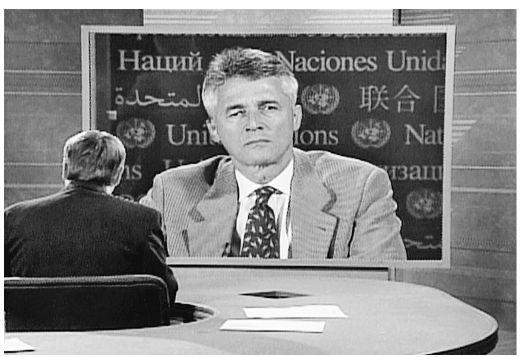
The MacNeil/Lehrer NewsHour, April 28, 1999.
shelter to defuse the emergency. Families in Albania displayed remarkable generosity toward their Kosovar kin, and very few refugees died of disease, exposure, or starvation. The emergency abated. Some 800,000 Kosovar Albanians settled into refugee camps.
Initially, they had reason to fear their exile would be permanent. Clinton’s renunciation of ground troops had convinced Milošević that, although his forces were hopelessly outgunned, they could wait out the air attacks until domestic public opinion in NATO countries turned against the war. Events on the battlefield augured well for the Serbs. Serb antiaircraft gunners shot down a U.S. F-117 stealth bomber on March 28. Four days later Serb forces captured three U.S. soldiers near the Macedonia-Yugoslav border. On April 12, NATO struck a passenger train south of Belgrade, killing thirty civilians and forcing Clinton to issue a public apology. Two days later NATO hit a convoy of families in flight, leaving sixty-four dead. On April 23, NATO destroyed the Serbian state television building, killing ten.
The heads of state of the nineteen NATO countries had expected to gather in triumph on April 23-25 in Washington to celebrate NATO’s fiftieth birthday. But the alliance’s first-ever war cast a pall on the occasion. And the bad news kept coming. On May 2 a U.S. F-16 fighter jet crashed inside Serbia (though its pilot was rescued). Three days later NATO suffered its first fatalities, as two U.S. Army pilots on a training mission in Albania died when their Apache helicopter crashed. On May 7 a NATO cluster bomb aimed at a military airport in Niš went astray and hit a hospital and a fruit and vegetable market, killing fifteen Serbs and wounding seventy.
NATO’s lowest point came at 9:46 p.m. on May 7. Relying on an out-of-date map, American pilots fired three cruise missiles at what they thought was a Serbian government building but that proved to be the Chinese embassy. As firemen descended on the scene, a blood-soaked, frantic Chinese cultural affairs adviser appeared on Serbian television, saying, “We haven’t found some of my colleagues.” More than twenty people in the embassy were wounded, and three were killed. Chinese ambassador Pan Zhanlien stood before the ruins and said, “The People’s Republic has been attacked.” In Beijing a mob gathered at the U.S. embassy, trapping the ambassador inside. Protesters in the NATO countries of Greece, Italy, and Germany decried the civilian toll of the war.40 A spokesman for Annan said the secretary-general was “shocked and distressed” at the growing number of deadly NATO mistakes.41
BEHIND SERB LINES
NATO’s struggles on the battlefield caused the UN’s star to shine brighter.The Western allies started to recognize that, while they had the military prowess to inflict severe harm, they would not necessarily succeed in extracting a surrender from Belgrade. For that they would need Serbia’s historic backer, Russia, to press for peace. The Russians, who were not quick to forgive NATO for launching the war, attached a condition to their cooperation: The UN (where Moscow had great clout) rather than NATO (from which Moscow was excluded) would play the dominant role in any postwar transition.
Vieira de Mello had his own ideas about how to make the UN relevant again, and they did not entail waiting for the Russians to broker a deal. In a senior staff meeting in early May, as Annan described the criticisms he was getting for not condemning NATO, Vieira de Mello spoke up: “Well, there’s one area we can take a stand,” he said, “the humanitarian area.” “Yes,” said Annan,“but what can we do that we are not already doing?” Vieira de Mello answered, “We can get inside Kosovo.”
It was a stroke of political genius. He would lead the first international team into Kosovo since NATO bombing had begun forty days before. The UN would place unarmed officials behind the front lines in a province from which Kosovars were fleeing and that NATO ground forces were avoiding. By entering Kosovo, Vieira de Mello thought he could ascertain the fate of the displaced civilians who had not made their way to safety and assess the extent of NATO’s collateral damage. The trip would instantly elevate the UN’s profile and might even do some good. Annan leaped at the idea, proposing it to the Security Council the following day.
The Russians were elated. Believing Vieira de Mello’s mission would aid his Serbian allies, Ambassador Sergei Lavrov told Deputy Secretary of State Strobe Talbott,“It is no accident that Sergio and I have the same name!” Lavrov urged Vieira de Mello to document the severe economic and environmental devastation caused by NATO. U.S. and U.K. officials had the opposite reaction. With new reports of NATO collateral damage surfacing each day, and with no sure victory in sight, NATO planners did not want to have to go out of their way to avoid hitting UN personnel and thus reduce their already-thin list of targets. Because Yugoslav officials on the ground would block the UN’s movement, the allies were also concerned that Vieira de Mello would emerge with more horror stories about stray NATO missiles than about Serb brutality. Nancy Soderberg, the acting U.S. ambassador to the UN, called him on May 5 to complain about the mission. “Sergio, this is a stupid idea,” she said. “You are playing right into Serb hands.” Firmly but gently he pushed back. “Nancy, my dear, I’m afraid this is nonnegotiable,” he said. “We are the United Nations, and no country, not even one as powerful as yours, can tell us where we can and cannot go.” U.S. officials nixed a planned Council statement welcoming the initiative.42 The following day the divided Council instead issued a noncommittal statement saying it “took note” of the mission “with interest.”43
One of the first people Vieira de Mello telephoned after he got approval to assemble a team was his friend Bakhet. They had spent countless hours debating whether there could ever be any such thing as “humanitarian” war. “Omar,” he said, “do you want to go to Kosovo so we can study the merits and demerits of humanitarian intervention up close?” Bakhet accepted eagerly.“In a simple sense the activist Sergio preferred to be in the field, to find out what people needed,” says Bakhet. “But the activist Sergio also knew that being in the field gave him more credibility in political discussions when he returned to capitals.”
Vieira de Mello was exhilarated by the prospect of returning to the center of “the action” and, in so doing, inserting the UN back in the game. At the press briefing where he laid out plans for the trip, he downplayed the dangers. “There is an element of risk in any such mission, and, although we are not irresponsible, I would say that we are used to working in that kind of environment. Unfortunately this is not new to the kind of job that we do.”44 He also waved off U.S. concerns that his team would be duped by the Serbs, saying testily that he would not be the “prisoner of a pre-arranged itinerary.” He had not amassed twenty-nine years’ experience for nothing, he said: The UN would not be manipulated.45
Vieira de Mello pulled together a team of experts on nutrition, health care, child care, sanitation, shelter, and reconstruction, even though he knew that the humanitarians would not be able to conduct detailed assessments on such a short trip under fire. The battle among agencies for a spot on the team was fierce. Louise Arbour, the UN prosecutor at the war crimes tribunal in The Hague, had been trying to send investigators into Kosovo since the massacre in Racak in January. She was enraged that Annan had thrown his weight behind Vieira de Mello’s mission but had not made any effort to press for access for tribunal investigators, even though reports were swirling that the Serbs were destroying evidence of their crimes. Arbour telephoned Vieira de Mello and demanded that a member of her staff be permitted to join his delegation. “I can’t do that, Louise,” he said. “The Serbs would never allow it.” “Have you asked them?” she asked. “Have you even tried?” He admitted that he had not. She then called Secretary-General Annan and persuaded him to insist.
Vieira de Mello entrusted Nils Kastberg, a forty-four-year-old Swede who headed UNICEF’s emergency programs, to lead an advance mission to the region to lay the groundwork for the trip. Kastberg’s first stop was Geneva, where he met two NATO officers from Brussels. They insisted that the UN drive in clearly marked white vehicles, travel only by day, notify Brussels of their precise route forty-eight hours in advance, and never deviate from the preordained plan.
Kastberg spent May 10-12 in Belgrade conducting delicate negotiations with the Serb authorities.The Serbs insisted that the UN travel at all times with a Serb escort and that before visiting Kosovo they first tour Serbian cities that had been bombed by NATO. Each day of negotiations Kastberg kept one eye trained on the clock, as he needed to ensure that he and his colleagues reached their hotel rooms by nightfall, which was when NATO commenced bombing each day. On May 11, as the afternoon negotiations wore on, Kastberg received a call from Arbour. She said that Annan had given her his word that a war crimes investigator would have a spot on the team.
Kastberg dreaded raising the issue with the Serbs, but when an order came from the secretary-general, he had no choice. He asked Serbia’s lead negotiator to join him for a walk in the garden, away from the listening devices. “I have something to ask you, and it is going to make you very angry, but after you express your anger I would like to ask you if we can put our heads together and find a solution.” The official nodded.When Kastberg explained the new wrinkle, the Serb negotiator erupted in rage. “You know how we feel about this so-called court,” he said, referring to the Serb belief that the tribunal was anti-Serb. “Are you trying to humiliate us?!” Kastberg waited him out. “I warned you that it would make you angry,” he said. The official paced back and forth around the garden. It was 4:30 p.m., and Kastberg needed to resolve the matter. A rumor was circulating that NATO was going to bomb one of Belgrade’s main bridges that day, so the UN team was in a special hurry to get back to their hotels. Finally the Serb gathered himself and said quietly, “You know, if anybody heard that there was someone from The Hague on the mission, not only is that person likely to be attacked, but so is the entire UN delegation.” Kastberg nodded, knowing that the Serb also saw an opportunity to present the tribunal with evidence of NATO war crimes. “The only way this will work,” Belgrade’s negotiator said, “is if the person assumes a different identity.” It was agreed that whoever Arbour nominated for the team would travel undercover.
Arbour tapped Frank Dutton, a fifty-year-old South African who had spent a decade investigating apartheid hit squads before joining the UN court. Dutton flew from The Hague to Geneva, where the UN drew up a temporary contract making him a “human rights officer” and giving him an entirely new UN passport, which no longer listed him as an employee of the tribunal. “We thought we had masterfully disguised his identity,” recalls Kastberg, “until he showed up to leave for the trip with all kinds of cameras and film and asked me to negotiate the filming of mass graves.”
While Dutton joined the UN assessment team eagerly, others felt as though they had no choice. Kirsten Young was based at UNHCR in Geneva as executive assistant to Dennis McNamara. A thirty-four-year-old Australian, Young had been subjected to relentless shelling when she worked in Bosnia in 1993. In the intervening years she had gotten married, undergone intensive post-traumatic stress counseling, and finally made her peace with the ghosts of the Balkans.Yet suddenly McNamara, her mentor, was asking her to return to the region. As she drove home from her office at UNHCR in Geneva, Young telephoned her husband, the head of an international NGO. As she broke the news of her forthcoming trip, she began sobbing so violently that she had to pull over to the side of the road. The prospect of aerial bombardment terrified her. “Kirsten, you don’t have to go,” her husband said. “No, I do, I do,” she said. “I have to go. How do I say no to this kind of mission?” Young remembers the pressure she felt. “The whole humanitarian world is such a macho cowboy environment,” she says. “They all talk about ‘having balls.’ You’re terrified to say no because then you would be showing you don’t ‘have any balls.’ Even feminists get sucked into that trap.” Young remained jittery until she met up with Vieira de Mello in Geneva a few days later, and her fears abated. “Sergio had this aura of nonchalance and invincibility,” she says. “I just resolved not to leave his side.”
Annan too was energized by the imminent trip. In a lengthy Q and A moderated by Judy Woodruff on CNN, he said he was tired of hearing criticisms of the UN.“This morning,” he said, “when people started talking about the incompetence of UNHCR and others, I did not hear a single person mention the sacrifice these people make and the risks they take.”46 Annan spoke suddenly as if from a position of strength. “I don’t think we are going to see NATO setting itself up as a policeman of the world, replacing the United Nations. My own sense, and I may be wrong here, is that after what NATO has gone through in the Balkans, it is going to reassess its own approach. And I think it should.”47 He said countries should not avoid the Security Council.“It’s like saying, ‘I’m not going to this or that court because I know that things will not go my way. So I’m going to do something else,’ ” he said. “We cannot lecture everybody about the need for the rule of law and ignore it when it’s convenient.”48 At a subsequent press conference Annan said that any apparent loss of relevance for the UN was “a short-term phenomenon because we live in a global and an interdependent world and today we need the UN even more than we did yesterday and the day before that.” In words that prophesied the U.S.-led invasion of Iraq in 2003, Annan warned, “Any nation or group of nations that decides to ignore this is setting a precedent and creating a situation that is likely to haunt all of us.”49