

And if he still remembers here
Poor fights he may have won or lost,—
If he be ridden with the fear
Of what some other fight may cost …
He may by contemplation learn
A little more than what he knew,
And even see great oaks return
To acorns out of which they grew.
BEFORE ROOSEVELT WENT to bed after hearing the election result, he dictated a letter to Kermit. It belied his sanguine words to the press. “Well, we have2 gone down in a smashing defeat; whether it is a Waterloo or a Bull Run, only time will tell.”
He did not have to wait for a full count of the vote to see that Wilson had scored the greatest electoral victory yet accorded a presidential candidate. Forty states had gone to the governor, and only six to himself. Taft had to be content with Utah and Vermont. Debs secured none. The electoral college tally was just as disproportionate, with 435 votes for Wilson, 88 for Roosevelt, and 8 for Taft. In Congressional races, the Democratic Party was triumphant, winning control of the Senate and substantially increasing its majority in the House of Representatives.
In his still-fragile3 state, Roosevelt yielded to rage against Root, La Follette, and all the others who had hampered his campaign from the start. Their efforts, he told Kermit, had been backed by “95% of the press” and “the great mass of ordinary commonplace men of dull imagination who simply vote under the party symbol and whom it is almost as difficult to stir by any appeal to the higher emotions and intelligence as it would be to stir so many cattle.” He railed at the “astounding virulence and hatred” of those who accused him of everything from habitual drunkenness to mendacity. Even after he had been struck down in Milwaukee, “the opposition to me was literally a mania.… I now wish to take as little part as possible in political affairs and efface myself as much as possible.”
Like a female ranger living near Old Faithful, Edith Roosevelt understood her husband’s regular need to erupt. “You know him4 well enough,” she warned Kermit in a covering note, “to realize that he will paint the situation in his letter to you in the blackest colors.”
Gradually, Roosevelt realized5 that his loss was not as devastating as it at first seemed. He had scored 4,126,020 popular votes over Taft’s 3,483,922. Wilson’s winning total was only 6,286,124: William Jennings Bryan had done better than him in losing four years before. Debs, by contrast, had doubled the Socialist vote of 1908 to nearly a million. This last was a remarkable achievement, but Roosevelt’s was historic. He had recruited a new party, schooled it in his Confession of Faith, and brought it to second place in a well-fought election. In just over ninety days, he had humbled a sitting president and decisively beaten a party that had dominated national politics for forty years. When the Progressive vote share, at just under 27.5 percent, was added to the GOP’s 23.2 percent, the Democratic total of 41.9 percent looked a lot less impressive. Technically, Wilson was a minority president.
This did not signify that Roosevelt would have inherited much of Taft’s support, had he won the GOP nomination and campaigned as a small-p progressive. He had always been anathema to the sort of Republicans who, on election night in Darien, Connecticut, had stomped and burned6 a portrait of him. But he might have forestalled Wilson’s own nomination, so reluctantly assented to by Democrats after forty-three ballots in Baltimore. Even if he7 had not, he would have had an established party organization behind him, and a platform that addressed itself to the changing national mood. His phenomenal personal popularity would have surged to new heights, along with his international renown. He would now8 probably be President-elect of the United States, and John Schrank not in the dock for trying to kill him.
There remained9 the moral question that his black butler—no student of Aristotle—was asking: whether by bolting the party that had once made him president, had he not committed the fatal insolence? Was he now irreversibly headed toward a pathetic, if not tragic end? Nothing in Roosevelt’s strenuous soul could entertain such an idea. He had cheated death. He had books to write, trees to chop, sons to bring up, a daughter to marry off, and another daughter to save from divorce ( poor Nick10 had been defeated, and was taking it out on Alice). Always, too, there was Edith.

ROOSEVELT ADMITTED11 TO feeling “a little melancholy” over the prospect of having to continue as head of the Progressive Party, when his real need was to start earning money again. His recent hospital and doctor bills, totaling between two and three thousand dollars, had cut into savings already depleted by marathon travels over the last two and a half years—not to mention the cost of entertaining hundreds of political pilgrims to Sagamore Hill. He had begun what was bound to be an expensive libel action against George Newett. And he suspected12 that Ethel was about to get engaged to her faithful doctor, Dick Derby. That would mean a large wedding in the spring. It could not compare in splendor to the White House nuptials of “Princess Alice” in 1906. But given the rise in prices under the Taft administration, it might run up a similar bill.
One way of making a great deal of money was to go on the lecture circuit. Demands for him to speak had become innumerable after his performance in the Milwaukee Auditorium. A novel feature of many of these invitations was the suggestion that he accompany his presentation with “moving pictures” of himself in Africa, Europe, and on the campaign trail. If there was not enough of such footage, more could easily be faked, using an impersonator and studio props.
Roosevelt was willing13 to address such institutions as the National Geographic Society and American Historical Association, with or without fee. He declined, however, to make an exhibition of himself on less prestigious platforms. “I could probably make a good deal of money by so doing,” he wrote Kermit. “But I shrink to a degree greater than I can express from commercializing what I did as President or the reputation I have gained in public service.”
He felt the same way about journalism. “I get from14 The Outlook a salary probably not more than one-eighth of what I could get by writing for the Sunday Hearst papers or the Sunday World; and nineteen men out of twenty would not see any difference; but there seems to me to be a very great difference.” He had his dignity to consider, and in that regard, unselfconsciously compared himself to Lincoln, Milton, and Darwin. “With none of these would it be pardonable to consider the possible monetary return, whether for the presidency, for Paradise Lost or for The Origin of Species.”
There remained15 his perennial source of gentlemanly income: the publication of books. African Game Trails had been enormously profitable in its first-serial form, and a bestseller for a while, but thereafter only a modest success. The polite notes Charles Scribner attached to Roosevelt’s half-yearly royalty checks did not quite mask editorial disappointment. Sales so far, in luxury and library editions, totaled fewer than forty thousand copies.
Looking back16 over his statements, Roosevelt could see that his other Scribner titles had lost momentum after his humiliation in the Congressional elections of 1910. Royalties earned by Oliver Cromwell, The Rough Riders, and Outdoor Pastimes of an American Hunter had fallen from $28,620 in February 1911 to $1,531 in February 1912. Oddly enough, his reemergence as the Bull Moose candidate had not arrested this slide; his latest check, for sales of all four books though 22 August, was a mere $895.
It was clear that something important had to come out of his pen during the winter, if he was going to reestablish himself as a man of letters. But what, and who would publish it? Most of the top houses in New York listed titles by him. G. P. Putnam’s Sons hadThe Naval War of 1812, Hunting Trips of a Ranchman, The Wilderness Hunter, The Winning of the West, American Ideals, and Theodore Roosevelt: Works, a fifteen-volume set issued somewhat prematurely in 1900. The Century Company17 had Ranch Life and the Hunting Trail, Hero Tales from American History, The Strenuous Life, and Stories of the Great West. Houghton Mifflin had Gouverneur Morris and Thomas Hart Benton; Longmans, Green & Co., New York: A Sketch; and the Outlook Company, The New Nationalism. Bibliographically, it was an impressive list, especially when the Scribners quartet was added to it, along with overseas editions and translations. Commercially, he had to accept that all of his books except The Rough Riders were languishing in backlist.
Late in November he let it be known that he was thinking of publishing some autobiographical chapters in The Outlook. He was not sure18 that he would enjoy this “experiment” in self-revelation, but very sure that he wanted to be well paid if it developed into a book. Charles Scribner was upset not to be offered first serial rights, since Scribner’s Magazine had such a wide circulation and had done so well with African Game Trails. But Roosevelt felt obliged to give them to The Outlook, which had suffered many canceled subscriptions after supporting his bolt from the Republican Party. Scribner, undeterred, scented another bestseller. It would be the first presidential autobiography since those of the two Adamses— not that19 they had been of much value. Ulysses S. Grant’s famous memoir had ended with the Civil War. Roosevelt was not only a gifted writer, but his life story was as thrilling as any novel. Scribner wrote to William B. Howland, treasurer of The Outlook, in a state of high excitement. “This is the first20 time that I have ever put in a blind bid for the publication of a book.” He asked if the Colonel would accept an advance of $12,000 and a royalty rate of 20 percent.
It was a generous offer, matching the record rate Scribner had paid for African Game Trails. He was pained when Howland replied on 3 December that Roosevelt had yielded to “another proposition21 [that] is distinctly better from more than one point of view.”
The proposition had come22 from the Macmillan Company, and was better indeed, paying Roosevelt an advance of $20,000 and a royalty rate of 50 percent. In return for these amazing terms, he was required to finish his manuscript by the summer of 1913, for publication that fall. Which meant printing the first chapters in The Outlook early in the new year, so that the whole book could be serialized before it appeared in hardcover.
Nobody in the industry doubted that Roosevelt could, and would, deliver on time: his reputation for promptness23 was legendary. But before starting work on what he insisted on calling his “possible autobiography,” he had some scholarly writing to do. The American Historical Association had elected him as its president, and invited him to address its year-end convention. He thought he would speak on the subject of “History as Literature,” and publish his lecture as the title piece in a volume of miscellaneous essays and reviews.
His third book project24 for the winter was unlikely to be profitable, but would satisfy the mammologist in him. It was to be the collaborative scientific study he had long planned to write with Edmund Heller, entitled Life-Histories of African Game Animals. Charles Scribner was awarded full publication rights for $4,000, a not exactly glittering consolation prize.
JOHN F. SCHRANK, meanwhile25, was tried in Milwaukee on a charge of assault with intent to murder. He pleaded guilty, but with qualifications: “I intended to kill Theodore Roosevelt, the third termer. I did not want to kill the candidate of the Progressive Party.”
A cooperative, often jocular witness, he insisted that26 he was neither insane nor a Socialist. He bequeathed27 the bullet in Roosevelt’s chest to the New-York Historical Society, although some would have thought it belonged to the Colonel by right of conveyance. At times, Schrank claimed he was penniless; at others, that he had inherited Manhattan real estate from his father, a Bavarian immigrant. He had cash enough to have bought a gun and pursued the Colonel for two weeks through the Deep South and on across the Midwest—intending but failing to shoot him in at least five cities before Milwaukee. Always his phobia had been that Roosevelt, if elected, would plunge the country into a civil war.
By court order, Schrank was remanded to the custody of a “lunacy commission” of five psychiatrists. They concluded that he was a case of “dementia praecox, paranoid type,” and unanimously recommended incarceration for life28 in the Wisconsin state asylum in Oshkosh. A guard escorting him there by train noticed him staring out the window at passing fields, and asked if he liked to hunt.
“Only Bull Moose,”29 Schrank said.
MUCH AS ROOSEVELT30 wanted to become a full-time “literary feller,” as he had proclaimed himself in his thirties, his still-evangelical followers begged him to stay on as their leader. With four years to expand, refinance, and consolidate, the Progressive National Committee was intent on “renominating” him for president in 1916—so much so that it had already scheduled a Party conference in Chicago to sanction that plan.
George Perkins, seeking31 publicity, presided at a preliminary dinner of “Highbrow Political Contributors” in New York. The Colonel was guest of honor. Frank Munsey attended, along with the short-story writer Edna Ferber, the journalist Will Irwin, and Hamlin Garland, the kind of all-round man of letters Roosevelt most enjoyed. Garland’s short stories and essays were highly regarded, and he had also written an excellent life32 of President Grant.
If Perkins was hoping for an evening of Progressive dialectic, he was disappointed. Garland was more interested in encouraging Roosevelt (looking fully recovered and cheerful) to push ahead with his autobiography. He said he knew how difficult it was for a public man to find the right intimate tone, and passed on a recommendation from William Dean Howells, the sage of American letters: the Colonel should reminisce aloud to a stenographer.
Roosevelt was in receipt of similar advice from Lawrence Abbott of The Outlook, but he let Garland think the notion intrigued him. “I’ll begin it immediately33, dictating the way Howells suggested.”
“Don’t give us too much of the political, the official,” Garland said. “Write it the way you talk to your friends.”
“That’s not so easy as it sounds, especially when you consider the distractions I suffer.” Roosevelt’s voice rose to the ironic squeak he sometimes used when mocking himself. “Being out of politics is not precisely retirement for me.”
ABBOTT’S IDEA34, SHREWDER than Howells’s, was to engage the Colonel in conversations at Sagamore Hill, with Frank Harper sitting in. They should be as informal as possible. When Roosevelt dictated, he orated. But relaxing in front of his own fire and surrounded by his own books and mementoes, he was a natural raconteur. He could go on for hours, with effortless sequitur and wit, often laughing himself into paroxysms. Abbott worried, however, that he might be inhibited by the sight of his secretary scratching away on a pad.
Fortunately Harper was so short as to be unobtrusive in any room with large furniture. Before their first, experimental session, Abbott instructed the young man to record everything verbatim, no matter how disjointed the sequence. They they joined Roosevelt in his study.
The Colonel began to talk about his childhood with freshness and freedom. From time to time, he remembered Harper’s presence and stiffened. But as the afternoon wore on, he relaxed and Abbott went home triumphant, with a mass of material to snip and paste. After a couple of days Roosevelt had a typed draft copy for approval. He edited and punctuated it with his usual conscientiousness. The result was “Boyhood and Youth,” the first chapter of what promised to be the most entertaining American memoir since Benjamin Franklin’s.
On October 27, 185835, I was born at No. 28 East Twentieth Street, New York City, in the house in which we lived during the time that my two sisters and my brother and I were small children. It was furnished in the canonical taste of the New York which George William Curtis described in the Potiphar Papers. The black haircloth furniture in the dining room scratched the bare legs of the children when they sat on it. The middle room was a library, with tables, chairs, and bookcases of gloomy respectability. It was without windows, and so was available only at night. The front room, the parlor, seemed to us children to be a room of much splendor, but was open for general use only on Sunday evening or on rare occasions when there were parties.… The ornaments of that parlor I remember now, including the gas chandelier decorated with a great variety of cut-glass prisms. These prisms struck me as possessing peculiar magnificence. One of them fell off one day, and I hastily grabbed it and stowed it away, passing several days of furtive delight in the treasure, a delight always alloyed with fear that I would be found out and convicted of grand larceny.
ROOSEVELT’S REDISCOVERY of his narrative voice was interrupted on 8 December by distant, discordant Bull Moose calls. They emanated from the Progressive conference in Chicago, where his presence was urgently requested.
Gifford and Amos Pinchot had never been able to reconcile themselves to the power George Perkins wielded as chairman of the Party’s Executive Committee. Ever since the election36, they had plagued Roosevelt with a proposal that the executive headquarters should be translocated from New York—Perkins’s orbit—to Washington, home of the more malleable Senator Dixon. The Colonel saw a threat to his reputation. The Party was bound to self-destruct if it lost its big-city backers. Perkins would resign rather than be sidelined by the Pinchots, and Frank Munsey was wistful to rejoin the GOP. Roosevelt did not want to look like a leader unable to hold on to his best men.
Showing as much37 good grace as possible, he left for Chicago on a special train, and found fifteen hundred loyal Progressives waiting for him next day in the ballroom of the LaSalle Hotel. The National Committee was sufficiently convinced by his support38 of Perkins to vote 32 to 12 in favor of keeping the executive headquarters in New York. As a sop to the Pinchots, a branch office was established in Washington, and antitrust language reinserted in the Party platform.
Roosevelt’s “renomination” two days later was more of a headline-getter than a formal nod toward 1916. He cast most of his speech of thanks in the present tense, telling the delegates that their current priority must be to fight for distributive justice at the state and federal level. He obstinately defended his philosophy of judicial recall: “39 The doctrine of the divine right of judges to rule the people is every bit as ignoble as the doctrine of the divine right of kings.”
With that he handed the platform over to Jane Addams, and the proceedings degenerated into a dry chautauqua on questions of organization, recruitment, and finance. Charts were drawn, titles devised, plans mooted, budgets projected, lists compiled from other lists, and committees split into subcommittees. Not until the morning of 12 December was Roosevelt free to head for home and his study, with its constant fire and Frank Harper tapping away on the typewriter downstairs.
BY CHRISTMAS HE had “History As Literature” finished, as well as several essays, the first few of his African game mammal studies, and another chapter of his autobiography. He decided to discontinue interview sessions with Lawrence Abbott and write or dictate the rest of that book. To Abbott and other editors at The Outlook, this was a fatal decision. The Colonel could not be expected to draw himself out, lacking the stimulus of a curious—and commercially-minded—interlocutor. He was aware of their distress, but relieved to be in control of his own story. “I have had40 to refuse to write a whole raft of interesting and sensational things that they would have liked me to put in,” he told Kermit. The result was that he became self-conscious about any revelations at all, and admitted that it gave him “a great deal of worry.”
Much of his inhibition derived from that traditional mute on the autobiographical trumpet, the over-protective wife. Still headachy and frail after her near-fatal riding accident of fourteen months before, Edith did not see why hundreds of thousands of readers should be privy to the sort of personal things kept for family letters, or better still, not put on paper at all: matters of health and bereavement and money and sex. It was out of the question that he should write about her, let alone the dead young woman whose face and name she had so assiduously erased from his Harvard photograph album. (But a lock of honey-colored hair41 survived, in a secret envelope inscribed in his own hand.)
The company of42 Archie and Quentin over the Christmas holidays, along with Ethel, Ted, Eleanor, and little Gracie, cheered both parents up. Stuffed stockings and dense snow insulating the house added the right Dickensian touches. Edith began to look “distinctly better,” Roosevelt wrote her sister. He thanked Emily for sending him two volumes of Italian short stories. “I shall read them both of course; probably the Fogazzaro first.”
He was intrigued43 to see how fast Quentin was developing in body and mind, and described him to Kermit as a “huge, wise philosopher.” Actually the boy was intelligent rather than intellectual. His instincts were tactile. Roosevelt, dictating, talked about the machinery of government; Quentin talked simply of machinery. He played the piano with ease, understanding it to be an intricate system of levers. He wrote well too, although flights of imagination seemed to engage him less than the delightful task of setting them as slugs of type, slathering them with greasy ink, and hearing them crank out during all-night sessions in the school print shop.
Ted, settled now in a Manhattan town house, with his pipe, his books, his wife and daughter, and a well-paying job, was bourgeois enough to bore a bank president—which he in fact repeatedly did, in his capacity as a bond salesman on Wall Street. Archie was what Archie would always be: faithful, dogged, inflexible.
Kermit claimed44 to be content in his subequatorial solitude. He was overworked and underpaid, but too proud to ask for help. Single or spliced, Edith’s beloved “one with the white head and the black heart” had the mark of a loner. “I’m afraid Mother thinks I’m hopeless,” he wrote Ethel, “what they call down here a vagabondo, which means a peculiarly useless sort of tramp.” His father tried to make him feel he was still an integral member of the family. “As president of45 the American Historical Association, I am to deliver an address which I hope you will like.… I shall send it to you when it is delivered.”
More excitingly46 to Kermit, Roosevelt mentioned that the Historical and Geographical Society of Brazil had invited him to deliver a series of lectures in Rio and São Paulo during the spring and early summer of 1913. That would be too soon for him, with his three books to finish; but both father and son felt that some sort of seed had been sown.
AT SYMPHONY HALL47 in Boston on Saturday, 27 December, Roosevelt had the novel experience of speaking to a capacity audience for nearly two hours without mentioning Progressivism. His listeners included not only the American Historical Association, but five other professional societies holding conventions in the city that weekend—sociologists, statisticians, economists, labor lawyers, and political scientists. He could not have asked for a forum more to his purpose, which was to offend as deeply as possible the data-drunk bores who, in his opinion, were leaching all the color and romance out of scholarship. Toward the end of the nineteenth century, American historians, modeling themselves on the German academics who wrote for one another, rather than for the general public, had forsaken the linear narrative of Prescott and Parkman and Lecky for prose that sat on the page like bagged sand.
Ironically, Roosevelt was guilty of writing this kind of history himself. His first book, The Naval War of 1812, had been so dense with logistics that it read like a manual in places. He had boasted at the time that the first two chapters were “so dry they would have made a dictionary seem light reading by comparison.” But having proved that he could match modern historians fact for fact, he had gone on to write The Winning of the West in the light of his own experience of the frontier, and with all the creativity he could legitimately apply to the study of sources. And the great Parkman48 had praised him.
He was less concerned, now, with the passing of the amateur historian—somebody he was not sorry to see go—but with the prejudice growing in academe against any prose that did not sound scientific. None of the members49 of the American Historical Association, he suspected, believed any more that history was a branch of literature. If their attitude held, historical writing was doomed as a civilizing influence. It would degenerate into the kind of sterile jargon that only professors fed on. He proceeded to say50just that, undeterred by stony stares and occasional titters among his audience.
Literature may51 be defined as that which has permanent interest because of both its substance and its form, aside from the mere technical value that inheres in a special treatise for specialists. For a great work of literature there is the same demand now that there has always been; and in any great work of literature the first element is imaginative power. The imaginative power demanded for a great historian is different from that demanded for a great poet; but it is no less marked. Such imaginative power is in no sense incompatible with minute accuracy. On the contrary, very accurate, very real and vivid, presentation of the past can come only from one in whom the imaginative gift is strong.
Imagination, Roosevelt argued, did not have to be invention. In nonfiction writing, it should be no more than the ability to see and feel intensely what was there to be seen and felt. “No amount of self-communion and of pondering the soul of mankind, no gorgeousness of literary imagery, can take the place of cool, serious, widely extended study.” Repeatedly he declared that color—authentic color—was not an embellishment of truth: it was truth. Modern scientists were dazzled by their discoveries, but apologetic, not to say perverse, in failing to communicate the beauty of revelation. Modern historians should beware of going the same way.
“Do not misunderstand me,” he said. “In the field of historical research an immense amount can be done by men who have no literary power whatever.” As the discipline developed to keep pace with technology, so must a new type of “investigator”—as opposed to narrative historian—arise and be accepted as indispensable. Roosevelt compared the relationship of the two types to that of the stonemason and the architect. Just as religious faith had had to square itself with Darwin, so must history adjust to the immense proliferation of proven fact. “So far from ignoring science, the great historian of the future can do nothing unless he is steeped in science.… He must accept what we now know to be man’s place in nature.” As Romance died, he must illumine the usual as well as the unusual.… “If he possesses the highest imaginative and literary quality, he will be able to interest us in the gray tints of the general landscape no less than in the flame hues of the jutting peaks.”
Except to deaf ears, Roosevelt had so far presented a plausible case. But what his friend Owen Wister called “the preacher militant”52 in him caused him to add that history should teach morality. It could not record the best and worst of human behavior without comment. Even as he said this, he backed down, and granted that many historical moralists, such as Thomas Carlyle, had made fools of themselves when they diverged from the abstract and started laying down principles of conduct. He fell into his old habit of equivocation, and indulged a long purple passage in praise of purple passages. This spoiled the effect of a fine admonition to the historian of the future:
He must ever remember53 that while the worst offense of which he can be guilty is to write vividly and inaccurately, yet that unless he writes vividly he cannot write truthfully; for no amount of dull, painstaking detail will sum up the whole truth unless the genius is there to paint the whole truth.
Alice Hooper of Boston, sitting in for Frederick Jackson Turner of “Frontier Thesis” fame, did not know whether to be approving or critical of the Colonel’s performance. “He is so54 self-impressed and so thoroughly sure,” she wrote Turner afterward, “… and is so anxious to make a ten strike every time he opens his mouth that it detracts from the profoundness of his learning.… His personality thunders too loud! But in spite of that—what an amount of things he carries about in his head doesn’t he—and admiration for his capacity must be acknowledged when all is said and done.”
Whatever others present thought of Roosevelt the historiographer, they basked in his celebrity at a post-lecture reception in the Copley Plaza Hotel. So many of them crammed in to meet him that the grand ballroom had to be opened up. He spent the night in the house of his friend William Sturgis Bigelow, a Buddhist scholar, and enjoyed himself at breakfast next morning with a couple of Harvard historians receptive to his views.
“T.R. came and went,”55 Bigelow reported to Henry Cabot Lodge in Washington. “He was apparently never better. You never said a truer thing that he has no spilt milk in his life. He was just as much interested in the next thing as if the last one had never existed.”
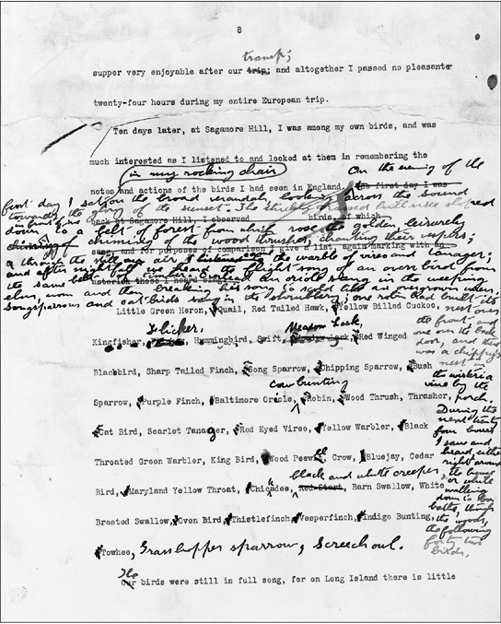
“ ‘UNLESS HE WRITES VIVIDLY HE CANNOT WRITE TRUTHFULLY.’ ”
The manuscript of Roosevelt’s autobiography, 1913. (photo credit i13.1)
ONE CONSEQUENCE OF Roosevelt’s recent escape from death was an end to his estrangement from Lodge. Since the latter’s declaration of neutrality in the presidential contest, they had had little politically to do with each other. But the personal bond between them remained strong, and Lodge had reaffirmed it in an emotional telegram immediately after the shooting. With some awkwardness56, they began to correspond again on the subject of Roosevelt’s lecture, and on the coincidental fact that they were both engaged in writing their autobiographies.
A much frostier57 estrangement showed no signs of thaw on 4 January 1913, when the Colonel and President Taft were seated opposite each other at the funeral of Whitelaw Reid in New York. Appropriately bitter weather buffeted the Cathedral of St. John the Divine throughout the service, which was attended by many of the eminent Republicans who had once thought of themselves as a team: Lodge, Elihu Root, Robert Bacon, Philander Knox, Henry White, J. P. Morgan, Joseph H. Choate, Andrew Carnegie, Frank Munsey, and others. By no attempt at a smile, or even a nod of the head, did Taft acknowledge his predecessor’s presence across the chancel. After the benediction, he rose quickly and marched down the stone aisle, his aides clattering after him. Eleanor, sitting with her father-in-law, asked if it was protocol for a president to walk out ahead of the coffin.
“No, dear, no,”58 Roosevelt said. “It is not customary, but in this case Mr. Taft probably thought there should be precedence even between corpses!”
His wisecrack59 may have been overheard by the President’s brother Henry, who was sitting close by. In a bizarre speech60 that night, at a GOP fund-raiser in the Waldorf-Astoria, Taft described himself as “deceased,” and the dinner in his honor “a wake.” He blamed Roosevelt (who was not present) for eliminating him, saying that a million Republicans had voted Democratic in order to avert the Progressive threat.
Then came a virtual wail for sympathy. “What was the political disease of which I died? I am hopeful that when historians conduct their post-mortems it may be found that my demise was due to circumstances over which I had no great control, and to a political cataclysm, which I could hardly have anticipated or avoided.”
FOR THE REST61 OF the winter, Roosevelt was absorbed in literary work. He continued to grind out what The Outlook obediently advertised as “Chapters of a Possible Autobiography,” as well as editorials and book reviews, and wrote his African life histories at such a rate that he had to urge Edmund Heller to keep up. In addition, he prepared “History as Literature” for publication in the April 1913 issue of American Historical Review and collected ten other pieces to appear with it in the essay volume he had promised Scribners. They included his three European university lectures, a paper on the ancient Irish sagas, “Dante in the Bowery,” and “The Search for Truth in a Reverent Spirit,” his analysis of the conflict between faith and reason.
Edith worried about the pace at which he drove himself, and the struggle he seemed to be having with his memoir. “It is very difficult62 to strike just the happy medium between being too reticent and not reticent enough!” he wrote her sister. “I find it difficult both as regards my life when I was a child and my political experiences.” His solution in the former case was simply to omit whatever was not pleasant, and in the latter to adopt what Abbott regretfully called his “argumentative” style.
He was shy63 about mentioning any members of his family except the Roosevelts and Bullochs who had preceded him, expressing awe of his father (“the only man of whom I was ever really afraid”), and tolerant affection for his “entirely unreconstructed” Georgian mother, with her stories of antebellum life on Roswell Plantation and “queer goings-on in the Negro quarters.” As far as any reader could tell, the woman who bore his first child had never existed. The mother of his later children was referred to only in passing as “Mrs. Roosevelt,” and the children themselves were neither numbered nor named. He wrote tersely about his juvenile battles with asthma, then dismissed the subject of health altogether. Adult traumas64, whether physical or psychological, went unrecorded. Autobiographically speaking, he had not squandered half his patrimony in the Badlands. He had not run for mayor of New York, let alone finished last in a three-way race. His younger brother, Elliott, had not impregnated a servant girl, the family had not paid her off, and Elliott had not died a hopeless alcoholic. Police Commissioner Theodore Roosevelt had been obstructed, rather than outwitted, by a Machiavellian colleague. Somebody else could take credit for comparing President McKinley’s backbone to a chocolate éclair. And the Colonel of the Rough Riders had not lobbied for a Medal of Honor on the ground of personal heroism.
A few of these lacunae were self-serving, but most were self-aware, to be expected in the reminiscences of a former president. He knew that every word that he wrote on personal matters would be pored over. (Hundreds of newspapers, including The New York Times, were quoting each chapter as soon as it appeared in The Outlook.) His moral instinct, moreover, prevented him from recording material that did not trumpet his beliefs. Owen Wister saw clearly in characterizing him as “an optimist65 who saw things as they ought to be, wrestling with a realist who knew things as they were.”
The optimist forged ahead with his text, cutting down on anecdotes and applying political experience to future ideals. Yet it was the realist, persuaded to reminisce by fellow editors at the magazine, who here and there set down stretches of beguiling autobiography, faithful to his own precept that vividness was a necessary part of historical truth. He wrote an elegiac chapter, “In Cowboy Land,” about his years as a rancher and deputy sheriff in North Dakota:
That land of the West66 has gone now, “gone, gone with lost Atlantis,” gone to the isle of ghosts and of strange dead memories. It was a land of vast silent spaces, of lonely rivers, and of plains where the wild game stared at the passing horseman.… In the soft springtime the stars were glorious in our eyes each night before we fell asleep; and in the winter we rode through blinding blizzards, when the driven snow-dust burnt our faces.… We knew toil and hardship and hunger and thirst; and we saw men die violent deaths as they worked among the horses and the cattle, or fought in evil feuds with one another; but we felt the beat of hardy life in our veins, and ours was the glory of work and the joy of living.
ON TUESDAY67, 4 MARCH, the present and the future simultaneously intruded themselves on literary recall. Woodrow Wilson was sworn in as President of the United States, calling upon “all honest men, all patriotic, all forward-looking men” to come to his side. “God helping me, I will not fail them, if they will but counsel and sustain me!”
Doubting, somehow, that Wilson wanted his advice, the Colonel went that morning68 to the huge new “Futurists Exhibition” at the Sixty-ninth Regiment Armory in midtown Manhattan. Since its opening two weeks before, the show, officially entitled “International Exhibition of Modern Art” and displaying well over a thousand paintings and sculptures, had drawn record crowds, setting off reactionaries against sophisticates, critic against critic, and the avant-garde against the merely curious, in a bedlam of aesthetic debate69. It seemed worthy of an Outlook review.
Roosevelt had never written art criticism before. His references to painting, mostly in letters, were conventional and uninvolved, although Arthur Lee had managed to thrill him with the gift of some Valhallan landscapes70 by Pinckney Marcius-Simons, a New Yorker transplanted to Bayreuth. As for sculpture71, Alice had once been convulsed by her father’s admiration for a “particularly fine Diana,” despite three-dimensional evidence that the figure was Apollo.
Monocular vision was part of his problem, but he also had a tin ear for music, and no sense of interior design beyond the hunter’s desire to surround himself with disjecta membra. “Art,” Roosevelt admitted72, “is about the only subject of which I feel some uncertainty.” That had not stopped him, as President, from being strongly supportive of the creative classes. His executive dining room73 had vied with Henry Adams’s breakfast parlor as a meeting place for writers, artists, and intellectuals. He had put the poet Edwin Arlington Robinson, the novelist James B. Connolly, and the cartoonist Thomas Nast on the federal payroll, on the understanding that they would do as little governmental work as possible. He had sponsored a classical restoration of the White House by the architects McKim, Mead & White, teamed up with the planners of the City Beautiful movement against the yahoos of Capitol Hill, posed for John Singer Sargent, and chosen Augustus Saint-Gaudens to design the most elegant coins in modern circulation. “I’d like to be remembered in that way—a patron of art,” he told Hamlin Garland.
Nevertheless, something earthy in him mistrusted what was most fine in the fine arts. He had trouble reading Jane Austen, and thought Henry James effeminate. He disliked poetry that dwelt on intuitions or sensation, preferring border ballads and Longfellow’sSaga of King Olaf to Keats and Baudelaire. Yet his own writings demonstrated a lyrical receptivity to the sights and sounds of the natural world, plus a willingness to be surprised. He rejected nothing new until he understood it well enough to form an opinion of it—usually on moral or utilitarian grounds. Even then, he was amenable to changing his mind, if an expert could improve his perception. Unlike most74 of the sixty thousand traditionally minded viewers who had preceded him to the Armory, he came without prejudice. He felt that75 the organizers of the show were doing a public service in displaying “art forces which of late have been at work in Europe, forces which cannot be ignored.”
An electricity never given off before by an art event in New York was palpable around the huge building. Double-parked automobiles crowded the streets to north, east, and south. Porters tried to control the jostle of ticket holders, and hollered through megaphones at cabs blocking the entrance. Of the two side exits, the most animated—mainly by people laughing and improvising “Cubist” jokes—was that adjoining Gallery I, notorious for its concentration of works by Matisse and other Parisian enfants terribles.
Roosevelt was in76 no hurry to bypass the American rooms, which outnumbered those of France, Britain, Ireland, and Germany almost three to one. The first area he entered, a luminous, tented space full of sculptures and decorative pieces, at once seized his attention. He was predisposed77 to like the lacquered oak screens of Robert Chanler, not just because the artist was the brother of one of his old comrades-in-arms, but because the exquisite designs that covered them fulfilled his long-held dream of a new aesthetic arising out of the paradox of American identity. Here was the work of a man like himself, a wealthy Knickerbocker who had served as a sheriff and lived in the West, yet who was at home in European salons. Chanler, too, loved nature, finding zoomorphic beauty even in the rule of tooth and claw. His Asiatic-looking black wolves, their tails flowing like serpents, bit soundlessly into the writhing bodies of white stags. Attenuated giraffes, splotched as delicately as orchids, grazed the tops of impossibly tall trees. Moonlight irradiated the needles of porcupines slinking through a forest of blue and silver. Perhaps most thrilling, to a tired man of letters planning to take his youngest sons to Arizona in July, was a representation of the Hopi Snake Dance in the “sky city” of Walpi. By transfiguring primitive movement into an ethereal choreography, Chanler was doing the reverse of what the Ballets Russes had done in Paris—where his panels were apparently admired.
Moving on through five more galleries of contemporary American art, Roosevelt saw nothing by Saint-Gaudens, Frederick MacMonnies, William Merritt Chase, and other favorites of his presidency. He did not miss them. They had had too long a reign, with their effete laurel wreaths and Grecian profiles. It was clear that78 the show’s organizers, headed by the symbolist painter Arthur B. Davies, intended to eradicate the beaux arts style from the national memory. Even Sargent was shunned, in favor of young American artists of powerful, if not yet radical originality: George Bellows, Marsden Hartley, Edward Hopper, and dozens of women willing to portray their sex without prettification. Roosevelt was taken79 with Ethel Myers’s plastilene group, “Fifth Avenue Gossips,” whose perambulatory togetherness reminded him of the fifteenth idyll of Theocritus. He liked the social realism of John Sloan’s “Sunday, Women Drying Their Hair” and George Luks’s camera-quick sketches of animal activity at the Bronx Zoo. Leon Kroll’s “Terminal Yards” impressed him, although it represented the kind of desecration of the Hudson Palisades that he and George Perkins had worked to curtail. From a vertiginous, snowcapped height, the artist’s eagle eye looked down on railroad sidings and heaps of slag. Drifting vapor softened the ugliness and made it mysteriously poetic.
What pleased Roosevelt80 about the work of these “Ashcan” painters, and indeed the entire American showing as he wandered on, was the lack of “simpering, self-satisfied conventionality.” All his life he had deplored the deference his countrymen tended to extend toward the art and aristocracy of the Old World. Sloan was a social realist as unsentimental as Daumier, but bigger of heart. Walt Kuhn’s joyful “Morning” had the explosive energy of a Van Gogh landscape, minus the neurosis. Hartley’s foreflattened “Still Life No. 1” was the work of a stateside Cézanne, its Indian rug and tapestries projecting a geometry unseen in Provence.
Davies modestly exhibited only three oil paintings. He eschewed realism in favor of a dreamlike classicism that was at once as serene yet more mysterious than the masterworks of Puvis de Chavannes. Roosevelt, like virtually every American critic or connoisseur, revered Puvis, but Davies’s “Moral Law—A Line of Mountains” was perhaps the most cosmopolitan picture in the show, with its unmistakably Western chain of peaks shimmering across a prairielike emptiness, and pale vague nudes that could have been doodled by Puvis, or traced from the walls of the Roman catacombs, floating in the foreground. Roosevelt took pleasure in it even if the title was bafflingly cryptic.
His enjoyment did not diminish when he found himself among the works of European moderns81 loosely cataloged as “post-impressionist.” He was blind to a piece of pure abstraction by Wassily Kandinsky, but responded happily to the dreamy fantasies of Odilon Redon and the virtuoso draftsmanship of Augustus John, as well as to Whistler, Monet, Cézanne, and other acknowledged revolutionaries.
Then came the slap82 in the face that was Matisse. More vituperation had been directed at this painter, in reviews of the show so far, than at any other “Cubist”—a term that actually did not apply to him, but nevertheless was used as an epithet. Roosevelt gazed at his “Joaquina” and found its cartoony angularity simply absurd. Beyond loomed a kneeling nude by Wilhelm Lehmbruck. Although obviously mammalian83, it was not especially human; the “lyric grace” that had made it the sensation of a recent exhibition in Cologne reminded him more of a praying mantis.
A phrase he84 had recently tried out on Henry Cabot Lodge, in a letter complaining about political extremists, came to mind: lunatic fringe. It seemed even more applicable to the French radicals who now proceeded to insult his intelligence, as if he and not they were insane: Picasso, Braque, Brancusi, Maillol. He boggled at Marcel Duchamp’s Nu descendant un escalier, a shuttery flutter of cinematic movement propelled by the kind of arcs that American comic artists drew to telegraph punches, or baseball swings. If this was Cubism, or Futurism, or Near-Impressionism, or whatever jargon-term the theorists of modern art wanted to apply to it, he believed he had seen it before, in a Navajo rug.
At least Duchamp had had the decency not to flaunt sexual organs. Roosevelt noted no e on the end of Nu in the painting’s title (helpfully lettered onto the canvas), and decided in the face of general opinion to translate it as “A Naked Man Going Down Stairs.” Nakedness seemed85 to be a motif of the show’s remaining galleries, so much so that he elected to ignore a walking nude by Robert Henri that verged on the anatomical, and a frankly lesbian study by Jules Pascin that had three girls preparing to have sex on a bed, limbs intertwined, lips caressing a proffered nipple.
As James Bryce86, the outgoing British ambassador in Washington, noted, Roosevelt “wouldn’t always look at a thing.”
HOWEVER, IN HIS SUBSEQUENT87 review, modestly entitled “A Layman’s Views of an Art Exhibition,” he declined to be as outraged as most professional critics. His tone in confessing his inability to appreciate much of what he had seen was at first almost wistful, as if to acknowledge that the new century had begun to bewilder him. But if the law of evolution was applicable to artists, those fittest to survive were not the ones who mutated most startlingly. “It is true, as the champions of the extremists say, that there can be no life without change, and that to be afraid of what is different or unfamiliar is to be afraid of life. It is no less true, however, that change may mean death and not life, and retrogression instead of development.”
He thought that there was life, and much “real good” in the work of the two emergent American modernist schools, “fantastic though the developments of these new movements are.” Personally, he preferred the nationalistic realism of the Ashcan artists to the violent expressionism of a Marsden Hartley. If the former group was popularist, it was at least all-American, and relatable to Progressivism, as were the new sociological novels of Theodore Dreiser, the “saleswoman” stories of Edna Ferber, and Israel Zangwill’s immigrant drama The Melting Pot, which Roosevelt had himself endorsed as an advertisement for Western-style democracy.
What disturbed him88 was the Armory Show’s message that the Old World was, ironically, far ahead of the New in developing a cultural response to the terrifying implications of modern science. His own written attempt at such a response, “The Search for Truth in a Reverent Spirit,” could be taken as naïve, if the future—even the present!—really was as inhuman as Lehmbruck and Duchamp and Brancusi saw it. Unable to conceive of a head as a metal egg, Roosevelt abandoned reverence for humor:
In this recent89 exhibition the lunatic fringe was fully in evidence, especially in the rooms devoted to the Cubists and the Futurists.… The Cubists are entitled to the serious attention of all who find enjoyment in the colored puzzle-pictures of the Sunday newspapers. Of course there is no reason for choosing the cube as a symbol, except that it is probably less fitted than any other mathematical expression for any but the most formal decorative art. There is no reason why people should not call themselves Cubists, or Octagonists, or Parallelopipedonists, or Knights of the Isosceles Triangle, or Brothers of the Cosine, if they so desire; as expressing anything serious and permanent, one term is as fatuous as another. Take the picture which for some reason is called “A Naked Man Going Down Stairs.” There is in my bathroom a really good Navajo rug which, on any proper interpretation of Cubist theory, is a far more satisfactory and decorative picture. Now, if for some inscrutable reason, it suited somebody to call this rug a picture of, say, “A Well-Dressed Man Going Up a Ladder,” the name would fit the facts just about as well.… From the standpoint of terminology each name would have whatever merit inheres in a rather cheap striving after effect; and from the standpoint of decorative value, of sincerity, and of artistic merit, the Navajo rug is infinitely ahead of the picture.
ROOSEVELT’S SUDDEN INTEREST in modern art, on a day when he could have stayed home and read accounts of Woodrow Wilson’s inauguration, caused much editorial hilarity. A cartoon by Kemble90 in the Baltimore Evening Sun showed the new President contemplating a portrait of his toothy predecessor in the Oval Office and musing, “I wonder if that’s a futurist? It can’t be a cubist.” The New York World argued that the “Square Deal”91 of 1903 had been a proto-Cubist conceit, doing to the Constitution what Braque and Picasso would do to color and form ten years later. As for Progressivism, there was little to distinguish it from the dizziness of Duchamp. “The ‘Nude Descending a Staircase’ is the perfect pictorial representation of a Roosevelt platform.”
C. E. Wood, staff cartoonist for The Independent, drew a caricature92 of the Colonel explaining a Cubist construction to a fellow viewer at the Armory Show. “You don’t understand this new style of painting? It’s as clear as day.”
The canvas’s blocky shapes spelled out “1916.”
IT TURNED OUT93 that Sargent’s portrait of Theodore Roosevelt was indeed the sole wall decoration to greet Wilson when he reported for work in the Oval Office on 5 March 1913. Not only that, the new desk chair ordered for him had not yet been delivered, so he found himself sitting in Roosevelt’s old one, rather battered after seven and a half years of strenuous occupancy.
During the early days of his campaign, Wilson had reacted touchily when reporters suggested he should try to emulate the Colonel’s dynamic speaking style. “Don’t you suppose94 I know my own handicaps?… I’d do it if I could.” But when formal oratory was called for, Wilson was capable of eloquence without affectation, as his inaugural address showed:
The great government95 we loved has too often been made use of for private and selfish purposes, and those who used it had forgotten the people. There has been something crude and heartless and unfeeling in our haste to succeed and be great. Our thought has been, “Let every man look out for himself; let every generation look out for itself,” while we reared giant machinery which made it impossible that any but those who stood at the levers of control should have a chance to look out for themselves.…
We have now come to the sober second thought. The scales of heedlessness have fallen from our eyes. We have made up our minds to square every purpose of our national life again with the standards we so proudly set up at the beginning and have always carried in our hearts. Our work is a work of restoration.
Washington’s diplomatic corps noted that the new President had said nothing about the world outside the United States.
Roosevelt was determined not to criticize him publicly, as a matter of personal propriety as well as respect for the decision of the electorate. But his hackles were raised early by Wilson’s choice of William Jennings Bryan as secretary of state. Not only was Bryan a hayseed of the purest fiber, sure to alienate the aristocrats along Embassy Row, he also quaintly believed that all foreign provocations could be talked or prayed away. That boded ill for another crisis over Mexico, where an anti-American despot named Victoriano Huerta had seized power and, apparently, condoned an armed attack96 on a U.S. border patrol in Arizona, the same day Wilson was inaugurated.
Republican and Progressive congressmen wishing to urge a forceful response from the new administration found themselves barred97 by a White House access rule that reversed more than a century of democratic tradition. Wilson’s plump young secretary, Joseph P. Tumulty, announced that in future, all callers upon the President must bear invitations. This haughty policy was perhaps to be expected from a political scholar whose writings made clear that he believed in an isolated, powerful executive. Wilson felt that legislators over the years had spent too much time visiting the White House with unasked-for advice, and too little on Capitol Hill, consenting.
ON FRIDAY, 4 APRIL98, there was a gathering of Rooseveltians—both Republican and Progressive—at Christ Church, Oyster Bay, to watch the Colonel give away his younger daughter in marriage to Dr. Richard Derby. Although the gathering was large, cramming the flower-filled nave beyond capacity, it was select. Conspicuous absentees included William Howard Taft (now a professor of law at Yale), and Elihu Root. George von Lengerke Meyer, who had served in Taft’s cabinet as well as Roosevelt’s, had needed encouragement to attend. So had Senator Lodge. They were not sure they had been forgiven for failing to stand at Armageddon. Roosevelt scoffed at their embarrassment. “I feel very strongly99 against Root,” he told Winthrop Chanler, “because Root took part in as downright a bit of theft as ever was perpetrated by any Tammany ballot box stuffer.… But with Cabot and George it was wholly different. They had the absolute right to do each exactly as he did, and I never expected either of them to follow me.”
Both were, in any case, Harvard men, as were Chanler, Owen Wister, and many of the other top-hatted figures attending the ceremony—not least the bridegroom. “Dusky Dick,” as Alice Longworth teasingly called him (he was dark, and prone to black moods), happened also to be wealthy, with an easy expectation of twelve to fourteen thousand dollars a year over and above his professional income. This had been100 a further reason to approve him as an addition to the family. Roosevelt was so much a product of the Porcellian and Knickerbocker clubs that he never seemed to notice how exclusive his preferred field of acquaintance really was.

“FUTURE GENERATIONS WERE MANIFESTING THEMSELVES.”
The Colonel gives his younger daughter away in marriage, 4 April 1913. (photo credit i13.2)
He seemed near101 to tears as he escorted Ethel to the altar, in contrast to his unsmiling demeanor at Alice’s wedding in the White House. That had been a state function; this was private. It was, nevertheless, momentous as a rite of passage not only for the young woman at his side, glowing in ivory satin and emeralds, but for himself as a public person. Never again, probably, would he attract such a concourse102, as Wister called it, of familiars. The power that he had exuded for so long was diminishing by the day while Woodrow Wilson—not to mention Cubism!—remade the world in ways not to his liking.
Had Roosevelt not decided to make his autobiography as impersonal as possible, he could have brought it to an end with an account of this ceremony, casting the congregation as a sort of dramatis personae of his life and times. Here was old Joseph Choate, to whom he had turned, after the death of Theodore Senior, for career advice; his classmate Bob Bacon, still the handsomest man in the world, but grizzled now and replaced as American ambassador to France; tiny, guttural Jake Riis, who had opened his eyes to “how the other half lives”; his orthographical mentor, Brander Matthews, one of the few academics he could stand; Bill Loeb, who had handed him John Hay’s telegram in 1901, confirming his accession to the presidency; sleek George Cortelyou, manager of his huge electoral win in 1904; Gifford Pinchot, the architect of his conservation policies; Henry White, who had ridden with him and the Kaiser on Döbertiz Field; Lyman and Lawrence Abbott, his employers at The Outlook, wondering how long they could afford to showcase his political opinions; George Perkins, who intended to keep bankrolling the Progressive Party, and Frank Munsey, who did not. And here by virtue of blood was the sole Democrat present, thirty-one-year-old Franklin D. Roosevelt, recently confirmed as assistant secretary of the navy.
Dick and Ethel were married over the loud objections of little Gracie, Ted and Eleanor’s daughter. Future generations were manifesting themselves.
WITH SPRING UNDER WAY and the Derbys off to Europe on honeymoon, Roosevelt reapplied himself to the literary task he was beginning to find unbearable. “I am working103 with heated unintelligence at my ‘biography,’ ” he wrote Ethel. “I fairly loathe it, now.”
His boredom showed as he dictated two long, dry chapters about his commissionerships in Washington and New York in the 1890s. It was difficult to interest any modern reader in the civil service and municipal problems of a quarter-century before. He tried to make them sound less dated, and fell into a presentist mode, as if he were still campaigning against Taft and Wilson. A chapter on his service with the Rough Riders in Cuba, heavily appendicized with documents testifying to his heroism at San Juan104, ended with an argument for military and naval preparedness in 1913. Hindsight made him more pro-labor and better informed about the abuse of women than he had been as president. The Progressive Party platform kept intruding, like King Charles’s head. He seemed to realize that his book was becoming polemical, but could not help himself. Nor could he turn, as he had in happier days, to Elihu Root for corrective sarcasm.
Lawrence Abbott tried but failed to persuade him to write more “picturesquely.”105 It was not for lack of literary labor. Roosevelt revised some106 pages of typescript with such care that all four margins were crammed with interlineations. He eliminated anything that might be read as overtly boastful, assembling a sober and comprehensive account of his service as governor of New York State with the help of George Perkins, and asking Gifford Pinchot107 to draft a chapter entitled “The Natural Resources of the Nation.” The titles of five other chapters spoke for themselves: “The Presidency: Making an Old Party Progressive,” “The Big Stick and the Square Deal,” “Social and Industrial Justice,” “The Monroe Doctrine and the Panama Canal,” and finally “The Peace of Righteousness.”
Desperate to compile the most official record, he neglected his own advice to historians and wrote hundreds of colorless paragraphs unlikely to swell The Outlook’s subscription list. Only once, in an inserted chapter about his love of books and the outdoors, did he recapture the charmingly natural style of earlier installments. By the third week of May, he had had enough. He chose not to proceed any further than the end of his presidency, and left African Game Trails and The New Nationalism to account for what he had done since then. Simultaneously, he also finished Life-Histories of African Game Animals, and left on 24 April for Marquette, Michigan, on another documentary quest: to prove for all time that he was not a drunkard.