
PART THREE
CHAPTER 8

Columbus labored uncertainly on muleback along stony trails and dusty plains toward Valladolid, in north central Spain. Ferdinand and Isabella had wed here twenty-eight years earlier, in 1469, and they occasionally returned to preside over their expanding empire. Columbus’s companions included two close relatives of Caonabó, the duplicitous Indian cacique with whom he had formed an alliance. The Admiral of the Ocean Sea had planned to present Caonabó himself to the Sovereigns as a trophy, but he had died of disease at sea. Only his relatives remained.
The Admiral had returned to Spain at the conclusion of his second voyage only weeks before, and he managed this overland journey as if it were an extension of that seagoing enterprise. As the party stumbled on their way, their caged parrots, souvenirs of Hispaniola, screeched in alarm. Caonabó’s brother, who had converted to Christianity and taken the name Don Diego, remained nearly as conspicuous, wearing a prominent collar fashioned from gold and his crown, said to be “big and tall, with wings on its sides like a shield and golden eyes as large as silver cups.”
Ravaged by illness, Columbus looked a decade older than his forty-six years, drained of the vigor and stamina that had propelled him as a young navigator. His fine mane of hair had gone white, and his vision constantly troubled him, his retinas scorched from long hours of gazing at the sunlit sea. His bones ached with every lurch of the mule on which he rode. Suffering from arthritis and other disorders, he knew his time was limited, and rather than resting on his laurels, and allowing others to win glory and riches by building on the discoveries that he had made in the previous five years, he was determined to cram as much exploration as possible into the time left to him.
At times he brooded on the lack of recognition for his astonishing exploration of the Indies. “I discovered for you,” he reminded Ferdinand and Isabella between voyages, “333 leagues of mainland at the very end of the Orient and named 700 islands in addition to what was discovered on the first voyage, and I pacified for you the island of Hispaniola, which is larger than Spain and inhabited by innumerable people.” Columbus should have thought twice before making this boast. The Sovereigns had made him, and they could break him, confiscate his discoveries, and strip him of his honors, titles, and wealth if they wished.
Columbus, in contrast, believed that he had been unfairly penalized for his empire building rather than generously rewarded, as he deserved. He decried the “cursing and the scorn for the enterprise” that he had risked his life to set in motion, all because “I had not sent back ships right away laden with gold.” No one bothered to take into account the “enormous difficulties” that he faced. “For my sins, or rather, for my salvation, I was held in aversion, and obstacles were raised to whatever I said and asked.” He reminded his Sovereigns that he had, in the past, “brought you enough samples of gold and told you about the existence of gold mines and very large nuggets and also copper, and I delivered to you so many kinds of spices that it would be too long to write down,” but, he said bitterly, “all of this made no difference to some people”—his critics and rivals at court—“who had very consciously begun speaking ill of the enterprise.” He had performed the tasks that explorers through the ages had accomplished on behalf of their rulers and princes: “to serve God while expanding their own dominion.” Yet, “the more I argued for [the enterprise], the more the detractors redoubled their jokes on the subject.” He had implored Ferdinand and Isabella to hear his plea, but “Your Highnesses responded to me with a smile, saying that I should not be troubled at all by it because you did not view those who spoke ill of this enterprise as deserving authority or credence.” Nevertheless, he feared they hovered on the verge of betraying the sacred cause he shared with them.
His many discoveries had whetted his appetite for more. He was driven in part by greed and self-aggrandizement, and in part by a need to exonerate himself, to prove to the Sovereigns that he had kept his sacred promises to them, despite the incomplete and often contradictory evidence of his voyages. Even more troubling, he refused to address his monstrous blunders: the oath he had made his men swear on pain of death that Cuba belonged to the mainland of India, the fifty thousand Indians who had committed suicide in protest of his occupation of their lands, and his failure to locate the Grand Khan.
To proclaim his humility and piety, and perhaps unconsciously atone for the fatal outcome of his administration, Columbus took to wearing the habit of a Franciscan friar, woven of coarse brown cloth. Following the precepts of St. Francis of Assisi, members of this mendicant religious order emphasized penance. Presumably he belonged to the Third Order, the most secular Franciscan subdivision, which did not require its members to live in a Franciscan community but instead to work zealously to improve their lives. He scarcely resembled the imperious Admiral of the Ocean Sea, celebrated discoverer of an empire, and intimate of the Sovereigns. He had carefully concealed signs of worldly ambition and vanity in favor of devotion and humility.
Garbed in plain attire, he had visited at length with Andrés Bernáldez, who appreciated Columbus without challenging him. He entrusted his journals of the second voyage to the curate, who was compiling an ambitious history of the reign of Ferdinand and Isabella, the Catholic Sovereigns who had driven the infidels from Spanish soil. Columbus claimed a small but significant place in this history, one that had more to do with his discovery of gold than of new lands and peoples. A goldsmith named Fermín Zedo claimed that the walnut-size nuggets that Columbus had transported to Spain were alloys. No, Columbus insisted, the gold was pure, and he showed samples to prove his point, justifying himself in Bernáldez’s eyes.
Columbus showed Bernáldez the massive gold collar worn by Caonabó’s brother. “This I saw and held in my hands,” he exclaimed, together with Indian “crowns, masks, girdles, collars, and many articles woven of cotton.” On closer inspection, the curate made out the devil “represented in the shape of a monkey or owl’s head, or other, worse shapes.” Still, he beheld in amazement these souvenirs of another world, “winged crowns with gold eyes on their sides, and especially a crown they said belonged to the cacique Caonabó, which was very big and tall, with wings on its sides like a shield and golden eyes as large as silver cups weighing half a mark, each one placed there in a very strange and ingenious manner.” As if that finery were not sufficient, “the devil, too, was represented on that crown.” The Indian idolaters, he assumed, “regarded the devil as lord.”
Columbus arrived at Valladolid to learn that the Sovereigns had departed for the wedding of Don Juan and the Archduchess Margarita on April 3, 1497, at Burgos. On he went, for at Burgos he could see his sons, Diego and Ferdinand, and finally present the king and queen with the gifts and blandishments designed to secure his monopoly on the lands he had claimed in their names. His appearance there galvanized the desultory preparations for his return to Hispaniola. His Franciscan habit, his show of piety, his protestations of loyalty, his seriousness of purpose, and, above all, his experience exploring in the name of the Sovereigns combined to work in his favor. Although Columbus had compromised himself and fallen short, and others had been working strenuously to discredit him, he remained the discoverer who had brought the Sovereigns their empire.
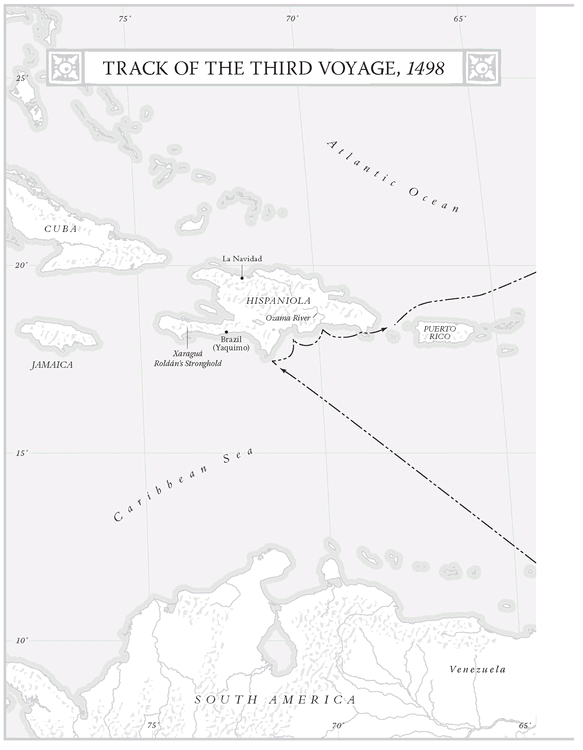
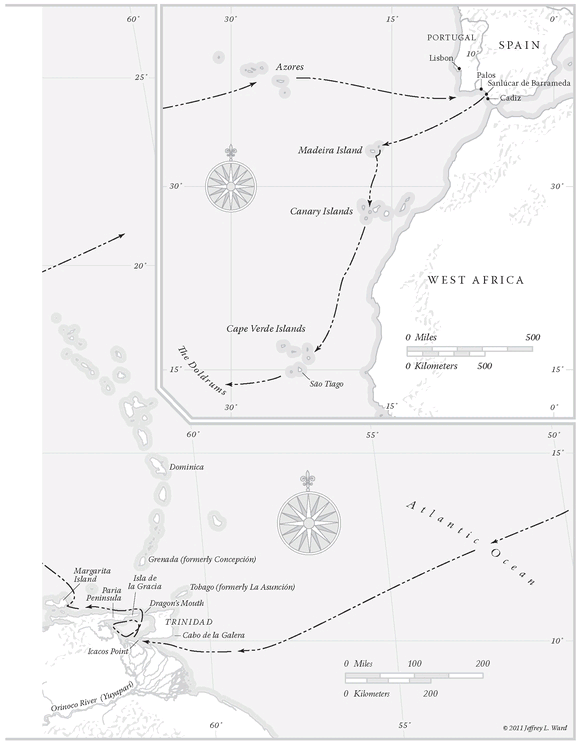
Just days later, on April 20, they approved a third voyage, authorizing him to bring three hundred people to the colony. Another fifty would be able to go at their own expense; spurred by the promise of easy riches, takers were easy to find. Able-bodied seamen and artisans would receive wages of thirty maravedís a day; soldiers, laborers (especially those willing to dig for gold), and cabin boys would receive twenty maravedís a day. Those prepared to stay and cultivate the land would earn six thousand maravedís a year. Women were permitted to participate in the voyage, grudgingly, it seems. Very little is known about this group, but it is assumed that they were expected to work, most likely at domestic chores.
To fill out the ships’ rosters, the Sovereigns offered pardons to jailed criminals who agreed to sail with Columbus. The policy did not apply to those convicted of murder, treason, sodomy, arson, or counterfeiting, but other convicts prepared to go to “Hispaniola and the islands and mainland of the Indies” for a year or more would receive a reduced sentence. And in Hispaniola, they would be free. These inducements hardly gave the Admiral of the Ocean Sea the experienced, disciplined force required for a voyage of discovery. Instead of dedicated servants of the crown, he found himself surrounded by mercenaries, amateur gold diggers, and criminals waiting for the chance to cause mayhem.
Financial backing for the voyage was slower to materialize; eventually the Sovereigns authorized 2,824,326 maravedís. By February 17, 1498, Columbus had merely 350,094 in hand to pay for all the necessary provisions, sail, and other costly supplies related to the undertaking. Extra support came not from Spain, but from the Seville bureau of the Genoese bank that had financed his long-ago merchant voyages to the Greek island of Chios. Although the Sovereigns had set aside funds for the voyage, Columbus had to answer to their notoriously cranky administrator, Bishop Fonseca, who disliked him intensely, and blocked or delayed the transfers. When a cargo of wheat for the voyage arrived from Genoa, Columbus could not pay.
After weeks, and then months of frustration, the cantankerous Admiral himself got into a fistfight with one of Fonseca’s representatives, Jimeno Breviesca, who had been ridiculing the Enterprise of the Indies. Hearing criticism once too often, Columbus knocked the bureaucrat to the ground, and kicked him. Breviesca was an officer of the crown, and by losing his temper Columbus had damaged his reputation, especially in the eyes of the Sovereigns.
In fact, his problems extended far beyond this unseemly brawl. He was losing the monopoly he had held for the previous six years over Spain’s transoceanic empire. Although the boundaries of the Treaty of Tordesillas were still in place, challengers were emerging, some obtaining the backing of Ferdinand and Isabella. Columbus no longer had the Indies to himself.
The exploration squadron under his command consisted of three ships: Santa María, the flagship; El Correo (“the Courier”), a caravel owned by Columbus and his Sovereigns; and La Vaqueños, thought to be leased to the expedition by a widow in Palos, Spain. Columbus planned to sail along a southerly course to the Cape Verde Islands, an archipelago often islets off the coast of West Africa. Known, if not well understood, since antiquity, they had been rediscovered by António de Noli of Genoa, who had sailed for Prince Henry the Navigator. King Alfonso V of Portugal later appointed António de Noli as the first governor of Cape Verde.
The Cape Verde Islands proved drab and bereft of the luxurious vegetation of other landmasses. Columbus declared the name “absolutely false . . . because they are so arid that I saw nothing green on them.”
Heading into uncharted waters, he planned to go farther south than ever before, in the belief that the closer to the equator he came, the more valuable his discoveries would be. This notion circulated among cosmographers such as Jaime Ferrer, who had advised Columbus that near the equator “great and precious things such as gems and gold and spicery and drugs” could be found. According to Ferrer, Indians, Arabs, and Ethiopians agreed “the majority of precious things come from a very hot region where the inhabitants are black or tan.” Therefore, wherever Columbus found such people he would find the precious items he sought.
He set sail at the height of midsummer, June 21, bound for Hierro, on the western edge of the Canary Islands, where during the brief hours of darkness he and his two accompanying vessels bade farewell to the supply fleet bound for Hispaniola. He dropped anchor in a bay near barren Boa Vista—the name roughly equivalent to “land ahoy!” in Portuguese—an island known for its leper colony. The Portuguese notary-in-charge, Rodrigo Alonso, told the Admiral that lepers came to Boa Vista in the belief that eating the meat of turtles and washing in their blood cured the affliction. The islanders caught the turtles by night, first by looking for their tracks with the help of lantern light. When they found one of the sleeping creatures, they flipped it onto its back, rendering it helpless, and then they turned over the next, and the next after that, before butchering the lot.
On Saturday, June 30, 1498, Columbus set sail for nearby São Tiago, the largest of all the islands in Cape Verde. Fog accumulated even in the intense heat, obscuring the sun by day and stars by night. Despite this obstacle, the little fleet departed on a southerly course on July 4, with the Admiral determined to test the boundaries of the recently modified Treaty of Tordesillas. He was, finally, bound for the Indies.
In search of a shortcut, as always, he sailed as far south as he dared, to the latitude of Sierra Leone, 8º30’ north of the equator, before heading west to the island of Hispaniola. On Friday, July 13, Columbus’s fleet entered a convergence zone where winds from the Northern and Southern Hemispheres flow together. The wind died, the ocean’s surface became ominously flat, and the temperature shot up. They had arrived at the Doldrums, a region that few Europeans, Columbus included, had ever explored, let alone survived.
“I entered a zone of heat so high and intense that I believed that the ships and crews would be burnt up,” he confided. “The heat came so unexpectedly and so out of measure that not a single man dared go below deck to salvage barrels of drink and victuals.” Becalmed, afflicted by melancholia, Columbus reeled with dread. In the “intense heat,” said Las Casas, “he feared that the ships would burn and the men perish.” The temperature was already taking its toll on the equipment. Wine and water casks ruptured, breaking the barrels’ hoops. Sheaves of wheat withered. Bacon and salted meat rotted almost before their eyes. Only clouds and the occasional rainfall spared them all death by exposure to the pitiless sun.
Suffering from painful gout and disorienting heatstroke, unable to sleep, scarcely able to breathe, Columbus forced himself to conjure a course to more temperate weather. He took heart from the sight of black and white rooks, birds that he believed did not stray far from land. By July 19, the heat was even more intense, and the suffering greater. But then a zephyr filled the ships’ sails, a few uncertain puffs at first, followed by more convincing gusts, until the sheets bulged and the air pulsed with vitality once again. “It pleased Our Lord at the end of these eight days to grant me a good wind from the east,” Columbus noted, “and I went west . . . always westward on the parallel of Sierra Leone with the intention of not changing course until I reached the location where I thought I would find land and repair the ships and replenish, if possible, our victuals and take on the water I needed.” He followed his westward course for seventeen days, believing that he would eventually arrive at a point due south of Hispaniola.
But first he had to find land. His ships were coming apart at the seams, and in urgent need of repair, and their stores were equally in need of replenishment. Sunday, July 22, brought birds flying from the west southwest to the northeast . . . still more birds traversing the skies on Monday . . . and, later that week, a pelican perched proudly on the flagship, suggesting the proximity of land, and drinking water, but where?
Veering north, he made for the big island of Dominica, whose coast he had skirted on the second voyage. Because of its reputation as a cannibal haven, he had chosen to avoid it on that occasion, but now he was so desperate for water and respite from the torments of the sea that he was willing to risk a landfall. Before he did, he sent his servant, Alonso Pérez, up to the mainmast. From his vantage point, “he saw land to the west, fifteen leagues away,” Columbus noted. “What appeared were three knolls or mountains.” They formed an unexpected deliverance from the anthropophagi. He named the outcroppings Trinidad, after their tripartite nature. As he approached, they appeared to him as “three mountains all at one time, in a single view.” Not since encountering land during his first voyage had he felt so relieved. “It is certain that finding this land in this place was a great miracle,” he recorded. He had just sighted one of the two islands that comprise today’s Trinidad, the southernmost landmass of the Caribbean, only seven miles from the coast of Venezuela and South America. The Spaniards on board rejoiced and chanted the “Salve Regina” as the others nodded in fervent agreement.
He made for a cape that had caught his attention. It seemed to resemble a galley under sail, and so he named it Cabo de la Galera, where, according to his records, he arrived at the hour of Compline, at day’s end. In search of a safe harbor, he coasted past miles of shoreline cloaked in forests that “reached to the sea.” Finally, Columbus caught sight of a canoe: his first contact with the people of Trinidad. Rather than expressing relief or curiosity, he brushed off the overtures of a small tribe approaching them in canoes. Stressed from the voyage, suffering from aches and pains, and even near blindness, and puzzled that the canoes did not carry Chinese, as expected, he avoided both their friendly gestures and hostile arrows. In reality, he was no closer to India than before, and had happened upon a local community related to the Taíno and Carib tribes.
The next morning, his fleet, rationed to a single cask of water, proceeded along a southerly course until dropping anchor at Point Erin, where the men gratefully refilled their supply of fresh water and cleaned themselves and their garments in heartfelt rites of renewal.
Aboard their ships once again, Columbus’s men spied thatched huts ashore, put them astern, and proceeded along Icacos Point, which marked Trinidad’s southwesternmost extension. The icaco, or cocoa plum, for which the point was named, sends forth glaucous leathery leaves and velvety fruit, often of a purplish hue. Tolerant of salt, cocoa plums provide a natural barrier against the sea’s erosion.
The flotilla paused again when Columbus sighted a landmass he took to be an island. But further exploration of the extensive coast—more than twenty leagues—challenged his judgment. On Wednesday, August 1, he arrived at the broad mouth of the Orinoco, among the longest rivers in South America, located at the border of Venezuela and Brazil. The topography persuaded him that he had arrived at the mainland, and the recognition marked the signal discovery of this or any other of his voyages, his first sighting of the continent whose size and location neither he nor anyone else in his ships fully understood or acknowledged. The mystic in him preferred to assume that Providence had led him closer to the entrance to paradise. He shied away from the rigors of geographical adjustment required for nautical reckoning. Nor did he know what to make of the coastal flora beyond noting that it appeared lush and reassuring. “The trees brushed against the sea,” in Las Casas’s paraphrase, a sign that the sea was calm “because when it is rough there are no trees there at all, but rather sand.” Yet a “surging current” appeared to emanate “from above,” and a “mounting current” from below.
He led the ships into a shallow, brackish body of water west of Trinidad, now known as the Gulf of Paria. After all he had endured, the sweeping shore seemed a sort of paradise, as befitting one of the best harbors in the continent’s eastern coast. “This gulf is a marvelous thing,” Las Casas commented, “and dangerous because of the great river that flows into it.” He called it Yuyaparí, now the Orinoco River. “This river travels more than 300, I believe 400 leagues.” He was describing the Orinoco Delta, a giant, fanshaped network of waterways. Between the land and sea lurked danger, as Las Casas explained. “Since that gulf is surrounded by mainland on one side and on the other by the island of Trinidad, and is, as a result, very narrow for the violent force of the opposing waters, they meet in a terrible confrontation and very dangerous battle.”
Dropping anchor on Thursday, August 2, Columbus permitted his exhausted men to venture onto a swampy brown beach near Icacos Point “so that they might rest and enjoy themselves” after their anxiety-ridden crossing. Restful it might have been, but the setting had an isolated, melancholy feel, as if time were running out as surely as the tide.
Later that day, a large canoe bearing twenty-four Indians appeared, halting at a safe distance. The Indians shouted over the water, and Columbus’s men responded not with words but with a show of objects—“brass pots and other shiny things”—to encourage the canoe to approach for a bit of friendly trading. The Indians came closer, but still kept their distance, even though Columbus improvised a dance of welcome. “I wanted very much to speak with them, and not having anything more that seemed to me suitable to show and lure them to approach, my last resort was to have a tambourine brought up on the quarterdeck to play and have some boys dance, believing that this way they would draw near to see the celebration.”
The Indians interpreted the merriment as a war dance and “took up and strung their bows, held up their shields, and began shooting arrows.” Their intended targets scurried below deck. Columbus “gave the command to stop the fiesta of drumming and dancing,” and ordered his men to bring out their crossbows and fire several warning projectiles at the Indians, who had expended their arrows and positioned themselves at the stern of one of the caravels, as if readying to overrun her. At that moment, the ship’s pilot summoned the confidence to dangle from the stern and lower himself into the canoe, armed only with gifts in the form of a “robe” and a “bonnet,” quickly accepted by the Indians, who gestured that the Spanish pilot should go ashore to receive their offerings. He agreed, and asked to be taken to the flagship so that he could ask permission from the Admiral. Before he completed the protocol, the Indians had given up and departed.
Columbus thought he had seen the last of them until one of their caciques came to the flagship. The Indian’s gold crown caught the eye of every Spaniard, as did his crimson cap and the dignified manner in which he paid his respects to the Admiral. He placed his crown on Columbus’s head, sealing their sudden bond. The generous gesture was not quite enough for Columbus, who was hoping for an offering of silk, or brocade, as if to reenact a scene from Marco Polo’s Travels. Instead, he met the steady gaze of curious Indians. “They were not so brown as the others,” said Las Casas, drawing on the accounts of Columbus and other participants, “rather more white than others that had been seen in the Indies, very good-looking with handsome bodies. Their hair was long and straight, cut in the Castilian style.” Their heads were bound with woven cotton, which Columbus, always on the lookout for signs that he had reached the East, took for turbans. Other Europeans eyed the Indians’ weapons, especially their bows and feathered arrows tipped with a sharp, barbed bone “like a fishhook.”

Negotiating their way past the Indians, Columbus and his men stumbled ever deeper into a boisterous paraíso teeming with anacondas, pythons, howler monkeys (the loudest land animals in the New World), capuchin monkeys (whose monkish appearance reminded early European visitors of the habits and hoods of the Order of Friars Minor Capuchin), macaws, toucans, parrots, storks, kingfishers, and woodpeckers. Agile jaguars and pumas wound their way through the impenetrable undergrowth. In search of pearls, Columbus, bewildered, remarked on the “very large oysters” before turning his attention to the plentiful fish and parrots staring at the intruders in their midst. The parrots were “green, of a very bright color tending toward white, while those of the islands are greener and of a darker color. All those of the mainland have yellow necks, like stains, and the points above the wings have colored patches, and there are some yellow feathers on the wings,” according to Las Casas.
Surveying from Point Arenal, on Venezuela’s northern coast, Columbus studied the islands to the north and the mountains to the south with growing curiosity. They saw tracks of animals—goats, the men assumed, but actually deer—but found the corpse of only one. Like so much else in the “other world,” they knew not what to make of the sight.
Columbus resumed searching for an Indian interpreter and for water. His men were at the point of digging wells in the sand when they came upon several boreholes that fishermen had apparently abandoned. He arrived at a channel that he named Boca del Dragón, the “Dragon’s Mouth,” between the pincerlike land extensions of Trinidad and Isla de Gracia. Refreshed, the Admiral intended to sail to the north toward the familiar sights of Hispaniola, but, he noted with alarm, “there were some great crosscurrents throughout the entrance that made a great roaring . . . like waves breaking and shattering on the rocks.” The question was how to get around the churning seawater. He anchored just beyond the opening of the channel, and “discovered that the water came in, night and day, from east to west with a fury like that of the Guadalquivir when it is high, and it flowed so continuously I feared I could not turn back because of the current nor proceed farther because of the shallows.” He was trapped.
In the early hours of August 4, the Dragon’s Mouth bit.
“Well into the night,” Columbus later recalled, “I heard while on deck a terrible roar coming from the south toward the nao; I ran to look and saw a tidal wave swelling from west to east like a hill as high as the nao coming toward me little by little, and on its crest an advancing line was visible, roaring with a great noise, with the same fury and roar of the other crosscurrents mentioned before and resembling waves breaking against rocks.” But he was delivered from destruction as suddenly and inexplicably as he had confronted it. “However, it went by and reached the entrance, where it stopped for a considerable time.”
The massive displacement of water snapped the cable securing La Vaqueños’s anchor, carrying her to an impossible height. Riding “atop the swell,” Columbus marveled that he had never experienced anything approaching this wild and potentially disastrous ride. According to Las Casas, Columbus declared that “if they escaped from here, they could tell stories about how they escaped from the Dragon’s Mouth. And because of this, the name stuck, and with good reason.” It was one of the few names that did; Las Casas, whose life span overlapped that of Columbus, noted that Columbus generally wrote on water. “Of all the names that he gave to islands and capes of the mainland, which he knew as Isla de Gracia, none remain or are known today except the island of Trinidad, the Dragon’s Mouth, the Testigos, and Margarita.”
As the wave passed, the ship plummeted toward the ocean floor, coming so close that the men could glimpse the bottom. And then the turmoil ended. He had survived his encounter with the Dragon’s Mouth. Months later, the memory of the traumatic event still shook him. “Even today,” he later informed Ferdinand and Isabella, “I have fear in my body, for it could have capsized the ship when it came under her.”
The monstrous surge was most likely a tidal wave, or tsunami, caused by a significant undersea earthquake: 7.5 magnitude or greater. A tsunami occurs when the earth’s crust, or tectonic plate, below the ocean shifts abruptly and vertically dislocates water. The sudden change generates giant, fastmoving waves that propagate in all directions.
Narrowly escaping disaster, Columbus sailed on until he made landfall on Venezuela’s Paria Peninsula, August 5, 1498. He sent men to find sweet water, which they soon did. “Since this was a mountainous area,” he reasoned, “I thought that farther on, to the west, the land would be flatter for that very reason, possibly more populated.” Or so he hoped. He raised anchor and skirted the coastline “to the low edge of this mountain and anchored in a river.”
All at once, “many people came and told me they called this land Paria, and farther west there were still more people.” There is some doubt about when Columbus himself went ashore. His young page, Andrés de Corral, later testified that the Admiral’s inflamed eyes confined him aboard ship. In this version, one of the fleet’s captains, Pedro de Terreros, took possession on behalf of the Admiral, and raised a large cross to mark the occasion. Another captain, Hernán Pérez, claimed that he arrived first on the mainland. Others agreed that Columbus did not go ashore at this time.
Later, said Pérez, “the Admiral with about fifty men landed in the country of Paria and took a sword in one hand and a banner in the other, saying that in the name of Their Highnesses, he took possession of the province.” Once ashore, he carefully observed the inhabitants who greeted him. “They are the color of all the others in the Indies; some of them wear their hair very long, others like us, but none have cut it as in Spain and the other lands. They are of very fair stature, and all well grown.” And, he said, “they wear their genital member tied and covered, and the women all go naked as their mothers bore them.”
Taking four Indians as hostage guides, Columbus sailed west for another eight leagues, past a point that he named Punta del Aguja, where the enthralling panoramas (“the prettiest in the world,” he enthused) convinced him to drop anchor once more, and go ashore and “see these people.” As soon as they saw him approach, they jumped into their canoes, paddled furiously to his ship, and, as he remembered it, “beseeched me, in the name of their king, to go ashore.”
Columbus briefly seemed a changed man. In the pages of his letters to the Sovereigns, he expressed an eagerness for the companionship of Indians, rather than sizing up their potential as slaves or converts to Christianity. Blistered by the Doldrums, shaken and humbled by the tidal wave, he sounded simply glad to be alive, and delighted to inhale deep drafts of scented air and to immerse his head in cold, sweet water. For a charmed interval, he saw himself as a fortunate survivor, part of the larger landscape linking divinity and humanity, rather than an overdetermined conqueror and master. Even the sight of gold and pearls adorning the Indians did not make him salivate with greed as it did on the previous voyages: “Many wore pieces of gold about their necks and some pearls on their arms. I was most happy to see those pearls and attempted to inquire where they could be found, and the people replied that they were taken from there, in the north of that land.” But Columbus put aside his obsession with riches in favor of the “wheat, wine, and meat” on the verge of spoiling in the holds of his ships, “and since my sole purpose was to see that they did not, I would not tarry for anything in the world”—not even gold. His priorities had altered; for once, he was more concerned with his well-being than with attempting superhuman tasks. The sense of tranquillity soon dispelled. On second thought, “I did try to get some of the pearls and sent the boats ashore.”

The landing party encountered “handsome,” “gentle,” and “tractable” people who gladly led the way to a “large house with a gabled roof,” rather than the expected tent, fully furnished with seats. The newly magnanimous Columbus praised his hosts for their good manners, and for their “fine bodies, tall and elegantly graceful, their hair very long and smooth and held around their heads by embroidered cloth . . . that from a distance seems to be made of silk and gauze.” He admired their well-made canoes (“I saw that in the center of each of them is a cabin with a bed occupied by the chief and his wives”) and on the setting, which he called Jardínes, or Gardens, “because that name fit it.” Absolutely riveted by the Indians’ showy gold jewelry, he peppered them with inquiries about where they had found it and how he could reach it, but they warned him away with tales of fierce cannibals or animals, he could not tell which. He considered seeking pearls as a substitute for gold but “did not carry out that search because of the victuals and the problems with my eyes, and because I have too big a nao, unsuitable for searching for pearls.”
A banquet of bread, fruit, and red and white “wine” awaited them. The alcoholic beverages puzzled Columbus; they were not distilled from grapes, but from some other fruit he did not recognize, and from maize, which he defined as “a grain with an ear shaped like a spindle.” Maize is the Taíno term for corn. Samples would be sent to Castile at the earliest opportunity.
Men and women remained segregated during the feast, and awkward silences dampened the mood. “Both parties were most sad because they could not understand each other; they wanted to ask us about our homeland, and we wanted to know about theirs,” Columbus remarked with laudable equanimity. He was tempted to linger, but “I was most anxious to deliver safely the victuals that would otherwise spoil and to get some remedy for myself since I felt sick from lack of sleep.” He calculated that “during this voyage on which I discovered the mainland I went thirty-three days without sleeping,” and claimed that he went “without my sight” throughout that period. At the very least, he suffered from impaired vision, and, he complained, “my eyes never hurt as much nor were as bloodshot and painful as they were at this point.”
Still unwilling to accept the mounting evidence that he had arrived at a continent, Columbus took refuge in the thought that the coastline delineated an island, and thought about sailing north, in the direction of Hispaniola. Wonder and confusion ensued when he dispatched a “light caravel to see if there was an exit or if a passage was likely.” Instead, the caravel reconnoitered a “large gulf,” an “awesome river,” and “the most abundant and freshest water I ever drank.” Yet he became “most disappointed” when he realized he was trapped, unable to sail to the north, south, or west. He had no choice but to turn back, but when he tried to raise familiar landmarks onshore, “the currents had carried me away.” Everywhere, “fresh, clear water carried me eastward with great force.” And in the distance, the roaring resumed. He decided that the “volumes of water flowing in and through the strait . . . were nothing less than the violent mingling of fresh and salt water: the fresh pushed forward, fighting its way out to the ocean, and the salt resisted it.”
At sea once more, he became unusually contemplative. “Sailing from Spain to the Indies I find 100 leagues west of the Azores the greatest change in the sky and the stars and the quality of the air and in the waters of the sea,” he reflected, “and I treasure that experience.” He noticed phenomena that in his frenzy he had overlooked: the way “the sea here is filled with a certain kind of weed resembling small pine branches bearing fruit like that of the mastic; this weed is so thick that on the first voyage I thought that the sea was shoal and that I would end up running the ships aground.” Now, he marveled, “one does not encounter a single twig.” His surroundings soothed him, “the sea very calm and peaceful, and even when a strong wind blows, the surface of the sea does not swell or ruffle.” The sky itself appeared “very mild” and conducive to stargazing: “I see that the North Star describes a circle with a diameter of five degrees, and the guards are on the right hand; at that very moment, the star is at its lowest point, from which it rises until it reaches the left side.”
His eyesight improving, Columbus passed his nights observing celestial objects, but the security such observations afforded him was illusory. The consummate dead-reckoning navigator was not especially adept with the navigational tools and concepts of his day, and on this occasion he came up with an outlandish finding. “I diligently observed it with the quadrant,” Columbus said, “and I regularly saw the plumb line fall to the same point,” whereas he expected it to shift slightly as his ship slid through the slick sea. Something was awry. “I hold that this is an unknown phenomenon,” he declared, and it led him, in this deceptively calm state of reflection, to the most radical hypothesis that he would ever make—more extreme, even, than his misguided belief that he had sailed to India. He believed that he had discovered the entrance to paradise.

In the grip of this idea, Columbus interpreted the movement of the ship’s compass needles as pointing the way to heaven. The farther west they sailed, he believed, the higher their ship would rise. Practically smacking his forehead in dismay at Columbus’s folly, Las Casas commented, “From this, he arrived at the idea, against all the common knowledge of astrologers and philosophers, that the world was not round,” that is, a perfect sphere. (Most Europeans of Columbus’s day realized that the world was round, as mathematicians and geographers of antiquity had predicted.)
Columbus meant something far more elaborate than a slight bulge or distortion in the earth’s sphericity. “Each time I sailed from Spain to the Indies, I found that when I reached a point a hundred leagues west of the Azores, the heavens, the stars, the temperature of the air and the waters of the sea abruptly changed,” he recorded. “It was as if the seas sloped upward.” Sloped upward? This observation perplexed him, because he had “always read that the world of land and sea is spherical,” yet now “I have found such great irregularities that I have come to the following conclusions concerning the world: that it is not round as they describe it, but the shape of a pear, which is round everywhere except at the stalk, where it juts out a long way. . . like a woman’s nipple.” This prominent feature led to paradise itself, extending from a watery summit. “I do not believe that anyone can ascend to the top,” he cautioned at the end of his fantastic conjecture.
If the gold and slaves and spices he had sent back from his earlier voyages would not silence his critics, perhaps this sighting would. “I do not believe that the earthly paradise is a steep mountain,” he explained, “except at its summit, the part I described as the stem of the pear.” He believed that “no one could reach the summit,” where the water’s source lay. He divined this because of the torrents of fresh water he had experienced off the coast of Venezuela, “for I never read nor knew of so much fresh water penetrating so far inland and so near salt water. . . . And if it does not come from there, from paradise, the wonder is even greater, because I do not believe that a river as big and deep is known anywhere else in the world.”
In this upwelling from his unconscious ruminations, his search for paradise served as a metaphor for the more elemental surveillance of womankind, of Mother Earth. He took solace in his reveries of inhabiting a world where magic was still possible even as he experienced a troubling sense of confronting the unknown. It was, for him, reassuring to know that the promise of paradise existed, even if he would never reach it himself.
Columbus’s visionary propensities remained intact, stronger and more singular than ever. Other explorers felt buoyed by the belief that they were fulfilling the Lord’s will, but Columbus’s striking conception of the entrance to paradise was unique. It was easy for students of Columbus, beginning with Bartolomé de Las Casas, to separate fact from folly, and science from delusion, but to the Admiral’s way of thinking, these seeming opposites remained inextricably intertwined. Even at this late date, eight years after setting out on his first voyage, he still believed that he was on the doorstep of the Indies, as well as the threshold of paradise. Experience fostered his illusions rather than dispelling them. As the voyage proceeded, he gave himself over to reveries. When he considered the globe, he no longer saw the ocean, evidence of currents and tides, sandbanks, reefs, bays, or other geologic features, but a series of shimmering images that might be better described as visions containing coded information about the nature of the cosmos. For him, reconnaissance was the process of deciphering this God-given code as best he could.
“The world is small,” he later declared, on the basis of this experience and other mystical flights. “Six parts are dry and only the seventh is covered with water. Experience has already verified that”—even though his voyages demonstrated that, on the contrary, the world was mostly covered by oceans. In his defense, he argued that “I hold that the world is not so large as thought by common men.” Columbus based his expert opinion on a conception of the world that included paradise, but excluded the Pacific Ocean and the Americas. His small world had a circumference of about 14,000 miles, when in reality earth’s circumference at the equator is about 24,900 miles.
Clinging to his insupportable beliefs, he maintained that as a result of the “navigation and exploration and discovery” promoted by the Sovereigns, he could tell which zones of the earth he had visited by the complexions of the people he encountered. In Cape Verde, he insisted, “the people there are much darker” than elsewhere, “and the farther south one goes the more extreme their color,” reaching the blackest at a point “where the North Star at nightfall was five degrees above the horizon.”
He explained that after he had passed through the dreadful Doldrums, and reached luxuriant Trinidad, “I found the mildest temperature and lands and trees as green and beautiful as the orchards of Valencia in April, and the people there have beautiful bodies and are whiter than the others I was able to see in the Indies.” Not only that, “they have greater ingenuity, show more intelligence, and are not cowardly,” qualities that he attributed to the “mild temperature,” the result of being in the “highest point in the world,” as he had previously explained. And, to clinch his argument, “Over our heads and theirs the sun was in the sign of Virgo.” Like others of his day, and Ptolemy long before him, Columbus remained a dedicated student of the movement of the planets and their effect on human behavior and destiny. The positioning of the zodiac was clearly a positive sign, and he confidently went about correcting the misapprehensions of Aristotle and “other sages” with his newly acquired—and utterly fantastic—data.
In his search for a paradise, Columbus touched the eastern cape of the Isla de Gracia, off the Venezuelan coast. Once again, he sent small craft to the shore, where his scouts encountered cold fires, a deserted dwelling, fish set out to dry, and other signs of people who had fled the intruders. The Spaniards harvested Jamaican plum, a leathery fruit that Las Casas compared to “oranges with insides like figs.” And they took note of “wild cats.” Otherwise, they had little to report. With every passing harbor, his visions of paradise faded, and the unresolved tasks of his voyage loomed.
On Monday, August 6, the fleet was approached by a small canoe bearing four men who belonged to the Guaiqueri Indian nation, and the occasion probably marked their first contact with Europeans. They wore brilliant textiles accented by jewelry fashioned from gold and gold alloy, which they obtained by trade from other Indian groups. This gleaming metal was likely guanín, an alloy combining gold, silver, and copper in varying proportions. Columbus had run across guanín a couple of times on previous voyages, thanks to the Taínos, who offered it to him, and he had sent a sample to Spain to be assayed, with interesting results. The Spaniards, of course, favored gold, but the Indian alloy contained a high proportion of copper, which lowered the melting point from over a thousand degrees centigrade for unadulterated gold to two hundred degrees for alloys containing 14 percent to 40 percent copper. For this reason, copper was more valuable to the Indians than gold.
While they exchanged and examined jewelry, the trading parties imbibed chicha, brewed from maize. Slightly cloudy and yellowish in appearance, and tasting like sour apple cider, the potion had a low alcoholic content that imparted a mild buzz. One of the Spanish pilots indicated to the Indians that he wished to accompany them to the shore, but as he stepped into the lightweight craft, he capsized it and the Indians swam away, but not fast enough to avoid the pilot, who presented them aboard ship to the Admiral. “When they left here,” he reported, “I gave these Indians bells and beads and sugar, and I sent them to shore, where they had a great battle. And after they found out about the good treatment, they all wished to come to the ships.” Columbus graciously received the Indians seeking safe haven, and received tributes of bread, water, and chicha. Warmed by the beverage, he cordially engaged them in conversation, with smiles and nods of mutual incomprehension all around.
The next day, the Indians returned to the ships in greater numbers, bearing more gifts, especially their pleasant, murky beverages. In exchange they were happy to accept tiny brass bells. The metal exerted a continuing fascination for the Indians, who gratefully sniffed the gleaming items, attempting to detect properties in European jewelry to which the Europeans themselves were oblivious. The Indians believed they could smell valuable copper, if any, in the jewelry.
The inhabitants offered shrieking, twitching parrots and skillfully woven, brightly colored textiles to the Admiral, who preferred to take the Indians themselves. By day’s end, his intended hostages had slipped away. In the morning, when a canoe bearing twelve Indians approached, the Spaniards briskly took them into custody. Columbus selected six to his liking, and dismissed the rest, “without scruple,” Las Casas reported, “as he did many other times on the first voyage.” Such behavior, according to Las Casas, amounted to a mortal sin, but these concerns did not trouble the Admiral when he was determined to add to his empire.
Several days later, Columbus heard of an Indian bearing a gold nugget the size of an apple. So there was gold, after all. Then men bedecked with gold, as well as ornamental necklaces and beads, arrived in canoes. The women wore strings of colored pearls on their arms. Entranced by the gold, Columbus opened negotiations for more of these precious objects to present to Ferdinand and Isabella. In high spirits, he happened upon an encampment of unusually charming and hospitable Indians, and with his men gladly partook of their red and white fermented beverages. Only the weather troubled him. “I am cold enough to need a cloak every morning, I say, even though I am so close to the equator.”
He sailed on in search of pearls, hailing Indians who might be helpful in his quest. As his dependable source, he relied on the Naturalis historia of Pliny, the Roman scientist, historian, and compiler, who led Columbus to believe that pearls generated from drops of dew forming within oysters when their shells were open. Observing abundant dew, and sizeable oysters, or creatures that he took to be oysters, Columbus expected to find pearls everywhere, even in the oysters he spotted growing on the branches of mangroves. However, he was mistaken: the mollusks were not oysters, and the pearls elusive. He continued to be undone by his hopes, his dreams, and his avarice.

Columbus risked leading his squadron to disaster as he entered alarmingly shallow water: only four fathoms deep, equivalent to twenty-four feet. The ships required at least three fathoms’ clearance for safe passage. Fortunately, the violent currents—three by his count—running past the Dragon’s Mouth carried them past the shoals to deeper waters.
The next day, August 13, he resumed his westward run along Paria’s northern coast, giving thanks to God for his deliverance and coming to grips with the new lands he had discovered within days of his arrival.
“Your Highnesses have won these vast lands which are an other world”—otro mundo, in his words—“in which Christendom will have so much enjoyment and our faith in time so great an increase.” The term “other world” marked a shift in his thinking. He had given up on the idea that he was exploring Marco Polo’s ancient India, in search of the Grand Khan, and instead had stumbled across something entirely new and troubling. “I have come to believe that this is a mighty continent that was hitherto unknown.” That was a true discovery, something utterly unexpected. That singular fact did not automatically mean that he now realized that Hispaniola and the other islands of the “Indies” lay far distant from India. It meant he was more perplexed than ever before. His voyages of confirmation had become voyages of doubt. He was equipped to confirm cherished myths, not explode them.
After leaving Venezuela’s Paria Peninsula, Columbus had seen the islands of La Asunción (now Tobago) and Concepción (now Grenada). On August 14, 1498, he discovered Margarita, located in the Caribbean Sea between latitudes 10°52’ N and 11°11’ N and longitudes 63°48’ Wand 64°23’ W. He named the splendid, mountainous island, about fifty miles long and twelve miles across, in honor of Margarita of Austria. The name also punned on the Spanish word for “pearl,” in recognition of the nacreous objects scattered about the region.
As his westward cruise lasted into mid-August, he heard reports of the gems from others on his ships, but as his son Ferdinand revealed, “The Admiral . . . could not give as full account of it as he wished because continual watching had made his eyes bloodshot, and therefore he had to write down what he was told by his sailors and pilots.”
Later that August, as Columbus gave orders to proceed north and west toward Santo Domingo, the crew spied a small caravel approaching them, the first ship they had seen since their departure from Spain. The approaching craft fired a warning shot, the jolt reverberating across the ocean. Only when she drew alongside the flagship, sails luffing, did Columbus realize that the captain was his brother Bartholomew, also serving the Spanish crown on Santo Domingo. The two Columbus siblings joined forces and sailed into Santo Domingo harbor. Later, a third Columbus brother, Diego, joined them. The Admiral eagerly imagined telling his Sovereigns of his marvelous findings, and the rapid expansion of the Spanish empire that he had brought about.
On the last day of August, the Admiral led his convoy up the Ozama River to Santo Domingo, where he expected a thriving colony to greet him. Instead, “When I arrived from Paria, I found almost half the people in Hispaniola in rebellion, and they have made war on me,” he lamented. Their leader was Francisco Roldán, or, as he was now known, the Rebel Roldán, and in Columbus’s absence, he had been sowing mayhem.