
PART FOUR
CHAPTER 11

In later life, Columbus’s son Ferdinand, whose mother, Beatriz de Arana, never married the Admiral, ascended to wealth and prominence in Spain. Over time, he exhibited patience and a steady temperament—two characteristics for which his histrionic father was not known—and won recognition as a scholar and collector of books. With a significant portion of the fortune he inherited from his father, blood money to be sure, he acquired a library consisting of fifteen thousand volumes, an extravagant amount by the standards of his day. There had always been a bookish side to Columbus, who spent years absorbing arcane learning; his brother Bartholomew shared this passion, dealing in books and maps before his brother appointed him the Adelantado. For the last thirty years of his life, 1509 to 1539, Ferdinand Columbus’s renowned library attracted scholars from across Spain and the Continent, including Desiderius Erasmus, the Dutch humanist and Catholic priest.
Ferdinand doted on his book collection. Each carefully chosen volume contained personal notations and the price paid for it. Perhaps the most radical decision he made as a collector was his preference for the newly available technology of printed books rather than gorgeously illustrated manuscripts. He acquired over a thousand priceless examples of incunabula (“swaddling clothes” from the Latin): books dating from the earliest years of the printing press, prior to 1501. His library also included books and papers that had belonged to the Admiral himself, complete with marginal notes, a comprehensive archive of Columbus’s intellectual universe. Before his death, Ferdinand inscribed in each volume a statement to the effect that Don Fernando Columbus, son of Don Cristóbal Columbus, the Admiral who discovered India, left this book for the use and benefit of all. Today, a fair portion of the library’s inventory, seven thousand volumes, survives intact as the Biblioteca Colombina, lodged in the Seville Cathedral.
Years before, as a boy of thirteen, the studious Ferdinand took the voyage of his life, sailing with his father, the Admiral, and an amalgam of thieves, gentlemen, ambitious enthusiasts, murderers, mutineers, and able-bodied seamen, priests, and pilots. They explored the Caribbean, Central America, and the island of Jamaica, where they passed an entire year in Robinson Crusoe–like desolation on a deserted beach.
It was a journey that no one expected Columbus to make—except for the Admiral himself, that is—and one that evolved into the wildest, most reckless, and grimmest voyage of them all. It was both the culmination and undoing of everything he had tried to accomplish on behalf of Ferdinand and Isabella in the previous twelve years. Responding to the allure of his apparently limitless empire, the Admiral felt impelled to return, as if summoned by the drumbeats of the mayohuacán and maguey, to distant shores. No other location on the map, real or imagined, would do, not even Marco Polo’s dominion. Otro mundo—the “other world”—barely hinted at the mingled splendor and terror of what he had found. A perpetual exile and pilgrim, he no longer belonged to Italy, or Portugal, or even Spain. He belonged to Hispaniola, even though he had been banished from the realm by his replacement, Nicolás de Ovando.
But that was a temporary aberration, to Columbus’s way of thinking, and he was determined to set matters right.
Now fifty-one, Columbus had become an old man, half-blind, afflicted with rheumatoid arthritis and fits of “paludal poison,” or malarial fever. He was more volatile and spiritually intense than ever. He had returned to the Carthusian monastery of Santa María de las Cuevas, where he led an austere, eremitical existence in a solitary cell.
In a Carthusian monastery, the hermit eats in his cell, twice a day or, during days of fasting, only once a day. Meals and other necessities are passed through a small turntable to the occupant, so he does not meet or even see the person who has delivered the items. Anything else he needs—bread, for instance—he may request by means of written communication. Speech is not permitted, even on feast days.
With the cooperation of a Carthusian monk by the name of Gaspar Gorricio, Columbus assembled a work known as Libro de las profecías, or Book of Prophecies, an idiosyncratic amalgam of biblical texts, commentary, and observations gleaned from ancient authorities, in both Latin and Spanish. It is difficult to know how much of it was composed by Columbus himself—it was written primarily in the monk’s hand, with additional entries by his son Ferdinand—but the result was intended to reflect Columbus’s spiritual vision of his life’s work and destiny. In the explorer’s words, it gathered together the “sources, statements, opinions, and prophecies on the subject of the recovery of God’s Holy City and Mount Zion and on the discovery and evangelization of the islands of the Indies and of all other peoples and nations,” all with Columbus playing a leading, and divinely ordained, role. In it, he appears not as the explorer preoccupied with gold, pearls, and other tokens of greed, nor with titles and his share of the fruits of the Indians’ arduous labor, but as a devout servant of the Lord. “The Lord opened my mind to the fact it would be possible to sail from here to the Indies,” he reflected, “and He opened my will to desire to accomplish the project.”
Columbus portrayed himself as a man who earned scorn and ridicule for his vision from rival mariners, bureaucrats, scientists, and scholars. Only the Sovereigns, to their undying glory, heeded his call. Buttressing his message with biblical citations, he entertained the notion that the time had come to launch a new Crusade to recapture the Holy Sepulchre and spark conversions to Christianity around the world. “I believe that there is evidence that our Lord is hastening things,” he declared. According to his calculations, there were only 150 years before the end of the world.
The Book of Prophecies reflected Columbus’s circumstances of the moment, serving as an apologia pro vita sua, and announcing to his critics at court and to posterity that everything he did, all the violence, all the lives lost, was done according to a larger plan. Even in his most ascetic frame of mind, he courted grandeur. Having prepared himself, he yearned for an endeavor he might never live to complete: a fourth voyage.
Inspired by Marco Polo’s voyage across Asia with his father and uncle, Columbus decided to bring his son Ferdinand on the fourth voyage to the New World. Polo was about seventeen years old at the time he embarked on his journey, and Ferdinand Columbus only a few years younger, thirteen years old. By voyaging with their families, both Ferdinand and Polo amassed a lifetime of experience and secured their dynastic legacies.
In maturity, Ferdinand recognized that as a young man he had been lucky enough to participate in one of the great events of his era, the exploration of a new world. But he was not merely a propagandist. As a scholar and amateur historian, he portrayed his father as a man determined to make and remake history. He generally avoided passing judgment on his father, and subtly censored some of his worst excesses. When matters went awry, as they did time and again throughout this voyage, Ferdinand preferred to blame disreputable Spaniards on board the ship rather than acknowledge his father’s failings. Although intended to vindicate the Admiral of the Ocean Sea, the Historie Concerning the Life and Deeds of the Admiral Don Christopher Columbus can also be read as an indictment of the Spanish colonial enterprise in all its cruelty and absurdity.

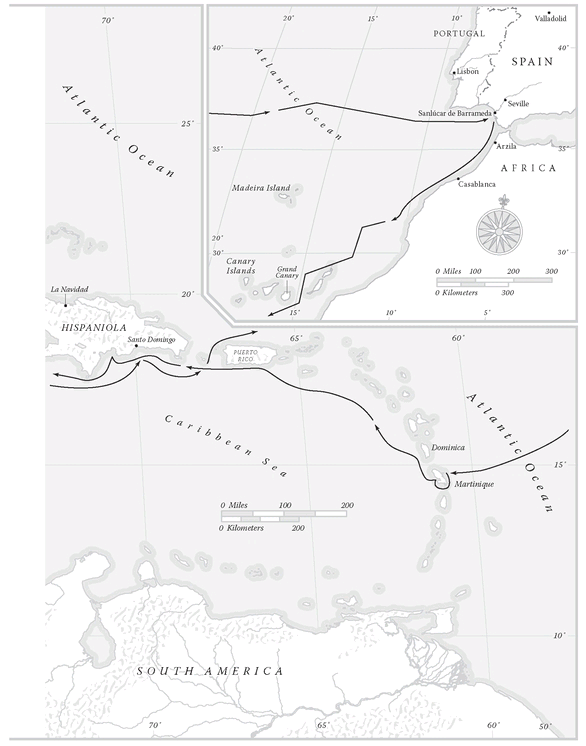
Columbus’s fleet consisted of just four ordinary ships leased by the Sovereigns. The flagship was known as La Capitana, under the command of Diego Tristán, a Columbus loyalist who received 4,000 maravedís a month for his labors. Ambrosio Sánchez served as master, his brother Juan as chief pilot, each receiving exactly half the captain’s salary. They supervised a crew of thirty-four, including fourteen sailors, who received 1,000 maravedís per month, and twenty ship’s boys. Specialists included a cooper (to protect barrels holding water and wine), a caulker, a carpenter, a pair of trumpeters to sound alarms and perform music appropriate to maritime events, and two gunners. Afflicted with gout and the poor vision that tormented him on his previous voyage, Columbus assumed a less definite role in the enterprise, in case he again became incapacitated, but he was unquestionably its most important personage.
Santiago de Palos, nicknamed Bermuda after her owner, Francisco Bermúdez, was a more compact vessel. Bartholomew Columbus functioned as her captain, without pay, while the nominal captain, Francisco Porras, earned a salary of 3,666 maravedís per month. His brother Diego Porras earned slightly less, serving as the crown’s comptroller and representative on board ship. Columbus had not wanted either Porras brother on the voyage, but he was compelled to take them along by the crown’s treasurer, Alonso de Castile, who maintained the Porrases’ sister as his mistress. This ship’s crew consisted of eleven sailors, a boatswain (in charge of the crew and equipment), a dozen or so cabin boys, along with a cooper, caulker, carpenter, and gunner, and six escuderos (gentlemen)—volunteers motivated by a combination of greed, lust, and thirst for adventure.
A more reliable crew operated Gallega (“the Galician”), with Pedro de Terreros as captain, earning the going rate of 4,000 maravedís per month. A diehard Columbus loyalist, he was sailing with the Admiral for the fourth time. The second-in-command, Juan Quintero, earning half that amount, had been boatswain aboard Pinta during the first voyage and, as the ship’s owner, had at least as much clout as the captain. A complement of sailors, a boatswain, cabin boys, and an escudero completed the roster.
The fleet’s smallest ship, Vizcaína (“the Biscayne”), boasted a captain with a famous name: Bartolomeo Fieschi came from a renowned Genoese family. Columbus was so determined to keep the fleet under his control that he bought the ship from her owner after sailing. Vizcaína carried several Genoese, a chaplain, and a page.
Whatever the flotilla lacked in size and status, it made up for in ambition.
“On May 9, 1502,” Ferdinand wrote, “we set sail from the harbor of Cádiz and made for Santa Catalina,” a fortress at the port’s opening, “whence we sailed again on Wednesday, the 11th of the month, for Arzila,” a city sometimes known by its older name, Asylum, situated on the Atlantic coast of northern Morocco, distinguished by stark white walls rising above the sea. In 1471, the Portuguese had wrested the city from Arab control.
Encouraged by King Ferdinand, Columbus attempted to repair his frayed relationship with Portuguese interests by offering to support the city in its struggle to ward off the foe, but by the time he arrived, “the Moors had already raised the siege,” wrote his son, for whom the spectacle of greeting one civilization after another assumed dreamlike clarity. “The Admiral sent ashore his brother the Adelantado Don Bartholomew Columbus and myself, together with the ships’ captains, to call on the captain of Arzila, who had been wounded by the Moors in the assault. He gave profuse thanks to the Admiral for this courtesy and for the offer of help, sending aboard certain of his gentlemen; some of these proved to be cousins of Doña Felipa Moñiz, who had been the Admiral’s wife in Portugal” and the mother of Ferdinand’s half brother, Diego.
Having paid their respects, the fleet called at Grand Canary on May 20, and began taking on “water and wood for the voyage” for the next four days, according to Columbus’s custom. “The next night we set course for the Indies,” said Ferdinand. Although ailing, Columbus performed a navigational marvel on this crossing by catching the trade winds, or easterlies. By the morning of June 15, “with a rather rough sea and wind,” they had arrived at Martinique, in the Caribbean Sea north of Trinidad, having crossed the Atlantic in only twenty days, a time frame that even a modern-day sailor would be hard-pressed to equal. If proof was needed that Columbus had not lost his navigational skill and weather eye, this feat surely provided it.
For all his skill, Columbus could not have expected to arrive precisely at this tiny speck, a little over four hundred square miles of sand and scrub at 14°40΄ 0˝ N, 61°0΄0˝ W. As his previous crossings had demonstrated, sailing west from the Canaries, with a push from the easterlies above and from the Gulf Stream below, he was bound to arrive somewhere in the Americas. But locating a specific port or island was highly unlikely. Except for a storm, little occurred in the open ocean that would affect a ship’s course, but coastal navigation was a different story, hit or miss. So it was that he discovered the diminutive island by chance.
On arrival, the men attended to chores, taking on water and wood, and washing their fetid clothing. On Saturday, they sailed the ten leagues to the island of Dominica. “Till I reached there I had as good weather as I could have wished for,” the Admiral noted some months and many disasters later, “but on the night of my arrival there was a great storm, and I have been dogged by bad weather ever since.” For a novice sailor like Las Casas, the misery of rolling and pitching in the ocean’s vastness was even greater, and it was all that he and his shipmates could do to endure the traumatic crossing. “The crew was so worn down, shaken, ill and overcome by such bitterness that they wanted to die rather than to live, seeing how the four elements working against them were cruelly torturing them,” he complained, having had a taste of the peril and misery that Columbus and his veteran crew members had endured for years at sea.
Outlasting the storms, Columbus reached Puerto Rico and finally Santo Domingo in Hispaniola. Stripped of his status, he was not supposed to be there at all, having been replaced by Nicolás de Ovando, the new governor and widely known as a Columbus detractor. As Ferdinand carefully explained, Columbus urgently needed to avail himself of Santo Domingo’s safe harbor “to trade one of his ships for another because she was a crank and a dull sailor; not only was she slow but could not load sails without bringing the side of the ship almost under water.” If not for the need to replace the ship, said Ferdinand, Columbus would have been on his way to “reconnoiter the coast of Paria and cruise down it until he came to the strait” and so on his way to India, at last. (The discovery of the rumored strait, several thousand miles to the south, would have to wait for another eighteen years, until 1520, when Ferdinand Magellan, a Portuguese sailing for Spain, battling mutinies and rivals in a manner that Columbus would have recognized, finally reached it.)
Instead, Ferdinand said, Columbus sailed directly into a confrontation with Nicolás de Ovando, “the Knight Commander of Lares, governor of the island, who had been sent by the Catholic Sovereigns to hold an inquest into Bobadilla’s administration,” just as Bobadilla had been sent to investigate Columbus.
Nicolás de Ovando, a decade younger than Columbus, was a son of the Extremadura. Bordering Portugal, this Spanish province served as the cradle of conquistadors—Vasco Núñez de Balboa, Hernán Cortés, Francisco Pizarro, Gonzalo Pizarro, Juan Pizarro, Hernando Pizarro, and Hernando de Soto—those soldiers of fortune, adventurers, conquerors, and narrowminded visionaries who succeeded Columbus. All carried the region’s affinity for the rigors of adventure and exploitation with them.
On the strength of his father’s political connections, Ovando joined the Order of Alcántara, devoted to fighting infidels and obeying strict monastic vows. Distinguished by outstanding ability and loyalty, he had won the Sovereigns’ appointment to succeed Columbus and reform the administrative shambles left by Francisco de Bobadilla. As governor, Ovando was charged with performing sweeping tasks: transfer powers of government from Columbus to the Spanish crown, establish the church, promote economic development, extend Spanish rule over all laborers and towns, and convert Indians to Christianity, which, in practice, meant teaching them to live as Spaniards in Hispaniola. Although his responsibilities were clear, the way to fulfill them was not. Many colonists, having been brought to Hispaniola by Columbus, remained loyal to the Admiral of the Ocean Sea, while others developed ties to their Indian wives and mistresses. The oppressive climate, the spread of disease, and the strangeness of the setting challenged Ovando. His legacy of making Hispaniola more Spanish than Spain consisted of constructing public buildings of stone, as well as an opulent stone palace for himself. Like Columbus and Bobadilla before him, he fell under the illusion that he ruled the island, and all its inhabitants, the moment he set foot there, so he banned the Admiral of the Ocean Sea.
The Admiral glumly summed up his situation: “I was commanded from Spain not to touch or land there.” But land at Santo Domingo he did. It was Wednesday, June 29.
Columbus dispatched one of his captains, Pedro de Terreros, to Ovando, the knight commander, to convey the Admiral’s respects and to explain that one of his ships had to be replaced, or lives would be endangered. Adding to the urgency of the situation, he warned of a “great storm” approaching the region, and for this reason if no other, “he wished to take shelter in port.” At the moment, the port was witnessing the final preparations of Bobadilla’s convoy of ships bound for Spain. As Columbus knew, one of those ships, the fragile Aguja, carried his personal treasure. So he used the storm both as a pretext to return to Santo Domingo and supervise his personal wealth and to deliver a necessary warning. Drawing on his experience in judging weather, he advised Ovando “not to permit the homeward-bound fleet to sail for eight days because of the great danger.”
Ovando stubbornly resisted Columbus’s prudent, if self-interested, warning. He “would not permit the Admiral to enter the port,” said Ferdinand, “much less would he detail the fleet that was homeward bound for Castile” even though the roster included such important personages as Francisco de Bobadilla and Francisco Roldán, “and all the other rebels who had done the Admiral so much hurt.” If Ovando and the others had heeded Columbus’s warning, matters would have turned out very differently. The fleet would have reached Spain only a few days later than planned. Instead, a calamity occurred.
Defying Columbus, Ovando ordered the fleet to depart, regardless of the storm warning. Ferdinand recorded that when the ships “reached the eastern end of Hispaniola, the storm assailed them with such fury that the flagship carrying Bobadilla and most of the rebels went down.”
Columbus recalled the calamity with biblical intensity and resonance: “The storm was terrible, and on that night my fleet was broken up. Everyone lost hope and was quite certain that all the rest were drowned. What mortal man, even Job himself, would not have died of despair? Even for the safety of myself, my son, brother and friends, I was forbidden in such weather to put into land or enter harbors that I had gained for Spain by my own blood and sweat.” Meanwhile, “Gallega lost her board and all lost a great part of their provisions.” Despite these hazards, he noted in wonder, “the ship in which I was traveling, though amazingly storm-tossed, was saved by Our Lord and was completely unharmed.” At times like these, Columbus felt singled out by the Lord, yet his salvation was not all that mysterious; he had wisely anchored in the lee of the shore. Even as the fleet’s crew found deliverance from the storm, they experienced waves of “grief and chagrin” at being snubbed by the imperious Ovando. And if another disaster appeared on the horizon, “they could expect no aid from ashore.” Stateless and unwanted, they were all on the way to becoming outlaws and buccaneers.
“By skill and good judgment he managed to keep the fleet together till the next day,” Ferdinand continued, “when, as the storm gained in intensity and night came on with deep darkness, three ships were torn from their anchorages, each going its own way; and though all ran the same danger, each thought the others had gone down. . . . Still greater was the danger of the caravel Bermuda, which ran out to sea, where water washed over the deck—from which it is easy to understand why the Admiral wanted to trade her for another.” Without Bartholomew, all agreed, the ship would have been lost.
The next day, the surviving ships in Columbus’s fleet held a rendezvous in the port of Azua. “As each captain related his misfortune, it appeared that the Adelantado, experienced seaman that he was, had weathered the great storm by going out to sea, while the Admiral had saved his ship by lying close to shore, like a sage astrologer who foresaw whence the danger must come.” Believing that he commanded the planets, the weather, and nature itself, the enemies of Columbus “charged that by his magic arts he had raised that storm to take revenge on Bobadilla and other enemies that were with him.” In fact, he had relied on his instinct for survival and hard-won nautical experience to warn against the hurricane.
When it was over, the men, utterly drained, went fishing, “one of the pleasures offered by the sea in such time of idleness.” The presence of natural splendor roused them from their misery, as did the sudden appearance of a giant manta ray gliding through the water on graceful fins tapered like a bird’s: a marvelous fusion of locomotion and beauty. To Columbus’s young son, the ray looked “as large as a medium-sized bed.”
The crew of Vizcaína came upon the creature asleep on the ocean’s surface and stabbed it with a harpoon “so it could not escape.” They secured it to their launch with a rope, and “it drew the boat through the harbor as swiftly as an arrow.” All the while, those aboard Vizcaína, “not knowing what went on, were astounded to see the boat running about without oars.” The fun ended when the manta ray died and “was hauled aboard with tackling gear used for heavy objects.”
Later, the men came upon a manatee, or sea cow. Ferdinand approached it cautiously. “It is not known in Europe,” he stated. “It is as big as a calf and resembles one in taste and color, but it is better tasting and fatter.” In its strangeness, the bulbous, glistening creature offered further proof that they had entered a world of mystery as well as danger.
By the middle of July 1502, one storm system after another was making up across the Caribbean Sea. It was hurricane season. Having completed repairs to his fleet, taken on supplies, and rested, Columbus and his men strained for the safer waters of Yaquimo, in today’s Haiti, to ride out the storm. As soon as they departed on July 14, they “ran into such a flat calm that he could not hold his course, and the currents carried him to some small sandy islands near Jamaica.” Ferdinand probably meant Morant Cays, sparsely vegetated islets rising from coral, beautiful to see but hazardous to navigate. Columbus called them the Puddles because “his men soon found enough water for their needs by digging puddles in the sand.”
During a leisurely southerly swing off the coast of Honduras, Ferdinand warned, “the map-makers have not traveled in this part of the world.” He continued, “They fall into a grievous error,” when they depicted Cape Gracias á Dios as a separate landform from Cape Honduras, although in reality they were the same.
As Ferdinand realized, this erroneous depiction was a hoax designed to deprive his father of the fruits of his exploration. Two envious explorers, Juan Díaz de Solís and Vicente Yáñez Pinzón (who had commanded a ship on the Admiral’s first voyage), set out in 1508 for Nicaragua, which the Admiral had considered so promising for exploitation. Reaching the islands off the coast of Honduras, which they knew as Guanajas, they ignored the advice given by one of their pilots, Pedro de Ledesma, who recognized the landforms because he had explored them with the Admiral. Instead, they falsely claimed they had arrived at another island for the first time.
Their assertion, backed by phony charts, fooled many, but not Ferdinand, who was determined to expose their conspiracy in his account of his father’s life. In Ferdinand’s words, the charts clearly “depict that island twice,” in different locations. In the short run, there was nothing Columbus or his son could do to correct a deception occurring in such a remote and poorly understood region.
In Guanaja, Columbus sent reliable Bartholomew ashore with two skiffs; there they “encountered people who resembled those of the other islands, but they had narrower foreheads.” Treading carefully among pine trees “and pieces of earth called cálcide, which the Indians use to cast copper,” and which some of the men, mistaking it for gold, pocketed, they came upon a canoe as long as a galley, eight feet across, hollowed out from a single giant tree trunk. Ferdinand wrote that the canoe was “freighted with merchandise from the western regions around New Spain,” an observation often taken to mean that Columbus’s men had come across an artifact of the Aztec empire, then at its apogee during the reign of the ruler Ahuitzotl.
More likely, the Europeans confronted the highly advanced, complex Maya civilization. In China, Marco Polo had encountered a culture beyond his own; now Columbus faced a similar situation. The Maya were an ancient, hierarchical, deeply spiritual, militaristic society. Their civilization had highly developed mathematics, astronomy, architecture, and letters. They charted the movements of heavenly bodies in books fashioned from the bark of trees. In the years after 1000 BC, when Romans and Celts were struggling to dominate a fragmented and stunted western Europe, Maya civilization flourished in villages and cities. The Maya writing system recorded the deeds of leaders and their political conquests.
By AD 250, Maya civilization entered its Classic era, characterized by the rise of dynasties, whose deeds were recorded in symbolic characters, or glyphs. The Maya population and cities expanded rapidly until about AD 900, when the empire entered a steep, mysterious decline—not all at once, and not everywhere, but the downward trend gained momentum and became irreversible. The Maya collapse was accompanied by civil war, exhaustion of natural resources, prolonged drought, and other calamities. The populace nearly vanished from the face of the earth; during the collapse, the number of inhabitants in one region alone declined 99 percent, or even more. Where there were once millions of Maya, there were now only a few thousand tending to deteriorating edifices, many half-buried by sifting topography, whose origins were lost in the mists of legend. Columbus and his men saw the remnants of a great civilization. Compared with the Maya, he and his European crew hailed from a New World, and now they were encountering theOld among the Maya in Veragua.
Columbus’s journals reveal that he had an inkling that he had stumbled across a powerful and ancient civilization, but ultimately the Maya failed to engage his interest for one overriding reason: they were not Chinese. The only aspects of the Maya that Columbus did appreciate were their seamanship and their long, agile, canoelike craft. Given their prowess on the water, it is worth asking why the advanced Maya did not discover Europe long before Columbus arrived on their shores. The answer has to do with the trade winds, which blow steadily south and west, defeating attempts to sail against them. Columbus benefited greatly from these prevailing winds, which at the same time kept Maya mariners hugging the shore.
The Spaniards paid close attention to the Maya watercraft. “Amidships it had a palm-leaf awning like that which the Venetian gondolas carry; this gave complete protection against the rain and waves. Under this awning were the children and women and all the baggage and merchandise. There were twenty-five paddlers aboard, but they offered no resistance when our boats drew up to them,” said Ferdinand. The reception was especially welcome after the unpleasantness of Nicolás de Ovando and near extinction in the hurricane. When the flagship got close enough, Columbus offered “thanks to God for revealing to him in a single moment, without any toil or danger to our people, all the products of that country.” Time and again on his voyages he had encountered fleeing Indians, deserted hamlets, and, on occasion, pots and skewers containing human body parts. This time, he had found the opulence he had sought for so long.
Columbus claimed the “costliest and handsomest things in that cargo: cotton mantles and sleeveless shirts embroidered and painted in different designs and colors; breechclouts of the same design and cloth as the shawls worn by women in the canoe, being like the shawls worn by the Moorish women of Granada; long wooden swords with a groove on each side where the edge should be, in which were fastened cord and pitch; flint knives that cut like steel; hatchets resembling the stone hatchets used by the other Indians, but made of good copper.” The haul even included crucibles to melt copper.
One other item, mentioned only in passing by Ferdinand, was, if anything, even more valuable than the others: the cacao leaf. When a handful of dried cacao beans used for currency fell to the floor, he noted, “all the Indians squatted down to pick them up as if they had something of great value—their greed driving out their feelings of terror and danger at finding themselves in the hands of such strange and ferocious men as we must have seemed to be.”
Columbus and his men were the first Europeans to behold the cacao, traditionally associated with trade and currency in the Americas. A thousand cacao beans could purchase a slave, for example, but beyond monetary value, the cacao itself was prized by the Maya, who called it ka’kau and believed it was discovered by the gods. The Spanish word cacao also derived from another Maya term, chocol’ha, or the verb chokola’j, meaning “to drink chocolate together.” The Maya used cacao for a variety of medicinal and spiritual purposes; they roasted the beans, mixed them with spices and water, and heated the concoction until it was piping-hot chocolate. Among the Maya, drinking the brew was a privilege reserved for royalty, wealthy princes, shamans, and artists.
Chastened by the Sovereigns’ disapproval of slavery, Columbus no longer regarded his dignified hosts as potential serfs and trophies to send to Spain, and his son considered them delegates of a remarkable, highly accomplished civilization. Impressed, Columbus “detained only one, an ancient named Yumbé, who seemed to be the wisest man among them and of greatest authority,” who would reveal “the secrets of the land” and persuade his people to talk with the visitors from afar. Satisfied, Ferdinand reported that the elder served them “willingly and loyally.” Too willingly, in fact. The more items Columbus displayed, according to Las Casas, “the more the Indians readily agreed that they knew where they were available simply because . . . to say so gave such pleasure, even when they had never before seen or heard of the things they were showing them and he was inquiring about.” The Indians went so far as to include fantastic descriptions of “people who lived in the lands of which they spoke [who] had ships and lombards, bows and arrows, swords and cuirasses”—armor—“and anything else they saw the Christians had.” Dazzled by the descriptions, Columbus fancied hearing accounts of horses, which were no more part of the landscape than unicorns. As they continued to talk, he misinterpreted their obliging descriptions to mean that he and his men were “only ten days’ journey to the river Ganges”—the largest, holiest river in India.
He immediately wrote a report on his findings for the Sovereigns.
The reason for the misunderstanding, besides Columbus’s overactive imagination and stubbornly held geographical misconceptions, was simple enough. “The whole conversation was conducted in sign language,” in Las Casas’s words. “And either the Indians were deliberately playing games with him, or he simply understood nothing of what they were trying to say and only heard what he wanted to hear.”
On this basis, the Admiral was elated. Here at last was the “great wealth, civilization, and industry” he had promised his Sovereigns. He had been toying with the idea of returning to Cuba, to his way of thinking still a peninsula, not an island, but the opulence of the region persuaded him that he had found a trade route to India, so “he decided to continue with his search for a strait across the mainland that would open a way to the South Sea and the Lands of Spices.” To Columbus, with his rigid yet mystical mind-set, this geographical impossibility seemed logical and in harmony with his interpretation of the Bible, the Travels of Marco Polo, and the authors of antiquity. At last everything was falling into place.
So he sailed on, said his son, “like one groping in the darkness.”
To judge from his son’s words, Columbus no longer assumed he was in Asia, but he believed he could locate a passage—over water, or, surprisingly, over land—leading there. Perhaps echoing the Admiral’s rhetoric, Ferdinand grandly described it as the “doorway through which Spain entered upon the dominion of many seas.” In search of this chimera, Columbus approached the coast of Honduras and “made for a point of the mainland that he called Caxinas from the name of a tree that grew there; this tree produces fruit resembling wrinkled olives with a spongy core,” but on arrival, he found “nothing worthy of mention” with the exception of Indians, dressed, Ferdinand recalled, “like those in the canoe, in dyed shirts and breechclouts”—a loincloth with flaps in the front and back. “They also had thick quilted cotton jerkins like breastplates that were sufficient protection against their darts and even withstood some blows from our swords.” The description strongly implied that some sort of conflict, perhaps hand-to-hand combat, had occurred between the Europeans and the Indians. Ferdinand refrained from saying anything critical about these Indians, but wrote about another group with foreboding, characterizing them as “ugly,” “black,” wearing no clothing, and “very wild in all respects.” The fleet’s captive Indian guide pointed out that they ate both human flesh and raw fish, and pierced holes in their ears large enough to insert hens’ eggs.
By Sunday morning, August 14, 1502, Columbus felt safe enough to go ashore with the captains and a substantial complement of sailors. They celebrated Mass along a placid Honduran beach while Spanish banners fluttered in the humid ocean breeze. Whether or not the participants, the Admiral included, were aware of it, this was the first Mass to be heard on the American mainland, or, as Columbus insisted, in “India.”
Three days later, the Admiral dispatched his brother and several launches to hear another Mass ashore and then “take formal possession of the land in the name of the Catholic Sovereigns.” In recognition, if not comprehension, of the ceremony, “more than a hundred Indians bearing food came down to the shore; as soon as the boats had beached, they presented these gifts to the Adelantado,” who, Ferdinand noted, “ordered them repaid with hawk’s bells, beads, and other trifles.” These Indians frightened the young Ferdinand as no others had. They communicated in unintelligible languages, and “they tattoo their arms and bodies by burning in Moorish-style designs that give them a strange aspect. Some display painted lions, others deer, others turreted castles.” In honor of their pierced ears, Columbus called the region Costa de la Oreja, Coast of the Ear. Their faces, covered with white and red cloth, haunted Ferdinand’s dreams. “They really look like devils,” he insisted.
Bartholomew attempted to learn more about the region’s resources. But his inexperienced interpreter, a native of Hispaniola, failed to comprehend the local language. At least the Indians took pleasure in the gifts from the visitors from afar, and repaid the hospitality the following day, when “more than two hundred others came to the same spot, bringing food of various kinds: chickens that were better-tasting than ours, geese, roast fish, red and white beans resembling kidney beans, and other commodities.” The gifts echoed the land’s abundance, its pumas, stags, and roe deer patrolling the hills, and its waters teeming with fish.
The Admiral led the fleet from the Honduran coast in an ordeal of beating to windward. Ferdinand reported that “it took them seventy days of sailing to make the sixty leagues from Point Caxinas to that Cape, now tacking toward the sea and again toward land, often gaining with the wind and as often losing, according to whether the wind was strong or weak when they came about.”
Columbus recalled the passage as a prolonged test of both his maritime skills and his sanity. “I found myself going against the wind and terrible contrary current. Against them I struggled for sixty days, after which I barely managed to cover a little over seventy leagues. In all this time I did not enter any port, nor could I, nor did the storm from heaven leave me; rain, tremendous thunder and lightning came continuously so that it seemed like the end of the world.” More than ever, he believed he was traversing a biblical universe of primordial awe. He took his trial at sea personally; the elements became mortal enemies, determined to claim the lives of everyone on board his ships. His suffering, coupled with piety, validated his discoveries.
For eighty-eight days the frightening storm did not leave me, to the point that while at sea I saw neither sun nor stars to act as a guide; my ships were devastated, sails torn away, anchor, rigging, and cables lost, as were the boats and much of the provisions; the men were sick to death, all of them contrite, many vowing to devote themselves to religious life, and none neglected to make vows and promise to undertake pilgrimages. Many times they reached the point of making confessions to each other.
Other storms had been experienced, but none ever lasted as long or had been as frightening. Many whom we considered courageous lost all hope time and again.
In the midst of the storm, facing a near-death experience, he was most concerned about the fate of at least one member of the fleet:
Anxiety for my son, who was with me, wrung at my heart, the more so since I saw him so young, thirteen, struggling so long with such travails. Our Lord gave him such courage that he inspired the others, and he worked as if he had been sailing for fifty years. It was he who consoled me. I had taken ill, and at various times I reached the point of death; from a small cabin that I had ordered built on deck I was directing the course. My brother was in the worst and most dangerous ship. My anxiety was actually greater, because I had brought him with me against his will. Another sorrow lacerated the heart in my breast, and that was for my son Don Diego, whom I had left in Spain, almost an orphan.
On September 12, the fleet arrived at a cape, which Columbus named Gracias á Dios after the gratitude he experienced on deliverance from the storm. “If the coast had not had some good anchorages, it would certainly have taken us much longer to make that distance, but as it was clean and had two fathoms of depth half a league from shore,” Ferdinand calmly recalled, “it was very easy to anchor at night or when the wind was slack.” The younger Columbus’s steady tone stood in contrast to his father’s melodramatic recapitulation of events. The Admiral described how it felt to be pummeled in a storm, while the boy about whom he had so much anxiety related circumstances as they arose in a more or less realistic manner. The father was always lunging forward, into the storm, while the son stood back to contemplate it.
On September 16, in Ferdinand’s words, “the Admiral sent the ship’s boats toward a river that seemed to be deep and easy of entrance. But as they came out, the onshore wind having freshened, and the sea becoming heavy, such a surf built up at the mouth that one boat was swamped, and her crew drowned.” Columbus named the unhappy stream in which two men had died Río de Desastres, as its banks were lined with “canes as thick as a man’s thigh.”
Nine days later, at an island named Quiribirí, the ships anchored tentatively before shaping a course to Cariay (most likely Puerto Limón), off the coast of Costa Rica, whose vistas made an indelible impression on the lad. “Here we found the best country and people that we had yet seen; because the land was high and abounded in rivers and great trees, and the island itself was very verdant, full of groves of lofty trees, palms,” and a “great number of Indians, many armed with bows and arrows, others with palmtree spears black as pitch and hard as bone and tipped with fish bones, and still others with macanas or clubs.” With his customary composure, he added, “They seemed determined to resist our landing.”
Columbus’s men signaled that they came in peace rather than war, whereupon the Indians jumped into the water and swam out to the ships to “trade their weapons, cotton cloaks and shirts, and the guanín pendants which they hang about their necks.” Volatile as ever, the Admiral refused on this occasion, preferring to demonstrate that he and his men “did not covet their possessions.” To emphasize his point, he ordered presents from Spain to be distributed. The less interest the Europeans exhibited in trading, the more the Indians showed, and they boldly invited the visitors to go ashore by making signs and “holding up their cloaks like banners.” But the Europeans, obeying the Admiral, stayed aboard ship, spoiling the fun. The Indians responded by tying all the trinkets they had received into a neat bundle, which they left on the boat landing for the Spaniards to discover.
On September 25, on Cariay, said Columbus, “I stopped to repair the ships and replenish my victuals and rest the crews, which were very sick, and myself, having, as I said, been many times at the point of death.” But he was not too sick to learn about the “gold mines of the region of Çiamba, which I was seeking. Two Indians led me to Carabarú, where the people went naked and wore a gold disk hanging from the neck, which they were unwilling to sell or trade.” As mesmerized by gold as ever, Columbus forgot about his suffering at sea, and debriefed the Indians about gold and gold mines.
The Indians treated the Europeans with caution. “Thinking that we distrusted them, the Indians sent aboard an old Indian of venerable presence bearing a banner tied to a stick; two girls, one eight and the other fourteen years old, accompanied him,” Ferdinand wrote. In reply, Columbus dispatched a skiff to retrieve water from the mainland. Before they returned to the ship, “the Indians urged them by signs to take the girls.” By all accounts, Columbus treated them well, ordering them to be clothed and fed, and then he sent them ashore, where they rushed into the welcoming arms of the Indian elder and more than fifty others. Later that day, the Indians returned all the gifts given to them by the Europeans, the hawk’s bells and other knickknacks.
In the morning, Bartholomew and a scribe went ashore. As soon as he set foot on the boat landing, Indians took him by both arms and sat him down on the tall, whispering grass by the water’s edge, in full view of the ships. He asked them a few questions, his amanuensis ready to record their replies, but “the Indians were so terrified by the sight of the pen and paper that most of them ran away. The reason was that they were afraid of being bewitched by words or signs.”
And yet, said Ferdinand, “it was they who impressed us as being great sorcerers, but on approaching the Christians they scattered a certain powder in the air; they also burned this powder in censers and with these censers caused the smoke to go toward the Christians,” not unlike the incense with which they were familiar. The Indians’ reluctance to accept gifts struck Ferdinand as “evidence that they suspected us of being enchanters, confirming the adage that says a rogue sees himself in every other man.” There was a spark of mutual recognition between the Indians and the Christians, who recognized the sophistication and intelligence—as well as the strangeness—of the other.
It was Sunday, October 2, the ships still anchored in the vicinity of Puerto Limón, when Columbus sent his indefatigable brother ashore once again, this time to “learn of the Indians’ dwellings, customs, and mode of life.”
Bartholomew and his party came across an amazing crypt, a “wooden palace” covered with cane, containing several tombs. One held a single corpse, “dried and embalmed”; another held two corpses, “with no bad odor, wrapped in cotton cloth: over each tomb was a tablet carved with figures of beasts, and on some the effigy of the dead man, adorned with many beads . . . and other things they most prize.” This memento mori illustrated both the brevity of their temporal lives and the longevity of their spiritual horizons.
Columbus being Columbus, he honored the Indians’ intelligence by capturing several “so that we might learn the secrets of the country,” in Ferdinand’s words. Out of seven seized, two were selected to act as guides. “The others he sent home with gifts in order not to throw the country into an uproar.” Relying as usual on an interpreter, he explained that he needed their assistance to navigate the coast, promising to set them free at journey’s end. The Indians misunderstood, and concluded, not unreasonably, that Columbus was holding them for ransom. The folly persisted into the next day, when a delegation of Indians presented the Europeans with “two native wild boars”—in all likelihood ugly, bristling peccaries, or New World pigs—“small but very savage,” in exchange for their kinsmen. Although he refused to yield, he paid them for the “boars” and sent them home politely clutching the same useless gifts they had refused in the past.
The peccaries briefly distracted Columbus, who had become fascinated by the only slightly less bizarre spider monkey, the “size of a small greyhound, but with a longer tail, so strong that if one coils it about something, it holds it as tightly as if it were fastened with a rope,” in Ferdinand’s deft description. “These animals move about in the trees like squirrels, leaping from tree to tree and grasping the branches not only with their hands but also with their tails, by which they often hang for rest or for sport.” Not knowing what to make of the agile, long-limbed spider monkeys, which are indigenous to the New World, Ferdinand called them “cats.” Their playfulness led to cruel sport, which Ferdinand never forgot.
A crossbowman brought one out of the forest that he had knocked down from a tree with a shaft, and because it was still so fierce that he dared not get near it, he cut off one of its legs with a knife. The sight of it scared a valiant dog we had on board but frightened even more one of those boars the Indians had brought, and it backed off in great fear; this surprised us because hitherto it had run at everybody on deck, including the dog. The Admiral then had boar and cat thrown together, whereupon the cat coiled his tail around the pig’s snout, seized him by the neck with his remaining foreclaw, and bit him so that he grunted with fear. From this we concluded that these cats hunt other animals, like the wolves and greyhounds of Spain.
The balance of October 1502 passed in an overheated hallucination of voyaging.
October 5 . . . Zorobaró Bay “has three or four channels that are very convenient for getting in and out with every kind of wind. The ships sailed as if in streets between one island and another, the branches of trees brushing the rigging of the ships.” Twenty canoes approach, with Indians “as naked as they came from their mothers’ wombs,” ready to trade gold for hawk’s bells. . . .
October 7 . . . Columbus seizes two Indians who refuse to sell their gold mirrors to the Europeans. “The Indians are painted all over their face and body in different colors, white, black, and red.” Pedro Ledesma, the pilot, experiences a more elaborate reception, according to Las Casas: eighty canoes, “each with a great deal of gold aboard,” approach the Spanish fleet, but “the Admiral refused to take any of it.”
Knowing the Admiral’s obsession with gold, Las Casas scratched his head. Either the encounter with eighty gold-laden canoes never occurred, or the Admiral concluded their cargo and their message lacked legitimacy.
Within days, the Spaniards are on the move again.
October 17 . . . The Admiral sends boats ashore at the Chiriqui Lagoon, whereupon a hundred Indians rush into water up to their waists “brandishing spears, blowing horns, beating a drum, splashing water toward the Christians, and squirting toward them the juice of some herb that they were chewing.” Once the Indians quiet down, Columbus’s men trade for sixteen mirrors of pure gold worth 150 ducats. Elation overcomes them.
In the last days of October, Columbus and his men detected “signs of a building,” by which Ferdinand meant an edifice made of stone rather than wood, cane, or thatch. For the Europeans, the presence of stone indicated an advanced civilization, in this case, the remnants of the Maya. The Maya’s architectural accomplishments were all the more remarkable because, unlike Europeans, they did not use animal or water power to assist in construction; everything was done by hand.
Ferdinand compared the sturdy result to a “great mass of stucco” that “appeared to have been made of stone and lime.” And the Admiral was so impressed that he “ordered a piece to be taken as a souvenir of that antiquity.” Having found in the Maya a civilization worthy of the name, Columbus appeared on the brink of further study and encounters, but he preferred to search for the Chinese described by Marco Polo, and so he moved on.
On November 2, the fleet arrived at a harbor that Columbus called Puerto Bello, in Panama, “because it is very large, beautiful, thickly populated, and surrounded by cultivated country.” Ferdinand extolled the setting, in which vessels could lie close to shore, yet slip away quickly. “The country about the harbor is well tilled and full of houses only a stone’s throw or crossbow shot apart, all as pretty as a picture, the fairest thing one ever saw.” Seduced by nature, the fleet tarried as rain and foul weather descended.
A week later, the sodden fleet resumed its course eastward, sighting fields of maize from the decks of their ships, and coming to rest in a cove, where the intruders terrified the locals, who frantically swam to safety. When the Europeans tried to catch up with a fleeing Indian and haul him aboard for sport, Ferdinand recalled that “he would dive like a waterfowl and come up a bowshot or two distant. It was really funny to see the boat giving chase and the rowers wearing themselves out in vain, for they finally had to return empty-handed.”
In the torpor of heat and rain—temperatures averaged in the high eighties by day, with only a little cooling at night—they were losing track of time. Suddenly it was November 23, and they were “repairing ships and mending casks”—this was when the coopers played their part—just before they called on Guiga, not far from the Isthmus of Panama, although the men had no idea that they found themselves on a strip of land separating two great oceans.
The sight of hundreds of Indians gathering on the shore, wearing gold pendants in their ears and noses, proved unnerving rather than welcoming. By Saturday, November 26, the fleet was under sail again, squeezing into a cramped harbor that the men called Retrete, that is, “closet,” or possibly “toilet,” “because it was so small that it would not hold more than five or six ships” negotiating an entrance barely more than seventy feet wide, “with rocks as sharp as the points of a diamond sticking up on either side.” The vessels negotiating their way through had so little room that a man could easily jump from the deck to the shore.
“In this harbor we stayed nine days, with miserable weather,” Ferdinand mournfully recalled. As before, Indians came to trade, but this time they observed sailors “sneaking ashore from the ships.” The moment they saw the intruders, the Indians returned to their dwellings, as this “greedy and dissolute set of men committed innumerable outrages.” The Indians lost patience, “and some fights occurred between the two sides” as the Indians circled the fleet trapped in the harbor’s confines. Too late, “the Admiral tried to placate them by patience and civility,” without success. To teach them a lesson, or, as Ferdinand put it, “to temper their pride and teach them not to scorn Christians,” Columbus ordered his artillery to fire at a crowd of Indians on an exposed hilltop. The cannonball fell to earth among them, letting them know “that this thunder concealed a thunderbolt.” This time, the show of force worked, and “after that, they hardly dared peep out at us from behind the hills.”
In this incident, Las Casas saw the tragedy and folly of the Enterprise of the Indies, for which he blamed one man: Columbus. “Had these people been treated right from the moment they were discovered in a fashion both loving and just, as natural reason dictates they should have been,” he explained, “and especially if this had been done in a Christian manner, we should have been able to obtain from these people all the gold and riches that they enjoyed in such profusion in exchange for our worthless baubles, and it is clear that there could have reigned between us such peace and love that their conversion to Christ would, as a consequence, have been both easy and certain.” But once again, the Admiral had only made things worse.
Meanwhile, the harbor teemed with “large lizards or crocodiles that came out to sleep ashore and gave out an odor as strong as if all the musk”—popularly known as an aphrodisiac—“ in the world were collected together.” The sight was understandably unsettling, even terrifying. “They are so ravenous and cruel that if they find a man asleep they will drag him into the water to eat him, but they are cowardly and flee when attacked.” The following night, the monsters and their stench returned, as they did each night.
Menaced by man and beast alike, Columbus fled northward on December 5, retracing his route.
“Never was seen more unsettled weather,” Ferdinand insisted. “Now the wind was fair for Veragua; now it whipped about and drove us back to Puerto Bello. And just as we were most hopeful of making port, the wind would change again, sometimes with such terrible thunder and lightning that the men dared not open their eyes and it seemed the ships were sinking and the heavens coming down.” At times, the booming thunder persisted to the point where “we were sure some ship of the fleet was firing signals for help.” Torrential rains soaked the sails and swept the decks. Vicious storms occur regularly in this region, off the coast of Nicaragua, and survival itself was at stake. “All suffered greatly and were in despair, for they could not get even a half hour’s rest, being wet through for days on end, sometimes running one way and sometimes another, struggling with all the elements and dreading them all.” There was much to fear: “The fire in the lightning flashes, the air for its fury, the water for the waves, and the land for the reefs and rocks of that unknown coast, which sometimes rears up at a man near the port where he hopes to find shelter.” But the sailors pressed on, his son trembling before nature’s wrath, as Columbus attempted to give orders while struggling to preserve his sanity.
As if these terrors were not sufficient to defeat the fleet, a “waterspout”—Ferdinand’s term for a small tornado—appeared on December 13, churning a deadly path between two ships. Catching sight of the funnel from the heaving deck of his ship, Ferdinand noted how “it raises the water up in a column thicker than a water butt, twisting it about like a whirlwind.” The only defense was prayer: “Had the sailors not dissolved it by reciting the Gospel according to St. John, it would surely have swamped anything it struck.”
As the tempest blew without respite, Vizcaína disappeared in the mist, forever, it was feared, until she reappeared “after three very dark and dangerous days, during which time she had lost her boat and once anchored near land, but had to cut her cable.” She was safe, for now.
The hurricane had relented, but from within the bowels of her hull, the snakelike shipworms were slowly destroying her.
Even a spell of calm weather, when it finally came “after the fleet had been half destroyed by the battering storm,” brought a new menace. A swirl of shadows beneath the rippling surface of the sea coalesced into a school of sharks—probably specimens of the Caribbean reef shark (Carcharhinus perezi). Los tiburones surrounded the ships and terrorized the superstitious sailors, who considered them the vultures of the sea and portents of death.
“These beasts seize a person’s leg or arm with their teeth and cut it off as clean as with a knife because they have two rows of saw-like teeth,” Ferdinand noted in revulsion. The sailors killed as many of the streamlined predators as possible, yet “they still followed us by making turns in the water.” He was referring to what is now known as a shark threat display, exhibited by sharks sensing danger. When making the display, they exaggerate their usual movements. The gray reef shark, for instance, plunges its rigid fins downward, arches its back, and lashes its tail to the side, swimming in a pattern resembling a figure eight. Sharks behaving in this manner are preparing either to strike or flee.
So ravenous were these sharks, Ferdinand recalled, that they ate carrion, and “one can catch them by simply attaching a piece of red cloth to the hook.” Their voracious greed exceeded his nightmares. “Out of one shark’s belly I saw a turtle taken that afterward lived on the ship.” Another slain shark yielded an entire shark’s head previously discarded by the men “because the head, unlike the rest of the body, is not good to eat.” Yet the shark had devoured it. Even though the slithering monsters repelled the men, “all did the shark the honor of eating it, for by that time we had been over eight months at sea and had consumed all the meat and fish that we had brought from Spain.” The blood, the slime, the foam, the stench, the ships rolling and pitching on the heaving seas: it made a man ravenous and nauseous at the same time. What little food they had caused them to retch in disgust. “What with the heat and the dampness even the biscuit was so full of worms that, God help me, I saw many wait until nightfall to eat the porridge made of it so as not to see the worms; others were so used to eating them that they did not bother to pick them out, for they might have lost their supper by being so fastidious.”
Deliverance came on December 17, when the fleet reached Puerto Gordo, Panama. “In this harbor, resembling a great channel, we rested for three days.”
The men staggered ashore, weak from the ordeal, to gaze at a new marvel. “The people here lived in the tops of trees, like birds; their cabins or huts were built over frames of poles placed across branches.” The men could not explain the phenomenon, and decided it was a response to “their fear of griffins”—mythical beasts with an eagle’s head and wings attached to a lion’s body. Or maybe living on raised frames had a simpler explanation, as a precaution against a rival group.
By December 20, the fleet was under sail once again, but “hardly had we put out to sea when the winds and storms returned to vex us, so that we were forced to enter another harbor.” Three days later, Columbus judged conditions safe enough for the fleet to try again, “but the weather, like an enemy that lies in wait for a man, suddenly attacked us.” The blasts drove the helpless vessels back to the harbor where they had sought refuge on December 12. As Christmas approached, the men occupied themselves with repairs toLa Gallega and loading maize, wood, and water, when their stomachs craved meat and wine. On January 3, 1503, the fleet put to sea once more, only to encounter “foul weather and contrary winds that actually grew worse each time the Admiral altered his course.”
The Admiral took his storms personally; they were contests with cosmic forces, in which he was bound to go mano a mano with the elements. He would not have been surprised to behold a spiteful angel emerge from a massive cumulonimbus, detonating with thunder and lightning, prepared to wrestle him to the bottom of the sea.
“For nine days I was lost with no hope of life,” he recalled.
Eyes never saw the sea so rough, so ugly, or so seething with foam. The wind did not allow us to go ahead or give us a chance of running, nor did it allow us to shelter under any headland. There I was held in those seas turned to blood, boiling like a cauldron on a mighty fire. The skies had never looked more threatening. For a day and a night they blazed like a furnace, and the lightning burst in such flashes that every moment I looked to see whether my masts and sails had not been struck. They came with such terrifying fury that we believed the ships would be utterly destroyed. All this time water fell unceasingly from the sky. One cannot say it rained, for it seemed like a repetition of the Deluge. The crews were now so broken that they longed for death to release them from their martyrdom. The ships had already twice lost their boats, anchors, and rigging and were stripped bare of their sails.
On January 6, the battered fleet came to rest in today’s Panama off the mouth of a river that Columbus chose to name Río Belén, an abbreviation for Bethlehem. After three days of ambiguous encounters with Indians and fruitless expeditions in search of gold, La Capitana (Columbus’s flagship) and Vizcaína rode the flood tide over the bar and proceeded up the Río Belén. The sight of the strange ships summoned droves of Indians peddling their fish with all the vigor of the dockside merchants of Genoa or Seville. Ferdinand was astonished to learn that the fish swam upstreamto meet their fate. Cadging a little gold wherever he could find it, Columbus gave over hawk’s bells and strings of beads for samples of the precious metal. The next day, the other two ships in the fleet crossed the bar, and, with his forces massed, the Admiral prepared to claim what he believed was gold hidden in the mines of Veragua.
“On the third day after our arrival the Adelantado took the boats down the coast and ascended the river to the village of the Quibián,” wrote Ferdinand, “which is the name those Indians give to their king.” Learning of visitors from afar, the Quibián immediately came downstream with his canoes to greet them. The result was perhaps the most decorous initial contact of the entire voyage: “They treated each other with much friendship and civility, each giving the other the things he most prized; and after they had conversed for a long while, the Adelantado and the Quibián each went their own way very peacefully.” The next day, the sociable cacique returned to greet the Admiral himself aboard the flagship, where they chatted for an hour without rivalry or rancor.
Then, on Tuesday, January 24, a storm broke. Moments before, the Spaniards had been feeling calm and secure, but now, in the deluge, the Río Belén overwhelmed its banks. “Before we could prepare for or run a hawser ashore,” Ferdinand wrote breathlessly, “the fury of the water struck the flagship with such force that she broke one of the two cables and drove with such force against Gallega, which lay astern, that the blow carried away her bonaventure mizzen”—the short, lateen-rigged fourth mast. “Then, fouling one another, they drifted so as to be in great peril of going down with all hands.” If they sank, all would be lost, and both Columbus and his son would go down with them.
Eventually the ships managed to untangle themselves, and they floated down the river to the sea. “So violent a storm raged there that the fleet would have been shattered to pieces at the mouth of the river.” There was nothing to do but wait, and pray. The outcome vindicated Columbus’s risky decision not to seek refuge at sea, where disaster lurked.
When the skies cleared several days later, he assigned his brother Bartholomew “to settle and conquer the land.” Columbus would give up his search for a strait leading to India in mid-voyage to return to Spain and his Sovereigns. The abruptness of the decision suggested that he was far sicker than anyone—even his son—realized, and he desired above all to return to Spain to recover, or die in the attempt.