
PART TWO
CHAPTER 5

To Columbus, one question took precedence on his return: the fate of the thirty-nine men left behind at La Navidad. He had placed their lives, and Spain’s honor, at risk. And he would have to return to “India” to rescue them, or to discover what befell these hostages to his ambition.
His first voyage had been a qualified success. That he returned with his fleet and its men alive, reasonably healthy, and intact was itself miraculous. He contended that his accomplishment was divinely inspired. Exactly what he had discovered or explored was subject to human interpretation and so less certain. He claimed the dozens of islands he had visited comprised a western extension of India, or China; that the figure of the Grand Khan and the trading possibilities that he offered lurked somewhere to the north and west of the turquoise waters over which his tiny fleet had sailed. He offered his journal as evidence, bolstered by the testimony of the others who had accompanied him, in the hope of claiming the riches and titles and glory to which he believed he was entitled, even divinely ordained, to have. Carefully embellished and edited to meet Ferdinand and Isabella’s expectations and his contractual obligations to them, that journal purported to demonstrate that he had accomplished and even exceeded his mission to the point of establishing a Spanish outpost in the islands he had discovered on his way to India. But the lives of thirty-nine Spaniards stationed there hung in the balance. He had created a situation in which he would play the champion, or, if matters went awry, the scapegoat.
The little fort served as the kernel of a vision of empire on which Columbus had been meditating ever since his first voyage, and by now the plan had become firmly established in his mind. He envisioned two thousand colonists settling Hispaniola. They would build “three or four towns”; collect gold, which would be closely guarded; and establish churches with “abbots or friars to administer the sacraments, perform divine worship, and to convert the Indians.” He explained his plans to regulate shipping, handle cargo, and protect valuable exports, especially gold, in grinding detail to satisfy Spanish bureaucrats who administered the kingdom’s day-to-day operations. He displayed an impressive familiarity with the minutiae of his administrative agenda, which belied the difficulty of carrying it out. Concerning navigation, of which he possessed a singular mastery, he had almost nothing to say.
Between the lines of his communiqué, Columbus urged Ferdinand and Isabella to act quickly, before the Portuguese or another rival outfoxed Spain. Rather than standing as an unprecedented feat of navigation, the voyage would become the first of many to assemble the greatest, the wealthiest, and the largest commercial empire in the world. Or so Columbus hoped. To make his case, the document simplified the complex reality of the “Indies.” He omitted references to the menace posed by the Caribs, the difficulty of replicating his feat of navigation, the vagaries of weather, and, of course, the stupendous misunderstanding of the location of his discoveries. He was selective to the point of being deceptive, but there was no mistaking his meaning. Spain would acquire a new empire and he would administer it, becoming wealthy in the process by founding a dynasty. The scheme had the virtue of familiarity; it echoed the Spanish—and for that matter, the Portuguese—approach to exploring and colonizing the African coast and the exotic islands to the south and west of the Iberian Peninsula, Madeira and Gomera and Cape Verde—not quite substantial enough for an empire, but a sphere of influence that might grow into one. Implementing Columbus’s plan meant pushing the boundaries of empire thousands of miles to the west.
Pope Alexander VI closely followed Columbus’s discoveries, recognizing that they could mightily increase the reach of the Church of Rome and his personal power. But it was crucial that he divide the spoils among the competing states that would administer and exploit their resources. Acting as a mediator, Alexander issued four bulls—formal proclamations—dividing the newly discovered lands and their riches between the leading contenders, Spain and Portugal, who were allies in matters of faith but rivals in matters of politics and trade. (Italy, which supplied much of the manpower for exploration, ranked a distant third behind them.) The bulls were based on the assumption that Christian nations could, by divine right, claim title to newly discovered non-Christian lands and their peoples.
In each bull, he gave to Spain the newly discovered “Indies” (the pope, like all of Europe, was mistaken about the location of Columbus’s tantalizing finds), and it was assumed that his Spanish origins influenced his decision. But his effort at clarification led to confusion in April 1493 when he established a line of demarcation that extended from the North Pole to the South “one hundred leagues toward the west and south from any of the islands commonly known as the Azores and Cape Verdes.” Anything west of the line—that is, everything that mattered—was Spain’s, and if Columbus was able to complete another voyage, partly his as well.
Columbus’s son Ferdinand later explained, “As the Catholic Sovereigns knew that the Admiral had been the prime cause of the favors and grants made to them by the pope, and that the Admiral’s voyage and discovery had given them title and possession of all the lands, they resolved to reward him well.”
On May 20, 1493, they appointed him captain general of a second voyage of discovery, and eight days after that, in an elaborate, finely honed document issued in Barcelona, they conferred rights and privileges on him, and gave him the title “Viceroy and Admiral of the Ocean Sea and the Indies,” or “Admiral of the Ocean Sea,” as he became known. By then, Columbus was inundated with formal orders for his second voyage with an urgency that seems all the more remarkable given the years of delay and evasion that preceded his first voyage.
Although the document conferred extraordinary powers on Columbus, it reflected the regal self-aggrandizement of Ferdinand and Isabella, determined to shape the stubborn mariner into an instrument of their empire and their will. They treated him as both their Admiral and their vassal, revealing themselves as traditional medieval sovereigns despite the changes swirling about them. The document was studded with entitlements for the newly created Admiral of the Ocean Sea, who was formally empowered to call himself “Don Christopher Columbus,” as would his sons and successors, and he was now admiral, viceroy, and governor of the island and mainlands “which you may discover and acquire,” as would his sons and successors. That hereditary status meant he could “hear and determine all the suits and causes, civil and criminal,” that he could “punish and chastise delinquents,” and that he could “levy fees and salaries.” It was a long way from being a merchant seaman from Genoa.

On May 29, 1493, the Catholic Sovereigns heaped more honors and obligations on the shoulders of “Don Christopher Columbus,” now fully authorized to claim and acquire lands for Ferdinand and Isabella, who charged and directed their admiral, viceroy, and governor to “strive and endeavor to win over the inhabitants” of the islands and mainland he claimed for Spain, which meant they would “be converted to our Holy Catholic Faith.” To assist Columbus in his primary mission, and to make certain it was done properly, the Sovereigns assigned a priest, Fray Buil (sometimes referred to as Father Boyle), and several assistants to the voyage “to see that they be carefully taught the principles of our Holy Faith.” The identity of this controversial cleric has been in doubt ever since, partly because of confusion surrounding his name. He was likely a Catalan who joined the Benedictine order. Although Columbus was profoundly religious, there was little love lost between the two.
For the record, the Sovereigns insisted that “the Admiral shall, after the safe arrival of his fleet there, force and compel all those who sail therein . . . to treat the Indians very well and lovingly and abstain from doing them any injury.” Not only that, but Columbus “shall graciously present them with things from the merchandise of Their Highnesses which he is carrying for barter, and honor them much.” In fact, if members of the fleet mistreated the Indians “in any manner whatsoever,” Columbus was ordered to “punish them severely.” The order, unequivocal in writing, proved anything but in action.
To accomplish these exalted goals, Columbus assembled a fleet worthy of Ferdinand and Isabella. This time, nothing was too good for him, by royal order. This carefully thought-out set of instructions marked a giant step forward in the Sovereigns’ appreciation of Columbus’s mission, and the rewards they hoped it would bring for everyone in this world, and, for good measure, in the next. The cost of the fleet was nominally borne by the crown. In fact, the Duke of Medina Sidonia lent five million maravedís for this purpose, much of it secured with property and jewelry confiscated from Jews during the Inquisition.
The Admiral’s partners in the operational side of the voyage were well known to the crown: Juan de Soria, representing the royal auditors, and Don Juan Rodríguez de Fonseca, representing the ultimate authority, the church, first as the archdeacon of Seville and subsequently as bishop of Burgos. At various times he antagonized and supervised Columbus’s efforts to equip the fleet; nevertheless, the Admiral willed himself to consider Fonseca an ally in the cause of conquest.
A new realism informed these instructions. There was no more talk of trading with the Grand Khan, although the possibility that he existed hovered over the voyage. Columbus still tried to reconcile the lands and people he had encountered with those described in Marco Polo’s flamboyant travelogue. In reality, the Venetian had died in 1324, and the Mongol empire had rapidly disintegrated.
Columbus’s orders also directed him to construct a “customs house for the storage of all the merchandise of Their Highnesses.” This plan borrowed heavily from the Portuguese model and made the venture’s commercial aspect explicit. Almost as an afterthought, Ferdinand and Isabella permitted Columbus to explore as he saw fit: “If the Admiral, after reaching the Islands, believes it would be well to send some vessels and people to certain parts to discover what has not hitherto been discovered, or for the sake of barter . . . all the captains and mariners whom he may so command are required to carry out and fulfill his orders.” Even here, trade was the impetus, and as an incentive the Sovereigns awarded Columbus a healthy share of the proceeds: “The Admiral should have one eighth part of whatever may be acquired from whatever gold and other things there may be on the Islands and Mainland.”
Never was there a more exalted moment in his career than this. He had vast resources and royal prestige at his disposal, beginning with the seventeen ships at his command. Three were classed simply as naos, or ships. Columbus named the flagship Santa María, after the durable vessel he had commanded during his comparatively modest first voyage, and called her by the affectionate nickname Maríagalante. She was owned by Antonio de Torres, the brother of the governess of Prince Don Juan. The connection to the Catholic Sovereigns was impressive and implied their approval.Colina and Gallega were similarly substantial craft. Of the remaining fourteen ships, twelve were light, maneuverable caravels. Sharp-eyed observers recognized Santa Clara as Niña of the first voyage, under a new name. Several of the caravels were square-rigged, that is, they carried conventional square rigging on the mainmast and the foremast, and lateen rigging on the mizzen, aft of the mainmast. Learning from the mistakes of the first voyage, Columbus insisted that at least some of his new fleet have a shallow draft to explore rivers and shoals without running aground.
The ships, according to his son Ferdinand, came “well-stocked with provisions and carrying all the things and persons needed to settle those lands, including artisans of all kinds, laborers, and peasants to work the land.” When he was preparing for his first voyage, Columbus had to scrape for every crew member he could find, and sailed shorthanded, but this time “so many offered themselves that it was necessary to restrict the number of those who might go,” even though the fleet was nearly six times larger than his earlier convoy. The ships carried horses—unknown in the Caribbean—and other beasts of burden that could be useful in settling Hispaniola. His company of over a thousand gentlemen, commoners, and criminals comprised a microcosm of Spain waiting and, for once, eager to be transported to a New World and its riches under the leadership of Christopher Columbus.
Many reprised their roles on the first voyage, a circumstance that spoke well of Columbus’s reputation as a navigator and the promise of easy riches. There were the Genoese; a few Basques, born to the sea; and still others from the Spanish towns of Palos, Huelva, and Moguer, where the sailors resided between voyages. The influential Pinzón family was conspicuously absent from the roster. Many in Spain believed their claim that they were responsible for whatever success Columbus had enjoyed on his first voyage. The Admiral would be on his own this time, with storms and tides mercilessly exposing his shortcomings, and no Pinzóns to come to his rescue.
His captains included bureaucrats and political leaders. Alonso Sánchez de Carvajal, for example, was the mayor of Baeza rather than an experienced mariner. Another participant, Pedro de Las Casas, was the father of Bartolomé de Las Casas, who had observed Columbus’s return to Seville after the first voyage. (It is believed that Bartolomé’s grandfather, Diego Calderón, was Jewish and had been burned at the stake in Seville in 1491.) Three of Bartolomé de Las Casas’s uncles were also on board, ensuring strong familial ties to Columbus.
Although the fleet’s physician, Diego Alvarez Chanca, had treated Queen Isabella, physicians in Spain were rarely revered, but he enjoyed Columbus’s trust and was considered one of the better-qualified medical practitioners in the land. Of all those on board the ships with Columbus, Chanca was among the best educated. If not quite brilliant, he showed himself to be reasonably thoughtful and resourceful in the journal of the voyage that he maintained.
Two other members of the fleet’s roster went on to win renown. The chart maker, Juan de la Cosa, aboard Maríagalante, had sailed on the first voyage as the owner and master of Santa María, Columbus’s flagship, and he would sail with Columbus on the third voyage; after that, he went to sea with Columbus’s sometime rival Amerigo Vespucci. Juan de la Cosa fashioned the celebrated Mappa Mundi of 1500, considered the first European cartographic representation of the New World, and the sole surviving map of Columbus’ voyages made by a participant. (His map is on display at the Museo Naval in Madrid.)
Then there was the charming and ambitious soldier of fortune, Juan Ponce de León, who later rose to become the first governor of Puerto Rico, by order of the Spanish government. Only eleven years after participating as a gentleman passenger on the second voyage, he financed his own expedition, a feat that not even Columbus at the height of his influence managed to accomplish. On April 2, 1513, Ponce de León would encounter a landmass he took to be an island. He called it La Florida because of its luxuriant foliage, and because it was Eastertide, observed in Spain as Pascua Florida, Festival of Flowers. He had landed somewhere in North America, and that alone was a significant accomplishment. Columbus, in all his voyaging, never touched, and never even knew, that a North American landmass existed.
While Columbus prospered, King João II of Portugal feverishly tried to reverse the papal decree, which threatened to diminish or even extinguish the Lusitanian empire. A unified Spain could abide without the resources of an overseas empire, but tiny, underpopulated Portugal required its colonies’ assets for survival. After enduring threats of naval action and pleas for Iberian cooperation for a year, João II cajoled Ferdinand and Isabella to send representatives to a summit conference in Tordesillas, Spain, on June 7, 1494, where a treaty between the two sovereign powers shifted the line of demarcation to 370 leagues west of the Cape Verde Islands, although this refinement opened the door to further confusion. Where was the line itself—in the middle of the islands, at the western edge? No one could say with certainty. Moreover, the size of the globe was badly misunderstood, so even if everyone came to an agreement on the line’s theoretical location, no one could actually find this geographical unicorn.
What seemed merely a technical victory for Portugal turned out to be critical. The alteration meant that ships flying the flag were permitted to ply trade routes along the west coast of Africa. Still more important and less appreciated, the redrawn line of demarcation gave to Portugal the immense, fertile, and largely unexplored land of Brazil.
But for now, the new order favored Spain’s emergent empire. It was said that Columbus had personally influenced the pope’s thinking, and he was duty-bound to follow up on it. He was already forty-three, an advanced age for a mariner, and he would do well to take action while he still enjoyed royal favor and was strong enough to endure a transatlantic crossing. As his father’s example demonstrated, political disenfranchisement was only a revolution away.
A festive atmosphere reigned on the day of departure, September 25, 1493, in the port of Cadiz. “The parting embraces were exchanged, the ships were decked out with flags, while streamers wound about the rigging and the colors of the sovereigns adorned the stern of every ship,” recalled one of the passengers, Guillermo Coma, a “nobleman of Spain.” All the while, musicians, “playing the flute and the lyre, dumbfounded the very nereids, seanymphs, and sirens with their mellifluous strains. The shores rang with the blare of trumpets and the blast of horns, and the bottom of the sea re-echoed to the roar of cannon.”
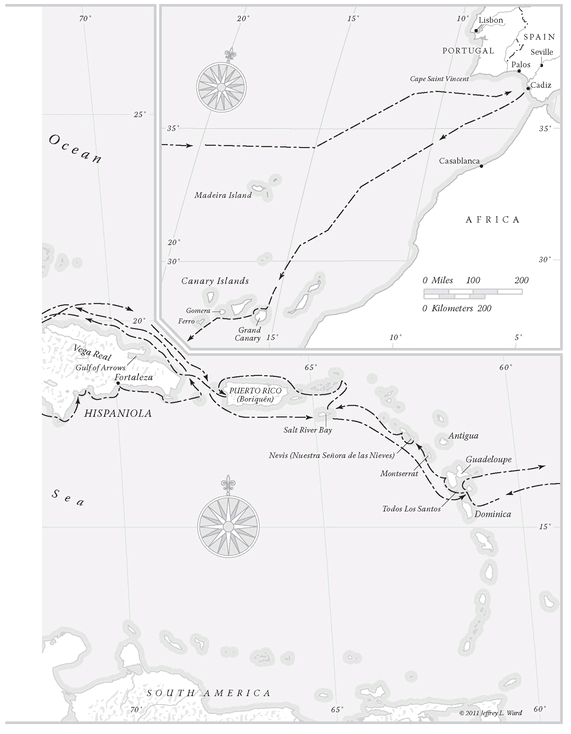
A fresh breeze sped the seventeen ships toward their destination. “On September 28, being one hundred leagues from Spain, many small land birds, turtledoves, and other kinds of small birds came to the Admiral’s ship; they appeared to be flying to winter in Africa.” They had their fixed route, to the south, and Columbus had his, to the south and east. Holding on his course, on Wednesday, October 2, he reached Grand Canary, a verdant landmass rising from the sea. He set his anchors, but not for long. By midnight, he was sailing for Gomera, and reached the small, lush island three days later.
Gomera had been settled since Roman times, and the island’s isolated inhabitants communicated with one another by means of a peculiar whistled language of rising and falling pitches known as Silbo Gomero. Columbus had no time to admire the curious tongue. His mission consumed his attention, as he obtained necessary supplies, especially animals. The transatlantic menagerie included pigs and sows, sheep and goats, twenty-four stallions, ten mares, and three mules. Unable to survive the long weeks at sea in the ships’ fetid holds, the animals occupied privileged space on the bridges. Arrayed against the sky, heads bobbing, they imparted a resemblance to that biblical ship, Noah’s Ark.
There was one other distraction on the island of Gomera: Doña Beatriz de Bobadilla. Or, as she was known in the Canaries, “Bobadilla the huntress, a woman of rare distinction.”
On the outward-bound leg of his first voyage, Columbus had paused at San Sebastián, Gomera, from September 3 through 6, 1492, long enough for a romantic encounter with the island’s ruler, Beatriz de Bobadilla. A thirtyyear-old femme fatale, she claimed noble lineage from Castile, and served Queen Isabella as a seventeen-year-old maid of honor; in this role she fell under the spell of King Ferdinand. (Despite his professed loyalty to his wife, Ferdinand carried on a series of clandestine liaisons.)
At about this time, the court was visited by Hernán de Peraza, who had the unpleasant task of accounting for the death of a commander associated with him. He received a pardon from Queen Isabella in exchange for vowing to conquer Grand Canary island in the name of Spain. And there was one other condition, a “less onerous penance,” as it is traditionally described: to marry young Beatriz de Bobadilla, and thereby distance her from Ferdinand. At one stroke Isabella won Peraza’s loyalty and removed the younger and more attractive rival for her husband’s affections. Beatriz de Bobadilla and Hernán de Peraza quickly wed and returned to Gomera, where her husband was killed by the indigenous people there, known as Guanches, to protest his tyrannical rule.
As a widow, Beatriz de Peraza proved to be no less cruel. She lured knights and local figures to her castle. Some survived their encounters with her, and others did not. One of her visitors, it was said, spread indiscreet rumors about the viuda’s scandalous behavior. She invited him to the castle, where they chatted a bit, and then summoned her servants, who arrested her visitor. He admitted his misdeeds and apologized, to no avail. She ordered her servants to place a noose around his neck and hang him from a tower beam. She calmly watched him in his death throes, and let the body hang from a palm tree, where it warned others who would gossip about Doña Beatriz.
Despite the local uproar over her behavior, she remarried, and soon found herself embroiled in a territorial dispute with a political rival, Fernán Muñoz, whom she also ordered to be hanged. She eventually ended her life by poison.
Those terrible events lay several years in the future. Now the huntress wanted Columbus, at the beginning of his second voyage, to stay with her on Gomera. Columbus dallied, and did his best to impress her. One of his gossipy friends, Michele de Cuneo of Savona, who had come along on the voyage, rolled his eyes at the number of “festivities, salvoes, and salutes we performed in that place . . . all for the sake of the lady of the place, for whom, in a former time, our Admiral had been smitten with love.” One account insists that she wished him to remain there permanently as her husband, and to refrain from sailing and exploring. This he was unwilling to do, for her or for anyone else.
On Monday, October 7, 1494, having settled his affairs and accounts on Gomera, Columbus and his fleet of seventeen ships shaped a course for the Indies.
At departure, Columbus gave sealed orders to the captain of each ship, not to be opened unless weather forced a change of course. He insisted on secrecy because he did not want others, especially the Portuguese, to be privy to his route.
By Thursday, October 24, 1494, he had run more than four hundred leagues west, concerned that he had not encountered seaweed, although by this point in his first voyage he had seen quantities. Then, “to the surprise of all,” a swallow appeared that day and for two days thereafter. The next day, “[t]he waves rolled high, darkness prevailed everywhere, and black night covered the sea, except where lightning flashed and the thunder echoed. There is nothing more perilous than a shipwreck under these circumstances,” Guillermo Coma recalled. The rain and wind blasted the ships with such force that “the yards snapped, the sails were torn to shreds, and the ropes parted. The planks creaked and the gangways were awash, while some [ships] found themselves hanging on the crest of the waves and others saw the waters spread apart and lay bare the floor of the sea.” The vessels threatened to collide like toys in a pond.
Amid the turmoil, St. Elmo’s fire appeared in their midst. Named for St. Erasmus of Formiae, or St. Elmo, the patron saint of Mediterranean sailors, St. Elmo’s fire displays glowing blue or violet air that has been ionized, or electrified, by a thunderstorm, often accompanied by buzzing or hissing. Superstitious sailors, dependent on omens to guide their lives at sea, regarded St. Elmo’s fire as a sign of divine favor.
November 2 found Columbus studying the skies, observing “dark, threatening clouds ahead, which convinced him that land was near.” He lowered sail, kept watch, and by daybreak on November 3 was rewarded with the sight of a mountainous island called Charis by its isolated inhabitants since time immemorial. No more. Having arrived on a Sunday, he christened it Dominica, as if converting the island itself.
Word of the landfall spread from one ship to another quickly.
¡Albricias!
¡Que tenemos tierra!
The reward! We have land!
He spotted another island, and another, four in all, now known as the Leeward Islands—the northernmost islands of the Lesser Antilles, located at the confluence of the Atlantic Ocean and the Caribbean Sea. (“Leeward” refers to the prevailing winds in the region; the islands are downwind, or leeward, of the Windward Islands, situated to meet the trade winds. The Leeward Islands include the U.S. and British Virgin Islands, Nevis, Saint Kitts, Saint-Barthélemy, Antigua, and Guadeloupe.) The miraculous appearance of these isles cheered all the men, who appeared on deck to intone prayers and hymns of gratitude and relief. As they did, the animals they carried with them, the chickens, the roosters, and especially the horses, raised an excited cacophony.
Columbus had successfully completed his second outbound transatlantic crossing, this time with seventeen ships, all of them avoiding serious accidents, over a distance of eight hundred leagues—about 2,400 miles—from the island of Gomera, in just twenty days. Relying on his judgment, instincts, and favorable winds, he had hit upon the optimal route between Gomera and the Leeward Islands, and demonstrated he could lead a transatlantic crossing without the Pinzón brothers; in fact, he surpassed them at this game. Of course, he was nowhere near his previous landfalls in the Indies, particularly the men stranded at La Navidad. Nevertheless, his men were safe, and the second voyage was off to an auspicious start.
He attempted to moor at Dominica’s eastern shore, but found no anchorage. “The sea was heavy and a storm and mist were approaching,” he later explained to Ferdinand and Isabella. Trouble was just starting. “I turned back toward the fleet that was quite scattered and brought them all together. Then I dispatched the best equipped caravel to the point in the north,” but he ignored her progress. “I was preoccupied because of the bad weather that was raging.” Reefing sail and summoning the other ships, he “made for another island ten leagues distant from Dominica.” Columbus swallowed his disappointment without realizing he had just been spared encountering cannibals said to be dwelling there. In the years to come, so the story goes, Europeans who fetched up on this island had a rough time of it—that is, until the day the cannibals became so ill after devouring a friar that they avoided anyone dressed as a cleric. For that reason, when Spanish ships from across the Atlantic had no choice but to forage on Dominica for food or water, they assigned a friar, or a sailor who dressed as one, to the task.
Unable to secure anchorage, Columbus ordered his fleet to a nearby island; the predatory Caribs called it Aichi, and the Taínos, their prey, knew it as Touloukaera. Heedless of the island’s contentious history, he christened this inviting speck of land Marie Galante, after his flagship. He dropped anchor, ventured ashore, and, in the words of his son, “with suitable solemnities renewed possession that in the name of the Catholic Sovereigns he had taken of all the islands and mainland of the Indies on his first voyage.” More powerful than ever, the Admiral of the Ocean Sea had returned to his demesne.
The expedition’s physician, Diego Alvarez Chanca, wrote of the landfall with wonder: “On this island there were woods so dense that it was amazing to look at them and especially stupefying were the many species of trees unknown to everyone—some with fruits, others with flowers, and all was green,” while the trees in Spain showed only bare gray branches at this time of year. Here, the very air seemed to tremble with magic. “We found a tree whose leaves had the most pleasant clove scent I ever before smelled,” he marveled. Tempted, several crew members tasted the unfamiliar fruit. Instantly, “their faces swelled up and they developed such a strong burning and pain to appear seized with rabies, which could not be cured by any means of cold things.” Two hours later, the visitors from Spain, tongues afire, departed in their ships.
Just nine leagues to the north, the fleet arrived at a spectacularly lofty island. “This island,” Columbus wrote, “is shaped like the point of a diamond, so high that it is a marvel, and from its summit gushes out a tremendous spring that scatters water on every side of the mountain; from where I stood other streams were flowing in on the other side, one of them so big its sharp, high drop made it resemble water gushing out of a barrel, all white, and we could not believe it was water and not a vein of white rock.” The sailors wagered: rock or water? When they dropped anchor, they had their answer: it was water, on an island filled with abundant streams. “Upon reaching the island I named it Santa María de Guadalupe,” he wrote, referring to a monastery in Santa María de Guadalupe de Extremadura, Spain. It was November 14.
The wind suddenly shifted, bringing bouts of dense mist and torrential rain. Columbus spent a strenuous day battling high winds and heavy seas. When the weather lifted slightly, he produced his spyglass and observed people barely visible through a clearing in the trees. He gave the order to drop anchor, but the panicky island dwellers fled well before the Spaniards could make contact with them. “I reached the north side,” Columbus wrote, “where most of the population lives, and I went in very close to land and anchored the whole fleet.”
Columbus sent a captain ashore, where he “found a good deal of unspun cotton, yarn, and edible provisions,” in Chanca’s words. But where were the people?
“Our men,” Ferdinand wrote, “found only some children, in whose hands they put hawk’s bells in order to reassure the parents when they returned.” The Spaniards inspected the structures, and noted “geese resembling our own” and unearthly parrots as large as roosters bristling with feathers of brilliant vermilion, azure, and white. Emboldened, they sampled a fruit similar to melon but sweeter in taste and smell. They noted bows and arrows, hammocks, and took care to restrain themselves from removing anything from the abandoned hamlet so that “the Indians might have more trust in the Christians.”
On closer inspection, the peaceful domestic scene turned into a nightmare. “In their houses,” Columbus wrote, “I found hanging baskets and great arches of human bones as well as heads hanging up in every house.” He was startled to come across “a large piece from the stern of a Spanish ship; I believe it was from the one I left at La Navidad last year.” An unnerving silence enveloped the explorers. They assumed they were being watched, but by whom?
“As for the people,” Columbus wrote to his Sovereigns, “few were taken and few seen; all of them fled into the countryside, and because the trees were thick could not be captured except for some women, which I am sending to Your Highnesses.” They were refugees, victims of brutality and cannibalism. “In my opinion, they were taken as slaves or concubines.” By means of gestures they indicated that “their husbands had been eaten and that other women had had their sons and brothers eaten, and that they themselves had been forced to eat them.” There was more, sadly. “I also found some boys who had been brought there, and each of them had had his penis cut off.” At first, Columbus thought they had been castrated “out of jealousy for their women,” but, he learned, “they follow that practice to fatten them up, like capons in Castile, so they can be eaten for feasts; women they never kill.”
Had the men at La Navidad met with the same end as the horrifying human remains in the Indians’ dwellings indicated? Had Columbus allowed them to be sacrificed in this manner? Stricken with guilt and panic, he intended to go from one island to the next, destroying every canoe he encountered as retribution, “but the desire to aid those whom I had left behind here did not allow time for searches, nor did I have peace of mind.”
His exploration of Guadeloupe revealed a string of abandoned villages, but in one hamlet his men came across an “abandoned one-year-old baby who remained alone for six days in this hut.” Each day his men passed by the hut, “and they always found the little one next to a bundle of arrows, and he used to go to a nearby river to drink and then return to his hut, and he was always cheerful and content.” Consumed by the idea of this small child alone in the wilderness, Columbus intervened, pledging the boy “to God and fortune,” adding, “so I had him entrusted to a woman who had come here from Castile.” References to this woman and others like her are too skimpy to convey an idea of what role, if any, they played. In this instance, the abandoned Indian child flourished under the care of his nursemaid. “Now he is so well behaved,” Columbus boasted to Ferdinand and Isabella, “and he speaks and understands our tongue very well, and that is beautiful.” He would send him to Spain forthwith, “but I am afraid he might die, being so young.”
Columbus, like other explorers of his day, considered his routes and discoveries trade secrets for which he daily risked his life, and he jealously guarded them from opportunists and rivals. Meanwhile, his trusted chart maker, Juan de la Cosa, amassed data for an official guide to the newly discovered archipelago, but it has not survived, and his famous map dating from the year 1500 contains little detail concerning this region. At some point during the second voyage, he gathered together “drawings of all the islands discovered so far along with those from last year, all of them on a map I made with no small labor,” but even if these charts had survived, they might have been of limited value.
Some names chosen by Columbus at this point in his voyage have endured, in abbreviated form, to offer clues to his whereabouts. Santa María de Montserrate, named for a monastery near Barcelona, became Montserrat; Santa María de la Antigua, named for the celebrated Virgin in the Seville Cathedral, before which Columbus is believed to have prayed, became Antigua. But Columbus’s San Martín surrendered its name to an island lying to the northwest; afterward, it was known as Nuestra Señora de las Nieves, Our Lady of the Snows. The evocative designation referred to a miracle attributed to the Virgin Mary rather than to actual snow on the island, of which there was none.
As he named these islands, Columbus led his fleet through a world that seemed newly formed each day, mountains emerging from the darkness at dawn, reaching toward stands of cumulus at midday, and receding into the dusk before disappearing into the star-pricked night. Sailing east in search of India, gliding over the quicksilver surface of the sea flashing from gray to cobalt to indigo, the ships seemed to be playing hide-and-seek, not just with islands and currents but with reality itself.
In the morning the Admiral dispatched two small boats to capture an Indian to point the way to Hispaniola and its fort, imperiled La Navidad. The boats returned with two boys, who explained they came from Boriquén, or Puerto Rico, and had been kidnapped by the Caribs. On another sortie, the boats retrieved six women seeking refuge from the Caribs aboard the Spanish ships. Columbus refused, gave them hawk’s bells and other small gifts, and sent them back to the island, where the Caribs seized the women and boldly pilfered the trinkets in full sight of the Spaniards.
When the boats returned a third time to take on wood and water, the women pleaded with the visitors for asylum. “Being kindly received and generously plied with food, they thought the gods had come to their aid,” Guillermo Coma reported. The women locked their legs around the masts and pleaded to remain rather than be returned to the Caribs, “like sheep to the slaughter.”
The grateful women divulged all they knew of the islands in the area, and secretly pointed out Caribs to the Spanish. The Caribs would impregnate women and devour their offspring. Male victims fared no better. If captured alive, they were immediately slaughtered and eaten. Chanca wrote that the Caribs “claim human flesh is so exquisite that a similar delicacy does not exist in all the world.” A pile of bare human bones testified to their predilection: “All that could be gnawed on, had been gnawed on, and all that was left, was what could not be eaten, because it was inedible.” Chanca reeled at the sight and smell of a “human neck . . . boiling in a pot.” Worse, “Young boys once captured have their members cut off and are kept as servants till adulthood, at which time, when the Caribs want to celebrate, they kill and eat them.” To demonstrate this last point, however extreme, three Indian boys who had escaped the Caribs and sought refuge among the Spanish “had been castrated.”
As Columbus prepared to sail for the island of Hispaniola, he learned that a company of nine men—eight soldiers and their captain—had gone ashore and had yet to return. No one aboard the ships knew what had become of them. Thick undergrowth concealed their location. Caught between abandoning part of his crew and the need to reach La Navidad, Columbus dispatched a rescue party armed with arquebuses, whose deafening blast, it was hoped, would lead the lost men to safety. But after a week of waiting, “we had by then considered them eaten by the natives,” Chanca confessed.
During the delay, Columbus, seemingly unafraid of the Caribs, ordered his men ashore to wash their clothes and to procure still more wood and water. Later, he sent a company of forty men under the command of a spirited young captain, Alonso de Ojeda, “to search for the strays and learn the secrets of the country.” They found no lost crew members, or their bones, but they did note an abundance of maize, aloe, cotton, ginger, and fowl resembling falcons, herons, crows, pigeons, partridges, geese, nightingales, and twenty-six rivers on this bedeviled isle. “Several times we went ashore, exploring all dwellings and villages that lay along the coast,” Chanca revealed, “where we found quite a few human bones and skulls hanging inside the houses and used as containers to hold things.” Despite these stark displays, “these people seemed to us more civilized than those living on other islands we had seen.” Their straw huts were sturdier; they had more yarn and cotton stored, so much “that they have nothing to envy of those from our country.”
More testimony about the voyage came from the pen of Peter Martyr d’Anghiera, a chronicler “tied in close friendship,” in his words, to Columbus. Peter Martyr, as he is usually known, was an Italian in residence at the Spanish court. He had originally met the explorer in April 1493, at the conclusion of the first voyage. A month later, in a state of excitement, Martyr dashed off a note to a friend. “There returned from the western antipodes”—that is, India—“a certain Christophorus Colonus of Genoa who had with difficulty obtained from my Sovereigns three ships [to visit] this province, for they considered what he said fabulous; he has returned and brought proofs of many precious things, especially of gold, which these regions naturally produce.”
Among the first to recognize the importance of Columbus’s discoveries, Peter Martyr related the explorer’s latest findings to members of the highest echelons of the church. “I chose these accounts from the originals of Admiral Columbus himself,” he said, and went on to explain to Cardinal Ascanio Sforza the ingenious construction of Indian homes and their furnishings: “First, they draw the circumference of the house with logs of very tall trees, set in the ground like piles; then shorter beams are placed inside to prevent the taller ones from falling in; finally they place the ends of the taller posts much like a military tent, thus all the houses have pointed roofs. Next, interwoven leaves from palm trees and some other similar trees are used to protect them very ingeniously from the rain. Across from the short planks and the inside posts are strung cotton ropes or certain twisted roots similar to esparto”—a tough fiber prevalent in southern Spain—“on top of which they lay cotton blankets. Since the island spontaneously produces cotton, they make use either of suspended beds made of raw cotton . . . or heaps of leaves. The courtyard surrounded by these ordinary dwellings is used for gathering and play.”
The courtyard, or batey, as the Indians called it, served as the arena for games. Ten or twenty athletes clustered at opposite ends of the batey, where they served and passed a ball from one player to another. Men and women competed separately. Indian rules prevented athletes from guiding the ball with their hands or feet, so they bounced it off their bodies, taking care to keep it within bounds. During these contests, ordinary spectators sat on the ground, the Indian ruling caste on benches or stools. The raucous games went on day after day, with caciques as well as the players themselves betting on the outcome. Often the teams represented chiefdoms, and took on a political slant, coinciding with significant Indian civic events.
The Spanish visitors had never seen anything like these strenuous games. Nor had they seen an elastic ball, rubber, or rubber plants. From these innocent, spontaneous encounters between cultures, the first traces of an American character began to form, although it went unacknowledged at a time when slaves and spices and gold led the agenda, along with not-soinnocent sexual encounters.
Nor had Columbus’s men seen anything like the Indians’ fantastic religious rites. The same courtyard where ball games were played served as the setting for elaborate Taíno ceremonies to honor local deities; elaborate observances of marriage and death, and battles; and reenactments of the deeds of their forefathers, all with hypnotic musical accompaniment. On the day of an observance, the pulse-quickening rhythms of Taíno drums and flutes reverberated throughout the public courtyard and the forest beyond. The most conspicuous instrument that Columbus and his men probably heard was the mayohuacán, or maguey, a drum carved from a substantial tree trunk, with an oval slit—or a slit in the shape of an H—on the top. The design produced a deep, powerful resonance that could be heard for miles around as a drummer used one or two sticks to strike themayohuacán, which was suspended between trees. The Taínos made music, too, with a prototype of maracas, a pair of substantial rattles containing a large ball; slits on the side permitted the rhythmic sound to emerge. Often used in religious ceremonies, they were adorned with carved representations and images of cemís, tiny but mighty Taíno religious figures. They were joined by güiras, raspers fashioned from hollowed-out gourds with ridges notched into their sides. Today, güira and maracas remain integral to Latin American music, as do modern versions of flutes and Taíno whistles called guamós or cobos. And there were the breathy exhalations of a Taíno trumpet, fashioned from a conch shell. Its notes carried throughout the forest to broadcast warnings of danger to distant members of their tribe.
With these instruments, the Taínos performed hymns and rites called areítos to celebrate natural events such as solstices, plantings, and harvests. Areítos commemorated the marriage of a cacique, the birth of an important nitaíno (a Taíno of the ruling caste), or a military victory. “Since time immemorial, particularly in the mansions of their kings, they have ordered their behiques or wise men to instruct their sons in knowledge about everything,” Peter Martyr wrote. “With this teaching, they accomplish two goals: one general, playing [songs] about their origins and development, and the other particular, lauding the illustrious deeds in peace and in war of their fathers, grandfathers, great grandfathers, and other ancestors.” In each case their “melody is perfectly in accord with each theme.”
The Taínos prepared carefully for their sacred areítos. The dancers fasted for eight days before the ceremony, imbibing only an herbal tea, or diga. Before performing, they bathed in rivers and in sacred charcos, natural pools, to purify their bodies. Europeans came to believe that the ritual bathing was meant to propitiate Atabeyra, at times the deity of fresh water and at other times the mother of Yúcahu, the Taínos’ principal god. After they purified themselves, the males decorated their bodies with vegetable-dye images of their cemís. Concluding the purification rite, they plunged elaborately decorated vomiting sticks made from the ribs of a manatee down their throats to empty their stomachs in preparation for receiving divine enlightenment.
At the start of the ceremony, the presiding cacique took his place on a dujo, a stool with four legs, decorated with colorful images of cemís. He inhaled the powerful hallucinogenic cohoba powder through the slender black stems of his pipe, one for each nostril.Cohoba was derived from a slender tree known to botanists as Anadenathera peregrina, and to the Indians as yopo, which flourished throughout the Southern Hemisphere. Its ground seeds produced the potent snuff, and after inhaling it, the cacique fell into a deep trance lasting three or four hours. When he emerged, he announced to his followers the prophecies he had heard from the cemís, and those divine utterances set the program that followed. Drummers and other musicians struck their instruments, and the intoxicating reverberation filled the public square, and floated up to the sky, even as the cohobadust filled the nostrils of the Indians and altered their perception of reality. Three hundred dancers, moving as one, shook the snail shells bound to their arms, their calves, their thighs, and even their heels. “Loaded with these shells they struck the ground with their feet, leaping, singing, and dancing, and they saluted the cacique who, seated in the doorway, received those who came, beating on his drum with a stick,” wrote Peter Martyr.
The dancers held hands or clasped each other’s shoulders as they danced, the men flashing their body designs in gaudy red, black, and white. “The women, on the other hand, came without any special haircuts or paint, the virgins totally nude,” said Martyr.
At a signal from the behiques, or wise men, the garlanded women, dancing and singing their hymns, which they call areítos, offered cassava in laboriously woven baskets. Upon entering, they began to circle those who were seated there; these, rising with sudden leaps, celebrated with admirableareítos of praise, together with them, to the cemí, narrating and singing with the illustrious gestures of their ancestors, giving thanks to the deity for their well being, humbly asking him for future felicity; both sexes on their knees at the end, they offered the deity cassava, which the wise men blessed, and then they divided the cassava into pieces as personal presents.
At the conclusion, each participant carried part of the cassava home and kept it all year as an object of sacred remembrance.

The lost party of nine men suddenly appeared before Columbus on November 8, explaining that they had gone astray in the forest. “We rejoiced at their arrival as though they had come back to life,” Chanca wrote, sensibly enough. They were accompanied by ten women and boys, all fleeing the Caribs. To find their way back to the waiting ships, several men had shimmied to the treetops “to get oriented with the stars but were absolutely not able to see the sky.” Wandering to the water’s edge, they stumbled upon the waiting fleet by accident.
The Admiral was more irritated than pleased by their unexpected return. The tale of their ordeal failed to move his unyielding heart. And he “punished them for their rashness, ordering the captain put in chains and placing the others on short rations,” Ferdinand reported.
At daybreak on November 10, Columbus and his fleet departed from Guadeloupe, sailing northwest along the coast to the island of Montserrat. The handful of Indians aboard his ship explained that the island had been ravaged by the Caribs, who had eaten “all its inhabitants.” Columbus hastened to Santa María la Redonda—so named because it was round—and then Santa María de la Antigua, and held to a northwesterly course, spotting more islands “all very high and densely wooded” and potentially useful, but as his son tells us, Columbus was “so anxious to relieve the men he had left on Hispaniola that he decided to continue” until November 14, when a storm forced the fleet to seek shelter in Salt River Bay, in the lee of the island now known as St. Croix.
A few of the men went ashore “to learn what kind of people lived there,” Chanca noted, “and also because we needed information about which way to follow.” Here, as on other islands, “most of the women . . . were prisoners of the Caribs,” just as they had expected “on the basis of what the women with us had predicted.”
Columbus again dispatched scouts to capture an Indian guide, but they returned instead with several women and three children. As the scouts approached their ship, they found themselves in a pitched battle with four men and a woman in an Indian canoe. The lone woman proved herself a capable archer; her arrow pierced a shield. In retaliation, the Spaniards rammed the canoe, dumping the Indians into the salt water. Swimming to safety, they continued to shoot arrows tipped with a deadly poison believed to have derived from manchineel fruit, sometimes called “beach apples,” growing in abundance on bushy trees. These apples were so toxic, wrote Fernández de Oviedo, that “if a man lies down to sleep for only an hour in the shade of one of these manchineel trees, he awakes with his head and eye swollen, and his eyebrows level with his cheeks.” The Spaniards called the fruit manzanilla de la muerte, little apple of death. The Caribs mixed the poison apples with toxins from vipers and poisonous insects to make an even deadlier concoction. Even the leaves were dangerous, and the Caribs used them to poison their enemies’ water supply. The only known antidote was seawater. Out of fifty wounded by poison arrows, “not three survived.”
Amid the melee, Peter Martyr reported, there appeared a woman whom the other Indians respected as their queen. Beside her stood her son, “a fierce and robust young man, with a ferocious look and the appearance of a lion.” They seemed prepared to finish every last Spaniard, even those in agony from the wounds they suffered from the poison-tipped arrows. Summoning their resources, the Spaniards rowed themselves beside the cannibals’ canoe to overturn it. Even with their canoe capsized, the Indian warriors, men and women alike, kept shooting their arrows, one stroke after another. Only when the archers sought refuge on a reef were the Spaniards able to capture them as they fought on to the end. Several Indians perished in this skirmish, and the Spaniards were pleased to note they had “wounded the queen’s son twice.”
The exhausted survivors were taken prisoner, and “even after being taken on board the Admiral’s ship the natives did not lose their fierceness and ferocious looks, not unlike African lions once they feel trapped,” in the words of Peter Martyr. Like many in Spain, the classically trained Martyr was of two minds about the Indians. From a safe distance, he compared them favorably to the “tyrants” of the time of “the mythical Aeneas,” the hero of Troy, and even portrayed their lives with a touch of envy. “But I feel that our natives of Hispaniola,” as he called the Indians, “are happier than they—more so were they converted to the true religion—because naked, without burdens, limits, or death-inducing currency, living in a golden age, free, without fraudulent judges, books, and content in their natural state, they live with no worries about the future.” Yet Columbus and his men realized that the Indian tribes they encountered often lived desperate, fear-ridden lives as they preyed on one another in an unending struggle for dominance and survival that mirrored the struggles of European nations. Even the wistful Peter Martyr was aware that the fierce Caribs ranged a thousand miles to find victims, and he admitted that the Indians, despite their apparent freedom and simplicity, were “troubled by the desire to rule and waste each other away with wars.”
Unlike the exalted, occasionally desperate sense of mission animating Columbus, his boyhood friend Michele de Cuneo, gentleman of Genoa, did not torment himself with questions about the fleet’s location or his role in God’s plan. Even the appalling castration practiced by the Caribs intrigued rather than horrified Cuneo. His determination to live in the moment, consequences be damned, prefigured the eventual arrival of buccaneers in the Caribbean.
Cuneo recorded careful observations of the Indians as they appeared to the men of the second voyage. The Indians pressed a heavy plate on the soft brows of infants to produce a profile they considered desirable, as he noted: “They have flat heads and the face tattooed; of short stature; as a rule they have very little beard and very well shaped legs and are thick of skin. The women have their breasts quite round and firm and well shaped.” They were carefully groomed, shaving and smoothing their skin with sharpened canes, and “the hair from the nose they uproot with their fingers.”
He observed their diet with amazement. “They eat all sorts of wild and poisonous beasts such as reptiles of 15 to 20 pounds each; and when they meet the biggest ones they are devoured by them.” He tried a sample, and found it “very good.” But the dogs were “not too good” at all; neither were the “snakes, lizards, spiders” that he claimed grew to the size of chickens. The Indians even ate “poisonous insects that breed in the swamps and weigh from a pound to a pound and a half.” Those he could not bring himself to stomach.
They acted according to their impulses, or so it seemed to Cuneo. They did not live long (“We have not seen a man who in our judgment would have been past 50 years of age”), they slept “mostly on the ground like beasts,” they let the women do most of the work, and they covered their bodies with dye to ward off the “extremely annoying” mosquitoes. (The Europeans, in contrast, failed to find any better remedy than staying in the water.) The Indians ate when hungry, had sex when it suited them, but they were “not too lustful,” which he attributed to their inadequate diet. “According to what we have seen in all the islands where we have been, both the Indians”—that is, the Taínos—“and the Caribs are largely sodomites, not knowing (I believe) whether they are acting right or wrong.”
Cuneo coolly recorded the brutal treatment the Spaniards accorded the Indians in the canoe as they battled against overwhelming odds. “One Carib was wounded by a spear in such a way that we thought he was dead,” he said of the confrontation, “but instantly we saw him swim.” The Spaniards quickly caught him and grappled him back to the ship, “where we cut off his head with an axe.” They took other Caribs as prisoners, and planned to send them all to Spain, as Cuneo casually recalled, with one striking exception. “While I was in the boat,” Cuneo bragged, “I captured a very beautiful woman, whom the Lord Admiral gave to me. When I had taken her to my cabin she was naked—as was their custom. I was filled with a desire to take my pleasure with her and attempted to satisfy my desire. She was unwilling, and so treated me with her nails that I wished I had never begun. I then took a piece of rope and whipped her soundly, and she let forth such incredible screams that you would not have believed your ears. Eventually we came to such terms, I assure you, that you would have thought she had been brought up in a school for whores.”
So began the European rape of the New World.
Had Ferdinand and Isabella learned of such escapades, the perpetrators would have paid dire consequences. And if Columbus knew of his comrade’s scandalous behavior, he kept the knowledge to himself, and Cuneo had the sense to confide his written accounts of daily life during Columbus’s second voyage only to a circumspect friend.
Gonzalo Fernández de Oviedo, the naturalist and scholar, preferred to emphasize the loyalty and sensuality of Taíno women. “They are very fond of the Spaniards and consider themselves highly honored when they are loved by them. Many of these women, after they have known Christians carnally, will remain faithful to them unless they go too far away and remain too long, for they have no desire to be widows or nuns who protect their chastity.” For many, chastity was not uppermost in their minds, and pregnancies inevitably followed, for which they had a remedy. “Many of the Indian women eat of an herb that moves and expels the pregnancy,” he wrote. “They say the old women are the ones who should bear children. The young women do not want to give up their pleasures, or to become pregnant, because childbearing causes their breasts to become flabby. They have very beautiful breasts and are quite proud of them.” If an Indian woman eventually gave birth to a child, Fernández de Oviedo noted, “she goes to the river and bathes, and immediately the flow of blood and purgation ceases, and for a few days she does no work. The sexual organs of Indian women then contract so that the men who have had sexual intercourse with them say that they are so tight that it is with pain that a man may gratify his passion. Those who have not borne children seem to be almost virgins.” This behavior, so resilient and flexible, was very different from that of conventional Spanish and Christian mores, which placed a premium on virginity, abhorred abortion, and often suppressed inherent female sensuality in the name of chastity.
The Indian men emphasized audacious sexual display. The caciques “wear a tube of gold, and the other men large snail’s shells, in which they place the male organ. The rest of the body is naked, because the Indians do not feel that the human body is anything to inspire shame”—Fernández de Oviedo wrote in appreciation—“and in many provinces neither men nor women cover their sexual organs nor do they wear anything on any part of the body.” Stirring accounts such as this made as much of an impression on European awareness of the Indians visited by Columbus as alarming reports of cannibalism and poison arrows.
In Chanca’s account, the battle between the Spaniards and the Indians arose not from provocation, as Cuneo implied, but from happenstance: the unexpected appearance of a canoe with two men and a boy who were so astonished by the sight of the enormous Spanish fleet that “they stayed for a good hour without moving.” They were slowly surrounded by Spaniards approaching in boats. “As they kept on wondering and trying to understand what it was all about, they did not notice that they could not flee.” When they finally tried to escape, “the men from our boat seized them very promptly.”
Chanca sympathized with the small party of captive Indians, far outnumbered by the twenty-five Spaniards who had seized them. Surrounded, the Indians “struck one with two arrows in the chest and the other with one in the ribs, and, had it not been for the fact they wore shields and wooden plates and also that there was a collision with the boat that capsized their canoe, they would have hit the majority of them with arrows.” They fought on even after their canoe capsized. Dodging poison-tipped arrows, the Spaniards wounded and captured a single warrior, and brought him back to the fleet, where he died of his injuries.
During the first voyage, the ferocious Caribs had been more rumor than reality. Now Chanca observed them at close quarters, their “very long hair,” and a “thousand different decorative images on their faces, crosses and other symbols of varying fashion, as each of them likes best.” The few Caribs captured by the Spanish had eerily “painted eyes and eyebrows, which—it seems to me—they do on purpose to appear more frightful.” They were, in fact, terrifying. The Spaniards captured their Indian attackers only to find that the men had been castrated: standard practice for the Caribs, who sought to improve the taste of their victims before eating them.
His need to hurry increasing with every league and sign of Carib cruelty, Columbus held to his northwest course, “preferring,” said Chanca, “to bring help to our people whom we had left on Hispaniola.”
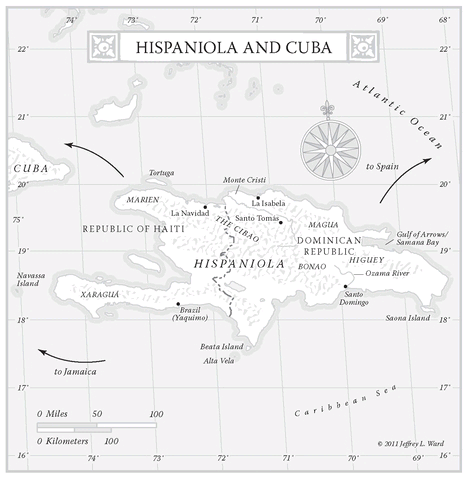
Slicing through cobalt sea, out of sight of land, the fleet was accompanied by the angular black, swooping silhouettes of frigate birds. Chanca accurately portrayed these pelicanlike creatures as “predatory sea birds that do not stop or sleep on the water.” Two days later, the men of the fleet spotted land, probably the Virgin Islands; fished for sole, sardines, shad, and even sea horses; passed along the southern coast of Puerto Rico; beheld an Indian watch tower “that could hold ten or twelve persons”; and on Friday, November 22, watched in expectation as the northern coast of Hispaniola finally came into view, solid, fragrant, and mysterious.
This was Chanca’s first visit to the Indies, and the scope of Hispaniola overwhelmed him. “A very wide territory,” he observed, “to the point that those who have seen its coast claim it could be two hundred leagues long.” He was accustomed to the sparse countryside of Spain, the parched soil, and in November, the sunny but chilly Seville.
Here, on Hispaniola, the profusion of strange flora perplexed him. “A very unusual land,” he remarked, “with a great many wide rivers, big mountain chains, ample and treeless valleys and high peaks. I suspect the vegetation does not dry up at all during the year. I do not think there is any winter in this territory, since at Christmas there can be seen many nests, some with birds, others with eggs.” These birds puzzled him. Their appearance was the result of a separate evolutionary track; as such, they were the product of forces unknown to Chanca or anyone else of that era. Lacking a taxonomy adequate to the formidable task of classifying the fauna all around him, he hesitantly recorded references to “a few multi-colored dogs,” and a “furry animal like the rabbit . . . with a long tail and with fore and hind legs like those of mice, and it climbs trees. Many people who have eaten it say it is indeed tasty.” At such moments, it seemed as though he were in another world similar to that of Europe, but subtly and enigmatically different, like a foreign language he could only partly decipher. Creatures that he took to be snakes, for instance, baffled him; he claimed that the Indians “like them a lot, much as we like pheasants in our country. They are of different shape but the same size as our lizards,” with the exception of one curious beast that he estimated to be the size of a calf “and had the shape of a lance.” The creature inspired an outpouring of Spanish abhorrence, yet “many attempts to kill it were thwarted by the dense vegetation where it could hide by the sea and never be caught.”
In late November 1493, the fleet paused at the port of Monte Cristi, on the inhospitable northern coast of what is now the Dominican Republic “to study the configuration of the territory,” in Chanca’s words, “since the Admiral considered unsuitable for a settlement the place where he had left the men.” With the benefit of hindsight, Columbus realized that his hasty choice of site on the first voyage had failed to take into account basic considerations such as the availability of water and food, and proximity to the aggressive Caribs. He concluded he needed to know the territory—and its dangers—better. He soon found them.
A scouting party came across “two dead men near the river, one with a rope around his neck and the other with a rope around his foot.” The next day, Chanca wrote, the scouts discovered “two more dead men, one of whom was in a position that revealed he had a long beard.” Who were they? With professional sangfroid, the physician observed that “some of our men had more negative than positive feelings, and rightly so, since none of the Indians have beards.” Columbus had nothing to say on a subject that could only bring dread to his men. They were about thirty-six miles from the fort.
Columbus departed for La Navidad two days later, on November 28, intending to call on Guacanagarí, the chief who had been entrusted with protecting the life of thirty-nine Spaniards from the first voyage. En route, the Admiral’s ship foundered amid the shallows in an eerie reenactment of the mishap the previous Christmas, when Santa María had struck a sandbar, but this time Columbus’s flagship broke free to arrive after nightfall. “We did not dare to take port near the coast until the next morning when the depth could be surely known and safe passage possible,” he recounted. They were still three miles from their goal when a canoe bearing five or six Indians gave pursuit, but Columbus had no intention of waiting for them.
He fired two shots to announce his arrival. As the reports echoed and faded, Columbus waited for the Christians in their garrison to respond in kind. But there was only silence that grew more poignant with every passing minute, “for they suspected that the comrades whom they had left there had been completely wiped out,” as Guillermo Coma remembered. Even the detached Chanca admitted to a “lot of concern” among the crew members. “Great sadness was all-encompassing,” he sighed. When the Spanish went ashore, they found neither fires nor dwellings.
Four or five hours later, the canoe approached one of the caravels; the Indians signaled that they sought Columbus, and came on board. One Indian identified himself as Guacanagarí’s cousin, and, exploiting Columbus’s lust for gold, presented the Admiral with gifts of “golden masks.” Hours of conversation ensued, and as the sun rose behind them, Columbus emanated “much satisfaction.” Perhaps the Christians were safe, after all. Guacanagarí’s self-styled cousin assured the Admiral that they were indeed well, with the exception of those who had died from illness, and a few others who had died “because of altercations.” And where was Guacanagarí himself? The Indian “cousin” claimed Guacanagarí was busy tending to a wound in his leg, but he would come the next day. There had been trouble, the Indian explained; two other chiefs, Caonabó and Marieni, had launched an attack and set fire to Guacanagarí’s village.
The Indians returned to their canoes, promising to come back the next day with Guacanagarí, “leaving us behind, less worried for the night,” Chanca recalled. Morning revealed that the village “had been burnt to the ground and all the belongings had been burnt and destroyed but for a few woven pieces of fabric and cloth that the Indians had brought to throw in the houses. All of the Indians who could be seen there seemed very suspicious, did not dare to approach us and indeed fled at first. . . . We nonetheless tried to flatter them by passing out such things as harness bells and seed pearls.”
Columbus went ashore to inspect the destruction of the first European fort in the Indies, and from the moment he set foot on blood-soaked foreign soil and imagined the suffering of his men, his sense of mission changed permanently. He “felt much grief at the sight of ruins of the houses and the fort,” said his son Ferdinand. “Nothing remained of the houses except some smashed chests and such other wreckage as one sees in a land that has been devastated and put to the sack.” He left orders to clean out the fort’s well, and to dispose of the gold nearby, but there was no gold to be found, and the well had run dry.
Sailing upriver in search of someone who could explain what had happened, Columbus found the corpses of ten Spaniards, “miserably deformed and corrupted, smeared with dirt and foul blood, and hideously discolored,” Coma recalled. “They had lain out in the open neglected and unburied for almost three months.” The Admiral and his men offered prayers for their souls, and prepared a Christian burial. “I felt great pain,” Columbus reflected, “and though I know it happened through their own fault, there is much to be sad about in such an event, for me it is a punishment greater than any experienced by their relatives, because I wanted them to win great honor at little danger.” And so they would have, he believed, “had they governed themselves according to my instructions.” Those instructions were clear: “Above all they were to leave alone the women belonging to their fellows as well as those of the Indians.” Instead, the Spaniards recklessly “gave themselves over to eating and to the pleasure of women, and so they came to ruin and destroyed themselves.”

Soon after, aboard ship, the Indians informed the Spanish that every single man at La Navidad had died. Who, Columbus wanted to know, had killed them?
Guacanagarí’s deputy replied that Chief Caonabó and Chief Marieni had been responsible for burning the fort and wounding the Indians who sided with the Spanish. In fact, he wanted to fly to Guacanagarí’s side and return with him to Columbus. The distraught Spaniards let him go: another mistake. “The entire day we waited for them, and when we realized they were not returning,” they suspected that the Indians had gotten drunk on the wine served to them aboard ship, climbed into their teetering canoe, capsized it, and drowned.
It seemed impossible that God’s will would be thwarted in such a drastic manner. The fortaleza had served as the linchpin of Columbus’s colonial enterprise and its destruction placed the fleet and all 1,500 men at risk. Columbus had come to believe that divine forces had combined to assist him in his mission. Why had divine favor yielded to divine displeasure?
Columbus ordered a thorough search of the devastated site, not forgetting to look for subterranean caches of gold. They reached a hamlet of seven or eight huts abandoned by their inhabitants the moment they heard the approaching Europeans “after taking with them what they could and leaving the rest hidden in the grass.” Within the huts were items once belonging to the men stationed at La Navidad, “in particular a mantle so elegant that one could not explain why it had been brought from Castile.” The Spaniards retrieved trousers, a piece of cloth, and even “an anchor from the ship”—Santa María—“that the Admiral had lost during the previous expedition.” All of these artifacts caused the Spanish concern, especially a small, carefully wrought basket holding a human head. “We inferred it was the head of a father, a mother, or a very dear person, only to learn later that many of these were found similarly preserved.”
The elusive Indians’ choice of a site struck the Spanish as extremely odd. “These people are so savage that they have no rationality in seeking out a place to live,” Chanca wrote in exasperation, “so it appears strange to see how primitively those who live along the sea built their houses, which are all so overtaken by weeds and humidity that I am amazed at how they can possibly survive.” But weeds and humidity, along with poisonous insects, snakes, and fevers, would form their environment as long as they remained in these islands.
Columbus’s little search party reached an Indian village, received a reassuring tribute of gold, and learned more about the murder of the Christians by Caonabó and Marieni. Chanca reported “indications of quarrels among the Christians, since some of them had taken three women, others four.” The story could have been a fabrication to justify the slaughter. The Spanish accepted it at face value. “Therefore, we believed their misfortune was caused by jealousy,” Ferdinand said in resignation. He pointed out that his father had heard a comparable tale from Indians who “could say some words in Spanish and knew the names of all the Christians who had been left” at the fort. “They said that soon after the Admiral’s departure, they began to quarrel amongst themselves, each taking as many women and as much gold as he could.”
As pieced together by Ferdinand, Caonabó’s rampage built to a ghastly climax. “Arriving at the town by night, Caonabó set fire to the houses in which the Christians lived with their women, forcing them to flee in fright to the sea, where eight of them drowned; three others, whom the Indians could not identify, were killed ashore.” If there was any redeeming element to this grisly tale, it was that Guacanagarí had taken the side of the Christians and was wounded while fighting against Caonabó, just as Guacanagarí had claimed to Columbus.
If that was the case, the Admiral had an ally among the Indians, after all. “I believe this Guacanagarí is not really responsible for the death of our people,” he came to believe. “On the contrary, I am most obligated to him.” The pendulum in Columbus’s mind kept swinging, and he concluded that the Indians were too timid to have murdered the reckless Spaniards: “This also feeds my suspicion that the disaster might have come about from internal quarreling.”
The next morning, December 7, Columbus dispatched a caravel to search for a suitable place to build a new city. Another party, including Chanca, set forth with the same goal. Eventually they came to a “very safe port” suitable for settlement, presumed to be present-day Cap Haitien, on Haiti’s northern coast. They would have made this attractive harbor their next encampment, but Columbus decided it was too far from the gold mines he expected to find.
The scouting party did locate Guacanagarí, lying “on his pallet in a posture of one who suffers from wounds,” in Chanca’s careful wording. Deeply suspicious of the chieftain, Columbus’s men questioned him about the massacre at La Navidad, and Guacanagarí repeated the story that it had been the work of Caonabó and Marieni, who had also wounded his leg. He displayed the bandages, temporarily convincing the Spanish skeptics, and winning friends by giving each of his visitors a “golden jewel”—finely worked gold that they “hang on their ears and in the nostrils . . . not to show wealth, but to look good.”
The following day, Guacanagarí sent his brother to invite the Admiral himself to visit. “The Admiral went ashore along with most of the leaders and so well-dressed that they would have drawn praise even in a great city,” in Chanca’s words. Columbus took care to bring a few trinkets to reciprocate for the gold he and his men had received. They found Guacanagarí regally suspended in his hammock, accompanied by his wife, twelve ladies-in-waiting—all naked, or nearly so—various companions, and guards reclining watchfully on the ground: the Indian royal court. They had prepared carefully for their visitors.
“He did not get up,” Chanca said of the wily Indian leader. “He addressed us with a gesture of courtesy as best he could and showed deep emotion to the point of tears for the Christians’ deaths, and began talking about that, saying as best he could that a few died because of illness and others had gone to Caonabó’s territory to find the gold mine in the city and were killed there, while the rest had been seized and killed in their own camp.” As if to wish away the tragedy, or in recompense for lives lost, Guacanagarí presented Columbus with more gifts—gold, always gold—and belts and headgear adorned with semiprecious stones. The jewels twinkled, they glittered, and the crown was solid and substantial in his hands, conferring the illusion of power and mastery on its grateful, wide-eyed recipient. Guacanagarí then bestowed still more gifts: “eight hundred small figured white, green, and red stone beads together with one hundred figured gold beads, a royal gold crown, and three little gourds filled with gold grains,” said Columbus’s son Ferdinand.
For the moment, the Admiral was more stunned and flattered than bent on revenge for the deaths of his men, and appeared only too willing to cooperate with his host. The brilliance of gold put the lives of the barely mourned, practically anonymous men who had lost their lives at La Navidad into the shadows of obscurity. A leader who valued gold above the security of his men could be counted on to aspire to great accomplishments at great cost.
Columbus offered Guacanagarí the services of Chanca, the fleet’s physician, and the surgeon, both in attendance. Chanca stepped forward and indicated that he needed to inspect the chief ’s wound in the light of day; it was too dark inside the dwelling. The injured chieftain complied, limping and leaning on Chanca’s shoulder. “After he was seated, the surgeon approached him and started taking the bandages off.” Guacanagarí explained that the wound had been caused by a weapon made of stone. “When the leg was unbound, we gathered to examine it. It was obvious he felt no more pain in it than in the other leg, although he cleverly tried to show it hurt him very much.” Columbus and his men began to suspect that his men had lost their lives not through their own recklessness, or disease, or even starvation (an unlikely occurrence in this fertile land), but had been murdered, every last one of them, by Indians. Nevertheless, he decided the best course was to pretend that he still believed the chieftain’s improbable story, to the point of inviting him to dine aboard ship that evening.
Guacanagarí received all the attention he could wish. “When he got to the Admiral’s ship,” said Guillermo Coma, “he was piped aboard with great pomp, welcomed by the beating of drums, the clashing of cymbals, and the flashing bombardment of the ship’s cannon.” He took his seat on the deck before a table “sumptuously” set with cakes, confections, and delicacies from the pantries of Castile. As the other members of the Indian party “looked with amazement upon all these things,” Guacanagarí “preserved a ceremonious decorum and gravity worthy of his rank,” enhanced by his offering gifts of gold to his appreciative hosts. The illusion of dignity dissolved when he noticed the Indian women aboard ship. “Turning to the women who had been saved from the cannibals, he was seen gazing and leering at one of them, named Catalina by our men,” Peter Martyr recorded. Guacanagarí would have persisted in his advances, but he was amazed by the strange beasts—horses brought by the Spanish. “They had engraved bits, bright-hued caparisons, and handsomely polished belly-bands,” according to Coma. “Their formidable appearance did not fail to terrify the Indians, for they suspected that the horses fed on human flesh.”
Employing Indian interpreters who had miraculously survived a spell in Spain after the first voyage and then returned to their homeland, Columbus explained his plans to build another settlement, this time on Guacanagarí’s territory. The chief claimed to welcome the arrangement, “although the place was unhealthy, being very humid.” Columbus then engaged the startled chieftain in earnest conversation about Christianity. In the past, the Indian leader had been skeptical, but now he “consented to wear about his neck a silver image of the Virgin, something he had refused to do before.”
With Guacanagarí aboard ship, wrote Peter Martyr, “there were those who advised the Admiral to keep Guacanagarí so that he could be punished if they learned that our men had been punished by his order. But, realizing this was not the time to irritate his feelings, the Admiral let him go.” It was a decision that Columbus would come to regret.
The chieftain’s brother returned the next day bearing gold, always gold, and accompained by women from Boriquén, or Puerto Rico. If the Spaniards assumed the women were intended for them, they were proved wrong as the Indian proceeded to violate them “both in his own name and his brother’s the king,” said Peter Martyr. After this episode, the Spaniards and, very likely, the exhausted Indian fell asleep aboard ship, at which point the women jumped into the water and fled to land. The Spaniards were slow to awaken to the situation, and by the time they did, the women “had covered such a long distance that our boats were not able to recapture more than four of them . . . when they were getting out of the water.” Peter Martyr cast their dash for freedom in sympathetic terms. “Catalina, with seven other women, relying on the strength of her arms, swam about three miles in a not very calm sea: indeed, that was the distance of the fleet from the shore.” The Spanish crew gave chase in small boats, capturing only three, but not their leader Catalina, who, they believed, had successfully escaped to Guacanagarí.
By the light of day, Columbus indignantly demanded their return, and sent a search party, which discovered that Guacanagarí himself had escaped in the company of the women with all his possessions. Columbus assigned a subordinate to lead a company of several hundred Spaniards in search of the fugitive Indian, only to wander into “some tortuous gorges, with steep hills on both sides.” They spied a substantial hut in the distance, and thinking that it might conceal Guacanagarí, they approached it. They confronted an Indian with a “wrinkled forehead and thick eyebrows, accompanied by a hundred men . . . armed with bows, arrows, painted lances and poles.” They ran toward the Spaniards “with a threatening look, shouting they were Taíno, that is, ‘noble people,’ not cannibals.” Though not above violence, the “noble people” were less belligerent, and the company of sailors, breathing a collective sigh of relief, gave a “peace signal,” whereupon the Indians “abandoned their arms and their fierceness.” The Spanish fostered the friendship by offering hawk’s bells that the Indians prized for the brass. Despite the reconciliation in the wild, the Indians had no idea of Guacanagarí’s whereabouts, and the Spaniards returned to their ships to ponder the enigmatic ways of the Indians.
The Admiral took the fleet eastward and anchored near Monte Cristi, on the northwest coast of the Dominican Republic. Sand from tall bluffs thickly matted with vegetation gently crumbled under the combined force of wind and rain to form aprons extending into the turquoise water, revealing every fish, crustacean, and reef beneath the crystalline surface. From this vantage point, this seemed to be the most open and inviting of lands, but Columbus, concerned with the island’s impenetrable vegetation—Ferdinand wrote of “flowers and bird’s nests, some containing eggs and others fledglings, and all the other things that are proper to the summertime,” even though the calendar showed it was December—considered the location too daunting for a fort or even a temporary landfall.
The fleet had been making very little progress against a steady trade wind. “The weather was so contrary that it was more trouble for us to sail thirty leagues up-wind than to come all the way from Castile,” Chanca complained. It took a full twenty-five days to put the distance behind them.
At last Columbus glimpsed an Indian settlement through trees near the shore. “A suitable site for a fortress,” in Ferdinand’s words, it featured a plain, a ravine, and palisades sloping to the water’s edge. “The plain has marvelous lands surpassing anything in Castile,” Columbus boasted in a letter to his Sovereigns. “It is fully covered with tall, green grass, better than a field of barley in Spain in the best season.” He estimated that the plain, known as the Vega Real, “has space enough for 20,000 inhabitants to plant grain and vegetables and construct buildings.” There he disembarked with the entire crew, food, and equipment necessary for a settlement intended to supplant the bleak memory of the tiny outpost constructed on his first voyage. Columbus and his men “believed it to be an excellent site for a town because it had a large harbor, though open to the northwest, and a lovely river a crossbow shot in width.” It was located on a promontory of alluvial soil or silt, nestled between the lapping ocean and a gently rising mountain range, divided by a large river emptying into the bay, and marked off by lagoons.
More relief disguised as exhilaration ensued. “The evenness of the climate seems incredible,” he exulted, “it is so sweet and mild; trees, mountains, and herbs are all in bloom and as fresh as Andalusia in April or May.” Even the wildlife cooperated with his vision: “The sparrows and other birds are so cheerful, with the nightingales always singing.” Nests were everywhere, “and hosts of ducklings are all over, and in the river one finds geese, more than anywhere else, and all the birds are very large: pigeons, herons, and ten thousand other species”—partridges, doves, and others whose names he did not know. “The parrots are countless,” and, one presumes, their screeching endless.
The maritime prospects elated him. “Two great leagues west of the city”—which existed only in Columbus’s mind at this point—“this land forms an excellent beach, at the end of which is one of the best ports in the world, large enough to hold all existing ships.” It commanded a sweeping view of the ocean, so that any approaching ship could be seen and identified at a safe distance. The soil was rich and red; the air pregnant with pollen. Vivid flame trees cast their scarlet sprays, while underfoot, emerald vegetation seemed to glow from within. To an untrained eye, the site looked ideal for the first real Spanish settlement in the Indies, but the beauty of the place proved deceptive. The Indies proved relatively easy to discover, but much harder to settle—impossible, in fact.
Farther inland, a lush, inviting, and tranquil plain charmed Columbus. According to the Indians, the site lay near gold mines. He noted with satisfaction a limestone quarry that with habitual overstatement he claimed was even better “than that of which the church of Santa María in Seville is built,” and a “powerful river, better than the Guadalquivir.” Columbus probably had the Ozama River in mind; the name is of Taíno origin. In reality, the waterway, less than a hundred miles long, is no match for the broad and mighty Guadalquivir, the second-longest river in all of Spain, but like the Guadalquivir, it was deep and wide enough to accommodate Spanish ships, and it emptied into the Atlantic.
He named the town La Isabela, after the queen who conferred legitimacy on his efforts. Guillermo Coma predicted that “in surpassing all others by virtue of its strategic position and benign climate [it] will within a few years be very populated, and filled and frequented by colonists.” And with even less justification, he added, “It will compete with any of the cities of Spain when its buildings are finished and its walls are magnificently raised. They have done the houses, and are constructing the protective walls, which adorn the city and give secure refuge to its inhabitants.” He described how a “wide street” would divide the city, crisscrossed by many other streets, with a fortress rising above the beach.
He spun out his extravagant ambitions for the tiny settlement. “The Admiral’s residence is called the royal palace, for at some future time, if God, the creator and giver of countless blessings, wills it, the Sovereigns may set out from Cadiz to visit this well-favored land and behold the islands won from them so far from home.” They would sail up the Ozama to stake their claim to the new lands Columbus had discovered. Once there, they would find, among other things, “a noble church . . . bursting with the furnishings sent from Spain by Queen Isabella for the worship of God.” Although the vision of the Catholic Sovereigns worshipping in these new lands seemed far-fetched, Columbus reported that Christianity was taking hold. The Indians, he said, regarded it with devotion and respect as they knelt in contemplation. It was a beautiful fantasy, eminently suitable for export.
In this spirit, Coma believed that La Isabela was not just another makeshift trading post or embattled fortress, but the early manifestation of a new civilization transplanted from Spain. He advanced the intoxicating but unrealistic conviction that La Isabela, and other new cities like it, would soon rival the capitals of Spain. If Coma expressed a shared sense among Columbus’s men, his words indicated a crucial shift in the voyage’s rationale: Columbus was no longer looking for ancient India. He had found the raw materials, the workers, and the setting for an entirely new and unexpected realm, something implicitly bigger and better than Spain in the sense that it was purer, and little more than three weeks’ journey (weather permitting) from the Canary Islands. Even Las Casas, so quick to condemn Columbus, acknowledged the importance of the new settlement. “When I was appointed prior of the Dominican house in La Plata harbor, I took a large stone from it [La Isabela]. And I laid it as the cornerstone of the monastery I began to build there. For the record,” he noted, “this stone stands in the east corner of the ground floor and was the first stone to be laid, right next to the main entrance and the church.” In this way, he preserved Columbus’s legacy in Hispaniola.
The ambitious task of building a new fort consumed Columbus, who was determined to learn the lessons of La Navidad and construct a safer refuge for his men.
Ferdinand remarked that his father became so overwhelmed that he had no time to keep a journal from December 11, 1493, until March 12 of the following year, when he fell seriously ill. “Suddenly during my sleep I was tormented on my whole right side, from the sole of my foot to my head, as if stricken by paralysis, which caused me not a little suffering,” he later reported. “Now I am better, and I have not ceased at that which I ought to concentrate on the best as I can and with contentment. Since then, both night and day, I wear no less clothing than I would in Seville.” All the while, he endured cool, dreary weather, which he likened to a “typical winter in Castile.” He appeared to have recovered his health, but his medical problems would reappear, each time with more severity.
Raw, incomplete, and unsanitary, La Isabela was formally founded on January 6, 1494, among the most important days in the Christian calendar, the Feast of the Epiphany, that is, the revelation of God in human form, in the person of Jesus Christ. A dozen priests dedicated the settlement in a makeshift church on land. This was the first Mass held in the New World, but under the pressure of events, there was no time to reflect on this milestone.
Two aides, Alonso de Ojeda and Ginés de Gorbalán, immediately set out from La Isabela for the mining region of the Cibao with about two dozen Spanish scouts and a handful of Indian guides. Columbus lingered at La Isabela, tending to his health.
Storms, mudslides, and floods assailed Ojeda’s party; the men sought refuge in an Indian village, where Ojeda heard reports of quantities of gold in the hills obscured in the fog and mist. To prove their claims, the Indians displayed three ample nuggets. Ojeda became so excited by the find that he decided to report to Columbus at the first opportunity, and by January 20 he was back at La Isabela, with gold, gifts, and additional Indian servants in tow. His subordinate, Gorbalán, spent an extra day ferreting out additional stores of gold, and arrived at the fort twenty-four hours later. Columbus, his health restored, rejoiced in the find, and readied a mining expedition to the Cibao to bring back a much larger haul, much to the frustration of his men, who yearned for the comfort and safety of Spain.
Without warning, sickness felled the men. Dr. Chanca, so diligent that he insisted on sampling each new kind of fish lest the men poison themselves, found himself treating three or four hundred fallen explorers, and he teetered on the verge of exhaustion himself. At first, Columbus faulted the climate for the outbreak, but on further consideration, he wrote, “I place greater blame on heavy womanizing, which here is very widespread, so if they are immodest and unrestrained it is not strange that they should suffer the consequences,” that is, syphilis. The disease presents in many ways, and is often self-healing, simply disappearing after a flare-up. Columbus observed of the afflicted, “Thanks be to God, they get well: four or five days and the illness runs its course.” That was not always the case; syphilis sometimes lurks in the nervous system for years until it explodes like a biological time bomb.
Syphilis was the scourge of both continents, and scientific consensus about the pattern of transmission has fluctuated. Reflecting the conventional view of his time, Fernández de Oviedo, the self-taught naturalist, wrote, “Syphilis first appeared in Spain after Admiral Christopher Columbus discovered the Indies and returned home. Some Christians who accompanied Columbus on the voyage of discovery,” as he called the first voyage, “and some who were on the second voyage brought this plague to Spain, and from them other people were contaminated.” Spanish soldiers brought it with them to Italy during a military campaign, and “from there it spread all over Christendom and was carried by men and women who had the disease.” It was so easy to transmit syphilis, Fernández de Oviedo believed, that merely sharing plates or cups or bedsheets would accomplish the deed. “Very few Christians who associate and lie with the Indian women have escaped the malady,” he warned. “This horrible disease came from the Indies,” where it was “quite common among the natives,” but, “not so dangerous there as it is here in Europe.” The reason for the disparity, according to Fernández de Oviedo, was that Indians cured themselves of syphilis, so he believed, by gulping drafts of water in which splinters of bark or wood that had been thoroughly boiled—not from just any tree, but the fruit-bearing guayacán of Hispaniola, or more precisely, the nearby island of Beata. “Undoubtedly many are cured of syphilis by this treatment.”
To meet the myriad difficulties facing the settlements, Columbus resolved to rotate his men; some would sail back to Spain, to be replaced with a fresh contingent of soldier-sailors ready to undertake the difficult work ahead. Those returning could boast of the giant gold nuggets waiting to be mined in the Cibao. The decision would alter the character of the voyage, splintering it yet again, and further weaken his uncertain command.
On the second day of February, 1494, Antonio de Torres, whom Ferdinand characterized as “a man of worth and good judgment, much trusted by Catholic Sovereigns and by the Admiral,” departed from La Isabela with a large fleet—twelve ships in all—bound for Cadiz, Spain. Torres planned to provide a full report of the voyage to the authorities, and to ask for more supplies to maintain the Spanish presence in the islands discovered by Columbus. He would also have to convey the grim news about the massacre at La Navidad and the uncertain prospects for the new settlements.
In the grand scheme of things, the promise of gold outweighed the loss of life.