
CHAPTER THIRTEEN

This is a righteous judgement of God upon these
barbarous wretches, who have imbrued their hands in
so much innocent blood … it will tend to prevent the
effusion of blood for the future, which are satisfactory
grounds to such actions, which otherwise cannot but
work remorse and regret.
Oliver Cromwell after the storming of Drogheda
The Irish Sea was choppy, the crossing was uncomfortable, and Cromwell turned out not to be a good sailor. Before he even left the harbour, according to Hugh Peter who accompanied him, Cromwell was as sea-sick as ever he had seen a man in his life.1 It is sometimes argued, lightly or otherwise, that this unpleasant experience affected Cromwell’s whole attitude to the natives of the island he was about to visit. It is true that Cromwell’s health throughout his entire nine months odd in Ireland was poor and this no doubt had the accustomed influence of such inconveniences in depressing – or exacerbating – his spirits. But his first public utterance to the people of Dublin displayed attitudes long inherent in Cromwell himself, as in the English people as a whole. Cromwell landed at Ringsend near Dublin on 15 August with thirty-five ships. Dutiful Henry Ireton followed two days later with another seventy-seven bound for the south; there were further sailings after Cromwell; all in all, it was a positive armada that crossed the Irish Channel.
Once in Dublin, Cromwell was ‘most heroically entertained’ wrote Whitelocke (a useful source for the English attitude to the Irish expedition, because his son James had enlisted to go there), with the resounding echo of the great guns around the city. He then proceeded to outline the nature of his mission to the vast concourse of people who had come to see him, ‘of whom they had heard so much’, standing graciously with his hat in his hand. Described as ‘most sweet and plausible’ by an English newsletter, the speech dwelt heavily on the need for a Protestant crusade:
As God had brought him thither in safety, so he doubted not but, by his divine providence, to restore them all to their just liberty and property; and that all those whose heart’s affections were real for the carrying on of the great work against the barbarous and blood-thirsty Irish, and the rest of their adherents and confederates, for the propagating of the Gospel of Christ, the establishing of truth and peace and restoring that bleeding nation to its former happiness and tranquillity, should find favour and protection from the Parliament of England and receive such endowments and gratuities, as should be answerable to their merits.2
This oration was soundly cheered: it should perhaps be pointed out that the audience must have been predominantly Protestant since Colonel Jones had already done all he could to drive the Catholics out of Dublin, and the penalty of harbouring a Catholic priest even for one hour was death or loss of property.* Many vowed that they would live and die with the man who so clearly intended to restore Ireland to that peaceful and profitable vehicle of English self-expression it had always been expected (by the English) to be. Such an emphasis on the peace previously enjoyed by Ireland, that the recent years of troubles were not the norm of the nation, was indeed the key to much of Cromwell’s Irish philosophy. At Bristol he had told his men that they were Israelites about to extirpate the idolatrous inhabitants of Canaan. It was a characteristically English point of view. The poet Payne Fisher, serving in Sir John Clotworthy’s regiment at the time of the rising of 1641, had addressed these lines to a brother officer regretting Ireland’s lost innocence:
When shall we meet again, Sir, and restore
Those pristine pastimes we found heretofore?
This Arcadia was somehow felt to have been rudely disturbed by the vicious actions of the native Irish population who thus deserved the retribution which was now falling upon them, or as Milton was to put it: the Irish by their own former demerits and provocations had been ‘justly made the vassals of England’. This was the vast importance then of the legend, growing with the years, of the Irish massacres of 1641;* it had lost nothing in the telling in the intervening eight years and, as will be seen, was certainly believed in implicitly by Cromwell among others. It provided the moral basis for the fresh English colonization that was now intended along lines graphically expressed in the declaration of Parliament of February 1642: ‘that the country will be replanted with many noble families of this nation, and of the Protestant religion’.4
But of course this English attitude stretched historically far further back than 1641, nor had Payne Fisher’s peaceful Arcadia ever really existed. Edmund Spenser in his View of the State of Ireland had not failed to express the essentially bellicose view of the Elizabethan English. Reflecting all too presciently on Ireland’s ‘fatal destiny’ – was it in the very genius of the soil or in the influence of the stars? – he observed with English confidence that ‘no purposes whatsoever which are meant for her good, will prosper or take good effect’. Therefore it was necessary to cut away Irish evils with a strong hand, before any good could be planted, ‘as the corrupt branches and unwholesome boughs are first to be pruned, and the foul moss cleansed and scraped away before the tree can bring forth any good fruit’. Cromwell, in his crusading speeches and letters, was expressing the habit of mind not only of his own Protestant contemporaries, but also of preceding hordes of Englishmen. And with the prospect of much ‘good fruit’ before them – the various waves of investment of English money in Irish land, from the Adventures of early 1642 onwards, to ripen – it was no wonder that not only Cromwell but the English army as a whole had set off in July 1649, as Ralph Josselin observed in his diary, with ‘a wonderful confidence’. The combination of religious proselytizing zeal with future financial profit was a heady one. For this Cromwell, wrote Mercurius Elenticus,
in warlike Equipage
Like Guy of Warwick rides,
He hopes t’extract a Golden-age
Out of his Ironsides …
For this ‘the buff coat, instead of the black gown appeared in Dublin pulpits’, wrote the more friendly Moderate Intelligencer, since ‘to use two swords well is meritorious …’ A second declaration to the people of Dublin forbade all future profaning, swearing, drinking and cursing which were said to be the daily practices of the place, and in place of the former usages of ‘a bloody enemy’, sought to establish the customs felt appropriate to Puritan England.5
Nevertheless Cromwell, experienced campaigner as he was, did not for one minute go so far in his religious zeal as to forget that he was a soldier with an operation to carry out. He had spent nearly half a year insisting that the army should be well supplied and well paid. His first declaration to the people of all Ireland evinced his determination that his final successes in this respect should prove their worth: the English soldiers were specifically forbidden to wrong ‘the Country People’, and these same people were offered a free market in which to sell their goods;6 there were then to be none of the sufferings and resentments inherent in the granting of free quarter, by which the soldiers lived off the land gratis. At the same time the English army would not be permanently dependent on Dublin for supplies, the great weakness of previous forces. This declaration proved a sound shrewd move.
Having struck this dual note of extirpation of heretical rebellion, and practical efficiency in the doing of it, Cromwell’s immediate problem was to strike north after Ormonde. It was true that Rathmines had been a telling blow to the confederate Royalists. When Ormonde wrote to Jones afterwards for a list of prisoners, Jones responded with the sardonic joke: ‘My lord, since I routed your army, I cannot have the happiness to know where you are that I may wait upon you [with the list].’ But northwards in Ulster the confederate forces were still extremely strong, to say nothing of the rampant power which Anglo-Irish Protestants and Catholic Irish, temporarily joined together in the cause of the King, exerted over virtually the whole of the south. The key to the north was Drogheda, thirty miles up the coast from Dublin, and thither Cromwell set out on 31 August, the army a bold spectacle in ‘Venice red’ as Ludlow described it in his memoirs,7 bold against the flat rich pastoral land of the northern coastal strip towards Swords, heavily green in August, that peculiarly rich moist green of the Irish grass watered throughout the year. They were marching through an alien land.
For all the happy reports of John Owen later, left behind in Dublin, that he had carried out ‘constant preaching to a numerous multitude of as thirsting a people after gospel as ever yet I conversed with withal’, such intelligence only applied to the narrow circle of Dublin itself.*9 The capital city, with its riches and English customs, was no clue to the nature of the land itself. And for all the English fantasies of former blisses, it was a country quite unlike England itself. The alien nature of Ireland was not even concentrated on the fact that the vast majority of its toiling population believed in and attempted to practise a proscribed religion. The very spirit of the place represented something quite foreign to a man like Cromwell (who had never left the British mainland and never left it subsequently – Ireland was his only taste of being abroad). In this, Ireland contrasted forcibly with Scotland; there, as has been seen, at least the religious accents were much the same and the priorities and values not unalike.
For Ireland, as Edmund Campion had written eighty years before, lay ‘a-loof in the Western ocean’. Its geographical isolation was something on which all contemporary travellers commented; that, and the wide open unenclosed spaces of which the country itself seemed composed. ‘The cities being rare and farre distant,’ wrote that indefatigable observer Fynes Morison, the traveller ‘must have a guide who may without great trouble inquire them out’. Luke Gernon, a German who visited Ireland in 1620, likened it to a nymph, ‘a young wench that hath the green sickness for want of occupying’. And he went on to launch a series of strange but effective gastronomic similes: here and there the emptiness was broken by a ruined castle, looking like the remainder of a venison pasty, with broken forts lying about like mince pies, and old abbeys with turrets sticking up, looking like the carcase of a goose.10 Communications not surprisingly were atrocious and mails thus particularly slow and unreliable. There were hardly any coaches (which in any case could hardly have managed the terrain) and lightly-loaded horses had to be used. With a series of mountain barriers, the most effective communications were carried out between the cities by sea, but even the sea was not without its perils: piracy flourished, and round the exposed southern coast ordinary people had actually been known to be captured and sold into slavery.
Of course there were advantages to such wildness: Ireland was a rare country for sport. Hawking was as popular as it was in England; pheasants, grouse and hares proliferated; woodcock flew among the scrubby trees that had replaced the ancient forests. There might be no rooks, crows or magpies to give a feeling of home to an English soldier (and no nightingales either for that matter) but ospreys and kestrels, rare in England, were both commonplace. Above all wolves abounded, and were actually on the increase in the period of the Civil Wars; a public wolf-hunt was held at Castleknock, now a suburb of Dublin, in 1652, and a price of £6 offered per wolf; the rise in the wolf population provided Cromwell later with a venomous comparison to the expansion of the Roman Catholic clergy in Ireland. Altogether, wolf-hounds and all, Ireland as a colony had provided something of a sporting paradise for the Anglo-Irish gentry to enjoy, with horses and horse-racing, shoots in which the ladies shot bravely with their husbands – Lady Broghill was said to do better with a fowling-piece than most men. The soldiers, by and by, could partake of these delights.11
The people who lived in this wilderness were themselves alien in appearance, ways and customs, as well as religion. They lived in huts, often built into the side of a hill, which Sir William Brereton, travelling in Ireland in the 1630s, called ‘the poorest cabins I have ever seen …’ These were the sort of wretched dwellings that were quick to erect, and quick to move; on an open hearth in the centre of the hut burnt fuel made of earth and cowdung. Irish women wore linen head-dresses, and as Sir William noted, you would often see a crucifix tied to a black necklace hanging between their breasts – ‘It seems they are not ashamed of their religion.’ The men wrapped themselves in frieze cloaks. But the odd thing was that the English way of life, so very different, did not survive intact from prolonged contact with the native ways; it was constantly being vitiated – as it seemed to those who followed after from England. There were Anglo-Irish gentlemen who only bothered to doff their Irish-style dress to come to Dublin. Sir Henry Piers, a baronet of Westmeath, described ‘the degeneracy of many English families’ as being a great hindrance in the reduction of the Irish people to proper civility. He listed the fostering of children in their tender years to the Irish, and above all inter-marriages, as contributing to this undesirable effect: the very names became Irishified. ‘Fitzsimmons, McKuddery, Weysley, McFalrene,’ he wrote angrily, ‘from men such metamorphosed what could be expected?’12
The truth was that as a people the Irish had many charming characteristics: they were generous and hospitable; they were gay; they loved the music of the harp; there was much dancing and story-telling, stories that would stretch back happily into the past for a people much taken up with their pedigrees and genealogy. The indulgent side to this was drinking and gambling, but these were venial social crimes, and perhaps the prevalence of flowing ‘usquebagh’ or whiskey could be explained by what Englishmen called ‘the dropping weather’, and the usquebagh in turn explained their undoubted quarrelsome tendencies. Indeed many of the vices of which the English traditionally accused them sprang from circumstances over which they had no control. Laziness, the idea that they were naturally slothful and boorish, often sprang from lack of work. The accusation of ‘indecency’ in their dress could be explained by poverty or the national custom of sleeping naked. As for their morals, they were not lower than those of the rest of Europe, and it was noticeable that rape was not among the charges made by the English at the time of the 1641 massacres. As a way of life, it was not only a far cry from the Puritan reform of manners spread unwillingly in England, it was also a way of life which seduced many of the English who came to settle there.
But such magic needed time to work. Oliver Cromwell had no such time. At the head of an armed expedition, he marched northward convinced that he was crusading against a priest-ridden, drunken, barbarous, vicious bunch of men. In this mood he commenced his siege of Drogheda, called by the English then Tredagh, but in Irish Droched Atha, the Bridge and the Ford. Ironically enough Drogheda itself was very much an English-style city, with its position at the mouth of the river Boyne. ‘Fair and commodious’ Sir William Brereton called it, and its streets and canals even reminded him of Holland. Ormonde had fallen back, but at Drogheda he had deputed Sir Arthur Aston with about two thousand men to hold off Cromwell as long as possible from marauding further towards Dundalk and the north. Aston was an Englishman (he was also a Catholic), a professional soldier who had served in Poland against the Turks before the Civil War and fought for the King at Edgehill. Although Aston was well aware that Cromwell’s forces must outnumber him heavily – Cromwell had in fact about eight thousand foot and about four thousand horse – he was confident that Drogheda’s superior position would enable him to survive the Cromwellian onslaughts, even if he could not hope to beat the Lord-Lieutenant in the field. Or, as he vividly put it, ‘he who could take Drogheda, could take Hell’. Aston then expected those twin perils of any siege, in Ormonde’s phrase, Colonel Hunger and Major Sickness, to take over and complete the good work for him by weakening the Parliamentary army beyond repair.
The geography of Drogheda was crucial to the siege. The town itself was totally contained within a formidable town wall, one and a half miles long, twenty foot in height, rising to six foot in width although narrowing to two foot at the top for a soldier to stand there. The main town lay north of the river, but to the south, and still within these impressive fortifications, there was an important additional urban area, situated on a hill, which had to be tackled first by any army coming from the south before they could reach the town proper. In the extreme south-east corner of this outpost, virtually embedded in the city wall, lay St Mary’s Church. From its lofty steeple not only could the defenders obtain a fine view of the town, but they could also indulge in some murderous firing. Flanking the church on the townside was an extremely steep ravine or gully known as the Dale. Then there was the heavily guarded Duleek Gate, the entrance to this southern outpost, and behind that an imposing artificial mound called the Mill Mount.*
Arriving at nearby Tecroghan, Cromwell had no choice but to draw up his line of battle and install his guns to the south of the town. He was fortunate in that, thanks to his own care over the preparations, he had a particularly strong artillery train. No less than eleven siege-guns and twelve fieldpieces had been granted by the Council of State on 12 July, and placed under his comptroller of artillery, Captain Edward Tomlins. Yet for all this advantage, and his own numerical superiority, Cromwell hoped to take Drogheda by masterful but pacific methods. He was encouraged in this view by the fact that there were some desertions to his own army from that of the Irish leader Lord Inchiquin. To this end, he kept his own soldiers under extremely tight discipline, and two men who were caught plundering hens from some Irish women on the road from Dublin were hanged.13In the meantime the country people, being well-paid, were content to flock to the Parliamentary army and sell it food, as had been anticipated by the Dublin Declaration.
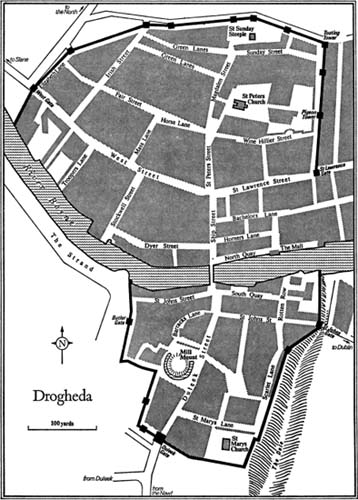
On 10 September Cromwell issued his first official summons to Sir Arthur Aston to surrender the town, under a white flag, having in his own words ‘brought the army belonging to the Parliament of England before this place, to reduce it to obedience, to the end effusion of blood may be prevented … If this be refused,’ he continued ominously, ‘you will have no cause to blame me.’ Aston however refused to surrender. Cromwell’s white flag was replaced by one of red, the colour of blood. The great guns installed south of the town on a hill now known as Cromwell’s Mount began to pound. And the city wall, magnificent structure as it was, began to sag and crumble. Aston at this point undoubtedly had fearful problems. The harbour was blockaded by the enemy, under Sir George Ayscough. He had in all about two thousand, two hundred foot and three hundred and twenty horse, of whom the preponderance were Catholics. Ormonde could send him no more reinforcements. His arms and his provisions were both running short, and the lack of armaments in particular made it difficult to make punitive sallies out of the town. Worst of all, the town of Drogheda was not united behind him. As a microcosm of the troubles of Ireland in the last seven years in which the various factions had always found it so difficult to combine against a common enemy because of their own divergent interests, there were those within who preferred the idea of the English Parliamentary force. Aston’s own grandmother, Lady Wilmot, a woman in whom advancing years had not brought a diminution of spirit, headed a ladies’ plot to betray Drogheda. Aston’s attitude to it all was unsentimentally brisk. Turning Lady Wilmot and her relations out of the town, he threatened otherwise to ‘make powder of her’, grandmother or no grandmother. Subsequently Ormonde, more gentlemanly than the betrayed grandson, merely banished Lady Wilmot to Mellefont ‘in the consideration and respect we retain for her years and quality …’14 But the whole incident showed up the dilemma in which Aston found himself.
The rules of war of the time, with regard to sieges, were clear. If a commander refused to accede to a summons to surrender, and the town was subsequently won by storm, then he put at risk the lives not only of all his men, but of all those who could be held to be combatants. The significant moment was when the walls were breached by the opposing side; thereafter quarter could not be demanded. The reason for the rule was equally clear: it was an age when sieges were long, wasteful in disease and supplies, and men sitting endlessly before a fortress were liable to be debilitated in every sense (as indeed Aston and Ormonde had foreseen in their plans for holding Drogheda; immediately after the siege Cromwell admitted that his troops lying in their wet cold tents had already suffered from that short period of exposure). Therefore a besieged commander often did well to hold out as long as possible, unless he had some marked incentive to surrender. The rule of no quarter once the walls were breached did provide this important incentive. It was hoped that in the end lives would actually be saved: garrisons would surrender quickly, sieges would be short, and victories brief but not bloody. The rule was well understood at the time. A few months later in Ireland, Lord Broghill, by no means an inhumane man, had the officers of Castleton shot ‘to affright these little castles from so peremptorily standing out’. And it was a rule still observed in the time of Wellington one hundred and fifty years later. The Duke himself declared that ‘the practice of refusing quarter to a garrison which stands on assault, is not a useless effusion of blood’.15
Therefore when Aston told Ormonde that ‘they were unanimous in their resolution to perish rather than to deliver up the place’, he was making a heroic boast which he might well be called upon to implement. Nor was the civilian population of the town necessarily protected from the rash consequences of the commander’s refusal to surrender – which may do something to explain the Wilmot embroilment. For one thing there was the obvious danger that combatants and non-combatants would become confused in the hubbub of a sack. But the theories of the time were not even particularly conscious of the humanitarian claims of the weak and helpless. Grotius in De Jure Belli ac Pacis, a work first printed in 1625, that attempted to prescribe some limits to the vengefulness of war as a result of the appalling slaughters of the Thirty Years War, still postulated that it was lawful to kill prisoners of war, and furthermore that ‘the slaughter of women and children is allowed to have impunity, as comprehended in right of war and 137th Psalm – “Happy shall he be that taketh and dasheth thy children against the storm” ’. The massacre of Magdeburg was less than twenty years away, that before Philiphaugh where even Leslie indulged in something at least comparable only four. Monk later committed atrocities at Dundee without a blemish on his reputation. The first regulations of war were introduced to protect soldiers, not civilians. Taken all in all, it was not a pretty age in which to be involved in a siege willy-nilly, and the situation of the civilian inhabitants of Drogheda in September 1649 could at best be said to be highly exposed.
The first effect of the Cromwellian cannonade was to beat down the steeple of St Mary’s, and the tower at the corner of the wall. It was then decided, in Cromwell’s own words, ‘to do our utmost the next day to make breaches assaultable, and by the help of God to storm them’. The site chosen for this first assault was the church itself. As Cromwell said, it was not so much that it was an easy position to take (it clearly was not) but that having stormed it with their foot, they could hold it successfully against the enemy’s horse and foot until their own horse could enter. No other point in the town had a similar advantage. The assault began at five o’clock in the evening of 11 September. But from the first, the plan did not go smoothly. For one thing, the breaches made were too small to allow the horse to enter, so that it was the Parliamentary foot versus the combined forces of horse and foot on the other side. The enemy put up an exceptionally stiff resistance. Worst of all, Colonel James Castle, in command of a regiment of Parliamentary foot, was shot in the head and soon died, while a number of other officers and men were killed ‘doing their duty’ (Cromwell’s words). As a result of this, coupled with the reckless courage of the defenders (which Cromwell in rather disgruntled tones noted God had granted them) and the natural ‘advantages of the place’, the Cromwellian forces were obliged to retreat and abandon their breach altogether for the time being.16
It is legitimate to speculate that this preliminary unlookedfor rejection, at the moment when Cromwell’s whole Irish military policy still swayed in the balance, was the weight which now brought it down on the side of violence. Although some of his men now got through near the Duleek Gate, and killed forty or fifty of the enemy, they still could not reach the town proper. It was time for the second assault on the church, if possible more bloody than the first, and still the dispute was fiercely hot, and still the English were being driven back. It was at this point that Cromwell himself, seeing their disheartenment, rushed into the breach, and held it until reinforcements under Colonel Ewer came up. Finally, and at much cost, with seven or eight thousand men of the Cromwellian army at last pouring through the walls, the church and surrounding entrenchments were seized.
It was at this point, according to the evidence later given to Ormonde, that some offer of quarter was given to and accepted by certain Irish officers and soldiers, who agreed thus to lay down their arms. The matter, not surprisingly in the heat of battle, is obscure. It is true that Colonel Wall, the Irish leader, was killed. After this, some individual offers of mercy may have followed, so that some Irish officers may have laid down their arms genuinely believing that they would be spared. Two things however are certain. First, that no quarter at this point could possibly have been expected by the rules of war. Second, that no such offer was ever made officially. Ludlow in his memoirs specifically denies it was made. Whitelocke heard that ‘they all agreed in the not giving of quarter’.17 As for Cromwell, it is extraordinarily unlikely that, even if it had been put to him, he would ever have agreed to such a thing.
For Cromwell was by this time in a white heat of passion. After the seizure of the church, Aston and those defenders with strength and spirit left to go had fled across the traverse of the hill to the Mill Mount, and ensconced themselves once more in its huge squat fortification. Pursued by the Parliamentarians, there were some tentative approaches for surrender. But at this point the infuriated Cromwell rushed up and ordered all to be put to the sword. In this manner, nearly every man was killed, including the defiant Aston, who was bludgeoned to death with his own wooden leg which the soldiers erroneously believed to be stuffed with gold-pieces. Blood-lust, that terrible emotion, now swept across the Parliamentary ranks, nor did their commander do anything to quell it, nor perhaps could much else have been expected in that cruel context. As the Parliamentary hordes swept through the streets of Drogheda, for it was too late now to cut off the commodious northern part of the town by its drawbridge, one thousand people died in the streets. Orders were given that all who had borne arms should be put to death, and although civilians were thus officially spared,* undoubtedly many perished, either by accident or because the line of demarcation between combatant and non-combatant was impossible to draw in the hectic conditions of a sack where it was human nature for any man, civilian or otherwise, to hold a weapon in his hand.
The friars and priests of Drogheda were another matter. Their fate was extreme. No orders were given to spare them. They were treated as combatants, and perhaps, poor wretches, some of them had fought to preserve their cause. But they died almost to a man. More horrible still was the fate of those defenders of another church, in the north of the town, St Peter’s, which also refused to surrender. Clustered in the steeple, those inside found their refuge turned into a huge funeral pyre, as the wooden pews of the church were gathered beneath them and set alight. The voice of a miserable human torch was heard crying out: ‘God damn me, God confound me; I burn, I burn.’ Cromwell repeated the words afterwards in his battle report to Parliament without emotion. But one who jumped free and only broke a leg was given quarter ‘for the extraordinariness of the thing’. By nightfall there were still men lurking on top of the city walls, and it was intended to abandon these and let them be starved into submission. But when some of their numbers were unwise enough to fire downwards and kill a few Parliamentarians, Cromwell ordered the officers among them to be ‘knocked on the head’, and every tenth man of the soldiers to be killed;* the rest were to be sent to Barbados. According to the Verney family memoirs, some of the Mill Mount officers were put to death with more variety. Sir Edmund Verney, who was supposed to have been granted quarter, was enticed out of Cromwell’s presence and run through. And when Colonel Boyle was dining with Lord More the next day, one of Cromwell’s soldiers whispered to him that he must now come outside and meet his end. As Boyle rose from the table, Lady More asked him in surprise where he was going. With perfect savoir-faire, Boyle turned and replied: ‘Madam, to die.’19 It was an answer in the great tradition of those Cavaliers who had died with honour and a jest on their lips in the Civil War.
Altogether somewhere between two and four thousand people died at Drogheda: Cromwell gave two, Dr Bate four, and the official verdict was nearly three thousand. At least there can be no argument as to how Cromwell looked on the whole affair afterwards. In his letter to Parliament via the Speaker concerning the battle, he wrote: ‘I am persuaded that this is a righteous judgement of God upon these barbarous wretches, who have imbrued their hands in so much innocent blood; that it will tend to prevent the effusion of blood for the future, which are satisfactory grounds to such actions, which otherwise cannot but work remorse and regret.’ He then proceeded to his proverbial exhortations to Parliament to attribute all the glory of this victory to God. However for once God’s mercy was seen to have pursued a somewhat fluctuating course: ‘That which cause your men to storm so courageously, it was the Spirit of God, who gave your men courage, and took it away again; and gave the enemy courage, and took it away again; and gave your men courage again, and therewith this happy success. And therefore it is good that God alone have all the glory.’20 Baldly, even brutally, Cromwell had summed it all up from his own point of view. First of all, the Irish, those massacrists of 1641 (who Cromwell had somehow convinced himself were now congregated within the walls of Drogheda), had richly deserved their fate, or as Jones was supposed to have boasted beforehand, he would sacrifice the flower of the Irish army to the ghost of the English they had killed. Secondly, the massacre of Drogheda was in any case also an excellent practical move, which would help on the progress of peace in Ireland as a whole.
Leaving aside the historical inaccuracy of Cromwell’s first point, his second point, if grim, did have much force. Drogheda, by rubbing in the lesson of a siege and a storm, undoubtedly frightened many lesser garrisons into peaceful submission. Cromwell hardly needed to underline the point in his message of summons to Dundalk soon after Drogheda, calling on them to surrender and ‘thereby prevent effusion of blood’. The terrified garrison, like that of Trim, simply abandoned their position. As Ludlow commented in his memoirs, ‘the extraordinary severity I presume was used to discourage others from making opposition’. Ormonde made the same point from the other side in his letter to King Charles ii: ‘It is not to be imagined how great the terror is that those successes and the power of the rebels [i.e. the English] have struck into this people … [they] are yet so stupefied, that it is with great difficulty I can persuade them to act anything like men towards their own preservation.’ Henry Fletcher, in his comparatively balanced seventeenth-century biography of Cromwell, defended his subject against the accusation of cruelty along the same lines: he had acted merely as a surgeon, only opening a vein to preserve ‘the whole Body of the Nation’. Militarily, then, the sack of Drogheda could fairly be said to have done what Cromwell wanted, and what was more, the achievement came at the outset of his expedition. In September 1649 the English situation was still far from secure in Ireland, for all the Rathmines victory, but Drogheda showed from the outset that Cromwell, one way or another, intended to be master. As Whitelocke commented of this delicate period: ‘if the Parliament had lost but one battle, all who were engaged with them had been in danger of ruin’.21
But that, alas, cannot be the end of the story. It is not only that the propaganda war against Cromwell in Ireland began at this point with Ormonde, who described the events of the sack as ‘making as many several pictures of inhumanity as are contained in the Book of Martyrs or the Relation of Amboyna’,22 two extremely emotive comparisons to seventeenth-century Englishmen. They referred respectively to Foxe’s famous Book of (Protestant) Martyrs, and the pamphlet or Relation describing the atrocities of the Dutch against the English settlers in the East Indies in 1623 which had a great effect on English public opinion. Many and terrible were the Irish stories which grew and grew out of the fearful doings of that day and night at Drogheda; there were tales of young virgins killed by soldiers, of Jesuit priests pierced with stakes in the market-place, of children used as shields by the assailants of the church, although Oliver’s own mercy was said to have been stirred by the sight of a tiny baby still trying hopelessly to feed from the breast of its dead mother. Propaganda is one thing. Personal guilt is another. It is personal guilt which interests the biographer. The conclusion cannot be escaped that Cromwell lost his self-control at Drogheda, literally saw red – the red of his comrades’ blood – after the failure of the first assaults, and was seized with one of those sudden brief and cataclysmic rages which would lead him later to dissolve Parliament by force and sweep away that historic bauble. There were good military reasons for behaving as he did, but they were not the motives which animated him at the time, during the day and night of uncalculated butchery. The slaughter itself stood quite outside his usual record of careful mercy as a soldier, and as he said himself, under other circumstances would have induced ‘remorse and regret’.
And so quickly over, in the heat of the moment, in a foreign land, occurred the incident that has blackened Oliver Cromwell’s name down history for over three hundred years. Even so, it is important to realize that at the time the reaction to the news in England itself was one of delight and rejoicing. The ministers gave out the happy tidings from the pulpits; 30 October was set aside to be a day of public thanksgiving. More practically, an additional body of troops was ordered to be sent across the Channel. All public expressions were those of satisfied acclaim: the heinous Irish rebels had received their just rewards.
With Drogheda, Dundalk and Trim emasculated, Cromwell harried a little of Meath and Westmeath, waiting for news of Colonel Venables from Ulster. Perhaps he visited Trim, perhaps Ballinlough, more certainly Trubly Castle. To this period accrue many legends, the most prominent being the story of Lord Plunkett who was watering his horse at the ford at the same time as Cromwell and saw the reflection of the Englishman’s dreaded countenance in the stream. He hurled his naked blade at the tyrant but in vain; Lord Plunkett, son of the Earl of Louth, was captured and condemned to death. However when he asked to die with his good sword in his hand against any two of Cromwell’s officers, the General was moved by his spirit to grant him pardon, on condition that there should always be an Oliver in the Plunkett family. Not all the details of this engaging tale can be correct, there had already been Olivers among the Louths since the 1st Earl of Louth a hundred years earlier.23 Nevertheless throughout Cromwell’s time in Ireland there is a steady substratum of stories of clemency shown towards personal courage beneath the layers of harsher tales, to which pleasant tradition this belongs. Soon Cromwell heard with delight that Venables had captured Carlingford and Newry with small cost, and later Belfast; with Sir Charles Coote established in Down in Antrim, the north was secured. It was time for Cromwell to turn towards the south where a more formidable resistance might be expected in southern Leinster and Munster, based on their prolific seaports.
But first Cromwell called in again on Dublin, there to be united with Mrs Cromwell, who brought with her not only the delights of her company, but also a quantity of household goods and furniture. According to the Venetian Ambassador, she fully intended ‘to enjoy … the title and command of Vicereine, if the plan [the subjugation of Ireland] succeeds’. Perhaps it was some of this same furniture which was seized on Cromwell’s march south, during a raid down from the hilly passes of the Wicklow mountains carried out by the buccaneering Christopher Tothill; even Cromwell’s own horse fell a victim, although its master was not astride at the time, and Tothill subsequently refused to exchange it for £100, regarding it as a useful souvenir.24 In other respects the expedition down the fair Wicklow coastline was staid; Cromwell had a formidable well-equipped body of men, and the fleet sailed majestically down beside them in support. On the way to Wexford, there was a pause to take Enniscorthy Castle, a neat little castle in another orderly quayside town, a miniature version of Drogheda. It surrendered without a blow. So it was on down the wooden riverside road to the port of Wexford, close to the extreme southwest tip of Ireland.
Wexford, with ‘its brave spacious harbour’ in the words of Sir William Brereton ‘capacious of many thousand sail’, had a twofold importance for the invaders. In the first place it was the natural jumping-off and jumping-in place for the Continent, and as such must be quelled, added to which the inhabitants were suspected of having recently dipped their fingers in the muddy waters of piracy. Secondly, the season, that ineluctable factor of all foreign campaigns, was drawing on, and the weather was already markedly wet and windy. The army was not improving in health as a result, and ‘the country sickness’ or dysentery was taking a fearful toll. It was necessary to think of winter quarters, for which Wexford provided the obvious focus. Wexford was reached on 1 October by the van of the army, and the rest followed the next day; over seven thousand foot and two thousand horse now encamped in the north-west corner of the city. Their camp was ‘almost drowned in rain and dew’ as they waited for the furious storms to subside in order to unload their siege-guns and ammunition from the ships now blockading the harbour: so wrote Robert Wallop the regicide, who accompanied the expedition, in the anonymous narrative believed to be his.25
Within Wexford itself, the split between military governor and town population, already noted in the case of Aston and the inhabitants of Drogheda, was much magnified. Indeed the town had already wished to surrender and only the arrival of that governor in the shape of Colonel David Sinnott with an extra one thousand, five hundred men, at the orders of Ormonde, had stiffened its weakening backbone. Even so, the civic dignitaries of the town were far more inclined to peace than war, and as Sinnott told Ormonde, ‘to speak the truth nakedly, I find and perceive them rather inclined to capitulate and take conditions of the enemy’. There were many Catholics within Wexford who preferred the prospect of Cromwell to that of Ormonde’s confederation. Some of the inhabitants under Hugh Rochford tried to negotiate with Cromwell, and the Mayor and Aldermen made their feelings clear by serving Cromwell with placatory offerings of sack, strong waters and strong beer throughout his negotiations with Sinnott. When the fort of Rosslare, which guarded the harbour, was evacuated by the defenders ‘by the bounty of Heaven’, Cromwell had some reason to hope for a tranquil acquisition of the whole town.
Sinnott however was an optimist. Wexford as a city lay the whole length of the harbour, and was surrounded by a town wall of exceptional strength – twenty-two foot high, and lined with ramparts of earth fifteen to twenty foot thick. There was a castle at the southern end of the town, just outside the wall. Moreover the ferry to the outside world to the north was still open, by which Sinnott hoped to receive further reinforcements from Ormonde, to make up for Cromwell’s vast numerical advantage. Therefore Cromwell’s first summons of 3 October, in the usual language ‘to the end effusion of blood may be prevented and the town and country about it preserved from ruin’, met with a prevaricating response from Sinnott. He suggested a general cessation of hostilities. Cromwell would have none of this, calling for a more definite resolution by twelve noon, pointedly adding that in the prevailing filthy weather ‘our tents are not so good a covering as your houses …’ However he did agree to send deputies to treat, so long as it was understood that they were to treat only of surrender. Sinnott’s answer was to demand ‘honourable terms’ otherwise he would die honourably, and to suggest a further delay until eight the following morning. Cromwell’s reply to this was to unload his guns from the harbour.26
But at this point Lord Castlehaven arrived with one thousand, five hundred horse via the ferry, to supplement Sinnott’s meagre resources. Although Sinnott was quick to deny to Cromwell that he had been delaying on purpose, awaiting just such a development, he did now ask for more time that Castlehaven too might consider the terms, and from the tone of Cromwell’s reply of 6 October, it is clear that he was becoming enraged by Sinnott’s obvious procrastination. Three days later, he moved his entire camp round to the south of the town, and positioned his great guns on the high ground which rose above it there, now called Cromwell’s Fort, dominating the panorama of water and buildings below. An outcrop of rocks, including one particularly imposing one known as the Trespan Rock, provided an excellent stable environment for a cannonade.* Cromwell’s guns knocked some damaging holes in the structure of the castle lying at their mercy below them, at which, as Cromwell wrote later, ‘the Governor’s stomache came down’, and he began to negotiate once again.27
The appearance of Ormonde outside Wexford, sending another five hundred foot and one hundred horse into the beleaguered city, brought yet another element into Sinnott’s calculations. According to a contemporary, Sinnott once more refused to surrender on any conditions (which this same witness believed had been his intention all along). But in the meantime, before the arrival of these fresh reinforcements, Sinnott had certainly suggested lavish terms for himself and the townsfolk, including the free exercise of the Catholic religion, the total evacuation of the garrison with all its equipment, and a general indemnity to the townspeople for their former actions (which no doubt covered the piracy). In reply Cromwell, while showing further annoyance with Sinnott’s presumption in expecting quite such glowing terms when he was in an undeniably inferior position, did offer some counter proposals. Soldiers and non-commissioned officers were to depart freely with what they stood up in, having sworn a promise not to bear arms against Parliament for life; commissioned officers would be given quarter, but retained as prisoners; as for the townsfolk, ‘I shall engage myself that no violence shall be offered to their goods, and that I shall protect the town from plunder.’ These terms were in themselves generous by the standards of the time, and when he wrote them, Cromwell clearly meant them.28
But at this point a surprising development took place, euphemistically described by Cromwell afterwards as ‘an unexpected Providence’. What actually happened was that a Captain Stafford, in control of Wexford Castle and described as ‘a vain, idle young man, nothing practised in the art military’, either found his ‘stomache’ even further down than that of Governor Sinnott or enjoyed being ‘fairly treated’ by the Cromwellians. At all events, he took advantage of the negotiations for a treaty to betray the whole castle to Cromwell. As the castle abutted the town wall, and as the wall dominated that southern corner of the town, the Parliamentarians were presented with an unrivalled opportunity to swarm over and in after the contumacious inhabitants of Wexford. Cromwell at this point, it is clear from his own narrative which makes no attempt to gloss over what happened, was still studying how to make best use of the town itself, preserving it from plunder in order to use it as winter quarters.
Let Cromwell tell the subsequent action in his own words.29 When his own men showed themselves at the top of the castle, the enemy immediately quitted the town walls, and started to flee. When the Parliamentarians saw this they
ran violently upon the town with their ladders, and stormed it. And when they were come into the market-place, the enemy making stiff resistance, our forces brake them, and then put all to the sword that came in their way. Two boatfuls of the enemy attempting to escape, being overprest with numbers sank, whereby were drowned near three hundred of them. I believe, in all, there was lost of the enemy not many less than two thousand; and I believe not twenty of yours killed from first to last of the siege.
In these stark words, Cromwell recounted what was arguably a greater blot on his career as a General than Drogheda, where at least there had been the excuse of stiff resistance, a double rebuff and the deaths of Cromwellian officers. But Wexford took place not on his orders but despite them; his men ran amok, yet no effort was made to check them by Cromwell or anyone beneath him. For them it was enough to reflect afterwards on what the wicked Catholics of Wexford had recently achieved in the way of piracy, preying upon families, ‘as a result they were now made with their bloods to answer the cruelties which they had exercised upon divers Protestants’.
Cromwell, who had not lost his appetite for Catholic atrocities, related two new ones ‘which I have been lately acquainted with’. In one tale, seven or eight Protestants were put to sea in a leaky vessel and drowned in the harbour; and in another some Protestants were deliberately starved to death in a chapel. Yet the Cromwell who related this horror story with pious disgust was the same man who had described the deaths of hundreds of Catholics without a qualm; the dichotomy in his attitude was total, his blindness to the equal human claims of the people he regarded as cruel barbarians absolute. It was God who had ‘brought a righteous judgement upon them [the inhabitants of Wexford] causing them to become a prey to the soldier …’ His only expressed regret was that the soldiers, in plundering, inconveniently had gone so far as to destroy the town: ‘I could have wished for their own good, and the good of the garrison, they had been more moderate.’ And his last words were especially revealing: Wexford was a fair city, ‘pleasantly seated and strong’ with its ramparts, and its profitable fishing trade. As the former inhabitants had mainly run away or been killed, ‘it were to be wished that an honest people would come and plant here’ to take advantage of the many excellent properties now empty.
Many details of the sack of Wexford of course appeared afterwards to fill out Cromwell’s brief account. There is the evidence of the Bishop of Ferns, Dr Nicholas French, who heard of his sacristan-cum-gardener, a boy of sixteen, killed in the episcopal palace, of priests scourged and thrown into drains, his chaplain pierced six times and left to die in his own blood.30 Certainly at Wexford priests and friars were treated simply as enemy soldiers, soldiers in the uniform of a hated faith perhaps, and were butchered with the rest. In the general slaughter that took place at the Market Cross, to the north of the town, to which many wretched people had fled for refuge through the narrow streets, undoubtedly many women died. Even if the numbers have become exaggerated the fact is attested not only in the subsequent Irish accounts, but also in English tracts of the time; Heath in his biography of 1663 gave a terrible picture of two hundred women, many of them of high rank, asking for mercy ‘with the command of their charming eyes and those melting tears’ – but it was denied to them.*31 As to numbers, it seems likely that one thousand, five hundred actual inhabitants died, quite apart from the Irish soldiers, according to a petition made from Wexford after the Restoration.*
Yet the Catholic religion, while it brought death in its wake at Wexford on 11 October 1649, brought also its own compensations. There were stories of sanctity in extremis, the rainbow after this storm of carnage: the blood of the priest staining his executioner which the man could never afterwards wash off; the dying monk whose cowl bullets could not penetrate; the English soldiers who having donned religious habits in mockery went sick and died, haunted by their blasphemies; towards the end of the day, a beautiful woman was seen from a distance ascending into the sky, just over the spot where a number of religious had died.33
Such consolatory tales presented an extraordinary contrast to the attitude of the Puritan attackers, and their future plans for Wexford. Hugh Peter wrote enthusiastically on 22 October that it was ‘a fine spot for some godly congregation, where house and land wait for inhabitants and occupiers … I wonder thousands do not come out of England to see this work, which I hope is the fulfilling of prophesies.’34 An English pamphlet on the subject, printed in London at the end of 1649, echoed Cromwell’s own words: ‘there was a wonderful providence seen in it, that when they were even on the brink to hear conditions, it should be so marvellously denied them’. Even the fact that Wexford was now totally unfit for winter quarters was seen in some way as another piece of Providence. Wallop, while admitting that the sack was contrary to intention and ‘incommodious to ourselves’, drew this conclusion from it: ‘And so we may conceive God had a further quarrel with them [the inhabitants of Wexford] than we had, and by him the issue was otherwise ordered’; it was thus the divine will that they should not use the town ‘for a winter retirement’.35 It was an attitude fully shared by Oliver Cromwell. He had not intended that Wexford should be sacked, and it is possible to make a case that Sinnott behaved with dangerous imprudence, considering his weak situation and the known disloyalty of many of his so-called supporters, in thus dragging out the negotiations. Yet once the deed was done, Cromwell’s hatred of the Irish, his conviction of their former iniquities, descended like a convenient mantle and covered it all with the embracing folds of ‘an expected providence’.
From Wexford, it was on westwards to New Ross – luckily the weather was temporarily improved – and here the summons with its now familiar references to ‘effusion of blood’, and Cromwell’s keen desire to avoid such an outcome, was passed by a trumpeter to the Governor, Sir Lucas Taaffe. The Parliamentary guns did get as far as some moderate play on the town, before Sir Lucas hastily announced that he intended to give in on honourable terms. And Cromwell, showing that he meant what he said about the advantages of surrender, did subsequently allow the soldiers to march away with arms, bag and baggage, while he guaranteed the inhabitants freedom ‘from the injury and violence of the soldiers’. However there was a delicate moment when Taaffe also asked for freedom of conscience for the people. Cromwell replied firmly: ‘For that which you mention concerning liberty of conscience, I meddle not with any man’s conscience. But if by liberty of conscience you mean a liberty to exercise the Mass, I judge it best to use plain dealing, and to let you know, where the Parliament of England have power, that will not be allowed of.’36 To latterday ears of course, Cromwell’s words have an ironic ring, since his boast of toleration so clearly had its limits. But it is only fair to point out that the irony would have been much less apparent at the time: the Catholic Mass was of course illegal in Ireland – as in England – so that Cromwell’s words were literally accurate. The distinction between freedom of thought and freedom of action, which immediately brought about a problem of the law and therefore of order, was a genuine one, in which Cromwell showed himself somewhat ahead of many of his contemporaries particularly in his later treatment of English Catholics under the Protectorate.
Despite the ‘seasonable mercy’ of Ross’s surrender, as Cromwell described it, happy at the good augury for the re-conquest of Munster, the Irish expedition was beginning to take its toll not only on his men, but on his own physique. At Ross he fell extremely sick, quite ‘crazy’ in his health, as he described it in a letter from thence to Richard Mayor. It was quite possibly his first bout of the low malarial fever that was to plague him later.* Otherwise in this unusually melancholy epistle, Cromwell was full of gloom about his son Dick, who should be admonished by his father-in-law ‘to mind the things of God more and more; alas, what profit is there in the things of this world; except they be enjoyed in Christ, they are snares’. The invalid even struck a querulous note about his usually beloved daughter-in-law Dorothy, who had failed to write to him: ‘As for Dick, I do not much expect it from him, knowing his idleness, but I am angry with my daughter as a promise-breaker. Pray tell her so; but I hope she will redeem herself.’37 (She did: by April Cromwell was asking Dick to thank her for ‘her loving letter’.) Yet for all such fancied family slights, the course of the Irish campaign was going extremely well. The death of the Irish leader Owen Roe O’Neill left the loyalty of his own forces in abeyance. The presence of Lord Broghill on Cromwell’s side was at the same time having its expected salutary effect on Munster.
During October the garrison at Cork revolted by night against the confederates; the Governor, Sir Robert Starling, awoke in the morning to find that he had lost his command, or as it was put with Irish wit at the time ‘one may truly say he was caught napping’. An English Royalist lady, Ann Fanshawe, recounted in her memoirs how she heard from her bed the lamentable shrieks of the Irish as ‘stripped and wounded’ they were turned out of the town. Sending a warning to her husband who was at nearby Kinsale, she packed hastily; obtaining at three a.m. a pass from a friend in reward for past kindnesses, she was able to steal out of Cork at five, together with her children, in a cart belonging to a neighbour. Cork was merely the first step in the Parliamentary possession of the valuable Munster garrisons. Even Lord Inchiquin started to make overtures, with a view to establishing his own immunity. At the beginning of November Youghal also revolted successfully, and Capperquin, Mallow and other neighbouring garrisons soon fell into line. Nor were these revolutions of allegiance quite as drastic as they seemed: many of the strongholds had been on the side of Parliament in the early stages of the Irish Civil War, and had only turned to the Royalist confederation in 1648. When Cromwell wrote back to England, giving an account of the course of events, and asking for additional supplies, he felt able to add: ‘through the same blessed Presence that hath gone along with us, I hope, before it be long, to see Ireland no burden to England, but a profitable part of its Commonwealth’.38
However it was comparatively late in November before a recovered Cromwell felt able to leave Ross and march on towards Waterford. The fort named Passage, which guarded the harbour, was quickly taken by his dragoons, and here once more Cromwell expected a quick pacific victory. However the weather was once more appalling and sickness was cutting through the ranks of his men at a fearful rate, a figure as high as a thousand being mentioned for the deaths, including that veteran of the New Model, Colonel Horton, and the Lord-Lieutenant’s own cousin, another Oliver Cromwell, son of his uncle Sir Philip. ‘Thus you see how God mingles out the cup unto us,’ was Cromwell’s own comment on these sorrows. Under the circumstances, it was thought politic to abandon Waterford, still unrelenting, and on 2 December proceed on towards Dungarvan, ‘it being’, wrote Cromwell, ‘so terrible a day as I never marched in all my life’.39 Finally the easeful seaside town of Youghal was reached, some twenty miles east of Cork; the army, astonishingly late in the season, was at last allowed to relax into its winter quarters.
Here at Youghal Sir Walter Raleigh had once dreamed of other worlds and read the Faerie Queen under his walnut tree. Here now Michael Jones, hero of Rathmines, died of the prevailing sickness; despite vicious rumours that Cromwell had poisoned him out of jealousy and that Jones had denounced Cromwell with his dying breath, it was the Lord-Lieutenant who pronounced the funeral oration at St Mary’s Church, and paid him a touching tribute in his letter afterwards. Cromwell himself lodged in St John’s Priory, a modest fourteenth-century building in the narrow main street.* However his winter retreat was destined to be of exceptionally short duration. In the course of it he left Youghal for Cork, where he was agreeably entertained, going on to Kinsale, as well as making a further plunge into the extreme south-west. At Kinsale a characteristic story was told of Cromwell presenting the keys to a certain Colonel Stubber, despite stories that he was not strict in his religious observance. To this Cromwell replied, in terms reminiscent of his early defence of the Anabaptists: ‘Maybe not, but as he is a soldier, he has honour, and therefore we will let his religion alone this time.’40
Despite his vicissitudes of personal health, Cromwell’s sense of purpose in Ireland remained as strong as ever, and to his original intention to defeat the Catholic powers was now added a new care for the actual population, whom he somehow divided off in his mind from his enemies. At the end of November, in writing to Parliament, he had produced the weakened health of the army as yet another instance of divine guidance: because the divided Irish had failed to take advantage of it. ‘Sir, what can be said to these things?’ he observed of the Parliamentary victories. ‘Is it an arm of flesh that doth these things? Is it the wisdom, and counsel or strength of men? It is the Lord only … Sir, you see the work is done by divine leading … I tell you, a considerable part of your army is fitter for an hospital than the field; if the enemy did not know it, I should have held it impolitic to have writ it. They know it, yet they know not what to do.’ But writing to his friend John Sadler during the winter, to persuade him to become Chief Justice of Munster, he described the ordinary Irish people as being ‘very greedy to hear the Word’, and flocking to ‘Christian’ meetings – ‘a sweet symptom, if not an earnest of the good we expect’. Cromwell expressed himself as eager to take the place of the dissolved former authority in this anarchistic land, which God was busy delivering into their hands, and urged Sadler to join him in the good work: ‘Sir, it seems to me we have a great opportunity to set up, until the Parliament shall otherwise determine, a way of doing justice among these poor people.’41
Such sentiments were in conspicuous contrast to Cromwell’s feelings towards the Irish clergy, who at the Convention of Clacmanoise on 4 December had proclaimed a kind of holy war of their own against the English. The gesture had already brought its own disadvantages among the Irish themselves, since the Anglo-Irish body of Protestant Royalists were much put off by it. Cromwell however countered with a blistering Declaration on 14 January, which however it is read, cannot amount to less than an expression of total hatred for one way of life; its more violent phrases go further and point to something nearer paranoia on the part of Cromwell towards the Roman Catholic clergy.42 Their declared aim had been towards union. To this Cromwell answered:
By the grace of God, we fear not, we care not for union. Your covenant was with death and hell … You say your union is against a common enemy; and to this, if you will be talking of union, I will give you some wormwood to bite on, by which it will appear God is not with you. Who is it that created this common enemy? I suppose you mean Englishmen. The English! Remember, ye hypocrites, Ireland was once united to England. Englishmen had good inheritances, which many of them purchased with their money; they or their ancestors, from many of you and your ancestors … They lived peaceably and honestly amongst you … You broke this union! You, unprovoked, put the English to the most unheard-of and most barbarous massacre (without respect of sex or age) that ever the sun beheld. And at a time when Ireland was in perfect peace, and when, through the example of the English industry, through commerce and traffic, that which was in the natives’ hands was better to them than if all Ireland had been in their possession and not an Englishman in it … What think you by this time, is not my assertion true? Is God, will God be, with you? I am confident he will not.
And from this amazing start, which one must at least believe to be a sincere expression of the attitude of England to Ireland in the seventeenth century, Cromwell proceeded to denounce the Roman Catholic religion in language of even greater violence. It was the priests who were ‘the intruders’ in Ireland, the ‘violators of the known laws’ with their Mass. And as for the charge that the English army had only crossed the sea to claim Irish lands:
No, I can give you a better reason for the army’s coming over than this. England hath experience of the blessing of God in prosecuting just and righteous causes, whatever the cost and hazard be. And if ever men were engaged in a righteous cause in the world, this will be scarce a second to it. We are come to ask an account of the innocent blood that hath been shed … We come to break the power of a company of lawless rebels … We come (by the assistance of God) to hold forth and maintain the lustre and glory of English liberty in a nation where we have an undoubted right to do it …
Yet even here, in this gale of passion, it must be noted that Cromwell preserved the distinction between the ordinary people and the priests; at least the former were to benefit from Cromwell’s own brand of belief in personal tolerance, ‘what thoughts they have in matters of religion in their own breasts I cannot reach; but think it my duty, if they walk honestly and peaceably not to cause them in the least to suffer in the same’. As at Ross earlier, the emphasis for them was on civil order not on private conformity.
By 29 January Cromwell was ready to take the field again, and since he wrote to Parliament that regiments which had lately marched but four hundred men were now mustering eight or nine hundred, we must assume that the sick were now on their way to health. His next objective was to expunge Ormonde’s influence from the rich Munster inlands in a series of castle-cropping operations in the golden vale to the east of Tipperary; here the castles of Cahir, Cashel, Fethard and Clonmel formed a kind of square, averaging about a dozen miles apart, over the Comeragh mountains from Cork. There were some relaxed moments during the campaign which with its adjacent castles and rivers, its marching soldiers and generals, took on the character of a chess game. Newcastle, the seat of the Prendergasts, was saved from destruction by surrender, on condition that it was no longer fortified, and some Parliamentary soldiers were left behind to supervise the removal of the armaments. Suddenly the pack of buckhounds belonging to the owner gave tongue; the retreating army hurried back, under the impression that their own soldiers were being attacked and yelping for help. In the end dogs and owner had to be taken before Cromwell to convince him of the innocent truth. Cromwell, only too pleased no doubt to ameliorate the conditions of his Irish stay with his favourite outdoor pursuit, proceeded to have some excellent sport with the pack, and as Protector, wrote a personal note that this same Prendergast should not be transplanted.43
All in all, those fortresses which showed the wisdom of surrender, received the promised reward of mercy. Fethard’s agreement, for example, contained a crucial clause protecting the inhabitants from the plunder of their estates and property from that time forth, and five years later when Cromwell was Protector, they successfully petitioned him against transplantation ‘under the shelter of your gracious annexed concessions’. The result was a note signed Oliver P: ‘Our will and pleasure is that the Articles granted by Us to the Inhabitants of the Towne of Fethard in Ireland, be well and truly observed and performed in all things, according to the true intention and meaning of them.’ And the lives of the clergy were spared. Cahir, a particularly imposing castle on the river Suir, did put up some resistance. Cromwell in his account of it to Parliament could not resist pointing out that it was a stronghold which had taken the Earl of Essex in the days of Elizabeth eight weeks to besiege, but was now theirs without loss of a man. Even so Cahir’s terms were generous and the clergy were spared. There is a tradition that Cromwell observed, standing on a hill, ‘This, indeed, is a country well worth fighting for’, and although the story is also told of William of Orange, it is easy to see how he might have been seduced by the dulcet beauty of the Tipperary plains, stretched out round the Rock of Cashel like a green sea; the story also gains plausibility from the fact that Cromwell set aside a good deal of Tipperary for himself, rather than the Adventurers or the soldiers.44
Having joined up once more with Ireton, Cromwell now turned to Kilkenny, north of Callan, where the magnificent castle of the Ormonde family dominated the rocky town; it was a palace, wrote a Frenchman of the period, to rival some of the palaces of Italy with its marble fitments. Cromwell had high hopes of securing Kilkenny without striking a blow, particularly since a certain Tickle was expected to betray it to him. He arrived without siege materials. But Tickle was routed out by the Governor, Sir Walter Butler, and the subsequent negotiations for surrender were long and for a time fruitless, since first of all the castle was ‘exceeding well fortified by the industry of the enemy’ and would cost much ‘blood and time’ to take, and then the Governor expressed his intention of dying with his whole garrison rather than submit.
For all Butler’s obduracy, Cromwell in a rational mood was a very different fellow from Cromwell in anger. The first assault of his army was uncharacteristically weak, and Butler did not finally propose terms until a second storm had begun. Although Cromwell understandably refused to allow Butler the same favourable terms as the previous towns (which Butler demanded) he did suggest a compromise scheme which protected the townsfolk from the natural effects of a sack. The soldiers having been promised the right of plunder if they took Kilkenny by storm, Cromwell, pointing out that the townsfolk had Butler to blame for their predicament, asked them to pay in lieu £2000 ‘as a gratuity to his Excellency’s Army’. Even so, Butler’s men were allowed to march away free with drums beating and colours flying; and of their forfeited arms, they were allowed to keep at least one hundred muskets and one hundred pikes to defend themselves against the Tories – those Irish brigands who were now pillaging all-comers.45
The season was now advanced into April, and Cromwell, as he himself admitted, was well aware that his presence was beginning to be urgently required back in England. As early as 11 January, the Speaker of the House of Commons had been ordered to write to him to confer about Ireland and the settlement of the civil government there, since the Scottish situation was rapidly getting out of hand. But in his report on Kilkenny back to Parliament, Cromwell only referred to ‘divers private intimations’. Without an official request from the Speaker, he decided it would have been ‘too much forwardness’ in him to have left his Irish charge. As a reply, it showed Nelsonian overtones of turning a blind eye to orders and need not be taken quite at its face value. Cromwell certainly knew of the official desire for his return even if a proper request had not reached him. As a professional soldier however he was anxious not to leave Ireland until the campaign was to all intents and purposes concluded. By now only Clonmel, Waterford and Limerick remained of strongholds to the Royalist cause, and it was to Clonmel that he proceeded to turn his attention. Already he had the encouraging news that the Royalist confederation itself was melting away in the unhappy atmosphere after Clacmanoise, and negotiations were put in hand for the disbandment of the Royalist army in Ireland, on condition that the soldiers should find their way abroad. On 26 AprilArticles for the Protestant Party in Ireland were signed by Cromwell at Carrick; although both Ormonde and Inchiquin refused to allow themselves to be personally included in them, Cromwell at least did his best to press safe-conducts upon them, having much to gain from their disappearance abroad. In the end only Lady Ormonde accepted an official pass from the Lord-Lieutenant, who allowed her, her family and her household to leave by ship.
At Clonmel, another town flanked by the meandering Suir, Cromwell found Hugh O’Neill. Sometimes called by the Irish buidhe or swarthy, he was the nephew of Owen Roe O’Neill by his elder brother Art Oge; he had been born in the Spanish Netherlands and served in the Spanish army. With twelve hundred men, O’Neill had been installed at Clonmel since February. By the end of April the Cromwellian guns were engaged in their now familiar bombardment upon Irish stone. But in Hugh O’Neill Cromwell had met a wily adversary, one who was neither pusillanimous nor lacking in initiative. O’Neill’s first move was to have huge fortifications of stones piled up within the town walls, forming lanes behind which he placed his guns. As a result, Cromwell’s first attempt at a storm, accompanied as it was by some fervent hymn-singing, was nevertheless an unrelieved disaster. His men found themselves caught in a peculiarly unpleasant trap. The leaders, when they realized the truth, were quick to cry out ‘Halt! Halt!’, but as in the Lays of Ancient Rome when those behind cried forward and those in front cried back, the followers were too busy screaming ‘Advance! Advance!’ to heed. The outcome was a massacre. Some estimates of the dead even went over two thousand. Cromwell, waiting vainly at the main gate to be admitted, was said by a soldier eyewitness to have been as vexed ‘as ever he was since he first put on a helmet against the King, for he was not used to being thus repulsed’. He insisted on a further assault being carried out, but this time, although his men penetrated the town, hundreds more were slain by the skilful defenders. It was necessary to retreat.
Of course O’Neill knew that with his inferior numbers and lack of powder such a recoil could only be temporary. Having behaved himself, according to Sir Lewis Dyve, both ‘discreetly and gallantly’ in defence of the town, he decided to escape with all his men in the middle of the night, leaving the Mayor of the town free to treat for terms in the morning. Thus when Cromwell finally entered Clonmel, having granted the usual moderate terms to the Mayor, it was only to find that the armed birds were flown. Cromwell was said to have been furious and turned on the Mayor: ‘You knave, you served me so, and did not tell me so before?’ ‘Had his Excellency enquired,’ replied the Mayor smoothly, ‘he would have told him before.’ As to the treaty of surrender, he reminded Cromwell that he had his reputation for keeping his promises in these respects. Cromwell calmed down. He also kept to the terms. But he did think it worth enquiring what sort of man O’Neill was. The Mayor told Cromwell that he was ‘an oversea soldier born in Spain’. This provoked another explosion from the General – ‘God damn you and your oversea’ – and a threat to pursue O’Neill and destroy him.46 The spritely O’Neill however continued to elude Cromwell’s vengeance. Later he held Limerick against Ireton, and when that too finally surrendered in 1651, pleaded Spanish nationality with success to escape the death sentence. Imprisoned in the Tower, he was released on the intercession of the Spanish King, and died peacefully in Spain. He deserved his survival for his unique feat in outwitting old Ironsides.
Altogether Clonmel – from Cromwell’s point of view – was a sorry affair. For his military reputation, it must rank with the second battle of Newbury (where of course he was not holding supreme command) as one of his very few rebuffs. One could plead that although he had mastered the rules in the West Country in 1645 Cromwell had never been a great sieger, relying more for his effects on daring and surprise. When he met daring and surprise on the other side in the shape of Hugh O’Neill, the odds were by no means so loaded in his favour. Indeed, militarily speaking, Cromwell’s real triumph in Ireland was to have succeeded in mounting such an exceptionally well-paid, well-equipped and well-trained force, the like of which had hardly been seen in that country before. With guns ‘like sons of Mars’ as a contemporary wrote,47 it was no wonder that so many Irish castles crumbled to his touch. Otherwise Ireland did not provide him with victories, no new stars to join the great constellation already formed by Marston Moor, Naseby and Preston.
By now however Cromwell’s days in Ireland were numbered in earnest. On 9 April the Council of State had despatched a message ordering him to return forthwith, and the new frigate President, built on the orders of the Admiralty Committee the preceding autumn, was sent to bring him back. By 13 May horses were being ordered up to await the conqueror’s return at either Barnstaple or Bristol. Although Cromwell proceeded south once more, and paused briefly before obstinate Waterford, a further letter from the Council outlining important matters ahead of him at home clinched the matter of his return. Leaving Ireland to the cares of Henry Ireton, Cromwell left Youghal for England by the harbour beyond its mediaeval walls on 26 May. The Irish venture was over. He had been in Ireland for nine months and fourteen days.
But the mud of his Irish reputation was not so easily shaken off. It was not that Cromwell did worse than some conquerors. Cromwell was no Macbeth. He did not feel so far in blood imbued after Drogheda and Wexford that nothing remained to him but to plunge in it still further. As has been seen, his subsequent terms for surrender were mild, and his actual pardons to priests and friars contrasted strangely with the vicious words in which he denounced the Roman Catholic clergy generally in his Declaration. But Cromwell fought a dangerous opponent: the folk memory of a tenacious, doughty, romantic, bellicose people – the people of Ireland. It was this force, mightier even than the godly Ironsides, which would quarry down Cromwell’s memory in the future as relentlessly as those priests were hunted down at Drogheda and Wexford. Some of the Irish stories about Cromwell are predictably fey and strange;* his name is latched on to improbable fairy tales; he becomes an English cobbler who rose to become King of all Ireland and whose body is put into the sea in three coffins at his death at a point where three seas meet; in other stories the King of France’s son courts his daughter.† Then of course there are the inevitable stories of iconoclasm, as in England, and as in England a considerable proportion apply to places Cromwell did not actually visit. The rhyme recited concerning one castle: ‘Oliver Cromwell, he did it pommel’ may stand for a whole series of tall tales by aspiring guides.48 What is true however is that ‘the Curse of Cromwell’ remains a prodigious oath on the lips of Catholic Ireland, and may never be forgotten.
It remains to consider how far Oliver Cromwell deserved this nemesis which has come upon him. It has been seen that the attitudes which he expressed were conventional to much of contemporary England, for better or for worse. On his return from Ireland to England he was fêted as a hero, and throughout his stay there, Whitelocke noted that in his own country his honour had increased with his successes. It was to signify his recall that Marvell sprang into verse with his great Horatian Ode; the Perfect Diurnall took the line that the Irish had been well treated at all points, except the toleration of ‘their Popish idolatry’ which was not to be expected. Mercurius Politicus referred with uncritical adulation to his ‘famous services in Ireland; which being added to the garland of his English victories, have crowned him in the opinion of all the world, for one of the wisest and most accomplished of leaders, among the present and past generation’.49 A day of public thanksgiving was set aside. The Speaker Lenthall spoke an eloquent Oration, describing ‘the great Providence of God in those great and strange Works, which God hath wrought by him [Cromwell] as the Instrument’. With peace in Ireland, the way was open for the continued settlement there by the English, that period of Irish history known as the transplantations. It was in this manner that Cromwell came to symbolize a hated policy.
He had not initiated this policy: it had been in full swing since the reign of Elizabeth, and the theory of England’s rights of colonization had existed for centuries before that. Nor for that matter did Cromwell have much to do with the carrying out of it: many of his critics in Ireland might be surprised to learn as they invoked the Curse of Cromwell that he never went back there again after May 1650, and although the transplantations and Adventurers’ settlements were put into effect during the Commonwealth and Protectorate, Cromwell’s personal interventions were always on the side of mercy for individuals. Nevertheless he came to personify a policy which the historian Lecky in the eighteenth century described as ‘the chief cause of the political and social evils of Ireland’.
Yet there is a grim justice even in the false charge. Cromwell was a soldier of genius; it was as a victorious general that he had incurred the focus of public attention upon himself; the glory that he trailed in the minds of the English was military glory, and it was by military strength that he had been able to bring about those political objectives which seemed to him right. In Ireland, as a conqueror, he had fallen below his own high standards as a soldier, at Drogheda in hot blood, at Wexford in cold. Harshly judged as he has been for these two aberrations, he had always earlier benefited from the power and prestige conferred by victory. Whether he intended to or not, Cromwell lived by the sword. Now his reputation perished by the sword. It was certainly not fair, but at least in some sad sense it was fitting that what should have rightfully been the Curse of England now became the Curse of Cromwell.