

Elizabeth Steward, Oliver Cromwell’s mother, a portrait by an unknown artist, now at Chequers.
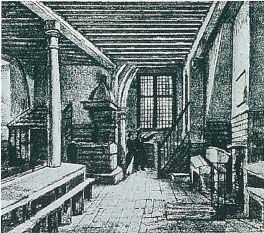
Huntingdon Grammar School where Cromwell studied under Dr Thomas Beard (now the site of the Cromwell Museum).
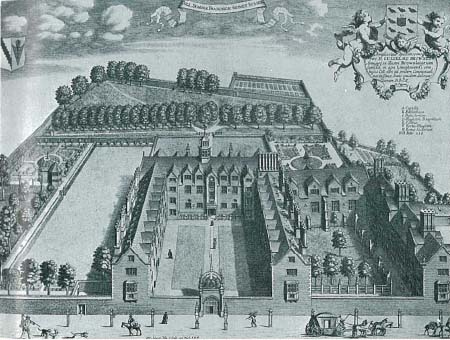
Sidney Sussex College, Cambridge, where Cromwell was a student 1616–17.

The entry for the marriage of Oliver Cromwell and Elizabeth Bourchier on 22 August 1620, taken from the registry of St Giles, Cripplegate.

Elizabeth Bourchier, Cromwell’s wife, after a miniature by Samuel Cooper.
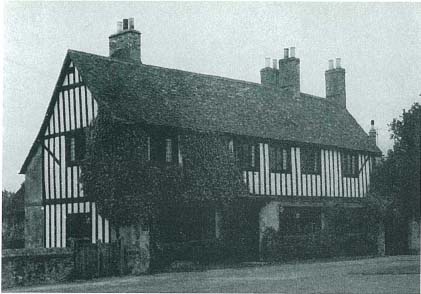
Cromwell’s house at Ely, near the Cathedral, to which he moved in 1636, seen today.
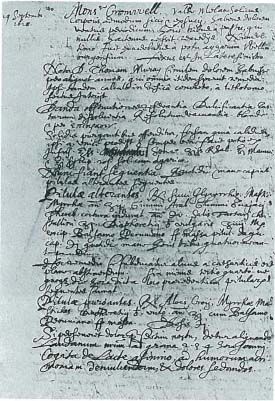
From the notebook of the celebrated doctor Sir Theodore Mayerne describing the visit of ‘Monsr. Cromwell’ on 19 September 1628, and his symptoms.
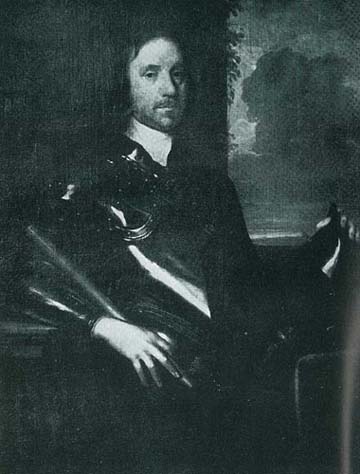
Oliver Cromwell by Robert Walker; presented by Cromwell to the Countess of Exeter after the siege of Burghley House (where it still hangs) this picture has a claim to be the earliest version of Walker’s portrait. Cromwell would have been in his mid-forties.

Colonel John Hutchinson, the Parliamentary soldier and regicide, together with his wife Lucy, who wrote the life of her husband. Painted by Robert Walker.

The Earl of Manchester, the Parliamentary General whose command was criticized by Cromwell in the events leading up to the Self-Denying Ordinance of December 1644.

Robert Rich, Earl of Warwick, by Van Dyck; a leading Puritan peer, whose grandson later married Cromwell’s daughter Frances, the richness of his dress illustrates the fact that not all Puritans dressed sadly.
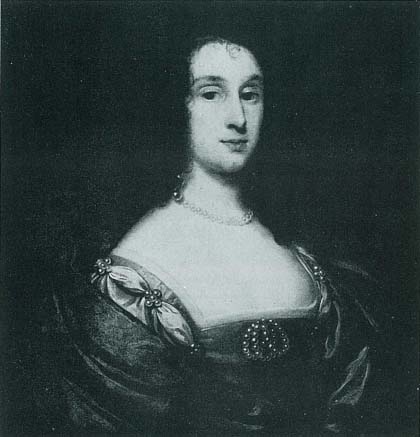
Cromwell’s eldest daughter, Bridget.

Henry Ireton, one of Cromwell’s closest associates and Bridget Cromwell’s first husband.
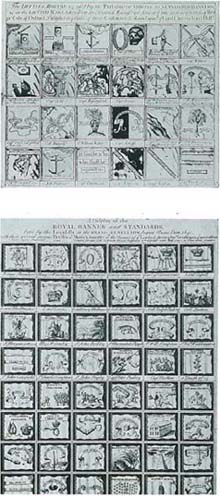
The banners and standards of Parliamentarians and Royalists from an engraving of 1722 after a seventeenth-century manuscript.

St Mary’s Church, Putney, scene of the Army debates of the autumn of 1647; the bridge shown here on the left of the picture linking the Putney side of the river to Fulham was not in existence in the seventeenth century and a ferry was used.
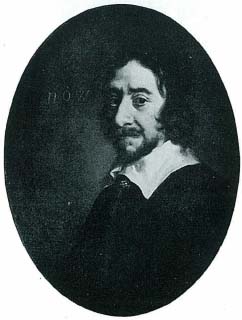
Henry Marten, the republican politician.
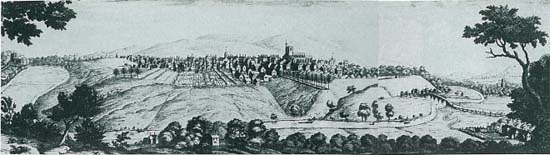
South prospect of the town of Preston engraved in 1728; the Ribble bridge and the hill, including Walton Hall, to which the Royalists retreated at nightfall, can be seen to the right of the picture.
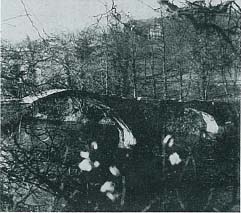
The Hodder Bridge, near Gisburn in Lancashire, at which Cromwell took the fateful decision to attack the Scots at Preston from the north, thus cutting off their retreat home; photograph by the author.
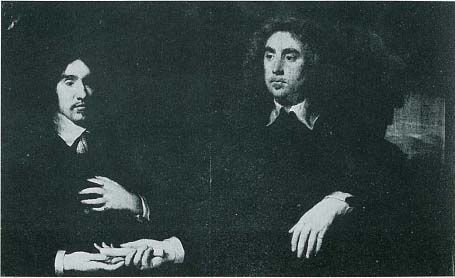
The Earl of Lauderdale and the 1st Duke of Hamilton.

The Marquess of Argyll.

Moray House, in the Canongate, Edinburgh, where Cromwell stayed in October 1648 and again in the winter of 1650–1. The house still stands today.

Sir Thomas Fairfax, by an unknown artist.

The Independent divine, Hugh Peter; from an anonymous contemporary engraving.
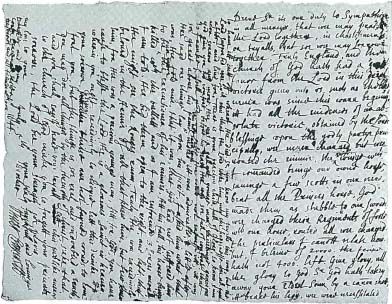
Two of Cromwell’s most famous private letters, both now at Chequers: to his brother-in-law Valentine Walton, describing the death of Walton’s son at Marston Moor in July 1644, containing the sentence ‘There is your precious child full of glory, to know sin nor sorrow any more.’ (See 3rd line down, vertical.)
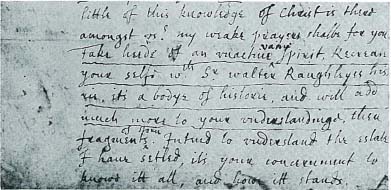
to his own son Richard (Dick) urging him, among other precepts, to read Sir Walter Raleigh’s History of the World; written while campaigning in Ireland in April 1650.
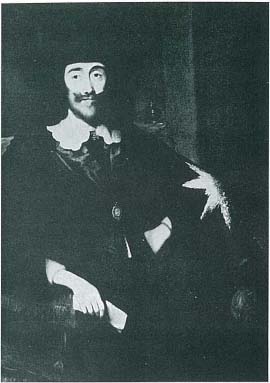
King Charles I at his trial, by Edward Bower.
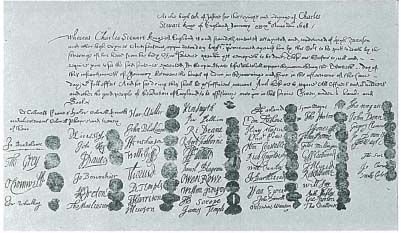
The death-warrant of King Charles I. The signature of Cromwell is seen on the left, third from the top.

Westminster Hall, 1647, from the engraving of Wenceslaus Holler.
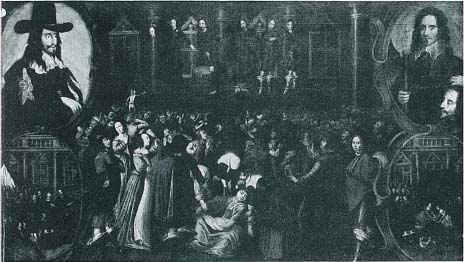
The execution of Charles I by Weesop.
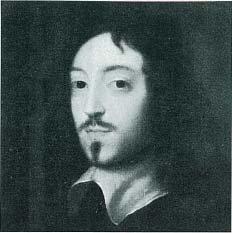
Bulstrode Whitelocke, politician and diplomat, and author of the Memorials which are an important source for the period.

The Seal of the Commonwealth, originally designed immediately after the King’s death, although this version dates from 1651. It shows the House of Commons, now the sole repository of power in the kingdom, and on the obverse side (not given) is a map of England and Ireland.

An early Royalist satire on Cromwell and his associates shows them consulting with the Devil.
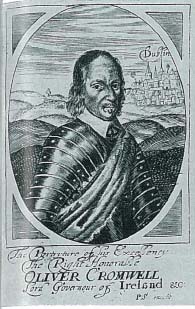
Oliver Cromwell as Lord-Lieutenant of Ireland; the frontispiece to a contemporary English publication, printed in London in 1650, giving the history of the ‘Irish Warres’.

James Butier, Earl of Ormonde, commander of the Irish Royalist forces against Cromwell; sometimes known as ‘James the White’ from his profusion of thick fair hair. Cromwell himself, gazing at his portrait, said that he looked more like a huntsman than a soldier.
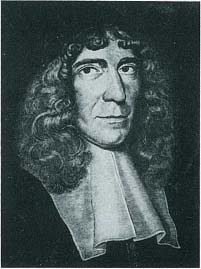
John Owen, Cromwell’s chaplain on his expedition to Ireland, and later Vice-Chancellor of Oxford University.

A map of the battle of Dunbar from a print made for Payne Fisher’s projected history of ‘these times’ commissioned by Parliament in 1651; the town of Dunbar and Cromwell’s camp can be seen in the right-hand corner, the Broxburn (river) in the centre of the picture and Broxmouth House where he planned his surprise night attack, on the right bank near the sea.
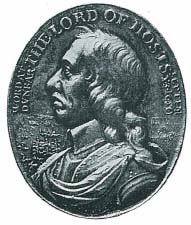
The Dunbar Medal, given to all ranks, engraved by Thomas Simon, who paid a special visit to Scodand to get the likeness of Cromwell.
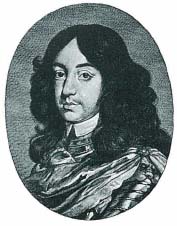
An engraving of King Charles II in 1650 at the age of twenty.

William Lenthall, Speaker of the House of Commons throughout the Long Parliament; this portrait hangs today in the Speaker’s House at Westminster.
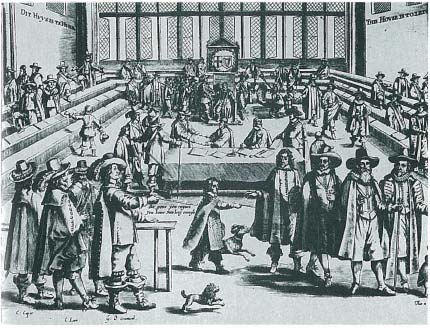
An imaginative Dutch engraving of Cromwell’s dissolution of the Rump of the Long Parliament in April 1653.
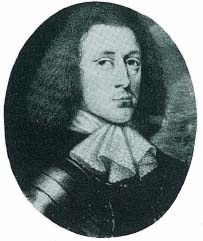
Richard Cromwell, Oliver’s elder surviving son.

Henry Cromwell, his younger son.

Oliver Cromwell, the miniature by Samuel Cooper painted when he was in his early fifties, which is thought to have been the master copy from which many later portraits were taken.
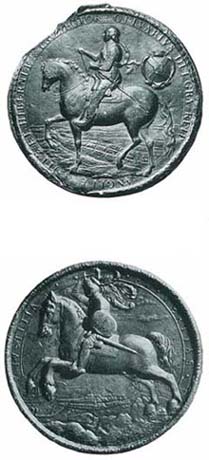
The Scottish seal of Oliver Cromwell as Protector. It shows a striking similarity to that of King Charles I in design, also shown here, although the battle-field of Dunbar has been substituted for a view of Edinburgh, illustrating how many of the details of the Protectoral office were modelled on former royal ones.

John Thurloe, Secretary to the Council of State.
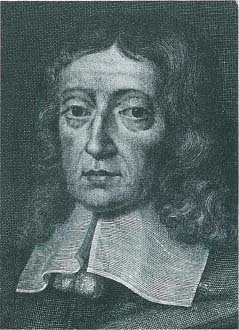
John Milton, an engraving by Vertue.

Andrew Marvell by an unknown artist c.1655–60.

Charles Fleetwood, Puritan soldier and politician, who married Cromwell’s daughter Bridget as her second husband.
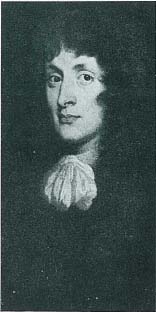
John Lambert by Robert Walker.
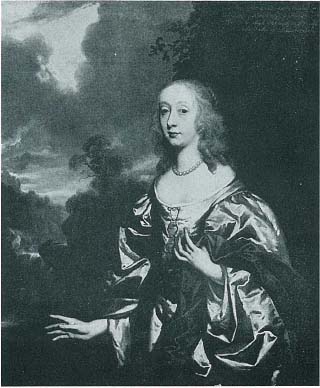
Elizabeth (Bess) Murray, wife of Sir Lionel Tollemache and Countess of Dysart in her own right, alleged to have been Cromwell’s mistress.

A group of personal belongings:
(a) Cromwell’s hat, said to have been worn at the dissolution of the Rump Parliament.
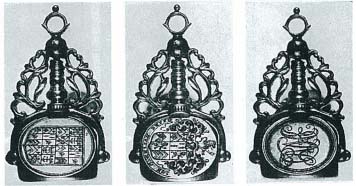
(b) Three views of his private seal as Protector. Both the hat and the seal are owned by his direct descendants via Henry Cromwell, the Cromwell Bush family, on loan to the Cromwell Museum, Huntingdon.
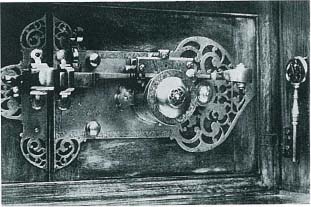
(c) Cromwell’s private lock, now owned by a direct descendant via Bridget Ireton.
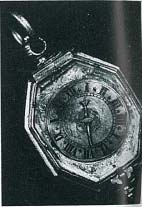
(d) Mrs Cromwell’s watch, now at Chequers, among other relics inherited via Frances Cromwell’s descendants.
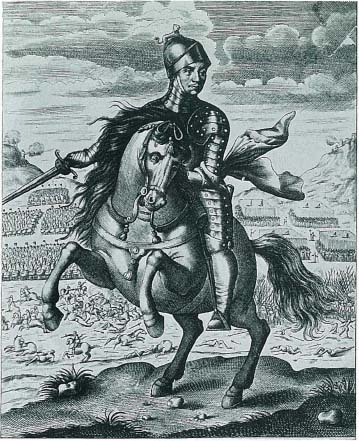
Engraving by William Fairthorne.
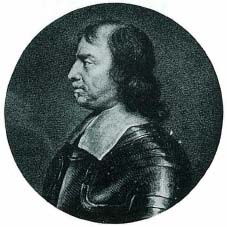
Engraving of Cromwell by Houbraken, after the miniature by Samuel Cooper.

Cromwell’s favourite daughter Bettie, a miniature now at Chequers.
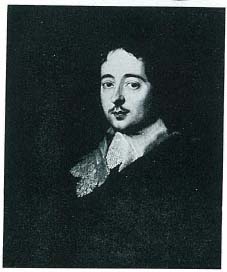
Her husband John Claypole.

Mary Cromwell, wife of Viscount Fauconberg of Newburgh Priory, York, where this portrait still hangs today.
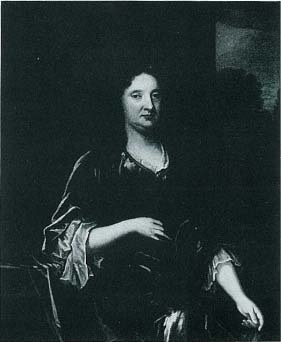
Frances Cromwell, who married first Robert Rich and then Sir John Russell; a portrait now at Chequers, the property which once belonged to her descendants.
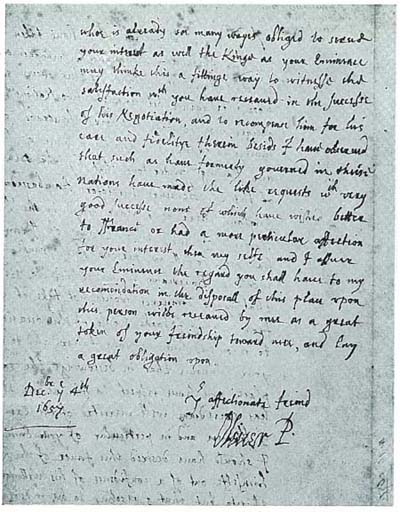
Part of Cromwell’s letter to Cardinal Mazarin, written in his own hand in December 1657 recommending the French Ambassador Bordeaux for a place in the Parlement de Paris. The writing is noticeably weaker than that of six years earlier.

One of the last-known signatures of Oliver Cromwell, dated 26 July 1658, less than six weeks before his death, and showing extreme shakiness.
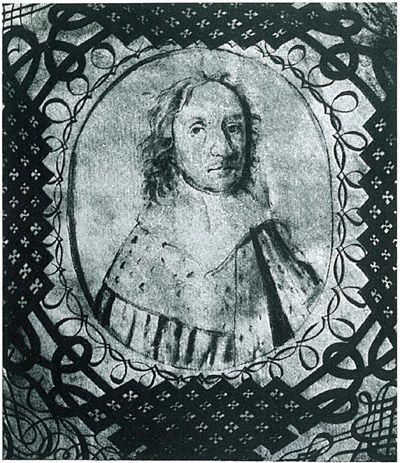
An illuminated initial from a charter of 1658 at Chester showing Cromwell in the ermine-trimmed robe of a king. A comparison with a similar charter of King
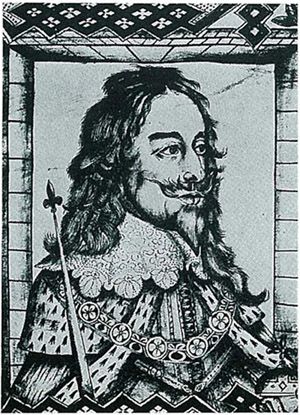
Charles I shows how close to regality Cromwell’s image was now approaching in the last year of his life, despite the rejection of the kingship.
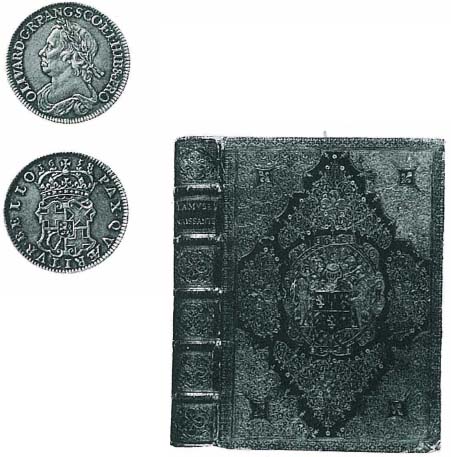
An example of the Protectoral coinage, which although struck was probably never circulated, showing Cromwell’s imperial profile, crowned with a laurel wreath, with a crown on the reverse.
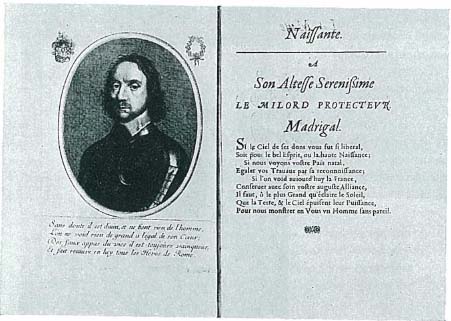
The title page and binding, incorporating the Protector’s arms, of a book of 1657 by a French boy prodigy, Jeune Apollon by Chastolet de Beauchasteau, which was bound richly in morocco for presentation. The flattering verses show the elevation of Cromwell’s European reputation.
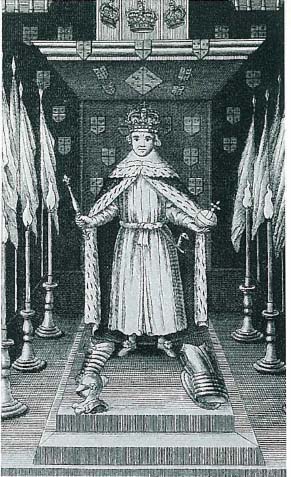
The apotheosis of Oliver Cromwell: Cromwell standing in state at Somerset House; from a contemporary engraving of a broadsheet of 1659.

his lying-in-state in Somerset House after death, in which a wax effigy was used, first lying, then raised to signify the passing of the soul from Purgatory to Heaven; the ceremony was closely modelled on that used for King James I’s lying-in-state.

A head of Oliver Cromwell, now in the Bargello Museum at Florence, probably a contemporary replica of his wax funeral effigy, also modelled by Simon but in plaster.
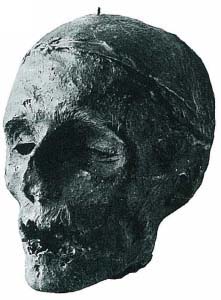
The skeletal head of Oliver Cromwell, buried since 1960 near the chapel of Sidney Sussex College, Cambridge. Note the hole in the head indicating that it was trepanned after death for embalming.
* Now known as Cromwell House and used by the Huntingdon Research Centre for their library. Since 1968 it has been marked by a large painted version of the Cromwell coat of arms on the exterior.
* First published in 1663 in the full fervour of post-Restoration hatred.
* The Welsh took much care with their pedigrees, because of the way their legal system worked; land belonged within certain groups and fines were liable to be paid within these groups for crimes such as murder, all of which necessitated keeping a close grip on family alliances. For this reason Welsh pedigrees, although a matter for pride, were not necessarily proof of wealthy status, as English ones might be.
* Noble’s Memoirs of the Protectoral-House of Cromwell, first published in 1787, is nevertheless a valuable source for the intimate details of Cromwell’s life because the author was in a position to sift and gather up many of the legends concerning him before they had been altogether lost by the passage of time. In this he was assisted by his friendship with the Misses Eliza and Letitia Cromwell of Hampstead, descendants of the Protector, and guardians of many family traditions as well as actual relics and portraits.14
* ‘The Brewer’ was one of the many scornful nicknames applied to Oliver Cromwell by his enemies. Verses such as The Protecting Brewer, of which a typical stanza ran:
A brewer may be as bold as Hector
When as he had drunk his cup of nectar
And as a brewer may be a Lord Protector
As nobody can deny
show the insulting, if rollicking, uses to which the theme lent itself.18
* Beneath the date and above the entry can be seen the words ‘England’s plague for five years’ although they have been scored through. They are likely to have been added during the Civil War period and crossed out later.
* The building can still be seen today, largely in its original state; it is the site of the Cromwell Museum, opened in 1962. The school has another distinguished old boy in Samuel Pepys.
* In his Bibliography of Oliver Cromwell W. C. Abbott cites this as the first biography proper of Cromwell printed after his death. It was dedicated to Richard Cromwell.
* W. C. Abbott in his Letters & Speeches of Oliver Cromwell I, p. 33 makes a case for Oliver’s attendance at Gray’s Inn, on the grounds that so many of his future associates were there at the time when Oliver also would have attended. But this seems an unnecessary complication in view of Oliver’s family connexions with Lincoln’s Inn, and the fact that Gray’s Inn is not mentioned by any of the early biographers.
* By the mid-seventeenth century the name Joan was intended as an insult; for although earlier ladies of class had borne it, such as Oliver’s aunt, Joan Barrington, and his sister who died as a baby, about this time the name was coming to be used as the generic name for a type of female rustic – witness Shakespeare’s reference to ‘greasy Joan’ keeling her pot.
* Two entries in the Register of St John’s Church, Huntingdon, dated 1621 and 1628, in which Cromwell was rebuked for ill-doing and did penance for it have been shown to be later entries in another hand. Even if (as S. R. Gardiner believed) they represent some authentic local tradition, they are just as likely to concern some tithing misdemeanour as a personal one. The nature of the wrong is not specified.
* Obviously any group critical of the monarchy found itself from time to time in a literal sense in opposition to its aims. But there was of course no official opposition, in the modern sense, since any opposition to the King, as such, constituted treason. Since the composition and aims of such a group also fluctuated between 1628 and 1643, there was also no political ‘party’ in the modern sense.
* One of the difficulties of this period is the fact that the complete proceedings of Parliament were not, as now, officially disseminated. Members of the House of Commons sometimes kept private journals or diaries of proceedings or made notes; Sir Simonds D’Ewes in his important Journalsdrew on some of these sources. About 1640 certain speeches began to be printed by order of the House. Both these were inevitably selective procedures. It was not until 1681 that a general resolution was adopted for printing the votes and proceedings of the House. The Commons’ Journals however, recording bills passed and the various stages of passing, were first begun in the reign of Edward VI.19
* In one of these parish records Oliver Cromwell’s signature has met its usual fate of being in some way defaced – in this case cut out by an eighteenth-century church warden. But in the town of St Ives today a commanding statue of Cromwell has been erected in the main street, finger pointing towards the wayfarer, which although regularly disfigured with red paint is nevertheless an imposing memorial to his sojourn there.
* When the rectory of St Mary and Holy Trinity was surveyed under the Commonwealth in 1650 with similar properties belonging to deans and chapters with a view to selling them, there was mention of a ‘lease’ of the oblations and offerings of the parish from ‘Oliver Cromwell, Esq., late farmer and by him of the said rectory, and by Daniel Wymore, late archdeacon of Elye, unto Richard Pursaby of Elye, tanner’.9
* The house, apparently a tavern in Carlyle’s time,11 is now the vicarage of the nearby church of St Mary’s.
* The title was first applied by the Royalist newspaper Mercurius Aulicus in November 1643.
* He succeeded his father as Earl of Manchester in November 1642, to become the well-known Civil War leader of that name; Viscount Mandeville was his courtesy title during his father’s lifetime, but as he had been raised to the House of Lords in 1625 in his own right as Lord Montagu of Kimbolton, he was also sometimes known as Kimbolton during this time.
* See Walter D. Love, Civil War in Ireland: Appearances in Three Centuries of Historical Writing.
* See F. J. Varley, Cambridge during the Civil War 1642–1646, pp. 79–83 for a reassessment of this incident, correcting the Royalist records from those of the Colleges.
* Perez Zagorin in The Court and the Country, 1969 in his Conclusion calls it ‘one of those singular correspondences that figuratively declare the passing of things … in a very real sense what began in 1485 [i.e. the realm’s subjection to monarchical authority as established by the Tudors] was ending in 1642’.33
* To mention some of his competitors in the stakes of reputation, Julius Caesar had performed military service as a young man, and Wellington of course was trained as a professional soldier from his youth.
* A monument to the battle, a five-foot pillar of Cotswold stone, can be seen on the road between Kineton and Edgehill. Its inscription includes the reminder that many of those who lost their lives in the battle are buried near by.
* See especially G. F. Nuttall, Was Cromwell an Iconoclast? and Alan Smith, The Image of Cromwell in Folklore and Tradition.
* Hotham is here using the term ‘Anabaptist’ pejoratively to denote among other things a person of low birth, in the way it was always used in this period: the Baptists themselves never employed it. Dr Christopher Hill has described the term ‘the Anabaptists’ as the seventeenth-century equivalent of the modern term ‘Reds’.31
* For the battle in general see especially Brigadier Peter Young, Marston Moor 1644, where the various contemporary accounts are listed, pp. 210–69.
* Brigadier Peter Young in Marston Moor uses the evidence of Lumsden’s plan of the battle, unknown to earlier writers, to suggest that the Parliamentary forces may well have been about five thousand less than has been supposed, which again makes Rupert’s challenge more plausible.
* The obelisk that marks the battle of Marston Moor, erected jointly by the Cromwell Association and the Harrogate group of the Yorkshire Archaeological Society, in addition to a tribute to Fairfax, bears the tactful inscription: ‘Near this site The Parliamentary Army Left to the leadership of Oliver Cromwell Supported by David Leslie Completed the defeat of The forces of Prince Rupert.’ As a considered judgement one could do much worse.
* Not Hinton-in-the-Hedges near Banbury, north of Oxford, as W. C. Abbott suggests. For this point and for a general reassessment of the pre-Naseby campaign, see R. N. Dore, Sir William Brereton’s Siege of Chester and the Campaign of Naseby.
* Not printed in W. C. Abbott. For full text see R. N. Dore, op. cit., p. 30 and p. 31.
* Not printed in W. C. Abbott. For full text see R. N. Dore, op. cit., p. 30 and p. 31.
† Not printed in W. C. Abbott. See The Letter-Books of Sir Samuel Luke, ed. H. G. Tibbutt. No. 1301, D. 30, p. 542.
* The scene of the battlefield can still be examined profitably today since it is not too dramatically changed; the exception is the present Naseby–Clipston–Harborough road, which at the time, as Professor Austin Woolrych pointed out in Battles of the English Civil War, p. 124 and fn. 1, was only ‘the most vestigial of tracks’ leading north to Sibbertoft. In discarding this road (because it barely existed) as the road the New Model were following, and in the placing of the battle, which necessarily follows, farther west than that of Colonel H. C. B. Rogers in his Battles & Generals of the Civil Wars, the present writer has therefore followed Professor Woolrych.
* One of their original mottoes had in fact been:
If you take our cattle
We will give you battle
* After Bettie’s untimely death, he married again, and at the end of his life his affections were the subject of dispute between this second wife and the laundress with whom he lived.
* See Professor G. E. Aylmer Was Oliver Cromwell a Member of the Army in 1646–7 or not? who cites the appropriate references from the PRO Commonwealth Exchequer Papers, Army Committee, Warrants SP 28/41.
* See Thomas H. Clancy SJ, The Jesuits and the Independents: 1647.
* Rainsborough was a rising star in the councils of the Army, a man who had connexions with Puritan worlds both New and Old; one of his sisters was married to Governor Winthrop of Massachusetts and another to Winthrop’s son. Having raised a regiment for Manchester (which was full of returned New Englanders) he had become an MP in May.
* The French text reads: ‘Il me disoit un jour, que l’on ne montait jamais si haut, que quand on ne sait où l’on va’, but of course Cromwell must have spoken to the Ambassador in English, having little if any French. S. R. Gardiner dates the conversation convincingly 9–11 July, when Bellièvre visited the officers: in any case it had to take place sometime before October when Bellièvre left England.39
* This historic church (see illustration), although rebuilt in the nineteenth century, can still be seen today in its old strategic position, although it now lies just over the (new) Putney Bridge.
* For this speech, and those of 23 November and 3 December, an important source is the diary of John Boys: see David Underdown, The Parliamentary Diary of John Boys 1647–8. A man of forty who had been MP for Kent for the past two years, Boys made radical speeches but also voted with the moderates on occasion, his career, like that of many middle-group MPs of the period, showing no particular consistency. His diary is often couched in dog-French which gives rise at times to some bizarre expressions.
* Not an anachronism: the word actually used, deriving from the Old English Canne.
† Roger Lord Broghill and later Earl of Orrery lived until 1679, but could of course have told the story to his chaplain and biographer many years before his death. In the eighteenth century the whereabouts of the ‘Saddle Letter’ was the subject of fashionable speculation. About 1743 Bolingbroke told Alexander Pope that Lord Oxford had handled a letter from the King to the Queen which had been intercepted; earlier there was a report that an auctioneer named Millington had possession of it, but would not show it to the enquirer.27
* The York tavern in Pembroke Main Street is pointed out as the site of Cromwell’s headquarters inside the town. A field near the Underdown camp is still known as Cromwell’s Field where the Roundhead dead are said to have been buried.
* Born William Hamilton, he had been created Earl of Lanark by Charles i in 1639. He subsequently succeeded his brother as 2nd Duke of Hamilton.
* Not the Ribble Bridge as Oliver wrote in his letter, not knowing the area, but that of its tributary the Hodder; the bridge in question can still be seen, now ruined but beautiful in decay.
* This lie of the land, still marshy and used for allotments, can be discerned today, despite surrounding town development. The main intersecting road is named Cromwell Rd, and its offshoots, Langdale Rd, Lambert Rd and Hamilton Rd, a tribute to the historical imagination of a nineteenth-century town council.
* Cromwell’s pious hopes for the baby’s future were not fulfilled. The boy, later 1st Marquess of Wharton, became a notorious profligate, and was described by Swift as wholly occupied by ‘vice and politics’. Perhaps he was even reacting against his early upbringing, for Swift also termed him that worst of all things, ‘an atheist grafted on a dissenter’.
* The origin of the nickname later given to the English political party, just as the Irish Catholic peasants gave rise to the opposing epithet – also originally opprobrious – of Tory.
* Still to be seen in the Canongate, with a coroneted M for Moray over one window, although now a college of education.
* Much use was made of this doctrine, in full Salus Populi Suprema Lex, in the Remonstrance to provide moral authority for the attack of the Army on the King; it claimed that ultimate sovereignty lay with the people, there being merely a contract between ruler and ruled, which if broken (as Charles had done) entitled them to revolt.8
* See David Underdown, Pride’s Purge p. 149 and footnote 17, which corrects W. S. Abbott’s tentative dating of 29 November; this not only allows for too long a gap between Cromwell’s reception of the Remonstrance and his comment to Fairfax, but also by making the Tuesday of his letter 5 December, ignores the fact that Cromwell actually left on 1 December.
* This second speech is dated by its reporter 2 January, but it clearly covers the same occasion as the first, and it was on 26 December that the House first moved to ‘proceed capitally against the King’.20
* Both hat and armour can still be inspected today, the hat in the Ashmolean Museum, Oxford, and the armour in the Guildhall, Stafford.
* Today roughly the site of a blind courtyard between the House of Commons and the House of Lords, or St Stephen’s Court as it is termed in the guidebooks, known more informally as the Boiler House Court and used appropriately enough for storing scaffolding. It must be remembered that the river was then considerably wider, and the present terraces of the Houses of Parliament non-existent.
* Today a brass plate marking the spot where he sat commemorates the trial of King Charles i. Hastings was later impeached in Westminster Hall, but it stopped being used for such judicial trials in 1806. The remaining law courts were moved in 1822. The more modern brass plates commemorate merely the peaceful lyings-in-state of British sovereigns and their consorts, as well as a few notabilities including Mr Gladstone and Sir Winston Churchill.
† See C. V. Wedgwood, The Trial of Charles I, bibliographical note p. 227 for a useful summary and consideration of the various texts of the trial.
* It is only fair to say that Ingoldsby’s signature shows in fact no signs of such violence; for all his boasted words, ‘If his name there were compared with what he had ever writ himself it could never be looked upon as his own hand’, it seems perfectly normal.
* The story was first published in Spence’s Anecdotes in the eighteenth century; it was supposed to have been told by Lord Southampton to an intermediary whence it reached Alexander Pope.
* See Robert Birley, The Undergrowth of History, where other similar stories are considered at length such as King Alfred and the Cakes, Sir Walter Raleigh’s cloak, etc.
* According to the old method of dating which started the year on 25 March, the King had been put to death on 30 January 1648.
* The word, originally meaning the public welfare or general good, had come by the beginning of the sixteenth century to mean the body politic or the State, especially viewed as a body in which the whole people had a voice or interest; by the seventeenth century it was also coming to designate a republic.6
* Later he came to be known as the Latin Secretary, because although he could translate French, Italian, Spanish or Portuguese, he wrote back in Latin.
* Shades of the colour green were then the acknowledged colours of the revolutionaries, as red is now.
* See R. H. Gretton for The Levellers at Burford, pp. 223–56 in Studies in Burford History.
* A signature carved by a soldier Antony Sedley during his enforced residence can still be seen in Burford Church, and a note in the register records three soldiers shot to death on 17 May 1649 buried in Burford churchyard.
* If Cromwell had heard correctly about Dorothy’s condition, then she must have already by this time have been pregnant again, for the first child, a daughter, was born to the Richard Cromwells at the end of the following March.
* Some priests seem to have got through the net. Father Nicholas Netterville, SJ, claimed to have dined with Cromwell and played chess with him, and used the story to announce afterwards that he proposed to say Mass with impunity: ‘I am a priest, and the Lord General knows it. And tell all the town of it, and that I will say Mass here every day.’ The story is probably apocryphal; but it is curious that Cromwell always showed a weakness for the personal company of Roman Catholics, while he denounced them roundly in the whole.3
* See Chapter 4.
* Compared by Dr Edward MacLysaght in Irish Life in the Seventeenth Century to that of Hong Kong today, whose customs are very different from those of China.8
* St Mary’s Church, the Dale Mill Mount, and even the town wall, although much knocked about, can all be seen today: a visit does much to make the course of the siege of Drogheda intelligible because it makes clear the peculiarly strong defensive position presented by the south end of the town.
* It must be emphasized that Cromwell gave no direct orders for the massacre of the civilian inhabitants: when he related the casualties in a letter to Parliament, he did not mention them, and it was the Parliamentary printer preparing it as a pamphlet for public circulation who added the words at the end: ‘And many inhabitants’.18
* From this type of reprisal derives the word ‘decimation’, which has come to mean, in popular usage, the destruction of a large number, but originally meant on the contrary that only one among ten of mutinous, cowardly or rebellious soldiers died.
* Still to be seen today: much played on by children from the nearby housing estates.
* Today a plaque can be seen on the site, now the Bull Ring, at Wexford, commemorating the massacre in these words: ‘It is fitting that this plaque be erected here to commemorate the five Franciscan priests, two Franciscan brothers, and numerous citizens of this town, who were slaughtered by Oliver Cromwell on October 11 1649.’ The Franciscan church has an account of the massacre prominently displayed on its wall, and the names of seven Franciscan friars killed, some kneeling before the altar and others hearing confessions; two friars were called Sinnott and two the less glorious name of Stafford.
* State papers. Irish Series. Charles ii. Vol. 307. No. 65. PRO: – ‘where among the rest the said governor lost his life and other of the soldiers, and inhabitants to the number of fifteen hundred persons’. It is wrongly calendared in the Irish State Papers to give the impression that a total of 1500 died, but the original makes it clear.32
* A form of malaria which was extremely common in the seventeenth century: it was not, however, a fatal disease, being of the benign tertiary variety.
* Still to be seen and marked by a plaque, although now an electrical shop.
* Lady Gregory’s Kiltartan History Book cites four, of which the most appropriate is actually entitled A Worse Than Cromwell and concerns drink: ‘Cromwell was very bad but the drink is worse. For a good many that Cromwell killed should go to heaven, but those that are drunken never see heaven.’
† The general impression presented by the legends collected at the Irish Folklore Commission in their file on CROMAIL is, perhaps surprisingly, more one of great power than of great evil. It is also noteworthy, if less surprising, how few of the stories could possibly ever have had any foundation in fact.
* The sequence of this newspaper, which lasted in this form until May 1658, provides an interesting sidelight on how the English Government wished itself to be regarded abroad during this period. It appears that it made sufficient impression on the Continent for Cardinal Mazarin to have read it on occasion.6
* But there is no suggestion that Cromwell himself called for the information, any more than that contained in the subsequent horoscope cast by Ashmole for the exact moment of his entry into Scotland on 22 July. As an ardent astrologer, Ashmole naturally bent his attention to personalities and events of national importance. Six weeks later he was to be found enquiring via the configuration of the heavens whether ‘the news of the routing of the Scots be true or not’.9
* Trevelyan (Longwitton) MSS. Not printed in W. C. Abbott.
* Isaiah, Chapter 28, v. 1–15. Cromwell was slightly misquoting. The prophet actually wrote: ‘Because ye have said, we have made a covenant with death, and with hell we are at agreement …’ Cromwell was presumably also quoting the same passage in Ireland, although he did not think it worth giving the Roman Catholic clergy the Biblical reference.
* Maurice Ashley in Cromwell’s Generals, p. 38, suggests that it was not so much the cramped Scottish right wing which attracted the Generals’ attention as their strung-out position, presenting several openings; but although Cromwell was later to make lethal use of such an opening, his own letter specifies the ‘shogging’ of the right (to shog, literally to shake, agitate, thus to jog) as being the feature which first caught their notice. He does not mention the openings in what was a detailed account of the incident.
* The monument, a roughly shaped stone commemorating Dunbar with some words of Carlyle, ‘Here took place the brunt of essential agony of the battle of Dunbar’, is placed on the low ground at roughly the point where Cromwell would have sent in his reserves. The battlefield, dominated by Doon Hill, can still be seen today in very much its original form (with the exception of some modern cement works).
* The first medal for all ranks to be struck. There was not to be another until the battle of Waterloo over one hundred and fifty years later.
* Later Cromwell, hearing of the incident and impressed by the tailor’s character – ‘the man (I am credibly informed) feared the Lord’ – commended his widow and children to Parliament’s charity; but they had already been voted a gift of £200, and a further £100 a year.49
* Although Worcester, known as ‘the faithful City’ with its appropriate motto Civitas in Bello in Pace Fidelis, still commemorates the last Royalist stand in a plaque in Sidbury, and by the head of Cromwell nailed by its ears over the Guildhall shows its continuing opinion of the victor of the battle. There is however also a plaque placed by the Cromwell Association at the city end of Sidbury bridge recalling his own words: ‘It is for aught I know a crowning mercy.’
* An archaic term, confusing in the seventeenth century when there are Captains, Captain-Generals etc. in the field, but now coming back into use among military historians as an overall description of a commander.
* This was finally repealed in 1772. In 1827 the law was altered so that if a prisoner stood mute, a plea of not guilty was entered. For this whole subject see G. B. Nourse, Law Reform under the Commonwealth and Protectorate.
* Sir Charles Firth did take the reference to the ‘Seeker’ in this sense,20 although there is no other evidence for Cromwell’s participation. See also Geoffrey F. Nuttall, The Lord Protector: Reflections on Dr Paul’s Life of Cromwell.
* The bright and hopeful boy won golden opinions during his short lifetime (he died of smallpox just after the Restoration); he was a staunch Protestant, refusing his mother’s Catholicism, and the outcome, had he lived to replace his brother James or succeed his niece Queen Anne, is another sad might-have-been of Stuart history.
* See Quentin Skinner, Thomas Hobbes and the defence of the de facto powers. Skinner points out that Hobbes was by no means the solitary thinker in this field as has sometimes been supposed, but rather ‘the one genius at large in the discussion’ who freed it from its providentialist aura.
* See Blair Worden, The Bill for a New Representative: the Dissolution of the Long Parliament, for a convincing reassessment of long-held theories on this subject.
* That of Whitelocke who was present, that of Algernon Sidney the Republican MP whose father, Lord Lisle, later Lord Leicester, recorded it, and that of Ludlow who pieced together his story from various eye-witness accounts, notable among them that of Thomas Harrison.40
* Ludlow’s version. According to Sidney, Cromwell said, ‘Take away these baubles’, and according to Whitelocke, he bid one of his soldiers take away ‘that fool’s bauble the mace’.41
* But the true opinions of the gentlemen concerned of each other are probably better expressed by a later anecdote in which Mazarin began by dismissing Cromwell contemptuously as ‘a Successful Fool’; the story was then repeated back to Cromwell who replied that Mazarin on the contrary was ‘a Juggling Knave’ (as he had earlier termed Vane a ‘juggler’ over the Dissolution of the Rump).4
* See Austen Woolrych, The Calling of Barebone’s Parliament, for the most modern assessment.
† His own name was also variously spelt Barbon, Barebone and Barebones. The story that Praisegod had two brothers – Christ-came-into-the-world-to-save Barebone and If-Christ-had-not-died-thou-hadst-been-damned Barebone (familiarly shortened to Damned Barebone) has not been substantiated.
* The words ‘from the south’ should perhaps have been added: it was true that the Romans got no further than the Grampian mountains south of Inverness, but of course there had been other invaders from the north.
* Thus anticipating the similar rhyme about Trelawney and the Cornishmen by some thirty years.
* Just a few Frenchmen spoke English, it was thought absurd to learn English at the French Court, and the French Ambassadors’ spelling of English names was often a travesty.29
† A phrase of which Cromwell seems to have been particularly fond when overruling the practical objections of others to a scheme of his own, as will be seen later over the business of the kingship.
* This is the shade from which the bad men fled
While better fellows took their ease instead.
* Although bound with the January 1657 papers in the CSP Domestic, Sir Charles Firth makes it earlier.
* See G. Layard, The Headless Horseman, on the various vicissitudes of this engraving, a commentary on the mutability of the times, and in general David Piper, The Contemporary Portrait of Oliver Cromwell.
* The other few scattered mentions of mistresses and bastards are remarkable only for their paucity and unlikelihood. In late 1650 (when Cromwell was in Scotland) a woman ‘of ill report’ in London was saying that Cromwell ‘had been often with her, and bragged up and down of it, and that he used to give her 20s. a time’. Colonel Barkstead was said to have given her 40s. Such stories were not taken seriously by Cromwell’s contemporaries and need not be given greater weight now. In any case, like Bess’s taradiddles, they mainly spring from the gossip of later ages, such as the story of Dr Millington, conjectured in the postscript to a letter of 1744 to be ‘a bastard of Oliver Cromwell’. There was supposed to be a note in the register of his birth at Strensham in Worcestershire: ‘Query, was he not a bastard of Oliver Cromwell?’ But if this was the royal doctor Sir Thomas Millington, born in 1628, who became President of the Royal College of Physicians and died in 1704 – so that he would have been known to the writer of the letter – he was born at Newbury in Berkshire. Even Noble, who accepted this rather dubious evidence, described a history of ‘a natural son of the Protector’ then extant, as being ‘too marvellous to be true’.46
* The correspondence, not printed in W. C. Abbott, appears in the Bridgwater MSS.
* The name adopted by a flourishing modern society, founded by Brigadier Peter Young, for recreating the battles of the Civil War. Unlike its seventeenth-century prototype, the modern Sealed Knot admits of Roundheads as well as Cavaliers and has nothing to hide.
* In this manner great estates were built up, as many officers were also under another hat Adventurers. Captain Henry Pakenham, for example, of Abbott’s Dragoons, built up his Westmeath estate by three methods: land owing to him as an Adventurer, military debentures, and outright acquisition by purchase.31
* ‘And I will lay it waste: it shall not be pruned, nor digged; but there shall come up briers and thorns.’ Isaiah, Chapter V, v. 6; see also Chapter VII, v. 23, 24, 26; Chapter IX, v. 18; Chapter X, v. 17; Chapter XXXII, v. 13; Chapter LV, v. 13, for other references to thorns and briers.
* See Michael Roberts, Cromwell and The Baltic, in Essays in Swedish History, which opens with a useful résumé of the judgements of previous historians.
* See Roger Crabtree, The Idea of a Protestant Foreign Policy (Cromwell Association Handbook 1968–9).
* In the great tradition of financiers Noell survived the holocaust of the Restoration, and was in fact knighted by King Charles ii. However he seems to have died bankrupt.
* It was for this reason that Sir Winston Churchill as First Lord of the Admiralty in 1911 was so anxious to name a new battleship the Cromwell; he was defeated by stern opposition not only in official circles but from King George v.
* To be compared to the Spanish Civil War in the late 1930s, as a test of opinions.
* Not everyone took the tart line of Lady Cromwell, who was said to have responded to the rising price of oranges and lemons in housewifely fashion by depriving the Protector of his favourite orange sauce with his loin of veal. When he protested at the economy, the Protectress retorted that he should have thought of such matters before he indulged in his Spanish War …35
* The destruction of Chmielnicki’s archives also makes it impossible to state with absolute certainty that the letter did not exist. The source for it is a seventeenth-century Polish history: Annalum Poloniae ab obitu Vladislai IV. climacter primus, W. Kochowski, Cracow, 1683. In the original Latin, the Poles are said to have intercepted the letter – ‘si modo non figmentum erat – if it was not a forgery’ – between Cromwell and Chmielnicki. The letter is said to have caused some laughter, not only for the grandeur of the salutations to the Cossack, but also for the notion of an alliance between such faraway peoples, compared by the author to ‘serving up dishes of food decorated with gold and colourings; while they feast the eyes they in no way satisfy the stomach’. But of course such dishes – and such alliances – do impress onlookers.
* But see Menna Prestwich, Diplomacy and Trade in the Protectorate, for the classic exposition of the view that the Protector did deliberately ignore trade interests for those of Protestantism, to the detriment of his country.
* Lechmere MSS; not printed in W. C. Abbott.
* There is something intolerable to the spirit about official kill-joys: in the same way the Chastity Commission of the Empress Maria Theresa in the eighteenth century, which was intended to raise the moral tone of the nation, and whose commissioners had power to search houses on suspicion, had to be withdrawn after six months owing to its extreme unpopularity.
* In December 1655 the Venetian Ambassador was to repeat a story that Oliver had met Menasseh ben Israel in his youth, while travelling in Flanders.14 But there is no conclusive evidence of this, and neither party ever referred to it. If, as has been suggested, Oliver never even made this journey abroad, then the encounter was probably a legend invented to explain his philo-Semitic tendencies.
* It had been previously held that Oliver gave the Jews a verbal assurance of safety in January 1656; but this has been demonstrated to rest on a mistranslation of Salvetti’s report, from ‘meanwhile they continue to meet [for prayer]’ to the false text of ‘meanwhile they may continue to meet’. Menasseh ben Israel wrote in April 1656: ‘as yet we have had not determination from His Serene Highness’.
* Still to be seen today, although long since filled by the descendants of the Marranos and their brethren, and disused. It lies behind the Spanish and Portuguese Jews’ Hospital.
† Sigmund Freud named one of his sons Oliver in response to what Cromwell had done for the English Jews.
* In the first documentary reference to the Society, the Children of Light, then Truth’s Friends or the Friends of Truth, and so abbreviated to Friends. A meeting was first noted in 1648.
* In his insistence on mercy, Cromwell even referred to the famous text on charity of I. Corinthians … as though it applied to mercy: ‘we know that it is saith that if a man could ‘‘speak with the tongue of men and angels’’ and yet want that [mercy] ‘‘he is but sounding brass and a tinkling cymbal’’,’ he said.
* It is however the modern view that these coins although struck were never actually circulated. No Cromwell coin figures in the Trial of the Pyx of 1657. Arguments to the contrary were advanced by H. W. Henfrey in Numismata Cromwelliana, on the grounds that surviving coins show great signs of wear. But this could be explained by their retention as souvenirs, and in any case the wear exhibited is often disproportionate to the length of time they could possibly have been circulated. The popularity of such coins as souvenirs is attested in Pepys’s diary; and a series of copies were even made as a result in the late seventeenth and eighteenth centuries in England and Holland. But the proclamation of Charles ii after the Restoration demonetizing coin struck under the Commonwealth does not mention the Protectoral coinage.
* This Henry Cromwell continued to show a nice sense of timing in his allegiances. He was married to his cousin, the poetess Anna Cromwell, a passionate Royalist, who in some lines even compared Charles i to Jesus Christ; after the Restoration, he was one of those Cromwells who changed their name back to the earlier Williams, under which patronymic he attended the Court of Charles ii with success.
* Owing to the many Catholic connexions of the name Belasyse, in 1658 the Baptists attacked Oliver for having let his daughter marry one: but already in 1653 over the matter of his father’s estate and the compounding, young Fauconberg had indignantly rebutted the notion that he was a Catholic. He seems on his record to have been on the contrary a convinced Anglican.21
* It is interesting to note that Charles’s debauchery was already a feature of his reputation before he reached the throne: he himself wrote a letter of witty complaint on the subject to Lord Taaffe in 1659, concerning those ‘blind harpers … they have done me too much honour in assigning me so many fair ladies as if I were able to satisfy the half’. Leaving the question of the King’s modesty on one side, the answer was of course that it was in the interests of those in power in England to exaggerate such stories in order to stress his unsuitability for the throne, just as stories of Cromwell’s drunkenness and sickness or madness were disseminated by the Royalists.23
* Guizot, Cromwell & the Commonwealth, Vol. II, p. 346, note i, is surely right in suggesting that this letter should be dated 23 June 1657 not as bound in the Thurloe Papers, Vol. V, 23 June 1656; it looks forward to the engagement, which occurred in October 1657. The 1656 dating allows for much too long a gap.
* But among the many plaques in Westminster Hall, including of course one to the trial of Charles I, there is no plaque to this unique event in English history, the investiture of the Lord Protector.
* And in history generally up till the present time. See J. H. Plumb, The Death of the Past.
* See Charles Webster, Science and the challenge to the scholastic curriculum, 1640–1660. History of Education Society.
* The similarity to the scheme eventually adopted over three hundred years later by the British Government in 1971 is marked.
* And even then – in the 1950s – a motion to use the name Cromwell College was defeated.10
* See Maurice Ashley, Financial and Commercial Policy under the Protectorate, for a defence of Cromwell; H. J. Habbakuk, Public Finance and the Sale of Confiscated Property during the Interregnum, describing on the contrary the innate financial insecurity of Cromwell’s regime primarily because people would not lend to it, takes as his starting-point the fact that the Long Parliament was not solvent at its dissolution.
* English cooking, and even vegetables, were said to have been introduced, and the English accent also (to this day the east coast accent is notably nearer to that of England than that of the west, and easier for an Englishman to understand). It was a phenomenon, together with its Cromwellian origin, noted by Defoe in his tour of Scotland in the early eighteenth century.
* See H. R. Trevor-Roper, Scotland and the Puritan Revolution, pp. 392–444, in Religion, the Reformation & Social Change.
* Assistance still commemorated in name by Cromwell Tower at Aberdeen University, which preserves the name of the benefactor even if the structure is not contemporary.
* The controversy about the two possible emotive names for the Second Chamber was solved in the time of Richard’s Protectorate by referring to it as neither the House of Lords nor the Other House, but as the Upper House.
* When Henry Cromwell was told of this later, his acid brother-in-law’s comment was: ‘I believe the milk wherein 653 [code for Fleetwood] was sopped had much water in it.’45
* It was a measure of the Royalists’ appreciation of Bettie’s efforts in this respect that she was actually supposed to have harangued her father on the subject on her deathbed ‘like another mad Cassandra’ – a story not otherwise corroborated.16
* Today it is marked, but only by a very small incision in a tile near the place, scarcely visible to those who do not search it out.
* Oliver’s last known signature, on a document connected with the custody of an idiot, is dated 29 July; another very late signature on a letter from Hampton Court of 26 July (Milnes-Coates MSS, not printed in W. C. Abbott) concerning a place to be filled is weak and extraordinarily shaky.
* But see Earl Malcolm Hause, Tumble-Down Dick, pp. 45–8, for a recent view that Fleetwood was Oliver’s intended successor.
* See Dr Frederick F. Cartwright in collaboration with Michael D. Biddis, Disease and History, pp. 141–4, for a historical discussion of the subject of malaria.
* The author is grateful to Dr Chalmers Davidson of Edinburgh for this diagnosis, and to the Wellcome Institute of the History of Medicine for consultation.
* We owe many of the sayings of his last hours to the account of one who was present for ‘the most part’, probably his groom of the Bedchamber Charles Harvey.35 Although its essentially hagiographical nature has led to some doubts, its broad outlines – the heavy emphasis on religion – are surely likely to be correct. It seems logical to suppose that Oliver Cromwell would be obsessed with religion on his deathbed, having been preoccupied with it throughout his life. The man who had invested even his battle reports with Scriptural allusions was scarcely likely to fail now.
* The date continued to be held in reverence among Cromwell’s descendants. And in 1666 there was a curious incident reported in the London Gazette in which six soldiers were said to have chosen 3 September in advance for a military plot, because the date was astrologically favourable. Since that day was not in fact particularly propitious by these standards, perhaps they were seeking to benefit from the old coincidence of the Lord-General’s victories.5
* Many casts of this death-mask exist, notably in the Ashmolean Museum, Oxford and the National Portrait Gallery. See David Piper, The Contemporary Portrait of Oliver Cromwell. But he is ‘unable to reconcile’ the death-mask in the British Museum with Oliver’s appearance, believing it to be an authentic death-mask of the period, but of someone else. There remains the question of the so-called ‘life-mask’, on which David Piper again casts doubt, for although these were becoming popular, he thinks it unlikely the Protector would have submitted to the process. He suggests it may be a study for the bust by Edward Pierce, or otherwise based on the State effigy.
* The American President Theodore Roosevelt, repeating this story in his own biography of Oliver Cromwell, waxed particularly indignant over it, in view of the many honours given to the descendants of Charles ii and his mistresses: ‘One hardly knows whether to be most amused or indignant at such fantastic incapacity to appreciate what was really noble or what was ignoble,’ he wrote.23
* It is to the boundless energy of that great guardian of Westminster Abbey in the Victorian age, Dean Stanley, that is owed the tablet, now hidden by the carpet of the RAF chapel, which commemorates the interment of Cromwell, his mother, sister Jane Desborough, Ireton and little Anne Fleetwood. The Cromwell Association have now placed a stone at the east end of the Henry VII chapel which reads: ‘The burial place of Oliver Cromwell 1658–1661.’
* In our century, Lenin and Castro (at the time of writing) are two names that come to mind as having gone through the same experience, in their different ways. Trotsky, of course, did not survive.