
CHAPTER SIX

Truly England and the Church of God hath had a great favour from the Lord, in this great victory given to us. It had all the evidence of an absolute victory obtained by the Lord’s blessing upon the godly party principally.
Oliver Cromwell on Marston Moor
So far as numbers were concerned, the Battle of Marston Moor during the long evening of 2 July 1644 was certainly the biggest ever to be fought on British soil: afterwards the environs of the battlefield would constitute the largest communal burial ground.* There had been wet weather all that summer and this was yet another cold damp day with intermittent squalls of rain, of the type that sometimes makes the English summer climate the despair of its denizens. If the weather was gloomily predictable, one of the surprises of the terrain was that in the level verdant flatness of the Vale of York there should be some high points, of sufficient rise to constitute some sort of strategic advantage. For out of the green rye fields, knee high and soaking wet and at the edge of an area of heath, between the two villages of Tockwith and Long Marston, there arose an undoubted if gentle eminence known as Marston Hill. At the crest was parked the Parliamentary baggage while just below it, on the spot now known as Cromwell’s Plump, the joint forces of the Parliamentary armies had established a form of command-post from where they could survey the battlefield. On the lowest flanks of the slope and just above the Tockwith–Marston road was stretched out their battle line, extended for about one and a half miles between the two villages – it was not customary at this date to fortify the villages themselves.
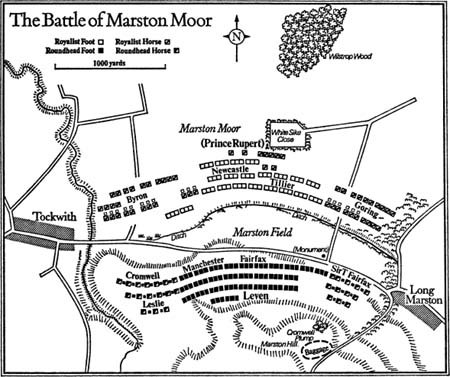
In the manner of the time, the foot were placed in the centre, flanked by cavalry on both wings. On the Parliamentary right, close by Long Marston there were about five-thousand-odd men under Sir Thomas Fairfax – four thousand horse, five hundred dragoons and six hundred musketeers – some of them Fairfax’s own ‘new levied troops’, and some Scots; Fairfax’s second-in-command was another Yorkshire man, the young and popular Colonel John Lambert. Next were drawn up a total of fifteen brigades of foot, with two regiments to the brigade, to make a total of about eleven thousand men under the general command of Manchester and the Scot Leven. Lastly came another great body of cavalry on the left wing under the command of Cromwell himself – two thousand five hundred men under his personal control, the Scottish dragoons under Colonel Hugh Fraser on the extreme left ending up at Tockwith, and behind a further six hundred Scots horse under David Leslie.
The Royalist ‘battalia’, or line, was drawn up below the Tockwith–Marston road, that is to say topographically slightly lower than that of Parliament and the Scots, and the conventional distance of about four hundred yards away, which meant that it was slightly beyond the range of the lighter pieces of ordnance generally in use at battlefields. But there was also a ditch, as well as the road, between the two armies, lying on the Royalist side, and curving irregularly to meet the road itself near Tockwith.1 The Royalists also made use of this convenient stop, lining it with their musketeers of the ‘forlorn hope’ as the advance guard was generally known. Their baggage on the other hand was at Wilstrop Wood, and the back of their line was shut in by White Sike Close. Between the two lay roughly the same disposition of troops as on the opposing side, a centre of foot and two wings of cavalry.
On the Royalist left facing Fairfax, was the dashing but unstable cavalry commander Lord Goring, a man whose ‘vivacity’ impressed his contemporaries, but whose character defects and inability to accept the authority of another was to prove one of the major problems of the Royalist command. The Royalist foot in the centre, totalling about eleven thousand, included some men brought up by Rupert from the south and some of Newcastle’s ‘Lambs’ or ‘Whitecoats’, so called because their jackets were made of undyed woollen cloth. On the Royalist right wing facing Cromwell was Rupert’s own cavalry, about two thousand six hundred strong, with Lord Byron and his regiment of horse in the front rank – an ominous piece of positioning since it was Byron whose precipitate charge of cavalry had caused much havoc at Edgehill two years earlier, and events were to show that he had not learnt much tactical wisdom since. Rupert had also lined his cavalry with musketry to break the first charge according to the Swedish fashion. Finally at the rear of the line Rupert stationed another smaller regiment of cavalry, about one thousand five hundred men altogether including his own lifeguards, known as the Bluecoats.
Both sides possessed some guns – although Parliament far outnumbered the Royalists with their twenty-five pieces – and some intermittent fire was exchanged during the afternoon while the two lines were being drawn up. Sir Henry Slingsby observed that the Parliamentary armies were merely ‘shewing their teeth’ with their random fire, since presently it stopped and they then fell to singing their Psalms among the cornfields. Something like forty thousand men now faced each other across the open ground, so near that Cromwell’s Scoutmaster said afterwards that the two wings were a musket shot apart. The Royalists at any rate had mustered about eighteen thousand by the time Newcastle and his second-in-command Lord Eythin made their belated arrival from York to receive Rupert’s grim words of welcome: ‘My lord, I wish you had come sooner with your forces …’ Estimates of the Parliamentary and Scottish forces vary from twenty-seven thousand to something nearer twenty-two or twenty-three thousand, with opinion now inclining towards the lower figure.*2
In the afternoon light the gay billowing standards of war provided not only much traditional colour for the battlefield but also the much-needed means of recognition of the various troops and their commanders: for regimental colours as such did not yet exist, and it was left to each troop and company to be marked by its own standard, guidon or colour. The cornets of the cavalry were generally of painted taffeta or perhaps damask, and borne by the fifth commissioned officer in the troop, who was thus christened by the name of Cornet. They might bear political cartoons or religious or loyal slogans, ranging from a picture of a mastiff being harried by five little beagles, out of whose mouth came forth the legend ‘Pym, Pym, Pym’ and in Latin ‘how long will you abuse our patience?’, to the simpler motto ‘Pro Rege et Regno’. The infantry colours were much larger than those of the cavalry, roughly six foot by six foot to the two by two foot of the horse: that of the Colonel was generally a plain colour, the Lieutenant-Colonel would have the cross of St George in the corner next to the staff, and so on downwards with various spots and devices to distinguish the lesser officers. The Scottish colours bore St Andrew’s Cross instead of the cross of St George.3
Obviously in an age not only before regimental colours but also before any coherent policy for uniforms, these individual rallying-points were highly important. It was true that the Royalists tended to wear crimson silk scarves and their opponents orange silk during the early stages of the Civil War, but there were many variations, as a result of which some sort of field sign was often adopted before a major battle involving many different regiments – the field sign for Marston Moor was a white favour, a handkerchief or even a piece of paper, in the hat. There was certainly no difference in the clothing of the various commanders, and the pictorially traditional lacey splendour of the Cavalier as opposed to the Puritan severity of the Roundhead commander has no basis in historical fact. On both sides, officers could be distinguished simply by the ornate nature of their dress, having no particular badge of rank to mark them out. The cavalry generally wore buff coats of thick leather with their armour over them, although some ill-equipped men had to make do with their buff coats alone. The pikemen also wore leather coats and additional thighpieces.
It was only in some picturesque coats and facings worn by individual regiments (in which there was at least a tendency among the Parliamentarians of the Eastern Association to concentrate on red) that the future convenient uniformity of army clothing was at all prefigured. Manchester’s foot for example had coats of green cloth lined with red; Colonel Montagu’s men wore red faced with white; Essex’s men wore red lined with blue. Rupert’s own lifeguards on the other hand wore blue, Newcastle’s wore white, and Colonel Tillier’s green. But clearly confusion, mistaking friend or foe, and general ignorance as to the course of the battle in another part of the line were all made a great deal more possible by such colourful – and often misleading – diversity. So that the symbolic importance attached to the colours, and the triumph over their capture is not hard to understand. These colours were the tangible proofs of victory after the event, as they were the focus for the men on both sides during the struggle itself.
The scene might be gay, but conditions for the men waiting patiently in the wet fields were not. The great question remained: would a battle be fought at all that day? Prince Rupert was one who solved the dilemma to his own satisfaction. In vain Newcastle referred doubtfully to the enemy’s advantages of ‘sun, wind and ground’. In the Prince’s view there would be no battle. He would begin no action against the enemy till early the next morning, he told Newcastle, and so saying he retired from the lines for supper, feeling no doubt that a day which had already contained an amazing march and the irritatingly slow arrival of Newcastle himself, had contained enough. And that was that. But Newcastle’s forebodings were fully justified. For in the meantime only a few hundred yards away the Roundhead commanders had other plans for the first charge. While Newcastle smoked a consolatory pipe of tobacco in his coach and Rupert enjoyed his supper, the decision to attack was taken by the armies of Parliament. The senior commander by far on their side was the sixty-four-year-old Scottish Earl of Leven, the ‘little crooked soldier’ as the Scottish divine Baillie described him, with years of military experience behind him.4 Although the final decision was probably made by a council of war (at which Cromwell would have been present) it seems reasonable to suppose that it was Leven who from Cromwell’s Plump observed the natural advantage of the ground, and the superiority of numbers that Parliament currently enjoyed – which, if he made the inspection before all Newcastle’s troops had arrived, would have been even more striking. A surprise attack would further weight the scales to their advantage.
The sky was already turning dark with an impending storm, and soon after seven o’clock ominous claps of thunder were heard. Drenching rain now began to hail down on the heads of both armies. It was at this moment that on the Parliamentary left wing, Cromwell’s well-tried men of the Eastern Association with Leslie’s Scots behind them began one of their new type of charges, rapid, controlled, riding short-reined and short-stirruped, close in together, probably at something like a fast trot rather than the modern gallop. And now all the allied line was moving forward, appearing to Manchester’s chaplain Simeon Ashe, who was standing on the hill watching, in all its different components ‘like unto so many thick clouds’. It was Cromwell’s charge which went most ferociously: ‘We came down the hill in the bravest order and with the greatest resolution that ever was seen’ wrote Scoutmaster-General Leonard Watson with pride afterwards. At this point Lord Byron attempted rather unwisely once more as at Edgehill to charge out ahead and meet Cromwell head on, which although perfectly usual tactics to employ when coping with a cavalry assault, had the unfortunate effect of rendering useless the fire of his own musketry by masking it. ‘By the improper charge of Lord Byron much harm was done’ said Rupert’s diary afterwards.5 So Byron’s first line and part of his second line were routed; and at the same time much good work was done by the Scottish dragoons of Colonel Hugh Fraser (a man trained in the Swedish Army) in clearing the ditch of these same musketeers. Crawford also acquitted himself well by making a path across the ditch which could be used without encountering Rupert’s troops.
In the centre of the battle-line Manchester’s foot also surged forward valiantly and after eliminating the ‘forlorn hope’ of the Royalists ahead of their battalia, managed to capture their guns. It was on the right that Sir Thomas Fairfax and his cavalry were from the start in trouble, if only because the ground they faced was particularly unsuitable for a cavalry charge, covered in bushes and scrub, and uncomfortably rutted, quite unlike the terrain which Cromwell had faced on the left. In the event Fairfax was already much harassed by Goring’s musketeers as he crossed the crucial ditch, and although a rapid charge did break Goring’s line in places, the results were not particularly fortunate. While some of Fairfax’s men pursued some of Goring’s cavalry towards York, Sir Thomas himself turned back, only to find that the course of battle had gone against him and he was actually surrounded by squadrons of enemy horse.
Nor was the prospect of the Parliamentary left wing quite so rosy since the effects of that first pulsing charge had worn off. Rupert was certainly not beaten yet, in fact he had barely entered the field, for his attention was only attracted to the mêlée by the unexpected hoarse shouts and rattling musket-fire which reached him as he ‘sat upon the earth at meat, at a pretty distance from his troops’. Most of his horsemen who were with him were dismounted and were lying on the ground. Rupert shot up from his ill-timed meal, gathered as many of his lifeguards to him as he could, and set off for the scene of the first rout by the Parliamentary left. It was now, in the ensuing tough fighting, as Leonard Watson described it, that Cromwell’s own division had ‘a hard pull of it’, for they were charged by Rupert’s bravest men both in front and in flank. Both sides were now hacking at one another at sword’s point. This grisly process came to an end with Rupert breaking through in a counter-charge and scattering his immediate adversaries before him ‘like a little dust’.6 Were it not for the Scots horse under Leslie in the second line, which punished the Royalist horse in the flank and thus enabled Cromwell’s men to recover, the situation might have been grim indeed.
Where was Cromwell at this point? According to a story current at the time, he had actually been lightly wounded in the neck – ‘above the shoulders’ wrote Clarendon – during the first charge. Whitelocke heard that it was a careless pistol shot let off by one of his own men, but Colonel Marcus Trevor who was commanding the regiment in Byron’s front line also claimed the honour of stabbing him with his sword, which seems the more likely version, especially as Trevor was made Viscount Dungannon at the Restoration for his intrepid gesture. Traditionally Cromwell went off to have his neck dressed at a nearby cottage at Tockwith. Leaving aside the ludicrous angle given to the story by the ever-hostile Denzil Holles (Cromwell is said to have pleaded with Lawrence Crawford for advice in pathetic tones and thankfully accepted his suggestion to leave the field), and taking the undeniable fact of Rupert’s successful counter-charge, it does seem probable that Cromwell was absent for a short while at this juncture; perhaps Rupert was even unconsciously aided by his departure.7 In which case it was indeed Leslie who by his own charge gave the Parliamentary cavalry the necessary breathing-space to rally.
But now was the time for the second great assault by the left wing of the allied horse, and for this Cromwell was certainly present. This was the charge which sent Rupert’s cavalry dramatically ‘flying along by Wilstrop roadside as fast and as thick as could be’, scattered indeed by their resurgent opponents. So far so good. But were the newly triumphant cavalry now to pursue their routed foes on to York where glorious plunder and inglorious slaughter called equally? It was at this critical juncture that Cromwell, going quite against the instincts of the time, pulled his men instead right up, and in the words of an eye-witness, Cholmley, kept them ‘close and firm together in a body’ for all that the Prince’s right wing had been routed. Lord Saye too observed his special care in seeing that the regiments of horse should not divide, having broken the enemy, nor lose their order, ‘but keep themselves still together in bodies to charge the other regiments of the enemy which stood firm’.8 The time was about 8.30 p.m. and for those who now had leisure to look around, there was indeed much to see of a nature both desperate and perplexing elsewhere on the battlefield.
For one thing the regiments of the enemy elsewhere, far from being defeated were on the contrary uncomfortably close to smelling victory. We left Sir Thomas Fairfax on the right surrounded by Royalists, and it is pleasant to report that this gallant commander (who, perhaps rather rashly for a senior officer, always seemed to show a propensity for personal adventure on the battlefield) tore off the white favour which marked him for Parliament and threaded his way successfully through the enemy’s lines to safety, eventually reaching Cromwell’s horse. But in the meantime in the centre the notably raw infantry of his father Lord Fairfax had been broken by Newcastle’s Whitecoats; Leven, standing behind with his Scottish foot, was engulfed by the flood of fugitives, some of whom were crying aloud pathetically in Scots: ‘Wae’s us, we are all undone.’9 Leven, who had not survived thirty years of fighting for nothing, or at least without discovering that discretion was by far the cannier part of valour, decided to be ready to fight again another day. He made a strategic withdrawal at some speed, not drawing rein until he reached Leeds. Manchester himself understandably wavered as the catastrophe mounted, although his chaplain Ashe bears witness to the fact that he did eventually rally about five hundred men. Only two brave regiments of Scots, those of the Earls of Lindsay and Maitland, stuck grimly to their task and fought on. After a time the pikemen of Baillie and Lumsden came to their aid, and by sticking their long staves in the ground before them, did break to some extent the fearful charges coming pounding at them from the other side. But it was doubtful even so how long these steadfast warriors could have held out.
Yet help was nigh. Somehow in the nick of time a message had reached Cromwell. Now right over by Wilstrop at the end of his rout of Rupert, at the very back of the enemy position, he learned of the dire straits of the allied right wing, the bleak situation of the foot still struggling in the centre. Possibly Sir Thomas Fairfax himself bore the message. It was now that the men of the Eastern Association, Cromwell’s ‘lovely company’, showed their worth. Still admirably gathered in their close and firm body, at Cromwell’s orders they struck fiercely back at Goring from exactly the angle he was least expecting it (Royalist and Parliamentary cavalry had by now virtually changed over positions and Cromwell was charging approximately from the Royalist wood). Indeed Goring was hardly expecting a charge at all since, with some reason, he supposed the battle was almost won. As Watson put it, at the sight of Cromwell’s cavalry’s gallant posture, they had to abandon their notions of pursuit; they realized uncomfortably that they must ‘fight again for that victory which they thought had been already got’.10 This time, definitively, Goring broke and his horse scattered.
Still the battle was not over. Newcastle’s Whitecoats in the centre – local men fighting passionately for their own cause on their own home ground – still struggled on in a hopeless last-ditch attempt to break Manchester’s foot. So it was that refusing all offers of quarter, they died where they stood, barely thirty of them surviving, their white coats, as one eye-witness said, acting as their winding-sheets. By now it was close on 9.30, two hours after the start of the battle, and the light of the long summer evening had quite died away. Yet dark had not come to replace it or shield the shattered Royalists from their hungry pursuers; for with the night had risen a bright harvest moon, illuminating still the slaughter. Cromwell’s victorious cavalry used it to pursue Goring’s horse almost to York itself. Rupert was popularly supposed by his enemies only to have escaped capture by hiding in a beanfield, an incident wittily commemorated in a satirical drawing of the time. The allied armies settled down to sing a Psalm of thanksgiving and then sleep, some of them still supperless, in the blood-stained fields. As for Leven, when he arrived at Leeds and enquired the latest news, expecting to hear of a disaster, he was somewhat surprised to be greeted with the words: ‘All is safe, may it please your excellence, the parliament’s armies have obtained a great victory.’ He then returned hastily to the scene of the battle, where he observed histrionically: ‘I would to God I had died upon the place.’11
There was however more than enough slaughter to satisfy any Moloch. Whitelocke reported that everyone agreed at least three thousand Royalists had been killed, while some put it as high as seven thousand. The buriers reckoned the corpses at over four thousand. Right until the end of the eighteenth century graves could be seen at the edge of Wilstrop Wood to commemorate Cromwell’s massive retaliation against Rupert’s cavalry, and at the same date it was noticed that when Lord Petre’s woods were cut down on the edge of Marston ‘the sawyers found many bullets in the hearts of trees’. There were at least 1500 Royalist prisoners. The allies fared much better: although their wounded were numerous, not more than three hundred were actually killed. As for the Royalist colours, for which there was a reward of 10s. for each one captured, enough were taken ‘to furnish all the cathedrals in England’ said one contemporary. Of these hostages of the Royalist fortune, some were taken south to hang in Westminster Hall, others became personal trophies of the victors. There was a story that on the eve of Marston Moor Cromwell had ridden over to Knaresborough to dine, but once there, had disappeared for over two hours. He was found by a little girl at the top of a tower in a locked room: looking through the keyhole, she saw Oliver on his knees, Bible before him, wrestling in prayer. Those prayers had been answered. ‘Truly England and the Church of God hath had a great favour from the Lord, in this great victory given unto us,’ wrote Cromwell to his brother-in-law Valentine Walton two days after the battle. ‘It had all the evidence of an absolute victory obtained by the Lord’s blessing upon the godly party principally.’12
War then as now was Janus-faced. The Lord dealt sorrows as well as blessings to the godly, and the true purpose of Cromwell’s letter to Walton was less exultation than the need to break the news of the death of Walton’s son, the young Valentine, after the battle. ‘Sir, God hath taken away your eldest son by a cannon-shot,’ he wrote:
It brake his leg. We were necessitated to have it cut off, whereof he died. Sir, you know my trials this way [the deaths of his sons Robert and young Oliver]; but the Lord supported me with this: that the Lord took him into the happiness we all pant after and live for. There is your precious child full of glory, to know sin nor sorrow any more. He was a gallant young man, exceeding gracious. God gave you His comfort. Before his death he was so full of comfort that to Frank Russel and myself he could not express it, it was so great above his pain. This he said to us. Indeed it was admirable. A little after, he said one thing lay upon his spirit. I asked him what it was. He told me that it was, that God had not suffered him to be no more the executioner of His enemies. At his fall, his horse being killed with the bullet, and as I am informed three horses more, I am told he bid them open to the right and left, that he might see the rogues run. Truly he was exceedingly beloved in the Army, of all that knew him. But few knew him, for he was a precious young man, fit for God. You have cause to bless the Lord. He is a glorious saint in Heaven, wherein you ought exceedingly to rejoice. Let this drink up your sorrow; seeing these are not feigned words to comfort you, but the thing is so real and undoubted a truth. You may do all things by the strength of Christ …
Indeed death was often a slow and messy business, not always instant obliteration, in the days of cannon balls and pikes, of few surgeons (only one with two mates to each regiment was normal even in the New Model) and no field hospitals at all. The last action of some of Newcastle’s heroic Whitecoats, beaten to the ground, was to gouge the stomachs of their enemies’ horses with their pikes as a final measure of desperate revenge. Edmund Ludlow’s young cousin, the Cornet Gabriel Ludlow, died slowly and painfully ‘with his belly broken and bowels torn, his hip-bone broken, all the shivers and the bullet lodged in it’. In his agony, he asked Ludlow to bend down and kiss him before he died. The glamour of seventeenth-century warfare was in the spirit and courage of the charge; there was nothing glamorous in the grim sight of the field after the battle, where great tragedies mingled with small. ‘Alas for King Charles, Unhappy King Charles!’ exclaimed the Royalist cavalry commander Sir Charles Lucas, a veteran fighter, now a prisoner of the Scots, as he gazed on his fallen Royalist comrades on the moor.13 Prince Rupert’s mascot, the spaniel Boy, had vanished before the battle and was found dead after it.
But courtesy was shown. Colonel Charles Towneley of Lancashire had fallen and the next day his wife Mary who was at Knaresborough, waiting vainly for news, came over to search for the body. She stood watching some of the Roundhead men stripping the bodies, according to the ugly if inevitable custom of the victors, until an officer came up to her and begged her to abandon a scene where she might so easily be offered insults by the troopers. Calling up one of his own men, he ordered the fellow to ride Lady Towneley away en croup. As she was carried back to Knaresborough she enquired the name of her protector from the trooper. It was Oliver Cromwell. Lady Towneley lived until 1690 and the story of Cromwell’s chivalry to the widow of an enemy was handed down in her family.14 Perhaps Cromwell’s own letter to Walton with its mixture of compassion, sympathy for the bereaved parent, and pride in the unflagging military zeal of the dying boy, making the troopers part so that he could see ‘the rogues run’ where he lay, best sums up that strange aftermath of a battle fought in a civil war, where the heart of the country bleeds with the deaths of both sides.
Yet curiously enough, in spite of the fact that Cromwell’s letter was essentially concerned with the boy’s death, devoting only a few preliminary lines to the course of the battle, it has sometimes been used as proof that he minimized the role played by the Scots in order to claim the whole credit for the victory for himself and his own men. Cromwell’s actual reference to the Scots was indeed of the briefest: ‘The left wing, which I commanded, being our own horse, saving a few Scots in our rear, beat all the Prince’s horse. God made them as stubble to our swords, we charged their regiments of foot with our horse, routed all we charged.’ But then he wasted little time on the battle itself – ‘the particulars which I cannot relate now’ – before turning to a full and moving description of young Valentine’s last hours.15 The truth was that this letter was no battle report, as has sometimes been implied by his critics, but a heartfelt letter of condolence to an intimate friend.
If however Cromwell himself is acquitted of deliberately underplaying the Scottish achievement in this particular letter, what estimate should we place upon their participation, and how far indeed was the successful outcome of Marston Moor due in fact to the crucial charge of the Scots? For as Lord Saye put it: ‘herein indeed was the good service David Leslie did that day with his little light Scotch nags’, doing execution on the enemy’s broken regiment. One interesting aspect of the contemporary reception of the battle is that at first both sides hailed it as a victory, much as had happened at Edgehill; in this case the mistake was due partly to the difficulty of communications between Yorkshire and the South, partly to the genuine doubts about the outcome which had existed right up to Cromwell’s final obliterating action. The Royalist newspaper Mercurius Aulicus for example claimed a Royalist triumph in an issue dated 30 June–6 July, and the editor later explained the mistake by saying that his report came from those troops driven from the field by Rupert’s first charge.16 In Ireland the Earl of Ormonde received a report from Arthur Trevor who had actually been present, saying that one side had had the better of it on the right wing, and the other on the left, so that the outcome of the battle was merely doubtful, now both sides ‘being retired with broken wing and gone to the bone-setter’. By 12 July the Venetian Ambassador in London still did not know which side had won although he was confident that there had been a ‘sanguinary’ engagement.17
Nevertheless once the dust of battle settled, much prominence was given in the contemporary accounts to Cromwell’s glorious contribution to the success: Ludlow and Whitelocke both ascribed the victory to him, and Whitelocke reported further how he was ‘much cried up’ for his service. Watson, while giving Leslie due credit in his account of the battle, called Cromwell ‘the great agent in this victory’.18 And indeed, whether Cromwell was absent from the field for the vital rebuff to Rupert or not, it is difficult to disagree that it is Cromwell, the inspiration of the Eastern Association cavalry, the man who, unique among the cavalry commanders of the day, could gather his men to him for a second charge, who is owed the first rank of the battle awards. It was after Marston Moor that Rupert first gave the nickname to his enemy of ‘Old Ironsides’ because his ranks were so impenetrable – the name originated with the man and passed to his regiment. Leslie and his Scots behaved with courage and aplomb at a crucial moment, which certainly should be applauded, but the ultimate honours of Marston Moor go to Cromwell’s methods of discipline and training, now triumphantly vindicated.* Having said this, one must add that the victory was also much due – negatively speaking – to Rupert’s rash decision in offering battle at all. Had he allowed Newcastle time to recover from the siege of York, and the two Royalist armies a breathing space to plan tactics together, his inferior forces might also have been increased, as Ludlow believed, by local recruits drawn by their York success, ‘like the rolling of a snowball’. Furthermore, having decided impetuously on a battle frankly not justified by his orders from the King, why did he not fall upon the Parliamentary rearguard when he first sighted them as they fell back on Tadcaster? The answer given by his diary was probably the true one: ‘If ye P. had fallen upon ye Rear and miscarried it would have been objected that he should have stayed for Newcastle …’19 So Rupert followed up initial audacity with subsequent caution, a fatal mixture in a situation where a policy totally animated by either emotion would surely have provided better results.
The war in the North had now, with the exception of a few castles such as Pontefract which still held out, gone the way of Parliament for ever. Newcastle himself went abroad from motives of disgust and also perhaps self-disgust: in any case he did not wish to be laughed at by the Court. His lieutenant Lord Eythin, whose late arrival on the field had aroused Rupert’s ire, went abroad too. ‘If the victors of Marston Moor had known how to seize their chances,’ writes one authority, ‘they could have won the war by the end of the year.’20 The King had only about ten thousand men left in his army, together with what was left of Rupert’s horse, and the five thousand men of his brother Prince Maurice. The fact that the Parliamentary Generals did not avail themselves of the opportunity for another terminatory strike at their weakened foes was partly due to the innately localized disposition of their central command. Unfortunately this was not yet eradicated by the happy lesson of a joint victory in a pitched battle. It was also due to the internal religious disputes of Presbyterians and Independents in the Parliamentary armies, to which the Scottish resentment of the unfair credit accorded to Cromwell for his part in the battle merely contributed further heat. By 16 July Robert Baillie, chaplain in the Scottish auxiliary army, was complaining from Edinburgh that Major Harrison had arrived and was trumpeting the praises of the Independents all over the city, in order to persuade the world ‘that Cromwell alone, with his unspeakably valorous regiments, had done all that service’. On 8 July in a narrative read aloud to the House of Commons on the subject of the recent victory, Thomas Stock-dale issued the pious hope that it ‘hath let out much of that ill blood that hath so long distempered the State’.21 It seemed however that there was a considerable amount of ill blood left behind.
The separation of the victorious Generals was immediate. Leven went north again to besiege the town of Newcastle. The Fairfaxes concentrated on the Yorkshire fortresses still in Royalist hands. As for Manchester, to the immense frustration of his Lieutenant of the horse, he merely withdrew at a leisurely pace towards his own country of the Eastern Association and showed absolutely no inclination for further bloodthirsty engagements for the time being. When John Lilburne did capture Tickhill Castle against orders, Manchester threatened to hang him. Nor would he listen to pleas to grab the mighty fortress of Belvoir Castle, standing on its lofty Lincolnshire hill, while he could. Still less would he attempt to storm the troublesome Royalist stronghold of Newark, let alone once more try to tackle Rupert who had now reached Chester, by joining up with the local forces of that area under Sir William Brereton. The trouble with Manchester from Cromwell’s point of view was not that he was at all personally unpleasant – he was on the contrary genuinely humane, ‘a sweet meek man’ the Scot Baillie called him, and he spent the night after Marston Moor ministering to his men’s wants. Nor was his Presbyterianism particularly virulent: Baxter related afterwards that he was for ever trying to get the Presbyterians to tone down their more vehement passages. But Manchester was above all a weak man, happy to be led by others, ‘debonair’ but ‘very facile and changeable’ Sir Philip Warwick called him.22 These might be the qualities of a pleasing companion but they were scarcely those of a great strategic commander. And the paramount need in war for a prompt response to a favourable opportunity was now underlined by the fact that the King’s own fortunes suddenly improved. The opportunity was not to be of long duration.
For one thing, already before Marston Moor – although the news was not known at the time – Charles had eluded Sir William Waller’s attempts to pen him into Oxford, and on 29 June at Cropredy Bridge near Banbury had inflicted a substantial defeat on his opponents. Prince Rupert was now in control of Chester. Worse still, the Parliamentary General Essex had set off on an expedition of his own to the South to beat up Royalist Cornwall, a foray which also proved singularly disastrous in actual military terms. It culminated in the colossal Parliamentary defeat of Lostwithiel on 2 September, thirty miles west of Plymouth. Although Essex himself, attacked from the rear, managed to hack his way out, and Philip Skippon saved most of the cavalry, about eight thousand of the infantry fell into the King’s hands, together with a great deal of valuable artillery. Charles was now in an excellent position to march once more on the undefended capital.
Already long before the outrageous news of Lostwithiel was known, Cromwell, the experienced soldier only too well able to appreciate the military realities of the situation, was being driven into a frenzy of frustration at the wilful inaction of his own General who would not pursue Essex to the West. By 1 September, when he was still at Lincoln, a letter concerning his duties as Governor of Ely contained the pregnant phrase: ‘I am so sensible of the need we have to improve the present opportunity of our being master of the field.’ A more intimate letter to Valentine Walton a few days later, written confessedly because it gave him a little ease to pour out his mind into the bosom of a friend in the midst of calumnies, made his anguish at lost openings much clearer: ‘We do with grief of heart resent the sad condition of our Army in the West, and of affairs there,’ he wrote. ‘That business hath our hearts with it, and truly had we wings, we would fly thither. So soon as ever my Lord [Manchester] and the foot set me loose, there shall be no want in me to hasten what I can to that service … Indeed we find our men never so cheerful as when there is work to do …’23
The two following days at Peterborough and Huntingdon Cromwell tried once more to persuade Manchester to march west, but even the news of Lostwithiel, when it was Manchester’s positive duty to throw his army between the King and London, only brought the characteristic reaction of a weak and indecisive man driven into a corner: he would hang anyone who gave him any more advice. Cromwell himself believed firmly that it was Manchester’s egregiously irritating Major-General Crawford who was the source of all the trouble. Finally he was driven to the expedient of telling Manchester that all his Colonels would resign in a body if a new Major-General were not appointed. The quarrel had moved beyond the confines of Manchester’s army and had to be laid before the Committee of Both Kingdoms; as a result Manchester at last promised to go to the help of the Parliamentary army in the west, while Cromwell in return backed down from his demand that Crawford should be removed.
Cromwell in his correspondence persisted in regarding his disagreement with Manchester as a military one. Why would not Manchester perform his evident obligation as a General? It is clear from his outburst to Walton that he regarded the counter-charges of the Presbyterians that he was filling his ranks with Independents as irrelevant to the point at issue, which was to win the war. But while Cromwell was certainly right to criticize Manchester for his failure, it seems that he himself was also not guiltless of the crime of picking Independents, if crime indeed it was. Manchester later repeated words said to have been spoken by Cromwell at this juncture: ‘I desire to have none in my army but such as of the Independent judgement.’ The reason was that if there should be propositions for peace which would not be satisfactory to honest men, ‘this army might prevent such a mischief’. As a result, said Manchester, his regiment of horse was swarming with ‘those that call themselves the godly’, some of them actually professing to have seen visions and received revelations. As for the Scots and their fanatically strict Church discipline Cromwell was further reported to have burst out: ‘In the way they carry themselves now … I would as soon draw my sword against them as against any in the King’s army.’24
The truth was that the concealed problem of peace, the need to beat the King thoroughly before terms could be proposed, as well as the manifest problems of war, were beginning to obtrude themselves on Cromwell’s consciousness. And the Independents were more likely to achieve total defeat than any other body. It was the conduct of the war which now divided Manchester and Cromwell, not the mysterious alleged plot of Sir Henry Vane to replace King Charles i with some other more religiously tolerant monarch on the eve of Marston Moor, which has recently been exposed as a myth with but little to substantiate it.25 The behaviour of Cromwell’s own men, so many of them Independents, under fire at Marston Moor itself had settled his own mind resolutely on the course it had long been faintly pursuing. Surely God had showed his approval of the Independents by rewarding them with such a resounding victory.
Thus an inclination towards Independency grew to a conviction. On 13 September, in a debate in Parliament – the first Cromwell had attended for seven months – on the subject of the ordination of the ministers of the proposed new style of Church, Cromwell spoke out on behalf of the sectaries. Oliver St John’s motion on the subject put the loose and tolerant point of view of Independency extremely well. The Committee of Lords and Commons appointed to deal with the Commissioners of Scotland and the Committee of the National Assembly on the subject ‘should take into consideration the differences in opinion of the members of the Assembly in point of church-government, and, in case that cannot be done, to endeavour the finding out some way, how far tender consciences, who cannot in all things submit to the common-rule, which shall be established, may be borne with according to the Word …’ And at the time the motion was remarked as being redolent of the spirit of Cromwell. It was during this sitting that the Speaker of the House gave official thanks to Cromwell for his faithful service in the late battle near York ‘where God had made [him] a special instrument in obtaining that great victory’.26 While the Presbyterians were thereby reminded of the real source of Cromwell’s influence at the present time – he was an effective warlord – the wording would also have been approved by Cromwell who did indeed see himself as God’s special instrument on this occasion. The problem would arise, and was indeed to make itself felt shortly, when God’s special instrument did not provide a victory: clearly for one of Cromwell’s providentialist philosophy the explanation would have to be sought in outside interference of some sort, the undue blunting of the godly weapon.
In the meantime as the Parliamentary offensive once more got under way, Manchester at last brought himself to move: his orders were to fill the gap left in the middle of England by the departure of Waller to help Essex in the west. Yet his delays were still incontrovertibly so great, despite the explicit orders of Parliament, that he had only reached Harefield in Middlesex by 27 September. And his correspondence with the Committee supports the view that these delays were deliberate, and of Manchester’s own choice.27 The plan had been that Manchester should send his horse on ahead to join that of Waller and Essex, together with his refurbished infantry. But Manchester now stuck stubbornly at Reading long enough to miss the opportunity of checking the King before he got to Salisbury. As a result the Royalists not only entered Salisbury but also obliged the Parliamentarians to call off their own siege of Donnington Castle, a splendid fortified strongpoint a mile north-west of Newbury. At last Manchester did react to the crisis, and joined up with Waller at Basingstoke. When Essex’s foot arrived, and with the addition of some trained bands from London, the Parliamentary forces now added up to the handsome total of eighteen thousand – incidentally outnumbering the King’s by two to one. When the King took his stand at Newbury on 27 October, it seemed that Providence was offering to Parliament once again, four months after Marston and after many vicissitudes, the opportunity of inflicting upon him a resounding defeat.
But the King had one advantage left at least: he was occupying an extremely strong position, with Donnington Castle at his back, the left wing of his cavalry on the Lambourne River with fortified Shaw House protecting the crossing, and his right at Newbury. The attack would need considerable co-ordination if it were to succeed. The plan now hatched at a Council of War, under Manchester’s general command since Essex was ill, was twofold. One half of the army under Waller (who may have suggested it), including the horse under Skippon and Cromwell, were to make a wide detour of a march, and end by attacking Prince Maurice at Speen from the rear. At the same moment Manchester himself was to assault Shaw House from the front. Despite the fact that Prince Maurice was prepared and waiting for them, the Parliamentarians at Speen did well. The chanting sound of the Psalms was heard again about three o’clock in the afternoon. They stormed the fortifications and captured Prince Maurice’s guns. It was at this point that Manchester’s capacity for delay was once more fatally exhibited. He had been waiting to hear the noise of Waller’s guns at Speen to commence his own assault, but for some reason could not distinguish them from the rest of the gunfire, and so his supporting lunge hung fire until after four o’clock, by which time the two prongs of the attack were fatally out of kilter. Eventually night put an end to his attempts, although Manchester said later that they had fought vainly by moonlight for at least one hour. Just as Manchester failed to blast his way into Shaw House, so too the cavalry could make no further headway without assistance. Thus the combined assault ended in confusion. Under cover of darkness the Royalist party now managed to escape.
So far, so disastrous – but there was more to come. Waller and Cromwell, frantic at the lost chance, were all for pursuing the enemy and rushed back to Manchester to try to persuade him to join them since infantry support was essential. But once again Manchester preferred inaction, giving as a reason this time the exhaustion of his own men. There was also undoubtedly a miserable lack of doctors to attend to the wounded. There followed more fruitless manoeuvring, in the course of which the King returned to the relief of Donnington Castle, and Cromwell refused to obey Manchester’s orders to stop the Royalist advance on the grounds that his horses were exhausted. ‘This most unhappy accident’ at Donnington as Sir Samuel Luke, who had been after the guns for his own garrison at Newport Pagnell, called it; and still there had been no further battle against the King.28 By 9 November the Parliamentarians were still at Newbury, and no nearer to capturing either Donnington or indeed Basing House, the great Catholic fortress near Basingstoke. In the meantime the particularly filthy weather of the autumn, the lack of communal spirit among the commanders, sickness among the men, had all combined to weaken still further their forces. The King on the other hand, having secured his guns and siege materials from Donnington and staved off a harrying action on his rearguard from Cromwell’s horse, had once more joined up with Prince Rupert. On 23 November he took up his quarters for the winter at Oxford.
Acrimonious dissensions now broke out between Manchester and the more belligerent members of the army on the one hand, and the Committee at London and the united army on the other. In the first of these disputes it was Cromwell who blamed Manchester’s string of delays for their failure to punch home any form of victory. And these delays in turn, as he saw it, originated in Manchester’s inability to grasp the true importance of a victory in the field: only by beating the King would they achieve the much desired proper religious settlement. The issue was fairly raised at the Council of War held by the Parliamentary commanders near Newbury on 10 November. Cromwell spoke up boldly for continuing the war, despite the seedy condition of their men, citing as arguments the eternal military advantages of decision and surprise. Even if the present moment did not appear particularly propitious, how much worse things might become in the spring, if the King succeeded in obtaining aid from France. Manchester on the contrary spoke up against taking any further action. One of his remarks, reported by Cromwell later, revealed significantly the sheer bewilderment of much of the thinking of those on the Parliamentary side:29 ‘If we beat the King 99 times, he would be King still and his posterity, and we subjects still,’ cried Manchester, ‘but if he beat us but once we should be hanged and our posterity undone.’ To which Cromwell retorted: ‘My Lord, if this be so, why did we take up arms at first? This [Manchester’s words] is against fighting hereafter. If so, let us make peace, be it never so base.’ But the truth was that not everyone on the Parliamentary side was as certain as Cromwell of the paramount need for war.
In the second dispute on the other hand, in which the Committee of Both Kingdoms attacked Manchester for not abiding by their orders to attack Basing House, Cromwell took the side of his General against that of the central civilian authority; this included of course the Scots whose ill-informed orders had in fact also contributed to the inefficiency of the past campaign. A reply was drawn up by Cromwell, which all signed, pointing out that the total of Manchester’s strategic decisions had been taken by a Council of War. It also drew attention to the utterly exhausted state of their sick and weary men and horses ‘in such extremity of weather as hath seldom been seen’, and the fact that the country people were being bankrupted by having the soldiers quartered upon them. The fundamental error had been to indulge in such sieges as Donnington in the first place and ‘the loose prosecution of them; we find nothing of that can be laid to our charge’.30 In the last remark can be detected the particular bugbear of Cromwell, the new type of professional soldier, who instinctively turned away from the old idea of sieges and retreats to fortresses (beloved of the King) towards the modern method of attack as a method of winning. On 17 November permission was given by the Committee for the Army to go into winter quarters at Reading; the commanders themselves adjourned to Westminster, and on 23 November Waller and Cromwell, as members of the Committee, were asked to give an account of events at Basing House, Donnington Castle and ‘the present postures of the armies’.
Clarendon revealed in his History that at this stage of the war, when the King was feeling ‘melancholic’ he used to cheer himself up by reflecting that the disorder of Parliament was greater, and that all the wealth of the kingdom could not prevent them being plagued from inside with ‘distractions and emulations’. Sir Samuel Luke, whose Letter-Books reveal his growing dislike of and antipathy to the Independents after Marston Moor, put it another way: on the subject of the coming discussions between the various parties of opinion in the Army, he reflected: ‘I fear fair Words will endanger us more this Winter than all the force of the enemy has done this Summer.’31 Certainly the battle between Manchester and Cromwell, smouldering before Newbury, flaming thereafter, was about to begin in earnest, and words enough, fair or otherwise, would pour forth upon the ears of the Commons and the country for the next few months.
On 25 November, at the request of the House of Commons, Cromwell presented to them his case against Manchester in a long speech, of which the main burden in the short notes on the subject which have come down to us was that ‘the said Earl hath always been indisposed and backward to engagements, and the ending of the war by the sword, and always for such a Peace as a thorough victory would be a disadvantage to – and hath declared this by principles express to that purpose, and by a continued series of carriage and actions answerable’. Another version of Cromwell’s accusation exists in his Narrative, a printed statement in the drawing up of which Waller, Haselrig and Vane may well have had a hand. This Narrative lists the charges against Manchester in great detail (although Cromwell’s own refusal to attack Donnington when his horses were exhausted is not touched upon).32
Manchester’s answer to all this was to make a long personal statement of his own to the House of Lords three days later, in the course of which he accused Cromwell of crude outbursts against the nobility itself: ‘he [Cromwell] hoped to live to see never a nobleman in England, and that he loved such better than others because they did not love Lords’. He had even told Manchester personally that ‘it would not be well till he was but Mr Montagu’. Such tales, even if true in substance, had certainly lost nothing in the telling, and were of course calculated to enrage the House of Lords to whom they were recounted. Cromwell was also said to have boasted of making the Isle of Ely the strongest place in the world, where, having thrown out all the irreligious wretches, ‘he would make it a place for God to dwell in’. The writer of the aide-mémoire to Manchester’s accusations, which is the only form in which they survive, added to this statement the gratuitous view that in fact Ely was now no better than ever and in fact more like Amsterdam (a notorious haunt of the sectaries). Then there were the charges of embezzlement, including that £5 a week paid to Mrs Cromwell referred to earlier.
Apart from these personal charges, Manchester also issued his own long Narrative,33 probably drawn up for him by Crawford, full of military justification. Its outstanding theme was that Manchester had enough to do keeping the army from mutinying without being ‘put on by Cromwell and his junto’ and that Cromwell ‘went on in a most high way … attributing all the praise to himself of other men’s actions’ (a charge for which the modern-sounding explanation has been suggested that Cromwell was more inclined to talk to the special correspondents for the battles, and was thus given preferential mention in the newspapers of the day). Manchester also accused Cromwell of failing to support him with the horse and thus preventing them routing the King. As a result of all these parallel trumpetings, full of sound and fury, each House referred the dispute to its own committee.
Into this situation already virulent with the plague of military quarrels came the further animosity of Cromwell’s religious enemies. At the beginning of December, Essex suggested that some lawyers, including Whitelocke, might confer with the Scots to see if Cromwell could be charged with being ‘an Incendiary’. According to Whitelocke, not only was the charge thought difficult to make stick but the truth was that Cromwell was extremely popular generally, and it was hard to see what would be gained overall for the Parliamentary cause.34 Nevertheless the mere exploration of such a possibility shows how bitterly the opponents of the King were already divided within their own hearts; and of course such hostility can scarcely have endeared the Scottish faction to Cromwell himself.
However Cromwell showed by his next move that whatever the pettiness of others, his own stature was growing with his opportunities, and great events were beginning to make a great man of him. Three stirring speeches were made by him in the House of Commons in one day, and although Clarendon noted of the second that he ‘had not yet arrived at the faculty of speaking with decency and temper’ so that no doubt he had not quite cast off his old vehement style, the language of the first at least is noble. The philosophy expounded is also highly adroit.35
‘It is now a time to speak, or forever hold the tongue,’ he began:
The important occasion now is no less than to save a Nation out of a bleeding, nay, almost dying condition, which the long continuance of this War hath already brought it into; so that without a more speedy, vigorous and effectual prosecution of the War – casting off all lingering proceedings like those of soldiers-of-fortune beyond sea, to spin out a war – we shall make the kingdom weary of us, and hate the name of Parliament.
In a passage reminiscent of Mark Antony after the death of Caesar, Cromwell proceeded to discuss the many criticisms being uttered of the self-interest of members of Parliament who continued the war just because they had ‘great places and commands and the sword into their hands’: but these were not his own thoughts, nor was he doing more than expressing to their faces what others were saying behind their backs; he himself was ‘far from reflecting on any’. No one knew better than he the worth of these commanders, members of both Houses, who were still in power: ‘but if I may speak my conscience without reflection upon any, I do conceive if the Army be not put into another method, and the War more vigorously prosecuted, the People can bear the War no longer, and will enforce you to a dishonourable peace’.
In his suggestions for a cure, Cromwell showed further the two-faced charity of Mark Antony. It was not for him ‘to insist upon complaint or oversight of any Commander-in-Chief upon any occasion whatsoever; for as I must acknowledge myself guilty of oversights, so I know they can rarely be avoided in military matters’. (This was from one who had just listed Manchester’s military oversights to no mean tune.) But without strict enquiry into the causes of such things ‘let us apply ourselves to the remedy; which is most necessary. And I hope we have such true English hearts, and zealous affections towards the general weal of our Mother Country, as no Members of either House will scruple to deny themselves, and their own private interests, for the public good …’
The keynote to the remedy then was self-denial: Cromwell’s speech, the first in which he showed himself as a politician rather than a revolutionary or a prophet, pointed the way to the Self-Denying Ordinance by which no member of either House of Parliament could hold office in the Army from forty days after its passing. The Ordinance was proposed by Tate on the same day and seconded by Vane. In the words of Baillie, the House of Commons had in one hour ended all the quarrels which had existed between Manchester and Cromwell. This being done so suddenly in one session, with great unanimity, there was still some general doubt as to whether it was a wise, necessary and heroic action, or the most hazardous and unjust course ever pursued by Parliament. In Baillie’s own opinion, there was much to be said for both points of view: ‘as yet it seems a dream and the bottom of it is not understood’.
Perhaps the bottom of the Self-Denying Ordinance will never be quite understood since its precise authorship remains in doubt, although it has been suggested that it was Vane, the skilled political negotiator, who was responsible.36 For one thing the idea itself was not new since in November there had already been considerable discontent about offices of profit held by MPs, for which a committee of a different complexion had been set up, which included Holles but not Vane or Cromwell. Then some Kentish petitioners had come forward complaining that the war was being dragged out because of the financial benefits to be derived from it. From the point of view of the political Independents, epitomized by Vane, the Ordinance was a skilful move to make the earlier committee unnecessary, shut the mouths of the Kentish petitioners and get rid of the unsuccessful Generals – all with the concurrence of the Presbyterians.
But Cromwell himself, fresh from the field and still very much the soldier, had a further vested interest in securing the reform of the Army itself as a quid pro quo for the self-denial of the commanders. This was a subject on which after all he had felt strongly since he first began to form his ‘lovely company’. In the second of his speeches, on 9 December, in which he declared quite roundly his own willingness to lay down his commission, he concluded with an enlargement on the vices and corruptions which had got into the Army, ‘the profaneness and the impiety and absence of all religion, the drinking and gaming, and all manner of licence and laziness’. He then said plainly that ‘till the whole army were new modelled and governed under a stricter discipline, they must not expect any notable success in anything they were about’. This surely was the heart of Cromwell’s matter, and a new modelled Army for which he had been hoping and no doubt praying for so long was what he personally expected to get out of the Self-Denying Ordinance. Whitelocke, one of those who spoke against the Ordinance in Parliament, argued that on the contrary those would serve the cause best whose interests most coincided with it; and he quoted the example of the Greeks and Romans who gave the greatest offices to the same senators in both peace and war for this very reason. Cromwell however had come to see that the noblest Roman of them all at the head of an army was no sure recipe for victory so long as that army itself was ragged, insubordinate, ill-fed, ill-equipped, ill-paid and last of all (perhaps post hoc propter hoc) ill-conducted in private life.37
As 1644 drew to a close there were now three separate but complicatedly interwoven strands in the political texture of events. First there were the prolonged negotiations to secure the consent of the House of Lords to the passing of the Self-Denying Ordinance, presented to them by the Commons on 19 December. This consent was essential if the Ordinance was to be enacted, but the Lords, still smarting under the attack on their member Manchester, were hardly in a mood to grant it and several weary months of political manoeuvre were to pass before the bill finally became law. Secondly there were the continuing moves of the peace party to negotiate in some sense with the King. Despite the failure of one round of propositions in November, the Scots were the principal instigators of a further set of discussions at the end of January 1645. The Treaty of Uxbridge, as this abortive attempt to avoid a settlement by war came to be known, finally ended in failure also at the end of February. It left the Presbyterian Scots with the unpleasant discovery that the eel-like King Charles was perhaps best dealt with at the end of a gaff after all, a view which the Independents had been urging on them for some time. Thirdly Cromwell was among those foremost in framing the regulations by which the great New Model Army, the hope of Parliament, was to be brought into being. Among all this Byzantine activity, the execution at the end of a protracted trial of that lingering ghost from quite another world, Archbishop Laud, in January 1645 seemed almost irrelevant, although the fact that in this the Commons finally managed to get their way against the protests of the Lords was not.
By the end of the year Cromwell had been placed on two important committees. One was constituted in order to draw up a letter to the Scots, suggesting friendly relations between the two Parliaments. The other, close to Cromwell’s heart, was to be a subsidiary of the Committee of Both Kingdoms which would make decisions with regard to the reorganization of the Army. In the early months of 1645 his energies were evidently concentrated on this vital point. The New Model was to consist of ten regiments of horse of six hundred men, twelve foot regiments of twelve hundred men and a regiment of one thousand dragoons; later another regiment of horse was added, a total approaching 22,000 men, to be paid for by a levy of £6000 a month on all the districts under the control of Parliament. It was on 21 January that the officers for the New Model Army were chosen. In the election of Sir Thomas Fairfax as the new Commander-in-Chief – an obvious choice since not only was he, as Cromwell said in recommending him, ‘very equal to the task’ but he was also one of the few Generals who was not also a member of Parliament – Cromwell and Vane told for the Yeas. The post went to Fairfax by 101 votes to 69. Philip Skippon, a devout man of engaging personality and also a professional soldier who had served abroad before the Civil War, was named as Major-General. He now gave his men an ‘excellent, pious and pithy hortatory speech’ which ended with a vow ‘to live and die with them, with God’s help as he had done before’.38
Only one appointment was left significantly empty in this brave new army – that of Lieutenant-General of the cavalry. But the man who had established a reputation as the great Parliamentary cavalry leader, and undoubtedly had every right to the post on grounds of military skill, Oliver Cromwell, was now busying himself in organizational matters. He was exceptionally assiduous at this period on the committee which provided the measures for the new Army, missing only two meetings before he was drafted to leave London. As the arguments with the House of Lords over the Self-Denying Ordinance dragged on – it was not finally passed by them until 3 April and then in a much less tough form – Cromwell still gave no outward indication that he would regret the inevitable passing of his active military career in the field.
Instead, he concerned himself with the fight to make the new Army militarily efficient, as opposed to Parliament-controlled. He felt strongly on a proposed measure by which all officers above the rank of Lieutenant were to be nominated by both Houses: Cromwell argued for the right of a Commander-in-Chief to make his own appointments. In the end a compromise was reached by which appointments were to be made by Fairfax, but approved afterwards by Parliament. Cromwell also opposed steadfastly, as he had always done, the notion that the officers should take any form of religious covenant as a sine qua non of their service. In the course of the discussion on the subject, Whitelocke saw fit to observe that if Cromwell’s officers were to be taken as typical of those who did not subscribe to such a rigid form of Church government, it must also be noted that ‘no men appeared so full and well armed and civil as Colonel Cromwell’s horse’.39 In fact when the House of Lords tried to strike out two Colonels and more than forty Captains from Fairfax’s list of appointments on the grounds of their religious opinions, the House of Commons obliged them to give way.
The brave new Army thus brought into being was created out of what remained of the armies of Manchester, Essex and Waller (although numbers were by now so reduced that impressment had to be used to make them up with an additional eight thousand men drawn from London and the southern and eastern counties). Cromwell’s own regiment of Ironsides, which had risen to fourteen troops, was now divided up, since each regiment of horse in the New Model was only to consist of six troops. Six went to form Fairfax’s own regiment – the General’s regiment as it was usually called; six were put under Colonel Whalley and two more dispersed. The officers in the General’s regiment included some of those Puritan stalwarts of the early days of the Eastern Association and Cromwell’s first efforts at recruitment, his brother-in-law John Desborough, James Berry who had been his own Captain-Lieutenant, and that William Packer, now a Captain, on behalf of whose religious convictions he had tangled with Crawford a year previously.40
The New Model was ready by the beginning of April and entering the field officially by May. Of course at its inception it was still only one of the several armies supposed to be fighting on the side of Parliament, including that of the Scots and those formed by local levies. Equally the idea of a reformed Army was not new; as early as March 1644 unsuccessful attempts had been made to refurbish Essex’s army, and in June Waller had spoken in Parliament concerning the uselessness of the home-based levies: ‘Till you have an army merely your own, that you may command, it is impossible to do anything of importance.’ But now dreams, such as Cromwell had long had, were becoming realities, and Parliament was at last armed with a well-paid and well-disciplined force. Above all it was free from those local irritations which had previously bedevilled its strategy, as when Essex’s men refused to fight under Waller, the Eastern Association constantly requested the return of their own forces to protect their own area, or Manchester displayed his famous reluctance to leave that area in the first place. It was symbolic of the new feeling for uniformity and discipline that all the Parliamentarian soldiers were now to be dressed in red. ‘Redcoats all’ a newspaper called the New Model Army in May, with only the facings, such as the blue of his family colours for Fairfax’s own, to distinguish the various regiments.41
If war was fought on paper, perhaps Cromwell would have lived to lay down his command for ever within forty days of the passing of the Self-Denying Ordinance as did Manchester, Waller, Essex and the many other notabilities who were also members of Parliament, such as Sir Samuel Luke. But long before this came to pass, the ugly facts of a military situation in which a political theory of command at Westminster would not necessarily win a single battle in some more remote part of the country had forced themselves back on the attention of the House of Commons. The truth was that in the spring of 1645 the spirits of the King’s party were by no means so low as might be supposed with hindsight and our own knowledge that the creation of the New Model was to prove the turning-point of the war in favour of Parliament. The astonishing victories of Montrose in Scotland contributed in some measure to their elation; so did hopes of Irish Catholic support. The spectacle of Parliament resolutely divesting itself of the majority of its tried commanders, including its one unbeaten cavalry leader, Cromwell, cannot have been altogether dissatisfying. As for Parliament’s own supporters, the mood of the Scots was notably sour, since they had seen in what terms their beloved Covenant was discussed by some of those in the Commons. The inclination of their army to sally forth once more from their northern vantage point to the aid of these irreverent allies was correspondingly decreased. Against this was to be balanced only the hopes of a force still very much in the making, and absolutely untested as an experiment. Looking back on this period in April 1646, in a sermon to both Houses of Parliament, Hugh Peter beseeched them to remember their own depression and forebodings, extending even to plans of exile: was it only a year since ‘we had thought to have hung our harps upon willow trees in some strange countries under some strange Princes, and there might have been called unto for our English songs; Alas, how would they have been mingled with tears, sighs and groans!’42
At this point the persistent threat of Goring in the west, backed up by the Royalist-held fortress of Bristol, an ever-open door to the dreaded possibility of Irish or even Continental assistance for the King, called for Parliamentary action in the field. It was decided that Waller must hold off Goring, and as some of Waller’s men were in a state of mutinous discontent, while others of Essex’s troops refused to serve under Waller, it seemed important as a temporary measure to back up Waller with Cromwell and his horse. Together Waller and Cromwell might relieve Taunton and if possible capture Bristol. The expedient was a purely interim one and did not affect the workings of the Self-Denying Ordinance, which was in any case not yet in action owing to the delaying tactics of the Lords. Cromwell was put under Waller’s command, and at the end of the campaign was designated to go back to Windsor and there deliver up his commission to Fairfax, engaged in fitting out the New Model. Throughout this campaign in the west, Waller testified to the fact that Cromwell bore himself as an obedient officer, who never disputed his superior’s orders nor displayed any form of arrogance.
In fact this spring campaign, the last under the old dispensation, revealed how lethal were the problems of this style of army, with Waller’s men in a perpetual state of ferment over their absence of pay. In spite of these problems, the campaign was not without its humorous moments of relief: on 9 March at Andover some Royalists were captured under Lord Percy, whom Cromwell was deputed by Waller to entertain. One of the prisoners was a particularly charming and fair-complexioned young man, whose military credentials aroused Cromwell’s suspicions. With his rather earthy sense of humour, which at any rate endeared him to his soldiers who enjoyed his easy manner of ‘rustic joking’ with them, Cromwell decided the matter must be put to the test. He requested the so-called soldier to sing to him. The result was a piping treble. Cromwell told Lord Percy with amusement that as a warrior he did well to be accompanied by Amazons, and Lord Percy in confusion admitted that ‘she was a damsel’. Percy, his men and presumably also his Amazon were given passes to go to France, subject to Parliament’s approval.43
On 17 April the date had been reached by which Waller, and Cromwell likewise, were to return from Salisbury and hand over their commissions at Windsor according to the Self-Denying Ordinance, now at last in force. It was at this critical juncture that the news came that the King, not content to remain placidly at Oxford while his enemies marshalled themselves in better order against him, was planning to join up with Prince Rupert and together march up via the two important Royalist garrisons of Chester and Pontefract, to challenge the Scots. Ordinance or no ordinance, it was now absolutely imperative that this union of the Royalists should be prevented, and from Windsor Cromwell was accordingly ordered to take the field yet again. With his former regiment, now Fairfax’s, and Colonel Fiennes, he must at all costs hold off the King.
In this next campaign, a series of skirmishes and assaults near Oxford and its environs, Cromwell showed himself at his brilliant best. He hastened to throw himself between the King at Oxford, and the Royalists at Hereford and Worcester. Then he beat up the Earl of Northampton’s cavalry at Islip, just north of Oxford itself, in a surprise attack by which he captured over a hundred of the King’s horse and put an end to the King’s intention of quitting the city. Next he took Bletchingdon House, about fifteen miles away, without any difficulty, due either to the prudence or cowardice of its commander who did not give battle; from Bletchingdon he inherited a substantial quantity of ammunition, horses and muskets. He then proceeded to blast the Royalists in surrounding Oxfordshire, and throughout his predatory raids, still firmly prevent the King from communicating with his supporters at Worcester. Once more by swift decisive action at a critical moment, Cromwell had reversed the immediate prospects for Parliament.
His own battle report to the Committee of Both Kingdoms, issued after Islip and Bletchingdon on 25 April, shows the enormous significance that Cromwell attached to this, his first military command after the formation of the New Model, so that he was able to describe himself to its commander Fairfax as leading ‘your honour’s regiment (lately mine own)’ to victory. It was also his first military command since the Self-Denying Ordinance had come officially into force, and in this context the ending of his report was peculiarly interesting:44
This was the mercy of God, and nothing more due than a real acknowledgement; and though I have had greater mercies, yet none clearer; because in the first God brought them to your hands when we looked not for them; … His mercy appears in this also, that I did much doubt the storming of the house it being strong and well manned, and I having few dragoons, and this being not my business; and yet we got it.
He ended: ‘I hope you will pardon me, if I say, God is not enough owned. We look too much to men and visible helps …’
In a further report to the Committee three days later, he praised the new dispensation which was producing these manifestations of the Almighty’s approval:
God does terrify them … and surely God delights that you have endeavoured to reform your armies; and I beg it may be done more and more. Bad men and discontented say its faction. I wish to be of the faction that desires to avoid the oppression of the poor people of this miserable nation upon whom one can[not] look without a bleeding heart.
Cromwell concluded with some criticisms of the system by which the Army lived off free quarter, thus annoying the local country people, before sounding once more the note of personal inspiration and divine guidance: ‘My Lords, pardon this boldness; it is because I find in these things wherein I serve you that He does all. I profess His very hand has led me. I preconsulted none of these things.’
Cromwell’s enemies – to say nothing of the Royalist writers – later accused him of having engineered deliberately this whole ‘Juggle of the Self-Ordinance’, as Denzil Holles called it in his Memoirs, in order to promote the fortunes of the Independents. Thus all the old commanders must retire, ‘cast by, as old Almanacks’ in Holles’s vivid and indignant phrase, ‘except for Cromwell – for him they soon find a starting-hole’. To counteract these charges, historians have rightly pointed out what an enormous gamble Cromwell was taking in offering to lay down his command, if indeed he intended to wriggle out of retirement at the last moment.45 There were many factors that weighted the scales against him, and as will be seen, his official role in the New Model Army was not in fact confirmed until 10 June, and then a time limit was still given to his command. But if one delves into the reactions of Cromwell himself, one must take into account his peculiar providentialist temperament. Since to Cromwell the successful outcome of any venture could be interpreted as a sign that God had approved of his involvement in the first place, the events of this first command after the Self-Denying Ordinance was passed become extremely important. The charge of double-dyed hypocrisy from the first can hardly be made to stick in view of the immense difficulties and the total lack of certainty of success which would have faced him in such an intrigue in December 1644. But the notion of the gamble is more plausible.
In a certain sense Cromwell was gambling on the right card turning up in the end. And the speedy victories of the Oxfordshire campaign demonstrated to him amply that God’s seal of approval was still upon him. All along it had apparently never been God’s intention that he should surrender his command; on the contrary he was intended to help to lead on the great new Army for whose establishment he had worked so hard. Oddly enough Cromwell’s next minor engagement against Goring at Faringdon on 2 May ended in a rebuff, which even if the boastful Goring much exaggerated his victory, still had to be rated as a check. It is an interesting speculation what attitude Cromwell might have taken to his new command, if his first skirmishes had all been unrelievedly disastrous. Would the signs have pointed to a due return to London, a laying down of the command? As it was, in Cromwell’s own words, although he had received greater mercies, yet none had a clearer message than that of Bletchingdon. It was a remarkable piece of providence. The course was now firmly set in his mind that God intended him to fight on in the field, alone of all the numerous members of Parliament who had once led dual roles as soldiers and politicians. With conviction, Joshua Sprigge, Fairfax’s chaplain, wrote of Bletchingdon: ‘Thus God was with our New-Model, or rather a branch of it, and declared himself so to be, betimes.’46 With equal certainty, Oliver Cromwell felt that the Lord was on the side of his own participation: he too should form part of this great new and godly striking force.