
V
The ‘home movie’ nights of my childhood were the most exciting. To watch Grandma Mimosa cutting up the Sunday chicken in 1929 seemed no less than a miracle – in Grandfather’s home movies with their title cards: ‘BACK TO SCHOOL, YOU CAN IMAGINE HOW THEY FELT’, and, ‘BANG UP TO DATE LANDING IN GAY PAREE IN SILVER WING, LANDING LOAD OF 19’. Thirty minutes of film would cover as many years, and there was always a chance the old projector might break down. Half-way, in 1939, when my father took over the filming, everything broke out into the most brilliant colour – sequences of the World Fair in New York, of my parents driving to Scotland early in the war, Lossiemouth in a blaze of purples and oranges, mountains reflected perfectly in the lochs … The war: aerial shots of Wellington bombers and camouflaged RAF stations … And post-war Italy, orchards and picnics at Ostia. Then back to England, grey Nissen huts, coke stoves and fading camouflage.
~
Beginnings
In 1970 Marc Balet, an American architectural student, who was later to become the art editor of Andy Warhol’s Interview magazine, arrived in London with a Super 8 camera which he brought down to the studio at Bankside. I borrowed it and made a brief three-minute record of the studio – the first of a whole series of films in this home movie gauge.
~
July 1972, Worth Matravers: Andrew Logan is to play the silver masked god. Christopher Hobbs has constructed the mask of genius. Bente is a mermaid, a siren who lures sailors. Ian is a drowned sailor. The music will be Daphnis et Chloe. We’ve no props except for a hundred silver paper boats that Christopher has designed to float in the rock pools at Dancing Ledge.
Late one afternoon we drive down to Dorset in an old car, and the journey takes three hours under a lowering sky. Spirits rise at the first sight of Corfe Castle through the drizzle; and as we climb the hill to the Matravers the sun makes a brief appearance, and we look back at the gaunt grey castle guarding the entrance to the isle of Purbeck like a broken tooth. At Worth we unpack and, staggering under the bedding and camera equipment, take off across the damp fields down to the sea. Usually the chalk downs are alive with butterflies. Now everything is ominously still and silent except for a flock of crows which wheel away as we approach.
We have decided to spend the night in the huge smugglers’ cave at Winspit, cut deep into the cliffs, and to emerge very early in the morning to film The Siren and the Sailor … even at Worth Matravers intrepid tourists invade by ten. Andrew has brought an old wind-up gramophone; we sit listening to an old version of ‘Land of Hope and Glory’, from a last night at the Proms, as it echoes through the cave. The mist is closing in and a rough sea sends up plumes of salt spray. We eat our cold supper miserably as the darkness descends, and then make up a large and very uncomfortable communal bed on some foam rubber. This is performed by the light of a single guttering candle, which does little to dispel the gloom of the strange surroundings. We sleep fitfully as the cold invades; and the water dripping in the cave and the storm raging outside combine to keep us awake. At one o’clock Marc Balet doles out valium. The project seems doomed.
At first light the whole world is awash. You can’t even see the sea; and the seagulls, mewing and hovering about our cave, sound an agony. By ten, with the rain still pelting down, we realise it’s hopeless and drag our rheumatised joints back up the hill, burdened with the soaked bedding and the gramophone. The village pub is open; and here, warming ourselves, we lay a plan to rescue the day by driving to Bridport further down the coast – where Michael Pinney, who has published my poems on his little press, has said we would be welcome for tea at his exquisite Queen Anne manor, Bettiscombe. Marc, an American, and Bente and Ernst from Denmark, would at least feel the long and fruitless journey had been worthwhile. I telephone Michael, and he invites us over.
At Bettiscombe we arrive to find Michael in the library with Iris Murdoch. Detached yet curious, she interrogates us over her sherry: ‘And what do you do?’ We all look the worse for wear, and Andrew is dressed with his usual sartorial abandon. We explain that we’re making a film, and leave her (and ourselves) none the wiser. Then Michael takes down the family treasure, The Screaming Skull of Bettiscombe, passing it round for us to admire while explaining that if it were ever removed Bettiscombe would fall like Usher. At four the weather has cleared a bit, and he suggests we walk up the hill above the house, where we link hands and wish on the Sarsen stone. Michael says you have to be very careful, as your wish always comes true. We decide that a communal wish for good weather the following Saturday can do no harm. Late at night, exhausted, we return to London.
The next Saturday, we start at four as we’d all voted against another night in the caves. When we arrive, at eight, it is brilliant sunshine. The tourists who we feared might disrupt the place fail to turn up: the rocks are deserted, except for a middle-aged lady dressed as though she were in Torremolinos. She continues reading her Barbara Cartland novel without batting an eyelid at our antics and nudity. Bente assumes her mermaid position, naked on the rocks. Andrew dons his mask which glints in the sun, and a rainbow cloak he has made for Miss World. Ian, dressed as a sailor, drowns at the water’s edge in an emerald-green rock pool, bobbing with the hundred silver boats. By ten we’ve finished filming, and spend the rest of the day getting sunburnt. Michael’s stone did the trick, for it is one of the very few fine days of summer.
~
In the autumn of 1972 I was in New York for the launch of Savage Messiah at a special screening organised by the Museum of Modern Art. The weather was still warm and sunny, and I spent the days walking through the Lower East Side with Ken and Shirley Russell. We developed a passion for the hideous light and furniture shops of the Lower East Side, and ate at a deli that sported a sign: ‘Send a salami to your boy in the army.’ In the evenings I propped up the bar at the Ninth Circle with Bart Gorin and Silver Thin, the last scintilla of Andy Warhol’s fading Factory, or disappeared into the steam of the Continental Baths, then in full swing. Ken was interviewed at the Factory for the magazine, and I found myself drawn to Max’s of an evening, where satellites of Warhol would cluster round the bar. There were trips to the cinema with Richard Bernstein, who airbrushed the covers of Interview, with Sandy Daly, a film-maker. The latter pocketed Richard’s tooth mug, and had a couple of bottles of vodka shoved into the pockets of her mac which she shared with the audience in the cinema queue, before we sat in the front row of the vast cinema to watch Lady Sings the Blues. I took the left side of the screen and exchanged information about what was happening while the vodka flowed freely in between. Sandy had made a film with Robert Mapplethorpe – ‘Robert having his nipple pierced’ – for which Patti Smith had spoken the soundtrack.
Robert lives with Patti and was the first person I looked up when I arrived. I gave Patti packets of Passing Clouds (in their blue and pink wrapping as perfect as Gitanes) which I told her were Virginia Woolf’s favourite cigarette, which amused her. She flitted elfin-like between Robert’s sculptures made of leather jackets and bicycle parts, and in return gave me her poems, which a quick-talking boy from the Bronx managed to extract from me a couple of days later.
The weather, which had been perfect, broke on the eve of my return – the night before Richard Nixon was re-elected – and a hurricane swept through the city. I arrived at Kennedy nearly two hours after my plane should have taken off, ran through the various departure procedures, and climbed on board as the door closed.
~
September 1972: We closed the doors for ever at Bankside this evening after a showing of A Midsummer Night’s Dream and The Wizard of Oz. When the films were over I didn’t turn the lights on, so we all crept out of the building in the dark. Downstairs I shut the massive padlock. The demolition men, who have been tearing down the buildings all around us, will be in next week. Before winter there will be just a hole in the ground and Horseshoe Alley will be no more.
~
Alice
November 1972, St George’s Terrace: At Max’s I was introduced to someone who introduced me to Alice Cooper’s manager. He suggested, as he spooned cocaine like rat poison, that I stage Alice on Broadway.
I joined the band a couple of months later in Copenhagen. There were thirty or more of them, resembling a gang of Davy Crockett trappers. They travelled in a private jet, took over the floor of an hotel, and played a long-running table-tennis tournament as they downed an infinite supply of Budweisers. I arrived late and missed the concert, but was whisked away to see a live show where Alice was to be photographed. The seedy basement was piled supermarket-high with mountains of Budweisers: Alice carried one around with him wherever he went. At the end of the basement was a double bed on which unattractive, sweaty men humped equally sweaty and unattractive girls. Alice, together with python and Budweiser, capered about like a praying mantis in bondage while the furry-looking band shouted obscenities to cover up their embarrassment – a gang of thirty-year-old schoolboys.
The lesbian scene with organ music completely subdued them, and this was followed by a girl who dressed herself in Alice bondage and wriggled on the bed inviting the band to join the action. After a few remarks like ‘she’ll give you a dose’ the girl switched to the offensive. ‘Are you all gay?’ she asked aggressively. At that one of the band clambered on to the bed to the cheers of the rest of them, and the girl gave him a blow job – but to his increasing embarrassment nothing happened. She gave up with a shrug, and he hitched up his pants and climbed down scarlet-faced. The girl followed him down and sat on Alice’s lap. Alice jumped like a jack rabbit, sprung on to the bed, and laid about him with a whip. The photographers clicked away. Somehow the girl tangled with the whip as Alice lashed out and she started to cry. I sat at the back with Ernst during this performance. He whispered in my ear, ‘Isn’t heterosexuality charming?’ His wife, Bente, who had come with him, was sick. This was my introduction to the wonderful world of pop, with its aspirations to being taken seriously.
Having begun this way it carried on. In Frankfurt there was a Thanskgiving dinner complete with python, turkey and beer; and from there we travelled to Berlin for the main concert of the tour, then back to Copenhagen. But as the plane was chartered it had to land in East Berlin.
When the band emerged from the plane the East Germans decided that they had an emergency on their hands. The airport was cleared and the formalities completed faster than lightning; the coach was parked so close to the exit that you stepped right on to it. The light was failing, and my first sight of Berlin was one of drab dereliction. Hawks perched on the airport fences, and an old steam train, the last I ever saw, puffed past. The Wall was more unpleasant than Western propaganda had made it: electric fences with death’s heads, crash-barriers across the road, tank-traps, a great ploughed minefield – which stretched as far as the eye could see – with look-out towers, and finally, a high concrete wall angled towards you to stop you climbing it. Our bus was stopped and searched inside and out; and the customs officers stared at you and your passport for at least two minutes. As we crossed into the West (guarded by a Red Cross emergency unit to give blood transfusions and help to any refugee who could cross that assault course), we cheered. We drove through the rain-lashed streets of the west, a dazzle of artificial lights; then booked into the Hilton, where the usual floor had been set aside. After a quick bath, we set off for the Deutsches Halle, a barn of a building packed with some thousands of Alice’s fans. I sat on the stage among the sound equipment, and every now and then one of the roadies would ask aggressively what I was doing – in spite of the fact that I’d been on the plane with them for three days and my mission explained. We waited and waited. An hour or so after the concert was scheduled Alice’s manager and the German organisers were to be found counting vast piles of marks. One for you, two for me. And until this primitive finance was sorted out, we were told that nothing was going to happen. The crowd grew restless, then bored, and still we waited. One for you, two for me. Finally, it began: Alice, python and beer can, cavorted around the stage singing ‘School’s Out’ before hanging himself. When it was all over I walked round to the dressing-rooms. A roadie was allowing the prettiest of several hundred little lolitas with Alice T-shirts into the dressing-rooms; and when later the fifteen or so hired cars drove back to the Hilton, they were packed. The band and their fans invaded the lobby en masse, while the porters yelled and tried to stop them; but it was sixty against six, and the little girls screamed and ducked and ran for the lifts. ‘Fumf! fumf!’ yelled the roadies, as the girls ran helter-skelter through a group of bloated German industrialists in dinner-jackets, who were themselves just leaving some gang-bang with their mink and diamond wives. Wave after wave piled into the lifts as telephones rang and porters shouted. On the fumf floor anarchy reigned – exhausted, I rang the porter a little later. ‘What time does the first plane for London leave tomorrow?’ – 5·30 – and I was on it without a goodbye.
I sent a letter explaining a staging for Alice, who was to arrive on a huge articulated black widow spider. It would crawl out of a steely web on to the Broadway stage with Alice at its helm holding a gold and leather harness, dressed in rubies from head to foot, like Heliogabalus entering Rome – and that was that. I never heard from them again.
~
Miss World
Friday, 2 October 1981, Olympia: Andrew Logan’s ‘Miss World’ competitions have grown like Topsy to gargantuan proportions. This year he’s taken the great hall at Olympia and filled it with a fairground for one thousand people. The Miss World has become the Chelsea Arts Ball of our time. The highlight this evening is a certain ‘Miss’ who appears with a whole troop of guardsmen (real ones, not transvestites) in evening-wear and swimwear. Her ‘act’ climaxes with a huge choir ranged around the balconies which sing her to her coronation. There were fire-eaters, and stilt-walkers, a ferris wheel, and a score of side events. There was also a life-size tyrannosaurus rex, twenty feet high and hideously lifelike, which waddled in led by Beardsley androgynes. Every freezing minute was worth the enormous entrance fee, as was the beautiful commemoration programme. Over the years the Miss Worlds have provided many people with an immense amount of fun. Of the five to six so far, I’ve been to four.
~
Pegasus
10 January 1983: Andrew Logan is curled up in his convolvulus chair, an Edwardian picture-book fairy – Tinkerbelle. For him, everything is make believe: in a thousand smashed mirrors he has stolen all the world’s bad luck. He has snatched a dream out of thin air, his cloud-capped towers and gorgeous palaces are built with everything you and I have thrown away. The jealous, who do not know the secret of making do with nothing, will never want to understand. For them it’s just precious. But there is no excess in Andrew’s vision. It is truly egalitarian. He would have us all be butterflies – such an easy change, and the means are there and cost nothing. He ought to be the most revered of artists, who has made no distinction between his life and art. Fly away with him on Pegasus, over the rainbow, ‘Oh I can’t believe it, no, over the rainbow!!’ and then laughs, ‘Oh, Derek, I couldn’t.’ But he knows he is already there.
 Interviewing Andrew Logan for Interview Magazine, 1974 (Photo: John Dewe-Matthews)
~
November, 1972, Kensington High Street: Derry and Toms’ Ladies’ Department is colour co-ordinated, and run by a dragon-like hostess. Lost in the sea of navy, pink and olive-green is a demure little stand of flowery plastic bathing-hats. When Patrik and I see them we are like Yukon explorers at a gold strike. However, before I had managed inexpertly to fit one on, for size, the scarlet dragon lady arrives: ‘Get out of here!!’
‘I was only trying it on to see it it fitted! I want to buy it.’
‘You heard me, we don’t serve your types in here. You’re in the wrong department.’
It’s the only swimming-hat for sale in London, it’s mid-November and I’m desperate – it completes days of hard work on my costume as the Southern belle, Mrs Hippy. Whoever heard of swimwear without a floral hat? ‘I want to see the manager.’
‘He won’t see you. Get out of here, you heard.’
On the fifth floor, we pushed past startled secretaries into the manager’s office. A wicked plan had entered my head. The manager rose from his desk, ‘Can I help you?’
‘I’ve been thrown out of the Ladies’ Department while trying on a bathing-hat.’
‘Were you in the right department, sir?’
‘Yes!’ And then the killer, ‘I’m designing Ken Russell’s new movie, Wagner. We have an enormous drag ball at King Ludwig’s palace. We thought Derry and Toms’ would be the ticket.’
I got the hat reduced while the manager fluttered around. The floor manager smouldered in a corner, reduced to a heap of ashes. I convinced him that she’d lost the store a contract worth thousands.
Shortly afterwards, Derry and Toms’ closed its doors for ever.
Patrik Steede, who had never intended entering, won the first Miss World as Miss Yorkshire – a last-minute decision made in the dressing-room. I came third. So much for trying.
~
Saturday 22 January 1983: On the floor of my room still stands that copy of a fragment of one of the seven wonders of the ancient world, the several times life-size head of Mausolus, which once crowned the top of his tomb at Halicarnassus. When the antique-room was dismantled at the Slade in 1965, it struck some deep chord: at that moment, the Renaissance had at last succumbed to the air-conditioned nightmare of Pop. Five centuries of the European love affair with antiquity was quietly labelled ‘obsolete’ by the Slade, its last guardians. In the life-room I made a final series of drawings of the nude with fragments of statuary strewn across the floor. Ever since, the dismembered marble torsos have haunted my work. In 1970 I brought what remained of the room to Pinewood, where I had it recast for the study of Urbain Grandier in The Devils. On the wall was a copy of Poussin’s ‘Triumph of Pan’ which Michael Ginsborg had produced for me. Poussin had reinvented classical antiquity with meticulous care and had painted the ‘Triumph’ like the frieze of a sarcophagus. But when I built this room I had no foreknowledge that Ken Russell was going to have it smashed to pieces in the scene in which Grandier is led to his death. I stood looking on with complete horror as this destruction was completed, carrying with it even the Poussin. The whole action could never have been contemplated in seventeenth-century France. The annihilation of the Renaissance was complete.
During the 1970s, in several large canvases and drawings, I presented the graveyard of the old culture. In ‘The Fragments of Antiquity’ and ‘The Pleasure of Italy’ the statues are piled one on top of another like used cars in a breaker’s yard. An apocalypse had overtaken the old dream. The bust of Mausolus was used again and again. In In the Shadow of the Sun it becomes a mighty idol consumed by flames. It’s in Jubilee and also on the desk of Prospero in The Tempest. Back in 1965, when I came home from the life-room to the studio in Cunningham Place, I made designs for Orphée: the gates of hell are the Brooklyn Bridge. This unconsciously delineated my attitude to ‘American’ Popism, nicely. The Elysian Fields, on the other hand, are strewn with the perfect fragments of the classical world we were casually discarding.
~
July 1971 – The Billboard Promised Land
‘Their footsteps echoed in the silence, which was broken by the steady sound of dripping water and the clutter of stone chips dislodged by their feet. Huge, unseeing eyes stared up at them. Locks of stone hair, massive hands with broken fingers pointed vacantly to the sky. Two lizards scuttled in the crevices and flies warmed themselves on these stones, as the blue of the sky was as cold as ice and cast a deadly chill. Heavy frost glittered in gaping mouths and tightened its grip on marble torsos. Here was the broken statue of a great Emperor on horseback, there a great winged bull – a pathway opened ahead of them. Meandering between precipitous cliffs of marble fragments which glowed an unearthly blue in that cold light deeper and deeper they travelled into the twilight. Now they were in an avenue lined with tall obelisks which resembled the darkest recesses of a pine forest. A great space unfolded itself. A huge stadium surrounded by cascades of marble statues. John and the King walked into it.’
~
Gargantua
April 1973, Rome: Every morning I catch a taxi from Albergo d’Inghilterra to PEA, the production company which is making Russell’s Gargantua in EUR on the outskirts of Rome. Our basement office is alongside the one from which Pasolini’s Arabian Nights is being run. Every morning Patrik Steede and I go to dinner with Gerald Incandella, who works in a clothes shop in a street near the Piazza Navona.
Gerald lives in a tiny silver-painted basement near the walls of the Vatican. It is cluttered with objects: a treasured puppet, a large plastic apple-green ice bucket, and a small Art Nouveau table. He sits cross-legged on the bed with his friend Elizabeth. Both wear baggy white oriental trousers, are stripped to the waist, with masses of dark curly hair falling over their shoulders. They are playing in a scene from the Satyricon. Gerald was born in Tunis, which he refers to as ‘Carrtarrhge’, pronounced breathlessly. His parents now live in Nice, and he has arrived in Rome via Berlin where he spent last summer with other young drifters. When the Gargantua project collapses he returns with me to London.
~
20 May 1973, Shad Thames: We’ve spent the week making a Tourist film with Gerald. The plot is simple: a photographer cruises a tourist and follows him to the sights of London. Huge urns of tulips in Regent’s Park – the pagoda at Kew, and the worthies of the Albert memorial. Gerald, in black coat and pork-pie hat, complains of the cold and the wind which whips across Tower bridge. The photographer clicks away. They end up making love in the greenhouse. The film is shot through a piece of red gel which accentuates dramatic light and shade – particularly in the greenhouse sequence, with the light bouncing off the glass facets.
~
The Art of Mirrors
July 1973, Shad Thames: The footage for The Art of Mirrors came through the door this morning. It’s some of the most unusual film I’ve ever seen. It will be impossible to edit as there is not a moment I’ll want to lose – each reel is more surprising than the last. The mirrors flashing sunlight into the camera with the light meter set at automatic sends the whole film lurching into negative. Luciana Martinez and Kevin Whitney in black evening-dress are excellent. There’s one shot of Luciana where the light falls through her mesh hat on to the blue triangular make-up which is wonderful. Gerald looks sinister in his paper-bag mask – the green filter takes less of the light than the heavy red, but you still need the sun to make it really sing. This is the first film we’ve made on Super 8 with which there is nothing to compare. The other Super 8s of the last few months are still too close to 16mm work; whereas this is something which could only be done on a Super 8 camera, with its built-in meters and effects. At last we have something completely new.
~
Butlers Wharf
August 1973: The studio is a forest of emerald-green columns. At sunrise, the ducks float in on the driftwood over a glacial river which reflects orange and vermilion, while the sun pours in through open doors. As the river fades to blue the first barges pass and disappear downstream. Tower Bridge opens slowly and silently to let a sailing-boat through. Gerald pulls on his black silk dressing-gown and sits at the pink metal table by the open window eating his breakfast. I throw a towel over my shoulder and walk to Bermondsey Public Baths for a shave. Outside each cubicle the mongoloid attendant turns on the taps; inside you shout ‘Hot, more hot’ – or ‘cold’. The Victorian tubs are the biggest I’ve ever seen, and good value for 5p. I float as the shouts of hot and cold echo in the white-tiled room.
The studio is furnished; the greenhouse is up. There’s a Baby Belling to cook on, carpets from the Lots Road auction-rooms – and furniture collected from the empty offices of Butlers and Colonial Wharfs. Since there is no one else working at the wharf I close and padlock the huge iron gates: now we have our own 1,000-feet terrace on the Thames where we can film undisturbed in the sun.
~
In the Shadow of the Sun
During the summer of 1973 I filmed the main sequences of a full-length Super 8 film – In the Shadow of the Sun, which was to wait eight years before it saw the light in 1980 at the Berlin Film Festival. The first sections were already filmed a year before, in 1972 – ‘A Journey to Avebury’ and ‘The Magician’ – and the final sections were filmed in 1974 on Fire Island before the whole thing was put together. The camera I used was a simple NIZO 480 which cost £140. Most of the sections were filmed for the price of the stock, usually about £20 – some lavish sequences, the fiery mazes for instance, had a budget: costumes £5, sawdust £4, paraffin £2, roses £10, candles £4·50, notebook £1, taxis £5. The film was structured around a series of cryptic phrases which appear briefly in the film as Penny types them with one finger – these are some of them:
SLNC
IS
GLDN
Little by little the sun has imprinted its image on earth and that image is GOLD. – Then others titled ‘The Kingdom of Outre Mer’ and ‘Ronde de la Mort’; the work changed from day to day like a kaleidoscope. I wrote in the diary – ‘I’ve failed to develop in the way that was expected.’ ‘Am I certain the picture I’m looking at accurately portrays the contents?’ The film-makers I showed the films to were generally uncomprehending. No one took Super 8 particularly seriously – they all had technical training, could read numbers on light meters, and so worked in 16mm. I was fazed by numbers and am hopeless with machines. I have never learned to drive a car. The film-makers at the Co-op were involved in the destructuring of film; to one who had stumbled on film like a panacea this seemed a rather negative pursuit – like calling water H20. When I received my first film back and it was in focus, the whole thing seemed magical – an instrument to bring dreams to life, and that was good enough. I disliked the subsidised ‘avant garde’ cinema. There was a strong official line; but Super 8, which cost next to nothing, allowed one to ignore that. The resources were small enough; so if independence were a form of purity, I had my hands on the philosopher’s stone. In 1974 I bought Jung’s Alchemical Studies and Seven Sermons to the Dead, and this provided the key to the imagery that I had created quite unconsciously in the preceding months; and also gave me the confidence to allow my dream-images to drift and collide at random.
~
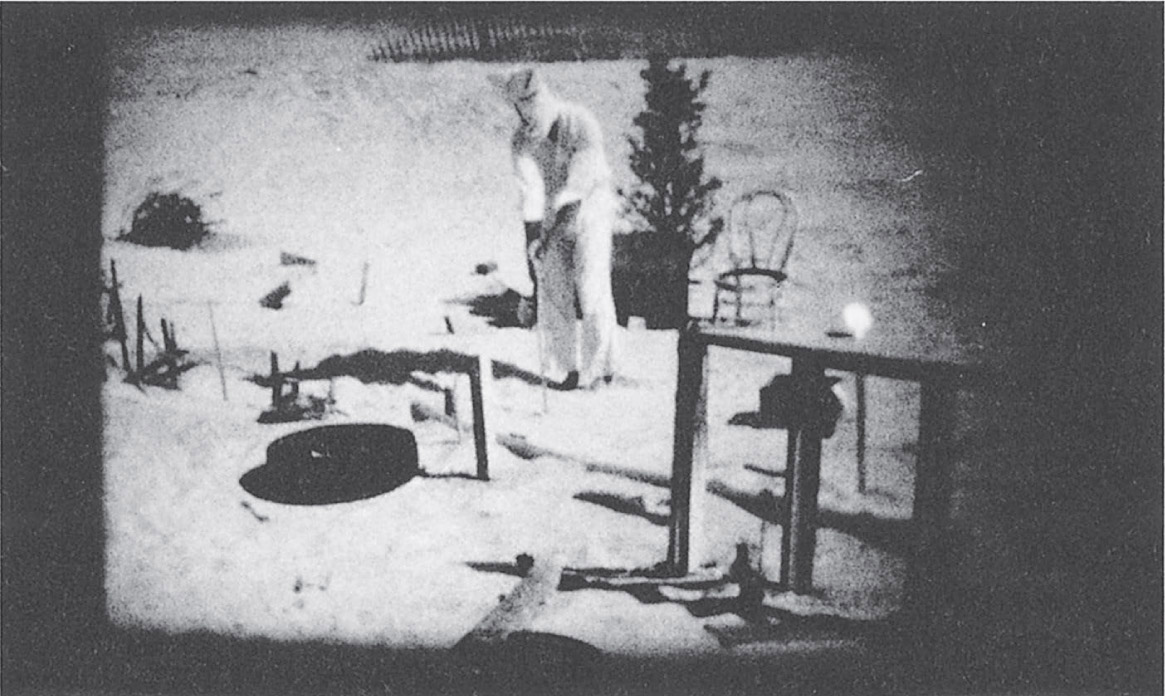 From In the Shadow of the Sun, 1974 - The Kingdom over the Sea
 From The Art of Mirrors, 1973
January 1971, Bankside
From ‘The Billboard Promised Land’ (a short story)
Chapter 7
‘Archaeology of words’ ‘and now the old poet sat by the lake watching the ripples on the water where the goldfish swam. Every now and again where the young god had cast his shadows a word or a phrase would escape in scintillating sparks. A poetry of fire which momentarily casts the place into darkness with the brightness of its reflections.
The heaven and earth are united in gold
he combs (his hair)
the golden rays
(in his hands) the roses burn
the days are long
the wheel turns in the circle
cooled by breezes from the four corners
he enters (his chamber)
the swallow has risen (in the east)
the doors are open
man awakes
the poets of the sulphur baths in seven crystal tiers
star shaped, with the laughter of ghosts in its water
here watch a butterfly trapped in a glass
the sand pours in
white wings flutter into stillness
6 × 3
archaeologies
burning in high winds
one last walk
one last look
then there were other poets studying a whirlwind of shadows
a picture of wind on the sea
washing their hands in the sun
or the sign which read ‘walk don’t walk’ as the circuit had fused
stories × the sea shore
All of this happened whilst John and Amethyst walked in the city of Disc, past the great sulphur baths, the pools of saturnalia with their laughing, sighing waters, and the poets with their tape recorders mingling with the ghosts. Debating the outcome of the battle between Love and Chastity fought at the vernal equinox each year.’
~
Kingdom of Outre Mer
This is the way the Super 8s are structured from writing: the buried word-signs emphasise the fact that they convey a language. There is the image and the word, and the image of the word. The ‘poetry of fire’ relies on a treatment of word and object as equivalent: both are signs; both are luminous and opaque. The pleasure of Super 8s is the pleasure of seeing language put through the magic lantern.
The images of In the Shadow of the Sun are fused with scarlets, oranges and pinks. The degradation caused by the refilming of multiple images gives them a shimmering mystery/energy like Monet’s ‘Nympheas’ or haystacks in the sunset. There is no narrative in the film. The first viewers wracked their brains for a meaning instead of relaxing into the ambient tapestry of random images. The language is there and it is conveyed – and you don’t know what you have to say until you’ve said it. You can dream of lands far distant.
The film became divided in my mind into four sections, although it was not constructed in that way. The first section is based on a journey to the standing stones at Avebury in Wiltshire, coupled with two fire mazes. It contains a man who points, another who takes photos, a third in bondage, and animals – dogs and a sacred cow. There are burning roses which occur throughout the film. The second maze is circular – Ronde de la Mort – in which a couple dances in the flames which devour the whole landscape and the great standing stones. A third and final image of Narcissus, a mirror which flashes the sun into the camera so that the image explodes and reinvents itself in a most mysterious way. This section is brought to a close with some refilmed footage off the screen at the Elgin Cinema in NYC from The Devils – the final moment when Madeleine escapes from the claustrophobic city of Loudun into the world outside, over the great white walls; but now, in my version, she walks into a blizzard of ashes.
The second section is an invocation. Black and white masked figures walk through the flames. A magician finds the key to a cabinet of secrets. Now we are in the kingdom of the other sea, where an Egyptian pharaoh materialises in the surf, ushered in by a bacchante who dances in black with the herb of grace. Atlas supports the world lost in the galaxies. Dancing at the edge of time. The section ends with a figure turning in a magic circle, which burns the film out to white.
The third section contains the typewritten messages. The images are evanescent. The pyramids burn to a candlelit requiem, the people gamble and barbarians ride through the ruins.
In the final section the images fade into blank footage where the atoms dance, punctuated by explosions, and a figure listens to a message on a shell:
SLNC
IS
GLDN
August, 1973, Verzons: The designs of the old walled garden at the Verzons are finished. The wilderness will be put back to meadow grass, with cowslips and buttercups. A simple geometric topiary garden will be planted – four circular yew hedges at the four compass points, approached by an avenue of clipped yew obelisques. Christopher is to cast two of his eighteenth-century sphinxes in terracotta – perhaps there will be statues, but those will be done later.
~
Green Fingers
Masks, models, puppets, painting, sculpture, costumes, watercolours, make-up – Christopher Hobbs’ work is scattered through every film I’ve made. He can paint a Rembrandt, fake up rococo plasterwork, sculpt you a Gaudier. We first worked together on The Devils, where Christopher built the body of the burning Oliver Reed out of layers of rubber and tissue paper on a plastic medical skeleton.
For the Super 8 films, Christopher made masks and suits of armour out of silver card, models of castles, pyramids, and clothes out of yards of cheap calico. When he wasn’t working on the films he was building a palace for a supermarket magnate on the top of a mountain in Spain or restoring houses for the National Trust. All this work was made in a small muddled studio off Tottenham Court Road. He lived in one room of trompe l’oeil grandeur in a decayed terrace house in Islington, where the water splashed through the rafters and the garden was overgrown by an enormous sleeping princess rose bush. We filmed Christopher as the magician for In the Shadow of the Sun in this room, looking like an extra from Ivan the Terrible in purple velvet with gold embroidery and a bulky fur collar among his crystal cabinets and seventeenth-century hangings. Later, he put on a top hat and tails and seduced Gerald on the riverbank, while bouquets of flowers burned in slow motion, and Gerald danced in a filmy black dress covered with hand-painted orchids.
~
Burning for Profit
August 1973, Butlers Wharf: All through the summer the buildings burn on the river, bringing a glint to the speculators’ eyes. The first to go was the beautiful regency building that John Betjeman had listed after I showed it to him last year. Then the huge ice storage warehouse at Hays went, followed by St Catherine’s Dock. Some of the finest buildings in London – then Mary’s Wharf opposite, and a warehouse just beyond St Saviour’s Dock – Not a bad tally for one summer’s speculation.
~
Nicholas and Fiona Logsdale, who own the Lisson Gallery, were here this evening to see the fire films In the Shadow of the Sun and The Art of Mirrors. Pyromania was in the air as at about ten we heard a fire engine bell. The music was loud and the room plunged into darkness – down below a second fire engine passed. ‘I wonder where the fire is,’ I remarked, then walked out on the metal bridge which crosses Shad Thames at the back of my room, to find the building next door a sheet of flame. The firemen went wild when they saw that what they’d thought were deserted warehouses were in fact occupied. They shouted at us to come down at once. I put the speakers out on the balcony and played Roberta Flack’s ‘Sweet Bitter Love’ as loud as possible over the roar of the flames – I don’t think they were amused – and went back inside to save my films. Nicholas and Fiona took an armful of drawings down with them. Thankfully by midnight the fire was out, and I crept back upstairs to sleep fitfully.
~
Silver Apples
September 1973: Beryl Grey has banned Silver Apples of the Moon after an argument with Tim Spain the choreographer over the flesh-coloured tights the dancers wear at the end of the piece. The opening at the Coliseum has been announced and people have bought tickets – but this is ignored. It’s a dictatorial decision: no one was invited in for any discussion, and several thousand pounds of the Gulbenkian Foundation’s money have been thrown away for the most ridiculous prudery. ‘We’re not that sort of company,’ she told Tim. It’s destroyed Tim’s career here as you can imagine the rumours, and the ballet will never be seen. I’m furious, because the ballet is simple, totally harmless, and also probably the best design work I’ve ever done. The front cloth is painted from a black and white photograph of a galaxy – the set is simple, consisting of several hundred half-silvered bulbs in silver holders on transparent flex which hang from the bars in rows. Behind them is a second black and white cloth painted with arcs tracked by comets with small red, yellow and blue arrows. The costumes follow this through – the men are in black dinner-jackets with red, yellow and blue gloves and shoes, and silvered spectacles – the girls are in primary coloured tutus and the mirrored glasses. The opening is a coup de théâtre – no stage lighting is used, the curtain rises in darkness, and the hundreds of bulbs are suddenly switched on about six inches from the floor. The dancers stand motionless against them; and as the music starts they fly upwards, a thousand glittering stars. On the first, and only, night (in Oxford), the audience burst into spontaneous applause.
~
Vandals
October 1973, Sloane Square House: This month Anthony left London for NYC and gave us his flat, as heating Butlers Wharf during the winter was proving impossible. The glittering sixties’ interior was no more – eighteen months before it had been stripped by the bailiffs while Anthony was in France. This was done with the connivance of Bob, the hated porter, who had a key. I arrived shortly after Anthony walked into the flat and discovered the destruction, to find him standing in the middle of the rubble. Everything had been taken except the bed, and that had been vindictively vandalised. The Bernard Leach vase and the Japanese tea bowls were inexplicably untouched. The wind-blown tree was overturned and the glass icicles lay smashed on the floor. Scattered among them were books which Jean Cocteau had dedicated with drawings; their covers were torn and stamped with heavy boot-marks. Dom Sylvestre-Houedard’s Tralee Dingle laminate lay untouched. Anthony shrugged his shoulders without a flicker of emotion, ordered another typewriter and carried on in the chaos as if nothing had happened. All his treasures had been sold, including the grey mirrors on the walls. He changed the locks and refused access to the instigator of this act – a mean little glass merchant with a ritzy shop in the Fulham Road who had bought the best pieces at knockdown prices.
~
Miss Synthetic
1973, Butlers Wharf, Downham Road: Gerald is entering Miss World, and I’m going to film it in fast new black and white Super 8. Like the first one, it’s being crushed into Andrew’s new studio at Downham Road.
Gerald has made himself a see-through polythene costume which makes him waddle like a fish. He’s decorated it with some black ostrich-feathers and painted his face with dead white pancake. He’s calling himself Miss Synthetic. In the dressing-room he sits like a sad little bird that has plunged into an oil slick. He chain-smokes and seems overwhelmed by the event. I’ve never seen him so nervous before. He’s an extraordinary contrast to Karl, who’s swishing around like a Phoenix Matron in a mink coat, silver, wild or something Lindy Guiness has lent him. Later, he gets jammed on the catwalk – which hardly allows two to pass by – against the wet palette of the vampish Miss St Germain des Près. This is a catastrophe for the mink. I sit in the dressing-room and film as much as I can. It’s hardly possible to move. Miss Holland Walk wins; Miss Yorkshire crowns him, draped with a python.
~
Crisis
31 January 1974, Sloane Square: My thirty-second birthday, and Gerald left in tears. I’ve put him in a taxi to Thilo’s. The last month, aggravated by his jaundice, has been really bad. I’ve had all the flak, while Thilo has the good times. I rang the producer, Harry Benn, to turn down Russell’s Tommy. Harry has tried all week to seduce me back, but I’ve made up my wavering mind – I’ve had enough of film design and the huge amount of energy and time it takes punches gaping holes in my own work. Patrik is on his way to Italy to sort out Sebastiane. Perhaps the jolt will get him working. We’re all dead broke, but I refuse to be the soup kitchen any longer. It’s very difficult to fight Harry’s offers of huge sums of Stigwood money, but it’s done. On Monday I’m going to sell a decade’s clutter of possessions at the studio in Butlers Wharf. With Anthony paying the rent at Sloane Square it should be easy to get by until I go to NYC in early June.
~
Corfe
March 1974: there was always a prize of sixpence for the first one to see Corfe Castle as we drove to Swanage for our childhood holidays. I know every bend in the road after crossing the bridge at Wareham. The Purbeck hills in the distance cast a shadow across the sandy, gorse-covered heath. Corfe looms up massive on its conical mound guarding a cleft in the hills. Ahead lay the twilit England – old Harry and his wife, Peveril Point, Dancing Ledge, Tilly Whim. Rocky cliffs and smugglers’ coves, limpets and seaweed (which twists through the water and by which you can tell the weather), buckets, spades, and candy floss.
At Corfe, the jackdaws circle round the grey stone keep with its towers still at the crazy angles after they were mined by Cromwell in the 1640s. The road spirals through the little stone village up to the drawbridge. Today, years later, Paul Humfress wears the silver paper armour with its faery decoration, and the mirror mask which flashes in the sunlight. The rain blows in from the west across the Purbeck hills. We shelter in the keep as the showers scurry by; this morning we have the castle to ourselves. Luciana glides along the battlements in a white calico gown, sown with pearls – her headdress a-flutter with little white birds. The wind catches her train and swirls it around. The pale-blue filters catch the rain; but at lunch the sun comes out for an hour, and we complete the Troubadour film.
Expenses for the film at Corfe: two nights in hotel – £30. Petrol £10. Costumes £15. Film stock £50.
~
Fire Island
10 June 1974, Fire Island: Anthony has taken a home here which he shares with some New York lawyers. On the wall above the fire is the only artwork in the house: an immaculate boîte en valise which the Los Angeles police department has dedicated to drug identification. As perfect as a Duchamp, it is the icon of the house. Each drug is faked in plastic. Last night, after dinner, Anthony produced an elaborate silver sweet dish – the sort you find in Indian restaurants, to serve chutney – which was passed around the table. It contained nearly every drug you could identify in the attaché case.
~
12 June 1974, Fire Island: I’m living rough as I have been expelled from Anthony’s house in a farce which could only happen here.
Yesterday, I met a lad on the beach and invited him back to swim in the pool. For half an hour we fooled around with no clothes on. This morning I came down to breakfast and was greeted by an uncomfortable silence. Tom and his friends were watching a video that they had made the night before which left nothing to the imagination. Breakfast was cooked by Tom’s peroxide blonde mother, who’d arrived from Washington. After she had organised the eggs and bacon, she joined us and watched her son tying up some muscle-bound hunk on the television without batting an eyelid. After breakfast was over, and we’d washed the dishes, Tom informed me that I was no longer welcome at the house. I was completely taken aback when he said, ‘How dare you bring a stranger to the house and swim in the pool with no clothes on, knowing that my mother had arrived from Washington. She saw you and was deeply shocked.’
~
September 1974, New York City: The prettiest boys in the Continental Baths are the hustlers – not sex but drugs. They lounge around behind half-open doors with tumescent cocks and catch you with their angel dust eyes. Once lured in, you are presented with acid and mescalin and bags of grass – they fuel the dynamo which keeps the baths dancing. At $11 a night the baths are cheaper than an hotel, and some of the dealers have lived there for months. There are bars and restaurants, a hairdresser’s, saunas and steam-rooms, a swimming-pool with fan-shaped fountains, games-rooms, and floor after floor of cubicles. On Fridays the stars of the subculture sing – Jackie Curtis, Bette Midler; and the socialites arrive in their Yves St Laurent, lace their champagne with coke, and watch the boys making it in the hammocks around the pool. Forty-eight hours on acid passes in figures of eight, and Sunday morning at dawn brings a cool, sharp clarity. At six the sun sparkles down the empty avenues casting de Chirico shadows – the carefree boys of the night return home to empty apartments where the roaches can be heard clattering through a week’s washing up. The boys put out notes for themselves to call the exterminator in the morning.
~
The houses in the pines are run by ad-men and lawyers in their thirties. Fire Island has a deadly, well-heeled monotony. Well-tanned Ambre Solaire, work-out muscles, and faces wrinkled by over-exposure to the December sun-ray lamps. At the tea-dance the music pounds away while these muscle-bound fantasists bob up and down in a thundering mass with whistles and fans, and moustaches pinned on like limp wrists. When the sun goes down there is dinner at any number of houses, barbecues from overstocked fridges and gallons of Californian wine. Then around midnight the parties begin, and carry on till dawn. Fireflies float amongst knots of men cruising along the wooden walkways. As the sun comes up it reveals a world of failing looks and crushed boutique clothes mirrored to infinity in a house where the walls, ceilings and floors are mirrored – reflecting the desperate hope of a good fuck.
~
The derelict piers stretch out into the West river, huge covered sheds with the ground under your feet sparkling with smashed glass. Moonlight falls through the broken windows in the long sequences of empty rooms, while phantom figures cruise past in silence. Young Puerto Rican pickpockets move deftly amongst the groups of men making it in odd corners – you have to put your change in your shoes. Eyes soon grow accustomed to the gloom, and your ears become sensitive to surrounding danger. The cop cars prowl – throughout the night, men cruise through the piers, and at midday you’ll find a guy in boxer shorts being blown as he leans against his bike.
~
I’ve spent the last three months in NYC, most of the time at Hal’s empty apartment, and now in an empty roach-infested loft with an escaped python in SoHo. Money has been a continuous problem, as Anthony’s promises of accommodation faded; and he’s so wrapped up in Robert he seems oblivious to my difficulties. I managed to sell some of the Diaghilev costumes I bought at the Sotheby sale, but that soon ran out. Now I’m making the odd dollar putting Robert’s flat in order. This enables me to eat one meal a day at the West Side Diner, where Reggie, the peroxide waitress, plays tricks – dispensing four-leaf clovers for luck – and slips me the biggest portions of french fries to keep me going. However, there are plusses. I’ve filmed the final section of In the Shadow of the Sun out at Fire Island, more for the name than its reputation – though even that was held up when sand got into the lens as I was sleeping rough after my expulsion by the lawyers from Anthony’s house.
I’m temperamentally unsuited to New York life – my journeys here seem founded in a self-destructive impulse. But I’ll be back in London next week, so perhaps some friendly djinn looks over me.
~
Anthony’s dream flat is being built in the usual sea of debts – he’s purloined Nina’s sapphires to make it possible. Into one small room he’s put a sofa by Claus Oldenberg, sewn in ultra suede; and a glass desk, with a sophisticated lighting system by Dan Flavin. The only decoration is a porcelain chess set by Malevich. The entrance is an infinity cube. What the rather dull lawyer who is getting all this makes of it I can’t say. I spend the day shifting books and polishing.
~
1 January 1974, Sloane Square
Ars Mortis The End of Tradition
The Disaster of War
Bring the Goya etching from Norwood and burn it. Film and tape the event. The ashes framed between two sheets of glass and exhibited with the film. The resulting work to be exchanged for another work of art which will be similarly processed. A legally binding document to go with the work to prevent its resale unless an exchange is made and further work processed.
~
Third Time Lucky – Miss World
March 1975, Butlers Wharf: Keith dyes my hair primrose with a black triangle at the back; it’s very short, a crew cut. I’ve a massive wardrobe of costumes from the Super 8s, including the silver diamanté dress from In the Shadow of the Sun, and a troubadour dress and armour from the film we made last summer at Corfe. I have a headdress made from a green rubber frog, with pearls and lashings of ruby and diamanté drops. This time I’m going to win. On stage I act: I fall in the swimming-pool with a bottle of gin as a drunk from the Titanic. As Joan of Arc, I conceal Josephine Baker’s ‘J’ai deux amours’ on a small tape-recorder beneath my armour. Seizing the mike, I secretly switch it on. No one knows where the sound is coming from as I mime to it. I win.
Andrew has constructed the most unstable of thrones. I wait in terror as Hermine totters towards me along a tightrope, bearing the sceptre and orb high above a very anxious crowd. In a brief speech as reigning Miss World, I offer my services formally to close bankrupt British industries in the coming year, by tying them up with pink ribbon.
~
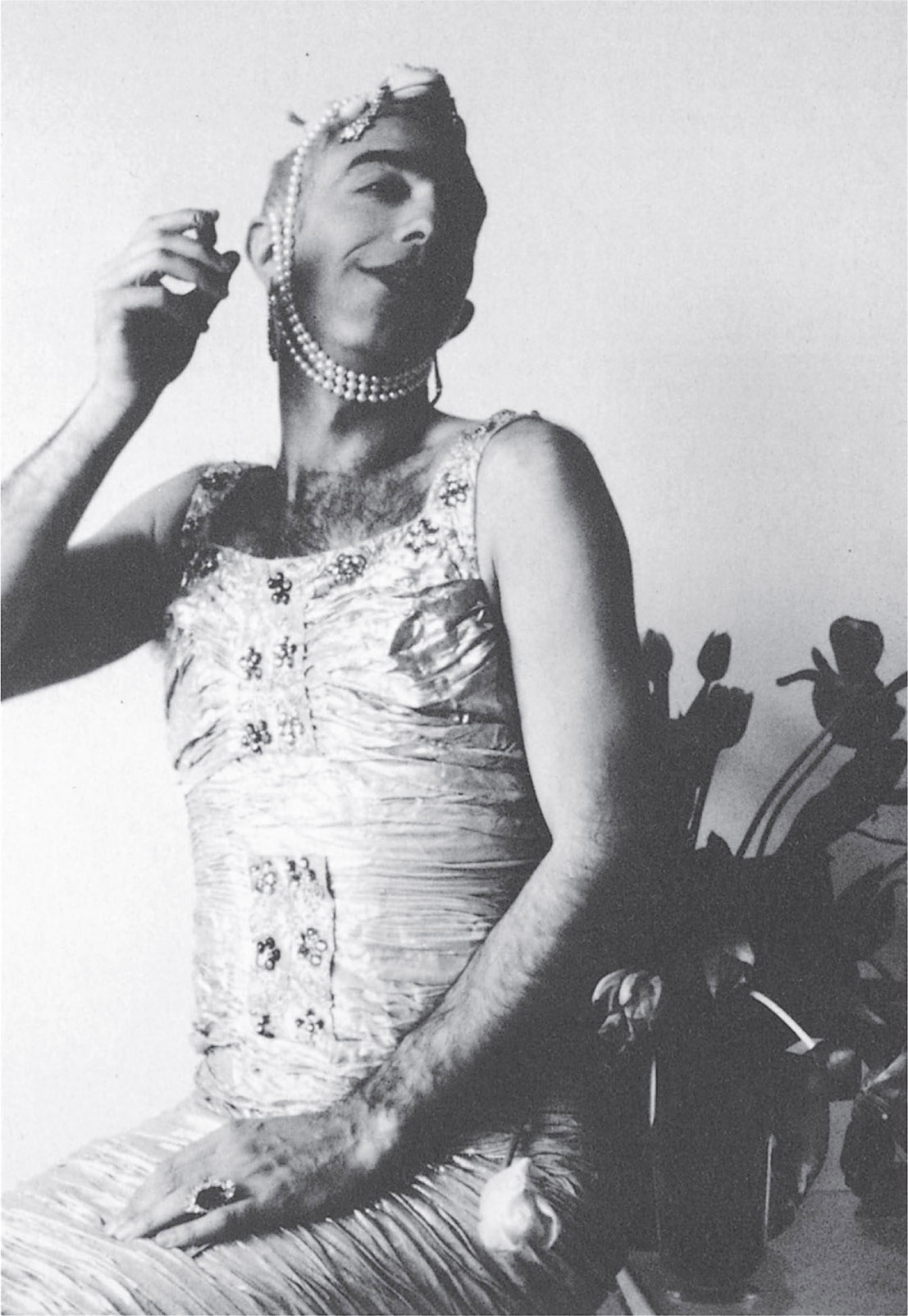 The Third Miss World, 1975 - official portrait (Photo: Marc Balet)