
Сhapter TEN
WHEN I WAS A BOY, another magical place I dreamed of visiting was Australia, home of the fabled duck-billed platypus. The platypus was the sort of creature that fired the imagination of an animal nerd like me, and I yearned to see a live one. With a flat, wide bill like a duck's tacked on to a furry body, webbed feet for swimming, and a poisonous spur on the male's hind legs, the platypus is an egg-laying mammal that suckles its young on modified sweat glands that drip milk onto hairs from which the young can lap it up. In North America, zoos might boast kangaroos or even a koala, but never a platypus.
In the 1960s, when I was starting out at the University of British Columbia, I met Jim Peacock, a brilliant young Australian doing groundbreaking work on chromosome replication in plants. He held a postdoctoral fellowship at the University of Oregon, and we would meet at conferences. We became friends. Unknown to me, he put my name forward for a position at the University of Sydney. Out of the blue, I received a request to apply for a genetics position. I was flattered to receive an unsolicited inquiry right at the beginning of my career, so I sent my very short curriculum vitae, hoping that at least I might be invited to visit and give a talk.
Instead, I was offered the position. I knew the university was the home of an eminent chromosome expert, Spencer Smith-White, which made the institution an attractive place to be. But my marriage was breaking up, and I could not imagine being so far away from my children, so I turned down the opportunity without even mentioning it to the head of my department to try to chisel a raise. I have often wondered what might have happened had I accepted that job.
In 1988, I finally went to Australia, and I immediately fell in love with it. The environmental movement was at a peak of energy and public support around the world, and Australia had recently established the Commission for the Future, a government-funded organization to look at the role of science in Australian society and its place in the country's future. It was a good idea, similar to the Science Council of Canada, which Brian Mulroney dismantled in 1993 during his second term as prime minister.
Phil Noyce (not the Aussie filmmaker of the same name) had been a science teacher who was recruited to the Commission for the Future because of his interest in communicating science to the public. He was young and keen and had encouraged the organization to invite me to give a series of talks in 1988. He would later become a close friend who convinced me of the importance of acting immediately to fight climate change. I had known humanity was affecting Earth's climate, but I felt it was a problem far in the future and that there were other, more pressing issues. Phil disagreed, and the evidence has piled up to show how prescient he was in believing action was urgent. (Tragically, he had an undetected congenital heart defect and died in the prime of his life, while playing tennis.)
I was delighted to receive the invitation and accepted. At last I would be going to Australia. What would I see? Because of the horrific discrimination endured by the Aboriginal people of Australia and the government's infamous “white Australia” policy of restricting immigration to maintain a Caucasian-dominated nation, I expected to have to search hard to see a person of color. In addition, the sexism of the country was well known, and perhaps that is why one of the most globally influential feminists of the time was an Australian, Germaine Greer. I was fully prepared to encounter bigotry, sexism, and anti-gay attitudes. I also thought there would be kangaroos and other marsupials jumping through fields and streets.
How ignorant I was. Like Americans arriving in Toronto to find a huge, modern city devoid of the expected igloos, I landed in Melbourne to discover a huge, sophisticated city of great diversity. I certainly did not expect to find vigorous Chinatowns in Melbourne and Sydney, as well as lots of Thai, Vietnamese, and Japanese restaurants. To my surprise, I discovered sophisticated, multicultural cities with plenty of ethnic diversity. There were no kangaroos in the cities, of course, but I did see them in the wild, where I learned they also gather in farmers' fields and graze openly. In the cities and in “the outback”—less inhabited, vast inland areas—there was an amazing profusion of birds in all shapes and colors—cockatoos, budgies, parrots. Even the “pest” birds like magpies are beautiful. And I'm not a great birder.
On one of my early visits to Australia, Phil took me to Phillip Island south of Melbourne, where fairy or little blue penguins (Eudyptula minor) still live in tunnels in the banks above the beach, and it is possible to listen to them making their gurgling songs in their nests. We can watch as they waddle down to the water's edge in the morning, hesitate, and then collectively plunge into the surf on their way to sea. In the evening they make their way back to their homes, walking past tourists without paying any attention. It's an impressive sight that reminded me of the way animals on the Galapagos Islands failed to recognize us as deadly predators and simply ignored us.
We had a similar experience in 2003 on Kangaroo Island off the southern coast of Australia. There we encountered an echidna; it and the platypus are the only members of that select order of egg-laying mammals, the monotremes. With a sharper beak, the echidna carries a layer of thick, protective quills and makes a living by rooting about for grubs. When we spotted one, we jumped out of our vehicle; the creature ignored us as it dug into the side of the road and we chalked up another amazing encounter.
I asked Phil if I could finally see a platypus, and I was rewarded at the zoo in Melbourne. I was taken behind the exhibits and shown an elaborate waterway constructed for the animals. I was able to watch them for as long as I wanted and saw them being fed their favorite food, a kind of crayfish called a yabbie. It was the realization of my childhood dream and one of the great thrills of my life.
The Commission for the Future was determined to get its pound of flesh out of me, so Phil had arranged a heavy schedule of publicity events in addition to several formal speeches. It was virgin territory for me and for my audience. No one there had heard of me or my ideas, so I could spout off about all of my favorite subjects and be as opinionated as I wanted. It was very gratifying that people were tremendously receptive to my words. It makes sense—Australia is a country whose climate and unique ecosystems encourage being in the outdoors, whether swimming, camping, or just firing up the barbie and chugging a few frosties from the Esky (translation: lighting the barbecue and drinking a few beers from the cooler). Water is a very real issue to everyone. I also suspect Australians were intrigued to hear a “Japanese” (me) who would slang the Japanese for their depredation of global resources like trees and fish. Whatever the reasons, there was a flurry of media interest in me wherever Phil had arranged interviews and news conferences.
The Australian Broadcasting Corporation (ABC) is as important to Australians as the Canadian Broadcasting Corporation (CBC) is to Canadians, but unlike Canadians, Australians fiercely support and defend the public broadcaster. After relatively small cuts were made to ABC's budget in the late 1990s, more than ten thousand people gathered at a demonstration in Sydney to protest the loss of funding. In contrast, when the federal government made draconian cuts in the CBC's budget, only a couple of hundred people gathered in Toronto to support the corporation.

Quokkas, a type of marsupial, on Rottnest Island, near Perth, Western Australia
In Australia I was extensively interviewed on several local and national programs on ABC, none more important than the long-running Science Show hosted on radio by Robyn Williams. Robyn is an expat from Britain whose abilities in science communication have made him widely recognized and admired by the public, a kind of Aussie version of the late American astronomer-broadcaster Carl Sagan. I have come to know Robyn very well, as we have crossed paths often in Australia and North America. He has been the only host since the Science Show began to broadcast in the spring of 1974, and his program was a wonderful opportunity to talk about my ideas in depth.
By the time I had finished my first visit, I had not had time to get outside Melbourne and Sydney and so had still not seen any of the fabled wildlife of the continent. Nevertheless, I had fallen head over heels for the country and its people. Back home, it seemed everything I looked at triggered a memory of Australia. “Gee, in Sydney. . .” I'd say. Finally, Tara looked at me suspiciously and asked if I had a girlfriend back there.
As a result of that first visit, several groups invited me to return to give talks, and I was determined to go back with Tara. I was also approached by Patrick Gallagher, head of Allen & Unwin Publishers, an Australian company that had started out as a subsidiary of the English publishing house of the same name but in 1990 became independent. We have become good friends, and I have enjoyed a close relationship with the company. When I told Patrick I wanted to set aside some of my Australian book royalties to support Aboriginal and environmental groups in Australia, Patrick promptly offered to contribute 5 percent of the profits the company makes on my books to the fund.
Soon I was planning a return visit to Australia, this time to tour several cities to talk about my books Metamorphosis (my first autobiography) and Inventing the Future (a collection of columns I had written for newspapers). In 1989, Tara accompanied me to see for herself what had so impressed me with the country. We had a whirlwind tour through Melbourne, Sydney, and Canberra with lots of media interest. Sales of the books took off, and they became best-sellers.
Australia is as exotic as any place, yet people are familiar and speak English, so it is easy to get about and converse. Australians and Canadians share a colonial history and ties with Britain, and both are adamantly proud of not being American. In Australia, scores of young Canadians can be found working on farms or waiting on tables, and Australian accents can be heard all over the ski slopes of Whistler and Banff. People in both nations think of themselves (erroneously) as a country with a small population covering a vast area. In fact, much of Canada is covered in snow, ice, or rock, and that's why most Canadians snuggle along the southern border with the United States. Similarly, much of Australia is desert, so most of the population crowds into five major cities on the coasts. But nature and wilderness or the outback are a critical part of what people in the two countries value as part of our heritage and culture.
I once heard the Canadian communications theorist Marshall McLuhan remark that one difference between Americans and Canadians is that Americans will invite new acquaintances into their homes, but Canadians invite them to meet in a pub or restaurant, preferring to keep home for family and friends. I don't know how good a generalization that is, but I do feel Canadians are not nearly as outgoing and open as Americans. I have often been astonished to meet an American for the first time and be invited to stay at his or her home after a very short period of conversation. It is a quality I admire and appreciate.
In Canada, in contrast, we are far slower to extend such hospitality, but when we do, it seems more deeply felt and meant. Australians are much more open and gregarious than Canadians, but without the underlying assumption of superiority many Americans express. And the use of language by Australians is enthralling, from the contraction of words as in “uni” (university), “ute” (utility vehicle), and “servo” (service station) to novel terms like “larrikin” (hooligan) and “come the raw prawn” (attempt to deceive).
On that visit in 1989 with Tara, Phil Noyce and his wife, Georgina Tsolidas, accompanied us on a jaunt to the Great Barrier Reef. We flew to Cairns, the northernmost city on the east coast of Queensland. From there we traveled north by bus for another hour to the sleepy town of Port Douglas, where, a few years later, the wonderful Australian film Travelling North was shot. Port Douglas at the time was a tiny village with a few shops and a harbor where the Quicksilver, a large twin-hulled catamaran, is moored. It departs for the barrier reef daily, tying up at a permanent float at the outer reef. From there, tourists fan out to scuba dive or snorkel or just go down into a viewing area under the float.
Our first trip to the reef was heaven. We had never experienced such diversity of form and color, including dozens and dozens of species of coral—immense beds of purple stag coral with antlerlike branches, and huge domes of brain coral. There are giant clams with lips of green, pink, and purple, threatening to clamp onto unsuspecting divers the way they do in horror movies, and fish from immense groupers to parrotfish, pufferfish, and tiny clownfish hiding in the protective tentacles of soft corals. The Great Barrier Reef is truly one of the wonders of the natural world.
When we returned from our enchanting trip on the Quicksilver, we noticed an excavation site a block away from Port Douglas's Four Mile Beach with a sign saying an apartment building was soon to go up and one suite remained for sale. Phil, Georgie, Tara, and I bought it. Tara and I have enjoyed it ever since, an investment that represents our commitment to Australia as a second home. In the eight years I had lived in the United States, the idea of staying there permanently never entered my mind. But there in Port Douglas, having spent a wonderful day on the Great Barrier Reef, then walking the exquisite sands of Four Mile Beach in perfect weather, we seriously thought about moving to Australia. We have never regretted remaining in Canada, but we do feel privileged to be able to return to Australia again and again.
We fell in love with Port Douglas because it seemed a throwback to another time, when people moved at a slower pace. But when we returned a few years later, the town had been “discovered” and had undergone a major growth spurt that included a new Japanese-backed luxury hotel. Eventually the Quicksilver was sold to a Japanese company, and now high-end restaurants attract more tourists, and the feel of the place has changed. But the Japanese invasion and explosive development are just the latest assaults to change the area.
From December to March, the hot, muggy weather leads locals and visitors to spend a lot of time in the water. But you can't go swimming along Four Mile Beach, because of the “stingers”—poisonous jellyfish—some of which can incapacitate and even kill an adult human. Pictures of victims with stinger “burns” are pretty brutal, displaying open sores and wide swaths of red, swollen tissue. The only ocean swimming in the summer is in “stinger nets,” which are strung out in the water and provide a haven from the jellyfish. It's not the way I had imagined spending time in the ocean.
Stingers were not a hazard in the past, because there were plenty of turtles that fed on them. But the turtles were “harvested” for their meat and shells, and at some point their numbers became so depleted that they could no longer sustain themselves, and they disappeared. Stingers and stinger nets now are just an accepted part of the hot season—but they didn't have to be. Let's hope the great interest of tourists in viewing turtles will help spur the reintroduction and protection of this species.
Two hours' drive from Port Douglas is the Daintree, a jewel of tropical rain forest that is easily accessible and delightful to explore. Yet in the adjacent lands around it, lots are being cleared and sold off for development. Every time I've visited the Daintree, I've been overwhelmed by the immensity of our ignorance and our arrogance in the way we treat nature. A few years ago, biologists “fogged” some of the canopy of the Daintree with pesticide, just as research entomologist Terry Erwin of the Smithsonian Institution had done in the Peruvian Amazon, and, like Erwin, they found thousands of species of insects that had never before been seen by humans. It is thought there must be tens of thousands of species in the Daintree yet to be discovered.
But remember, when a new organism—plant, animal, or micro-organism—is collected, it can be “keyed out,” meaning its taxonomic position is identified, and if it is new to science, it can be named. When a name is assigned to a new species, that does not mean we know anything about its numbers, distribution, habitat needs, or interaction with other species or even such basic biology as what it eats, how it reproduces, or when it matures. It is breathtaking, therefore, that even though we remain almost completely ignorant of most of the species' needs and interactions with ecosystems, we do not hesitate to destroy those ecosystems to get a few “resources” that we find useful. We should remember the story of the goose that laid golden eggs and realize that entire ecosystems like the Amazon and Daintree forests are the goose. Only so long as they flourish will we be able to collect the golden eggs.
BEFORE MY THIRD VISIT to Australia, I received a message that someone named Peter Garrett, who sang with an Australian group called Midnight Oil, had offered to do an event with me in Sydney on my next visit. I wrote to ask Patrick Gallagher who this guy was and whether he was legit. Patrick replied that he was a big name and Midnight Oil was a very popular group, but the publisher seemed hesitant about the idea of my doing an event with a rock band. His reluctance gave me visions of trying to deliver a serious talk in front of a screaming, drug-crazed audience interested only in hearing the rock group. Uh-uh. I told Patrick to thank Peter but turn him down. Patrick seemed relieved.
Huge mistake. I soon learned that Peter and the Oils were not just big in Australia, they were huge! And they were on their way to conquering North America and Europe.
Peter was far more than just a performer; he was president of the Australian Conservation Foundation (ACF), one of the largest environmental groups in the country, and he had run unsuccessfully for the Australian Senate in 1984 for the Nuclear Disarmament Party, a predecessor of the Greens. His fans were my kind of people. When I first heard their signature song, “Beds Are Burning,” demanding that Australians confront the fact that the land belongs to the Aboriginal people, I was blown away.
The song had the same impact on me as had another in 1988. First I had received a call from a Bernie Finkelstein in Toronto. “Who are you?” I asked. “I'm Bruce Cockburn's manager,” he answered, “and Bruce asked if you would listen to a song he has just recorded.” Kind of a weird request, but I did know Bruce Cockburn was a successful Canadian singer, and Bernie's office was close enough to the CBC for me to drop in. So I did, and Bernie put on a CD to play a brand-new Cockburn song, “If a Tree Falls.” I cried when I heard it. It was powerful, and later, with the video, I knew it would be a hit. When Paiakan stayed with us, he loved Bruce's video of that song, even though he didn't understand the words.
Peter Garrett is an impressive sight. He must be six and a half feet tall, and he is lean and bald. When he performs, he's like a scarecrow puppet being manipulated by someone high above, arms and legs flailing about. I saw him onstage for the first time in Anaheim, California, and his rapturous reception by the audience showed me how badly Patrick and I had erred, but by then Peter and I had become good friends.
When he came to Canada in 1993 as the long battle over logging in the Clayoquot Sound rain forest on the west coast of Vancouver Island was heating up again, Midnight Oil volunteered to perform in the protest area. I was delighted to have the opportunity to introduce the band, and it was a marvelous concert, marred only by the nastiness of loggers who were there harassing the protesters and who screamed epithets and threatened the band as they left. (Eventually, more than nine hundred people were arrested before the Nuu-chah-nulth First Nation signed a resource management agreement with the British Columbia government.)
Because of the Australian public's tremendous response to my message of environmental stewardship, I had been urged by a number of people to start a David Suzuki Foundation Australia modeled on my Canadian foundation, but I resisted because I don't want to form a multinational organization. If our approach is useful and can be copied in Australia, there should be an autonomous Australian-created group based on similar principles.
On one of those early visits to Australia, I was told that a program called The Couchman Show, hosted by Paul Couchman, had asked that I appear as a guest. The Allen & Unwin publicist, Monica Joyce, was worried because she thought the show tended to be confrontational, and she suggested I talk to Couchman before deciding yes or no. I called and told Couchman that I was interested in dialogue, not in confrontational diatribes. “Oh no,” he assured me, “we're not that kind of show. We like to have everyone offer their positions so we can have open discussion.” I accepted the invitation.
Couchman had not leveled with me. The audience was stacked with businesspeople and economists, with a sprinkling of environmentalists, and the entire format was set up for confrontation. Because I had received assurance from the man himself, I was completely relaxed. An eminent economist shared the stage with me, and I presented my case that economics was fundamentally flawed because it excluded nature as a central part of its underpinnings (economists call it an “externality”). I probably said it a bit more forcefully than that.
Well, the economist launched into an attack on my position, egged on by Couchman. As the audience generously applauded the economist, I finally realized I had been set up. A few environmentalists in the audience tried to defend me, but we were overwhelmed by the onslaught against us.
In the end, the economist told me I didn't know what I was talking about, that the air and water were cleaner today than they had ever been. I exploded, “If you believe that, you are a fool!” I shouldn't have been so rude, but I had been under steady assault, and his statement revealed how ignorant he was. When it was over, I stomped over to Couchman and said, “You lied to me.” He didn't care; he had generated his fireworks.
A year later, I met the Australian filmmaker Paul Cox at his home, and the first thing he told me was that he had watched me on The Couchman Show and had been infuriated by the nonsense the economist spouted. He apologized over and over on behalf of Australians. I had long since overcome my anger, but I was glad there was support for my position among the viewers.
On another of those early visits to Australia, I received a request that I meet Green Party politician Bob Brown of the state of Tasmania. As an elected senator in the federal government, he has played an indispensable role in raising the profile of environmental and human-rights issues. We met in Melbourne, and as we strolled along the Yarra River at dusk, Bob suddenly stopped talking, looked intently along the riverbank, and pointed at something. It was a platypus. Thus my first sighting of a wild platypus occurred in a most unlikely environment, but I was delighted to think there was still room for the animals even in the middle of a city.
Bob wanted to know whether Lake Pedder, a pristine glacial lake in Tasmania's southwest wilderness that had been flooded in the 1970s to generate hydroelectric power, could be restored. Was it feasible? Did Tasmania need the energy the inundated lake supplied, and would the original values of that ecosystem be able to recover if the dam in the Tasmanian Wilderness World Heritage Area was removed? To study such matters, he needed money, and I offered him enough for someone to do the work. It was the early days of the David Suzuki Foundation, and I was pleased to be able to support an international project under our name.
The study showed that the energy supplied by the dam that had caused the flooding of Lake Pedder was a small part of the state's needs and could easily be given up without any economic disruption. The findings also suggested there existed sufficient residual vegetation and animal species around the lake to restore the original ecosystem if the water was permanently allowed to return to its natural flow. The study was released to the public, but, as with so many things in Tasmania, tearing down a dam seemed a regressive step to the powers that be and the idea was rejected with hardly a thought.

Sarika and Severn posing with David Hudson's dance troupe in Queensland
One of our most memorable visits to Australia occurred in 1991, when my father had recovered from my mother's death in 1984 and had regained some of his great zest for life. Dad adored our children, and we invited him to join us on a trip to Australia. He was thrilled to go, and with his genuine curiosity and his skills as a raconteur, he captivated all those he met down under. He was enchanted with the trees, the flowers, the birds, and the people—a whole world to fill his insatiable appetite for new experiences and knowledge.
With Georgina and Phil in tow, we made our way to Port Douglas. There Tara bought an inflatable vest for Dad, and we took the family out to the Great Barrier Reef on the Quicksilver. Dad's arthritis had gnarled his limbs and digits, so he looked like a twisted gnome, but he didn't let it slow him as he hobbled onto the float. We fitted him with mask, fins, and snorkel to go along with his protective vest, and in he jumped, hand in hand with Sarika. There was Dad at eighty-one, holding onto eight-year-old Sarika, paddling over to one of the “bommies,” a column of coral rising to the surface and easily encircled. I watched them swimming off and listened to their muffled exclamations through the snorkels: “Look at that!” “Over there!” “Grampa, Grampa, what is that?” It is one of my happiest memories.
SINCE THOSE EARLIEST VISITS, Tara and I have made several trips to Australia together, and during that time we have seen many changes. In the almost two decades since our first joint trip, the Great Barrier Reef has been changed by tourism, fishing, and the accumulation of effluents from cities, towns, and farmers' fields, which ultimately percolate through the reefs.
More recently, climate change has been responsible for coral bleaching over immense areas. Coral is more than one organism. An animal called a coelenterate, which is related to jellyfish, creates a hard shell around itself, a carbonaceous material we think of as the coral. The coelenterate harbors within it another species, a plant that provides energy through photosynthesis in return for the nutrition the animal captures. It's a classic example of symbiosis, a partnership in which both parts benefit from each other. The plants also confer color to the animal, and the Great Barrier Reef is a profusion of colors from purple to pink and green. The plant parts are extremely sensitive to temperature, and a rise in water temperature of just a degree or two can cause their death and hence the “bleaching” phenomenon of color loss. The animals can survive a season without their partners, but they then die if they are not reinfected with the plants.
Coral bleaching related to El Niño events unprecedented in their heat, duration, and shortened interval between are thought to be the basis for a global bleaching episode; El Niños are deviations from normal temperatures in the southern Pacific Ocean between South America and Australia. Coral reefs are oases of life, supporting a disproportionate abundance of life forms, and, as with tropical rain forests, disruption of their integrity represents a catastrophic threat to the ocean ecosystems of the world.
In 2003, when Tara and I again visited the Great Barrier Reef, it had visibly changed in both abundance of organisms and vitality. Dead stag coral littered the bottom, and the numbers and variety of fishes were noticeably diminished. (This is not a scientifically validated observation—it is subjective and anecdotal—but I think too much is at stake to ignore it.) Yet when we finally climbed back on the boat, the guides bubbled with enthusiasm, extolling the wonders of the reef and all its components. Part of that is their job; after all, we had paid a lot of money for the trip. But it is my impression that they really were enthusiastic and meant what they were saying.
Even in that short span since Tara and I had first visited this place in 1989, the degradation was perceptible to us. Because the guides had been working there only for a few years, however, they didn't have the same baseline for comparison. To tourists, the coral and fish are still dazzling in profusion and color, but I am sure an old-timer who has known the reef for decades will remember it in a state that no longer exists.
It was the same on our visit to the Serengeti Plain in Tanzania in eastern Africa. Our encounter with so many mammals filled us with wonder and delight that there still are such pristine areas with abundant wildlife—until we talked to some of the people who have lived there all their lives and remember a flourishing plain that no longer exists. Urban people like us live in such a degraded environment for wildlife that almost anything else looks rich and unspoiled. It's only when we dig deeper to find what the state of wildlife was decades or centuries before that we realize how much we are drawing down on nature's abundance.
ON THAT VISIT IN 2003, I was asked for the second time to be honorary patron of the Youth Conservation Corps (YCC), a program for youth who had dropped out of school but were unable to find jobs. The program gave them a stipend to spend six months a year learning how to rehabilitate the land, cleaning up soil and rivers, planting native species, making inventories of wildlife, and otherwise being trained for jobs in conservation. When Mike Rann had been minister for Aboriginal affairs in the Labor government of the state of South Australia in the 1990s, I met him, and we hit it off. I was asked to be the honorary patron of YCC, but when Labor was thrown out of office in 1993, the program was cancelled. Mike led the party back to power in 2001 and as state premier then resurrected the Youth Conservation Corps and asked me to return as honorary patron. I was delighted with the honor, and Tara and I attended a YCC event in Adelaide.
Once again, we were moved to see the dedication and enthusiasm of the kids. A young girl who seemed to have rings hanging from every part of her face and body enthused about her bird inventory: “I've seen twenty-five species right here in this field.” A young man with tattoos on his face, arms, and legs and a bush of hair that exploded from his head exulted about how great it was to be out here in the country and to be paid for it. We were taken to a large area of degraded land where the trees had long been cut down, the land overgrazed by sheep, and the soil overrun by grass and brush. “This will be Suzuki Forest, named in honor of our patron,” announced John Hill, the minister of environment. The Youth Conservation Corps will plant native trees on that land so that perhaps a couple of decades from now there will again be a young forest, one bearing the name of that Canadian bloke who used to visit Australia.
AYERS ROCK, THE LANDMARK familiar around the world as one of Australia's icons, is now known by its Aboriginal name, Uluru, and is an amazing sight. Imagine a flat desert, hot as hell; out of its haze looms a massive piece of rock that changes color as the sun makes its way across the sky. An Aboriginal woman offered to walk around Uluru with Tara and me. As when I was filming !San people in the Kalahari Desert, at first all I saw was scrub and sand. And as with the !San people, I was shown there was food aplenty. In Australia it's called “bush tucker,” and this woman demonstrated great knowledge of it, pointing out tiny edible fruits and various nutritional and medicinal plants, as well as hiding places for insects and scorpions.
One of the terrifying aspects of globalization and economics is that this kind of knowledge is not seen as having value in a modern industrialized world, and what has taken thousands of years of careful observation, experimentation, and insight is being lost all over the planet in just a few generations and will never be recovered. This information is far more profound than current science, because it has been tested over time with the survival of those who possessed the knowledge.
During a book tour in the 1990s that took me to Brisbane, an Aboriginal man offered to take me on a short walk through the bush. I was delighted, and we drove to a nearby park. I was dressed in shorts and sandals, and as we stepped onto the trail, I looked at the leafy ground beside it and realized there were leeches waving their heads about a half an inch off the ground, just waiting for an easy victim. Fortunately, I evaded them as we searched for witchetty grubs, the white, fatty, larval forms of beetles that are much prized by Aboriginal people and eaten live or cooked. I was determined to eat a live one, but I must admit that I was not highly disappointed when the only grubs we found were “not the right kind.”
In Adelaide after one of my readings, an elder who looked white approached me and introduced himself. He was Lewis O'Brien, a respected elder of the Kaurna people. He was very pleased because I had talked about the book I coauthored in 1992 with Peter Knudtson, Wisdom of the Elders, which examined the congruence between aboriginal knowledge and scientific insights, and I talked about my respect for traditional knowledge and the way First Nations people had educated me about our relationship with Mother Earth.
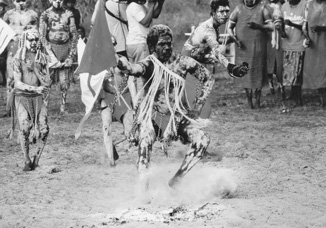
Aboriginal people in Arnhemland performing for The Sacred Balance
In a simple gesture, Lewis said, “I want to give you a name—Karnemeyu. It means ‘holy mountain'.” Receiving a name is the highest honor I can imagine. It means far more to me than receiving an honorary degree from a university. What surprises me is that of the names I have received from aboriginal peoples, three have meant “mountain.” Simon Lucas, a Nuu-chah-nulth from Ahousat on Vancouver Island, gave me my first such name, Nuchi, meaning “mountain,” and the Blood Tribe near Lethbridge, Alberta, gave me the name Natooeestuk, meaning “sacred mountain.”
I was browsing through children's books in a store in Australia and came across one of several books written by Percy Trezise, a white man, and illustrated by Dick Roughsey, an Aboriginal artist. As I read the book, I found this pairing of a Caucasian and an Aboriginal intriguing. I saw that Percy lived in Cairns, so when Tara and I were in the city, I called him. He invited us to drop in, and when we did, he was happy to talk about his life.
Born in 1923, Percy had grown up believing Aboriginal people were primitive, almost subhuman; that was the prevailing attitude of the day. When he was an adult, he met Dick Roughsey and quickly realized the artist was very talented. As he began to spend time with Dick, he learned the horrific cost of bigotry and became committed to showing the world that Aboriginal people are neither primitive nor unintelligent.
A professional pilot, Percy started to explore the northern parts of Queensland and to locate rock paintings all over the territory. These lands aren't empty; they are filled with evidence of thousands of years of unbroken use by the original inhabitants. By the time he died in 2005, Percy had contributed vastly to the documentation and preservation of Aboriginal culture and rock art and was an artist himself.
One of our greatest regrets was a trip Percy arranged for us that never happened. His son is a pilot, and Percy arranged for us to meet him and fly to one of the remote areas where Percy had documented and mapped hundreds of rock paintings. We were on the plane and strapped in when the announcement came that the weather was too inclement to risk flying.
BYRON BAY IS HIPPIE heaven on the east coast of Australia. I was met at the airport by a lawyer who was volunteering to help my book tour. On the drive into town, I casually mentioned that I had heard there were a lot of hippies and pot smoking in Byron Bay. Bam, he pulled a joint out of his pocket and asked if I wanted a toke. I turned it down, of course, but it looked as if Byron Bay was my kind of place. My talk was very well received, and we sold a lot of books. Before saying goodbye, the man who had picked me up handed me an envelope, which I shoved in my pocket and later threw into my suitcase.
The next day I had time to go snorkeling in the gorgeous bay that gives the place its name. The water was amazingly clear, and I spent most of my time simply floating among massive schools of sardines. There were turtles, seals, and lots and lots of fish. At one point I felt a burning across my cheek and after frantic wiping found an almost invisible tentacle of a bluebottle jellyfish. I ended up with a red line across my face, a small discomfort for a wonderful swim.
I forgot about the envelope from the man who had picked me up the day before and flew to Sydney to change planes to fly to Perth. As I got out on the tarmac, I noticed a sign warning that dogs were used to detect illicit materials. Then I remembered the envelope, so as soon as I got into the airport terminal building, I whipped into a men's room and threw it away. I came out whistling, and there was a dog! It approached my bag and immediately went at it. The dog's handler was a woman who recognized me and, pulling on the leash, said apologetically, “I don't know why he's so excited.”
“Well, I did have some mangoes in there this morning,” I suggested. “That must be it,” the officer said, and she rather brusquely pulled the dog off my bag. Poor thing was only doing its job, but ever since, when I go to Australia, I ask my hosts how the mangoes are.
IN ALMOST TWO DECADES of visiting Australia at least twice a year, I have come to think of it as my adoptive land. It is a continent of extreme contradictions. Any tourist may be impressed with gleaming, modern cities, yet most of the country is virtually uninhabited by whites. Australia is an island continent where a rise in sea level as the planet warms will have an enormous impact. The climate, already tropical and subtropical, will grow increasingly warmer, but the federal government repeatedly refuses to act seriously to reduce its greenhouse gas emissions. Canadians envy Australia for its quantities of sunlight, yet the government fails to exploit this free, nonpolluting energy to make Australia a leader in solar technology as Germany and Denmark are with wind power.
Australia is a major exporter of wheat and rice, two crops that are not indigenous to the continent and require vast quantities of severely limited water. The flora and fauna of Australia set the nation apart with its unique biodiversity, yet exotic species, introduced accidentally or deliberately, continue to wreak havoc on local populations.
The history of Australia over the past two centuries has been one of decimation of the Aboriginal people, a deliberate attempt to eliminate them by killing or through assimilation, and a climate of racism has led to enormous problems for the survivors. But as the twentieth century ended, Australians overwhelmingly wanted justice and reconciliation for the Aboriginal people, and it is my sense that there is a growing appreciation for their knowledge and art.
Islands, even large ones like Australia, impose boundaries and acknowledgment of limits. Being bound together by the constraints of water, land, and biodiversity, Australians have an opportunity to confront the major issues of our time as a unified country. Unlike Canadians, who must constantly refer to or compare ourselves with our neighbors to the immediate south, Australians aren't as psychically hampered. The twenty-first century truly offers the chance for Australians to realize their future as the lucky land.