
CHAPTER 6
Few were left from the clan that had gathered for Claudius’ marriage to Agrippina on New Year’s Day 49. Claudius himself was dead, as was his son Britannicus and now his daughter, Octavia. Agrippina too had gone to the underworld, to be forever tormented by the husband she had killed (or so her ghost declares in the play Octavia). Nero had stripped himself of immediate family, and with the assassinations of Plautus and Sulla, he had made inroads into the ranks of cousins—though two distant ones, Decimus SilanusTorquatus and his young nephew Lucius, still remained alive, the last direct descendants of Augustus besides Nero himself.
The freedmen who had run the palace fourteen years earlier were also gone from the scene. Narcissus and Pallas had both been killed, the former by Agrippina, the latter poisoned for his estate by a cash-hungry Nero. Even Doryphorus, a special favorite with whom the princeps enjoyed playing rough sex games, was dead, executed for showing too much favor to Octavia. New court pets had arisen to fill the empty places by Nero’s side: Spiculus the gladiator, Menecrates the lyre player, Pelagon the eunuch.
The most consequential departure was that of Burrus, the stalwart Praetorian prefect, recently dead. The gruff old soldier had been one of few who stood up to Nero, speaking his mind and then, if asked to reconsider, saying to the princeps: “I’ve told you already, don’t question me twice.” But Burrus’ replacement, Tigellinus, had taken the opposite tack, indulging all Nero’s vanities and delusions. Tigellinus spent vast sums for the emperor’s pleasure and used his cruelty to serve the emperor’s power. Above all, he supported Poppaea, the bride whom Burrus had resisted and the people hated, but who made Nero happy, and was about to bear him a child.
Seneca alone remained, of the old guard who had helped usher in Nero’s age of gold. Isolated and vestigial, he lingered on, with no clear role to play in the regime but no hope of leaving it. The job Agrippina had given him long ago, that of rector, “steersman,” of the emperor’s youth, had ended. So too had the roles he had subsequently taken on—senior counselor, speechwriter, caretaker of government, voice of Nero’s conscience. He lived now in twilight, a prisoner chained to the palace by the very moral stature that had brought him there to begin with.
There was no precedent for this plight amid the galleries of historical exempla in which Seneca often roamed. In the Greek world, philosophers had been banished, outlawed, or even killed by rulers they had sought to instruct; none had been retained at court against his will. Only Octavia, before her fall, furnished an analogue to Seneca’s situation: an outsider whom the princeps did not like or trust yet could not set free. But Octavia’s grim end did not bode well for Seneca. And her absence now made it harder for him to withdraw, for Nero could ill afford to lose both his most visible badges of moral authority.
Escape was out of the question; Seneca had no place to hide. Besides, he had his brother Gallio and his nephew, the adored Marcus Lucanus, to think of. Lucan, the young poet so full of promise, was especially vulnerable. By this time, he had published the first three books of his epic poem Civil War, but the brilliant debut was having a strangely adverse effect on Nero. Since the princeps, too, now fancied himself a bard, the luminous talent of his protégé no longer inspired pride but jealousy and mistrust. Lucan was going to need his uncle’s protection—if Seneca still could provide any.
The danger that now lurked for the Annaei, and for all the political elite, had been made clear earlier in 62. Abandoning his restraint toward the Senate, Nero had come close to executing a Roman praetor, Antistius Sosianus, for a minor offense. That offense, as Seneca and his nephew must have noted, had been a literary one—composing poetry of the wrong kind.
The “crime” took place at a dinner party given by a certain Ostorius Scapula. Antistius, no doubt emboldened by drink, recited some scurrilous verses poking fun at the emperor. He had no reason to fear retribution; Nero had thus far preyed only on his own family. But now Nero had Tigellinus at his right hand, a man who believed in the principle oderint dum metuant, “Let them hate, as long as they fear.” It was Tigellinus’ son-in-law, Cossutianus Capito, who in the aftermath of the dinner party brought a charge ofmaiestas, treason, against Antistius. The authorities who screened such charges allowed the case to proceed.
Not since the bad old days of Claudius had a trial on maiestas charges gone forward. The very word evoked memories of that regime’s abuses and of the far worse predations of Caligula before that. Maiestas had served those emperors as a catchall with which to destroy their enemies, or to allow their adherents to destroy theirs. Almost any gesture or word could be portrayed as treasonous if a princeps was willing to listen. Once, under Tiberius, a senator had been indicted for picking up a chamber pot while wearing a ring on his hand that bore the emperor’s image.
Ostorius, host of the “treasonous” dinner party, made a brave effort to protect Antistius, swearing he had heard nothing untoward. This effort was in vain. To the horror of official Rome, Antistius was sentenced to die by an ancient and cruel method, his neck to be fixed in the fork of a tree and his naked body beaten with rods.
Under the hierarchical structure of the principate, no such sentence could have been passed without the emperor’s approval. Tacitus says that Nero agreed to the death penalty because he planned to step in and prevent it, thereby winning points for clemency. The story is plausible, but it’s also just what an emperor would say when caught overplaying his hand. As things turned out, it was not the princeps but a senator who intervened to save Antistius’ life, in a move that had large implications.
Thrasea Paetus at last broke the silence with which he had thus far snubbed Nero’s excesses. He argued before the Senate that Antistius deserved exile and loss of property, not death. Moved by his courage, the entire Senate fell in behind Thrasea, voting to rescind the death penalty and impose exile instead. The consuls feared to ratify the decision without Nero’s consent, so they asked the emperor what to do. Nero sent a petulant letter telling the Senate to act as it pleased; he would not interfere. His pride had suffered a blow, whether his own plan to show leniency had been usurped, or whether—perhaps more likely—he had been denied his show of force.
It was not entirely a heroic moment, for Thrasea carefully larded his Senate speech with praise of the princeps. Nonetheless a threshold had been crossed. The calm that had prevailed in politics thus far in Nero’s reign, the compact between Senate and ruler proclaimed in the inaugural speech, had been broken. Maiestas had again been unsheathed as an instrument of repression. But the thrust had been parried; Nero’s will had been thwarted. The princeps began to look with greater mistrust on the Senate, and it upon him.
Whose side was Seneca on, as he watched this drama unfold? Thrasea was a kindred spirit, a committed Stoic like himself, yet the two men stood on opposite sides of a constitutional chasm. Seneca had embraced the absolutism of the principate, had virtually proclaimed Nero a king, while Thrasea was a senator to the core. Thrasea celebrated the birthdays of the tyrant-slayers, Brutus and Cassius, as though they were independence days. Both Seneca and Thrasea revered Cato, the steely-spined Stoic who had chosensuicide over surrender a century earlier. But Thrasea seemed more inclined to take Cato as a guide for action.
Seneca and Thrasea, two moral men who might have been close allies either in politics or in philosophy, were bound on separate paths, headed toward separate perils. Both would surely have been surprised to learn that those paths would converge and that a single cataclysm would one day consume them both.
For Nero, Thrasea Paetus had begun to loom as an enemy, and he put the Roman world on notice, in early 63, that he regarded him so. In January of that year, he celebrated the birth of his first child, a daughter whom he named Claudia. Brimming with exuberance, Nero brought the entire Senate to Antium, some twenty miles south of Rome, where Poppaea was caring for her newborn. True to his free-spending ways, he staged athletic games and laid out elaborate banquets for all present. He excluded only one senator—Thrasea Paetus—from the celebrations.
The prospect of an heir—Poppaea had not yet borne a son, but the couple had proved they were fertile—had greatly strengthened Nero’s position, and a maiestas charge against Thrasea might not have been long in coming. Tigellinus, the new Praetorian prefect, no doubt urged such a move, for his family bore a long-standing grudge against Thrasea. Five years earlier Tigellinus’ son-in-law, Cossutianus Capito—now serving the regime as a delator who brought legal charges against enemies—had incurred a rebuke from the Senate for mismanaging an eastern province. Thrasea had aided the prosecution.
Cossutianus was to have his revenge, but not yet. Claudia, Nero’s adored daughter, did not survive past her fourth month. Thrasea’s fate took a different turn. Nero was overcome with grief and also humbled by his loss of a trump card. He suddenly felt the need to shore up relations with the Senate. In a deferential gesture, he reached out to Thrasea Paetus. The two men agreed to a rapprochement—for the moment.
This prompted a bitter exchange between Nero and Seneca, recorded by Tacitus in one of his many snapshots of this tortured relationship. Nero boasted at court of his new entente with Thrasea, making certain that Seneca would hear. It was a cruel taunt, suggesting that the princeps would now bestow his favors elsewhere, even on another Stoic sage. But Seneca did not take the insult lying down. He replied that Nero deserved congratulations for this new friendship—as though the princeps, not Thrasea, was the one who gained by it.
“Thus increased the glory, and the danger, of these exceptional men,” Tacitus observes, looking ahead to the parallel dooms that would end the unparallel lives of Seneca and Thrasea Paetus.
Unable to resign even at the price of his huge estate, Seneca had nonetheless withdrawn from court to the degree that was safe. He no longer kept up the routine of a powerful statesman, no longer saw crowds of clientelae, friends in need of favors, in his chambers each morning. He rarely went out in public, and when he did, he no longer had a large retinue of attendants. He was trying, within the limits Nero had set, to reduce his visibility.
His pace of writing increased. He had more time now for moral reflections and a greater need to publish them, for his reputation had suffered badly as Nero had spiraled downward. From 62 on, he produced an astounding body of work, some of it now lost, much still extant. His longest and most ambitious prose works were composed at this time and, almost certainly, his most harrowing tragedy, Thyestes. Seneca, now at the peak of his literary powers, was writing like a man running out of time—as indeed he was.
Seneca was in his midsixties and feeling his age. Constantly cold, depleted by lifelong respiratory disease, he claimed to be “among the decrepit and those brushing up against the end.” Everywhere he looked, he saw reminders that he had passed into the last phase of life, his senectus. Making the rounds of his estates, he found that a stand of plane trees had become gnarled and withered; he scolded a caretaker for failing to irrigate them. The man protested that the trees were simply too old to be helped. Seneca did not reveal to the caretaker, but did to his readers, that he himself, in youth, had planted those trees.
Seneca was often on the move, whether checking on his properties or following the emperor and the court through Italy. He was in Campania much of the time, sometimes visiting the wealthy resort towns of Baiae and Puteoli. He went at least once to Pompeii, as he eagerly wrote to his old friend Lucilius, a native of that town. Seneca felt closer to Lucilius as the years advanced, perhaps because so many other friends were dead. A man slightly younger than Seneca, a fellow member of Nero’s staff—caretaker of the emperor’s estates in Sicily—Lucilius shared Seneca’s literary tastes and philosophic concerns. He was also a fellow survivor, having undergone torture at the hands of Messalina and Narcissus, Seneca’s persecutors as well.
Wherever Seneca went in these years, he carried on work on his magnum opus, a remarkable set of short moral essays framed as letters. Ostensibly addressed to Lucilius, these letters were in fact aimed at a wide audience. But the fiction of an intimate correspondence gave Seneca latitude in the structure of the essays, as well as unusual freedom to vary voice, tone, and technique. The melding of ethical inquiry with epistolary style produced a breakthrough for Seneca. He carried on the Letters to Lucilius at far greater length than anything else he had written and with greater candor about his life and thoughts—or at least, what seems to be candor.
A typical letter begins with a moment from daily life, then goes on to explore insights arising from that moment. In one of the letters, for example, Seneca describes a trip to a friend’s vacation home, a wealthy estate house in Puteoli (modern Pozzuoli).
To reach this house from Baiae, his point of departure, Seneca needed to cross a three-mile bay. He set out on a small hired ship, although dark clouds loomed in the distance. Hoping to beat the storm, Seneca told his steersman to save time by taking a direct route rather than hugging the shore. But that only put him in deep, open water when the winds began to pick up. Halfway across, when there was no longer any point in turning back, Seneca found himself in a pitching, heaving swell. Seasickness, a condition he found intolerable, began to torment him, though he found he could not relieve his distress by vomiting.
Panicking, Seneca urged the steersman to change course and head for the nearest shore, but that was a rough coastline without anchorage. The steersman argued that the ship could not go near those rocks, but Seneca was by now in agony. He forced the crew to bring the ship as near to land as they could. And then he leaped into the sea.
Noting that he had always been a good swimmer, Seneca describes to Lucilius how he got himself to shore and hauled himself painfully onto the rocky beach. Somehow he located a faint path leading to the villa he was seeking. He now understood, he writes whimsically, that the sufferings of Odysseus, driven about in his ship for ten years as described in the Odyssey, must have stemmed more from seasickness than from sea monsters.
Later, washed and changed, with the villa’s slaves giving his body a rubdown to restore its warmth, Seneca reflected on how nausea had driven him to desperation. “I endured incredible trials because I could not endure myself,” he writes, using a typically pointed turn of phrase. Then he let his thoughts wander down their usual path, toward the search for a virtuous life, a life of moral awareness. Discomforts overwhelm the body, Seneca muses, in the same way that vice and ignorance overwhelm the soul. The sufferer may not even know he is suffering, just as a deep sleeper does not know he is asleep. Only philosophy can rouse souls from such comas. Philosophy, Lucilius, is what you must pursue with all your being. Abandon all else except philosophy, just as you would neglect all your affairs had you fallen gravely ill.
The letter lands its readers at a very different place than where it appeared to be headed. The retching, desperate man who pitches himself into the sea turns suddenly into a serious thinker. Seneca’s portrait of his own folly in taking a shortcut, and his description of embarrassing physical distress, draw us in with their frankness and closely observed detail. Once we have been hooked by Seneca the man, Seneca the sage reels us in.
But Seneca was not only a man and a sage; he was also a politician. His mastery of image making during his decade at Nero’s side, his many efforts to manipulate public opinion, make the task of reading his Letters to Lucilius a complicated one. Is it the real Seneca we see before us—a man of profound moral earnestness, whose every third thought is of philosophy—or an imago, a shape conjured by the wordsmith’s arts? Did Seneca himself, after fifteen years in which his every written word was a political act, even know the difference?
Seneca explores in one of his letters how an author’s style reflects his character. He seems not to have considered that style might shape character—that constant, prolonged engagement in “spin” might make it hard for an author to stop spinning. In the Letters, Seneca is often spinning himself, performing himself as philosopher. “Philosophy is such a sacred thing that even that which resembles it wins approval by means of deception,” Seneca writes to Lucilius. There are times in the Letters when he too deceives, though just how often is very hard to say.
Seneca describes in one of the Letters the course of a typical day, but the description is only partial. His morning is consumed with reading and thinking, interrupted for a spot of exercise—a footrace against a young slave boy, Pharius, whom Seneca, on that particular day, had managed to tie. Then a tepid bath, with water heated only by the sun; for Seneca, who throughout his life kept up a habit of cold-water bathing, no longer has the fortitude he once had. Then comes a spare lunch: dry bread and other simple fare, requiring neither the use of a table nor the washing of hands afterward. Then a nap—brief, for Seneca claims not to need much sleep.
It is the ideal portrait of a sage in retirement, tranquil, ascetic, serene. But the description takes us only to the midpoint of Seneca’s day. The letter turns to other topics, leaving afternoon and evening a blank. As in much of what he wrote, Seneca has contrived to have it both ways. He wins our trust with his willingness to expose himself. But then he leaves gaps in the record, keeping important moments veiled.
The Letters contain no mention of Seneca’s political career. The deeds he took part in, the crises he managed, the people he had watched, or helped, Nero kill—none of them even entered his thoughts, if we judge the Letters to be their record. Perhaps he could not mention these topics without provoking the princeps; perhaps silence was the price he paid for freedom to publish. Whatever the reason, the Letters form a strangely partial self-exploration. Seneca examines himself from every angle, seeks the truth at every turn, seems willing to confide all—yet he says nothing about the most consequential part of his life, still ongoing at the time he was writing.
A few vague statements in the Letters seem to imply regret for the past or to admit failure. “I show the right path to others; I myself spotted it only late, after wearing myself out with straying,” he says. He compares his moral condition to that of a patient with skin lesions that have at last stopped spreading, though they also are not healing. He claims to have found an unguent for these sores, a medicine he will record and transmit for posterity: the Letters themselves.
Not for the first time, Seneca portrays his moral self as suffering from incurable illness—a trope that allowed him both to acknowledge shortcomings and to disclaim responsibility. Coming from a man who colluded in the murder of Agrippina, the metaphor suggests special pleading or even an apology. Not all readers of the Letters have been willing to accept it.
Seneca had begun his literary career by pondering the omnipresence of death. “We are dying every day,” he had written to Marcia to console her for the loss of her son. Now, as he neared the end of that career, the theme of death, and especially suicide, occupied his mind more than ever. He saw death drawing ever nearer, and the thought of hastening it by his own action was becoming very real.
In the Letters, Seneca anticipates death as a great philosophic challenge, the ultimate test of character and principle. Seneca’s moral heroes, Socrates and Cato, had had their finest moments when they met that test. Socrates had calmly drunk a cup of lethal hemlock, then vowed an offering to the gods for having healed him. Cato had resolutely torn out his own bowels rather than have his wound stitched up. Seneca had chosen the compromises of the court over the absolute quest for virtue, yet he glimpsed a final chance to join these sages. His death might in the end redeem his complex, imperfect life.
All around him, Seneca encountered premonitions and foretastes of the coming crisis. His respiratory illness caused him attacks in which he could not draw breath and lingered in a state of near-asphyxiation. Referring to these moments by the medical termmeditatio mortis, “rehearsal for death,” he describes to Lucilius how he had ceased to dread them. “Even while suffocating, I did not stop resting serene in brave and cheerful thoughts,” he proclaims. “Take this as a guarantee from me: I will not tremble when I reach the brink; I am already prepared.”
Examples of suicide also surrounded Seneca, reminders that the path of “freedom,” as he had called it in De Ira, was always open. Two cases greatly impressed him, both involving enslaved gladiators forced to fight in the arena. Finding their plights intolerable, both men resolved to die, despite being constantly under guard. One man contrived to visit a privy and force the lavatory sponge down his throat, choking himself to death. Another, while being driven to the arena on a cart, drooped toward the ground as though falling asleep, then inserted his head between the wheel spokes so that its rotation broke his neck. Despite almost total powerlessness, these men had found release.
Meditating on these examples, Seneca takes on the gloomy question of whether one should commit suicide to preempt a death that is certainly coming. To endure torture or wasting disease is brave, he concludes, but to do violence to oneself and end these conditions is also brave. He cites arguments on either side, then admits, uncharacteristically, that he cannot make up his mind.
Seneca had reason to dwell on such topics. His relationship with Nero had become a kind of captivity, or else a wasting disease, likely to kill him in the end. He was dying every day, just as surely, and even more slowly, than the rest of suffering humanity. But his plight was not wretched enough to call for the final solution—at least, not yet. Indeed there are passages in the Letters, and in his other late prose work, Natural Questions, that suggest he was doing his utmost to stay alive.
In one of the Letters, Seneca appears to offer Nero a mutual nonaggression pact. The topic he has chosen to discuss with Lucilius is whether philosophers are the enemies of monarchs. Of course they are not, Seneca opines. Rulers preserve the peace that allows sages to think great thoughts; the sage should revere the ruler as a child does a parent, or a student his teacher. Seneca quotes two obsequious lines of verse, originally addressed by the poet Vergil to the emperor Augustus:
He is a god who made this serenity for us,
A god—such he will always be, to me.
The quote suggests a continuing effort to cut a deal with the princeps, a deal Nero had already once refused. Seneca will go quietly into retirement and not defame the regime, in exchange for being left unharassed. If Nero will become an Augustus and provide safety, Seneca will become a Vergil and give praise.
A parent, a teacher, a god—Seneca, in his midsixties, could not have relished giving these roles to Nero in his midtwenties, his own former pupil. He kept the discussion general and left the analogy implicit. But in another work composed at the same time,Natural Questions, he was more direct. Here, in a treatise dealing with meteorology and earth science, Seneca again dared to make mention of Nero, a name he had not set down in writing for nearly ten years.
Seneca knew that Natural Questions would have powerful readers, probably including Nero himself. He took care to mention the princeps, at several points, in ways designed to show amity and win favor. In one passage, he praises Nero for his poetry—an arena in which Seneca’s talent had, according to Tacitus, posed a threat—and even quotes a line he claimed to especially admire. In a second passage, he discusses an expedition (otherwise unknown) that Nero had sent to the upper Nile. There, in a phrase that drips with insincerity, he characterized the princeps as “a man passionately devoted to truth, as he is to the other virtues.”
In a third passage of Natural Questions, Seneca confronted his Nero problem by way of historical analogy. As was well known to Seneca’s readers, the Macedonian king Alexander the Great had brought a philosopher to his court to elevate its moral standing—much as Seneca had been brought to Nero’s. For years that sage, Callisthenes, had dutifully played his part, until one day, for unknown reasons, he shook off subservience. He stood up at a banquet and, before the assembled high command, denounced Alexander’spretensions to godhood. Within a few months, he was dead, on Alexander’s orders.
Seneca recalls this notorious murder in the following way: “This is an eternal charge against Alexander, that no virtue, no success in war will redeem. Whenever someone says, ‘He killed many thousands of Persians,’ there will come a reply: ‘… and Callisthenes.’ Whenever it is said ‘He killed Darius, who ruled the greatest empire of that time,’ there will come a reply: ‘… and Callisthenes.’ ” The reminder of Alexander’s stained legacy carries an implied warning for Nero: if he too kills a philosopher, the crime will darken his name forever.
But even while touting the lessons this episode held for Nero, Seneca ignored the lessons it might have held for himself. Perhaps Alexander had incurred eternal reproach—but Callisthenes, at the same time, had won eternal glory. Some inner voice had prompted that sage to stand up and denounce a tyrant. The effort had cost him his life, but Callisthenes, if he shared the outlook of Socrates and Cato, the one all Stoics professed to admire, must have felt the sacrifice was worth it.
Had Seneca ever tried to emulate Callisthenes, or did he now hope to? With all his eloquence and inside knowledge, he could have done much to harm Nero’s regime. Nothing suggests he felt tempted to use those weapons. Rather, he sought to keep writing, keep mum about the crimes he had seen, and keep alive. He would take a different path than Callisthenes. He would make himself too respected a sage for even Nero to kill.
While Seneca was composing Natural Questions, in 62 or 63, Campania was shaken for a number of days by severe earthquakes. Though Romans could not have known it, their sumptuous resort region straddled an active fault line; thus comes the vulcanism (ongoing today) of Mount Vesuvius. Pompeii and Herculaneum, wealthy resorts on the Bay of Naples, were hardest hit by the temblors. A stone frieze recovered from Pompeii gives one artist’s record of the event, depicting cracked and collapsing buildings in the public square.
Seneca reflected on the disaster in Natural Questions, one portion of which deals with earthquakes. Curious details caught his interest: a flock of hundreds of sheep inexplicably dropped dead; a bronze statue was split down the middle; a man taking a bath watched his bathwater disappear into cracks that appeared between tiles, then surge up again as the cracks reclosed. Residents wandered away from the scene, some babbling insanely, some in a catatonic trance. Many, Seneca noted, vowed to leave Campania and never return to the stricken region.
The fact that destruction had arisen from the sudden instability of solid ground impressed Seneca mightily. To his philosophic mind, earthquakes offered a paradigm of greater instabilities, the evanescence of life itself. Death is stalking us everywhere, he mused, playing on his favorite theme. How useless to fear or dread death, still more useless to flee it! We panic over natural disasters, though the smallest things—a gangrenous cut, an accumulation of phlegm—can do us in just as easily. We fret over oncoming floods, when a drink of water that goes down the wrong way can be every bit as lethal.
This refusal to lament Campania’s fate exemplifies the Stoic approach to misfortune. Happiness comes not from one’s circumstances but from cultivation of Reason, the Stoics taught; a true sage, a sapiens, would be unharmed by torture or loss, even loss of life. But such acceptance can translate all too easily into passivity, especially in an autocracy where death often arrives by imperial order. By insisting that death is everywhere and cannot be escaped, Seneca seems to relieve himself of the burden of action. For indeed, Seneca was taking very little action in these years to help himself or others.
History supplies an ironic footnote to Seneca’s discussion of the Campania quake. The refugees he scoffed at for leaving Campania were in fact, as time would tell, saving their lives. Seventeen years later the region would be enveloped by ash and hot gases, in the volcanic eruption that entombed Pompeii and Herculaneum. The earthquake had been not a disaster so much as a warning. Seneca, his eyes fixed on the ubiquity of death, had not seen that Nature was offering escape.
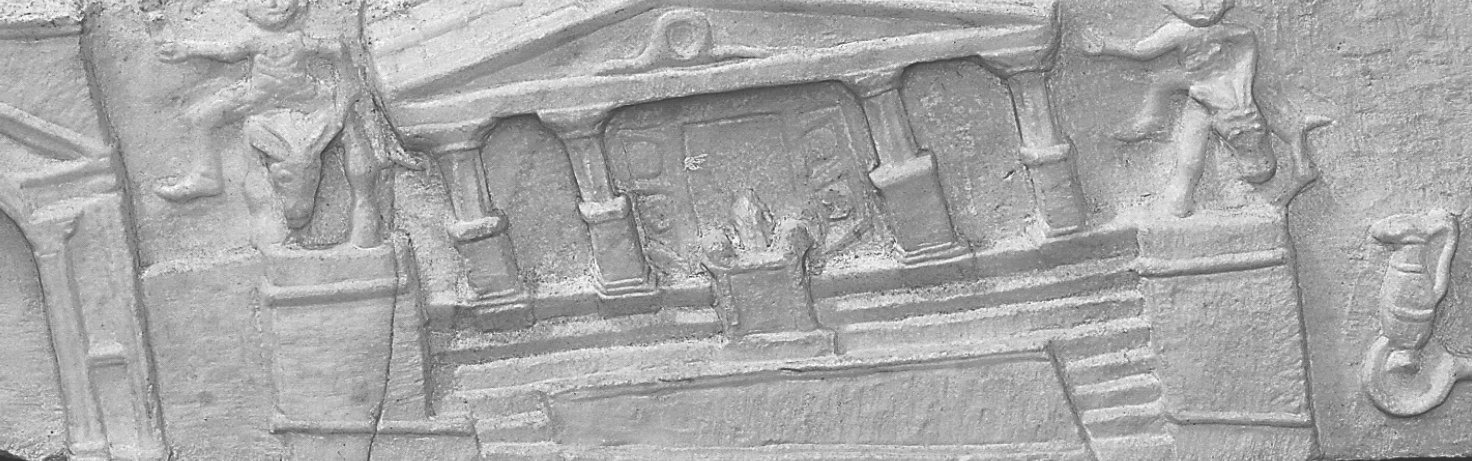
A frieze depicting the devastation caused by the Campanian quake.
In August 64, Romans again faced sudden ruin, this time in Gaul, in the regional capital Lugdunum (Lyons). A fire raged through the town, virtually annihilating it in a single night. Again Seneca preached acceptance and calm, expressing his views this time in one of the Letters to Lucilius. His point of departure is the grief of his friend Aebutius Liberalis, a native of Lyons who had, in all likelihood, lost everything in the fire. It is pointless to grieve, Seneca reminds Liberalis, when disaster is the common lot of humankind. Far better to practice praemeditatio malorum and imagine doom before it arrives, mentally embracing it until it ceases to terrify.
“Exile, torture, disease, war, shipwreck—think on these,” Seneca counsels. “Let us take in with our mind the worst thing that can possibly happen, if we don’t want to be mastered by it”—for it will eventually come to pass. The rise of cities only portends their fall; we should greet that fall with untroubled minds. Besides, he remarks—changing tack and offering multiple solaces—new buildings will sprout from under the ashes. A better city will rise than the one destroyed by the flames.
This last idea strikes the keynote of apocalypse, another theme that had haunted Seneca from his earliest writings. His Stoic training taught that all humankind would be wiped out, then reborn in a primitive state, in an endless cycle designed to renew the tired world. But Seneca imagined the scene more vividly than any Stoic before him. And he was more certain that the last days were near.
“There won’t be long until the destruction,” he writes in Natural Questions. “Already concordia [the harmonious balance of the cosmos] is being tested and torn apart.” The certainty and imminence of the collapse seems to have given him a kind of comfort. All would meet the same fate. All action—attempts to flee, to find remedies, to help others—would be equally useless.
Earlier Stoics had theorized that flames would cause the world’s end, the fiery cosmic exhalations they called ekpyroseis. But Seneca, in Natural Questions, imagined, as he had before in Consolation to Marcia, a universal flood. With grim foreboding, he notes that water is everywhere on earth—collecting in every hollow, flowing down every mountain, pooling beneath every acre of ground. “Nature has put moisture everywhere—so that, when she wishes, she can attack us from all sides,” he writes in Natural Questions. In a special-effects spectacular, he imagines each source breaking its bounds, each aquifer bursting forth from beneath its crust, until earth itself is liquefied.
“All boundaries will be sundered,” he foresees, in the same ecstatic tone he had used in Consolation to Marcia. “Whatever Nature has split into separate parts will be merged together.… Waters will converge from East and from West. A single day will serve to bury the whole human race. All that fortune’s favor has preserved for so long, all that it has raised above the rest—the noble, the glorious, the kingdoms of great peoples—all will plunge alike into the abyss.”
The twilight of the world, it seemed to Seneca, was coinciding with the twilight of his own life. Soon, he foresaw, virtue and vice would no longer matter; such distinctions would be swallowed up by the cataclysm. Perhaps he told himself that the same was true of autocracy and freedom, passivity and defiance, action and inaction.
Seneca was not the only leading figure trying to withdraw from political life. Thrasea Paetus, the senator whose Stoic beliefs mirrored Seneca’s in many ways, had suddenly stopped attending Senate meetings, at some point in 63.
This absence was remarkable and, to many no doubt, discouraging. Thrasea had thus far been a lone example of bravery in a servile body. It was he who had stirred the Senate to reduce the sentence of Antistius, the man whose only crime had been to recite risky verses at a dinner party. More recently, he had again led the Senate in asserting itself. He introduced a motion to ban state commendations, which, as he pointed out, were being used simply to advance the careers of corrupt administrators. His plea for honesty in public discourse was warmly welcomed—though the presiding officers, fearing Nero’s disapproval, at first would not allow it to come to a vote.
Thrasea’s dissent had often, up to now, taken the form of nonparticipation. He had walked out of the Senate, without a word, on the day in 59 when it heard, with approbation, the letter justifying Nero’s killing of Agrippina. A short while later, when others had cheered Nero’s first singing performance, he had withheld applause. Under the reign of Nero, where servile conformity was regarded as loyalty, mere absence and silence could be forms of protest. Now Thrasea had decided to employ them on a broader scale.
But was his departure from the Senate an act of courage or cowardice? By his absence, did he advance the cause of autonomy or deprive it of a leading voice? The dilemma must have troubled him, as it has troubled many others—righteous people whose political participation has helped bad rulers. Is withdrawal from the fray an act of conscience or mere self-protection?
However Thrasea answered these questions, he soon showed official Rome that his absenteeism would be total. On New Year’s Day 64, when the Senate gathered to beseech the gods on behalf of the Roman state, Thrasea did not attend. Two days later he skipped another annual rite, at which the senators swore loyalty to the princeps and prayed for his safety. These breaches of protocol were unmistakable in their import: Thrasea was gone for good.
Like Seneca, he turned increasingly to his writing and to his study of Stoic precepts. It was probably in these years that he produced a biography of Cato, the exemplar of Stoic courage whom both he and Seneca revered. Perhaps he was inspired by Seneca’s nephew, Lucan, who by this time had begun circulating his Civil War, an epic poem about the conflict in which Cato had died. For all three men, Seneca, Thrasea, and Lucan, Cato provided a powerful symbol of integrity in an age of autocracy—a symbol that could still be safely held aloft, thanks to a century of intervening time.
Thrasea had begun studying with Demetrius of Sunium, the Cynic guru whom Seneca also frequented and whom he had lionized in De Beneficiis. This man was said to go about “semi-nude,” wearing only a threadbare cloak that left one shoulder exposed, or even to lie naked on the ground, showing both contempt for social mores and indifference to discomfort. In Demetrius, the virtues of the great Cato, who had also practiced self-exposure as an ascetic discipline, seemed to be reincarnated. This hardy Cynic provided both Thrasea and Seneca with a spiritual refuge—an escape from the cares of the palace, in Seneca’s case, and from those of the Senate in Thrasea’s.
Meanwhile in Sicily, Seneca’s friend Lucilius was also seeking otium, retreat from political involvement, in the early 60s, as is clear from Seneca’s advice in the Letters. To judge by the urgent tone of this advice, and the many different forms it took, the decision to leave the public sphere, for a thinking Stoic, was a complex one. How far into retreat should Lucilius go? Seneca wonders at various points in the Letters. How should he protect himself from the incursions of politics and business? How ought he to disguise his retreat—for to make it openly, Seneca is quite certain, would incur ill will or actual danger. At one point, he advises Lucilius to feign illness rather than openly withdraw. “Some animals mix up their own footprints around their lair so as not to be found,” Seneca writes, metaphorically casting the seeker of otium as a hunted beast. “You must do the same, or there will be no lack of men to chase you down.”
Seneca wrestled all his life with the issue of otium or nonparticipation, expressing different views in different works and even in different sections of a single work. He devoted an entire treatise to it, De Otio, only part of which survives. In a modern scholarly study, an analysis of Seneca’s views on otium runs to fifty dense pages and even then comes to no firm conclusions. “It is difficult, if not impossible, to give an account of Seneca’s views which, while remaining faithful, would produce a consistent and coherent system,” concedes Miriam Griffin, the author of that study.
The problem that the principate presented to Stoic men of morals was indeed insoluble. The Stoic creed, with its emphasis on service to the common good, required involvement in political life, unless the regime was hopelessly evil or the Stoic’s own life was in danger. But what if the Stoic’s life was more endangered by leaving politics than by staying? And what if, by his departure, he made an evil regime more evil? The let-out clauses posed perils of their own. And the question of when to invoke them—at what point a regime’s malady became incurable, or one’s own risks rose unacceptably—was a thorny one.
Seneca’s own career exemplified the dilemmas, yet he could not safely write from experience. He had to frame all discussions of withdrawal in general, even hypothetical, terms. This gives many of his works a strangely detached quality. He tells his father-in-lawPaulinus, his brother Gallio, and his friend Lucilius to chuck political office and devote themselves to philosophy. But Seneca himself, when he addressed those men, still clung to political office. He spoke often as though he would withdraw, was doing so, or had already done so, never acknowledging the bonds that kept him at court.
The leading men of Nero’s age made their way, as best they could, through the moral thicket of the participation problem. Thrasea chose to depart the arena, while Lucan, as will be seen, remained intensely engaged. Seneca, less free than these two to do as he wished, took the middle path, the hardest of all. He withdrew only part of himself into a serene world of philosophic contemplation. The other part, the part that had chosen politics to begin with, remained chained to Nero—even though the emperor was rapidly becoming Seneca’s worst nightmare.
Now in his midtwenties, Nero was growing fat. He had already lost the graceful lines and angles that his youthful portraits reveal. His jowls were heavy, his brow doughy and soft. Soon he would grow a chin beard, the first facial hair yet seen on a princeps, perhaps as a way to disguise the fleshiness of his thick neck.
Nero had many opportunities to add to his girth, for everywhere he went, he found courtiers and social climbers eager to provide what he most enjoyed: banquets that stretched from noon to midnight, interrupted perhaps by refreshing dips in snow-cooled pools. By offering such hospitality, an aspiring parvenu could rise higher in Nero’s favor than any senator or noble. For it was on the equites and even lower social classes that Nero relied for support. One such was Vatinius, a cup maker from Beneventum, who pleased the princeps with an oft-repeated joke: “I hate you, Nero—because you’re in the Senate!” Both men enjoyed the camaraderie of this quip, the illusion that they belonged to the same class and could together scoff at their betters.
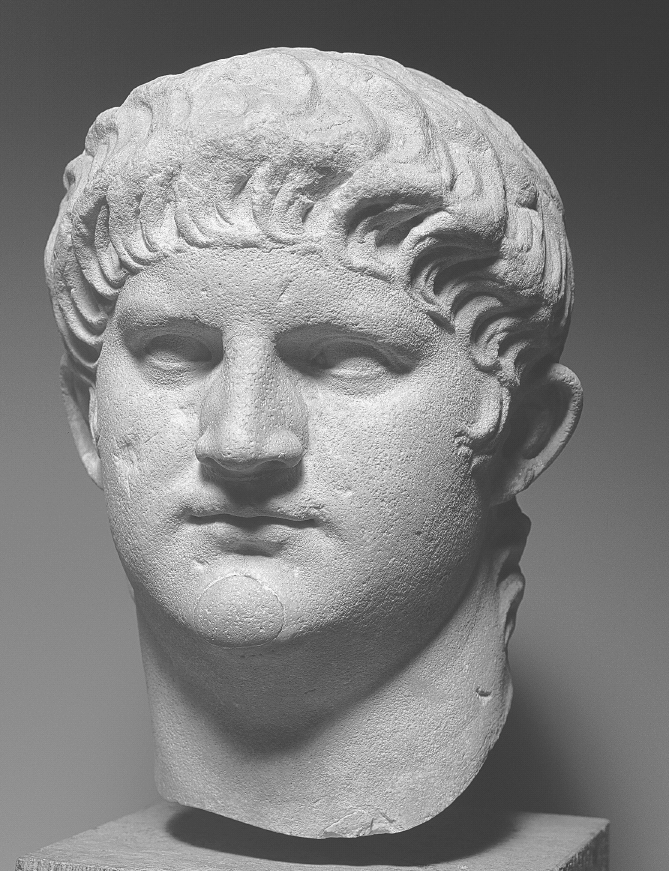
An official portrait of Nero in his early twenties.
By May 64, Nero’s mind was bent on music. He was determined to build an audience for his singing and lyre playing, arts to which he had given intense efforts. Thus far, obeying the restrictions imposed by his senior counselors—principally Seneca—he had taken the stage only once, in a private setting, on his own palace grounds. Now he wanted to go public. He chose to begin in Neapolis, a largely Greek city in Campania—the Hellenic spirit being more receptive, he thought, to the mixing of musicianship and rule.
Even at Neapolis, Nero took cautious measures to ensure a large audience. His Augustiani accompanied him, well paid to applaud in rhythmic patterns for their princeps, along with a few thousand recruits from the lower classes. But he wanted a full house, which at Neapolis meant more than 8,000. His troops and advance men collected farmers and herdsmen from surrounding villages to fill the benches. Finally the Praetorians themselves took up any empty seats. Spectatorship was a new kind of military service, imposed by a new kind of emperor.
Nero had trained his singing voice throughout his reign and always took care not to strain it. At the suggestion of Terpnus, his Greek lyre teacher, he had kept on a rigorous diet heavily weighted with leeks and had purged himself frequently with emetics and enemas. When he had to address the army, he avoided shouting but whispered instead, and subordinates soon learned they could avoid a dressing-down by reminding him to spare his throat. Terpnus had stayed in his service throughout his reign, coaching what was reportedly a thin and hoarse voice into one worthy of the stage.
Nero sang for the crowds at Neapolis over the course of several days. No reports have survived of those historic performances, except a notice that the stands at one point collapsed due to a seismic tremor. Fortunately the crowds had all gone home before this occurred. In nearby Pompeii, gladiatorial games were held in thanks “for the safety of Nero in the earthquake,” as one resident inscribed on a wall. Those words were preserved when the town was buried in volcanic ash, fifteen years later.
Seneca might well have been among Nero’s audience, for several of his Letters to Lucilius place him in Neapolis at this time. But if he did attend the performances, he tried his best to disguise that fact. In one letter, he complains to Lucilius that he had found the theater of Neapolis full while the philosophers’ lecture hall—his own destination—was empty. This was among the riskiest things he said in all his written works, since it could be taken as a jab at Nero’s artistic ambitions. But it also showed, perhaps quite pointedly, that Seneca had no part in them.
Nero’s launch of a public singing career deeply disappointed Seneca. He had long tried to prevent such a spectacle, finding it unsuited to the gravity of the principate, but he could no longer rein in Nero’s will. Conceivably he had played a role in the choice of Neapolis, not Rome, for the debut, just as earlier he had persuaded Nero to move his chariot racing outside city limits. But it was now Tigellinus, not Seneca, who shared Nero’s counsels, and Tigellinus was urging the princeps to pursue whatever mad fancy he pleased.
In the ancient battle between philosophy and poetry, the lines of which had been drawn by Plato four centuries earlier, Nero and Seneca had ended up on opposing sides. While Seneca focused on moral self-examination in Letters to Lucilius, Nero moved further than ever from this pursuit—toward passion, fantasy, and the ecstasy of Greek music. Reaching out in their different media toward different audiences, Seneca and Nero were vying for the hearts and minds of Rome, one exalting the power of reason, the other channeling strong emotion.
Those who now surrounded Nero, in particular Tigellinus, saw an opening in this temperamental divide. They whispered in Nero’s ear that the moral gravity of the Stoics was somehow a threat to his regime. In months to come, they would openly allege that mere gloomy looks, or ascetic ways of life, were treasonous in that they implied disapproval of Nero’s exuberance. To be “schoolteacherly”—to go about with a superior or censorious air—became a crime against the state. Nero would rely on such prejudices to brand the Stoics his enemies and to destroy some of the best men of his time.
From Neapolis, Nero intended to make a crossing to Greece and begin a full concert tour, but his movements became halting and uncertain. He got only as far as Beneventum before canceling his Greek trip and returning to Rome. There he announced an intention to sail for Egypt but immediately abandoned that journey, too, claiming that adoring Romans would not want him absent for long.
This change of heart prompted Tigellinus, who was vying to add the post of master of revels to his brief, to pull out all the stops. He arranged a fantastic soiree to celebrate Nero’s decision to stay near Rome. On the Lake of Agrippa, a reservoir near the Pantheon, he floated a vast barge and had it towed about by rowers in gold-and-ivory-adorned ships. The lake was stocked with exotic fish brought from afar, while rare animals and birds ringed the shore. In the center of the barge, Nero, Tigellinus, and other high officials dined while lying on purple pillows. The rowers meanwhile took them on a sexual pleasure cruise: on every bank stood women, from high classes and low, beckoning Nero to enjoy their favors in specially built lakeside brothels.
After this grand fete, Nero left Rome and headed to Antium, about twenty miles south. His intentions at this point are unclear, and from his rapid pace of movement, it seems he had become agitated or uneasy in mind. That summer had been thick with portents. At the start of May, a comet had appeared in the night sky, and it had continued to move slowly through the heavens, week after week.
Nero looked for advice about the comet’s meaning, but not, significantly, from Seneca—though the sage had discussed comets in Natural Questions and had used “the comet we saw for six months in the most fortunate reign of Nero” (in A.D. 60) to prove that they did not portend the fall of rulers. Instead Nero turned to Balbillus, a former prefect of Egypt who had become adept in astrology. Balbillus did not question the dire significance of this new comet but suggested a ruse to avert the danger. If Nero contrived to kill off some high-ranking aristocrat, the intent of the heavens would be fulfilled and the princeps spared.
Probably Balbillus meant to give a pretext for the murder of Lucius Junius Silanus, the last male member of Augustus’ sacred line—other than Nero himself. But on July 17, it seemed that no such measure would be needed, for the comet was no longer seen. The baleful star had shone for more than two months without incident. Rome, and Nero, were able to breathe a sigh of relief.
But the very next night began a disaster as terrible as if the comet had hurtled to earth and struck the city dead center.
Nero was at Antium in mid-July of 64, the place of his daughter’s birth and his own, when messengers from Rome told him of a fire in the city. It had begun near the Circus Maximus, a racecourse built of stone but surrounded by wooden shops crammed with flammable goods. Winds were driving the blaze into several adjoining regions, and thousands of residents were fleeing. Nero elected to stay where he was, trusting in the vigiles, the corps that oversaw fire fighting and civic safety, to handle the problem. Later, though, when he learned that his own grand construction, the Domus Transitoria, was being consumed, he made haste to return to Rome.
By the time he arrived, the city had become a cauldron. The flames had moved at breakneck speed and were attacking four of Rome’s seven hills. The primary weapon of the vigiles, buckets of water, was utterly useless. A fallback strategy, destruction of buildings to form a brake, was failing as well: by the time battering rams could be brought into position, the blaze had already raced past the line of defense, or else the intense heat—estimated at 1100 degrees Fahrenheit—simply jumped any barrier. Those who escaped their tinderbox homes had become a throng of seared, scarred, and panicked refugees. They jammed the narrow streets and blocked one another’s paths, clogging escape routes with heaps of goods they had saved from the flames, or looted.
Nero could not save Rome, but he did what he could for the Romans. He threw open his own properties, imperial gardens in untouched places like the Vatican hill, to survivors and ordered shelters built. The Field of Mars, thus far out of the path of the fires, was converted into a refugee camp. Emergency grain supplies were brought up from Ostia and sold at a subsidized price. Those still able, and willing, to live would have the means to do so.
After six days the fire was apparently stopped by a brake, but it flared up again and burned for three more days. Finally it died out for good, mostly for lack of fuel. Perhaps two-thirds of the city had been destroyed. The only regions spared were those fenced off by barriers: the Tiber River had protected the Vatican, while the Field of Mars and the Quirinal and Esquiline Hills were shielded by a set of old ramparts called the Servian Walls, originally built around a much smaller Rome to guard against Gallic invaders.
In the camps that now sprawled in these places, stories began to spread, many demonizing Nero. Some said that torchbearers had been seen setting the blaze, who, when accosted, claimed they were acting on high authority. Others said that vigiles attempting to douse the blaze had been prevented. The most damning rumor of all claimed that the princeps had stood on his palace battlements and strummed his lyre while the city burned, reciting his own verses about the destruction of Troy. The ingenious lampoon allowed the public to feel both rage over the fire and disgust at Nero’s artistic delusions, a devastating mixture. The image thus created continues to define Nero, in popular lore, to this day.
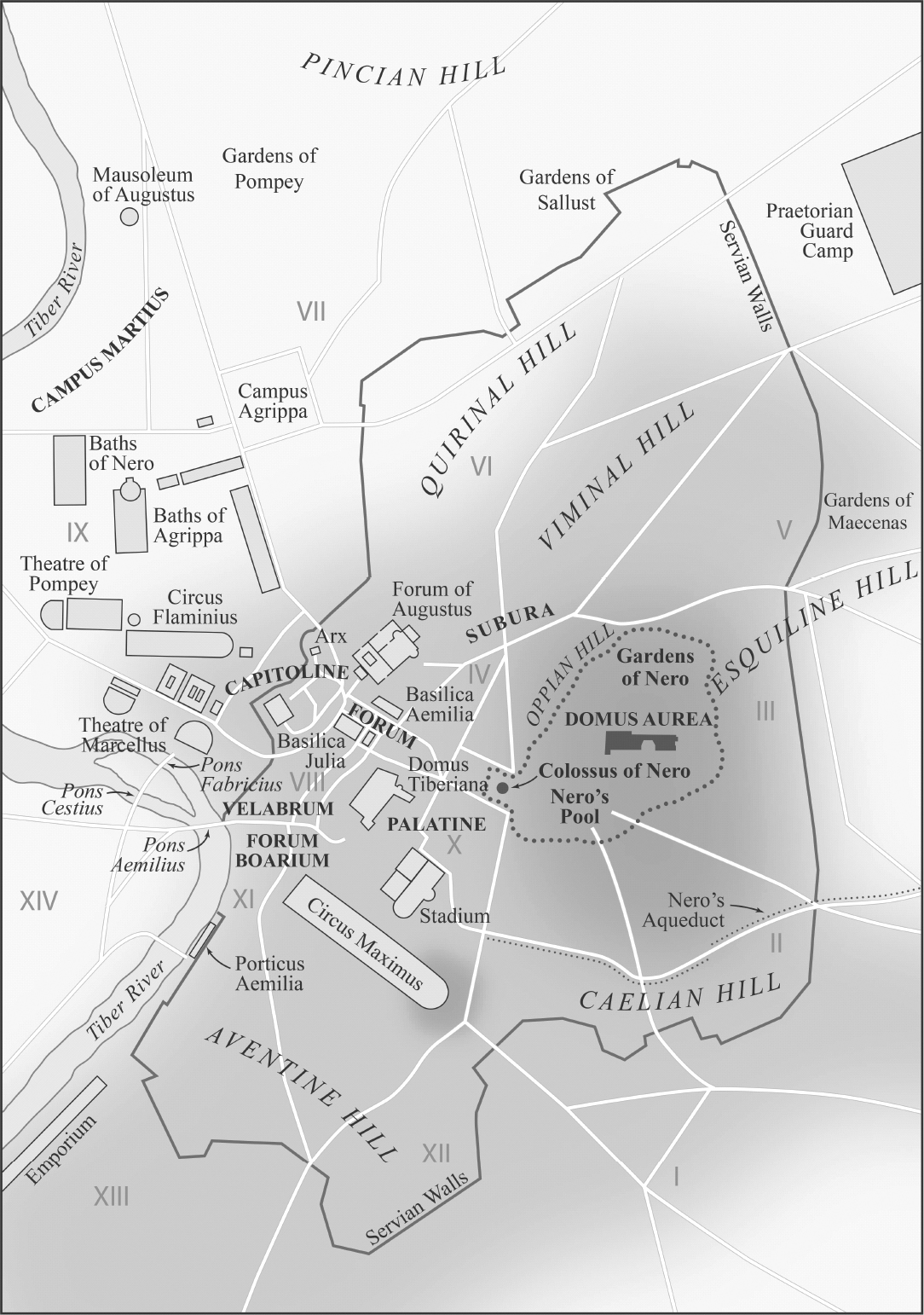
Map of Rome showing the extent of fire damage.
Was Nero far enough gone in mind to torch his own city? Or to treat its destruction as an occasion for song? What would have been his purpose in setting the fire—to build a new Rome in his own image, a Neronopolis, as Suetonius says he planned to do? Or to lash out at disapproval of his new persona and at the Stoics, whose scowls hurt him so deeply? Rome was his conscience, the city he dreaded to enter after killing his mother, the city that had, briefly, made him ashamed to reject Octavia. If, as psychologists tell us, arson often springs from buried rage and a quest for revenge, then Nero did have motives. Whether he actually set the blaze is a question that, for Tacitus, could not be resolved, and it remains unresolved today.
What mattered to Nero was that people believed him guilty. He threw himself into the reclamation of the city and of his battered reputation. He poured fortunes from the treasury and from his own funds—the two were hard to distinguish—into relief and reconstruction. And he began a campaign to shift blame from himself to others.
The sect the Romans called Christiani, and their founder Christus, appear first in Latin literature in Tacitus’ account of the great fire. According to this famous passage, the Christians were arrested on spurious charges and brought to Nero’s palace grounds for horrendous ordeals. They were dressed in animal skins and then were set upon by wild beasts; they were wrapped in pitch-soaked cloth and set on fire; or with a significance Nero could not have intended, they were nailed to crosses to suffocate to death. PerhapsPeter or Paul, or both, met their deaths in this savage purge—though evidence is strangely lacking, in both Roman and Christian sources, on the fates of these apostles.
Rage over the fire, and the violence it spawned, slowly died away, along with the heat trapped in the smoldering ruins. Nero began to rebuild. He made certain that the new Rome would be more fire-resistant than the old; he widened streets and introduced flat porch roofs from which the vigiles could do their jobs. He paid for much of the construction himself, since most homeowners had been wiped out. The princeps, and the state, were spending on an unprecedented scale, reconstructing Rome while supporting perhaps 200,000 displaced and suffering Romans.
In such a crisis, any sane princeps would have scanted his own needs. The flames had spared many imperial properties; Nero was comfortably housed. But his precious Domus Transitoria, not yet fully complete before the fire began, had been destroyed. Nero set out to replace it with a building that would beggar Rome’s imagination—and break its bank. He began work on the Domus Aurea, the Golden House, an immense pleasure grounds occupying more than a hundred acres. At the entrance to the main building—a three-hundred-room architectural fantasy, designed largely for entertainment—he erected the Colossus Neronis, a bronze statue of himself, over one hundred feet tall.
Money had to be found. Imperial agents scoured the provinces, squeezed taxpayers, and ransacked the treasuries of Greece and the Near East. Not even temples of the gods were spared, for many contained precious statues clad in gold and ivory. The hoard of art stolen from the Greeks during Rome’s eastward expansion, two and three centuries earlier, had been largely lost in the fire. Replacements were ripped from their shrines by Acratus, one of Nero’s trusted freedmen, and Carrinas Secundus, a lackey who had been trained in Greek philosophy and could sweet-talk his way through the East.
It was the greatest transfer of wealth since the conquests of Alexander the Great. It pained all those who admired the beauty of the Greek world, or who wanted Rome’s empire to be more than merely a global shakedown. Among them was one who, despite his earnest efforts and dearest wishes, was implicated in the squeeze.
Seneca felt, as he watched the Golden House rise on mountains of loot, that he must get clear of politics without delay. Nero had become an offense to all Stoic principles, an embodiment of luxury and excess. The icons of the gods themselves were being smelted into the emperor’s tableware. The twilight realm in which Seneca dwelt had grown gloomier than ever.
The fire of Rome had destroyed part of Seneca’s property, but he was still vastly wealthy. Two years earlier, when he had tried to buy his way out of politics, Nero had refused. Now, with imperial funds draining away as never before, Seneca saw a second chance. He once again sought to surrender his wealth to the princeps. This time his offer was accepted—but on Nero’s terms. The princeps took possession of Seneca’s wealth and lands, but would not allow the sage to absent himself from court. The regime was too badly weakened to withstand a high-level defection.
Seneca’s last stratagem was the course he had urged on Lucilius, his friend in Sicily, when advising him how to practice otium. He feigned illness and stayed in his chambers. He must live a lie, if he was to live at all.
Tacitus reports that at this point Seneca discovered from his loyal freedman, Cleonicus, that Nero was trying to have him poisoned. There is no reason to doubt the information, though Tacitus indicates it did not have solid authority. Nero had the means for such a crime, thanks to Locusta, and plenty of opportunity. Simple dislike would have served for a motive, or the fear that Tigellinus had drummed into him, that serious and sober men—“schoolteachers”—meant him harm.
Seneca had already watched as Claudius and Britannicus were felled by Locusta’s poisons. He began eating simple, uncooked foods, plucking fruit off the trees on his estates, scooping water from running streams. Earth itself would nurture him, with victuals even Nero could not taint.
Death was looming all around. The question Seneca could not answer in Letters to Lucilius haunted him every day: whether to await a doom that was sure to come, or by suicide take charge of his own fate. With his actions, he gave his answer. While the fruit trees burgeoned and the streams ran pure, he would do his best to stay above ground.