
10
With Eleanor installed as queen, the sources for her life become slightly more forthcoming. But this in itself presents a problem, as the years which were to follow were so crowded with a variety of events and interests that a chronological treatment cannot hope to do justice to the evidence which emerges. Left only in that format, it is hard for the woman and her interests to emerge from the welter of detail. The next three chapters therefore consider in turn three key aspects of Eleanor’s life as queen: her work, her own personality and interests, and her family. This should enable the reader to see key themes which run through the remaining fabric of her life, and appreciate how they come together, when the story returns to a chronological format.
The story which this chapter tells is how Eleanor, more or less uniquely among English queens, managed to combine her day job as queen with carrying on another full-time professional job as a businesswoman dealing in property. In flat contrast to her later reputation as a modest and retiring queen, she was, in effect, an essential member of Edward’s cabinet, dealing with an important and discrete job on his behalf. In so doing, she worked incredibly hard, driving her team mercilessly, and gained a reputation for being an implacable person who should not be flouted.
As this story takes us so far from the preconceived notion of Eleanor, it is obviously important to make the case good from the evidence; and herein lies a problem, for while a huge amount of material relating to the details of Eleanor’s properties and dealings has been uncovered and analysed (principally by John Carmi Parsons in his magisterial Eleanor of Castile, Queen and Society in Thirteenth Century England), the details do not easily illustrate the overall picture. Each transaction is too small to be significant, but in getting into the details of the transactions, the overall picture recedes. One therefore has to effectively pan in and out from the detailed picture over a period of time to provide a synthesised perspective.
The best starting point for considering Eleanor’s work is probably to step back and look at what she achieved overall and how she was perceived by contemporaries at the time. As to this, the bottom line is simple. The funds available to thirteenth-century queens had fallen way below the amounts which were required. Eleanor instituted a programme of land acquisition and management which effectively balanced the books, more than doubling the revenue available.
Eleanor and Edward had, of course, been plagued by financial difficulties since their marriage, and one might imagine that once he had acceded to the throne all such worries would be over. However, this was far from the case. The loss of the Angevin lands in France was a major blow to the financial position of the English monarchy, which had led to a pressing need to increase revenues from England. At the same time, Crown spending had increased sharply. Henry III had acquired a number of earldoms of greater or lesser financial use, but had granted them all away to family members. Edward himself, despite a highly aggressive policy of land acquisition in his own right, still had revenues in the 1280s of less than £19,000 per year and simply could not afford to follow the traditional route of allowing Eleanor to hold her dower lands during his lifetime.1
The difficulties facing them are illustrated by the fact that, even with Eleanor turning her attention actively to revenue generation and even as queen, it can be seen that from time to time she had recourse to the standard expedients to help her cash flow. So in June 1290 we find her selling a cup and a brooch, and in 1289 she borrowed funds from friends to cover some of her building works. Moreover we can see that she assigned debts and made substantial payments (over £2,000 between 1286 and 1290) to Edward’s preferred bankers, the Ricciardi, which suggests that she had debts to them.
Why was Eleanor short of money? Some extent of the scale of the funds a Queen of England required can be seen by a consideration of Eleanor of Provence’s position; even with her somewhat controversial and remunerative use of grants of wardship, Henry III still had to subsidise her heavily during his reign and acknowledged the kinds of amounts she would need (albeit on the smaller scale of a widow) by increasing her dower assignment to £4,000 per annum. This suggests that, as queen, with a greater household and responsibilities, Eleanor would be likely to need a larger sum even than that. Parsons suggests the figure required was somewhere in the region of £6,000 to £8,000 per annum and calculates her 1289–90 expenditure as being £8,800 once wardrobe expenses, alms, wages, household expenses and other miscellaneous payments are counted. While 1289–90 was probably an atypically expensive year, and the expenditure figures may be open to some argument, the material does suggest that some thousands of pounds per annum were required.2
On the other side of the balance sheet, the funds available to a Queen of England had become hopelessly inadequate. Since the change from the practice as to the holding of dower during the king’s life, queens had been substantially reliant on ‘queen’s gold’; that is effectively a tax of 10 per cent of any fine above 10 marks or on any tax of the Jewry. This source produced wildly varying sums depending on the number and level of fines levied in a year – between the fourteenth and sixteenth years of Edward’s reign they varied between just short of £500 and some £1,400 per annum – but at no time did they come close to the kinds of sums required.
While, in addition to queen’s gold, a king would regularly grant his wife debts, reliefs or fines owed him, this source of income was erratic and unreliable – and highly unlikely to bridge the yawning financial gap. The same is true for simple cash gifts from the king or third parties. A combination of circumstances had meant that it was not until the thirteenth century that English queens were in a position to try to grapple with the problem, Eleanor of Aquitaine’s freedoms being somewhat contracted by Henry II after her rebellion and Berengaria of Navarre and Isabella of Angoulême being placed by their respective husbands in a position of even more complete financial dependence.
Eleanor of Provence’s approach to the problem had met with very mixed success and garnered her very considerable unpopularity. She had probed the very limits of queen’s gold with her attempts to extend its ambit, leading to considerable complaint. She had also shown clearly that wardships and associated marriages were a politically dangerous source, and therefore they were an unsafe route for substantial revenue generation. Further, even with all their disadvantages, they still did not provide sufficient revenue.3
Eleanor therefore had to look for other means to bridge this gap. How she did so was to assemble, more or less from a standing start, a property portfolio of considerable extent and value. By the time of her death, her properties were bringing in somewhere between £2,500 and £2,600 annually, i.e. the most significant portion of her income; and, it will be recalled, roughly two and a half times the large dower which Eleanor de Montfort had from one of the largest estates in England. This landholding was kept intact as a separate estate after her death; run as ‘Terre Regine’ until Edward’s second marriage to Margaret of France, the land then passed to her as dower and formed the backbone of English queens’ dower assignment for the next century. Eleanor therefore created a great estate.
The extent of this achievement is underlined by how she was actually perceived. The clearest accounts which we have of Eleanor actually relate to her land-gathering activities, and are not flattering. The most straightforward is the simple ditty ascribed by Walter of Guisborough to the common people of the time: ‘The king would like to get our gold/The queen our manors fair to hold.’ Also pithy is the epitaph provided by the Dunstable annalist: ‘A Spaniard by birth, who obtained many fine manors.’ So, even among those who had no direct contact with it, Eleanor’s involvement in property acquisition was so extensive as to have become well known. When the annalists thought of Eleanor, they thought of business.4
One important point to note is that the queen herself was associated directly in the endeavour even by the gossips – and that gossip was true. There are numerous surviving pieces of correspondence which show Eleanor taking an active part in decision making, dealing with a variety of administrative details: the enclosure of a tract of land, a confirmation of a conveyance – even an allocation of wine or a recently arrived shipment. There are also letters which show her staff reporting to her, and plainly expecting her to be au fait with quite minor details, or apologising for not reporting to her in person – again indicating that she is expected to be keenly interested. There are letters from her most frequent man of business, alluding in passing to the details of the business ‘which we spoke about’, and advising her to consider the position in relation to specific portions of her holdings. The evidence, then, is quite clear – Eleanor was personally involved in her own business empire, right down to the level of fine detail. This is in sharp contrast with Eleanor of Provence, who did have land dealings herself, albeit on a smaller and more random scale. Her land dealings were seen (accurately) as being run for her by professionals. So Matthew Paris pictured Eleanor of Provence’s estates steward William of Tarrant as a man who thirsted for money as a horse leech after blood, but he did not associate the queen with his misdeeds.5
More lengthy, but equally to the point, in particular in associating Eleanor as an active participant in the property dealings of her office, are two letters from the Archbishop of Canterbury, Archbishop Pecham: one in 1283 and one in 1286.6 In the first, the archbishop focuses on dealings with the Jews and usury, referring to her property dealings in a sideswipe:
… for God’s sake, my lady, when you receive land or manor acquired by usury of the Jews, take heed that it is a mortal sin to those who take the usury and those who support it, and those who have a share in it, if they do not return it. And therefore I say to you, my very dear lady, before God and before the Court of Heaven, that you cannot retain things thus acquired, if you do not make amends to those that have lost them, in another way, as much as they are worth more than the principal debt. You must therefore return the things thus acquired to the Christians who have lost them, saving to yourself as much as the principal debt amounts to, for more the usurer cannot give you. My lady, know that I am telling you the lawful truth, and if anyone give you to understand anything else he is a heretic. I do not believe that you retain in any other manner things thus acquired, but I would wish to know it by your letter, so that I can make it known to those who think otherwise …
In the second letter, from 1286 to Geoffrey de Aspale, the keeper of Eleanor’s wardrobe, we see that his mind has not been put at rest:
A rumour is growing strong throughout the kingdom of England and much scandal is thereby generated, because it is said that the illustrious lady queen of England, in whose service you are, is occupying many manors of nobles and lands and other possessions, and has made them her own property – lands which the Jews extorted with usury under the protection of the royal court from Christians. It is said that day by day the said lady continues to acquire property and the possessions of others by this means with the assistance (though we ourselves do not believe it) of certain clerics who are followers of the devil and not of Christ. There is gossip and debate about this in every part of England. Wherefore, as a gain of this sort is illicit and damnable, we beg you, and firmly command and enjoin you as our clerk, that when you see an opportunity you will be pleased humbly to beseech the said lady on our behalf, that she bid her people to abstain entirely from the these practices, and to restore what has been thus seized, or at any rate make satisfaction to those Christians who have been wickedly robbed by usury.
While the full extent of Pecham’s assertions may be open to doubt – the evidence of the annalists tends to cast doubt on his suggestion of gossip and debate in every part of England – the picture is fairly clear. Eleanor acquired a very serious landholding – one sufficiently large to be the subject of talk which troubled the archbishop – and she did so via practices which some might regard as rather sharp or even morally reprehensible.
We can be sure that Eleanor did not do this on her own initiative. Her abilities and training may have enabled her to take a very active part in the business, and even made the role a fulfilling one for her, but the truth is that the plan to acquire a substantial and certain landholding to provide revenue and a source of patronage for a Queen of England was one which was authorised by Edward and which dovetailed very neatly with his coronation oath to regain as much of the land dispersed by his predecessors as was possible.
The plan may be one which was initiated well before Henry III’s death – as evidenced by Eleanor’s early dealings in property, and her close involvement in those dealings. But it is clear that, on return from the Crusade and after the coronation, the plan was picked up and put into action as swiftly as possible and with considerable business focus. Again the distinction between the two Eleanors, Castile and Provence, is clear in the evidence and was specifically noted by Eleanor of Provence’s biographer.7
Having set the scene for what Eleanor was to achieve, one can now turn to look in more detail at how she went about this process. A good way in to this story is to consider the court’s movements in the year which followed the coronation. This illustrates how Eleanor reacquainted herself with her existing properties and set about familiarising herself with potential acquisitions. The most straightforward aspect of it is neatly illustrated with one of the first bits of business of 1275: a visit to the New Forest.
The New Forest location reflects a part of the small property portfolio which Eleanor was nurturing before her departure on Crusade; between 1266 and 1270 she had acquired the manor of Ringwood and the issues and profits of the New Forest. So we see that one of her first interests, once the coronation and Edward’s necessary business was seen to, was to get back in touch with her existing estates – in person if possible.
But there was far more going on than this simple story shows. As we know, Eleanor had turned her attention to getting a revised dower assignment. There were two reasons for this. The first was simply the need to keep pace with her mother-in-law – Eleanor of Provence had induced Henry III to increase her dower assignment to £4,000 in 1262. Eleanor would have been very unusual if she was not vexed to think that she had a quarter of the dower assignment which her mother-in-law had, and very imprudent if she had not looked ahead to the possibility of coping on such a sum if she were ever widowed (as she had so nearly been on Crusade).
Secondly, if a revision of the dower assignment was necessary, and if she was to commence work building up a property portfolio, practicality dictated that now was the time to revise the dower assignment; that way, the new dower assignment could form the nucleus of her future business dealings, so that her existing properties and those which she was to hold in dower would run well together administratively. So throughout this period, Eleanor and her team will have been liaising with Edward’s team to audit which of the properties he had in his gift or which could be brought into play, could best be transferred to her to form part of her new dower and fit with her plans for future expansion.
This planning process for the revised dower can be seen from an even earlier trip – in fact the very first trip taken following the royal couple’s return to England and coronation in December 1274. This excursion took them to Northampton, then on to Fotheringhay, King’s Cliffe near Peterborough, and the hunting lodge of Geddington near Corby (later the site of one of the Eleanor crosses raised by Edward), looping back inland via Overstone. There at first appears no very good reason for this itinerary.
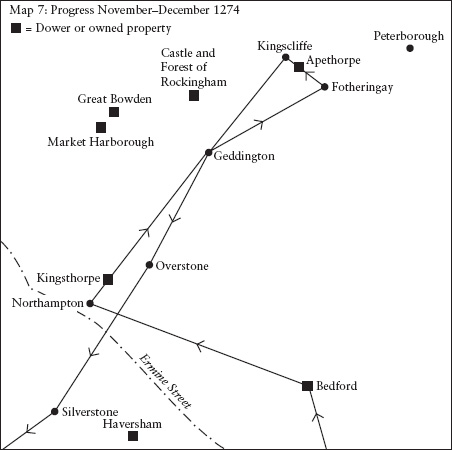
However, before the Crusade, Eleanor had built up a decent holding at Great Bowden and Market Harborough, which lie just a little north of Geddington; and she had also acquired Kingsthorpe, which lies just outside Northampton and practically next door to Overstone. These original holdings were supplemented in the 1275 dower with properties nearby, but just over the Northamptonshire border: Apethorpe and the castle and forest of Rockingham. Fascinatingly, these two properties were cheek by jowl with King’s Cliffe and Fotheringhay, where the court stayed. It therefore very much looks as if, on this trip, Eleanor and her team were not simply looking at existing properties, but actively scoping out suitable extra properties to be added to her dower. Also consistent with this is an early stop at Luton on the way north, which fits nicely with the later grant to Eleanor of the town of Bedford as part of her dower assignment.
Similarly, a stay which was made at the start of 1275 in Wiltshire offered an opportunity to review a grant to Eleanor in November 1274 of lands at Compton Chamberlayne and the grant to her in the 1275 dower assignment of the nearby farms of Bedwyn and Wexcombe. These were later to become the heart of one of her key property groups.8
Yet another example comes in immediately after the birth of the next baby, Margaret, in March of 1275, where we find in the itinerary a trip to Aylesbury, which later becomes part of the revised dower allocation. Also part of the revised dower allocation were the manor and forest of Brill and the farm of Wycombe – and these were probably viewed on this occasion from Risborough, where the court stayed briefly before reaching Aylesbury. The Aylesbury stop was followed by a stop in Balsham (more or less the location of the modern-day Gatcombe Park), Bury St Edmunds and Lavenham. These stops were suitable for pilgrimage, as was appropriate after a return from Crusade (and indeed replicate a round of pilgrimages previously pursued by Henry III); but they were also very convenient to enable Eleanor to inspect existing properties, in particular her holding at Dullingham in Cambridgeshire, some recent acquisitions at Badmondisfield, as well as Soham, which was to form part of the revised dower assignment. Piety and practicality could therefore be combined.
Once the requisite stay at Westminster for Parliament had been completed, the theme comes to the fore again. In August 1275, the royal progress went north. While a part of the trip constituted a stop within Edward’s lordship of Chester, the journeys to and from Chester were so made as to enable the party to take in, along the way, Eleanor’s future dower properties in Warwickshire, the very significant acquisitions via dower of Derby and Macclesfield and a second view of the Leicestershire and Northamptonshire properties.9
It is also possible to trace a certain amount of tying in of properties further afield. So, reverting to Eleanor’s earlier holdings in Somerset, prior to Crusade, Eleanor had lands in the neighbourhood of Dundon and Somerton. To these, she immediately added on her return a further wardship at Barwick. A stay at Eleanor of Provence’s manor in Gillingham in Dorset (a place which that lady abominated for ‘the greasy smoky vapours which rise in the evenings’) in December 1275 would have had Eleanor and her team well placed to visit those properties and that of nearby Camel and Kingsbury, which were added as part of the dower assignment in October 1275. In the dower assignment was also added a further block of properties further north in Somerset: the farms of Cheddar, Axbridge and Congresbury.10
It is therefore possible to see quite clearly, from the amount of time and effort taken, the work of the queen in putting together a property empire appearing as a priority for both king and queen in the immediate aftermath of the coronation; and it is also apparent that Eleanor must have been very hands-on in the management of this business. Property management could perfectly well have been deputed to staff. But instead we see the entire court traipsing around the country in her wake, as she inspected existing lands and assessed suitable future lands to add to her portfolio. Edward’s approval of this paradigm is apparent in his bringing himself and the court along; it was of course open to him to let her go with her staff alone, or to insist that she relied on third-party assessments. The royal partnership might divide responsibilities, but it was a manifest partnership.
One can therefore see that Parsons is wrong when he says that there was little movement toward increasing Eleanor’s estates between her return in August 1274 and the granting of the revised dower assignment in October 1275. There was in fact extensive work in the sense of planning – backed up by very active interest from both Eleanor and Edward.
The upshot of Eleanor’s work was a revised dower assignment which was approved in October 1275. It amounted to £4,500 in English and Gascon lands, spread over twenty-two shires. So far as the English property was concerned, some of the more disparate elements of the 1254 dower were abandoned. To add to the blocks already outlined above, in Suffolk the castle and town of Orford and a number of farms (including Ipswich) were given. There was a huge grant of places in Derbyshire and Nottinghamshire (Ashbourne, Bolsover, Derby, Horston, Wirkworth, Clipston and Mansfield), which were added to complement her holdings around the Peak. There was also a significant block in Essex, the castles and towns of Bristol and Odiham and the city of Lincoln, accompanied by the town of Grimsby and the Soke of Caistor. Eleanor also received a considerable dower in Gascony: £2,000 per annum comprising Millan and Harbefaure and the castles, towns and forests there, with customs revenue from Bordeaux making up the shortfall.11
But Eleanor’s work was far from done when the revised dower assignment was over. What followed thereafter was a careful acquisition of properties which complemented her existing portfolio and her dower. An example of how this seems to have been done can be traced through from a couple of examples pieced together by Parsons. The first example is her holding in Norfolk. It will be recalled that Eleanor had acquired the manor of Aylsham first at pleasure, and then in fee for life, together with some lands at Scottow, a little east of Aylsham. In late 1275 she acquired a manor at Scottow, with the advowson and member at Great Hautbois (then part of the hundred of South Erpingham). This was obtained via one of her Jewish connections. Having acquired these properties, Eleanor then arranged for her 1275 dower to include Cawston with the hundred of South Erpingham. This property was adjacent to Scottow and Aylsham and had been surrendered voluntarily to Edward by John de Burgh, the grandson of Henry III’s regent Hubert de Burgh, to rid himself of an inherited debt to the Crown. In later years Eleanor would then build on this solid base, to add in 1278 Burgh ‘next Aylsham’. Significantly, this was a move which was probably contemplated even at the time of the dower assignment, since Eleanor moved to acquire all John de Burgh’s debts owed to the Jewry in November 1275 – just a month after the dower assignment.
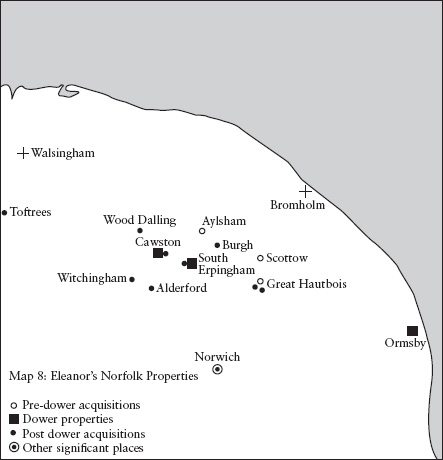
Also interesting is the fact that Burgh was not finally acquired until after Edward and Eleanor had toured Norfolk in 1277. Again, as with the dower, it would appear Eleanor wanted, if possible, to view properties before any irrevocable steps were taken. This can be seen again when in 1281 (following another Norfolk trip) Eleanor added supplementary lands around Great Hautbois as the former owner’s affairs went from bad to worse, following another acquisition of his debts owed to the Jewry in May 1275. Later still, in 1288, Witchingham and Alderford, lying to the south of Cawston, were added to the group. Eleanor also acquired some strategically placed wardships nearby in 1284 and 1285. Thus a core holding was in place to begin, and at the time of the dower both dower properties and future acquisitions were effectively marked down, with steps being taken to be ready to make acquisitions later. After that, any unrelated but convenient individual properties could be added.12
This set of acquisitions hints that one approach adopted was to monitor estates that were being dissipated and put herself in a position to reunite them. Further support for this theory is given by the situation in Eleanor’s Kent holdings. Here the Crevequer family had held a barony based around Chatham, but it had been split into three parts – one being pledged by the heir, Robert, to the Jews, another part (including Leeds Castle) likewise pledged by William de Leyburn (son of Edward’s old associate Roger), and a third (including Chatham itself) being in the hands of one Roger Loveday. Robert Crevequer was a part of Eleanor’s household in 1290, being one of her household knights, and swapped other properties with Eleanor in 1283. It is at least possible that her knowledge of the details of the family’s affairs came direct from him; it may be that he, like John de Burgh, alienated his inheritance willingly in order to free himself from inherited debts. In any event, Eleanor acquired an interest in the Crevequer debts in early 1275, and one in the Leyburn debts a month after the dower assignment was completed. There then seems to have been work behind the scenes to procure the transfer of these properties, and the purchase of the Loveday share, which resulted in transfers of all three parts of the barony to Eleanor in mid- to late 1278. Thereafter it would appear that Eleanor visited with her project managers in October of that year, while the court was nearby in Gillingham and Teynham en route for Canterbury; and then the builders were sent in.
A similar approach can be seen in her Leicestershire properties discussed above, where an acquisition of a convenient estate at Welham, near the Market Harborough grouping, was made in 1276, but Eleanor had already been the holder of debts owed to the Jewry by its owner.13
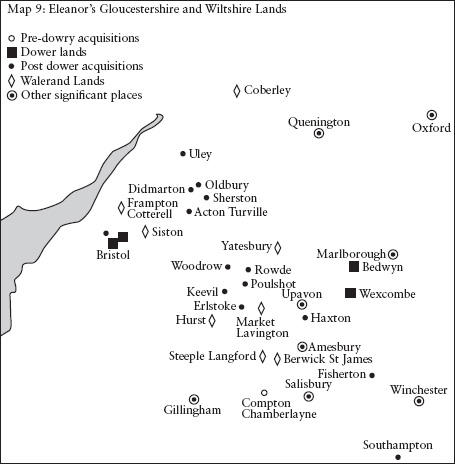
Another way in which Eleanor and her team went about building up her portfolio can be illustrated by her estates in Gloucester and Wiltshire. Here, she had a fairly limited dower assignment – the castle and town of Bristol and farms of Bedwyn and Wexcombe and no previous holdings. Additions were made to these assigned properties in 1279–80 when Eleanor purchased the manors of Great Sherston, which was about equidistant between her two holdings, and Woodrow, which was just south of Sherston. So far the story provides nothing remarkable, but this grouping yields two letters which show Eleanor and her team considering acquisitions specifically by reference to their location relative to her existing holdings. Thus, shortly after the Sherston and Woodrow acquisitions, follow these letters about a potential acquisition at Didmarton – in Gloucestershire, but just a few miles from Sherston. The first came from her bailiff John le Botiller – addressed direct to Eleanor – advising that he has heard from a local woman of a piece of land which would be a convenient acquisition for Eleanor, being close to Sherston, and has acted on the information, entering on the property. But within a few days a certain Sir Robert Burdon had ejected Botiller, claiming it was his land. Botiller suggests the queen get the king to act to get the land back.
A short while later comes another letter direct to Eleanor about this transaction, this time from the man who had sold Sherston and Woodrow to her. He is keen to pass on the news that, fortuitously, Sir Robert Burdon has died, leaving even more land in the vicinity; and a manor at Devizes, too. Anticipating her keen interest, he has taken custody of the small boy whose land this was to be, so that the queen could get the wardship of him, and thus the lands – since, as he notes, the wardship and marriage will be of great profit to her.
Following the initial misfire, Eleanor acted on the second tip-off and obtained the wardship of young Burdon and thus possession of the lands at Oldbury, practically next door to Didmarton and at Poulshot, similarly close to Woodrow. Young Nicholas Burdon was taken into Eleanor’s children’s household. However, it appears that Eleanor did take over Didmarton again following the death of Sir Robert and held it against her own ward until the inquest on her lands following her death, when it was proved that the original information from John le Botiller was false; the woman to whom he spoke held the land from Burdon and had no right to grant it to Eleanor. This story shows very clearly that those who dealt with Eleanor, either regularly or in relation to one-off transactions, knew she personally was actively looking for properties conveniently sited near her existing holdings and acted on that knowledge. It also shows that when such properties did become available, she acted with expedition to take them under her wing.
This Gloucester–Wiltshire holding was still further supplemented as the years went on. In 1284, a further acquisition of lands in wardship at Acton Turville added to the Sherston holding. Then in 1287 she gained Uley to add to the northern Sherston group and Erlestoke, Rowde and a manor at Yatesbury near to Poulshot in the southern group. Finally, in 1288, via a wardship in the Walerand family (considered further below), three further holdings were added to the southern group – another manor at Yatesbury, one at Market Lavington and one at Keevil. If one maps these acquisitions on a before-and-after basis, one can see clearly the impact of what has been achieved.
As for oversight by Eleanor herself, these two groups split neatly to be within range of places which she would visit regularly anyway: the northern Sherston group of properties was within reach of a favoured spring retreat at Quenington and Down Ampney, while the southern group was close to Marlborough and Upavon, where fairly lengthy regular stays were also made. So, for example, in 1279 Edward and Eleanor were at Quenington in March and December and in 1280 they were in Upavon and Marlborough at the end of February, and at Quenington and Down Ampney in March.14
One can therefore see a variety of different techniques being used by Eleanor and her team to put together a current landholding which was administratively streamlined, and which would sit well with her dower assignment. Crown grants formed a part of this, albeit a relatively small one. Otherwise Eleanor either acquired directly, or through debts owed to the Jewry, properties from individuals who wished or needed to sell portions of their lands.
The idea of acquiring lands via the debts of the person entitled to the land appears at first unattractive, and has been in part responsible for the rather poor press that Eleanor’s land-gathering business has acquired over the years. At first blush, what it appears to suggest is the acquisition of debts and then rather ruthless foreclosure. However, closer examination shows that this hypothesis seems to be wide of the mark. In fact, the disposal of lands (and the redemption of their debt to the Jewry, on which compound interest was doubtless being charged) was often seen as a desirable step by those in question. For example, John de Burgh in Norfolk was keen to clear himself of inherited debt and had already voluntarily surrendered some of his properties to Edward, who included them in the dower assignment; and Robert de Crevequer remained on sufficiently good terms with Eleanor to be a knight of her household and be offered preferments in Wales as the years went by.
Indeed, this is something of a theme – while acquiring an endowment for herself, Eleanor’s activities were capable of being positively helpful to those whose lands she acquired; Crevequer, for example, was given life tenure in other lands, which was presumably of more use to him than the rump of a fractured barony and a load of debt. So too with John de Camoys, who conveyed his lands at Torpel and Upton to Eleanor – he was granted life tenure in other lands. Gilbert Pecche, whose debts enabled her to acquire properties in Kent, Essex, Suffolk and Cambridge, was given rents worth as much as the lands he conveyed. Most emphatically proving that the transactions should not be seen as hostile takeovers is the transaction of Leeds Castle concerning William Leyburn. His father, Roger, was a key ally in the Barons’ War, and had been involved in helping with Eleanor’s early property transactions; exploitation of the son would therefore be most unlikely. But the mutually beneficial nature of the transaction is actually demonstrated by Eleanor obtaining pardons of William and Roger’s debts to the Jewry and to the Exchequer.
Further supporting the view that Eleanor’s acquisitions were, if anything, more ‘white knight’ moves than the converse, Parsons notes that in the inquiry into Eleanor’s property affairs which took place after her death only one of the fourteen individuals whose debts Eleanor obtained from the Jewry raised any complaint; and that one, as discussed below, may well have been a ‘try on’. This apparently tendentious section of her business was therefore much less controversial than it at first appears.15
A consideration of Eleanor’s property transactions quickly conveys to the reader a sense that she and her team were a very businesslike outfit. Confirming this, it has been noted by one commentator that Eleanor’s achievement in carrying forward a surplus in her accounts to 1286 is a feat almost unprecedented in medieval financial administration. Glimpses of the detailed planning involved in putting together the estate peek though the record repeatedly. One example, the letter at the outset of Eleanor’s property dealings in 1265, has already been cited. Another is seen in the acquisition of debts to the Jewry secured on properties which marched with properties to be included in the dower assignment. Nor were they isolated incidents; between December 1274 and mid-1275, Eleanor was granted the Jewish debts of four other debtors. All of these debts shortly after resulted in property acquisitions in convenient places for Eleanor’s portfolio.
But perhaps the best example of forward planning is the wardship of the Walerand family, where planning can be traced for over a decade before the properties materialised. In 1273, Robert Walerand, a notable supporter of Henry III, died, leaving a wife and no children. His heirs were the infant sons of his brother, both of whom were apparently mentally handicapped and unable ever to run their own affairs. The wardship of the heirs – an unusually long-term prospect – was in Edward’s hand, and at least one of the boys was sent to reside with Eleanor’s children. But meanwhile, Eleanor kept her eye on the dower manors enjoyed by Robert’s widow, Maud, which would normally pass into the wardship on her death. Instead, all of these were granted to Eleanor on Maud’s death in 1288; and meanwhile Eleanor had already acted. Maud Walerand’s death brought Eleanor properties in five different shires. In each Eleanor had already acquired properties in the immediate vicinity of those manors, so that the new acquisitions slotted in without trouble to an existing structure. One example has been described in the Wiltshire area above. If this had occurred in one county it might be dismissed as coincidence, but five counties with key acquisitions in each is beyond the realm of happenstance.16
One complementary point, which emphasises the professionalism of the endeavour in which Eleanor was engaged, is the fact that she did not take up properties which did not march conveniently with her acquisitions and which were therefore uneconomic for her to run; or if obliged to take them as part of a package deal, she took the first opportunity to rid herself of them. So, when acquiring Robert Burdon’s properties near Sherston, she did not seek the wardship of the Devonshire estates, even though she had the heir in her household. In another transaction in 1280, lands in Dorset and Somerset were taken into wardship, but inconvenient lands at Aust on the Severn were disposed of to Bishop Giffard of Worcester. Similarly, an isolated wardship holding of Weeting in Norfolk was granted to the mother-in-law of the king’s household steward, some outlying lands in Somerset were leased out and the less convenient part of the Crevequer barony was first leased to a dependent, and later swapped for a better prospect – the custom and rent of the port of Sandwich.17
How was all this business done? In terms of the administration of her property empire, Parsons has uncovered a good deal of illuminating material. For example, Eleanor’s household included at least eight messengers, of whom about half were given the formal title nuncius while the remainder were only entitled cursor. These messengers were kept very busy indeed. In 1290 alone they carried messages to her bailiff at Macclesfield, her steward Hugh de Cressingham, her seneschal in the New Forest, her manors at Lyndhurst, Leeds and Haverford and to the treasurer of the Bishop of Ely, the sheriffs of Northumberland and Worcester, and messages to London, Sandwich and Oxford. What is more, her couriers were astonishingly speedy – perhaps the best example is that one managed three visits to France in six weeks. We actually have what appears to be a joking eyewitness depiction of one of them on some documents relating to Eleanora’s wedding: the courier, carrying Eleanor’s arms, is shown proceeding at such speed that his hair streams behind him in the wind.
By way of aside, the evidence of the messengers also shows the additional range of work undertaken by Eleanor as queen – in 1289–90 alone there is correspondence with the Archbishop of Canterbury, the bishops of Ely, Durham, Lincoln and Salisbury, and the earls of Lincoln, Ulster, Gloucester and Cornwall; as well as the incumbent and dowager countesses of Lincoln. All of these (except possibly the Lincoln correspondence, which may well have been either property related, since Lincoln was part of Eleanor’s dower, or based in friendship, as the earl and countess were close friends) suggests a considerable role in broader public affairs. So too does the frequent despatch of messengers to France.18
As for the administration of her properties specifically, it will readily be appreciated that this required a department of its own. This was headed by the steward and later stewards of the queen’s lands. Walter de Kancia was the first, later (from 1276) holding the position together with Geoffrey de Piccheford. He was later succeeded by William de St Claro and then Hugh de Cressingham. There was a separate steward for the New Forest, but he ranked lower, with the queen’s local bailiffs. These bailiffs were effectively the next step down, being the ‘officer in charge’ of lands within their geographical remit. They were in charge of trading as necessary with the produce of the estate and producing accounts, which would then be passed on to the queen’s auditor, John de Lovetot.
Effectively, Eleanor’s lands were divided up geographically and placed in the hands of a bailiff responsible for each area; thus a group of properties in the same locale would all be administered by the same man. The bailiffs were a mixed bunch. Some appear to have gained their places through contacts in Eleanor’s household. So Robert de Bures may well have been related to Eleanor’s ‘garderobius’, and John de Ponte was tied to Walter de Kancia. John de Cretingham came from a village near the homes of both Geoffrey de Aspale and the queen’s knight Adam de Cretyng. Others, sensibly enough, were locals. The most obvious example is Thomas de Macclesfield, but Robert de Petra, the bailiff at Cawston, was from Aylsham, John de la Woderowe at Didmarton probably hailed from Eleanor’s manor of Woodrow in Washlingstone and Brenchly, Walter de Chidecroft had been in the employ of the Crevequer family, and in Lincolnshire Roger de Walcote came from a family near Eleanor’s holdings at Nocton. The local origins of John le Botiller at Woodrow in Wiltshire are suggested by the information conveyed to her by him.
Overall, there were effectively seven departments or bailiwicks in which Eleanor’s lands were arranged under chief bailiffs. John de Horstede covered Somerset, Dorset, Gloucester and Wiltshire from a base at Somerton, one of Eleanor’s first holdings; John FitzThomas covered Hampshire and the New Forest; Richard de Hoo controlled the properties in Oxfordshire, Buckinghamshire, Hertfordshire and Essex from Langley; Moses de Wautham dealt with Warwick; Hugh de Lyminstr covered Snowdon and Anglesey; and Thomas de Macclesfield covered Macclesfield and the Peak, together with the other Derbyshire properties and those in Chester and Stafford. Roger de Walcote had the substantial group of Northampton, Lincoln, Rutland and Leicester and was based at Market Harborough, again one of Eleanor’s earliest acquisitions. There was then a Norfolk, Suffolk and Cambridge bailiwick. It is not clear how the holdings in Kent, York, Sussex or Surrey were managed, though certainly in the latter period the centre for the Kent holdings was at Leeds Castle.19
Consideration of the property portfolio and its management conveys a clear impression of a department working under considerable pressure to maximise revenue. The records show that wherever property was acquired, steps were taken quickly to assert rights and collect dues. The classic example of this is the abortive Barwick transaction of 1265, where Eleanor was only in possession for three weeks, but her bailiffs seized the full quarter’s rent plus the relief due from the tenant. Examples can be found of administrative steps being taken within twenty-four hours of a grant being made to Eleanor. Another example is Sandwich in 1290, where Eleanor granted fairs, corresponded about the priory’s rights and intervened with the town council on behalf of a Breton merchant, all within less than a month of the grant of the custom of the port being made to her. The queen’s administration did not sleep.
Efficiency can also be seen in the records of management of the estates, with close attention paid to agricultural yield. As a major landlord, Eleanor was in a position to acquire substantial amounts of produce and sell them in the open market. To maximise profits in this respect, her staff tried to avoid agreements that involved payment in kind, such as a rent of grain owed to the Abbot of St Benet Hulme from the farm of Scottow, and the amount of grain to be enjoyed free by the Abbot of Muchelney; cash payments were negotiated in substitution. It is also reputed that Eleanor was the introducer of the more productive merino sheep to England; and while the tradition cannot be precisely verified, there is certainly a record of her importing some sheep. Her interest in efficient farming may also explain the possession by the royal family of a copy of Rutilius’ Re Rustica, the Roman manual on agriculture.20
There was, however, a much less pleasant side to this nose-to-the-grindstone approach, and it is this which has considerably tarnished Eleanor’s reputation. On her death, an inquest into her property affairs took place, and this turned up a number of complaints, some of which were held to be justified. However, the inquest and its results have to be kept in proportion. The holding of such an inquiry was not unusual; Eleanor of Provence instituted one in her own lifetime. Nor can it be considered surprising that such an inquiry, which involved hearings in four locations, designed to be convenient to the bulk of Eleanor’s tenants, should turn up justified complaints over such a substantial and complex landholding. Nor that, when such an inquest was announced, a large number of complaints were made, some of them on a rather speculative or even dishonest basis.
The problem is that, of the contemporaneous records which survive of Eleanor, these are the largest in volume and the most cohesive. There is therefore a danger of inflating the importance of what was found simply because it is material which survived when other materials did not. Furthermore, just because a complaint was made does not mean that its validity should be accepted; while a number were overtly dismissed – for instance on the basis that those complained of were not in Eleanor’s employ at all – a greater number of complaints (including some of the most damaging allegations) seem to have been withdrawn or abandoned. In such cases it may be inferred that these complaints probably were not soundly based. An example is the case of John de Wauton, regarded by Parsons as a fairly damaging accusation against Eleanor. De Wauton alleged that he was brought into Eleanor’s council by her staff, that he asked for help in paying loans he had incurred to Aaron son of Vives without losing his lands and consequently entered into agreements with Hagin son of Cress, who collusively sold the debts to Eleanor – who then took the lands. While the charge was not formally dismissed, the implausibility of the story is apparent; and the fact that Edward granted the land in question to one of the members of the council named in the complaint indicates forcibly that it was considered unsustainable.
Having said that, what the records do show is that the bailiffs and reeves acted harshly on numerous occasions – there are any number of tabloid-worthy examples, of which perhaps the best is the case where one of Eleanor’s reeves seized a house from its owners, falsely procuring their imprisonment and abandoning their baby in a cradle in the middle of the road. Another striking story is the family who were ejected from their home so that the local bailiff could use it to entertain a prostitute.21
One facet of the picture which emerges, which has modern corporate resonances, is that reeves and bailiffs in Eleanor’s employ did not want to convey bad news up the line to a demanding superior. So when Eleanor took possession of properties and a review had to be made of what it would yield, sometimes stewards inflated the rents and services due from the properties, or overstated the size of the property. Thus at Overton a property was reported as nine acres, where previously it had been described as seven, and rents were stated to be 7d, not the 6d previously charged. Thereafter it seems that, under pressure to make good on the figures they had declared, bailiffs pressured tenants into paying the increased rents. In one case rent was exacted in what had been previously agreed as a rent-free period, in another case rents were extracted in full even though Eleanor had agreed to reduce them on account of the tenants’ poverty. In yet another, previously free pasture was made subject to an annual charge of 1d. These are not isolated examples and show that Eleanor’s team were keenly after every penny and often far from scrupulous.22
Another important fact which emerges is that a good deal of this can be put down to venal and opportunistic employees higher up the food chain, who took advantage of their own immunity from prosecution while on the queen’s business. Archbishop Pecham – albeit no friend of Eleanor and her business practices – described them as coming of the followers of the devil, rather than of Christ. Walter de Kancia, for example, is considered by Parsons as notorious for his venality and viciousness. It may be that he was behind a number of sharp practices, such as the one where Richard Cole sued a certain Robert Baldwin, who owed nothing to the queen, having him fined £13 6s 8d, to cover which fine six of his oxen were seized and sold, and grain to the value of £20 was also seized. He then procured de Kancia and another authority, John de Budesthorn, to uphold him (presumably for a cut of the profits). Eleanor’s decision to take Kancia’s estate into her own hands on his death (his family only received its value after her own death) may reflect some suspicion on her part that he was salting away sums due to her.
Other examples which can be traced to Kancia include charging the Bokland family in the New Forest rent for eighteen years for a farm which had been surrendered some time before Eleanor took over the New Forest, and charging Richard de Burele 30s rent for a cow pasture he no longer needed, having lost his cows more than a decade before in the Barons’ War. He also falsely asserted that another New Forest tenant had died intestate, seized goods worth £35 10s 8d and kept them himself, though he claimed to be acting in the queen’s name. In a number of cases at the inquest it was found that Walter had acted dishonestly, that even his own colleagues had little to say in his defence, and the jury frequently found that sums had come into his hands and ‘not to the profit of the lady queen’.23
Another example is Eleanor’s own auditor, John de Lovetot. He was in her service by 1273–4 and became a justice of Common Pleas in 1275. This did not, however, stop him presiding on occasions when the queen’s business was before the court; an approach which would somewhat surprise a modern judge. He also acted as a member of Eleanor’s council in the 1280s and witnessed a large number of her acts, reflecting a considerable working closeness and degree of trust. He acted on commissions on her lands and audited Ponthevin accounts. His perceived influence is illustrated in a case where her bailiffs wrongfully sued someone on the orders of Lovetot, whom, they said, ‘they dared not refuse’.
Lovetot seems to have been involved in the shady practice of inflating the amounts claimable on lands for rent and services. When defalcations on his part were proved, Eleanor did not defend him: he was one of the justices disgraced during inquiries against the justices in 1290. Nonetheless, in his case in particular, a degree of complicity or constructive knowledge on Eleanor’s part may be suspected, in that employing an auditor who was so embedded in her administration seems to have run contrary to normal or at least best practice, which, even at the time, was to employ ‘eminent men from outside the lord’s entourage, men whose station commanded respect and whose lack of affinity to the lord’s stewards and bailiffs postulated a capacity to do impartial justice to those … who might complain of the lord’s officials during the audit’.24
This brings us to the crucial question: to what extent was Eleanor actually aware of or complicit in these misdeeds? Not entirely, we can be sure, since one example of her officials’ wrongdoing involves the charging of rent to William and Iseut le Bruyn, former members of her personal household, who had actually been given lands in the New Forest by Eleanor herself; Eleanor had to certify in writing that she had remitted the rent when she made the grant before the bailiffs would desist. Nor was she likely to be aware of those examples given above, where Walter de Kancia abused his power to enrich himself, or similar cases where another bailiff ejected a tenant and had him jailed on the false accusation that he had broken into the house, or a reeve compelled tenants at Overton to give half of all their catch to the reeve’s wife, who sold it and kept the proceeds. Nor would she be likely to know the facts underlying the inflation of rents and services (or the mirror image, withholding of rent from those from whom the queen held her manors); active as she was in her business, she will probably not have been able to master the minutiae of each property.
Further, on every occasion when injustices or hardships were drawn to Eleanor’s attention, she acted to assist the person in distress. So, in 1289–90, one of Eleanor’s team was told that a certain John de Folebourne owed money to the queen, and his lands were consequently taken into her administration. He proved he actually owed nothing and Eleanor restored the lands to him. Similarly, John de Budesthorne’s lands were seized after his death based on information that he had been her bailiff, but were released when his wife proved that he had not been. In two cases which can be traced, Eleanor ordered repairs to be made to properties: one which she was granting to a dependant and another where her men had done damage to the property. Likewise, two different tenants at Overton were protected from the unjust actions of the queen’s bailiff, and on Anglesey she reduced the rent of tenants who explained to her that they were reduced to poverty. The evidence suggests that, well before her death, Eleanor was keen not to act unjustly by her tenants – where injustice was brought to her attention.
However, tempting as it is to try to clear Eleanor entirely, the facts do not really permit it. The habit of inflating rents coming in and skimping on rents going out was probably not one which was profitable to her staff (unless a number of them were complicit in skimming profits from her, which is of course possible), and yet it was plainly common practice. Add to this the fact, noted by Parsons, that the only cause for which Eleanor dismissed or prosecuted her officials during her lifetime was for failure to produce revenue; and while Walter de Kancia’s peculations in the New Forest were outed in 1277 and he lost his stewardship there, he was her gold keeper and overall steward until his death in 1283. Other malfeasant officials likewise kept jobs in her service.25
It therefore seems that these common wrongs were ones done, if not with Eleanor’s knowledge, then at least in keeping with the fairly hard line being taken as to the need to maximise income, without much attention being given to the little people caught in the meshes, unless those little people actually managed to find a route to make representations personally to the queen. Eleanor can therefore probably be held guilty of at least some Nelsonian knowledge of her administrative staff’s misdemeanours; and indeed, such knowledge would be consistent with her insistence on her deathbed that her estates’ affairs be looked into, in case injustices had been done.
That there were doubts among those fairly close to her about her business practices is wonderfully illustrated by the story of Hugh Despenser ‘the Elder’ (in the sense of being the father of the Despenser famous under Edward II; he was, however, the son of the Despenser featured earlier who died at Evesham). A man with close ties to the royal family (his step-grandfather was Earl of Warwick, his stepfather was Earl of Norfolk and he was married to a sister of a later Earl of Warwick) he found himself owing Eleanor 1,000 marks in 1287 after he married Isabel Beauchamp, whose lands were under Eleanor’s wardship, without royal licence. To secure the debt, he pledged a manor at Soham in Cambridgeshire – which was, of course, very temptingly close to Eleanor’s own holdings there. He was obviously not entirely confident that this temptation would be withstood, since he asked for formal confirmation that the manor would be restored to him after he paid the debt. There is even a sting in the tail of the story: Despenser did indeed get Soham back, but he ended up surrendering lands at Macclesfield to Eleanor instead.26
It is actually in providing for her team of clerks that the greatest questions arise over Eleanor’s own actual knowledge and approach. The principal means of providing for her clerks appears to have been via benefices in her gift or the gift of others she could influence – a route also explored by Eleanor of Provence, but with less success, owing to Henry III’s tendency to grant her wardships while keeping the associated advowsons (rights to present the clerical benefice). So the invaluable but disreputable Walter de Kancia held a stall at Lichfield and at least six churches, including ones within Eleanor’s property empire at Great Bowden, Macclesfield and Prestbury, as well as Little Billing (near Eleanor’s holding at Kingsthorpe), presented to him presumably at Eleanor’s behest by Henry III in 1270, and Taxal (near Macclesfield), presented by Edward. This need to provide for a department of hard-working clerks explains Eleanor’s more than careful acquisition of advowsons with new properties whenever possible and the purchase of other convenient advowsons. In this way Eleanor provided for Edmund de Loundres, John de Caen and John de Berewyk among others, including her chaplain William de Windsore, who obtained St Peter’s Northampton, with the chapels at Tring and Upton. Thus, too, Geoffrey de Aspale became one of the country’s most prominent pluralists, holding fifteen benefices – including one described by Archbishop Pecham in a letter of protest as ‘fat’ – simultaneously.
However, some of the methods employed in making such provision were at least questionable. The records show a habit of usurping advowsons which were alleged to appertain to properties which she acquired, sometimes with success; though, again, she may not have received the accurate information from her clerks. She was also sometimes involved in collusive dealings to get others. So, having obtained lands from Robert de Camville in Fobbing and Shenfield in Essex via his debts to the Jewry, Eleanor agreed to make common cause with the prior and convent of Romilley in recovering various advowsons (including those of Fobbing and Shenfield), which Camville had detained from the convent. They then granted the advowsons to her for 250 marks in ready money. Another similar agreement was reached with St Osyth’s Abbey regarding advowsons connected to the lands of William de Montchesny, which Eleanor was busy acquiring in her later years. Such an approach to litigation is certainly less than creditable, although it would appear that the priories were in the right and the underlying land transactions were not hostile; de Camville’s son was in the royal daughters’ household, and Eleanor paid for candles at his funeral, dowries for his daughters and made provision for his wife and daughter-in-law.27
But it is certainly the case that, in procuring such preferments, there is some evidence that Eleanor was very hard-nosed indeed. The classic tale – and, it should be noted, the sole case in the post-mortem inquiry where evidence emerged which implicated Eleanor directly in deliberate administrative vindictiveness – is that of Richard of Stockport. This gentleman had obliged Eleanor by presenting the egregious Walter de Kancia to his local living of Stockport and also that of Prestbury. On Kancia’s death, Eleanor then required him to present another clerk, John de Caen, to the Stockport living. Stockport, however, had already given the living elsewhere. He was tormented, apparently on her orders, by her men for seven years, being sued and having property unjustly seized. The evidence implicating Eleanor personally came from her own bailiff at Macclesfield. While that alone might simply indicate an attempt to shift blame, the complainant asserted that Robert Burnell also knew the truth. There is no record of a finding in Stockport’s favour and one can easily hypothesise circumstances which would excuse or mitigate the offence – for example if Stockport had sold the living to Eleanor, or was somehow in cahoots with the venal Kancia. However, there is no evidence for those possibilities and, at the very least, Eleanor’s direct involvement in some fairly rough behaviour appears to be indicated by the fact that this case was ordered to be heard in camera once the accusation against her had been raised.28
But while it is the only case which ties Eleanor to actual wrongdoing, it seems to have been far from the only case where Eleanor made herself rather unpleasant in the search for good preferments for her men. In 1283, Bishop Godfrey Giffard of Worcester (a close connection of Eleanor’s) advised the prior of Deerhurst to give a preferment to the queen’s nominee, even though he had already given the nomination elsewhere; and Eleanor had not merely enlisted Giffard herself, she had also got Robert Burnell to take up the case. In another case in the early 1280s, the Bishop of Winchester was warned by Pecham not to run contrary to the queen’s desire to have her Spanish physician presented to the church of Crondall. But in this sort of matter it would seem that not even close associates were exempt. In 1290, Giffard himself was concerned about his position with the queen when she asserted that he owed her £350. He sought assistance from Burnell, who reported back to him that the queen was indeed unhappy with him, and advised Giffard to meet her only in his (Burnell’s) presence. The subtext is that Burnell might be able to speak a word to turn away the queen’s wrath.29
A further story which reinforces Eleanor’s own reputation for hard dealing is that of her acquisition of the two parts of the barony of Haverfordwest inherited by Humphrey de Bohun, Earl of Hereford, in 1286–8. It appears that young Hereford had been driven to distraction by that notorious robber baron, his guardian William de Valence, self-styled Earl of Pembroke. That Hereford sold the barony to Eleanor suggests that he and she considered that she was capable of dealing with the senior surviving Lusignan. And rightly so. Eleanor sent in her experienced and objectionable servant Hugh de Cressingham, a man whose reputation as a fat bully has survived to this day. The result, predictably enough, was litigation. Eleanor did not simply leave the matter to Cressingham, but superintended the dispute by correspondence. Despite complaints about Cressingham’s behaviour, which involved ignoring royal mandates, and which Edward I described as ‘unprecedented’, Eleanor won the action.30
The conclusion to which one is inevitably drawn in considering Eleanor’s business dealings is that, while she was scrupulous as to individuals who came to her attention, in general in business she played very hard, and occasionally overstepped the mark. Was this approach anything out of the way in the context of her times? There appears very little to suggest that it was. Certainly Eleanor of Provence’s administrators were considered no better than Eleanor’s and Pecham reprimanded other landowners, such as Earl Warenne, for similar shortcomings. Furthermore, while Edward was scrupulous as to matters of justice, his own approach to land gathering was very much on the ruthless side (or, as Prestwich calls it, ‘devious and grasping’) – his acquisition of the valuable honour of Aumale in 1278 and the Isle of Wight in 1293 still attract accusations of collusion and fraud. Nor, interestingly, do Eleanor’s actions seem to have made her actively unpopular. It is true that the two contemporary summaries of her life focus on her land gathering, but in a factual way. As Parsons notes, comment would be likely to be generated by any lord who in the space of twenty-five years acquired lands worth £2,500 per year. Nowhere in the chronicles is there the sort of negative comment which Eleanor of Provence routinely attracted, or any protest directed at Eleanor. All in all, she was an active landlord, and to our perspective not a particularly model one; but to her contemporaries, the conduct of her affairs was not seen as particularly remarkable – save in the scale of her operations.31
The area of Eleanor’s business dealings for which she has attracted most criticism since her time is that which involves dealing with debts owed by individuals to members of the Jewish community. Aside from Pecham’s concerns about usury, such dealings do not seem to have concerned her contemporaries: it is notable that neither the Guisborough or Dunstable annalist refers to this aspect of her business affairs. One reason may be that, as has been shown above, a significant proportion of the dealings by which Eleanor acquired key properties have all the appearance of concerted acquisitions, in the sense that she was pushed towards them by the debtor in question, who could see a way to free himself from a debt to the Jewry and please the queen, with consequent benefits for himself.
However, her dealings in Jewish debt were not confined to property exchanges. Edward made somewhat of a habit of granting her issues of fines for coin clipping, the targets of which were predominantly Jewish. Thus in 1280 he gave her a grant from the issues of transgressions of coin and on 20 April 1283 a grant of all issues of concealed goods and chattels of condemned Jews and from all transgressions of coin. In addition, there are numerous debts granted to Eleanor which did not end up with her possessing the debtor’s property. For example, in Trinity term 1275 she was granted debts owed to Hagin son of Cress in the amount of £1,207 13s 4d, where no property gain seems to have resulted. The inference is that she enforced the debts instead and received cash. Similarly, in November 1279 there was a grant of debts owed to Hagin son of Moses in the amount of £5,262 6s 8d. Some parts of this sum resulted in land transfers, though others did not, and it is to be presumed the debts were paid. The difficulty of enforcing some of these debts may have raised the profile of Eleanor’s dealings in Jewish debts: some disputes about whether debts had already been paid dragged on for over a decade and were only finally thrashed out at the inquest into Eleanor’s affairs after her death, and Eleanor had to summons the Abbot of St Mary’s Abbey twice, in 1282 and again in 1284 when he asserted that the debt on which she sued was based on a forgery by the Jewish moneylender.32
So numerous were Eleanor’s dealings with the Jewry that she had a specific contact, Hagin son of Cress, who was known as ‘the queen’s Jew’. However, this sort of association was not unique; Aaron son of Vives was known as ‘the Jew of the king’s brother’. Eleanor certainly obtained a significant number of debts and properties through her dealings with Hagin and his uncles Hagin son of Moses and Mr Elias. Further, a certain degree of closeness is implied by the fact that she persuaded Edward to name Hagin son of Cress as arch presbyter of the Jews, a move which would have been highly unwelcome to most of the community since he had been excommunicated from Jewish society. Another fact tending in this direction is that between 1268 and 1272 Eleanor nominated Jews to the custodianship of her Irish queen’s gold revenues and tried to do so again in 1273 and 1276.33
Having said that, there is certainly no sign of open closeness; there is no evidence that Eleanor even met those Jews with whom she dealt frequently. Indeed, one may speculate that if she dealt openly and personally with the Jewish community, that would be likely to have attracted the attention of such a keen critic as Pecham. The mere fact of these dealings was enough to attract censure from those who took a very strict line on such matters. However, it would seem the Dominicans took a more nuanced or lawyerly view which relied on the Fourth Lateran Council’s distinction between ‘excessive’ usury, which was condemned, and ‘moderate’ usury, which might be considered permissible. This would enable dealings in Jewish debts, so long as sums exacted were in some sense reduced. It appears very possible that this approach explains some of the compensatory transactions Eleanor entered into in relation to properties acquired, as well as explaining Pecham’s stress that Eleanor may be being wrongly advised – and her apparent rejection of his approach.
But there is nothing in Eleanor’s continued dealings with the Jewish community which particularly suggests any sympathy for them as a group. On the contrary, she seems to have had nothing to say against the ruination of the family of Jacob son of Moses, one of her first contacts in the Jewish community and formerly her gold keeper at the Exchequer of the Jews, nor did she intercede for Benedict de Wintonia, a long-term contact, nominee for her Irish queen’s gold keeper and again former gold keeper at the Exchequer of the Jews, who was hanged for coin clipping in 1278. Moreover, in 1288, while abroad, Eleanor had no hesitation in appointing an agent to assist in the matter of enforcing seizure of the goods of a number of condemned Jews, to ensure all was dealt with efficiently. All the signs therefore point to the conclusion that Eleanor, while dealing extensively with the Jewish community, did so only in the way of business.34
The latter point links to another aspect of her Jewish dealings which is not irrelevant to Pecham’s accusation of scandal. This is that they were predominantly in the earlier part of the reign, around the time of the dower assignment and the associated acquisitions. While there were some continued dealings with Jewish debts, most of the property acquisitions associated with these can be traced to conveyances of debt in the earlier phase of her business, before 1281. Only two property acquisitions fall outside this rule. The last grant of all a Jew’s debts to her was in 1279, and there was no acquisition of a debtor’s total debts to the Jewry after that. Why, then, was Pecham making such an assertion in 1286? Part of it may almost certainly be traced to the fact that he disapproved of Eleanor’s theological independence, and her application of that to her unqueenly business dealings. Part, too, may be referable to the fact that Pecham, as a prominent Franciscan, was generally in favour of a more hard-line approach to dealing with the Jewish population than Eleanor and her Dominican advisers – Franciscan advice has been linked to Eleanor of Provence’s expulsion of Jews from her dower lands. He also took a very strong line on pluralism – the backbone of Eleanor’s financial provision for her more talented clerks.
But also there was tension from the fact that Eleanor and her administration were no respecters of the Church’s asserted rights. Some of the disputes which arose concerned property issues, where Eleanor’s administration seem to have made something of a habit of disputing rent or services owed to church landlords, including (and this is a far from exhaustive list) Clive Abbey, Southwark Priory, St Albans Abbey, Peterborough Abbey and even Amesbury Priory, home to Eleanor of Provence and Eleanor’s own daughter Mary, and niece and goddaughter Eleanor. But other disputes had at least some link to Jewish debts in their purely financial incarnation. So Eleanor had disputes with the Bishop of Worcester about a debt to which both claimed title. Most particularly, it is tempting to see, in the dispute with St Mary’s Abbey in York, grounds for church gossip and scandal and hence the genesis of his outburst. As recorded above, in this action Eleanor had the abbot before the Exchequer of the Jews on two occasions; moreover, provocatively, she claimed and was awarded not just the sum owed but also ‘usury incurred’. It therefore seems likely that the archbishop’s letter reflects a rather partial view, assisted by church rather than national gossip.35
One further topic should be dealt with while considering the queen’s work. That is intercession, which (aside from childbearing) was the traditional job of the queen. In a society offering limited exercise of power for women, it had become traditional for queens to promote their profile by interceding with their royal husband, and procuring his exercise of power in favour of the object which they advocated. This role, where the obvious parallel is with the biblical Queen Esther, but a further strong parallel can be drawn with the intercessory role of the Virgin Mary, demonstrated actual influence and also associated the queen with powerful role models, giving power by association. Huneycutt has traced how effectively and prolifically Matilda, wife of Henry I, exploited her role as intercessor, but it can be seen echoed again and again by other queens both before and after Eleanor. For example, perhaps the best-known example of a queen’s intercession is that of Philippa of Hainault for the burghers of Calais in the fourteenth century, a wonderful set piece of roleplay both for king and queen, which has duly received its tribute in artistic memorials by, among others, Rodin and Benjamin West. This intercessory role was of increasing importance to English queens as their roles in government lessened throughout the twelfth and thirteenth centuries, along with their control during their husband’s lifetime over their dower properties. Eleanor of Provence, for example, was a great proficient in the intercessory art. At her own coronation she made a formal intercession with Henry for pardons. Among her surviving letters are numerous examples of intercessions with her husband while she was queen, and still more are addressed to Edward in her years as dowager queen.36
In this formal intercessory role there is almost a complete break during Eleanor of Castile’s reign as queen. She did exercise her intercessory role under Henry III; and one example of this, on behalf of the de Haustede family in 1266, may well have won her loyal service from the family for two generations. However, this formal intercession practically stopped once she became queen. Aside from three intercessions for murder recorded in the Patent Rolls, there is not one single letter or account which demonstrates her interceding with her husband. Indeed, Eleanor of Provence was a far more prolific intercessor with Edward than was Eleanor the queen – as also was Margaret of France after Eleanor’s death. Eleanor’s behaviour is thus anomalous.
There is just one story which is generally cited as an example of Eleanor adopting an intercessory role. For a variety of reasons, however, it actually shows no such thing. The story in the records of St Albans Abbey goes thus: knowing that ‘the queen’ was about to visit the monastery, local people who were at odds with the abbot lay in wait to seek her help, forming a somewhat fractious mob. The abbot took the queen ‘a private way’ to avoid them, but the people nonetheless obtained access to her, running up shouting and crying. She rebuked the abbot for trying to keep the people from her. One of the queen’s household then asked a poor woman all about the issue between the town and the abbot, but she was so overcome that she could not answer. In the end the issue was tried and found in favour of the abbot, which the chronicler of St Albans seems to find highly satisfactory.37
This somewhat inconsequential story is frequently cited as grounds for saying that Eleanor was looked to by the people as a benign queen to whom the common folk might look for intercession in the face of abuse from their superiors. It should be noted at the outset that even if this were a story about Eleanor, it does not actually demonstrate her interceding at all. But in fact, the story does not stack up as a story about Eleanor of Castile. The date given by the chronicler is around Maundy Thursday. It appears in the chronicle in a section which begins ‘in 1274’ and before a section which begins ‘in 1275’; accordingly, Parsons originally considered that context of the story places it around Maundy Thursday 1274, at which point Eleanor was not even in the country. He later changed his view to suggest that the Maundy Thursday referred to is 1275, which is just about possible owing to the slightly thematic arrangement of the chronicle. However, the two possibilities for Eleanor’s location on that date place her elsewhere. In March 1275, Eleanor had recently given birth to Margaret at Windsor. If Parsons’ theory that Margaret was born on 15 March and Eleanor habitually lay in for twenty-nine days after birth is correct, on Maundy Thursday she was still at Windsor following the birth of Margaret. If, as I suggest in Chapter 11, Eleanor moved from Windsor with or shortly after Edward, she was spending Holy Week (including Maundy Thursday) at Weston, considerably further north in Hertfordshire; having followed a route well to the north of St Albans from Aylesbury. It is therefore more than likely that, whenever the incident took place, the queen in question was not Eleanor of Castile but Eleanor of Provence.
What is more, at this period Eleanor of Provence was far better known to the populace as queen than her daughter-in-law, and as we know, she continued to use the title of queen. The queen in question being Eleanor of Provence would also be consistent with the terms of the petition apparently presented to the queen on this occasion, which explicitly refers to ‘your help, which you have often given to us’. There seems to have been no scope for the younger Eleanor to have given any help in the past at all. In contrast, Eleanor of Provence had close associations with the abbey at St Albans. Finally, identifying the St Albans queen as Eleanor of Provence is also consistent with the oddity of the story featuring a queen travelling alone. This is not at all remarkable if the widowed Eleanor of Provence is the queen, but highly anomalous if it is Eleanor of Castile.38
To the extent that Eleanor did intercede, she predominantly did so not directly with Edward, but with administrative staff. In this context, there are a number of letters from her to Edward’s clerks in which she asks them to do something for a petitioner, and indicates that she will regard the doing of the thing as a favour to her. But are these properly categorised as intercessions? They are not intercessions in the accepted mode; they are not to the king and they are quiet, behind-the-scenes letters, which could gain no public advantage for Eleanor except through the (minimally useful) report of the individual petitioner. In fact, given the material regarding Eleanor’s very considerable influence with Edward, and her dislike of being thwarted, one may perhaps better read these letters as gentle threats in the mode of a powerful ‘Godfather’-style figure than actual intercessions; a command concealed under the courtesy of a request and a kind thank you. If that seems extreme, one may ask the question – where bishops tremble, would any clerk actually wish to cross Eleanor?
Further support for an inference that Eleanor actively rejected the role of intercessor may be seen in two other places. The first is that there is actually one classic example of Edward being procured to intercede with Eleanor, rather than vice versa. In 1287, the people of Southampton objected to paying a sum granted to Eleanor by Edward. They did not ask her to waive the sum or to intercede with Edward. Rather, they approached Eleanor of Provence, who held the town in dower, and she duly made a traditional intercession with Edward, asking him to remit the sum as it would reduce the town to poverty. The result? Eleanor peremptorily told Edmund of Cornwall, Edward’s lieutenant in the area, that she had told the king that she would tell Edmund to give the petitioners short shrift. In effect, therefore, Eleanor of Provence interceded with Edward, who interceded with Eleanor – with no success.
The second piece of evidence which supports a vision of Eleanor as standing outside the traditional role as queenly intercessor is one of the surviving letters to her from Archbishop Pecham, which is considered further in the next chapter. This explicitly refers to ‘those who say that you cause the king to use severity’. In other words, at least among a certain group known to him, Eleanor’s reputation was the diametrical opposite of the intercessory queen; rather than moderating the king’s wrath, she was seen as inclining him to greater harshness.39
Which comes first, the absence of intercessions or the reputation for harshness? At this distance, it is impossible to tell. However, if the correct answer (tentatively favoured by Parsons) is that Eleanor had a reputation for harshness leading to an absence of requests for intercessions, that reputation would have to have been established somehow; Eleanor as queen was an unknown quantity at Edward’s accession and a body of evidence or rumour would take time to build. One would therefore expect to see a falling off in intercessions and consequently a pattern early in the reign of a number of people coming to Eleanor for intercession. Of course, an unsuccessful petition would be unlikely to show up. However, there is in fact no greater sign in the records of Eleanor interceding more earlier in the reign than she did later. There is therefore at least a suggestion in the air that the absence of intercession was a positive choice by her.
Furthermore, we will see later that such a non-standard approach to more or less accepted queenly practice can also be discerned when it comes to Eleanor’s religious and charitable approach. It looks very much as if Eleanor, secure in her relationship with Edward (who would generally do as she wished), busy with her assigned role in putting the queen’s financial affairs into order, and with no desire to be considered as affiliated with any other team than ‘Team Edward’, simply rejected the traditional intercessory role as being unnecessary to her. In doing so, she would of course know that an alternative route was available to would-be petitioners. The ‘other’ Queen Eleanor was still alive and well, with an established track record for and disposition much more inclined to the intercessory role, and she did indeed go on to play that role.
The picture which emerges is of Eleanor as a queen who carved out a unique and important role in the administrative side of government, which she pursued with vigour and considerable focus. With that important and fulfilling job available to her, and with constant additions to an already sizeable family materialising, as well as the necessary formalities of queenship, she had neither need nor time to expend much effort on other aspects of the traditional role of queen. So far as power was concerned, she had it in her financial autonomy and the influence on her husband which was well established and needed no advertisement to those around them. She therefore saw no need to adopt all the conventions of queenly behaviour. Eleanor did not simply accept the role of queen; instead she made her queenship in her own image.