
16
When Eleanor arrived back in Dover on 12 August 1289, she had just over fifteen months to live.
She and Edward were greeted by their family, two of whom – Edward and Elizabeth – would hardly recall their parents after a three-year absence in their five- and six-year-old lives. The older girls, perhaps under the influence of their grandmother, had decked themselves out in brand-new cloth of gold dresses trimmed with green velvet. The next day, the family proceeded to Canterbury, where they were joined by a large assembly and sumptuous celebrations of their return were staged. During the course of the party which ensued, Edward sent to invite Archbishop Pecham to join in, but the archbishop refused because archiepiscopal ceremonial required that he be preceded by a procession and cross which, with the precedent of Henry II and Becket in mind, he felt might not be taken kindly. When Pecham’s concerns were explained to Edward, he summoned a clerk and, tongue firmly in cheek, had drawn up and sent straight back a formal sealed proclamation permitting the pompous archbishop to have his cross borne before him in the presence of the king.
The general situation which confronted the returning royals was considerably less light-hearted. In the prolonged absence of the king, general lawlessness had increased, with armed gangs roaming the countryside. Nor were these malefactors all of lower castes – in 1288 the regent warned four earls about riding around the country and causing trouble. There were also considerable bodies of clergy, merchants and townspeople who considered that they were being hemmed in by government.
Edward’s solution was to implement measures which indicated that the king was minded to deal with all forms of malfeasance. So, in October, he announced that there would be a general review of grievances. He then set in train an examination of the justices for corruption, which examination revealed considerable cause for concern, with many justices, including Chief Justice Thomas Weyland, being convicted and losing their jobs. There was, therefore, in late 1289 a perceived need to make sure that one’s deputies were doing a good job and not acting unfairly.1
Eleanor thus faced a dual imperative on her return. The first was to make sure that her property business yielded as much as possible, given the Crown’s desperate need for money. The second was to review the way in which her estates were being run, in the light of her long absence and the current climate of feeling regarding abuses.
The royal party’s first stop was for a break of two weeks or so at Leeds Castle, where at least some time for pleasure was found: the party celebrated the marriage of Eleanor’s cousin Marie de Pécquigny to Almeric de St Amand. But it should not be supposed that the stop was all leisure. The likelihood is that Leeds, as department centre for the Kentish properties, offered a good location for Eleanor to catch up with her local interests. That this was in her mind is put beyond doubt when one traces the royal party’s next steps, which were to Rayleigh and Eastwood, both parts of Eleanor’s dower assignment; and then to Nayland in Suffolk, another part of the dower assignment. On the way, she contrived to make stops through Essex near to all but one of the groups of properties which she held in that county. From Nayland the southern Suffolk properties could be inspected, and the next destination was Melford, convenient for the middle and western Suffolk lands, followed by Bury St Edmunds, close to both the northern Suffolk lands and the Cambridgeshire holdings.
At this point, however, rather than striking back to London, or making direct for Eleanor’s Norfolk holdings, the party moved on (at no great pace) to Walsingham, home to the famous shrine. It is more than likely that the purpose of this visit was to seek intercession in relation to Eleanor’s health. This inference is supported by the surprisingly long time taken on the Essex leg, with over a week spent at Rayleigh, and by the circumstances surrounding the next stage in the tour. This did indeed take the party to Eleanor’s Norfolk properties, starting with Burgh, the administrative centre for that area; but after another unusually long stop of five days, we find two boatmen of Spalding being hired to row the king, queen and attendants from West Dereham in Norfolk to Ditton in Cambridgeshire, by way of the Isle of Ely. Green saw this as a medieval boating holiday. It seems more likely that the cause was Eleanor’s increasing ill health. But naturally, it finished right in the middle of Eleanor’s Cambridgeshire properties.2
Despite Eleanor’s frailty, after a short stop in London the party was off again in mid-October, again via locations convenient for Eleanor’s properties – but again at a rather slower pace than of yore, and with a long stop in early November at Clarendon. There, on 6 November 1289, Edward of Caernarfon’s fate was decided at a meeting with Norwegian and Scottish representatives: he would marry Margaret of Norway within twelve months. In late November, Eleanor made a visit to her sick friend Ermintrude de Sackville in Dorset. The court then headed back to Westminster for the Christmas period via Lyndhurst, part of Eleanor’s New Forest property, and Odiham, part of Eleanor’s dower assignment. Then, in the February of 1290, the court was off again for what was to be Eleanor’s final stay at Quenington.3
It seems probable that by this stage Eleanor and those who surrounded her suspected that her illness was terminal. Her hunting expenses, until now regularly incurred, cease altogether in February 1290. She would appear to have been constantly taking medicines for some time – in April 1289 the queen’s wardrobe provided Peter of Portugal, who was attending her, with a silver vessel ‘wherein to place the queen’s syrups’, a phrase indicating that use of syrups was now habitual. Further, Peter of Portugal himself seems to have been brought back to England on the return from Gascony. By February 1290, a court goldsmith was making images in the queen’s likeness for intercession when she was ill. Tellingly, too, Eleanor gave £100 to have a chapel prepared for the burial of her heart at the London Dominican priory and arranged for the purchase of stone for her tomb – steps which plainly intimate that she was considering that they might be needed in the near future. Parsons suggests credibly that the number of other donations to religious houses in the same year tell the same story: land given to the canons of Chatham to enlarge their garden in May, land and advowsons in Kent to Christ Church Canterbury in June, and two manors to Holy Trinity Canterbury in the same month.4
Interestingly, the Liber Garderobe lets slip these facts almost grudgingly. With hindsight, we can know that Eleanor was ill and had been so for some time. But there is no overt mention of her illness until almost the day of her death, only administrative arrangements for dealing with it and contingency planning for her death. This, together with her continued travels with the king, and still more her travels by reference to her properties, indicate that Eleanor refused to have a fuss made. She soldiered on.
Another indication that there was an awareness of her impending death can be read in the fact that not only were arrangements for young Edward’s marriage being expedited, but two of the princesses were married in this period, after weddings had hung fire for some time. Joan’s wedding to the Earl of Gloucester had been arranged in 1283, and by spring 1290 Joan was well over the customary age of marriage, being nearly eighteen. Similarly, Margaret’s match with the heir to the Duke of Brabant had been in preparation since 1278, when Margaret was only three years old, and her groom had been resident in the kingdom for five years already in 1290 – notionally completing his education, but from the evidence of the wardrobe books, principally hunting and spending money.
There is therefore a sense that Eleanor wanted to see her children settled before she died and hurried on the marriages. This would explain the rather startling fact, remarked on by Green, that at Joan’s wedding on 30 April 1290 Joan and her sisters did not have new dresses for the occasion – rather their dresses had required nine days of work in the mending.
Whether the weddings were at Eleanor’s wish or not, the bustle and stress surrounding them was probably no great help to her health; and these weddings were certainly not without their stresses and strains. Joan, for example, in the run-up to her wedding took exception to the fact that she had fewer attendants than her older sister. While this was dealt with by the expedient of hiring in temporary staff, one can envisage the family scene which led up to this solution. Nor was this the only row which surrounded the weddings. After her wedding, Joan initially refused to stay at court for Margaret’s, and retired to her husband’s estates. Enraged at her decision, Edward and Eleanor took back seven dresses she was to have had from them, and decided to make them part of Margaret’s trousseau instead. It would therefore appear that tempers were running high all round.5
After the Cotswolds spring stay the court was off again, this time into Worcestershire, to Eleanor’s new acquisition of the forest of Feckenham (resigned to her by Eleanor of Provence in 1286 on her taking the veil) before a return in early April to Woodstock, where Edward of Caernarfon was then based.
After a ten-day stop here, there was time for a quick review of the Berkshire, Buckinghamshire and Wiltshire properties, before a stop at Amesbury, where Gilbert de Clare’s pre-marriage oath to uphold the succession was taken. The location was probably chosen for a variety of reasons: the previous movements of the king and queen, a natural desire to see Eleanor of Provence prior to Joan’s wedding and to pick Mary up for her visit to court for the wedding. At the same time, plans for Edward of Caernarfon’s projected marriage to Margaret of Norway were being moved on, with Edward writing to Norway asking for Margaret to be sent to England without delay. Again, this reinforces the impression that Eleanor was keen to see her children settled as quickly as possible.
After Amesbury, there was no simple return to court. First, the Hampshire properties were taken in review via Winchester, where a celebration in honour of the various weddings was held. As usual, the return to Westminster was therefore rushed, with the royals arriving just two days before the wedding. Despite Joan’s bridal nerves, the wedding seems to have been an enjoyable occasion. Although she was dressed in a second-hand dress, Edward and Eleanor gifted her with a ‘magnificent zone [belt], all of gold with emeralds and rubies’ and a matching headdress, sent for from France. While the wedding was private, the wedding party was held in a temporary hall lined throughout with cloth – perhaps a nod to Eleanor’s taste, and an obvious precursor to modern faux silk-lined marquees – and one guest enjoyed himself so much he broke several tables (sadly history does not relate quite how).6
The family then appears to have been fixed in Westminster for some time. Part of this was due to the fact that, for most of May, Parliament was in session. In part this was due to the fact that it was during this period, on Ascension Day, 11 May 1290, that the translation of Henry III at Westminster took place, moving his body from his temporary grave in the old grave of Edward the Confessor to its current resting place alongside the Confessor’s shrine. It was here that his descendants, and Eleanor, were to rest with him. It was reported that the king’s body appeared intact, with a luxuriant beard. During this period, Eleanor seems to have attended yet another wedding – that of the daughter of the king’s steward to John de la Mare.
The fact that the royal party then remained in London throughout the rest of May and most of June may indicate that Eleanor was again unwell. Certainly when they moved it was not far – only to Havering-atte-Bower, Brentwood and Thurrock in Essex – close to those of Eleanor’s properties in Essex which had not been particularly convenient for the earlier Essex circuit. There is another resonance at Thurrock, however. It was the home of a family by the name of Torel – and it was William Torel who produced the image of Eleanor for the Westminster Abbey tomb. It thus seems quite likely that Eleanor, aware of impending death, was making her own arrangements for her memorials. Some further indication of ill health may be taken from the uncharacteristic length of time then spent at Havering. Usually Eleanor’s stays were no more than a day or two; but the Havering stay was nearly two weeks. It also featured a further wedding, that of the Earl of Norfolk, Roger Bigod to Alix of Hainault, a member of a family closely associated with both the Brabant and Holland families. In relation to this wedding, Edward seems to have reached the end of his tolerance for company – he refused to attend the service and we find Eleanor, the amused and long-suffering wife, arranging for some minstrels to keep him happy, while the rest of the family did the polite thing and attended the service. It also appears from the wardrobe records that the marriage of Margaret was privately celebrated – and consummated – here on 2 July.7
In July came the formal wedding of Margaret, and once again Edward and Eleanor arrived at the last moment – reaching London the day before the wedding. This wedding was well covered by the chroniclers and seems to have been an altogether bigger affair than Joan’s – with a distinct ‘royal wedding’ flavour. Again there was a zone and headdress of gold – in this case of pearls and rubies, with the royal leopards in sapphires. Another headdress, studded with 300 emeralds, formed part of her trousseau. Her sister Eleanora, attending her down the aisle, wore a costume decorated with ‘fifty-three dozen’ (in other words 636) silver buttons, which Green rightly points out sounds rather heavy. Edward of Caernarfon attended with eighty knights, while the Earl of Gloucester (possibly put up to this by Joan) was accompanied by 103 knights (but only six ladies). Edmund, Earl of Cornwall also limited himself to six ladies, but brought 100 knights. The groom, on the other hand, brought sixty ladies and only eight knights, and set a precedent for the more extravagant modern brides by changing his outfit three times in the course of the day. An additional 700 knights and ladies formed a mobile party, at first assisting the celebrations at the palace and then moving off to join the citizens partying in the streets. For those in the palace, there were plenty of fools and minstrels, harlequins, harpists, trumpeters and violinists. For the wider populace, there was a massive illumination for which it had taken four days to prepare the candles. Meanwhile, Edward again seems to have been on a somewhat short fuse, perhaps angry at the toll which the constant round of socialising was taking on Eleanor: at this wedding he is recorded as having struck and injured a squire.
After the wedding, Archbishop Pecham preached the cross and many nobles and bishops pledged to go, including Gloucester and Joan. Also taking the cross was Otho de Grandison, now nearing his sixties. He, as an experienced Crusader, diplomat and trusted friend, was to go as advance guard for the Crusade and make on-the-spot preparations. He would return only after Eleanor’s death and the fall of Acre.8
The royal family remained in London for another two weeks. With the tail end of wedding celebrations, various political affairs and the presence of the Duke of Brabant, there would clearly have been a huge amount going on. In addition, the Avagour–de Vescy wedding was celebrated at this time, on 16 July 1290. And while we know from the records of Sandwich that Eleanor was continuing to work at her property business, her health was still giving concern – Edward of Caernarfon sent ‘medicinal waters’ to his mother. It may be partly because of concerns over Eleanor’s health that Margaret and her new husband did not yet depart.
These weeks also saw the passing of the Edict of Expulsion of the Jews from England. This was hardly a surprising move, given the expulsion from Gascony in 1287, Edward’s financial crisis and the fact that the compromise promoted by the Statute of Jewry had not paid off in financial terms for the Crown. At this point there was more to be gained from expelling the Jewish population, which would ease a grant of taxation from Parliament, than from keeping them. There is no sign that on this occasion Eleanor interceded for the Jewish people, with whom she had done so much business. As noted earlier, her relations with them had been based purely on economic considerations; if there was no economic case to be made, she was not the person to resist the tide. Moreover, as she made her preparations for death, it is more than likely that the advisability of aligning herself with Church teaching began to loom larger.
At the end of the month there was a week’s stay at Eleanor’s manor of Langley – the administrative centre for Eleanor’s properties in Oxfordshire and Buckinghamshire as well as Hertfordshire and Essex. It may be that this visit doubled as a chance to see Edward of Caernarfon, whose favoured residence it was, although Edward’s wardrobe books suggest that he returned to Woodstock; Elizabeth of Rhuddlan accompanied her parents as far as St Albans, where she, her father and her sisters Eleanora and Margaret all made offerings at the shrine and relics of the abbey church of St Albans.9
In the closing days of July, Eleanor’s final journey commenced. Since this trip took in the Clipstone parliament of October to November 1290, it is tempting to say that the journey was made with this in mind. But it actually seems unlikely that Parliament had been summoned as early as this; summonses under Edward were usually no longer than about a month and a half in advance of the session. Further, the Clipstone parliament is unique in not taking place in a city. Clipstone was a hunting lodge in the middle of Sherwood Forest in Nottinghamshire, and was apparently ill adapted for holding a parliament, with attendees being lodged in every nearby abbey and great house and clerks being stationed as far afield as Warsop.10
It is therefore likely that the summoning of Parliament to Clipstone was an afterthought and the journey was commenced with some other purpose. A number of writers, puzzling over the Clipstone venue, have suggested that Edward was there on his way to harass the Scots – or that he was journeying north to meet Margaret of Norway. But harassing the Scots was off the menu given the impending marriage, and Margaret’s arrival was not imminent. She was initially bound for the Norwegian territory of Orkney, before a formal entry into Scotland. Consequently, neither of the popular theories provides a satisfactory explanation.
But with our greater familiarity with the modus operandi of the court under Edward and Eleanor, and the locations of her properties as well as the stops along the way, one purpose is clear. The journey was one of Eleanor’s property-monitoring trips, and was commenced at her instance. Thus, the party, including Eleanora and Margaret and her husband, set off immediately after the wedding for a review of her extensive properties in the North. The itinerary shows the usual ceaseless round of work: a trip to Ashridge in the middle of her southern Buckinghamshire properties during the Langley stay, then on to Leighton Buzzard, well placed for the northern Buckinghamshire and Bedfordshire properties, before a month spent around the properties in Northamptonshire, Nottinghamshire, Rutland, Derbyshire and Chester.
The itinerary also shows clearly that the tradition which had Eleanor lying ill for several weeks at Harby, where she later died, is completely wrong. The confusion is caused by the fact that there were two stops at two different places called Harby. Harby in Leicestershire was visited in September, en route between the Midlands properties and those in Derbyshire and Chester. Following the Clipstone parliament, Eleanor reached the other Harby in Nottinghamshire (on the border of Lincolnshire) only in late November.11
But by autumn, Eleanor was certainly ill. It may even be this factor which led to Parliament being summoned to Clipstone rather than London; Eleanor was simply too unwell to travel at anything like their usual speed, or to face a trip back to London and then another north to meet Margaret of Norway later on in the year. As early as the start of August, the party seem to have required a stop at Silverstone even to get as far as Northampton from Leighton – and they remained there some days.
By this stage, Edward and those used to travelling with Eleanor must have been becoming very concerned. This may well explain the rather peculiar passage in Edward’s wardrobe records which show him making some thoroughly over-the-top donations – feeding of 300 poor men and additional alms to be distributed by John of Brabant – to make up for Margaret and her husband failing to attend Mass on 6 August at Silverstone. Things did not improve, however; the moderate eighteen-mile leg from Northampton to Geddington required a stop at Pytchley. The longer Rockingham-to-Nottingham leg now took three days and required stops at unfamiliar houses, including Newstead Abbey, without any apparent reason in the property portfolio. By 23 September, Eleanor’s health had deteriorated to the extent that Peter of Portugal was sent for; but she still set off for a further excursion into her Derbyshire and Chester properties on about the same date, returning in mid-October for Parliament.12
During the course of the Clipstone parliament, news reached the royal party that Margaret of Norway, who had set off by boat a few weeks earlier, had died on her journey. This was a blow to Eleanor’s hopes to see young Edward married. But Eleanor will doubtless have been interested to know that, with no clear successor to the Scottish throne, one of the main contenders, John Balliol, was not only a loyal supporter of Edward’s family, his father having fought at the Battle of Lewes; he was also a lord of Ponthieu, his family hailing originally from Ballieul-en-Vimeu, near Abbeville. Indeed, he himself seems to have spent rather more time in Ponthieu than in Scotland.
Further medicines were purchased for Eleanor at Lincoln on 28 October. Joan appears to have been summoned to see her mother; she came north in November under the escort of her wayfarer Robert, with her expenses paid for by the king. This strongly suggests that those around Eleanor considered it likely she would never reach London again. So too does the fact that the younger children were summoned north – a plan which drew a protest from Eleanor of Provence, on account of the risk to the children’s health. It was, however, proceeded with – Edward and Elizabeth are recorded at Clipstone in October.13
By the end of the parliament, the deterioration in Eleanor’s health can be pretty clearly reckoned by the court’s slow progress. Leaving Clipstone on 13 November to travel the fifteen to twenty miles to Lincoln – usually a short day’s journey and, tellingly, a considerably shorter distance than some of those covered by her funeral procession, they made it as far as Laxton (roughly halfway) on the first day, and were obliged to stay there until 17 November. The desperation of the situation is made clear when one sees that they then proceeded only a couple of miles up the road to Marnham, a manor in the family of Eleanor’s former chaplain Payn de Chaworth, where another two days were passed. Still the queen was working, sending a letter to the Bishop of Rochester, concerning a disputed advowson granted to her by the priory of Canterbury, in exchange for the Sandwich port revenues. While she worked, however, it would seem the household surrounding her were distraught – this letter was not recorded in her own records, surviving only in the Canterbury archives.
The royal party arrived at Harby on 20 November. It is highly unlikely that this was a planned stop – Harby is and was a tiny village and had never been part of Eleanor’s round in this well-trodden area. It was only a few miles from Lincoln. The only permissible inference was that she was simply too ill to travel further. It was fortunate that Harby had a house in the ownership of a member of the de Weston family, local justice Sir Richard de Weston, a connection of John de Weston of the royal household.
On 23 November – probably Eleanor’s forty-ninth birthday – a member of the household bought parchment for wardrobe accounts and letters, indicating that Eleanor intended to keep at her work. On 24 November comes the first open acknowledgement in theLiber Garderobe that the queen was ill (‘at that time having become infirm’). A rider was sent to Lincoln to buy urinalli, which Parsons speculates was some sort of bowl for preparing medicines, but which more strongly suggests Eleanor was now too weak to leave her bed. The next day, another messenger was sent to London with all speed ‘on account of the queen’s illness’. A message was sent to Robert Tybetot, Edward’s long-time friend and ally, the only one of Edward’s close friends not at court who was available to be summoned. Then for four days the records are silent.
On Tuesday 28 November, another messenger was sent to buy specia – ingredients for medicines. It is not clear whether he arrived in time for the medicines to be made, but in any event it was to no avail. The Liber concludes its entries for 28 November with the words ‘Decessus Regine’ – the queen died. The timing at which Westminster Abbey later observed her death, on St Andrew’s Eve, which ran from 6 p.m. on 28 November to 6 p.m. on 29 November, indicates that she died at some time after 6 p.m.14
Perhaps characteristically, some of Eleanor’s last thoughts were with her work: ‘After she had devoutly received the last rites she earnestly asked her lord the king, who was agreeing to her requests, that everything taken from anyone unjustly by her or her staff should be restored and damage repaired.’ This was, of course, in keeping with the current political climate – in the summer of 1290, Eleanor of Provence had requested a similar inquest into the conduct of her officials. But it might also reflect questions raised by her recent journeys through her properties and the sense which she was bound to have, in the light of Archbishop Pecham’s remonstrances, that theologically she was treading a very difficult line.
What is also clear from this account is that Edward was, as one might expect, fixed firmly at the side of the wife to whom he had been so devoted since their teens, listening to her every word and promising what relief it was in his power to offer. The circumstances of Eleanor’s death mean that she will have had a chance to bid farewell to the close household which had surrounded her for years, and to her daughters. Almost certainly her friend Robert Burnell will also have been in attendance, and the proximity of Lincoln suggests strongly that her friends the earl and countess of Salisbury also were enabled to say their last goodbyes. Some reports also suggest that the local priest, William de Kelm, and the Bishop of Lincoln, Oliver Sutton, were at her deathbed also.
What killed Eleanor? At this distance of time we shall never know. Parsons, taking the view that she was gravely ill only from about 20 November, favours the theory that she died from an opportunistic infection or septicaemia, consequent on malaria contracted in Gascony. Most other commentators defer to his opinion, but in my own view the history of illness demonstrated by the records over a period of three to four years and the timing of the supposed ‘malarial’ infection in the cold Pyrenean December militate against this view. Another commentator suggests tuberculosis. However, this diagnosis rests on some unreliable assumptions.
Although the possibility of coronary or circulatory problems was dismissed by Parsons in his early work, he noted a significant point – that on her paternal side her father and grandfather had apparently suffered from such problems and that her own brother Alfonso may have done likewise. This medical history would certainly be regarded as a risk factor for heart disease today. It seems quite possible that some form of heart malady – even something as simple as coronary artery disease – could account for a fairly long period of reduced vitality, with intervals of illness requiring medical intervention, leading to a final complete breakdown of health over her final year.15
Eleanor’s body was removed to Lincoln. By 2 December, her body had been eviscerated, embalmed and stuffed with barley, preparatory to a progress back to London which was unprecedented in English history and which has formed much of the myth of Eleanor which survives. The process of embalming was probably performed by the Lincoln Dominicans, who had their own water supply and were situated close to the North Gate of the city, through which a cortege from Harby could most safely access the city. The body would then have been carried to the cathedral to lie before the high altar, with priests keeping vigil. The ceremony observed probably reflected that when King John brought the body of St Hugh to Lincoln; the body was carried by his magnates to the porch of the cathedral, where it was received by the archbishop and bishops. Thence it was carried to the choir on the shoulders of priests.
For this, and for the procession south, Eleanor’s body was not coffined but exposed, dressed in loose robes as for a coronation. She wore a crown and carried a sceptre, a parallel with the approach taken on the death of Henry II and probably Richard I, and also the approach taken more recently by the French in 1252 with her great-aunt Blanche of Castile, who was ‘attired completely as a queen with a crown on her head’ and carried in a litter of gold. This approach, according Eleanor honours previously bestowed on ruling kings and France’s greatest and most powerful queen, surely reflect a tribute by Edward to her active role in assisting him, as well as of affection.
Eleanor’s viscera were buried in the cathedral on 3 December. This meant that she ultimately received what is termed a ‘triple’ burial, with heart, viscera and body all in different places. This was the first recorded instance of such a burial in England, although double burials were plainly fashionable – examples were those of John de Vescy and Alphonso, both of whose hearts awaited Eleanor’s at the house of the London Dominicans. Henry III had also received double burial, his heart being sent to the Abbey of Fontevrault. Further, there was a growing trend in the European monarchies for triple burials. After Louis of France was so divided after his death on Crusade, this approach was followed by his brother Charles of Anjou and one of his sons, Peter of Alençon. Interestingly, the practice, which was not conformable with the usual Spanish burial practices, was also adopted by Eleanor’s brother Alfonso on his death in 1284. However, it appears likely that, although Eleanor’s burial was to be an unprecedented event in English history, this triple burial was not specifically a part of the plan to provide a funeral of inimitable grandeur; rather, as with the other ‘triple burial’ in English history (that of Richard I), the inconvenient fact of dying far from the destined grave rendered separate burial of the viscera expedient, particularly if the plan for a prolonged procession was already in play.16
The next day, 4 December, a magnificent cortege departed. Eleanor’s bier, on which the royally clad body was clearly visible, was accompanied by her chaplain, a cross propped on his saddle. Some distance behind rode Edward, giving primacy to the wife who had so loyally supported him. Accompanying him were the household (including presumably Eleanora and Margaret), the chancellor and ‘numerous magnates’.
Unprecedented as it was, there is no full account of the procession in the chronicles. The timing and course of the journey is reconstructed from the evidence of the business of the court, which still went on at each stop. Thus we can see that halts were made by the bier as follows:
Monday 4 December: Grantham
Tuesday 5 December: Stamford
Weds–Thurs 6–7 December: Geddington
Friday 8 December: Hardingstone near Northampton
Saturday 9 December: Stony Stratford
Sunday 10: Woburn
Monday 11: Dunstable
Tuesday 12: St Albans
Wednesday 13: Waltham
The cortege arrived at the priory of the Holy Trinity Aldgate on 14 December before moving to St Pauls, convenient for the Dominicans’ house at Blackfriars on 15 December. The final stop was at Charing on 16 December, leaving a short, final distance to Westminster. At each overnight stop, Burnell and the attendant nobles chose out a fitting place for the bier to rest and the place was sprinkled with holy water. These then became the sites of the memorial crosses.
Edward followed the procession until St Albans and probably proceeded direct via Watling Street (the modern A5) while the cortege passed across country to Waltham, entering through the city, thereby allowing his wife to be honoured in her own right throughout the city of London.17
It will be noted that most of the stops had a resonance with Eleanor’s landholdings, past or present. Thus Lincoln was part of her 1275 dower and she had acquired houses there, whereas Stamford and Grantham had been part of the original dower and again she had properties in the vicinity of each. Dunstable, Geddington and Northampton were all places at which Eleanor had stayed while on tour examining her properties, actual or prospective; indeed, Geddington had been one of the first places the royal couple had stayed on return from Crusade, and had been visited in 1275 and 1279 as well as earlier in 1290. Stony Stratford was a couple of miles from her Haversham holdings – now held by one of her de la Plaunche relatives, who had married the heiress in May 1289. Woburn was the closest point on Watling Street to Eleanor’s Bedfordshire landholdings, St Albans was close to Langley and Waltham was near to her property of Shenley.
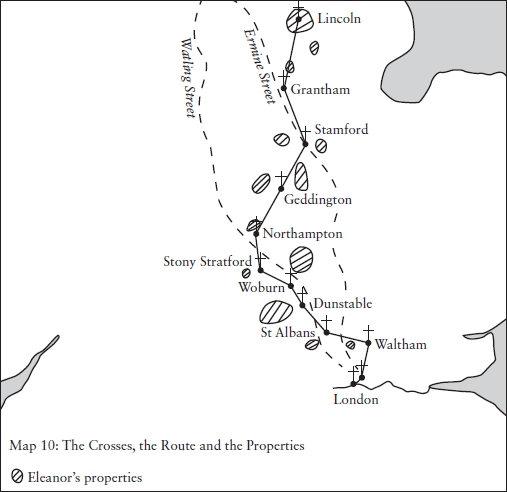
It should not be thought that this coincidence of properties and stops was entirely fortuitous. The cortege started out, and finished, on Ermine Street (which approximates to the A1 in its northern reaches and to the A10 closer to London), entering London at its north-eastern corner. However, it moved from Ermine Street to Watling Street after the Stamford stop, and then looped back after St Albans. Given the detours involved in the two changes of route, there has to have been some good reason for this. Powrie suggests a variety of possible reasons, but her suggestions are not compelling. Yet when one looks at the route taken for the move to Watling Street, one likely reason becomes very apparent: that route, following the modern A43, enabled the cortege to process right through one of the most crowded areas of Eleanor’s holdings, past most of her Northamptonshire holdings, and close to her property centre for the area at Market Harborough. After that, Watling Street would bring the cortege close to the Bedfordshire holdings and within reasonable distance of the most easterly of the Buckinghamshire properties. Following Ermine Street would, after Stamford, have exposed the cortege to relatively little of Eleanor’s property – her Cambridgeshire properties were some way off Ermine Street, and her Norfolk and Suffolk properties still further away. Given Eleanor’s devotion to her work, and the amount of time she and Edward had consequently spent in the area, the fact that the move to Watling Street enabled them to ‘take in’ the heart of Eleanor’s property empire is surely no coincidence. Essentially, therefore, someone ensured that Eleanor progressed to London within sight of her own lands, and readily accessible for all her tenants and dependents on those lands to pay their last respects.
The Dunstable annalist, giving a first-hand account, recorded how precious cloths and a stunning eighty pounds of wax for candles were provided on the night when she rested there. He also describes how ‘her bier lay in the centre of the market place until the king’s chancellor and the nobles who were there with it chose a suitable place, for there to be built … a wonderfully large cross; and our prior sprinkled holy water to bless the chosen place’. The St Albans witness, in turn, gives a sense of the grandeur of the event, with the entire abbey, dressed in their finest vestments, going to the edge of town to meet the bier and escort it to the abbey before a massive service and night-long vigil.18
Edward was not as prone to great pieces of showmanship as his father had been, but on this occasion it is clear that he had learnt the lessons of how to stage such an event well – and to use it with focus and subtlety. The act of returning the body to Westminster, and creating a lavish funeral there, continued the tradition which Henry III had begun of marking Westminster as a royal ‘centre’ akin to those of the French royal family at Sainte-Chapelle and the Castilian royal family at Las Huelgas, and hence elevating the status of his royal house both at home and abroad. The magnificent procession did not just honour Eleanor; it also inflated the importance of the entire royal family. At the same time, after a period which had been politically difficult for Edward, it marked him out as a focus for sympathy and support. Undoubtedly deep grief was there, but he had managed to pull off a truly excellent piece of political theatre in the midst of it.
Whether the plan of the memorial crosses had been reached at once is unclear; very probably it had, since the idea almost certainly came from the Montjoie memorials erected in France to mark the resting places of the body of King Louis on its return from the Crusade; a lavish procession would therefore fit with the creation of monuments in its wake, and by Dunstable, certainly, sites were being marked. Still more interesting is the question of whether the planning was all Edward’s, or if it had been pre-concerted with Eleanor. The Torel meeting and her ordering of material for her own tomb-chest suggest that at least some planning had gone into Eleanor’s funeral at her own behest. The Westminster tomb can therefore be inferred to be at least in part Eleanor’s idea. There is nothing, however, which links her to the crosses, save to the extent that they took their styling in some measure from the main tomb. It is more probable that these, which do contain more touches of sentiment, were genuinely Edward’s own idea, albeit inspired by ideas which he knew were important to Eleanor.
On Sunday 17 December, the queen’s body was buried in Westminster Abbey. The funeral was conducted by Oliver Sutton, the Bishop of Lincoln, since Archbishop Pecham was ill. The event was so splendid that Walter of Coventry thought the like had not been seen in England since the coming of the Christian faith. It records that she was interred ‘with royal vestments, crown and sceptre, dust on forehead and breast in the form of a cross, and a wax candle with certain writings’. In terms of position, it is interesting to note that Eleanor effectively usurped Eleanor of Provence’s position opposite Henry III, possibly because the latter had decided that she wished to be buried at Amesbury’s mother house of Fontevrault or because preparations had already begun on her grave and tomb, since her decease was naturally to be expected within a few years, and Eleanor’s untimely death required the grave to be annexed.
On 19 December, Eleanor’s heart was deposited at the Blackfriars church, together with those of John de Vescy and Alphonso. Once the ceremonies were over, Edward retreated until the end of January to the hermitage which Edmund of Cornwall had founded at Ashridge in Buckinghamshire. From here came his best-known tribute to his lost wife; writing to the Abbot of Cluny, he refers to the wife ‘whom living we dearly cherished, and whom we cannot cease to love, now she is dead’. At Easter, three months later, her absence from his bed was still a powerful grief as he paid the traditional fine to her ladies, which in previous years had restored him to enjoyment of his conjugal rights after the loneliness of Lent.19
The tombs and memorial crosses were obviously some time in the making; each of them was a work of art in its own right, and together they may be seen as the highest flowering of arts under Edward’s reign. The Westminster tomb survives gloriously to this day, and is widely regarded as one of the best medieval tombs. On top of the tomb an effigy of Eleanor reclines in gilt bronze, cast by William Torel in 1291. The use of the bronze image rather than the more orthodox marble was surely a nod to Capetian practices – Eleanor was given the treatment accorded only to their most glorious kings. Dressed in flowing robes, whose loose folds suggest luxury and softness even in their brazen form, one hand, which would once have held a sceptre, rests gently along her right flank while the left is raised over her chest, in a gesture which now suggests blessing but in fact reflects the fact that she is pulling gently at the cord of her mantle – in a similar way to the established fashion at Sainte-Chapelle, also depicted in the English context in L’Estoire de Seint Aedward le Rei.
Eleanor’s head rests on two pillows, her hair flows free as for a coronation, and she wears a full circlet crown. This, the sceptre and the mantle would at the time have been gilded and borne paste jewels. Overall, the pose – and even the gable which surrounds her head – is very reminiscent of the pose in which she appears on her own seal. Her face is thoughtful, meditative even – no sign remains of the fiery personality which we know resided within the real woman. Parsons notes how the pose mingles the sacred and the secular, and could equally be a model for a statue of the Virgin Mary or the goddess Diana. But to the contemporary viewer, the secular message would have been very clear. The coronation references in the effigy – including the wearing of unadorned clothes, as was then considered appropriate to such a ceremony – would emphasise her status as a crowned queen and evoke the continuity of the monarchy. The tomb slab and the pillow beneath her head are carved with a patchwork effect of castles and lions, signifying Castile and Leòn and reminding the viewer of Eleanor’s elevated birth and thus her status in her own right.
Interestingly, Eleanor did not disclaim the less elevated sides of her ancestry either. The sides of the tomb have an arch-and-gable motif and are richly carved with heraldic shields, suspended from foliage. These shields state Eleanor’s full pedigree. So, while the arms of Castile and Leòn are there, so too are those of Ponthieu, flanked by the royal leopards of England; an acknowledgement of her mother’s family and perhaps a sly nod to the families she had successfully seeded into England’s highest aristocracy. But also, the combination of these three shields identifies Eleanor precisely: no one else was entitled to exactly these arms. Her tomb identifies her as a particular individual in unambiguous terms.
What is more, the message at the time would have been even clearer than it is now. Not only would the audience understand the arms, but they screamed out from the side of the tomb in Technicolor. The facsimile version of the viscera tomb at Lincoln Cathedral gives something of the effect which the painted shields would have had: the rich red and gold of the English shields, bold blue and gold diagonal stripes of Ponthieu and the martial black lions and gold castles of Castile and Leòn. But the Lincoln tomb is a slightly muted version; it has only four shields (two English coats of arms and one each of Castile and Leòn, and Ponthieu), where the London tomb has six, two of each. Again Eleanor’s heritage and uniqueness is referenced by the Norman-French inscription around the tomb: ‘Here lies Eleanor, sometime Queen of England, wife of King Edward son of King Henry, and daughter of the King of Spain and Countess of Ponthieu, on whose soul God in His pity have mercy. Amen.’ In this mixture of the messages of majesty, spiritual power and domestic context, in death, as in life, Eleanor presented herself ambivalently.
On the ambulatory side of the Westminster tomb is a fine carved iron grille by Thomas of Leighton Buzzard, which shields Eleanor from prying eyes behind a screen which evokes a garden trellis with plants growing up it – possibly intended again as a personal reference to her tastes. Also on the ambulatory side is a painting (now hard to discern) which is thought to depict Otho de Grandison, arrayed in chain armour, praying for Eleanor in the Holy Land before the Virgin and Child. The floor of the ambulatory by the tomb was apparently set with tiles depicting the queen between St Edmund and St Thomas Becket.
Overall, the tomb appears to have been a groundbreaking work. While there was a precedent for a gabled, arcaded tomb chest embellished with coats of arms – that of Jeanne, Countess of Toulouse, at Gercy Abbey – that tomb appears to have been much simpler and to have involved a more formal praying effigy. There are also echoes of effigies of the French royal family at Sainte-Chapelle and at the abbey of Royaumont, but those tombs lack the surrounding detail and magnificence. The shield work best recalls the striking dual tomb of Alfonso VIII of Castile and Eleanor of England. But that, it seems nearly certain, was not in place at the time. Indeed, there is a powerful case to be made, inter alia by reference to such details as the form of the castles and the lions on that tomb, that it was not installed until around 1330, and that it was deliberately intended as an homage to Eleanor’s tomb, using the prestige which she and Edward still had to add to the glamour of a venue which had fallen out of fashion. In fact, the repeated shield work may best be seen as referencing Castilian fashions, in a way which was unprecedented.
The tomb therefore captured the best and most up-to-date trends in royal burials and harmonised them into a major work which was to inspire other notable tombs for years, including that of Edward’s brother Edmund, his first wife Aveline de Forz and Aymer de Valence, all at Westminster Abbey.20
The Lincoln tomb was apparently a replica of the London tomb, since two large images were ordered from William Torel. The tomb itself, of marble, was made by Dymenge de Leger and Alexander of Abingdon between 1291 and 1292. The tomb visible today is not the original, but a copy produced in 1891 and sited on the opposite side of the church from the location of the original.
The London heart tomb was rather different. The nature of the monument is unclear and has been considerably debated. It stood on the north side of the choir, in a chapel, possibly the lady chapel. It appears clear that it was a smaller monument than those at Lincoln or Westminster, more in the nature of a reliquary than a full tomb; though, given the amount of wax and metal ordered for the image, it was certainly not small. It featured three metal images made by William of Suffolk and a figure of an angel holding a representation of the queen’s heart made by Adam the Goldsmith. The heart tomb was surrounded by some decorated stonework by Alexander of Abingdon. It also had paintings by the same artist as provided the London tomb painting (William de Dunolmia). There was a crest carved by one William de Hoo above the tomb, and, in keeping with Eleanor’s love of wall hangings, there was a cloth painted to hang above the queen’s heart. Although parallels with Aymer de Valence’s heart tomb at Winchester and that of Thibaut of Champagne at Provins have been suggested, it seems more likely that St Louis’ lost heart tomb would have been the inspiration, or perhaps the viscera tomb of Isabelle of Aragon at Cosenza, which features three relief figures beneath a tracery arcade above an altar.21
As for the memorial crosses, which have come to be known as ‘Eleanor crosses’, their derivation from the St Louis Montjoies has been noted briefly above. The idea of a memorial cross was not unprecedented. In France, some memorial crosses had been erected along part of the route of Philip Augustus’ funeral and Henry III raised one in Merton for the Earl of Surrey in 1240. Edward and Eleanor themselves had erected one at Reading in memory of his sister Beatrice. But these were simple crosses. The Montjoies, of which Eleanor and Edward may well have seen a sample on the 1286 trip, redefined the genre. Named after the traditional French war cry of Charlemagne, ‘Montjoie!’, they were elaborate structures with detailed sculptural decoration and included statues of the king – or, according to some theories, ‘a’ king.
The images were lodged beneath an ornate gable, on each of the road-facing sides. None survive today, and so we are reliant on seventeenth-century pictures of them for information as to how they looked. It appears that they were two-storey constructions, the base being a hexagonal gabled structure with statues in niches between the gables. The second storey was a rod, about the same height as the first storey, topped with a cross. The statues were in a variety of fairly standard postures, similar to those seen on tomb effigies. The king toyed with a glove, or held a sceptre, or raised his hand to the fastening of his cloak. Interestingly, some scholars have interpreted the memorials as being fairly unsubtle reminders of the power of the king – a point which would have resonance, given the law-and-order problems which faced Edward on his return from Gascony.22
The tributes erected in Eleanor’s memory built on all these aspects. They are essentially bigger and better than the Montjoies, being three storeys high and tiered like a wedding cake. The base is solid, generally with a foliate cornice easing the transition to the open storey; the second layer is open, with statues of the queen bordered by pinnacles and again topped by a foliate gable; and the third (again arched and decorated) is solid, topped with a cross. As with the Montjoies, the focal points of the crosses are statues of Eleanor, in what at first blush appear to be somewhat formulaic positions – again evoking the coronation idiom, with flowing robes, unbound hair and circlet crown, and, in some images, sceptres.
However, a closer inspection of the detailed sketches made in 1791, when the statues were in better condition than they are today, indicates an interesting variety and hints of personality in the poses. In some, her mantle is clasped and her hands are by her sides; in another, echoing the tomb effigy, there are remains of a sceptre and one hand toys with the cord of her cape. In another, her robe is looped up on one side and she appears to be stepping forward, on the verge of speech. These details would probably have presented more clearly at the time with the new images, each of which would have been painted, than they do on the weathered versions which survive today. Furthermore, unlike the Montjoies, the crosses were larded with references to Eleanor as a person, separate from her role as queen. Her arms appeared again and again, including those of Castile, Leòn and Ponthieu. They are a celebration of a unique individual.
With Louis it is generally considered that the crosses were intended, at least in part, as part of a bid for sainthood – ultimately, of course, successful. The purpose of the Eleanor crosses is altogether more obscure. In the light of the Montjoies’ existence, they cannot be taken simply as a tribute of love and grief on Edward’s part. Some, therefore, see them as essentially an invocation of the dignity and prestige of kingship, without personal overtones. Others consider them as part of an attempt to rehabilitate Eleanor – that the quasi-religious imagery (for even sceptres carried Marian overtones) represents a bid to refashion her as the compliant intercessory queen she had not been, and to do away with her alleged unpopularity. From the distant perspective of the twenty-first century, this seems perfectly rational.
However, as discussed above, Eleanor was in fact by no means an unpopular queen. Further, this approach ignores the repeated personal references which would not have been lost on a contemporary audience – and the placing of the crosses, which were positioned in the heart of areas where Eleanor was best known. Overall, in the trouble taken to invoke the actual woman and her personal identity, one is entitled to see the crosses as a very personal tribute. Another factor which tends in this direction, largely unremarked to date, is the preponderance of roses in the decoration of the crosses. The Geddington cross’s elaborate tracery is principally composed of roses, and at Waltham the arches containing the shields are surrounded by a background composed of roses. We know, too, that some of the other crosses featured roses, since this is one part which survived at Stamford. This decorative feature should not be taken as a mere standard filler, for such decoration was by no means common – indeed, the crosses’ lavish use of miniature features was something entirely new. Nor was the rose as well associated with the English Crown as we, brought up on the Wars of the Roses and Tudor history, instinctively think. In fact, the rose as a royal symbol was new – it had first been adopted in the form of the golden rose by Edward I himself, perhaps based on his mother’s badge, or on the papal golden rose. Thus, it seems plain that, while Edward may have been making some propaganda points along the way in the concept of the crosses, the tribute was very personal.23
Otherwise, the crosses showed an interesting variety. All were three-layered, and all the surviving crosses appear to be about forty feet tall, minus the cross which it is considered likely originally surmounted them – raising the tantalising possibility that, with the cross, each was forty-nine feet tall – echoing Eleanor’s age at her death. However, all the three surviving crosses are subtly different in shape. The Geddington cross is most noticeably different and, aesthetically speaking, divides opinion. It is the most delicate of the three which survive and is, in its uniqueness, enigmatic. It has a hexagonal base but rises to be triangular and bears three images of Eleanor. It also features ‘stone lacework’, which it has been suggested may reference Moorish architecture, although there are echoes in the decoration of Westminster Abbey’s choir, too. This decorative feature is richer than what is discernible on the other surviving crosses, or the illustrations of lost crosses. The images of the queen are generally considered inferior in quality to those of the other surviving crosses both in anatomical treatment and in the handling of the draperies. Each image of the queen (here wearing a headdress under her crown) is set in a gabled recess, but her feet appear to stand on a lace-decorated column which features a shield – in each case one out of England, Castile/Leòn and Ponthieu, reinforcing her descent. Above the second layer is a slender, spire-like storey with finials adorned with oak leaves and flowers. One particularly striking feature of the cross is that the narrowness of the base means that the statues cannot sit opposite the gable openings and so the statues hide behind a pillar of the gables, affording the viewer only a side-on glimpse. In purely aesthetic terms, this is probably a fault; but to anyone who has pursued the elusive Eleanor through the record, it seems remarkably apposite.
Some commentators have suggested that the Geddington cross is the work of a mason called ‘Garcia of Spain’ because of the differences to the other remaining crosses and surviving illustrations of Cheapside and Charing. However, the reference to Garcia of Spain in the records is to a cross ‘given to the Queen’ by John de Berewyk (one of her executors) and costing only 30 shillings. Such a cost could have nothing to do with the Geddington memorial, and this entry must sensibly refer to some smaller cross either given to Eleanor on her deathbed and buried with her or left on one of her tombs.
The other two remaining crosses are polygonal and resemble each other more closely. The Northampton cross is actually more properly called the Hardingstone cross, for it stands on a hill, some little way south of the town on the London road (the modern A508), just on the borders of what was then the village of Hardingstone. The site was apparently chosen because of its proximity to the abbey of De la Prie of St Mary’s de Pratis, a Cluniac foundation of King Stephen, which held the church of Fotheringhay. It was in the chapel of this foundation that Eleanor’s bier rested overnight.
The cross was originally perched on twelve steps, though now only ten are visible. It has an octagonal base supporting eight gables with lacework, in each of which a pair of shields appears. Beneath the shields on alternate faces is a stone book, which it has been suggested were painted or carved with prayers to be said for Eleanor, but again these also reference the real woman behind the tribute. The pinnacles and gables of the first layer are adorned with blind tracery and foliage. Above this layer the monument steps in, and becomes four sided, with another set of fancy gables with finials and foliage protecting recesses, in each of which a statue of Eleanor appears. The images (one of which has a headdress, like the Geddington images) are to some eyes inferior to the Waltham images, but time and restoration have to be considered here, and certainly both sets of images were made by key workers in royal employ – William of Ireland in Northampton and Alexander of Abingdon in Waltham. The third layer is a square layer, somewhat lower than the Geddington third layer, with Gothic arches. The top, originally bearing a large cross, which will have seemed to float above the monument, is lost.24
The Waltham cross is effectively the first of the London crosses. Although it survived the Civil War, it has not passed through the centuries unscathed. The antiquarian and Eleanor cross expert Revd Dr William Stukeley, writing to the Earl of Oxford in 1728, stated that ‘Waltham is pretty perfect, but this last summer Mrs Robinson has rebuilt part of her house and encroached upon the road and broke down a good deal of the cross to make way for her roof’. Another reporter, Gough, writing in 1796, says that the pub ‘the Four Swans’ (later the Falcon) has built almost into the cross, ‘whereby much of its beauty is concealed and many of its ornaments disfigured.’ Stukeley also reports a good deal of damage from carriages running against the cross, which can be seen fairly clearly in numerous eighteenth- and nineteenth-century prints and sketches (including some by J. M. W. Turner). Two restorations consequently took place in the nineteenth century.
One cannot, therefore, be very confident about the extent to which the remains actually reflect the original cross. However, overall it appears to be a somewhat scaled-up version of the Hardingstone cross. It is reputed to have boasted six images, but, while this is consistent with the shape of the second layer, the arrangement of the arches in that layer appears to make this unlikely; and certainly the Vetusta Monumenta survey shows only three. Thus the cross commences with a hexagonal base, with gables ornamented with rosettes and heraldry, a foliate cornice and battlements, and on the second storey a hexagonal layer of hollow gables fitted with images of the queen in one face followed by a double gable supported by a pillar in the next face. There is then a smaller, hexagonal top layer with another round of arch-and-gable carving and a mini-parapet, above which a cross, which may or may not have resembled the one which now sits there, would have sat. Caen stone was bought for the images on this and the Charing cross.
As for the images, there certainly seems to be something to recommend the view that they are the finest of the survivals. The version which has Eleanor grasping the cord of her cape bears a striking resemblance to the tomb effigy. Meanwhile, the one with the looped-up draperies seems both on the point of movement and of speech – the most lifelike of the entire lot, and a strong argument against the theory that no portraiture was intended in the representations. That Alexander was also deemed the more accomplished workman to thirteenth-century sensibilities is implied by the fact that he was the person commissioned to make the ornaments for the final, most upmarket, cross at Charing.25
As for the lost crosses, a certain amount can be inferred from the surviving evidence. The Lincoln cross, which probably stood outside Wigford by St Catherine’s Priory, utilised rods, rings and hoods, and also statues of the queen made by William ‘Imaginator’. The Grantham cross does not figure in the accounts and no part of it is known to survive to the present day. All that we do know is that it featured heraldry, since Stukeley refers to having ‘one of the lions’ – presumably from the arms of Castile – in his garden.
The Stamford cross, which the more reliable witnesses place on the Casterton Road on the way out of Stamford towards Geddington, had (depending on which account you prefer) a hexagonal or octagonal base thirteen feet long, with steps of ‘squared Barnack stone’. Again heraldry was a major feature. Captain Richard Symonds in 1645 and Richard Butcher in 1646 refer to shields, and Symonds describes the arms of England, Ponthieu and Castile and Leòn carved repeatedly – presumably on each face of the cross. It was topped with a piece described and drawn by Stukeley as being pyramidal and carved with roses. As to its details, the Stamford cross was considered ‘not very splendid’ by Camden. It may be that the lack of splendour reflects that it was on the more simple Geddington pattern – and the surviving sketch by Stukeley, though very rough, tends to support this theory. But it may equally reflect a comparison with the London crosses, or the state of its repair when Camden viewed it.
Stony Stratford was built by the same builder as the Hardingstone cross and obviously featured images of Eleanor, but has otherwise disappeared. Of the Woburn cross no trace or description remains, but given that it was made by the same builder as the other Watling Street crosses, it is likely to have been stylistically consistent. The Dunstable cross, also from the same stable, is described as ‘having engraven on it arms of England, Castile and Ponthieu and adorned with statues’. Likewise, the St Albans cross (the original long lost – the cross in existence is a modern copy) was made by the same builder, who supplied the rings, rods and hoods which indicate the presence of statues. Overall, therefore, it seems clear that all the crosses shared the theme of repeated statues of Eleanor, and repeated iterations of her arms.26
As for the lost London crosses, the first of these was the cross known as ‘the Cheapside cross’, which stood outside St Peter’s, Cheapside, opposite the entrance to Wood Street. It appears to have been made under the direction of one man, Master Michael of Canterbury. Over the period early 1291 to late 1292, he charged £226 13s 4d for this cross – nearly twice the traceable cost of the Waltham cross. Other than that Walter of Guisborough considered the cross (and that at Charing) to be ‘most beautiful’ and described them as being made of marble, very little clue remains as to what the Cheapside cross looked like. If its shape remained consistent after its first renovation it would seem likely to have been hexagonal, but an octagonal shape has also been suggested. However, consistent with the theme thus far, the fragments which remain in the Museum of London bear Eleanor’s arms – the shields of England and Castile quartered with those of Leòn, apparently displayed in gables as were those in Northampton and Waltham.
The final cross, at Charing, is perhaps appropriately controversial. The first point to make is that, contrary to popular tradition and a sense of romantic fitness, Charing was not so called after Eleanor as chère reine. Charing had existed for some time before Eleanor’s bier rested there. Its name probably derives from the Saxon cierre, which means to turn, as it fronted on to a bend in the River Thames. There is, consistent with this, another ‘Charing’ at a bend in the Pilgrim’s Way to Canterbury. The second point to note is that the cross did not stand where the modern version stands, but where the equestrian statue of Charles I is located, on the south side of Trafalgar Square. One may ask why a cross was needed here, so close to Westminster. The answer again emphasises the very personal element in the tribute: Charing was the site of Eleanor’s beloved royal mews, which she had beautified with a remarkable fountain in the Spanish style and where she will have spent many happy times with the like-minded Edward.
This cross, made under the supervision of Richard and then Roger of Crundale, seems to have taken an implausibly long time to create, with the payments preceding and outlasting the payments for all the other crosses – indeed, Eleanor’s executors accounts are liberally littered with entries simply entitled ‘Charing’. The total construction cost exceeded £700, of which the majority was labour cost. It was said to be constructed of marble, and certainly some payments for Purbeck marble can be identified, but was probably actually constructed in part at least of Caen stone, polished to look like marble and only part faced with marble. The cross is reputed to have been based on an octagonal design with eight images of the queen, though the later sketches of it which survive suggest six as the more likely number.
One possibility, which does not seem to have been much canvassed to date, is that the crosses formed a progression, with the simplest at the start of the journey, and the most ornate nearest her grave. On this hypothesis it may be that the ‘puzzling’ Geddington memorial is actually the last in a lost set running from Lincoln to Geddington and that Lincoln, Grantham and Stamford were also all hexagonal with three images, like Geddington. This would be consistent with one description of the top part of the Stamford cross as being ‘pyramidal’, and with the substantial absence of any records of the construction of all these crosses from the surviving records. The fact that the Charing cross is reported to have been the most magnificent of the series would be consistent with this, as would the fact that Waltham cross, which effectively bridges the move from country to town, is considerably more ornate than either of the preceding surviving crosses (though possessing one fewer image than Hardingstone).27
Most of the crosses were worked on by the same teams, with pedigrees on royal sites. So John of Battle, a mason and undermaster at Vale Royal, worked on the Hardingstone and St Albans crosses, including lifting into place the images of the queen, and also worked on the crosses of Stony Stratford and Dunstable. The images of the queen for the later crosses were mass produced by Alexander of Abingdon (also known as ‘the image maker’) and William of Ireland, at a cost of £3 6s 8d each. Both of these artists have been identified as working at Westminster. Meanwhile, Dymenge de Leger and Roger Crundale, who worked also at Westminster and the Tower, worked on Waltham cross before being transferred to work on the Lincoln tomb. Work appears to have commenced in 1291 and to have been substantially completed by 1293. There is no conclusive evidence for the process by which the designs were arrived at, but there seems reason to suppose that an overall plan of the shape of each cross and its significance in the procession were agreed, as were authorised types of pose for images of the queen. The workmen for each cross were then given a limited amount of scope in which to express their artistic instincts and produce a cross which was coherent with the plan, but at the same time unique.28
However, while the crosses are indubitably glorious, perhaps the depth of Edward’s mourning may be best judged not in those politically charged memorials but in his ongoing commemoration of Eleanor. For the first year after her death, he made a special distribution of alms each Tuesday to as many as might approach him. There seems to have been a wide understanding that Edward encouraged commemorations of the queen: less than six months after her death, the Archbishop of York reported that over 47,000 Masses had already been said for her and a forty-day exemption from penance had already been granted there for anyone who said the paternoster and Ave Maria for the queen. A similar indulgence was granted at Lincoln in 1291.
On the first anniversary of her death, there were very glorious memorial services in both the abbey and the London Dominican priory. Each featured a special Mass and an elaborate hearse, and in total 3,000 pounds of wax was used for candles. So elaborate were these memorials that the clergy were reported to be exhausted by the ritual. The memorial service seems to have been a national talking point, being picked up by almost all of the annalists. Judging by one of the later celebrations, the abbey would have been ablaze with light, with each member of the congregation holding a candle, large candles round Eleanor’s tomb and smaller ones round those of Henry III and the Confessor, and a framework constructed above the shrine on which candles were placed at regular intervals. At the same time, services were held at the manors which were the hubs of Eleanor’s estates: Market Harborough, Burgh, Somerton, Lyndhurst, Leeds, Langley and Haverfordwest.
Thereafter, Edward endowed a yearly observance at Westminster for Eleanor’s soul, granting the abbey seven of Eleanor’s properties to fund the service. The extent of the grant itself shows how magnificent the remembrance was to be, but the terms of the grant, which survives, make matters even clearer. Eleanor’s tomb was to be surrounded by thirty large candles at all times. All were to be lit on great feasts, and two were to be kept burning at all times. Every Monday, the eve of the day on which she died, the entire convent was to gather in the abbey and sing Placebo and Dirige with nine lessons and a tolling of bells. On the Tuesday, the convent would celebrate Mass with the tolling of bells, and 140 paupers (or such lesser number as appeared) were to receive a silver penny – but each was to recite the paternoster, credo and Ave Maria before and after receiving the coin, for Eleanor’s soul. It is interesting to note that, by this provision, two of Eleanor’s own interests, the recitation of prayers and alms for the poorest in society, were thoughtfully combined.
As for the annual memorial, it began on the vigil of St Andrew, and one hundred candles, each weighing twelve pounds, were to be lit. The weight of the candles was calculated to allow them to burn without interruption from that time until after High Mass the next day. Bells were to be rung incessantly throughout this period and divine office chanted hourly with Placebo, Dirige and nine lessons. At the end of the commemoration, alms were to be given to the poor, the mendicant friars and the London hospitals. To ensure proper observance of all the details, the entire letter patent was to be read out annually in chapter and all the goods of the abbot, prior and convent of Westminster were pledged to compliance. It would appear that this was complied with until the Dissolution: in around 1500, a visitor to the abbey was told that candles had never ceased to burn on Eleanor’s tomb since her burial there.29
In addition to all these more ceremonial and politically resonant memorials, Edward also endowed a chantry chapel in the church at Harby. Lands were made over to Lincoln Cathedral to provide 10 marks paid annually to a chantry priest to pray for Eleanor’s soul. Edward also founded chantries at Maidenheath, the London Dominicans priory and at Leeds Castle. Nor did he rely on these donations to keep Eleanor in mind: in 1300, when in York, he specially arranged with the sacristan of York for the ringing of a knell on the anniversary of her death.
And Edward was not alone in remembering Eleanor; it was apparent to all that the commemoration of Eleanor was likely to be well received by the king, and thus from 1291 we find records of other people endowing chantries or chaplains in her memory. A move to Peterborough by one of Edward’s clerks was granted on condition that two chaplains celebrated Mass daily forever for her soul. Three celebrated her anniversary in the controversial manor of Southorpe, and two hundred paupers were fed. Henry Sampson, who had sold Eleanor another rather controversial piece of land in Rutland in 1285, endowed a chapel there for her soul and that of his parents.
Less seemingly charged dedications followed: St Albans founded a yearly service in 1294 and the Archbishop of York provided a chaplain for the Harby chantry. In the same year, William and Juliana de Copstone arranged for a celebration at the altar of St Edward the Confessor in Coventry Cathedral. In 1305, Edward II asked the Abbot of St Albans to take in John le Parker, a servant of Eleanor’s from her manor of Langley, who wished to spend his last days in prayer for the queen’s soul. A chantry was founded by the Friars of the Sack in London in 1305 for the king and both his queens and their children, and in 1315 a chaplain was provided for at Lincoln Cathedral to pray for Edward II, his family and his parents. There is also some evidence of alienations of land by religious houses to support chantries in honour of Eleanor as late as 1323. Finally, and rather touchingly, the William Somerfeld for whom one of Eleanor’s earliest acts of patronage took place as far back as 1269 gave several vestments to St Paul’s, London, in her memory; and Alice Wisman, Eleanor’s laundress, petitioned Edward to be allowed to give fifty-two acres of land in Elm to a chaplain to chant for Eleanor’s soul.30
Eleanor, then, was not just mourned by her nearest and dearest – she was also remembered fondly among those who had known her across the spectrum of society.