
SIX
Augustin Filon, the Prince Imperial’s tutor and a man who understood the empress better than most people, said in his memoirs that she took all her political ideas from Napoleon III, ‘in whose political judgment she possessed unquestioning confidence’. The emperor, he added, had unbounded respect for Eugénie’s political intuition, consulting her again and again, although Filon commented that in his own view this high opinion was not quite borne out by events. Yet whatever Filon may have thought, her politics did not always mirror those of her husband, who often teased her for her Legitimist or at any rate conservative sympathies. And it was partly because of these very un-Bonapartist sympathies that Eugénie encouraged him to make one of the Second Empire’s biggest mistakes.
She had been shocked by the fate of Italian sovereigns – banishment and confiscation of their property. For Austria this added insult to injury since the Grand Duke of Tuscany and the Duke of Modena were Habsburgs while the King of Naples was Franz-Joseph’s brother-in-law. Something must be done to mollify the Austrian Emperor.
Eugénie always insisted that it was her idea to create a Mexican Empire and that she first suggested it to Napoleon in September 1861 when a young Spanish diplomat, José Manuel Hidalgo (a friend since childhood) was staying at the Villa Eugénie. For some time Hidalgo had been begging her to persuade her husband to send an army and save the Mexican upper classes from the godless revolution that was confiscating their estates. In fact Napoleon had already made up his mind to give Mexico a monarchy – pathologically secretive, he concealed it from Eugénie.
‘But note: there was never a political move over which the Emperor had so long and so deeply brooded – for many years’, the British prime minister, Benjamin Disraeli, remembered. ‘In 1857 he mentioned to me his wish and willingness to assist in establishing a European dynasty in Mexico…. He looked upon its establishment as of high European importance.’ Disraeli then explained why. ‘It was his custom to say that there were two powers who hated old Europe: Russia and the U.S. of America.’ And we know that Napoleon was far from along in holding such an opinion. ‘Shall America become Europe’s protector and master?’, a French writer asked angrily in 1862.
Naïvely, the emperor believed that a Mexican empire might help to block the rise of the forthcoming transatlantic superstate. He also suffered from the delusion that the Mexican leader Benito Juarez and his ‘radicals’ were a tiny minority. In addition, he hoped that cotton could be grown in Mexico on a large-enough scale to make up for Confederate cotton declining imports which were destroying the French textile industry.
Eugénie told Napoleon and Hidalgo that Archduke Maximilian would make an excellent emperor. Franz-Joseph’s younger brother and a former governor of Lombardy-Venetia, Maximilian was not yet thirty, handsome and dignified. The Italians had liked him, even if he was a bit pompous. On first meeting Eugénie in 1856, he had found her court ‘completely lacking in tone’ and was horrified by her shaking hands with her ladies. There was even a rumour that he was not a Habsburg but a Bonaparte, his real father having been the emperor’s cousin ‘Napoleon II’. Maximilian might have had reservations, but Eugénie was convinced that the gift of a throne could make an ally of Franz-Joseph. Napoleon agreed, hoping it would persuade him to cede Venetia to Italy.
Morny welcomed the idea, for personal reasons. Among the loans on which President Juarez had recently defaulted were Swiss bonds worth 15,000,000 pesos, in which Morny had a 30 per cent interest: unless there was military intervention, the president of the Corps Législatif was going to lose a great deal of money. Neither Napoleon nor Eugénie knew about the ‘Jecker’ bonds, so called after the bank which issued them.
Early in 1862 France, England and Spain sent a joint expeditionary force. At first Palmerston was enthusiastic about ‘the monarchy scheme’, which would ‘stop the North Americans, whether of the Federal or the Confederate States in their projected absorption of Mexico’, but then London and Madrid changed their minds, pulling out their troops. The French commander, Admiral Jurien de La Gravière, advised Napoleon to do the same. His advice was ignored, leaving a French army of under 3,000 men marching on Mexico City, to be humiliatingly routed en route by Juarez’s guerillas. Declaring that in no circumstances would he negotiate with Juarez, the emperor sent out 30,000 more troops, who occupied the Mexican capital in June 1863, news that was cheered in Paris, although most people could see no need for the war. Napoleon had one sound reason, however – Mexican cotton, even if there was not enough of it.
In July an assembly of ‘notables’ in Mexico City offered the crown to Maximilian, General Bazaine arranging a plebiscite which approved the offer. Yet, understandably, the archduke was still very reluctant to commit himself. The situation was complicated by the Civil War that made French intervention possible. While the emperor refused to recognise the Confederacy, he tried to keep on good terms with both sides. In 1862 the Confederate government had offered him 22,000 tons of raw cotton, but it would have had to go through the Federal blockade on French ships and Napoleon declined, unwilling to risk war with the Union.
One must not forget that most European observers expected the South to win, as it very nearly did at Gettysburg. If this happened, then both the Union and the Confederacy would disintegrate, and none of the successor states would be strong enough to give Juarez sufficient help to overcome French intervention in Mexico, in which case Maximilian would have a reasonable chance of surviving. During the early 1860s the ‘United States’ were scarcely a good advertisement for republicanism, while there was what appeared to be a sound precedent for a monarchy in the New World – few American régimes seemed more solidly established than the prosperous Brazil of Emperor Pedro II, a member of the Portuguese royal family.
The concept of a Catholic monarchy in the New World had captured Eugénie’s imagination – ‘a dictorship that should bring liberty’. In February 1862, through Metternich and the Austrian ambassador in Brussels, she persuaded the Belgian king (Maximilian’s father-in-law) to ask Queen Victoria to tell her cabinet that she had no objection to the scheme. In 1863 Eugénie visited Madrid to win over Isabella II, who was unhappy at the prospect of a Habsburg reigning over a country that had once belonged to Spain.
In March 1864 the archduke and his wife Charlotte (soon to be Carlotta) came to Paris where they were warmly welcomed. Maximilian, his jutting Habsburg lip hidden by weeping blonde side-whiskers even longer than his brother’s, was impressive and Carlotta made an excellent consort, tall, stately and handsome, with large, expressive brown eyes. Eugénie and Napoleon had met the archduke before, but now they found his ideas more interesting – like them, he genuinely wished to make the world a better place.
After nearly refusing the crown, and reducing Eugénie to tears of frustration, Maximilian finally accepted. He arrived at Vera Cruz in May, having spent the voyage compiling a manual of court etiquette. Given a spectacular welcome, his régime was quickly recognised by almost every European country. However, Washington and Richmond refused to acknowledge him, while attempts to float a loan in Paris or London failed disastrously. He soon found that he ruled only by the grace of French bayonets, most Mexicans staying loyal to Juarez, who was an Indian like themselves. Intent on recovering their estates, the conservatives sneered at his good intentions and liberal ministers, and at a constitution that safeguarded the rights of manual workers.
As soon as the Civil War ended, the Union sent guns and volunteers to Juarez, and North American cotton began reaching France. Bazaine’s men suffered such heavy casualties that in October 1865 he issued an order not to take prisoners. The situation continued to deteriorate. Early in 1866 Napoleon accepted that the adventure had failed, although the last French troops would not withdraw until 1867. Maximilian asked Bazaine to train a Mexican army but the marshal advised him to leave with the French.
Having bombarded Napoleon and Eugénie with letters, in August 1866 Empress Carlotta suddenly appeared in Paris. Eugénie called on her at her hotel, explaining that the emperor was too ill to see her (he was in agony, from a stone in his bladder). Carlotta made such a scene, however, that she gave way, asking her to come to Saint-Cloud the next day. When Carlotta arrived, the Mexican eagle was flying over the château and she was greeted by the little Prince Imperial wearing a Mexican order.
Napoleon told her gently that he could no longer go on helping Maximilian. France had already lost too many men. ‘You’ve condemned us to death’, cried Carlotta. He continued patiently that the Senate and Corps Législatif opposed any further involvement in Mexico, but she demanded that he mount a coup to make them change their minds.
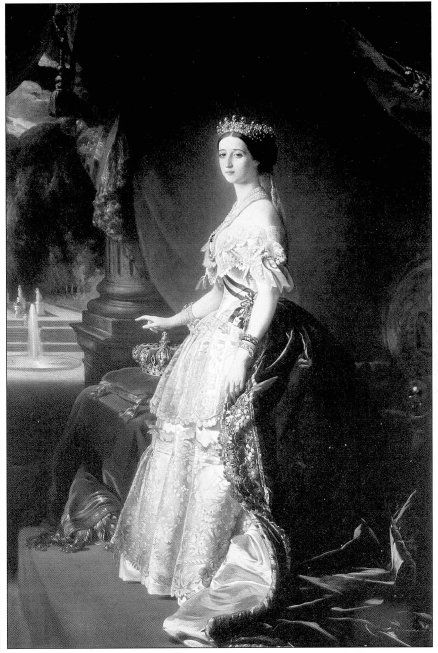
Empress Eugénie in 1853, in robes of state. Franz Xaver Winterhalter’s official portrait. (Museo Napoleonico, Rome)
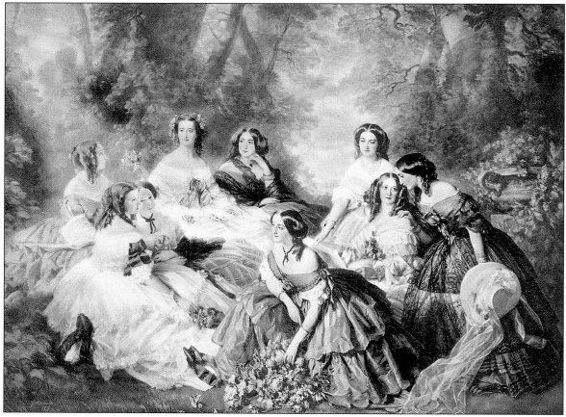
Eugénie with her ladies-in-waiting in 1855, by Winterhalter: ‘not a man in it’, sniffed her husband. (Museo Napoleonico, Rome)
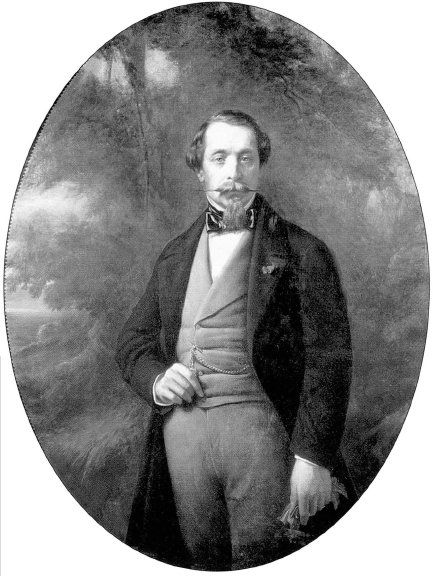
Napoleon III in 1857, by Winterhalter. This is a flattering portrait of an ugly little man, who despite his appearance possessed considerable charm. (Musée national du château, Compiègne: AKG London/Erich Lessing)
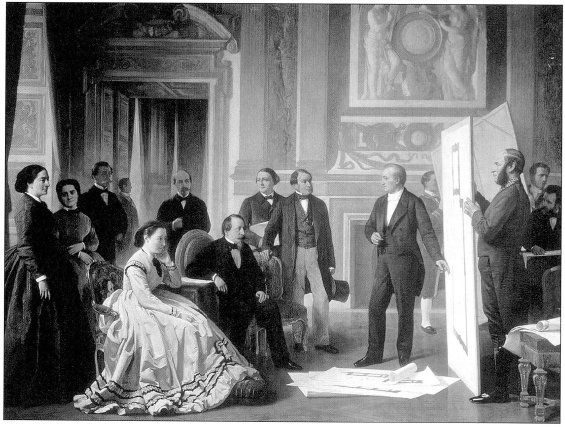
Eugénie and Napoleon in 1853, examining plans for completion of the Louvre, by Ange Tissier (Musée du château, Versailles: AKG London/Visioars)
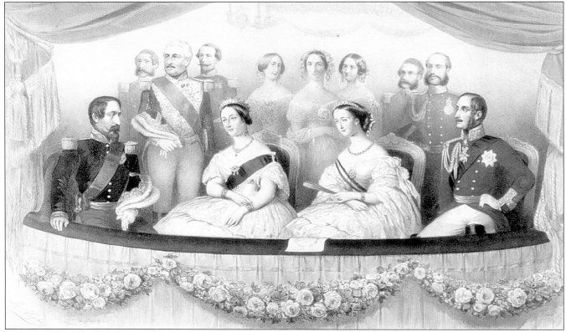
Eugénie and Napoleon in Londonin 1855, at the Opera with Queen Victoria and Prince Albert. (V&A Museum: Bridgeman Art Library)
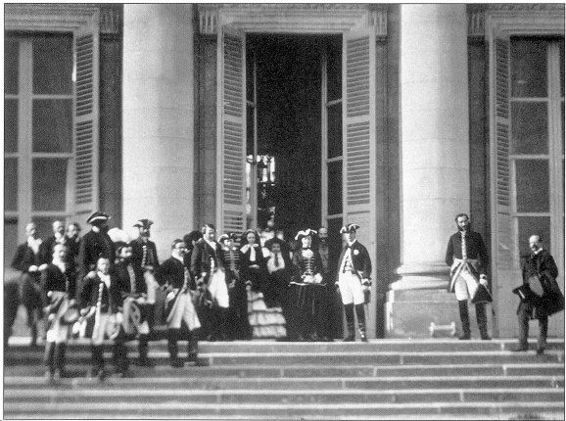
Eugénie and Grand Prince Ferdinand of Tuscany in the uniform of the imperial hunt, at Compiègne in October 1856. Photograph by Comte Aguado. (Chateau de Compiègne: RMN/Frank Raux)
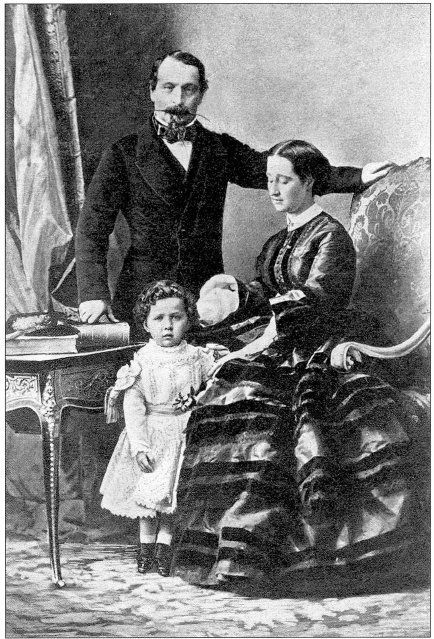
Eugénie, Napoleon and ‘Lou-Lou’, the Prince Imperial, in 1859. Doctors warned that trying to bear a second child would kill the empress. Photograph by Disdéri. (Author’s collection)
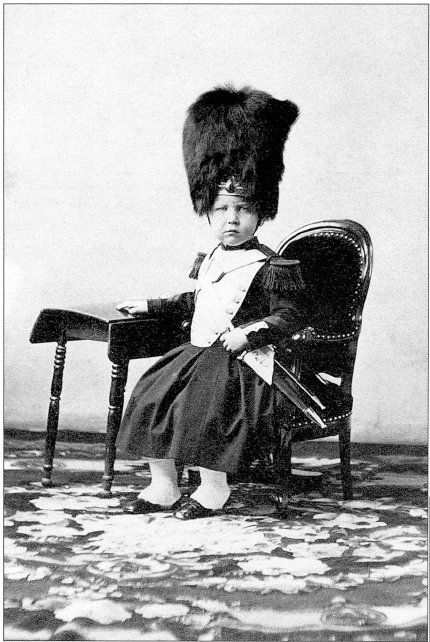
The Prince Imperial in 1861, as a haughty Grenadier of the Imperial Guard. The prince’s name was already on the regiment’s muster-roll. Photograph by Disdéri. (Author’s collection)
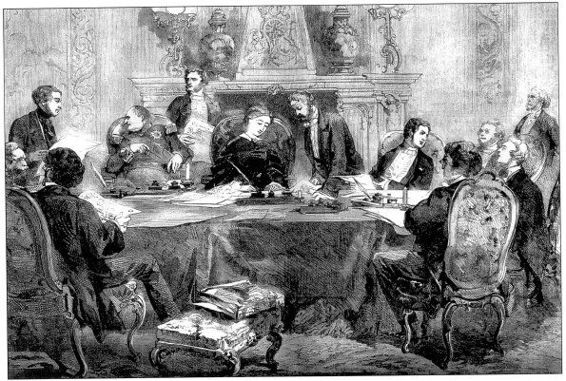
The astonishing spectacle of a woman presiding over a nineteenth-century cabinet meeting: the Empress Regent with her ministers in June 1859. (Illustrated London News)
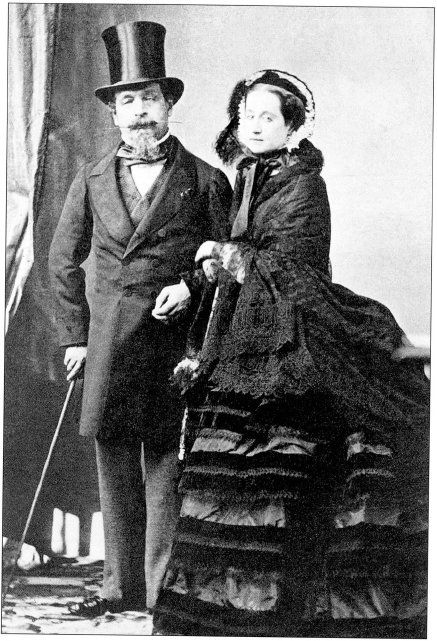
Eugénie and Napoleon as a happy married couple in 1862. In reality the emperor was a wildly unfaithful husband and Eugénie a wife tormented by jealousy. Photograph by Disdéri. (Archiv für Kunst und Geschichte, Berlin: AKG London)
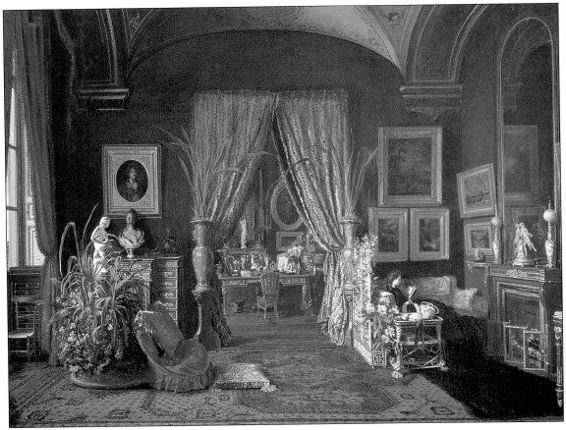
Eugénie’s private salon at the Tuileries, by Castiglione. Her favourite room, hung in Indian silk, was always full of flowers. (Liria Palace, Madrid: Institut Amatller d’Art Hispànic-Arxiu Mas)
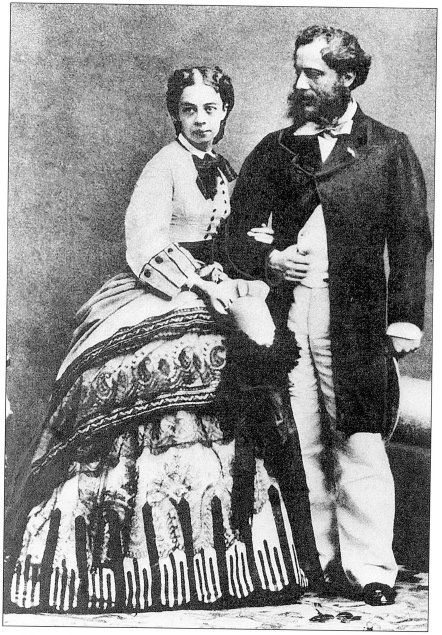
Prince and Princess Metternich. Pauline (the ‘Cocoa Monkey’) was Eugénie’s closest, if ultimately faithless, friend. She is wearing a dress designed by Mr Worth. Photograph by Disdéri. (Archiv für Kunst und Geschichte, Berlin: AKG London)
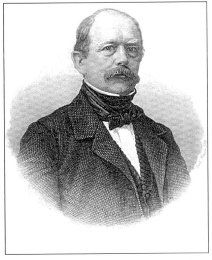
Otto von Bismarck (Gothaischer genealogischer Hofkalender, 1870)
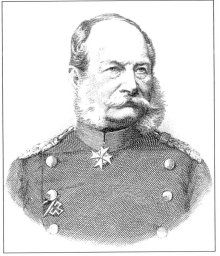
King William of Prussia (Gothaischer genealogischer Hofkalender, 1871)
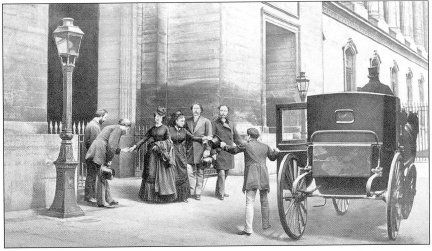
Eugénie’s escape in 1870, restaged by actors for the former court photographer Comte Aguado. Two, not five, men had been present. (Author’s collection)
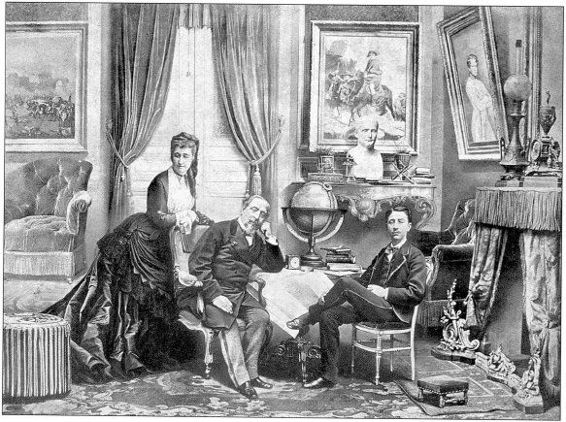
The imperial family in exile at Chislehurst, December 1872. This is the last known photograph of Napoleon III, who was planning another coup d’état. (Private collection: AKG London)
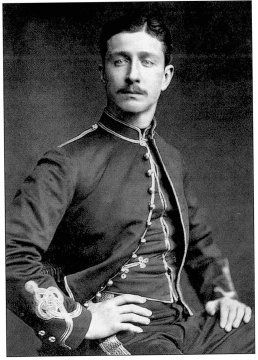
‘Napoleon IV’ at twenty-one, in British uniform, from a photo-graph of 1877. He is wearing the mess kit of the Royal Artillery. (Author’s collection)
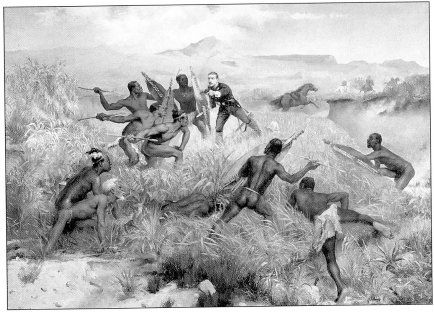
The death of the Prince Imperial in 1879 by Jamin. On the front of his body were found seventeen assegai wounds. (Château de Compiègne: RMN – Jean Hutin)

Eugénie’s court in exile about 1905 at Villa Cyrnos, from an unpublished photograph, with Augustin Filon on the extreme left, and Franceschini Pietri next to him. (Collection of Dudley Heathcote)
Carlotta forced her way into Saint-Cloud four times more. On the last occasion the emperor said that her husband should abdicate – he would be found another throne in the Balkans and all Europe would admire him for ‘sparing blood and tears’. She screamed, ‘blood and tears, they’re going to flow again and again because of you, in rivers of blood, all on your head’. When Eugénie offered her a glass of water, she threw it at her, howling, ‘Murderers, I won’t drink your poison.’
The Empress Carlotta then left for Rome, writing to Maximilian that Napoleon was really the devil in disguise. At Rome she told the pope that her ladies were trying to kill her and must be arrested. She had gone completely insane. Taken home to Belgium, she lived on, hopelessly mad, until 1927. The Emperor himself stayed in Mexico, refusing to abdicate or to leave the country, which, for the time being, was protected by French troops.
If Eugénie’s judgment failed her over Mexico, her husband was equally at fault. She was certainly telling the truth when she said that her concept of a Mexican empire had been largely inspired by a wish to bring benefits to a backward country. ‘We were misled,’ she claimed with reason, ‘We were told that the Mexican people would welcome the proclamation of a monarchy … several times – for example, after our troops entered Mexico city, after Bazaine’s victories in the northern provinces or after Maximilian’s warm reception at his capital – we had some cause to think that the expedition would be a success.’
Even so, as will be seen, sometimes she was shrewder than her husband.