
FIFTEEN

I think this would be a good time for a beer.
—FRANKLIN D. ROOSEVELT, MARCH 12, 1933
ANALOGIES BETWEEN MILITARY and political campaigns are often overdrawn, but what FDR did in rescuing the country in the first hundred days bears comparison with what General Ulysses S. Grant did in preserving the Union. Both men accepted responsibility, delegated freely, and radiated a confidence that inspired their subordinates to do their best. Roosevelt’s decisive action to save the banking system during the week following his inauguration resembles Grant’s steadfast resolution in the face of impending disaster on the battlefield. At Donelson, Shiloh, and the Wilderness, federal forces had been soundly whipped, and caution dictated a Union withdrawal. Grant counterattacked and carried the day. In March 1933 the nation’s financial structure was in chaos and disarray. Roosevelt kept his head, quietly took charge, and gave marching orders to his subordinates. “This Nation asks for action, and action now,” he said, and he was as good as his word.1
Roosevelt came to Washington armed with two proclamations: one calling Congress back to the capital for a special session;2 the other declaring a bank holiday under the dormant provisions of the wartime Trading with the Enemy Act. On the morning of the inauguration, FDR asked incoming attorney general Homer Cummings to determine whether the act remained in force. At the same time he requested Treasury secretary Woodin to draft emergency legislation that would permit the banks to reopen in an orderly manner. Those tasks assigned, Roosevelt settled back to enjoy the inaugural festivities. Cummings spent the day at the Department of Justice reading the legislative history of the Trading with the Enemy Act, while Woodin, with Raymond Moley in tow, repaired to the Treasury, where Hoover’s team still held forth. When the cabinet was sworn in early Saturday evening, Cummings told FDR he was satisfied that the act remained in effect. Woodin said he could produce a bill for Congress by Thursday.
Roosevelt took both reports at face value. The shape of Woodin’s bill was unclear, but FDR was content to leave the drafting to the secretary. As Sara had told Jim Farley, Franklin did not worry about details. Sunday afternoon, after services at St. Thomas’ Church,* Roosevelt convened the cabinet to review the situation. “The President outlined more coherently than I had heard it outlined before, just what this banking crisis was and what the legal problems were,” Frances Perkins remembered.3 Armed with Cummings’s opinion, FDR said he would issue a proclamation that evening that would declare a four-day bank holiday, embargo the transfer of gold and silver, and prohibit the exchange of dollars into foreign currency. The purpose of the bank holiday, he informed the cabinet, was to prevent further runs on the banks and allow Woodin time to draft the necessary legislation. Roosevelt said he would recall Congress on March 9 so Woodin’s bill could be acted upon as soon as it was ready.4
That evening FDR met with congressional leaders in the White House. In addition, he invited Senator Glass and Representative Henry B. Steagall of Alabama, chairmen of the respective committees that would report the legislation. Later in the evening he met with House minority leader Bertrand H. Snell of New York and Republican senator Hiram Johnson of California. The most remarkable thing, said Johnson afterward, was Roosevelt’s “readiness to assume responsibility and his taking that responsibility with a smile.”5 After eight years as assistant secretary of the Navy, working with Josephus Daniels and observing his easy relations with Capitol Hill, Roosevelt had an unparalleled understanding of how to deal with Congress. He knew how to stroke the members, how to play to their vanity, and how to accommodate their needs. “No president ever approached the prerogatives of the legislative body with more scrupulous attention to detail,” said John Gunther, one of Washington’s most astute observers.6
At 11 P.M. Sunday, after FDR was satisfied that the congressional leadership would be supportive, the White House issued the president’s proclamation recalling Congress at noon on Thursday, March 9. Three hours later, Roosevelt’s proclamation declaring a bank holiday was released, the delay occasioned by doubts expressed by several directors of the Federal Reserve that the president had the authority to close their banks. At 2 A.M., Woodin, supported by outgoing Treasury secretary Ogden Mills and Fed chairman Eugene Meyer, overrode the directors’ objections and ordered the banks closed.*
Monday morning, FDR met with the governors of the forty-eight states in the East Room of the White House. Most were in town to attend the inauguration, and the president had intended to spend the day with them discussing common problems. But the banking crisis took priority. “I have been so occupied that I have not had a chance to prepare any formal remarks,” Roosevelt told the governors. He spoke impromptu for ten minutes, explained why he had closed the banks, pledged to provide unemployment relief, and said the national government must find a way to prevent the continued foreclosure of farm and home mortgages.7 He was given a prolonged standing ovation, and in a pledge of support those present stated, “Without regard to our political affiliations we Governors of the States … hereby express our confidence and faith in our President and urge the Congress and all the people of our united country to cooperate with him.… He is ready to lead if we are ready to follow.”8
Roosevelt was riding a tidal wave of support. First reaching out to the leaders of Congress, then appealing to the governors were the instinctive acts of a consummate politician. FDR needed no focus groups or opinion polls; he did not require staff direction or an array of political consultants. He was the quarterback calling the plays, and the people responded by giving him their confidence.†
Monday afternoon, Senate Democrats took the unprecedented step of agreeing to bind themselves to support the president whenever a majority of the caucus voted to do so.9 Since the Democrats controlled the Senate 60–35, that ensured quick passage of whatever emergency measures Roosevelt chose to send up.* Three Democrats, including Huey Long, voted against the resolution, but it is unlikely that any caucus vote would have bound the Kingfish.10
Secretary Woodin, meanwhile, had run into difficulty. Drafting comprehensive banking legislation on the spur of the moment was not as simple as it had first appeared. Bankers summoned to Washington on Sunday gave conflicting advice, and Treasury officials were uncertain how best to reopen the banks and ensure an adequate supply of currency after so much had been withdrawn. After forty-eight hours of nonstop discussions at the Treasury, Woodin broke off the talks and went to bed. “I’ll be damned if I [will] go back into those meetings until I get my head cleared,” he told Moley.11
Monday night Woodin dozed a little, strummed his guitar a little, and thought through the various proposals to restore the nation’s money supply. He rejected the idea of issuing temporary scrip as the government had done during the panic of 1907, and settled on the Federal Reserve’s proposal to issue new currency under the Federal Reserve Act. “It won’t look like stage money,” he told Moley Tuesday morning. “It’ll be money that looks like money. And it won’t frighten people.”12†
Relying largely on intuition and common sense, Woodin had cut through a fog of financial advice and adopted the simplest of all possible solutions: the government would simply print new money. It would be backed not by gold or silver but by the assets of the banks in the Federal Reserve system. Woodin laid the plan before Roosevelt at ten o’clock Tuesday morning and in twenty minutes had FDR’s approval. With the currency issue decided, the rest of the banking bill fell into place, although putting the provisions into statutory language by noon Thursday proved a near-run thing.13
On Wednesday morning, at the height of the banking crisis, FDR held his first press conference in the White House. Coolidge had met the press regularly, but his comments had always been off the record. Hoover had held weekly news conferences but the sessions had been brief and exceedingly formal, the president standing behind a podium in the East Room of the White House. Both Coolidge and Hoover had required that the questions be submitted in writing beforehand and answered only those they wished to. Roosevelt received reporters sitting at his desk in the Oval Office. He met them every Wednesday and Friday and answered off the cuff. Correspondents could ask whatever they wished.14 Nearly 125 members of the White House press corps crowded into FDR’s office at ten o’clock March 8 for a remarkable give-and-take with a president who clearly enjoyed every minute. After shaking hands with each reporter, Roosevelt set the ground rules. He would not answer “iffy” questions or those “which for various reasons I do not wish to discuss, or am not ready to discuss, or I do not know anything about.” He said he did not wish to be quoted directly unless Press Secretary Steve Early provided the quotation in writing. Straight news should be attributed to the White House. Some of his remarks would provide background information that could be used but not attributed. And then there would be confidential off-the-record material, which was not to be divulged to anyone.15 Nearly all of FDR’s comments that morning were for background or off the record. The one item of hard news was that he would send his banking bill to Congress the next day and his message would be brief. For forty minutes the president bantered with reporters, answered candidly, and gave them almost nothing they could use directly. “Mr. Roosevelt looked fresh and fit,” reported The New York Times. “There was little sign of the strain he has undergone—and is still under—since he became President.”16
It was a virtuoso performance. When Francis Stephenson of the Associated Press intoned the traditional “Thank you, Mr. President,” hard-bitten Washington reporters broke into spontaneous applause. Every correspondent in the room had a sense that he or she was participating in the new administration, being confided in by the president and treated as a partner. “We were antagonists,” wrote Richard Lee Strout of The Christian Science Monitor, “but we liked each other and we laughed and had a perfect understanding of what each was trying to do and there was a certain degree of affection.”17*
After his press conference Roosevelt met with Harvard’s Felix Frankfurter, hoping to entice him into becoming solicitor general—the number two post in the Justice Department and the government’s primary advocate before the Supreme Court. Frankfurter declined but in the course of the conversation told FDR he was planning to call on retired Supreme Court justice Oliver Wendell Holmes, who was celebrating his ninety-second birthday. Roosevelt, who knew Holmes from the Wilson years, was intrigued and told Frankfurter he would like to pay his respects as well. That afternoon, breaking with protocol,† the president took time off from the banking crisis to visit Justice Holmes at his I Street home. Negotiating the front steps was difficult for Roosevelt, but he found Holmes in a convivial mood, slightly tipsy on bootleg champagne. They chatted amiably about old times, including prizefighters they had known, and when it was time to leave FDR asked the old justice for his advice. Holmes, who friends said had never been psychologically mustered out of the Union Army after the Civil War, drew himself slowly to attention and said, “Mr. President, you are in a war. Form your battalions and fight.”18
When FDR came out on the street, hundreds of citizens cheered and clapped uproariously. “Gosh, it sounds good to hear that again,” whispered Richard Jervis, chief of the White House Secret Service detail, who had served four years under Hoover.19
Roosevelt’s decision to visit Holmes was purely personal. “Your kind thoughtfulness in coming sets me free to express my congratulations and good wishes,” wrote Holmes afterward. “They are very sincere, and follow what seems to me a most fortunate beginning of the term.”20 Holmes is alleged to have observed that Roosevelt had a second-class intellect but a first-class temperament. The story was propagated principally by the literary critic Alexander Woollcott but is as apocryphal as Andrew Jackson’s supposed comment after the Supreme Court’s 1832 decision in Worcester v. Georgia: “John Marshall has made his decision, now let him enforce it.” There is absolutely no basis for the statement attributed to Jackson nor any reason for him to have made it.21 The words were put into Old Hickory’s mouth by Horace Greeley in 1864, nineteen years after Jackson’s death, just as the Holmes quote was put into the justice’s mouth by journalists intent on good copy.22*
Wednesday evening, Roosevelt called congressional leaders of both parties to the White House to brief them on the banking bill he would submit when Congress convened the next day. Earlier he had met separately with Huey Long and California’s newly elected Democratic senator, William Gibbs McAdoo. Both would be key players Thursday: Long, a perennial loose cannon, and McAdoo, who had been Wilson’s longtime secretary of the Treasury. Either could cause trouble, and Roosevelt flattered them with a half hour’s personal attention.
The text of the bill was not yet in final form, but FDR, flanked by Woodin and Attorney General Cummings, carefully reviewed a draft with the legislative leaders. As Roosevelt explained it, the bill would confirm his actions under the Trading with the Enemy Act, give the president added powers to regulate gold and foreign exchange, provide for the issuance of Federal Reserve notes to restore the nation’s currency supply, authorize the secretary of the Treasury to review and reopen all banks found to be solvent, and reorganize those in trouble so they too could eventually reopen. The meeting lasted from 8:30 until shortly before 1 A.M. Drafters at the Treasury were still working on the statutory language, but from his presentation it was clear that Roosevelt had decided to preserve the banking system more or less as it was rather than take advantage of the crisis to nationalize it.
The House of Representatives convened as scheduled at noon, Thursday, March 9. Congress would remain in session until June 15, exactly one hundred days, the most productive legislative session in history. As soon as the members were sworn in and officers elected, the president’s banking message was read: “I cannot too strongly urge upon the Congress the clear necessity for immediate action.”23 At 2:55 P.M. House majority leader Joseph Byrns of Tennessee introduced the legislation (H.R. 1491) under a closed rule that permitted no amendments. Debate was limited to forty minutes. Minority Leader Snell asked Republican support: “Give the President what he says is necessary.”24 The printed bill was not yet available, and Chairman Steagall of the Banking and Currency Committee read aloud from a typewritten copy. Before he finished, shouts of “Vote! Vote!” echoed through the chamber. There was no debate. There had been no hearings, no committee consideration, no action by either caucus. Members took on faith what the leadership presented, and the leadership took on faith what FDR requested. Shortly before four o’clock Speaker Henry T. Rainey of Illinois asked for the yeas and nays. The bill passed with a unanimous whoop of approval. There was no request for a roll call. The New York Times reported that the members appeared like poker players “who throw in their last chips in the belief they will win.”25*
By the time the Senate turned to the bill, printed copies were on hand and the debate was less perfunctory. Huey Long sought greater aid for the “little banks at the forks of the creeks,” while western populists, led by Robert La Follette, wanted FDR to nationalize all the banks. The amendments were shouted down, and just before seven-thirty the Senate passed the bill 73–7, the opposition coming primarily from Progressives, who believed the bill did not go far enough in asserting federal control.26 An hour later the measure was at the White House. FDR whipped out a dime-store pen Nancy Cook had given him and quickly added his signature. The entire legislative process, from the bill’s introduction in the House to the president’s signature, took less than six hours. After signing the bill into law Roosevelt extended the bank holiday. Originally, he hoped some banks might reopen Friday. But officials at Treasury and the Federal Reserve needed more time to separate the sound banks from those that needed help.
Under regulations promulgated by the president, banks wishing to reopen required a license from the secretary of the Treasury. Reviewing assets and liabilities was a time-consuming process, but within a month, eight out of every ten banks were open again. By and large this was a bureaucratic process. The exception was the Bank of America, A. P. Giannini’s West Coast goliath, with 410 branches in California and more than a million depositors. Woodin and Comptroller of the Currency F. Gloyd Awalt, a Hoover holdover, believed the giant bank was no worse off than any other California bank and to keep it closed could cause enormous distress with ramifications throughout the country. Lined up on the other side was the Federal Reserve Bank in San Francisco, headed by John U. Calkins, an old-line banker with strong ties to California’s economic and social elite. The clubby West Coast banking community, of which Calkins was a charter member, despised and feared Giannini, an upstart Italian immigrant whose vigorous expansion threatened their supremacy. Calkins was adamant in his opinion that the Bank of America was insolvent, although the evidence was mixed.
Woodin and Awalt took the case to the president. Roosevelt’s handling of the situation was masterly. He declined to take direct action and order Giannini’s bank reopened. Instead, he shifted the decision to Calkins. FDR instructed Woodin to call the San Francisco director and either convince him to agree to the bank’s opening or require him to take personal responsibility for keeping it closed. “The conversation was punctuated by some pretty strong language on Woodin’s end,” Moley recalled. When Woodin asked point-blank if Calkins would accept responsibility for keeping the Bank of America closed, he declined. “Well then,” said Woodin, “the bank will open.”27 Giannini was personally grateful to FDR and became a staunch supporter of the New Deal. Roosevelt, for his part, enjoyed taking personal credit, though his hand had been hidden. “It was the same old crowd trying to destroy competition,” he told California lawyer J.F.T. O’Connor.28
As soon as FDR signed the Emergency Banking Act, he moved to consolidate his conservative support. Just as he did after winning the nomination in Chicago, Roosevelt turned right before he turned left. Within the hour he summoned congressional leaders back to the White House to inform them he wanted authority to reduce government spending across the board.* Roosevelt sought to put the government’s house in order: to balance the federal budget before undertaking emergency relief. The two biggest culprits, in FDR’s eyes, were government salaries and bloated veterans’ benefits. He told the legislators he wanted to cut all government workers’ salaries by at least 15 percent to bring them into line with the reduced cost of living since 1928 and scale back the elaborate array of entitlements enacted for veterans since World War I—currently consuming roughly one quarter of the federal budget.29 Under Roosevelt’s proposal, for example, congressional pay would be reduced from $10,000 to $8,500 and his own salary would fall from $90,000 to $75,000. Shortly after midnight the leaders departed—some stunned, some enthusiastic, and a few, such as the populist John Rankin of Mississippi and progressive Robert La Follette, very angry at what the president proposed.
Roosevelt was undeterred. The following day, Friday, March 10, he sent a special message to Congress: “For three long years the Federal Government has been on the road to bankruptcy.” The growing deficit, he said, had increased economic stagnation, multiplied the unemployed, and contributed to the banking collapse. National recovery required the government’s credit to rest on a solid foundation, and that required that the budget be balanced. Roosevelt asked for broad authority to effect the economies he deemed necessary. “If the Congress chooses to vest me with this responsibility it will be exercised in a spirit of justice to all, of sympathy to those who are in need and of maintaining inviolate the basic welfare of the United States.”30 Attached to the message was “A Bill to Maintain the Credit of the United States” drafted by the Bureau of the Budget.31
Congress was incredulous, and for a moment the president’s control hung in the balance. Although conservatives such as Carter Glass and Mississippi’s Pat Harrison offered unstinting praise, liberal Democrats felt betrayed. The last thing the country needed at this time was more deflation, and FDR’s proposal was surely deflationary. In the House, Majority Leader Byrns refused to introduce the bill. When Speaker Rainey assembled the Democratic caucus Saturday morning, he failed to get the necessary two-thirds vote that would have bound the party to support the president. That afternoon the bill was introduced on the floor by Representative John McDuffie of Alabama, a skilled parliamentarian and rock-hard conservative who had been narrowly defeated for the speakership.32 After two hours of fierce debate, the bill passed 266–138. Ninety-two Democrats and five Farmer-Labor members voted against, but 69 Republicans led by the ultraconservative John Taber of New York crossed the aisle to support the president.* At the same time the House was acting, the Senate Finance Committee, chaired by Pat Harrison, reported the bill favorably, setting the stage for action by the full Senate on Monday. “I am for giving the President whatever he wants in the way of power,” said Senator Arthur Capper, a Kansas Republican. “This is an emergency situation.”33
Sunday evening, at the conclusion of his first week in the White House, FDR gave his first fireside chat. The banks were scheduled to reopen Monday, and Roosevelt wanted to avoid a panic. In simple language he analyzed the banking crisis and spelled out what had been done. “I do not promise you that every bank will be reopened or that individual losses will not be suffered, but there will be no losses that possibly could be avoided.”34 Will Rogers said the president had explained the banking situation so well that even the bankers understood it.35
Public response was overwhelming. “When millions of people can hear the President speak to them directly in their own homes, we get a new meaning for the old phrase about a public man ‘going to the country,’ ” said The New York Times. When the banks reopened Monday, reassured depositors returned much of the money they had withdrawn. Not only was there no run on the banks, but the Federal Reserve reported that deposits exceeded withdrawals by more than two to one despite the cash-starved existence most had led the past week. The banking crisis was over. On foreign exchanges the dollar soared. Raymond Moley proclaimed, “Capitalism was saved in eight days.”36 When the New York Stock Exchange reopened March 15 (it had been closed since March 3), stock prices rose by a whopping 15 percent—the greatest one-day rise in living memory.
Conservatives vied with liberals in shouting Roosevelt’s praise. “The new Administration in Washington has superbly risen to the occasion,” said The Wall Street Journal. Henry Stimson wrote FDR, “I am delighted with the progress of your first week and send you my heartiest congratulations.” Newton D. Baker called Roosevelt “a providential person at a providential moment.” William Randolph Hearst said, “I guess at your next election we will make it unanimous.”37
Roosevelt stayed on the offensive. At dinner the evening he delivered his fireside chat, the president told guests with a twinkle in his eye, “I think this would be a good time for a beer.”38 That sent Louis Howe scurrying for a copy of the Democratic platform. When FDR finished his radio address, he wrote a seventy-two-word message to Congress quoting word for word the Democratic pledge to amend the Volstead Act and permit the sale of beer and light wine.39* The message, perhaps the shortest on record, went to the House at noon Monday. Divided Democrats rallied back to the president’s side. The Ways and Means Committee drafted the requisite legislation within five hours of FDR’s request. On Tuesday, the House of Representatives, ignoring the pleas of the Anti-Saloon League and the Women’s Christian Temperance Union, voted for beer, 316–97. On Wednesday the Senate passed FDR’s economy measure 62–13, and on Thursday it voted to amend the Volstead Act 43–30. Roosevelt signed the Economy Act on March 20 and the Beer-Wine Revenue Act two days later. The administration was three for three, and the Democratic ranks were now more solid than ever.
Originally FDR had assumed that Congress would remain in session only so long as necessary to deal with the banking crisis. But with the legislative tide running so strongly in favor of the administration, he decided to hold it in Washington until the bulk of the New Deal program could be enacted. Public confidence had recovered, but the economy remained in the doldrums. Freight car loadings, electric power, and steel production continued to slide, employment had drifted downward, and there was as yet no glimmer of relief for farmers or those without work. “I haven’t any real news,” Roosevelt told his press conference on Wednesday, March 15. And after that casual disclaimer he broke the story that he was going to move immediately to assist the nation’s farmers and the unemployed. The banking bill, the economy measure, and the amendment of the Volstead Act had done nothing constructive for the economy, he said. What was needed was a definite effort to put people to work and a program to raise farm prices. FDR said he could not go into detail because the measures were still being worked out. But he made it clear that he planned no letup.40
Congress was ready to respond. A full third of the House (144 of 435 members) were new to Washington, swept into office on FDR’s coattails. In the Senate, with fourteen new members, Democrats were in control for the first time since the election of 1916. Both houses turned to the president for leadership. And Roosevelt took no chances. Holding almost one hundred thousand full- and part-time jobs not subject to civil service rules, FDR let it be known that he would make no patronage appointments until the end of the session. John McDuffie drove the point home when he demanded a roll-call vote on the economy act. “When the Congressional Record goes to President Roosevelt’s desk in the morning he will look over the roll call we are about to take, and I warn you new Democrats to be careful where your names are found.”41*
On Thursday, March 16, FDR sent the first genuine New Deal measure to Congress, an agriculture bill intended to raise farm income by reducing agricultural surpluses through a system of domestic allotments. Farmers would be paid directly by the government not to produce crops beyond an allotment set by the secretary of agriculture. Funding for the allotment payments would be provided by processing taxes levied on millers, canners, packers, textile manufacturers, and commodity brokers. Farmers would derive immediate income through the allotment payments, and when the surpluses were reduced the price of farm products was expected to rise proportionately. It was a radical departure, providing unheard-of government control of agricultural production, historically the most individualistic segment of the economy. “I tell you frankly that it is a new and untried path,” Roosevelt told Congress, “but I tell you with equal frankness that an unprecedented condition calls for the trial of new means to rescue agriculture.”42 The measure, eventually known as the Agricultural Adjustment Act, was drafted by Secretary Wallace and Rexford Tugwell following a week of breakneck discussions with farm leaders throughout the country. The bill was followed three weeks later by Roosevelt’s request for legislation to provide federal funding to refinance farm mortgages threatened with foreclosure.43 Like the emergency banking legislation and the economy bill, the agricultural adjustment bill was considered by the House under a closed rule prohibiting amendments. Debate was limited to four hours. On March 22, less than a week after it had been received, the measure passed the House 315–98, all but 24 Democrats voting in favor.
The bill ran into trouble in the Senate. Food and fiber processors had time to mobilize against the processing levy, and a knock-down, drag-out fight ensued. Wallace and Tugwell urged the president to force the bill through without amendments, but FDR was not ready to risk his coalition on an issue so fundamental as farm relief. He instructed Majority Leader Robinson to accept whatever changes were necessary. If a senator’s support could be obtained by adding his amendment, he said, add it. The resulting bill, said one Washington observer, “sought to legalize almost anything anybody could think up.”44 The final sweetener came when Roosevelt agreed that all jobs created to administer the Agricultural Adjustment Act would be outside the civil service—a vast reservoir for legislative patronage. After five weeks of debate, the Senate approved the measure 64–20, having added the president’s mortgage protection plan to the bill. It was signed into law by FDR on May 12.45
Roosevelt saw the farm program as the centerpiece of the New Deal. Not only was agriculture the most perennially depressed sector of the economy, but ever since his experience as a state senator, FDR (who had chaired the Agriculture Committee in Albany) had stressed the relationship between farm prosperity and the well-being of the rest of the country. If farmers had no money to buy what industry produced, the cities suffered as well. The lopsided majority that eventually voted for the bill reflected Roosevelt’s skill in handling the Senate, almost on a man-to-man basis. The food processors were routed, and the New Deal coalition was solidified.* In that sense the passage of the Agricultural Adjustment Act had a significance considerably beyond its impact on America’s farms.
The legislative floodgates were open. The week after FDR sent his farm bill to Congress, he asked for quick authorization to establish a civilian conservation corps, which would employ young men in reforestation and flood control; requested $500 million in federal funds to provide direct relief for the unemployed; and urged the necessity of a public works program to put people to work. These were quickly followed by requests for regulation of the securities market, mortgage relief for home owners, establishment of a Tennessee Valley Authority, and the rehabilitation of the nation’s railroads.46 There was no particular order in which the bills were submitted. Roosevelt was still operating with only a handful of his own appointees. As soon as they were able to get on top of the situation and draft the necessary legislation, FDR sent it forward.
The Civilian Conservation Corps became one of the New Deal’s most popular programs. By the time the United States entered World War II, the CCC had put more than 3 million young men to work for $30 a month ($25 of which they were required to send home to their families) planting trees, thinning saplings, cutting firebreaks, building bridges, digging reservoirs—the gamut of vigorous outdoor activity to protect, enhance, and reclaim the nation’s natural resources.
The CCC was Roosevelt’s personal idea. Throughout his life FDR had an abiding interest in conservation, and reforestation ranked high on his list of personal priorities. At Hyde Park he sometimes planted 20,000 to 50,000 trees a year on his estate.47 As governor of New York when the Depression hit, he had initiated a work program that by 1932 employed 10,000 men planting trees throughout the state. In his acceptance speech at Chicago, he promised to put a million men to work fighting soil erosion and reforesting the landscape.48 And during his first week of office, when he was grappling with the banking crisis, he found time to draft a bill that would provide employment for 500,000 men in the nation’s forests.
On Thursday, March 9, the day Congress convened and the banking bill was passed, FDR explained his proposal to secretaries Ickes and Dern, gave them a one-page summary, and instructed them to draft the necessary legislation by nine that evening. After signing the banking bill, Roosevelt read over the draft, made a few changes, and invited Miss Perkins and Secretary Wallace to comment. During the next week the program was scaled back to an initial 250,000 men, but the basic structure of Roosevelt’s plan remained intact. The men, ages eighteen to twenty-five, would live in government-built camps, food and clothing would be provided, and the pay would be a dollar a day. Enlistment would be for six months, with possible renewals up to two years. The Labor Department would recruit the men, the Army would run the camps, and the Forestry Service would supervise the work.
“I think I will go ahead with this,” FDR told Moley, “—the way I did with beer.”49 At his press conference on March 15, Roosevelt revealed his plan on background, explaining in remarkable detail the ins and outs of forest management.50 The following week he sent his proposal to Congress. “I estimate that 250,000 men can be given temporary employment by early summer if you give me authority to proceed within the next two weeks.”51 Organized labor voiced misgivings: first at the dollar-a-day pay, which, they argued, would depress wages throughout the country; then at the regimentation of camp living. “It smacks of fascism, of Hitlerism, of a form of sovietism,” said William Green, president of the American Federation of Labor.52
Roosevelt moved quickly to douse the criticism. Yes, the pay was only a dollar a day, he told reporters on March 22, but it cost the government another dollar a day to feed and house the men. “Two dollars a day would probably be higher than what labor is being paid in a great many places.” As for the charge of militarization, FDR called it utter rubbish. “The camps will be run just like those in any big project—Boulder Dam or anything like that. Obviously, you can’t allow a man in a dormitory to get up in the middle of the night and blow a bugle. You have to have order—just perfectly normal order.”53
Stung by labor’s opposition, FDR made it clear he was not backing down. That evening he invited all members of the House and Senate Labor Committees to the White House to discuss the measure and to emphasize the need for speed. Flattered by the president’s solicitation, the legislators agreed to expedite the bill’s passage by holding joint hearings of the two committees—an extraordinary procedure reserved for emergency situations. After two days of hearings dominated by administration spokesmen, the CCC bill was reported favorably. Two days later it was passed in the Senate by voice vote without a roll call. The House acted on March 30, again by voice vote, and Roosevelt signed the act on March 31.
In retrospect it seems incredible, but in less than a month, and aside from rescuing the banking system, FDR had taken on and defeated three of the most powerful special interests in the nation: veterans (with the economy bill), temperance (with the beer bill), and organized labor (with the CCC).
Neither FDR nor the union leadership could afford a permanent estrangement, and the fence-mending began immediately. To head the Civilian Conservation Corps, Roosevelt selected Robert Fechner, a vice president of the AFL who had worked with FDR and Howe on labor matters during World War I. A rough-at-the-edges trade unionist with remarkable administrative skills, Fechner proved to be an inspired choice and headed the CCC throughout its existence. And William Green was not neglected. When FDR made his first inspection tour of CCC camps in Shenandoah National Park in August 1933, he invited Green to accompany him. Green was thrilled with the invitation and later wrote Roosevelt that he “could not help but view the whole project in a most sympathetic way.”54 From that point on the CCC aroused no serious opposition from organized labor.
The CCC did more than reclaim natural resources. It literally gave 3 million young men a new lease on life. The money they sent home supported many times their numbers, and the funds spent on constructing and running the camps were a constant source of revenue for the communities in which they were located. Ultimately almost 2,500 camps were established, most west of the Mississippi. The Army provided the organizing talent, and its contribution was enthusiastic and effective.* Many officers associated with the CCC (such as Colonel George C. Marshall, who organized nineteen camps in Georgia and Florida) developed strong ties to the Roosevelt administration and, while not overtly political (most officers in the regular Army never voted), came to understand and sympathize with the aims of the New Deal.55
Roosevelt’s two other pump-priming initiatives, emergency relief and public works, sailed through Congress as well. On March 30 the Senate approved (55–17) FDR’s request for $500 million for grants-in-aid to assist the states in their relief efforts. Three weeks later the House concurred, 326–42.56 The act established a Federal Emergency Relief Agency to administer the grants, and Roosevelt immediately named Harry Hopkins, who had led relief efforts in New York, to head it. Speed was important, and Hopkins knew it. Before nightfall on his first day in office he had cabled funds to the governors of Colorado, Illinois, Iowa, Michigan, Mississippi, Ohio, and Texas.57 At the end of its first year, FERA had assisted 17 million people and disbursed $1.5 billion.† All of this with a staff of 121 persons and a monthly payroll of $22,000.58 As Roosevelt knew from working with Hopkins in New York, money would flow swiftly to where it was needed, and overhead would be kept to a minimum.
Passing the public works bill required more time. Assigned to Miss Perkins and the Department of Labor, the original draft included a wish list of projects that totaled $5 billion—roughly $400 million more than the entire federal budget in 1932–33.59 Roosevelt reviewed the proposal with his principal cabinet officers on Saturday afternoon, April 29, and pared it to $1 billion. According to Charles Wyzanski, the Labor Department solicitor who had drafted the bill, FDR took the New York projects one by one “and showed a remarkable knowledge of every single item. It was a masterly demonstration, and he convinced everyone how unsound most of the projects were.”60 By the time the bill was presented to Congress in May, the cost of the projects included had risen to $3.3 billion, a figure the Bureau of the Budget thought was sustainable. It was passed in the early morning hours of June 16, 1933, the final piece of legislation enacted during the hundred days.61*
At the end of March, as the relief measures took shape, Roosevelt shifted the administration’s focus to Wall Street. Reflecting public demand for reform of the stock market, the Democratic platform had pledged legislative action to require full disclosure of all pertinent financial information whenever stocks and bonds were issued.62 On March 29 FDR sent the securities legislation forward. “This proposal,” he said, “adds to the ancient rule of caveat emptor, the further doctrine ‘let the seller also beware.’ ” Roosevelt told Congress that the bill put the burden of truth on the seller. “It should give impetus to honest dealing in securities and thereby bring back public confidence.”63 As with the Agricultural Adjustment Act and the CCC, the proposal for federal regulation of securities broke new ground. The bill required that complete information on new stock issues be filed with the Federal Trade Commission, which was empowered to stop the sale if the data were found defective. Company officials were made personally responsible, subject to both criminal and civil penalties. The legislation was put into final form for FDR by Felix Frankfurter and shepherded through Congress by Sam Rayburn, chairman of the Interstate Commerce Committee. Roosevelt signed it into law May 27, 1933. “If the country is to flourish,” said FDR, “capital must be invested in enterprise. But those who seek to draw upon other people’s money must be wholly candid regarding the facts on which the investor’s judgment is asked.”64
Two weeks after sending the securities bill to Congress, FDR shifted gears by asking for the creation of a Tennessee Valley Authority to develop the economic potential of one of the nation’s great river basins—and one of the most poverty-stricken regions of the country. The Tennessee River and its tributaries, spilling into seven southern states,* drained an area of 640,000 square miles. Flooded might be more precise. The once-fertile bottomland was sadly depleted; the forests were cut over; the thin soil of the uplands was eroded, crisscrossed with gullies, barren of serious vegetation, and unable to contain the annual runoff from devastating spring rains. Income in the region was less than half the national average. Only two out of every hundred farms had electricity. Infant mortality was four times greater than elsewhere, pellagra and tuberculosis were endemic, medical care was sparse, and sanitation was primitive. There was no industry to speak of, little commercial life, and few prospects other than further descent into squalor.65
It was a scene Roosevelt knew well from his exposure to similar rural poverty at Warm Springs. But the Tennessee valley had resources lacking in southern Georgia: specifically, the giant hydroelectric dam on the Tennessee at Muscle Shoals, Alabama, constructed by the federal government during World War I to produce power for the manufacture of munitions. Since the war, the great productive capacity had remained idle, water falling uselessly through its spillways. Twice progressives in Congress, led by George Norris of Nebraska, had passed legislation authorizing the government to operate the dam to produce electric power for the region, but both Coolidge (in 1928) and Hoover (in 1931) had vetoed the bills. For the government to produce electricity, said Hoover, would be “the negation of the ideals upon which our civilization has been based.”66
The dam at Muscle Shoals was the focus of FDR’s proposal. In January 1933 Roosevelt had taken time from Warm Springs to visit Muscle Shoals with his daughter, Anna, accompanied by Norris and an imposing delegation of power experts and congressional leaders.67 “It is at least twice as big as I ever had any conception of it being,” he told Norris. Later that evening, speaking impromptu to a large crowd from the portico of the state capitol in Montgomery, Roosevelt said he was determined to do two things: “The first is to put Muscle Shoals to work. The second is to make of Muscle Shoals a part of an even greater development that will take in all of that magnificent Tennessee River from the mountains of Virginia down to the Ohio.… We have an opportunity of setting an example of planning, tying in industry and agriculture and forestry and flood prevention, tying them all into a unified whole over a distance of a thousand miles.”68
On April 10 FDR asked Congress for authorizing legislation. The brief message, which he wrote in his own hand, forcefully restated Roosevelt’s commitment to use the power of government for the general welfare. The Tennessee Valley Authority, he said, involves “the future lives and welfare of millions. It touches and gives life to all forms of human concerns.”69
Norris called Roosevelt’s message “the most wonderful and far-reaching humanitarian document that has ever come from the White House.” In the House of Representatives, Mississippi’s John Rankin said, “The power that can be generated at Muscle Shoals now exceeds the physical strength of all the slaves freed by the Civil War.”70 Norris introduced the bill in the Senate, where it passed 63–20. Rankin led the administration forces in the House, where opposition was stiffer. Joseph Martin of Massachusetts spearheaded the Republican attack, asserting that the TVA was “patterned closely after one of the soviet dreams”—a theme embellished by New Jersey’s Charles Eaton, who charged that the scheme “is simply an attempt to graft onto our American system the Russian idea.” Even The New York Times expressed alarm: “Enactment of any such bill at this time would mark the ‘low’ of Congressional folly.”71 But the Democrats were riding high, the leadership was in firm control, and the House voted its approval, 306–91. Roosevelt signed the Tennessee Valley Authority Act the afternoon of May 18, 1933.72 At a stroke FDR had solidified his support among the two most disparate elements of his coalition: traditional southern Democrats and Republican progressives. He had also taken a massive step toward modernizing the South.73*
From Wall Street and the TVA Roosevelt turned his attention to the plight of home owners beset by mortgages and taxes they could not pay. In 1932, 273,000 home mortgages had been foreclosed—almost four times the normal rate—and in early 1933 the rate had doubled yet again. Increased foreclosures not only caused enormous personal hardship but further endangered the assets of hard-pressed banks, savings and loan associations, and insurance companies. House prices plummeted, and the entire real estate market was threatened with collapse. New-home construction shrank to 10 percent of its 1929 level. Even home owners and prospective purchasers who had money found it difficult to negotiate new mortgages or renew old ones.74 The impact on the nation’s morale was devastating. The decline in home values, combined with the threat of foreclosure, struck at the roots of the American dream.
On April 13 FDR asked Congress for legislation to protect individual home owners from foreclosure. Home ownership was a guarantee of social and economic stability, said Roosevelt, and to protect home owners from “inequitable enforced liquidation at a time of general distress is a proper concern of the Government.”75 The resulting legislation, which marched swiftly through Congress, was patterned on the farm mortgage bill. It established a Home Owners’ Loan Corporation to refinance the mortgages of distressed home owners, provide money for taxes and repairs, and set repayment schedules over a long term at a relatively low (5 percent) interest rate. To ensure that the act benefited only small home owners, the ceiling for HOLC loans was $20,000.76
The act was not only a lifesaver for millions of Americans, it initiated a housing boom that has continued to this day. New loan criteria, longer amortization periods, and lower interest rates made home ownership readily accessible for the first time in American history. The HOLC assumed one sixth of all urban mortgages in the United States. When its loan authority expired in 1936, it had made more than one million loans totaling $3.1 billion.77 Like the TVA, which brought southern Democrats and northern progressives together, nothing solidified FDR’s support among the American middle class as the HOLC.78
After six weeks in office, Roosevelt could relish his accomplishments. The banking crisis had been ameliorated, the government’s budget pruned, and the heavy hand of mandatory temperance overturned. The farm crisis, if not under control, was being dealt with; young men were being mobilized in the cause of conservation; and relief was flowing to embattled home owners and the unemployed. A significant public works program was in the making, the administration had undertaken to tame Wall Street, and a breathtaking experiment in government planning—the Tennessee Valley Authority—had been approved. FDR was at the top of his game. He was improvising from crisis to crisis and savoring every minute. The legislation passed and the initiatives undertaken shaped the New Deal and decisively altered the nation’s course. Yet each measure represented Roosevelt’s nimble response to circumstance rather than any grand design. “To look upon these policies as the result of a unified plan,” wrote Raymond Moley afterward, is “to believe that the accumulation of stuffed snakes, baseball pictures, school flags, old tennis shoes, carpenter’s tools, geometry books, and chemistry sets in a boy’s bedroom could have been put there by an interior decorator.”79
Nothing better illustrates FDR’s response to circumstance than his decision on April 18 to take the United States off the gold standard. At issue was whether to inflate the nation’s currency and hope that commodity prices would rise in the aftermath. Advice was divided. Traditional economists and the Bureau of the Budget believed that prosperity would return only when government expenditures were brought under control. Adherence to the gold standard ensured a sound dollar and generous protection for creditors and bondholders. Most of Wall Street agreed. Bernard Baruch, an oracle of orthodoxy, ridiculed the idea that to inflate the currency might help restore prices. “People who talk about gradually inflating might as well talk about firing a gun off gradually.… Money cannot go back to work in an atmosphere filled with a threat to destroy its value.”80
Those favoring inflation included most members of Congress, particularly those from the farm states, brain trusters like Moley and Tugwell, and, surprisingly, the House of Morgan. Rising above conventional wisdom, J. P. Morgan and his partners, Thomas Lamont and Russell Leffingwell, worried about the unrest that continued to sweep the farm belt and believed a rise in commodity prices was essential to ensure the nation’s political stability.* The fastest way to achieve that was to go off the gold standard and let the market set the value of the dollar. A cheaper dollar would make American farm products more attractive to foreign buyers, and the increased demand would raise domestic prices. Morgan and his partners were not idle spectators. They made whatever overtures they could to the administration through Treasury secretary Woodin and enlisted Walter Lippmann, the nation’s premier political analyst, in the cause. “Walter,” said Leffingwell over lunch in New York, “you’ve got to explain to the people why we can no longer afford to chain ourselves to the gold standard. Then maybe Roosevelt, who I am sure agrees, will be able to act.”81
Roosevelt may or may not have agreed. On monetary matters FDR was agnostic. He was amused at the doctrinal intensity of the gold bugs but wary of unleashing a runaway inflation such as the one that had helped destroy the Weimar Republic in Germany. Eventually he came to the conclusion that if the nation was to recover, inflation was inevitable. The gold standard would have to go. Lippmann’s article may have helped. On April 18 Lippmann wrote that the United States faced a choice between keeping up prices at home and defending the gold content of the dollar abroad. “No nation has been able to do both.” If Washington stayed with the gold standard, it would be unable to fund the ambitious relief and public works programs the New Deal had initiated. In Lippmann’s view, there was no question what the president should do.82
That evening Roosevelt summoned his financial advisers to the White House.83 Normally such conclaves began with considerable jocularity and small talk. This time Roosevelt got right to the point. “Congratulate me,” he said. “We are off the gold standard.”84 FDR had made the decision. He wasn’t asking advice. Woodin and Moley had been informed beforehand, but for everyone else the news was a shock. “All hell broke loose,” Moley remembered.85 For two hours the discussion raged, much to Roosevelt’s amusement. James Warburg, then an adviser to the president, called the plan “harebrained and irresponsible.”86 Budget Director Lewis Douglas wailed, “This is the end of Western civilization.”87 FDR was unmoved. The following day he announced the decision to the press. He had come down with a cold overnight and received reporters in his quarters upstairs in the White House. “I have gotten to the point where even a cigarette tastes bad,” he said. After sparring a few rounds with correspondents, FDR broke the news: the United States was off gold. “The whole problem before us is to raise commodity prices. Let the dollar take care of itself. If you want to know the reason why, I think the best exposition of it was by Walter Lippmann yesterday morning.”88 Congress quickly endorsed FDR’s action and enacted legislation abrogating the clauses written into public and private contracts stipulating payment in gold—the so-called gold clauses.* The day after Roosevelt’s announcement, stock prices soared on record volume. In a rare public statement, J. P. Morgan called the retreat from the gold standard “the best possible course under existing circumstances.” Russell Leffingwell wrote FDR, “Your action in going off gold saved the country from complete collapse. It was vitally necessary and the most important of all the helpful things you have done.”89
On May 9, as the legislative calendar moved forward, the first contingent of Bonus Marchers descended on Washington for another attempt to secure early payment of their insurance policies. They also wanted to protest FDR’s Economy Act, which had reduced veterans’ benefits substantially. By the end of the month more than three thousand were on hand. Alerted in advance to the veterans’ arrival, FDR had quarters prepared for them at Fort Hunt, an old Army post across the Potomac near where the Pentagon stands today. Tents, latrines, showers, mess halls, and a large convention tent were ready and waiting when the veterans arrived. The Army provided a never-ending supply of coffee and three hot meals a day; the Medical Corps treated their ills; service dentists fixed their teeth; and the Navy Band played daily concerts. Louis Howe took personal charge of the arrangements. He met regularly with the leaders, arranged conferences for them with senior congressmen and senators, and took them to the White House to meet FDR. Roosevelt was dead set against yielding to the veterans’ demands, but he was determined to give them a full hearing. The breaking point came in late May when Howe took Eleanor to Fort Hunt, unannounced and unaccompanied by the Secret Service or anyone else.
Although Louis often asked me to take him for a drive in the afternoon, I was rather surprised one day when he insisted that I drive him out to the veterans’ camp just off Potomac Drive. It did not take long to get there. When we arrived he announced he was going to sit in the car but that I was to walk around among the veterans and see just how things were. Very hesitatingly I got out and walked over to where I saw a line-up of men waiting for food. They looked at me curiously and one of them asked my name and what I wanted. When I said I just wanted to see how they were getting on, they asked me to join them.90
At first, the men could not believe the first lady was among them. Mrs. Roosevelt spent more than an hour at the camp. She sloshed through the mud, inspected mess facilities and living quarters, and reminisced about her experience in wartime Washington serving coffee, making sandwiches, and visiting the wounded. In the large convention tent she led the veterans in singing old Army songs and spoke briefly: “I never want to see another war. I would like to see fair consideration for everyone, and I shall always be grateful to those who served their country.”91
When Mrs. Roosevelt returned to her car, she found Louis Howe fast asleep. It was a boffo performance. “Hoover sent the Army,” said one veteran. “Roosevelt sent his wife.”92* Several days later the Bonus Army voted to disband. FDR waived the age rules (most of the veterans were in their forties), and some twenty-six hundred enlisted in the CCC. The remaining four hundred or so were given free rail transportation home.
The capstone of the one hundred days was the passage by Congress of the National Industrial Recovery Act on the last day of the session. The NIRA was the most inclusive, most ambitious legislation of the hundred days, yet, like FDR’s decision to go off gold, it was a response to circumstance. On April 6 the Senate, acting on its own initiative, passed a bill (53–30) introduced by Senator Hugo Black of Alabama that would bar from interstate commerce goods produced in plants where employees worked more than five days a week or six hours a day. By limiting the workweek to thirty hours, Black and his supporters claimed, the bill would create 6 million new jobs.
FDR was caught off guard. He believed the Black bill was unconstitutional,* that it was inflexible, and that it would retard recovery by forcing employers into a straitjacket.93 But with the vigorous support of organized labor, the bill appeared unstoppable. Rather than buck the tide, Roosevelt diverted the flow. Working with Moley, Frances Perkins, and Secretary of War Dern, he expanded the Black bill into an omnibus proposal governing the whole range of industrial recovery. On May 17 FDR sent a new bill to Congress that had something for everyone. Title I, based loosely on the experience of the War Industries Board during World War I, authorized business to establish production codes controlling prices and output in each industry, free from antitrust regulation. Section 7(a) of the bill, modeled on War Labor Board practices, guaranteed labor’s right to bargain collectively and stipulated that the industry codes should set minimum wages and maximum hours. Title II contained Roosevelt’s public works proposal, $3.3 billion in government spending parceled for the maximum legislative support.94 The House roared its approval, 325–76. The Senate was more narrowly divided. Progressives like Norris and La Follette objected to the blank check given business to set prices and production levels; conservatives like Carter Glass objected to the collective bargaining provisions for labor. But the center held, and as the clock ticked down on the closing minutes of the first session of the Seventy-third Congress, the Senate added its concurrence 46–39, 15 Democrats voting against.95
Earlier in the day Congress had enacted legislation establishing the Farm Credit Administration to consolidate agricultural credit programs, passed the Railroad Coordination Act FDR requested to reorganize the nation’s railroads, approved the Glass-Steagall Act divesting investment houses of their banking functions, and voted the largest peacetime appropriation bill in the nation’s history. Of the four, the Glass-Steagall Act had the most far-reaching implications. In addition to decreeing that those who sold securities could no longer handle the bank accounts of those who bought them, the act gave the Federal Reserve Board authority to set interest rates and established a Federal Deposit Insurance Corporation to guarantee bank deposits up to $2,500—in effect more than 95 percent of all individual accounts in 1933.96 FDR had initially opposed the deposit guarantee because he believed it would encourage bankers to be reckless; the weak banks, as he put it, would bring down the strong.97 But congressional support for deposit insurance was overwhelming. Roosevelt threatened to veto the measure, but when it became clear his veto would be overridden, he gave way. Ironically, federal deposit insurance, a New Deal stepchild, so to speak, became the most successful of the many successful programs launched during the hundred days. The peril of bank failure was almost totally eliminated, and even when a bank did fail—which was rare after 1933—a depositor’s funds remained secure.
When the hundred days ended in the early morning hours of June 16, Congress had shattered all precedent for legislative activity. Roosevelt had sent fifteen messages to the Hill, and Congress had responded with fifteen historic pieces of legislation.* FDR’s mastery of the legislative process was complete. He compromised when compromise was necessary, zigzagged when required, but in the end saw his program through. “It’s more than a New Deal,” said Interior secretary Harold Ickes. “It’s a new world.”98

Franklin H. Delano, 1882, Sara’s “Uncle Frank,” for whom FDR was named.

Sara Delano Roosevelt in Rome, on her honeymoon, in 1881.

Franklin, six years old, with a Campobello playmate, at the wheel of Half Moon, his father’s yacht.

At seven years old, on his pony “Debby.”

Age fifteen, at the Delano estate in Fairhaven, Massachusetts.

Franklin and Sara in 1893.
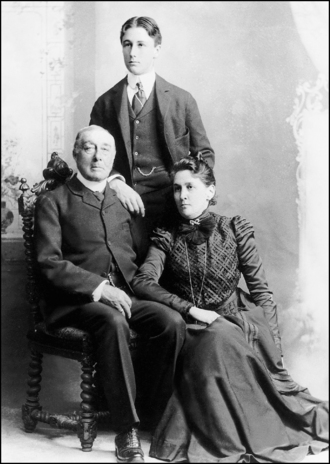
James, Franklin, and Sara in 1899, one year before James’s death.
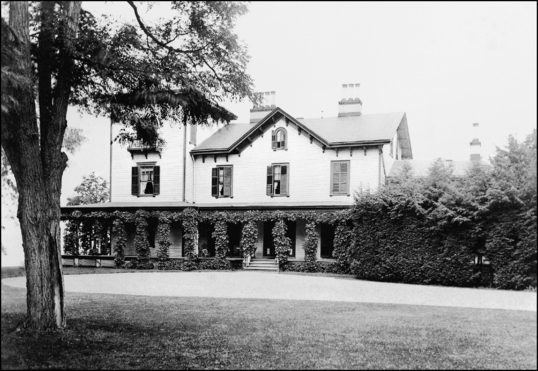
Springwood, the home of James and Sara in Hyde Park, as it appeared in 1885.

The Roosevelt twin town houses at 47–49 East Sixty-fifth Street in New York City. FDR and Eleanor occupied number 49 (right), Sara number 47. Note the common entry and the Roosevelt family crest between the third and fourth floors.

Algonac, the home of the Delano family in Newburgh, New York, where Sara was raised.

The Roosevelt home in Hyde Park as it appeared after Sara and FDR’s 1916–1917 renovations.
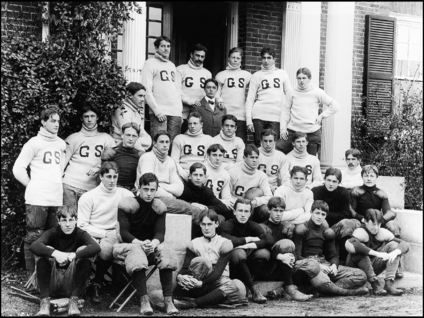
Groton first and second football teams. FDR (without school letter) is seated second from the left in the first row.

Reverend Peabody frowned on too much privacy for his charges.

The Harvard Crimson, 1904. Roosevelt (center) was president of the Crimson during his final year at Harvard—an incredibly important and prestigious position, the significance of which is best appreciated by Harvard grads.

Eleanor, as she appeared in Saint-Moritz in 1898.

Young marrieds at Hyde Park in 1905. In a reversal of roles, Franklin is knitting while Eleanor holds a cocktail glass.
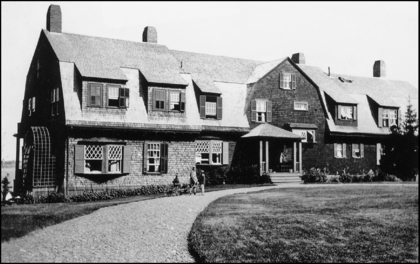
Campobello, 1914, FDR’s thirty-four room “cottage,” given to him by Sara in 1909.

FDR and Eleanor with Elliott, James, and Anna, 1912.
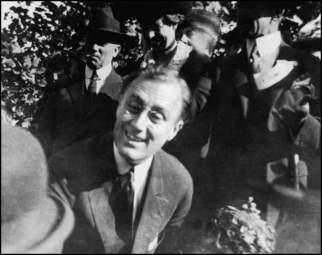
FDR greeting Dutchess County voters during his first political campaign, running for the New York State Senate in 1910.
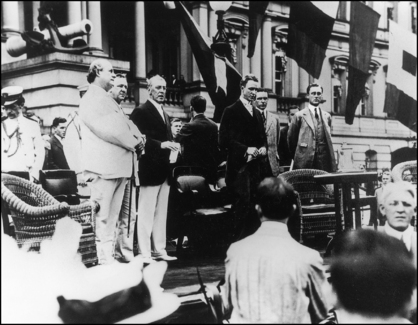
Flag Day, 1914. Left to right: Secretary of State William Jennings Bryan, Secretary of the Navy Josephus Daniels, President Woodrow Wilson, Assistant Secretaries of State Breckinridge Long and William Phillips, and FDR.

Assistant Secretary Roosevelt leads the Washington Senators in a demonstration of patriotic solidarity, May 14, 1917.

FDR and Josephus Daniels standing on the balcony outside their offices in May 1918, gazing at the White House. “You are smiling,” said Daniels, “because you are from New York and you know that someday you might live there.”

FDR assisted from a seaplane following an aerial inspection of naval facilities in Pauillac, France, August 14, 1918.

FDR accompanies Daniels and the Prince of Wales (later Edward VIII) to inspect the brigade of midshipmen at Annapolis, November 1919.

Democratic presidential candidate James Cox named FDR as his running mate in 1920. They are shown here greeting voters at a Democratic parade in Dayton, Ohio.
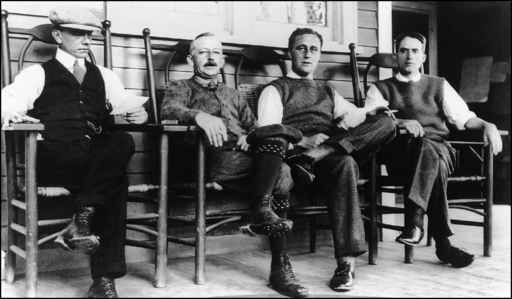
Roosevelt and his political entourage relax after a day of campaigning in Billings, Montana. Left to right: Louis Howe, Thomas Lynch, FDR, Marvin McIntyre.

This family photo from July 27, 1920, was taken shortly after Franklin’s romance with Lucy Mercer was discovered. Sara seems to console Eleanor with her hand on Eleanor’s knee. Children, left to right: Elliott, FDR, Jr., John, Anna, James. Chief is in the foreground.

Boy Scout encampment, Palisades Park, New York, July 27, 1921. FDR contracted the polio virus here. This is the last photograph to show Roosevelt walking unassisted.

Roosevelt spent the years from 1923 to 1926 in Florida attempting to regain his health, much of the time aboard the Larooco, a seventy-one-foot houseboat described by co-owner John Lawrence as “a floating tenement.”

On the beach in Florida with Frances (Dana) De Rahm. Aside from his slender legs, it would be difficult to recognize that FDR was paralyzed.

FDR posing on horseback in Warm Springs, Georgia, with Missy LeHand and Sergeant Earl Miller of the New York State Police.
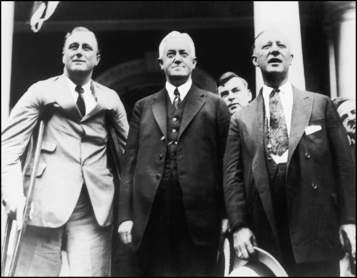
FDR with Democratic presidential nominee John W. Davis and New York governor Al Smith at Hyde Park, August 7, 1924.
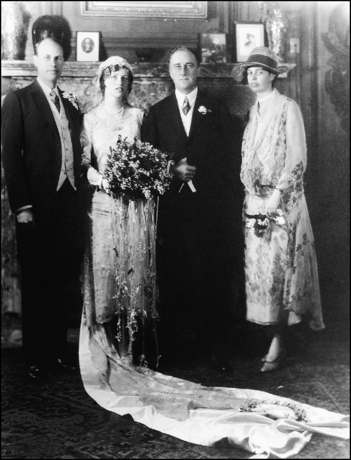
Franklin and Eleanor with Anna and her husband, Curtis Dall, at Hyde Park, June 1926.
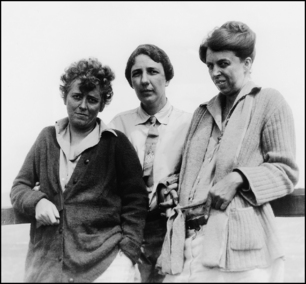
Eleanor poses for a snapshot with her friends Nancy Cook and Marion Dickerman at Val-Kill, July 1926. The depth of their friendship continues to be a subject of speculation.
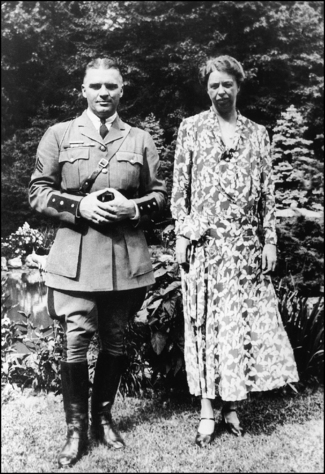
Eleanor developed a lasting relationship with New York State Police sergeant Earl Miller that continued throughout her life. This photo is from 1930.
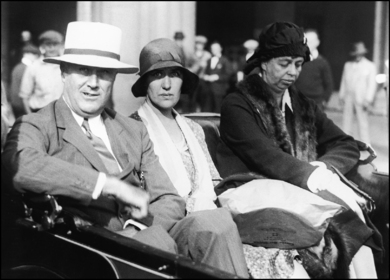
Governor Roosevelt rides with Missy LeHand and Eleanor from the governor’s mansion to the state capitol.

Roosevelt read four newspapers daily and scanned a dozen others. Here, he is checking the Times at Warm Springs in 1931.
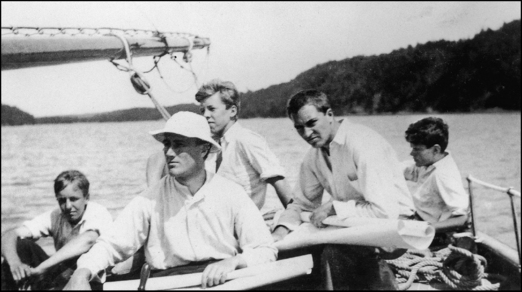
FDR sailing with his sons. Left to right: John, Elliott, James, and FDR, Jr., off Campobello, September 15, 1931. Roosevelt enjoyed blue-water sailing and used his nautical ability with telling effect in the early 1930s to discount rumors of his invalidism.

Strategy session with vice presidential nominee John Nance Garner at Hyde Park. On the decisive fourth ballot at Chicago, Garner had thrown his support to Roosevelt, ensuring FDR’s nomination.

Presidential candidate Roosevelt attending the third game of the 1932 World Series in Chicago. Chicago Cubs manager Charlie Grimm and the Yankees’ Joe McCarthy are in the foreground. Chicago mayor Anton Cermak is behind McCarthy. Eleanor is behind Franklin.

Campaigning in Seattle, FDR greets fellow polio victim Melidy Bresina, September 22, 1932. (The young boy is unidentified.)
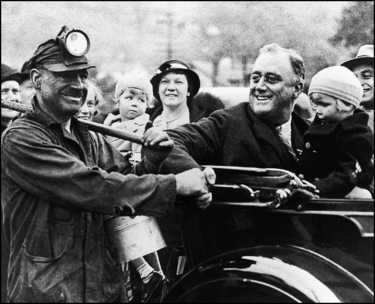
Despite the opposition of UMW president John L. Lewis, FDR carried the coal fields of West Virginia overwhelmingly. He is shown here greeting Zeno Santello in Elm Grove, West Virginia, October 19, 1932.
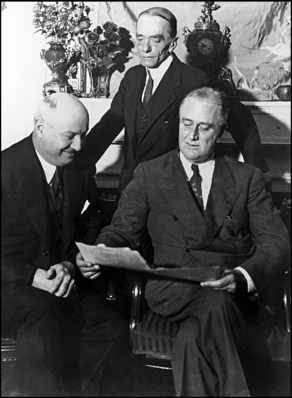
FDR reviews final election returns with a jubilant James Farley and Louis Howe. Howe’s tepid smile is the closest he came to expressing genuine pleasure.

January 23, 1933. President-elect Roosevelt poses with Anna outside his residence at Warm Springs before departing to inspect the giant hydroelectric dam at Muscle Shoals, Alabama.

FDR spoke briefly to American Legionnaires at Bay Front Park in Miami the evening of February 15, 1933. Chicago mayor Anton Cermak was shot moments later when an assassin’s bullet aimed at Roosevelt misfired.
* The Roosevelts sat in their old pew, the one they had used when FDR was assistant secretary of the Navy, eight rows from the front on the left. Because it was Communion Day the service was especially long, and Roosevelt did not get back to the White House until 1:30. The New York Times, March 6, 1933.
* FDR’s proclamation closing the banks reflected extraordinary input from leading members of the Hoover administration. Woodin was without staff support when he took office, and Secretary Mills, Undersecretary Arthur A. Ballantine (a Harvard classmate of FDR’s), Comptroller of the Currency Gloyd Awalt, and Walter Wyatt, general counsel of the Federal Reserve Board, helped put the proclamation into final form. “Mills, Woodin, Ballantine, Awalt, and I had forgotten to be Republicans or Democrats,” wrote Raymond Moley. “We were just a bunch of men trying to save the banking system.” After Seven Years 148 (New York: Harper & Brothers, 1939).
† FDR relished the “quarterback” metaphor. As he described his role calling plays to his press conference on April 13, 1933: “It is a little bit like a football team that has a general game plan against the other side. Now the captain and the quarterback of that team know pretty well what the next play is going to be and they know the general strategy of the team; but they cannot tell you what the play after the next play is going to be until the next play is run off. If the play makes ten yards, the succeeding play will be different from what it would have been if they had been thrown for a loss. I think that is the easiest way to explain it.” 2 The Public Papers and Addresses of Franklin D. Roosevelt 139, Samuel I. Rosenman, ed. (New York: Random House, 1938).
* FDR’s working majority in the Senate was far greater than 60–35, since Farmer-Labor Senator Henrik Shipstead of Minnesota and four Republicans—Hiram Johnson of California, George Norris of Nebraska, Robert La Follette of Wisconsin, and Bronson Cutting of New Mexico—were solidly behind the president. In future years, when Shipstead, Johnson, Norris, La Follette, and Cutting faced reelection, FDR did his utmost to ensure that there was no serious Democratic opposition.
† Woodin’s decision to issue federal reserve notes backed by the assets of the nation’s banking system is the basis of American currency today. A quick look at a bill in one’s pocketbook will show the words “FEDERAL RESERVE NOTE” clearly printed on the front. The usage dates from the emergency banking legislation of March 1933.
* As one reporter noted, “Mr. Roosevelt’s features expressed amazement, curiosity, sympathy, decision, playfulness, dignity, and surpassing charm. Yet he said almost nothing. Questions were deflected, diverted, diluted. Answers—when they did come—were concise and clear. But I never met anyone who showed greater capacity for avoiding a direct answer while giving the questioner a feeling it had been answered.” Quoted in Bernard Asbell, The F.D.R. Memoirs 58 (New York: Doubleday, 1973).
† The day before the inauguration, a testy Herbert Hoover told FDR, “Mr. Roosevelt, when you are in Washington as long as I have been, you will learn that the President of the United States calls on nobody.” Quoted in Arthur M. Schlesinger, Jr., The Coming of the New Deal 14 (Boston: Houghton Mifflin, 1959).
* Two years later to the day, on what would have been his ninety-fourth birthday, Holmes was buried with full military honors at Arlington National Cemetery. Roosevelt was among the mourners at the graveside. A soft spring rain was falling, but, as one of Holmes’s admirers said, “Soldiers don’t mind the rain.” Liva Baker, The Justice from Beacon Hill 643 (New York: HarperCollins, 1991).
* Eleanor Roosevelt observed the proceedings from the House gallery. When ER was recognized, she was given a standing ovation. “The House rose as one man,” said The New York Times. “The informality of the new occupants of the White House was never more forcefully evident. Not only did [ER] wear no hat, but she knitted almost constantly.” March 10, 1933.
* Congressional leaders attending included Speaker Rainey and House minority leader Snell; Senate majority leader Robinson; Congressmen John McDuffie of Alabama, chairman of the House Economy Committee; Sam Rayburn (D., Tex.); John Rankin (D., Miss.); William Connery (D., Mass.); and Senators Glass, La Follette, Wagner, Edward Costigan (D., Colo.), and James Byrnes (D., S.C.). Also in attendance were Secretaries Ickes, Wallace, and Dern, plus Director of the Budget Lewis Douglas. The New York Times, March 10, 1933.
* “This is not a Democratic bill and it is not a Republican bill,” said Mary Norton of New Jersey. “It is a bill to maintain the credit of the United States, and I shall support it.” The New York Times, March 12, 1933.
* The lame-duck Seventy-second Congress had voted on February 20, 1933, to repeal the Eighteenth (Prohibition) Amendment, but the proposal, which subsequently became the Twenty-first Amendment to the Constitution, did not become effective until ratified by the thirty-sixth state (Utah) on December 5, 1933. Amending the Volstead Act provided interim relief.
* Roosevelt was true to his word. At the end of the session Time reported that of the hundred thousand appointments available, FDR had made only 272, all at the highest level. The remaining jobs were being held in limbo by Postmaster General James A. Farley—whom Time called the party’s chief patronage dispenser. Farley had a “white list” of Democrats who had consistently supported the president and a “sinners’ roll” of party members who had deserted on crucial roll calls. The constituents of those on the “sinners’ roll” could expect slim pickings. June 26, 1933.
* The processors eventually had their day in court and temporarily prevailed when the Supreme Court, speaking through Justice Owen Roberts, overturned the Agricultural Adjustment Act in United States v. Butler, 297 U.S. 1 (1936). The decision is well known to constitutional scholars for Roberts’s remarkable description of constitutional adjudication. The Court’s duty, as Roberts would have it, was simply “to lay the Article of the Constitution which is invoked beside the statute which is challenged and to decide whether the latter squares with the former.” The decision in Butler was explicitly overruled in Mulford v. Smith, 307 U.S. 38 (1939), and Wickard v. Filburn, 317 U.S. 111 (1942). Of more than passing interest, the decision in Mulford v. Smith reversing Butler was also written by Justice Roberts, who apparently found a new set of carpenter’s tools.
* After the economy measure was passed in March 1933, FDR and the Bureau of the Budget zeroed in on the Army to absorb a significant portion of the cuts. The 1934 military budget was to be slashed by $80 million, roughly 51 percent. But the necessity to get the CCC up and running placed a premium on military experience. Not only was the Army budget spared, but many reserve officers were recalled to active duty to manage the camps. William Manchester, American Caesar: Douglas MacArthur 154–156 (Boston: Little, Brown, 1978); Forrest C. Pogue, George C. Marshall: Education of a General 276–280 (New York: Viking Press, 1963).
† In current dollars the $1.5 billion disbursed would amount to roughly $21 billion, given a conversion factor of 13.89.
* The act established the Federal Emergency Administration of Public Works, commonly known as the Public Works Administration, and on July 8, 1933, FDR appointed Interior Secretary Harold Ickes to be the administrator. Between July 1933 and March 1939, the PWA financed the construction of more than 34,000 projects at a cost of more than $6 billion. Projects ran the gamut from lighthouses and battleships to municipal sewer systems. Approximately 1.2 million men were employed on site under the program. The PWA was dissolved in June 1941. 2 Public Papers and Addresses of Franklin D. Roosevelt 270–271. For the Public Works Administration generally, see America Builds: The Record of the PWA (Washington, D.C.: U.S. Government Printing Office, 1939).
* Tennessee, Alabama, Mississippi, Kentucky, Georgia, North Carolina, and Virginia.
* Utility shareholders quickly challenged the constitutionality of the TVA but lost in a powerful decision written for an all-but-unanimous Court (8–1) by Chief Justice Hughes. The Court upheld the act based on Congress’s authority to provide for national defense and to regulate interstate commerce. The sale of electricity—a by-product—was authorized by Article IV, section 3 of the Constitution, granting the federal government power to sell property it acquires lawfully. Ashwander v. TVA, 297 U.S. 288 (1936).
* In a scene reminiscent of Shays’ Rebellion in 1787, U.S. District Court judge Charles C. Bradley was dragged from the bench in Le Mars, Iowa, by angry farmers, beaten, thrown into a truck, and driven out of town, where he was nearly lynched for refusing to suspend mortgage foreclosures. Six counties in Iowa were placed under martial law, and Governor Clyde L. Herring called out the National Guard to maintain order. The unrest in Iowa was the tip of the iceberg.
* The legislation was challenged repeatedly and came before the Supreme Court in the “gold clause cases” of 1935: Norman v. Baltimore & Ohio Railroad, 294 U.S. 240; Nortz v. United States 294 U.S. 317; and Perry v. United States 294 U.S. 330. Speaking for a sharply divided Court (5–4), Chief Justice Hughes upheld the power of Congress to regulate the monetary system, including the power to override private contracts if they conflicted with that authority. “This is Nero at his worst,” chided Justice James McReynolds in dissent.
* Unaccompanied forays such as the one to Fort Hunt drove the Secret Service to despair. After the visit to the veterans, the White House detail gave Louis Howe two pistols: one for himself and one for ER. Eleanor carried hers dutifully, but Howe couldn’t be bothered, though he enjoyed waving it in the face of startled visitors in his office. Alfred E. Rollins, Jr., Roosevelt and Howe 386–387 (New York: Alfred A. Knopf, 1962). Eleanor had been taught to shoot during the Albany years by Sergeant Earl Miller. For ER’s refusal to accept Secret Service or police protection, see Joseph P. Lash, Eleanor and Franklin 367–368 (New York: W. W. Norton, 1971).
* In 1918 the Supreme Court had overturned the Keating-Owen Federal Child Labor Act, which forbade the interstate shipment of the products of factories, mines, and quarries that employed children under the age of fourteen or where children between the ages of fourteen and sixteen worked more than eight hours a day. “If Congress can thus regulate matters … by prohibition of the movement of commodities in interstate commerce, all freedom of commerce will be at an end,” said Justice William Day, speaking for the Court. Hammer v. Dagenhart, 247 U.S. 251 (1918). FDR believed that Justice Day’s reasoning would apply with equal force to the Black bill.
* The Emergency Banking Act was passed March 9, 1933; revision of the Volstead Act, March 16; the Economy Act, March 20; Civilian Conservation Corps, March 31; Federal Emergency Relief Act, May 12; Agricultural Adjustment Act, May 12; Emergency Farm Mortgage Act, May 12; Tennessee Valley Authority, May 18; Truth-in-Securities Act, May 27; abrogation of gold clauses in public and private contracts, June 5; Home Owners’ Loan Act, June 13; Glass-Steagall Banking Act, June 15; Farm Credit Act, June 15; Railroad Coordination Act, June 15; National Industrial Recovery Act, June 16, 1933.