
TWENTY-THREE

Yesterday, December 7, 1941—a date which will live in infamy—the United States of America was suddenly and deliberately attacked by naval and air forces of the Empire of Japan.
—FRANKLIN D. ROOSEVELT, DECEMBER 8, 1941
ROOSEVELT WAS CONSUMED by the war in Europe: his relations with Churchill, Lend-Lease, aid to Russia, and the struggle in the Atlantic. The military leadership—Stimson and Knox, Marshall and Stark—shared the president’s concern. As a consequence the deteriorating situation in the Pacific received less attention. Discussions with Japan were handled by the State Department, and subordinate commanders saw little sense of urgency. Vessels of the Pacific Fleet routinely put in at Pearl Harbor every Friday so officers could spend weekends with their families; the Army parked its airplanes wingtip to wingtip to minimize the number of sentries required; antiaircraft guns remained limbered so as not to alarm Hawaii’s tourists; and the island’s radar operated three hours a day. Military intelligence cracked the Japanese diplomatic code in August 1940 (MAGIC), but the Army and Navy initially assigned it such a low priority that it often required two weeks to translate the intercepts and occasionally as long as two months. “The island of Oahu, due to its fortification, its garrison, and its physical characteristics, is believed to be the strongest fortress in the world,” General Marshall assured Roosevelt in April 1941. “With the force available [to defend it], a major attack against Oahu is considered impractical.”1
American relations with Japan had been on a downward spiral ever since the Grant administration. President Grant had spent a month in the country during his world tour in 1879. “My visit to Japan has been the most pleasant of all my travels,” the former chief executive wrote from Tokyo. “The country is beautifully cultivated and the people, from the highest to the lowest, the most kindly and the most cleanly in the world.… The progress they have made in the last twelve years is incredible.… This is marvelous when the treatment of their people—and all eastern people—receive at the hands of the average foreigner is considered.”2 Grant was so captivated that one of the reasons he considered accepting a third term in 1880 was to improve American relations with China and Japan.3
Grant lost the Republican nomination to James A. Garfield, and without his contribution Japanese-American relations deteriorated. Rather than accept Japan as a legitimate imperial power in Asia—such as the United States had become with its annexation of the Philippines in 1898—American policy, often colored with an ugly tincture of racism, became gratuitously condescending.4 After the Japanese victory over the Russian fleet at the Tsushima Strait in 1905, President Theodore Roosevelt, who arbitrated the Russo-Japanese peace settlement at Portsmouth, New Hampshire, denied Tokyo’s claim for indemnity and ruled out significant Russian territorial concessions in Manchuria. As the Japanese saw it, the United States denied them the fruits of victory.5 The so-called Gentlemen’s Agreement of 1908 closing off immigration from Japan fueled that resentment.* In 1913 the United States summarily dismissed Japan’s protest against California legislation forbidding Japanese citizens to own land in the state. In 1919 Woodrow Wilson rejected a Japanese proposal to include a declaration of racial equality in the League of Nations Covenant. And in 1924 Congress permanently barred Japanese immigration to the United States.6 But the most unforgivable action (in Japanese eyes) was American refusal to recognize Japan’s acquisition of Manchuria in 1932.
The Japanese takeover was scarcely unexpected or without precedent. As early as the Root-Takahira agreement of 1908, the United States recognized Japanese hegemony over Manchuria.7 Japan controlled the province’s economy, owned its principal railroad, and managed its seaports. And the fact is, there was little armed resistance (and certainly no atrocities) when the Japanese Army finally took complete control. The League of Nations formally condemned the action, however, prompting Japan to quit the League, and the United States responded with the Stimson Doctrine, promulgated by high-minded Henry L. Stimson, who was then Hoover’s secretary of state. The Stimson Doctrine declared that the United States would not recognize any territorial arrangements imposed on China by force. “The Western powers taught Japan the game of poker,” lamented the Japanese diplomat Yosuke Matsuoka, “but after it acquired most of the chips they pronounced the game immoral and took up contract bridge.”8
The Japanese saw themselves as colonizers rather than conquerors—like the Dutch in the East Indies, the French in Indochina, the British in Burma and Malaya, and yes, the Americans in the Philippines. They invested heavily in Manchuria, installed the boy emperor of China (who had been deposed in 1912) as sovereign, renamed the territory Manchukuo, and immediately dispatched half a million citizens to settle there, with another 5 million slated to join them. Between 1932 and 1941 Japanese public and private investment in Manchuria totaled $3.3 billion (roughly $45 billion in today’s currency.)9
Nevertheless, the Stimson Doctrine suited America’s sense of righteousness. It reflected the influence of generations of American missionaries in China as well as latent public support for Chinese independence. Yet it ignored strategic reality in the Far East, overlooked the needs of the growing Japanese economy, and underestimated the advantages of modernization that accompanied Japanese colonization.
Roosevelt embraced the Stimson Doctrine wholeheartedly. Despite warnings in 1932 by brain trusters Raymond Moley and Rexford Tugwell that America’s interests lay with Japan, FDR, as president-elect, backed Stimson down the line. “How could you expect me to do otherwise, given my Delano ancestors?” he asked.10 Roosevelt’s comment was flippant. Yet it determined American policy for the next decade.
As Moley and Tugwell had warned, the Stimson Doctrine curdled U.S. relations with Japan but had little effect on the situation in the Far East. As a policy, it was purely rhetorical: “an attitude rather than a program” in the words of historian Herbert Feis.11 When Japan stepped over the line with its assault on China in 1937, the United States took few tangible steps to oppose it. Roosevelt condemned Tokyo’s action and provided some token aid to Chiang Kai-shek but did nothing to curtail American exports to Japan, including the strategic materials and petroleum that fueled the Japanese war machine. The United States championed Chinese sovereignty verbally but resisted committing substantial resources to defend it.
By 1940 Japan’s wrongful incursion into China was three years old, with no conceivable end in sight. Japanese troops had won significant victories and occupied China’s most productive coastal regions but had not been able to subdue Chinese resistance. In a word, China had become a quagmire. The impatience of the military to end the stalemate brought down Japan’s government in July 1940 (the third government to fall in less than two years) and installed an Army-dominated regime pledged to expedite the war and solve Japan’s dependence on foreign imports, particularly those from the United States.12 The Roosevelt administration was not complicit in the fall of the government, but a more conciliatory stance toward Manchuria—as was urged by the American embassy in Tokyo—would have provided Japanese politicians more leverage to withstand the military.*
Until 1940 the Sino-Japanese conflict was a purely regional affair. It convulsed Asia but remained an isolated event unconnected with the accelerating pace of aggression in Europe.13 With a new government in Tokyo, that changed quickly. Encouraged by Hitler’s conquest of France and the Netherlands, as well as the onset of the Battle of Britain, Japan’s promilitary government turned its eye to the colonial outposts in Southeast Asia: the oil fields of the Dutch East Indies, the rubber plantations of British Malaya, and the tin mines and rice paddies of French Indochina. “We should not miss the present opportunity or we shall be blamed by posterity,” said Japan’s new war minister, General Hideki Tojo.14
With Britain under German attack, Tokyo prevailed upon London to close the Burma Road for three months (cutting China’s principal supply route) and to withdraw the British garrison from Shanghai. A more concerted move against the French and Dutch colonies appeared imminent. The path to a world war lay open. Roosevelt responded on July 26 with an embargo banning the export of high-octane aviation gasoline and premium grades of iron and steel scrap to Japan. It was a slap on the wrist, but Washington hoped it would send a message to Tokyo and deter further moves against Southeast Asia. “We are not going to get into any war by forcing Japan into a position where she is going to fight for some reason or another,” FDR told the State Department.15
Roosevelt’s limited embargo produced the opposite effect to what he intended. It riled the Japanese but did nothing to restrain them. Indeed, it convinced Tokyo that its American supply line was in jeopardy and should be replaced as soon as possible. On September 23, with the reluctant acquiescence of Vichy France, Japan occupied the northern portion of Indochina, adjacent to the Chinese province of Yunnan. Roosevelt responded the following day with a complete embargo on all types of iron and steel intended for Japan and on September 25 announced a $100 million loan to China through the Export-Import Bank.16 An implacable tit for tat had begun. The United States and Japan settled into a rhythm that would characterize their relations for the next year. Each undertook a series of escalating moves that provoked but failed to restrain the other. Japan gambled on the action it could take without precipitating open conflict with the United States. The Roosevelt administration—which did not give its full attention to the matter—reckoned it could pressure Tokyo by economic means without driving the Japanese to war.17
Two days after Roosevelt announced the loan to China, Japan joined the Berlin-Rome axis. The move caught Washington by surprise. Japan recognized the leadership of Germany and Italy in Europe; Germany and Italy recognized Japanese hegemony in Greater East Asia. All three agreed to come to the aid of one another if attacked by a third party that was then at peace. Since the treaty explicitly excluded the Soviet Union, it was unmistakably clear that the pact was aimed at the United States. In effect, events in Europe and Asia were now joined. By threatening Washington with a two-front war, each of the contracting parties hoped to prevent American intervention.18
Japan had raised the ante, and Roosevelt began to have misgivings about a confrontation in the Pacific. In early October 1940 Churchill requested the United States send a naval squadron (“the bigger the better”) to visit Singapore—a bit of saber rattling he thought would intimidate the Japanese.19 General Marshall and Admiral Stark thought the move unnecessarily provocative, and FDR agreed. With the election a month away, the president simply ignored Churchill’s request and sent no reply.
Throughout the winter and spring of 1940–41 Roosevelt received conflicting advice. The hawks in the administration—Stimson, Knox, Morgenthau, Ickes, and Harry Hopkins—urged the president to tighten the screws on Japan and embargo the shipment of the oil it so desperately needed. (Eighty percent of Japanese petroleum came from the United States.) Secretary of State Hull and the military urged FDR to go slow. Hull favored continued negotiations; Marshall and Stark argued that if Japan’s oil supply were closed off she would be forced to seek other sources. The Dutch East Indies, Burma, Malaya, and even the Philippines would be threatened. Not only was the United States unprepared, but a military confrontation against Japan in Southeast Asia would undermine efforts to support Britain in the Atlantic. “Every day that we are able to maintain peace and still support the British is valuable time gained,” said Stark. Marshall agreed. This was “as unfavorable a moment as you could choose for provoking trouble,” the chief of staff told the president, and he urged that the Marine garrison in Shanghai be withdrawn to avoid a possible incident.20
With the Battle of the Atlantic raging full tilt, Japanese policy remained a secondary issue for Roosevelt. But he was not dismayed by the split among his advisers. The president liked to keep his saddlebags balanced. When Justice James McReynolds of Tennessee resigned from the Supreme Court in February 1941, Morgenthau suggested FDR appoint Cordell Hull (another Tennessean) to the vacancy and make Stimson secretary of state. As Morgenthau saw it, that would remove the principal advocate of negotiations from the cabinet and put the more bellicose Stimson in charge. Roosevelt refused to be stampeded. It was a bad suggestion, he told Morgenthau. In retrospect, said the president, he wasn’t at all sure Stimson had been right about Manchuria in 1932 and that Hull’s tactics of negotiation might have been the better course for the United States to pursue. “The president’s comments certainly surprised me,” wrote Morgenthau.21
Policymakers in Tokyo were equally divided. According to longtime ambassador Joseph C. Grew—a schoolmate of FDR at Groton and Harvard who sometimes wrote “Dear Frank” letters to the president—the Emperor, the premier, and a majority of the cabinet, as well as most of the Japanese Navy, favored continued negotiation with the United States. The Army, desperate for victory in China, pressed for war, as did Foreign Minister Matsuoka, but thus far they had been unable to convince their colleagues.22*
On April 13, 1941, Matsuoka scored an important diplomatic victory when Japan and the Soviet Union announced the conclusion of a neutrality pact between the two nations. Again Washington was caught flat-footed. Russia recognized the independence of Manchukuo and implicit Japanese control; Japan reciprocated with respect to Outer Mongolia, a Soviet satellite similarly detached from China. The pact represented a significant strategic breakthrough. By resolving the smoldering colonial tensions along Manchukuo’s border, it freed both nations to shift their military focus elsewhere.
While Matsuoka prepared the way for war, the peace faction in the Japanese government moved to repair the breach with Washington. In early 1941 Tokyo replaced its ambassador to the United States with Admiral Kichisaburo Nomura, a former foreign minister who had served as naval attaché in Washington during World War I and was acquainted with Roosevelt from that time. As foreign minister, Nomura had shown a keen interest in improving relations with the United States.23 He feared the drift to war and undertook the Washington posting at the urging of naval colleagues to help prevent it.24 Roosevelt received Nomura cordially. He recalled their earlier friendship, said he intended to call him “Admiral” rather than “Ambassador,” and proposed they talk candidly. “There is plenty of room in the Pacific area for everybody,” said the president. “It would not do this country any good nor Japan any good, but both of them harm to get into war,” to which Nomura readily assented.25
Roosevelt suggested that Nomura might find it useful to sit down with Hull and discuss how relations could be improved. For the next nine months Nomura and Hull met some fifty times, often at the secretary’s home in the Wardman Park Hotel. Hull wrote later he credited Nomura “with being honestly sincere in trying to avoid war between his country and mine.”26 Both men worked under severe handicaps. Nomura was out of step with his government in Tokyo, and Hull, who was in poor health, was often excluded from White House strategy sessions.27
Hitler’s invasion of the Soviet Union in June 1941 took Tokyo by surprise. When he recovered from the shock, Foreign Minister Matsuoka said it provided Japan with a golden opportunity to extinguish for all time the Russian threat in Siberia. “He who would search for pearls must dive deep,” he told the cabinet.28 Despite the recently concluded neutrality agreement with Moscow, Matsuoka maintained that the Tripartite Pact with Germany and Italy took precedence. In his view, which he put directly to the Emperor, Japan should join the war against Russia immediately.29
The Army high command agreed that Hitler’s attack on the Soviet Union offered an opportunity, but they wanted no part of another northern adventure. In May 1939 the Japanese Kwantung Army had crossed the Khalkhin-Gol River separating Manchukuo from Soviet-controlled Mongolia to attack Red Army troops stationed on the other side. The fighting escalated through the summer, culminating in the humiliating defeat of the Japanese at the end of August. Japan’s losses totaled more than 50,000 men killed and wounded; the Russians (under General Georgi Zhukov) lost one-fifth that number.30* There was as yet no evidence that Stalin was reducing his Siberian garrison to meet the German invasion, and without overwhelming numerical superiority the Japanese generals had no interest in attacking the Red Army again.31
Instead of going north, the Army advocated a southern strategy. The German attack would keep the Russians at bay, and with its northern flank protected Japan could move south against Burma, Malaya, and the Dutch East Indies. Seizing Southeast Asia would further isolate China, ensuring Chiang’s eventual defeat. But above all it would provide continued access to vital raw materials. And the petroleum from the rich oil fields of the East Indies would eliminate Japan’s dependence on the United States.
“The Japs are having a real drag-down and knock-out fight trying to decide which way to jump,” Roosevelt (who thanks to MAGIC intercepts was privy to the Tokyo debate) told Harold Ickes on July 1. “No one knows what the decision will be, but it is terribly important for the control of the Atlantic for us to keep peace in the Pacific. I simply have not got enough Navy to go round.”32
At a meeting of the privy council held in the presence of the Emperor on July 2, the Japanese government chose to go south. The Kwantung Army would be reinforced to take advantage of the situation should Russia suddenly collapse, but the principal thrust would be southward. “The Imperial Government will continue its efforts to effect a settlement of the China Incident, and seek to establish a solid basis for the security of the nation. This will involve an advance into the Southern Regions and, depending on future developments, a settlement of the Soviet Question as well.” The Emperor and the Navy hoped the southern strategy could be pursued peacefully but were under no illusions. “The Imperial Government will carry out the above program no matter what obstacles may be encountered.… In case the diplomatic negotiations break down, preparations for war with England and America will also be carried forward.”33
On July 23 Japanese troops, already garrisoned in northern Indochina, moved into the southern portion of the country. Under a new protocol signed with Vichy, Japan acquired the use of eight airfields including Da Nang and Bienhoa, the naval bases at Saigon and Cam Ranh Bay, and the right to station an unspecified number of troops in the south. This provided the Japanese with a forward vantage point from which not only to interdict the remaining supply routes into China but to threaten Malaya, Singapore, the Dutch East Indies, and the Philippines.
Cables from Ambassador William Leahy in Vichy as well as MAGIC intercepts alerted Roosevelt as early as July 14 that the Japanese planned to move into southern Indochina.* At cabinet on the eighteenth Morgenthau pressed the president for a response: “What are you going to do on the economic front against Japan if she makes this move?”
“Well, to my surprise [wrote Morgenthau] the President gave us quite a lecture why we should not make any move because if we did, if we stopped all oil, it would simply drive the Japanese down to the Dutch East Indies, and it would mean war in the Pacific.”34
FDR’s caution dovetailed with the military’s assessment. On July 21, 1941, Admiral Stark forwarded to the president a Navy Department memorandum emphasizing the paramount importance of the Battle of the Atlantic and suggesting that the Japanese were unlikely to move beyond Indochina unless the United States cut off the flow of oil. “An embargo would probably result in a fairly early attack by Japan on Malaya and the Netherlands East Indies, and possibly would involve the United States in an early war in the Pacific.” Stark added a handwritten postscript noting his concurrence.35 Marshall told Stimson essentially the same. “Collapse in the Atlantic would be fatal; collapse in the Far East would be serious but not fatal.”36
When Roosevelt met with his cabinet on July 24, the day after the Japanese occupation of southern Indochina, he spent much of the time whiplashing his subordinates to expedite aid shipments to the Soviet Union. He was annoyed by the Japanese move but had not changed his view that the United States should not overreact. “Notwithstanding that Japan was boldly making this hostile move,” wrote Ickes that evening, “the President was still unwilling to draw the noose tight. He thought it might be better to slip the noose around Japan’s neck and give it a jerk now and then.”37
The noose Roosevelt envisaged was a freeze on Japanese assets in the United States. That would require specific government approval before funds could be released to pay for exports to Japan. It would not embargo trade but would add a modicum of inconvenience and uncertainty. The Japanese would have to apply for an export license before each shipment. Much to the disappointment of the hawks in the administration, FDR said the United States would continue to ship oil and gasoline. Asked specifically by acting Treasury secretary Daniel Bell (Morgenthau was on vacation) how Japanese requests for petroleum should be handled, FDR said he was “inclined to grant the licenses for shipment as the applications are presented.”38
Roosevelt was more explicit later that day when speaking extemporaneously to volunteers from the Office of Civilian Defense. People are asked to conserve gasoline, he said. Why should they do so when we are shipping all of this gasoline to Japan?
Now the answer is a very simple one. There is a world war going on, and there has been for some time. One of our efforts, from the very beginning, was to prevent the spread of that world war in certain areas where it hadn’t started. One of those areas is a place called the Pacific Ocean. It was very essential from our own selfish point of view of defense to prevent a war from starting in the South Pacific.…
All right. And now here is this Nation called Japan. Whether they had aggressive purposes to enlarge their empire southward, they did not have any oil of their own. Now, if we had cut the oil off, they probably would have gone down to the Dutch East Indies a year ago, and you would have had war. Therefore, there was—you might call—a method in letting this oil go to Japan, with the hope—and it has worked for two years—of keeping war out of the South Pacific for our own good, for the good of the defense of Great Britain, and the freedom of the seas.39
Roosevelt announced the freeze of Japanese assets on July 26. It was coupled with a freeze on Chinese assets and a military order placing the Philippine armed forces under American command.40 Later that afternoon the War Department announced that General Douglas MacArthur had been recalled to active duty to command U.S. forces in the Philippines.* “If there is going to be trouble in the Far East,” Roosevelt told his military aide, Pa Watson, “I want Douglas to be in charge.”
The chain of circumstances leading to MacArthur’s recall is unclear. What little documentation exists suggests MacArthur took the initiative with a letter to FDR’s press secretary Steve Early (an old friend) on March 21, 1941, offering his services to the president. “Isn’t that fine? It is just what I would expect Douglas MacArthur to do,” said Roosevelt. Pa Watson, the president’s military aide, thereupon wrote MacArthur that Roosevelt “wants you in your military capacity rather than any other.” MacArthur replied, “This would naturally be my choice and I am gratified beyond words that this is his decision.”
The War Department was less enthusiastic about MacArthur’s recall than FDR was. By the end of May 1941 MacArthur had heard nothing from Washington and dispatched another letter to Early stating he had booked passage back to the United States and planned to settle in San Antonio. There is no paper trail of what happened next, but apparently FDR made his wishes known to Stimson and Marshall. Early wired MacArthur to sit tight, and on June 20, 1941, Marshall wrote that he and Stimson agreed that “your outstanding qualifications and vast experience in the Philippines make you the logical selection for the Army in the Far East should the situation approach a crisis.”41
After the order freezing Japanese assets was announced, FDR departed Washington for Hyde Park, and four days later he left for New London and the trip to Newfoundland to meet Churchill. There is no doubt about his intentions. The freeze was designed to disconcert the Japanese, but the flow of oil was to continue. Daniel Bell at Treasury was aware of that; Ickes, who had been named petroleum coordinator, was aware; and so was the State Department. “The President’s chief objective in the Pacific for the time being,” Sumner Welles told his British counterpart, Sir Alexander Cadogan, at Argentia, “is the avoidance of war with Japan.”42
The export licenses Japan required fell under the jurisdiction of the interdepartmental Foreign Funds Control Committee, a subcabinet body chaired by Assistant Secretary of State Dean Acheson. The committee had the sole authority to release the frozen funds. As fate would have it, Acheson was one of the leading hawks in the administration, who had long favored a full embargo of oil shipments to Japan. With Roosevelt and Welles out of the country and Hull taking the waters at the Greenbrier in White Sulfur Springs, West Virginia, Acheson asserted that the freeze order was imprecise and refused to thaw Japanese funds for any purchases whatever. With the breathtaking arrogance that became his hallmark, the future secretary of state maintained his action could not possibly provoke war in the Pacific since “no rational Japanese could believe that an attack on us could result in anything but disaster for his country.”43* Despite protests from the State Department’s Far Eastern Division and the Treasury, Acheson refused to make any Japanese funds available—a de facto embargo that snuffed out Japan’s access to petroleum. “Whether or not we had a policy, we had a state of affairs,” gloated Acheson in his memoirs.44
FDR learned of the freeze only upon his return from Newfoundland in early September, and by then to reverse the policy and issue the export licenses would have been perceived by many as appeasement. Public opinion polls in early August indicated that 51 percent of Americans believed America should risk war rather than allow Japan to become more powerful. By September that number had risen to 67 percent.45 In that context Roosevelt allowed Acheson’s decision to stand. Contrary to his original intention, all American trade with Japan was now cut off.46 In Tokyo, Ambassador Grew brooded about the effect: “The vicious circle of reprisals and counter reprisals is on. Facilis descensus Averni est. [The descent into Hell is easy.] Unless radical surprises occur, it is difficult to see how the momentum of the down-grade movement can be arrested, or how far it will go. The obvious conclusion is eventual war.”47
The embargo stunned Tokyo. Japan consumed an estimated 12,000 tons of oil each day and had less than a two-year supply on hand. As one Japanese leader put it, the nation was “like a fish in a pond from which the water was gradually being drained away.”48 Added to the worry about petroleum was the balance of naval power in the Pacific. In the summer of 1941 the Imperial Navy enjoyed numerical superiority against the combined fleets of the United States, Great Britain, and the Netherlands. But the naval buildup Congress authorized after the fall of France in 1940 would eliminate that advantage by 1942. If Japan was to act, the window of opportunity was closing rapidly.
On September 6, 1941, the Japanese government met with the Emperor. Prime Minister Prince Fumimaro Konoye, who desperately sought to prevent war, was given a month to negotiate a settlement with the United States. If an agreement to lift the embargo could not be reached by October 10, the armed forces would prepare to move south. Emperor Hirohito, who rarely intervened in such ceremonial conferences, reminded the government of the risks ahead. When the military appeared to equivocate on the desirability of a diplomatic settlement, he reached into his robe, drew out a piece of paper, and read a poem by his grandfather, the great Emperor Meiji:
Throughout the world
Everywhere we are brothers
Why then do the winds and waves rage so turbulently?
After a stunned silence, Admiral Osami Nagano, chief of the Navy general staff, promised that diplomacy would take precedence. “War would be chosen only as an unavoidable last resort.”49*
On the evening of September 6, after the conference adjourned, Prime Minister Konoye invited Ambassador Grew for a private dinner. Traditionally in Japan the prime minister had no contact with foreign envoys, and Konoye took elaborate precautions to keep the meeting secret.50 They dined in the home of a mutual friend, Baron Ito; automobile license plates were altered to avoid identification; servants were sent home before the guests arrived, and the meal was served by Baron Ito’s daughter. For three hours Konoye pressed Grew for a personal meeting with FDR, perhaps in Hawaii. “Time is of the essence,” said the prime minister.51 He told Grew that his government believed the four principles for reconciliation previously announced by Secretary Hull provided a satisfactory basis for resolving all differences: the territorial integrity of all nations; noninterference in the internal affairs of other nations; the open door for trade; and the preservation of the status quo except for change by peaceful means.52 Konoye assured Grew that if he and Roosevelt could agree on the principles, the details would fall into place. “The Prime Minister is cognizant of the fact that certain points may need clarification and more precise formulation, and he is confident that the divergences in view can be reconciled to our mutual satisfaction” (Grew’s emphasis). Konoye said the ship waiting to take him and his party to meet the president was equipped with powerful radio equipment that would allow him to communicate directly with Tokyo. When he reported to the Emperor that an agreement had been reached, “the Emperor would immediately issue a rescript ordering the suspension forthwith of all hostile operations.”53
Grew said, “I returned to the Embassy from that historic meeting with the firm conviction that we had been dealing with a man of unquestioned sincerity, a point which need not be labored when one considers the high traditions of Prince Konoye’s background and family, extending back to the dim ages of Japanese history.”54
Grew immediately informed Washington of his talk with Konoye: “the most important cable to go from his hand since the start of his diplomatic career.”55 In numerous follow-up messages, including a personal letter to FDR on September 22, he warned that time was short.* Above all, he cautioned against the State Department’s tendency to insist on detailed, ironclad commitments before the meeting. It was not the Japanese way. The conciliation process was evolutionary. Konoye, with the Emperor’s backing, was taking the first step. The alternative, Grew warned, was replacement of the Konoye government by a military dictatorship and a steady drift toward war.56
Washington disregarded Grew’s advice. The hawks in the cabinet—Stimson, Knox, Ickes, and Morgenthau—were not interested in a settlement short of Japan’s capitulation. “I approve of stringing out negotiations,” Stimson told Morgenthau, but “they should not be allowed to ripen into a personal conference between the President and the Prime Minister. I greatly fear that such a conference if actually held would produce concessions which would be highly dangerous to our vitally important relations with China.”57 Hull and the Far Eastern Division of the State Department shared Stimson’s concern. When alerted to the possibility of a Roosevelt-Konoye meeting, the division warned Hull of the consequences, believing that FDR might be too accommodating. It insisted that prior to any summit meeting Japan announce its intention to withdraw from the Tripartite Pact with Germany and Italy; agree to remove its troops from China; clarify its stand on the open door; and resolve whatever ambiguities there were concerning Hull’s four principles for reconciliation.58
Hull needed no prodding. Weaned on the fundamentalist pessimism of southern Appalachia, the secretary wanted every i dotted before agreeing to a meeting with the Japanese prime minister. He was also concerned about the public effect of such a conference coming so soon after FDR’s dramatic meeting with Churchill off Newfoundland. “I was thoroughly satisfied that a meeting with Konoye, without an advance agreement, could only result in another Munich or in nothing at all. I was opposed to the first Munich and still more opposed to a second Munich.”59
In his Memoirs Hull wrote, “President Roosevelt would have relished a meeting with Konoye, and at first was excited at the prospect. But he instantly agreed that it would be disastrous to hold the meeting without first arriving at a satisfactory agreement.”60 As Hull would have it, the State Department should control negotiations with Japan, and only when it was satisfied should FDR meet with Konoye to ratify what the diplomats had agreed to. Hull’s account appears unlikely. For someone who placed as much faith in his ability to improvise extemporaneous solutions as Roosevelt did, and who thrived in unstructured negotiations, it is difficult to believe that he would have “instantly” passed up the opportunity to meet with Konoye.* A more plausible explanation is that FDR, consumed by the war in Europe, had given the deteriorating situation in the Far East too little attention. Deeply engaged with the battle against German U-boats in the Atlantic, anxious to expedite aid to the Soviet Union, and troubled by the great battle shaping up before Moscow, he had left negotiations with Japan in Hull’s hands too long to overrule him now. And so when Hull and the State Department, plus Stimson, Morgenthau, and Hopkins, argued against such a meeting, Roosevelt acquiesced. Whether a meeting between the president and Konoye in autumn 1941 would have averted war is one of history’s imponderables. But it did not take place.61†
If Hull, the State Department, and the hawks in the cabinet feared a Roosevelt-Konoye meeting, ultranationalists in Tokyo were enraged at the possibility. Konoye narrowly averted assassination on September 18, 1941, when four young men armed with ceremonial daggers charged the vehicle in which he was riding from his home to his office. They were repulsed by plainclothes policemen, but the climate of assassination in Tokyo surely gave increased urgency to the negotiations.62
Yet nothing happened. Traditional historiography argues that Japan’s refusal to withdraw from China was the sticking point, and to some extent that is true. But the reverse is also true. Stimson, Morgenthau, and Hull feared that if Japan did withdraw from China it would free the Japanese Army to attack Russia in Siberia, which no one in Washington wanted. Accordingly, the best strategy was to keep the talks with Tokyo going but agree to nothing. On October 16, unable to lift the embargo or secure a summit with FDR, Konoye resigned. The Emperor, who still hoped for a peaceful resolution, turned to his war minister, General Hideki Tojo, to form a new government. Intervening directly in the process and wholly without precedent, Hirohito explicitly requested Tojo not to feel bound by the decision of September 6 to prepare for war but to review all issues anew: to start with a clean slate. Shaken by his new responsibility, Tojo accepted the Emperor’s request without question.63 In some respects, Hirohito’s action in picking Tojo was similar to Hindenburg’s selection of Hitler as chancellor of the Weimar Republic in January 1933: both hoped to resolve the crisis facing their nation by turning to the strongest player on the board.
On the day Konoye resigned, Roosevelt penned longhand notes to Churchill and King George VI. “I am a bit worried over the Japanese situation,” he told the King. “The Emperor is for peace, I think, but the Jingoes are trying to force his hand.” To Churchill he said, “The Jap situation is definitely worse and I think they are headed north—however in spite of this you and I have two months of respite in the Far East” (FDR’s supposition was that Japan would not move south until Russia was defeated).64
The following day, Roosevelt met with Hull and his military advisers. At the president’s direction Admiral Stark flashed a warning to commanders in the Pacific that hostilities between Japan and Russia were a strong possibility. An attack on U.S. and British forces could not be ruled out. “In view of these possibilities you will take due precautions.”65 Neither Stark nor General Marshall considered the Japanese threat imminent. The next day, October 17, 1941, Stark assured Admiral Husband E. Kimmel, the Pacific Fleet commander, that he did “not believe the Japs are going to sail into us. In fact, I tempered the [alert] message I was given considerably. Perhaps I am wrong, but I hope not. In any case after long pow-wows in the White House it was felt we should be on guard.”66 General Marshall, for his part, informed General Walter C. Short in Hawaii and MacArthur in the Philippines: “No abrupt change in Japanese foreign policy appears imminent.”67
In Tokyo the “clean slate” debate within the Tojo government continued through the first week in November. Grew advised Washington that the hopes for a settlement were fading fast. The economic pressure Washington had applied, particularly the oil embargo, had been a mistake, said Grew. In a lengthy cable on November 3, 1941, and a shorter follow-up the next day, Grew warned that if negotiations failed “Japan may go all-out in a do-or-die effort to render herself invulnerable to foreign economic pressure, even to the extent of committing national hara-kiri. Those of us who are in direct touch with the atmosphere from day to day realize that this is not only possible but probable” (Grew’s emphasis).
Grew said Japan’s standards of logic “cannot be gauged by any Western measuring rod. It would be hazardous to base our national policy on the belief, held in certain quarters, that our economic pressure will not drive Japan to war.” If war came, Grew noted, it “may come with dangerous and dramatic suddenness” (Grew’s emphasis).68
Grew understood the situation better than most. On the afternoon of November 5, 1941, the Japanese privy council, again meeting in the presence of the Emperor, made the decision to prepare for war. “To adopt a policy of patience and perseverance,” said Prime Minister Tojo, “was tantamount to self-annihilation. Rather than await extinction, it was better to face death by breaking through the encircling ring and find a way for existence.”69 At the insistence of Foreign Minister Shigenori Togo, negotiations with Washington would continue. But if an agreement could not be reached by November 25, the final decision for war would be placed before the Emperor. Warning orders to prepare for combat were flashed to the military services, and Ambassador Nomura was instructed to make a final approach to Hull. Said Togo, “The success or failure of the pending discussions will have an immense effect on the destiny of the Japanese Empire. In fact, we gambled the fate of our land on the throw of this die.”70
At the same time the privy council was meeting in Tokyo, the Joint Board of the Army and Navy—a precursor of the Joint Chiefs of Staff—met in Washington to review the situation. After reaffirming the primary objective of American policy to be the defeat of Germany, the Board explicitly advised FDR, “War between the United States and Japan should be avoided.” Such a war, said Marshall and Stark, “would greatly weaken the combined effort in the Atlantic against Germany,” and the United States simply was not prepared. To emphasize the need for peace in the Pacific, the chiefs stated categorically that further Japanese advances in China or into Thailand or an attack on Russia “would not justify intervention by the United States against Japan.”71

Inauguration, March 4, 1933. Except for exchanging pleasantries, President Hoover and Roosevelt rode in silence to the ceremony at the Capitol. They did not see each other again.

First press conference, March 6, 1933. FDR met the press twice a week—a total of 998 times—usually in the Oval Office, and always unrehearsed. Roosevelt enjoyed the sessions as much as the reporters. John Gunther, a frequent attendee, said that in forty minutes FDR “expressed amazement, curiosity, sympathy, decision, playfulness, dignity, and surpassing charm.”

Fireside chat. Whenever FDR sought to rally public opinion, he took to the airwaves, usually Sunday nights, to speak directly to the people. By explaining the issues in simple language that everyone could understand, whether it was the banking crisis, Lend-Lease, or the menace of fascism, Roosevelt changed the nature of presidential leadership forever.

Roosevelt was the first president inaugurated under the Twentieth (lame-duck) Amendment, which moved the date from March 4 to January 20. A blinding rainstorm failed to put a damper on the 1937 ceremony as FDR proclaimed “one-third of a nation ill-housed, ill-clad, ill-nourished.” Courtesy of the Library of Congress

New York’s Mayor Fiorello La Guardia takes a break from the 1938 campaign at Hyde Park. Mrs. La Guardia is at left, Congresswoman Caroline O’Day sits on the rear seat, Eleanor stands at right.

Roosevelt flashes his identification as a member of the volunteer fire department of Hyde Park.

FDR’s devoted secretary and confidant Missy LeHand and the president in the Oval Office, September 6, 1938. Justice Felix Frankfurter called LeHand the fifth most powerful person in the country.

FDR observing naval exercises from the deck of the USS Indianapolis, May 3, 1934. Navy secretary Claude Swanson is at left, former secretary Josephus Daniels at right.

Sara entertained the King and Queen at Hyde Park with simple dignity. When she suggested her son forego pre-dinner cocktails, the president demurred, supported by the King. “My mother would have said the same,” George VI observed.
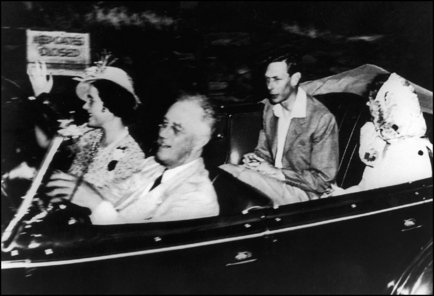
“I was never so frightened in my life,” said Queen Elizabeth after riding with FDR along woodland trails to Top Cottage at Hyde Park. Betsey Cushing Roosevelt (James’s wife) sits beside the King.

Anna and FDR watch an impromptu baseball game between newscaster Lowell Thomas’s “Nine Old Men” and White House correspondents at Pawling, New York, August 31, 1938.

Roosevelt liked nothing better than to inaugurate the major league baseball season each year at Washington’s Griffith Stadium. The cast changed little from 1934 to 1940: James Farley, Harry Hopkins, Clark Griffith, “Bucky” Harris, Joe McCarthy, Joe Cronin, and Connie Mack. The 1937 All-Star game was played in Washington, and Mel Ott of the New York Giants joined the festivities.

Opening day, 1937.

FDR watches as Secretary of War Henry L. Stimson draws the initial number for the nation’s first peacetime draft, October 29, 1940.

Roosevelt salutes the Atlantic Fleet from the bridge of the USS Houston.

Churchill, meeting Roosevelt off Newfoundland, presents the president a letter from King George VI on August 9, 1941. FDR grips Elliott’s arm; son John stands behind Churchill.
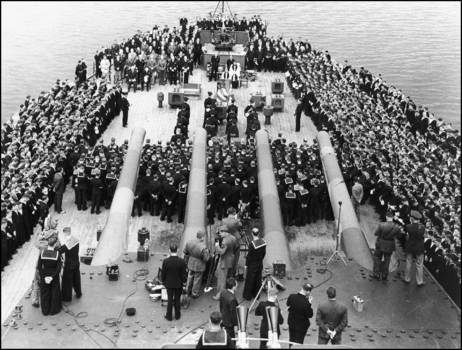
Joint Sunday service on the fantail of the Prince of Wales. Roosevelt and Churchill are seated at top left. FDR insisted on walking the length of the ship to take his seat.

FDR and Churchill, shown here at service, became fast friends and were always able to resolve differences between their staffs. Left to right: Admiral Ernest J. King, Averell Harriman, General George C. Marshall, Field Marshal Sir John Dill, Admiral Harold R. Stark.

FDR and Churchill hold a joint press conference sitting behind Roosevelt’s desk in the Oval Office, December 21, 1941. The president wore a black armband to commemorate Sara’s death.

The president bestows the Medal of Honor on Brig. Gen. James Doolittle following his daring 1942 raid on Tokyo. Left to right: General Henry H. “Hap” Arnold, FDR, Mrs. Doolittle, Doolittle, General Marshall.
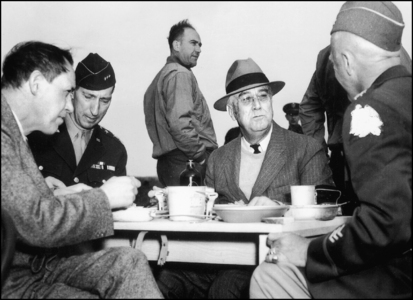
FDR enjoys army field mess in Morocco with Harry Hopkins, Lt. Gen. Mark Clark, and Maj. Gen. George Patton. Military censors blanked out Patton’s 1st Armored Division shoulder patch. Courtesy of the National Archives and Records Administration

General Henri Giraud and General Charles de Gaulle pose for the cameras at FDR’s insistence. “Roosevelt meant the peace to be an American peace … and that France … should recognize him as its savior,” de Gaulle wrote later. Courtesy of the National Archives and Records Administration

Roosevelt, in the presence of a pensive Churchill, announces the doctrine of “unconditional surrender” at Casablanca.

Churchill keeps FDR company as he fishes at Shangri La, May 16, 1942, during a break from the TRIDENT conference.

A healthy and ruddy Roosevelt meets with Canada’s governor general, the Earl of Athlone (George VI’s uncle), Prime Minister Mackenzie King, and Churchill at Quebec, August 17, 1943.
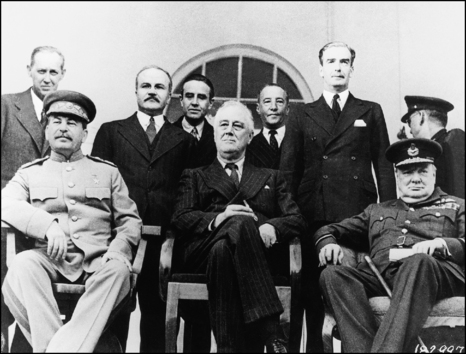
The Big Three at their first meeting, Teheran, November 30, 1943. Harry Hopkins, Soviet Foreign Minister Vyacheslav Molotov, and Anthony Eden stand directly behind.

FDR preparing to review American troops with Eisenhower at Castelvetrano, Sicily, December 8, 1943. George Patton stands at left.
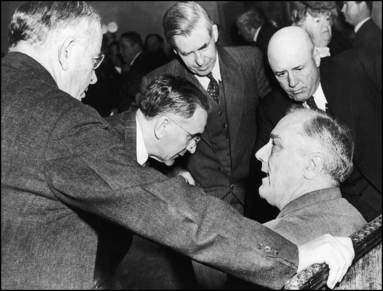
Roosevelt huddles with the Democratic congressional leadership following his return from Teheran, December 17, 1943. Left to right: Senate Majority Leader Alben Barkley, House Majority Leader John McCormack, Vice President Henry Wallace, Speaker Sam Rayburn. Courtesy of the National Archives and Records Administration

Five-year-old Ruthie Bie was the granddaughter of Christian Bie, caretaker of Top Cottage. This photo, taken by Daisy Suckley, is one of only two images known to exist showing FDR in a wheelchair.

Roosevelt sailed to Hawaii to discuss Pacific strategy with MacArthur and Nimitz, shown here on the deck of the USS Baltimore, July 26, 1944. Courtesy of the National Archives and Records Administration

A beaming Churchill greets FDR at Quebec for the OCTAGON conference, September 14, 1944. It was here that Roosevelt and Churchill initially approved the Morgenthau Plan for the pastoralization of Germany. Courtesy of the National Archives and Records Administration

Running mate Senator Harry Truman and Roosevelt at a Rose Garden photo op, August 18, 1944. “I had no idea he was in such a feeble condition,” said Truman afterward. “He got more cream in the saucer than he did in the cup.”

To allay concerns about his health, FDR barnstormed through New York City for four hours in pouring rain and near-freezing temperatures, October 21, 1944. Courtesy of the National Archives and Records Administration
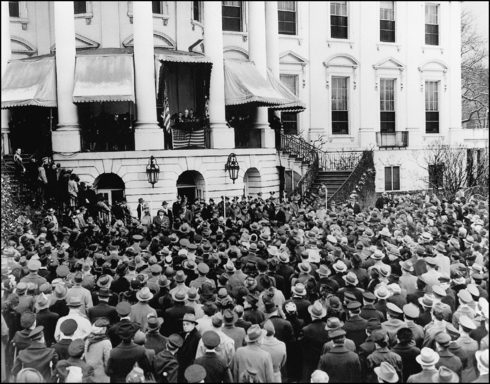
Roosevelt’s fourth inauguration, January 20, 1945, was held on the south portico of the White House rather than at the Capitol, and there was no parade. “Who’s going to march?” asked FDR.

Stalin and FDR confer privately at Yalta (interpreters Pavlov and Bohlen at right). At this meeting Stalin agreed to join the war against Japan three months after Germany’s defeat.

FDR and Stalin await Churchill for the formal picture-taking ceremony, February 9, 1945. Secretary of State Edward Stettinius stands behind the empty chair; General Marshall, caught with his hands in his pockets, is behind Roosevelt.

Formal portrait of the Big Three. Air Chief Marshal Sir Charles Portal, Admiral William Leahy, and General Alexei Antonov stand behind the principals. Courtesy of the Library of Congress

An exhausted Roosevelt reports to Congress on the results of the Yalta conference. This is the first time FDR remained seated when he addressed a joint session.
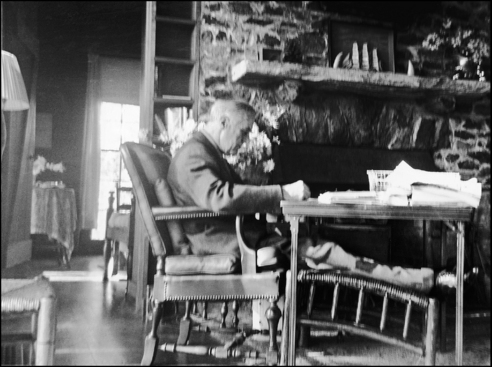
FDR at his writing table at Warm Springs two days before his death. The president went to Georgia to regain his health.

Lucy Rutherfurd at Warm Springs, April 11, 1945. After Missy LeHand’s stroke in 1941, Lucy and FDR resumed seeing each other, often at the White House or at Shangri La. Lucy was with the president when he died and hers was the last face he saw.

Franklin D. Roosevelt, April 11, 1945. This is the last photograph of the president.
Marshall and Stark’s recommendation made sense to Roosevelt. When the cabinet met on November 7, he asked Hull to summarize the situation in the Far East. In his meandering Tennessee vernacular, Hull spoke fifteen minutes. (“If Cordell says, ‘Oh Chwrist’ again I’m going to scream,” FDR whispered to Frances Perkins. “I can’t stand profanity with a lisp.”)72 The secretary of state’s conclusion was that the situation was critical and that Japan might attack at any time.73 Roosevelt asked each member of the cabinet for his or her opinion. All agreed that Congress would give the president a declaration of war if he asked for it, but public support would depend on the circumstances. The president turned sharply to Hull. “Do not let the talks [with Nomura] deteriorate. Let us make no more of ill will. Let us do nothing to precipitate a crisis.”74 The split was evident. Hull and the cabinet, temperamentally inclined to support China regardless of the strategic consequences, were ready for war; Roosevelt and the military, determined to avoid a diversion in the Far East, sought to minimize conflict with Japan.
In his talks with Nomura (who was joined on November 15 by Saburo Kurusu, a seasoned diplomat sent by Tokyo to impart a final urgency to the discussions*) Hull was rigid and sanctimonious. White supremacy ran deep in east Tennessee and Hull found it difficult not to be condescending. When the Japanese sought concrete answers, Hull lectured on moral principles. As one scholar wrote, the secretary of state was more “intrusive, altogether more ‘preachy,’ he flogged the tired old issues again and again.”75
On November 20, 1941, Nomura and Kurusu presented Japan’s final offer—a proposal for a six-month cooling-off period that would allow both sides time to reassess the situation. Essentially it was a return to the status quo before the American embargo. Japan would agree to no further territorial expansion and would withdraw its troops from southern Indochina in return for a relaxation of U.S. trade sanctions.76 Thanks to MAGIC intercepts, the administration knew this was Tokyo’s last stand. “This time we are making our last possible bargain,” Foreign Minister Togo informed his Washington representatives. “I hope we can settle all our troubles with the United States peacefully.”77
The Japanese proposal said nothing about China. As a result Hull found it “clearly unacceptable.”78 But Roosevelt saw a glimmer of hope. Fully mindful of Marshall and Stark’s admonition to avoid war with Japan, he seized on the idea of a temporary modus vivendi. After learning the details of the Japanese offer, he scribbled a note to Hull as a basis for a conciliatory reply:
6 Months
1. U.S. to resume economic relations—some oil and rice now—more later.
2. Japan to send no more troops to Indochina or Manchurian border or any place South (Dutch. Brit. or Siam).
3. Japan to agree not to invoke tripartite pact even if U.S. gets into European war.
4. U.S. to introduce Japs to Chinese to talk things over but U.S. to take no part in their conversations.
Later on Pacific agreements.79
Roosevelt said the United States did not intend to interfere or mediate between Japan and China. “I don’t know whether there is such a word in the parlance of diplomats, but the United States’ only intention is to become an ‘introducer.’ ”80 The president dropped earlier American demands that Japan withdraw from China. Later he told Ickes “he was not sure whether or not Japan had a gun up its sleeve.” Ickes was convinced war was inevitable, but Roosevelt was not. “It seemed to me,” wrote Ickes, “that the President had not yet reached the state of mind where he is willing to be aggressive as to Japan.”81
Roosevelt’s conciliatory stance won quick military support. On November 21 Major General Leonard T. Gerow, chief of the Army’s War Plans Division, representing General Marshall, who was spending Thanksgiving in Florida, wrote Hull that the Army considered it a matter of “grave importance to the success of our effort in Europe that we reach a modus vivendi with Japan.… [A] temporary peace in the Pacific would permit us to complete defensive preparations in the Philippines and at the same time insure continuance of material assistance to the British—both of which are highly important.”82
Time was running out. Nomura and Kurusu asked Tokyo for an extension of the November 25 deadline, and Togo gave them until the twenty-ninth. “This time we mean it. The deadline absolutely cannot be changed. After that things are automatically going to happen.”83 MAGIC intercepts delivered the message to FDR and Hull almost as quickly as Nomura received it.
For whatever reasons, Roosevelt’s suggestion of a modus vivendi was never presented to the Japanese. Revisionist historians and some conspiracy theorists argue that the Roosevelt administration had given up hope for peace in the Pacific and wanted to lure the Japanese into attacking first.84 Traditional historians have downplayed the significance of modus vivendi and assert that Japan was bent on war in any event.85 Hull’s rendition of events is meretricious; Stimson’s is flawed; and Roosevelt left no record.86 Professors William L. Langer and S. Everett Gleason, in their magisterial account of prewar diplomacy, call the failure to present the modus vivendi a mystery: “Until and unless additional evidence comes to light, the role of the President as well as of Secretary Hull will remain a subject of speculation.”87
The sparse record available indicates that FDR’s plan encountered heavy going, both from America’s allies and in the cabinet. China was outraged, the Australians and the Dutch thought it was a bad idea, and Churchill, who always favored a tough stance toward the Japanese, deftly played the China card. “Of course, it is for you to handle this business and we certainly do not want an additional war,” he cabled Roosevelt. “But what about Chiang Kai-shek? Is he not having a very thin diet? If [China] collapses our joint dangers would enormously increase.”88 In the cabinet Stimson and Knox were prepared to play for time but despaired of leaving China in the lurch; Morgenthau was appalled at the prospect; Hull was already on record to that effect; and Ickes (for the umpteenth time) considered resigning. “If this negotiation with Japan had been consummated, I would have promptly resigned from the Cabinet with a ringing statement attacking the arrangement.… I believe the President would have lost the country on this issue and that hell would have been to pay generally.”89
When Roosevelt met with his war council (Hull, Stimson, Knox, Marshall, and Stark) on November 25, 1941, it was agreed that little room for negotiation remained.90 The discussion focused on what to do should Japan reject a temporary truce. Aware that Tokyo had set a November 29 (Saturday) deadline, Roosevelt said, “We are likely to be attacked perhaps as soon as next Monday because the Japanese are notorious for attacking without warning. The question is how to maneuver them into firing the first shot without too much danger to ourselves.”91 The president was not baiting a trap but, like Lincoln prior to Fort Sumter, wanted Japan to be perceived as the aggressor.* The consensus was that the Japanese would move from Indochina against Thailand, Malaya, Singapore, and the Dutch East Indies, rather than the Philippines. It was not a question of whether the Japanese would attack, but where and when.92
Separated by more than sixty years and three generations from events in 1941, it is difficult to appreciate the implicit racial hostility toward Japan that characterized Roosevelt’s discussions with his advisers as war drew near. Sir Lewis Namier, the eminent British scholar, once observed that historians are inclined to remember the present and forget the past. Dimensions of tolerance are much greater now than they were then, and, given Japan’s current economic and industrial prowess, we can easily forget how little credibility Westerners assigned to the Japanese military in 1941. The army had been bogged down in China for four years; Zhukov had made quick work of the garrison in Manchukuo; and the Japanese Navy had not been engaged in battle on the high seas since 1905. “The Japs,” as FDR called them, might prevail in Southeast Asia, but they were scarcely seen as a threat to American forces in the Pacific, certainly not to Pearl Harbor, which both the Army and the Navy believed to be impregnable. This supercilious dismissal of Japan as a serious military rival allowed the war council to discuss the possibility of war in Southeast Asia with remarkable detachment. The conflict, if it came, they felt would be a distraction but little more.
Hull met Nomura and Kurusu in the late afternoon of Wednesday, November 26. Instead of presenting FDR’s plan for a modus vivendi, he gave the Japanese what they interpreted to be an ultimatum: a ten-point clarification of American demands for settlement in the Pacific that went far beyond anything broached previously. Not only was it nonresponsive to the Japanese truce offer, but the United States called for Japan’s complete withdrawal from China and Indochina, recognition of the Chungking government of Chiang Kai-shek, renunciation of further expansion in Southeast Asia, and withdrawal from the Tripartite Pact.93 It was a statement for the record rather than a serious attempt to reach agreement.94 “I have washed my hands of it,” Hull told Stimson afterward. “It is now in the hands of you and Knox—the Army and Navy.”95
The abrupt shift from modus vivendi to confrontation caught the military by surprise.96 On November 27, 1941, Admiral Stark alerted Kimmel in Hawaii and Admiral Thomas C. Hart, commanding the Asiatic Fleet, to be on guard. “This dispatch is to be considered a war warning. Negotiations with Japan looking toward stabilization of conditions in the Pacific have ceased and an aggressive move is expected within the next few days. The number and equipment of Japanese troops and the organization of naval task forces indicates an amphibious expedition against either the Philippines, Thai or Kra [Malay] peninsula or possibly Borneo.”97*
The Army’s warning to commanders in the Pacific was less strongly worded but made the same point:
Negotiations with Japan appear to be terminated to all practical purposes, with only the barest possibilities that the Japanese Government might come back and offer to continue. Japanese future action unpredictable but hostile action possible at any moment. If hostilities cannot, repeat cannot, be avoided the United States desires that Japan commit the first overt act. This policy should not be construed as restricting you to a course of action that might jeopardize your defense.98
To this day there is no satisfactory explanation of why Hull jettisoned the quest for a cooling-off period with Japan or why FDR supported him. Roosevelt had too much on his plate. There is no doubt he was under great pressure. He had just ordered the Navy to shoot enemy vessels on sight in the Atlantic; he had just finished a bruising battle with Congress over repeal of the Neutrality Act;* and the German Army was thirty miles from Moscow. To press his proposal for a modus vivendi may have been more than Roosevelt wanted to take on. Like the wrongheaded oil embargo in July, events got ahead of him. As for Hull, his official biographer, Julius Pratt, confesses to being baffled: “The President had given Hull a very free reign in dealing with Japan.… [I]t seems that his decision to ‘kick the whole thing over’ (as Stimson records him saying) was a petulant one by a tired and angry man.”99 Whatever the reason, the plan for a temporary truce was discarded, and, as Stanford historian David Kennedy recently observed, “the last flimsy hope of avoiding, or even delaying, war with Japan thus evaporated.”100
Nomura and Kurusu were dumbfounded at the severity of Hull’s ten-point memorandum. Tokyo’s reaction was similar. “We felt that clearly the United States had no hope or intention of reaching an agreement for a peaceful settlement,” said Foreign Minister Togo, one of the most moderate members of the government.101 On December 1, at a meeting of the privy council attended by the Emperor, the Japanese government opted for war. “It is now clear that Japan’s claims cannot be attained through diplomatic means,” said Prime Minister Tojo. The Emperor asked each member of the council for his opinion. The decision was unanimous. Hirohito nodded acceptance. “At this moment,” concluded Tojo, “our Empire stands on the threshold of glory or oblivion.”102
On the morning of December 2 the chiefs of staff of the army and navy went to the Imperial Palace to formally request the Emperor’s approval for a war order issued in his name setting the date for attack as December 8 (December 7 in Hawaii and Washington), 1941. That afternoon, following the Imperial assent, powerful radio transmitters in Tokyo flashed the message to the Japanese armed forces:
NIITAKAYAMA NOBORE 1208.
(CLIMB MOUNT NIITAKA ON DECEMBER 8.)103†
As was the case with all great powers at the time, the filing cabinets of the Japanese military bulged with war plans to fit any contingency. A drive to the south had been war-gamed repeatedly, and the consistent finding was that an attack on the Dutch East Indies, Singapore, or Malaya would be at risk so long as the U.S. Asiatic Fleet was intact in the Philippines and the Pacific Fleet in Hawaii. The problem fell squarely into the lap of Admiral Isoroku Yamamoto, commander in chief of the Japanese Combined Fleet since 1939.
Yamamoto was at the summit of his distinguished naval career. Four years younger than MacArthur, Marshall, and Stark (all of whom were born in 1880), he had lost the fore and middle fingers on his left hand as a junior officer at Tsushima. No one in the Japanese Navy knew the United States better than Yamamoto, and no one had wanted war less than he. In the early twenties Yamamoto studied English as a graduate student at Harvard. He hitchhiked across America and understood the vast industrial and agricultural capacity of the country. From 1926 to 1928 he served as naval attaché in Washington. In the tense foreign policy debates in the 1930s he had been a voice of moderation, steeling the Navy against military adventurism and skeptical of the alliance with Nazi Germany and Mussolini’s Italy. His life had repeatedly been threatened by nationalist extremists.104*
Yamamoto’s experience provided a unique perspective on modern warfare. Though not a pilot, he was closely associated with naval aviation, having been executive officer of the Navy’s flight school in the mid-1920s, commander of the First Carrier Division in the early 1930s, director of the Aeronautical Department of the Navy from 1935 to 1936, and vice minister from 1936 to 1939. Like Brigadier General William “Billy” Mitchell in the United States, he was a champion of airpower; unlike Mitchell, Yamamoto possessed the rank, prestige, and administrative skill to do something about it. In the Navy he was known as a bold, original thinker and an inveterate gambler. He thrived on all-night poker games, testing his opponents’ nerves, endurance, and patience—just as he tested himself. “In all games Yamamoto loved to take chances just as he did in naval strategy,” explained his administrative aide, Captain Yasuji Watanabe. “He had a gambler’s heart.”105
The war plan Yamamoto inherited in 1939 envisaged a decisive naval battle with the American fleet near the home islands in which land-based planes and submarines would whittle down the U.S. armada until the Imperial Navy took it on in an old-fashioned line-of-battle slugfest. Yamamoto recognized that strategy was inadequate to support an all-out southward thrust against numerous objectives several thousand miles away. The U.S. Navy would have to be destroyed at the outset if the long, exposed Japanese flank were to be secured.106
When Yamamoto first thought of attacking Pearl Harbor is unclear. The British victory at Taranto on November 12, 1940, in which twelve carrier-based torpedo planes surprised the Italian fleet lying at anchor and sank three battleships, focused his attention on the possibility.107 In his own correspondence, Yamamoto suggests that planning began in December 1940, first as a concept, then a plan, finally as an exercise, including repeated mock attacks on a model of Pearl Harbor set up in Japan’s Kagoshima Bay. The logistical problems were enormous. To mass the necessary number of planes (Yamamoto estimated 300) would require a task force of at least six carriers, and the 3,500-mile attack route—well beyond the fleet’s cruising range—would require tricky refuelings at sea.* But the most difficult problems were tactical: first, to ensure complete surprise; then to launch a torpedo attack in the shallow waters of Pearl Harbor. The Italian anchorage at Taranto, by contrast, was in deep water, and the general view in naval circles was that aerial torpedoes required a depth of at least 12 fathoms (72 feet), otherwise they would hit bottom, lodge in the mud, or explode prematurely. The American Navy was so convinced that was the case that it rejected the use of antitorpedo nets at Pearl Harbor as unnecessary.108 By October 1941 the Japanese had developed a finned torpedo that could run in 6 fathoms (36 feet), and by November had perfected a launch technique with pilots flying at 100 knots (roughly 115 mph) and an altitude of 60 feet that guaranteed an 83 percent success rate.109
As finally written, Yamamoto’s attack plan had eight interlocking components, of which the attack on Pearl Harbor was the centerpiece. Additional formations moved against the American Asiatic Fleet in the Philippines, against the British off Singapore, and the Dutch near Borneo. Invasion forces, some comprised of more than a hundred vessels, steamed independently toward Malaya, Guam, and Luzon, plus a small neutralization force toward Midway. Yamamoto kept the main body of the Combined Fleet—six battleships, two light carriers, two cruisers, and thirteen destroyers—under his personal command in the Inland Sea, ready to move wherever required. The principal task, the attack on Pearl Harbor, was assigned to the newly created First Air Fleet under Vice Admiral Chuichi Nagumo, a battleship sailor who was president of the Naval Staff College in Tokyo when Yamamoto tapped him for the assignment. Described by friends as “a Japanese Bull Halsey”—jaunty, extroverted, supremely self-confident—Nagumo was the senior officer available for the post, and Yamamoto chose to go with rank and tradition rather than specialized carrier expertise.*
By November 29, 1941, each of the Japanese task forces had put to sea. Each was instructed that “in the event an agreement is reached with the United States, the task force will immediately return to Japan.” The First Air Fleet was also instructed to turn back if sighted by the enemy before X-Day minus one.110
Yamamoto’s decision to attack the Pacific Fleet at Pearl Harbor not only was breathtakingly bold but involved a revolutionary, hitherto untried use of naval airpower—an experimental concept untested in the crucible of battle. Taranto had involved twelve planes from a single carrier 170 miles away. The First Air Fleet would assault what was considered the strongest naval base in the world, halfway across the Pacific, with the largest air armada ever assembled at sea. “What a strange position I find myself in,” Yamamoto wrote to his friend Rear Admiral Teikichi Hori on the eve of the fleet’s departure, “—having to pursue with full determination a course of action which is diametrically opposed to my best judgment and firmest conviction. That, too, perhaps is fate.”111
When the attack order was given on December 2, 1941, the First Air Fleet had covered about half the distance to Oahu. Nagumo’s sprawling task force of nearly three dozen ships moved wedgelike in an easterly direction at a steady fourteen knots: six fast aircraft carriers jacketed by a protective screen of destroyers, cruisers, and battleships, with submarine lookouts fore and aft and a supply train of eight 20,000-ton tankers. On December 4, in heavy seas, First Air Fleet pivoted southeast, roughly nine hundred miles north of Hawaii. Two days later, at precisely 11:30 A.M.,Nagumo completed his final refueling, released his slow-moving tankers, swung due south toward Oahu, and increased speed to twenty knots. After hoisting the historic “Z” flag Admiral Togo had flown at Tsushima, Nagumo flashed Yamamoto’s Nelson-like message to the fleet: “The rise and fall of the Empire depends upon this battle. Every man will do his duty.”112
At 5:50 the following morning, December 7, 1941, the First Air Fleet was 220 miles north of Oahu. Nagumo wheeled due east into a brisk wind and increased speed to twenty-four knots, essential for a successful launch. The flattops pitched violently, listing between twelve and fifteen degrees, making the first-light takeoffs all the more risky. “I have brought the task force successfully to the point of attack,” Nagumo told his air officer, Commander Minoru Genda. “From now on the burden is on your shoulders.”113
Weather delayed the takeoff twenty minutes. At 6:10 A.M. the launch began: first the fighters, then the horizontal bombers, dive-bombers, and torpedo planes—183 in all. By 6:20 they were in battle formation bound for Oahu. One hour later, Nagumo launched the second attack wave, mostly horizontal bombers and dive-bombers. Within ninety minutes of the first wave’s initial takeoff, a formidable fleet of 350 planes was homing in on its targets at Pearl Harbor, Hickam and Wheeler Fields, and Kaneohe Air Station.
Despite widespread knowledge of the worsening political situation in the Pacific and an explicit war warning from Washington, the Japanese attack caught the American military in Hawaii off guard.* In a sense, the defense of Pearl Harbor fell into the void between the Army and the Navy. The Army assumed that the Navy was conducting distant reconnaissance off the islands, as provided for in joint defense plans; the Navy, for its part, believed the Army was continuously manning Oahu’s early-warning radar, which was also provided for. Neither proved to be the case. And neither the Army nor the Navy placed their forces on alert.114 Perhaps it was overconfidence, perhaps sloth—peacetime laziness amid the comforts of Honolulu, perhaps simply a refusal to take Washington’s war warning seriously. “I never thought those little yellow sons-of-bitches could pull off such an attack, so far from Japan,” Kimmel confessed years later.115
General Marshall put the attack into perspective. Pearl Harbor, he said,
was the only installation we had anywhere that was reasonably well equipped. Therefore we were not worried about it. In our opinion the commanders had been alerted. In our opinion there was nothing more we could give them.… In our opinion it was the one place that had enough within itself to put up a reasonable defense. The only place we had any assurance about was Hawaii.116*
The Japanese attack lasted little more than two hours. When the last plane winged away at 10 A.M., eighteen U.S. vessels, including eight battleships, had been sunk or heavily damaged. More than 175 military aircraft were destroyed on the ground and another 159 crippled. In all, 2,403 servicemen were dead, 1,103 of them entombed on the battleship Arizona, which sank almost instantly when a bomb exploded in its forward magazine. Another 1,200 men were wounded. Japan lost twenty-nine planes, mostly dive-bombers, in the second attack wave. “If I am told to fight regardless of the circumstances,” Yamamoto had told Konoye the year before, “I shall run wild for the first six months or a year, but I have utterly no confidence for the second or third years.”117
Roosevelt learned of the attack at 1:40 P.M. Washington time, roughly forty-five minutes after the first wave of Zeros began their strafing run. He was having a late lunch with Harry Hopkins at his desk in the upstairs study when Knox called from the Navy Department. “Mr. President, it looks like the Japanese have attacked Pearl Harbor.”118 A flurry of phone calls followed. At 2:30 Stark called the president with confirmation. “I could hear the shocked unbelief in Admiral Stark’s voice,” said Grace Tully as she put him through to FDR.119 Stark said that it was a very severe attack, the fleet had been heavily damaged, and there was considerable loss of life. Roosevelt told Stark to execute the standing orders that were to go into effect in case of war in the Pacific.120 Official Washington was not surprised by the Japanese attack, but it was stunned that it had come at Pearl Harbor and appalled by the damage.
At three o’clock Roosevelt met his war council. Reports continued to come in, each more terrible than the last. The president handled the telephone personally. He ordered Hull to inform the Latin American governments and secure their cooperation; Knox and Stimson were instructed to draft the necessary orders to put the nation on a war footing. Roosevelt discussed troop deployments at length with General Marshall and ordered military protection for the Japanese Embassy and all Japanese consulates in the United States. His mood was businesslike with no sign of panic. As Sumner Welles reported, FDR was at the center of the action and completely in charge. Eleanor, who went briefly into the study, noted her husband’s steadiness.121
Churchill called from Chequers, his weekend estate. “Mr. President, what’s this about Japan?”
“It’s quite true,” Roosevelt replied. “They have attacked us at Pearl Harbor. We are all in the same boat now.”
“That certainly simplifies things,” said Churchill. “God be with you.”122 Later Churchill wrote, “To have the United States on our side was to me the greatest joy. I thought of a remark [Sir] Edward Grey [the British foreign secretary] had made to me more than thirty years before—that the United States was like ‘a gigantic boiler. Once the fire is lighted under it there is no limit to the power it can generate.’ Being saturated and satiated with emotion I went to bed and slept the sleep of the saved and thankful.”123
Shortly before 5 P.M. Roosevelt called Grace Tully to his study. He was alone, Tully remembered, and had just lit a cigarette. “Sit down, Grace. I’m going before Congress tomorrow. I’d like to dictate my message. It will be short.”
Roosevelt dictated in the same steady tone in which he answered his correspondence, only more slowly and precisely: “Yesterday comma December seventh comma 1941 dash a date which will live in infamy dash …” The entire message ran less than five hundred words—about twice as long as Lincoln’s Gettysburg Address. Every word was Roosevelt’s own, except for the next-to-last sentence, which was suggested by Hopkins.124 The president focused on Japanese treachery and catalogued the areas where the enemy had struck. Contrary to Stimson’s advice, he did not ask for a declaration of war against Germany. Contrary to Hull’s wishes, he kept it short.125
Dinner that evening was with Hopkins and Grace Tully in the upstairs study. At 8:30 FDR met the cabinet. He was grim as the members filed in, and there was no small talk.126 Roosevelt opened on a somber note: “This is the most serious meeting of the Cabinet that has taken place since 1861.” By coincidence they were meeting in the same Oval Study in which Lincoln’s cabinet had assembled after Fort Sumter.127 He then recounted what had happened. Frances Perkins recalled that FDR “could hardly bring himself to describe the devastation. His pride in the Navy was so terrific that he was having actual physical difficulty in getting out the words that put him on the record as knowing that the Navy was caught unawares.”
Twice FDR asked Knox, “Find out, for God’s sake, why the ships were tied up in rows.” To Perkins it was obvious that Roosevelt “was having a dreadful time just accepting the idea that the Navy could be caught off guard.”128 As a former assistant secretary of the Navy, FDR never forgave Kimmel and Stark for the lack of readiness at Pearl Harbor. Kimmel was relieved of command, reduced in rank to rear admiral, and forced to retire. Stark was removed as chief of naval operations, shunted to England, and, after a suitable period, also pushed into retirement. Roosevelt chose Chester Nimitz to replace Kimmel and Admiral Ernest W. King, the hard-as-nails commander of the Atlantic Fleet, as chief of naval operations.
At ten the cabinet was joined by the congressional leadership. Roosevelt extended the invitations personally, including the Republican isolationist Hiram Johnson of California (whom he wanted to win over) and excluding the House Foreign Affairs ranking member Hamilton Fish (whom he detested). For all his many virtues FDR had a vindictive streak, and Fish was one of those who experienced it.129 When Roosevelt recounted what had happened at Pearl Harbor, the legislators were dumbfounded. “They sat in dead silence and even after the recital was over they had very few words,” wrote Stimson.130 Finally Tom Connally of Texas spoke up. “How did it happen that our warships were caught like sitting ducks at Pearl Harbor?” he bellowed. “How did they catch us with our pants down? Where were our patrols? They were all asleep!”131
FDR dipped his head. “I don’t know, Tom, I just don’t know.”132
Roosevelt asked the leaders when they would be ready to receive him, and it was agreed he would speak to a joint session of Congress at 12:30 the next day. FDR declined to say in advance whether he would ask for a declaration of war, determined to make the announcement to the country himself. “Republicans will go along with whatever is done,” said Senate minority leader Charles McNary. GOP House leader Joe Martin (of “Martin, Barton, and Fish”) told Roosevelt, “Where the integrity and honor of the Nation is involved there is only one party.”133 The meeting broke up shortly after eleven.
Roosevelt had one last meeting that evening—a personal tête-à-tête over beer and sandwiches with two outsiders: thirty-three-year-old Edward R. Murrow, back from London; and FDR’s Columbia classmate William Donovan, who since July had been heading the president’s clandestine intelligence operations as the innocuous “coordinator of information.” From Murrow he wanted to know how the British were bearing up. From Donovan, a current intelligence assessment. From both he wanted independent judgment on how the American people would react to a declaration of war. And he let his hair down. American planes had been destroyed “on the ground, by God, on the ground,” pounding his fist on the table.134
At noon Monday, Roosevelt motored down Pennsylvania Avenue to Capitol Hill, deliberately choosing an open car to demonstrate his confidence and resolve. In the second car rode Eleanor and Mrs. Woodrow Wilson, whom FDR had asked to join the presidential party. When he entered the House chamber, the Congress rose as one for a prolonged standing ovation. Twelve times in a speech of only twenty-five sentences the president was interrupted by thunderous applause. He catalogued Japan’s Pacific aggression—not only at Pearl Harbor but in Malaya, Hong Kong, Guam, the Philippines, Wake Island, and Midway:
The facts of yesterday speak for themselves. No matter how long it may take us to overcome this premeditated invasion, the American people in their righteous might will win through to absolute victory.
I ask that the Congress declare that since the unprovoked and dastardly attack by Japan on Sunday, December 7, 1941, a state of war has existed between the United States and the Japanese Empire.135
It was a powerful speech, powerfully delivered. Congress acted within thirty-three minutes: unanimously in the Senate, 388–1 in the House, the lone dissenter Congresswoman Jeannette Rankin of Montana—who had also voted against war in 1917.
The United States was at war.
* The “Gentlemen’s Agreement” of 1908 arose in response to action by the San Francisco Board of Education, which in 1906 decreed that Japanese students must attend a segregated Oriental school lest they overwhelm the city’s white students. Since there were only ninety-three Japanese students involved, overcrowding was scarcely the issue. As the San Francisco Examiner crowed, “Californians do not want their growing daughters to be intimate in daily school contact with Japanese young men.”
TR intervened, called the San Francisco action a “wicked absurdity,” and invited the school board to Washington, where a compromise was worked out. Tokyo agreed not to issue passports to Japanese citizens who wished to settle in the United States, thus choking off immigration, and the San Francisco school board agreed to allow properly prepared Japanese students to enroll in the same classes with whites. The arrangement was spelled out in a series of notes between the Japanese government and the State Department and is summarized in 2 Foreign Relations of the United States 1924 370–371 (Washington, D.C.: U.S. Government Printing Office, 1939).
* By statute, Japanese ministers of war and Navy were chosen from the senior ranks of the services. By refusing to nominate a candidate or withdrawing its officer from the cabinet, either service could topple a government. The Army, moreover, reserved the right to appeal directly to the emperor, bypassing the civilian government altogether. The system was patterned on Germany before World War I, an infelicitous choice similar to General P. G. T. Beauregard’s decision to base the Confederate battle plan at Shiloh on Napoleon’s tactics at Waterloo. David M. Kennedy, Freedom from Fear 503–504 (New York: Oxford University Press, 1999).
* Ambassador Grew was married to Alice de Vermandois Perry, the granddaughter of Commodore Oliver Hazard Perry, the victor of the Battle of Lake Erie and brother of Commodore Matthew Perry, who opened Japan to the West in 1853. Her father, Thomas Sergeant Perry, held the chair in English literature at Keio University. Alice had spent her youth in Japan and had developed a wide network of contacts who gave her husband remarkable access to the Japanese leadership. Joseph C. Grew, 1 Turbulent Era: The Diplomatic Record of Forty Years, 1904–1945 9 (Boston: Houghton Mifflin, 1952).
* Zhukov established his military reputation on the Khalkhin-Gol. Given command by Stalin in June, Zhukov revitalized a demoralized army, massed his tanks and artillery contrary to traditional military doctrine, and, in a tactic made famous in World War II, launched a tidal wave of a counterattack on August 20 that swept the Japanese from the field. Otto Preston Chaney, Jr., Zhukov 38–59 (Norman: University of Oklahoma Press, 1971).
* After the fall of France and the establishment of the Vichy regime with Marshal Henri-Philippe Pétain as head of state, FDR appointed Admiral William D. Leahy as U.S. ambassador. Leahy had retired as chief of naval operations in 1939 and was then serving as governor of Puerto Rico. Roosevelt believed a military man would enjoy greater prestige in Vichy.
* Following his retirement as Army chief of staff in 1935, MacArthur went to Manila as commanding general (field marshal) of the Philippine Army. His headquarters were separate and distinct from the U.S. Army in the Philippines, which was commanded by Major General George Grunert. With MacArthur for a time were Lieutenant Colonel Dwight D. Eisenhower as his executive officer and Captain Lucius D. Clay as his engineer. For a snapshot of the organization of MacArthur’s headquarters and its relation to the U.S. Army in the Philippines, see Clay’s comments in Jean Edward Smith, Lucius D. Clay: An American Life 76–82 (New York: Henry Holt, 1990).
* Dean Acheson’s record for anticipating the likelihood of war in the Far East sets a standard for error that few statesmen would wish to emulate. Not only did he make the wrong call in July 1941, but his speech to the National Press Club as President Truman’s secretary of state on January 12, 1950, placing South Korea outside the American defensive perimeter in the Pacific, contributed significantly to the North Koreans’ decision to cross the 38th parallel in June 1950. For the text of Acheson’s speech, see 22 Department of State Bulletin 116 (January 23, 1950).
* At a separate audience with the heads of the Army and Navy on September 5, Emperor Hirohito pressed the chiefs as to the probable length of hostilities in case of war with the United States. According to the record kept by Prince Konoye, the Army chief of staff, General Sugiyama, said that operations in the South Pacific could be disposed of in about three months. “The Emperor recalled that the General had been Minister of War at the time of the outbreak of the China Incident, and that he had informed the Throne that the incident would be disposed of in about one month. He pointed out that despite the General’s assurance, the incident was not yet concluded after four long years of fighting. In trepidation the Chief of Staff went to great lengths to explain that the extensive hinterland of China prevented the consummation of operations according to the scheduled plan. At this the Emperor raised his voice and said if the Chinese hinterland was extensive, the Pacific was boundless. He asked how the General could be certain of his three months calculation. The Chief of Staff hung his head unable to reply.” “Konoye Memoirs,” quoted in Herbert Feis, The Road to Pearl Harbor 266 (Princeton, N.J.: Princeton University Press, 1950). For a more critical assessment of Hirohito’s role, see Herbert P. Bix, Hirohito and the Making of Modern Japan 387–437 (New York: HarperCollins, 2000).
* “Dear Frank,” wrote Grew on September 22. “As you know from my telegrams, I am in close touch with Prince Konoye who in the face of bitter antagonism from extremist and pro-Axis elements is courageously working for an improvement in Japan’s relations with the United States.… I am convinced that he now means business and will go as far as is possible, without incurring open rebellion in Japan, to reach a reasonable understanding with us. It seems to me highly unlikely that this chance will come again or that any Japanese statesman other than Prince Konoye could succeed in controlling the military extremists in carrying through a policy which they, in their ignorance of international affairs and economic laws, resent and oppose.” 4 Foreign Relations of the United States, 1941 468–469 (Washington, D.C.: U.S. Government Printing Office, 1956).
* On September 10, 1941, Eleanor wrote to her daughter, Anna, who was living in Seattle, “Father told me this morning to tell you that there are still negotiations going on and he might go to Alaska [FDR thought Hawaii too far] to meet the Japs. You and John [Boettiger] are not to mention this to anyone. If he goes he would leave about Oct. 10 and be returning via Seattle about Oct. 21st.” Anna Halstead Papers, FDRL.
† On his return from Japan in 1942, Grew asked Hull why Konoye’s proposal to meet with FDR had not been accepted. Grew said he thought it might have brought peace. “If you thought so strongly,” Hull replied, “why didn’t you board a plane and come tell us?” Grew reminded the secretary of his daily telegrams expressing his feeling about the situation. Later Grew wondered if Hull had read them. Joseph C. Grew, 2 Turbulent Era 1330.
* Kurusu had most recently served as Japanese ambassador to Germany, which made him suspect in the eyes of the State Department. But he had also been Japan’s consul in Chicago, was married to an American whom he had met there (Alice Little), and spoke English flawlessly, which Nomura did not. In retrospect it appears his assignment was indeed made to move the talks forward.
* In his 1946 statement to the Joint Committee on the Investigation of the Pearl Harbor Attack, Secretary Stimson expanded on FDR’s remarks. According to Stimson, “If you know that your enemy is going to strike you, it is not usually wise to wait until he gets the jump on you by taking the initiative. In spite of the risk involved, however, in letting the Japanese fire the first shot, we realized that in order to have the full support of the American people it was desirable to make sure that the Japanese be the ones to do this so that there should remain no doubt in anyone’s mind as to who were the aggressors. We discussed at this meeting the basis on which this country’s position could be most clearly explained to our own people and to the world, in case we had to go into the fight quickly because of some sudden move on the part of the Japanese.” Stimson Statement, 11 Hearings Before the Joint Committee on the Investigation of the Pearl Harbor Attack 5421–5422 (Washington, D.C.: U.S. Government Printing Office, 1946).
* Accompanying the war warning was a personal letter from Stark to his friend Kimmel. “I held this [letter] up pending a meeting with the President and Mr. Hull today.… Neither will be surprised over a Japanese surprise attack. From many angles an attack on the Philippines would be the most embarrassing that could happen to us.” Stark to Kimmel, November 27, 1941, 5 Pearl Harbor Attack 2301.
* Repeal of the Neutrality Act carried the Senate 50–37, the smallest majority FDR had won on any foreign policy issue since the war in Europe began. In the House the vote was even closer (212–194), with only Southern Democrats solidly behind the president. Critics who wonder why FDR said so little about racial inequality in the South should consider the source of his foreign policy support in Congress.
† Mount Niitaka (Yu Shan in Chinese), which at 13,113 feet was the largest peak in the Japanese empire, is located in Yu Shan National Park in central Taiwan (Formosa).
* Yamamoto was to have accompanied Konoye to meet FDR had the conference taken place. He advised the prime minister to approach the talks “as though your life depended on the outcome. Even if the discussions break down, don’t get defiant, but leave room for further moves.”
Yamamoto was a regular subscriber to Life magazine and always left his copy in the wardroom of his flagship. When a junior officer asked him to recommend a biography to improve his English, Yamamoto recommended Carl Sandburg’s Lincoln. “I like Lincoln. I think he’s great not just as an American, but as a human being.” The admiral was also very fond of American football. On his way to the London Naval Conference in 1934, he took his staff to see Northwestern play Iowa in Evanston (Iowa 20, Northwestern 7). Hiroyki Agawa, The Reluctant Admiral: Yamamoto and the Imperial Navy 21, 24, 53 (Tokyo: Kodansha International, 1979).
* Because Japan’s original war plan anticipated meeting the American fleet near the home islands, the Japanese Navy had neglected to design ships with a long cruising radius. The destroyers escorting the Pearl Harbor task force, for example, had to be refueled daily. Gordon W. Prange, At Dawn We Slept 322–323 (New York: Penguin, 1982).
* Naval historians are fond of pointing out that while Nagumo’s appointment rested on seniority, Kimmel was a “merit” appointee, selected to command the Pacific Fleet over the heads of six more senior admirals. U.S. Congress, Report of the Joint Committee on the Investigation of the Pearl Harbor Attack 75, note 4.
* In the two weeks prior to December 7, 1941, the nine military and naval commanders in the Pacific area received repeated warnings of pending hostile action by Japan. Seven of the commanders, including Admiral Hart and General MacArthur in the Philippines, General John L. DeWitt on the West Coast, and General Frank M. Andrews in Panama, put their commands on a war footing. Hawaii was the only exception. Neither Admiral Kimmel nor General Short took Washington’s war warnings seriously. Mark S. Watson, Chief of Staff: Prewar Plans and Preparations 505–512 (Washington, D.C.: U.S. Government Printing Office, 1950).
* The judgment of the Joint Congressional Committee on the Investigation of the Pearl Harbor Attack is scathing with respect to Admiral Kimmel and General Short. After months of hearings and detailed field investigations, the committee concluded:
The commanders in Hawaii were clearly and unmistakably warned of war with Japan. They were given orders and possessed information that the entire Pacific area was fraught with danger. They failed to carry out these orders and to discharge their basic and ultimate responsibilities. They failed to defend the fortress they commanded—their citadel was taken by surprise. Aside from any responsibilities that may appear to rest in Washington, the ultimate and direct responsibility for failure to engage the Japanese on the morning of December 7 with every weapon at their disposal rests essentially and properly with the Army and Navy commands in Hawaii whose duty it was to meet the enemy against which they had been warned.
Report, Pearl Harbor Attack 238.