
TWENTY-SIX

I can’t talk about my opponent the way I would like to sometimes, because I try to think that I am a Christian.
—FRANKLIN D. ROOSEVELT, NOVEMBER 4, 1944
ROOSEVELT APPEARED TO BE in excellent health at Teheran. Bohlen said he was “clearly the dominating figure at the conference, never showing any signs of fatigue and holding his magnificent leonine head high.”1 Lord Ismay thought he “looked the picture of health and was at his best … wise, conciliatory, and paternal.”2 Stimson, greeting the president on his return to Washington on December 17, 1943, noted that he looked very well. “He was at his best [and] greeted all of us with very great cheeriness and good humor and kindness.”3
Franklin and Eleanor spent Christmas at Hyde Park—the first time since 1932 that the family gathered at Springwood. Anna was there from Seattle, and the two younger boys, FDR, Jr., and John, had secured leave from their units. For Anna, whose husband was with the Army’s press contingent in North Africa, it was a special reunion. The president was lonely. Missy, his companion for twenty years, languished stroke-ridden at her sister’s home in Massachusetts; Louis Howe had been gone for a decade; Marvin McIntyre, FDR’s longtime appointments secretary, had died while the president was in Teheran; and Hopkins had moved out of the White House on December 21.* Anna filled the void. She gossiped with her father as Missy had done, shared breakfast with him in the morning, sat beside him in his study as he worked, and joined him for cocktails before dinner. “It was the beginning of a new intimacy in their relationship,” wrote Doris Kearns Goodwin.4
Anna had intended to return to her job at the Seattle Post-Intelligencer after Christmas, but Roosevelt asked her to stay on. Would she consider coming to work for him? he asked. “Father could relax more easily with Anna than with Mother,” Elliott observed. “He could enjoy his drink without feeling guilty.”5 Anna agreed to the change immediately. “With no preliminary talks or discussions,” she recalled, “I found myself trying to take over little chores that I felt would relieve Father of some of the pressure under which he was constantly working.”6 Anna was never given an official title or paid a salary, but she became as much a part of FDR’s daily routine as Missy had been. “It was immaterial to me whether my job was helping to plan the 1944 campaign, pouring tea for General de Gaulle, or filling Father’s empty cigarette case.”7 She rented out her house in Seattle, moved with her children into the Lincoln Suite, which Hopkins had vacated, and settled into the White House for the duration of the war.
Roosevelt met the press for the 929th time on December 28, 1943. He was asked about the New Deal: Was the term still appropriate to describe his administration? FDR thought not. “How did the New Deal come into existence?” he asked. “It was because there was an awfully sick patient called the United States of America, and it was suffering from grave internal disorder. And they sent for the doctor.”
“Old Doctor New Deal” prescribed a number of remedies, said Roosevelt. “He saved the banks of the United States and set up a sound banking system. One of the old doctor’s remedies was Federal Deposit Insurance to guarantee bank deposits. Another remedy was saving homes from foreclosure, through the H.O.L.C. [Home Owners’ Loan Corporation]; saving farms from foreclosure by the Farm Credit Administration; rescuing agriculture from disaster through the Triple A [Agricultural Adjustment Administration] and Soil Conservation; protecting stock investors through the S.E.C. [Securities and Exchange Commission].” The president ticked off a list of prescriptions Doctor New Deal had written: Social Security; unemployment insurance; aid to the handicapped and infirm; minimum-wage and maximum-hours legislation; abolition of child labor; rural electrification; flood control; the public works program; the TVA; the Civilian Conservation Corps; the WPA; and the National Youth Administration. “And I probably left out half of them,” he added.
“But two years ago after the patient had recovered, he had a very bad accident. Two years ago on the seventh of December he was in a pretty bad smashup—broke his hip, broke his leg in two or three places, broke a wrist and an arm, and some ribs, and they didn’t think he would live for a while. Old Doctor New Deal didn’t know ‘nothing’ about legs and arms. He knew a great deal about internal medicine but nothing about surgery. So he got his partner, who was an orthopedic surgeon, Dr. Win-the-War, to take care of the fellow who was in this bad accident. And the result is that the patient is back on his feet. He has given up his crutches. He isn’t wholly well yet, and he won’t be until he wins the war.”
Q: Does all that add up to a fourth term declaration? (Laughter.)
FDR: Oh now—we are not talking about things like that now.8
The deterioration of Roosevelt’s health became evident in the late winter and early spring of 1944. For years his blood pressure had been rising, and he had given up his daily dips in the White House pool sometime in 1940.9 Grace Tully noticed that the president was slowing down: the dark circles under his eyes grew darker, his shoulders slumped, his hands shook more than ever as he lit his cigarette. The year before he had ordered a coffee cup twice as large so he could hold it to his lips without spilling it. These were normal signs of aging, Tully thought, intensified by the relentless pressure under which Roosevelt worked.10
But in February and March 1944 the signs grew worse. FDR seemed unusually tired even in the morning hours; he occasionally nodded off while reading his mail and several times fell asleep while dictating. “He would grin in slight embarrassment as he caught himself,” Tully recalled. Once he blanked out halfway through signing his name to a letter, leaving a long, illegible scrawl.11
Anna was stunned at her father’s failing health. She mentioned it to Eleanor, but her mother dismissed it. “I don’t think she saw it,” Anna told the writer Bernard Asbell. “She simply wasn’t interested in physiology.”12 In the last week of March Roosevelt’s temperature reached 104 degrees. He canceled all appointments and confined himself to his bedroom. Anna stayed beside him and grew increasingly worried. After consulting with Grace Tully, she confronted Admiral Ross T. McIntire, the president’s personal physician.13 (McIntire wore a second hat as the Navy’s surgeon general, and in retrospect the two jobs may have been more than he could handle.)14 What was happening to her father? Anna asked. McIntire, originally an ear, nose, and throat specialist, saw no reason to worry. The president was recovering from his usual winter bout with influenza, he said. A week or two in the sun, and he would be fine. “I didn’t think he really knew what he was talking about,” Anna said later.
“Do you ever take his blood pressure?” she asked.
“When I think it necessary,” McIntire testily replied.15*
At Anna’s insistence, Admiral McIntire reluctantly scheduled a checkup for the president at Bethesda Naval Hospital on March 27, 1944. “I feel like hell!” Roosevelt told White House aide William Hassett as he entered his limousine.16 Anna rode with FDR up Wisconsin Avenue to Bethesda. When they reached the hospital grounds, the president pointed to the tall tower that dominated the facility. “I designed that one,” he said proudly. And it was true. While campaigning in the Midwest during the 1936 election, Roosevelt had been struck by the design of the Nebraska state capitol in Lincoln—a twenty-two-story skyscraper rising out of the prairie. Like President Grant many years earlier, FDR deplored the pedestrian style of federal architecture. “Therefore, I personally designed a new Naval Hospital with a large central tower of sufficient square footage and height to make it an integral and interesting part of the hospital itself, and at the same time present something new,” he wrote his uncle Frederic Delano.17 Roosevelt laid the cornerstone for the hospital on Armistice Day 1940 and spoke at its dedication in 1942.
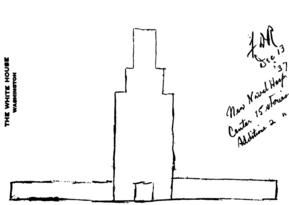
FDR’s SKETCH OF BETHESDA NAVAL HOSPITAL
Waiting for FDR inside the hospital was Lieutenant Commander Howard G. Bruenn of the Naval Reserve, the staff consultant in cardiology from Columbia-Presbyterian Medical Center in New York. McIntire had instructed Bruenn to examine Roosevelt, report his findings directly to him (McIntire), and say nothing to the patient.18 “I suspected something was terribly wrong as soon as I looked at the president,” Bruenn recalled. “His face was pallid and there was a bluish discoloration of his skin, lips and nail beds. When the hemoglobin is fully oxygenated it is red. When it is impaired it has a bluish tint. The bluish tint meant the tissues were not being supplied with adequate oxygen.”19
Bruenn noted Roosevelt was having difficulty breathing. With his stethoscope he listened to FDR’s heart. “It was worse than I feared,” said Bruenn. X-rays and an electrocardiogram revealed that the apex of the heart was much further to the left than it should have been, indicating a grossly enlarged heart. Blood pouring through the atrium to the left ventricle of the heart was meeting resistance. Bruenn heard a blowing sound—a systolic murmur, which indicated the mitral valve was not closing properly. When he asked the president to take a deep breath and hold it as long as he could, Roosevelt expelled it after only thirty-five seconds.20 His blood pressure was 186 over 108. Bruenn could not understand why McIntire had not reacted earlier. The conclusion seemed obvious: Roosevelt was suffering from congestive heart failure. His heart was no longer able to pump blood effectively. If it continued untreated, the president was unlikely to survive for more than a year.21
Roosevelt chatted amiably with Dr. Bruenn throughout the examination but did not inquire about his condition, nor did Bruenn (in keeping with his instructions from McIntire) volunteer any information. But the young cardiologist recognized that the situation was critical. He immediately reported the findings to Admiral McIntire, along with his recommendations: bed rest with nursing care for one to two weeks; digitalis; a light, easily digestible diet with reduced sodium intake; codeine (½ grain) for his cough; and sedation in the evening to ensure a good night’s sleep.22McIntire was appalled. He doubted that Roosevelt had a heart condition, and he did not want to worry the president or upset his routine. “The president can’t take time off to go to bed,” he told Bruenn. “You can’t simply say to him, Do this or that. This is the president of the United States.”23
When Roosevelt’s condition failed to improve, McIntire convened a team of senior consultants to review Bruenn’s findings. They unanimously rejected his diagnosis. After all, someone said, Admiral McIntire had been treating the president for years and it was impossible to imagine that FDR had become so ill overnight.24
“I was only a lieutenant commander,” Bruenn remembered. “McIntire was an admiral. But I knew I was right, so I held my ground.”25 Finally McIntire agreed to let two outside consultants, Dr. James Paullin of Atlanta and Dr. Frank Lahey of Boston, examine the president. Afterward, both agreed that Bruenn was correct. Lahey believed Roosevelt’s condition was sufficiently serious that he should be informed of “the full facts of the case in order to insure his full cooperation.”26 McIntire rejected the suggestion. He preferred not to tell the president of the diagnosis. The conference agreed on a scaled-down version of Dr. Bruenn’s original recommendations. Low doses of digitalis would be administered, callers would be held to a minimum at lunch and dinner, and Roosevelt would be asked to cut his consumption of cigarettes, limit his cocktails in the evening, and try to obtain ten hours of sleep.27
In addition to keeping Roosevelt in the dark about his condition, McIntire also misled the public. Speaking to the press on April 3, he blithely reported the president was fine; FDR had come through his medical checkup with flying colors. “When we got through we decided that for a man of sixty-two we had very little to argue about, with the exception that we have had to combat the influenza plus respiratory complications that came along afterwards.” McIntire made no mention of the president’s heart condition or the treatment that had been prescribed.28*
Roosevelt responded quickly to his new regimen. X-rays taken two weeks after treatment began showed a definite decrease in the size of the heart and a notable clearing of the lungs. His blood chemistries were normal, and an EKG revealed marked improvement in the heart’s rhythm. Dr. Bruenn was reassigned from Bethesda to the White House and examined FDR almost daily. “At no time did the President ever comment on the frequency of these visits,” said Bruenn, “or question the reason for the electrocardiograms and other laboratory tests that were performed from time to time. Nor did he ever have any questions as to the type and variety of medications that were used.”29
On April 19 Roosevelt, accompanied by Bruenn, McIntire, Pa Watson, and Admiral Leahy, departed Washington for what was planned as a two-week stay at Bernard Baruch’s secluded South Carolina plantation, Hobcaw Barony, but which stretched into almost a month. “The whole period was very pleasant,” Bruenn recalled. “The president thrived on the simple routine. I had never known anyone so full of charm. At lunch and dinner alike he animated the conversation, telling wonderful stories, reminiscing with Baruch, talking of current events, pulling everyone in. He was a master raconteur.”30 According to Bruenn, Roosevelt displayed no cardiac symptoms, although his blood pressure remained elevated, ranging from 240/130 after breakfast to 194/96 in the evening.31
Returning to Washington in early May, Roosevelt wrote to Hopkins, who was recovering at White Sulphur Springs from abdominal surgery complicated by a bout of jaundice. “It is a good thing to connect up the plumbing and put your sewerage into operating condition,” he told Hopkins. “You have got to lead not the life of an invalid but the life of common sense. I, too, over one hundred years older than you are, have come to the same realization and have cut my drinks down to one and a half cocktails per evening and nothing else—not one complimentary highball or night cap. Also, I have cut my cigarettes down from twenty or thirty a day to five or six a day. Luckily they still taste rotten but it can be done.… I had really a grand time down at Bernie’s—slept twelve hours out of the twenty-four, sat in the sun, never lost my temper, and decided to let the world go hang. The interesting thing is the world didn’t hang. I have a terrific pile in my basket but most of the stuff has answered itself anyway.”32
One of the pressing issues Roosevelt returned to confront was the crisis of European Jewry. Hitler’s campaign of genocide was now in full swing. Few as yet grasped the extent to which mass extermination was being conducted in specially constructed death camps, but it was becoming increasingly clear that the problem Washington faced was not so much providing asylum for several hundred thousand refugees but rescuing an entire population caught in the Nazi death machine.33
From the beginning of his presidency Roosevelt had been sympathetic to the plight of the Jews.* Yet he faced insurmountable obstacles. The Immigration Act of 1924 was unyielding, and the Seventy-eighth Congress was in no mood to consider changes. Public opinion, always susceptible to nativist appeals, was at best indifferent. Church leaders for the most part remained silent, and the intellectual community, with few exceptions, took little notice. The State Department’s striped-pants set (particularly those charged with immigration matters) was permeated with genteel anti-Semitism. The War Department—from Stimson and McCloy to Marshall and Eisenhower—resisted any diversion of military resources from the central effort to defeat Germany. And at that time the American Jewish community itself was divided. Members of the old-school Jewish establishment, primarily German in origin—men close to FDR, such as Felix Frankfurter, Sam Rosenman, Herbert Lehman, and the publishers of The New York Times—were lukewarm about mounting any special effort to rescue the Jewish populations of eastern Europe, fearing its effect on efforts to assimilate.
Hitler’s “final solution” had been launched with the utmost secrecy on January 20, 1942, at what historians call the Wannsee Conference—a meeting of top government officials on the outskirts of Berlin. By the summer of ’42 reports of death camps began to filter west. How much Roosevelt knew is uncertain. The State Department initially suppressed the information because of its “fantastic nature.” Career foreign service officers, remembering the atrocity stories manufactured during World War I, characterized the reports as having “the earmarks of war rumors inspired by fear” and declined to send them forward.34 When Rabbi Stephen Wise, the head of the American Jewish Congress (and a longtime friend of FDR*) provided Sumner Welles with irrefutable documentation in September 1942, Welles asserted the State Department had authoritative confirmation that the Jews were being transported eastward to construct roads and fortifications on the Russian front.35 Throughout the autumn of 1942 the evidence mounted, including a report from Myron C. Taylor, the president’s personal representative to the Vatican.† Welles soon confirmed the reports—“There is no exaggeration,” he told Wise—and on December 2 the rabbi appealed directly to FDR:
Dear Boss,
I do not want to add an atom to the awful burden you are bearing … but you do know that the most overwhelming disaster of Jewish history has befallen Jews in the form of the Hitler mass-massacres.
Wise asked Roosevelt to meet as soon as possible with him and other Jewish leaders to discuss a course of action. “As your old friend I beg you somehow to arrange this.”36
Roosevelt responded immediately. Wise was invited to the White House December 8 and brought with him the heads of four major Jewish organizations.37 FDR received the delegation cordially. Wise made a brief oral presentation and presented the president with a twenty-page summary of the extermination data. He asked Roosevelt “to warn the Nazis that they will be held to strict accountability for their crimes.”38 Roosevelt agreed without hesitation and requested Wise and his colleagues to draft a statement for him condemning the atrocities. He said he would endorse it sight unseen.
Roosevelt acknowledged that the government was now aware that Wise’s information had been correct. “We have received confirmation from many sources.” The president asked for concrete recommendations as to what might be done. The group, which was apparently taken by surprise, had none to suggest other than a public statement. FDR said he understood. “We are dealing with an insane man. Hitler and the group around him represent … a national psychopathic case. We cannot act toward them by normal means. That is why the problem is very difficult.”39 When the meeting ended, Roosevelt assured his visitors, “we shall do all in our power to be of service to your people in this tragic moment.”40
Nine days after meeting with Wise, Roosevelt induced Churchill and Stalin to join with him in a Declaration on Jewish Massacres, which denounced “in the strongest possible terms this bestial policy of cold-blooded extermination”; condemned the German government’s “intention to exterminate the Jewish people in Europe”; and announced their joint determination to try as “war criminals” all those responsible—the origin of the war crimes trials that later convened in Nuremberg.41 Given that U.S. and British troops had yet to land on the continent of Europe, the declaration nevertheless represented a powerful statement of Allied purpose.42* It received wide publicity in the American and British press and committed the United States, Great Britain, and the Soviet Union to prosecute war crimes against European Jewry.43
But the fact is that little tangible could be done. An Anglo-American conference on refugees convened in Bermuda in April 1943 but foundered on Britain’s refusal to discuss Palestine as a possible destination for whatever Jews might be liberated from Hitler’s grasp.44 In June Roosevelt met with Zionist leader Chaim Weizmann, who pressed the Jewish case for a Palestinian homeland. “The attitude of Mr. Roosevelt was completely affirmative,” wrote Weizmann.45 The president said the Arabs had not been helpful in the war and had not developed their vast territories. He thought they could be bought off and suggested that Weizmann meet with Saudi Arabia’s Ibn Saud.46 Later FDR authorized Rabbi Wise and Rabbi Abba H. Silver to announce on his behalf that “full justice will be done to those who seek a Jewish National Home.” The United States, Roosevelt was quoted as saying, had never approved Britain’s 1939 white paper restricting immigration. As Wise and Silver put it, “The President was happy that the doors of Palestine are today open to Jewish refugees.”47*
In the summer of 1943 the Treasury Department pressed plans to ransom 70,000 Jews from Romania at a cost of $170,000. The money would be deposited in Switzerland for Romanian officials to collect after the war. Roosevelt approved the arrangement, but because of State Department foot-dragging nothing came of it.48 Similarly, when Rabbi Wise came to FDR in July with a Swiss proposal to rescue Jewish children hiding in France, Roosevelt immediately agreed. “Stephen, why don’t you go ahead and do it,” the president said. When Wise suggested that Morgenthau and the Treasury Department might not cooperate, Roosevelt picked up the phone. “Henry, this is a very fair proposal which Stephen makes about ransoming Jews.” Treasury thereupon approved the plan, but again diplomats at State scuttled it.49
By the end of 1943 it had become evident that the European Affairs Division of the Department of State was determined to block any rescue effort. Officials at Treasury (most of whom were not Jewish) were incensed. Led by General Counsel Randolph Paul, Foreign Funds Control Chief John Pehle, and Assistant Counsel Josiah DuBois, the Treasury staff prepared a confidential report for Morgenthau documenting State Department obstructionism entitled “Report to the Secretary on the Acquiescence of This Government in the Murder of the Jews.” It charged that the State Department was “guilty not only of gross procrastination and willful failure to act, but even of willful attempts to prevent action from being taken to rescue Jews from Hitler.”50
Morgenthau retitled the memorandum “A Personal Report to the President” and met with FDR on January 16, 1944. Accompanying the secretary were Paul and Pehle. Morgenthau summarized the findings of the report and urged the president to establish a cabinet-level rescue commission that would strip the State Department of its refugee responsibility. Roosevelt needed little convincing. On January 22, 1944, he signed Executive Order 9417, establishing a War Refugee Board (WRB) consisting of Morgenthau, Hull, and Stimson, with Treasury’s John Pehle as director. “It is the policy of this government to take all measures within its power to rescue victims of enemy oppression in imminent danger of death” and to provide “relief and assistance consistent with the successful prosecution of the war,” the order stated.51 Three days after the WRB was established, New York congressman Emanuel Celler wrote Roosevelt, “Your glorious action has cleared the atmosphere. It is like a bolt of lightning dispelling the storm.”52
Under John Pehle’s aggressive leadership, the WRB moved swiftly to provide whatever relief was possible. “The board,” Morgenthau wrote later, “was made up of crusaders, passionately persuaded of the need for speed and action.”53 When Hitler occupied Hungary in March 1944 and ordered the deportation of 700,000 Jews—the largest intact Jewish community in Europe—the WRB dispatched the Swedish diplomat Raoul Wallenberg to Budapest under diplomatic cover. With a combination of bluff and bribery, using funds funneled through the WRB, Wallenberg saved thousands of Jews. The board also arranged for air-leaflet drops warning of war crimes prosecutions and induced New York’s Francis Cardinal Spellman, the ranking Catholic prelate in the United States, to record a radio broadcast reminding Hungarian Catholics that persecution of the Jews was in direct contradiction of Church doctrine.54
Roosevelt addressed the issue again on March 24, 1944. Stung by Morgenthau’s report of State Department malfeasance, FDR took pains to clarify the government’s intention to provide succor. “In one of the blackest crimes of all history,” said the president, “the wholesale systematic murder of the Jews of Europe goes on unabated every hour.” The Jews of Hungary were now threatened. “That these innocent people, who have already survived a decade of Hitler’s fury, should perish on the very eve of triumph over the barbarism which their persecution symbolized, would be a major tragedy.” FDR promised swift retribution. “This applies not only to the leaders but also to their functionaries and subordinates in Germany and in the satellite countries. All who knowingly take part in the deportation of Jews to their death … are equally guilty with the executioner. All who share the guilt shall share the punishment.”
Roosevelt pledged to persevere in the effort to rescue the victims of Nazi brutality. “Insofar as the necessity of military operations permit, this Government will use all the means at its command to aid the escape of all intended victims of the Nazi and Jap executioner.… We shall find havens of refuge for them, and we shall find the means for their maintenance and support until the tyrant is driven from their homelands and they may return.”55
The president’s statement received front-page treatment. “Roosevelt Warns Germans on Jews,” bannered The New York Times. It was broadcast by the BBC and translated into many languages throughout Europe, and copies were dropped behind enemy lines. Rarely has there been a more explicit announcement of American intentions. And rarely was there so little the United States could do.
In postwar years the question has often been raised whether the United States should have bombed the death camps or at least the rail lines running to them. There is no evidence that Roosevelt was ever approached about the matter.56 When John Pehle raised the issue with the War Department in the summer of 1944, John J. McCloy rejected the proposal as impractical.57 The U.S. Strategic Air Force in Europe concurred.58 General Marshall firmly opposed any operation not aimed specifically at enemy forces, and Eisenhower, who had his hands full moving against the Siegfried Line, resisted any diversion from the main effort.59 If Roosevelt had been consulted, there is no question that he would have backed the military. Aside from the fact that the president never intervened in tactical matters, he firmly believed that the most effective way to save the Jews from Hitler was to defeat Germany as quickly as possible.*
Harvard’s Alan Dershowitz put the matter into perspective:
Roosevelt was a man with considerable, but certainly not unlimited, power to influence the course of events in Europe. And he prioritized the use of that power in what he believed was the most effective manner: win the war as quickly as possible and save as many Jews as was consistent with the first priority and the political realities that limited his power.
Reasonable people can debate specific decisions, indecisions, actions and inactions.… But no one should question Roosevelt’s motives or good will toward the Jewish victims of the world’s worst human atrocity.60
A second pressing matter Roosevelt faced was the status of General Charles de Gaulle and his Free French movement. With D-Day the issue became acute. Were those portions of France that were liberated to be governed by Eisenhower and the SHAEF general staff as occupied territory, or would the provisional regime of de Gaulle—the French Committee of National Liberation (FCNL)—hold sway? Eisenhower, who had lived in Paris for two years (1928–1929) and knew France well, unequivocally favored de Gaulle.61 He wanted the military cooperation of the French resistance, which was inextricably linked to the FCNL, and above all wanted a civil authority to govern France, freeing his headquarters of the administrative burden. So too did Churchill. “It is very difficult to cut the French out of the liberation of France,” he told Roosevelt on May 26, 1944.62 But FDR resisted. Abetted by State Department mandarins enthralled by Vichy’s rollback of the social excesses of the Third Republic and fortified daily by the anti–de Gaulle rants of Admiral Leahy, his former ambassador to Pétain, the president petulantly refused to recognize the FCNL as the legitimate or even provisional government of France.63
The best that can be said for Roosevelt’s intransigence is that the president wished to delay recognizing any French government until the people of France could make a free choice after the war. “We have no right to color their views or to give any group the sole right to impose one side of a case on them,” he told Eisenhower on May 13, 1944.64 But the fact is that by 1944 de Gaulle had established his government in exile as the legitimate successor to the Third Republic. He had swept the competitors from the field, leaving only Vichy as an alternative—which the Allies under no circumstances could accept. In seeking an alternative to de Gaulle, Roosevelt was flogging a dead horse. The president’s attitude, as the general presciently observed, “seemed on the same order as Alice’s Adventures in Wonderland.”65
At Roosevelt’s insistence, de Gaulle (who was in Algeria at the time) was not informed of the invasion until two days before D-Day. At Eisenhower’s urging, he was brought to England, taken to Ike’s headquarters, and given a complete briefing. Afterward Eisenhower sheepishly gave him the copy of a speech SHAEF wished him to deliver to the French people after the troops had landed.66 De Gaulle refused. Aside from the limp military prose (which would have been reason enough to decline), de Gaulle rejected categorically the idea that as head of the provisional government of the French Republic his words should be dictated by the Allies. Churchill intervened and eventually brokered an arrangement for de Gaulle to write his own message.67 “It’s a girls’ school,” lamented Sir Alexander Cadogan, permanent undersecretary in the British Foreign Office. “Roosevelt, P.M. and—it must be admitted deG.—all behave like girls approaching the age of puberty.”68*
The problem of who would govern liberated France resolved itself. On June 14, with Eisenhower’s acquiescence, de Gaulle landed at Bayeux with members of the provisional government. His reception exceeded all expectations. Local officials appointed by Vichy pledged their allegiance, and the provisional government assumed control. Ike gave his military blessing to the arrangement, calling it essential to secure his rear areas. Civil affairs officers deferred to de Gaulle’s appointees. Whether the United States recognized him or not, de Gaulle was now de facto the chief executive of liberated France.69
Roosevelt adjusted to military reality.70 He invited de Gaulle to Washington but insisted it was not a state visit, and the customary honors were not rendered. De Gaulle stayed in the capital from July 6 to July 9 and then touched down briefly in New York and Canada, where he addressed the Houses of Parliament. Wherever he went, the reception was enthusiastic. FDR might be unwilling to recognize de Gaulle, but it had little effect on the warmth with which he was welcomed.
Aside from the usual round of luncheons and dinners, Roosevelt and de Gaulle met twice privately for extended discussions. De Gaulle also met with Hull (“who acquitted himself of his crushing task with great conscientiousness and distinction of spirit”); Morgenthau (“a great friend of our cause, in charge of a treasury which, for being inexhaustible, was no less subject to his scrupulous ordering”); Marshall (“a bold organizer but a reserved interlocutor, the animating spirit of a war effort and military strategy of global dimensions”); and Leahy (“astonished by the events that had defied his counsels of conformity, surprised to see me there, but persisting in his prejudice”).71
Roosevelt’s discussions with de Gaulle dealt primarily with global matters. The president laid out his plans for a four-power (Britain, China, Russia, and the United States) directorate to settle the world’s postwar problems. “His will to power cloaked itself in idealism,” de Gaulle wrote afterward. “The President, moreover, did not explain matters as a professor setting down principles, nor as a politician who flatters passions and interests. It was by light touches that he sketched his notions, so skillfully that it was difficult to contradict this artist, this seducer, in any categorical way.”
De Gaulle countered by stressing the primacy of Western Europe. “It is the West that must be restored. If it regains its balance, the rest of the world will take it for an example. If it declines, barbarianism will ultimately sweep everything away.” The exchanges were civil, but there was no meeting of minds and little warmth. De Gaulle resented Roosevelt’s reluctance to recognize his government, and Roosevelt did not hide his skepticism about the future of France. “The American President’s remarks ultimately proved to me,” wrote de Gaulle, “that in foreign affairs, logic and sentiment do not weigh heavily in comparison with the realities of power. To regain her place, France must count only on herself.”72
The encounter had one practical consequence: on July 11, while de Gaulle was addressing Parliament in Ottawa, Roosevelt announced he was granting de facto recognition to the FCNL, which, he said, “is qualified to exercise the administration of France.”73 Formal recognition, however, was months away. In mid-August, the Allies landed in southern France, assisted by seven divisions of the French First Army, and still de Gaulle was not recognized. On August 25 de Gaulle entered Paris to a tumultuous welcome and was not recognized. On September 17, Hull, now firmly in de Gaulle’s camp, recommended recognition, but again FDR refused. “The Provisional Government has no direct authority from the people,” he told Hull. “It is best to let things go along as they are for a moment.”74 By mid-October Eisenhower, the Joint Chiefs, the State Department, and Churchill were all urging recognition.75 Roosevelt realized he was completely isolated on the question and on October 23 gave way. Britain, the Soviet Union, and the United States officially recognized the FCNL as the provisional government of France. De Gaulle said drolly, “The French Government is satisfied to be called by its name.”76 Diplomatic recognition is a presidential prerogative. FDR’s pique against de Gaulle poisoned the well of Franco-American relations, the legacy of which continues to this day.
De Gaulle’s visit to Washington coincided with the run-up to the Democratic National Convention. In June the Republicans, meeting in Chicago, acclaimed Thomas E. Dewey (“Boy Orator of the Platitude”) as the party’s nominee on the first ballot.* Photogenic governor John Bricker of Ohio (“an honest Harding” in the words of William Allen White) was chosen as his running mate.77 Unlike 1940 (when Willkie ran) it was scarcely a compelling ticket. But after twelve years of Democratic rule perhaps it did not matter. Even though there was a war on, the midterm elections in 1942 had indicated the country was ready for a change—and FDR’s failing health was difficult to conceal.
In 1940 Roosevelt did not announce his decision to run for a third term until the convention voting was about to begin. This time he put his cards on the table early. In a message to party chairman Robert E. Hannegan of Missouri on July 11, well over a week before the delegates would assemble, the president said that although he did not wish to run, his duty compelled him to do so. “Reluctantly, but as a good soldier, I will accept and serve in this office, if I am ordered to do so by the Commander in Chief of us all—the sovereign people of the United States.”78
Roosevelt’s renomination was never in doubt. Three southern delegations—Louisiana, Mississippi, and Virginia—defected to Senator Harry F. Byrd, but the president won easily on the first ballot, 1,086–89.79 The fight was over the vice presidency. Wallace, who still mystified Democratic politicians, was a drag on the ticket. Ickes claimed he would cost 3 million votes. And FDR’s health could not be ignored. “If something happened to you, I certainly wouldn’t want Wallace to be president,” Morgenthau told Roosevelt two weeks before the convention.80
Roosevelt recognized the problem Wallace posed. In June he invited Bronx boss Edward J. Flynn and his wife to spend a weekend at the White House. FDR genuinely enjoyed Flynn’s company, who as national chairman in 1940 had organized the president’s third-term campaign. With Farley out of the picture, no one had a better grasp of electoral mechanics than Flynn, and Roosevelt valued his judgment.
Flynn and his wife were astonished at how FDR’s health had deteriorated. “We were both very unhappy about his condition and sat up for two hours discussing it.” When the question of a fourth term came up, Flynn urged the president not to consider it. He also spoke with Mrs. Roosevelt and begged her to use whatever influence she had to keep him from running again. “I felt that he would never survive the term.”81
Both Roosevelt and Eleanor dismissed Flynn’s concern. FDR believed it was his duty to run, and ER thought her husband’s victory was essential for the good of the country. “If elected, he’ll do his job well,” she wrote her son James. “And I think he can be kept well to do it.”82 Roosevelt asked Flynn to take the party’s pulse. The Solid South was taken for granted, but it was imperative to carry New York, Pennsylvania, Illinois, New Jersey, and California. Would Wallace help or hurt the ticket?
Flynn, who personally admired Wallace, took soundings across the country. He told Roosevelt that notwithstanding the vice president’s strong support from organized labor, he would drive independents and middle-of-the-road voters to Dewey. There was no hope of carrying the key electoral states if Wallace remained on the ticket.83 FDR accepted Flynn’s analysis. The two men thereupon reviewed alternatives. FDR thought James Byrnes was the strongest candidate, but Flynn said he would not do. Born and raised a Catholic, Byrnes had left the Church when he married; labor opposed him because of his decisions as director of war mobilization; and he was an outspoken segregationist. Catholics, labor, and African-American voters in the North were three constituencies the Democratic party could not afford to offend. Sam Rayburn was ruled out because he was from Texas, and if FDR could not have Byrnes, he did not want another southerner. That also eliminated Alben Barkley. “We went over every man in the Senate,” said Flynn,
and Truman was the only one who fitted. His record as head of the Senate Committee to investigate the National Defense Program was excellent; his labor votes in the Senate were good; on the other hand he seemed to represent to some degree the conservatives in the party, he came from a border state, and he had never made any “racial” remarks. He just dropped into the slot.
In Flynn’s words, “It was agreed that Truman was the man who would hurt [the president] least.”84
Roosevelt left the mechanics to Flynn. Remembering the repercussions when he had forced Wallace on the convention in 1940, the president did not want to repeat the episode. For that reason he consistently denied he had made any commitment. That encouraged both Wallace and Byrnes to believe they would get the nod. “While I cannot put it just that way in public,” Roosevelt told the vice president after a private luncheon meeting on July 13, “I hope it will be the same old team.”85 To Byrnes he said, “You are the best qualified man in the whole outfit and you must not get out of the race. If you stay in, you are sure to win.”86 Flynn did not believe FDR was being duplicitous. “I did not think President Roosevelt enjoyed the physical strength and mental vigor he had in the past. He had aged considerably. I believe that in order to rid himself of distress or strife and rather than argue, he permitted all aspirants for the nomination to believe it would be an open convention.”87
Wallace and Byrnes both went to Chicago confident they had the president’s support. Byrnes was told of Roosevelt’s decision the night before the voting and withdrew “in deference to the wishes of the President.”88 Wallace remained in the race. The final session of the convention on Friday, July 21, lasted nine hours. National committee chairman Hannegan controlled tickets to the gallery, and Mayor Kelly’s Chicago police ensured that Wallace supporters did not crash the gate. Nevertheless, Wallace’s delegate strength was formidable. Flynn aimed to prevent a first-ballot victory for the vice president, then stampede the delegates to Truman. Sixteen names, including fourteen favorite sons, were placed in nomination. When the roll call concluded, Wallace led with 429 votes—far short of the 589 required; Truman had 319; and the remaining 428 votes were scattered. A second ballot commenced immediately. By prearrangement Alabama’s favorite son, Senator John Bankhead, withdrew in favor of Truman, and the rout began. State after state switched from favorite son to Truman. Massachusetts put Truman over the top when Senator David I. Walsh withdrew in favor of his Missouri colleague. The final count was Truman 1,031, Wallace 105. Truman’s acceptance speech, one of the shortest in American political history, lasted less than a minute. As David McCullough and others have written, Truman did virtually nothing to secure the nomination. Party leaders from Flynn down recognized that they were choosing a president, not a vice president. They were determined to dump Wallace, and Truman fit the bill.89
Roosevelt did not attend the 1944 convention. When his nomination was announced, he was in San Diego making ready to embark on the cruiser USS Baltimore for Pearl Harbor, where he would confer on Pacific strategy with Nimitz and MacArthur. “His mind was on the war,” said his son James, who was stationed nearby at Camp Pendleton. “The fourth-term race was simply a job that had to be accomplished, and his attitude toward the coming political campaign was one of ‘let’s get on with it.’ ”90
While the balloting was under way at Chicago, Roosevelt was scheduled to review an amphibious-landing exercise staged by the 5th Marine Division, a dress rehearsal for its next Pacific operation. Just as he was about to leave for the exercise he suffered a sudden seizure. The president turned deathly white, with a look of agony in his face. “Jimmy, I don’t know if I can make it—I have horrible pains.” Roosevelt struggled to speak. James wanted to call a doctor, but FDR resisted. “Both of us thought he was suffering from some sort of acute digestive upset—Father himself was positive it had nothing to do with his heart.” James helped him lie flat on the floor of his railroad car and watched in terrified silence for ten minutes or so as his father recovered. “Never in all my life had I felt so alone with him—and so helpless.” Gradually color returned to the president’s face and he opened his eyes. “Help me up now, Jimmy. I feel better.” Minutes later Roosevelt was seated in an open car, smiling jauntily and waving to spectators as he headed out to watch the marines hit the beach.91
FDR sailed for Pearl Harbor July 21, 1944, accompanied by Leahy, Sam Rosenman, and his dog, Fala. The crossing was uneventful, save for Rosenman having to intervene to protect Fala’s pelt from young seamen who wished to clip a souvenir lock of the famous dog’s hair. “The poor dog was in danger of being completely shorn.”92 At 3 P.M., Wednesday, July 26, the Baltimore docked in Honolulu to the cheers of an immense crowd of Hawaiians alerted to Roosevelt’s arrival. Nimitz and some forty flag officers sprinted up the gangway to greet the president on the quarterdeck. One commander was conspicuously absent. “Where’s Douglas?” FDR asked Nimitz. An embarrassed silence followed. As the presidential party prepared to debark, the scream of police sirens shattered the calm. Onto the dock roared a motorcycle phalanx of Honolulu’s finest, followed by what Rosenman remembered as “the longest open car I have ever seen.”93 In front was a military driver in starched khaki; in back—MacArthur.
“Hello, Doug,” said the president. “What are you doing with that leather jacket on? It’s darn hot today.”
“Well, I’ve just landed from Australia,” MacArthur replied. “It’s pretty cold up there.”94
Between strategy sessions Roosevelt toured the island’s installations, driving in an open car through the streets of Honolulu flanked by MacArthur and Nimitz, with Leahy riding shotgun beside the driver. Visiting a military hospital, Roosevelt asked a Secret Service man to wheel him slowly through the amputee wards occupied by patients who had lost one or both legs. The president stopped at one bed after another, chatting briefly. He wanted to show his useless legs to those who would face the same affliction.* “I never saw Roosevelt with tears in his eyes,” Rosenman recalled. “That day as he was wheeled out of the hospital he was close to them.”95
The strategy issue Roosevelt faced was simple enough. The Joint Chiefs— Admiral King, General Arnold, and to a lesser extent General Marshall—wanted to bypass the Philippines, land on Formosa, and take the fight quickly to the Japanese home islands. “Bypassing the Philippines is not synonymous with abandoning them,” Marshall reminded MacArthur at the beginning of July.96
MacArthur insisted that the Philippines be liberated first. It was as much a moral issue as a military one. Filipinos looked on the United States as their “mother country.” To leave them at the mercy of a Japanese army of occupation, said MacArthur, would be “a blot on American honor.”97
MacArthur made a masterly presentation, speaking as he customarily did without notes, and concluded with a strictly military analysis: Luzon was more important than Formosa because with it went control of the South China Sea. Japan’s lines of communication to its southern outposts would be cut; the Filipinos, unlike the Formosans, would provide powerful guerrilla support; and bypassing Luzon would expose American forces to crippling attacks from Japanese bombers stationed there. Nimitz, less eloquent, made King’s case for Formosa first, but, as Leahy perceived, he did not disagree with MacArthur. Pressed by Roosevelt, Nimitz said he could support either operation.98
FDR had assumed he was going to Hawaii to referee a knock-down, drag-out fight between the Army and the Navy. Instead, consensus arrived quickly. MacArthur and Nimitz agreed that the Philippines should be recovered with the forces available in the western Pacific and that, contrary to the view of the Joint Chiefs, Japan could be forced to surrender without invading the Japanese homeland. “It was highly pleasing and unusual to find two commanders who were not demanding reinforcements,” wrote Leahy.99
MacArthur had expected the worst but was pleasantly surprised at the outcome. The president, he said, had conducted himself as a “chairman” and had remained “entirely neutral,” while Nimitz displayed a “fine sense of fair play.”100* Leahy thought FDR was “at his best as he tactfully steered the discussion from one point to another and narrowed down the areas of disagreement between MacArthur and Nimitz.”101 The only discordant note was Roosevelt’s health. “He is just a shell of the man I knew,” MacArthur told his wife, Jean. “In six months he will be in his grave.”102
From Pearl Harbor, Roosevelt sailed to Alaska. On July 31, while under way, he received a cable from the White House that Missy LeHand had died of a cerebral embolism earlier that day. She had never recovered from her stroke three years earlier. Eleanor, along with James Farley and Joseph Kennedy, attended her Cambridge funeral, presided over by Bishop (later Cardinal) Richard Cushing. FDR issued a moving personal statement.103 Writing in The New York Times, Arthur Krock noted that Roosevelt had now lost two of his most trusted advisers, Louis Howe and Missy LeHand.104 Rosenman said, “She was one of the most important people of the Roosevelt era.… She was the frankest of the President’s associates, never hesitating to tell him unpleasant truths or to express an unfavorable opinion about his work or about any proposed action or policy. I feel that had she lived she could have so lightened his wartime burden that his own life would have been prolonged.”105
Roosevelt mourned silently, but Missy’s death took its toll. He spoke informally to the troops at Adak, Alaska, on August 3, and then suffered an attack of angina a week later while delivering a speech to Navy Yard workers at Bremerton, Washington. FDR had been out of the country twenty-nine days and had traveled 10,000 miles by ship, a voyage that in past years would have restored him. But the Bremerton speech sent shock waves through the country. Roosevelt had intended the speech to be an informal report to the American people on his travels together with some reassurances on the progress of the war in the Pacific. He had written it two days before delivery and had not bothered to polish it—a surprising lapse since the speech was to be broadcast nationally and would be his first opportunity to address the country since the Democratic convention. He spoke from the fantail of a destroyer, facing a brisk wind, standing on braces he had not worn in almost a year. The heavy rocking of the ship forced him to hold on to the lectern with both hands, making it difficult to turn the pages. All of this affected Roosevelt’s delivery, which was rambling, halting, and indecisive.106
Ten minutes into the speech, the president experienced excruciating chest pains that extended to both shoulders. Despite the pain he gamely persevered with the speech, sweating profusely for the next fifteen minutes, until the discomfort subsided. When he finished speaking, he returned to the destroyer captain’s cabin and collapsed into a chair. Dr. Bruenn cleared everyone out, administered an electrocardiogram, and took a white blood count, but found no abnormalities.107
Rosenman, listening to Roosevelt’s speech over the radio, thought it was “a dismal failure.” That, together with the president’s gaunt appearance—he had lost nineteen pounds—caused many to write Roosevelt off. “It looks like the old master has lost his touch,” The Washington Postconcluded. “His campaigning days must be over. It’s going to look mighty sad when he begins to trade punches with young Dewey.”108
Roosevelt arrived back in Washington on August 15 and less than a month later left for Quebec, where he would meet again with Churchill and the Combined Chiefs of Staff (OCTAGON). Because postwar monetary issues were on the agenda, the president was accompanied by Secretary Morgenthau, and it was at Quebec that he and Churchill endorsed the Morgenthau Plan for the pastoralization of Germany. Churchill was initially aghast. “I am all for disarming Germany, but we ought not prevent her living decently. There are bonds between the working classes of all countries, and the English people will not stand for the policy you are advocating.… You cannot indict a whole nation.”109 But when Morgenthau agreed to write off Britain’s Lend-Lease debt and proposed a $3 billion postwar loan for the British economy, Churchill relented. “When I have to choose between my people and the German people, I am going to choose my people,” he told an incredulous Eden.110
The Morgenthau Plan had a short shelf life. Back in Washington the responsible cabinet officers heaped scorn on the proposal. “I have yet to meet a man who is not horrified at the ‘Carthaginian’ attitude of the Treasury,” said Stimson. “It is Semitism gone wild for vengeance and will lay the seeds for another war in the next generation.” In Stimson’s view, the industrial capacity of the Ruhr and the Saar were essential for the recovery of Europe.111 Hull told Roosevelt it would lead to last-ditch, bitter-end German resistance that would cost thousands of American lives.112 When the Republicans appeared ready to make the Morgenthau Plan a campaign issue, FDR backed off. “Henry Morgenthau pulled a boner,” he told Stimson on October 3. The president said he was frankly staggered by the plan to convert Germany into an agricultural and pastoral country and “had no idea how he could have initialed this.”113
That Roosevelt did not remember may have been his way of dissociating from an unpopular position. It may also have been a sign of his flagging health. Churchill sought out Admiral McIntire at Quebec to inquire about FDR’s wan appearance. McIntire assured him that the president was fine. “With all my heart I hope so,” Churchill replied. “We cannot have anything happen to that man.”114 Lord Moran, for his part, wondered how far Roosevelt’s health impaired his judgment. “You could have put your fist between his neck and his collar—and I said to myself then that men at his time of life do not go thin all of a sudden just for nothing.”115
Harry Truman, who called at the White House for a symbolic picture-taking session with the president, shared Moran’s worry. “You know, I am concerned about the president’s health,” he told his legislative assistant, Major Harry H. Vaughan. “I had no idea he was in such a feeble condition. In pouring cream in his tea, he got more cream in the saucer than he did in the cup. There doesn’t seem to be any mental lapse, but physically he’s just going to pieces. I’m very much concerned about him.”116
Like an old fire horse responding to the station’s alarm bell, Roosevelt rallied for the campaign. This was America’s first wartime election since 1864, and, like Lincoln, FDR made the most of his role as commander in chief. While Dewey toured the country, racking up short-term gains with attacks on the “tired old men” who were running the government and outrageous charges of Communist influence (FDR had pardoned Earl Browder, leader of the American Communist Party), the president held his fire until September 23, when he kicked off the Democratic campaign with a speech to the Teamsters Union at the Statler Hotel in Washington, D.C. This would be FDR’s first speech to the nation since the debacle at Bremerton, and the party leadership worried about the outcome. “Do you think Pa will put it over?” Anna whispered to Sam Rosenman. “It’s the kind of speech which depends almost entirely on delivery. If the delivery isn’t just right, it’ll be an awful flop.”117
Roosevelt not only rose to the occasion but gave what many believe to be the greatest speech of his political career. Mindful of his problems at Bremerton, the president delivered the speech seated and honed the text through dozens of drafts. He began with a humorous reference to his age: “Well, here we are together again—after four years—and what years they have been. You know, I am actually four years older, which is a fact that seems to annoy some people.” The audience loved it. As they warmed to the president, Roosevelt proceeded with a voice that purred softly and then struck hard, taunting his opponents for their reactionary record and ridiculing Republicans for their quadrennial efforts to pose as friends of labor and the working class. “The whole purpose of Republican oratory these days seems to be to switch labels. The object is to persuade the American people that the Democratic party was responsible for the 1929 crash and the depression.… If I were a Republican leader speaking to a mixed audience, the last word in the whole dictionary that I would use is that word ‘depression.’ ”118
Waves of thunderous applause cascaded through the Statler’s giant ballroom. The outpouring of affection from the audience startled even those who had seen Roosevelt on the campaign trail in many past elections. “The Old Master still had it,” a reporter from Time observed. “He was like a veteran virtuoso playing a piece he has loved for years, who fingers his way through it with a delicate fire, a perfection of timing and tone, and an assurance that no young player, no matter how gifted, can equal.”119
The climax came when Roosevelt delivered his facetious rebuttal to Republican charges about Fala. “These Republican leaders have not been content with attacks on me, or my wife, or my sons. No, they now include my little dog, Fala. Well, of course, I don’t resent attacks, and my family doesn’t resent attacks, but Fala does resent them.” The audience howled its delight, and Roosevelt continued with deadpan seriousness:
You know, Fala is Scotch, and being a Scottie, as soon as he learned that the Republican fiction writers in Congress and out had concocted a story that I had left him behind on an Aleutian Island and had sent a destroyer back to find him—at a cost to the taxpayers of two or three, or eight or twenty million dollars—his Scotch soul was furious. He has not been the same dog since. I am accustomed to hearing malicious falsehoods about myself … but I think I have a right to resent, to object to libelous statements about my dog.120
The Dewey campaign suffered a body blow from which it never recovered. “The campaign of 1944 was the easiest in which I ever participated,” wrote Harry Truman afterward. “The Republican candidates never had a chance.”121 Thomas E. Dewey, a humorless, self-important young prosecutor propelled by his own ambition—the groom on the wedding cake, in Alice Longworth’s dismissive phrase—was an easy man for Democrats to despise and for Roosevelt to hate. The only remaining hurdle to victory in November was the question of the president’s health, and FDR chose to address it head-on. On Saturday, October 21, he undertook a grinding tour of New York City’s four largest boroughs—Brooklyn, Queens, the Bronx, and Manhattan—riding in an open White House limousine. Roosevelt wanted to make a point, and the weather could not have been more opportune. It was forty degrees and raining heavily when he started out at Brooklyn Army Terminal, pouring when he addressed 10,000 spectators at Ebbets Field on behalf of Senator Robert Wagner, and coming down in bucketsful by the time he reached Times Square. Roosevelt was soaked almost as soon as he got under way, often riding bareheaded and without his cape, waving and flashing his famous smile for four hours as the procession wound its way fifty-one miles through the city. In 1944, 7 percent of American voters lived in New York City, and Roosevelt was seen by an estimated 3 million persons. Two and a half inches of rain fell on New York that day, the tail end of a hurricane lingering off the Atlantic coast, and Roosevelt’s bravura performance temporarily stilled speculation that his health was not up to the demands of another four years in the White House.
That evening, after resting at ER’s Washington Square apartment (his first visit there), Roosevelt gave a powerful internationalist address to the two thousand members of the Foreign Policy Association at the Waldorf-Astoria. “Peace, like war,” said the president, “can succeed only when there is a will to enforce it, and where there is available power to enforce it. The Council of the United Nations must have the power to act quickly and decisively to keep the peace by force if necessary.”122
In late October MacArthur landed in the Philippines; the Navy sent most of what remained of the Japanese fleet to the bottom of the Pacific in the Battle of Leyte Gulf (four carriers, three battleships, ten cruisers, and nine destroyers); and the campaign turned into a rerun of 1864 after Sherman captured Atlanta. Roosevelt repeated his New York appearance in Philadelphia on October 27, riding another four hours in an open car despite intermittent rain and near-freezing temperatures. In Chicago he spoke to the largest crowd in the city’s history, 125,000 persons shoehorned into Soldier Field plus another 150,000 outside, and closed out the campaign with a swing through New England and a final address to a packed house at Fenway Park, where Frank Sinatra sang the national anthem. “Religious intolerance, social intolerance, and political intolerance have no place in American life,” said Roosevelt in Boston.
I reminded a genealogical society—I think they are called ‘ancestor worshippers’*—I said to them that they knew that all our people—except the pure-blooded Indians—are immigrants or descendants of immigrants, including even those who came over here on the Mayflower.… It is our duty to make sure that, big as our country is, there is no room in it for racial or religious intolerance—and that there is no room for snobbery.123
When the campaign ended, Dr. Bruenn examined the president and was pleasantly surprised. Roosevelt, he said, “really enjoyed the ‘hustings’ and his B[lood] P[ressure] levels, if anything, were lower than before. He is eating somewhat better, and despite prolonged periods of exposure, he has not contracted any upper respiratory infections. The patient appears to be well stabilized on his digitalis regime.”124
As was his habit, FDR awaited the returns on election night in the dining room at Hyde Park—AP and UP news tickers in the corner and the radio on. He tabulated the results on long tally sheets, placing a call to Democratic National Headquarters at the Biltmore from time to time, and by 10 P.M. the trend was clear. The president put down his pencil and turned to Admiral Leahy. “It’s all over, Bill. What’s the use of putting down the figures.”125 Roosevelt defeated Dewey 25.6 million to 22 million and carried thirty-six states with 432 electoral votes. Dewey took twelve states with 99 electoral votes. He carried Wisconsin, Wyoming, and Ohio, which Willkie had not, but lost Michigan, which returned to the Democratic column. In the House, the Democrats gained 24 seats, giving them a comfortable 242–190 majority, and lost 2 in the Senate, where they retained control 56–38. The icing on the cake for Roosevelt was the defeat of his neighbor and bitter political opponent Hamilton Fish in New York’s Twenty-ninth Congressional District, and the isolationist Senator Gerald P. Nye in North Dakota.126
Roosevelt’s health took a decided downturn after the election. His appetite was poor, and he lost more weight. Dr. Bruenn reported that his blood pressure climbed to 260/150, although an electrocardiogram showed no change and there was no evidence of digitalis toxicity.127 After a two-hour cabinet meeting on January 19, Frances Perkins noted the president’s fatigue and thought he had the pallor of a man who had long been ill. “He looked like an invalid who had been allowed to see guests for the first time and the guests had stayed too long.”128
Though his health was obviously failing, Roosevelt’s spirit appeared undaunted. He resumed his twice-weekly press conferences in the Oval Office, and his bantering with newsmen continued unabated. Asked by Tom Reynolds of the Chicago Sun to reflect on his presidential years, FDR replied, “The first twelve were the hardest.” That moved May Craig to inquire whether “the word first” had any significance.129
Inauguration day, Saturday, January 20, 1945, dawned bitterly cold, an inch of snow blanketing the capital. Because of the war Roosevelt dispensed with the traditional parade (“Who’s going to march?”), and shifted the scene from the Capitol steps to the south portico of the White House. Leaning once again on the arm of his son James, the president, hatless and coatless, made his way laboriously to the lectern, repeated the oath after Chief Justice Harlan Stone, and delivered a brief, five-hundred-word address before several thousand people assembled in the snow. This was the first time since Bremerton that Roosevelt had worn his leg braces and the last time he would deliver a speech standing. “We have learned that we cannot live alone at peace, that our own well-being is dependent on the well-being of other Nations far away. We have learned to be citizens of the world. We have learned, as Emerson said, ‘The only way to have a friend is to be one.’ ”130
Rosenman recalled the simple majesty of the scene.131 John Gunther called it something from Brueghel, “with sharply colored figures etched on the loose snow, the throng of tall men in dark clothes above, and the fluid, informal movement of the listeners.”132 Roosevelt was chilled to the bone and afterward felt the same kind of angina attack he had experienced at San Diego. He rested briefly in the Green Room with his son James before heading into the reception that had been laid on in the State Dining Room. “Jimmy, I can’t take this unless you give me a stiff drink. You’d better make it straight.” His son brought him half a tumbler of scotch, which Roosevelt downed virtually in one gulp, after which he went off to the reception.133 Dr. Bruenn, evidently unaware of the president’s seizure, reported that Roosevelt seemed in excellent spirits.134 The New York Times said, “the President appears in good shape to carry on his job” and noted that “he looks as well as he did several years ago.”135
Others who had not seen Roosevelt recently were shocked by his appearance. Gunther, who attended the ceremony with Orson Welles and Mark Van Doren, said he was terrified. “I felt certain he was going to die. All the light had gone out under the skin. It was like a parchment shade on a bulb that had been dimmed.”136 Mrs. Woodrow Wilson whispered to Frances Perkins, “He looks exactly as my husband did when he went into his decline.”137
Two days after the inauguration Roosevelt departed for Norfolk, Virginia, where he boarded the cruiser Quincy (sister ship of the Baltimore), bound for the Mediterranean island of Malta. There he rendezvoused with Churchill before proceeding seven hours by air to Yalta, a Soviet resort town on the Black Sea, where Stalin waited. The meeting of the Big Three was intended to review current military matters and reach agreement on the structure of the postwar world. Roosevelt’s primary concern was not to keep the Soviets out of Eastern Europe, where the presence of the Red Army was an accomplished fact, but to secure early Russian entry in the war against Japan. The atomic bomb had yet to be tested, and whether it would be available was problematic. If the Japanese home islands had to be invaded, the Joint Chiefs estimated the fighting would continue through 1946 and cost perhaps a million American casualties.138
The Crimea conference (ARGONAUT) convened in the Livadiya Palace, the vacation residence of the Romanovs, on February 4, 1945. Roosevelt was billeted in the czar’s bedroom suite; Marshall and King in the quarters of the czarina. Sergo Beria was on hand once more, this time armed with newly developed directional microphones that could pick up conversations two hundred yards away.139 Churchill thought Roosevelt looked frail and ill. Stalin told the Politburo, “Let’s hope nothing happens to him.” Lord Moran assumed that the president was suffering from an advanced case of arterial sclerosis. “I give him only six months to live.”140
On the other hand, the American delegation saw no problem. Edward R. Stettinius, who had succeeded Hull as secretary of state in December, thought Roosevelt had recovered significantly since the inauguration and appeared to be “cheerful, calm, and quite rested.”141 Leahy felt the president conducted the meetings with great skill. “His personality dominated the discussions. He looked fatigued when we left, but so did we all.”142 Charles Bohlen, again serving as FDR’s translator, saw no loss in the president’s acumen at Yalta: “While his physical state was not up to normal, his mental and psychological state was certainly not affected. Our leader was ill, but he was effective.”143 Harriman said Roosevelt carried on the negotiations “with his usual skill and perception.”144 Dr. Bruenn, who was best placed to observe, told Anna the president had a “serious ticker situation” but did not appear overly concerned.145 In his notes Bruenn recorded that throughout the conference, with one exception, Roosevelt’s blood pressure and electrocardiogram remained unchanged.* “His mood was excellent. His appetite was excellent, and he appeared to enjoy Russian food and cooking.”146
The Big Three met eight times in eight days, usually for three to four hours. As had become customary, FDR presided. Additional discussions took place over lunch and dinner. The conference began with a review of the military situation. On the eastern front, Red Army troops had taken Warsaw, enveloped Budapest, driven the Germans out of Yugoslavia, occupied East Prussia, and were poised on the Oder, fifty miles from Berlin. In the West, the Allies had recovered from the Battle of the Bulge, expelled Nazi forces from Belgium, cracked the Siegfried Line, and were closing on the Rhine. Slowly the war in Europe was winding down.
The conference reached quick agreement on the occupation of Germany. The country would not be dismembered (as had been suggested at Teheran), and France would be added as an occupying power. The divisive issue of reparations was papered over. It was agreed to take the figure of $20 billion as a basis of discussion, with the Russians entitled to 50 percent, but the matter was referred to a tripartite commission for final action. Arrangements for the trial of major war criminals was handed off to the three foreign ministers. In a major breakthrough, Stalin accepted FDR’s proposal for voting procedures on the United Nations Security Council.147 Each member of the Council would have one vote, but all major decisions would require the unanimous agreement of the permanent members. The Soviets also agreed to Roosevelt’s suggestion that a conference to organize the United Nations convene shortly in San Francisco.
The issue of postwar Poland proved the most contentious, although, as Harriman observed, “events were in the saddle.” The Red Army occupied the entire country and had already installed a pro-Soviet government in Warsaw. “It would have taken a great deal more leverage than Roosevelt and Churchill in fact possessed,” Harriman observed, “in order to alter the situation fundamentally.”148 Stalin wanted a Communist Poland for security reasons. “It was a matter of life and death.”149 Roosevelt wanted face-saving cover to protect his standing among Polish Americans. The result was the Declaration on Liberated Europe. It pledged free elections in liberated countries and governments that were “broadly representative of all democratic elements.”150 The formula was so elastic, Leahy complained to FDR, that “the Russians can stretch it all the way from Yalta to Washington without ever technically breaking it.”
“I know, Bill—I know it,” Roosevelt replied. “But it’s the best I can do for Poland at this time.”151 And there is no doubt he was correct. When Yalta convened, the war had progressed to such a point that political decisions could do little more than ratify military reality.152
With the Polish issue in place, Roosevelt met privately with Stalin to arrange Russia’s entry into the war against Japan. Agreement came quickly. Stalin pledged to move against the Japanese within two or three months of Germany’s surrender. For his part, Roosevelt agreed to recognize the status quo in Soviet-controlled Outer Mongolia; return the southern portion of Sakhalin Island to the Soviet Union (Japan had acquired it in the 1904 Russo-Japanese War); also return the Kurile Islands (ceded to Japan in 1875); and lease Port Arthur to the Soviets as a naval base. Dairen would become a free port, and the Soviet lease on Manchurian railroads would be revived.153 Roosevelt made these commitments without consulting the Chinese, but his overriding concern was to secure quick Soviet participation in the war against Japan, with which, incidentally, Russia had a nonaggression pact. FDR saw Stalin’s agreement as a major victory. “This makes the trip worthwhile,” Leahy was quoted as saying.154
The Americans and British left Yalta feeling they had done well. Stalin had wanted a firm commitment on German reparations and had not gotten it. The Soviets had wanted to exclude France from the control machinery in postwar Germany, but France had been included. They had wanted to exclude governments in exile from Eastern Europe, but the door had been left open. The framework for the United Nations was in place, and Russia had agreed to join the war against Japan. Even on Poland, which was overrun by the Red Army, the agreement on free elections represented a significant Soviet concession.155 Churchill wrote Clementine, “We have covered a great deal of ground and I am very pleased with the decisions we have gained.”156 Roosevelt advised Daisy Suckley that the conference “turned out better than he dared hope for.” Later he told Adolf Berle, “I didn’t say the result was good. I said it was the best I could do.”157
On March 1, 1945, Roosevelt made a dramatic appearance before a joint session of Congress. The House chamber was packed to overflowing as the president made his way down the aisle in his wheelchair, the simple Hyde Park kitchen chair with no arms that he had designed two decades earlier. This was the first time FDR had not walked to the well of the House on the arm of an aide or associate, and he was greeted with a thunderous ovation. “I hope you will pardon me for this unusual posture of sitting down during the presentation, but I know that you will realize that it makes it a lot easier for me not to have to carry about ten pounds of steel around on the bottom of my legs.”158 Another prolonged ovation.
“It was the first reference he had ever made to his incapacity,” Frances Perkins recalled. “He did it with such a casual, debonair manner, without self-pity or strain that the episode lost any grim quality and left everybody quite comfortable.” Perkins thought Roosevelt had recovered substantially from his earlier exhaustion. “His face was gay, his eyes were bright, his skin was a good color again. His speech was good. His delivery and appearance were those of a man in good health.”159
The president relished the occasion. “It has been a long journey. I hope you will also agree that it has been a fruitful one. I returned from the trip refreshed and inspired. The Roosevelts are not, as you may suspect, averse to travel. [Howls of laughter.] We seem to thrive on it.” [Laughter and sustained applause.]
Roosevelt spoke for almost an hour. At times he rambled, but his message was clear:
The Crimea Conference was a successful effort by the three leading Nations to find a common ground for peace. It ought to spell the end of the system of unilateral action, the exclusive alliances … the balances of power, and all other expedients that have been tried for centuries—and have always failed.
This time we are not making the mistake of waiting until the end of the war to set up the machinery of peace. This time, as we fight together to win the war finally, we work together to keep it from happening again.160
Roosevelt’s address to Congress was his last major public appearance. On Saint Patrick’s Day he and Eleanor celebrated their fortieth wedding anniversary with a small formal dinner in the State Dining Room. The guests included Crown Princess Juliana of the Netherlands, Justice and Mrs. Robert Jackson, and the Nelson Rockefellers. “Thus another milestone is passed in the career of an extraordinary man and wife,” reported White House aide William Hassett.161
Roosevelt had exerted himself to the utmost during the campaign, the trip to Yalta, and his address to the joint session. His health was spent. And he had resumed a taxing schedule. According to Dr. Bruenn, Roosevelt was again working too hard, seeing too many people, and working too late in the evenings. “His appetite had become poor, and although he had not been weighed, it appeared that he had lost more weight. He complained of not being able to taste his food.”162 On Saturday, March 24, the president and Eleanor left for several days’ rest at Hyde Park. ER noticed that for the first time Franklin did not wish to drive himself. He let her drive, and he let her mix the drinks before dinner, something that ordinarily would have been inconceivable.163
Roosevelt returned to Washington briefly on March 29, before leaving for Warm Springs that evening. Grace Tully, who saw FDR upon his arrival, was distressed at his appearance. “Did you get any rest at Hyde Park, Mr. President?” she asked.
“Yes child, but not nearly enough. I shall be glad to get down South.”164
Roosevelt’s last appointment in the White House was with General Lucius D. Clay, who had just been named to head the military government in Germany. Clay was then deputy director of war mobilization, and he was escorted into the Oval Office by James Byrnes. FDR reminisced about his boyhood in Germany and stressed the need for a giant power development in Central Europe, something along the line of the TVA. He never gave Clay a chance to get a word in. “Two or three times Steve Early tried to break it up,” Clay recalled, “but without success. Finally we left, and when we got out, Mr. Byrnes sort of teasingly said, ‘Lucius, you didn’t answer any questions. You didn’t say very much.’
“I said, ‘No, I didn’t. The President didn’t ask me any questions, but I am glad that he didn’t. Because I was so shocked watching him that I don’t think I could have made a sensible reply. We’ve been talking to a dying man.’ ”165
Roosevelt arrived in Warm Springs in the early afternoon of March 30, 1945. Mike Reilly of the Secret Service found it difficult to transfer the president to his car—“he was absolutely dead weight”—but once seated behind the wheel FDR appeared to revive and drove from the station to the Little White House joking with his cousins Laura Delano and Daisy Suckley.166
“He is steadily losing weight,” William Hassett wrote in his diary. “Told me he has lost 25 pounds—no strength—no appetite—tires so easily.… The old zest was going.” That evening Hassett told Dr. Bruenn, “He is slipping away from us and no earthly power can keep him here.” Bruenn admitted the president was in a precarious condition but thought the situation was not hopeless. He told Hassett that Roosevelt could be saved “if measures were adopted to rescue him from certain mental strains and emotional influences.” Hassett did not believe Bruenn’s conditions could be met. “This confirmed my conviction that the Boss is leaving us.”167
The weather in Warm Springs was ideal, and Roosevelt seemed to recover. “Within a week,” Bruenn recorded, “there was a decided and obvious improvement in his appearance and sense of well-being. He had begun to eat with appetite, rested beautifully, and was in excellent spirits. He began to go out every afternoon for short motor trips, which he clearly enjoyed. The physical examination was unchanged except for the blood pressure, the level of which had become extremely wide, ranging from 170/88 to 240/130.”168
On one afternoon outing Roosevelt encountered Merriman Smith, the White House pool reporter from United Press, riding a horse he had hired at the village drugstore. “As I reined in the horse,” Smith remembered, the president “bowed majestically to me. His voice was wonderful and resonant. It sounded like the Roosevelt of old. In tones that must have been audible blocks away, FDR hailed me with ‘Heigh Ho, Silver!.’ ”169
On Monday, April 9, Lucy Rutherfurd arrived from Aiken, South Carolina, with her friend the society portraitist Elizabeth Shoumatoff, whom she had commissioned to paint a portrait of the president. Doris Kearns Goodwin reports that presidential phone logs reveal that in the days leading up to her visit, FDR called Lucy almost daily from Warm Springs.170 Dinner that evening was festive. Shoumatoff reported that the president was “full of jokes” and seemed constantly to address himself to Lucy in a wide-ranging conversation that moved from Churchill to Stalin to food.171
On April 11 Roosevelt worked on his Jefferson Day address for the Democratic faithful. He penned the peroration in his own hand:
The only limit to our realization of tomorrow will be our doubts of today. Let us move forward with strong and active faith.172
That evening Henry Morgenthau came to dinner. He was shocked at the president’s appearance. “I found he had aged terrifically and looked very haggard. His hands shook so that he started to knock over the glasses. I had to hold each glass as he poured out the cocktail.… I found his memory bad and he was constantly confusing names. I have never seen him have so much difficulty transferring himself from his wheelchair to a regular chair, and I was in agony watching him.”173
The following day, Thursday, April 12, 1945, Roosevelt sat in the living room of the Little White House while Elizabeth Shoumatoff painted. She was struck how much better the president looked. The “gray look” had disappeared, and he had “exceptionally good color.” Later Shoumatoff learned from doctors that Roosevelt’s flushed appearance was a warning sign of an approaching cerebral hemorrhage.174
Shortly before one o’clock the butler came in to set the table for lunch. FDR glanced at his watch and said, “We have fifteen minutes more to work.” Then suddenly, he put his hand to his head in a quick jerky manner. “I have a terrific pain in the back of my head,” he said.175 Roosevelt slumped forward and collapsed. He never regained consciousness. At 3:35 P.M. Dr. Bruenn pronounced the president dead.
The world mourned. “I was overpowered by a sense of deep and irrefutable loss,” wrote Churchill.176 In Moscow, Averell Harriman drove to the Kremlin to inform Stalin. The Soviet leader was “deeply distressed” and held Harriman’s hand for perhaps thirty seconds before asking him to sit down. “President Roosevelt has died but his cause must live on,” he told Harriman and then agreed to send Molotov to represent the Soviet Union at the upcoming United Nations conference in San Francisco.177 Senator Robert Taft, long in opposition, captured the moment. “The President’s death,” he said, “removed the greatest figure of our time at the very climax of his career, and shocks the world to which his words and actions were more important than those of any other man. He dies a hero of the war, for he literally worked himself to death in the service of the American people.”178
On a soggy country road behind enemy lines near Pffeffenhausen, Germany, a band of American prisoners of war was being marched to a new enclosure, presumably to prevent their liberation by advancing Allied forces. From the German guards they learned that President Roosevelt was dead. At noon the ranking American officer climbed a nearby hill, accompanied by a bugler. He turned and addressed his fellow prisoners: “I have been told that President Roosevelt died yesterday, April the 12th. The sergeant will now play Taps, then we will have a moment of silence.”
“It was the saddest Taps I had ever heard,” remembered Bill Livingstone, who had been captured by the Germans after bailing out of his damaged B-17 in 1944. “Tears ran down my face, as they did on the faces of the rest of the group. When the sergeant finished playing, we all stood silently, with our heads bowed. Then we marched on.”179
* Hopkins and his young daughter, Diana, had lived in the Lincoln Suite down the hall from FDR since the death of Hopkins’s wife in May 1940. When Hopkins remarried in July 1942, his new wife, Louise Macy, joined them. But the inevitable friction that developed between Mrs. Roosevelt and Mrs. Hopkins in such close quarters caused Hopkins to seek other accommodations, and in December 1943 he, Louise, and Diana moved to a town house near 33rd and N Streets in Georgetown.
* According to FDR’s medical history, as reported by Dr. Howard G. Bruenn, the president had not had his blood pressure checked since February 27, 1941—three years previously—when it had measured 188/105. By current standards Admiral McIntire would be considered guilty of egregious neglect for failing to consult a cardiologist and recommend remedial treatment at that time. But in the 1940s—and indeed, even into the 1960s—a majority of physicians believed that rising blood pressure was a necessary physiological response by an aging body to force blood through hardened arteries.
According to Dr. Daniel Levy, the director of the Framingham Heart Study, “Leading physicians believed that it was dangerous and irresponsible to lower high blood pressure. That position grew out of scientific dogma from the nineteenth century which suggested that with normal aging elevated blood pressure was necessary … to supply enough blood to organs, especially the kidneys.” Dr. Daniel Levy and Susan Brink, A Change of Heart 45 (New York: Alfred A. Knopf, 2005); Howard G. Bruenn, “Critical Notes on the Illness and Death of President Franklin D. Roosevelt,” 72 Annals of Internal Medicine 580 (1970). Also see Ray W. Gifford, Jr., “FDR and Hypertension: If We’d Only Known Then What We Know Now,” 51 Geriatrics 29–32 (1996).
* Roosevelt’s medical file, including all clinical notes and test results, was kept in the safe at Bethesda Naval Hospital. It disappeared immediately after the president’s death. Supposition holds that the file was removed by Admiral McIntire and later destroyed.
* American anti-Semites, of whom there were many, often referred to FDR as “Rosenfeld” and the New Deal as the “Jew Deal.” Some to this day continue to believe that Franklin Delano Roosevelt was Jewish, and the limericks that circulated about his and ER’s racial attitude, particularly during the 1940 election, were truly revolting.
* Dr. Stephen S. Wise, a Reform rabbi and longtime Zionist, was the foremost Jewish spokesman in the 1930s and 1940s. A longtime leader of the interfaith social justice movement, Wise was a crusader for political change and in that capacity strongly endorsed FDR for governor in 1928 against Albert Ottinger, New York’s Jewish attorney general. Roosevelt’s narrow victory was no doubt assisted by Jewish voters influenced by Wise. Wise believed in FDR and trusted him, and Roosevelt for his part respected Wise and always appreciated his political assistance. Many writers on the holocaust, particularly the noted scholar David S. Wyman of the University of Massachusetts (Amherst), are critical of Wise for placing so much faith in FDR. David S. Wyman, The Abandonment of the Jews 69–70 (New York: Pantheon Books, 1984).
† The United States did not establish official diplomatic relations with the Holy See until January 10, 1984, during the administration of Ronald Reagan.
* In issuing the statement Roosevelt overrode the objections of the State Department, which believed it too strong and too definite. “In the first place, these reports are unconfirmed,” wrote R. Borden Reams, a specialist on Jewish matters in the Division of European Affairs. “The way will then be open for further pressure from interested groups for action that might affect the war effort.” Reams to [John D.] Hickerson and [Ray] Atherton, December 8, 1942. For background, see Kenneth S. Davis, F.D.R.: The War President 739–740 (New York: Random House, 2000).
* Roosevelt’s views about Palestine were revealed to Henry Morgenthau in December 1942. According to Morgenthau’s diary entry, the president said he “would call Palestine a religious country … leave Jerusalem the way it is and have it run by the Orthodox Greek Catholic Church, the Protestants, and the Jews—have a joint committee run it. [He] would put a barbed wire around Palestine … begin to move the Arabs out” and “provide land for the Arabs in some other part of the Middle East. Each time we move out an Arab we would bring in another Jewish family. Palestine would be 90 percent Jewish and an independent nation.” Morgenthau Diary, MS, December 3, 1942, FDRL.
* Leonard Dinnerstein, in his careful study Antisemitism in America, notes that “Roosevelt always dealt with the Jews as an issue in the context of a broader agenda. His primary goal was to end the war as quickly as possible, his British allies were pressuring him to do nothing to help Jews escape from Europe, and he wanted to retain Congressional good will to insure support for a United National organization after the war.… The country had elected an extremely conservative group of men and women to the House of Representatives in 1942. When he sought permission from Congress to permit him to allow people into the country who would not qualify under existing legislation, the members emphatically rejected his request.” Antisemitism in America 143–144 (New York: Oxford University Press, 1994).
* An important collateral issue pertained to the currency Allied forces would use in France. In January 1944 Morgenthau and McCloy met with Roosevelt and suggested that the bills (which were to be printed by the Bureau of Engraving) be emblazoned “Républic Française.” FDR overruled them. “How do you know what kind of a government you will have after the war is over?” he asked. “De Gaulle is on the wane.” At the president’s insistence the new currency proclaimed “La France,” with the Tricolor supported on either side by British and American flags. The FCNL objected strenuously. “Allez, faites la guerre avec votre fausse monnaie [Go make war with your counterfeit money],” said de Gaulle contemptuously. The issue was not resolved until de Gaulle’s visit to Washington in July, when it was agreed that only the government of the Republic of France could issue currency. Charles de Gaulle, 3 The War Memoirs of Charles de Gaulle 253, 275 (New York: Simon & Schuster, 1959); G. E. Maguire, Anglo-American Policy Towards the Free French 133–135 (London: Macmillan, 1995); Ted Morgan, FDR: A Biography 717–719 (New York: Simon & Schuster, 1985); McCloy to FDR, June 10, 1944, FDRL.
* Dewey received 1,056 of the 1,059 votes, two delegates being absent and one from Wisconsin voting for Douglas MacArthur. The allusion is to Nebraska’s William Jennings Bryan, known at the inception of his career as the Boy Orator of the Platte.
* Roosevelt normally was seen in public either standing with his braces locked, or seated in an open car. On only one other occasion did he allow strangers to witness his infirmity. That was in 1936, when he dedicated a new building at Washington’s Howard University. Howard’s president, Dr. Mordecai Johnson, asked Roosevelt if the students could see that he was crippled. They had been so crippled because of their race, said Johnson, the president’s example would inspire them. “Roosevelt agreed. He let himself be lifted from his car and set down in public view, and then he proceeded to walk slowly and painfully to the platform.” Doris Kearns Goodwin, No Ordinary Time 532–533 (New York: Simon & Schuster, 1994).
* “You know, the President is a man of great vision—once things are explained to him,” MacArthur is alleged to have told the newspaper correspondent Clark Lee. William Manchester, American Caesar: Douglas MacArthur, 1880–1964 370 (Boston: Little, Brown, 1978).
* The reference is to FDR’s 1937 speech to the Daughters of the American Revolution. 5 Public Papers and Addresses of Franklin D. Roosevelt 214–217, Samuel I. Rosenman, ed. (New York: Macmillian, 1939).
* The exception came after a particularly stressful session on February 8 when Poland was discussed. Bruenn reported that the president suffered pulsus alternans (alternating strong and weak beats) that night but soon recovered. Howard G. Bruenn, “Clinical Notes on the Illness and Death of President Franklin D. Roosevelt,” 72 Annals of Internal Medicine 589 (1970). Also see Jay Kenneth Herman, “The President’s Cardiologist,” 82 Navy Medicine 6–13 (1990).