
15
YEARS LATER GARCÍA MÁRQUEZ would say that after he got home he sat down at his typewriter the next day, just as he did every day except “this time I did not get up for another eighteen months.”1 In fact the writing would take not much longer than a year, July 1965 to July or August 1966, including several interruptions, yet he would always say it was eighteen months; perhaps because it had really taken him eighteen years. He told Plinio Mendoza that his biggest problem had been: “Getting started, I remember quite distinctly the day that with enormous difficulty I finished the first sentence and I asked myself, terrified, what the hell came next. In fact, until the galleon was discovered in the middle of the jungle I didn’t really think the book would get anywhere. But from that point on the whole thing became a kind of frenzy, and very enjoyable as well.”2
In other words, only when he got about ten pages in and wrote the episode in which the first José Arcadio Buendía comes aross a Spanish galleon in the tropical forest did he realize that the magic was not going to end this time and that he really could begin to relax. This was evidently in the very first week, while he still had vacation time away from the office. All the burdens of the previous five years began to fall away. He expected to write eight hundred typed pages which he would eventually reduce to about four hundred; not a bad guess, as it turned out. In those four hundred pages he would tell the story of four generations of the Buendía family, the first of whom arrives at a place called Macondo some time in the nineteenth century and begins to experience a hundred years of Colombian history with a mixture of perplexity, obduracy, obsessiveness and black humour. The family moves from a posture of childlike innocence through all the stages of man and woman to eventual decadence and the last of them is swept away by a “biblical hurricane” on the last page of the novel. Critics have speculated endlessly on the meaning of this conclusion ever since the book first appeared. The six central characters, who begin the novel and dominate its first half, are José Arcadio Buendía, the excitable founder of the village of Macondo; his wife Ursula, the backbone of not only her family but also the entire novel; their sons José Arcadio and Aureliano—the latter, Colonel Aureliano Buendía, generally considered the principal character of the book; their daughter Amaranta, tormented as a child and embittered as a woman; and the gypsy Melquíades, who brings news of the outside world from time to time and eventually stays on in Macondo. The history of Colombia is dramatized through two principal events: the War of a Thousand Days, and the massacre of the banana workers in Ciénaga in 1928. These were of course the two main historical references which had been the context of García Márquez’s own childhood.
The book he had always wanted to write was a family saga set in Aracataca but renamed Macondo. And this book he was now writing was indeed a family saga set in Aracataca, renamed Macondo. But the family was no longer only Colonel Nicolás Márquez’s family, still suffused with nostalgia and longings for epic validation as in Leaf Storm, though now also treated with lofty irony; but also Gabriel Eligio García’s family, treated parodically and satirically, with a comic turn which oscillated between the affectionate and the cruel. And the book was written not by the twenty-year-old man who had started “The House” but, in a curious way, by the small boy whose experience that twenty-year-old had recalled with such nostalgia, and that small boy was walking hand in hand not with Colonel Márquez but with the family man of nearly forty that García Márquez himself now was, a writer who had read all the world’s literature and had lived through the most decisive of the ages of man.
What had happened to Gabriel García Márquez? Why was he now able, after so long, to write this book? He had realized, in a lightning flash of inspiration, that instead of a book about his childhood he should write a book about his memories of his childhood. Instead of a book about reality, it should be a book about the representation of reality. Instead of a book about Aracataca and its people, it should be a book narrated through the world-view of those people. Instead of trying yet again to resurrect Aracataca he should say farewell to Aracataca by narrating it not only through the world-view of its people but by putting into the novel everything that had happened to him, everything he knew about the world, everything that he was and that he embodied as a late-twentieth-century Latin American; in other words, instead of isolating the house and Aracataca from the world he should take the entire world to Aracataca. And above all, emotionally, instead of trying to raise the ghost of Nicolás Márquez he himself should somehow become Nicolás Márquez.
What he felt was relief coursing through him on multiple levels from a hundred different directions, all the efforts and all the anguish and all the failures and frustrations of his life relieved; liberation and self-recognition and self-affirmation all embodied in this extraordinary creation which he knew—he knew—could be a unique, possibly immortal work even as he started to write and then, as he worked on it with growing excitement, began to take on the grandiosity of a myth in its own right. So of course it felt magical, miraculous, euphoric, even to him, as he wrote it; and then, later, to his readers. It was, indeed, an experience of the magic of literary creation raised to the highest degree of intensity. Moreover, the writing was also radically therapeutic: instead of obsessively, neurotically, diligently trying to re-create the events of his life exactly as he remembered them he now rearranged all that he had been told or personally experienced in the way he wanted to, so that the book took on the shape its author needed. And so the book really was magical, miraculous, euphoric: it was curing him of many ills.
Now a man who usually wrote one paragraph a day was writing several pages every day. A man who turned his books inside out and upside down looking first for the sequence and then for the structure was now writing the chapters one after another like God himself ordaining the shape and rotation of the Earth. A man who had always suffered every twist and turn, every small technical and psychological decision in each of his books, was playing with his life: fusing his grandfather with his father with himself, Tranquilina with Luisa Santiaga with Mercedes, weaving Luis Enrique and Margot in and out of several characters, turning his paternal grandmother into Pilar Ternera, smuggling Tachia in through the character of Amaranta Ursula, and fusing the history of his entire family with the history of Latin America, uniting his Latin American literary ingredients—Borges, Asturias, Carpentier, Rulfo—with the Bible, Rabelais, the chronicles of the Spanish conquest and the European novels of chivalry, Defoe, Woolf, Faulkner, Hemingway. No wonder he felt like an alchemist; no wonder he fused Nostradamus and Borges—and himself, García Márquez—into the figure of the great Writer-Creator Melquíades, another genius who locked himself away in a small room to encapsulate the entire cosmos in that enchanted space, at once transhistorical and intemporal, known as literature. What he now did, in short, was not only to mix everything in but above all (and this is why he succeeded, according to many, in writing something like the Latin American equivalent of Don Quixote) to confront and combine the two principal, contradictory characteristics of that little-known but extraordinary and life-enhancing continent: over the dark story of conquest and violence, tragedy and failure, he laid the other side of the continent, the carnival spirit, the music and the art of the Latin American people, that ability to honour life even in its darkest corners and to find pleasure in ordinary things, a pleasure which for so many Latin Americans is not just a consolation for oppression and failure but a premonition of that better world which to them is always so close and which they celebrate not only through their revolutions but also through the festive victories of daily life. Later, of course, García Márquez would deny all such transcendent intentions: “I was never conscious of any of it,” he would tell Elena Poniatowska in 1973, “I am a man who tells stories, anecdotes.”3
By the end of the first week in September he had made huge strides. He soon discovered that he needed total commitment and a complete suspension of his other activities. Trying to write the book and work on in the advertising agency gave him excruciating headaches. He decided to give up both paid employment and his regular social life. This was an extraordinary gamble for a family man.
The book was set in Aracataca, in Macondo, but Macondo was now a metaphor for the whole of Latin America. He knew Latin America all right; but he had also visited the Old World and he had personally witnessed the difference between the old liberal democracies of the capitalist world and the new socialist countries including the USSR. And he had also lived for a time in the iconic city of the USSR’s historic rival, the country that was defining the future of the planet and had already, for more than half a century, circumscribed and controlled Latin America’s own destiny: the United States. This man knew a lot about the world. All this he knew before we even start to recall what he had learned about literature.
So Macondo, the living image of a small town anywhere in Colombia or Latin America (or, indeed, as readers in Africa and Asia would later attest, anywhere in the Third World), would become a symbol of any small community at the mercy of historical forces not only beyond its control but even beyond its ken.
The story, as it now emerged, was the saga of a family which migrated from the Guajira to a place very like Aracataca some time in the nineteenth century. The father figure, José Arcadio Buendía, had killed his best friend out of honour and machismo, and was forced to leave because he was haunted by his friend’s ghost. José Arcadio founded a new village named Macondo where he and his resilient wife Ursula built a house and became the unofficial leaders of the new community. They had three children, Arcadio, Aureliano and Amaranta, and over time took in a number of others. One of the household servants, Pilar Ternera, had relationships with several male members of the family down the years, contributing to the family’s terror that eventually there would be an incestuous coupling which would produce a child with a pig’s tail and bring about the end of the family line. Gypsies visited frequently, including an especially shrewd and talented fellow named Melquíades, who eventually stayed in Macondo and moved into the family house. But there was also a negative arrival: the central government in Bogotá (unnamed in the novel), which sent political and military representatives to control the innocent little community; this original sin led to a series of civil wars in which Aureliano, once grown up, became an enthusiastic and indeed fanatical participant on the side of the Liberal Party until eventually he became known throughout the country as the legendary warrior Colonel Aureliano Buendía. Later, even more sinister outsiders would appear: the North Americans who would arrive with their Fruit Company to transform the town’s economy and culture until the locals rebelled by going on strike, at which point the gringos prodded the central government into action and three thousand striking workers and members of their families were massacred beside the railway station in Macondo. After this dark episode Macondo went into decline, a decline signalled by Ursula herself—the heart and soul of the novel—finally dying, whereupon the less vigorous younger generation, who live more as victims of history than as creators of myth, find themselves returning to some sort of primordial darkness and sinfulness. Eventually the last member of the family, as was predicted, engendered a child with a pig’s tail after a wild affair with his youthful aunt, and both he and the whole of Macondo were swept away, as was also predicted (by Melquíades), in an apocalyptic hurricane wind.
The novel would also be modernist in the sense that García Márquez would write a book which would condense all books, macrocosm contained within a microcosm: it begins and ends in biblical style and contains some of the universal myths of anthropology, the characteristic mythemes of Western culture and the peculiar negative thrust of Latin America’s own specific experience of grandiose aspiration and humiliating failure, right down to the multifarious continental theories of the best-known Latin American thinkers. Yet almost everything in the book would be the result of García Márquez’s own lived experience. Anyone familiar with the outlines of his life can find half a dozen or more items on every page which correspond directly to García Márquez’s biography—the writer himself has claimed that every single incident and every single detail corresponds to a lived experience. (“I am just a mediocre notary.”)
Most wondrous of all was the form, which somehow managed to contain all these multifarious elements, a remarkable combination of high art with the ways of oral communication. Yet while it is true that the novel has assimilated large quantities of Colombia’s own popular experience it is not entirely easy to agree with those who see the book as a storehouse of folk wisdom. What García Márquez has achieved, and the achievement is no less extraordinary, is the magical appearance of a world of folk wisdom—because, after all, what characterizes the inhabitants of this novel is how little wisdom they actually possess and how ill equipped they are to confront the world it is their destiny and misfortune to inhabit. Theirs is a world where folk wisdom is no longer relevant or valid. The form could not be further from the form of those typical modernist works which are, nevertheless, the point of reference of this novel—written as if it were a “timeless classic” yet informed by every discovery made by the novel in the first sixty years of the twentieth century. It is as if James Joyce set out to write a novel using the story-telling tone and narrative techniques of García Márquez’s Aunt Francisca.4
There it is, then. A man who writes about village, nation and the world using the discoveries of the great Western myths (Greece, Rome, the Bible, the imported Arabian Nights), the great Western classics (Rabelais, Cervantes, Joyce) and the greatest precursors from his own continent (Borges, Asturias, Carpentier, Rulfo) to produce a work—a mirror—in which his own continent at last recognizes itself, and thus founds a tradition. If it was Borges who designed the viewfinder (like a belated brother Lumière), it is García Márquez who provides the first truly great collective portrait. So Latin Americans would not only recognize themselves but would now be recognized everywhere, universally. This was the meaning of the book Luisa Santiaga Márquez Iguarán de García’s son was writing in his tiny smoke-filled room at his crude, diminutive writing desk in the midst of a vast and chaotic Third World city. His excitement was more than justified and its nervous, euphoric intensity is embedded in the pages of the book.
García Márquez’s run of luck was by no means over; indeed, in a sense it would never end. After Luis Harss left Mexico at the end of June he had travelled on through various Latin American capitals and eventually arrived in Buenos Aires, where his book of interviews was to be edited by the prestigious publishing house Sudamericana. Harss’s contact at Sudamericana was Francisco “Paco” Porrúa, who would later confess, “I had never heard of García Márquez until Harss mentioned him to me. And there he was, alongside Borges, Rulfo … and other greats. So the first thing that came into my head was, ‘Who is he?’” He wrote to García Márquez enquiring about his books. Months later a deal would be struck.5
Early in September García Márquez had taken time off from his writing one afternoon to attend a talk by Carlos Fuentes about his new novel A Change of Skin (Cambio de piel) at the Instituto de Bellas Artes. At the end Fuentes had mentioned several of his friends, among them the Colombian, “to whom I am linked as much by our Sunday rituals as by my admiration for the ancient wisdom of this bard from Aracataca.” Perhaps symbolically Fuentes asserted on this occasion that earning fame and fortune was a legitimate part of a writer’s aspirations: “I do not think it is a writer’s obligation to swell the ranks of the needy.”6 Afterwards Alvaro Mutis and his wife Carmen had invited Fuentes and Rita Macedo, Jomí García Ascot and María Luisa Elío, Fernando del Paso, Fernando Benítez and Elena Garro, as well as García Márquez and Mercedes, among others, to a paella in the Mutises’ apartment in Río Amoy.7 García Márquez had begun to relate anecdotes from his new novel on the way out from the talk, in the street, in the car and had continued in Mutis’s apartment. Everyone had heard more than enough already and only María Luisa Elío continued to pay attention. In the tiny crowded apartment María Luisa made him go on all evening telling her stories, most notably the one about the priest who takes chocolate in order to levitate. There and then—for listening with such rapt attention—he promised to dedicate the new novel to her. He had the skills of Scheherezade, she the beauty.
Latin American critics and journalists have been obsessed with this period ever since the publication of the novel in 1967. García Márquez’s own brother Eligio devoted an entire book to the genesis and creation of the novel thirty years after it was published. Every single detail has been given cabbalistic, not to say fetishistic, significance. Yet the room where the writer worked could not have been less magical, though many people, years later, would want to call it “Melquíades’s Room.” The “Cave of the Mafia,” as García Márquez himself dubbed it, was ten feet by eight feet with its own small bathroom adjoining and a door and a window on to a yard. There was a couch, an electric heater, some shelves and a very small, absolutely rudimentary table with an Olivetti typewriter on it. It was now that García Márquez took to wearing blue worker’s overalls in order to write—he who had been getting quite conventional lately (even wearing ties). He had already made the revolutionary decision to move from night-time to day-time work. Now, instead of writing at the ad agency after a day’s work or at the offices of the film studios, he worked in the mornings until the boys came home from school. Instead of the family demands crippling his creative faculties and cramping his style, they had now forced the change which would transform García Márquez’s whole approach to work and self-discipline. Mercedes, previously a wife, mother and housekeeper, now became receptionist, secretary and business manager as well.8 Little did she know it would be for ever. The new novel would benefit directly and dramatically from these changes.
García Márquez would drive his sons off to school in the morning, sit at his desk by 8.30 a.m. and work through until 2.30 p.m. when the boys got home. They would remember their father as a man who spent most of his time incarcerated in a small room, lost in blue cigarette smoke, a man who hardly noticed them, appeared only at meal times and answered their questions in a vague and distracted manner. They little suspected that he was inscribing this too into his all-consuming novel—José Arcadio Buendía’s belated discovery of his own children, after his experimental obsessions, in chapter 1.
García Márquez would later recall, “From the first moment, long before it was published, the book exerted a magic power on everyone who in some way came into contact with it: friends, secretaries, etc., even people like the butcher or our landlord, who were waiting for me to finish so I would pay them.”9 He told Elena Poniatowska, “We owed the landlord eight months’ rent. When we only owed three months, Mercedes called the owner and said, ‘Look, we’re not going to pay you these three months, nor the next six.’ First she’d asked me, ‘When do you think you’ll finish?’ and I said in about five more months. So to be sure she added an extra month and then the owner said to her, ‘If you give me your word, all right, I’ll wait until September.’ And in September we went and paid him …”10
One of the many people waiting for García Márquez to finish was the long-suffering “Pera” (Esperanza) Araiza, a typist who worked for Barbachano and who also typed Fuentes’s novels. Every few days García Márquez would take Pera another chunk of the novel, typed by him but heavily corrected by hand, and she would produce a clean fair copy. Since his own spelling was never better than shaky, he relied on Pera to clean up his literary act; but he nearly lost her and the start of the novel on the very first day when she was almost run over by a bus and the papers flew all over the wet streets of an autumnal Mexico City. Only much later did she confess that she invited her friends round each weekend to read the latest chapter.
Everything we know about this time suggests that García Márquez was indeed touched by magic. He was, at last, the magician he had always wanted to be. He was pumped up, high on literary narcotics. He was Aureliano Babilonia. He was Melquíades. Glory awaited him. The book was a grand mythological enterprise punctuated by rituals. Every evening, after his session with his notes, friends would come round. It was nearly always Alvaro Mutis and Carmen, Jomí García Ascot and María Luisa, supportive friends who for a whole year would turn into privileged witnesses and would watch the construction of one of the great edifices of Western literature. As the novel went on and he realized its scale, so his confidence and self-importance grew. By day he would sit in his smoky dungeon making it all up and in the afternoon he would consult the reference books and see how much of it could be true. Jomí and María Luisa could hardly wait for successive episodes. María Luisa particularly had grasped that she was witness to something of transcendental importance and was his most intimate confidante. He would later say that although she was admittedly entranced by his book, he in return was repeatedly stunned by her own insight into the worlds of magic and esoteric wisdom and that many of her perceptions eventually ended up in the book. He would call her at any time of the day to read the latest episode.11
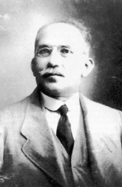
Colonel Nicolás R. Márquez (1864–1937), GGM’s maternal grandfather, c. 1914.
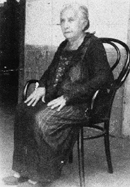
Tranquilina Iguarán Cotes de Márquez (1863–1947), GGM’s maternal grandmother.
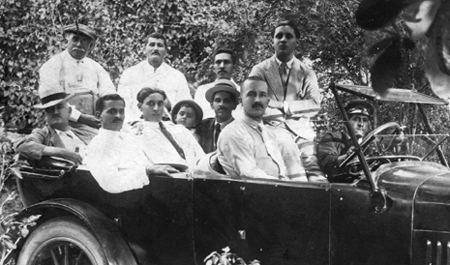
Colonel Nicolás R. Márquez (top left) on a tropical day out, in style, in the 1920s.
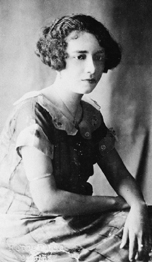
Luisa Santiaga Márquez Iguarán (1905–2002), GGM’s mother, before her marriage.
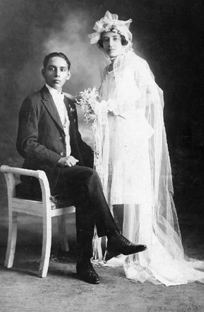
Gabriel Eligio García (1901–1984), GGM’s father, and Luisa Santiaga on their wedding day, Santa Marta, 11 June 1926.
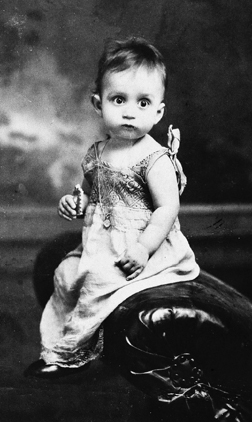
GGM on his first birthday. This is the picture GGM chose for the cover of his 2002 autobiography.
Part of the Colonel’s old house in Aracataca before any reconstruction work took place.
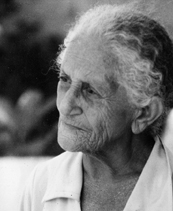
Elvira Carrillo (“Aunt Pa”), one of the aunts who looked after GGM and his sister Margot during their childhood in Aracataca.

(Left to right) Aida GM, Luis Enrique GM, Gabito, cousin Eduardo Márquez Caballero, Margot GM and baby Ligia GM, in Aracataca, 1936. The photograph was taken by the GM children’s father, Gabriel Eligio.
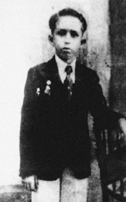
Gabito at the Colegio San José, Barranquilla, 1941.
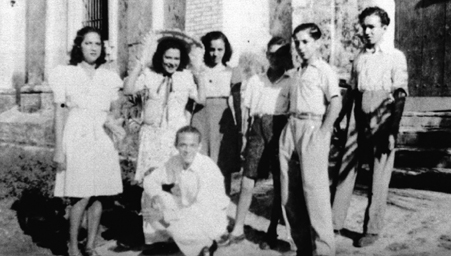
The GM brothers, Luis Enrique and Gabito (right), with cousins and friends, Magangué, c. 1945.
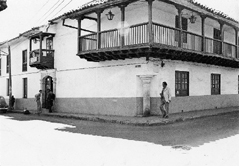
The Liceo Nacional in Zipaquirá, where GGM studied between 1943 and 1946.
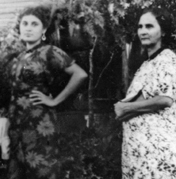
Argemira García (1887–1950), paternal grandmother of GGM (right), in Sincé with her daughter Ena, who died in 1944 aged twenty-four, allegedly as a result of witchcraft.
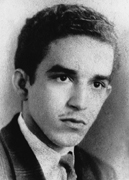
GGM, the budding poet, Zipaquirá, mid-1940s.
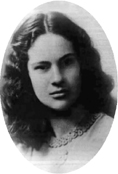
Berenice Martínez, GGM’s girlfriend in Zipaquirá, mid-1940s.
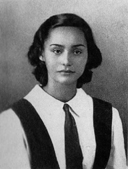
Mercedes Barcha at school in Medellín in the 1940s.
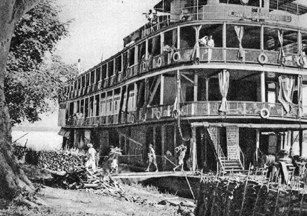
Steamship David Arango, on which GGM travelled to Bogotá from the Costa in the 1940s.
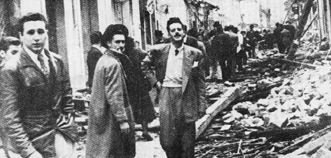
Fidel Castro (left) and other student leaders during the Bogotazo, April 1948.
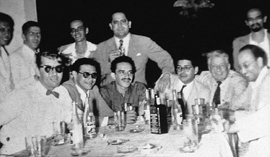
Barranquilla, April 1950: farewell party for Ramón Vinyes. Drinkers include Germán Vargas (top, third left), Orlando Rivera (“Figurita”) (top right), “Bob” Prieto (seated first left), GGM and Alfonso Fuenmayor (centre), next to Ramón Vinyes (second from right).
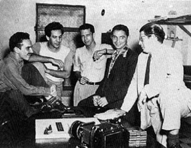
Barranquilla, 1950: (from left) GGM, Alvaro Cepeda, Alfredo Delgado, Rafael Escalona and Alfonso Fuenmayor in the El Heraldo office.
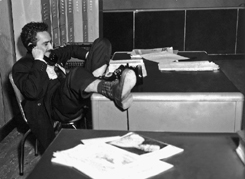
GGM, journalist at El Espectador, Bogotá, 1954.
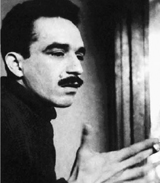
GGM in the Hôtel de Flandre Paris, 1957.
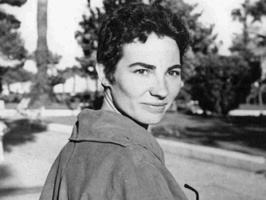
Tachia Quintana, Paris.
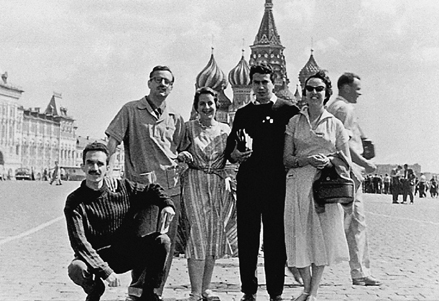
GGM and friends (Luis Villar Borda, standing left), Red Square, Moscow, summer 1957.
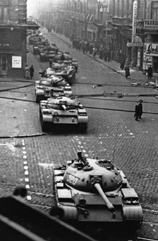
The Soviet invasion of Hungary: Russian tanks on a Budapest street in 1956. This was the moment when socialists worldwide concluded that the USSR’s problems were not caused only by Stalin.
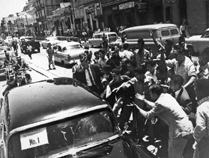
Caracas, 13 May 1958: demonstrators attack U.S. Vice-President Richard Nixon’s limousine. A historic wake-up call for U.S. Latin America policy.
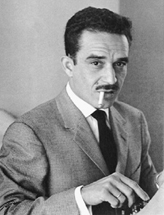
GGM working for Prensa Latina, Bogotá, 1959.
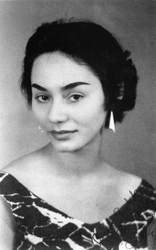
Mercedes Barcha in Barranquilla before her marriage to GGM.
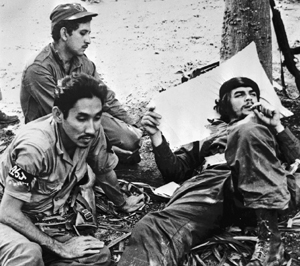
Cuba, December 1958: Che Guevara and comrades relax after battle before marching into Havana.
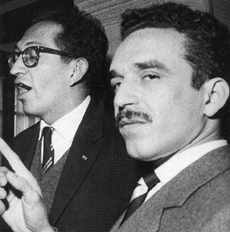
GGM and Plinio Mendoza in Prensa Latina, Bogotá, 1959.
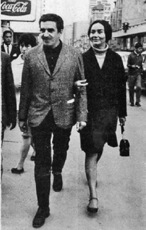
GGM and Mercedes on Séptima, Bogotá, 1960s.
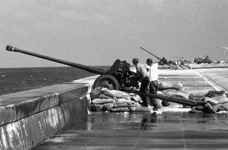
Havana, January 1961: Cuban militia prepare for the expected U.S. invasion, at the time GGM arrives in New York to work for the revolution.
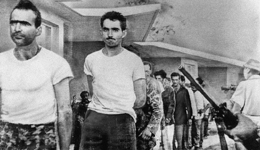
Havana, 21 April 1961: U.S.-backed invaders are taken to prison following defeat at Playa Girón (Bay of Pigs), at the time GGM is planning to leave Prensa Latina and travel to Mexico.
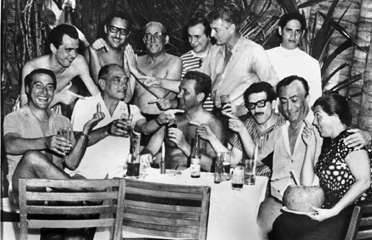
Mexico, 1964: GGM (in glasses, looking distinctly alienated) with Luis Buñuel (front, second left), Luis Alcoriza (front, first left), and (top left to right) Armando Bartra, unknown, unknown (probably Cesare Zavattini), Arturo Ripstein, Alberto Isaac and Claudio Isaac.
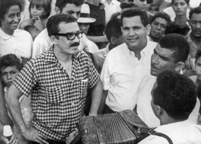
GGM in Aracataca, 1966, with accordionist: this improvised event was the seed of the later vallenato festivals in Valledupar.
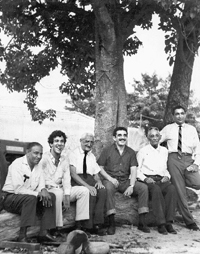
Valledupar, Colombia, 1967: (left to right) Clemente Quintero, Alvaro Cepeda, Roberto Pavajeau, GGM, Hernando Molina and Rafael Escalona.
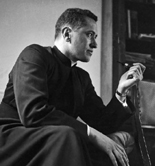
Camilo Torres: university friend of GGM, baptized his first son Rodrigo, became Latin America’s best-known revolutionary priest and died in action in 1966.
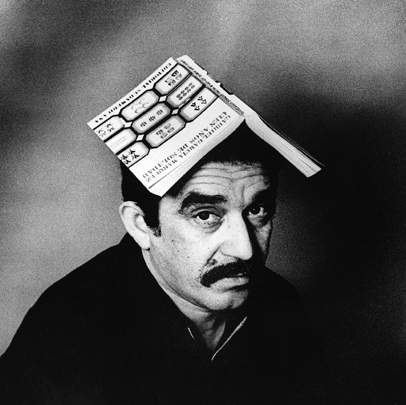
Wizard or dunce? GGM in Barcelona, crowned by the famous cabbalistic cover of One Hundred Years of Solitude, 1969.
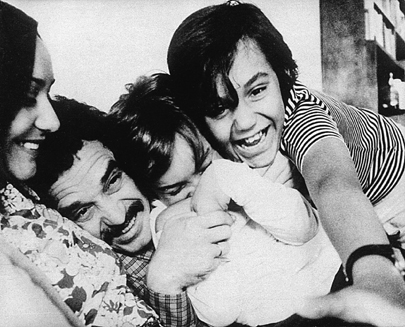
Mercedes, Gabo, Gonzalo and Rodrigo, Barcelona, late 1960s.
A few months later García Márquez was invited by the cultural section of the Mexican Foreign Office to give a lecture and, where he would normally have refused, he in fact agreed, though specifying that he would like to give a literary reading rather than a talk. Always self-critical and concerned with the quality of his work, he had become anxious that he was now lost in a world of his own with Alvaro and María Luisa and that their enthusiasm for his ideas might have hypnotized him:
I sat down to read on the illuminated stage; the stalls with “my” audience completely in the dark. I started to read, I can’t remember which chapter, but I went on reading and at a given moment there was such silence in the hall and I was in such a state of tension that I panicked. I stopped reading and tried to peer through the darkness and after a few seconds I could see the faces of those in the front row and on the contrary, I could see they had their eyes open wide, like this, and so I was able to go on calmly with the reading. Really people were hanging on my words; not a fly buzzed. When I finished and stepped down from the stage, the first person to embrace me was Mercedes, with an expression on her face—I think it was the first time since I married her that I realized she loved me, because she looked at me with such an expression on her face! … She’d been managing on virtually nothing for a year so that I could write and the day of that reading the expression on her face gave me the certainty that the book was heading in the right direction.12
Mercedes went on fighting her own campaign to keep the family finances afloat. By early 1966 the money set aside from previous earnings had gone but although her husband’s writer’s block was a thing of the past, the book just got bigger and bigger and seemed set to go on right through the year. Finally García Márquez drove the white Opel to a car pound in Tacubaya and came back with another large sum.13 Now their friends had to drive them around. He even considered letting the telephone go, not only to save the money but to avoid his greatest distraction: talking endlessly to his friends on the phone. When the money for the car ran out Mercedes began to pawn everything: television, fridge, radio, jewellery. Her three last “military positions” were her hairdryer, the liquidizer for the boys’ meals and Gabo’s electric fire. She bought her meat from Don Felipe, the butcher, on ever more elastic credit; she persuaded Luis Coudurier, the landlord, to wait even longer for the rent. And their friends brought regular supplies of every description. They kept the record player, though. García Márquez could not at this stage in his life compose a novel while music was playing; but he could not live without music either and his beloved Bartók, Debussy’s Preludes and the Beatles’ Hard Day’s Night were in the background of most of what he did in those times.
His worst day in the entire writing was the death of Colonel Aureliano Buendía (chapter 13). Like many writers he experienced the loss of his principal character as a personal bereavement, perhaps even as a homicide. The narration of the death is invested with some of García Márquez’s own most poignant childhood memories and, though the critics have not realized it, the novelist had put more of himself into this apparently unsympathetic character than into any other in his fiction before that time. Aureliano, although the second child, is “the first human being to be born in Macondo”; he is born in March, like García Márquez; born, moreover, with his eyes open, eyes which gaze around that house the moment he emerges from the womb, as little Gabito’s were said to have done. From early childhood he is clairvoyant, just as Gabito is reputed to be in his family. He falls in love with a little girl (and marries her before she reaches puberty); but after her death he is “incapable of love” and acts only out of “sinful pride.” Though capable of great empathy and even kindness as a young man (and though a writer of love poetry—which later embarrasses him), Aureliano is solitary, egocentric and ruthless; nothing can stand in the way of his personal ambition. In Aureliano Buendía, then, García Márquez fuses selected memories of Colonel Márquez (the war, the workshop, the little gold fish) with a self-portrait which amounts to a self-critique; a self-critique which amounts to a perception that he has now achieved his lifelong ambition but that the quest to do so has been calculating, all-consuming and ultimately narcissistic and egotistical. The vocation for writing (for becoming Melquíades), which he would later stress so strongly in Living to Tell the Tale, in fact screens another more elemental and perhaps less palatable instinct, the will to triumph and the desire for fame, glory and riches (Colonel Aureliano Buendía). The Autumn of the Patriarch would take this self-critique to even more surprising lengths.
At two in the morning, after the deed was done, he went up to the bedroom, where Mercedes was fast asleep, lay down and wept for two hours.14 It requires little biographical insight to suppose that in killing off his central character he was brought to confront not only his own mortality and the end of this novel but also the end of a uniquely euphoric experience—indeed, the end of an entire era of his life and of a person he had been, and the end of a particular inexpressible relationship with the most important person in his life, his grandfather (now lost for ever because literature could not resurrect him). Now, irony of ironies, García Márquez was back, in the midst of his triumphs, to being the man envisaged by his first stories, a man doomed to multiple, successive deaths as he left behind each moment of his life and each object and person that he had loved. Except his wife and children.
Although he has always given the impression that he stayed in his smoke-filled room until the book was completed, the opportunity of travelling to Colombia at someone else’s expense arose and, after much consideration, he decided to take the opportunity. He had persuaded the Ripsteins to enter Tiempo de morir in the Cartagena Film Festival and travelled by cruise liner from Veracruz to Cartagena, arriving on 1 March 1966 (two weeks after the death in combat of his friend Camilo Torres, now a guerrilla). The film won first prize at the festival, despite García Márquez’s own doubts about the job Ripstein had done. He had much to celebrate on 6 March: the triumph of his movie, the prospects for his novel, and his thirty-ninth birthday back home with the family in Cartagena. He made a brief visit to Bogotá and then flew in to Barranquilla, where Plinio Mendoza was now living. Mendoza received a phone call at work.
“Gabo, great to hear your voice, where are you?”
“Sitting in your house, asshole, having a whisky.”15
He told Mendoza and Alvaro Cepeda about his novel: “It’s nothing like the others, compadres. This time I’ve finally let my hair down. Either I’m going to make my big hit or fall flat on my face.” During the visit he walked round the old haunts in Barranquilla with Alfonso Fuenmayor, reliving old times and reminding himself of places and faces. To complete the whirlwind tour, he returned to Aracataca for the first time in a decade.16 This time he travelled not with his mother but with Alvaro Cepeda, in a jeep driven by Cepeda himself. They were conveniently accompanied on their quest for time past by the Barranquilla correspondent of El Tiempo, who wrote a detailed report: suddenly García Márquez was being converted into a folk hero by the media—prior to his further metamorphosis into a superstar.17
He had intended to stay several weeks but embarked for Mexico after a few days, arriving towards the end of March. Alfonso Fuenmayor protested at his departure, and García Márquez explained that the night before he left he had suddenly seen the end of his novel so clearly that he could dictate it word for word to a typist. He locked himself away in that room again, and set about assimilating what had just happened to him. The ending that had occurred to him—which speaks perhaps to a sense of how much he had moved on and how much his Colombian friends had not—was one of the greatest conclusions to a novel in all of literature.
One Hundred Years of Solitude was a book that had a publisher almost from the moment it was started. It had a daily audience of enthusiasts on whom its author could count. And the euphoric writer was hardly in need of encouragement: he was a man possessed. Possessed of creative powers of literature pulsing through him and possessed of the certainty that the work’s success was in the stars, preordained. James Joyce’s Ulysses is the closest example of a mythic book which the cognoscenti knew was coming and which they knew was destined for greatness; but Joyce had no publisher and could never expect to be a best-selling author. Yet so confident was the normally hyper-cautious García Márquez that, far from succumbing to the superstitions that usually restrained him, during his visit to Bogotá in March he had given his old colleagues in El Espectador the first chapter, which they published on 1 May. Carlos Fuentes, by now back in Paris, received the first three chapters in June 1966 and was dazzled.18 He passed them to his friend Julio Cortázar. The reaction was the same. Then Fuentes passed chapter 2 to Emir Rodríguez Monegal to publicize it in the first edition of a new literary magazine, Mundo Nuevo, in Paris in August 1966.
In an interview with the editor, Fuentes announced that he had just received the first seventy-five pages of García Márquez’s “work in progress” (the reference to Joyce was unmistakable) and considered it without the slightest doubt an absolute masterpiece which immediately consigned all previous Latin American regional classics to a dusty past.
Then Fuentes sent an article to La Cultura en México (¡Siempre!) announcing to his compatriots also, on 29 June, that One Hundred Years of Solitude was coming and was a great novel (García Márquez probably hadn’t even finished it): “I have just read eighty magisterial pages: the first eighty pages of One Hundred Years of Solitude, the novel Gabriel García Márquez is working on.”19 People could hardly express their astonishment. There were no precedents for what was happening.
In view of the climate of expectation, it was as well that García Márquez was able to finish the novel. He told Plinio Mendoza: “The book arrived at its natural end in a rush, at eleven in the morning. Mercedes was out and I couldn’t find anyone on the telephone to tell the news. I remember my confusion as if it were yesterday: I didn’t know what to do with myself and tried to make something up to survive until three o’clock in the afternoon!”20 Later that day a blue cat came into the house and the writer thought, “Hmmm, maybe this book is going to sell.” Minutes later the two boys came in with brushes and blue paint all over their hands and clothes.
His first act was to send a copy off to Germán Vargas in Bogotá, prior to sending the manuscript to Sudamericana. García Márquez asked Vargas if he thought it was all right to have made references to himself and his friends in Barranquilla. First Vargas, then Fuenmayor, replied that they were honoured to be friends of the last of the Buendías. Then Vargas, in that slow way of his, digested the book and wrote an article entitled “A Book That Will Make a Noise,” which he published in April 1967 in Encuentro Liberal, the weekly he himself edited in Bogotá; Vargas’s own essay itself made a noise and was the first Colombian prediction of the novel’s future status.21 Plinio Mendoza also received a copy in Barranquilla and, cancelling work for the day, read it from start to finish. He told his new wife Marvel Moreno, an ex-beauty queen and future novelist, “He’s done it. Gabo’s made the big hit he wanted.” Plinio passed it on to Alvaro Cepeda. Alvaro read it, took the cigar out of his mouth, and shouted, “No shit, Gabo’s pulled off a helluva novel.”22
The way García Márquez has always told it, his return to the world was almost as dramatic and confusing as that of Rip Van Winkle.23 It was the year of Swinging London. Indira Gandhi was now running the largest democracy on earth and Fidel Castro, in whose company García Márquez would meet that same Indian leader many years later, was busy organizing the first Tricontinental Conference of Asian, African and Latin American States to be held in Havana in August 1967. A right-wing actor called Ronald Reagan was running for Governor of California. China was in uproar and Mao would proclaim the Cultural Revolution a few days after García Márquez sent the first tranche of his precious package to Buenos Aires. In fact García Márquez himself had to leave the magical world of Macondo in a hurry and begin to make some money. He felt unable to take even a week off to celebrate. He was afraid that it might take him years to pay off the debts he had accumulated. He would say later that he had written 1,300 pages of which he had finally sent 490 to Porrúa; that he had smoked 30,000 cigarettes and owed 120,000 pesos. Understandably, he still felt insecure. Soon after he had finished it he attended a party at his English friend James Papworth’s house. Papworth enquired about the book and García Márquez replied, “I’ve either got a novel or just a kilo of paper, I’m still not sure which.”24 He went straight back to working on film scripts. Then, in his first article for five years, dated July 1966 and still not written for consumption in Mexico, García Márquez wrote a self-referential meditation for El Espectador entitled “Misfortunes of a Writer of Books”:
Writing books is a suicidal profession. No other demands as much time, as much work, as much dedication, by comparison with its immediate benefits. I don’t think many readers finishing a book ask themselves how many hours of anguish and domestic calamities those two hundred pages have cost the author or how much he received for his work … After this grim assessment of misfortunes, it is elementary to ask why we writers write. The reply, inevitably, is as melodramatic as it is sincere. One is a writer, simply, as one is a Jew or a Black. Success is encouraging, the favour of one’s readers is stimulating, but these are mere additional gains because a good writer will go on writing anyway, even though his shoes need mending and even if his books don’t sell.25
The new García Márquez, the first sight of whom could be glimpsed in the interviews he gave when he arrived in Cartagena the previous March, has been born. He has started to say almost the exact opposite of what he means. He writes about his misfortunes because his misfortunes are almost over. The man who never complained, never made a fuss in even the most straitened circumstances, is intending to make a fuss henceforth about everything—not least about the cupidity of publishers and booksellers, a topic that will become an obsession. Here he is, the García Márquez who will endlessly fascinate the public and permanently irritate the critics, particularly those who will be convinced that he does not deserve his success and that they who are far more sophisticated, far less vulgar and far more important literarily speaking, should have his glittering prizes. This new personage—a true man of the sixties, apparently—is provocative, opinionated, demagogic, hypocritical, wilfully uncouth and yet impossible to pin down; but the people will love him for all this because he seems to be one of them, making it big and getting away with it thanks to his wit, which is their wit, their view of the world.
Around the same time, soon after completing the novel, García Márquez wrote a long letter to Plinio Mendoza. It begins with a striking statement of his feelings at the time and then moves on to an explanation of his newly finished masterpiece and what it means to him:
After so many years of working like an animal I feel overwhelmed by tiredness, without clear prospects, except in the only thing that I like but which doesn’t feed me: the novel. My decision, which speaks to an overwhelming impulse, is to arrange things any way I have to in order to go on writing my stuff. Believe me, dramatic or not, I don’t know what’s going to happen.
What you’ve said about the first chapter of One Hundred Years of Solitude has made me very happy. That’s why I published it. When I got back from Colombia and read what I’d already written I suddenly had the demoralizing feeling that I was embarked on an adventure that could as easily be catastrophic as successful. So to find out how it would be viewed by other eyes I sent that chapter to Guillermo Cano and here I brought together the most demanding, expert and candid people and I read them another one. The result was great, above all because the chapter I read was the riskiest: Remedios the Beauty’s ascent to heaven, in body and soul…
I’m trying to answer, without any modesty, your question as to how I write my things. In reality One Hundred Years of Solitude was the first novel I tried to write, when I was seventeen, entitled “The House,” which I gave up after a while because it was too much for me. Since then I’ve never stopped thinking about it, trying to see it mentally, to find the most effective way of narrating it, and I can tell you that the first paragraph hasn’t a comma more or less than the first paragraph written twenty years ago. My conclusion from all of this is that when you have a topic that pursues you it starts growing in your head for a long time and the day it explodes you have to sit down at the typewriter or run the risk of murdering your wife …26
The letter makes it clear that in writing all this he is partly preparing himself to defend his views—and his novel—in public and that he is expecting a parallel high-profile career in journalism. He also says he now has three different projects for novels which are “pushing” him.
In early August, two weeks after writing that letter, García Márquez accompanied Mercedes to the post office to mail the finished manuscript to Buenos Aires. They were like two survivors of a catastrophe. The package contained 490 typed pages. The counter official said: “Eighty-two pesos.” García Márquez watched as Mercedes searched in her purse for the money. They only had fifty and could only send about half of the book García Márquez made the man behind the counter take sheets off like slices of bacon until the fifty pesos were enough. They went home, pawned the heater, hairdryer and liquidizer, went back to the post office and sent the second tranche. As they came out of the post office Mercedes stopped and turned to her husband: “Hey, Gabo, all we need now is for the book to be no good.”27