
PART III

17
THE GARCÍA BARCHA FAMILY arrived in Spain on 4 November 1967.1 After almost a week in Madrid they travelled to Barcelona. They intended a quite brief stay but, as in Mexico, they would remain almost six years.2 Once again it would be impossible for García Márquez to work as a journalist because the press was ruthlessly censored and he was a figure of international renown. But this would turn out to be a blessing: the separation from journalism and politics in Mexico City had coincided with one big book,One Hundred Years of Solitude, and in Barcelona it would coincide with an almost equally large one, The Autumn of the Patriarch.
To many the journey to Barcelona seemed a curious venture for a left-leaning Latin American, and García Márquez had always claimed to have avoided visiting Spain out of hatred for the Franco dictatorship.3 Mexico was the most hostile of all Hispanic countries to the Spanish regime and it was certainly an irony that García Márquez would travel from there to live in a country from which so many of his Catalan friends in both Mexico and Colombia were exiled. But although he would usually deny it, the spectacle of the old Spanish dictator near the end of his life and power was inevitably a stimulus to the writing of the book he had long since planned on an even more geriatric Latin American tyrant, a literary one whose power would seem eternal to his helpless and long-suffering subjects.
In fact there was much else to be said for the decision. His literary agent, Carmen Balcells, was in Barcelona and was already on her way to becoming one of the most influential agents not only in Spain but in the whole of Europe. With the Seix Barral publishing house and many others already in existence or springing up, Barcelona was, despite Franco, at the very centre of the 1960s publishing boom in Latin American fiction. Behind it was a renascent if necessarily muted Catalan nationalism and an economic upturn which, despite everything, the policies of the Franco dictatorship had recently begun to foment. The raw material fuelling the publishing boom was of course the creative “Boom” of the Latin American novel itself of which García Márquez was already the brightest star.
He arrived in Barcelona at the very moment the Boom’s importance was becoming clear. The unparalleled albeit temporary openness of horizons which characterized the 1960s created an aesthetic moment of extraordinary fertility. This openness, this choice between alternatives, is clearly visible in both the subject matter and the structures of the canonical Latin American texts of the era. All are about the historical formation of Latin America, the contribution of both history and myth to contemporary Latin American identity, and, implicitly, about its possible futures, both good and bad.
Looking back, the intense historical moment that was the Boom ran from 1963, when Julio Cortázar’s Hopscotch (Rayuela) appeared, to 1967, when García Márquez’s One Hundred Years of Solitude—the Boom novel par excellence—was published. Everyone agreed that Hopscotch was something like “Latin America’s Ulysses”—appropriately enough, because the Boom is best understood as the crystallization and culmination of Latin America’s twentieth-century modernist movement. But One Hundred Years of Solitudechanged the entire perspective, making it clear at once that something much more far-reaching had occurred for which a quite different time-frame was required—because, as almost everyone again agreed, One Hundred Years of Solitude was “Latin America’s Don Quixote.”
García Márquez became the focus of attention, almost the icon of the burgeoning literary movement; it would begin to seem as if he alone attracted as much media coverage as all the other writers put together. No one said it in so many words but clearly here was some kind of Exotic Phenomenon, some Noble Savage, some Caliban of Letters metamorphosed magically into a new image of the writer for this contradictory era of pop culture and post-colonial revolution. The Spanish press, culturally and politically underdeveloped after thirty years of Francoism, was completely unprepared for the novelties and complexities of the Latin American new wave and García Márquez was subjected to dozens of thoughtless and embarrassing interviews. Few journalists were interested in the fact that this man from nowhere, who seemed to have appeared, like his book, out of thin air, through some form of spontaneous Third World combustion, was actually a deadly serious, inconceivably industrious, ferociously determined writer who had worked unceasingly for two decades to get where he was and would be prepared to work equally tenaciously to stay there—whatever he might say, in throwaway remarks, to gullible journalists. This was a writer who would use his literary celebrity to become a great public figure and on a scale unimagined by any of his predecessors except perhaps Hugo, Dickens, Twain or Hemingway.
Yet he would be consistently underestimated. Over nearly four decades, his critics would fail to see what was there before their very eyes: that he was cleverer than they were, that he was manipulating them at will, that the public loved him more than they loved the critics and would forgive him almost anything, not only because they loved his books but because they felt that he was one of them. Just as they had loved the Beatles in part because instead of being managed by the media (like Elvis or Marilyn) they knew how to play the journalists at their own game: taking them deadly seriously by appearing not to take them seriously at all. He was, it seemed, an ordinary guy—not pretentious, pompous or pedantic. He was just a man like his readers but one who made genuine literature accessible and easy.
His arrival in Barcelona started a trend. Before long José Donoso and Mario Vargas Llosa would also arrive. García Márquez was soon acquainted with such leading Spanish writers and intellectuals as the critic José María Castellet, Juan and Luis Goytisolo and Juan Marsé.4 At this time underground opposition to the Franco dictatorship was growing all across Spain, led and mainly organized by the Communist Party through figures such as Santiago Carrillo, Jorge Semprún and Fernando Claudín, but paralleled by the Socialist Party (PSOE) and young clandestine militants such as Felipe González.5 Historically Catalonia has been not only the home of the bourgeois businessmen who famously stoked the engine that pulled Spain’s otherwise empty carriages in the nineteenth century but also a land of anarchists and socialists, painters and architects, the stage of Gaudí, Albéniz, Granados, Buñuel, Dalí, Miró and, by adoption, Picasso. Second only to Paris as a cultural laboratory or greenhouse for “Latin” culture, Barcelona had been an avant-garde city between the great Renascenza of the 1880s and 1890s and the fall of the Spanish Republic in 1939. Now, in the 1960s, with its language officially suppressed, Spain’s most industrious and productive province was beginning to assert itself once more; however, in the 1960s politics had to masquerade as culture and Catalan bourgeois nationalism, denied normal expression, took on a radical left-wing persona through a heterogeneous group of mainly middle-class writers and architects, film-makers and professors, painters and media celebrities, philosophers and models known as the gauche divine (divine left).
One of García Márquez’s first contacts was Rosa Regás, today one of Spain’s leading women writers and cultural impresarios but in those days a tall, beautiful young woman who looked like the Vanessa Redgrave of Antonioni’s Blow-Up and was one of the “muses” of the divine left. Her brother Oriol, who was big in public relations (like so many of the people García Márquez knew in his Mexican and Spanish years), was also the owner of Bocaccio, the “in” bar up on Calle Muntaner where the beautiful and dangerous young people of the avant-garde used to meet. The mini-skirted Rosa was a married woman in her mid-thirties with children, but she led a life of sixties freedom that scandalized the traditionalist majority and was a standard-bearer for every new cultural fashion. At this time she was organizing public relations in Carlos Barral’s office, though by the end of the decade she would be running her own imprint, La Gaia Ciencia. She had read One Hundred Years of Solitude and was “blown away”: “I was madly in love with that book; indeed, I still travel with it now as I do with Proust and I always find something new in it. It’s like Don Quixote; I have no doubt it will last. But in those days it seemed to speak to me directly, it was my world. We all loved it; it was like a children’s craze, we all passed it around.”6
Rosa Regás immediately invited Gabo and Mercedes to a party in their honour at her house, where she introduced them to some of the influential members of Barcelona’s avant-garde society. It was there they met a couple, Luis and Leticia Feduchi, who were to be their closest Spanish friends over the next thirty years. Part of the attraction was that the Feduchis were not from Catalonia. As in Mexico, the García Barchas would interact above all with the émigré crowd. Luis Feduchi was a psychiatrist born in Madrid and Leticia was from Málaga and had recently studied literature at the University of Barcelona.7 He and Leticia gave “the Gabos,” as they were beginning to be called, a lift home after the party, stopped the car, talked for a long time, and arranged to meet again. Their three daughters, the “infantas,” as García Márquez would call them, were much the same age as Rodrigo and Gonzalo, and the five children too would also become lifelong friends, like favourite cousins.8
A young Brazilian woman, Beatriz de Moura, was another early acquaintance, another “muse” of the divine left and another person who, like Rosa Regás, would be running her own publishing house, Tusquets (her then husband’s family name), in 1969, at the age of thirty. If this was salon society, the new hostesses were astonishingly young. Beatriz had arrived in Spain because, as the daughter of a diplomat, she had broken with her conservative family over politics and made her way through her talent and, no doubt, her youthful glamour. (If Rosa was like the Vanessa Redgrave of Antonioni’s Blow-Up, Beatriz resembled the Jeanne Moreau of Truffaut’s Jules et Jim.)
However, García Márquez, it turned out, was in Barcelona to work, and he and Mercedes soon began to limit their socializing. They moved from one apartment to another, all in the pleasant but unfashionable Gracia and Sarriá areas north of the Diagonal, before finally renting a quite small apartment in a new block on Calle Caponata, still in Sarriá. Guests were struck by the sobriety of its decor—essentially the Mexican conception of white walls with furniture of colours that varied from room to room—which would characterize all their residences from this time forward. Here they would stay, in a pleasant area surprisingly reminiscent of the unpretentious and sensible, almost suburban zone where they had lived in Mexico, until the end of their stay in the Catalan capital.
They decided to send Rodrigo and Gonzalo to the local British School, the Colegio Kensington. The headmaster, Mr. Paul Giles, was a Yorkshireman who had studied law at Cambridge and had something in common with the García Barchas: before opening his school in Barcelona, he had lived in Mexico. As for his pupils’ famous parent, García Márquez had a tendency to the sarcastic which Giles, quintessentially English, did not appreciate: “I didn’t pay him much attention, he wasn’t that well known in those days. He was pleasant enough but also rather aggressive. I assumed he had a chip on his shoulder against the English. But why be disagreeable about other people’s cultures? I mean, why pour beer in someone else’s Beaujolais? … Do you think García Márquez is as good as they say? What, as good as Cervantes? Good Lord, who says that? Him, I should think.”9
The two biggest editorial contacts available in Barcelona were the formidable Carmen Balcells and Carlos Barral, one of the founders of the Seix Barral publishing house. García Márquez’s relationship with Barral was already doomed: although Barral did more to promote the Boom than any other single individual, he was also the man, so it was said, who back in 1966 had “missed,” or “lost” (it is the same word in Spanish) One Hundred Years of Solitude, which, if true, would be the single biggest misjudgement in the history of Spanish publishing. By contrast Balcells is, without a doubt, García Márquez’s most important contact in Barcelona and the most important woman in his life after Luisa Santiaga and Mercedes. She had started out negotiating contracts for Barral at the beginning of the 1960s and then struck out on her own. “When I started out I knew nothing. There was snobbery everywhere, and beautiful girls; I felt like a peasant woman by comparison. Of course, in the end I made it; my first customers were Mario Vargas Llosa and Luis Goytisolo; but it was Gabo who really pulled my chestnuts out of the fire.”10
With Mercedes to run the home (he told interviewers, “she gives me pocket money for sweets, like she does with the boys”)11 and Carmen to run his business and other affairs, which she did first with alacrity and then with devotion, García Márquez was in a position to administer his fame and write his next book. He would not be long in realizing that the world was now at his feet. His telephone vice would now reach unimagined heights: he could be in daily contact with whoever he wanted in any of his strategic places—Colombia, Mexico, Cuba, Venezuela, Spain and France—or indeed anywhere else in the world, at a moment’s notice. In terms of business, however, he would need to chase no possibilities, launch no initiatives, seek no advantages: from now on the world would be coming to him, through Carmen. This would take some adjusting to but he would get there.
Part of the process of adjustment lay in explaining—not least to himself—the relation between the already mythical One Hundred Years of Solitude, the “dead lion,” and his current project, The Autumn of the Patriarch. He would have been immortal thanks toOne Hundred Years of Solitude even had he written no other book but he was not interested in talking about it: he wanted to concentrate on the new one. So he began to tell journalists that he was bored with One Hundred Years of Solitude—as much as anything he was bored by their stupid questions—and even, horror of horrors, that the book was “superficial” and that its success was largely due to a series of writer’s “tricks.”12 In short, he seemed to be saying, he was not really a magician, just a talented conjuror.
In one way of course he was obviously right: One Hundred Years of Solitude is indeed full of “tricks”; not only the sleight of hand readers love so much in the Thousand and One Nights (which foreshadowed Melquíades and his associated themes and strategies) but the modernist techniques, arduously acquired, which had allowed the author to distance himself from the preoccupations of “The House” and hence to dissolve all his lifelong obsessions—both biographical and literary—into thin air.13 But behind this, no doubt, there is some further dimension of disappointment and even resentment. Now it was as if the book had robbed him of that house and that past. He could never go back again. He had not necessarily wanted to know that.14
Another reason for him to react against One Hundred Years of Solitude was the question of celebrity with all its attendant pressures, responsibilities and expectations.15 He was ambivalent about this, even hypocritical at times, but there can be no doubt that, from the start, he—a large part of him—sincerely deplored and lamented it. Like so many others before him, he had wanted the glory but he was reluctant to pay the price. Thus the novel had released him from a tormented past but condemned him to a complicated future. So among other things the story of the rest of his life would be that of a man who had deserved the fame he now enjoyed and then had to learn how to live with it, to meet both the expectations and the responsibilities, and to triumph again (this time over fame and success themselves) and keep on triumphing with each new book.16
Viewed in this way, One Hundred Years of Solitude is evidently the axis of García Márquez’s life: the end of Macondo (his previously unassimilated world) and the beginning of “Macondo” (its successful representation, now achieved and behind him); the end of his obscurity and virtual anonymity, the beginning of his “power” (as The Autumn of the Patriarch would put it); the end of his modernist period and the beginning of his postmodernist period. Even more grandiosely, the novel is also the axis of Latin America’s twentieth-century literature, the continent’s only undisputable world-historical and world-canonical novel. And more grandiose still, but nonetheless true, it is part of a worldwide phenomenon which marks the ending of all “modernity” with the post-colonial arrival of the Third World and its literatures on the global stage (hence the parallel importance of Cuba and Castro): the end of the period, we could say, that began with Rabelais (saying farewell to the Middle Ages by satirizing its world-view) and was confirmed by Cervantes; and whose end was announced by Ulysses and, it may be asserted, confirmed by One Hundred Years of Solitude.17 No one would have found it easy to adjust to the idea—even the possibility-of that degree of historical significance.
IN APRIL AND May 1968 the family made their first foray outside Spain, taking in Paris and Italy, where Giangiacomo Feltrinelli was publishing the first translation of One Hundred Years of Solitude into a foreign language. Feltrinelli’s book launches were usually “happenings,” media spectacles which exalted the celebrity status of literary figures. But although Feltrinelli presented him as “the new Quixote,” García Márquez was true to his word and refused to have anything to do with the launch of the book or with its publicity. He felt strongly that publishers exploited writers and that they should at least handle their own end of the business: “Editors don’t help me write my books so why should I help them sell them.”18
This European tour was completed while the almost revolutionary events of May 1968 took place in Paris. García Márquez has barely ever mentioned this huge historic phenomenon, whereas Carlos Fuentes and Mario Vargas Llosa hastened to Paris to take part and Fuentes wrote a well-known eyewitness report and analysis of the failed insurrection, Paris: The May Revolution.19 Of course, although he was undoubtedly disappointed by the outcome, García Márquez had little faith in the ability of the French bourgeoisie, even its student youth, to transform a country and a culture about which he had fundamental reservations; and in any case he still had his eyes firmly fixed on Latin America. Nevertheless he decided to return to Paris over the summer, at the end of which he communicated his feelings to Plinio Mendoza:
Paris came out of me as if it were a splinter I had stuck in my foot… The last threads that linked me to the French just broke. That precision, that fabulous ability to split a hair in four, is something that has simply aged and the French don’t realize it… We arrived there when the paving stones were still broken after the battles in May and those battles were already petrified in the minds of the French: the taxi drivers, the baker, the grocer, made wearisome analyses of the events, drowned us in a bucket of rationalizations, and left us with the impression that all that had happened was a collision of words. It was infuriating …
My fate is that of a bullfighter and I don’t know how to cope with it. In order to go over the translation of One Hundred Years of Solitude I had to take refuge in Tachia’s apartment; she is now a well-set up lady, with a marvellous husband who speaks seven languages without an accent, and on first meeting she established a very good friendship with Mercedes based principally on complicity against me.20
It was true: García Márquez had met Tachia again. She had been living for some years with Charles Rosoff, a French engineer born in 1914 whose parents had left Russia after the failed 1905 uprising. His father had gone back in 1917 to join the revolution and then left again in 1924, disillusioned after the death of Lenin. Before meeting Rosoff Tachia had some transient relationships but no new love, though Blas de Otero had sought her out again in Paris and attempted to rekindle their tempestuous affair. Ironically it was through Blas, in 1960, that she had met the man she was to marry. But now, in 1968, García Márquez was back in her life. “We all met up at our apartment in Paris; I was very nervous. We all behaved terribly well and talked brightly but it was actually a very tense occasion, very strange, very difficult. But we all managed to act ‘as if nothing had ever happened’ and carried it off.”
García Márquez was still in Paris when the Soviet army invaded Czechoslovakia on 21 August to crush the socialist reform movement or “Prague Spring” led by Alexander Dubcek, the recently elected First Secretary of the Czech Communist Party. Czechoslovakia was a far more serious matter for García Márquez than the events in Paris because it seemed to demonstrate that Soviet communism was incapable of evolution. He told Plinio Mendoza: “My world collapsed but now I think maybe it’s better like this: to demonstrate, without nuances, that we stand between two imperialisms, equally cruel and voracious, is in a certain sense a liberation for one’s conscience … A group of French writers sent Fidel a letter published in L’Observateur, saying his support for the Soviet invasion was ‘the Cuban Revolution’s first serious error.’ They wanted us to sign it but our reply was very clear: it’s our dirty washing and we’ll do it at home. But the truth is I don’t think it will be washed very easily”21
Politically 1968 was proving the most turbulent year in living memory. In January Colombia had re-established diplomatic relations with the USSR for the first time in twenty years and Pope Paul VI had visited the country in August on the first ever papal visit to Latin America. (“Big Mama’s Funeral” had predicted such a visit.) Martin Luther King had been assassinated in Memphis in April and Bobby Kennedy was assassinated in Los Angeles in June; Andy Warhol was shot in New York the same month; the Chicago police had run riot at the Democratic Party convention in August and Richard Nixon would be elected President in November. And of course the French students had rioted in Paris in May largely unaided by the workers; the USSR had carried out its invasion of Czechoslovakia, supported by Cuba; and in early October the Mexican army would kill hundreds of unarmed demonstrators at Tlatelolco, in Mexico City, just before the first Olympic Games ever held in the Third World. All this while García Márquez himself spent most of his time closeted away in Barcelona with his paper “patriarch,” though living under a real dictatorship.22
As for Spain, indeed, García Márquez took so little interest in the nation’s politics that many people in Barcelona thought he was “apolitical.” During his period in the city there would be two major “sit-ins” which crystallized opposition to the Franco regime, participated in by many of his friends, including Vargas Llosa, and virtually every major member of the Divine Left; but not by García Márquez. Thirty years later Beatriz de Moura told me: “In those days Gabo was completely apolitical. Underlined: apolitical.You never heard him talk about politics and it was impossible to know what his opinions were. It was considered de rigueur to be politically committed in those days. And Gabo never was.”23
Novelist Juan Marsé was left with quite a different recollection of the “apolitical” García Márquez. In the late summer of 1968 Marsé was one of the foreign jury members invited to award literary prizes for the Fourth Competition of the National Union of Writers and Artists of Cuba (UNEAC). When it became clear to the authorities that the poetry prize was going to the allegedly counter-revolutionary poet Heberto Padilla and the theatre prize to the homosexual playwright Antón Arrufat, a crisis broke and the juries were effectively sequestered in Cuba for several weeks. This was the beginning of a conflict about freedom of expression which—three years on—would eventually change Cuba’s international image for ever, especially in Europe and the USA, and cause an irremediable rupture between many writers and what at this time was still seen as a reasonably liberal socialist revolution. The juries finally insisted on their verdicts and the authorities had to content themselves with printing a “health warning” in the two books when they were published. So after his six weeks stranded in Cuba while Fidel Castro waited in vain for the juries to change their mind, Marsé arrived back in Barcelona in late October and narrated his experiences to a group of friends at a party, among them García Márquez. Marsé told me, “The jury gave the prize to Padilla because his book was the best. UNEAC said it wasn’t and of course the message had come down from above. It was true that Padilla turned out to be a provocateur and a really twisted guy, a nutcase. But even if I’d known that I wouldn’t have changed my mind. His was the best book and that was that. Anyway I got back to Barcelona and Carmen held a party for me, so I told my story. I can see Gabo now, with a red kerchief round his neck, pacing up and down while I’m explaining what happened. He was furious with me, really angry. He said that I was an idiot, that I didn’t understand anything about literature and even less about politics. Politics always came first. It didn’t matter if they hanged all us writers. Padilla was a bastard who worked for the CIA and we should never have given the prize to him. It was an extraordinary display. He didn’t actually abuse me but he made it clear that we inhabited totally different intellectual and moral universes. After that we remained friends but I have the feeling that nothing was ever quite the same again, especially for him.”24
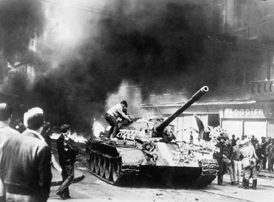
The Soviet invasion of Czechoslovakia, August 1968: the last straw for many former supporters of the USSR.
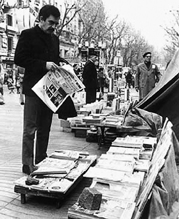
GGM, Barcelona, late 1960s.
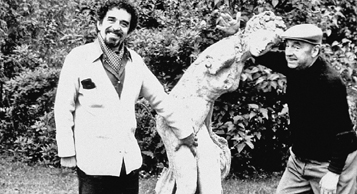
GGM and Pablo Neruda in the garden of Neruda’s Normandy home, c. 1972.

Boom couples: (left to right) Mario Vargas Llosa, his wife Patricia, Mercedes, José Donoso, his wife María Pilar Serrano and GGM, Barcelona, early 1970s.

GGM writing The Autumn of the Patriarch, Barcelona, 1970s (taken by his son Rodrigo).
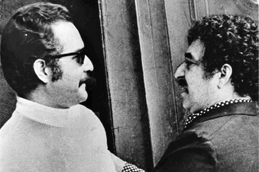
GGM with Carlos Fuentes, Mexico City, 1971.
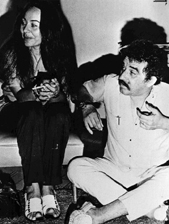
GGM and Mercedes, 1970s.
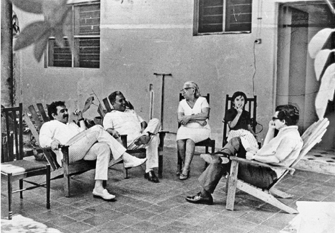
Cartagena, 1971: GGM visits his parents Gabriel Eligio and Luisa Santiaga with his son Gonzalo and Mexican journalist Guillermo Ochoa.
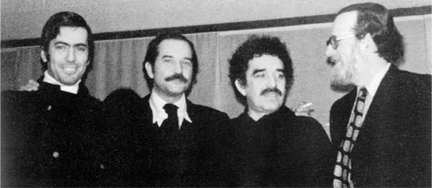
Writers of the Boom: (left to right) Mario Vargas Llosa, Carlos Fuentes, GGM and José Donoso. Only Julio Cortázar is missing.

Julio Cortázar, Miguel Angel Asturias and GGM, West Germany, 1970.
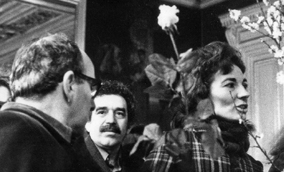
Paris, 1973: the wedding of Charles Rosoff (left) and Tachia Quintana (right). GGM, the best man, looks on.
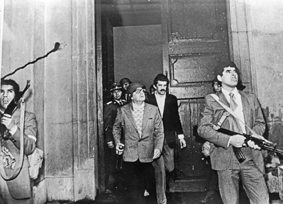
Santiago de Chile, 11 September 1973: President Salvador Allende defends the Moneda Palace against rebel forces. Just behind him is Dr. Danilo Bartulín, who, unlike Allende, survived, and became a good friend of GGM’s in Havana.
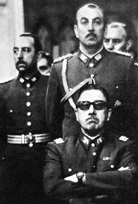
Santiago de Chile, 11 September 1973: General Pinochet and his henchmen.
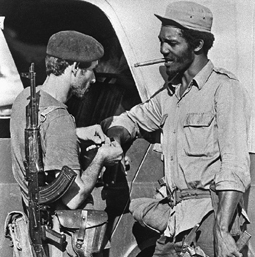
Cuban troops in Angola, February 1976.
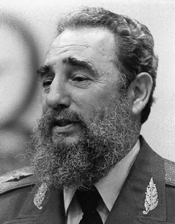
“Fidel is a king”: Castro, President of Cuba, 1980s.
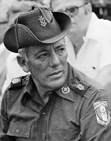
General Omar Torrijos, President of Panama, 1970s.
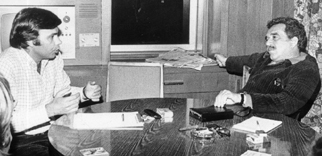
GGM interviews Felipe Gonzalez in Bogotá, 1977.
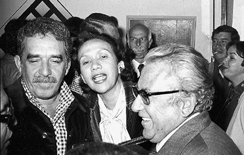
Bogotá, 1977: GGM with Consuelo Araujonoguera (“La Cacica”) and Guillermo Cano, editor of El Espectador. He would be killed by Pablo Escobar’s hitmen in 1986 and she would be murdered, allegedly by FARC guerrillas, in 2001.
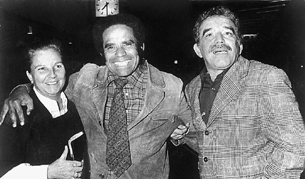
GGM with Carmen Balcells and Manuel Zapata Olivella, El Dorado Airport, Bogotá, 1977.
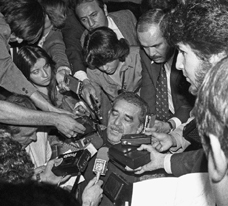
Mexico City, 1981: GGM buried by press attention following his self-exile from Colombia.

Mexico City, October 1982: Alvaro Mutis chauffeurs GGM and Mercedes around to protect them from media attention.
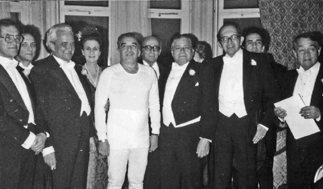
Stockholm, December 1982: (left to right) Jaime Castro, Germán Vargas, GGM, Charles Rosoff (behind), Alfonso Fuenmayor, Plinio Mendoza, Eligio García (behind) and Hernán Vieco.
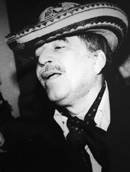
Stockholm, December 1982. GGM celebrates his prize in a costeño “sombrero vueltiao.”
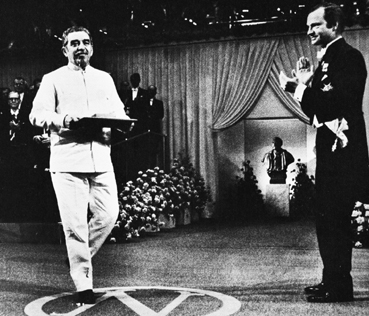
Stockholm, December 1982: GGM in the chalk circle; King Carl XVI Gustav applauds.
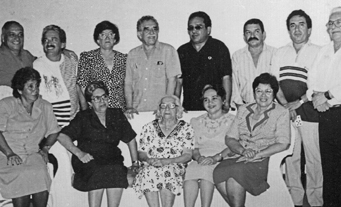
Cartagena, 1993: Luisa Santiaga and her children. (Top row, left to right) Jaime, Alfredo (Cuqui), Ligia, GGM, Gustavo, Hernando (Nanchi), Eligio (Yiyo), Luis Enrique; (bottom row, left to right) Germaine (Emy), Margot, Luisa Santiaga, Rita, Aida.
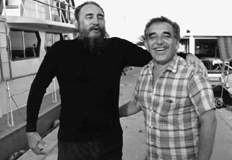
GGM and Fidel Castro, by the Caribbean, 1983.
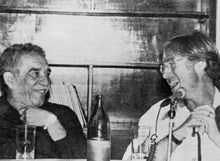
Havana, 1988: GGM and Robert Redford.
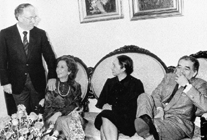
Bogotá, mid-1980s: GGM and Mercedes with President Betancur and his wife Rosa Helena Alvarez.
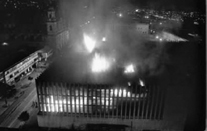
Bogotá’s Palacio de Justicia in flames, 6 November 1985 (during Betancur’s presidency), after the army stormed the building to dislodge M-19 guerrillas.

The world changes: celebrations at the fall of the Berlin Wall, November 1989.
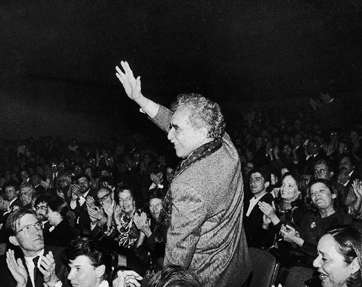
Bogotá, 1992: GGM salutes his admirers in the Jorge Eliécer Gaitán Theatre.
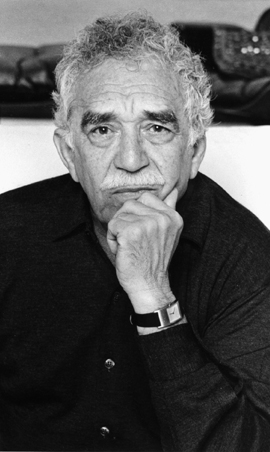
GGM, 1999.
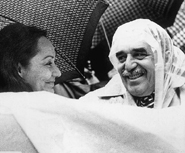
GGM and Mercedes, La Santamaría bullring, Bogotá, 1993.
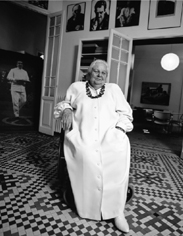
Barcelona, c. 2005: Carmen Balcells (“La Mamá Grande”) in her office, with photo of Gabo triumphant behind.
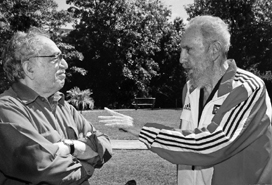
Havana,2007: Gabo visits his ailing friend Fidel before travelling to Cartagena for his eightieth birthday celebrations.
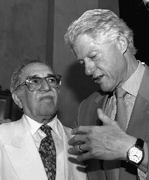
Cartagena, March 2007: GGM and Bill Clinton.
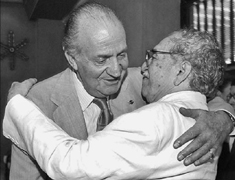
Cartagena, March 2007: GGM and King Juan Carlos I of Spain.

Cartagena, 26 March 2007: GGM waves to admirers during the celebrations for his eightieth birthday.
What Marsé did not know was that García Márquez, who intuited how serious this problem might eventually become, had supported a direct behind-the-scenes approach to Castro over the Padilla problem. In mid-September he had prolonged another visit to Paris to see Julio Cortázar, with whom he had been corresponding but whom he had never managed to meet. Cortázar had just separated from his first wife, Aurora Bernárdez, and wrote a gloomy letter to Paco Porrúa in Buenos Aires. The only bright spot, he said, was his meeting with García Márquez: “I want you to know that I met Gabriel, who stayed two extra days to meet me; I found both him and Mercedes marvellous; friendship springs up like a fountain when life puts you in touch with people like them.”25The two men had discussed the Cuban situation—appropriately enough because they were the two who would subsequently support the revolution through thick and thin and, in doing so, distance themselves from most of their contemporaries and certainly from the most famous of them: Vargas Llosa, Donoso, Cabrera Infante, Goytisolo and even Fuentes. García Márquez claims that it was he who suggested a private approach by sending a joint letter to Fidel, though Cortázar seemed to believe it was his initiative. In essence the idea seems to have been to appeal privately to Fidel not to punish Padilla in return—implicitly—for their silence. No reply ever came but Padilla, who had been removed from his work at Casa de las Américas, was reinstated. In 1971 the whole affair would blow up once more; but people such as Vargas Llosa, Juan Goytisolo and Plinio Mendoza had already turned away from Cuba in 1968 and nothing would ever be the same again.
On 8 December García Márquez travelled on an extraordinary expedition to Prague for a week with his new friend Julio Cortázar, Cortázar’s new partner the Lithuanian writer and translator Ugné Karvelis, who worked at the top Parisian publisher Gallimard, and Carlos Fuentes. They were keen to find out what was really happening in the newly occupied Czech capital and wanted to talk to novelist Milan Kundera about the crisis.26 According to Carlos Fuentes, “Kundera asked us to meet him in a sauna by the river bank to tell us what had happened in Prague. Apparently it was one of the few places without ears in the walls … A large hole opened in the ice invited us to ease our discomfort and reactivate our circulation. Milan Kundera pushed us gently towards the irremediable. As purple as certain orchids, the man from Barranquilla, and I, the man from Veracruz, immersed ourselves in that water so alien to our tropical essence.”27
Despite these adventures, the dominant image of García Márquez during this period is that of the solitary hero, tied to his vocation as to a ball and chain yet bereft of inspiration, wandering the dead-end corridors and empty halls of his mansion (forget that he lived in a small apartment) like some Citizen Kane of narrative fiction; or perhaps like Papa Hemingway only with literary bullets that were blanks instead of live ones. He was actually far from house-bound during the writing of The Autumn of the Patriarch as he had been during the writing of One Hundred Years of Solitude. Still, his anguish was undoubtedly real, despite the often ludicrous spectacle of his private torment being splashed repeatedly over the pages of newspapers all across Latin America.
After a while he began to visit Carmen Balcells’s office between five and seven in the evening several days a week, ostensibly to leave the latest section of The Autumn of the Patriarch for safe keeping—Carmen Balcells’s archive started receiving substantial sections of the novel as early as 1 April 1969 and was still receiving them as late as August 1974, with strict instructions “Not to be read”—but also to use her telephone on an unlimited basis for his commercial deals and confidental assignations. This kept business out of the home and perhaps saved Mercedes knowing about things that might have upset her, not least the large amounts of his new wealth that García Márquez would choose to give away over the coming years and, as time went on, the political and other affairs in which he became increasingly involved. In addition Balcells began to act as a kind of sister, a sister he could tell almost anything, a person who would come to love him dearly and who would make any sacrifice on his behalf. “After he had been in Barcelona for a while,” she told me, “he would come in and say, ‘Get ready, I’ve a job for Superman.’ That was me. And that’s who I’ve been ever since for him.”28 (She was later not averse to a joke, though. Years later he asked her during a telephone conversation, “Do you love me, Carmen?” She replied, “I can’t answer that. You are 36.2 per cent of our income.”)
Meanwhile the boys were growing up. García Márquez would later remark that the relationship between parents and children, unchanging for centuries, was radically transformed in the sixties: those parents who adjusted remained young for ever, those who did not were even older than middle-aged people had been before. Rodrigo, today a successful film-maker in Hollywood, told me, “What I most remember is that although we had a very social life it was really just the four of us, always. Just the four of us in the world. We were a wheel with four spokes, never five. So much so that when my brother had a baby a few years ago I was traumatized, I simply couldn’t believe that now there was a fifth spoke. And that’s after me living away from home for many years.”29
He added: “The two of us were breast-fed with a number of essential values. There were things you just had to know. One was the great importance of friendship. There was a huge emphasis on the sheer fascination of other people and their lives. It was my father’s drug. You had to know about their lives and all their business and you had to share in other people’s experiences and share your own with them. At the same time we were brought up to be completely unprejudiced, except in a couple of significant respects. Firstly, Latin American people were the best people in the world. They were not necessarily the cleverest, they might not have built a lot, but they were the very best people in the world, the most human and the most generous. On the other hand, if anything went wrong you always had to know that it was the government’s fault, it was always to blame for everything. And if it wasn’t the government, it was the United States. I’ve since discovered that my father loves the United States and has a lot of admiration for its achievements and a lot of affection for some Americans but when we were growing up the United States was to blame for almost everything bad in the world. Looking back, it was a very humanistic, politically correct upbringing. Although I was christened by Camilo Torres we never had any kind of religious education. Religion was bad, politicians were bad, the police and the army were bad.30
“There were other essentials too. If there was one word we kept hearing it was ‘seriousness.’ For example, my parents were very strict about manners. You had to hold doors open for ladies and you couldn’t talk with your mouth full. So there was this great belief in seriousness, in manners, in punctuality. And you had to get good grades, you couldn’t possibly not get good grades. But you also had to fool around, you had to know how to fool around and when to fool around; it was almost as if fooling around was part of ‘seriousness.’ And if we went over the top and fooled around too much, then we would be punished. Only two things in the world were really worthy of respect: service—being a doctor or a teacher or something like that—and, above all, creating works of art. But it was always embedded in our brains that fame was of no importance at all, he always said it wasn’t ‘serious.’ You could be immensely famous and still not a great writer; indeed, fame might even be suspicious. For example, he said, his friends Alvaro Mutis and Tito Monterroso were very great writers but no one had ever heard of them. On the other hand, we boys quite liked it when Dad started to be recognized in the street.”31
It was around this time that García Márquez gave up smoking. He had been an addict since the age of eighteen and at the time he set them aside he was often smoking eighty cigarettes a day of black tobacco. Only two years before he had said that he would rather die than give up smoking.32 The conversion took place one evening over dinner with his psychiatrist friend Luis Feduchi, who explained how he himself had given up a month before and why. García Márquez would not reveal the full details of this conversation for more than three decades but he stubbed out the cigarette he was smoking over dinner and never smoked another; though he was outraged two weeks later when Luis Feduchi started smoking a pipe.33
In January 1970 One Hundred Years of Solitude was named Best Foreign Novel of 1969 in France, recipient of a prize first instituted in 1948; but García Márquez flatly refused to attend the ceremony. Months afterwards he would tell an interviewer that “the book doesn’t feel right in French” and hadn’t sold very well despite positive reviews—perhaps because, unfortunately, “the spirit of Descartes has defeated that of Rabelais” in France.34
Ironically, the situation was totally different with regard to the United States. No novel in recent history had received more unqualified praise than García Márquez now began to receive there. John Leonard, in the New York Times Book Review, declared:
You emerge from this marvelous novel as if from a dream, the mind on fire. A dark, ageless figure at the hearth, part historian, part haruspex, in a voice by turns angelic and maniacal, first lulls to sleep your grip on a manageable reality, then locks you into legend and myth … With a single bound, Gabriel García Márquez leaps onto the stage with Günter Grass and Vladimir Nabokov, his appetite as enormous as his imagination, his fatalism greater than either. Dazzling.35
London followed on 16 April. In June The Times, the then establishment pillar and in some respects the most conservative newspaper in the world, which had only recently permitted photographs, dedicated an entire broadsheet page to the first chapter of One Hundred Years of Solitude, accompanied by “psychedelic” illustrations that might have been stolen from the Beatles’ cartoon movie Yellow Submarine. In December the New York Times named One Hundred Years of Solitude one of the twelve books of the year: it was the only fiction title among them. Gregory Rabassa’s inspired English version of One Hundred Years of Solitude was widely considered the best foreign translation of the year.
As for the other “Boom” writers, Mario Vargas Llosa finally made his long-heralded move to Spain that summer. He had completed his monumental novel Conversation in the Cathedral the previous year and now left his teaching position at the University of London and moved to Barcelona. His friends would call Mario “the cadet,” not only because of the topic—a military academy—of his best-seller The Time of the Hero (1962) but because Mario himself was always neat, tidy, well organized and, in theory at least, aiming to do the right thing. Yet controversy often surrounded him: by now this brilliant but ostensibly conventional young man was married to his first cousin Patricia, having put behind him the scandalous adolescent marriage to his aunt which would later become the subject of his novel Aunt Julia and the Scriptwriter. Meanwhile, another of his projects, a biographically oriented study of García Márquez’s narrative fiction, was surely one of the most generous and remarkable acts of homage in literature from one great writer to another. It was to be entitled García Márquez: The Story of a Deicide (García Márquez: historia de un deicidio), and it remains arguably, thirty years later, the single best book ever written on García Márquez and still a fundamental reference source today—even if, as many critics have said, it turned the Colombian into a writer with many of the attributes and the obsessions of Mario himself.
Another writer now in residence was the hypochondriac Chilean José Donoso, whom García Márquez had first met in Carlos Fuentes’s house in 1965. Donoso was the “fifth member of the Boom” (about equivalent to being the “fifth Beatle”), writer of the remarkable The Obscene Bird of Night (1970). Donoso later authored two important chronicles of the era, his Personal History of the “Boom” (1972) and his novel, The Garden Next Door (1981), which casts a satirical—and envious—eye on the relationship between Carmen Balcells (Núria Monclús) and her “favourite” writer, García Márquez (Marcelo Chiriboga).36
And Plinio Mendoza and his wife Marvel Moreno had decided to move across the Atlantic, first to Paris and then to Mallorca.37 Living in the most stringent austerity, Mendoza would soon become a frequent visitor to Barcelona, thanks to García Márquez’s largesse, but he found things difficult: “I would stay in his house. But in that apartment on Caponata Street, roomy and quiet, that lady with airs and pearl necklaces, Celebrity, was also staying.”38
It was at this time that García Márquez met Pablo Neruda and his wife Matilde. Neruda was Latin America’s greatest poet, an old-style communist who was also an old-style bon vivant whose approach to life even the sybaritic Alvaro Mutis must have envied and admired. Yet another Latin American writer terrified of flying, Neruda was on his way back by boat from a trip to Europe to be present at the elections which would bring socialist candidate Salvador Allende to power. One of the victorious Allende’s first decisions would be to make Neruda Chile’s ambassador to Paris in 1971. When Neruda’s ship stopped in Barcelona in the summer of 1970, meeting García Márquez was one of his principal objectives.39 Afterwards García Márquez wrote to Mendoza, “It’s a shame you didn’t see Neruda. The bastard caused a hell of an uproar during the lunch, to the point where Matilde had to send him to hell. We pushed him out of a window and brought him here for a siesta and before they went back to the boat we had a fantastic time.”40 This was the occasion on which Neruda, who had still not quite completed his all-important siesta, dedicated a book to Mercedes. García Márquez recalls, “Mercedes said she was going to ask Pablo for his signature. ‘Don’t be such a creep!’ I said and went to hide in the bathroom … He wrote, ‘To Mercedes, in her bed.’ He looked at it and said, ‘This sounds a bit suspicious,’ so he added, ‘To Mercedes and Gabo, in their bed.’ Then he thought, ‘The truth is it’s even worse now.’ So he added, ‘Fraternally, Pablo.’ Then, roaring with laughter, he said, ‘Now it’s worse than ever but there’s nothing to be done about it.’”41
The next few months saw the high-water mark of the Boom. This brief moment began when Carlos Fuentes’s play The One-Eyed Man Is King was premiered in Avignon in August and he invited all his Boom companions to attend. An expedition was organized from Barcelona. Mario Vargas Llosa and Patricia, who had only just moved to the Catalan capital, José Donoso and Pilar, and Gabo and Mercedes, with their two sons, all took the train from Barcelona to Avignon for the premiere. Spanish novelist Juan Goytisolo, another honorary member of the Boom, travelled down from Paris. Avignon was only forty miles from the village of Saignon, Julio Cortázar’s country home in the Vaucluse, and Fuentes chartered a bus to take the group, and many hangers-on, to see Cortázar and Ugné Karvelis on 15 August. For his part Cortázar organized a huge lunch at a local restaurant and then the entire party descended on his house and spent a long afternoon and evening there.
For many reasons, but above all because this was the first and only time when the entire Boom clan ever got together, the occasion has since taken on a legendary character. Unfortunately, behind the joviality there lurked a couple of problems, one of which had been growing ever since the first Padilla Affair in Cuba in 1968 and had deepened with Castro’s support of the Soviet invasion of Czechoslovakia. Now both problems were about to reach a crisis point and the already significant latent divisions between the six friends would shortly become unbridgeable. But not quite yet. The first problem was Cuba’s repression of writers and intellectuals; the second, related to it, was Juan Goytisolo’s project for a new magazine, to be located in Paris and to be entitled Libre, “Free,” a name which by now several of the friends gathered together were convinced would itself be considered a provocation in Havana and proof that the architects of the Boom were, as the Cubans already suspected, a bunch of “petty-bourgeois” liberals.
A week after the party Cortázar would write: “It was at once very nice and very strange; something outside of time, unrepeatable of course, and with some deeper meaning that escapes me.”42 It was the last moment when the utopian longings enshrined in the Boom could still be partly sustained as a collective enterprise; and it was ironical that this first great gathering had taken the form of a pilgrimage to Cortázar’s solitary dwelling, he who had always avoided crowds and false bonhomie but who now was not only a member of a mafia welded together by frequent male bonding on a monumental scale but was also gravitating towards the vast collectivist projects of the socialist dream.
On 4 September Salvador Allende was elected as President of Chile on a minority vote and would be inaugurated on 3 November, promising the Chilean people “socialism within liberty.” But even before he was installed, a CIA-inspired attack fatally wounded General René Schneider, the Commander-in-Chief of the Chilean army, on 22 October. García Márquez had recently met Chilean writer Jorge Edwards, later the biographer of Neruda, whose role in Cuba as Chilean ambassador would have much to do with the ultimate outcome of the Padilla Affair.
A week before Christmas Cortázar and his wife Ugné drove from Paris to Barcelona, via Saignon. After their arrival all the writers and their wives went off to a Catalan speciality restaurant, La Font des Ocellets (The Bird Bath) in the old quarter. The system there was for the customers to write their orders on a printed form but everyone was so busy talking that after an extended period of time the form was still blank and the waiter complained to the owner. He emerged from the kitchen, scowling, and with heavy Catalan sarcasm uttered the immortal words: “Don’t any of you know how to write?” There was a silence, part embarrassment, part indignation and part amusement. After a moment Mercedes spoke up, “Yes, I know how to write,” and she proceeded to read out the menu and organize the order. Her coolness under fire was legendary. Once an anxious Pilar Serrano rang to tell her that Donoso, an inveterate hypochondriac, was convinced he had leukemia. Mercedes replied, “Don’t worry, Gabito’s just had cancer in his head and now he’s doing fine.”43
Christmas Eve was spent in the small apartment of the Vargas Llosas so that the Peruvian couple could pack their young children off to bed. Cortázar, who had already been throwing snowballs at all and sundry, now engaged Vargas Llosa in a frenetic competition with the electric racing cars the boys had received for Christmas. Then, after Christmas, Luis Goytisolo and his wife María Antonia organized a party to which both Spaniards and Latin Americans were invited. Donoso, who retained his almost English sense of restraint and decorum, recalled in 1971: “For me, the Boom as an entity came to an end—if it ever was an entity outside one’s imagination and if, in fact, it has ended—in 1970 at the home of Luis Goytisolo in Barcelona with a party presided over by María Antonia who, while weighed down by outrageous, expensive jewelry and in multi-colored knickers and black boots, danced, bringing to mind a Leon Bakst model for Scheherezade or Petrouchka. Wearing his brand-new beard in shades of red, Cortázar danced something very lively with Ugné. In front of the guests who encircled them, the Vargas Llosas danced a Peruvian waltz and, later, the García Márquezes entered the same circle, which awarded them a round of applause, to dance a tropical merengue. Meanwhile, our literary agent, Carmen Balcells, lay back on the plump cushions of a couch, licking her chops and stirring the ingredients of this delicious stew, feeding, with the help of Fernando Tola, Jorge Herralde, and Sergio Pitol, the fantastic, hungry fish that in their lighted aquariums decorated the walls of the room. Carmen Balcells seemed to have in her hands the strings that made us all dance like marionettes, and she studied us: perhaps with admiration, perhaps with hunger, perhaps with a mixture of the two, just as she studied the dancing fish in their aquariums. More than anything else that evening, the founding of the magazine Libre was talked about.”44
After Cortázar and Ugné returned to Paris through the late-December blizzards the festivities gradually wound down. García Márquez and Mercedes have always liked to organize New Year parties rather than Christmas ones and it was in their house that the small group of remaining Boomers—the Vargas Llosas and the Donosos—welcomed in the year 1971. Little did they know that this was the last time they would be celebrating or indeed fraternally discussing anything together. The Boom was about to implode.