



July 1917, as the First World War reached its third exhausting year, was not a good month for monarchs. In London, George V, King of Great Britain and Emperor of India, decided to change his name. A month or so before, he had held a dinner party at Buckingham Palace. The occasion would have been slightly grimmer and plainer than usual for a European monarch. In an effort to show their commitment to the war effort, George and his wife, Mary, had instituted a spartan regime at the palace: no heating, dim lighting, “simple” food—mutton instead of lamb, pink blancmange instead of mousses and sorbets—and no alcohol. The king had taken a pledge of abstinence for the duration as an example to the nation—an example to which it had remained noticeably deaf. Since there was no rationing in England, the aristocratic guests would almost certainly have eaten better at home. Nor, very probably, was the conversation precisely scintillating. The king and queen were known for their dedication to duty and moral uprightness, but not for their social adeptness: “the King is duller than the Queen,” went the refrain of a rather mean little poem by the society wit Max Beerbohm. During the course of the meal, Lady Maud Warrender, occasional lady-in-waiting to Queen Mary and a friend of Edward Elgar and Henry James, happened to let slip that there were rumours going round that because of the king’s family name—Saxe-Coburg-Gotha—he was regarded as pro-German. Hearing this, George “started and grew1 pale.” He left the table soon afterwards. He’d been shaken by the abdication and arrest in March of his cousin the Russian tsar, Nicholas II; the new rumours made him fear again for his position. He had always been hypersensitive to criticism and was prone to self-pity, though he tended to cover it with barking anger. The war had gnawed at him; it had turned his beard white and given him great bags under his eyes and somehow eroded him: observers said he looked like an old worn-out penny.
Things were worse for George’s cousin, Kaiser Wilhelm II, the German emperor. The war had once and for all destroyed the pretence that Wilhelm—supposedly the apex of the German autocracy—was capable of providing any kind of consistent leadership. In early July the kaiser’s two most senior generals, Ludendorff and Hindenburg, threatened to resign unless Wilhelm sacked his chancellor. The gesture was a move to demonstrate and secure their hold over the civilian government. Wilhelm ranted and complained, but his beleaguered chancellor resigned anyway. The generals imposed their own replacement. They took away the kaiser’s title of “Supreme Warlord” and awarded it to Hindenburg. “I may as well abdicate,” Wilhelm grumbled. But he didn’t, remaining the increasingly flimsy fig leaf of a military dictatorship. In Germany, they began to call him “the Shadow-Emperor.” (In Britain and America mass propaganda portrayed him as a child-eating monster, egging his troops on to ever greater atrocities.) Those closest to him worried about the serious “declining popularity of the monarchical idea,” and sighed over the levels of self-deception—Wilhelm veered between depression and “his well-known, impossible, Victory mood.” Through the hot July days, a virtual prisoner of the army, he shuffled from front to front, pinning on medals, then dining at some grand aristocrat’s large estates: “Once more a rich dinner and the same bunch of idlers,”2 a particularly disillusioned member of his entourage observed.
Further east, just outside Petrograd in Russia, at Alexander Palace at Tsarskoe Selo, “the Tsar’s village,” George’s other cousin, Nicholas Romanov, the former tsar—to whom the king had always said he was devoted—was in his fourth month of house arrest since his abdication. Throughout July, Nicholas spent his days reading, cutting wood and pottering in the kitchen gardens of the palace. It was a life that in many respects suited him, and he seemed to greet his downfall with a stoic calmness that might even have been relief—but then he’d always been hard to read. On hot days his children swam in the lake, and his son Alexis showed the household his collection of silent films on his cinematograph. Beyond Tsarskoe Selo, Russian soldiers at the front were mutinying, and on 3 July angry workers, soldiers and Bolsheviks had taken to the streets of Petrograd. There was fierce fighting as the moderate provisional government struggled to stay in control. The city was full of furious rumours that the hated Romanovs were about to flee the country. A few weeks before, the provisional government’s foreign minister had asked the British ambassador for the second time whether Britain could give asylum to the former tsar and his family. The ambassador, deeply embarrassed, said it was impossible. At the end of the month Alexander Kerensky, the new prime minister, told Nicholas that the family would have to get away from Petrograd for their own safety, just for a few months. They must be packed and ready to leave by 31 July. Their destination was Tobolsk in Siberia—which had a certain appropriateness; the old regime had consigned thousands of its enemies to Siberia. Nicholas’s wife, Alexandra—perhaps the most hated woman in all Russia—wrote to a friend, “what suffering our3 departure is; all packed, empty rooms—it hurts so much.”
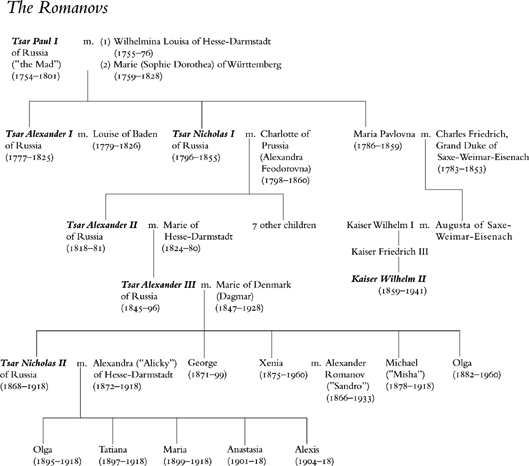
Back in England, George came up with a new last name for himself: Windsor—irreproachably English-sounding, and entirely made up. It established the British royal family once and for all as a slightly stolid but utterly reliable product of the English Home Counties. Though, of course, it wasn’t. Saxe-Coburg-Gotha—like Windsor, not so much a surname as a statement of provenance—had been given to George’s grandmother Queen Victoria (herself half-German) by his grandfather Albert, the Prince Consort, son of the German Duke of Coburg. It was redolent of the close relations and blood ties that linked the whole of European royalty, and which in Britain had been crowned by the fact that Kaiser Wilhelm was Queen Victoria’s eldest grandson. George’s father was Wilhelm’s uncle; his mother was Nicholas’s aunt; Wilhelm and Nicholas, meanwhile, were both second and third cousins, through the marriage of a great-aunt, and a shared great-great-grandfather, the mad Tsar Paul of Russia.
When Wilhelm heard that George had changed his name, he made his almost only ever recorded joke: that he was looking forward to seeing a production of the Merry Wives of Saxe-Coburg-Gotha.
Fifty-odd years before, these three emperors had been born into a world where hereditary monarchy seemed immutable, and the intermarriage between and internationalism of royal dynasties a guarantee of peace and good international relations. How the world had changed. This book tells the story of that change, through the lives of George, Wilhelm, the last kaiser, and Nicholas, the last tsar, and how they presided over the final years of old dynastic Europe and the outbreak of the First World War, the event which set twentieth-century Europe on course to be the most violent continent in the history of the world.
Throughout their lives, Wilhelm, George and Nicholas wrote to each other and about each other in letters and diaries. The history of their relationships—as well as those with George and Wilhelm’s grandmother Queen Victoria and her son Edward VII, who also ruled during this era and whose relationships with the three men were crucial (there were moments in this book’s writing when I almost considered calling it “Four Emperors and an Empress”)—is a saga of an extended and often dysfunctional family, set in a tiny, glittering, solipsistic, highly codified world. But this personal, hidden history also shows how Europe moved from an age of empire to an age of democracy, self-determination and greater brutality.
Wilhelm and Nicholas wielded real power, more power perhaps than any individual should have in a complex modern society—certainly more than any unelected individual. What they said and did mattered. George did not—though neither he nor his father nor grandmother liked to acknowledge it—but his role in the functioning of government was welded into the fabric of British and empire constitutional politics, and there were moments when the monarch could make a difference.
And yet, at the same time, they were all three anachronisms, ill-equipped by education and personality to deal with the modern world, marooned by history in positions increasingly out of kilter with their era. The system within which they existed was dying, and the courts of Europe had turned from energetic centres of patronage into stagnant ponds of tradition and conservatism. The world was leaving them behind. The great technical innovations and breakthroughs, the great scientific theories, the great modern masterpieces of art and letters, were being produced by men—Chekhov, Stravinsky, Einstein, Freud, Planck, Yeats, Wilde, Picasso—who might have been born under monarchies, but for whom the courts meant nothing. As great mass movements took hold of Europe, the courts and their kings cleaved to the past, set up high walls of etiquette to keep the world out and defined themselves through form, dress and precedence. The Berlin court, for example, had sixty-three grades of military officer alone. The Russian court included 287 chamberlains and 309 chief gentlemen in waiting.
Though the world was overtaking them, the three emperors witnessed high politics in the decades before the war from a proximity denied anyone else—even if the conclusions they drew from events were often the wrong ones. Kaiser Wilhelm and Tsar Nicholas led their countries into a conflict that tore their nations apart, destroyed the illusion of their family relationships and resulted in their own abdication, exile and death. George looked on, usually powerless to do anything. Every so often, however,
there came an occasion when his decisions did have consequences. By a terrible irony, 1917—the year he changed his name—would give rise to one of those moments, when he had power over the future of his cousin Nicholas. His decision would vividly demonstrate how Queen Victoria’s vision of royal relationships—indeed the whole edifice of European monarchy—was irrefutably broken.