
John Adams 1735–1826
John Adams was the eldest of three sons of John and Susanna Adams of Braintree, Massachusetts who could trace their lineage back to the first generation of Puritan settlers. While his father wanted him to enter the ministry, Adams instead decided on law.
Early on, Adams became a visible member of the resistance movement against Parliament’s taxation. Yet, despite his hostility toward the British government, he defended British soldiers who fired on a crowd in Boston in 1770. In 1774, Adams was selected to represent Massachusetts at the First Continental Congress where he rejected any reconciliation with Britain. At the Second Continental Congress in 1775, he nominated George Washington to serve as commander-in-chief of the newly created army, and selected Thomas Jefferson to draft the Declaration of Independence. For the next two years, Adams served as head of the Board of War and Ordnance, responsible for raising and equipping the American army.
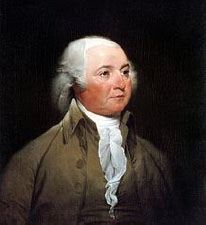
John Adams
For a time, Adams served as an ambassador, but his liability to emotional explosions made him an unnatural diplomat. Despite this, he was partly responsible for the favourable terms of the 1783 Treaty of Paris which recognized the United States as an independent country. Upon returning to the United States, Adams found himself on the ballot for president in 1789 against Washington. When Washington was selected, Adams became vice-president. After serving eight years under Washington, Adams was elected president in 1796 and served one term.
Charles Cornwallis 1738–1805
Charles Cornwallis was the eldest son of the 5th Baron Cornwallis, who was created 1st Earl Cornwallis in 1753. Young Cornwallis was educated at Eton, and Clare College Cambridge, and after graduation entered the army where he saw service in the Seven Years War. Elected to Parliament in 1760, he opposed the tax measures that helped bring on the American Revolution.
When the war came, however, he agreed in 1776 to be sent to America where he served under General William Howe at the Battle of Long Island, in the New Jersey campaigns, and at the Battle of Brandywine.

Charles Cornwallis
In 1778, Cornwallis became second-in-command to Sir Henry Clinton, the British commander in America. Two years later he took command of the British Southern campaign which led directly to the 1781 Siege of Yorktown that ended the war. After holding administrative posts in London, Cornwallis was dispatched to Ireland in June 1798 when the Irish Rebellion broke out. In 1800, he was instrumental in convincing the Irish Parliament to pass the Act of Union that proved a critical step in uniting the British and Irish crowns and creating the United Kingdom of Great Britain and Ireland.
Sir Henry Clinton 1730–1795
Little is known of the earliest years of Clinton’s life. His father, a high-ranking military naval officer, earned the governorship of the Province of New York in 1741 and arrived in New York in 1743, with young Henry. Clinton was educated in the New York and began his military career by joining the local militia in 1748. Three years later, he returned to England to enter the British army. Purchasing a commission as a captain in the Coldstream Guards, Clinton proved a gifted officer.
Clinton took part in the 1775 Battle of Bunker Hill, Massachusetts, and went on to command an unsuccessful expedition against Charleston, South Carolina in 1776. In 1777, he headed the British occupation of Rhode Island. When Howe moved on Philadelphia, Clinton assumed the command of New York, but took no part in the British defeat at Saratoga, New York.
Sir Henry, knighted in 1777, succeeded Howe as the supreme command in America in 1778 after Howe failed to crush Washington’s army at Valley Forge. Acting on orders from London, he evacuated the British troops in Philadelphia and returned to New York. Safely reaching New York, Clinton planned to shift the focus of the war to the South where he believed Loyalist support would be greater. After learning of a French fleet approaching New York, Clinton was forced to turn over command to Charles Cornwallis. When Cornwallis was trapped by Washington at Yorktown, Virginia, Clinton attempted to organize a relief force. Unfortunately, by the time he departed, Cornwallis had already surrendered to Washington. As a result of Cornwallis’ defeat, Clinton was replaced by Sir Guy Carleton in March 1782.
King George III 1738–1820
George William Frederick was born in London on June 4, 1738, the son of Frederick, Prince of Wales and Augusta of Saxe–Gotha. He was the third ruler in the royal British House of Hanover, a Germanic dynasty that had come to the English throne in 1714. He was the first of the dynasty to be born in England. His turbulent reign spanned nearly sixty years, and to date is only surpassed by that of his granddaughter, Queen Victoria.
George came to the throne in 1760, when his grandfather, George II, suddenly died. On September 8, 1761, at age twenty-three, George III married seventeen-year-old Charlotte of Mecklenburg-Strelitz. Their marriage was an affectionate and fruitful union, resulting in fifteen children.
During George III’s reign, Britain was a constitutional monarchy. When he came to the throne, George III inherited a ministry that had started the Seven Years’ War, a global conflict with France and Spain, and fighting in North America, known as the French and Indian War. The government had borrowed huge sums of money to finance the conflict, and when it was decided to tax the American colonies, the American Revolution occurred.

King George III
George’s rule was hampered by mental health problems which may have been attributed to a genetic condition called porphyria, symptoms of which can include severe mental confusion. George had mild bouts of illness early in his reign, but his health significantly deteriorated from the 1780s. He experienced recurring episodes of severe mental trauma during which he was often physically restrained. The Science Museum of London has in its collections an envelope containing hair taken from George III’s head after his death. Analysis found it to be laden with arsenic at a concentration over 300 times that considered toxic. A likely source of arsenic was James’s Powders, a common medicine regularly given to George.
The King’s Golden Jubilee was celebrated in 1809, but soon afterward his mental state collapsed. On 5 February 1811, he was declared unfit to rule and his son George was appointed as regent. George III died on 29 January 1820.
Alexander Hamilton 1755–1804
Alexander Hamilton was born in Nevis, British West Indies. After both his parents died, friends sent him to a preparatory school in Elizabethtown, New Jersey, and in the autumn of 1773 he entered King’s College (later Columbia University) in New York. Intensely ambitious, he became a serious and successful student, but his studies were interrupted by the brewing revolt against Great Britain. He publicly defended the Boston Tea Party, and went on to write three influential pamphlets, which upheld the agreements of the Continental Congress on the non-importation, non-consumption, and non-exportation of British products.

Alexander Hamilton
In March 1776, he organized his own company, and at the Battle of Trenton, he and his men prevented the British, under Lord Cornwallis, from crossing the Raritan River to attack George Washington’s main army. In February 1777 Washington invited him to become an aide-de-camp with the rank of lieutenant colonel. At the siege of Cornwallis’s army at Yorktown in October 1783, Hamilton mounted an assault on a British stronghold which resulted in Cornwallis’s surrender.
As Secretary of the Treasury, Hamilton was the primary author of the economic policies of the George Washington Administration, especially the funding of the State debts by the Federal government, the establishment of a national bank, a system of tariffs, and friendly trade relations with Britain. Widely criticized for his programs (which in time would prove valuable to the new country’s strength), tired and anxious to repair his private fortune, Hamilton left the cabinet on 31 January 1795.
In June 1804, Aaron Burr, who at the time was the Vice President of the United States, demanded revenge for remarks Hamilton had allegedly made against him at a dinner. Hamilton held an aversion to duelling, but as a man of honour, he felt compelled to accept Burr’s challenge. The two men met early in the morning of 11 July at Weehawken, New Jersey, and Hamilton was killed.
Sir William Howe 1729–1814
William Howe was born in England, into a family that was well connected at the Hanoverian Court, where his maternal grandmother reportedly was a favourite of George I. At the age of seventeen he saw service in Flanders. He fought during the French and Indian War, and succeeded General Gage as commander of the British army in America. Before the American Revolution, Sir William had returned to England, where he served in Parliament.
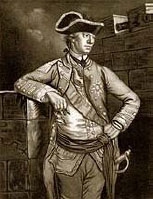
Sir William Howe
Three years before the Revolution, he was made major-general, and in 1775 was sent to the relief of Thomas Gage at Boston. His first engagement after the start of the Revolutionary War was the disastrous victory of Bunker Hill where the British were victorious, but lost over 1,000 men without gaining much strategic advantage. It was after this battle that he was chosen to succeed Gage. He commanded successfully at the battles of Long Island, White Plains and Brandywine, but after making no attempt to crush Washington’s weakened army at Valley Forge, he was replaced by Sir Henry Clinton in 1778.
John Jay 1745–1829
John Jay was born in New York City to a prominent family. Educated in his early years by private tutors, he later went to King’s College (later Columbia University) to study law. In early 1774, at the age of twenty-eight, he was one of the most prominent members of the New York Committee of Correspondence and attended the First Continental Congress. Irritated that his opinion on independence from Britain was not supported in the early years, Jay retired from Congress in 1776 rather than sign the Declaration of Independence. When Jay returned to Congress, he helped negotiate the Treaty of Paris in 1783, ending the war with Great Britain.

John Jay
Though he did not attend the Constitutional Convention to replace the Articles of Confederation, he did contribute five essays to a series of newspaper articles called ‘The Federalist Papers’, which called for the ratification of the proposed Constitution. Jay became the first Chief Justice of the United States Supreme Court, serving from 1789 to 1794. Washington appointed him to negotiate the Jay Treaty in 1794, which eliminated British control of western posts, established the US claim for damages from British ship seizures This also provided the US with a limited right to trade in the West Indies. More importantly, it prevented war with Britain. For the Jay Treaty he was widely lambasted, despite its various successes. Jay retired from public life in 1801 and died on 17 May 1829.
Thomas Jefferson 1743–1826
Jefferson was born in Albemarle County, Virginia, inheriting 5,000 acres of land from his father, a planter and surveyor, and high social standing from his mother – a Randolph. He studied law at the College of William and Mary. In 1772 he married a widow, Martha Wayles Skelton, and lived with her in Monticello, Virginia.

Thomas Jefferson
In the Virginia House of Burgesses and the Continental Congress, he contributed to the Patriot cause with his pen rather than his voice. As the ‘silent member’ of the Congress, the thirty-three-year-old Jefferson drafted the Declaration of Independence.
Jefferson succeeded Benjamin Franklin as minister to France in 1785. Whilst he was Secretary of State in President Washington’s Cabinet, his sympathy for the French Revolution led him into conflict with Alexander Hamilton. He resigned in 1793.
A reluctant candidate for president in 1796, Jefferson came within three votes of election, thus becoming vice president instead, under his opponent John Adams. In 1800 he at last became the third president of the United States, serving two terms. Under his guidance, for a cost of $15 million, United States purchased from France all the land west of the Mississippi, effectively doubling the size of the United States.
Henry Knox 1750–1806
Henry Knox was born in Boston, Massachusetts, and left school by the age of nine due to family circumstances. Years later, he nevertheless gained an education of sorts as a bookstore owner, cultivating a keen interest in military history and artillery. He became active in the colonial militia and in 1775 joined the Continental army at Cambridge, Massachusetts where he was placed in charge of the artillery.
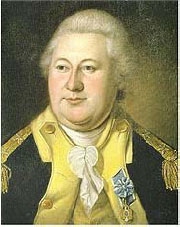
Henry Knox
Eventually promoted to major general in the Continental army, he took part in most of the major battles of the Revolutionary War, and became a close friend and advisor to George Washington.
After the war, Congress made Knox the Secretary of War. He remained in this position throughout George Washington’s presidency.
James Madison 1751–1836
James Madison was brought up in Orange County, Virginia, and attended Princeton (then called the College of New Jersey). A student of history and government, and well read in law, he participated in the framing of the Virginia Constitution in 1776, and served in the Continental Congress. When delegates to the Constitutional Convention assembled at Philadelphia, the thirty-six-year-old Madison took frequent and emphatic part in the debates.

James Madison
Madison made a major contribution to the ratification of the Constitution by writing, with Alexander Hamilton and John Jay, the Federalist essays. In later years, he was referred to as the ‘Father of the Constitution’. He was elected to the House of Representatives in 1789 and served as Washington’s chief supporter. But as Washington increasingly embraced Alexander Hamilton’s financial proposals, Madison began to oppose both of them. Madison served as President Jefferson’s Secretary of State and went on to be the fourth elected president himself in 1808.
Lawrence Washington 1718–1752
Lawrence Washington was born in 1718 at Pope’s Creek Plantation in Westmoreland County, Virginia, son of Augustine and Jane Washington. He was the older and beloved half-brother of George Washington, and took over George’s education when their father, Augustine Washington, died. He was a soldier and prominent landowner in colonial Virginia. As a founding member of the Ohio Company of Virginia, and a member of the colonial legislature representing Fairfax County, he was chiefly responsible for securing the establishment of the town of Alexandria, Virginia on the banks of the Potomac River in 1749.

Lawrence Washington
In July 1743 Lawrence married Anne Fairfax from Belvoir, Virginia. She was the daughter of Colonel William Fairfax, himself a land agent for his cousin, Thomas Fairfax, 6th Lord Fairfax of Cameron. In 1751, Lawrence and George sailed to the island of Barbados hoping that the tropics might help Lawrence recover from tuberculosis. The warmer climate did little to help and Lawrence died at his Mount Vernon home, in July 1752. In time, George Washington inherited the estate at Mount Vernon.
Martha Dandridge Custis Washington 1731–1802
Born at Chestnut Grove in New Kent County, Virginia, her father John Dandridge emigrated to Virginia from England at the age of thirteen. He settled in New Kent County and became county clerk in 1730, the same year he married Martha’s mother, Frances Jones.

Martha Washington
Martha was the eldest of three brothers and five sisters, and married Colonel Daniel Parke Custis in 1750. Custis managed the large New Kent County plantation of his father, Councillor John Custis, who lived at the brick house known as Custis Square in Williamsburg, Virginia. Martha and Daniel Custis had four children, but only John (Jacky), born in 1755, and Martha (Patsy), born in 1756, survived childhood. When Martha Custis was only twenty-six-, her husband Dandridge died suddenly.
Martha married George Washington on January 6, 1759. In April of that same year, George, Martha, Jacky, and Patsy moved to Mount Vernon. Although she remained at Mount Vernon when George was at war and with the Congress, she occasionally accompanied him to his headquarters during the war years. They lived in Philadelphia until Washington’s retirement, returning to Mount Vernon on 15 March 15 1797. Following her husband’s death in 1799, she lived as a widow for two and a half years until she too died at Mount Vernon 22 May 1802. Although the title was not coined until after her death, Martha Washington is considered to be the first First Lady of the United States.