
PART THREE

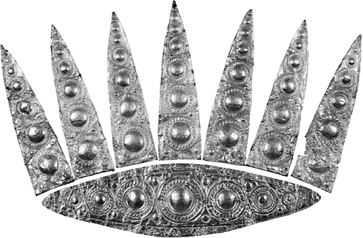
Previous page:
Gold diadem of a princess, found in Shaft Grave III at Mycenae. c. 1550–1500 BC.
Wise men in Greece in the meanwhile to swagger so about a whore
THOMAS NASHE, Of Lenten Stuff (1599)
THE FRESCOES AT THERA suggest that a pubescent, pre-historic princess was quite some prize. And now, the architects of Helen’s story tell us, in Sparta, in the Age of Heroes, this was a prize that had to be played for. Helen’s brush with sexuality on the banks of the Eurotas had been premature. In one sense she was a spoiled woman. But her assailant Theseus was, at least, a king. Helen had not been defiled by a nobody. This was a princess with land and standing – she still had worth. Whoever married her might not get a virgin, but they would get the rich Spartan kingdom. They would – we are told – also get a fair woman, shining, golden, a young girl blessed with incomparable beauty. Messengers were sent across Greece and beyond: Tyndareus’ peerless daughter was to be fought for. Down to the 3rd century BC, Greek families boasted that their ancestors had gone to Sparta to vie for Helen’s hand. Losing was no shame – competing with such a prize at stake was honour enough in itself.1
Because Helen was worthy of only the finest, her father, Tyndareus, organised a marriage contest in which all the warriors of the land had to compete in shows of strength and offers of wealth.2 There is no consensus as to where the contest took place, other than at Tyndareus’ home. Some ancient writers say Sparta itself,3 others just leave a blank. But in Euripides we find Tyndareus’ domain coupled with a reference to the name Amyklai.4 Amyklai was originally a pre-historic settlement 7 km due south of Sparta. It is surrounded by plenty of flat land which could have accommodated the contests of heroes – chariot-driving, foot-racing, wrestling – not to mention the bulkier bribes the suitors brought with them: the poet Hesiod tells us that in a bid to win Helen, the hopeful heroes imported vast herds of oxen and sheep as well as gleaming pots, pans and cauldrons.5 So let us imagine the marriage contest for Helen taking place here.
Amyklai is an atmospheric place – face east and at your back is the Tayegetan mountain range that keeps its snow long into the summer. Look out across the little promontory of the site and you are greeted by a soft green patchwork of farmland – hummocky and ramshackle, where elfin fields are peppered with copses of olives. Sapling trees and oleanders grow over half-excavated blocks of stone. The peace is broken only by the sound of tractors chugging up and down the lane below, delivering the agricultural produce which has always been particularly plentiful in this sheltered spot.
Close by at Vapheio, up a neat avenue of olive trees, there is a deep beehive tomb dating from the 15th century BC – the final resting place of a Mycenaean warrior. The tomb had been plundered down the centuries, but robbers overlooked a sunken burial pit, which was then excavated in 1889 by the Greek archaeologist Christos Tsountas. Here alongside the accoutrements of the dead – perfume vases, a mirror, daggers, knives, hunting spears, axes, beads and an ear-pick – were found two lavish gold cups, both moulded with rippling scenes of bull-taming.6
At Amyklai itself there are only a few remnants from pre-history. The site seems to have been occupied after many of the larger palatial complexes such as Mycenae had been destroyed around 1200 BC. The Mycenaean objects uncovered here included unique finds – human clay figures of almost life-size who would have overseen some kind of ritual activity. Here too there was a plethora of rough female figurines. This was a place of cultic significance. Amyklai, serene now, once witnessed idiosyncratic and fervent rites, long since lost to time.
Throughout the archaic and classical periods this was the home to alfresco festivals such as the Hyakinthia which was held in honour of Apollo and Hyakinthus.7 The textual references are matted, but there is a strong possibility that Helen was worshipped here too in a festival called the Heleneia. 8 Families would take tents, picnics and plenty of wine to the sanctuary and eat, drink and dance long into the night. Girls would drive here in kannathra from the town of Sparta: some of these gaudily decorated carts were in the shape of fantastical creatures – griffins or goat-stags.9 The whoops and cries of the drivers and the jingle of tack would be heard for miles about as the young Spartans raced each other in Helen’s honour. The course ran through the outskirts of Sparta to Amyklai, or to ‘eis to Helenes’ – to Helen’s sanctuary.10 The races were popular, the competition fierce. It is all a far cry from Athens, where women were allowed to ride in chariots only to weddings and funerals.

The notion of a Bronze Age precinct here at Amyklai, or at Sparta itself, packed with suitors, the tense and sweaty pick of male Mycenaean society, is vivid – and was inspirational to the earliest known authors in the West. Hesiod lists the heroes who came to fight for the Spartan princess on that first occasion – because, of course, they are to meet again, competing for Helen on the battlefields of Troy. He mentions one suitor, Philoctetes, and then quickly, and elegantly, moves on to describe the heroes’ prize. Throughout this catalogue of the great and the good Hesiod drops in little reminders of Helen’s beauty. She is ‘neat-ankled’, ‘rich-haired’, ‘the girl whose renown spread all over the holy earth’.11
We have only fragments of Hesiod’s poem and so cannot trace a complete list of heroes, although tradition has it that anywhere between twenty-nine and ninety-nine men turned up. Helen’s husband-to-be, Menelaus, one of the princes of Mycenae, did not attend, although his older, richer brother Agamemnon was there.12 Achilles, being too young to come, was conspicuous by his absence. Hesiod points out, in a barbed aside, how lucky Menelaus was to get Helen: ‘Menelaus could not have won Helen nor would any other mortal suitor, if swift Achilles returning home from Pelion had encountered her.’13
Each hero, each clan-leader in the stories, had his own coterie of likely lads, or ‘etai ’. This was a social rank that has its counterpart in the Late Bronze Age hequetai, who seem to have been a chariot-driving warrior caste. Contests such as these are not figments of the classical imagination. The Bronze Age elite would certainly have met together in fierce combat-sports to sort out the men from the boys: to determine among them which of the aristocrats really was the best (aristos in ancient Greek) and who there-fore deserved control (kratos). On a variety of visual sources from the Bronze Age we find men slugging it out – not in battle, but in complicated ‘friendly’ combats, engagements that were designed to perfect close-quarter combat skills. Submission fighting, submission wrestling, mock battles with pikes and shields and boxing are all represented. These contests were important preparation for war, but also served to identify the real ‘heroes’ within the citadels. Their ancient Greek name, agones, is the root of ‘agony’; the etymology goes some way to convey the intensity of such contention.
Dressed to impress, to strut in front of each other, and perhaps Helen, the Mycenaean hopefuls would have worn short kilt skirts or tailored tunics made of linen, or goat or sheep wool. Frescoes from Pylos show men with black leather skirts, cut into points, the leather offering a second-skin protection. It appears that only the elite were allowed to wear pleated tunics – those of lower status have a simpler garment, on occasion decorated with braids. Workers wear loin-cloths.14
Homer was eloquent when recounting the impact the elite would have made, massed on the battlefield: ‘Argives armed in bronze’.15 Then in 1960, in the Argolid at Dendra near the Mycenaean citadel of Midea, came a staggering discovery: a Late Bronze Age tomb harbouring a warrior’s fine armour dating from c. 1400 BC. The village that peters out just before the site has a scruffy old-world charm; small-holdings abutting the site are ramshackle; scrawny hens pick their way around rusting cars. Nothing prepares you for the stern glory of the panoply that was dug up a few yards away. The bronze plates are 1 mm thick; skilfully wrought, they would have been lined and laced with leather, and stitched together, a high collar covering mouth and chin. The overall impression is bold, inhuman – designed to intimidate.
This fine panoply, three and a half thousand years old, now stands quietly on the first floor of the Nafplion Museum – a half-hour drive from its point of discovery. The Nafplion Museum looks directly out over the town’s central square, a place bright with activity, serving ice-cream and pungent coffee late into the night. Most of the diversions on offer are fresh and brassy. There are children’s boutiques, pool bars and an unfeasible number of shops selling rainbow-coloured komboloi – worry beads. In the museum, the armour, although one of the oldest inhabitants of the area, seems almost out of place: discoloured and dull from its many centuries in the earth, alien, sterile, awkwardly weighty. But imagine that bronze new and polished as Homer did and suddenly the armour sparks with life:
As ravening fire rips through big stands of timber high on a mountain ridge and the blaze flares miles away, so from the marching troops the blaze of bronze armour, splendid and superhuman, flared across the earth, flashing into the air to hit the skies.16
Also found at Dendra were the bronze cheek-pieces (chalkoparios in Homer meaning ‘of brazen cheeks’) that would have been attached to a boar’s-tusk helmet. Extant archaeological examples that pre-date Homer by five hundred years match his account perfectly.17 Here forty or so split tusks are wrapped around in concentric circles – up to ten adult animals would have been killed for each helmet. Hard boar’s tusks would have made a good barrier, cradling the warrior’s skull – but they were also symbolic. Of all the animals potentially fatal to Bronze Age populations, it was the grouchy, belligerent wild boar that would have been encountered most frequently. An animal behaviourist told me while we were analysing pre-historic hunting techniques that he would far rather be left in a cage of wolves than in the wild boar enclosure.18 A boar’s-tusk helmet signalled both a successful hunter and a warrior who carried the fighting spirit of a fearsome animal with him.
A marriage contest in the Bronze Age for a woman such as Helen – a Spartan heiress – would have sponsored an excess of preening and posturing, since otiose display was at its heart. Showy panoplies such as that found at Dendra and boar’s tusk helmets would have been dusted down and paraded in front of the assembled company. In a society whose good relations were based firmly on gift exchange, a unique prize such as Helen would have attracted only those able to promise substantial material reciprocation.19 A sexually mature princess, a living, precious asset, was joining herself to the member of another clan and to merit such an honour, he and his family would have to deck themselves in their finest attire and dig deep into their pockets. Opening his doors to the glory of Greece, Tyndareus must have smiled as he thought ‘And may the richest man win.’
In Mycenaean Greece money was yet to be coined. So a Bronze Age hero would hope to impress in other ways. Recent discoveries suggest that in addition to gift-giving one form of social display – a way of broadcasting superiority – may well have been an equitation. In the 13th century BC horse-manship was already well advanced east of the Bosphorus, but appears to have been in its infancy on the Greek mainland.20 There are a number of representations of Mycenaean chariots and charioteers on frescoes, seal-stones and grave-markers – but up until the middle of the 20th century, none had been found of a mounted rider. Then in 1953, a miniature figurine, a man dressed in armour and riding a horse, was found at Mycenae.21 Forty years later there was an extraordinary discovery: five clay figurines excavated in the destruction layer of a cultic shrine at Agios Konstantinos near Methana, each showing a man on horseback. The riders sit high up, their arms flung around the horses’ withers, their hands wound into the animals’ manes. One figure in particular looks as though he is half-standing, leaning against the horse’s neck in a streamlined position, the stance of a jockey winning a race.22
The movement and poise of these figures is not tentative, it is confident. Riding might have been a novelty, a skill in its infancy, but these are men in charge of their mounts. With the Methana discovery it was evident that on the Greek mainland in the Late Bronze Age, a select band of men could ride – and could ride well. Mastering this new mode of transport-cum-fighting-machine would have been both the privilege of the elite and its distinguishing mark. Homer’s depiction of Agamemnon’s father, the King of Mycenae, as ‘that skilled breaker of horses’,23 of the ‘stallion land of Argos, 24 now seems appropriate. We can indeed imagine the Mycenaean heroes on horse-back, signalling their superiority as they rode through Peloponnesian territories.25
When the eager suitors thundered through the Taygetan plain to Sparta, their horses spittle-flecked and colourful, a caravan of gifts behind in preparation for the marriage contest ahead, they would have cut quite a figure.26 All yearning to win glory and a peerless princess. To take possession of a thing of beauty. This moment of anticipation was brilliantly evoked in the 7th century BC by Hesiod as he coupled male sexual imagery (a spear) with a description of Helen’s god-given charisma:
… Philoctetes sought her, a leader of spearmen … most famous of all men at shooting from afar and with the sharp spear. And he came to Tyndareus’ bright city for the sake of the Argive maid [Helen] who had the beauty of golden Aphrodite, and the sparkling eyes of the Graces.27
But as they rode into the Spartan domain, the old King of Sparta, Tyndareus, made them promise one thing before they fought, raced, sang and bid for the princess. Since there could be only one winner and many losers, they had to swear eternal allegiance to he who was successful. Even if they were not lucky enough to claim Helen, they must remain loyal to each other, must help each other whenever asked, must not allow jealousy to divide them.28 As a sign of the enormous importance of the pact, Tyndareus sacrificed a horse.29 The heroes of Greece would keep their word.