
PART FOUR

Previous page:
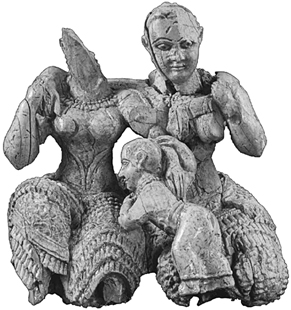
An ivory triad, two women and a girl – one of the first pieces of Greek art carved in the round. Discovered in the citadel at Mycenae. Probably made around 1350 BC. Some believe these are goddesses.

1 Helen emerges from an egg. In some versions of the story, Helen’s mother was not Leda but Nemesis – the spirit of Fate or Revenge – who took the form of a goose and mated with Zeus.
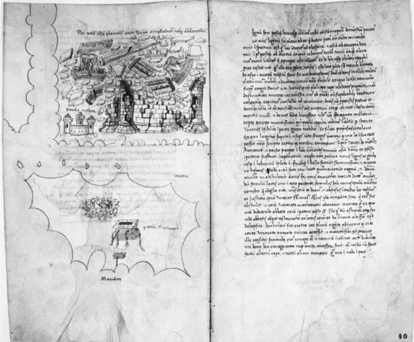
2 From the Classical period onwards, men have searched for the site of Troy. This illustration from a 15th century AD manuscript gives an artist’s impression of the settlement. Troy was a totemic site for both the East and the West – after taking Constantinople in 1453, the Ottoman ruler Mehmet the Conqueror visited, declaring his desire to avenge the age-old Trojan dead.

3 Women appear to dominate the religious rituals of the Mycenaean age. This fresco was discovered in the cult complex at Mycenae in 1968. The imagery is obscure. One woman holds a giant sword, another a staff, a third ears of wheat. Two tiny male figures tumble down in front of the armed ladies.

4 Helen was worshipped in the town of Sparta itself and on the nearby hill of Therapne. These are two of the votive offerings left to her: a mounted terracotta female figure and a perfume jar inscribed with Helen’s name (5).

6 Spartan girl-athletes dedicated mirrors, such as this 6th century BC example, at religious sanctuaries. These were expensive, finely wrought items.

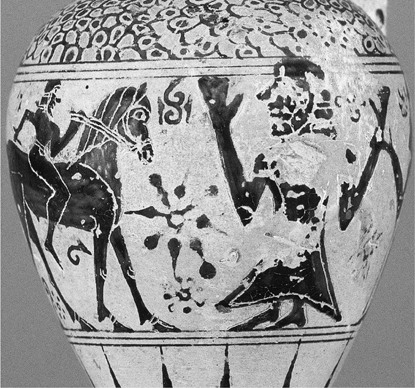
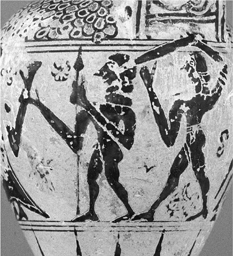
7 Theseus’ abduction of Helen could relate to a broader mythological story: the seizure of a young woman who represents fertility (spring and summer) and whose absence brings winter to the earth. In this early image (c. 680 BC) Helen has monstrous proportions, suggesting she is being represented as a quasi-divine figure (8). Theseus and Peirithous seize her, but she is about to be saved by her two brothers, Castor and Pollux, mounted on horses.

9 This female figure from Mycenae clasps her breasts – a defining gesture of a goddess. Dots represent bracelets and a necklace.

10 The mounted goddess figurine could suggest that highborn women were permitted to ride in the Late Bronze Age.
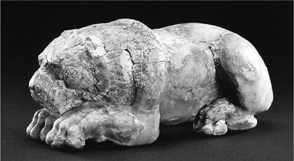
11 Mycenaean delight in visible beauty is demonstrated by this finely carved ivory lion.

12 In the Late Bronze Age, female figurines were produced in great numbers. This example, found at Mycenae, carries one child in her arms while another is strapped to her back underneath a parasol. She is a kourotrophos – a nurturer of shoots/youngsters.
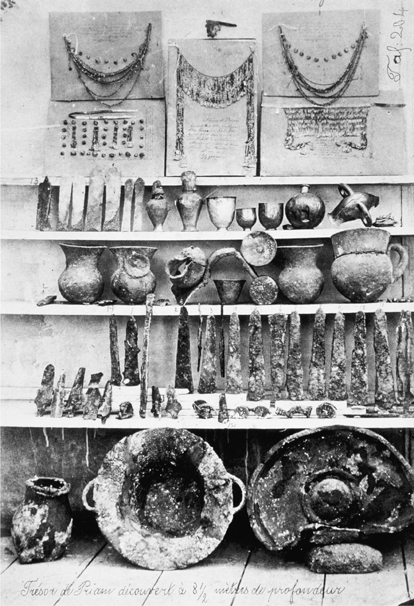
13 Schliemann proudly presented ‘Priam’s Treasure’ (a misnomer) to the public in this archive photograph taken in 1874. To access finds such as these, during his first excavation season at Troy, Schliemann moved 78,000 cubic metres of earth.
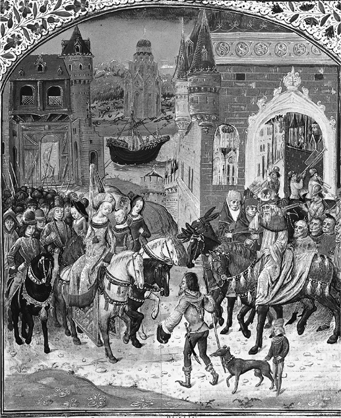
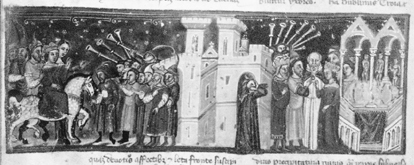
14 A number of European dynasties traced their lineage back to the Romans (as the Romans did back to the Trojan hero Aeneas). In both these medieval scenes, Helen is welcomed into Troy as an honoured and respected aristocrat. But in fig. 15 Cassandra, the prophetess, hints at the doom to come as she tears out her hair.

16 Mycenaean chariots have wheels with only four spokes (the Hittite chariot has six) and are lighter than their Hittite counterparts.
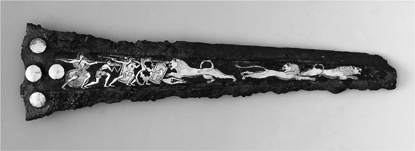
17 Much Mycenaean art deals with military themes or the joy of the hunt. The decoration on this dagger shows Mycenaean warriors killing a lion. Note the large rectangular ‘tower-shield’ and the shields covered in hide. In the Iliad, Ajax is described as bearing a shield ‘like a wall’ covered in ox-hide.

18 Linear B tablets were incised blocks of clay. This tablet lists the herbs and spices (such as e-pi-ka – hibiscus) used for culinary and medicinal purposes. The word pa-ma-ko (the root of pharmacy) has also been inscribed.
Let the premature guzzle wine that is hardly fermented, I’ll take wine from a jar mellowed in vintage with time. Only the full-grown tree resists the heat of the sunlight, Meadows too recently sown offer the barefoot no joy. Who wants Hermione, if Helen is his for the taking?
OVID, The Art of Love1 1st century BC/AD
BEFORE DISASTER STRIKES, the poets allow Helen and Menelaus a little happiness. In the Spartan palace they have a child, a beautiful daughter, Hermione.2 Hesiod tells us this was a difficult confinement: ‘she bore fair-ankled Hermione in his halls – though the birth had been despaired of ’.3 Difficult and singular. In the Iliad, while slipping in the information that Menelaus had sired a son (Megapenthes – ‘great grief ’) by a slave girl, Homer relates:4
To Helen the gods had granted no more offspring once she had borne her first child, the breathtaking Hermione, a luminous beauty gold as Aphrodite.
To try to solve their fertility problems, both the Helen of the epic poems and our Bronze Age queen would have made propitiation to the goddess of procreation and childbirth, Eileithyia. The name means ‘she who appears’ or ‘she who arrives’. A divinity first attested on Crete, where she appears on Linear B tablets as Eleuthia. 5 Eileithyia was a popular goddess who came to be worshipped at cultic sites across the Aegean.
In the 6th century BC a stone effigy of Eileithyia was hacked out of a lumpy piece of rock: it now stands alone against a side-wall of the museum at Sparta. I noted during one visit to the museum that curators had hedged their bets and the figure was described on its faded cardboard label as ‘Eileithyia/Helen/Hera’.6 The form is beautiful and undeniably earthy. The figure’s sex organs are marked by a deep gash at the vulva, and the woman is clearly in labour: either side of her there are daimons or spirits, clutching her belly, helping her get through the terrible pains of childbirth.7
Travel south from Sparta for a day and a night by boat, and you find Eileithyia again. About half an hour inland from Crete’s cramped Heraklion airport, in the summer packed with tourists, mainly British, there is an underground cavern known as the Eileithyia cave. No longer an official tourist attraction, the cave can be reached by scrambling off the roadside and forcing a way through a small overgrown copse of olive trees. Inside the air is dank and bitter. As eyes grow accustomed to the dark, phallic and vulvic rock-forms loom out of the shadows. The walls are moist with a pale green fluid that drips down the rock-face.
Votive offerings left here reveal virtually continuous use as a sacral site from 3000 BC. There are potsherds spanning time from the Bronze Age to the medieval period – including the remains of Christian lamps from the late Roman Empire. A Linear B tablet from Knossos indicates that in the Late Bronze Age honey was brought to the cave as an offering to Eleuthia.8 The cavern is described in the Odyssey as the haunt of the goddess of childbirth and labour.9 Just inside the entrance there is a stomach-shaped flat rock, worn smooth over 5 millennia by the gyrations of countless, name-less believers: pilgrims hoping to enhance their own fertility through contact with the divine spirits of the place.10
It was as a pregnant, twelve-year-old woman, following her abduction by Theseus, that Helen was said to have founded her own shrine to Eileithyia in Argos. The sanctuary was noted by Pausanias as he migrated around Greece:11 commemorating the rape of a young girl and a bastard birth, the shrine was still the locus of devotions well into the Roman period.12

And it would have been as a twelve-year-old that a Bronze Age Helen would be charged with the responsibility of producing heirs for the Spartan citadel. Skeletal evidence from the Late Bronze Age indicates that women had lower life-expectancy than men – largely because of the trauma associated with continuous pregnancies and childbirth. A seminal osteo-archaeological survey of Late Bronze Age female bone-material across the Eastern Mediterranean has drawn the conclusion (from traumatised pubic bones) that women would typically have sustained five pregnancies by the time of their death.13 Other studies of the period show that women might have produced at least one child a year.14 A Late Bronze Age aristocrat – typically dead by the time she was twenty-seven or twenty-eight15 – would never have become menopausal; she would have seemed eternally fecund.16
Yet we know that the high-born of the Late Bronze Age tried to avoid pregnancy: there are descriptions from contemporary societies of recipes and gadgets used by women to afford themselves some contraceptive protection.17 The Egyptian records are particularly explicit. Because of their regular contacts with Egypt through trade,18 it is absolutely possible that the Mycenaeans would have had access to the Egyptian contraceptive recipes which had been in circulation since around 1850 BC. 19 Documents from Egypt show that the Egyptians exchanged remedies with the Minoans during the period of Mycenaean occupation.20 In the vicinity of the cult centre at Mycenae, Egyptian blue-green faience doorposts, inscribed with the throne-name and birth-name of Amenophis III, flanked a room that some argue was set aside as an Egyptian ‘consulate’, a place specifically dedicated to the mediation of Egyptian interests and information, including medical knowledge.21
The Egyptians favoured contraceptive suppositories (both oral and vaginal) and creams. Some, such as those made of elephant or crocodile dung, must have formed a rather dubious barrier. But old wives on occasion knew what they were doing; one preparation incorporates the tips of acacia (containing gum arabic), which produces lactic acid during fermentation – and lactic acid is a constituent of many modern contraceptives. Many of these unguents and embrocations were bound together with honey and held in place by natural sponges – precursors of honey-caps, today’s contraceptive of choice for the eco-friendly.
There is no extant evidence of contraceptive use in the Mycenaean world – we have to wait until the classical period before Greek prescriptions and potions are written down. One thing that is clear once documentary evidence is available is that many women relied on polypharmacy for both contraception and abortion; that is, throwing in as many ingredients as possible and keeping their fingers crossed. Cedar resin was applied to the mouth of the womb; sponges were soaked in vinegar and oil; Vitex agnus castus22was eaten. According to many ancient sources, the latter brought on contractions in labour, promoted the flow of breast-milk, could act as an early abortifacient or suppress sexual desire (the Latin agnus comes from agnos, which in Greek means ‘chaste’). Modern research shows that over a period of time, derivatives from the shrub act as a hormone balancer and can indeed be used to treat a number of gynaecological problems.
It was vital to keep all these tricks and treatments used by women under surveillance, because without healthily reproductive females ancient communities could not survive. So, some time at the end of the 5th century BC, the Peri Partheniōn is written – part of the Hippocratic Corpus. It deals with subjects such as menstruation, the hysteria of adolescents, appropriate treatment of the hymen, and far-fetched theories including the peregrinations of the womb around the female body during the menstrual cycle. In the ancient world girls and their periods were a serious, if baffling, business.
Those women in classical Greece who were expected to produce heirs for the family and the community were subjected to regular and intimate physical examinations. The progression from maiden (parthenos) to wife (gyne) was marked by three kinds of bleeding: menstruation, loss of virginity and childbirth.23 All these stages would be tabulated by other members of the household. And a woman was thought to be a true gyne, or wife, only if she had passed lochia (normal discharge) after the birth of her first child. There was intense pressure on a Greek woman’s body to behave in an ‘orthodox’ biological fashion.
Still, the Helen remembered in the stories of the ancient Greeks had passed this test – she had proved herself fertile and, in an apparently matrilineal society, had succeeded in producing an heir for the Spartan citadel. Hermione was the obvious person to pick up the mantle of Helen’s perfect, enticing beauty and authors of antiquity fantasised about the daughter as they did about the mother; witness the Roman writer Plutarch quoting a fragment of Sophocles:
… that young maid, whose tunic, still unsewn, Lays bare her gleaming thigh Between its folds, Hermione.24
There are towns named after Hermione, songs written about her, small tokens of honour. Sappho25 lists her among the great beauties, in a fragment that bears only the words, ‘… [for when] I look at you face to face, [not even] Hermione [seems to be] like you, and to compare you to golden-haired Helen [is not unseemly] …’26 But the girl who would be abandoned by the Spartan queen never managed to reach her mother’s iconic status. She was attractive, but lacked her mother’s ability to floor men – an also-ran if ever there was one. First, she was branded by Helen’s misbehaviour.27 In Euripides’ Helen, Hermione sits alone in Sparta, unmarried because she has a harlot for a mother.28 In another Euripidean play, Andromache, we hear that once she has become a mature woman, her husband finds her unattractive because she is barren and ‘unfit’.29 But most importantly, because thousands of men willingly fought and died for Helen, it is the mother who is exalted. Helen’s beauty is magnified by the blood shed in her name. Whereas Helen still blazes a trail after the Trojan War, many imagined Hermione’s life to be cauterised by her mother’s crimes. Hermione is a blameless beauty – and she is less exciting because of it.
Down the centuries, however, Hermione proved useful as a foil for Helen’s disgrace. By emphasising that Hermione was an innocent, a reject, a victim, authors could really stick their knives into the Spartan queen. The Roman poet Ovid, in his clever, manipulative style, manages to evoke Hermione’s grief in his Heroides30 (a collection of fictitious letters from one ancient celebrity to another):
Oh my mother, you did not hear your daughter’s childish words, you neither felt her arms around your neck nor felt her weight on your lap; it was not your hand that cared for me; when I was married no one prepared the bed. When you returned, I went to meet you – I tell the truth – but I did not know your face. You were the most beautiful woman I had ever seen, you had to be Helen, but you asked which one was your daughter.31
Maternal neglect is another notch on the tally of Helen’s transgressions. As ever, following her footsteps one encounters not only history and myth, but the preoccupations and prejudices of those who have made her their subject.