
PART SEVEN

Previous page:
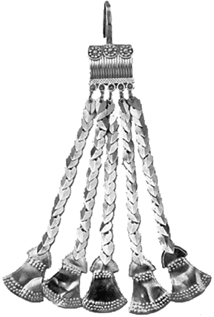
A gold earring from the hoard of treasure nominated by Schliemann ‘The Jewels of Helen’ discovered at Troy. c. 2500 BC.
For then it was, because of the rape of Helen, that Troy began to summon against herself the chieftains of the Argives, Troy – O horror! – the common grave of Europe and Asia, Troy the untimely tomb of all heroes and heroic deeds.
CATULLUS (1st century BC)1
THE RELIGIOUS SITE OF DELPHI in the north of Greece is – despite the coachloads of tourists – still an awe-inspiring place. High in the hills, hugging the southern slopes of Mount Parnassus, the air is light and sweet. Delphi was considered by the Greeks to be theomphalos – the navel of the earth, the centre of the world.2 Throughout antiquity, men would come here from as far away as Syria and Sicily to make their religious devotions, to trade, to hone political deals and to try to comprehend the cryptic pronouncements of the Delphic oracle.3
The oracle handed out advice in all degrees. Some came with domestic problems: should they marry? How could they get a son? Statesmen arrived with grander questions: what sort of law codes should they introduce? Should they invade their neighbours’ territory? Treasuries and embassies crowded along the Sacred Way. Here the leaders of the day met to talk and admire the self-aggrandising portraits commissioned for the busy highway. Every four years (when it was first instituted, every eight) gymnasts, boxers and charioteers – a polyglot crowd – would limber up for one of Greece’s busiest religious festivals, the Pythian Games. Delphi was a place that mattered, and the pronouncements of its oracle were taken very seriously indeed.
One section of the ancient site is not open to the public. Although reaching the spot is quite a hike and would probably pick off the less determined sightseers, here the landscape is peaceful and strange. Close to the fine, classical stadium there is a peculiar, bulbous stone – once a pint-size temple hacked out of volcanic rock. The rock was the home of the Pythia, an old woman symbolically dressed in a young virgin’s clothes, who, high on the fumes of roasted henbane seeds or crushed laurel, would babble out the Delphic oracle. These mumblings would then be analysed by a male priest who turned them into hexameter verse. Generally the oracle’s prophecies were translated into such obtuse riddles that they could be interpreted in a number of ways. But the pronouncements pertaining to Helen were unambiguous. Recorded on stone, the stark words told the ancient world that:
Helen would be brought up in Sparta to be the ruin of Asia and Europe and for her sake the Greeks would capture Troy.4

Any modern-day traveller through Turkey is sure to remember the moment sailing over the Bosphorus, or crossing the Atatürk Bridge by coach, passing over the swordfish and dolphins and anchovies swimming down below, and being told through the proud nasal tones of a tannoy that one is leaving Europe to enter Asia. Our world-view – partly informed by the reception of tales of the Trojan War – is that the globe is indeed split in two: that the Orient and the Occident exist as distinct (often antagonistic) entities.
Was there a moment when two Bronze Age lovers crossed some kind of imaginary fault-line – the moment when West became East? This was certainly an idea that caught hold of the popular imagination in the 5th century BC – at a time when tensions between Europe and Asia were to the fore. Since the 6th century BC, the Persians had made it clear to the Greeks that their ambitions lay in the west. The Persian Empire was indeed mighty – at its peak between 522 and 486 BC during the reign of Darius 1, it reached from the coast of modern-day Turkey to Afghanistan and Pakistan and included parts of Egypt, Armenia, Iran and Iraq. Greece was outranked and, with their backs against the wall, the Greeks were quick to vilify their towering rivals across the waters.5
The immoral, degenerate Persians were much talked about in plays and literature, often contrasted with the tough, wily Greek underdogs.6 In either 479 or 478 BC the popular orator Simonides delivered an elegy, equating the Persian and Trojan Wars.7 The earliest extant Greek tragedy, Aeschylus’ Persians, produced on stage in 472 BC, dealt with the hostility between Persia and Greece – Aeschylus himself was a veteran of the Persian conflict. The sack of Troy, an exponential Greek victory, gave great hope to the beleagured Athenian Empire. The Trojan War story swiftly became a part of political and cultural polemic. Aeschylus equated the Bronze Age Trojans with the modern-day Persians – or, as he calls both peoples, the ‘Phrygians’.8
The historian Herodotus, writing in the 5th century BC, is very clear that the oracle at Delphi was sound, that it was Helen’s crime that had marked a totemic division between east and west, the start of an enmity between Europe and Asia. Twice he quotes Persian sources as proof: ‘in their opinion, it was the taking of Troy which began their feud with the Greeks’; and again, ‘the Greeks, all for the sake of a Lakedaemonian woman, mustered a great host, came to Asia, and destroyed the power of Priam. Ever since then we have regarded the Greeks as our enemies.’9
Herodotus was born into the instability and bloodshed of the Persian Wars, when the Greeks and ‘men from the east’ were once again enemies. The conflict witnessed epic-worthy contention, the battles of Marathon, Thermopylae, Salamis, Plataea. In 449, the Peace of Kallias achieved an uneasy truce: it did nothing to allay the suspicion and mistrust that the Greeks and Persians felt towards one another. As Herodotus gathered his material and wrote his histories it was important for him to find the inception of this ethnic fault-line.
During the Persian wars, both sides had committed dreadful atrocities. Temples had been torched and populations massacred or enslaved. Herodotus claimed that, as they entered enemy territory, the Persian forces turned the most beautiful boys into eunuchs and sent the most beautiful girls as slaves to their king. Advancing towards the Battle of Marathon, the Persian armies spread across the landscape, a malign ‘net’ of men, wiping out whatever was in their path.10 The stories of their ferocious brutality came thick and fast. These were the horrors whispered fearfully at night, passed from one village to another as the smoke of enemy fires was spotted snaking up on the horizon.
Herodotus came from Halicarnassus (modern-day Bodrum in Turkey) on the edge of Asia Minor, and therefore spent his earliest years within the Persian satrapy, or province, of Lydia.11 Today Bodrum is a high-octane tourist town that welcomes international travellers – here you can find the best (and most expensive) carpets and massages in Turkey. It is as cosmopolitan now as it was then. Halicarnassus tolerated a diverse population which embraced Ionian, Dorian and Carian influences. As a young man Herodotus and his family had been exiled to the island of Samos following their political struggles against the Persian-backed local tyrant Lygdamis. Ten years later Herodotus was in Athens (possibly again an exile) and by the end of his life he had been granted citizenship of Thurii in southern Italy.12 He was a man who had lived and suffered, who had seen the world and understood men – Greeks and non-Greeks alike.
Although Herodotus was famously dubbed ‘the Father of History’ his historiographical technique would sit more happily on the desk of a roving (and brilliant) journalist in Fleet Street today than in the ivory towers of our great educational establishments.13Herodotus was peripatetic: as he gathered information for his histories (his ‘historiai’ or enquiries), he claimed to have covered massive distances – from Babylon to the Black Sea, from Tyre to Thessaly. He met officials, gathered local knowledge and kept his ear to the ground. The scale of some of his expeditions must have been exaggerated, but, importantly, Herodotus had the chance to assimilate attitudes and opinions as well as hard data. And what he found around him was hostility between east and west.14
A useful place to test the temperature of popular thought has always been the theatre, and in 5th-century Greece it is on the stage that we find an ‘anti-barbarian’ polemic oft repeated. Xenophobia is a lazy crowd-pleaser, and so in a number of dramas ‘the Athenian’ becomes typified as democratic and egalitarian and manly, ‘the Barbarian’ as tyrannical, hierarchical and effeminate. Helen is a pivotal character in this theatricalised discussion of East vs. West. Hecuba, Paris’ mother, condemns Helen and broadcasts the perceived intemperance of the east in Euripides’ Trojan Women: ‘In Argos you were used to a small retinue; having got rid of the Spartan city, you looked forward to a deluge of extravagance in Phrygia with its rivers of gold. The halls of Menelaus weren’t large enough for your luxury to wanton in.’15 And in his play Helen, written three years later, the Spartan queen bewails: ‘There is no man living but Helen is his hate, notorious through all Hellas as having betrayed my husband, to live in the golden houses of the East.’16
The stereotypes on stage could also be found in the workshops of Athenian artists. Dark easterners (like Paris) covet white-armed Greek women (like Helen). On vase paintings and murals from the 5th century BC, Trojans are increasingly painted in Persian garb. Gradually the two ethno-graphically and historically distinct groups morph into one another: Persia = Troy = Bad News.17
On occasion, Helen is praised for uniting the disparate communities on the Greek mainland against the East. But the eulogy is deeply ironic. The xenophobic proto-nationalism that was becoming the norm in classical Athens is evident here. Take, for instance, Isocrates’ praise-song for Helen, his Encomium:
Apart from the arts and philosophic studies and all the other benefits which one might attribute to her and to the Trojan War, we should be justified in considering that it is owing to Helen that we are not the slaves of the barbarians. For we shall find that it was because of her that the Greeks became united in harmonious accord and organised a common expedition against the barbarians, and that it was then for the first time that Europe set up a trophy of victory over Asia …18
In the classical corpus, Helen is more typically cited as ruinous – the cause of an agonising death for Greeks and Trojans alike:
You plague, holocaust, blight Of both nations – see this graveyard of heroes And the naked bones lying all over The plain unburied. Your nuptials strewed them. For you spurted Asia’s blood, spurted Europe’s, As you viewed duelling husbands – indifferent, Unsure of your wish.19
It was Homer who introduced the concept of barbarism – barbarophōnoi, ‘bar-bar-speakers’, – alluding to men whose language was so indistinct and incomprehensible to the Greek ear that it simply sounded like ‘bar-bar-bar-bar-bar’.20 And yet Homer treats Greek and Trojan with equity – he sees the hero and the degenerate in both. The Iliad is not a document of oriental/occidental division although it has been promoted as such down the centuries: Homer has been hijacked.21
There is no contemporary indication that Bronze Age populations thought in terms of east and west. The Eastern Mediterranean was quite simply a fractious theatre of power. What we do have is hard evidence that in the Late Bronze Age the traffic of people between east and west was two-way. A tablet known as the Tawagalawa letter was sent by a king of the Hittites to a Mycenaean ruler in around 1260 BC. 22 In the letter the Hittite king Hattusili III bemoans the fact that no fewer than 7,000 of his Western Anatolian subjects from the Lukka Lands in Ahhiyawan territory have been resettled in Greece. Recent analysis has proved that what we call ‘Mycenaean’ territory was, in the Late Bronze Age, ‘the land of Ahhiyawa’.23 Those Anatolian immigrants could have been used by their Greek overlords to flesh out the workforce that went on to build the giant Mycenaean citadels. Over a thousand years later, Strabo says it was the Cyclopes (giants from Lycia – corresponding to the Bronze Age Lukka Lands) who built Tiryns.24 The outsize blocks of stone that make up the walls of the Mycenaean citadels and engineering projects are often of an unfeasible bulk and size. Did folk memory in Strabo’s time recall Lycian natives heaving monstrous masonry into place? An act that could have been carried out only by giants?
Another clay tablet, very fragmentary, appears to document a dispute between the Greek mainlanders – the king of Ahhiyawa – and the king of the Hittites over the ownership of lands ‘off Assuwa’ (most probably Lemnos, Imbros and Samothrace), which may have been given in exchange for a princess, the daughter of a man called ‘kadmu’ (possibly the ruler of Thebes).25 Natives of Greece and Turkey today would recognise the tension. It is pertinent to the Helen story that a princess was thought a worthy exchange for such strategic territories.26
So in the Late Bronze Age there were both close connections and uncomfortable tensions across the waters. The Mycenaeans and the Trojans were powerful neighbours, although separated by stretches of sea. These were communities that bought and sold each other’s goods, worked each other’s land, slaved for each other’s rulers and were able to communicate with each other. They were also embroiled in each other’s politics. For any trader or migrant travelling up the Dardanelles in the Late Bronze Age, the idea that the men from the West were in some way more advanced than and superior to the men from the East, would have seemed risible. The Greeks were not sailing to Troy to confront a bunch of culturally inferior barbarians. Think in reverse. In the Bronze Age it was the Greek mainland that was on the edge of things. Greece was itself the western tip of a far older civilisation, a civilisation originating predominantly in Mesopotamia and interfacing directly with the Greek mainland via the Hittites and their allies.
Helen’s beauty and infidelity (not, you notice, Paris’ hubris and lust) were seen as the trigger for disintegration and conflict on an international scale and for enmity between Europe and Asia. There are usually many contributory causes to international conflict, to the end of civilisations; the ancient Greeks needed only one: the promiscuity of a beautiful woman.27
Helen is a piece of creation so perfectly beautiful that like the butterfly, called by the Greeks psyche – a soul or life-breath – she was thought to hover somewhere between the real and the fantastical.28 But Helen is also a perfect exemplar of the butterfly effect. In the grand scheme of things, she is of little significance – she is a regent in Lakonia and Paris a princeling of Troy. This is not the story of the greatest power-brokers of the age, a scandal involving the Queen of Mycenae or Thebes, the King of Troy himself or his heroic, firstborn son Hector. Helen and Paris start out as bit-players, but their sexual peccadillo changes the world: a private, local act that ends up dragging human history along behind it.
So as the Troy-bound lovers listen to the sounds of the night, and stroke each other’s arms, as the waves lap the boat’s side and Helen pushes her ‘loose and lustrous hair’ back out of her eyes, the picture of mortal bliss, there is a dreadful inevitability about what is going to happen next.29 A butterfly has flapped its wings. Chaos is on its way.