
PART EIGHT

Previous page:
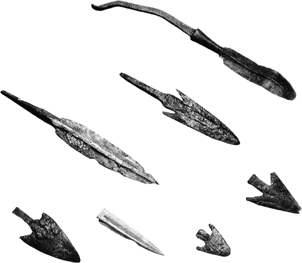
Arrow and spear heads (possibly Mycenaean) discovered outside the walls of Troy. 13th century BC.
So now let no man hurry to sail for home, not yet … not till he beds down with a faithful Trojan wife, payment in full for the groans and shocks of war we have borne for Helen.
Nestor, in Homer, Iliad1
THE GREEK VERB φρíσσω(phrisso) is an interesting one, the root of our word frisson. A useful word, it is flexible and while it can be interpreted in a number of ways it is always evocative. It is a word used by Homer in connection with Helen. In Troy we learn from her that πάυτεδ δέ με πεφρíkαιυ, ‘all around me cringe or bristle with fear’. Elsewhere she is ριγεδαυή Eλέυη, ‘Helen who makes you shudder’ or ‘makes you tremble’. She is sweet poison – both dreadful and delicious.2 And now that she has come to Troy, because Helen trails disaster in her wake, the plains of Troy too will bristle with arms. As Cassandra has predicted, as Zeus has planned, the Greeks want Helen back.
Homer paints a vivid picture of the boats, clustered up on the shore of the Bosphorus, row upon row, blackening the sand with their hulls until the beach below is submerged. The armies are like swarms of flies, seething over freshly collected milk.3Elsewhere in the Iliad he speaks of the fires around the new Greek camp glowing in the dark, and the men in their bivouacs, tense and expectant. And he imagines these soldiers rank with aggression. Listen to the first lines of the Iliad.
Rage – Goddess, sing the rage of Peleus’ son Achilles, murderous, doomed, that cost the Achaeans countless losses.4
Homer makes it clear from the outset of the epic that the Iliad is a story of hate as well as of love, of human lives adulterated by the maw of conflict. Furious passages in Book 1 describe two men jarring over a woman – not Menelaus and Paris over Helen, but ‘brilliant’ Achilles and Agamemnon ‘lord of men’ over Briseis ‘the girl with the sparkling eyes’. Agamemnon has already been filibustering about another girl, Chryseis. We do not hear much about Chryseis directly, but we are told that her father, the priest Chryses, loves her and is outraged that she is being used as Agamemnon’s whore. She has been dragged from the temple of Apollo and seems destined to become a spoil of war, as Agamemnon barks at Chryses:
The girl – I won’t give up the girl. Long before that, old age will overtake her in my house, in Argos, far from her fatherland, slaving back and forth at the loom, forced to share my bed!5
There are echoes of Helen’s fate, if we believe that she too is a woman forced to share the bed of a foreigner a long way from home. The lines also pre-echo the fate of the women of Troy, a fate described with sometimes unbearable brilliance by the tragedians Euripides and Aeschylus. Homer makes it clear to us that men will always use the possession of women to score points over one another. Agamemnon brags to Achilles that he will have another woman, Achilles’ Briseis: ‘So you can learn just how much greater I am than you.’ The Greeks are on Trojan soil and they are ready to punish all women, who, like Helen, weaken men by love. Ready to force open the gates of Troy and to force open the women protected by the city’s sloping walls.
As Homer fleshes out the narrative of the Trojan War, we come across a use of language that does not presume a dividing line between the lust for love and the lust for blood. Swords and rapiers stab at yielding bodies. The heroes seek satisfaction in slicing open their enemies’ flesh. Hector teases and intimidates Ajax: ‘My long spear will devour your white flesh.’6 Or, as Fagles puts it in his translation of the same line: ‘If you have the daring to stand against my heavy spear, its point will rip your soft warm skin to shreds!’7Suddenly, in the heat of battle, towering Ajax has become female: in Greek artistic and literary iconography it is usually women who boast soft, lily-white flesh.
Aphrodite’s lovers were Ares the god of War, and Hermes the guide of the dead.8 And so unfortunately for Paris and for Helen, where love travels, eris (discord or strife or deadly conflict) will follow. Helen’s is a gutsy love in pursuit of which much blood will be spilled. She is as deadly as she is delectable. When we talk about desire and death, sex and violence, we couple them because they are distinct, contra. But for the ancients these were close cousins, the malign progeny of unbridled nature, building blocks of the cosmos, creatures close to Chaos. Helen’s love was lethal. She is famous for inspiring men to fuck and to fight. Consequently we remember her, not as Helen of Sparta, but as Helen of Troy.9
The conflation of sex and violence in the Greek mind can be traced through the language. Both lovers and warriors can mingle together: meignymi. Damazo could mean to slaughter or rape or to seduce or subdue. Kredemna denotes either a city’s battlements or the veils of a woman. When Troy falls, both will be ripped and blasted – the thing they had hidden will be defiled and destroyed. Writers such as Thucydides and Euripides used the word eros in metaphors to describe the fever that roused men to fight. The Spartans sacrificed to the spirit of Eros before they went into battle.
It is little surprise that ‘much-desired’ Helen enters extant written record as spoil. We first hear about her in Book 2 of the Iliad where she is described both as ‘a trophy’ and as an instrument of destruction. The gods are gossiping. Hera is warning Athena that the Argives have lost hope and are sailing home:
… Inconceivable!/ … All the Argives flying home to their fatherland,/ sailing over the sea’s broad back? Leaving Priam/ and all the men of Troy a trophy to glory over,/ Helen of Argos, Helen for whom so many Argives/ lost their lives in Troy, far from native land.10
Helen’s casual introduction here into the plot of the Iliad demonstrates that Homer does not need to explain her origins, confident as he was that his audience was already familiar with a fuller Helen narrative. The poems of the Epic Cycle, written a hundred years or so after Homer, which tell of Helen’s earlier life, must have been echoes of older songs, lost now, that dealt in more detail with the tale of the Queen of Sparta.
When we meet Helen face to face in the Iliad, in Book 3, she is brought in to survey the men fighting for her on the plains of Troy. Priam, the great king who is about to see the pride of Greece crawling over his lands, slaughtering his men and enslaving his women, calls her over to watch: ‘Come over here, dear child. Sit in front of me … I don’t blame you’.11 So there is Helen, famous, beautiful and desired. A prize for Trojans and Greeks alike. She is watching men slug it out for her, just as they did twenty years before in the marriage contest arranged by her father. But now the bar has been raised as Anatolian heroes too have entered the fray. The need to possess the ultimate beauty will spur Greeks and Trojans alike to a ruthless odium.

Today it is still possible to stand on the citadel walls of Troy to look over the Scamander plain which does indeed stretch out beyond the ‘Scaean Gate’. Tourist guides promote a rag-bag of Trojan tales in an impressive array of languages as they shepherd their charges along the walls. Walking the ramparts, looking down over the ‘lower town’, now scrubland, with a copy of the Iliad in hand, the romantic can fancy, following Homer’s lead, the hungry, worn Trojans gathering to watch as Helen, a willing captive, was shown off to the assembled crowd. The displays were intended as morale-boosters, reminding the tired, benighted inhabitants why they had to endure such suffering and why, with such a prize at stake, it was still worth fighting this long and bloody war.
These showy personal appearances were designed to galvanise spirits, and they worked, even after years of privation and personal loss; the elders at Troy, according to Homer, declare that Helen’s radiance is indeed worth the disintegration of their lives. As she passes, the old men start to chatter; their voices rising and falling like cicadas.12 She has a face like a goddess they say. In a world where divine power could be malign or benign, that might be a terrible as well as a wonderful thing:
And catching sight of Helen moving along the ramparts, they murmured one to another, gentle, winged words: ‘Who on earth could blame them? Ah, no wonder the men of Troy and Argives under arms have suffered years of agony all for her, for such a woman, Beauty, terrible beauty!’13
As she passed along the ramparts of Troy, this is what a Bronze Age Helen would have seen. In the 13th century BC, there were five gateways, three of them massive, on the citadel at Hisarlik Hill, each providing access through the citadel walls – which were, in parts, 9m high. At some point these gates have been burnt to the ground. Watchtowers14 were built into the walls – remembered three thousand years later by Marlowe as ‘the topless towers of Ilium’.15 As at Mycenae, the aristocratic zone is terraced, and two-storeyed mansions surround a central ‘palace’. The streets of Troy, as Homer says, are walled and ‘well-laid’ – although three thousand years on, the broad, cracked flags buckle and bulge.
The excavations begun by Professor Korfmann in 1988 and subsequent magnetometer surveys of the site have delivered a more complete picture of the 13th-century BC city than was ever before available. The south-western ‘Scaean Gate’, operational until just after 1300 BC, was subsequently blocked up – the infill is still clearly visible. Just beyond the gated ramparts there is a marked concentration of small-scale finds (evidence of a busy shanty town at Troy’s walls) and then, further out still, south of the citadel, Troy’s lower town. The lower town (which Schliemann never found – dying before he could begin his planned excavations in 1891) has been shown to be protected by two ditches: one is 400m from the citadel, the other 500 m. Both ditches are U-shaped, cut straight out of the limestone bedrock and around 11½ feet (3.5 m) wide, 6½ feet (1.95 m) deep – almost certainly dug to protect against chariots – that ferocious weapon of the Late Bronze Age. The area, enclosed perhaps by palisades, is at least 270,000 square m (75 acres).16
With this discovery, the city of Troy has now been shown to have been large enough to accommodate anything between seven and ten thousand people. Here there are storage pits, pavements and cobbled streets, traces of figs and vines, and (interestingly) a fair amount of Mycenaean pottery – both imported and imitation; the Trojans clearly had a taste for Greek style.
Typical of other Anatolian fortress-towns of the time, Troy was indeed – as described by Homer – both a trading town and the seat of a royal family.17 And protecting those aristocrats and merchants, circling the citadel were great sloping walls, Homer’seuteikheion, ‘well-walled’ city. In the Iliad, Homer constructs a vivid scene where Achilles’ lover, the Greek hero Patroclus, tries four times to scale the ‘jutting walls’ of Troy. With gargantuan effort, the eager hero nearly succeeds.18 But this is a war between the gods as well as between men and eventually Patroclus is blasted back by the wrath of Apollo, the god worshipped with great piety at Troy, protecting the city that was dear to him.
Homer talks a good deal about Apollo’s love for Troy, and recently archaeologists have turned up a tantalising piece of evidence from the 13th century BC. 19 Across Turkey you will find giant carved ‘god-stones’ at door-ways and gateposts. The Bronze Age Anatolians believed that these megalithic blocks protected the spirits of their deities and spirits. God-stones have been excavated at Troy too – at the time of writing, seventeen have been found. An inscription on the Alaksandu treaty tells us that one of the ‘swear-gods’ particularly revered at Wilusa was a male god, Ap(p)aliunas. Homer makes it clear in the Iliad that the god Apollo was the pre-eminent deity in the city – is this another instance where he was right? Was Ap(p)aliunas, Apollo?
With its god-stones and sanctuaries, its stocks of weapons and mansions, its stores of fine perfumed cloth and its gold, its cosmopolitan population, in both the minds of the ancients, and in Bronze Age reality, Helen or no, Troy would certainly have been a city worth sacking.
The siege of Troy famously lasted for ten years. While looking for reminders of Helen from the classical world, I once travelled to Manchester in the north of England where a number of remarkable pieces are held by the University of Manchester Museum.20Here there is a finely painted black figure-skyphos (a deep wine-cup) from Attica, which speaks of the yawning stretch of years and the duller, drearier days of such a lengthy campaign. The heroes Achilles and Ajax are bent over a gaming board.21 The men are lost in the counters in front of them, enjoying their absorption in some-thing other than death and destruction. A mitigation from the tense tedium of a protracted – and perhaps pointless – campaign. In the quiet of the museum it is a tacit reminder of the gentler moments of any grand military campaign.
In reality it would have been impossible for the Trojans (or for any Late Bronze Age city) to endure a ten-year siege. The Mycenaeans too would have been entirely debilitated after camping out in the Troad for ten winters.22 But arrowheads and stores of sling-shot and burnt walls do show that Troy suffered sustained periods of attack in the Late Bronze Age. Throughout the second millennium BC the fortifications of the site are built with increasing vigour, and new archaeology reveals that the population of Troy would have had the wherewithal to withstand and survive shorter onslaughts. Homer talks about underground springs and rivers at Troy. Not only have references to ‘subterranean water channels’ been traced in the Hittite texts which describe Wilusa,23 but recent excavations24 have revealed Troy’s hidden strength, a concealed underground water channel – a ‘water-mine’ possibly built as early as 3000 BC. Up to 306 gallons (1,400 litres) of water still run through it every day.25
When I last visited, the place was easy to find. Reeds grow around it and one of the dogs that make the site their home will lead you there to have a quick drink from the oozing puddle outside the mouth of the channel, now barred by a metal grille. Behind the grille stretch four channels – one large, three small; the deepest is 100 metres long. Deep in the cave is a reservoir, the overflow caught in storage tanks. Although aesthetically uninspiring, this is a strangely moving spot. Perhaps these man-made water cisterns complemented the ‘washing pools’ that Homer describes close to the banks of the Scamander River (itself still ‘broad and sandy’) at Troy.26 Hearing the gentle splash of water one is reminded that whether or not this natural resource kept Helen alive, it would, over years of Trojan history, have saved the lives of many.
So what inspired those stories of a ten-year siege? A muscular Mycenaean presence on Trojan territory? An aggressive neighbour staking out a patch in a cosmopolitan little kingdom? Or maybe the story of the Trojan War is a conflation of any number of micro-conflicts suffered by those on the glittering crescent of coastal land around the Troad? Skirmishes over land and taxes and trading routes and slave labour, ugly little squabbles that become inflated into an epic event in the popular imagination? All interpretations are possible.27
What is certain is that in the 13th century BC and again c. 1180 BC, the Trojans experienced great perdition.28 Cracks in the citadel’s fortifications and massive rock-falls have been diagnosed as earthquake damage – fires followed.29 Could a natural disaster have sounded the death knell for a city already weakened by human agency? There are a few human skeletons from this period at Troy; all have been mutilated. By 1180 BC the ‘topless towers of Ilium’ were destroyed. Archaeology cannot yet give us the definitive cause of its destruction – but for over two and a half thousand years men have been swift to blame not fire, or earthquakes, or military ambition, but Helen.