
PART NINE

Previous page:
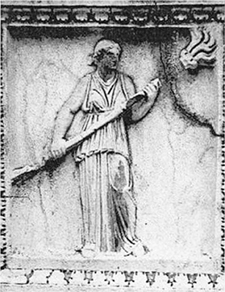
Carved marble relief showing Helen carrying a torch on the altar in the sanctuary of Lacus Juturnae in the Forum at Rome. Made during Trajan’s reign as emperor.

When the war ends, Helen resumes her place as a matter of course in the house of Menelaus. She bears it with unconstrained and perfect dignity; and her relations to her husband carry no mark of the woeful interval, except that its traces indelibly remain in her own penitential shame.
RIGHT HON. W.E. Gladstone, DCL, MP for the University of Oxford1
WAS IT THE CURVE OF HELEN’S NECK that stopped Menelaus’ steely blade? The gift of beauty, of kharis, the queen’s only shield? Was Menelaus simply overpowered by his old love for her? I suspect not. Whether he was the real bridegroom of a Mycenaean land-holder, or the mythical consort of a half-divine woman, the beautiful creature in front of him had superb connections. By aligning himself with Helen – and thanks only to that association – Menelaus is told on the journey home to Sparta that he has an opportunity for immortality:
But about your own destiny, Menelaus,/ dear to Zeus, it’s not for you to die/ and meet your fate in the stallion-land of Argos,/ no, the deathless ones will sweep you off to the world’s end, the Elysian Fields … /where life glides on in immortal ease for mortal man;/ … /All this because you are Helen’s husband now – the gods count you the son-in-law of Zeus.2
How could Menelaus have cut Helen’s throat as she cowered in a corner of Troy? He would have been slicing through his one connection to rich Lakonian lands, killing the only mortal daughter of Zeus, and denying himself the chance of an eternal life in the Elysian Fields. Where Helen leads, Menelaus follows.
The ancients imagined Helen’s return on the Spartan king’s boat to be, in some ways, as heady and as charged as her outward dash over a decade before with the Trojan prince; the royal couple had all those lost years to pick over. So much resentment, so many questions. Had she left her heart in Troy? Had the east changed her? Was she defiant, was she humbled? Was she raging, was she broken? Was she snaggle-toothed3 or stooped? Was she – as the tragedian Euripides asked in a rare comic aside – fat?
MENELAUS: She’ll be shipped aboard, Be cargoed home.
HECUBA: Not on your ship!
MENELAUS: Why not? She’s put on weight? 4
Fat or thin, termagant, defiant or burning with shame, at this point in the story, one would imagine that Helen – a dishonoured woman, ‘her hair scabbed with dead men’s blood’5 – is humiliated and dragged back to her homeland. Not so. Menelaus has dropped his sword. There are surprisingly few recriminations. It seems the adulteress is going to get off scot-free.
The reunited royals have time aplenty to kiss and make up because homeward bound, along with other Greek heroes, they are caught in a storm at Cape Malea and their boat is blown a long way off-course. So begins the difficult journey home for the heroes of Troy – recorded in detail in another fragmentary epic, the Nostoi (‘The Homecomings’). Homer, famously, charts Odysseus’ ten years of peregrinations on the high seas in his Odyssey. His wife Penelope has spent the duration of the Trojan War loyal to her husband, but her palace at Ithaca is overrun by voracious, opportunist suitors. Agamemnon is delayed by a storm and at the end of a grand feast to celebrate his homecoming, along with his Trojan concubine Cassandra, is murdered in his bath by his wife Clytemnestra and her lover Aigisthus.6 Diomedes’ wife too is faithless, his kingdom no longer his when he returns. Nestor makes his way back to Pylos safely to ‘grow rich and sleek in his old age at home’ but many – Ajax, Achilles and Patroclus – are now dust on the plains of Troy.7
Helen and Menelaus too have troubles ahead. Hostile winds take them to Gortyn on Crete and to Cyprus, Phoenicia, Ethiopia and Libya. Once again, within Homer’s poetry, Bronze Age trading routes are being tabulated. And for all authors – Homer, Stesichorus, Herodotus, Euripides, the anonymous composers of the Epic Cycle – the great, rich lands of Egypt ‘where the houses overflow with the greatest troves of treasure’8 are an important part of the royal couple’s journey home.9
When Herodotus chronicles the fact that the flesh-and-blood Helen stays in Egypt while the warriors fight for a phantom in Troy,10 he also reports that even here blood is shed – because her presence leads to a human sacrifice.11 Having left Troy and travelled up the river Nile to Memphis, Menelaus has discovered Helen in Egypt, and, impatient to get his (now blameless) wife back home, he tries to set sail. But the winds are against him. Furious, he sacrifices two native children, earning, as he does so, the enmity of Egypt and of its king, Proteus. The Spartan king and queen have to flee for their lives, getting as far as Libya where, for the outraged Egyptians, the trail then goes cold.12
Herodotus’ story is, of course, not the first time Helen has been associated with ritual murder. The most notorious sacrifice is of Iphigeneia, her niece (or her daughter, depending on the source), and the Delphic oracle too connects Helen to ritual death, making reference to a tenacious plague in Sparta: the solution, the annual sacrifice of high-born Spartan virgins. One year, it is Helen who is led to the altar stone. Just before the knife enters the flesh, an eagle swoops down and rips the weapon out of the priest’s hands, dropping it, point down, onto a heifer. From that moment on it is young cows rather than young girls that are lined up for the priests’ cold blade.13
Without hard evidence it has always been immensely difficult to judge whether human sacrifice was in fact a part of the Bronze Age experience.14 But on Crete, a staggering excavation appears to have exposed incontrovertible remnants of ritual murder. Just below Anemospilia (the ‘Cave of the Winds’), a half-hour drive inland from the capital Heraklion, there is a redolent site. When I first visited, retracing the literary Helen’s steps on the way back from Troy, I had to brush past tall grasses thick with herbs to reach the sanctuary.15 The Aegean stretches out beneath, the peak of Mount Juktas towers above.16 Here in the 1970s, four bodies were found – three men and one woman – all dating from around 1600 BC. Analysis of the human remains showed them all to be well built, well fed and well dressed: the elite of society. One man had been carrying a large bowl, a second had collapsed on the floor. Jugs filled with a viscous fluid stood nearby. The third man, aged about eighteen, was lying on an altar, with a bronze dagger laid across his chest. His feet had been bound and his body bled dry. Further forensic tests show that on the left-hand side his neck had been sliced through. The scene is so shocking that some scholars – quite rightly – have been careful to propose less sensational interpretations. But it is very hard to read this as anything other than the sacrifice of the young man.17
It is too simplistic to bring our 21st-century sensitivities to the idea of human sacrifice. A sacrifice means ‘to make something sacred’. For ordinary humans to become part of the divine stratosphere may have been perceived and experienced as a great honour, though an honour bestowed only in extremis. Helen’s story is an extreme one (her impact on the world around her both affirmed life and denied it) and I suspect this is why we find her name linked with a number of human sacrifice stories. In the minds of the Ancient Greeks, it was no surprise that Helen catalysed the ritual murder of her fellow men. After all, this was a woman who traded in blood as well as in beauty.
And yet, in Homer there is no scandal attached to Helen’s stay in Egypt, there are no untimely deaths. Instead the royal couple gather up stories and treasures to bring back with them to Sparta. Among the gifts lavished on Helen during her Egyptian sojourn is a golden spindle – a romantic, story-book prop if ever there was one. But real golden spindles have now been discovered in the graves of Anatolian women; one particularly fine example comes from Alaca Höyük in central Turkey. Whether or not ‘precious gifts: a golden spindle, a basket that ran on casters, solid silver polished off with rims of gold’18 were given to a Mycenaean queen, again we find that Homer is not fantasising, but itemising specific details of the Bronze Age past.19
So Helen is on her way home. And, according to Homer, once she lands back on Greek soil, she does so with impunity. Her Trojan husband is dead, his body burned on a Trojan funeral pyre; she is free to become a good Greek wife once again.20 In theOdysseywe find her back at Sparta, in the palace of her birth, relaxed and in control. She runs the household; she chats to guests; when Trojan War veterans arrive she pulls up a chair to listen to their tales and to add her own (note that it is Helen rather than Menelaus who initiates the storytelling session – a sign in Homeric society of the respect due to her); she impresses the assembled company by interpreting, correctly, an omen in the sky.21 She is reunited with her estranged daughter – as her niece Electra bitterly points out in Euripides’ play Orestes: ‘In her [Hermione] she takes her joy and forgets her troubles.’22 She seems fulfilled and content. It is, almost, as if nothing untoward had ever happened.
But beneath the surface there are hints of trouble. What Homer does, very skilfully, is to paint a picture of a woman who is both relaxed and wary, both resourceful and tricky. The royal couple are hosting a wedding party – Hermione is to marry the son of Achilles, and among their guests is Telemachus, the son of Odysseus. The palace is full. In jubilant mood, a bard plays on his lyre, ‘a pair of tumblers dashed and sprang, whirling in leaping handsprings, leading on the dance’.23 Helen enters this scene from her ‘scented, lofty chamber’ with a train of women. But when the feasting is over and the lights are low, the mood changes and thoughts turn to the pain and suffering of the last ten years. Tales told of dead heroes make the entire room weep inconsolably. Helen has the answer.24
Into the bowl in which their wine was mixed, she slipped a drug that had the power of robbing grief and anger of their sting and banishing all painful memories. No one who had swallowed this dissolved in wine could shed a single tear that day, even for the death of his mother and father, or if they put his brother or his own son to the sword and he were there to see it done.25
The drug was most likely opium – which, when mixed with alcohol becomes pure laudanum.26 There is no doubt that opium would have been used within palatial culture in the Late Bronze Age – and it was much loved by the Mycenaeans. As well as rock-crystal pins made in the shape of poppy seed-heads, Mycenaean women wore beads carved out of red carnelian representing poppy flowers27 and gold rings depicting orgiastic rites to which opium poppies were central.28 One of the goddesses found in Crete, dating from the Mycenaean occupation of the island, has a diadem made of woven poppy seedheads. This stiff, somnolent figure with her arms bent and palms facing out, flat on, has a glassy stare. The seedheads crowning her brow have been split open – the optimum moment for opium latex to be extracted. Homer tells us that nepenthes drugs were imported from Egypt – for the ancients, ‘made in Egypt’ implied top-grade medicinal goods.29 But forensic analysis shows that opium poppies, Papaver somniferum L., were home-grown in the Peloponnese in the Late Bronze Age. At Tiryns and at Kastanas opium poppy seeds have been recovered from excavation levels relating to the late 13th century BC. 30 As well as acting as an effective pain-killer Papaver somniferum L. has acute psychotropic effects.31
There is no doubt that a Mycenaean queen, with the privilege of rank, perhaps a high priestess, would have known how to use these powerful narcotics, just as the Homeric Helen does. Opium is a useful tool to heal wounds, both physical and psychological; it opens a path to dreams. Mixing her drugs, interpreting omens, captivating the assembled company, the Homeric Helen is both a sorceress and a salve, intoxicating to the last. Having stupefied her household, she puts away her golden spindle and her purple-tinted wool, to bed down with Menelaus: ‘Menelaus retired to chambers deep in his lofty house with Helen the pearl of women loosely gowned beside him.’ This is the last time we see Helen in the works of Homer.
While at Troy Homer tells us Helen embarked on an intricate tapestry – a never-ending creation that tolds the tales of heroes and of war. Now, it seems, the final stitch is completed, the running thread snipped. But this is a story destined to be reworked again and again; Helen’s prophecy in the Iliad, ‘On us the gods have sent an evil destiny, that we should be a singer’s theme for generations to come’, will be fulfilled. Helen might have completed her own epic work of fabrication back in Troy, but now there would be a whir and a clatter as others settled themselves at the loom to begin their own versions of the life of the Spartan Queen.
Our Homeric Helen may have sailed home to a warm welcome. The Helens that followed her centuries later described a bleaker route through history.