
The Constable is created duke and peer of France — Attitude of Diane de Poitiers towards Montmorency and the Guises — Ascendency of Diane over the King — The favourite is created Duchesse de Valentinois, and is presented with the Château of Chenonceaux — Description of her Château of Anet — Henri II at Anet — Devotion of Henri II for Diane — His letters to her — His obligations to her — Question of her sentiments towards him considered — Singular relations between Diane and Catherine: a ménàge à trois — Secret hatred of the Queen for the mistress — Obscure amours of the King — His liaison with Lady Fleming, governess of Mary Stuart — Birth of a son — Indiscretions of Lady Fleming, who is dismissed from Court — The animosity of Madame de Valentinois towards the Constable, whom she suspects of having encouraged her rival, causes her to throw her entire influence on the side of the Guises — Increased importance of the Guise brothers consequent on the death of the Duc Claude and the Cardinal Jean de Lorraine — They determine to force France into another war with Charles V
THE English alliance, which promised to strengthen very materially the position of France in Europe, since it could be directed equally against either the Papacy or the Empire, was, as we have seen, the work of the Constable, who had conducted the diplomacy of France with as much skill as he had her strategy. Henri II hastened to show his appreciation of his old friend's services, and, almost immediately after the signing of the marriage-treaty, letters-patent were issued erecting the Constable's barony of Montmorency into a duchy-peerage, the title to be transmissible to his daughters in the event of the failure of heirs male.
On the two important questions of foreign policy which had found Montmorency and the Guises in opposition — that of Italy in 1548 and that of England — the counsels of the Constable had prevailed, and, notwithstanding the credit which his rivals had secured by the betrothal of their niece to the heir to the throne, there can be little doubt that he would have continued to exercise the paramount influence in affairs of State if the Lorraine princes had not enjoyed the support of a powerful ally.
This ally was, of course, Diane de Poitiers, who, it will be remembered, from jealousy of the Constable, had encouraged the ambition of the Guises. That for four years Montmorency had been more than able to hold his own against so redoubtable a combination can only be explained by the supposition that Diane, true to her policy of holding the balance between the rival parties, had been unwilling to allow the Guises to become too powerful, and had therefore employed her influence somewhat sparingly on their behalf. For, with the years, Diane's influence over the King seemed to increase rather than diminish. "The person whom without doubt the King loves and prefers," writes the Venetian Ambassador in 1552, "is Madame de Valentinois. She is a woman of fifty-two. . . . He has loved her much; he loves her still, and she is his mistress,01 old though she is. Truth to tell, although she has never made use of cosmetics, and perhaps in virtue of the minute pains that she takes, she is very far from appearing as old as she is. She is a woman of intelligence, who has always been the King's inspiratrice, and has even assisted him with her purse when he was Dauphin. His Majesty regards himself as under a great obligation to her, and from the beginning of his reign has made her Duchesse de Valentinois and has given her what I have said, and gives to her still, and does in that and in all else everything that she wishes. She is informed of everything, and each day, as a rule, the King goes after dinner to see her and remains an hour and a half to discuss matters with her; and he tells her everything that happens."02
Honours and riches almost beyond the dreams of avarice were showered upon the King's favourite. Soon after his accession, Henri II presented her with the beautiful Château and estate of Chenonceaux, which had been ceded to the Crown by Antoine Bohier, in 1531, the pretext for the gift being the valuable services rendered the State by her deceased husband, Louis de Brézé;03 then, in October 1548, he created her Duchesse de Valentinois04 and gave her several estates near Montpellier; while gratifications from the Royal Treasury, gifts from the "good towns" which his Majesty honoured by solemn entries, the confiscated property of Protestants, fines extorted from the Jews, were being continually poured into her lap. All was grist that came to the mill, for she was one of the most rapacious of harpies, and those shapely white hands of hers were always itching to grasp whatever came within their reach.
Happily for the artists of her time, she had cultured tastes and spent lavishly for their gratification, and the wealth which flowed from all directions into her coffers was metamorphosed into arabesques, frescoes, statues, and paintings for the embellishment of her Norman home.
For, though the duchess — as we must now call her — several times entertained the Court at Chenonceaux, where she built a bridge across the Cher, laid out a beautiful Italian garden, and planted a labyrinth, Anet remained her favourite residence. It was no longer, however, the frowning mediaeval castle to which Louis de Brézé had taken his bride, and where François I had drafted the marriage-contract of the future Henri II and Catherine de' Medici, but the "paradise of Anet" — as the poet Joachim du Bellay styles it — a palace of enchantment, before the glories of which the residences of the Montespans, the Pompadours, and the Du Barrys, splendid as they appeared to their contemporaries, fade almost into insignificance. For Anet was — alas! it is almost a case ofIlium fuit— not only one of the masterpieces of French Renaissance architecture, but its decorations were of exquisite beauty and of a character to be found in no other building of the time. "Finding myself near the road to Anet," writes the Florentine Gabriello Simeoni, in his account of the journey he made through France in 1557, "I betook myself thither, for I have always been a virtuoso and eager to possess and behold all rare and exquisite things; and, without exaggeration, I came to the conclusion, after having seen everything, that the Golden House of Nero was not so costly or so beautiful."
Anet perished amid the vandalism of the Revolution, and nothing now remains of Diane's wonderful palace save the lines of the walls, part of one wing, and the chapel. But, thanks to the minute plans of the buildings published in 1579 by the Huguenot engraver, Du Cerceau, in his great work, les Plus excellents bastements de France, the few precious bits of sculpture which have been preserved, and several admirable modern monographs, of which the best is that by M. Pierre Roussel, himself a native of Anet,05 we are fortunately able to form some idea of what it must have been like in the heyday of its splendour.
Between 1545 and 1547, Diane acquired several properties adjoining Anet and caused the ancient buildings to be demolished; and in 1548 she commenced the construction of her new Château, which took four years to complete, while the decorations were not finished until 1554. The celebrated Philibert Delorme, who, many years later, designed the Tuileries for Catherine de' Medici, was entrusted with the architecture, in which he displayed all the resources of his art and of his inventive character; Jean Goujon, the French Phidia, of whom Diane had been one of the earliest patrons, was responsible for the most important sculptures, and embellished the château both inside and out with marvellous fountains, statues, bas-reliefs, and balustrades, while, finally, he created the great tomb of the duchess, which is said to have occupied him eleven years; Jean Cousin filled the windows with the stained glass which became celebrated under the name of grisaille d'Anet; Léonard Limosin, in collaboration with his brother Pierre, enriched the chapel with those exquisite plaques of the Twelve Apostles now in the Church of Saint-Pierre at Chartres; while there were beautifully coloured vases by Bernard Palissy, paintings by Primaticcio and Del Rosso, and chimney-pieces by Benvenuto Cellini.06
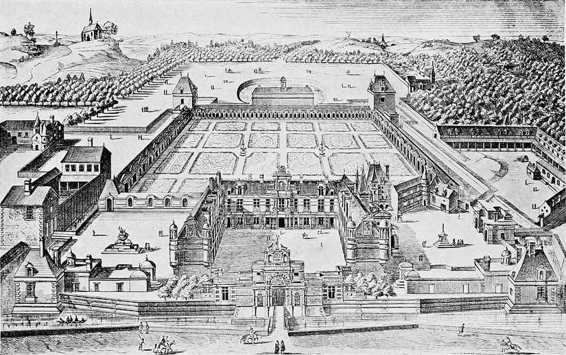
THE CHÂTEAU ANET IN 1550
AFTER A CONTEMPORARY PRINT
The home of all these treasures was, as will be gathered from a glance at the plans of Du Cerceau, of immense size. It occupied three sides of a square, the fourth being filled in by a richly-decorated gateway connected with the two side wings by buildings which gradually curved inwards from right to left. Those who entered beneath the centre gateway found themselves in the spacious cour d'honneur and immediately fronted by the principal facade, exactly opposite. "The grand portal of access," writes Lady Dilke, "was not, as at Écouen, put on one side of the court; it occupied the most imposing situation, precisely in the centre of the principal facade. There it towered upwards, heavy crescent-crowned, finding support right and left (after an interval spaced with ingenious skill) in the prominence given to the great dormers which surmounted the third columns of openings on either side. The grouping of the windows so as to form perpendicular shafts was a conspicuous feature of the design."07 A long colonnade ran entirely round the basement, the roof of which formed a balcony beneath the windows of the first story. To the right and left of the cour d'honneur, on which the inner windows looked, were other courts of even greater extent, known as the cour de Charles le Mauvais, and thecour de Gauche, in which was the orangery. Behind these three courts was a garden, divided into several compartments destined for the rarest flowers and plants of the time. This great garden, which was in the form of a square, was encompassed by a very beautiful open gallery, on the north side of which stood a vast salle de bains. Beyond it, an immense park extended to the coast. To the north-east of the cour de Charles, le Mauvais and the gardens were the stables; further to the north was the Hôtel Dieu, an infirmary for the sick servants and poor dependants of the châtelaine. The chapel had been ingeniously placed in the exterior angle, formed by the junction of the left wing with the remnant of the old château, which was remodelled and preserved in the new scheme for convenience sake. To the west of the cour de Gauche, just outside the wall of the garden, was a second chapel — a sepulchral one — which contained Diane's tomb. Behind it were the aviary and the heronry; the kennels were at the rear of the old fortress.08
Everywhere the interlaced monogram "H.D." met the eye: on the capitals of the columns, the frontals, the tops of the entablatures, the friezes, the pavements, the inlaid floors, the doors, the windows, the ceilings, the wainscots, the carpets, the tapestries, the plate, the crockery, and even the books in the library.09 Everywhere, too, the decorations recalled the story of the goddess whose name the duchess bore. Above the great gateway was a group representing the rash Actæon struggling with his hounds, the work of Goujon. The fountains playing in the side-courts were also embellished with the attributes of Diana, and the basin of that to the left was crowned by what is undoubtedly Goujon's masterpiece, if not the masterpiece of all French sculpture — the celebrated Diane chasseresse, now in the Louvre.
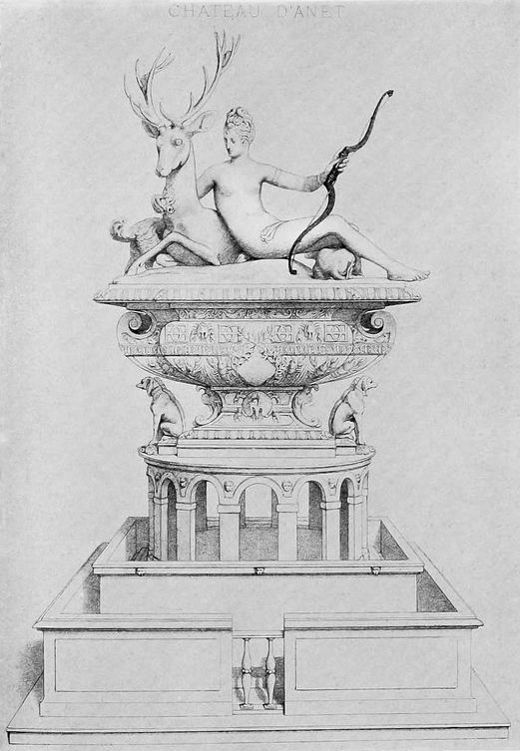
"DIANE CHASSERESSE"
FROM AN ENGRAVING AFTER THE STATUE BY JEAN GOUJON IN THE LOUVRE
The goddess is represented perfectly nude and in a semi-recumbent posture, with her two dogs (Procyon and Sirius) and a stag — around whose neck one arm is thrown, while in the other hand she holds her unstrung bow. "What pride, what gentleness in that pose!" exclaims La Ferrière. "To see the half-formed bosom, one would call her a young girl; but the body, in its full and robust contours, is certainly that of a woman in all her maturity. The true character of the beauty of Diane de Poitiers was strength and not delicacy. In deifying the mistress of the King, the great artist has remembered this."10
Henri II was as interested in the construction and decoration of Diane's fairy palace as the lady herself. "All that I did at Anet," wrote Philibert Delorme after Henri's death, "was by command of the late King, who was more anxious to learn what was being done there than in his own residence, and used to get angry with me if I did not go there often enough. All that I did there was for the King."11
Once Henri II had crossed the threshold of Anet, he was continually returning. He was at Anet in the first week of August 1550 — only a few days after Catherine de' Medici had given birth to the future Charles IX. It was from Anet that he set out, two months later, to make his "joyous and triumphant entry into his good town of Rouen," the splendours of which almost rivalled that of Lyons; and on his way back to Saint-Germain he paid it yet another visit. It was at Anet that, in March, 1552, he received the English Ambassador, Sir William Pickering, who describes it as "a wonderful fair and sumptuous house." Diane desired that Pickering should be shown all the splendours of her palace, with which the Ambassador was duly impressed. "Madame de Valentinois commanded that collation (as they term it) should be prepared for me in a gallery, and that afterwards I should see all the commodities of the house, which were so sumptuous and prince-like as ever I saw."12 In 1555, the King was twice at Anet; in fact, not a year seems to have passed without the Château being honoured by one or more royal visits.
That Henri II loved Diane de Poitiers and loved her with a deep and enduring devotion to which the annals of royal amours afford no parallel, is beyond dispute. It is attested by the favours and honours heaped upon her, by the immense influence which she enjoyed, by the testimony of a score of trustworthy witnesses, and, if any further proof is needed, we may find it in the few letters of the King to his mistress — all signed with the famous monogram — which are preserved in the Bibliothèque Nationale.
What a depth and sincerity of affection, what tenderness, what respect, do they reveal!
"Mamye," he writes to her from Fontainebleau,13 "I beg you to send me news of your health, because of the distress with which I have heard of your illness, and so that I may govern my movements in accordance with your condition. For, if your illness continues, I should not wish to fail to come and see you, to endeavour to be of service to you, and also because it would be impossible for me to live so long without seeing you. And, since I did not fear, in time past, to lose the good graces of the late King, in order to remain near you, I should scarcely complain of the trouble that I might have in rendering you any service, and I assure you that I shall not be at my ease until the bearer of this returns. Wherefore, I entreat you to send me a true account of the state of your health and to inform me when you will be able to start. I believe that you can understand the little pleasure that I experience at Fontainebleau without seeing you, for, being far from her upon whom all my welfare depends, it is very hard for me to be happy. With which I will conclude this letter, from fear that it will be too long, and will weary you to read it, and will present my humble recommendation to your good graces, as to that which I desire ever to retain. —  ."
."
And, after receiving the anxiously-awaited letter:
"Madame mamye, — I thank you very humbly for taking the trouble to send me news of yourself, which is the thing most pleasing to me on earth, and entreat you to keep your promise to me, for I cannot live without you, and if you knew the little enjoyment that I find here, you would pity me. I shall not write you a longer letter, save to assure you that you cannot come as soon as is the wish of him who remains for ever your very humble servant, ."
And here are two letters written from the army, the first; during the Alsace campaign of 1552, the second during the Flemish campaign six years later:
"VALDERSEN (?), May, 1552
"Madame mamye, — I shall not write you a long letter, having fully informed the bearer of this, and also because I have not the leisure, since I find myself on the point of marching to pass the River Sarre. I beg you to believe that my army is splendid,14 and animated by an excellent spirit; and I am confident that, if it is intended to dispute the passage, Our Lord will aid me by His grace, as He did at the first. I shall not tell you anything else, but remit all to Monsieur d'Aranson, who is presently returning; nevertheless, I entreat you to keep in your remembrance him who has known only one God and one friend, and to assure you that you will never be ashamed of having given me the name of servant, which I entreat you to keep for me for ever. ."
"PIERREPOINT (?), August 13, 1558
"Madame, — I received yesterday, by Laménardyère, the letter which you have written me, and also the chemises of Our Lady of Chartres.15 They could not have arrived at a more opportune moment, for I intend setting off the day after to-morrow, in the expectation of reaching Mondidier in the middle of August, where I hope to put myself into such condition that I shall prove myself worthy to wear the scarf which you have sent me. I shall not write you anything about our enemies or my camp, as I have charged the bearer of this to inform you of that; and nothing remains for me save to tell you that I am sending Laménardyère back . . . and to entreat you always to keep in remembrance him who has never loved, nor will love, any one but you — . I beg you,mamye, to be willing to wear this ring for the love of me."
On one occasion, his Majesty breaks into poetry, for, in common with many other princes of the sixteenth century, he had quite a pretty turn for verse-making:
"Hellas, mon dyu, combyen je regrète
Le tans qui j'é pertu an ma jeunesse;
Combyen de foys je me fuys fouèté
Avoyr Dyane pour ma seul mestrèse;
Mès je cregnoys qu'èle, quy est déese,
Ne se voulut abèser juques là
De fayre cas de moy, quy fa[n] sela
N'avoys plésyr, joye, ny contantement
Juques à l'eure que se délybèra
Que j'obéyse à son coumandemant.
Elle, voyant s'aprocher mon départ,
M'a dyt: Amy, pour m'outer de langeur,
Au départyr las! layse moy ton ceur
Au lyu du myen, où nul que toy n'a part.
Quant j'apersoys mon partemant soudyn,
Et que je lèse se qui tant estymè,
Je la suplye de vouloyr douner,
Pour grant faveur, de luy béser la myn.
Et sy luy dys ancores daventege
Que la suplye de byen se souvenyr
Qui n'aie joye juques au revenyr,
Tant que je voye son hounête vysage.
Lors je pouré dyre sertènemant
Que, moy quy fuys sûr de sa bonne grâse,
J'aroys grant tort prouchaser otre plaser,
Car j'an refoys trop de contantement."16
To which the lady replies:
Adieu délices de mon cœur!
Adieu mon maistre & mon seigneur!
Adieu vrai estocq de noblesse!
. . . . .
Adieu plusieurs royaux bancquetz!
Adieu epicurieulx metz!
Adieu magnifiques festins!
Adieu doulx baisers coulombins!
Adieu ce qu'en secret saisons
Quant entre nous deulx nous jouons!
Adieu, adieu, qui mon cœur ayme!
Adieu, lyesse souveraine!
Lorenzo Contarini wrote that Henri II regarded himself as under a great obligation to Diane. He had reason to. What kingly qualities he possessed he undoubtedly owed to her influence and counsel. She had found him a timid, taciturn, awkward young prince, and she had moulded him into a dignified, gracious, and tactful monarch, who as an "actor of royalty" could compare favourably with any sovereign in Europe. The process, it is true, had been a very gradual one, and there must have been times when Diane may well have despaired of making anything of her pupil, for however much he might unbend in her society, he, for some years, continued to show to the world the melancholy side of his character; but she persevered, and by the time Henri ascended the throne her labours had been rewarded.
There were still moments, as on the occasion of the duel of Jarnac and La Châtaigneraie, when, confronted by some unexpected emergency involving an instant decision, the King's somewhat sluggish intellect might be unequal to the demands made upon it. But such were fortunately of very rare occurrence, and in the everyday matters which called for his personal attention — questions of Court etiquette and the like — Henri, thanks to the counsels of his Mentor, seems to have shown a commendable sagacity.
If no uncertainty exists as to the nature of Henri II's feelings for Diane, her attitude towards him is not so easy to define. Did she reciprocate his devotion? Was their connection really that "happy marriage," that true union of souls, which some writers believe?
We should naturally hope to find an answer in her correspondence, but, though many letters of Diane have been preserved, not a single one addressed to Henri II is to be found among them, if we except the verses already cited. Nor is their total disappearance difficult to explain. It was then the rule to burn all private letters of importance, and, though, fortunately for the student of French society in the sixteenth century, this custom was by no means always observed, the ladies of the time almost invariably insisted on the destruction of their love-letters, and their adorers, however painful the sacrifice might be to them, felt bound in honour to obey, saying with Marot:
"Car j'ayme mieux deuil en obeyssant
Que tout plaisir en desobeyssant."
Diane had more interest than any one in the destruction of her billets-doux, since, if they could not tell the Queen more than she knew already,17 they might become, at some future time, in Catherine's hands, very formidable weapons against the favourite. In consequence, the duchess had no doubt impressed upon the King the importance of burning her letters as soon as he received them, and the King, like a zealous and obedient cavalier, had not failed to comply with her wishes.18
But, if these interesting epistles have disappeared, we have a number of other letters from Diane's pen which afford a valuable index to her character, and we may well ask ourselves whether, in the life of the unemotional, shrewd, matter-of-fact woman which they reveal to us, there could have been any room for a grande passion. Love of a kind there no doubt was, but it was the love of the mother for the son, of the teacher for the pupil, rather than that of the mistress for the gallant.
Interesting as are the relations between Henri II and Diane, the attitude of the mistress and the injured wife towards one another is not less so. On the death of François I, Catherine would appear to have attempted some remonstrance with her husband on the error of his ways; but she very soon perceived the necessity of accepting the situation. "At the opening of the reign," writes Contarini in 1552, "the Queen was unable to endure such love and favour on the part of the King for the duchess; but later, by reason of the urgent prayers of the King, she became resigned, and now she supports it with patience. The Queen is continually in the company of the duchess, who, on her side, renders her excellent services in gaining her the King's good opinion, and often it is she who exhorts him to go and pass the night with the Queen."19
What a picture! The servility, the moral abasement, of the courtiers, who so humbly solicit Diane's good offices; of the artists, who multiply allegorical allusions to the object of the King's devotion; of the towns, which mingle the name of the mistress with their protestations of fidelity, and cover their triumphal arches with the famous monogram, extends to the royal ménage itself! "Diane," writes Guiffrey, "has penetrated so far into the intimacy of the august couple that she forms, so to speak, the apex of the conjugal triangle and completes its harmony. Her influence extends even to the alcove, of which she has little by little constituted herself the sovereign arbiter. It is owing to her that the King loves the Queen. It is owing to her that he decides to fulfil the duties of a husband. At night, she urges him towards that couch to which no desire draws him. And perhaps Catherine de' Medici should owe some gratitude to Diane de Poitiers for this odious intervention, since it is thus that she will be able to become the mother of a whole line of kings."
Shocking as this species of family compact appears to modern ideas, it was not so regarded then. It was the age of platonic chivalry — the age which took for its models the heroes and heroines of the "Amadis of Gaul" — when a man was permitted to have a "lady of his thoughts," without it being considered in any way inconsistent with the most rigorous observance of his marriage vows. This idol of the heart was, in theory, of course, merely the inspiratrice of the most generous thoughts and the most noble actions; he wore her colours, broke lances in the lists in her honour, addressed her in the most ceremonious language, and called himself her servant. In point of fact, the inspiratrice was often a good deal more; but it was a serviceable fiction, which paved the way for many attachments which would otherwise have been impossible, or, at least, have been the cause of much scandal.
Both Henri II and Diane were fervent admirers of these high-flown ideas — two volumes of the French version of the "Amadis" were dedicated to the latter — and, though no one was deceived thereby, least of all the Queen, they to the end appear to have pretended that the bond between them was merely that which custom had sanctioned. Thus it was that cardinals and bishops could without embarrassment enrol themselves among the courtiers of the favourites. Thus it was that Catherine was able to accept without a blush the "excellent services" of her husband's mistress.
But if Catherine succeeded in schooling herself to complaisance; if, after that attempt at remonstrance to which Contarini refers, she strove to hide her feelings from all but a few intimate friends; if she continued to behave as though her society were necessary to her husband, "following him as much as she could, without a thought of fatigue," there can be no doubt that she suffered bitterly and hated bitterly. "If I made good cheer for Madame de Valentinois," she wrote many years later, "it was the King that I was really entertaining, and besides, I always gave him to understand that I was acting sorely against the grain; for never did woman who loved her husband succeed in loving his mistress."20
Notwithstanding the devotion of Henri II to Diane, it must not be supposed that he was altogether proof against the wiles of the many light beauties who frequented the Court. "The King Henri," writes Brantôme, "used to love good stories as much as his predecessors did, but he was unwilling that the ladies should be put to shame by them; so much so that he used to visit them in the most secret manner possible, in order that they might escape suspicion and scandal. And if there were one who was discovered, it was not his fault, but rather the lady's."
Of these obscure amours at which the historian hints, only two have come down to us: one was that of the Piedmontese beauty who became the mother of Diane de France; the other we shall now relate.
We have mentioned among the suite which accompanied the little Queen of Scotland to France a certain Janet Stuart, Lady Fleming, a natural daughter of James IV, who filled the post of governess to her youthful Majesty. Lady Fleming was no longer young — in fact, at the time of her arrival in France she must have been at least thirty-eight, and she had presented her husband, who had fallen on the field of Pinkie, with five sons and two daughters, the elder of the girls being one of the young Queen's "four Maries." But, like Diane, she had discovered the secret of preserving her charms, for, two months after Mary Stuart's arrival at Saint-Germain, we find Artus de Brézé assuring the Queen-Dowager of Scotland that "she had sent a lady hither with the Queen, her daughter, who had pleased all the company as much as the six most comely women of this kingdom could have done. For my part, I would not for the world have had her absent, having regard not only to the service of the Queen, but to the reputation of the kingdom — I mean Madame de flamy (sic)."21
It is probable that by "all this company" the discreet diplomatist intended his royal correspondent to understand the King; and, any way, by the summer of the following year, his Majesty's own correspondence with Marie de Guise shows him to be taking a most suspicious interest in the lady in question:
"MADAME MY GOOD SISTER, — I believe that you appreciate sufficiently the care, pains, and great vigilance which my cousin the dame de Flamyn (sic) always displays about the person of our little daughter, the Queen of Scotland. The really good, virtuous, and honourable manner in which she performs her duties in this respect makes it only reasonable that you and I should continually bear in mind her children and her family. She has been lamenting to me that one of her sons is still a prisoner in England, and I desire to lend a helping hand to obtain his liberation; but, situated as I am at present, it is not easy for me to accomplish this. It appears to me, Madame my good sister, that you ought to write and request, if you have the means of doing so, to have him exchanged for some English prisoner. This would be doing a good work, and for a person who deserves it. And I pray God, Madame, to have you in His holy and worthy keeping. Written at Paris, the xxvi day of June MDXLIX.
"Your good brother,
"HENRI"
A month later (July 25), the King again writes to Marie de Guise, to inform her that a certain Captain Achaux Jay, lately returned to France, has surrendered to him "the right which he claims over mestre Vbilfort (sic), English prisoner in Scotland," and to beg her to effect an exchange between the Englishman and the son of Lady Fleming, whom he was very anxious to reward "for the good and agreeable services which she renders about the person of our little daughter the Queen of Scotland."22
The good and agreeable services of Lady Fleming were not confined to her royal mistress, and towards the end of 1550 she found herself in an interesting condition. All might have been well with her had she but observed the discretion which so delicate a situation demanded; but, "instead of keeping a closed mouth," she was so ill-advised as actually to boast about it. "God be thanked!" said she, in her broken French, "I am with child by the King, and I feel very honoured and very happy about it," adding that the royal blood must certainly contain some magical properties, since she found herself in such excellent health.23
These rash words were duly reported to Madame de Valentinois, who was, of course, well aware of what had been going on. Diane might have been disposed to pardon an infidelity in which the senses of her royal lover had probably been far more concerned than his heart; but she felt that it was impossible for her to ignore so public a scandal, so impudent an invasion of her prerogatives. She and Catherine united to get rid of this mistress of the moment, and made things so unpleasant for his Majesty that he was glad enough to make his peace with them by the sacrifice of his Scottish inamorata, of whom he had perhaps already grown weary. And so Lady Fleming was deprived of her post of governess to Mary Stuart, and banished from the Court,24 though it was not until 1555 that she returned to Scotland, where she appears to have passed the rest of her life at Boghall Castle, which had been left to her by her husband.25 The fruit of her liaison with the King — a boy — was named after his royal father, and is known to history as the Bastard d'Angoulême. He was created Grand Prior of France, wrote some very commendable verses, played a particularly odious rôle in the St. Bartholomew, the horrors of which he subsequently endeavoured to revive, and was finally killed by a Huguenot gentleman in a duel, at Aix, in 1586.
This affair, ignored by many historians, nevertheless entailed consequences of the first importance. Hitherto, as we have said, Madame de Valentinois would appear to have employed her influence somewhat sparingly on behalf of the Guises, with the result that the Constable still continued to dominate the policy of France. But, rightly or wrongly, Diane believed that, out of jealousy of her ascendency over the King, Montmorency had encouraged the amorous relations of his Majesty and Lady Fleming, in the hope that the latter might succeed in supplanting her in the royal favour. This conviction exasperated Diane to the last degree; the smouldering antagonism between her and the Constable leaped into flame; and her entire influence was henceforth thrown on to the side of the Guises.
"There was a moment," writes the omniscient Contarini, "when the Court asked itself which of the two the King loved the most — the Constable or Madame de Valentinois — but now it is known, by many signs, that Madame is the best beloved . . . for the attachment which the King entertains for the Constable may be dependent on the need which he has of him, while that which he feels for the duchess can proceed from no other source than the most lively passion. I say this, because, to the King's great displeasure, these two personages, the Constable and Madame, are now declared enemies. This hostility began three years ago, but it only broke forth openly last year, when the duchess perceived that the Constable had plotted to divert the King from the passion he had for her, by making him fall in love with the governess of the little Queen of Scotland, a very pretty little woman. The affair, indeed, went so far that this governess became with child by the King. Madame complained bitterly of this; the King had to offer many apologies for it, and for a long time the Constable and Madame were not even on speaking terms. At length, at his Majesty's entreaty, they made a semblance of a peace, but at bottom their hatred is as bitter as ever. Hence have arisen the two parties which are like two factions at the Court, and he who draws near to one knows assuredly that he must expect nothing but hostility from the other."26
The death of Duc Claude and of his brother, the Cardinal Jean, in the spring of 1550, had left the direction of the Guise family to François, Duc d'Aumale, who immediately assumed his father's title of Duc de Guise; while Charles, Cardinal de Guise, took that of his uncle — Cardinal de Lorraine — and Diane's son-in-law, Claude, Marquis de Mayenne, became Duc d'Aumale and peer of France. The brothers shared the other dignities between them. To François fell the offices of Grand Huntsman and Grand Chamberlain of France, with the governments of Dauphine and Savoy; to the second Cardinal de Lorraine the innumerable benefices of the first, and to Claude the government of Burgundy.
These changes greatly increased the importance of the two elder brothers, and with it their arrogance. Because Lizet, the First President of the Parlement of Paris, refused to recognise their princely quality, on the ground that the body of which he was the head recognised no princes in France save the Valois and the Bourbons, they insisted on his dismissal, and replaced him by a creature of their own, Le Maistre, who was later to distinguish himself by his persecution of the Huguenots. They next attacked the Chancellor Olivier, and, on the plea that his health was no longer equal to the discharge of his duties, he, too, was removed, though he was allowed to retain the title. Flushed with success and assured of the full support of Madame de Valentinois, they now determined to seek a revenge for the Constable's military and diplomatic successes by forcing France into another war with Charles V.
Notes
(1) The phrase in the original is too coarse to permit of a literal translation.
(2) Lorenzo Contarini to the Senate, in Armand Baschet.
(3) "Services which it had remained for Henri II to discover and reward," observes Mr. T. A. Cook, in his charming book on the Châteaux of Touraine, But Mr. Cook forgets the very real service which Louis de Brézé had rendered to the Crown in the discovery of Bourbon's conspiracy.
(4) The seigneurie of Valentinois, which was originally a simple county, had already belonged to the seigneurs of Poitiers. Louis de Poitiers had ceded it to Charles VII, then Dauphin, and Louis XII had erected it into a duchy for the benefit of Cæsar Borgia, whom, however, he subsequently deprived of it, to punish him for having allied himself with the enemies of France. Diane had persuaded François I to restore to her the usufruct of the duchy, but she was not able to obtain the title until the accession of Henri II.
(5) Histoire et description du Château d'Anet (Anet, 1875).
(6) Roussel, Histoire et description du Château d'Anet; Miss Hay, "Madame Dame Dianne de Poytiers."
(7) "The Renaissance of Art in France."
(8) Roussel, Histoire et description du Château d'Anet; Lady Dilke, "The Renaissance of Art in France."
(9) "Diane had collected at Anet a very rare collection of books on the chase. The most remarkable of all is 'The Chase' of Oppian, in the original Greek, which had been copied in its entirety by Ange Vergèce, a celebrated Hellenist of the time. Diane has caused it to be bound in one of those mosaic bindings, whose compartments, skilfully combined, cross and intersect one another with an infinite grace. Grolier first, then Catherine, had introduced the type from Italy. On the face of the book Diane has placed, with a kind of pride, the three golden fleurs-de-lis, flanked on either side by the crowned 'H' and her initial interlaced with that of Henri II. On the reverse of the book, in an oval medallion, she has caused herself to be represented under the traits of Diana of mythology. Attired in a simple Greek tunic, short enough to allow one to perceive the cothurnus, the arms bare, the quiver on her shoulder, the softest blond hair massed on her head and surmounted by a crescent, she holds in hand a beautiful white greyhound with a golden collar round its neck, and follows with her glance a stag which flees in the distance. It is a happy reduction of the portraits of Primaticcio." — La Ferrière, Les Grandes chasses au XVIe siècle.
(10)Les Grandes chasses au XVIe siècle.
(11) Cited by La Ferrière.
(12) Pickering to the Council, March 22, 1552, "State Papers (Foreign), Edward VI."
(13) This and the following letter are undated, but they probably belong to the autumn of 1547.
(14)See p. 272 infra.
(15) The cathedral at Chartres possessed a chemise, supposed to have belonged to the Virgin, which had been brought from Constantinople in the ninth century and presented to the church by Charles-le-Chauve. This miraculous relic was credited with having assured the safety of the town on several occasions when besieged by enemies, and, by a natural consequence, those who wore metal representations of it were preserved from dangers in war. They were sold at Chartres, and Diane had sent thither to procure some for the King.
(16) "These verses," observes Guiffrey, "are entirely in the handwriting of Henri II. The form of the letters, the erasures which accompany them, can leave no doubt as to their authenticity; they are certainly the work of the King, and no Court poet appears to have had a hand in them. It is probable that they were neither the first nor the last of the royal poet, but if any other exist, they have escaped our researches. As the epoch of their composition, we should be disposed to take the year 1552. In fact, Henri II speaks in these verses of regrets for the time lost in his youth, before possessing the desired mistress. He must then have been already of a certain age. Further, the liberty with which he expresses himself authorises the belief that he was King and freed from the impediments which his father had placed in the way of his first inclinations. Finally, the departure to which he alludes is quite consistent with the year 1552. It is, in fact, the date of his triumphal promenade across Alsace and his bellicose attempts against the duchy of Luxembourg."
(17) If we are to believe Brantôme, Catherine had caused a hole to be bored in the floor of her apartments at Saint-Germain, which were immediately above those of Diane, so that she might see and hear what went on below.
(18) Guiffrey, Lettres inédites de Dianne de Poytiers.
(19) La Diplomatie vénitienne.
(20) Catherine de' Medici to Bellièvre. April 25, 1584, La Ferrière, Lettres de Catherine de Médicis.
(21) Balcarres MSS., published by Miss J. T. Stoddart, "The Girlhood of Mary Queen of Scots."
(22) Balcarres MSS., published in Maitland Club "Miscellany," 1834.
(23) Brantôme.
(24) Catherine de' Medici makes an interesting reference to this affair in a letter which she wrote in 1582 to her son-in-law, Henri of Navarre, to remonstrate with him at the indignation he had displayed over Queen Margot's dismissal of his mistress, la belle Fosseuse (Françoise de Montmorency) from her service. (For a full account of the Fosseuse scandal and the singular part played therein by Marguerite de Valois, see the author's "Queen Margot" (London, Harper; New York, Scribner, 1906.) "My son," she writes, "I was never in my life so astounded as when I heard the words which Frontenac has been repeating everywhere as being those which you ordered him to convey to your wife. I should never have believed that this was true, if he had not himself assured me of the fact. . . You are not, I am aware, the first husband who is young and of little prudence in such matters, but I believe that you are the first, and the only one, who, after an affair of this nature, would venture on such language to his wife. I had the honour of marrying the King, my lord and your sovereign, but the thing which annoyed him the most in the world was to discover that I had heard news of this kind; and when Madame de Flamin (sic) was with child, he considered it very fitting that she should be sent away, and never showed any temper, nor spoke an angry word, about it. As for Madame de Valentinois, she, like Madame d'Étampes, behaved in a perfectly honourable manner; but when there were any who made a noise and a scandal, he would have been very displeased had I kept them near me." — La Ferrière, Lettres de Catherine de Médicis.
(25) W. Hunter, "Biggar and the House of Fleming" (1862). This ingenuous historian has some observations on Lady Fleming's French experiences, which, in view of the evidence before us, are distinctly entertaining: "Lady Fleming was much respected and caressed at the French Court. The attentions paid her gave a handle to the English Ambassador to make an attempt to injure her reputation, by alleging, in a letter he sent to the English Council, that an improper intimacy existed between her and the French King. The story appears to have been a mere fabrication, got up for the purpose of gratifying certain parties in England. It is certain, however, that Henri II, King of France, held Lady Fleming in very high estimation."
(26) La Diplomatie vénitienne.